




Abstract
This article examines who volunteers for humanitarian organizations as compared to volunteering for other organizations versus people not volunteering, in the Netherlands. Using high-quality survey data (N = 5,050), we depart from a classic theoretical resource-based approach to study what forms of resources play a role in the likelihood to volunteer for different types of civic associations. We find that education and subjective health as indicators of human capital matter in volunteering for most types of associations, however, more so for humanitarian organizations than some other types of organizations. Social capital is of larger importance in volunteering for leisure organizations than for humanitarian ones, while cultural capital is relevant for volunteering but not more for humanitarian associations. Some forms of capital are thus stronger related to particular organizations, showing the different demographic compositions of the distinguished associations. We recommend to be more sensitive in distinguishing explanations of volunteering for different associations.
With the crisis in Syria also, the Netherlands received relatively many refugees from Syria from 2014 onwards. Next to a response of protest to the arrival of asylum seekers, a vast response of volunteer initiatives was triggered wanting to assist these newcomers (Pries, 2019; Van der Veer, 2020). “During the decisive period of the second half of 2015 and in 2016 it was mainly volunteers [. . .] that engaged in receiving, welcoming and taking care of the new arrivals” (Pries, 2019, p. 2). As waves of asylum immigration continue to persist, all the more evidenced by the recent refugee crisis in Ukraine—and with the prediction that in 2050, the share of immigrants and refugees in Dutch society will have further increased (cf. De Beer et al., 2020)—it is relevant to get an understanding of volunteering for humanitarian organizations. Therefore, this study elaborates on who volunteers for humanitarian organizations, compared to volunteering for other associations versus people not volunteering in the Netherlands.
Volunteering is defined as “unpaid work, without any obligations, for the benefit of others and/or society” (Ellemers & Boezeman, 2010, p. 245). The domain of volunteering is characterized as civil society, constituting numerous civic associations (Dekker, 2002). However, three types of overarching civic associations according to their primary goals can be distinguished: activist organizations, interest organizations, and leisure organizations (Gesthuizen et al., 2013; Van der Meer et al., 2009). We are, however, primarily interested in humanitarian organizations. These associations for humanitarian aid, human rights, minorities, and migrants are subsumed under activist organizations. Also environmental associations are part of this type of organizations. These organizations primarily serve broader interests in society that in general do not directly benefit the socio-economic interests of their members (Lelieveldt et al., 2007). In contrast, leisure organizations, like sports clubs and cultural associations, offer recreational and socializing activities. Interest organizations, as trade unions, business, or consumer associations, defend and represent socio-economic interests of their stakeholders (Gesthuizen et al., 2013). Moreover, we include religious associations, political parties, and other associations that encompass other types of civic organizations. It is theorized that civil society has benefits for social cohesion (Putnam, 2000). Volunteering for humanitarian organizations in particular may contribute to social cohesion in society. These volunteers may offer a bridging function for newcomers in helping them to connect to local communities and activities. Moreover, they may be middlemen in dealing with negative reactions that often follow upon arrival of newcomers. Humanitarian organizations may thus build bridges between the in-group majority in society and an out-group of newcomers (cf. Granovetter, 1985). Humanitarian organizations distinguish themselves from other associations, where volunteering usually takes place within, or for the benefit of, the in-group. Consequently, volunteering for humanitarian organizations may contribute to the development of resilient societies. Therefore, it is relevant to get an understanding of who volunteers for humanitarian organizations specifically. Hence, the research question is as follows: What are the socio-structural determinants of those who volunteer for humanitarian organizations in 2019, compared to those who volunteer for other civic associations versus people not volunteering?
This fills a lacuna, as there exists little research that focuses on exploring who volunteers in humanitarian organizations. To answer our research question, we systematically build on a classic theoretical framework, enriched with other theoretical insights comprising an extensive and coherent set of determinants of volunteering (Wilson & Musick, 1997). Moreover, we take advantage of recent, high-quality data, containing elaborate valid measurements on volunteering as well as on socio-structural determinants in a large representative sample of Dutch people (Scherpenzeel, 2009). In addition, we provide information for humanitarian organizations on which individuals can be attracted to volunteer for them. In doing so, we add to recruiting strategies and policies that encourage volunteering in humanitarian organizations.
Theoretical Background
Resources in Volunteering
Our theoretical framework departs from a resource-based approach. The crucial proposition is that the likelihood to volunteer is dependent on a number of resources. This proposition is derived from the classic work of Wilson and Musick (1997). Their integrated theory of volunteer work builds on four premises, related to different forms of capital. The following three of these premises are relevant for this article: (a) Volunteer work is productive work that requires human capital, (b) volunteer work is collective behavior that requires social capital, and (c) Volunteer work is ethically guided work that requires cultural capital. Wilson and Musick (1997) showed convincing evidence that human, social, and cultural capital are relevant resources for effective volunteering, also relevant for other countries (e.g., Bekkers, 2006). As these capital forms are unequally distributed in society, the likelihood to volunteer is unequally divided as well. In applying Wilson and Musick’s theoretical framework on the likelihood to volunteer for humanitarian organizations—compared to other types of organizations versus people not volunteering—we use this classic theory to unravel which capital forms play a role in the likelihood to volunteer for different types of civic associations in the Netherlands, acknowledging that some of the indicators can cover more than one form of capital at the same time. We thus use generic insights derived from Wilson and Musick (1997) and specify these to humanitarian organizations.
Human Capital
Comparable to the labor market, there is a market for voluntary labor. It is like any labor market that admission to and performance in this market is conditional on individual qualifications (Wilson & Musick, 1997). Human capital represents those resources capturing required qualifications that make productive work possible. It enables people to volunteer (Wilson, 2012).
Educational level is the first indicator of human capital. Education is a form of “ability signaling”: it makes sense as a voluntary association to recruit more highly educated people, as they already demonstrated competences to think and perform well on a higher level (Musick & Wilson, 2007). Gesthuizen and Scheepers (2010) pose the following three mechanisms that explain why especially higher educated people are more likely to volunteer. First, individuals obtain cognitive competences during their educational trajectory that they use as resources for their community. Second, the educational process assigns them into higher status positions in the labor market, which qualifies them for volunteer work. Third, higher educated people may develop more awareness of (surrounding) social problems with a tendency to opt to solve these issues (Gesthuizen & Scheepers, 2010). Higher educated people are more likely in general to favor volunteering for initiatives of solidarity, such as humanitarian organizations and stigmatized groups, compared to other volunteering purposes (Kalogeraki, 2018; Maggini, 2018). Therefore, we expect a positive relationship of educational level with volunteering for all civic associations, which may be strongest for humanitarian organizations.
Income is our second indicator of human capital. High income indicates a dominant status, which qualifies individuals for volunteer work (Smith, 1994; Wilson & Musick, 1997). Previous contributions showed that higher income groups volunteer more, are more likely to be recruited, and can better afford the expenses of doing voluntary work (Benenson & Stagg, 2016; Musick & Wilson, 2007; Wilson, 2012). So far, the relationship between income and volunteering for different associations has rarely been studied. Musick and Wilson (2007) found a positive effect of income on volunteering to be quite consistent across all domains of volunteering. Maggini (2018) found that volunteers with the highest income level are overrepresented in refugee support initiatives. We expect that income is positively related to volunteering for all organizations. Our third human capital indicator is one’s subjective health condition. A good health is a resource, whereas bad health raises the costs of doing volunteer work (Gesthuizen & Scheepers, 2010; Wilson & Musick, 1997). The possibility to volunteer thus partly depends on physical abilities. Consequently, people with deteriorated health might volunteer less (Komp et al., 2011). 1 A good health condition therefore marks the availability of a basic resource for volunteering in general. Hence, we expect one’s subjective health condition to be positively related to volunteering for all civic associations.
Social Capital
The way in which people participate in their society and the forms of social bonding that take place, is referred to as social capital (Pichler & Wallace, 2007). When social connections are embedded in formally constituted organizations and activities—such as volunteering in civic associations—it is conceptualized as Formal Social Capital (Pichler & Wallace, 2007). We propose that indicators of informal social capital, derived from the theoretical framework of Wilson and Musick (1997), may induce volunteering.
The first indicator of social capital is informal social interaction. People with frequent conversations and meetings with friends and relatives are more likely to volunteer (Brown & Ferris, 2007; Musick & Wilson, 2007). These individuals have more trust in other people and more access to shared information, resources that increase volunteer levels (Wilson, 2000). Close contacts influence the way people value social issues and how important volunteer work can be in relation to these issues (Passy & Giugni, 2001). Even the idea that others display prosocial behavior promotes becoming socially involved as well (Van Teunenbroek et al., 2020). Previous studies revealed the influence of social interactions on the likelihood to volunteer for activist organizations (Baggett, 2001; Kalogeraki, 2018). Therefore, we expect a positive relationship of informal social interaction with volunteering for all associations, which may be strongest for activist organizations.
Our second social capital indicator is the number of children in the household. Building on Wilson and Musick (1997), we assume that parents with children still living in the household have more frequent social interactions that draw them into community activities. Moreover, as children grow older, become more independent, and involved in activities, parents are often drawn into volunteering opportunities, especially those related to their children’s activities (Einolf, 2010, 2018; Gee, 2011). It is thus more likely to volunteer for leisure organizations because of one’s own child(’s) involvement. It is, however, less likely that parents volunteer for interest associations (Musick & Wilson, 2007; Wilson, 2000). We expect a positive relationship of having children in the household with first and foremost leisure organizations, followed by activist ones and finally interest associations.
Cultural Capital
Wilson and Musick (1997) also propose that volunteer work is ethically guided work that requires cultural capital. Such ethics may refer to the expression of tastes as well as to moral values as benevolent helping (unknown) others and being a good citizen. This ethic of benevolence is often linked to religiosity, although other socializing agents (e.g., school systems) may propagate it as well. Nevertheless, religious considerations are frequently given as reason to volunteer (e.g., Bekkers & Schuyt, 2008), suggesting that this “benevolence emphasis” is still institutionalized and, moreover, socialized in churches. Their theory therefore proposes that religiosity “prepares” individuals in voluntary work.
We, therefore, propose religion as the first indicator of cultural capital. The impact of religion in volunteering is widely acknowledged in previous contributions (Bekkers & Schuyt, 2008; Van Ingen & Dekker, 2011; Vermeer et al., 2016). Those who frequently attend religious gatherings are more likely to volunteer (Vermeer et al., 2016). Two mechanisms are responsible for this, for which one fits the cultural capital explanation, but the second, the social capital explanation. First, the more frequent people attend religious gatherings, the more likely they are to hear sermons teaching them the virtue of doing volunteer work. Second, frequent churchgoers are more socially integrated, belong to more voluntary associations and have more social contacts (Musick & Wilson, 2007; Son & Wilson, 2011). Accordingly, they are more likely to be contacted and, consequently, recruited by organizations. Churches propagate helping others, also those people outside of the in-group. This “bridge” of reaching out to others fits the typical humanitarian organization purpose. That is, volunteering for people who need help, mostly outside the (benefit of the) in-group majority in society. Hence, we expect a positive relation between religion and volunteering for all organizations, which may be strongest for humanitarian associations. To incorporate also the expression of tastes, as suggested by Wilson and Musick, we also include Bourdieu’s cultural capital theory that has been largely absent in volunteerism research (Dean, 2016). Bourdieu (1984) views cultural capital as the outcome of the process during which high-class parents, in particular, provide their children with cultural resources consisting of tastes and preferences that are valued and classified as superior in society. Moreover, involvement in this culture is associated with the development of competences that are employable in various life domains (Van Hek & Kraaykamp, 2013). Cultural involvement might also prepare for the necessary competences required in volunteering. Highbrow cultural consumption is therefore our second indicator of cultural capital. Attending cultural performances or institutions that are regarded as highbrow—such as visiting a ballet, opera, museum, art gallery, a library, and reading books (Van Hek & Kraaykamp, 2013)—widens one’s perspective, might broaden one’s worldview and, importantly, increases competences to be willing and capable to think and act outside the (benefit of the) in-group majority in society. Hence, we expect a positive relation between highbrow cultural consumption and volunteering for all organizations, which is strongest for humanitarian associations.
Data and Measurements
Data
To test our hypotheses, the archived and open-access data were derived from the Longitudinal Internet Studies for the Social Sciences (LISS), a panel that is representative of the population of the Netherlands of 16 years of age and older. We make use of existing data that were collected in 2019, the last year before the COVID-19 pandemic. We test generic hypotheses on data collected in the last year before the pandemic, hence, data that are not disturbed by the pandemic. However, we do expect that these generic hypotheses may apply to other pre-Covid years as well. The dataset comprises 5,050 respondents. Annually, LISS uses a representative, large-scale sample. Moreover, LISS uses pre-validated measurement instruments in their survey. For example, LISS included measurement instruments that were derived from the European Social Survey of 2002. The foregoing leads to high-quality survey data that are developed to monitor changes in the life course and living conditions of the panel members representing the general Dutch population (Scherpenzeel, 2009). Questionnaires were filled out online. The survey includes non-Internet users as well. The yearly retention rate is about 90% and refreshment samples are drawn to maintain panel representativeness. The LISS survey consists of several components (called modules), and modules on Health, Religion and Ethnicity, Background Variables and Social Integration and Leisure were used.
Measurements
Dependent variable
LISS respondents were asked in which type of organization they were active as volunteers. This was measured as follows in the LISS survey: “Can you indicate, for each of the organizations listed, what applies to you at this moment or has applied to you over the past 12 months?” The authors then constructed the dependent variable “Volunteering,” with categories (a) volunteering for humanitarian organizations; (b) for environmental organizations; (c) for leisure organizations (sports clubs and cultural associations); (d) for interest organizations (trade unions, business organizations, and consumer organizations; (e) for other voluntary organizations (religious organizations, political parties, science, education, teachers or parents’ associations, youth, pensioners, women or friends’ clubs and “other associations”) versus; (f) not involved in volunteering. Respondents could indicate to volunteer for multiple organizations. If this occurred, we applied an “allocation-rule.” 2 Note that we employed this rule to contrast volunteers for the abovementioned associations against the same, fixed group of people not involved in volunteering. In doing so, we were able to compare our results per organization toward an identical reference group. Alternative methods, where respondents in the absence of an allocation-rule could volunteer for multiple associations, did not provide the opportunity to contrast respondents to an identical “not involved” reference category. 3
Independent variables
Educational level was measured in LISS based on the guidelines of Statistics Netherlands, with the question: “What is your level of education in CBS (Statistics Netherlands) categories?” Answer categories were (a) primary school, (b) intermediate secondary education, (c) higher secondary education, (d) intermediate vocational education, (e) higher vocational education, and (f) university. To construct and calculate the Personal disposable income per household member, in euros, the authors divided two variables measured by LISS. Net household income was divided by the number of members in the household. Subjective health was measured in LISS by asking, “How would you describe your health, generally speaking?” Answer categories were (a) poor, (b) moderate, (c) good, (d) very good, (e) excellent. The scale of informal social interaction was constructed by the authors, out of three items measured in LISS: “how often do you spend an evening with family,” “ . . . spend an evening with someone from the neighborhood” “ . . . spend an evening with friends outside your neighborhood.” Categories were then reversed by the authors, constituting (a) never, (b) about once a year, (c) a number of times per year, (d) about once a month, (e) a few times per month, (f) once or twice a week, (g) almost every day. Number of children in the household was measured in LISS and concerned the number of living-at-home children in the household and/or children of the household head or his/her partner, running from zero to a maximum of six children. Attendance at religious gatherings was measured in LISS with the question: “Aside from special occasions such as weddings and funerals, how often do you attend religious gatherings nowadays?” Categories were then reversed by the authors, constituting (a) never, (b) once or a few times a year, (c) at least once a month, (d) once a week, (e) more than once a week, (f) every day. Relying on Wilson and Musick (1997), we consider attendance at religious gatherings a public practice of religion. Prayer is seen as a private practice, and was measured in LISS through “Aside from when you attend religious gatherings, how often do you pray?” Answer categories were reversed by the authors, and are similar to attendance at religious gatherings, running from (a) never to (f) every day. Highbrow cultural consumption was constructed by the authors, and based on a question in LISS by whether or not people had visited cultural organizations or performances over the past 12 months. We followed Van Hek and Kraaykamp (2013) in the selection of cultural organizations and performances that are considered highbrow (and who were available in LISS). Highbrow cultural consumption runs from zero (no highbrow cultural consumption in the past 12 months) to eight (all selected cultural organizations and performances were at least a single time visited in the past 12 months).
We controlled for several factors measured in LISS which in previous contributions were associated with the likelihood to volunteer; gender (a = female, b = male), age (in years), migrant background, marital status, and primary occupation. Migrant background had categories of Dutch natives versus those with a migration history (categories constructed by authors). The latter was reference category. Marital status had categories (a) married, (b) divorced or widow(er) versus (c) never been married (categories constructed by authors). 4 Those who had never been married were the reference category. Primary occupation was coded by the authors into (a) does paid work versus (b) not at work, or does unpaid work.
Method
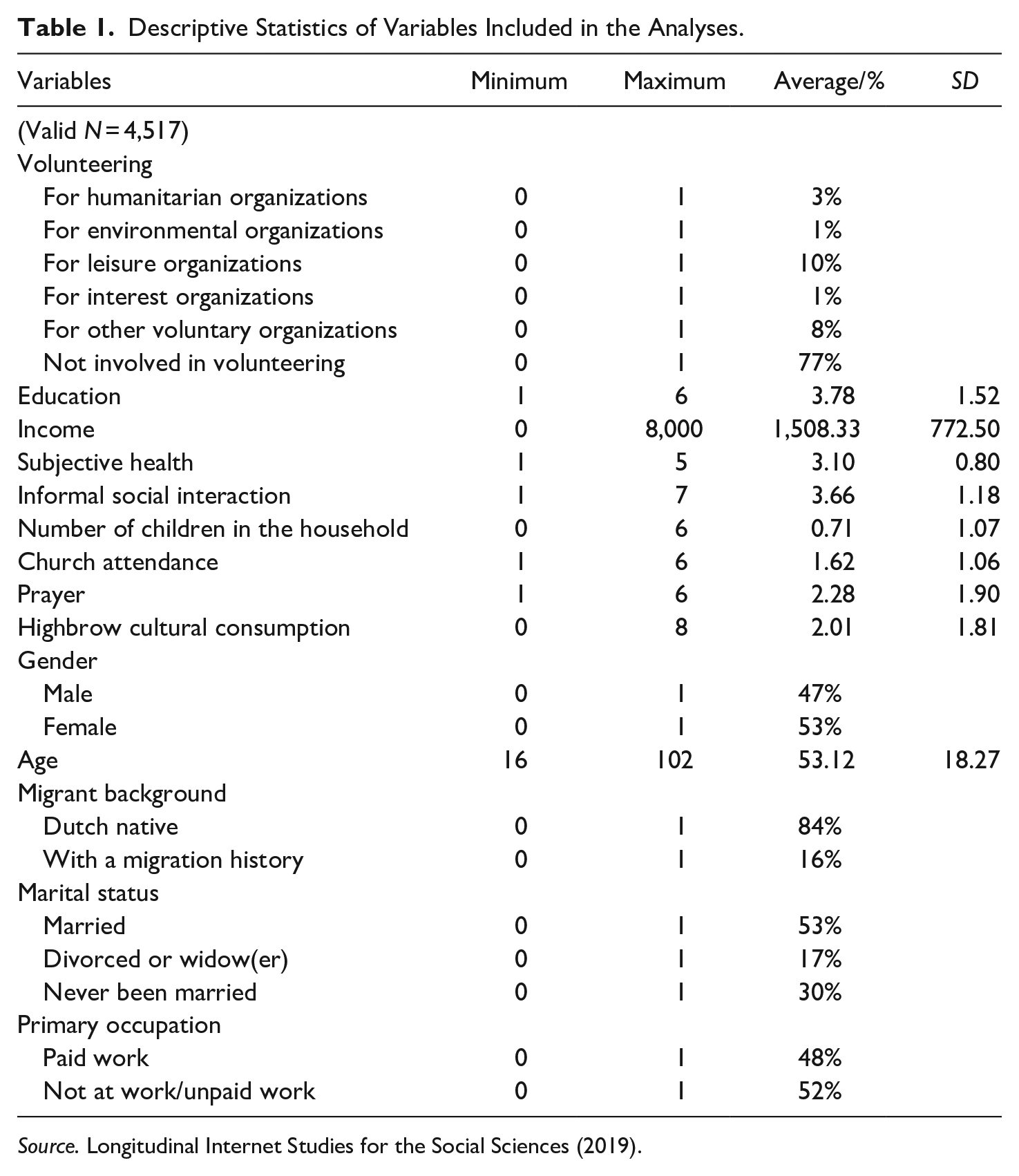
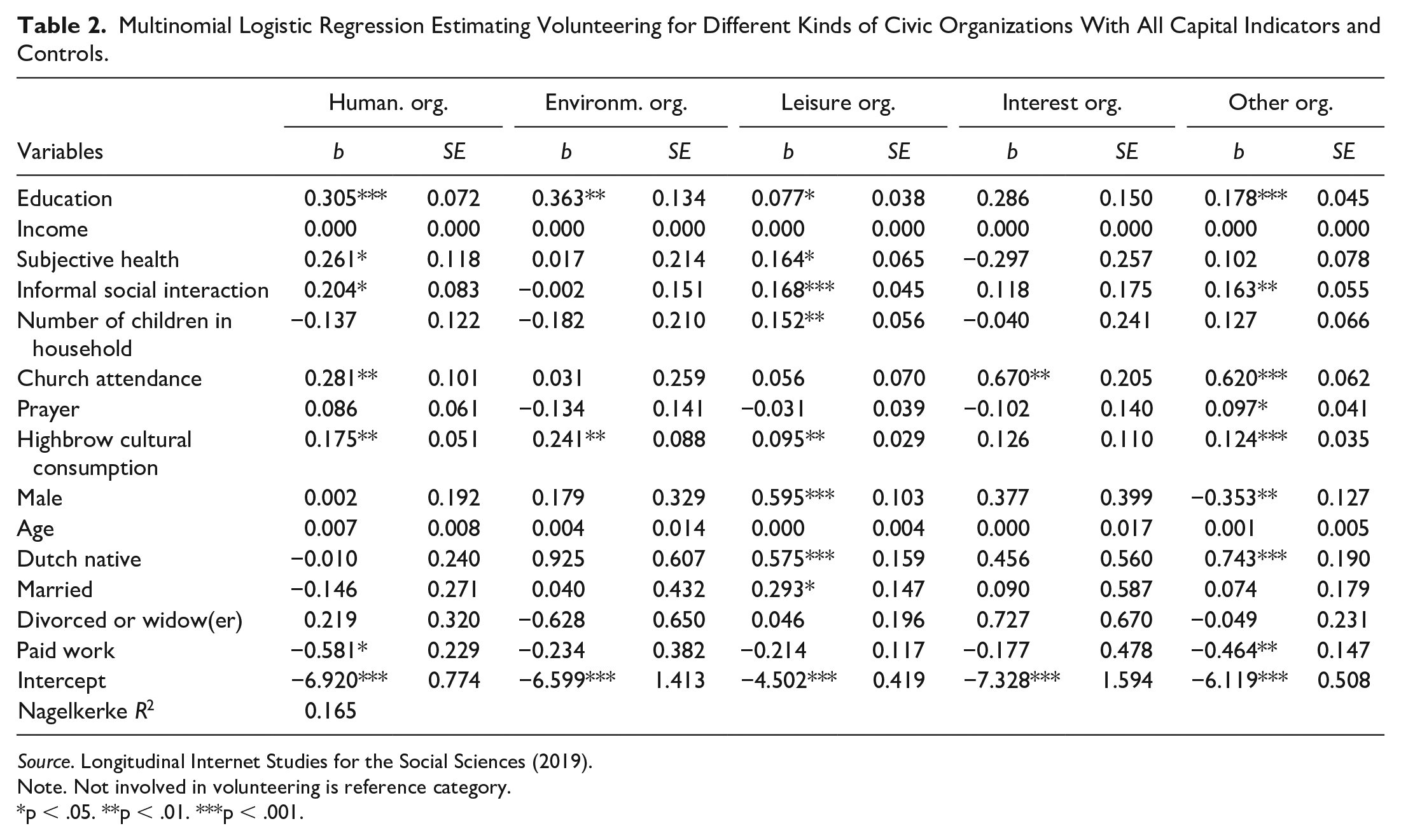
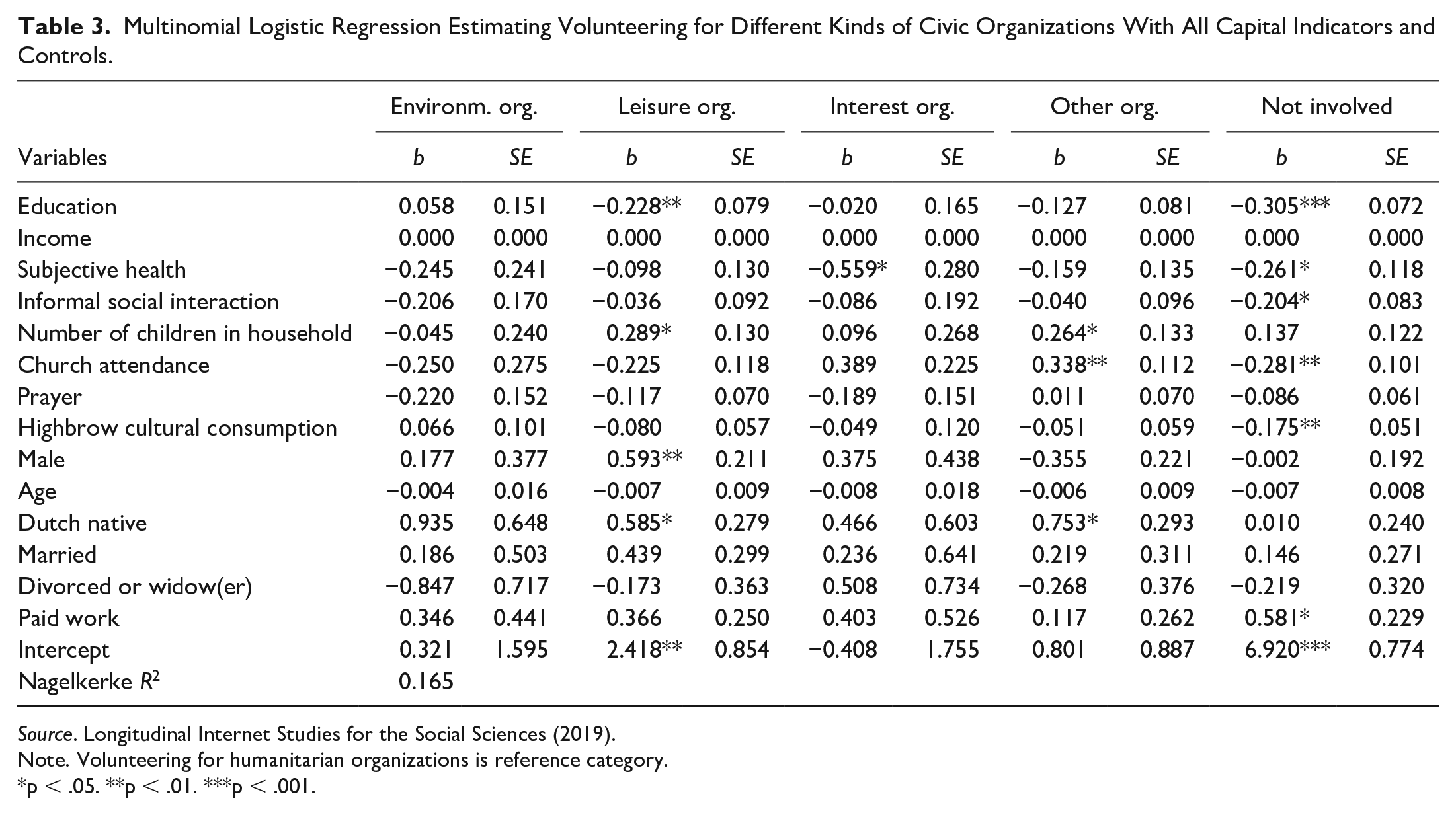
Descriptive information of all variables included in the analyses is presented in Table 1. The number of valid cases in the data is 4,517 respondents. 5 Multinomial logistic regression was used to test the hypotheses. We followed a stepwise procedure in adding variables to the model, before estimating the full model. Note that the model fit (intercept only model vs model with added variables) improved significantly and that the full model fitted the data best. First, we performed multinomial logistic regression with human capital variables only including control variables; next, solely social capital variables and controls; third, only cultural capital variables and controls; finally, all capital variables including controls were added for estimating the full model. We only present the results of this final, full model. We first estimated a full model with people not involved in volunteering as reference category. The results are presented in Table 2. Next, we performed a full model with volunteers for humanitarian organizations as reference category to test whether relationships are stronger for this type of volunteering as compared to the other types of volunteering. Results are displayed in Table 3.
Descriptive Statistics of Variables Included in the Analyses.
Source. Longitudinal Internet Studies for the Social Sciences (2019).
Multinomial Logistic Regression Estimating Volunteering for Different Kinds of Civic Organizations With All Capital Indicators and Controls.
Source. Longitudinal Internet Studies for the Social Sciences (2019).
Note. Not involved in volunteering is reference category.
p < .05. **p < .01. ***p < .001.
Multinomial Logistic Regression Estimating Volunteering for Different Kinds of Civic Organizations With All Capital Indicators and Controls.
Source. Longitudinal Internet Studies for the Social Sciences (2019).
Note. Volunteering for humanitarian organizations is reference category.
p < .05. **p < .01. ***p < .001.
Results
Human Capital Indicators
Concerning educational level, results show significant positive effects of educational level on the likelihood to volunteer for humanitarian (b = 0.305, p < .001) and environmental (b = 0.363, p < .01) associations and other types of organizations (b = 0.178, p < .001), as compared to those not involved in volunteering. To a lesser extent, however still significant, educational level also increases the likelihood to volunteer for leisure organizations (b = 0.077, p < .05). Only volunteering for interest organizations is not related to educational level, when compared to the group not involved in volunteering. We proposed that educational level has a positive relationship with volunteering, and this actually holds for four out of five distinguished organizations. We, moreover, theorized that the positive relationship of educational level with volunteering is strongest in the likelihood to volunteer for humanitarian organizations. Table 3 shows that this is only true when the strength of the relationship of humanitarian organizations is compared to leisure organizations (b = −0.228, p < .01) and those not involved (b = −0.305, p < .001). In other words, the relationship of educational level with volunteering for humanitarian organizations is not stronger when compared to environmental, interest and other organizations. Therefore, the proposition is partly supported. Contrary to our expectation, personal disposable income is not related to volunteering for either of the associational types, when those not involved are the reference category. Moreover, there are no differences between organizations when those volunteering for humanitarian organizations are the reference category. Subsequently, against our expectation, subjective health only has a positive relationship with the likelihood to volunteer for humanitarian (b = 0.261, p < .05) and leisure organizations (b = 0.164, p < .05). When humanitarian associations are taken as reference, it shows that a better subjective health decreases volunteering for interest organizations as compared to volunteering for humanitarian associations (b = −0.559, p < .05).
Social Capital Indicators
When compared to those not volunteering, informal social interaction increases the likelihood to volunteer for humanitarian (b = 0.204, p < .05), leisure (b = 0.168, p < .001), and other types of associations (b = 0.163, p < .01). This relationship is strongest for the latter two organizations. Informal social interaction is not related to environmental and interest associations. We proposed a positive relation of informal social interaction with volunteering, which is, however, not supported for all distinguished organizations. Moreover, Table 3 and additional analyses revealed, however, no differences between associations; informal social interaction is not stronger related to the likelihood to volunteer for any particular organization as compared to volunteering for humanitarian organizations. 6 Number of children in the household is only positively related to volunteering for leisure organizations (b = 0.152, p < .01) when compared to those not involved in volunteering. Table 3 and additional analyses showed that, indeed, number of children is more positively related to volunteering for leisure organizations (b = 0.289, p < .05) when compared to humanitarian associations. 7
Cultural Capital Indicators
Our results indicate a positive relationship between church attendance with the likelihood to volunteer for humanitarian (b = 0.281, p < .01) and interest organizations (b = 0.670, p < .01), as compared to those not involved. Also, there is a strong positive relation with the likelihood to volunteer for other types of organizations (b = 0.620, p < .001). This makes sense, as religious and church associations are part of this category. Considering prayer, results clearly reveal that this private form of religion is not related to the likelihood to volunteer for any type of organization, when compared to those not involved in volunteering. Again, there is a positive relationship in the likelihood to volunteer for other types of associations (b = 0.097, p < .05). We expected both forms of religion to be stronger positively related to humanitarian organizations. However, Table 3 indicates no differences in strength of the relationship when compared to environmental, leisure, and interest organizations. Table 2 shows that highbrow cultural consumption increases the likelihood to volunteer for all types of associations when compared to those not involved, except for interest organizations. We also proposed that the relationship was strongest for humanitarian associations. Table 3 shows, however, that highbrow cultural consumption is equally important in the likelihood to volunteer for the different types of associations we distinguished.
Control Variables
With regard to our control variables, it is noteworthy that volunteers for humanitarian organizations mostly had no paid work (b = −0.581, p < .05) when compared to those not involved in volunteering. When volunteers for humanitarian organizations were compared to volunteers for leisure associations, humanitarian organizations had more female volunteers (b = 0.593, p < .01) and more volunteers with a non-Dutch background (b = 0.585, p < .05). Also, the other types of organizations (for instance, religious associations and political parties) had less volunteers with a non-Dutch background (b = 0.753, p < .05) when compared to humanitarian organizations.
Conclusion
Humanitarian organizations distinguish themselves from other civic associations. In these latter associations, volunteering usually takes place within, or for the benefit of, the in-group. Instead, humanitarian organizations, for instance, provide aid to minorities as refugees and asylum seekers. In doing so, humanitarian organizations build bridges between different groups, thereby contributing to societies’ social capital. However, there is a lack of research that explores who volunteers in humanitarian organizations. Therefore, this article addressed the research question who volunteers for humanitarian organizations as compared to volunteering for other organizations versus people not volunteering, in the Netherlands. Using survey data (N = 5,050), we showed which aspects of human, social and cultural capital play a role in the likelihood to volunteer for humanitarian organizations, versus environmental-, leisure-, interest and other types of associations. We built on a theoretical approach in which resources to volunteer are linked to volunteering (Wilson & Musick, 1997) for specific types of organizations, enriched with complementary theoretical classic insights (Bourdieu, 1984), constituting a coherent set of determinants to volunteer.
Concerning human capital, educational level is important for volunteering in general. This is irrespective of type of organization, except for interest organizations, thereby confirming its importance in volunteering (see Musick & Wilson, 2007; Wilson, 2012). Education matters, nevertheless, more in volunteering for humanitarian associations than for leisure ones. In fact, education matters for activist organizations in general, as it is strongly positively related to environmental associations as well. We find that income is unrelated to volunteering for all civic organizations, at least after controlling statistically for educational level. This contradicts previous findings (e.g., Musick & Wilson, 2007). One’s subjective health is important in volunteering for humanitarian and leisure organizations. The relationship is, however, rather weak.
One particular social capital indicator, that is, informal social interaction is strongly related to volunteering for leisure organizations. Number of children in the household only relates to volunteering for leisure organizations. Our findings support the proposition that parents are often drawn into volunteering opportunities, especially those related to their children’s activities (Einolf, 2010, 2018; Gee, 2011).
Next, we find a stronger relation of church attendance with volunteering, than of praying. Church attendance positively relates to volunteering for humanitarian organizations. This shows the importance of moral values as benevolent helping (unknown) others and being a good citizen. These moral values are often spread in churches, and are likely to increase volunteering for humanitarian organizations. Highbrow cultural consumption is positively related to volunteering for almost all types of organizations. As a factor being mainly overlooked before (cf. Dean, 2016), our study shows that highbrow cultural consumption can be a structural predictor of volunteering in future research. Furthermore, humanitarian and environmental organizations (constituting activist organizations) barely differ regarding the strengths of the relationships with all capital measures.
This article showed that some capital forms are more related to particular types of civic organizations. This reveals the different demographic compositions of the distinguished organizations. Previous research has, however, more than often treated volunteers irrespective of the type of organization they volunteer for (e.g., Ruiter & De Graaf, 2006). Therefore, we recommend to be more sensitive in distinguishing volunteering for different types of organizations in future research, as this article made clear that these organizations are substantially different from each other in terms of demographic characteristics of their volunteers. This finding may benefit volunteer management (e.g., Brudney, 2005; Brudney & Meijs, 2009) in all distinguished civic organizations, as they are provided with a more detailed understanding of their types of volunteer.
Next, by unraveling different socio-structural determinants of volunteering, we are better able to present a more comprehensive picture on “who” volunteers for different organizations and “who” volunteers for humanitarian associations in particular. This article namely found that volunteers for humanitarian organizations are relatively high educated, in good health, have frequent informal social interactions, attend religious gatherings, and visit cultural organizations or performances. Moreover, compared to volunteers for other organizations, they are relatively often female and have relatively often an immigrant background. The “why” in volunteering for any organization, and particularly for humanitarian organizations, however, remains to be answered in future research. We recommend to investigate volunteer norms and values in explaining the “why” in volunteering for different associations. Finally, we studied socio-structural determinants for volunteering in the last year (2019) before COVID-19 that affected people’s everyday lives and, consequently, civil society. This raises questions whether socio-structural determinants for volunteering have changed during or after the pandemic, and whether this potential change is temporary or lasting.
Footnotes
Authors’ Note
The authors jointly developed the idea and the design for this study. Meijeren wrote the main part of the manuscript and conducted the analyses. Lubbers and Scheepers substantially contributed to the manuscript. In advance, we would like to thank the reviewers for their valuable suggestions.
Declaration of Conflicting Interests
The author(s) declared no potential conflicts of interest with respect to the research, authorship, and/or publication of this article.
Funding
The author(s) disclosed receipt of the following financial support for the research, authorship, and/or publication of this article: This study is part of the research program Sustainable Cooperation—Roadmaps to Resilient Societies (SCOOP). The authors are grateful to the Netherlands Organization for Scientific Research (NWO) and the Dutch Ministry of Education, Culture and Science (OCW) for generously funding this research in the context of its 2017 Gravitation Program (grant number 024.003.025).
