




Abstract
To enhance their effectiveness, nonprofit fundraisers may wish to harness the power of identification. Informed by Social Identity Theory and Charitable Triad Theory, we meta-analyzed 40 years of research on social identification and charitable giving to quantify the overall relationship and conducted meta-regressions to investigate moderators. Across 109 effect sizes drawn from 89,570 participants, we found a medium-sized relationship (r = .29). Identification with other donors (r = .23), beneficiaries (r = .24), and fundraisers (r = .36) were all positively associated with giving. Strength of identification (r = .32) was more strongly associated with giving than was shared identity (i.e., in-group vs out-group target; r = .15). Effects were smaller for actual behavior (r = .20) than for self-reported giving (r = .33) and were only found when giving was mediated through charities (r = .34) but not when giving directly to individuals (r = .04). We include practical recommendations for ways that fundraisers can effectively leverage the power of identification in recruitment campaigns, copywriting, and selection of spokespeople.
Charitable donations—defined as voluntary contributions of money that benefit people outside the giver’s family (Bekkers & Wiepking, 2011)—now exceed $470 billion annually in the United States alone (Giving USA, 2021). To support their essential charity work, nonprofit marketing teams must fundraise effectively, using their resources as wisely as possible to maximize funding. To be effective, they need to know what motivates people to give and apply that understanding to their campaigns.
One concept that has gained significant traction in recent years is the notion that identities and identification processes are critical for understanding charitable behavior (Aaker & Akutsu, 2009; Levine & Manning, 2013; Zagefka & James, 2015). Indeed, a range of studies have examined empirically the power of identities and social identification within charitable giving contexts (e.g., Chapman et al., 2020; Kessler & Milkman, 2018; Puntoni et al., 2011; Shang et al., 2008; Winterich et al., 2013). Articles and blog posts about the importance of understanding donor identities are also common within nonprofit industry media (e.g., Ahern, 2020; Charity Link, 2022), suggesting the topic is also being taken seriously within professional fundraising communities.
Given this surging attention, and the fact that social identification has captured the zeitgeist both within and outside academia, it is particularly important to present a clear-eyed overview of the extent to which—and the conditions under which—social identification is associated with charitable giving. Meta-analyses, which provide bird’s-eye overviews of large amounts of literature, are one way to provide this clarity. Meta-analyses are particularly useful when existing literatures have traditionally been fragmented across disciplines, as they have been in the field of charitable giving (with studies published across, for example, nonprofit studies, marketing, psychology, economics, sociology, and management).
Another advantage of meta-analyses is their ability to delineate important boundary conditions which are not feasible to test within individual studies. For example, the current literature obscures a critical theoretical question: identification with whom? Charitable Triad Theory (Chapman et al., 2022) argues that three actors—donors, beneficiaries, and fundraisers—are critical to understanding charitable giving contexts, and identification can be measured in relation to any one of these three actors. However, existing studies are not well-equipped to referee whether the effects of identification are particularly strong (or weak) when applied to each of these actors. Knowing the answer to this question is important for theory development, as well as for practitioners who need to know how to best direct resources and marketing efforts.
The vast canvas provided by a meta-analysis can also help answer other important questions, such as whether identification is a particularly strong correlate of giving for some pockets of the population compared to others, or whether identification is differentially associated with self-reported donation amounts (which are prone to distortion and bias) versus objective donation amounts. Answering these questions helps provide practical guidance for nonprofit marketers about when, how, and for whom to leverage the power of social identification in their fundraising appeals and marketing communications.
Meta-analyses can also help nuance between theoretical distinctions that are sometimes glossed over in the literature. For example, as outlined in the next section, Social Identity Theory (e.g., Tajfel, 1978) distinguishes between two related but separate notions: strength of identification and shared identity. In the literature, these concepts are sometimes treated as interchangeable, and together, they are used to speak to the power of identification in promoting giving. However, there are theoretical reasons to believe that the effects of one may be stronger than the other (elaborated below), and subjecting this prediction to empirical rigor adds both theoretical nuance and practically useful information for nonprofit managers and fundraisers.
In this article, we meta-analyze data from 74 independent samples recruited in 15 countries to understand when social identification is (or is not) associated with giving. We consider the strength of the relationship between giving and identification and examine empirically—and for the first time—the strength of the relationship for identification with each actor in the Charitable Triad. We also offer practical guidance for nonprofit marketers about when and how to leverage the power of identification in their fundraising appeals and marketing communications. Before doing so, however, we outline relevant theories that are used to frame our hypotheses and research questions.
Social Identity Theory
According to Social Identity Theory (e.g., Hornsey, 2008; Tajfel, 1978), people have a range of both individual (personal) and group-based (social) identities that may be relevant or salient in different contexts. The social groups that a person belongs to, in turn, provide meaningful information that helps shape their attitudes and behaviors. In this paper, we follow the Social Identity Theory tradition and use the phrase “social identification” to refer to both shared identity (focused on the group membership of targets relative to participants, with a dichotomous in-group vs out-group distinction) and strength of identification (a distinction that occurs on a graded scale among in-group members). These constructs are theoretically related and are sometimes used interchangeably in social identity research on charitable giving. However, these are two qualitatively distinct concepts that may have different relationships with charitable giving.
The extent to which shared group membership shapes attitudes and behaviors depends on whether the identity is a valued and important part of a person’s self-definition (i.e., the strength of identification). Strength of identification is typically construed as reflecting several distinct but related dimensions, including the extent to which the group membership is thought about often and is subjectively important to the individual’s self-definition; the extent to which positive feelings arise because of their group membership; and perceptions of similarity with other group members (Cameron, 2004). Importantly for the current analysis, it is presumed that strongly identifying with a target will make you more positively predisposed to that target: one will have more congenial attitudes, beliefs, attributions, and behaviors toward people and organizations to which we feel strongly identified.
In addition to strength of identification, social identification can influence attitudes and behavior through mere shared identity. For example, one robust phenomenon is the tendency for people to show preference toward people who belong to the same social groups as them (known as in-group members) rather than people who belong to other social groups (i.e., out-group members; Hewstone et al., 2002). This in-group bias is proposed to emerge naturally from group members’ motivations to achieve and maintain positive distinctiveness (Jetten et al., 2004). Previous meta-analyses have shown that sharing an important identity with a target motivates target-favoring behavior in a range of contexts, including jury decision-making (Mitchell et al., 2005), cooperative tasks (Balliet et al., 2014), and job performance evaluations (where in-group bias was found among male raters only; Bowen et al., 2000). Individual studies have also shown in-group favoritism in general helping (e.g., Levine et al., 2005; Stürmer et al., 2006). However, it is not yet known how robust the overall effect is in charitable giving contexts.
In-group bias is not a reflexive or straight-forward response to belonging to the same social group. Rather, the extent to which group membership translates into in-group favoritism depends on sociostructural factors, including the relative status and power of the groups and the extent to which these hierarchies are legitimate and stable. Indeed, Nadler (2002) proposes that intergroup helping relations are inherently status relations, and that sometimes people help out-groups to assert their own group’s dominance and keep beneficiary out-groups in a relatively low status position. Furthermore, van Leeuwen (2007) proposes that people sometimes give to out-groups as a way to restore threatened in-group identities. This literature implies that the effects of shared identity on giving may be complex and resist simple prescriptions such as “shared identity = more giving.” A meta-analysis can help tease apart the conditions under which social identification—whether shared identity or strength of identification—does (or does not) promote giving.
Charitable Triad Theory
Another important nuance is that, no matter how it is assessed, social identification can only be understood with reference to a particular target. Charitable Triad Theory (Chapman et al., 2022) proposes that charitable decisions are triadic and relational. This theory of donor psychology rests on three key tenets. First, giving is triadic: characteristics of three key actors—donor, beneficiary, and fundraiser—influence giving decisions. In the language of Charitable Triad Theory, donors are entities considering making gifts of money, beneficiaries are the end users of any funds donated, and fundraisers are the individuals or, more commonly, the nonprofit organizations who request donations from potential donors on behalf of beneficiaries. Second, understanding the characteristics of each actor in the triad may be necessary but not sufficient to understand the complexities of giving behavior. In other words, donor behavior cannot be meaningfully understood with reference to only one of the three targets. Instead (the third tenet), giving is relational: interactive relationships between the triad determine charitable choices. Various relationships between the actors are possible, including relationships based on liking, values alignment, or social identification.
Social identification is inherently relational, focused on a connection between two parties. Charitable Triad Theory, with its attention to relationships within the Charitable Triad, is therefore a useful frame to examine the way identification processes work in charitable giving contexts. Charitable Triad Theory proposes that characteristics of donors as well as donors’ relationships with both beneficiaries and fundraisers affect giving decisions. In this article, we suggest an enhancement to Charitable Triad Theory by proposing that the relationships donors have that influence their giving could also be with other donors. Specifically, we examine the extent to which relationships based on identification between a potential donor and (a) other donors, (b) beneficiaries, and (c) fundraisers influence charitable responses.
Based on Charitable Triad Theory and previous research, identification with all three members of the Charitable Triad should affect giving. Identification with other donors has been shown to promote giving. For example, customers who identify more strongly with a corporation are also more likely to donate to causes supported by that donor corporation (Lichtenstein et al., 2004). People are also more likely to model the generosity of a donor when they share an identity with that donor. For example, in one study, Italian students were willing to donate an average of $19.54 when they learned about the generous donation of a fellow Italian, but only $12.88 when the same donation was attributed to a German donor (Hysenbelli et al., 2013, Study 3). However, Croson et al. (2010) found that normative information about the giving of others was associated with the self-reported giving of women, but not men. Thus, identification with other donors should promote giving, but perhaps not for all people.
People who have stronger identification with beneficiaries appear to be more likely to give to charitable appeals and also to give more generously (e.g., Zagefka & Sun, 2021). For example, the more people identified with victims of Hurricane Katrina, the more likely they were to donate to disaster recovery efforts (Winterich et al., 2009). In a series of vignette studies, James and Zagefka (2017) also demonstrated preferences for donating to help disaster victims from participants’ national in-group compared to a fictional out-group country. In their third study, for example, participants reported that they would hypothetically make a £5.59 donation when they thought the victims were from their own country, compared to only £3.86 when victims were from another country. However, despite the expected tendency for people to help in-group members, sometimes donors offer help to people they do not identify with for strategic reasons such as to assert their group’s high status over others (Nadler, 2002). Thus, identification with beneficiaries may sometimes (but not always) promote giving.
Finally, identification with fundraisers can promote donations. For example, when people identify more with the fundraising nonprofit, they say they are more willing to donate to that nonprofit in the future (Boenigk & Helmig, 2013). Another study, however, shows that when supporters are seeking donations for a charity, their personal identification with the charity explains only 1% of variation in their fundraising success compared to other more pragmatic factors (Chapman et al., 2019). Thus, identification with fundraisers should promote giving, but the size of the relationship is disputable.
In sum, identification with other donors, beneficiaries, and fundraisers can sometimes, but perhaps not always, promote giving. Furthermore, the size of the relationships between identification with these targets and giving remains unknown. A meta-analysis can illuminate to what extent, and for which people, identification processes can be harnessed effectively for fundraising.
The Current Study
The purpose of the current study is to aggregate evidence to test the overall importance of social identification for charitable giving and identify caveats and boundary conditions to the relationship. Specifically, we meta-analyzed 109 effects from 74 independent samples recruited in 15 countries over a period of more than 40 years.
Our study is guided by several research questions and hypotheses (summarized in Figure 1). First, we anticipate an overall positive relationship between social identification and charitable giving. As elaborated earlier, this hypothesis is grounded in Social Identity Theory—which argues that identification is associated with various forms of prosocial behavior—and Charitable Triad Theory, which articulates that giving is inherently relational.
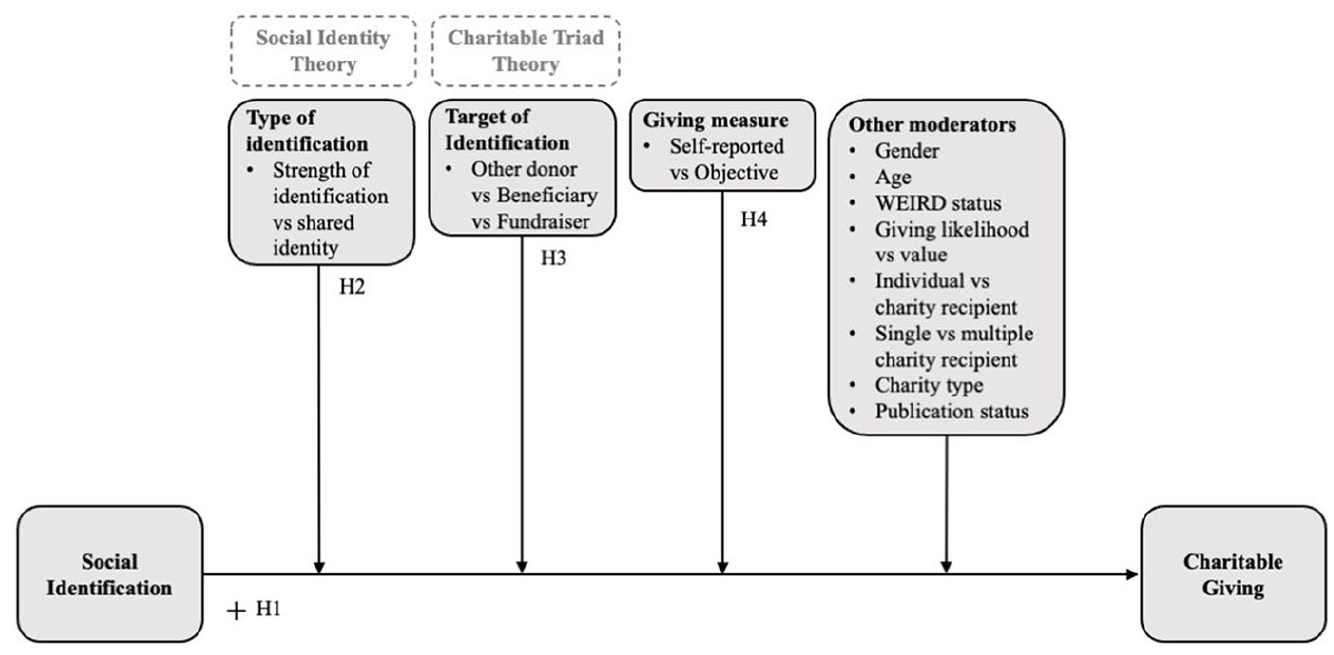
Conceptual Diagram of the Relationships and Moderators Being Tested in the Meta-Analysis.
An important nuance in the current analysis is that we distinguish between strength of identification (i.e., the extent to which people report being psychologically identified with targets) and shared identity (i.e., the extent to which targets share the same group membership as the giver). Both strength of identification and shared identity have been commonly used to assess identification effects in social identity research. From the perspective of Social Identity Theory, strength of identification provides a relatively clean index of the extent to which people are psychologically attached to a target, and so should have a relatively strong relationship with charitable giving. In contrast, as elaborated earlier, the effects of merely sharing an identity with a target are more complex and more ambiguous, potentially influenced by sociostructural relations between the groups and strategic considerations (Nadler, 2002; van Leeuwen, 2007). This reasoning leads us to propose:
One important element of the current analysis is the overlay of a Charitable Triad lens to consider target of identification: Does it matter whether identification is measured in relation to other donors, beneficiaries, or fundraisers? Answering this question can be of considerable importance for practitioners, who will be interested in “where” to direct their marketing energies. There is not yet sufficient theorizing to provide a priori hypotheses around the target of identification that would be most important in promoting giving. Charitable Triad Theory makes no predictions about which actor would be most important, and with almost no empirical research considering all three actors simultaneously (Chapman et al., 2022), there is simply not enough comparative evidence to make clear predictions on this point. However, following the basic tenets of Charitable Triad Theory, we propose that identification with all three actors will be associated with giving:
We also anticipate that the positive relationship between identification and charitable giving will be greater when giving is self-reported (e.g., as a behavioral intention or a report of past giving) than when it is measured objectively (e.g., observations of actual giving behavior). This hypothesis is grounded in two principles. First, intentions are an imperfect proxy for behavior, with larger relationships typically found for self-reported measures such as giving intentions than for observed giving behavior (e.g., Shang et al., 2019). Second, social desirability biases may lead people to over-report their giving to make a positive impression of themselves to others (Lee & Sargeant, 2011). Therefore:
In addition to these formal hypotheses, we also tested several other potential moderators that were not grounded in theory or previous research. Specifically, we examined whether the relationship between identification and charitable giving is affected by gender composition of the sample, mean age of the sample, national context, the charity’s cause, as well as how giving was operationalized. Testing these non-theoretical moderators provides useful information to fundraisers about who may be most responsive to identification-based appeals and which types of charities may achieve best results.
Method
We followed the Preferred Reporting Items for Systematic Reviews and Meta-analyses (PRISMA; Moher et al., 2015) to identify quantitative research on the relationship between social identification and charitable giving.
Search Strategy
Literature searches were run in November 2019 across four databases: the two largest multidisciplinary academic databases (Scopus and Web of Science) plus content-relevant databases in business (ABI/Inform) and psychology (PsycINFO). We used search terms nested around the concepts of charitable giving (donation*, donate, donor*, philanthrop*, charitable, “not for profit*”, “non profit*”, nonprofit*, NGO*, “non governmental”, “third sector”, “charit*”) and identification (identification, “social identity”, identifiers). Searches were based on title, abstract, and keywords and were limited to articles published in peer-reviewed journals since 1980. To ensure the corpus was as complete as possible, we supplemented the initial database searches with forward and backward citation searches on included articles (identifying all articles that the focal article had been cited by and had cited, respectively). These searches identified relevant articles published until the end of June 2022. Results were also supplemented with calls for unpublished data distributed through X (formerly Twitter) and the Association for Research on Nonprofit Organizations and Voluntary Action, American Marketing Association, and Society for Personality and Social Psychology mailing lists. All search efforts yielded 381 unique articles.
Eligibility and Screening
Screening was done in three rounds: first on title, second on abstract, third on full text. To be included, articles needed to be written in English and to have quantitatively measured both identification and charitable giving (specifically, donations of money to benefit non-kin others). For articles less than 10 years old that did not report bivariate effect sizes, we emailed authors to request this information. The PRISMA flowchart, summarizing the screening process, is presented in Figure 2.
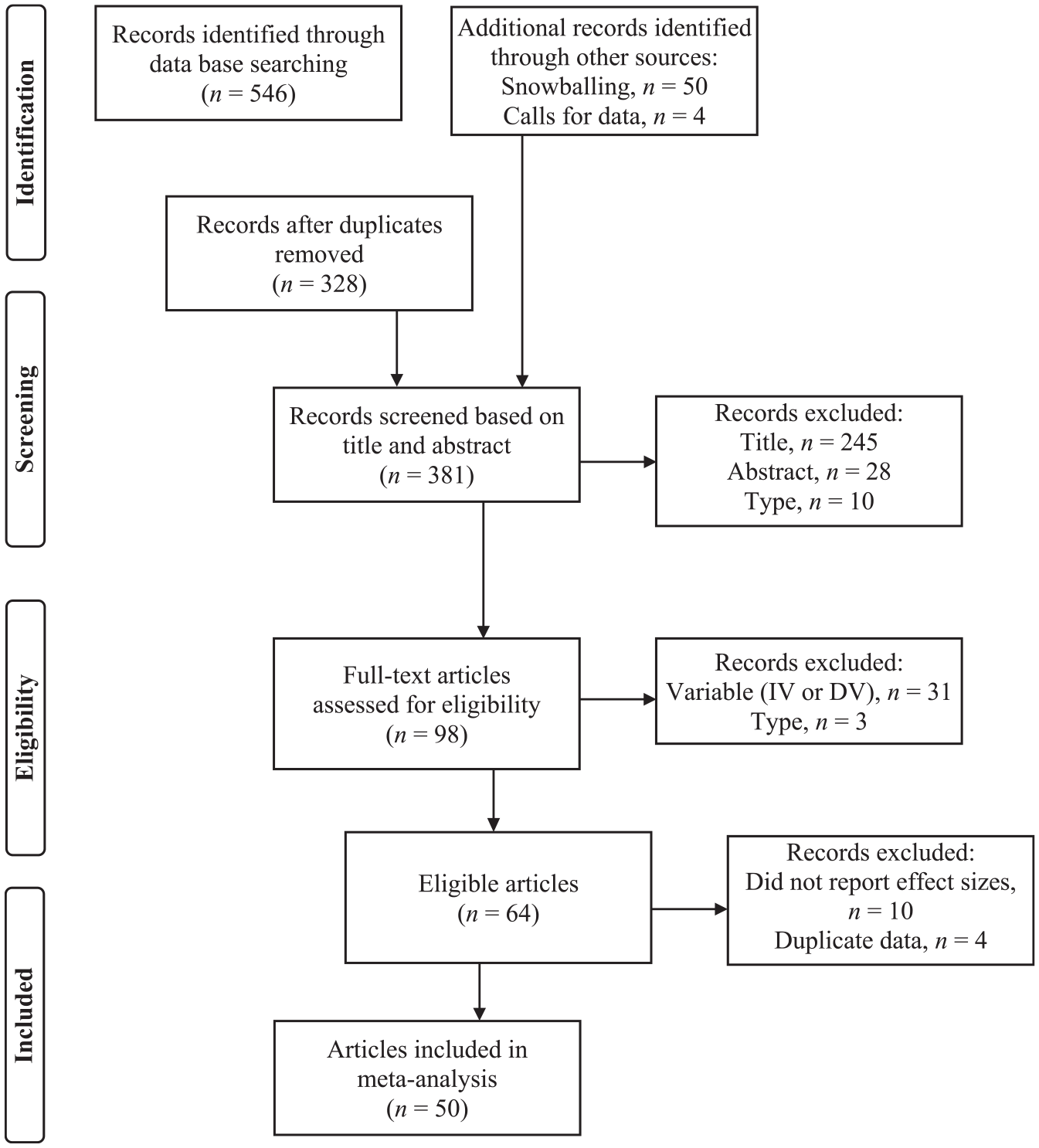
Flow Diagram of the Literature Search and Exclusion Process for Systematic Review and Meta-Analysis.
Coding
The type of bivariate effect size extracted depended on study design, but we typically extracted Pearson’s correlation coefficients (r) for correlational studies or Cohen’s ds for experimental studies. In situations where these values were not provided by the study, we used test statistics (e.g., means and standard deviations, F-values, frequency data) to calculate effect sizes. All effect sizes were transformed to Pearson r correlations for the meta-analysis.
In addition to effect sizes, we extracted information to examine potential moderators of the association. Of primary consideration, we extracted the way identification was assessed (i.e., measured strength of identification vs manipulated shared identity), the target of identification (i.e., with other donors, beneficiaries, or fundraisers), and how charitable giving was assessed (i.e., self-reported vs objective). We examined three variables relevant to the sample: gender (i.e., the proportion of the sample who were female), age (i.e., the mean reported age of the sample), and whether the data were collected in Western, Educated, Industrialized, Rich, and Democratic (WEIRD; Henrich et al., 2010) or non-WEIRD countries. Moderators based on methodology included the type of giving measure (i.e. likelihood of giving at all vs value of donation) and charity type. Further details, including definitions, examples, and coding of moderators, are available on the Open Science Framework (OSF; https://osf.io/hc63e/). The coding results spreadsheet, meta-analysis file, and citation library are also available on the OSF.
Analyses
Pearson’s correlation (r) was used to represent the association between social identification and charitable giving. To approximate a normal sampling distribution, all effect sizes (Pearson r correlations) were transformed to Fisher’s z correlations for the analyses. For ease of interpretation, our results report values transformed back to Pearson r correlations.
Given that the majority of studies included in this meta-analysis contributed more than one effect size (i.e., we extracted all relevant combinations of identification and charitable giving in a given study), we employed the three-level meta-analytic approach. Specifically, the three sources of variance accounted for are: sampling variance (Level 1), within-study variance (Level 2), and between-study variance (Level 3; Assink & Wibbelink, 2016).
Our analyses followed the procedures outlined by Assink and Wibbelink (2016) and used the rma.mv function of the Metafor package (Viechtbauer, 2010) in the R environment (R Core Team, 2020). We used multilevel random effects models and the restricted maximum likelihood estimation method to calculate all model parameters. The t-distribution was used to test individual regression coefficients and for calculating confidence intervals (Knapp & Hartung, 2003).
Sensitivity Analyses
Sensitivity analyses were conducted using a leave-one-out analysis and screening for r-standardized residuals with a cutoff of ±3.29 standard deviations. These analyses revealed one outlier (ES #74). Overall analyses with this effect size included or excluded returned the same pattern of results, so we elected to include this effect size in subsequent analyses.
Publication Bias
We tested for publication bias in three ways: visual inspection of the funnel plot (Figure 3), using Egger’s method of regressing the standardized effect size on the precision of the effect size (where a significant intercept indicates publication bias may be present), and the trim-and-fill method (which estimates how many studies are potentially missing and from which side of the average effect). We ran these tests only on the published articles in the sample. The results of these tests returned mixed results. Egger’s test for funnel plot asymmetry was not significant, t(41) = −0.39, p = .699, suggesting no publication bias; however, the trim-and-fill procedure estimated 10 missing studies on the right side of the funnel plot (i.e., positive effects). When estimated effect sizes from the hypothetical missing studies were imputed in the analyses, the strength of the association between identification and giving increased. This suggests that, if anything, the findings of our meta-analysis may be an underestimation of the true effect size—that is, overestimation from publication bias is likely not an issue. Nevertheless, because 14% of the effect sizes were drawn from unpublished studies, we were also able to test publication status (i.e., published vs unpublished datasets) as a potential moderator. Whether or not a dataset was published did not affect the size of association between identification and giving, F(1,107) = 0.47, p = .497.
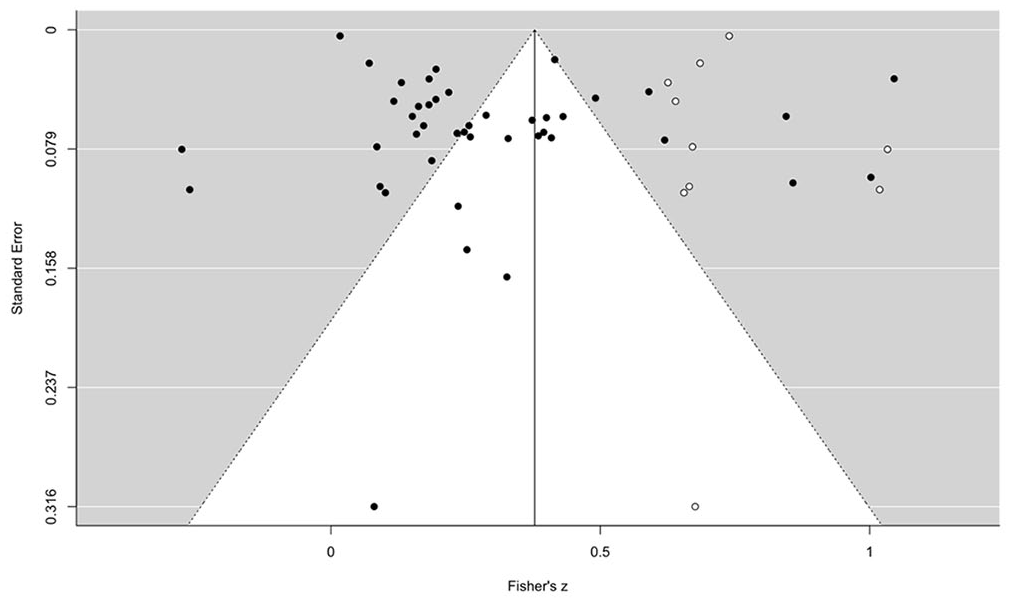
Funnel Plot for the Meta-Analysis.
Results
We report results in two phases. First, we summarize literature in terms of study characteristics, geography, and methods. In this first section, we summarize all 64 eligible articles that were identified in the systematic review. Second, we discuss the meta-analysis, including the aggregate effect size and evaluation of moderators. In this second section, we analyze only the 50 eligible articles that we were able to extract effect sizes from.
Description of the Literature
Our systematic review identified 64 relevant articles published since 1980 (summarized in Table 1). Based on the number of publications per year (Figure 4), there has been a noticeable burst of research attention on the role of identification in giving over the past decade. These articles were published across diverse disciplines, but especially in psychology (30%), marketing (25%), and nonprofit study journals (11%). Data on the association between identification and giving were collected in 15 countries. However, 84% of samples were collected in WEIRD countries, especially the United States (k = 42) and the United Kingdom (k = 11). On average, females constituted 58.7% of the samples, and the average age was 33 years. Among the articles that noted type of sample, approximately half used student samples (k = 31), and half used community samples (k = 37), but none used nationally representative samples. Overall, 70% of studies reported correlational data—either using surveys or experimental designs with other focal independent variables and measuring strength of identification—and 30% experimentally manipulated group status of targets (in-group vs out-group) to assess the impacts of shared identity.
Summary of 64 Articles Including Quantitative Data Examining the Association Between Identification and Giving Published Between 1980 and 2022.
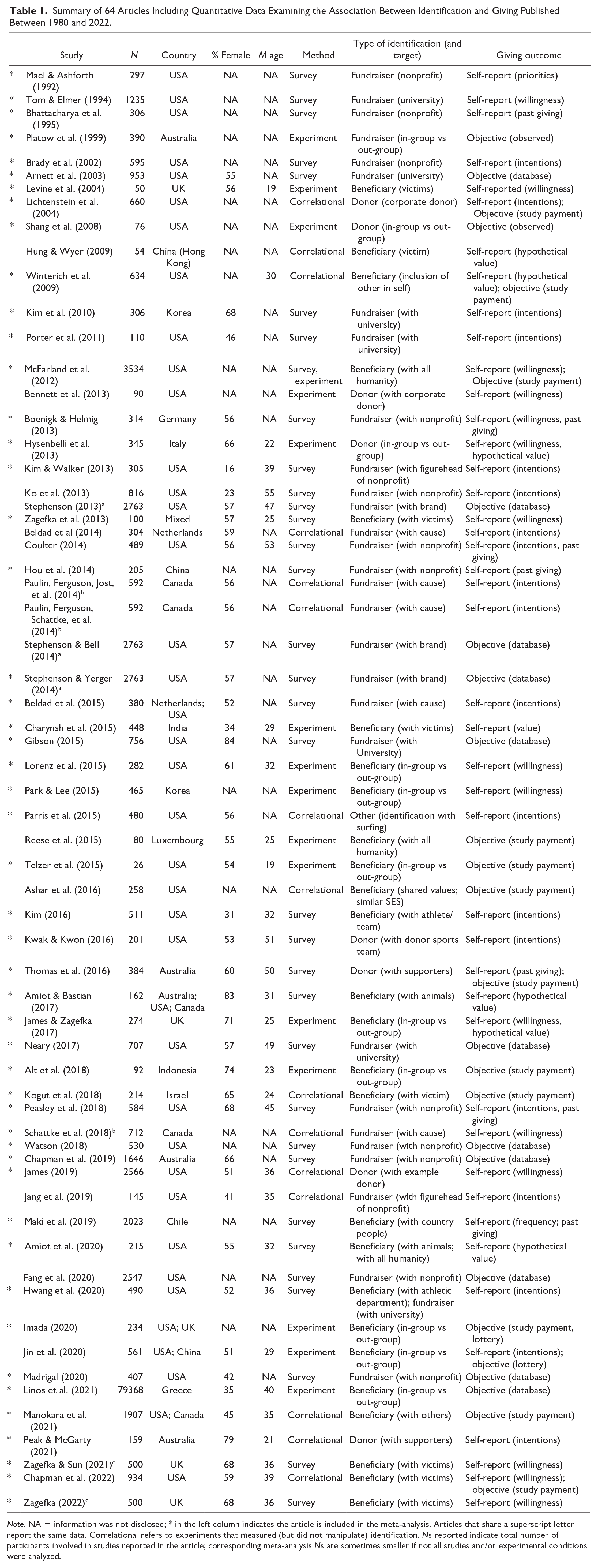
Note. NA = information was not disclosed; * in the left column indicates the article is included in the meta-analysis. Articles that share a superscript letter report the same data. Correlational refers to experiments that measured (but did not manipulate) identification. Ns reported indicate total number of participants involved in studies reported in the article; corresponding meta-analysis Ns are sometimes smaller if not all studies and/or experimental conditions were analyzed.

Summary of Publications Including Measures of Both Identification and Charitable Giving Over Time.
Different targets of identification were assessed. Most examined identification with either beneficiaries (k = 46) or fundraisers (k = 34), while only 11 studies examined identification with other donors. Identification was typically assessed with self-report measures (e.g., “When I talk about this charitable organization, I usually say ‘we’ rather than ‘they’”; Hou et al., 2014) or by manipulating the group membership of the target (in-group vs out-group).
Studies that used self-reports of giving included those asking participants to report their willingness to donate (k = 31), future intentions to donate (k = 25), hypothetical amount they would donate (k = 10), and self-reported past giving (k = 10). Those studies that included objective measures of giving typically assessed the amount of a study payment that the participant donated (k = 26), analyzed real giving behavior from charity databases (k = 12), included a lottery where participants could donate a share if they win (k = 7), or directly observed giving in the field (k = 2).
Finally, studies examined giving to a range of charity types. Many studies considered giving to multiple or all charities (k = 19). However, when the focus was on a particular cause, the most popular causes studied were education (k = 14), emergency relief (k = 12), international charities (k = 12), and children’s charities (k = 9).
Meta-Analysis
For the meta-analysis, we extracted 109 effect sizes from 74 independent samples published in 50 articles. On average, each study yielded 1.43 effect size estimates (SD = 0.79, range = 1–6). Data came from 89,570 participants in 15 countries.
Overall Association
Overall, a reliable positive association was found between social identification and charitable giving, r = .29, t = 7.46, p < .001, 95% CI = [.21, .36].
Heterogeneity
There was significant variance in effect sizes observed at both the within-study level (p < .001) and between-study level (p < .001). Using Cheung’s (2014) formula, 1.85% of the total variance could be attributed to sampling variance, 33.74% to within-study variance, and 64.41% to between-study variance. Results of these heterogeneity tests suggest that the true effects vary significantly across studies and measures, more so than would be expected based on sampling error alone. Thus, moderator analyses were warranted to identify likely causes of this heterogeneity.
Moderator Analyses
Three-level meta-regressions examined potential moderators of the association between identification and giving. Before conducting these moderator analyses, all categorical variables were coded into dichotomous dummy variables, and continuous variables were centered around their mean. With a sample of 109 effect sizes, we did not have sufficient statistical power to run multivariate analyses. Therefore, following the work of Hox and colleagues (2010), we conducted univariate moderator analyses, whereby each moderator was tested independently. Further detail on how moderators were defined and coded is available on the OSF. Results are summarized in Table 2.
Moderators of the Overall Association Between Identification and Charitable Giving.
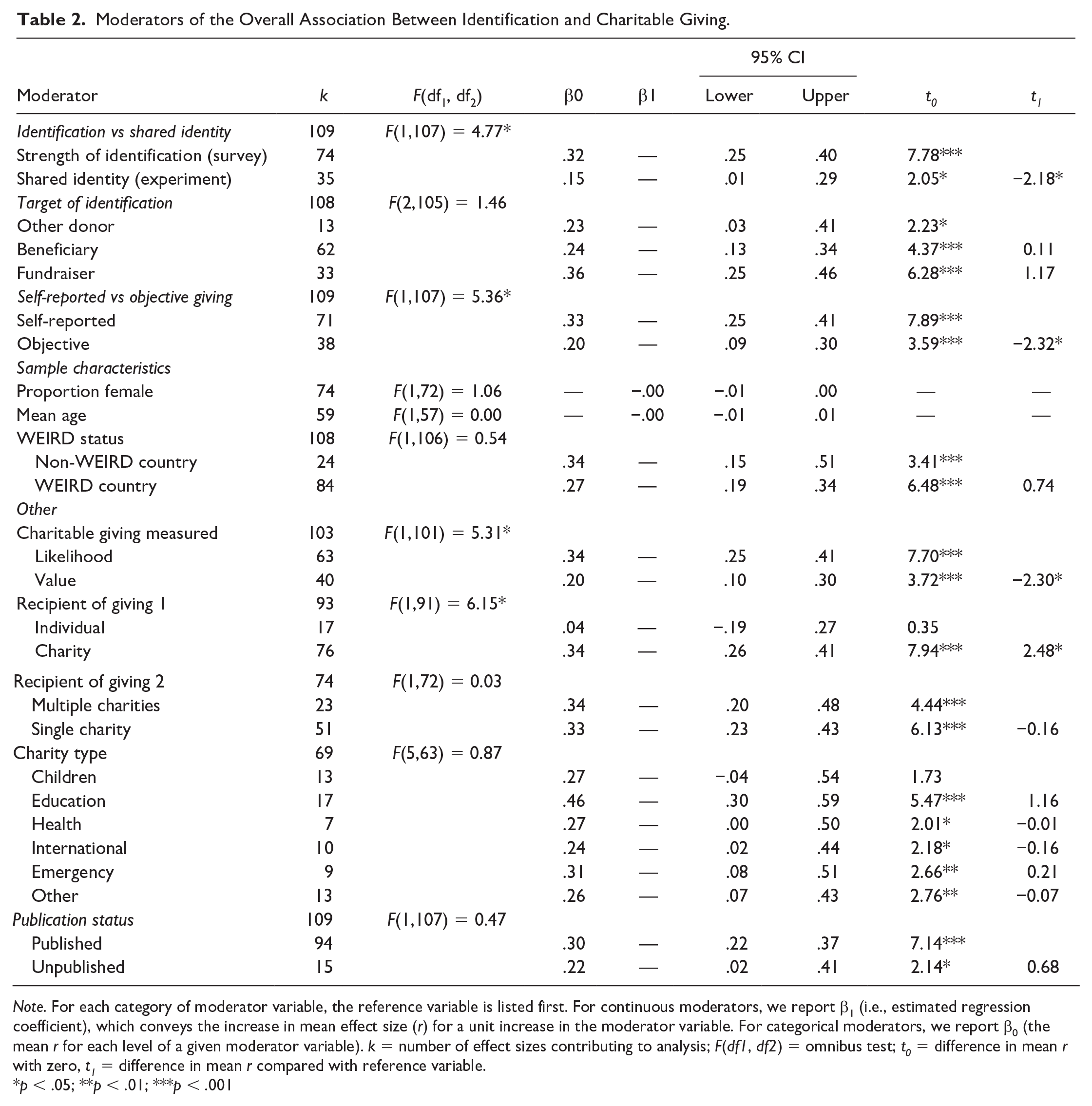
Note. For each category of moderator variable, the reference variable is listed first. For continuous moderators, we report β1 (i.e., estimated regression coefficient), which conveys the increase in mean effect size (r) for a unit increase in the moderator variable. For categorical moderators, we report β0 (the mean r for each level of a given moderator variable). k = number of effect sizes contributing to analysis; F(df1, df2) = omnibus test; t0 = difference in mean r with zero, t1 = difference in mean r compared with reference variable.
p < .05; **p < .01; ***p < .001
Strength of Identification versus Shared Identity
The way identification was assessed significantly moderated the association between identification and giving, F(1,107) = 4.77, p = .031. Specifically, the relation between identification and giving was significantly stronger in survey studies that measured both strength of identification and giving, r = .32, p < .001, than in studies that experimentally manipulated shared identity (i.e., in-group vs out-group status of targets), r = .15, p = .043. 1 Two forest plots summarize all effect sizes included in the meta-analysis: Figure 5 shows effect sizes for studies that measured strength of identification, and Figure 6 shows effect sizes for studies that manipulated shared identity.

Forest Plot Summarizing 74 Effect Sizes (Pearson’s Correlation Coefficients; r) From Studies That Measured Strength of Identification.

Forest Plot Summarizing 35 Effect Sizes (Pearson’s Correlation Coefficients; r) From Studies That Manipulated Shared Identity (i.e., In-group vs Out-group Status of Targets).
Target of Identification
Target of identification did not significantly moderate the association between identification and giving, F(2,105) = 1.46, p = .237. Instead, identification with all three of the Charitable Triad actors was significantly associated with giving: identification with other donors (r = .23, p = .028), beneficiaries (r = .24, p < .001), and fundraisers (r = .36, p < .001).
Self-Reported Versus Objective Giving
How giving was measured affected the strength of association. 2 Studies that captured self-reported giving (e.g., intentions to give, self-reported past giving value) yielded a stronger relation, r = .33, p < .001, than did studies that captured objective giving (e.g., actual giving behavior), r = .20, p < .001, F(1,107) = 5.36, p = .023.
Other Moderators
The proportion of females in the sample, F(1,72) = 1.06, p = .307, the average age of the sample, F(1,57) = 0.00, p = .967, or whether the data were collected in WEIRD or non-WEIRD countries, F(1,106) = 0.54, p = .463, did not change the size of the relationship between identification and charitable giving. Identification was more strongly associated with the likelihood of giving at all, r = .34, p < .001, than with the value of donations, r = .20, p < .001, F(1,101) = 5.31, p = .023. Finally, the recipient of giving also moderated the effects, F(1,91) = 6.15, p = .015. Identification was associated with giving to charitable organizations, r = .34, p < .001, but not directly to individuals, r = .04, p = .725. It did not matter whether the donation would benefit a single charity or multiple charities, F(1,72) = 0.03, p = .875; nor did the type of charitable cause in question moderate the relationship, F(5,63) = 0.87, p = .503.
Discussion
We meta-analyzed over 40 years of available quantitative data on the relationship between social identification and giving. Overall, we found a moderate positive association that varied depending on the type of identification (strength of identification vs shared identity) but not across different types of people or causes. Identification with all three actors of the Charitable Triad—other donors, beneficiaries, and fundraisers—was positively associated with charitable giving. However, identification was only associated with donations made through charities and not for those offered directly to individuals. In combination, these findings suggest that identification processes may be relatively universal in mediated giving contexts and could therefore be incorporated into fundraising strategies in diverse ways, as discussed below.
Consistent with H1, and in line with Social Identity Theory, our meta-analysis found a positive association between social identification and charitable giving (r = .29). Although the size of this effect is moderate, it should be noted that charitable giving is a complex behavior, determined by multiple psychological principles and curtailed by numerous practical constraints. The complex nature of the phenomenon means that it is rare for any one dimension to have large effects on giving. To benchmark the size of the current effect, it should be noted that it exceeds previous meta-analytic estimates on the effects of trust (r = .22; Chapman et al., 2021), having one’s giving observed (r = .15; Bradley et al., 2018), and exposure to prosocial media (r = .09; Coyne et al., 2018).
Consistent with H2, identification was found to be more strongly associated with giving when strength of identification was measured compared to when a shared identity based on common group membership was experimentally manipulated. As discussed earlier, measuring strength of identification captures a subjective sense of connection between participants and the relevant targets, providing a relatively clean index of the psychological relationship between participants and a target. In contrast, the mere effects of shared group membership are a relatively crude proxy for identification, albeit one that is commonly used. Although people’s preference for helping in-group members over out-group members has been well established (Levine et al., 2002, 2005; Levine & Thompson, 2004; Stürmer et al., 2005, 2006), the relatively weak association found here suggests that charitable giving may be a unique form of intergroup behavior that evokes distinct psychological processes compared to more generalized forms of helping. Perhaps donating money to out-groups is sometimes seen as a way to benefit the in-group, by restoring group-based esteem or to maintain a sense of higher status (see also the study by van Leeuwen, 2007). The notion that people sometimes help out-groups for strategic reasons has been established empirically (e.g., Halabi et al., 2008; Nadler & Chernyak-Hai, 2014; Nadler et al., 2009) and may explain why effects of the in-group (vs out-group) status of the relevant target were not very strong.
Relatedly, identities bring with them perceptions of what group members typically do or approve of; such perceptions are called social norms (Jetten et al., 1996; Lay et al., 2020; Smith & Louis, 2009; Terry & Hogg, 1996). It may be that certain identities contain norms for giving (see also the study by Chapman et al., 2023), which means that when the identity is made salient, then giving is more likely regardless of target. For example, if there is a perceived norm that British people are typically generous, then making the British identity salient may promote charitable giving to both in-group (i.e., British) and out-group (i.e., non-British) targets. This would also help explain the weaker effects observed for studies that manipulated shared identity status.
Finally, it may simply be that identification can more easily be harnessed than coaxed. In other words, if a subjective sense of identification exists (as when strength of identification is measured), then it promotes giving. However, simply manipulating group membership to highlight shared identities may not be as effective if the social identity in question is not central, positively valued, or does not generate a sense of connection with other group members (Cameron, 2004).
Our analyses were framed around the basic tenets of Charitable Triad Theory (Chapman et al., 2022): that charitable giving is triadic and relational. Results show how relationships of identification between a potential donor and (1) other donors, (2) beneficiaries, and (3) fundraisers are all positively associated with giving outcomes (supporting H3a–c). This evidences Charitable Triad Theory’s central argument, that to understand donor psychology one must consider all three actors in the triad (and the relationships between them) because each can influence charitable outcomes. Although no significant differences were found in the importance of identification with each of the actors, inspection of the trends suggests that identification with fundraisers (e.g., the nonprofit raising money for the cause) may be an especially powerful lever for promoting charitable giving. This is particularly important to note given the comparative neglect that fundraisers have experienced in the charitable giving literature (Breeze, 2017; Chapman et al., 2022).
The relationship between identification and charitable giving was significant regardless of whether giving was self-reported or measured objectively. However, consistent with H4, the size of the effect was somewhat stronger when giving was measured through self-reports. As discussed earlier, self-report measures can be notoriously imperfect proxies for reality, both because practical constraints curtail our ability to translate intentions into actions, and because people tend to exaggerate or over-report their prosocial behaviors (Lee & Sargeant, 2011). Having said that, the relationship between identification and objective giving was non-trivial in size (r = .20; 4% of variance in giving explained). Relatedly, the association was stronger when considering whether someone would give at all (giving likelihood) than how much they would give (giving value). This also likely stems from the fact that many pragmatic concerns (e.g., income) can affect the way an individual’s desire to give manifests.
The relationship between identification and giving was found to be stable across men and women, people of different ages, and cultural contexts. A ramification of this finding is that fundraising strategies based on identification with campaign-relevant targets should be effective for diverse segments and in a broad range of fundraising markets. However, we found identification effects when people were giving in ways that were mediated by charities, but not when people were giving directly to individual strangers. It is possible that design confounds this question, as most of the studies assessing giving to individuals were economic game experiments, which may not have ecological validity for assessing giving behaviors. Alternatively, it may be that social identities (sense of “we”) are more salient in formal giving contexts, while personal identities (sense of “I”) may be more meaningful in informal, one-on-one helping contexts. It is also possible that empathy may override identification processes when dealing with an individual recipient of charity; indeed, past research indicates that empathy works best on solitary targets and that people are more generous with individual victims (e.g., Bloom, 2006; Slovic, 2007). Future research may wish to examine whether it is indeed the individual that breaks the power of identification (rather than an artifact of study design) and why that happens. Experimental approaches would lend themselves well to these research questions.
Strengths, Limitations, and Future Directions
By aggregating data from 74 independent samples that used diverse methods, we can be confident about the generalizability of findings. Nevertheless, meta-analyses are limited by what data are available, and we found comparably few studies that examined identification with other donors. Those that did consider other donors often studied the impact of identification with corporate donors or celebrity supporters. Furthermore, none of the studies employed nationally representative samples. Future research may wish to examine how identification with everyday donors (i.e., people like you or I that support the target cause) may influence giving responses and should ideally collect data from nationally representative samples.
Our meta-regressions consider each moderator independently. There simply have not yet been enough studies examining identification and charitable giving to have sufficient power (i.e., enough effect sizes) to conduct multivariate meta-regressions and consider all moderators simultaneously. Doing so would add nuance to the current findings. We therefore recommend multivariate moderation analyses be conducted in the future when the corpus of available research is larger.
A further limitation of the available data is that the evidence base considered identification with other donors, beneficiaries, and fundraisers separately. We were therefore not able to look at their additive or interactive effects. This reflects a deficit in the literature: as highlighted by Chapman and colleagues (2022), the vast majority of studies on charitable giving focus on only one dimension of the triad, and only 2 of 1,337 articles in their review examined the full triad of actors simultaneously. We encourage future scholarship to engage with the dyadic and triadic relationships between the three Charitable Triad actors and to examine how identification with each actor interacts with identification with others.
Finally, only one of the studies examining donors’ identification with fundraisers considered individual fundraisers, with the others looking at identification with fundraising organizations or causes. This relative emphasis is reflective of the broader charitable giving literature, and not confined to social identification research (Chapman et al., 2022). We believe identification dynamics between donors and individual fundraisers, especially in the context of major and peer-to-peer giving, would be a fruitful direction for future research.
Managerial Implications
Having aggregated and examined 40 years’ worth of research, we conclude that social identification plays an important role in giving. People who identify more with other donors, with beneficiaries, or with fundraisers are more likely to give and are more generous when they do give. Fundraisers and nonprofit marketers could therefore benefit from incorporating identification cues into the framing of their appeals and in their donor solicitations.
If a subjective sense of identification exists (as when strength of identification is measured) then it promotes giving. However, simply highlighting shared identities may not be as effective if the social identity in question is not central, positively valued, or does not generate a sense of connection with other group members. Although shared identities can promote giving, simply highlighting the in-group status of a beneficiary (e.g., campaigns prompting potential donors to help people “in their own backyard”) or a fundraiser (e.g., highlighting that the fundraising organization has the same religious affiliation as potential donors) may not be as effective. Fundraisers must instead work to nourish a subjective sense of identification with the relevant Charitable Triad targets.
Nonprofit marketers have three key opportunities to leverage the power of social identification. They can leverage identification with other donors; for example, by recruiting existing major donors as spokespeople to solicit and attract new high-level givers. They can leverage identification with beneficiaries; for example, by drawing attention to points of similarity between donors and beneficiaries in campaign materials. Finally, they can leverage identification with fundraisers, which our analyses suggest may have a particularly strong relationship with charitable giving. One approach would be to work to increase the diversity of fundraisers themselves. In the UK, for example, 77% of fundraisers are women, and they are generally comparatively young and highly educated (Breeze, 2017). By increasing diversity in their ranks, fundraising teams may find more opportunities for shared identities with different kinds of donors. Beyond diversity, some useful roadmaps for how to cultivate meaningful relationships between individual fundraisers and high-value supporters have been laid out, such as Burnett’s (2002) relationship fundraising approach and Shaker and Nelson’s (2022) five-tier model of relationship building in fundraising. It may also be worth considering what not to do, such as Harrison’s (2023) recent research on common mistakes in donor stewardship and why donor-fundraiser relationships sometimes fail. Drawing attention to the relationship the donor has with either the fundraising organization or their spokespeople may also be particularly powerful in the contexts of alumni giving, celebrity endorsement, and peer-to-peer campaigns.
Footnotes
Declaration of Conflicting Interests
The author(s) declared no potential conflicts of interest with respect to the research, authorship, and/or publication of this article.
Funding
The author(s) disclosed receipt of the following financial support for the research, authorship, and/or publication of this article: Cassandra Chapman is the recipient of an Australian Research Council Discovery Early Career Researcher Award (project number DE220100903) funded by the Australian Government.
