




Abstract
While results-based performance measurement has become a common practice in governing relationships with external stakeholders, many nonprofits are struggling with severe tensions when implementing results-based management practices inside the organization. This article draws on performance management research in accounting and management to analyze why results-based management poses particular challenges for nonprofits. As its first contribution, the article conceptualizes dedication to values as a particular characteristic of nonprofit organizations that involves high role ambiguity among nonprofit staff. Second, it specifies a particular tension associated with results-based management practices in values-focused work: Results-based management helps to reduce role ambiguity, but by doing so it creates role conflict. Third, the article proposes the interactive use of results-based information as an approach to how organizations with a high dedication to values can increase role clarity for nonprofit staff, while avoiding role conflict.
Results-based performance measurement means that organizations define and measure the results of their activities along the steps of the intended process of stakeholder value creation (Franco-Santos et al., 2012). The nonprofit literature on results-based performance measurement focuses mainly on its use for governing the organization’s relationships with its external stakeholders (Ebrahim, 2019; Frumkin & Andre-Clark, 2000; Knutsen & Brower, 2010). Within this externally oriented governance function, organizations use results-based measures in strategy formulation to operationalize strategic goals, in external reporting to give account of their achievements, and in performance contracting to specify targets to be achieved. The importance of results orientation in governing nonprofit organizations’ relationships with their external stakeholders has grown steadily over the years (Ebrahim & Weisband, 2007; Frumkin & Andre-Clark, 2000; Knutsen & Brower, 2010; Salamon et al., 2010).
This article, however, does not focus on the use of results-based performance measurement in governing the organization’s relationships with external stakeholders but, rather, on its internal use in daily management. Within this internally oriented function of results-based performance measurement, results’ measures are used to inform staff about desired results at the individual or team level to coordinate the efforts of staff members toward the achievement of the organization’s overall strategy and goals (e.g., Franco-Santos et al., 2012; Mullins, 2016).
The external and internal functions of results-based performance measurement are interrelated. According to research in accounting, the external uses of performance information spill over into how organizations use this information internally (Joseph et al., 1996). Thus, when organizations focus more on results in governing their relationships with external stakeholders, this translates into increased results orientation in daily management. Indeed, empirical evidence across various types of nonprofit organizations suggests that increased results-based thinking on the part of funders and other external stakeholders has led to a continuing trend toward increased results orientation in daily management (Benjamin & Campbell, 2015; Carnochan et al., 2014; Hwang & Powell, 2009). However, while nonprofit executives and their external stakeholders “have firmly imbibed the mantra of performance measurement” (Salamon et al., 2010, p. 8), evidence suggests that many nonprofits are struggling with the difficulties of implementing results-based performance measurement practices inside the organization (Benjamin & Campbell, 2015; MacIndoe & Barman, 2013).
This article focuses on the use of results-based performance measurement practices in the daily management of an organization’s work activities, hereinafter referred to as results-based (performance) management. Drawing on empirical evidence from existing studies on nonprofit work, the article analyzes why so many nonprofits are struggling with tensions when trying to implement results-based management, although this practice has been successfully implemented in numerous profit-seeking companies (see, e.g., Franco-Santos et al., 2012; Speckbacher et al., 2003). In analyzing these tensions, the article highlights two particular characteristics of nonprofit organizations—high organizational goal ambiguity and high dedication to values—and it argues that dedication to values is a form of organizational goal ambiguity that creates high role ambiguity among staff. The article then goes on to argue that results-based management can help to reduce such role ambiguity among staff but by doing so risks creating role conflict. Both role ambiguity and role conflict are role stressors that have been shown to be associated with emotional exhaustion, job dissatisfaction, and even burnout (Gilboa et al., 2008; Peiro et al., 2001; Rizzo et al., 1970; Schmidt et al., 2014). The article thus contributes to a stream of literature that discusses how the use of management practices originally developed for the business sector influences nonprofit organizations’ societal roles, the nature of the work they do, and the work-related perceptions and behavior of nonprofit staff, more particularly (e.g., Sandberg & Robichau, 2022; Suykens et al., 2023).
From its analysis of why and how results-based management reduces role ambiguity while it reinforces role conflicts, the article goes on to explore how results-based management practices can be designed to reduce the role ambiguity created by an organization’s high dedication to values, while minimizing role conflicts. The article proposes the interactive use of results-based information as an approach to how organizations with a high dedication to values can increase role clarity for their staff, while avoiding role conflict. Two practical examples illustrate how interactive results-based management can be beneficially implemented by nonprofit organizations.
Results-Based Management
Results-based (performance) management is a general approach to coordinating employee activities toward an organization’s goals and mission that has been propagated under labels, such as managing for results, management by objectives (see, e.g., Carroll & Tosi, 1973; Drucker, 1954), or objectives and key results—OKR (Mullins, 2016). By giving employees information about desired work results, while leaving it up to them to decide how they achieve these results, results-based management empowers employees to think about the best ways to achieve the desired results.
Great parts of the literature view results-based management as a solution to the problem of how superiors can ensure that their subordinates act in the best interest of the organization when the subordinates do not share the goals of the organization (conflict of interest) and when direct supervision is too costly, due to information asymmetries (e.g., Eisenhardt, 1985; Merchant & Van der Stede, 2017). These approaches tend to see results-based management as a top-down mechanism in which the overall organizational goals are cascaded down through each hierarchical level, such that, goal achievement at each level ensures goal achievement at the next highest level (Carroll & Tosi, 1973). Since individuals or teams in larger organizations can only marginally influence overall organizational outcomes, cascading down the desired organizational outcomes into lower-level task results ensures that individuals get information on controllable work results, that is, work results that they can really influence by their daily activities.
While parts of the literature have portrayed the process of cascading down overall organizational results-based goals into lower-level results-based goals for individuals and teams as a top-down mechanism, this process can as well include bottom-up elements, and the results to be achieved can be determined in an interactive process, where employees and their superiors define the results they want to achieve in a negotiation process (Mullins, 2016).
Also the use of results-based information (e.g., information on achieved results or targets) can vary significantly. In some implementation approaches, results are primarily seen as information for employees to better understand how their work contributes to the organization’s overall mission. Others use results as binding targets for a certain time period. Moreover, results achievement may or may not link with rewards (Merchant & Van der Stede, 2017; Mullins, 2016; Speckbacher, 2013).
In this article, results-based management is understood as the process of specifying and communicating desired results for job tasks as well as a logic of how these results link with overall organizational results. Commonly, results-based management systems thus specify (1) measurable task results that are controllable by individuals/teams and (2) a logic of how these task results link with higher-level and overall organizational results. In practical implementations of results-based management systems (such as the Balanced Scorecard), organizations typically specify this logic in the form of cause–effect relationships (Franco-Santos et al., 2012; Speckbacher et al., 2003). As outlined above, the process of specifying desired task results as well as an underlying logic of how these task results link with organizational-level results can take many different forms, depending on the purposes for which results-based management is used and depending on the particular circumstances of its use.
How Goal Ambiguity Affects Results-Based Management
Business firms use revenues to measure the value of the goods and services they provide for their customers, and the difference between these revenues and the cost of their production (profit) provides a simple measure of operational efficiency. From the perspective of owners, who are considered principal stakeholders in businesses, profits are a simple and reliable measure of organizational goal achievement with respect to the resources they have provided. In contrast, nonprofits commonly do not sell their core services at market prices. Thus, they cannot rely on revenues and profits as measures of their effectiveness in serving clients or beneficiaries and their successful use of the provided resources. The ambiguities and difficulties of assessing the goal achievement and performance of nonprofit organizations have been widely noted (Forbes, 1998; Willems, 2016; Willems et al., 2014). Economic theories of nonprofit organizations have even explained the existence of such organizations by the difficulties in clearly specifying and measuring the outcomes they produce for various stakeholders (see Steinberg, 1990, 2006, 2010; Weisbrod, 1989).
The Three Dimensions of Organizational Goal Ambiguity
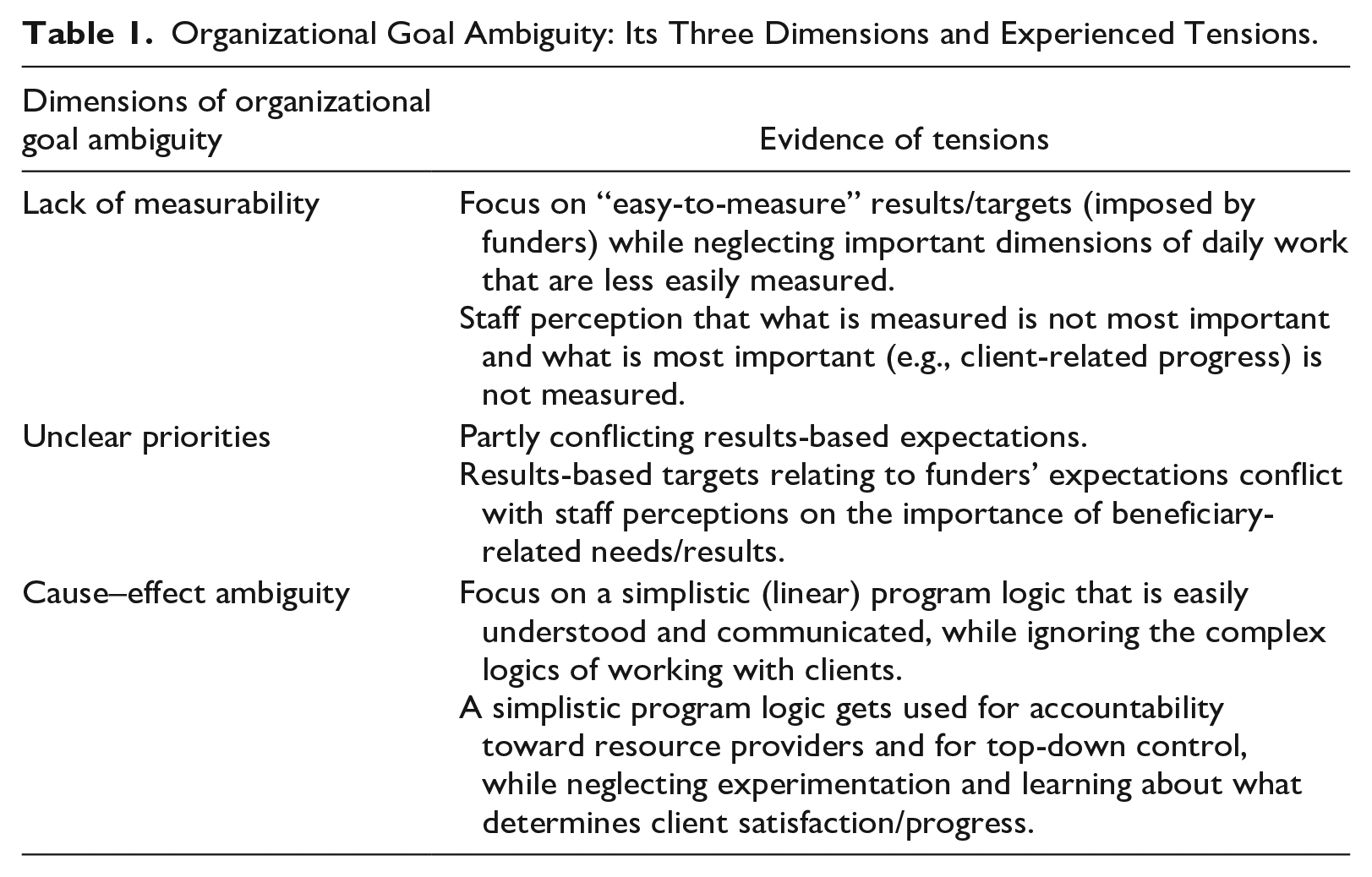
Prior literature has identified different dimensions of ambiguity in an organization’s overall goal system (Botti & Monda, 2019; Chun & Rainey, 2005; Jung, 2012; Song et al., 2020). The first such dimension refers to the lack of valid and objective performance indicators that provide information about the extent to which the organization achieved or made progress toward achieving its mission (lack of measurability). Second, an organization’s overall goal system may involve different dimensions with unclear priorities. Multiple goals do not as such create ambiguity if consistent aggregation or prioritization is possible. However, when an organization’s goals are uncorrelated or even conflicting, then goal priorities can be ambiguous (unclear priorities). The third dimension of organizational goal ambiguity refers to the amount of vagueness in the links between activities and organizational outcomes. This third dimension has been used in different disciplines with slightly different meanings and under different names, such as “knowledge of cause–effect relations,” “knowledge of the transformation process,” or “task programmability” (Merchant & Van der Stede, 2017; Thompson, 1967). High ambiguity in this dimension means that there is a high lack of clarity on which activities of individuals, teams, or organizational units make organizational mission achievement more likely (cause–effect ambiguity).
Results-Based Management When Goals Are Highly Ambiguous: Evidence on Tensions
Evidence from nonprofit organizations illustrates the challenges and tensions associated with employing results-based management under high organizational goal ambiguity. According to a study by Benjamin (2012), strong reliance on outcomes leads to a neglect of highly important but difficult-to-measure dimensions of daily work, such as relationship building with clients. Moreover, the multiplicity of results-based targets derived from incompatible demands of stakeholders creates tensions among staff. In dealing with multiple relevant goals that differ in terms of their measurability, organizations tend to focus on easily measured task results (such as number of clients served or client satisfaction), and such a focus leads to staff perceptions that results-based measurement neglects important dimensions of their work (Carman & Fredericks, 2008; LeRoux & Wright, 2010; Morley et al., 2001).
Similarly, Carnochan et al. (2014) provide evidence that results-based management in nonprofits commonly does not incorporate the perspectives and experiences of frontline staff as system users, thus creating tension between funder-mandated measures and data that would be considered useful by staff. Benjamin and Campbell (2015) conclude in their study that results-based management practices tend to focus on the program logic that is used in communications with external stakeholders, while client-defined, short-term outcomes that do not immediately link in with this program logic are largely ignored. The focus on measurable results and easily understood (linear) relationships is charged with preventing experimentation and internal learning about more complex relationships (Benjamin, 2012). This point is also illustrated by the director of a special education school:
For example, you want someone to become toilet trained when they come to the school not trained. That’s pretty quantifiable. How many days are they dry? But what about, Is the child less agitated? That’s much more difficult to quantify. So you have to say, How many seconds they can sit quietly without jumping up and running across the room screaming? Grantees and regulators want quantifiable measures unfortunately, and don’t want to know about the children’s real progress. (Hwang & Powell, 2009, pp. 289–290)
Moreover, the study by Hwang and Powell (2009) points at the negative motivational effects of applying results-based management under high organizational goal ambiguity. They report on staff complaints about extensive assessments to document changes in behavior, where many of these formalized assessments “are simply frustrating and a lot of baloney” (p. 294) and do not measure real change and how the services make a difference in people’s lives. The three dimensions of organizational goal ambiguity and the related tensions described in prior literature are shown in Table 1.
Organizational Goal Ambiguity: Its Three Dimensions and Experienced Tensions.
Dedication to Values as a Particular Characteristic of Nonprofits
Nonprofits frequently rely on values (Chen et al., 2013; Rothschild & Milofsky, 2006), and some authors even describe this dedication to values as the most basic feature of nonprofit organizations (Chen et al., 2013; Frumkin & Andre-Clark, 2000; Moore, 2000). In their study of human services organizations, Frumkin and Andre-Clark (2000) argue that dedication to values is a characteristic that materializes in provided services and helps to differentiate those provided by nonprofits from similar services of for-profit organizations in industries where both compete.
Values play a role in all kinds of organizations, but the one they play in nonprofits is very different from profit-seeking companies. Value-driven companies commonly focus on values, such as product quality or service orientation, while nonprofits typically focus on ethical, moral, and religious values like justice, human dignity, and service (Jeavons, 1992, p. 406). Furthermore, while profit-seeking companies commonly use values as a means to an end—that is, to be even more successful in terms of their intended outcomes, such as profit or market share—nonprofits frequently consider values as an end in itself and as a core reason for their existence (Chen et al., 2013; Rothschild & Milofsky, 2006).
Values are a person’s “internalized belief about how he or she should or ought to behave” (Meglino & Ravlin, 1998, p. 354) and, thus, values are fundamental guiding principles for human behavior (Kraatz et al., 2020; Schwartz, 1992). Literature has characterized values as very broad, situation-independent goals (Kraatz et al., 2020; Latham, 2007; Schwartz, 1992).
A number of empirical studies on nonprofit work have provided important case-based evidence on the central role of values in nonprofit organizations. Building on these insights, the following section will develop a conceptualization of “Dedication to Values” as a property of an organization’s mission that is characteristic of nonprofit organizations. Moreover, it is argued that an organization’s dedication to values involves a high degree of organizational goal ambiguity. While organizational dedication to values is not the only source of goal ambiguity in nonprofits, it is one that is highly characteristic of nonprofit organizations.
A Conceptualization of Dedication to Values: Guide, Change, and Express
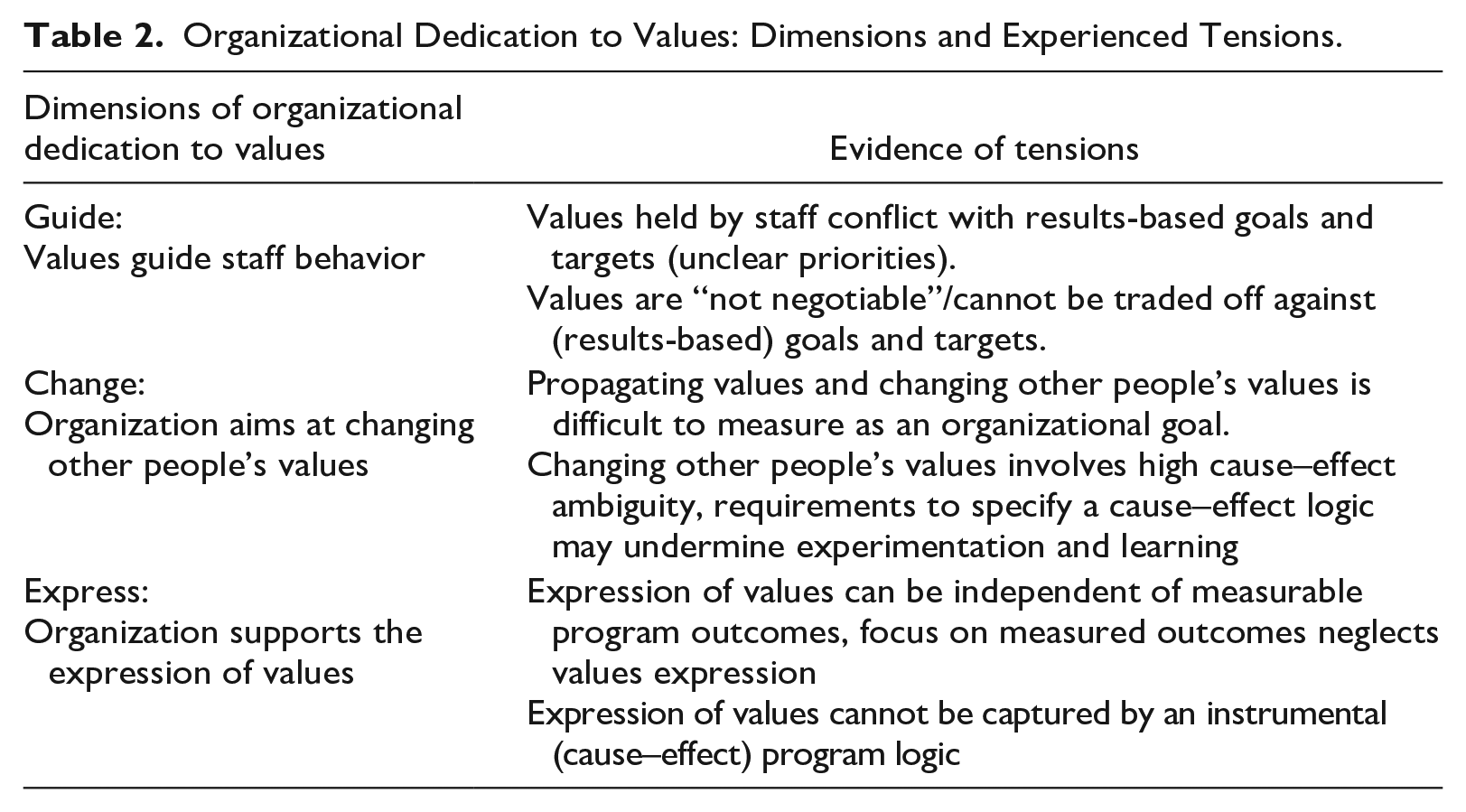
An organization’s dedication to values can reveal itself in different forms. First, organizations rely on values to shape and guide the behavior of those who work for it (guide). Organizations differ in the extent to which they focus on values for shaping and guiding staff behavior (see, e.g., Merchant & Van der Stede, 2017). The guiding function of values already becomes visible when organizations select those individuals who best fit the organization through self-selection mechanisms or effortful recruiting processes that focus on the fit between recruits’ values and organizational values. Potential candidates may, for example, have to work on a trial basis to check if their values fit before they are offered permanent positions. Values statements that are written down and communicated to potential candidates support self-selection and provide orientation to all members of the organization. Moreover, socialization processes play an important role in illustrating and exemplifying values through ongoing interaction and communication among organizational members. Prior research has provided evidence on the particular importance of all these mechanisms in nonprofit organizations, thus illustrating how their dedication to values becomes visible through the guiding function of values (Handy & Katz, 1998; LeRoux & Feeney, 2013; Willems, 2014).
Second, an organization’s dedication to values can manifest itself in its purpose of changing other people’s values and attitudes (change). Organizations, such as faith-based organizations, social movements, and social change organizations, seek to propagate their values, they aim to reshape society according to their desired values, they organize people who share certain values that they believe are not sufficiently supported by other organizations or the state, or they even seek to alter the values of the whole rest of the society (Chen et al., 2013; Greenspan et al., 2022). Other organizations, such as self-help groups, try to effect change in their own members’ values, attitudes, and actions. In their empirical study, Carnochan et al. (2014) provide comprehensive evidence from nonprofit human service organizations on the important role of changing clients’ attitudes and values in their daily work with clients.
Third, dedication to values can become apparent in the organization’s purpose of enabling its supporters to express their values and beliefs (express). A number of studies have pointed at the expressive nature of nonprofit work, that is, how attitudes and values become visible in activities beyond measurable program outcomes and an instrumental (cause–effect) program logic (Benjamin & Campbell, 2015; Frumkin & Andre-Clark, 2000; Knutsen & Brower, 2010). Organizations may, as a matter of principle, encourage their members to express and debate their values and they may help their members to express their values with likeminded people (Knutsen & Brower, 2010). Organizations can also help their members and other participants to build collective identity and commitment to shared values where the very act of campaigning for values, such as human rights, generates a sense of gratification for participants (Chen et al., 2013). Table 2 shows the three dimensions of dedication to values.
Organizational Dedication to Values: Dimensions and Experienced Tensions.
These three dimensions of dedication to values partly overlap and interrelate, and organizations differ in the extent to which they emphasize each of the three. For example, Christian values are important in a Christian nursing home in guiding the organization’s staff in their daily work, while the intention to change other people’s values and to enable organizational members to express their own values may well play a role, albeit not the main one. By contrast, a human rights organization may see propagating, spreading, changing, and expressing values as the main reason for its existence.
Dedication to Values Involves Goal Ambiguity
Since values are fundamental, situation-independent, and very broad principles of human behavior (Kraatz et al., 2020; Latham, 2007; Schwartz, 1992), they involve considerable ambiguity. More specifically, dedication to values involves all three forms of goal ambiguity, namely, lack of measurability, unclear priorities, and cause–effect ambiguity.
When it comes to their function of guiding human behavior, values only give very imprecise direction for behavior. Moreover, values frequently involve unclear priorities, disagreement, and even conflicts over priorities in concrete situations (Chen et al., 2013).
When organizations aim at changing other people’s values (the change function of dedication to values), it is difficult to assess, how effective and how enduring values are changed, and how such change can be measured. For example, in their empirical study among nonprofit human service organizations, Carnochan et al. (2014) report of staff in direct contact with clients raising the issue that data on progress in youth attitudes toward drug abuse, abortion, education, or homelessness and other changes in attitudes and values, are hard to capture and the requirement to measure such changes is problematic. Other empirical studies argue that the first important step toward desirable changes in attitudes and values is the building of relationships and trust between staff and clients. These processes of social interaction between staff and clients are highly complex and are based more on experimentation than on the (top-down) implementation of a program derived from known cause–effect relationships (Benjamin & Campbell, 2015; LeRoux & Wright, 2010; Morley et al., 2001). In other words, the processes of changing other people’s values involve high cause–effect ambiguity.
Just the same, values expression is a process that is very difficult to measure and it is unclear whether the processes of values expression follow a cause–effect logic at all. Prior literature has argued and provided evidence that the processes of how organizations support the expression of values involve high cause–effect ambiguity and the outcomes of such processes are very difficult to measure (Chen et al., 2013; Knutsen & Brower, 2010; Rothschild & Milofsky, 2006).
The Tension Between Dedication to Values and Dedication to Results
Referring to a study of a human services organization for persons with severe and persistent mental illness, Benjamin and Campbell (2015, p. 997) illustrate how staff prioritize values of client autonomy and integrity even at the expense of client progress as an intended result of their work:
Even if I wish they would make a different choice it is still their right, their integrity. I always try to preserve someone’s integrity because I think historically we’ve been way too quick to take away people’s civil liberties, especially people with mental illness.
Frumkin and Andre-Clark (2000) vividly illustrate how compliance with values may conflict with results-based goals using the example of a training and job placement center for young people. Staff at the center may perceive the requirement to deliver measurable results in terms of the number of placements as an implicit pressure to “cream” clients, that is, to focus on the more employable clients who are easy to deal with and promise higher placement rates. However, they may also feel that such a creaming strategy contradicts the organization’s overarching values of humanity, equality, and respect for human dignity, which may be interpreted as a preference for serving those who are most in need (Frumkin & Andre-Clark, 2000, p. 151). In line with the definition of values as fundamental beliefs and the long-term determinants of the more situation-specific ranking of (results-based) goals (Kraatz et al., 2020; Schwartz, 1992), it may seem infeasible to trade-off values against results-based goals.
Dedication to Values and Staff Role Ambiguity
Dedication to values is an organizational-level characteristic that refers to an organization’s mission and goals. As argued above, an organization’s dedication to values involves organizational goal ambiguity. The following section theoretically links dedication to values and organizational goal ambiguity as two organizational-level constructs with staff role ambiguity, that is, perceived unclarity about individual job roles, which is an individual-level construct.
As pointed out by research in performance management (Merchant & Van der Stede, 2017), even employees who fully share the organization’s values and its broader mission, may experience a lack of direction problem, as it can be very difficult to decide in a particular situation, which activities are in the best interests of the organization, what is expected from the individual or the team, and which activities and results are considered good performance. While values provide general guidance, they only deliver very imprecise information for decision-making in organizations. More specifically, values are not situation specific (by definition), and thus, they do not provide clear direction to staff on how to prioritize action choices in a given situation (Gerdin et al., 2019). In other words, when organizations largely rely on values for guiding and shaping staff behavior, their staff likely experiences high ambiguity on what is the right thing to do in a particular situation.
Moreover, when an organization shows high dedication to values by a mission that focuses on changing other people’s (clients’ or program participants’) values or that focuses on values expression, it even creates more ambiguity at the individual level. As the empirical evidence from nonprofit organizations cited above vividly illustrates, the processes of changing other people’s values and expressing values through joint activity within organizations are highly ambiguous, and staff whose job roles also refer to such processes will have difficulty in assessing the extent to which they have fulfilled these roles appropriately. The lack of information or clarity on what is expected from an individual who performs a certain job role within an organization has been discussed at length in organizational psychology as a main role stressor, known as role ambiguity (Rizzo et al., 1970).
Operationalizations of role ambiguity typically refer to the lack of clear, situation-specific goals, uncertainty about criteria for assessing one’s performance, and lack of clarity about job related expectations of colleagues or superiors (Rizzo et al., 1970; Schmidt et al., 2014). Taken together, the above deliberations suggest that an organization’s high dedication to values is associated with high role ambiguity among staff.
Results-Based Management in Organizations With High Dedication to Values Decreases Role Ambiguity but Generates Role Conflict
Literature on performance management has argued and provided persuasive evidence that results-based management can overcome role ambiguity. According to the definition provided above, results-based management systems specify (a) measurable task results that are controllable by individuals/teams and (b) a (cause–effect) logic of how these task results link with higher-level and overall organizational results. When results-based goals and targets as well as cause–effect relationships on how their activities affect organizational mission achievement are communicated to individuals, this information increases their role clarity and thus avoids the negative effects of role ambiguity (Endrikat et al., 2020). Hall (2008) argues and demonstrates that providing staff with information on the desired results of their work does indeed increase role clarity. Likewise, providing information on the drivers of performance and on how activities contribute to outcomes across the value generation process helps staff to comprehend their own role within the organization, to see the “big picture,” and to understand how different parts of the organization work together to create desired overall outcomes. Moreover, Gerdin et al. (2019) provide evidence that results-based management may be particularly useful for organizations with high values’ orientation and they point at the possible complementarities of combining values orientation with results-based management. Overall, this prior research supports the expectation that results-based management can mitigate the negative effect of organizational dedication to values on role ambiguity experienced among staff.
While results-based management provides staff with additional information on their job roles, this information does not necessarily deliver consistent and univocal guidance. As argued above, an organization’s high dedication to values goes hand in hand with high organizational goal ambiguity (i.e., a lack of measurability of the organization’s mission and overall goals, unclear priorities, and ambiguous cause–effect relations). Under high organizational goal ambiguity, results-based management has to rely on those results that can be specified, measured, and plausibly linked with measurable lower-level results of individual or team tasks. As widely discussed in existing literature (e.g., Ebrahim, 2016) and illustrated by the aforementioned empirical evidence, such a focus on “quantifiable” results and a simple, easy-to-communicate program logic is frequently encouraged by the accountability requirements imposed by resource providers. Existing literature points out that a simplistic results-based logic may then easily conflict with the far more ambiguous processes of creating results that are related to the well-being and progress of clients and other beneficiaries (e.g., Benjamin, 2012; Carman & Fredericks, 2008; Carnochan et al., 2014; Morley et al., 2001).
As argued above, providing staff with information on desirable results clarifies what is expected from them. However, neglecting the complex relationships and difficult-to-measure outcomes that they experience in their daily work with clients while imposing on them a simplistic results-based description of their job roles, reinforces the perception of incompatible demands among staff and volunteers in nonprofit organizations. Staff may feel forced to compromise on their own experiences and knowledge about their daily work to fulfill the role expectations imposed by a simplistic, results-oriented program logic driven by external accountability requirements.
As illustrated in the above example of a job training and placement center, when staff feels that a focus on easily measured results, such as placement ratios, is even in conflict with their own values, this further strengthens the perception of incompatible demands. Staff may even feel that good job performance is only possible by compromising on their values. Feeling forced to tradeoff deeply held values against measured results may lead to extremely frustrating perceptions of incompatible job demands.
In contrast to role ambiguity that refers to an individual’s lack of information on expected behavior in a job, the perception of multiple incompatible job-related demands is referred to as role conflict (Gilboa et al., 2008; Rizzo et al., 1970; Schmidt et al., 2014). Overall, the above deliberations thus lead to the expectation that increased use of results-based management in organizations with high dedication to values (and, accordingly, high organizational goal ambiguity) tends to increase the perception of role conflict among staff.
Role ambiguity and role conflict are the two main and most widely discussed role stressors. While these two role stressors have been shown to be different constructs that relate to different work conditions (although they may also overlap under certain work conditions), both have been shown to be associated with emotional exhaustion, job dissatisfaction, and even burnout (Gilboa et al., 2008; Peiro et al., 2001; Schmidt et al., 2014; see also Bang et al., 2023).
Propositions 1 to 3 suggest that organizational dedication to values is associated with role ambiguity among staff, and trying to reduce such role ambiguity through the use of results-based management comes at the cost of a higher chance of role conflict among staff. Since both role ambiguity and role conflict have been associated with a number of undesirable consequences for staff well-being and organizational performance, the obvious question then is, whether results-based management can be designed in a way that generates more role clarity while minimizing the described negative effects on role conflict. The following section builds on performance measurement research to distinguish diagnostic and interactive use of results-based management, arguing that role conflict is primarily created by diagnostic use, whereas interactive use can help to avoid role conflict while still improving role clarity.
Diagnostic Versus Interactive Results-Based Management
Literature on performance management distinguishes two main ways of using the information generated by results-based measurement. The first, diagnostic use, assumes a cybernetic logic according to which results-based targets are set top-down to monitor subordinate units and compare achieved results with preset targets. In case of deviations, corrective action is taken to bring performance back in line with preset targets. When results-based measures, however, are used interactively, results-based measures are employed to facilitate discussion and communication between managers and staff across all hierarchical levels of the organization, to continually challenge and debate underlying data, assumptions and action plans, and to incorporate the preferences and views of lower-level managers and staff (Merchant & Van der Stede, 2017; Simons, 1995). Table 3 shows typical indicators that have been used in prior empirical research to reflect diagnostic and interactive use, respectively (see Henri, 2006; Müller-Stewens et al., 2020).
Diagnostic vs. Interactive Use of Results-Based Information.
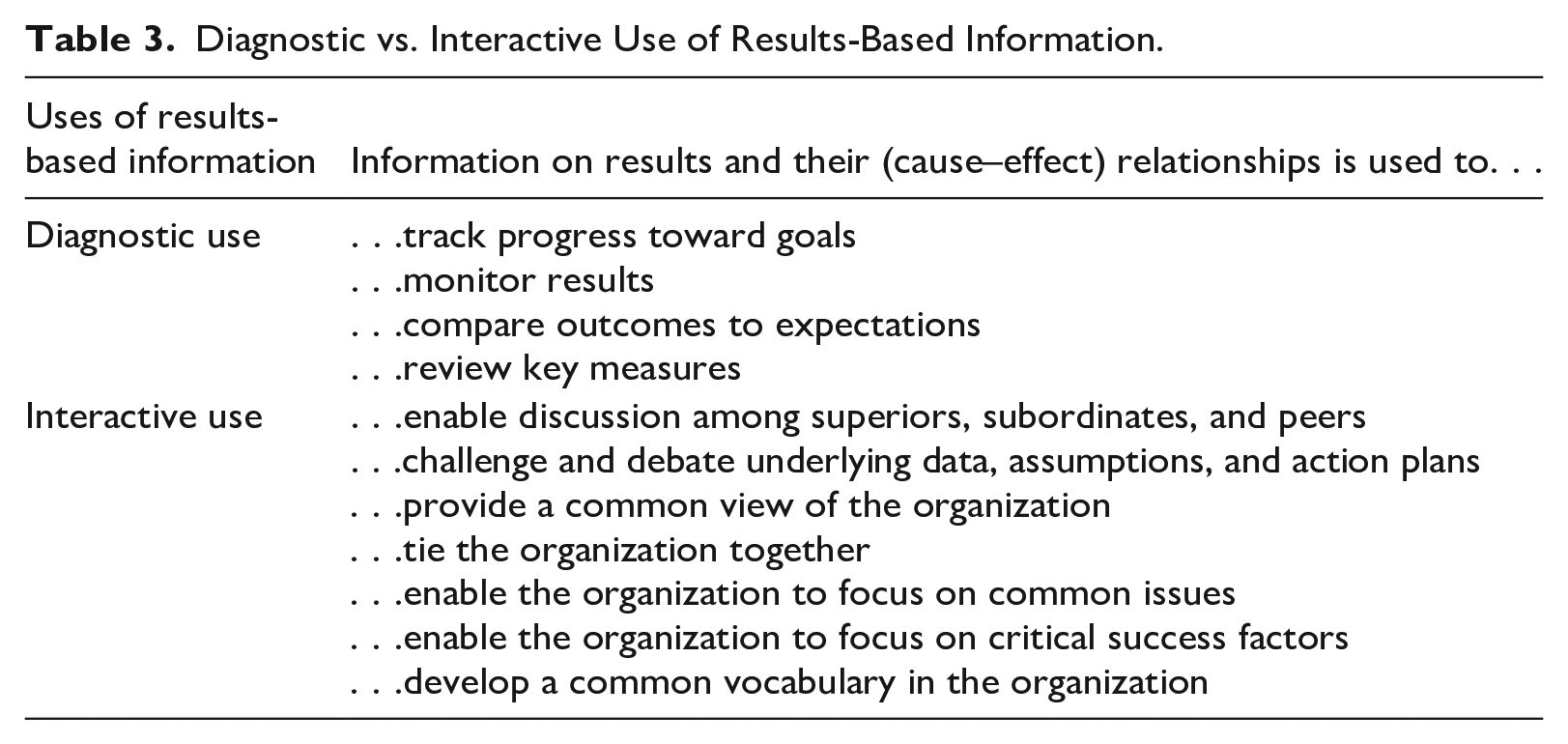
Diagnostic use of results-based information assumes well-defined organizational objectives and aims at aligning staff behaviors with these objectives. If there is a clearly defined system of organizational objectives in place as well as a clear way to cascade these objectives down into lower-level results and targets, then diagnostic use of results-based information is a very effective means of translating organizational goals into staff behavior following a “you get what you measure” logic (Merchant & Van der Stede, 2017; Simons, 1995).
In contrast to diagnostic use, interactive use of results-based information does not require a well-established goal system. Instead of using results as targets, it uses them for learning about the meaning of particular goals and the relationships between goals, thus following a “you learn what you measure” philosophy. The measured results and assumed relationships between results are continually reviewed, discussed, and adjusted. Prior empirical research has confirmed that interactive use of results-based information is associated with learning processes on how to define relevant results that can be measured, and how activities and results link with each other in generating organizational-level results (Endrikat et al., 2020).
Interactive use of results-based information stimulates opportunity seeking and encourages new ideas, initiatives, and experimentation at all levels (Simons, 1995). It has been argued that interactive use of results-based information helps managers and staff to align their mental models of how the organization functions and which activities are best suited to achieve its mission (Hall, 2008; Merchant & Van der Stede, 2017; Simons, 1995). Such mental models are typically shaped by individual experiences. They are also likely to differ across staff and such differences, if not coordinated, can create misunderstandings, disputes, and frustration (Willems, 2016). Updating and coordinating mental models can help to improve role clarity without creating role conflict.
In organizations with a clear and measurable goal system as well as clear cause–effect relationships, diagnostic use of results-based information can provide staff with very precise information on role expectations. However, when organizational goal ambiguity is high, using results-based information diagnostically and holding staff accountable for results can be problematic, because staff may feel that the prescribed results do not reflect the realities of their daily job. In contrast, interactive use of results-based information enables staff and managers to learn about cause–effect relations and helps them to align their views on how the organization can best achieve its mission.
Importantly, when dedication to values is high, managers and staff can use results-based information as a basis for discussing what value-congruent behavior means in a particular situation and which outcomes a team or the whole organization should strive for to live and express its values. The permanent process of debating and challenging assumptions while trying to find shared views of what should be done and what should be achieved (which is at the core of interactive use of results-based information) can be expected to overcome role conflicts regarding held values, and how these values are interpreted and applied in specific situations. Externally imposed views of resource providers can be scrutinized and adjusted to internal views. By translating internal views into a results-based logic, external views can more easily be corrected or adjusted in discussions with resource providers. Overall, when organizations with high dedication to values make more interactive use of results-based information, role conflicts among staff are expected to be lower than under highly diagnostic uses.
Rethinking Results-Based Management in Values-Focused Organizations
The following two examples of nonprofits that initiated a more interactive use of results-based management neatly illustrate how organizations can substitute an existing diagnostic results-based management system by a more interactive one. Moreover, these examples clarify the difference between diagnostic an interactive use of results-based information and they illustrate how interactive use can help to align values orientation with results orientation, thus increasing role clarity while avoiding role conflict.
Guter-Sandu and Mennicken (2022) provide evidence from privatized prison services in England and Wales, which illustrates how diagnostic results-based management can develop into more interactive uses aimed at incorporating values into results-based management. In the 1990s, these private prison services introduced a diagnostic results-based management system that included the number of prison escapes, the number of assaults on staff and other prisoners, the number of hours spent in purposeful activity, as well as financial numbers, such as the average cost per prisoner place. Over the following years, more and more measures were included, and from 2003 onward, prison performance measures of safety, security, rehabilitation, and economic efficiency were put together into a Balanced Scorecard-type weighted rating of overall prison performance. This rating was used to identify high-performing prisons that received a “star rating” as well as poorly performing prisons that were given 6 months to bring their performance back in line with preset targets—a typical example of diagnostic use of results-based information. The associated pressure to achieve results and meet targets at the individual prison level translated directly into a purely diagnostic results-based daily management system, where results were used to track progress, monitor operations and compare actual numbers with preset targets (see Guter-Sandu & Mennicken, 2022).
As a reaction to increasing criticism of these performance metrics for leaving “crucial questions of moral responsibility and individual transformation untouched” (Liebling, 2004, p. 26), the prison services rolled out a project for “moralizing” prison performance metrics in 2012. In contrast to their previous diagnostic use, results-based measures were now used more interactively to “link up and mediate between conflicting concerns and prison values, such as those of security, economy, and decency,” and “to bring prison values relating to questions of rehabilitation, care and decency back in” (Guter-Sandu & Mennicken, 2022, p. 319). Results-based measures were used to enable a well-informed discussion about how effective the organization was in supporting the individual transformation and rehabilitation of prisoners (changing their values and attitudes) and how certain values, such as care and decency, materialize in observable outcomes of work with prisoners. Thus, results-based measures were used to discuss effectiveness regarding the changing values as well as the guiding behavior dimensions of dedication to values. The study also illustrates how performance measures increasingly served as a platform for debate about prison values and reform. Moreover, by introducing a standardized survey of prisoners’ perceptions, the measurement system was intended to capture their day-to-day experiences and give them “a voice” in results-based measurement. This indicates a shift away from a results-based measurement system that is only focused upward on the views of resource providers toward a better inclusion of the (downward) perspectives of prisoners. While the system users were well aware that such quantification is inevitably reductionist, it enabled the inclusion of multiple voices into debates (e.g., with resource providers) where they would otherwise have not been heard (Guter-Sandu & Mennicken, 2022).
A second case study on a mental health development program in an international development nongovernmental organization, authored by Chenhall et al. (2017), provides evidence on how the interactive use of performance measures on beneficiary well-being can help to clarify how measured results reflect held values, and how results-based measures can even support the expression of values by staff and volunteers. According to this study, the (interactive) process of reviewing and reflecting on beneficiary-related indicators prompted discussions among staff and volunteers on which indicators are useful for measuring certain aspects of beneficiary well-being and how these measures of well-being conform with the values of patient self-determination, respect, and dignity. These discussions led, for example, to the development of a new indicator to measure the extent to which patients clearly articulate their needs, what they want, and what they do not want (e.g., staying in bed when they are not sleeping or certain medications), thus measuring the involvement of patients in their own care and treatment. Such performance measures, though reductionist and incomplete, were seen as results of observing values, such as respect and dignity when treating patients, and their mere inclusion into the performance measurement system was even seen by staff as an act of expressing these values (see Chenhall et al., 2017).
Conclusion
Existing literature on the management of profit-seeking companies has widely portrayed results-based management as a solution to the problem of how superiors can ensure that their subordinates act in the best interest of the organization when the subordinates do not share the (profit-related) goals of the organization and when direct supervision is too costly (e.g., Eisenhardt, 1985; Merchant & Van der Stede, 2017). Numerous empirical studies across the nonprofit sector (some of these studies were presented above), however, indicate that this fundamental conflict of interest between organizational goals and employee goals may not be the typical situation faced by nonprofit organizations. Rather, nonprofit organizations commonly have the advantage of high alignment between the organization’s mission and their staff (e.g., Handy & Katz, 1998; Speckbacher, 2013). As a consequence, the rationale behind using results-based management, as well as the evaluation of its benefits and downsides need to be adapted to the particular characteristics and specificities of nonprofit organizations.
While nonprofit organizations often enjoy the benefit of having staff and volunteers who broadly share the organization’s values and goals and who are intrinsically motivated to act in accordance with these values, the downside is relatively high ambiguity when it comes to translating the organization’s core values and mission into situation-specific task-related goals and into concrete behavior (Proposition 1). Providing staff with information on desirable task results and their assumed relationship with organizational mission achievement (i.e., making use of results-based management) reduces such role ambiguity, but it creates role conflict (Propositions 2 and 3). Such role conflict can arise from conflicting results-based targets or, more seriously, from results-based targets that contradict the values held by staff. According to the above deliberations, the solution to this problem is interactive (rather than diagnostic) use of results-based information. Interactive use helps to reduce role ambiguity while avoiding role conflict (Proposition 4).
While the conceptualization of organizational dedication to values along three dimensions provides a starting point for future empirical work to test the proposed theoretical model (established measures exist for all other constructs used in the propositions above), future case-based research is needed to better understand how nonprofit leaders and managers can establish best practices of interactive use of results-based information for creating a shared understanding of the meaning of results, and values as well as the processes for their creation and expression.
Footnotes
Declaration of Conflicting Interests
The author(s) declared no potential conflicts of interest with respect to the research, authorship, and/or publication of this article.
Funding
The author(s) received no financial support for the research, authorship, and/or publication of this article.
