




Abstract
Nonprofit activity produces social benefits, brings engaged actors in social networks, and promotes a sense of community and belonging by instilling shared values and norms, resulting in community trust and support back to the nonprofit. This reciprocal pattern of community building features the nonprofit role in building social capital. Social capital develops in interaction with the entrepreneurship context. Social entrepreneurial models of nonprofit learning and innovation demonstrate the potential of new entrepreneurial methods and market opportunities to help organizations achieve desired social impacts. This article adds a discussion on nonprofit missions as a vehicle driving nonprofit learning and innovation to be motivated to facilitate community building. By developing a moderated mediation model, we propose that value-instilled innovation from the interactive form of learning and shared mission enhances the nonprofit role in building social capital. The findings support the hypothesized relationships, producing implications for the community-building motivation of nonprofit organizations.
Introduction
Nonprofits are facilitators and agents of social capital (Bryce, 2006; Moulton & Eckerd, 2012; Weisinger & Salipante, 2005). Although social capital is defined in many ways and dimensions, it simply refers to the common values and resources of social networks that establish a sense of community and belonging with shared norms, trust, and reciprocal relationships. At the community level, social capital is illustrated by the collective ability to promote civic engagement in generalized reciprocity, in which engaged actors cooperate to build social relations and produce and benefit from common goods and values (Adler & Kwon, 2002; Hoyman et al., 2016; Portes, 2000; Putnam, 2000). The justification of nonprofit activity is much founded on a variety of social causes and unmet services in community-building dimensions. That is, nonprofit services seek community-engagement goals broadly categorized into public-serving, voluntaristic, and member-serving (Frumkin, 2002, p. 9). Their activities promote social values, trust, and shared norms while providing associational benefits and opportunities to the serving community (Putnam, 2000), which are then paid back to the nonprofits (Hyde et al., 2016). When a nonprofit enriches communitywide association activities through value-laden services, the activity context builds social networks in trust and promotes a sense of community and belonging.
The creation of community social capital unifies nonprofits’ expressive and instrumental goals (Bixler & Springer, 2018; Bruneel et al., 2020) as nonprofit sustainability is determined by community-based market economies. Knutsen and Brower (2010) articulate the nonprofit dual accountabilities featured as resource-seeking (instrumental) and value-seeking (expressive) activities. While market-focused and value-creating practices are often disjointed (Mosley, 2020; Sanders, 2015), nonprofit effectiveness largely hinges on how they align divergent goals.
Much research underscores social entrepreneurial models of nonprofit management as catalysts for ensuring ongoing engagement with both the community and the market through learning new knowledge and methods (Bruneel et al., 2020; Guo & Bielefeld, 2014; Weerawardena & Mort, 2012). The findings rest on assumptions of how nonprofits maintain their learning processes for the ongoing adoption of new models and how they align the operational competencies with their expressive role performance. Nonprofit learning and innovation improve service provision and expand market opportunities, leading to increased community and stakeholder engagement. Therefore, how a nonprofit facilitates social capital depends on the learning and innovation processes to advance the adaptive mobilization of resources, staff, stakeholders, and competencies for addressing the social cause and needs.
Despite the recent knowledge accumulation in reconciling the market-value conflicts facing the nonprofit sector, some studies note that new entrepreneurial priorities concerning marketization and competitive edges can jeopardize less profitable activities (Eikenberry & Kluver, 2004; Seo, 2020). That is, applying strategic changes and new methods is not always instrumental to enhancing their expressive performance. Even with the social entrepreneurship context for social capital creation (Bruneel et al., 2020), it is important to clarify how innovations become focused on enlarging a particular community-building domain.
Mission fulfillment as the expressive orientation may hold up the interdependence between the social value potential and the market potential of nonprofits (Beaton, 2021; Dart, 2004). For each nonprofit, the social justification for operation rests on its mission (Kravchenko & Moskvina, 2018; Sanders, 2015). The nonprofit mission sets the organization’s end goal to serve the social cause and is realized through community engagement oriented to the mission (Kirk & Nolan, 2010). As nonprofit missions ever change either explicitly or implicitly along the changing value propositions and interpretations, managing shared mission conceptions is critical in arranging organizational activities and resources (Beaton, 2021; Berlan, 2018; McDonald, 2007). The shared mission thus inspires mission-driven efforts in management, which in turn mobilizes innovative capacity for community engagement.
Taken together, we ask: Does shared mission in a nonprofit guide its learning and innovation impacts to be instrumental to social capital creation? Our conceptual framing proposes that nonprofits animating their learning and innovation practices instilled with a shared mission orientation would well perform the nonprofit role in facilitating community social capital. This study develops a moderated mediation model and conducts a structural equation modeling analysis. With the findings, we discuss how nonprofits successfully engage in community building.
Social Capital and the Nonprofit Sector
Defining Social Capital
Conceptualizations of social capital begin with a foundation of knowledge laid by social and organizational theorists (Adler & Kwon, 2002; Bourdieu, 1986; Burt, 1992; Coleman, 1988; Portes, 2000; Putnam, 2000). Bourdieu (1986, p. 248) initially defined social capital as “the aggregate of the actual or potential resources which are linked to possession of a durable network” of social–relational interactions in reciprocity to distinguish it from economic and cultural capital. The mutual benefits of the network mobilize membership recognition, engagement, and solidarity, expanding network connections. Burt (1992) clarifies the mutual resource-exchanging aspect of social networks through key connecting actors—structural holes. The bridging feature of social capital connects and explores more resources and opportunities brought by having diverse people and groups with dissimilar profiles join, develop, and benefit from social networks (Hwang & Young, 2022; Weisinger & Salipante, 2005).
In addition to bridging social networks, social capital also encompasses bonding characteristics of networked actors sharing in-network outcomes (Coffé & Geys, 2007). Coleman (1988) extends Granovetter’s (1985) network theory of embeddedness that assumes independent individual actions are embedded in structures of social relations. He suggests the collective structure of social relations established through the functioning of enforceable social orders (i.e., norms), information sharing, values, and trust. The networked actors bond together and reinforce community building in social relations. They share civic values, resources, and important collective goods while enforceable in-network norms and strong ties are configured in the homogeneous community membership (Adler & Kwon, 2002).
The aggregate of social networks is variously scaled, ranging from individual and organizational interactions for resource exchanges (Kwon et al., 2013; Tsai & Ghoshal, 1998) to local-level collective assets enriching community development (Hoyman et al., 2016; Hwang & Young, 2022; Paarlberg & Yoshioka, 2016). With the conceptual stretch between the individual and community networks, social capital is characterized as “an attribute of the community itself” (Portes, 2000, p. 3), created by civic members’ coordinated efforts (Putnam, 2000). The community characteristics determine public-owned trust, norms of reciprocity, and network resources to be shared by community members. The society builds its generalized reciprocity—communitywide trust in the availability of public assets functioning beyond mere bilateral resource exchanges—that exists as the community reservoir for social development (Putnam, 2000).
Combined, our conceptualization focuses on the community-building features of social capital through both bonding and bridging orientations of engaged members (Coffé & Geys, 2007; Putnam, 2000). Civic engagement bonds and bridges actors for social cohesiveness as well as development outcomes (Hoyman et al., 2016; Weisinger & Salipante, 2005). Therefore, this study defines social capital as the common values and resources of social networks in various forms that establish a sense of community and belonging. Various forms of social capital include shared norms, values, trust, information and knowledge, associations, and social services that bring together community members (Schneider, 2009) and produce social development externalities in generalized reciprocity (Glanville et al., 2016; Hoyman et al., 2016; Hwang & Young, 2022).
The Nonprofit Role in Building Community Social Capital
Nonprofits facilitate the creation of community social capital (Bryce, 2006; Moulton & Eckerd, 2012; Paxton, 2002; Schneider, 2009; Weisinger & Salipante, 2005). They lead the community-building dynamics as civic engagement with social values and interests is primarily realized through nonprofits’ associational and philanthropic activities (Putnam, 2000). These activities include building trust-based social networks (Moulton & Eckerd, 2012; Schneider, 2009), expressing and advocating social causes and interests (Garrow & Hasenfeld, 2014; Moulton & Eckerd, 2012; Paxton, 2002), and providing social development outcomes (Bhatt & Altinay, 2013; Bryce, 2006; Hoyman et al., 2016). In return, the elevated social capital reciprocates to the nonprofits with enhanced public support for the activities and missions (Fredette & Bradshaw, 2012; Glanville et al., 2016; Hyde et al., 2016; Saxton & Benson, 2005).
The conceptual components of the nonprofit role in building social capital can be organized in relation to subdimensions of social cohesion (Corbin, 1999). Social cohesion refers to the extent of connectedness and solidarity in a community with common goods and values (Cheong et al., 2007). Specifically, social trust, sense of community and belonging, and shared goals and values are combined to characterize social cohesion (Chan et al., 2006; Maxwell, 1996). It thus indicates the extent of community social capital (Kawachi & Berkman, 2000) and specifies the nonprofit role in building social capital (Moulton & Eckerd, 2012).
First, nonprofits build a sense of community by serving their target users and pursuing a mission as a channel for civic engagement (Schneider, 2007). Nonprofit activities ultimately serve their stakeholders as the channel to community philanthropy and resources by which they are bonded to the community (Grodach, 2010). Next, nonprofit organizations promote a sense of belonging by providing an open public place for community members to socialize, share common interests, and pursue common outcomes (Drezner, Pizmony-Levy, 2021; Hausmann et al., 2007). Finally, nonprofits bring together people with diverse backgrounds and interests and connect them in generalized reciprocity (Garrow & Hasenfeld, 2014; Min, 2022). Therefore, nonprofits facilitate social capital in these three community-building dimensions.
Model Development
Learning, Innovation, and Social Capital Creation
Community social capital develops in interaction with the entrepreneurship context (Kwon et al., 2013). Nonprofit organizations serve a community of values by implementing valid operational strategies in the service market, instrumental to the value proposition. Moss and colleagues (2011) emphasize the need for inclusive models to tie the expressive and instrumental roles in harmony. The strategic challenge of nonprofit management lies in navigating these seemingly contradictory expectations (Mosley, 2020).
Social entrepreneurship has received much attention as a social innovation approach to enhancing community involvement of nonprofit organizations (Bhatt & Altinay, 2013; Guo & Bielefeld, 2014). Social entrepreneurship focuses on innovations by nonprofits to explore new revenue sources and methods of service provision to better accomplish their social purposes (Austin et al., 2006; Morris et al., 2011). A growing body of literature particularly addresses the combination of nonprofit learning and innovation as an entrepreneurial instrument in animating value-creation opportunities (Choi, 2014; Liu & Ko, 2012). The ongoing process between learning and innovation mobilizes resources, staff, stakeholders, and professional skills to be aligned for both service provision and community-oriented outcomes, including social capital development (Bhatt & Altinay, 2013; Jaskyte, 2018; Kwon et al., 2013).
Organizational learning links the organization to external knowledge and enables internal members to build collective potential for developing capabilities (Jiménez-Jiménez & Sanz-Valle, 2011). Organizations learn new knowledge and information from peers’ successful strategies, adopt and share this knowledge internally, and store it in their context, theorized as knowledge acquisition, distribution, interpretation, and organizational memory (Huber, 1991). These processes generate new opportunities to develop business models, leading to innovation (Brockman & Morgan, 2003).
Organizational innovation refers to the implementation of new products or services, new processes of producing and delivering products or services, new marketing approaches, and new management systems (Tidd et al., 2005) and is often driven by market-oriented learning (Baker & Sinkula, 2002; Raj & Srivastava, 2016). Raj and Srivastava (2016) suggest that the antecedent role of organizational market orientation guides the learning cycles in promoting innovativeness. Organizational adaptive knowledge employed through the learning processes facilitates the employees to engage in innovative practices.
For the nonprofit context, research suggests that success in innovative practices is prompted by adaptive strategies for addressing the complexity of values, market, governance, stakeholder interests, and resource streams (Choi, 2014; McDonald, 2007). On an ongoing basis of new knowledge acquisition, nonprofit organizations recognize and reach various and changing stakeholders’ needs and demands as feedback information; through the processes of internal distribution and interpretation of the new models, they reflect on their service provision along with adaptive approaches to the environment, resources, and their managerial effectiveness. These new models are finally systemized as organizational memory. Effectively addressing the complications of operational contexts are necessary for nonprofits to secure the resources and attention necessary for innovation (Dover & Lawrence, 2012). The learning processes enable nonprofits to garner and communicate new insights, methods, and market opportunities; establish new knowledge and systems; and adapt to the changing market environments and constituents to implement innovations (Choi, 2014; Liu & Ko, 2012). The adaptability allows for new methods in their service provision. As a result, we hypothesize that nonprofit learning develops innovative capacity:
Organizational innovation is promoted by the salience of social capital as new knowledge, products, and methods are triggered in networks of external partnerships, knowledge exchange, social relations, and stakeholder engagement with shared norms and trust (Landry et al., 2002; Laursen et al., 2012; Tsai & Ghoshal, 1998). Similarly, nonprofit research suggests social capital provides a variety of resourceful and institutional opportunities underlying nonprofit attempts at new models of community engagement (Fredette & Bradshaw, 2012). Guo and Saxton (2014) explored how social media networks change nonprofit advocacy and their public relations strategies. Jaskyte (2018) found nonprofit board roles in strategic involvement, resource acquisition, and networking mediate the relationship between social capital and innovation. Jamali and associates (2011) examined business–nonprofit partnerships and demonstrated that social capital improves innovative collaborations, mediated by corporate social responsibility.
On the contrary, service-oriented social innovations can also facilitate the nonprofit role in enhancing social capital by increasing social development outcomes (Bhatt & Altinay, 2013; Hoyman et al., 2016). These nonprofit innovations include new types of social goods and services, new processes for producing and delivering the goods and services, and new market strategies for nonprofits. The innovations engage the organizations to adopt new entrepreneurial models aligned better with finding and fulfilling unmet community needs (Campbell & Lambright, 2016; Dover & Lawrence, 2012) and reaching the community deficiencies (Nash, 2016). They also encourage organizations to use new social change measures (Ebrahim, 2019) and social development outcomes (Hoyman et al., 2016) as service provision models are established. Mission fulfillment, social impact, and community networks are the social innovation outcomes. The motivation to improve the social value potential of nonprofits drives them to align new entrepreneurial models of operation with community engagement, thus facilitating community social capital:
Organizational learning and innovation have well-established ties to overall performance (Brockman & Morgan, 2003; Evangelista & Vezzani, 2010; Jiménez-Jiménez & Sanz-Valle, 2011). They interact through a mechanism wherein continual learning processes enable the organization to expand resourceful networks, reach out to successful cutting-edge business models, and so generate outcome-oriented innovations for service provision and market strategies, which in turn enhance goal achievement (Jiménez-Jiménez & Sanz-Valle, 2011). Nonprofit innovation is predominantly rooted in market norms with a focus on serving individual organizations, rather than communities, and needs to accompany organizational goals and processes more rooted in social impacts (Shier & Handy, 2015). Expanding resourceful networks and applying external models can encourage nonprofits to recognize a wider range of new opportunities for their community-building roles. Liu and Ko’s (2012) case study delves into the learning processes of social enterprises that develop a new marketing capability, enlarging the networks of engaged stakeholders. The increased market chances stimulate innovative capacity for service provision (Choi, 2014) and develop social networks in which the increased social development outcomes are nurtured and more widely circulated (Schneider, 2009). With the networked resources and models obtained, nonprofits adopt new measures of community engagement to enhance social impacts, bringing more community constituents and benefiting them in generalized reciprocity. As a result, we theorize that innovation serves a mediating role:
Shared Mission and the Effects of Learning and Innovation
Nonprofit organizations’ engagement with entrepreneurial approaches and innovation can be fraught, having the potential to shift these organizations away from their social purposes (Jager & Beyes, 2010; Sanders, 2015). The scholarly literature recognizes the potential gains in capacity and financial performance available to nonprofits from engaging in commercial and entrepreneurial activity. Yet widespread concern exists for the potential that such activity may shift nonprofits away from their social purposes or impede their achievement (Eikenberry & Kluver, 2004; Seo, 2020). To ensure that social entrepreneurial models achieve desired growth in social impacts, managing this potential conflict is critical. We anticipate this is achieved through deliberate management of how nonprofit professionals understand and interpret their mission.
Nonprofits pursue various public purposes laid out in their missions. This can lead to a splintering of how those in the organization define the mission or create personal mission conceptions (Berlan, 2018). Deliberate efforts to forge a shared understanding of the mission can instill the social cause, focus staff competencies, and in turn influence outcomes (Beaton, 2021; Kirk & Nolan, 2010). Efforts to forge a shared mission take the form of sensemaking processes, wherein internal members learn their organization, interpret meanings of various dynamics and practices, and develop cohesive understandings (Jeong & Brower, 2008). Deliberate learning and communication practices that seek to navigate tensions around the mission can help forge common understandings (Berlan, 2018; Sanders, 2015) and frame mission statements to engage staff, contributors, and volunteers (Pandey et al., 2017). These discussions echo the significance of mission as a substantive outlet for nonprofit roles.
Prior nonprofit research supports the benefits of developing a shared mission and the risks from its absence in regard to motivating the instrumental capacity for community building. The absence of clear consensus around the mission may impair the achievement of social outcomes even when operational capacity is high (Dym & Hutson, 2005). Where a shared mission or widespread attachment to the mission is achieved, employee satisfaction (Brown & Yoshioka, 2003), instrumental aims (Frumkin & Andre-Clark, 2000), and innovation (Mazzucato, 2018; McDonald, 2007) are also improved. That is, a shared understanding of value-creating patterns is a unique necessity in nonprofits, which navigates how the instrumental tools can best serve the expressive goal.
In contrast to widespread concerns about the conflicts between commercial and social purposes, recent scholarship has revealed patterns of nonprofits successfully blending the two purposes (Beaton, 2021; Kravchenko & Moskvina, 2018). Shared missions can improve innovation both through more effective communication (Mazzucato, 2018) and by instilling a clear social value orientation (McDonald, 2007). For the mission-supporting innovation, scholars also note that a shared mission facilitates the learning processes such that it effectively guides the organizational sensemaking when assimilating new knowledge and opportunities. This can strengthen the learning–innovation relationship. McHargue (2003) found that nonprofit learning based on a team-sharing dimension is associated with changes in mission performance. This combination indicates the potential of a shared mission strengthening the learning effect on nonprofit innovation. We posit that a shared mission enables nonprofits to apply learning processes more effectively in attending to innovations:
The research hypotheses together form a moderated mediation model for the nonprofit role in building social capital as presented in Figure 1. For the research framework, we add employment and asset size, and industry as control variables explained in the following section.
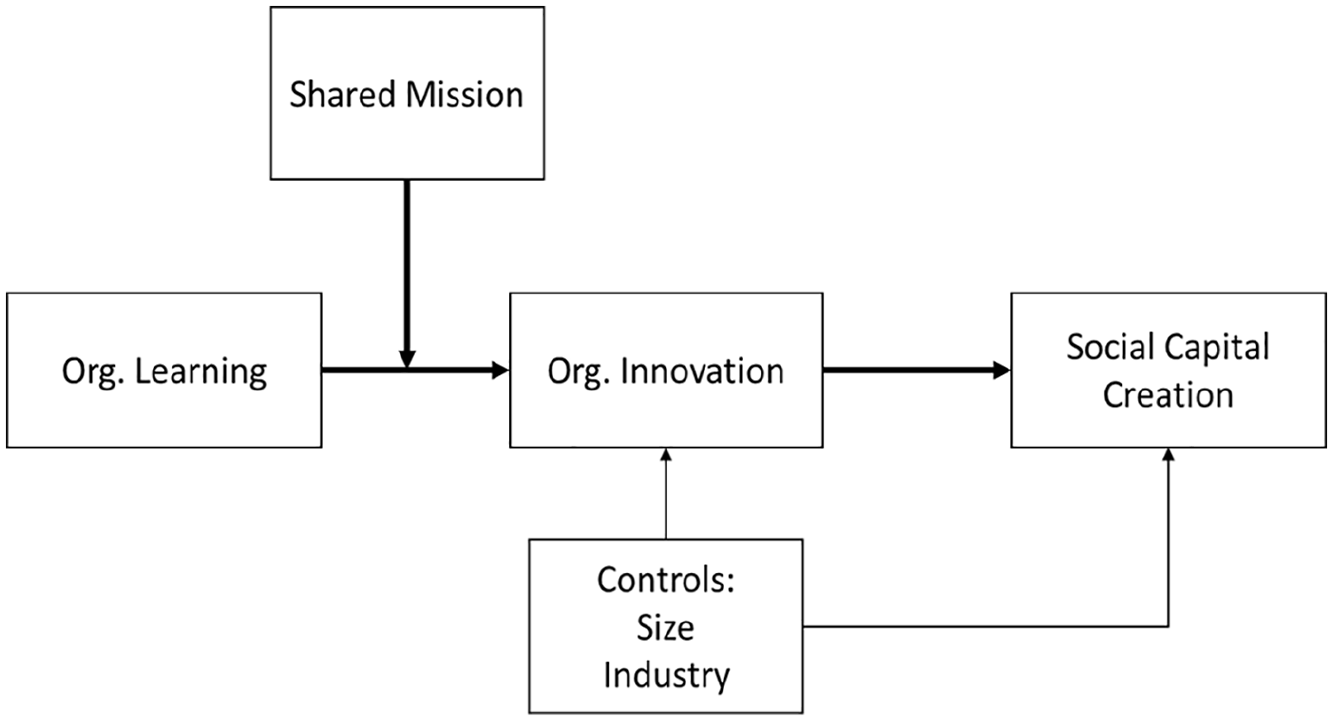
Conceptual Framework for the Nonprofit Role in Social Capital Creation.
Data and Method
Sampling and Recruitment
Data are drawn from a combination of our 2018 national online survey administered to nonprofit executives, and their organizational data. First, out of the nationwide population of 429,338 public charities in 501 (c)(3) drawn from the 2016 nonprofit data available through the National Center for Charitable Statistics (NCCS), we narrowed them down into 78,180 organizations meeting our criteria on employment and revenue size as our target population. We set the criteria—(a) minimum of US$200,000 in total gross receipts or (b) minimum of $250,000 in total compensations—to focus on nonprofits with the resourceful potential for operating a management system. Next, we determined an appropriate sample size of 700 or more by the 95% confidence level and the 3.5% margin of error (Bartlett et al., 2001). We chose a random sample of 7,890 organizations, expecting a low response rate. 7,890 executives in the organizations were invited. We met ethical requirements and obtained IRB approval from the affiliated institution.
Data Collection
A total of 856 executives responded to the survey, resulting in a 10.9% response rate. In all, 720 respondents agreed to use their answers for the research. The IRS archives’ 2018 organizational data were then integrated with the survey data.
To ensure the representativeness of the sample, the difference between two means tests was conducted for each of the chosen organizational characteristics—assets, revenues, expenses, compensations, contributions, and program revenues. As presented in Table 1, the financial comparisons show lower mean estimates in the subject organizations than the population mean parameters, but no significant differences were found only except for compensations. We attribute the consistently lower estimates in the subject organizations to the subsector composition difference, especially in terms of health and educational organizations. As presented in Table 2, this study categorizes nonprofits into five major subsectors—(a) Art, Culture, and Humanities; (b) Education; (c) Health; (d) Human Services; and (e) Other, following the NCCS’ major subsector grouping; it is a concise version of the National Taxonomy of Exempt Entities’ 28 subgroups. This grouping broadly reflects the industry composition while enabling the researchers to efficiently compare a few subsectors.
Mean Differences.
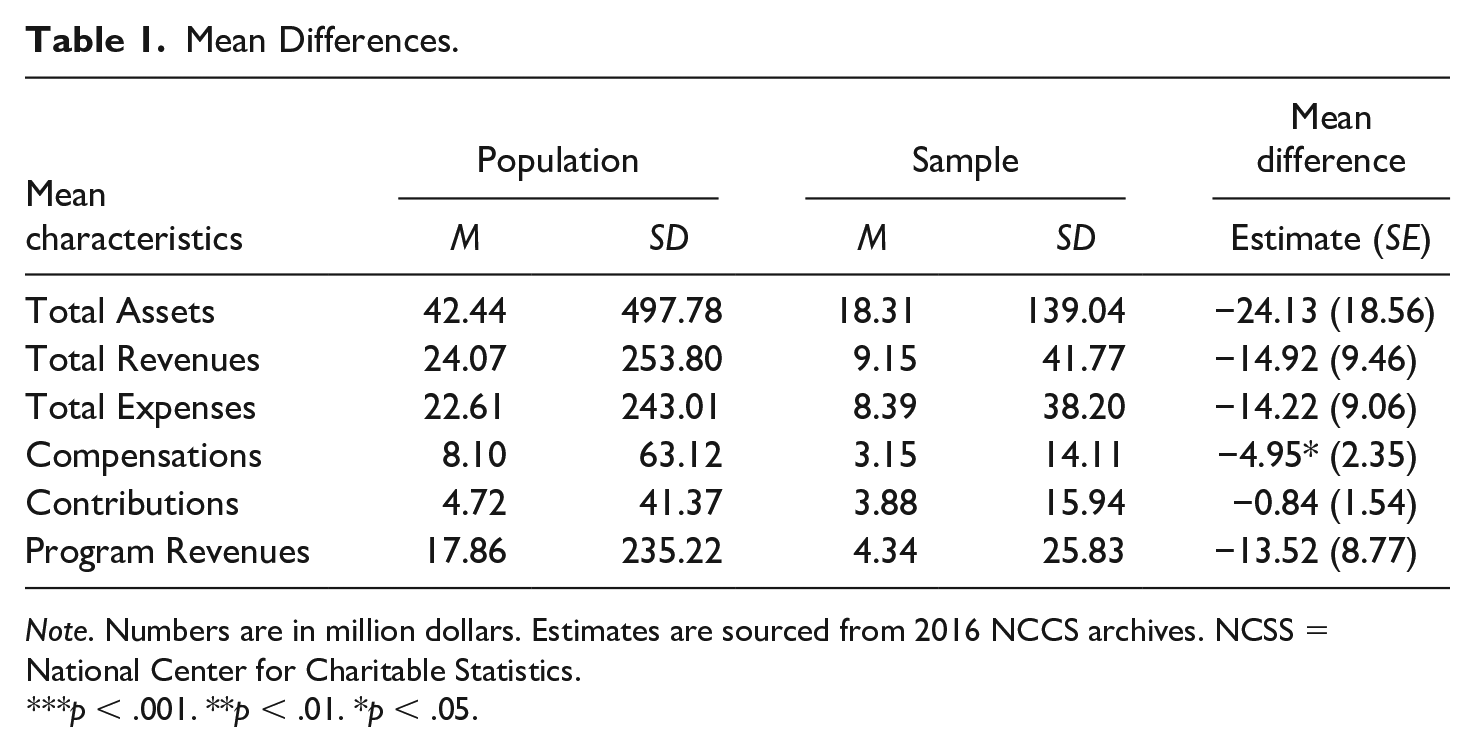
Note. Numbers are in million dollars. Estimates are sourced from 2016 NCCS archives. NCSS = National Center for Charitable Statistics.
p < .001. **p < .01. *p < .05.
Subsector Comparison (%).
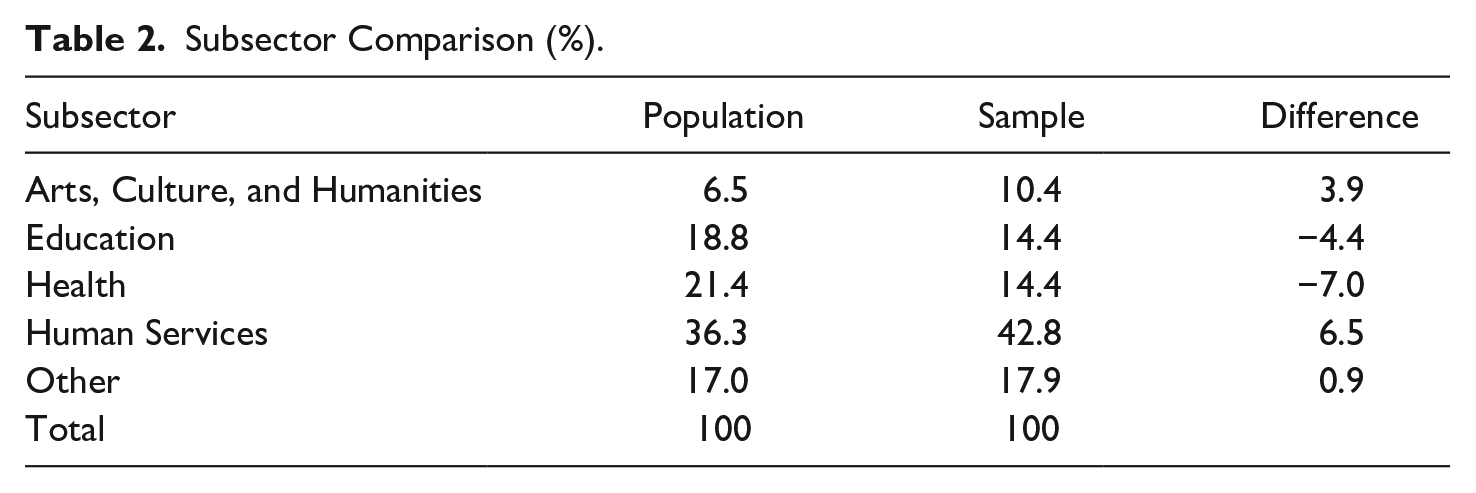
Health and educational organizations account for 21.4% and 18.8% of the population while the same subsectors each account for only about 14.4% of the subject organizations. The differences in these subsectors may have led to the significant mean difference in compensation. In the nonprofit sector, health and educational organizations are considered to earn higher revenues and contributions than other types of nonprofits. They thus provide more competitive compensations and retain more employees. The mean difference tests indicate that the sample data overall reflect the population mean characteristics.
Measurement
For measurement of the study variables, we adopted previously validated latent measures composed of multiple items with a 7-point Likert-type scale. For the study measures, we also conducted reliability, validity, multicollinearity, and multivariate normality tests introduced in the corresponding following sections for justification of the measurement and analysis approaches. The control variables are objective measures using the 2018 statistics—number of employees, total assets in million dollars, and subsector categories. The management literature uses the size and industry features as a concise set of controls to test organizational dynamics concerning learning and innovation (Evangelista & Vezzani, 2010; Jiménez-Jiménez & Sanz-Valle, 2011). The two size variables were chosen because employment and asset statistics are used by the Internal Revenue Service and the Small Business Administration to classify nonprofits by size; we use both as complements to each other, better controlling for the size effects in testing the hypothesized model. Therefore, we consider the literature and nonprofit practice in choosing control variables. Table 3 presents the measurement items.
Study Measures.
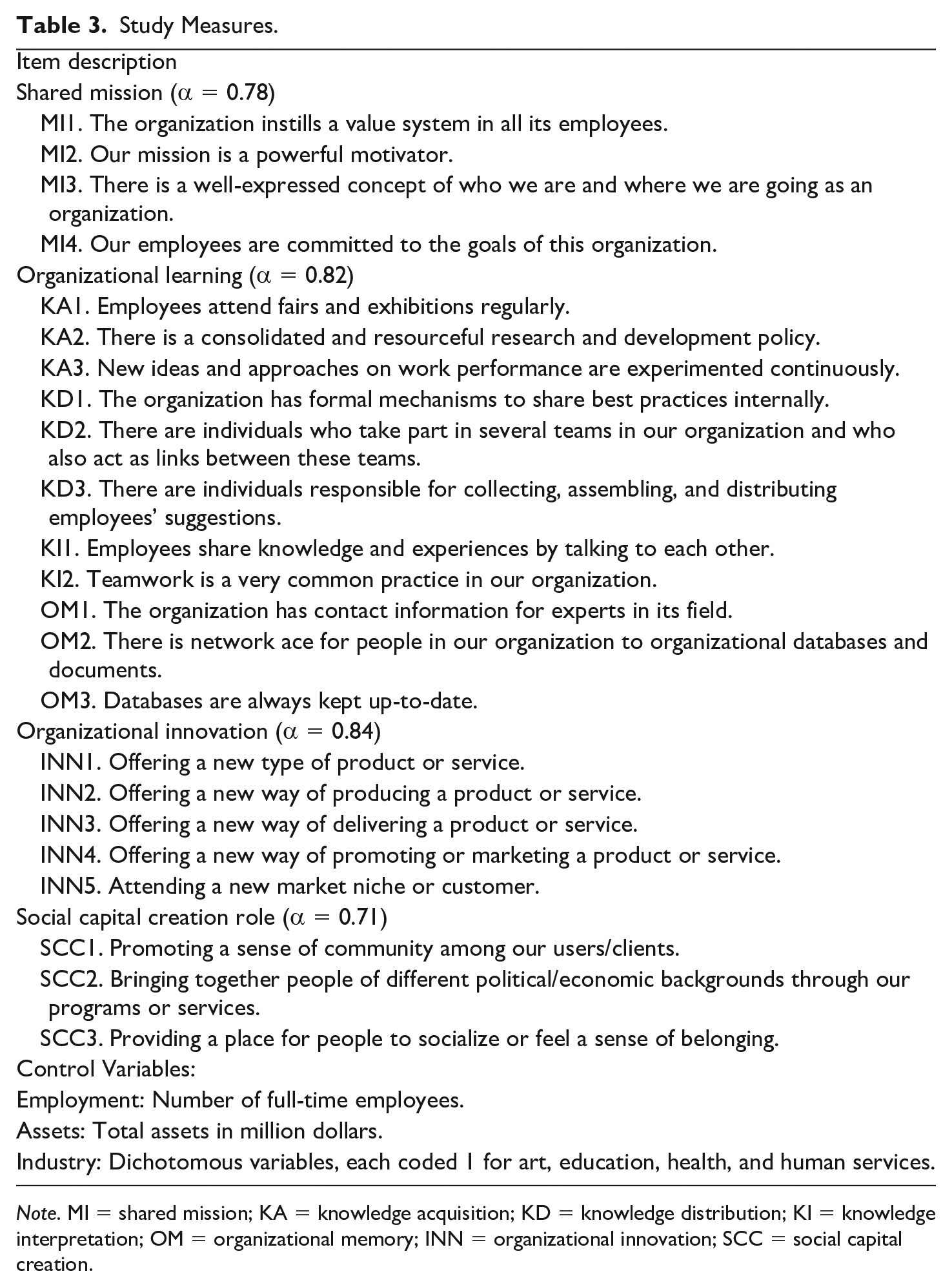
Note. MI = shared mission; KA = knowledge acquisition; KD = knowledge distribution; KI = knowledge interpretation; OM = organizational memory; INN = organizational innovation; SCC = social capital creation.
Shared Mission
This study uses McDonald’s (2007) four-item scale of a shared mission to measure the extent of internal alignment around mission in nonprofits. It resulted in a reliability estimate of .78.
Organizational Learning
It is measured by Jiménez-Jiménez and Sanz-Valle’s (2011) 11-item scale, rooted in Huber’s (1991) four learning processes—knowledge acquisition, knowledge distribution, knowledge interpretation, and organizational memory. As presented in Table 3, each subdimension is represented by a distinct three- or two-item set, constituting the single construct altogether. It produced a reliability of .82. Initially, we chose to include the original 12 items, but one of the items in knowledge interpretation (i.e., “Employees share the same aim and feel committed to it”) had a high match in the item description with a measurement item of shared mission (MI4: “Our employees are committed to the goals of this organization”). When structuring a correlation matrix between shared mission and the four subdimensions of organization learning, the removal of the high-match item from knowledge interpretation resulted in a substantial decrease in the correlation between shared mission and knowledge interpretation from 0.62 to 0.44. To address the multicollinearity concern between the two study variables, we chose to remove the item.
Next, we conducted a separate confirmatory factor analysis (CFA) to test whether the 11 items well represent the theoretical factor structure (Thompson, 2004). As presented in Table 4, a second-order measurement model was proposed, structured with the four subdimensions. This second-order factor structure resulted in acceptable fit statistics and standardized loadings. Only except for one first-order loading in knowledge acquisition, both the first-order and second-order loadings are high enough. The fit statistics—χ2/df ratio, comparative fit index (CFI), Tucker–Lewis Index (TLI), Standardized Root mean Residual (SRMR), Root Mean Square Error of Approximation (RMSEA)—meet the threshold points for an acceptable model fit (Hu & Bentler, 1999; Wheaton et al., 1977; Williams et al., 2009). This study uses the second-order structure to measure organizational learning.
Second-Order CFA of Organizational Learning.
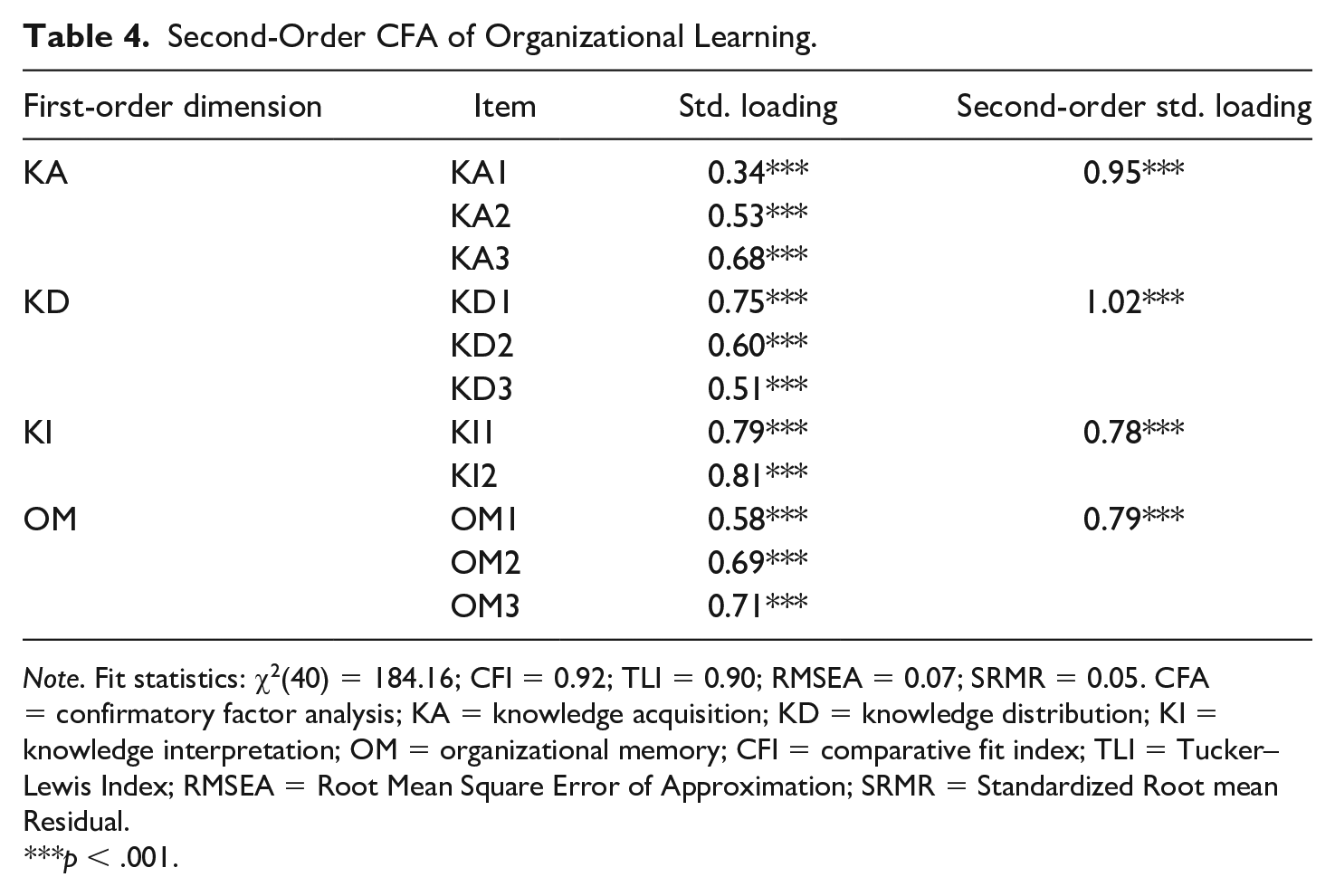
Note. Fit statistics: χ2(40) = 184.16; CFI = 0.92; TLI = 0.90; RMSEA = 0.07; SRMR = 0.05. CFA = confirmatory factor analysis; KA = knowledge acquisition; KD = knowledge distribution; KI = knowledge interpretation; OM = organizational memory; CFI = comparative fit index; TLI = Tucker–Lewis Index; RMSEA = Root Mean Square Error of Approximation; SRMR = Standardized Root mean Residual.
p < .001.
Organizational Innovation
Following the conceptualization of innovation with service, process, and marketing dimensions, our measurement approach takes the dimensionality of product, process, and marketing innovations. Adapted from OECD’s Community Innovation Survey items measuring innovation (Organization for Economic Co-operation and Development [OECD], 2005), we obtained and reworded five items tailored to a 7-point Likert-type scale, representing the three dimensions. The reliability estimate is 0.84. High and significant standard loadings and acceptable model fit statistics were obtained from the measurement model’s CFA. We use the five-item structure for this construct.
Social Capital Creation
Based on our conceptualization of the nonprofit role in building community social capital, we use Moulton and Eckerd’s (2012) three-item measure. Each item represents each dimension of building social capital outside the nonprofit, added up to the three-item construct. Although both the organizational learning and the social capital items include questions related to networks, they differ in how such ties are used, with those related to organizational learning focused internally, and those for social capital creation focused on building network ties that promote social capital in the community. The three items capture the following community-building outcomes of nonprofit activities: promoting a sense of community, bringing together people of diverse backgrounds and interests, and bonding through promoting a sense of belonging. This measure resulted in a reliability of .71.
Table 5 presents the descriptive statistics. As noted, these study measures all demonstrate reliability. Next, although we use the already validated study measures, as the study measures are drawn from a single survey, and they represent different latent constructs, each composed of multiple items or subdimensions possibly overlapped with those of other constructs in part, we consider two potential measurement issues: common method bias and multicollinearity. To check whether these issues are present, we conducted Harman’s single factor test with the Principal Axis Factoring unrotated factor solution method and a variance inflation factor (VIF) test on the study variable’s measurement items. The single factor test resulted in 25.58%, much less than the threshold of 50%, indicating no substantial common method bias issue. The VIF estimates on the variables ranged from 1.07 to 1.91 with a mean VIF of 1.43, all much lower than the conservative cutoff of 5, thus indicating that multicollinearity does not exist (Hair et al., 2019). We use the chosen measures for the model test.
Descriptive Statistics.
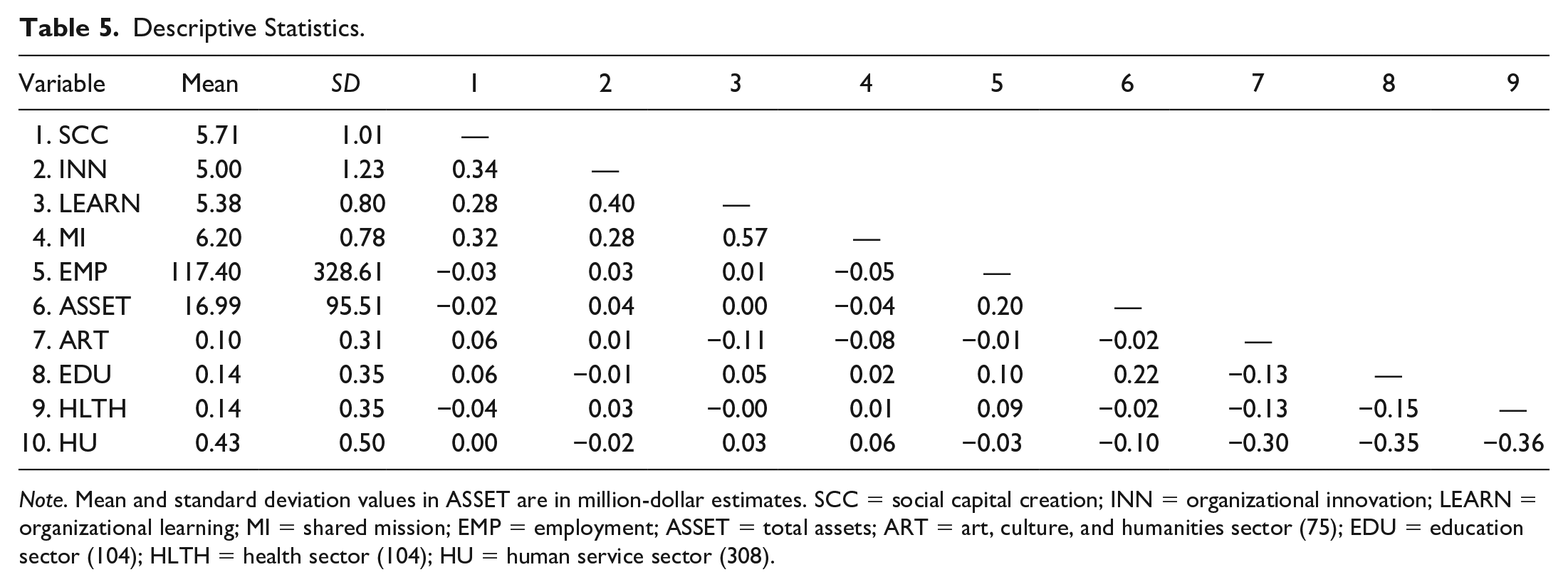
Note. Mean and standard deviation values in ASSET are in million-dollar estimates. SCC = social capital creation; INN = organizational innovation; LEARN = organizational learning; MI = shared mission; EMP = employment; ASSET = total assets; ART = art, culture, and humanities sector (75); EDU = education sector (104); HLTH = health sector (104); HU = human service sector (308).
Analytical Procedures
This study employs a first-stage moderated mediation process analysis to test the model (Hayes, 2018). Structural equation modeling (SEM) analysis is used. It applies two sequential covariance structure tests (Anderson & Gerbing, 1988). We first examined latent characteristics and covariance structures of the study measures through a joint CFA to check the model fit and construct validity in the analytical framework. Next, we conducted a full SEM analysis for the model test by using Mplus 8.7.
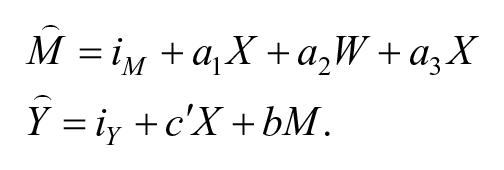
The model test integrates equations of two regression analyses. The outcome variable Y (social capital creation) is primarily a function of the independent variable X (learning) and the mediating variable M (innovation). Adding the moderating variable W (shared mission), the mediating variable is then a function of X and W, and their interaction term XW. The strength of the mediating mechanism becomes contingent on the moderating effect. The below equations show the integration, where i refers to the constant values of the equations and the caret symbol on M and Y denotes predicted values:
To determine the adequate estimation type of the joint CFA and the model test, we conducted multivariate (Mardia’s Skewness and Kurtosis, Henze-Zirkler, and Doornik-Hansen) and univariate normality (Skewness-Kurtosis) tests for the study variables, examining whether we can keep the normality assumption of the latent characteristics. As the tests all rejected the normality assumption, we chose to use maximum likelihood estimators with robust standard errors (MLR; Lubke & Muthén, 2004; Rhemtulla et al., 2012). This sandwich correction method addresses the non-normality of latent distributions as it does not require the normality assumption in factor analyses and model tests (Li, 2016; Rhemtulla et al., 2012).
Results
Model Fit and Construct Validity
Table 6 presents the joint CFA results. The fit statistics—χ2/df ratio = 2.27, RMSEA = 0.04, SRMR = 0.05, CFI = 0.92, and TLI = 0.91—indicate an acceptable model fit, supporting the model test (Hu & Bentler, 1999; Wheaton et al., 1977; Williams et al., 2009). With the CFA, convergent and discriminant validity of the study constructs were also tested, producing standard loadings, average variance extracted (AVE) and squared-rooted AVEs, composite reliability (CR) estimates, and interfactor correlations (Malhotra, 2010). Setting aside the first-order loadings under the learning construct, standard loadings are all higher than 0.5 and significant at the 0.001 level. For estimating the ratio of each variable’s variance due to the latent properties of averaged standard loadings, all AVEs exceed 0.4 (Huang et al., 2013). Their CR estimates, computed by the ratio of true variance in relation to the total variance (Raykov, 1997), are all higher than 0.7 (Malhotra, 2010). Convergent validity of the study measures is thus ensured.
Second-Order CFA for Study Constructs.
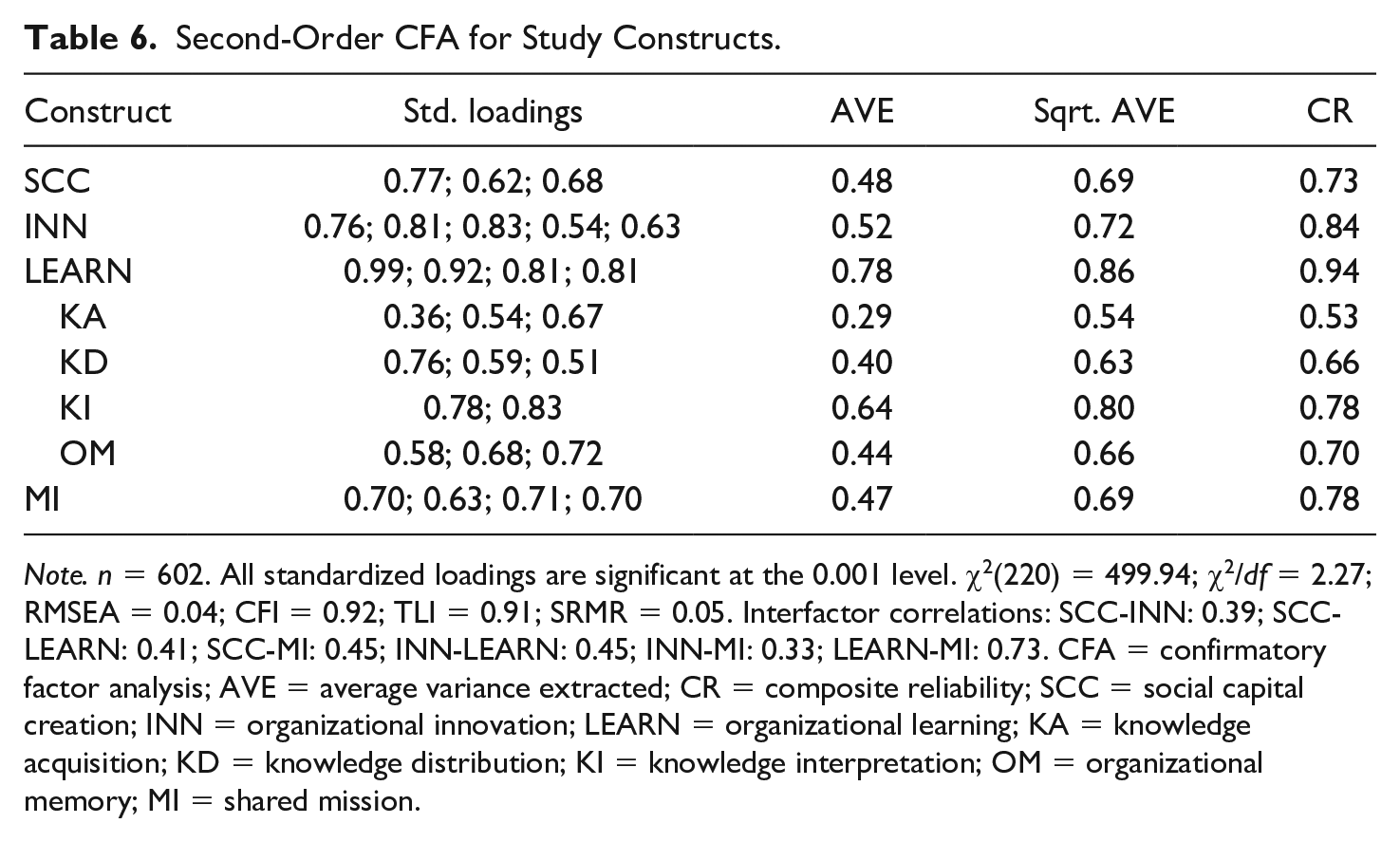
Note. n = 602. All standardized loadings are significant at the 0.001 level. χ2(220) = 499.94; χ2/df = 2.27; RMSEA = 0.04; CFI = 0.92; TLI = 0.91; SRMR = 0.05. Interfactor correlations: SCC-INN: 0.39; SCC-LEARN: 0.41; SCC-MI: 0.45; INN-LEARN: 0.45; INN-MI: 0.33; LEARN-MI: 0.73. CFA = confirmatory factor analysis; AVE = average variance extracted; CR = composite reliability; SCC = social capital creation; INN = organizational innovation; LEARN = organizational learning; KA = knowledge acquisition; KD = knowledge distribution; KI = knowledge interpretation; OM = organizational memory; MI = shared mission.
Next, discriminant validity is ensured by comparing the square roots of AVEs with the corresponding interfactor correlations. Every study construct showed inter-factor correlations lower than its square-rooted AVE, only except that shared mission had a correlation with learning at 0.73, higher than its square-rooted AVE of 0.69. While the interfactor correlation is much higher than other correlations, it is still lower than the square-rooted AVE of the learning construct at 0.86. We consider that the high correlation between shared mission and organizational learning is attributed to their common orientation of sharing organization-wide key information and practice. Despite the construct overlap between shared mission and learning in part, it is also clear that the conceptual and measurement distinctions are significant enough as addressed in the previous sections. Therefore, the discriminant validity of the study constructs is ensured. The model fit and construct validity of the study constructs are all suitable for the model test.
Hypothesis Testing
Table 7 shows the entire model test results. We used the general random type with MLR estimators. For the random type, we set the shared mission’s variance at 1 to estimate the model parameters; the estimators are unstandardized due to the model constraint imposed on the moderated mediation effects. The direct effect of learning on innovation (b = 0.95; p < .001) and of innovation on the social capital creation role (b = 0.20; p < .001) are all significant. In addition, the mediation effect (LE→INNOV→SCC) is significant (b = 0.19; p < .01). These findings demonstrate the direct and mediating relationships among learning, innovation, and the social capital creation role in nonprofits, supporting Hypotheses 1 through 3. Figure 2 depicts the structural relationships among the study variables.
Model Test.
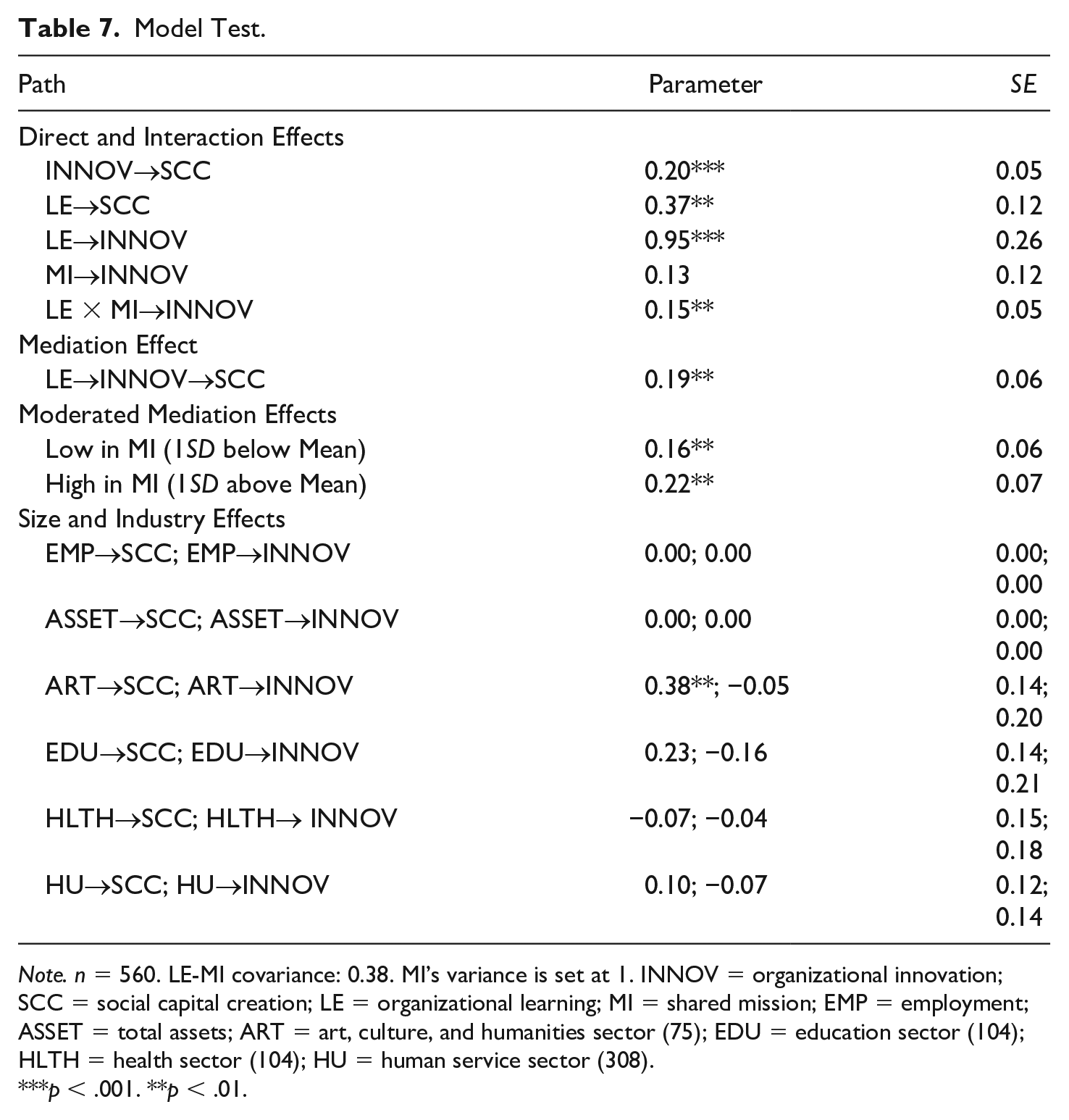
Note. n = 560. LE-MI covariance: 0.38. MI’s variance is set at 1. INNOV = organizational innovation; SCC = social capital creation; LE = organizational learning; MI = shared mission; EMP = employment; ASSET = total assets; ART = art, culture, and humanities sector (75); EDU = education sector (104); HLTH = health sector (104); HU = human service sector (308).
p < .001. **p < .01.
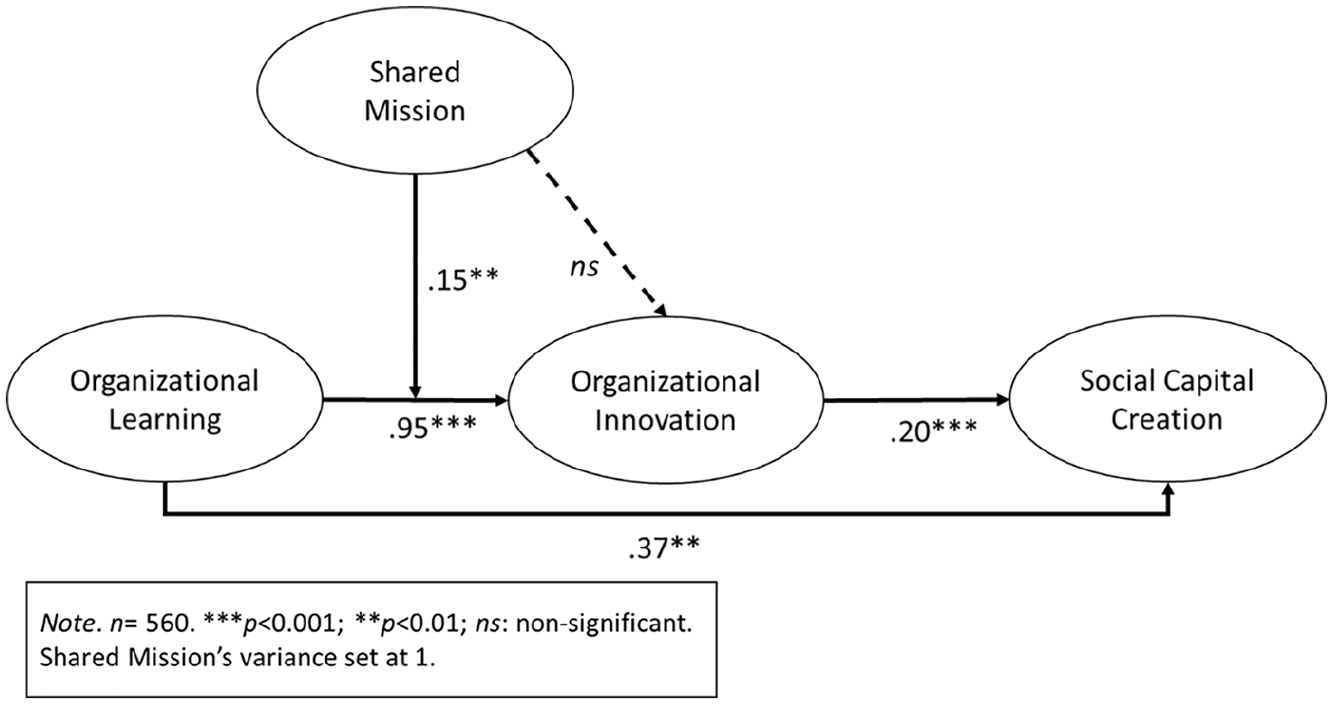
Hypothesis Testing Results.
For the first-stage moderated mediation effect, the interaction term of learning and shared mission for innovation was found significant in a positive way (b = 0.15; p < .01). Figure 3 draws the strengthening moderation effect of shared mission on the learning and innovation relationship, which then leads to the moderated mediation of innovation between learning and social capital creation. As detailed in Table 7, the indirect effect of learning on social capital creation through innovation became stronger for every 1 standard deviation (SD) increase in a shared mission. The unstandardized parameter of the mediation effect was 0.16 (p < .01) at 1 SD below the mean of the shared mission; it increased to 0.22 (p < .01) at 1 SD above the mean of the shared mission. Under no such moderation constraint, the mediation effect remained at 0.19 (p < .01). These findings support Hypothesis 4. Considering that shared mission was found to have no direct effect on innovation, it appears to strengthen the learning processes in improving nonprofit innovation.
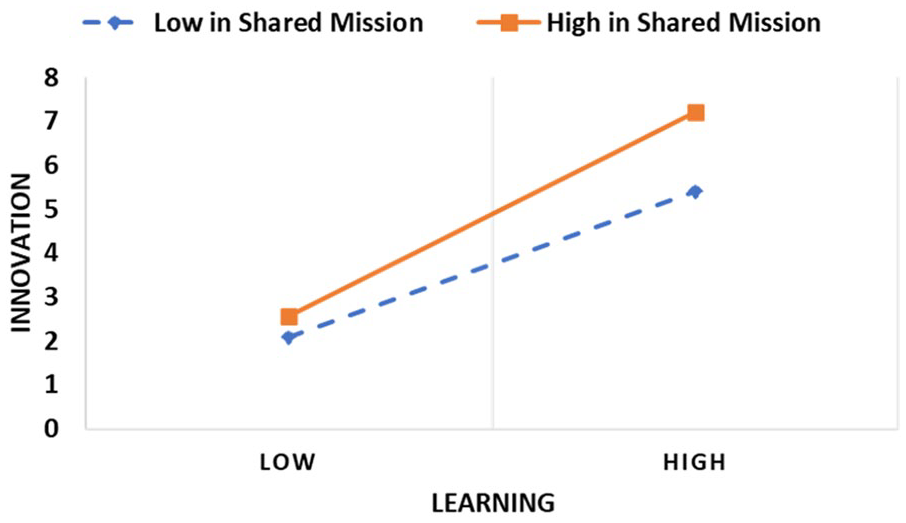
The Moderating Effect of Shared Mission on the Learning–Innovation Relationship.
For the effects of the control variables on both social capital creation and innovation, only the Arts subsector’s direct effect on social capital creation is significant (b = 0.38; p < .01). All other control variables lack significant relationships. In summary, the analysis results provide strong empirical support for all hypotheses, suggesting the moderated mediation model for the nonprofit role in building social capital. Nonprofit innovation positively mediates between organizational learning and the nonprofit role in building social capital. Shared mission heightens the mediating effect in an interactive form with learning.
Discussion
In this study, we developed and examined a moderated mediation model to show that the combination of nonprofit learning and innovation, guided by a shared mission, improves the nonprofit role in building social capital. Given the findings, we address the inquiry on how nonprofits combine their entrepreneurial and expressive orientations to promote community-serving competencies in three meaningful ways. First, this study corroborated that organizational learning’s ability to enhance innovation also applies to nonprofit activity and service provision. Founded on the assumption of the interactive dynamics between community social capital and the entrepreneurship context (Adler & Kwon, 2002; Jamali et al., 2011; Kwon et al., 2013), we suggest that the direct and indirect effects of nonprofit learning and innovation on the organizational role in facilitating social capital animate the social entrepreneurial models and networks for nonprofit success in community engagement. Nonprofit organizations articulate managerial and governing processes to develop and apply better social change measures (Ebrahim, 2019) and particular forms of social capital (Bixler & Springer, 2018).
Adding to the literature on the community-building motivation of nonprofit management (Frumkin & Andre-Clark, 2000; Garrow & Hasenfeld, 2014), we also revealed that a shared sense of the nonprofit mission incorporates divergent values, interests, resources, and strategic capabilities into the shared social goal orientation. This aligns the process of learning and innovation on operational models and unites the most significant activities, social relations, and resources for community social capital (Beaton, 2021; Kirk & Nolan, 2010; McDonald, 2007). Therefore, the unique contribution of this study relates to exploring the value-instilled force of instrumental practices toward community-building outcomes. Mission fulfillment of nonprofit organizations, while being stretched out, guides their market-focused competencies motivated to facilitate the social trust and justification of community-oriented activities and networks (Sanders, 2015).
In contrast with prior literature (Evangelista & Vezzani, 2010; Jiménez-Jiménez & Sanz-Valle, 2011), employment and asset size did not appear to affect nonprofit innovation and success, nor did any subsector outside of arts organizations. Given the simplicity of discussing the control variables, we note the need to clarify how size and industry are associated with the organizational outcomes in nonprofits in future studies.
Two managerial implications about the dynamics of facilitating social capital stand out. First, effective operational strategies enhance a value-driven sense of community and belonging in the social service market (Guo & Bielefeld, 2014). This reflects and justifies the recent surge in adopting business-oriented strategies and criteria all over the social service areas. Essentially, nonprofits are constantly required to develop adaptive knowledge and models to survive and enlarge market chances. Social entrepreneurship theory suggests how nonprofits keep their learning capacity for the ongoing adoption of new knowledge and networks characterize how they align their competitive edge with the expressive role performance (Austin et al., 2006; Weerawardena & Mort, 2012). The competitive service models become instrumental to aligning and advocating value propositions, given their relationships with stakeholders and resources. Therefore, ongoing improvements in market strategy for securing sustainability can never be the second priority to governing boards and executives although the outcome values differ across service areas (Liu & Ko, 2012; Weerawardena & Mort, 2012). Our results well capture the practical inclination of nonprofits that tailor market-based strategies to suit community engagement contexts.
Next, missions in the nonprofit sector have tangible impacts, in contrast to a traditional myth that perceives a nonprofit mission as symbolic in practice. A shared nonprofit mission holds up the ties between instrumental and expressive roles. That is, mission fulfillment inspires particular value-creating motivation in instrumental activities (Dart, 2004; Dym & Hutson, 2005; Knutsen & Brower, 2010; McDonald, 2007). The mission-supporting innovation ultimately promotes the community-serving role (Beaton, 2021; Kravchenko & Moskvina, 2018; Sanders, 2015). This study adds to the scholarship on the potential of bridging the dual goal orientations of nonprofits. A convincing expressive purpose and commitment of a nonprofit with shared understanding strengthen their innovative capacity to enrich community development outcomes.
Despite the key messages conveyed to managers, this research has limitations that caution readers to note. First, although the data were integrated from two separate sources for the model test, the much fewer associations between the observed variables and the outcome and mediating constructs than those between the four constructs themselves may question the validity of the data integration. As stressed, the authors consider the need to illuminate how the size and industry characteristics distinctively determine nonprofit innovation and performance. Second, the four study constructs are all relied on individual perceptions, supposed to measure organizational characteristics. Whether organizations take the learning processes, innovate, achieve a shared sense of the mission, and perform well are all beyond individual observations and evaluations. To minimize the potential for misleading measurement, we surveyed executive directors who have access to the most comprehensive organizational information. In addition, rigorous reliability, multivariate normality, multicollinearity, convergent validity, and discriminant validity tests were conducted. As stated, we obtained sound estimates for most of the tests except that the non-normality issue was present. The sandwich correction method was used in our SEM analysis with MLR estimates that address the non-normality of the study measures. Nevertheless, we acknowledge that the accuracy of the learning, innovation, and social capital measures for each nonprofit relies on the organizational leader. Future research may develop measures of nonprofit learning and innovation drawing from other sources of data and separate out distinct pathways between different forms of organizational learning and community social capital creation.
Conclusion
To conclude, this study fills a knowledge gap in how organizational learning can draw on nonprofit innovations focused by a shared mission to develop community social capital. We anticipate substantive benefits of manifold interactive fashions between mission and instrumental aims. In conjunction with the theoretical and empirical progression, this research calls for more frameworks to unite the separate nonprofit accountabilities. Future research may reveal the dynamics of mission fulfillment in the managerial context of profit-making, market opportunities, and the influx of business professionals. Finally, the effects of staff, finance, and industry characteristics should be examined in more depth on the mission-market interactions.
Footnotes
Declaration of Conflicting Interests
The author(s) declared no potential conflicts of interest with respect to the research, authorship, and/or publication of this article.
Funding
The author(s) received no financial support for the research, authorship, and/or publication of this article.
