




Abstract
Conventional thinking holds that for-profits need to innovate for growth to be financially viable. Nevertheless, to date, we have not recognized the importance of nonprofit growth and innovation’s function here. Yet despite “innovation for growth” being an even greater imperative for nonprofits in their quest to resolve societal challenges, prior sector research has, at most, only superficially investigated this construct new to nonprofits. In this first-in-field conceptual project, we weave together a comprehensive literature review with findings from 26 interviews with nonprofit directors. In doing so, we advance the scattered nonprofit-innovation and organization-performance research by describing nonprofit innovation for growth and why it matters. And we originally conceptualize that nonprofit boards seem to prioritize particular factorial determinants new to nonprofit-innovation research in their effective pursuit of innovation for growth.
Keywords
Introduction
In the corpus of for-profit innovation-performance literature, we conventionally understand innovation as an enabler of differentiation and competitive advantage (Baregheh et al., 2009) and crucial element of an organization’s survival and growth (Ferreira et al., 2015). However, we are yet to acknowledge these ideas in the nonprofit sector; in other words, that nonprofit growth is important for organizational sustainability and social impact, and the role that innovation can play here. This lack of appreciation stems from the focus on innovation process not performance in the embryonic investigation of its governance in nonprofits. Thus, we do not fully comprehend how innovation and organizational performance are interconnected in pursuit of “innovation for growth” in nonprofits, a new construct for the sector. In this study, we address this research puzzle by undertaking personal interviews with 26 nonprofit directors to describe nonprofit innovation for growth and its importance, and to determine how boards can foster it. By weaving together a comprehensive literature review with interview findings, in this first-in-field conceptual project we learn that innovation for growth may present differently in nonprofits than for-profits because of distinct nonprofit contexts and ambitions, and that nonprofits and boards that proactively address particular factorial determinants may be able to effectively pursue innovation for growth. We conclude with an agenda for future research investigation.
Innovation, Performance, and Governance Literature
We begin by defining innovation and then flesh out five global literature themes that are pertinent to our study of nonprofit-innovation governance.
The Oslo Manual, which offers an internationally accepted innovation language and approach to data collection, categorization, and analysis, defines innovations as introduced products (i.e., goods/services) or utilized business processes that are new or improved, in that they are distinctly different from the organization’s prior ones (Organisation for Economic Co-operation and Development [OECD] & Eurostat, 2018). It further specifies that innovation activities are those that are expected to generate organizational innovations.
In the following extended passage, we conceptualize our review of the relevant and disparate innovation and governance research into five literature themes of innovation’s nature, the institutional environment’s resource focus, innovation’s importance, the environment’s motivational orientation, and the board’s innovation pursuit.
Innovation’s Nature
In for-profits, where the historic research has largely focused (Bierwerth et al., 2015), innovation has been regularly characterized as radical, planned change (Lassen et al., 2006). The incipient nonprofit-innovation literature, however, does not describe innovation and has focused on its process not its performance (do Adro et al., 2022).
Institutional Environment’s Resource Focus
The institutional environment may affect not only the nature but also the existence and extent of innovation, for example, because of possible innovation supports or constraints such as resource access and allocation (institutional logics: Dyck & Zingales, 2004; resource theory: Pfeffer & Salancik, 1978).
Corporates often enjoy access to human resources (e.g., strategic risk/opportunity experience: Brancato et al., 2006) and financing (Brown & Slivinski, 2018) which facilitate innovation, although innovation has even been achieved in for-profit limited-resource contexts (see, for example, frugal innovation: Basu et al., 2013; bricolage: Lévi-Strauss, 1966).
Contrary to many corporates, though, nonprofits encounter unique resourcing constraints. For example, nonprofit innovation-investment capacity is limited due to low margins (Cabin et al., 2014), access to capital (do Adro et al., 2022), competition for funds (Kerlin & Pollak, 2011), and donor fatigue (Jaskyte, 2020). Also nonprofit-probity norms discourage investment; and the consequent impact on nonprofit performance has been investigated in a fragmented nascent literature. Nonprofit norm-busters (i.e., nonprofits lacking financial caution) had 53% more funds to invest than norm-followers in mission-related services over a 10-year period (Mitchell & Calabrese, 2022); nonprofits that invested in infrastructure/staffing were better able to enact their missions (Bedsworth et al., 2008); and higher overhead ratios in nonprofits led to greater mission fulfillment and revenue performance (Berrett, 2021).
Innovation’s Importance
Although we are yet to understand nonprofit innovation’s nature or how sectoral challenges may affect it, the literature does tell us that innovation enables differentiation (Baregheh et al., 2009) and is critical for organization survival and growth (Ferreira et al., 2015) (growth is defined as an increase in size/scale; OECD, 2007). Indeed, the seminal Oslo Manual (OECD & Eurostat, 2018) notes that up-to-the-minute ideas and approaches are needed to resolve contemporary societal issues (i.e., innovating to advance nonprofits and society). And certainly, the nonprofit sector’s economic and social significance is well documented (e.g., 6% of U.S. GDP, 7% of workers, volunteering by 30% of adults; Abramson, 2022).
Sectoral Motivations
In these institutional environments, dissimilar sectoral motivations which drive behavior seem to prevail. Organizations seek to maximize (a) owner value (agency theory: Fama & Jensen, 1983), (b) market share and profitability (competition theory: Porter, 1979), and (c) multistakeholder interests (stakeholder theory: Huse, 2007). These motivations, though, appear to be somewhat shifting and intertwining.
There is some paradoxical recent evidence of for-profit motivational evolution and associated procedural effects. However, we anticipate delays before wholesale change in corporate practice, noting, for example, the long development timeframe and isolated application to international business companies of the draft standards regarding environmental-social-governance reporting (“Toward common metrics and consistent reporting of sustainable value creation,” 2020). For now, financial performance persists as the predominant corporate metric (Karim et al., 2020).
Conversely, studies have identified the trend of nonprofits toward embracing marketization/mission competing tensions to achieve growth and impact. For instance, commercial decisions of social enterprises (established as financial-capacity social-impact builders) were affected by their founding nonprofit’s mission (Fitzgerald & Shepherd, 2018); and meaningful nonprofit work reflected prosocial/market-values coexistence (B. Sandberg & Robichau, 2022). Furthermore, a scattering of embryonic research explores the performative effects of nonprofit motivations and life cycles. To illustrate, Searing and Lecy (2021) hypothesize nonprofit-entrepreneurship stages (with associated motivations) of nascency/start-up (purpose, engagement), development/formalization (systems, finance, growth), and maturity; and find that fundraising, government funding, and net margin positively influence the nascency-formalization life cycle transition. Moreover, these nonprofit-specific motivations have been associated with recent diverse outcomes related to nonprofits’ multistakeholder contexts. To elucidate, according to contemporary research, nonprofit cross-sector collaborations enable social-problem reconceptualization, community participation, and allied social-services integration (Rey-Garcia et al., 2018); as well as new business models, continuous learning, resource access, and localization (João-Roland & Granados, 2020).
Board’s Innovation Pursuit
Having considered innovation’s nature, importance, and interaction with institutional forces, we now turn our gaze to its governance.
The board holds ultimate authority for the organization’s performance and direction (see framework of Hilmer & Tricker, 1994). In fulfilling its duties, this governing body adopts a comprehensive set of well-understood principles, namely: (a) accountability/transparency (the board informs stakeholders about the organization and its performance); (b) performance (the board is effectively run, organizational resources are used appropriately, and board and organization performance are evaluated); (c) strategy (the organization has a clear purpose and associated aligned strategy); (d) conduct and culture (the board models and pursues a culture reflecting the organization’s purpose and strategy, and clear behavioral expectations of the organization’s people exist); (e) stakeholder management (stakeholders are meaningfully engaged and the board accommodates their interests); and (f) board composition (the board’s structure and composition enable it to fulfill its role effectively) (ASX, 2019; Australian Institute of Company Directors, 2019; International Corporate Governance Network, 2021).
Nonetheless, these principles relate to all the board responsibilities for performance oversight and strategic direction, and do not guide us on how boards should perform their particular innovation responsibilities. Regardless of this advisory shortfall, it is well accepted that corporate boards often seek innovation for growth. However, nonprofit boards appear yet to embrace this strategy, despite isolated evidence of a relationship between innovation and nonprofit performance (Colbran et al., 2019; Fonseca & Baptista, 2013).
To compound our dearth of knowledge, projects have predominantly examined innovation governance in for-profits (Kumar & Zattoni, 2019) and investigation in nonprofits is limited (Meyer & Leitner, 2018).
Furthermore, extant research, corporate/nonprofit alike, has chiefly interrogated mono-factorial not multifactorial relationships, and these examinations concern traditional input factors (e.g., board composition) as opposed to factors such as board relations and practice.
Moreover, the variables used to analyze innovation and performance differ by sector. To elaborate, for-profit studies have investigated the relationship of firm size with firm innovation (Camisón-Zornoza et al., 2004; Damanpour, 2010); and of firm size (Salimath et al., 2008), resources (Ndofor et al., 2011), and location (Zhou et al., 2006) with corporate financial performance. Nonprofit projects have certainly scrutinized a selection of these variables, but also have examined the association of nonprofit-oriented variables (e.g., revenue concentration) with nonprofit innovation (Kim, 2017); of such variables (e.g., membership ownership) with nonprofit performance (e.g., revenue growth, club ranking, on-pitch performance, media profile: Ward & Hines, 2017); and of board factors with nonprofit innovation (e.g., civic-engagement investment: Suárez & Lee, 2011) and nonprofit performance (e.g., government funding: Dong & Lu, 2021).
In addition, recent research on corporate-governance factors, such as thought diversity and board culture, has unexplored and potential application to nonprofit-innovation study. Thought-diverse corporate boards avoid willful blindness (Bandura, 2015) and groupthink (Forbes & Milliken, 1999), capitalize on complex contexts (Snowden & Boone, 2007), and improve decision-making (Creary et al., 2019; Landaw, 2020). Psychologically safe group environments are related to learning, firm innovation, and company growth (Edmondson, 2018); organization culture, in association with board characteristics, influences firm performance (Omar et al., 2014); and constructive, open-minded board culture is a precondition for board effectiveness and firm success (Hilb, 2005).
Concluding our synopsis of research on the board’s innovation pursuit, we lack practitioner perspectives and in-boardroom lived experience because of the scarcity of qualitative studies on innovation and governance in both corporates and nonprofits; instead, projects have been quantitative and retrospective (Boyd et al., 2017).
Summary
To synthesize our review, the literature clearly describes corporate innovation and largely accepts that for-profits need to innovate for growth to be financially viable. Conversely, extant research does not explain the nature and importance of nonprofit innovation for growth, and how boards in their oversight role can foster it. To resolve this predicament, we undertook a first-in-field conceptual study in which we framed these issues sequentially as two separate research questions:
Method
The aim of this project was to understand the nature and importance of nonprofit innovation for growth, and to theorize how boards can effectively pursue it. The interview methodology supported scholarly calls for qualitative research to scrutinize governance influences (Boyd et al., 2017; Kumar & Zattoni, 2019), innovation-driven organizational performance (Bierwerth et al., 2015), and nonprofit-innovation governance (Jaskyte, 2015; Tacon et al., 2017). We conducted an extensive suite of semi-structured (Rogers, 1945) personal interviews (Seidman, 2006; van Manen, 2016). Sessions were video recorded following a standard practice in social-science literature (Flick, 2018; Hunt, 2003), and emerging approaches in governance (Bezemer et al., 2018) and management research (Christianson, 2018; Waller & Kaplan, 2018).
Data Collection
A convenience sample of 26 candidates was sourced from the authors’ networks. Following ethics approval from the primary investigator’s host university, candidates were contacted via email in March 2022 to seek their participation, with a reminder to non-respondents. Inclusion criteria were (a) participants who have current experience as a board director or executive reporting to a board/s of a medium/large nonprofit/s (defined as annual revenue +A500,000: Australian Charities and Not-for-profits Commission, n.d.) that grew in revenue during their tenure, (b) the candidate mix offers a variety of director characteristics and nonprofit experience, and (c) candidates are largely Australia-based, supplemented by some candidates from other jurisdictions. The rationale for these criteria, in their respective order, was to (a) provide lived experience of the topic under exploration, (b) enable high-level consistent themes to emerge, and (c) allow insight into an underexplored context under consistent jurisdictional conditions, augmented by additional country perspectives to further facilitate a big picture view (we note, though, that this was not a comparative study). Author networks were utilized to quality-screen for practitioner expertise given Australia’s director-population magnitude and knowledge variance; and to establish immediate comfort, enabling deeper discussion of this complex subject.
Of the original sample (59), some did not respond (22), several declined due to not meeting the criteria (3), some indicated willingness but current unavailability (8), and the remainder confirmed participation (26), a 44% participation rate. The infield phase began in March and, on reaching data saturation and confirmation of findings (Glaser & Strauss, 1967), was concluded in April without pursuing those who had expressed a willingness to participate later or undertaking snowballing to extend the sample.
These 26 participants were leading governance practitioners: two thirds had more than a decade’s experience as a board member (17); and half were chairs (13). Participants were largely Australia-based (23), although six of these interviewees also had a mix of other country board experience (the United States, the United Kingdom, New Zealand, Asia), and seven previously held executive roles outside Australia (the United States, the United Kingdom, Asia, Europe), noting some had multi-jurisdictional board and/or executive experience. In addition, three interviewees were board members domiciled in other countries (the United States, the United Kingdom, New Zealand). The sample reflects diversity in gender (15 males; 11 females), professional background, and board experience in terms of duration (5–20 years) and nonprofit size (A1–90M), footprint (metro, state, national), and scope (education, human services, sport, environment, human rights, member services).
The interview protocol and associated semi-structured interview guide were developed by referring to the primary themes and main factors identified in the literature review. The sessions employed open questions and follow-up probes to delve into participants’ relevant experience (J. Sandberg & Tsoukas, 2011). The initial questions were designed to get to know participants and their perspectives on nonprofit-innovation governance regarding its nature, evolution, challenges, and perceived importance. Interviewees were quizzed on how they had initially interpreted the term “growth-directed innovation,” probed about the language their boards use to talk about it, and asked to offer examples of it from their nonprofit-board experience to answer our first research question, What is nonprofit innovation for growth and why does it matter? Then, drawing on their nonprofit-board experience, the discussions explored how contextual and board-related factors could help or hinder nonprofit innovation for growth to address our second research question, How do boards effectively pursue it?
Prior to the participant sessions, a mock interview was conducted between the principal investigator and an expert qualitative researcher who is also an experienced director. As a consequence, in the interview guide we removed some peripheral probes to shorten the interview’s duration, reordered the questions to flow more logically, and reworded several questions for clarity and alignment to our research goals. The interviews were conducted by the principal investigator via Zoom. The meetings lasted for an average of 1 hr 9 min and ranged in duration from 31 min to 1 hr 48 min (half ran between 50 min to 1 hr 10 min).
Data Analysis
During each interview, the principal researcher took hand-written notes to enable follow-up questioning and capture of critical observations. After the discussions, but prior to transcription and coding, key insights were manually highlighted and a global thematic summary was developed. Following the interviews, each meeting’s audio file was auto transcribed and then corrected manually via comparison to its videorecording. Based on grounded-theory procedures (Glaser & Strauss, 1967), we conducted manual thematic analysis of the transcripts via an open-coding process, iteratively cataloging the data into themes and factors/subfactors (Tacon et al., 2017; Woodroof et al., 2020) which we documented in a coding book (an Excel spreadsheet). We periodically adjusted and/or regrouped themes, factors, and associated content to develop our narrative’s basic outline. Data connections were examined, theme consistency was assessed within and across participants, themes converged, and constructs (and associated category clusters) related to nonprofit innovation for growth emerged. Coder reliability was verified via a two-stage process. The interview guide—which served as the coding structure—was individually reviewed and modified by the authors and two additional researchers; and the thematic draft was adjusted by the second author to confirm structural consistency (Belotto, 2018). Then, after independently analyzing the interview data, the authors joined together to discuss perceived meanings and reach consensus on data interpretation and categorization (Bruneel et al., 2020).
Findings
Analysis of the transcripts indicates that nonprofit innovation is distinct and important, a combination of board and contextual factors appears to influence nonprofit innovation for growth, and effective boards seem to prioritize particular factorial determinants in their pursuit of nonprofit innovation for growth. The study’s currency was reinforced by participants’ consistent emphasis on COVID as changing their innovation landscapes and fostering innovation for growth, which they expressed both throughout the sessions and when prompted during the environmental-factor discussion. We now elaborate on the five themes identified in the interviews.
Innovation Is Broadly Defined and Manifests Differently in Nonprofits Than For-Profits
Through the course of the interviews, participants consistently conveyed that innovation is characterized broadly, and non-traditional language is used. Indeed, nonprofit boards instead use terms that reflect their resource-constrained, social-impact-based context, “like change, adaptability, providing more, better, sustainable, impactful, long-term benefit, efficiency.” In fact, the sessions revealed nonprofit boards’ general reluctance to embrace customary innovation terminology. As one participant observed: “It’s not a word that we have on the board like we did in corporate, we don’t have a t-shirt.” And, actually, such language hinders by inferring magnitude, “The innovation word . . . people have expectation . . . think of big humungous changes.”
Nevertheless, despite the lack of conventional innovation wording, one theme that surfaced strongly and uniformly throughout the conversations was that nonprofit innovation exists and embodies small, incremental improvements that emulate anew nonprofits’ resource-constrained capacity and multistakeholder environments. As a participant posited, Boards . . . want change . . . in a very incremental way so that they bring what is usually a very disparate, very broad stakeholder group with them . . . they don’t want you to turn . . . [the ship] around or go to a different country.
Instead, innovation is “by stealth” and “about adaption, and refinement and tailoring of a successful idea to the circumstances of the organization.” Boards ask, “[How can we] leverage an idea from a competitor, a colleague, or even outside our industry, and then bring it into our environment for the benefit of my organization?”
By contrast, noting most (23) had corporate board or executive experience to reference, participants suggested that corporate innovation represents planned yet dynamic radical change, And, reportedly, for-profit boards display comfort and expertise with risk/reward trade-offs and rapidly adjust and implement their strategies to respond to current market conditions: “Commercial entities . . . they’re much more slick . . . implementing and executing the strategy in a much liver way.” In addition, corporate innovation is resourced and heralded for its impact on organization performance, as a discussant explained: [In m]y corporate role . . . we had an innovation person and you had to talk about innovation, if you weren’t talking about innovation, then you weren’t with it, you’re on the way out, so there was an absolute pressure in the corporate world that you would be coming to the board with things that are called innovation.
Other comments emphasized that nonprofit innovation also embodies ecosystem connectedness, again reflecting nonprofits’ resource scarcity, multistakeholder contexts, and social-impact pursuits. As one participant elucidated, “There’s been a move from just support to this . . . connectivity with the community [and] self-sustainability, and that new strategy has involved a lot of innovation in processes, in services, in location.” Such collaboration affords cost-sharing that is deemed necessary for nonprofit innovation, “[T]he idea of partnerships . . . was becoming increasingly critical because the cost of capital and the cost of technology was escalating.” It also offers increased knowledge and differentiation for social impact: “[T]hey’re learning from each other . . . there isn’t this overlap . . . it’s not growth for growth’s sake, it’s growth where you can be impactful.” The value of that connectedness is beyond simply partnering though, instead enabling participation in something bigger and operating within an interdependent universe: Our constituency or . . . stakeholder groups is used quite a bit . . . you are one of many entities . . . [amongst] the people who benefit from your work, the people who contribute financially to your work, the regulators, your suppliers.
And the ecosystem evolution itself supports nonprofit innovation: You need your pioneers, . . . people who are out there doing things that nobody ever thought of, . . . a community of those people who talk to each other, . . . a kind of sector body . . . which gets all those people together to push things forward, . . . the regulation . . . which in a sense pulls up the worst performance.
Nonprofit Constraints Persist and Hinder Innovation and Growth
Nonetheless, the convergence of various director responses suggests that financial and people limitations provide significant constraints on nonprofit innovation, since innovation needs new thinking, approaches, and investment for a future outcome. As one participant commented, “There’s no spare money . . . to invest in new ways and better ways of doing things which may or may not work” because of financing cuts, competition for funds, and scarcity of capacity-building resourcing. Another queried the ability to innovate and continue operations without infrastructure investment that ensures “the protection of the information that we have, and the commercialization of the IP if that is appropriate to that organization.”
Staff investment was frequently cited as another capacity-building constraint. “One thing which not-for-profit boards grapple with is . . . when do you invest in resources in the day-to-day team and when don’t you and, if you do invest, do you get a return on that investment?”
And nonprofit boards’ limited expertise in resolving risk/return was comprehensively remarked on as a further people-resource hindrance, as one participant articulated: [They do not] acknowledge that actually if you do innovation, probably it’ll work about a quarter of the time, a third of the time . . . you’ve got to have 10 good ideas to get one that actually sees the light of day, that grows to be that great, innovative, massive oak tree of change . . . to have 10 medium sized oak trees, you probably need to have 100 saplings and/or 100 acorns.
Expanding on nonprofit boards’ lack of risk/return capability, a theme amplified through most discussions was that nonprofit boards are traditional, cautious, operational, and short-term focused which limits innovation. Such short-termism was attributed to a regulatory/compliance burden, inadequate appreciation of board/operational separation, and contradictory stakeholder priorities. As one participant remonstrated, “there can be conflicting government agendas that can hold back innovation . . . the other one that can raise its head is . . . sponsors having different agendas.”
Innovation Is Important in Nonprofits
Yet these constraints do not necessarily impede innovation which, in fact, was well understood as the pathway to growth and impact, as a discussant explained: Growth comes from . . . innovation in many areas, from the communication . . . to the structure of the governance processes, to the type of people involved and where they come from, and the professionalization of fundraising . . . all provides innovative fodder to improve the overall perception and impact of charities.
Indeed, there was wide recognition among interviewees that innovation underpins all strategic pillars. As one participant recounted, We will have talked about innovation when we spoke about the fundraising activity that we’re planning to do or how we’re going to make that better, or do we partner with this other organization, what’s the upside, how would we get value out of working with them, and how would that grow the services?
Nonprofits Reflect Competing Tensions in Their Pursuit of Innovation for Growth
Elaborating on nonprofits’ goals and strategic priorities, boards ask how can we diversify/increase revenue, expand services/membership, build workforce capacity, raise awareness/engagement, deliver on purpose, be more impactful, and is the opportunity worth the risk? Participants variously labored these distinct sectoral intertwined and competing constructs of financial sustainability (e.g., revenue-size/diversification), growth (e.g., of services), and impact (e.g., reach, engagement, connectivity). As pointed out by a participant, [U]ltimately the bottom line’s tricky with a not-for-profit but clearly you want to be financially viable to then be able to grow services, grow your geographic footprint, grow the customer base, so you can continue to grow relevance to more people and help improve lives.
These purpose and growth competing tensions were reinforced by another interviewee: “Innovating for growth is actually understanding the mission, doing something that really is impactful and powerful, and finding ways to monetize that so you can grow what the impact is, grow the scale, grow the number of staff.”
Nonprofit Innovation for Growth Is Related to Multiple Factors and Effective Boards Prioritize Particular Factorial Determinants
Segueing on from this comprehensive discussion of nonprofit innovation’s nature and importance, participants confirmed and refined the factors we were probing. Notably, effective boards seem to prioritize particular factorial determinants of thought diversity, board culture, and strategic practice in their pursuit of nonprofit innovation for growth. These nonprofits/boards compose the board for strategy-aligned skills and thought diversity. Their board relations exhibit constructive conflict and their board cultures demonstrate a balance between deliberation and decision-making. And, in their board practice, they develop a dedicated and measurable long-term innovation for growth strategy that is informed by stakeholders and that harmonizes growth and purpose-alignment tensions. We now dedicate our attention to these factors and their determinants.
All interviewees spontaneously and compellingly pointed to board composition as helping innovation for growth by affording know-how, connections, and better decision-making, especially when combined with an intentional skills-based approach and fostering of thought diversity: The power of diversity, and I’m not just thinking of gender diversity . . . I’m also thinking age . . . sector background and experience . . . life background . . . [and] if you don’t have diversity of thought, then you won’t have effective decision-making.
On the contrary, non-deliberate composition can hinder by slowing the nonprofit’s trajectory or, worse, taking it off course.
Here, many interviewees impressed that, like composition, board relations help to foster nonprofit innovation, and effective leaders are those who harness both cohesiveness and conflict to facilitate whole-of-board engagement which bolsters innovation, “[T]he board is functioning as a large, single-individual collective, but each of the individual parts is contributing to the overall situation.” Another interviewee postulated, You want board members . . . to work collaboratively as a team . . . and not as an individual, and to support a positive dynamic but to avoid groupthink, and to bring challenge and stimulating ideas and thought to the table.
In this environment, it was suggested, debate should be valued as “a little bit of disagreement, people challenging each other’s thoughts and ideas, that’s a good thing” and “having just a teeny bit of grit in the oyster shell helps come up with better decisions.” In fact, boards need a sufficient quota of “challengers” to provide “constructive discontent,” as one interviewee put it: You then need to say, okay, who are the people on this board who are going to be the disruptors, the people who are going to say, right, we need to do things differently? . . . you probably need a third of the board to be happy to talk about the changes that you need.
Extending this theme, effective boards, innovation-wise, foster a board culture that balances deliberation with decision-making; and their chairs use tools, such as encouraging “everybody [to] have a say and . . . bring[ing] the discussion to a point . . . [where] everybody [is] comfortable that they can live with the decision,” seeking input from others before participating, prior determination of director-interest areas, and meeting monitoring. Such board cultures bolster innovation, “people are in an equal way contributing . . . many voices are heard, challenging issues are discussed and presented, and real decisions are made.”
Tied to this, board-practice factors of how boards plan and operate can facilitate the successful pursuit of nonprofit innovation for growth. Indeed, from their experience of effective boards, discussants variously proffered longer strategy horizons (a quarter referencing emerging practice of 10+-year timeframes) and innovation’s associated function of “invest[ing] for growth,” stakeholder-informed innovation strategies, and measured and reported innovation activities. It was clear that a well-considered resource-allocation approach, underpinned by governance systems (e.g., board committees, authority delegations, risk frameworks, actions registers, budgeting processes), was deemed integral to fostering nonprofit innovation for growth. Elaborating on metrics, interviewees repeatedly accentuated their significance since “key performance indicators are absolutely essential to the success of an organization . . . incentivizes people . . . makes them understand what’s important.” And, in an associated vein, directors signaled that effective boards utilized improved reporting, describing that as a granular strategy dashboard with corresponding innovation/growth activities and targets.
Nonetheless, some discussants stressed that nonprofit oversight of innovation was often not as rigorous as it should be, instead reflecting history-based budgets and only ad hoc business-case/tender approvals, therefore not enabling thinking about innovation drivers.
At the same time, it was clear that organizational factors, such as staff and structure, can hinder too, “if you have people who . . . are well entrenched and have . . . high ownership of the current business model, and you don’t invest in a new team or a new model and dedicate resources to it.”
People constraints extend to staff who “may not agree . . . [or] may not do the innovation the way that you thought they would be doing or wanted to do it” and onto organizational-life cycle limitations, “The older an organization is and the more heritage and legacy it has, inevitably, the harder it is to innovate, and the harder it is to see the need for innovation.”
However, these people and structural organizational factors were also mentioned by some as helping innovation. Particularly important here is an open CEO who communicates vision, supplies resourcing, and ensures buy-in.
It was also widely accepted that environmental factors can help, such as industry/country events, in catalyzing innovation, and regulation in creating mechanisms for building knowledge and standard adherence: When there’s a good thing, like the Olympics, or a bicentenary . . . where . . . you can rally people, and they’ve got a reason to all head in the same direction but, more often than not, it’s a negative thing, like a war or pandemic, . . . that enables you to get innovation accelerated.
Expounding on the pandemic’s impact, throughout the sessions and when prompted here, interviewees typically underscored its positive effect in creating an urgent impetus for innovation to secure organizational survival and through opening up the range of possible strategies. Thus COVID was seen as generally beneficial in forcing and fast-tracking change necessitated by increased demand and reduced capacity because “[way more people] were actually able to access information . . . [and] the service delivery space”; developing boards’ thinking through cultivating “a more expansive view of the future and an even more aggressive handling of our innovation and growth forecasts”; re-engineering approaches since “before you’d have to go through a process of consideration and then finally you’d act, so it’s removed a lot of barriers”; and enabling a magnified collective impact, “the positive coming out of it is we’ve shown as a society, and . . . within our little microcosms of our partnerships and collaborations what can be achieved when people actually work together.”
In parallel, however, some environmental factors can hinder; and several interviewees disclosed that regulation can constrain nonprofit innovation for growth by creating complicatedness. As one participant reported, the regulatory environment is so complex, and the legislative environment in which it operates is so onerous . . . some sectors . . . [are] incredibly conservative and have a policy framework that makes . . . [innovation] difficult or challenging
and another lamented the associated distraction from innovation strategy, the regulatory framework that is in place . . . work health and safety . . . equity . . . staffing . . . storing, vehicles, training . . . we all know we spend a lot of time worrying about compliance.
Discussion
We set out to understand the nature and importance of nonprofit innovation for growth, and to determine how boards in their oversight role can effectively pursue it. In this first-in-field conceptual study, we now weave together the five global literature themes with our five related interview findings to answer these two research questions (see tabular summary, Table 1). In so doing, our study has important theoretical and practical implications.
Integration of Literature Review and Interview Findings.
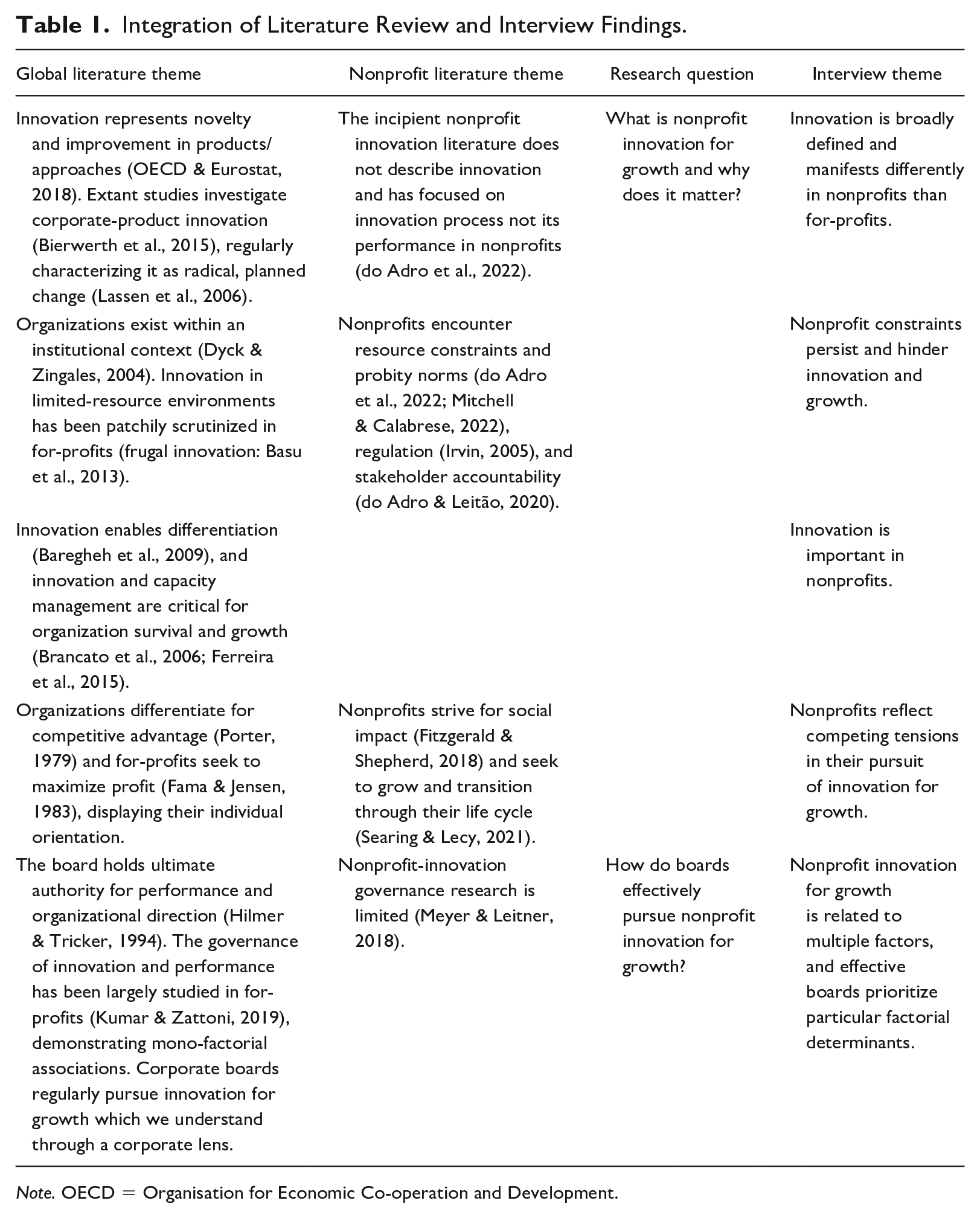
Note. OECD = Organisation for Economic Co-operation and Development.
First, innovation is defined as novelty and improvement in products and approaches (OECD & Eurostat, 2018) and has been investigated in for-profits where it is often represented as radical, planned change (Lassen et al., 2006). Advancing this knowledge, our interviews discovered that the emerging nonprofit innovation for growth construct represents sector-specific innovation and growth ideas of small, incremental improvements and connectedness, organizational social-purpose alignment (i.e., nonprofit pursuit), and demonstrated scale increase (i.e., growth). In fact, nonprofits use particular words such as change, improvement, sustainability, and impact to portray innovation in their sector. This result, which extends the fragmented literature, is important because, for the first time, we can glimpse the distinct nature of nonprofit innovation and thus acknowledge its sectoral specificity.
Second, and relatedly, we recognize that organizations exist within institutional environments which drive resource access and allocation (Dyck & Zingales, 2004). Nonprofits encounter resource constraints and probity norms (do Adro et al., 2022; Kerlin & Pollak, 2011; Mitchell & Calabrese, 2022), as well as issues associated with regulation (Irvin, 2005), stakeholder accountability (do Adro & Leitão, 2020), and performance definitions (Levine Daniel & Eckerd, 2019), that are likely to hinder investment in innovation and growth. The interview findings confirm that such nonprofit-specific resource constraints and multistakeholder interests, along with short-termism, do pose unique innovation-governance hurdles. Interestingly, despite these obstacles, the sessions uncovered that nonprofit boards indeed pursue innovation, specifically their version of it and in an inconspicuous manner. This empirically led discovery is significant as we now gather that nonprofits persevere to overcome well-documented innovation challenges and to seek sector-specific innovation for growth.
Third, the extant research tells us that innovation enables differentiation (Baregheh et al., 2009) and that innovation and capacity management are critical for organization survival and growth (Brancato et al., 2006; Ferreira et al., 2015). Building on this foundational base and unconventionally delving into nonprofit-innovation performance, our interviews revealed that nonprofit innovation is important as a growth pathway and that innovation for growth matters because it enables nonprofits to be financially viable, create impact, and address societal challenges. The value of this finding is that scholars, henceforward, are in a position to comprehend why nonprofit growth matters and make sense of the relationship between nonprofit innovation and growth.
Fourth, we know that organizations differentiate for competitive advantage (Porter, 1979) and for-profits are individually oriented and maximize profit (Fama & Jensen, 1983). Nonprofits, though, often strive for social impact (Fitzgerald & Shepherd, 2018); we are also beginning to discern how they may grow and evolve through their life cycle (Searing & Lecy, 2021). By originally applying the fragmented nascent literatures on nonprofit motivations and life cycles to nonprofit innovation, in the interviews we learnt that, when undertaking innovation for growth, nonprofits reflect competing tensions of growth and purpose-alignment in their search for financial viability and collective societal benefit. Our finding is noteworthy in uncovering how these apparently conflicting goals coexist and function to support nonprofits’ improved performance and impact.
Fifth, prior scholarly studies point to a scattered collection of factors which we probed to figure out the dynamics of boards’ effective quest regarding nonprofit innovation for growth. We recognize that for-profit boards regularly seek innovation for growth, a construct that, until now, we have understood only through a corporate lens. By exploring the selected factors, our interviews detected that a factorial blend may influence nonprofit innovation for growth where prior research, corporate/nonprofit alike, has determined mono-factorial innovation associations. The various factors (and associated determinants) we theorized of board composition (diversity), board relations (cohesiveness), and board practice (strategic orientation, resource access/allocation, stakeholder engagement, target setting/reporting), however, relate not only to innovation performance but also to the board’s fulfillment of its standard responsibilities for strategy and performance (Hilmer & Tricker, 1994). In probing further, we realized boards that effectively foster nonprofit innovation for growth seem to prioritize particular factorial determinants that are new to nonprofit-innovation research of thought diversity, board culture, and strategic board practice. Therefore, our conceptualization is meaningful, especially in an environment of change, in yielding pioneering scholarly knowledge of the multiple, interacting, and oftentimes neglected levers that may impact nonprofit innovation and performance.
Beyond these immediate research impacts, our investigation offers significant indirect and long-term benefits. Our newfound understanding of the distinct nature and importance of innovation for growth in nonprofits, together with the discovery that nonprofit boards do, in fact, pursue their version of innovation for growth, should encourage the research community to consider sectoral specificity in future innovation studies. And our consolidation and development of the scattered research on nonprofits’ objectives and life cycles is generative and offers fruitful avenues for further exploration. Moreover, the nonprofit-innovation levers we identified can be employed and refined by other scholars to further advance nonprofit theory and empirical research.
In addition to these proximal and distal theoretical implications, which are manifold and substantive, our project contributes methodologically because of its use of interviews, a relatively new technique in nonprofit-governance research (prior studies have been predominantly quantitative and retrospective: Boyd et al., 2017). The interview methodology allowed us to probe on innovation for growth’s nature and importance, likewise its pursuit, the latter which included assessing the impact on innovation performance of understudied board relational and practice factors that benefit from qualitative exploration. And having the audiovisual recording permitted simultaneous, recursive content review and iterative development of thematic findings. Incorporation of visual, not only audio, in the recording also added nuance and emphasis to the content, thereby informing and illuminating the findings. In these ways, the methodology was instrumental in providing a platform to access and analyze in-boardroom lived experience, thus enabling the uncovering of grounded fertile and novel insights. Furthermore, our methodological approach itself charts a new way for other scholars to delve into complex and interconnected topics that have previously been difficult to investigate.
Practical Implications
Our project delivers important implications for individual nonprofit boards and for the broader sector and stakeholders. It offers to practitioners a rich new awareness of the nature and importance of nonprofit innovation for growth together with learning how it may be productively fostered, which could assist nonprofit boards in positively influencing their nonprofit’s performance and social impact. Moreover, if we can use this research as a sector to elevate the importance and effective oversight of nonprofit innovation for growth, this may help investors and governments in their funding and policy decisions, which could strengthen nonprofit beneficiaries’ access to services and, potentially, more broadly, flow onto supporting development of a thriving and impactful nonprofit sector.
Limitations and Future Research
Notwithstanding these far-reaching theoretical and practical implications, the study has some limitations which suggest future research directions.
Although our project interrogated growth and innovation separately, it did not investigate whether growth without innovation is possible and, if so, to what degree might the two scenarios differ? Thus additional qualitative research to scrutinize alternative nonprofit-innovation outcomes may be helpful.
Our use of a convenience sample could also have limited the generalizability of findings. However, we intentionally opted for such a population in light of the topic’s complexity and having judged that participants with prior interviewer connections would afford comparatively greater interview depth and quality. And, to avoid any lingering non-randomness concerns, we ensured sample-diversity requirements in our inclusion criteria.
Yet because of the nature of qualitative research, our exploration identified valuable, complex constructs and inferred a pattern of association between board and contextual characteristics and nonprofit growth-directed innovation but could not determine the exact factorial blend, causality, direction, or effect size. Therefore, further research might usefully be directed to developing a multifactorial innovation for growth governance model. Moreover, quantitative examination via longitudinal dataset-based studies and surveys could be helpful to isolate the independent variables, ascertain the direction and extent of the relationships, and detect which blend of variables best predicts nonprofit innovation for growth. Such scrutiny could benefit by focusing on particular questions of, for instance, the effect of board diversity on innovation for growth and, likewise, board culture. More generally, investigations using archival sources to interrogate various organizational clusters (e.g., of size/life cycle) and countries (e.g., to examine regulatory or governance standards) might be deployed to determine the impact of contextual factors and to probe and calibrate a model. In addition, a project that juxtaposes board-factorial influences on innovation for growth in nonprofits against for-profits could be beneficial to realize possible different innovation drivers and approaches. Finally, development and testing of a composite measure of nonprofit innovation for growth and its governance could be a worthwhile future direction to support tracking and evaluation of this important new construct.
Conclusion
In this first-in-field study, we weave together the scant nonprofit-innovation governance research with findings from our series of interviews with 26 board members to reveal that nonprofit innovation for growth represents small, incremental improvements and connectedness, and is motivated by competing organizational purpose/growth goals. We also conceptualize the influence on nonprofit innovation for growth of a blend of board characteristics (composition, relations, practice) and contextual factors (organization, environment); and that effective boards, innovation-wise, appear to pay attention to particular determinants of thought diversity, board culture, and strategic board practice. Our research developed our understanding of board-led innovation for growth across this crucial sector, thereby supporting best-practice governance and contributing to a nonprofit sector that not only thrives but also generates significant and greater societal impact.
Footnotes
Declaration of Conflicting Interests
The author(s) declared no potential conflicts of interest with respect to the research, authorship, and/or publication of this article.
Funding
The author(s) received no financial support for the research, authorship, and/or publication of this article.
