




Abstract
The contested concept of social entrepreneurship has gained particular prominence in academic literature over the last few decades. To explore how patterns of understandings relating to social entrepreneurship have emerged and shifted over time, we undertook a critical historical review focusing on the most highly cited social entrepreneurship articles in each of five time periods over the last 30 years. We identify four thematic areas—conceptualization, theoretical approaches, the search for data, and social change outcomes—characteristic of each period, allowing us to plot the terrain of social entrepreneurship scholarship over time. We show how patterns emerge across these themes over time and relate our analysis to wider developments in the field. In concluding, we discuss how the concept has been theoretically and conceptually enriched by an ability to accommodate critique.
Introduction
Social entrepreneurship is a fluid and contested concept, with meanings that are interpreted differently according to cultural, geographic, and historical context (de Bruin & Teasdale, 2019). How we appraise concepts is shaped by our assumptions and normative theories (e.g., libertarianism, citizenship, egalitarianism, feminism—see Ranville & Barros, 2021). Concepts that align with dominant modes of thought are more likely to become widely accepted. And concepts that are malleable in response to shifting ideological environments are more likely to achieve longevity (Rehn, 2008). Social entrepreneurship has achieved longevity as a concept across a wide range of disciplines, including, but not limited to, management, social policy, political science, and economics. What is particularly notable to us is that the patterns of meanings associated with social entrepreneurship have shifted considerably over time as the concept has been reshaped to accommodate critique, particularly of the Schumpeterian hero social entrepreneur (e.g., Martin & Osberg, 2007). While there is no singularly accepted understanding of social entrepreneurship, Chliova, Mair, and Vernis (2020) usefully set out how, as the field has matured, an inclusive framing—entrepreneurship aimed at achieving social change or ameliorating social problems—has evolved, within which there is space for multiple exclusive framings to coexist. Similar to the arena of social entrepreneurship practice, this inclusive framing operates in academia as a pluralistic space open to a wide variety of disciplinary and normative “exclusive framings.” Hence contestation within the “winning label” of social entrepreneurship (Chliova et al., 2020) occurs as to: the pros and cons of market-based approaches (Eikenberry & Kluver, 2004) the levels at which social entrepreneurs pursue change (Zahra et al., 2009); the importance of the hero entrepreneur versus collective social approaches to social entrepreneurship (Montgomery et al., 2012); and whether social entrepreneurship is confined to social enterprises or can occur in any organizational setting (Defourny & Nyssens, 2010). As a broad generalization, social entrepreneurship scholars accept the desirability or necessity of social change to create a better world but are divided as to what this better world should look like and the precise approaches to get there (see Teasdale et al, 2021).
This accommodation of multiple exclusive perspectives within an inclusive framing poses problems to those seeking to understand and critique social entrepreneurship. For example, at the International Social Innovation Research Conference (ISIRC) in 2014 an audience member was critical of the role-played by Ashoka in the marketization of the nonprofit sector. The Ashoka speaker, not unreasonably, responded that the majority of their fellows did not engage in trading. As Rehn (2008) noted, it can be extremely difficult to land a “winning blow” on a concept that is deliberately ambiguous and hence impossible to pin down (see Chliova et al., 2020). But while such ambiguity and complexity might create confusion, it has also opened spaces for theoretical and methodological innovation. What was once labeled a “pre-paradigmatic” field (Nicholls, 2010b) lacking in conceptual clarity, common theoretical approaches and constrained by limited data (Dacin et al., 2011) has developed into a fertile interdisciplinary terrain, ripe for new combinations of (normative) theories and methods which have taken the concept in surprising new directions (Mair & Martí, 2006). The concept has demonstrated a remarkable ability to incorporate challenge. From a constructivist perspective, as the concept has evolved over time patterns of understanding have been continually reshaped through their enactment via interdisciplinary conversations and the importation and adaptation of theories and methods from different disciplines. In turn, this (r)evolution has led us, as researchers once critical of the hegemony of mainstream entrepreneurship theories - particularly the hero social entrepreneur approach popularized in the early 2000s - to rethink our assumptions. Hence, in this article we present results of a critical historical review showing how, and seeking to explain why, patterns of understandings relating to social entrepreneurship have emerged and shifted over time.
There have been several reviews and meta-analyses of the social entrepreneurship literature, particularly undertaken over the last decade or so. These reviews are useful in identifying themes within social entrepreneurship research (Kraus et al., 2014), the dominance of management and entrepreneurship journals as outlets (Rey-Martí et al., 2016), and an apparent underutilization of empirical approaches, particularly quantitative (Short et al., 2009), meaning that the social value created through social entrepreneurship is assumed rather than empirically demonstrated (Rawhouser et al., 2019; Saebi et al., 2019). While useful in highlighting geographical differences in how social entrepreneurship is conceptualized (Bacq & Janssen, 2011), review articles have neglected the temporal aspect: how meanings may have changed over time. Relevant to our historical perspective, Defourny and Nyssens (2010) adapt the work of Dees and Anderson (2006) to trace the intellectual roots of three schools of thought: the earned income (social enterprise) school; the social innovation school; and the “EMES” (L’émergence des entreprises sociales en Europe) approach of social enterprise (see also Bacq & Janssen, 2011). Hota, Subramanian, and Narayanamurthy (2020) take a systematic approach to identifying various schools (or the “intellectual structure”) of social entrepreneurship research through combining citation and network analysis. Their list of “core documents” would seem to suggest that the three schools of thought identified by Defourny and Nyssens (2010) may now be of limited use in classifying the social entrepreneurship literature, since almost all highly cited articles fall under the broad category of “social innovation” (Bacq & Janssen, 2011). In his most recent review, Hota (2021) analyzes the structure of the field by different time periods. This highlights the potential to incorporate a temporal dimension to the spatial-cultural aspects identified in previous reviews, alerting us to the possibility that we can not only identify the existence of different schools of thought/exclusive framings, but also trace how these have been constructed over time.
Critical historical reviews have tended to be employed in social science-influenced areas of health research, including nursing, social work, and psychiatry, often demonstrating how approaches to diagnoses and treatments vary over time through placing texts in their historical context (e.g., Daley et al., 2016). More relevant to social entrepreneurship, Ayob, Teasdale, and Fagan (2016) trace the historical emergence of “social innovation” as an academic concept, showing how different ideas became entangled, eventually leading toward a collaborative understanding. Given the contested nature of social entrepreneurship, and the range of empirical, theoretical, and normative approaches employed to its study, a critical historical review is appropriate for exploring how patterns of understandings relating to social entrepreneurship have emerged and shifted over time.
Our article proceeds as follows: We initially offer a brief “history” of social entrepreneurship. We then outline our bibliometric approach to identifying our corpus of highly cited articles focusing explicitly on social entrepreneurship (in their titles) in different time periods. Our critical historical analysis is presented in two stages. First, we inductively describe the contents of these articles, and particularly their patterns of meaning, by time period—attempting to place them within their historical context. In a second stage of analysis, we trace changing patterns over time across four “themes”: conceptualization, theoretical approaches, the search for data, and (social change) outcomes. We close by critically reflecting on how our own assumptions have shifted during our historical journey and briefly outlining what we feel to be potentially productive future research trajectories at the intersection of nonprofit and social entrepreneurship studies.
A Concise History of Social Entrepreneurship
Social entrepreneurship as practice predates academic interest. The social entrepreneurship literature regularly draws upon historical figures such as Robert Owen and Florence Nightingale as early exemplars of social entrepreneurship (see Chliova et al. (2020) and Bacq and Janssen (2011) for more complete accounts of the emergence of social entrepreneurship than we are able to present here). Figure 1 sets out a timeline of some of the most important external influences on the social entrepreneurship literature. It is important to note that the label “social entrepreneurship” was also used, almost accidentally, prior to its emergence as an academic concept. For example, Wharton (1920), for instance, depicts a protagonist in her novel who launches wealthy people into New York high society through introducing them to influential people as a social entrepreneur in her 1920 book, the Pulitzer Prize-winning The Age of Innocence. Bill Drayton, founder and CEO of Ashoka, is often accredited with (re-)coining the concept in the 1980s to describe the work of their Ashoka Fellows in using entrepreneurial skills (including connecting people) to tackle pressing social problems. Around the same time, U.S. nonprofits were increasingly turning to earned income strategies to supplement “traditional” sources of revenue. Thought leaders such as Jer Boschee and Jed Emerson drew upon a popularist notion of entrepreneurship as the creation of business ventures to describe these social sector “pioneers” as social entrepreneurs (Dees & Anderson, 2006). On the other side of the Atlantic just prior to the election of the “Third Way” New Labor Government in the United Kingdom, Leadbeater (1997) wrote The Rise of the Social Entrepreneur describing community activists tackling society’s most pressing problems through drawing on and developing social capital (in not dissimilar ways to those launching wealthy people into New York society).
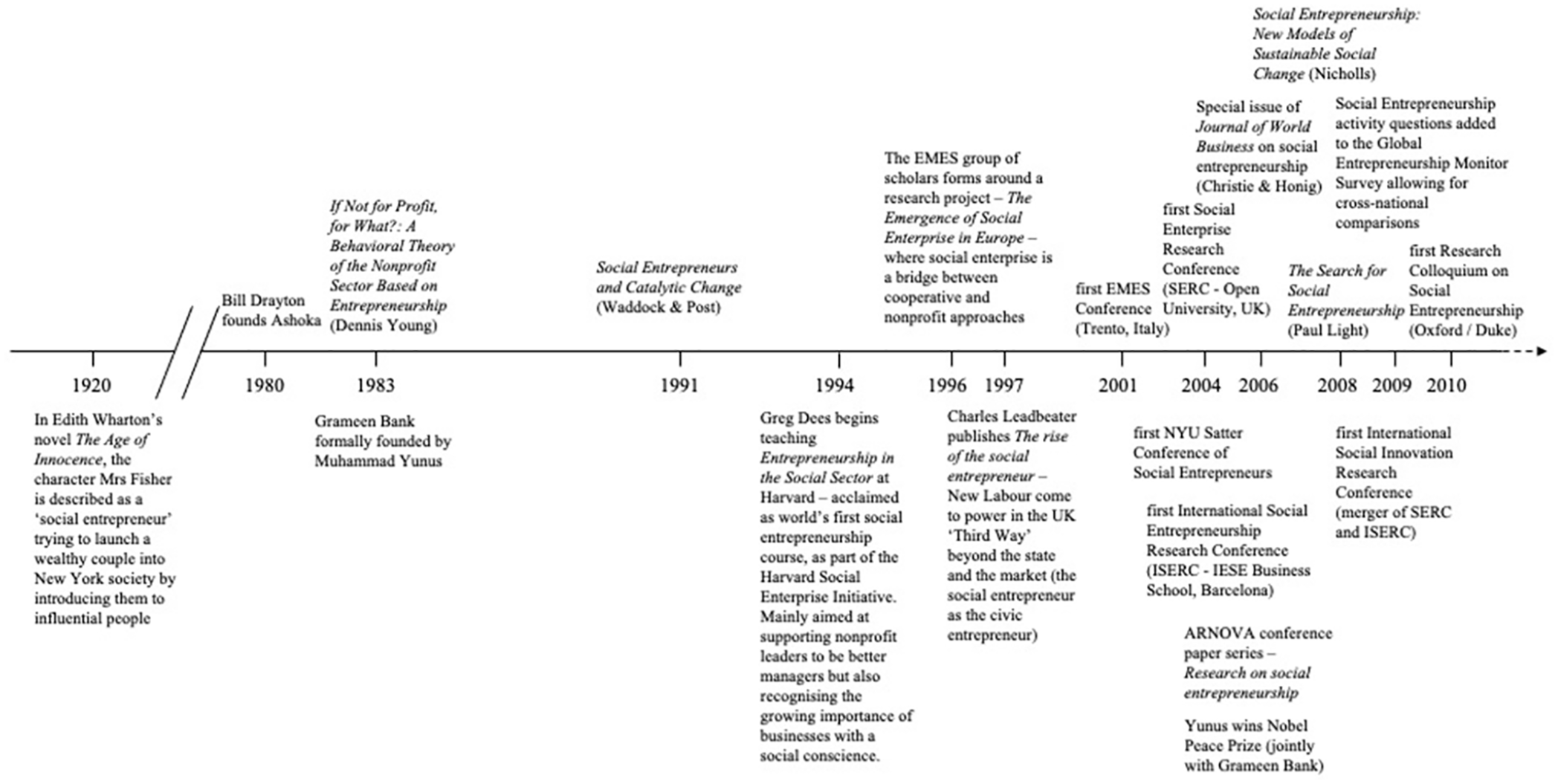
Social entrepreneurship timeline.
Academic genealogies of social entrepreneurship often converge on Young’s (1983) work developing a supply-side theory of nonprofit behavior, and thus introducing entrepreneurship theories to nonprofit studies. Dees (1998a, 1998b) who is regularly credited with pioneering social entrepreneurship research drew upon Young’s work in the late 1990s to define social entrepreneurs as “change agents” in the nonprofit sector. Academic interest in social entrepreneurship significantly increased following the award of the Nobel Peace Prize to Muhammad Yunus and Grameen Bank for their work to “create economic and social development from below.” Dees and Anderson (2006) identified two different schools of thought on social entrepreneurship: the social enterprise school, which draws from common-sense understandings of entrepreneurship to describe social entrepreneurs as those creating nonprofit businesses, and the social innovation school, which draws from Schumpeterian theory to describe social entrepreneurs as those who reform or revolutionize the patterns of producing social value. In 1996, a group of scholars formed around a major research project funded by the European Union. The EMES group, named for their focus on the emergence of social enterprise in Europe, initially positioned social enterprise as a bridge between cooperative and nonprofit organizational traditions. Two of the leaders of that group, Defourny and Nyssens (2010), later posited a third school of thought: the EMES approach to conceptualizing social enterprise. In essence, what we were seeing was different groups of actors seeking to win support for different exclusive framings of what social entrepreneurship ought to be (Nicholls, 2010a). New conferences, including the EMES conference, the International Social Entrepreneurship Research Conference (now merged with the Social Enterprise Research Conference to become ISIRC) in Europe, and the Annual Social Entrepreneurship Research Conference in the United States, have proven to be productive interdisciplinary spaces for the exchange and fertilization of ideas, leading to major international texts on social entrepreneurship (e.g., Nicholls, 2008; Robinson et al., 2009). Existing major conferences such as ARNOVA (Association for Research on Nonprofit Organizations and Voluntary Action) and the Academy of Management opened new chapters devoted to social entrepreneurship. Notably, and building from the ARNOVA’s special interest group, Light’s (2008) work “searching” for social entrepreneurship offered an influential critique of the limiting “hero” entrepreneur approaches to conceptualization, thus helping to widen the concept. New journals such as Journal of Social Entrepreneurship were launched, while mainstream journals such as Journal of World Business devoted important special issues to the topic. By 2011, we suggest that social entrepreneurship had permeated the academic mainstream to such an extent that elite journals were regularly publishing papers on the topic outside of special issues. Yet important articles still problematized social entrepreneurship as lacking a clear definition. Rather than seeing this as a problem, we wanted to explore how competing understandings have emerged over time.
Methods
The analysis in this article was undertaken between August 2020 and November 2020 and explores the 30-year period from 1990 to 2019 during which social entrepreneurship became established in the academic literature. Given the many thousands of articles published on social entrepreneurship (a cursory search on Google Scholar for “social entrepreneurship” in May 2022 yielded around 181,000 results), we made three key decisions aimed at narrowing the corpus. First, we decided to narrow our focus to articles or chapters with the term “social entrepreneurship” in the title. This decision assumed that articles setting out meanings of social entrepreneurship would most likely include the term in their title. Most articles that use social entrepreneurship as a keyword (and indeed some that use it in the title) do not define the concept, making it difficult or impossible to code them against definitional issues and conceptualization. Second, we did not include related concepts or “schools of thought” such as social enterprise, earned income, or social innovation. We wanted to let the data speak for itself rather than imposing prior assumptions and understandings. Our rationale was that if an article on social entrepreneurship was associated with a particular school of thought, then this would be apparent when coding it. However, including articles on social enterprise, earned income, or social innovation would rarely tell us about understandings of social entrepreneurship since most do not even mention social entrepreneurship. Our third decision was to focus only on the most highly cited articles. In part this was a decision necessary for making the corpus manageable. But it also ensures that we include the most influential articles that have shaped and reflected the concept of social entrepreneurship. However, partly to mitigate against bias toward older articles (which would be expected to have received more cumulative citations), and partly to ensure that we could trace the historical evolution of the concept, we chose to select the most highly cited articles in each of five separate time intervals. We identified these articles using the ISI Web of Science platform which provides access to multiple databases and is considered to be a comprehensive and effective platform for identifying cross-disciplinary research (Harzing & Alakangas, 2016) in a wide range of forms.
Search Strategy
We employed a binary search string with word truncations (i.e., “*”): “social entrepreneur*” OR social entrepreneur*. The former picked up all articles with social entrepreneur/entrepreneurship/entrepreneurial, etc. in the title. The latter picked up all terms with social AND entrepreneur* in the title: we were aware, for instance, that some papers use phrases such as “social and commercial entrepreneurship” (e.g., Austin et al., 2006) in their titles.
We deliberately avoided searching for papers that used associated terms (or concepts) such as social enterprise, earned income, and civic innovation that did not explicitly use the term “social entrepreneurship”. While recognizing that (at different points in time) some authors have treated different associated terms, or concepts, as synonymous with social entrepreneurship, we wanted to explore changing patterns of meaning over time, rather than being restricted by prior assumptions. This strategy also allowed us to identify influential papers in the social entrepreneurship literature which have discussed social enterprise and/or earned income as they relate to the social entrepreneurship concept (e.g., Bacq & Janssen, 2011; Defourny & Nyssens, 2010). We limited our search to the title of the document, which is a widespread and efficient strategy in systematic reviews (Mateen et al., 2013). We did not set any date range delimiters or language filters. A total of 3,721 papers were identified initially, and after extracting duplicates, we removed 2,370 records that did not relate to social entrepreneurship, and 122 papers written in languages other than English, French, Italian, Portuguese, and Spanish, leaving us with a corpus of 1,342 documents.
Organizing and Identifying the Important Articles
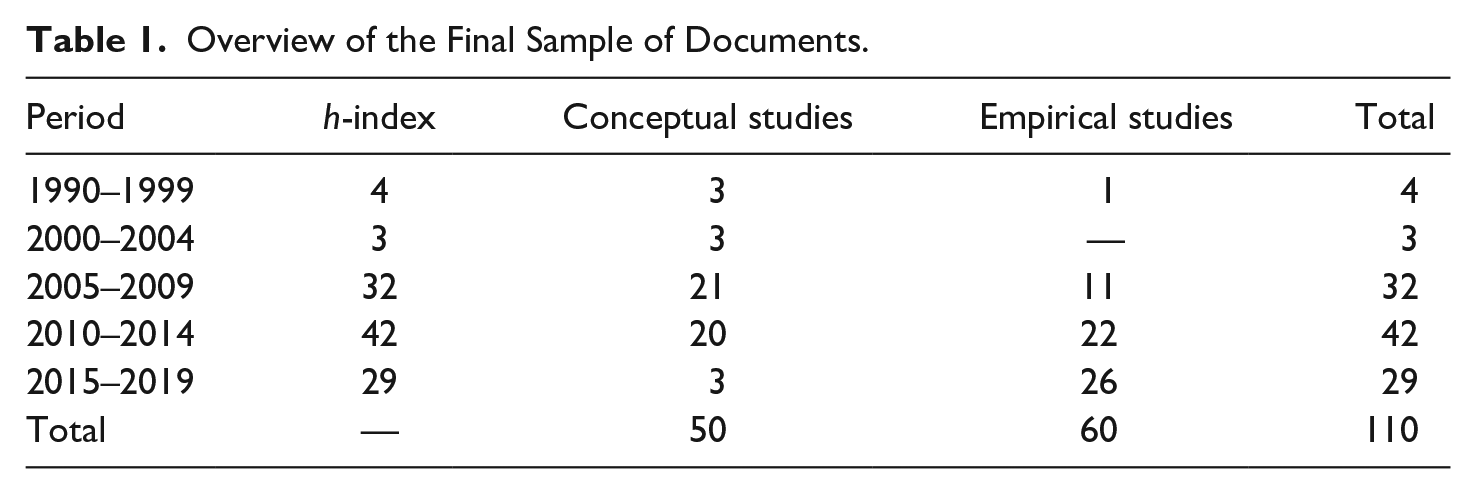
We grouped the documents into five separate time intervals: 1990 to 1999, 2000 to 2004, 2005 to 2009, 2010 to 2014, and 2015 to 2019. The duration of the first period was 10 years, rather than 5, simply due to the relatively low numbers of papers published on the topic during this decade. Through Web of Science, we identified the h-index score related to the topic in each period, sifting out all those papers with citation numbers lower than the h-index for that period (which is shown in Table 1). Our final sample thus comprised 110 documents, published between 1990 and 2019. A flowchart mapping out the number of records identified, included, and excluded, and the reasons for exclusion, is shown in Figure 2 and our breakdown of the final sample is provided in Table 1. A full list of the papers in the final sample is also available as an online appendix.
Overview of the Final Sample of Documents.
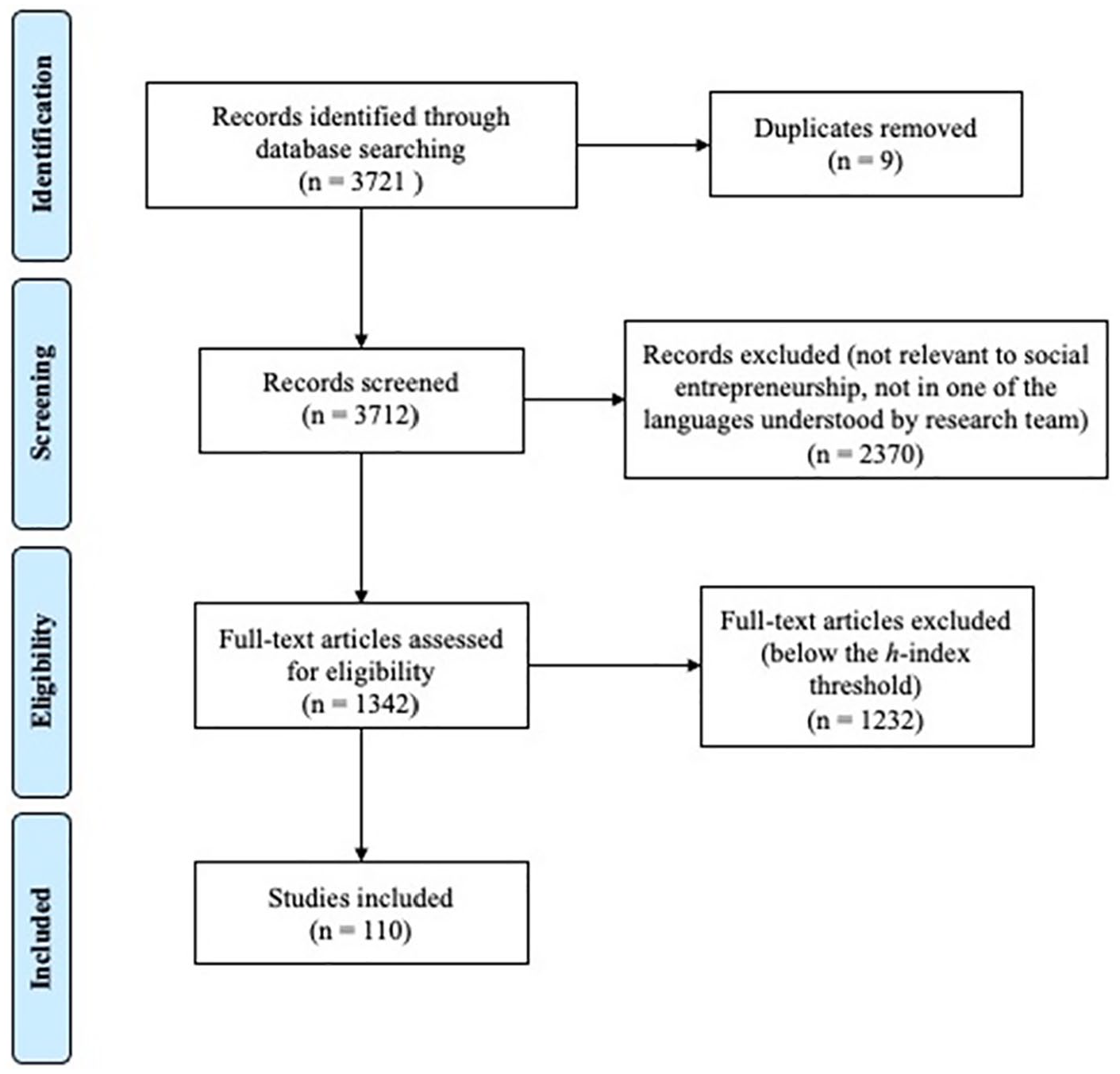
Search flowchart.
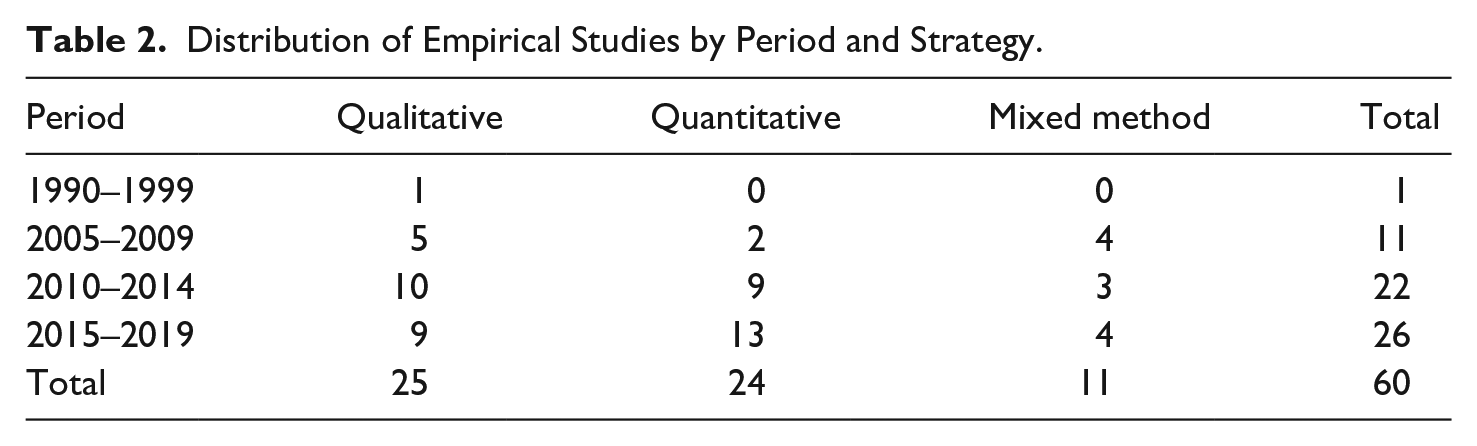
Our corpus consisted of 108 journal articles and two book chapters. Of the 60 empirical papers, 25 were qualitative studies, 24 were quantitative studies, and 11 employed a mix of methods. The distribution over time of the different strategies used, as shown in Table 2, demonstrates a definite shift toward quantitative studies as the field has matured.
Distribution of Empirical Studies by Period and Strategy.
Critical Historical Analysis
The lead author initially read each publication (n = 110) to identify how the different papers defined or conceptualized social entrepreneurship, the methods they employed, and the theoretical approaches they aligned to. For each time period, we collectively constructed narrative summaries (shortened versions of which are presented in the next section) of the articles, allowing our themes to be identified inductively and to be placed within their historical context. We then developed common themes for each time period: conceptualization, theoretical approaches, the search for data, and social change outcomes. This facilitated our historical analysis of how patterns within these themes have emerged and shifted
Findings
1990 to 1999: Social Entrepreneurship as Civic Innovation
Just four articles published between 1990 and 1999 were cited four or more times (Catford, 1998; de Leeuw, 1999; Duhl, 1993; Waddock & Post, 1991). All suggest a similar understanding of social entrepreneurs as nonprofit leaders combining resources in a creative approach to problem-solving (see Young, 1983) and working at the interface between nonprofit sectors and (local) government to influence policy agendas. Despite the attention paid by existing reviews to the “earned income” school of thought, just one of these articles (Duhl, 1993) also linked social entrepreneurship to market-oriented nonprofits. Waddock and Post (1991) focused on the role of the (nonprofit) social entrepreneur as catalyzing wider change in cities through shaping policy agendas, rather than simply working within the organization. Two articles toward the end of the period relate to the “Third Way” context, where popular commentators (e.g., Leadbeater, 1997) were positioning social entrepreneurs working in deprived inner cities as offering a third way beyond state and market in responding to social problems. Like Leadbeater, Catford (1998) draws heavily on the example of the Bromley-by-Bow Center, a long-standing and well-respected nonprofit “Healthy Living Centre” based in London, emphasizing the wider social and economic value that can be created through building social capital and tackling the social determinants of (poor) health. de Leeuw’s (1999) qualitative empirical paper derived from a large EU funded research project of 10 “healthy cities” and identified the catalytic role of social entrepreneurs operating outside their own organization in setting policy agendas, and that social entrepreneurs are most effective where cities have institutionalized social entrepreneurship in providing resources for nonprofits. Strikingly, the empirical evidence continually reinforces this point over the next 20 years. However, some later discourses of social entrepreneurship continually ignore, downplay, or even do away with altogether, the need for social entrepreneurs to work with local governments to achieve social change.
2000 to 2004: Critiquing the Neoliberal Underpinnings of (the Social Innovation School of) Social Entrepreneurship
During this period just three (conceptual) articles were cited three or more times. At the turn of the millennium a range of “popular” texts (e.g., Bornstein, 1997; Boschee, 2001; Dees, 1998a; Dees et al., 2002) had positioned social entrepreneurship as a means of transforming the nonprofit sector through earned income strategies. During this period, we can see this earned income (or social enterprise) school being incorporated into what Dees and Anderson (2006) term the “social innovation school” (see Bacq & Janssen, 2011). The articles in this period reflect and respond to this new discourse.
Lasprogata and Cotten (2003), writing from a legal perspective, set out the (now rather well-worn) case that nonprofits had to increase their earned income, claiming that donations to nonprofits in the United States were declining at a time of decreasing government funding. As such, commercialization strategies were both necessary and desirable. The notion that reducing government spending is necessary and unavoidable is an underlying premise of much of the popular social entrepreneurship literature (e.g., Martin & Osberg, 2007), particularly as regards earned income approaches (although see Kerlin and Pollak (2011) and Eikenberry and Kluver (2004) for a critique of this underlying assumption).
Fowler (2000) and Cook, Dodds, and Mitchell (2003) focus on the popular understanding of social entrepreneurship as opportunity recognition, risk-taking, and a keen attention to the “bottom line,” effectively incorporating the social enterprise approach into what Dees and Anderson (2006) term the social innovation school. Cook et al. (2003) equate this new discourse of social entrepreneurship with neoliberalism, and as based upon two false premises that social problems have individual, rather than structural, causes and the continuing myth of the fiscal crisis of the welfare state.
2005 to 2009: Emergence of the Hero Social Entrepreneur
During 2005 to 2009, 32 papers received 32 or more citations, a dramatic jump from the previous periods. This coincided with social entrepreneurship achieving considerable popular recognition following the award of the Nobel Peace Prize jointly to Mohammad Yunus and Grameen Bank in 2006. Just 11 of these papers were empirical, including two review articles. Almost all the others sought to conceptualize the “new” phenomenon of social entrepreneurship. It is notable that many of these conceptual articles drew upon entrepreneurship theories, and particularly Schumpeterian thinking (Schumpeter, 1934), to outline similarities and differences between social and conventional entrepreneurs (e.g., Dees, 2007). We also see early signs of critical discursive perspectives questioning this new language.
In 2006, a special issue of Journal of World Business on social entrepreneurship was published which discusses field-building efforts centered upon the entrepreneurship division of the Academy of Management conferences (Christie & Honig, 2006). This helps explain the significant number of articles over the period which apply mainstream entrepreneurship theories to the process of defining and conceptualizing social entrepreneurship, and definitions of social entrepreneurship emerging which emphasize opportunity recognition, mobilization of resources, creative destruction, and the creation of new (social) equilibria. By this time, the early focus on civic innovation had been almost totally displaced by this “social innovation school.” Differences between social and conventional entrepreneurs tended to be reduced to the social (as opposed to financial) value that social entrepreneurs pursue. There were also differences between those who confined social entrepreneurship to the nonprofit sector (e.g., Dees, 2007; Mair & Martí, 2006; Mair & Noboa, 2006; Weerawardena & Mort, 2006) and those who see social entrepreneurship as occurring “within or across the nonprofit, business, or government sectors” (Austin et al., 2006, p. 20). A second distinction concerns the extent to which social entrepreneurs are rare individuals (and/or the unique level of the social change they create). Zahra et al. (2009) distinguish between different entrepreneurship theories to develop a typology of social entrepreneurs: Social bricoleurs (most nonprofits) address local problems using whatever resources come to hand while Social constructionists (e.g., the Acumen Fund) build alternative social structures to address social needs that are not met by existing institutions. In contrast, social engineers (e.g., Muhammad Yunus) supposedly tear down unjust social structures and replace them with new ones.
Notably, most of the conceptual literature draws upon exemplars of “heroic” social engineers, with Yunus being particularly prominent. However, the rather limited empirical literature tends to focus more on social bricoleurs, suggesting that scholars were finding it rather difficult to find examples of Schumpeterian social entrepreneurship (see Light, 2008). For example, Sharir and Lerner (2006) draw upon 33 social ventures in Israel conducted between 1999 and 2001 to outline factors (and traits) contributing to “success.” During this period, not one of the empirical studies we identified assess the social value created through social entrepreneurship and there was rarely any mention of the potential role of government. While Korosec and Berman (2006), adopting a civic innovation perspective, find through their mixed-method survey approach that municipal support is associated with high levels of social entrepreneurship in cities, this is an outlier for a period in which Dees and Anderson’s social innovation school became the dominant conception of social entrepreneurship (see also Bacq & Janssen, 2011). Prior to the Global Financial Crisis of 2008, government had noticeably become part of the problem, rather than the solution, in the literature.
The critical discursive approach
While our corpus suggests that the social innovation school had become the dominant discourse of social entrepreneurship during this period, this does not mean that all authors enthusiastically embraced the potential for (market-driven) social change. Nicholls (2010b) speculated that social entrepreneurship is as much about rhetoric as meaningful social change. Farmer and Kilpatrick (2009) show how health professionals in Scotland and Tasmania utilize the discourse of entrepreneurship to attract policy resources. Chell (2007), adopting a discursive perspective, draws attention to the “heroic” nature of enterprise culture in the United Kingdom. Parkinson and Howorth (2008) critically question the application of entrepreneurship discourse to nonprofits in the United Kingdom. They found low (but growing) affinity with the social entrepreneurship discourse, noting (like Farmer and Kilpatrick) that some “social entrepreneurs” were simply nonprofit practitioners learning the new language to attract resources.
2010 to 2014: Embracing Diversity
This period can be viewed as partially representing a critical backlash against social entrepreneurship discourse, and particularly the individual (male) hero social entrepreneur figure. Perhaps representing the wider influence of EMES and their focus on the collective governance of social enterprises, some researchers began to stress the importance of social entrepreneurship as a collective endeavor. There is also a focus on gender, both as regards the representation of women as social entrepreneurs and in relation to social entrepreneurship as (potentially) empowering women. Institutional theories increasingly highlight the difficulties of achieving systemic social change, and researchers problematize the taken-for-granted concept of social value. A more realistic portrayal of social entrepreneurship begins to emerge which embraces, and seeks to explain, difference and diversity. Methodologically, by this time, there is an increasing number of empirical studies, particularly drawing upon the Global Entrepreneurship Monitor (GEM) dataset.
Theorizing the process of social entrepreneurship
While entrepreneurship theories still predominate, in this period (following a similar trajectory to the emergence of entrepreneurship as a field of study) articles now move beyond conceptualizing to develop early explanatory theories of social entrepreneurship, with a particular focus on what motivates social entrepreneurs and how they access resources in the absence of capital investment. Perrini, Vurro, and Costanzo (2010) explore the process by which social entrepreneurial opportunities are identified, evaluated, exploited, and scaled up. Miller, Grimes, McMullen, and Vogus (2012) put forward a model showing how compassion and prosocial motivations are translated into social entrepreneurship. Nga and Shamuganathan (2010) develop measurement scales to understand how personal traits influence who becomes a social entrepreneur. Corner and Ho (2010) introduce “effectuation” to social entrepreneurship research. By asking how opportunities are identified and exploited, they argue that “effectuators” seek to mold the environment to their purposes, rather than react to the world. Both Desa (2012) and Desa and Basu (2013) show how social entrepreneurs mobilize resources through processes of “bricolage” (making do with whatever is available).
Social value
By this time, an emergent body of research has begun to conceptualize the social value produced by social entrepreneurs. Dees (2012) sees social entrepreneurship as combining philanthropy with problem-solving. He argues that the social (i.e., nonprofit) sector needs to move away from “well-meaning” charitable efforts and toward intelligent problem-solving combined with rigorous evaluation methodologies. Nicholls (2010a), in a study of 80 social impact reports in the United Kingdom, suggests, however, that social impact reporting is more about rhetoric than demonstrating and/or improving performance. Santos (2012, p. 335) draws upon neoclassical economics to develop a “positive theory” of social entrepreneurship by highlighting the tension/trade-off between value capture and value creation (first raised by Mair & Martí, 2006). While this marks an attempt to move away from normative definitions of social entrepreneurship that labels some types of value creation “social” and others not, Santos does not really succeed beyond the conceptual level, since (as he notes) it is difficult to objectively measure “value”: the problem being that not all people can agree on what is valuable to society.
Critique
This period also serves up several important critiques of social entrepreneurship. Nicholls (2010b) identifies competing discourses with different paradigm building actors seeking to legitimize their actions. Dacin et al. (2011) highlight the normative underpinnings of social entrepreneurship researchers, suggesting that its advocates are often rather hostile to traditional governmental approaches to tackling social problems, and tend to support their arguments with selective use of positive exemplars rather than data.
It is notable that most empirical studies of social entrepreneurship neglect macro-level analyses (although it is notable that some studies of social enterprise do address this gap—e.g., Kerlin, 2009). Critical perspectives during this period seek to investigate the relationship between the (often positive) micro-actions of individual social entrepreneurs and the wider consequences of relaying on social entrepreneurs to solve societal problems. In this vein, Shaw and de Bruin (2013) consider whether social entrepreneurship offers a vehicle to reform capitalism, or whether it plays into the hands of neoliberal governments seeking to reduce public expenditure. Tending toward the latter perspective, and building from the critical discursive perspective which emerged between 2005 and 2009, Dempsey and Sanders (2010) analyze popular autobiographies of social entrepreneurs to show how “meaningful work” is centered upon the appeal of solving pressing social problems, but regularly privileges (often unpaid) employment over personal well-being and family life. Similarly, Hayhurst’s (2014) ethnographic study of Nike Foundation’s “the Girl Effect” draws upon the Foucauldian governmentality perspective popular with critical entrepreneurship scholars to show how Ugandan girls are transformed into “entrepreneurs of the self” whereby they internalize entrepreneurship and self-sacrifice. Social entrepreneurship from this perspective transfers the costs of social change efforts from governments and foundations to beneficiary groups, while maintaining the former’s ability to shape what is desirable. While beneficiaries do gain some autonomy and control over their lives, the “choices” they make correspond to subjectivities offered to them (by the Nike Foundation). Consequently, the author argues, beneficiaries of social entrepreneurship eventually become embedded in (market) systems that reinforce structural inequalities.
Collective social entrepreneurship
Partly in response to characterizations of individual hero social entrepreneurs in the social innovation school, Shaw and de Bruin (2013) emphasize the collective dimension of social entrepreneurship. Montgomery et al. (2012, p. 376) argue that social entrepreneurship tends to be “collaborative and collective, drawing on a broad array of support, cooperation and alliances to build awareness, gain resources and, ultimately, make change.” Such a perspective perhaps points to the growing influence of the EMES international research network, particularly outside of mainstream entrepreneurship and management journals. Meanwhile, Tapsell and Woods (2010) draw upon the case of Māori entrepreneurs to emphasize the importance of the historical (mainly colonization) and the cultural context and thus offer a counterbalance to more traditional approaches to social entrepreneurship.
Recognizing difference
A growing number of studies, by this time, start to recognize and embrace diverse approaches, in an attempt to open up “a more pluralistic and grounded debate about the limits, possibilities, and values of social entrepreneurship across the world” (Nicholls, 2010b, p. 627). Choi and Majumdar (2014) contend that a universally accepted definition of social entrepreneurship is not possible since social value creation is the only essential element of all definitions. Other features, the social entrepreneur, the social enterprise, market orientation, and social innovation, are all present to a greater or lesser extent in different definitions. Mair, Battilana, and Cardenas (2012) develop an empirically grounded typology of social entrepreneurship models. They find four main types based on types of capital: political, human, social, and environmental. The models are associated with different logics of justification. Bacq and Janssen (2011) show how collective values and forms of capitalism have shaped social entrepreneurship differently in Europe as compared with the United States, where more individualistic values dominate. The overall message from these studies being that social entrepreneurship looks different according to context.
Focus on the GEM
A problem regularly highlighted in the development of social entrepreneurship has been the lack of datasets permitting secondary analysis (e.g., Dacin et al., 2011). During this period, the release of social entrepreneurship data from the GEM Survey made comparative quantitative analyses possible. This survey has been criticized (e.g., Teasdale et al., 2011) for using such a wide definition of social entrepreneurship that it effectively measures nonprofit activity rather than allowing for the identification of a subset of social entrepreneurs (at least as characterized by the social innovation school). Lepoutre, Justo, Terjesen, and Bosma (2013) found that countries with higher rates of traditional entrepreneurial activity also tend to have higher rates of social entrepreneurial activity. Estrin, Mickiewicz, and Stephan (2013) draw upon GEM to show that prevalence of social entrepreneurship predicts future commercial entrepreneurship activity. They propose that social entrepreneurship is a function of strong institutional support. Hechavarria, Ingram, Justo, and Terjesen (2012) use GEM data to show that while men are more likely to pursue commercial entrepreneurship, women are more likely to engage in social entrepreneurial activity.
2015 to 2019: The Search for Data
The previous period saw widespread acceptance of an inclusive framing of social entrepreneurship that leaves space for difference and diversity as well as more exclusive framings. Between 2015 and 2019, the definitional debate appears to have become more settled. This period is characterized by a focus on empirical studies, particularly quantitative research further exploiting the (aforementioned) GEM dataset. Many of these studies derive from institutional theory, which has become integral to most quantitative approaches to the topic. Findings suggest that governmental support is strongly correlated with prevalence of social entrepreneurship. We also see innovative usage of other datasets, including videos from crowdfunding platforms and surveys of participants in massive open online courses (MOOCs). The more critical perspective starts to solidify around ethics, governmentality, and empowerment. Notably, despite a review paper on approaches to measuring social value, only one study in the corpus sought to measure the social value created by social entrepreneurship.
Exploiting data
Five of the studies identified use GEM data to explore the individual and institutional factors which lead to social entrepreneurship. These data suggest that social entrepreneurs are more likely to de driven by social goals (Bacq et al., 2016) and to rely on generalized, rather than specific, forms of human capital (Estrin et al., 2016). Social entrepreneurship is positively associated with: high levels of public expenditure (Hoogendoorn, 2016), high levels of government activism (Stephan et al., 2015), and high levels of societal collectivism and trust (Pathak & Muralidharan, 2016). These studies pose challenging questions to earlier conceptual work suggesting that social entrepreneurship emerges in institutional voids and as a response to state failure, although notably the social entrepreneurship identifier questions in GEM capture individuals running, for example, sports clubs in their spare time, rather than the popular conceptions of heroic entrepreneurs developing microcredit schemes (Teasdale et al., 2011).
More innovative approaches to exploiting data sources start to become apparent in this period. Calic and Mosakowski (2016) and Parhankangas and Renko (2017), for example, analyze a large sample of data from Kickstarter (a crowd funder) to show how adoption (or presentation) of a social orientation combined with linguistic style appears to facilitate crowdfunding success. Hockerts (2015) develops and validates measures for antecedents of social entrepreneurship behavior (empathy, moral obligation, self-efficacy, perceived availability of social support). Subsequently, he tests this model (Hockerts, 2017) using data from people signed up to a MOOC to find that the two variables most likely to boost social entrepreneurship are the belief that social problems can be tackled through social entrepreneurship and social support.
Muñoz and Kibler (2016) use data from the U.K. National Survey of Third Sector Organizations to show that among the most important influences on the confidence of social entrepreneurs to manage their business is the perceived influence capacity of local government. Yitshaki and Kropp (2016a, 2016b) draw on life story interviews of Israeli social and hi-tech entrepreneurs and find that personal identities are central to the businesses of hi-tech entrepreneurs, while social entrepreneurs are characterized more by enthusiasm and excitement, compassion and empathy (Yitshaki & Kropp, 2016a).
Social impact
In their review of the social entrepreneurship literature, Saebi et al. (2019, p. 89) highlight that there is no “hard” evidence to demonstrate it can alleviate poverty or bring about institutional change. Rawhouser et al. (2019) show how social impact is conceptualized in different ways, and at different levels. Notably, most articles assume social impact, and thus focus on the process leading to the impact (i.e., social entrepreneurship). Only one study in our review actually sought to measure the outcomes of social entrepreneurship (Zhong et al., 2017) through conducting a medical trial of a “social entrepreneurial testing model.” They did not link to existing social entrepreneurship literature, nor define what is meant by a “social entrepreneurial testing model.” Most encouragingly, though, they did find that it works!
Institutional and collective
Becker, Kunze, and Vancea (2017) analyze social enterprises as collectively owned membership organizations, finding that all have emerged from wider social movements. Rivera-Santos, Holt, Littlewood, and Kolk (2015; see also Urban & Kujinga, 2017) show how institutional factors shape social entrepreneurship in sub-Saharan Africa, identifying four predominantly African contextual dimensions: acute poverty, informality, colonial history, and ethnic group identity. Subsequently, Littlewood and Holt (2018) explore the interplay between the institutional environment and social entrepreneurship, showing how social entrepreneurship is likely to be shaped differently, and differently shape environments, in different contexts. Terjesen, Bosma, and Stam (2016) examine social entrepreneurship from the perspective of public administration, noting that while the literature focuses on institutional voids, empirical evidence suggests that social entrepreneurship flourishes with strong institutional support (linking clearly to the work of Stephan et al., 2015).
Ethics, empowerment, and governmentality
Chell et al. (2016) contest the presumption that just because an action is said to be socially orientated, the motivation for such action can be assumed to be ethically sound. Dey and Steyaert (2016) problematize this by drawing on Foucauldian governmentality. In essence, governmentality imposes ethics on subjects through discourse, telling them what is “ethically correct” and compelling them to behave ethically, becoming “entrepreneurs of the self” (Foucault, 1972). Social entrepreneurship discourse persuades social entrepreneurs to behave as businesses, not nonprofits, and to rely on trading, not charity. Personal ethics may involve stepping outside or transgressing these subject positions offered to them. Haugh and Talwar (2016) develop the notion of social entrepreneurship as empowerment for women in India (see also Kimbu & Ngoasong, 2016). Joining self-help groups gives women access to income-generating opportunities and can lead to wider social change by changing family attitudes to women in work. This provides a useful complementary perspective to the work of Dey and Steyaert (2016), if we consider governmentality and empowerment to be two sides of the same coin.
Discussion and Conclusion
Our historical analysis somewhat artificially imposes five distinct periods in the evolution of patterns of understanding relating to social entrepreneurship. Between 1990 and 1999, there was a fairly consistent approach to understanding social entrepreneurship as civic innovation, whereby social entrepreneurs worked outside of, but alongside, government, creatively using resources to catalyze change in cities. From 2000 to 2004, the (mainly public administration) literature turned critical of an emergent neoliberal social entrepreneurship discourse (emerging more from practice than the academic literature) which begins to combine social enterprise and social innovation approaches. Between 2005 and 2009, this new social entrepreneurship discourse takes center stage in (mainly business and management) literature, following the award of the Nobel Peace Prize to Yunus and Grameen. New streams within the Academy of Management conference led to special issues of prominent management journals, and entrepreneurship theories, particularly influenced by Schumpeter, tend to dominate. Differences within this literature develop around whether social entrepreneurship is confined to unique (“hero”) entrepreneurs, and whether social entrepreneurship is confined to the nonprofit sector. The earlier emphasis on markets and trading emphasized by the “social enterprise school” is either discontinued or taken for granted. Then the period from 2010 to 2014 sees a critical backlash (inspired in part by nonprofit scholars such as Eikenberry—see Eikenberry, 2009; Eikenberry & Kluver, 2004), which focuses discursively on the (neoliberal) underpinnings of social entrepreneurship discourse. From scholars influenced by social economy approaches to conceptualizing social enterprise (such as EMES), there is a recognition of difference and diversity, and a focus on the importance of the collective, eschewing too intense a focus on the individual entrepreneur. Institutional theories begin to rival Schumpeterian approaches, drawing attention to the contextual factors shaping social entrepreneurship. More conventional entrepreneurship approaches develop more intricate understanding of process, focusing on the traits and motivations of social entrepreneurs. While the Academy of Management conference has tended to reflect the import of entrepreneurship approaches to the field, interdisciplinary conferences such as ISIRC and EMES have provided spaces for different perspectives and approaches to coexist and cross-fertilize each other.
By 2015 to 2019, it appears widely accepted that social entrepreneurship differs according to context. There is evidence of interdisciplinary work across the three main theoretical approaches and an empirical turn, particularly the use of large datasets, notably GEM. Entrepreneurship theories use these to empirically demonstrate processual models, highlighting traits and motivations. GEM data highlight the importance of government support for social entrepreneurship which challenges institutional void/state failure perspectives. Discursive approaches are combined with an attention to resources to show how social entrepreneurs creatively negotiate discourse to attract resources. For the first time, scholars turn empirical attention to the outcomes of social entrepreneurship, focusing on empowerment, particularly of women in developing countries. But questions remain as to the extent to which empowerment through markets is “freely chosen.”
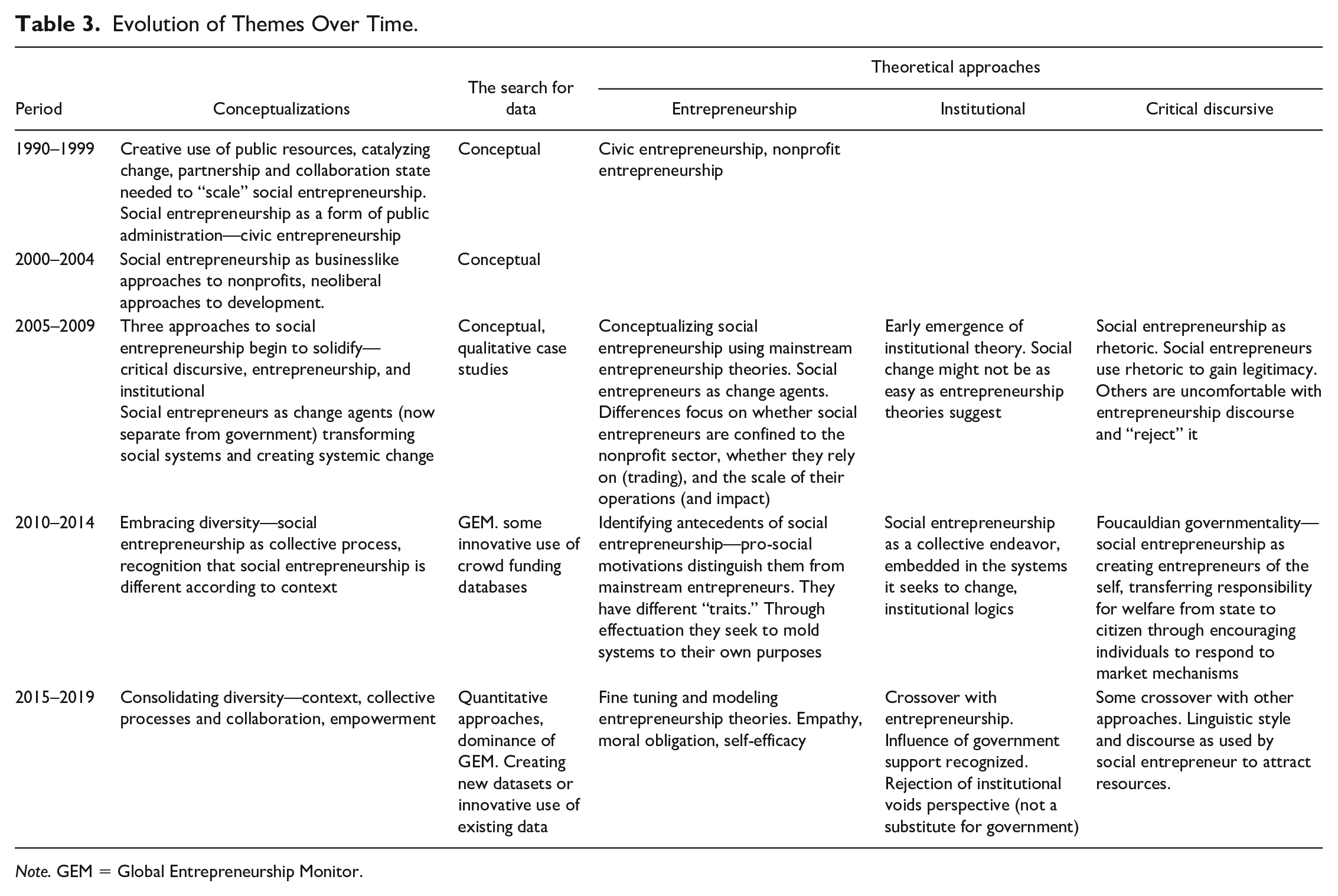
We identified four overarching themes: conceptualization, theoretical approaches, the search for data, and social change. Table 3 shows how the first three themes have emerged and shifted over time.
Evolution of Themes Over Time.
Note. GEM = Global Entrepreneurship Monitor.
In relation to our first theme, how social entrepreneurship tends to be conceptualized has changed over time: from civic innovation (1990–1999) to the almost total dominance of the social innovation school by 2006 to 2010. In more recent years there has been an embrace of diversity and pluralism within an inclusive framing (see Chliova et al., 2020) recognizing the importance of collective approaches, institutional support, cultural differences, and an acceptance that social entrepreneurship occurs at different scales and can operate within, or across, all sectors of the economy.
Second, we can see the emergence of three broad theoretical approaches to studying social entrepreneurship: entrepreneurship theories, where there is a focus on social entrepreneurship as process; identifying the characteristics of social entrepreneurs that make them different to mainstream entrepreneurs; and the development of processual models showing how they are considered to achieve social change (if not ever managing to demonstrate social change). Institutional theories, meanwhile, are drawn upon to highlight how social entrepreneurship is embedded in the systems it regularly seeks to change. There is a focus on legitimacy and legitimation strategies, and social entrepreneurship as shaped by the environment. Critical discursive approaches examine social entrepreneurship as discourse: a governmental technique aimed at transforming the nonprofit sector and transferring responsibility (and costs) for welfare from the state to individual citizens. What is perhaps most interesting is that while these approaches are mutually exclusive when applied to exclusive framings of social entrepreneurship—for example, they offer different explanations for/critiques of the narrow social innovation school of thought that was dominant between 2005 and 2009—an inclusive framing recognizes difference and permits interdisciplinary work across these approaches.
Third, what we have called “the search for data” reveals a lack of large comparative data sets. This leads to (over-)reliance on GEM. Collecting large datasets is regularly considered difficult and expensive. An inclusive approach to what is included within a study may capture too much (as per GEM) and the boundaries between social entrepreneurship, nonprofits, and conventional entrepreneurship are not clearly delineated anyway. Notably, most quantitative research using more “inclusive” datasets, such as GEM, highlights that social entrepreneurship flourishes with public support. This highlights the potential for future research around social entrepreneurship “ecosystems” (de Bruin et al, 2022; Roundy, 2017; Roy & Hazenberg, 2019).
Finally, despite social impact being conceptualized as the only characteristic common to all definitions of social entrepreneurship, there are hardly any empirical studies within the most prominent literature showing what social entrepreneurship actually achieves. The closest we get is a focus on social entrepreneurship as a form of empowerment, particularly in the global south; that by adapting to and embracing the market, women can emancipate themselves from oppressive social structures. The final stage in the social entrepreneurship research journey necessitates us measuring what difference it actually makes (and to whom). Such a journey also demands attending to a macro perspective. While we know that social entrepreneurship can act as a vehicle for empowerment (in the Global South), critical discursive approaches might suggest that one set of oppressive structures (patriarchy) is simply replaced by another (an over-reliance on the market).
Limitations
Just as there is no singularly accepted understanding of social entrepreneurship, neither is there a singularly accepted way to conduct a review article. Previous systematic reviews of the concept have identified clusters of literature/schools of thought (see, e.g., Choi & Majumdar, 2014; Hota, 2021; Hota et al., 2020). However, these reviews do not incorporate a historical perspective. Our article offers a useful complement to previous reviews in that our work helps demonstrate how an inclusive framing has evolved over time, showing the influence of different schools of thought on different framings of social entrepreneurship. Nonetheless, the decisions we made when selecting and then reducing the corpus need to be laid bare so that readers can understand why we took the approach we did, and what is excluded because of our decisions.
We would posit that the preselection of keywords, while helping to ensure a more comprehensive sample, also introduces an element of bias into any systematic review. Our focus has been on the evolution of social entrepreneurship as a concept: we wanted to see what the literature can tell us about patterns of understanding. For this reason, we avoided using additional keywords such as “social enterprise.” While it may be considered these may be key to many exclusive framings of the concept, we wanted to avoid giving too much emphasis to related concepts that are not central to all understandings. Widening our search to also incorporate keywords relating to exclusive framings or specific schools of thought would have dramatically increased the size of the original corpus, but more importantly for our purposes, would also have changed its “shape.” Some of the more highly cited articles on social enterprise, particularly those relating to negotiating competing logics (e.g., Battilana & Lee, 2014), would have become central to our analysis (see Choi & Majumdar, 2014) but many such articles deliberately avoid positioning themselves within an inclusive framing of social entrepreneurship, since such understandings are less acceptable to academic conventions of precisely defining concepts. For clarity, we are not arguing here that social enterprise and social entrepreneurship are unrelated concepts; simply that our analysis demonstrates that social enterprise (and other concepts such as civic entrepreneurship or earned income) is not central to all, or even most, understandings of social entrepreneurship.
We also made decisions to use Web of Science to identify the corpus and to focus our analysis only on the most highly cited articles during each historical period. Web of Science is a widely used database for systematic reviews but does tend to limit focus to particular “high quality” journals and some books. This has meant that some articles published in less prestigious journals (even if highly cited) have been omitted from our corpus. It also means that some highly influential books and conference papers have been omitted. We have attempted to partially redress this bias through highlighting these influential texts in our “concise history.” Our decision to focus only on highly cited articles was partly pragmatic: we needed to reduce the corpus of 1,342 documents sufficiently to permit a narrative analysis. However, by focusing only on the most highly cited articles (and then only those published in journals categorized by Web of Science), we introduce biases toward articles written in English and published in more highly cited academic fields (especially management). Notably, our corpus almost entirely neglects articles written by academics in the Global South. However, this is a clear reflection on the state of the field of social entrepreneurship research (albeit we are starting to see inspiring work on, for example, racialized diaspora communities emerging – see Hossein, 2017). Given that so many of the articles we included focus on social entrepreneurship in the Global South, it is somewhat disconcerting to see that academics from these regions are excluded from the higher echelons of the debate (at least as measured by citations). In addition, focusing on the more highly cited articles might be expected to bias our corpus toward conceptual and theoretical papers and away from empirical papers. While we recognize these limitations, in laying them bare we make it possible for readers to critically evaluate our work alongside other review articles.
In concluding, we would like to briefly reflect on our own journey of discovery. We began this research with our own sets of assumptions and a critical perspective honed mainly from our understandings of the social entrepreneurship literature as dominated by functionalist approaches (earned income) and ideologically motivated framings of the social entrepreneur as “heroic” individuals (such as Ashoka Fellows). Such individuals were thought to be seeking to replace what have been characterized as overly bureaucratic government, and well-meaning but “patronizing” philanthropic approaches (see Martin & Osberg, 2007). We were somewhat surprised to discover an earlier literature on social entrepreneurship as civic innovation, which has almost been lost from history. While the focus on heroic entrepreneurs did become dominant between 2006 and 2009, diverse approaches to conceptualizing and researching social entrepreneurship flourished within inclusive interdisciplinary spaces which have been opened by academic conferences. The EMES approach to understanding social enterprise as democratic and collective organizations has seemingly made little direct impact on the corpus of literature we studied, at least as regards articles authored by academics connected directly to EMES. However, their focus on collective organizing and participatory approaches has perhaps made inroads into influencing the literature, albeit somewhat indirectly.
Overcoming our own initial assumptions, we have discovered too that social entrepreneurship research has been enriched by the application of different disciplinary perspectives (including, but not limited to, public administration, economics, and development studies) and theoretical (including institutional theory and critical discursive) approaches. In the process, social entrepreneurship studies have become more measured, moving away from a focus on rare individuals and systemic change, and toward an analytical approach that emphasizes collective dynamics (Montgomery et al., 2012), negotiating and balancing tensions and institutional logics (Mair et al., 2012), and gradual and incremental change. Moving forward, we would emphasize the considerable productive potential for research exploring how practitioners, as well as academics, negotiate competing nonprofit and social entrepreneurship discourses and practices; how various forms of micro-resistance can shape the wider context (i.e., create social change); and in turn, how powerful actors may seek to constrain change.
Research Data
sj-docx-1-nvs-10.1177_08997640221130691 – Supplemental material for The (R)evolution of the Social Entrepreneurship Concept: A Critical Historical Review
Supplemental material, sj-docx-1-nvs-10.1177_08997640221130691 for The (R)evolution of the Social Entrepreneurship Concept: A Critical Historical Review by Simon Teasdale, Enrico Bellazzecca, Anne de Bruin and Michael J. Roy in Nonprofit and Voluntary Sector Quarterly
Research Data
sj-xlsx-2-nvs-10.1177_08997640221130691 – Supplemental material for The (R)evolution of the Social Entrepreneurship Concept: A Critical Historical Review
Supplemental material, sj-xlsx-2-nvs-10.1177_08997640221130691 for The (R)evolution of the Social Entrepreneurship Concept: A Critical Historical Review by Simon Teasdale, Enrico Bellazzecca, Anne de Bruin and Michael J. Roy in Nonprofit and Voluntary Sector Quarterly
Footnotes
Declaration of Conflicting Interests
The author(s) declared no potential conflicts of interest with respect to the research, authorship, and/or publication of this article.
Funding
The author(s) received no financial support for the research, authorship, and/or publication of this article.

Supplemental Material
Supplemental material for this article is available online.
Author Biographies
References
Supplementary Material
Please find the following supplemental material available below.
For Open Access articles published under a Creative Commons License, all supplemental material carries the same license as the article it is associated with.
For non-Open Access articles published, all supplemental material carries a non-exclusive license, and permission requests for re-use of supplemental material or any part of supplemental material shall be sent directly to the copyright owner as specified in the copyright notice associated with the article.
