




Abstract
This study examines the extent to which engagement within civil society relates to various forms of social trust among residents in local communities that received varying shares of asylum seekers during the European refugee crisis of 2015 to 2017. The study is based on a representative survey collected from individuals within 36 local Swedish communities that received very different shares of asylum seekers. The result suggests that engagement in civil society organizations moderates community trust under conditions of increased diversity. Outgroup trust varies with the share of asylum seekers only among those not involved in civil society. The results also suggest that involvement in civil society does not moderate generalized trust if the share of asylum seeker varies.
Introduction
The purpose of this study is to investigate the extent to which engagement within civil society relates to various forms of social trust among residents in local communities that received varying shares of asylum seekers during the European refugee crisis of 2015 to 2017. Previous studies have investigated how those active within civil society organizations were affected by distant critical events, such as the 9/11 terror attacks in the United States (Geys, 2017). This study investigates the following two core research questions: Were those involved in civil society organizations, in communities that received asylum seekers, more likely to have high levels of trust than those not involved? Does involvement in civil society moderate the relationship between the share of asylum seekers and different forms of trust? The research questions were answered by analyzing a representative survey collected from individuals within 36 local Swedish communities that received very different shares of asylum seekers.
During the height of the European refugee crisis of 2015, driven by the war in Syria and conflicts in countries like Afghanistan, Eritrea, and Iraq, around 163,000 individuals sought asylum in Sweden. Among European countries, Sweden received the largest share of asylum seekers relative to its population, and the second highest in absolute numbers, during the peak of the refugee crisis (Strömbäck & Theorin, 2018). In Sweden, as in most other European countries, the arrival of asylum seekers was covered extensively in news reports and largely dominated the political agenda during 2015 (Strömbäck & Theorin, 2018). The number of asylum seekers entering certain municipalities in Sweden during a short period dwarfs most other changes in the population composition experienced in modern times, while the influx in other municipalities was hardly noticeable. The sample of municipalities surveyed reflects this variation. Previous studies have indicated that an increased share of asylum seekers may give rise to anti-immigrant sentiments and distrust, especially in those local communities that received the largest shares of asylum seekers (Craig et al., 2018; Hangartner et al., 2019; van Heerden & Ruedin, 2019; Williamson, 2015). The arrival of asylum seekers in the studied local communities often resulted in an increase in the local presence of visible minorities and previous studies have found that the majority population notices and often reacts negatively to an increased share of visible minorities (Aldén et al., 2015; Laurence & Bentley, 2016; Strömblad & Malmberg, 2016).
As a remedy for negative sentiments, and to reduce social distances, policymakers have often suggested that engagement in civil society can contribute to the integration process of newly arrived immigrants. This has been supported by evidence showing that, ideally, civil society organizations could provide optimal conditions for intergroup contact, thus facilitating intergroup trust and the development of tolerance (Achbari et al., 2018; Finseraas et al., 2019; Laurence, 2020; Pettigrew & Tropp, 2006). Therefore, engagement in civil society organizations could have both theoretical and practical consequences. Less is known regarding the extent to which engagement in civil society, or the lack thereof, matters for individual levels of trust when local communities face sudden changes, such as the arrival of asylum seekers. Studies investigating the link between social trust and civil society organizations often focus on the link between engagement in civil society and generalized trust, while other forms of trust have been studied less (Gundelach, 2014). The present study contributes to this debate with an empirical investigation of how engagement in civil society moderates the relations between local diversity and various forms of social trust.
Asylum Seekers, Civil Society, and Social Trust
Previous studies have found that a marked increase in the share of asylum seekers in local communities can cause a surge in anti-immigrant attitudes among locals (Dinas et al., 2019; Hangartner et al., 2019). As asylum seekers arrived in Swedish local communities during the height of the refugee crisis, the levels of diversity especially among small local communities often rose quickly and became tangible. In previous studies, residents tended to react negatively to changes in the demographics of their local communities (Hopkins, 2010). Diversity and subsequent lack of social interaction within the population may constrict interpersonal trust (Dinesen et al., 2020; van der Meer & Tolsma, 2014). Previous studies have found a negative relation between population diversity in local contexts, especially regarding trust in others within the local community (Dinesen et al., 2020; Morales, 2013; van der Meer & Tolsma, 2014; Wallman Lundåsen & Wollebæk, 2013). Community trust is geographically constrained to people in the local community of residence (Dinesen et al., 2020; Wallman Lundåsen & Wollebæk, 2013; Wollebæk et al., 2012). Also, living in a local community that becomes more diverse has, in previous studies, affected attachment to the local community negatively (Laurence & Bentley, 2016). As stated in previous studies, those who participate in civil society organizations may be influenced by the culture within these organizations to, under certain circumstances, be less ethnocentric (Laurence, 2020), even if the civil society organization is homogeneous (Hooghe, 2003).
Civil society activities often occur within, and are tied to, specific local communities (Born & Fatke, 2019; Diani, 2015; Selle et al., 2019). Therefore, it is reasonable to assume that engagement in civil society also correlates with trust toward others within the local community (Wollebæk et al., 2012). We would expect that the arrival of asylum seekers correlates negatively, inter alia, with levels of community trust (Dinesen et al., 2020), but that the relation between shares of asylum seekers and community trust is moderated by individual-level involvement in civil society organizations, thus moderating a likely negative impact from increased diversity. Therefore, the following hypothesis can be formulated:
On the contrary, the empirical findings on the relationship between diversity and generalized trust are mixed within the European context (Dinesen & Sønderskov, 2015; Loxbo, 2018; Morales, 2013). Generalized trust is the belief that most other people can be trusted and is argued by Uslaner (2002) to be underpinned by a sense of belonging to a common moral community. Generalized trust is often thought to be developed early in life and is argued to be less subject to alteration due to changing conditions in the environment at a later age (Dahl & Abdelzadeh, 2017; Uslaner, 2002). It is debated to what extent generalized trust is based on experiences, but it is arguably less likely that generalized trust is solely based upon experiences with others in the specific local context (Dinesen et al., 2020). Previous studies have found that participants in civil society organizations mostly tend to self-select into engagement based on prior levels of generalized trust (Achbari et al., 2018; Dahl & Abdelzadeh, 2017; van der Meer & van Ingen, 2009; van Ingen & Bekkers, 2015; van Ingen & van der Meer, 2016). The relation between shares of asylum seekers and generalized trust is therefore expected to be weaker than the relation between shares of asylum seekers and community trust, as context diversity is more strongly linked to trustworthiness of others in the bounded local context rather than people in general (Dinesen et al., 2020). Therefore, the following hypothesis can be formulated:
Empirical studies have shown, however, that there may be an imperfect overlap between those who say they trust people in general and those who trust outgroups (Delhey et al., 2011; Kumlin et al., 2017). Even when people declare that they trust people in general, they may not include outgroups in their definition of “people in general” (Delhey et al., 2011; Kumlin et al., 2017). Outgroup trust is defined as trust in people with a different nationality and a different religion than that of the respondent (Delhey et al., 2011). Previous studies on the association between context diversity and outgroup trust have revealed both a positive and a weak negative link between these two variables (Dinesen et al., 2020; Gundelach, 2014). Context diversity is, in some studies, related to more interethnic relations and hence higher levels of outgroup trust (Gundelach, 2014). In other meta-studies, the association between context diversity and outgroup trust is negative and insignificant (Dinesen et al., 2020). As the asylum seekers were newly arrived in the local communities, it was less likely that interethnic friendships between residents and asylum seekers had evolved in the short run. A weak negative correlation between the presence of asylum seekers and outgroup trust can therefore be expected (Dinesen et al., 2020).
Studies have also shown that those involved in certain civil society organizations are less ethnocentric (Hooghe, 2003; Laurence, 2020; Lundberg & Abdelzadeh, 2021). Other studies have indicated that sudden shocks such as the 9/11 terrorist attacks did not result in changed levels of tolerance among those involved (Geys, 2017). We therefore expect little change in attitudes among those involved in civil society in the face of a sudden influx of asylum seekers (Geys, 2017). Outgroup trust for those not involved is tentatively assumed to be more directly affected by the presence of asylum seekers, as they lack the potentially inhibitory impact on ethnocentric attitudes from participating in civil society (Hooghe, 2003). Therefore, the following hypothesis can be formulated:
Method
The data in the study came from a survey called the Trustbarometer 1 conducted in 2017, with random samples of individuals aged 18 to 85 years, nested within 36 local communities across Sweden. To be eligible for the survey, individuals had to have been residents of Sweden for at least 5 years. The newly arrived asylum seekers were, therefore, not eligible to participate in the survey. The 36 municipalities were randomly selected in a two-stage process intended to create a sample with as much variation in contextual-level variables as possible within different subgroups of municipalities. From each subgroup, two municipalities were randomly selected by Statistics Sweden. To these municipalities, the three major urban areas (Gothenburg, Malmö, and Stockholm) and the municipality of Piteå were added. The net overall response rate of the survey was slightly less than 40%. On average, there were around 200 respondents nested in each municipality. The survey was administered by mail and self-completed. As expressing trust could be considered socially desirable in the Swedish context, it may be easier for respondents to report low trust in a self-completed survey.
Dependent Variables
The dependent variables in the study are three types of trust: community trust, generalized trust, and outgroup trust. Community trust was measured with two survey items, which asked whether the respondents had “trust in” “the people living in your area” and “the people living in your municipality.” The item responses followed a 4-point Likert-type scale, ranging from don’t trust at all to trust completely (Wollebæk et al., 2012). The correlation between the two items was .59 (Pearson’s r, p < .000). The additive index had seven scale points from don’t trust at all to trust completely on both survey items.
Generalized trust was measured with two survey items, also used in Wollebæk et al. (2012) as a simple additive index intended to capture the moral foundation of generalized trust (Uslaner, 2002). These items correlate with the propensity of trusting behavior toward strangers (Wollebæk et al., 2012). The items consisted of a 4-point Likert-type scale disagree completely, disagree somewhat, agree somewhat, and agree completely, applied to the following two statements: “One should trust fellow human beings without certain proof that they really are trustworthy” and “It is right to trust people even if you do not know them well.” The correlation between the two items was .71 (Pearson’s r, p < .000). The additive index had seven scale points (from disagree completely on both items to agree completely on both items).
Outgroup trust was measured with two survey items, similar to items in the European Values Study/World Values Survey (as in Delhey et al., 2011; Gundelach, 2014). The survey questions asked whether the respondents had “trust in. . .” “people with a different religion” and “people with a different nationality.” The item responses followed a 4-point Likert-type scale, ranging from don’t trust at all to trust completely. The correlation between the two items was .87 (Pearson’s r, p < .000). The additive index had seven scale points ranging from don’t trust at all to trust completely on both items.
Key Individual-Level Independent Variable
Involvement in civil society is measured as a dichotomous variable that taps involvement either as a member or as a volunteer in any civil society organization from a list of 10 categories 2 of organizations (including an “other” category) or lacking such involvement. Taken altogether, 24% of the respondents were not engaged in civil society, either as a member or as a volunteer (similar to results in Henriksen et al., 2019).
Municipality-Level and Neighborhood-Level Independent Variables
The key independent variable is the local share of asylum seekers, which was measured at the municipality level as the weighted average number of asylum seekers per 100 inhabitants who resided in the municipality during 2015 to 2017. The raw figures on asylum seekers came from the Swedish Migration Agency’s official statistical records. The share of asylum seekers in the sampled municipalities varied extensively, from an average of under 0.2 to an estimated 11.3, per 100 inhabitants. 3 Municipalities that received the highest share of asylum seekers tended to be smaller in population size. 4
Several control variables were used at the municipality level. The level of diversity (i.e., the likelihood that two randomly drawn persons in the municipality were born in the same country) was measured as the Herfindahl normalized score (that ranges between 0 and 1, where 1 represents complete homogeneity and 0 represents everybody being born in different countries). Diversity has been found to correlate with different forms of trust (Dinesen et al., 2020). The models also controlled for income inequality within municipalities, as this has been argued to affect individual levels of social trust negatively (Abascal & Baldassarri, 2015; Uslaner, 2002). Community size (i.e., the number of residents) was also controlled for. Residents from Africa and the Middle East in the neighborhood are also controlled for (as percent of residents in neighborhood). These groups of immigrants represent both visible minorities in the Swedish context (Strömblad & Malmberg, 2016) and countries of origin for previous relatively recent previous waves of refugees. Only those with a permit of stay are counted as residents. This variable is introduced as previous studies have shown that proximity in the neighborhood to diversity matters more for trust (Dinesen & Sønderskov, 2015).
Individual-Level Control Variables
At the individual level, socioeconomic and demographic variables were controlled for. The variables included age, gender (using men as a reference group), and Swedish or immigrant backgrounds (immigrant backgrounds were used as a reference group). Studies have indicated that it is important to control for personality traits to create robust models that control for other types of prosocial values (Ackermann, 2019; van Ingen & Bekkers, 2015). The models, therefore, controlled for the so-called Big Five personality traits (i.e., openness, neuroticism/stability, agreeableness, extraversion, and conscientiousness). For descriptive statistics, see Supplemental Table 2A.
Analytical Strategy
The respondents in the data set were nested within local communities (municipalities and neighborhoods); hence, mixed linear regression analyses were carried out. 5 To test whether involvement in civil society moderates the relation between the share of asylum seekers and different forms of trust, a cross-level interaction term (with random slopes) between involvement in civil society (the results for those not involved are shown) and the share of asylum seekers is included in the three-level (individual-level, neighborhood-level, and municipality-level) mixed models (Schmidt-Catran & Fairbrother, 2016).
Results
It is possible to assume that the share of residents involved in civil society organizations could be correlated with the share of asylum seekers within the municipality as the arrival of asylum seekers could lead to an increase in the activity within civil society organizations. However, the aggregate-level correlation between the share of the respondents in the municipality, involved as either volunteers or members, and the share of asylum seekers in the municipality, was close to 0 (Pearson’s r = .1). It is important to note that the aggregate-level correlation may not reflect mechanisms that occur within individual civil society organizations. For example, the arrival of asylum seekers may have made it more likely for groups that empathized with the asylum seekers to become engaged, whereas those with more negative opinions toward asylum seekers may have been more likely to quit.
First, community trust was analyzed as the dependent variable to test H1. The results in Table 1 (Model 1) showed that the interaction between not being involved in civil society and the share of asylum seekers received in the local community was significant. To facilitate the interpretation of the interaction term, the marginal effects of the results are also presented graphically.
Linear Mixed Regression, Robust Standard Errors in Parentheses.
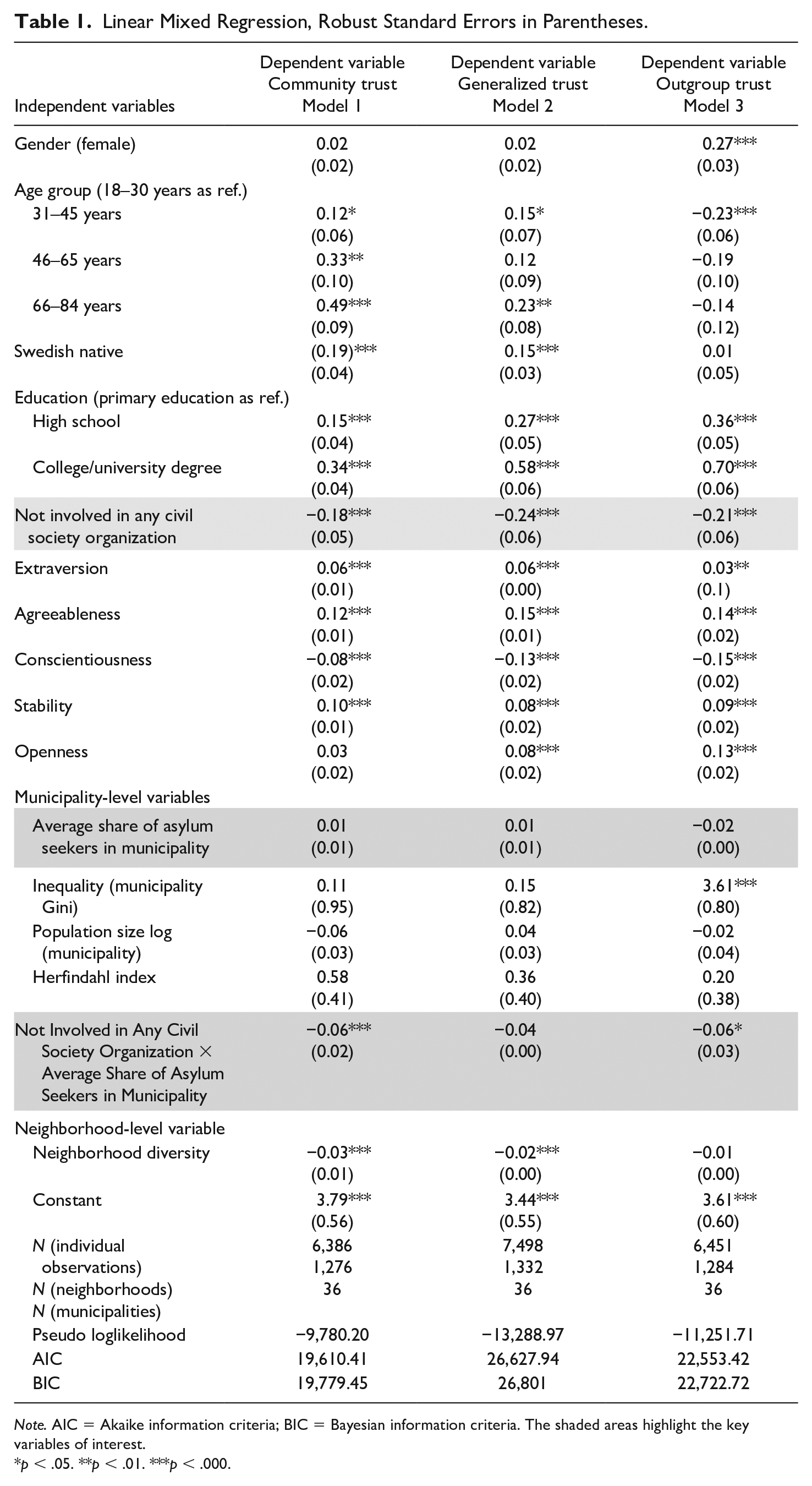
Note. AIC = Akaike information criteria; BIC = Bayesian information criteria. The shaded areas highlight the key variables of interest.
p < .05. **p < .01. ***p < .000.
Figure 1 illustrates the marginal effects of the interaction between lack of involvement in civil society and the share of asylum seekers in the local community. The results in Table 1 indicated that those not involved in civil society had lower levels of community trust. Those not involved in civil society were estimated to have lower levels of community trust, with an increasing number of asylum seekers within the municipality, whereas those involved in civil society organizations were estimated to have slightly higher levels of community trust with increasing shares of asylum seekers in the municipality. The different directions of the slopes in Figure 1 imply that the association between community trust and the share of asylum seekers is moderated by involvement in civil society, thus corroborating H1.
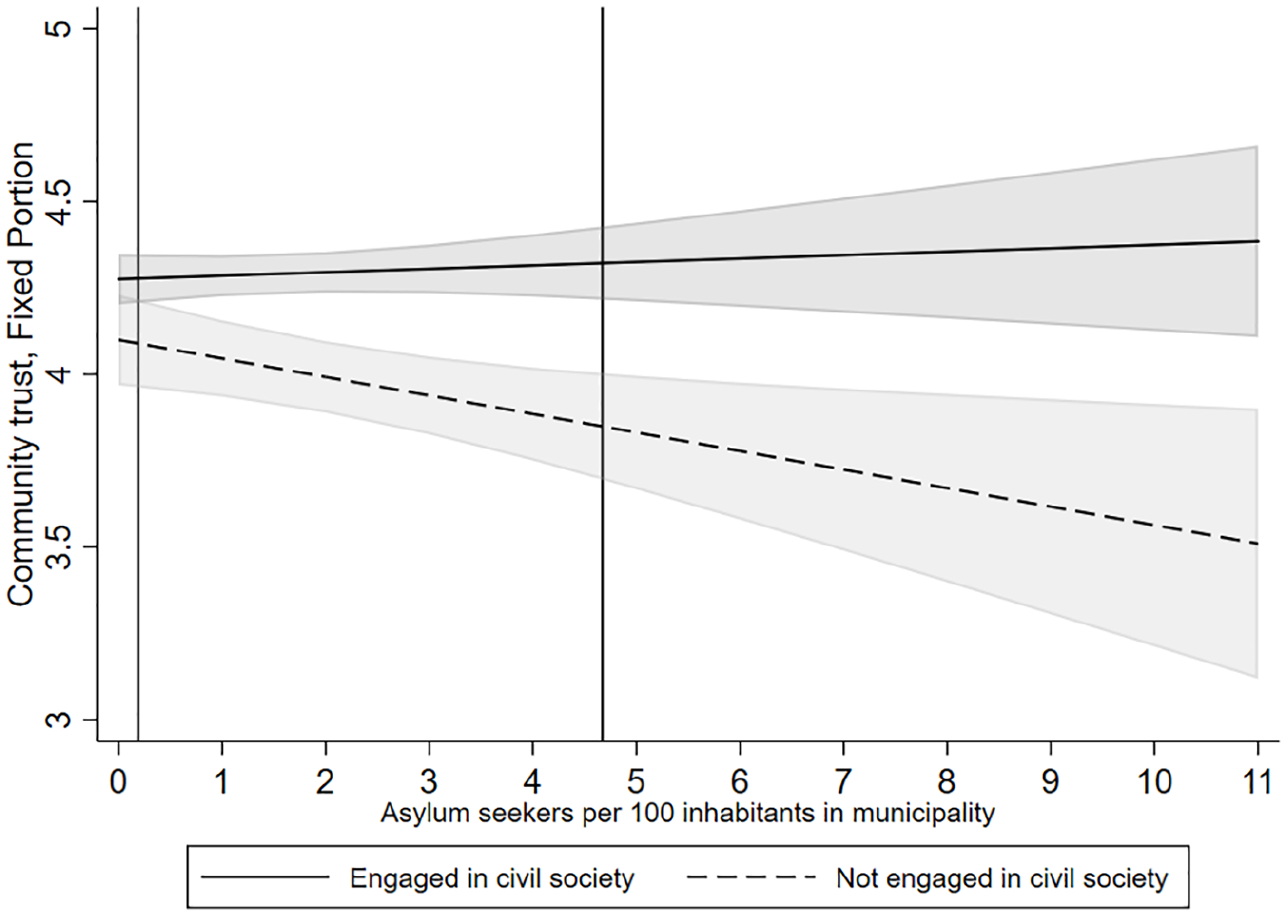
Involvement in civil society organizations and share of asylum seekers, community trust as dependent variable, predictive marginal effects.
We then proceeded to test H2. Table 1 (Model 2) shows that the interaction between those with no involvement in civil society organizations and the share of asylum seekers is not statistically significant at conventional levels; therefore, H2 cannot be corroborated. As Figure 2 shows, the slope of those not involved and those involved in civil society organizations is almost parallel, thus indicating that no moderation from involvement in civil society on generalized trust is occurring. The slope is only marginally steeper among those not involved in civil society organizations.
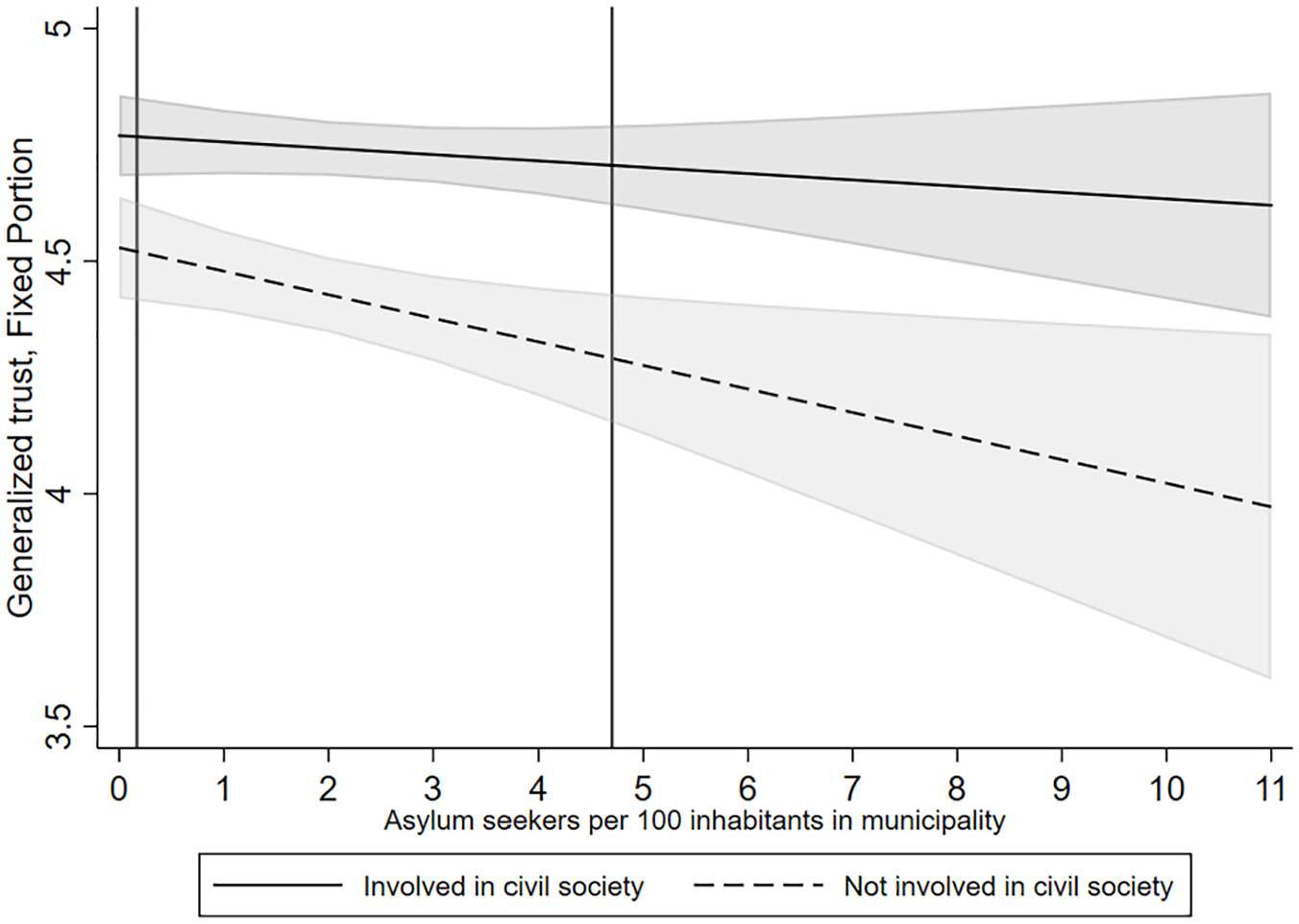
Involvement in civil society organizations and share of asylum seekers, generalized trust as dependent variable, predictive marginal effects.
We then proceeded to test H3: whether involvement in civil society moderates the relation between the share of asylum seekers and trust in outgroups. Here, the expectation is that the moderation from the presence of asylum seekers differs according to involvement in civil society. As shown in Table 1 (Model 3), those not involved in civil society organizations as volunteers or members tended to have higher levels of trust in outgroups than those not involved in civil society organizations. The interaction between engagement in civil society and the share of asylum seekers in the local community is within conventional levels of statistical significance. 6 Although the size of the regression coefficient of the interaction term in Model 3 is similar to the coefficient of the interaction term in Model 1, Figure 3 shows that the findings actually differ. Those who are involved in civil society organizations have almost constant levels of outgroup trust despite the share of asylum seekers. Those not involved in civil society are estimated, according to Figure 3, to have varying levels of outgroup trust with varying presence of asylum seekers. The outgroup trust for someone not involved in civil society, all else being equal, is estimated to be 0.68 points (on a 7-point scale) lower for someone living in the community that received the largest share of asylum seekers compared with someone, all else being equal, who lived in the community that received the smallest share of asylum seekers. H3 can, therefore, be corroborated, as the degree of moderation differed between those involved and those uninvolved in civil society.
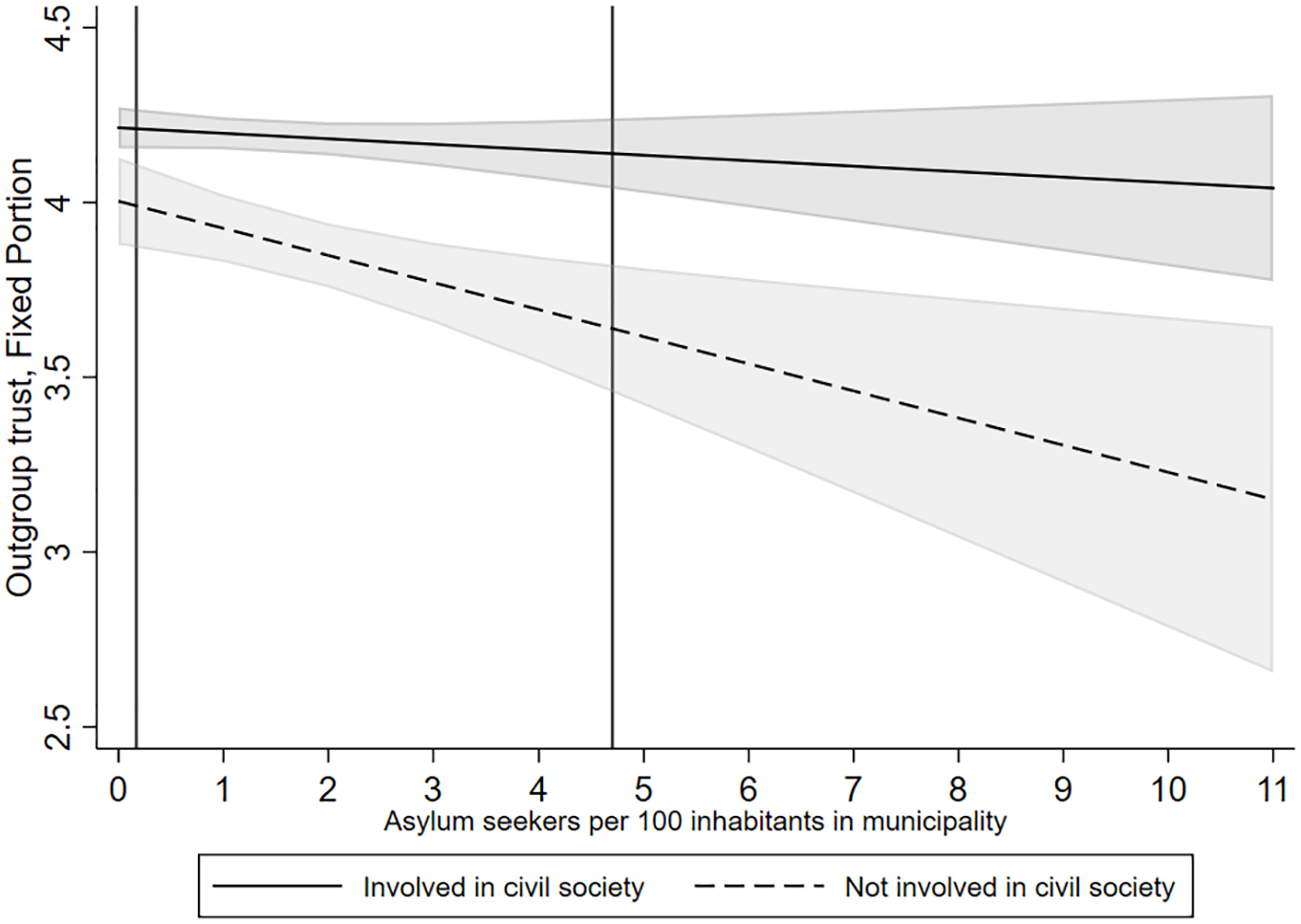
Involvement in civil society organizations and share of asylum seekers, outgroup trust as dependent variable, predictive marginal effects.
The results showed that involvement in civil society organizations to varying degrees moderates community trust, generalized trust, and outgroup trust.
Discussion and Conclusion
Changing demographics have become a more pressing issue, as many countries have experienced increasing shares of immigrants, thus altering the shares of majority and minority populations (Craig et al., 2018). Even if the long-term consequences of increased diversity may be positive, several studies have indicated a short-term negative association between diversity and social trust (e.g., Dinesen et al., 2020; Morales, 2013; van der Meer & Tolsma, 2014). This study investigated whether those involved in civil society organizations were more or less trusting in the face of the arrival of asylum seekers to their local communities. At the core of the investigation was the question of whether involvement in civil society moderates the relations between the share of asylum seekers and different forms of trust.
Although this study cannot infer causality, the result suggests that engagement in civil society organizations moderates community trust under conditions of increased diversity. Levels of community trust were higher among those who were engaged in civil society with increasing shares of asylum seekers in their local communities. Those who were not engaged in any civil society organizations on the contrary were more likely to have lower levels of community trust with increasing shares of asylum seekers. This is in line with previous studies that have found community trust to be more susceptible to diversity (Dinesen et al., 2020; Wollebæk et al., 2012). Likewise, the result suggests that outgroup trust is moderated by involvement in civil society. However, Figure 3 shows that the levels of outgroup trust differed significantly only among those not involved in civil society in relation to the share of asylum seekers. This is in line with other studies that have found that attitudes toward outgroups tend to be stable among those involved in civil society organizations (Geys, 2017), whereas those not involved in civil society may be less restrained by peer pressure in being less trusting of outgroups (Hooghe, 2003). Further studies are needed to understand these mechanisms.
The results however suggest that involvement in civil society does not moderate generalized trust. The lack of a significant interaction effect between no involvement in civil society and the share of asylum seekers for generalized trust could be attributed to the idea that generalized trust is developed early in life and more stable than other forms of trust (Uslaner, 2002). It could also be a consequence of the fact that those with low levels of generalized trust to a high extent opt out from participating in civil society (Wollebæk & Selle, 2002). In sum, the results lend support to the findings of Dinesen et al. (2020) of the different associations between diversity (share of asylum seekers) and community, outgroup, and generalized trust.
It is however impossible to rule out endogeneity in the analyses. Poorer local communities may have been systematically more willing to receive asylum seekers, due to, for instance, available housing, and less ability to protest to receive asylum seekers than in more well-off communities. There is, however, little evidence that low-trusting communities were more prone to accepting asylum seekers (Wallman Lundåsen, 2021). Thus, the associations between the shares of asylum seekers and various forms of trust were likely not solely dependent upon prior differences in trust. The focus of the study was, however, on whether involvement in civil society organizations could moderate the associations between the share of asylum seekers and various forms of trust. Those who are involved in civil society organizations at the local level are embedded in local contexts and this involvement appears to moderate their perceptions of whether others in the local community are to be trusted or not.
It is possible to interpret the findings, as at least a partial confirmation of Swedish civil society organizations constituting an important component of the social fabric at the local level (Selle et al., 2019). Therefore, a lack of connections to civil society organizations could also reduce meaningful social ties with others in the local context. One plausible interpretation, impossible to test empirically with the present cross-sectional data set, is that those involved in civil society organizations may have been involved in volunteering to help handle practical issues related to the arrival of asylum seekers especially in communities that received a high share, which could bring this group closer together. This could explain their higher levels of community trust. On the contrary, those with strong negative sentiments toward asylum seekers may also have been the first to leave the civil society organizations (Geys, 2017) in those communities where these organizations volunteered to help. Lack of social interaction in civil society organizations contributes to fewer bonds between residents and less social control or peer pressure (Dinesen et al., 2020; Hooghe, 2003; Laurence, 2020; Lundberg & Abdelzadeh, 2021), which may be especially negative for community trust and outgroup trust. Further studies are needed to better understand the interaction between context diversity, engagement in civil society, and various forms of trust.
Research Data
sj-docx-1-nvs-10.1177_08997640221077143 – for Engagement in Civil Society and Different Forms of Social Trust in the Aftermath of the European Refugee Crisis
sj-docx-1-nvs-10.1177_08997640221077143 for Engagement in Civil Society and Different Forms of Social Trust in the Aftermath of the European Refugee Crisis by Susanne Wallman Lundåsen in Nonprofit and Voluntary Sector Quarterly
Research Data
sj-docx-2-nvs-10.1177_08997640221077143 – for Engagement in Civil Society and Different Forms of Social Trust in the Aftermath of the European Refugee Crisis
sj-docx-2-nvs-10.1177_08997640221077143 for Engagement in Civil Society and Different Forms of Social Trust in the Aftermath of the European Refugee Crisis by Susanne Wallman Lundåsen in Nonprofit and Voluntary Sector Quarterly
Footnotes
Acknowledgements
This research was made possible through generous access to the survey the Trustbarometer. The fieldwork of the Trustbarometer was carried out by Statistics Sweden and commissioned by Marie Cederschiöld University College (previously named Ersta Sköndal Bräcke University College) and is financed by Länsförsäkringars forskningsfond. Principal investigator for the Trustbarometer is Professor Lars Trägårdh at the Center for Civil Society Research at Marie Cederschiöld University College. S.W.L. is also affiliated to the Center for Civil Society Research, Marie Cederschiöld University College. The author is very grateful for the many helpful and constructive comments received by the anonymous reviewers and the editor.
Declaration of Conflicting Interests
The author(s) declared no potential conflicts of interest with respect to the research, authorship, and/or publication of this article.
Funding
The author(s) disclosed receipt of the following financial support for the research, authorship, and/or publication of this article: This research was supported by Länsförsäkringars forskningsfond and the research grant “Civilsamhället: ‘Mötesplats för mångfald’ eller ‘Lika barn leka bäst’?” by the Swedish Agency for Youth and Civil Society.

Supplemental Material
Supplemental material for this article is available online.
Notes
Author Biography
References
Supplementary Material
Please find the following supplemental material available below.
For Open Access articles published under a Creative Commons License, all supplemental material carries the same license as the article it is associated with.
For non-Open Access articles published, all supplemental material carries a non-exclusive license, and permission requests for re-use of supplemental material or any part of supplemental material shall be sent directly to the copyright owner as specified in the copyright notice associated with the article.
