




Abstract
Numerous studies demonstrate the effectiveness of university-based community service programs on students’ personal, social, ethical, and academic domains. These effects depend on both, the characteristics of students enrolled and the characteristics of the programs, for instance whether they are voluntary or mandatory. Our study investigates whether effects of voluntary service programs are indeed caused by the service experience or by prior self-selection. Using data from a pre–post quasi-experimental design conducted at a public university in Europe and taking students’ socioeconomic background into account, our findings on self-efficacy, generalized trust, empathic concern, and attributions for poverty show that there are no participation effects. Instead, students who join in community service differ significantly from nonparticipants with regard to almost all investigated domains a priori, indicating strong self-selection. Our results underline the importance of structured group reflection, most notably with regard to attitude-related topics.
Keywords
Community service has been established at many universities in North America and beyond. As a form of experiential learning, it provides students with the opportunity to engage in authentic activities outside the classroom. Scholars widely agree that community service has a positive impact on students’ personal, social, ethical, and academic domains (e.g., Astin & Sax, 1998; Hooghe, 2003; Seider, Rabinowicz, & Gillmor, 2011; Stukas, Clary, & Snyder, 1999; Yoa, 2008). Especially for students in their late adolescence, a period considered sensitive for the development of civic engagement (van Goethem, van Hoof, Orobio de Castro, Van Aken, & Hart, 2014), the “transformative potential” (Jones, Gilbride-Brown, & Gasiorski, 2005) of community service has been demonstrated frequently (Celio, Durlak, & Dymnicki, 2011; Yorio & Ye, 2012). For instance, students’ service experience relates with clarifying their career goals (Yoa, 2008), civic responsibility (Astin & Sax, 1998), and self-efficacy (Vogelgesang & Astin, 2000).
Opportunities to engage in community service have steadily increased during the last decades (Griffith, 2012). Not all students enrolled in such programs, however, are indeed transformed by their experiences (Jones et al., 2005). First, this is because the impact of such programs may be moderated by participants’ characteristics, as a meta-analysis of 49 single studies reveals (van Goethem et al., 2014). Students’ abilities to engage with their community service course largely “depend on the intersection of their own sociocultural backgrounds,” and this becomes especially apparent in environments where privileged university students meet with community service beneficiaries that are mostly from out-groups (Jones et al., 2005, p. 4). So far, the issue of students’ background related to service-program outcomes has not received much attention (van Goethem et al., 2014), and there is a dearth of critical analysis of the effects of service learning (Deeley, 2010). Second, the outcomes of service programs may also be owed to the characteristics of the program, for example, whether it is voluntarily or mandatory (Furco, 2002; Raskoff & Sundeen, 2001; van Goethem et al., 2014). In the United States, more than 80% of students engage in community service on a voluntary basis (Griffith, 2012). In some states, countries or universities, however, participation is mandatory (van Goethem et al., 2014).
Above all, it is still unclear whether the impact of voluntary community service is caused by the service experience itself or because students with specific traits or background characteristics self-select into the program (Hooghe, 2003; Quintelier, 2013). Research on volunteering supports the latter. Bekkers (2012), for example, found that volunteers’ higher levels of generalized trust can be ascribed to self-selection rather than to participation. Self-selection may also reinforce or suppress participation effects (e.g., Wilson & Musick, 1999).
Our study particularly addresses these two issues, students’ background characteristics and the obligatory nature of the program. We employ data from a quasi-experimental design with pre–post control-group comparisons that makes it possible to distinguish between the effects of participation and students’ self-selection. We focus on students’ levels of self-efficacy, empathic concern and generalized trust as well as their attributions for poverty.
First, we assess students’ self-selection and examine whether participants differ from nonparticipants in terms of the domains mentioned above and in terms of their socioeconomic background. Second, we look at participation effects and analyze how students who participated developed in those domains compared with nonparticipants. To do so, we collected and analyzed data from a large public university in Austria in 2011. The findings enable us to contribute to the discussion of causes and outcomes of voluntary community service, and to examine self-selection and the effects of participation for various groups of students.
Answers to these questions are crucial for the implementation of such programs, above all as service programs spread increasingly across European higher education. Thus, our findings are relevant for learning about the characteristics and the conditions that moderate the outcomes of community service and for identifying associations with students’ socioeconomic background. Beyond this, they might also inspire research on the effects of volunteering.
We structure our article as follows. First, we discuss prior findings on university-based service programs and derive hypotheses. Then we report on data collection and the measures applied, and, finally, we present our results and discuss our findings.
Effects of Service Programs
Previous research on the effects of service programs, including five meta-analyses (Celio et al., 2011; Conway, Amel, & Gerwien, 2009; Novak, Markey, & Allen, 2007; van Goethem et al., 2014; Yorio & Ye, 2012), generally supports the presumption that community service is beneficial for adolescents (Driscoll, Holland, Gelmon, & Kerrigan, 1996; Eyler & Giles, 1999). In particular, evidence has been provided regarding students’ personality (e.g., self-concept, self-efficacy, and self-esteem), social attitudes (e.g., social responsibility, civic engagement, reducing stereotypes), learning (e.g., outcomes, course grades, and attitudes), career development, ethical values, and the ability to take responsibility and to deal with the consequences of actions (Celio et al., 2011; Pless, Maak, & Stahl, 2011; Yorio & Ye, 2012). Although most studies claim a positive impact on these dimensions, the effects on students’ outcome may also depend on the characteristics of the program, for example, the type of reflection or if it is optional or mandatory (e.g., Furco, 2002; van Goethem et al., 2014).
Regarding the latter, there is a debate about whether participation should be mandated or not. Scholars argue, on one hand, that mandatory programs yield poorer learning outcomes for students who are less inclined to participate. They also undermine students’ intrinsic motivation and thus reduce their future willingness to volunteer (e.g., Chan, Ngai, & Kwan, 2017; Clary, Snyder, & Stukas, 1998). On the other hand, mandatory programs bring students to volunteering who would not have done so otherwise, thus providing an opportunity to make new experiences as civic actors (e.g., Henderson, Brown, Pancer, & Ellis-Hale, 2007; Metz & Youniss, 2005). There are also studies that do not find a negative association (e.g., Henney, Hackett, & Porreca, 2017) or that even discern a positive association between mandatory participation and students’ future volunteering (Henderson et al., 2007). Again other studies reveal that mandatory programs have no effect on students’ intentions to volunteer. Those who volunteer free of will, however, are more likely to say that they will volunteer in the future than those who perceive their volunteering externally controlled (Stukas et al., 1999). Mandatory programs’ negative impact on students’ learning outcome is contested, too, as studies find no differences in the effects of mandatory or voluntary programs on students’ civil, social, or personal domains (e.g., Chan et al., 2017; Henderson et al., 2007; Yorio & Ye, 2012).
Insights on this issue are also provided by literature on the effects of volunteering on the volunteer (Wilson & Musick, 1999). It not only reveals significant differences between volunteers and nonvolunteers with respect to traits and attitudes (Taniguchi & Thomas, 2011; van Tienen, Scheepers, Reitsma, & Schilderman, 2011; Wilson, 2000), but also shows that the intention to volunteer is associated with self-efficacy, social values, understanding, empathy, and sense of social justice (Jiranek, Kals, Humm, Strubel, & Wehner, 2013). Whereas studies suggest that effects of self-selection are stronger than participation effects (Bekkers, 2012), those effects have not been investigated yet for students’ voluntary community service. Hence, we analyze how students’ participation in a voluntary community service program is related with their self-efficacy, empathic concern, generalized trust, and external and internal attributions for poverty.
Self-Efficacy
Self-efficacy is defined as an individual’s “belief in one’s capabilities to organize and execute the courses of action required to manage prospective situations” (Bandura, 1995, p. 2). According to this concept from Bandura’s (1977) socio-cognitive theory, “. . . expectations of personal efficacy determine whether coping behavior is initiated, how much effort will be expended, and how long it will be sustained in the face of obstacles and aversive experiences” (p. 191).
Although most studies show that community service is positively related with students’ self-efficacy (Morgan & Streb, 2001, 2002; Vogelgesang & Astin, 2000), some do not support this finding. Lakin and Mahoney (2006), for instance, report that changes in self-efficacy were not significant for participating middle-school students. They argue that participation merely mitigates a usual decline of self-efficacy during adolescence. Likewise, Gerholz and Slepcevic-Zach (2015) did not find any impact on students’ self-efficacy. From other studies, however, we learn that self-efficacy might be a predictor of voluntary engagement, including community service (Eyler, Giles, & Braxton, 1997; Giles & Eyler, 1994). We, therefore, assume both self-selection and participation effects. Compared to nonparticipating students, students who participate in community service display a
Empathic Concern
Scholars studying empathy usually distinguish between cognitive and affective aspects. The first refers to adopting another’s views, whereas the latter delineates emotional responses of compassion, concern, and the tender feelings for others, referred to as empathic concern (M. A. Brown, 2011; Davis, 1994). Research suggests that service programs relate positively with the affective component in particular (Jones & Hill, 2003; Mitani, 2014), mainly because they confront students with the community (M. A. Brown, 2011). A helper’s empathic concern is higher if help is given to distant others and helpful actions are unplanned (Einolf, 2008). Empathic concern also correlates with volunteering. Volunteers show higher empathic concern than nonvolunteers (Bekkers, 2005; Finkelstein & Brannick, 2007; Mitani, 2014). An experimental study by Brunelle, Danish, and Forneris (2007) confirmed that community-service participation strengthens empathic concern, too. Causality, however, remains unclear (Mitani, 2014; van Tienen et al., 2011; Wilhelm & Bekkers, 2010). Thus, we assume that empathic concern selects into community service, and that community service enhances empathic concern. Compared to nonparticipating students, those who participate in community service display a
Generalized Trust
It is widely assumed that voluntary engagement strengthens generalized trust (Brehm & Rahn, 1997; Claibourn & Martin, 2000; Jennings & Stoker, 2004), defined as “an abstract preparedness to trust others and to engage in actions with others” (Stolle, 2001, p. 205). Although Putnam (2000) claims that this relationship is reciprocal, others call the assumption that volunteering creates trust simply “a mistake” (Uslaner, 2002, p. 4). They argue that trust is a fairly stable personality trait that is shaped in earlier life stages. Although volunteers display higher levels of trust than nonvolunteers (Bekkers & Schuyt, 2008; E. Brown, 1999; Caputo, 2009), longitudinal analyses or analyses with lagged variables did not find any causality between volunteering and trust (Bekkers, 2012; Gross, Aday, & Brewer, 2004; Hooghe, 2003; Jennings & Stoker, 2004; van Ingen & Bekkers, 2015).
Although these findings rather suggest a selection rather than a participation effect, they do not completely exclude that participation also breeds trust, for example, for individuals adapting to new milieus (van Ingen & Bekkers, 2015) and for adolescents who are confronted with heterogeneous encounters (Flanagan, Gill, & Gallay, 2014; Flanagan & Stout, 2010). Therefore, we add the following two hypotheses:
Compared to nonparticipating students, those who participate in community service display a
Attributions for Poverty
Beliefs about the causes of poverty are crucial for the perception of social justice. In particular, believing that poverty is caused by either structure or agency indicates whether individuals support welfare policies aimed to reduce poverty. Individuals’ attributions for poverty are related with social class, political affiliation, religiosity, gender, and age (Bullock, 1999). Although it is difficult to modify such attributions, experiential learning can alter them (Seider, Gillmor, & Rabinowicz, 2011; Yorio & Ye, 2012). Prior research has distinguished between two attributional directions: individualistic (internal) and structural (external; Seider, Gillmor, & Rabinowicz, 2011; Seider, Rabinowicz, & Gillmor, 2011).
Attributions for poverty and community service relate in some ways. First, students’ majors play a role. Those majoring in business are more inclined to internal attribution than students with social science majors (Meier & Frey, 2004; Seider, Gillmor, & Rabinowicz, 2011). Second, participating in community service links with increased awareness for inequality and poverty, that is, external attributions (Seider, Gillmor, & Rabinowicz, 2011). Therefore, we assume both self-selection and participation effects, suggesting four more hypotheses:
Compared to nonparticipating students, those who participate in community service display a
Method and Data
Sample Description
We use data from pre–post quasi-experiments with students who participated in a community service program at WU Vienna, a large public business university in Austria. Data were collected by us in 2011, comprising a sample of 63 students taking part in the program (treatment group) and 362 students not taking part (control group, Table 1).
Descriptives and Bivariate Analysis Testing for Group Differences (Self-Selection) and Nonresponse Bias.
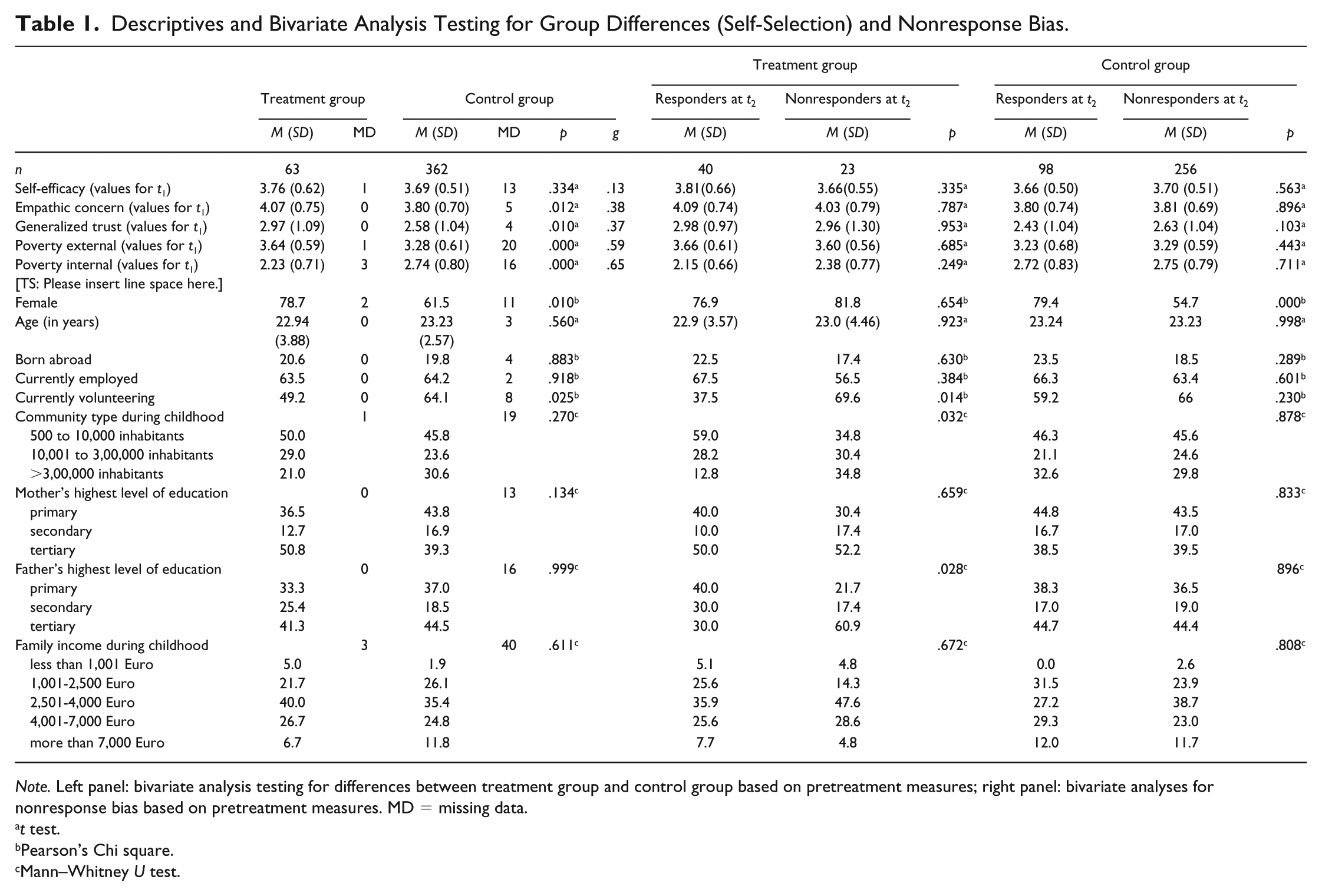
Note. Left panel: bivariate analysis testing for differences between treatment group and control group based on pretreatment measures; right panel: bivariate analyses for nonresponse bias based on pretreatment measures. MD = missing data.
t test.
Pearson’s Chi square.
Mann–Whitney U test.
The community service program offers students the opportunity of being a “buddy” or mentor for children from disadvantaged groups, most of them refugees. The goal of the program is to support these children with their schoolwork, to offer them positive role models and to foster their integration. It also enables students to work with a nonprofit and aims to strengthen their personal, civic, and ethical development. Each student meets with a child at least once a week and supports him or her in educational and social issues. Students have also to participate in training and reflection sessions. In total, they spend about 80 hours with their mentees, attend seminars of about 35 hours, and group supervision of about 10 hours per year.
Participation in this program is voluntary. To take part, students have to apply with a CV and a letter of motivation. They have to commit for at least half a year and do not receive any credit points for participation. If there is any doubt as to whether a particular applicant fits into the program, a personal interview is conducted to review the application. All students who meet these minimal requirements are accepted. Thus, taking part in the program is primarily a question of self-selection.
Students participating in this program filled in a questionnaire before taking part (pretreatment measurement, t1) and a year thereafter (posttreatment measurement, t2), containing measures for self-efficacy, empathic concern, generalized trust, and attributions for poverty. 1 In addition, we collected data on students’ prior voluntary engagement and their socioeconomic background, including family income during childhood and their parents’ highest level of education. To assess self-selection (Quintelier, 2013), a control group filled in the questionnaire at the same two points in time. Overall, we analyzed data from 425 students.
Measurement and Scales
To measure self-efficacy (Bandura, 1977), we applied the German version of the general self-efficacy scale (GSE) developed by Schwarzer and Jerusalem (1995, see Table 2). This 10-item scale is available in 31 languages. Cronbach’s alphas range from .76 to .90. 2 The normalized German GSE means are 3.89 (males) and 3.71 (females; Hinz, Schumacher, Albani, Schmid, Brähler, 2006). In our sample, the means are 3.89 and 3.63. Cronbach’s alpha is .84 (pretreatment) and .86 (posttreatment).
Items of the General Self-Efficacy and the Empathic-Concern Scale.
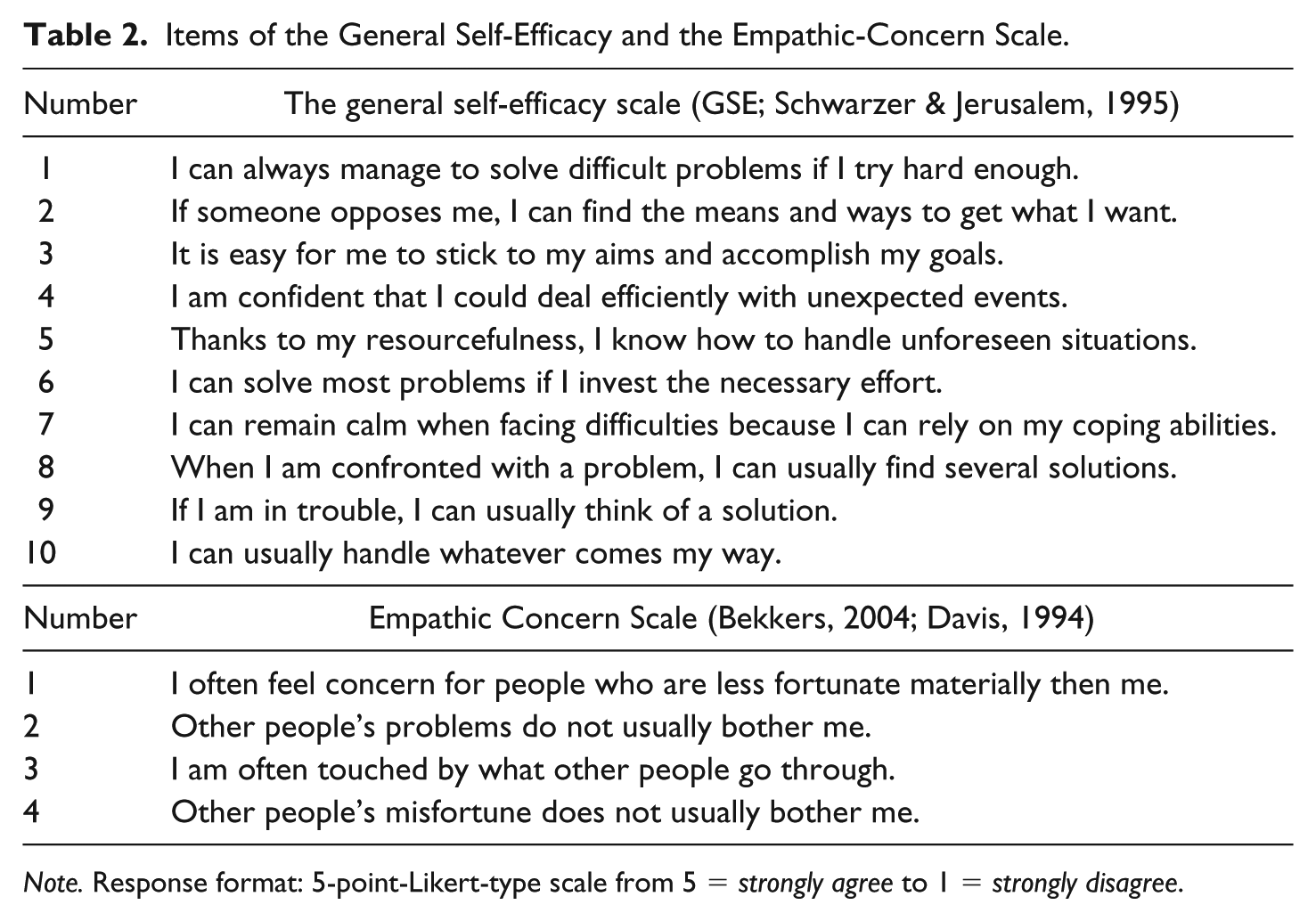
Note. Response format: 5-point-Likert-type scale from 5 = strongly agree to 1 = strongly disagree.
Table 2 displays the four items used for measuring the empathic predisposition that were rated on a 5-point scale ranging from 1 (strongly disagree) to 5 (strongly agree; Bekkers, 2004; Davis, 1994). Cronbach’s alphas for empathic concern are .76 (pretreatment) and .70 (posttreatment).
For measuring generalized trust, we applied a two-item scale originally developed by Rosenberg (1956) and recently adopted by Bekkers (2003, 2012), reading as “In general, most people can be trusted” and “You can’t be too careful in dealing with other people.” As this scale yielded unsatisfactory reliability measures (Cronbach’s alpha ≤ .1 at pre- and posttreatment), we omitted the second item (van Ingen & Bekkers, 2015). 3
For measuring the attributions for poverty, we applied a scale of eight items adapted from the Attributions for Poverty measure (Seider, Gillmor, & Rabinowicz, 2011). We adjusted the scale to the national context, arriving at four items representing statements of external and four items of internal attributions (Table 3). Cronbach’s alphas are .67 (pretreatment) and .73 (posttreatment) for the external and .80 (pre- and posttreatment) for the internal scale. Within the questionnaire, the items were randomly mixed up with those of the other scales (e.g., self-efficacy).
Items of the Attributions for Poverty Scale.
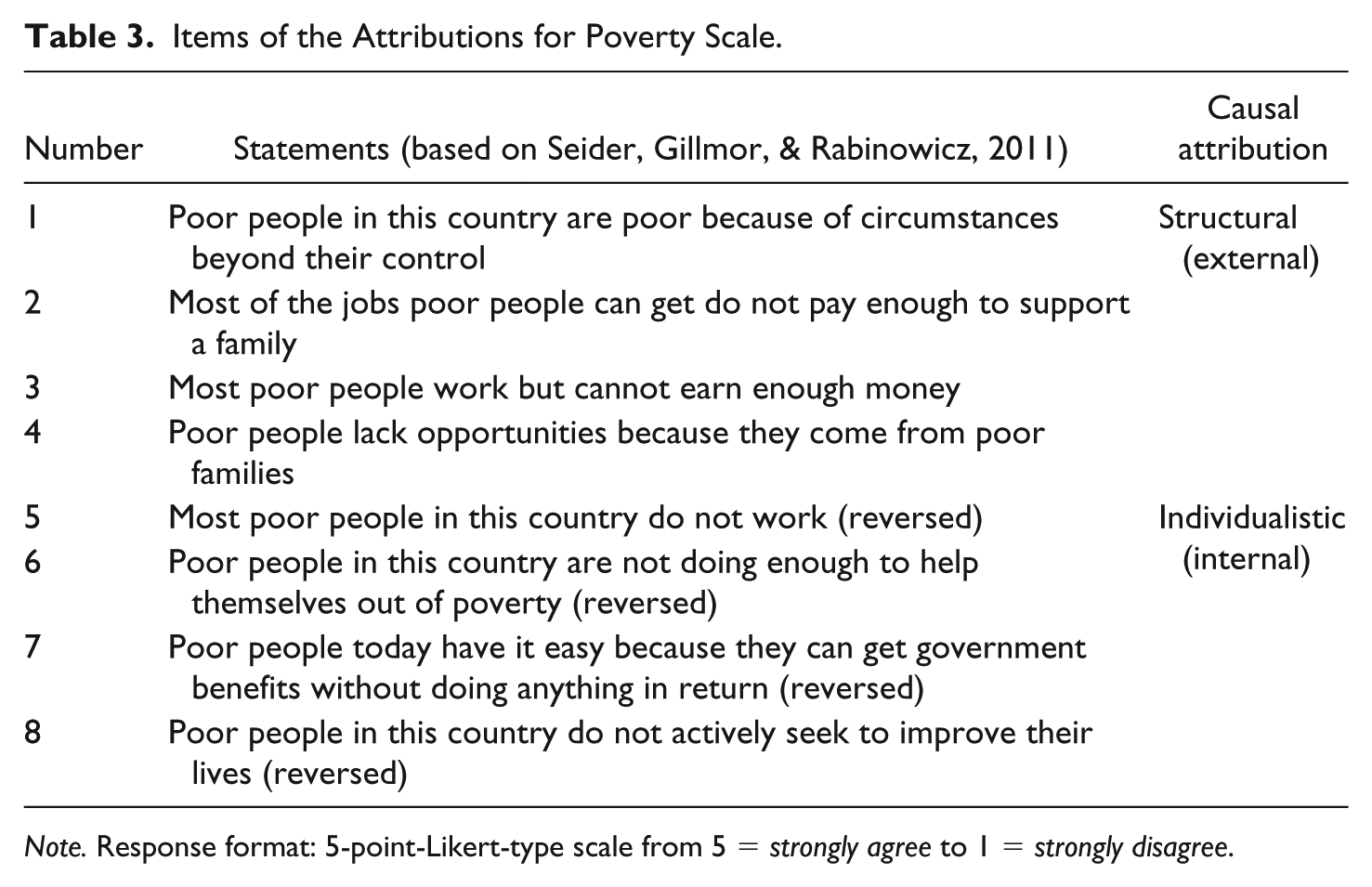
Note. Response format: 5-point-Likert-type scale from 5 = strongly agree to 1 = strongly disagree.
To control for students’ socioeconomic background, we collected data on their gender, age, and country of birth. Two dichotomous variables measure whether they are currently employed and whether they are currently engaged in additional volunteering. Further variables measure the highest level of education of both students’ mother and father (primary, secondary, or tertiary education) and the monthly disposable family income during students’ childhood (measured by five categories). Finally, the community type during students’ childhood, measured by the number of inhabitants, was surveyed (Table 1).
Nonresponse Bias
To check for a nonresponse bias, we examined whether students who completed the questionnaire at posttreatment differ systematically from those who did not complete it (Table 1). Regarding our key variables on self-efficacy, empathic concern, generalized trust, and attributions for poverty, no significant differences between the responders and nonresponders were revealed indicating no nonresponse bias. Nevertheless, we observed a nonresponse bias with regard to current volunteering (p = .014), type of community during childhood (p = .032) and fathers’ level of highest education (p = .028) in the treatment group. At the posttreatment measurement, the percentage of those who volunteer (37.5% vs. 69.6%), of those who live in large communities (more than 3,00,000 inhabitants; 12.8% vs. 34.8%), and of those with a father who has completed tertiary education (30.0% vs. 60.9%) is significantly lower among the responders compared with the nonresponders. Within the control group, we observed a gender bias. The percentage of females in the posttreatment responders group is significantly higher than in the group of nonresponders (79.4% vs. 54.7%; p < .001). We thus have to be cautious to interpret results in terms of these variables.
Analysis
To test our hypotheses, we applied t tests for analyzing self-selection and a repeated measure analysis of variance (ANOVA; Bortz & Döring, 2006; Girden, 1992) for assessing participation effects. Self-selection is given when there is a difference between the control and the treatment group in pretreatment measures, also referred to as the “group effect.” If there is a difference between pretreatment and posttreatment measures regardless of group affiliation (control and treatment group together), we call it the time effect. The interaction between group and time effect is what we call participation effect. This refers to changes between pre- and posttreatment measures within the treatment group compared with changes between pre- and posttreatment measures within the control group. In addition to the statistical significance (p value), the partial eta square (
In addition, we investigate whether self-selection is associated with students’ socioeconomic background. We first test for differences between the treatment and the control group using bivariate analysis (Pearsons Chi square, t test; Mann–Whitney U test) and then apply logistic regressions. Furthermore, we deploy linear regression analysis to explore whether students with certain socioeconomic background characteristics might benefit of the program more than others. Therefore, we conduct a regression on each of our five domains at the posttreatment measures and include the measures on the respective scale from the pretreatment measures, a dummy for treatment or control group and all socioeconomic variables as controls. For dealing with missing data, we apply listwise deletion in the regression analyses and testwise deletion for bivariate tests. Correlation tables are available in the supplemental material.
Results
Self-Selection
Descriptive statistics suggest self-selection for all investigated domains into the hypothesized direction, and bivariate analyses confirm these results with the exception of self-efficacy (Table 1).
There is no significant (p = .334) difference in the mean level of self-efficacy between the treatment group and the control group (M = 3.76, M = 3.69; Hedges’s g = 0.13). Therefore, H1a has to be rejected. When compared with the normalized data set from Germany (Hinz et al., 2006), neither group differs significantly from the overall population.
In contrast, results report a significant self-selection effect concerning empathic concern. The mean level of empathic concern in the treatment group (4.07) is significantly (p = .012; Hedges’s g = .38) higher than in the control group (3.80). Consequently, H2a is supported. Results for generalized trust also confirm our hypothesis. The mean is significantly higher (p = .010; Hedges’s g = .37) in the treatment group (M = 2.97) than in the control group (M = 2.58). There is a significant effect of self-selection for external attributions for poverty, too. Participating students score significantly (p < .001 Hedges’s g = .59) higher (M = 3.64) than the members of the control group (M = 3.28). For internal attributions for poverty, participants score significantly (p < .001; Hedges’s g = .65) lower (M = 2.23) than the members of the control group (M = 2.74). Thus, both H4a and H5a are supported.
We next analyze whether students’ socioeconomic background moderates our findings on self-selection. Bivariate analyses indicate that the pretreatment measures differ significantly between treatment and control group with regard to gender (p = .010) and volunteering experience (p = .025). Female students are overrepresented in the treatment group (78.7% vs. 61.5%), and those currently volunteering are underrepresented (49.2% vs. 64.1%; Table 1). Logistic regressions on the likelihood of being in the treatment or in the control group affirm that gender and volunteering are significantly associated with self-selection (Exp(B) = 1.97; p = .053; Exp(B) = .577; p = .066; Model 1, Table 4). Nevertheless, further logistic regression analyses confirm that the significant difference between the treatment and the control group regarding empathic concern, generalized trust and both external and internal attributions for poverty still remain when controlling for students’ socioeconomic background characteristics (Model 3 to Model 6, Table 4). The level of students’ self-efficacy, however, does not differ significantly (Model 2, Table 4).
Self-Selection: Logistic Regressions.
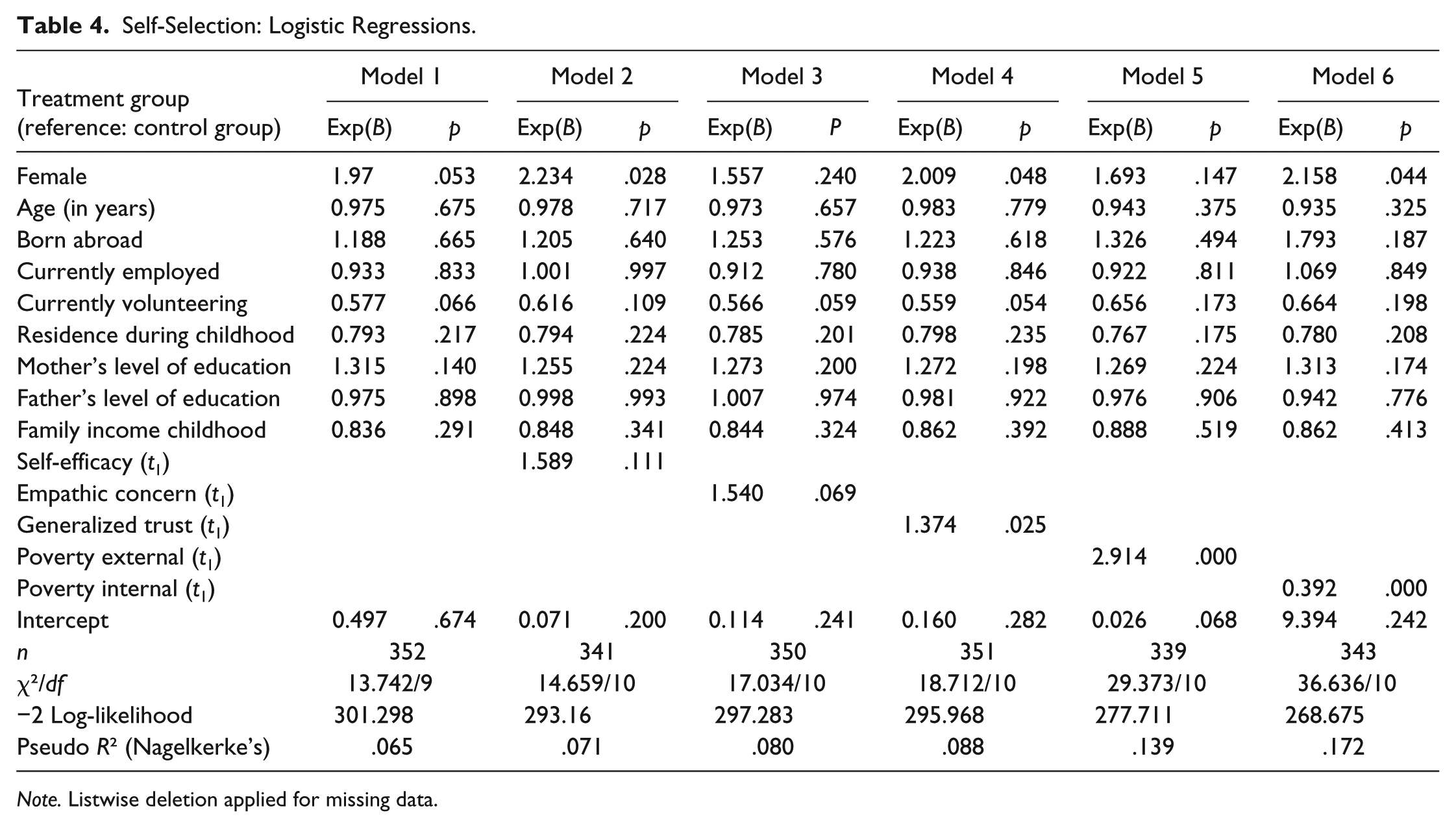
Note. Listwise deletion applied for missing data.
Summing up, we find empirical support for H2a to H5a. We observed a significant self-selection effect at pretreatment for empathic concern, generalized trust, and attributions for poverty. H1a is not confirmed, as there is no significant difference between the two groups regarding their level of self-efficacy. All findings have been consistently corroborated by multivariate analyses including students’ socioeconomic background characteristics.
Participation Effect
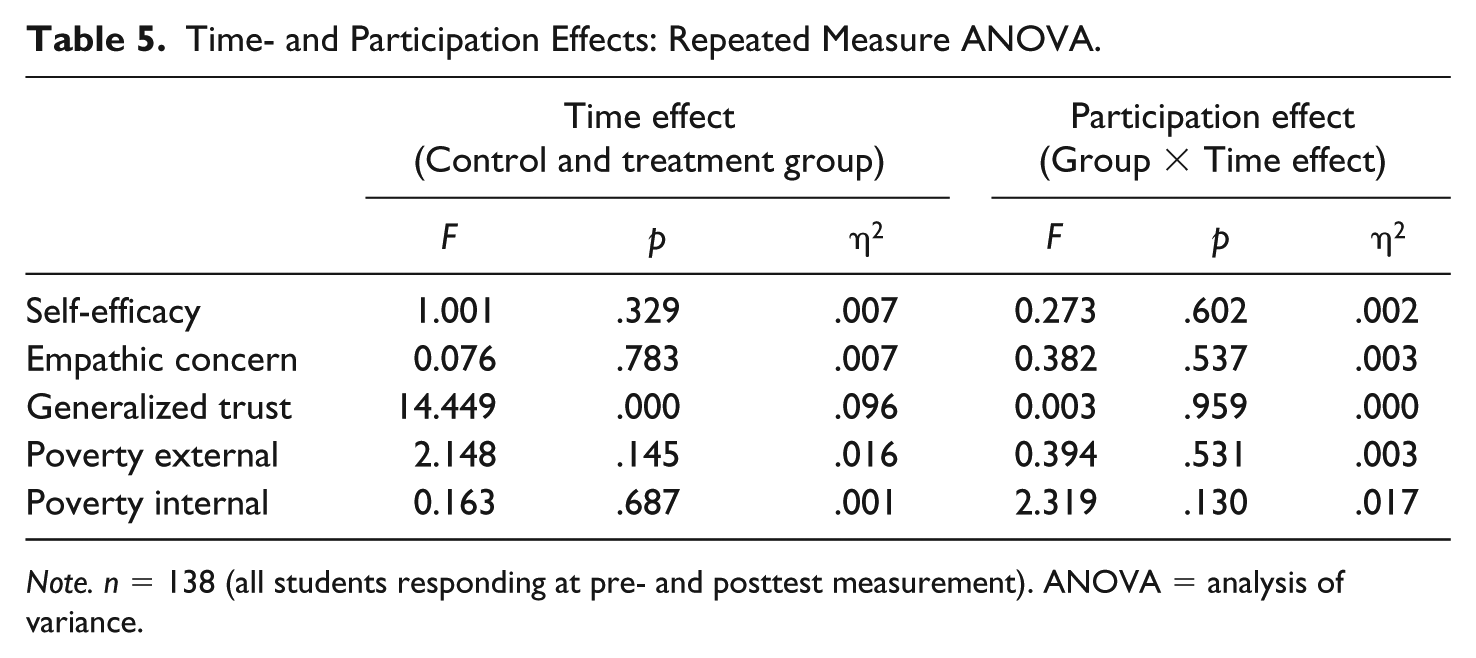
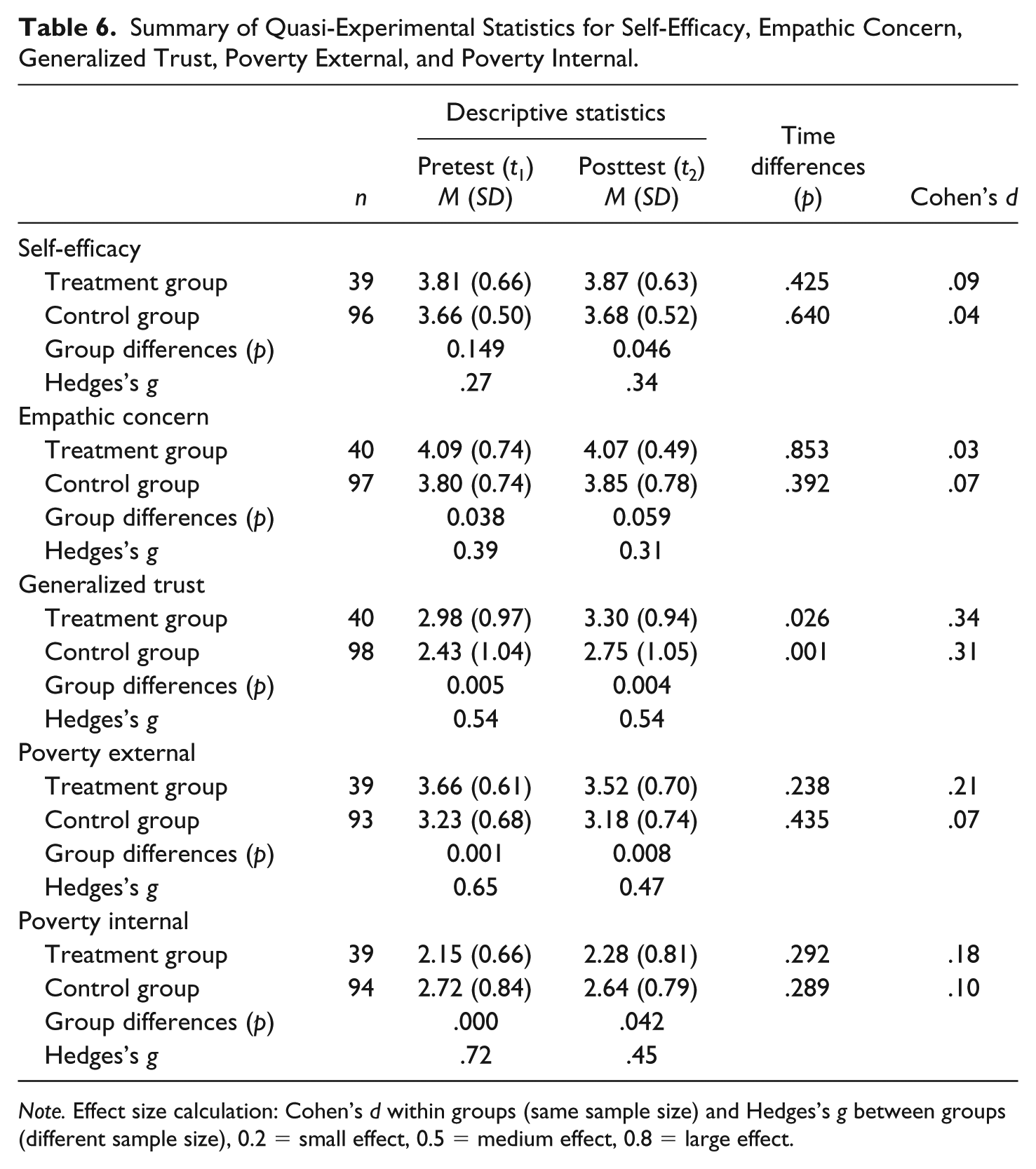
Table 5 reports the estimated marginal means for the treatment group and the control group on each of the supposed outcomes (repeated measure ANOVA). The corresponding means (M), standard deviations (SD), and effect sizes (Hedges’s g and Cohen’s d) are provided in Table 6. 4
Time- and Participation Effects: Repeated Measure ANOVA.
Note. n = 138 (all students responding at pre- and posttest measurement). ANOVA = analysis of variance.
Summary of Quasi-Experimental Statistics for Self-Efficacy, Empathic Concern, Generalized Trust, Poverty External, and Poverty Internal.
Note. Effect size calculation: Cohen’s d within groups (same sample size) and Hedges’s g between groups (different sample size), 0.2 = small effect, 0.5 = medium effect, 0.8 = large effect.
We find no support for any participation effect on self-efficacy. Neither is there a time nor a treatment effect (group × time: F = 0.27; p = .602). The mean levels of self-efficacy of the control group (t1 = 3.66, t2 = 3.68) and treatment group (t1 = 3.81; t2 = 3.88) do not differ significantly. Neither we find any significant treatment effect for empathic concern (F = 0.382; p = .537). Although the mean level within the control group increases slightly from M = 3.80 to M = 3.86, the level of empathic concern for the treatment group remains almost the same (t1 = 4.09, t2 = 4.07; Table 5).
Likewise, for generalized trust, no significant participation effect can be found (F = 0.003, p = .959). Instead, generalized trust increased both in the treatment (from M = 2.98 to M = 3.30) and in the control group (from M = 2.43 to M = 2.75), revealing a significant time effect (F = 14.449, p < .001). Contrary to our expectations, external attributions for poverty decreased over time within the treatment group (t1 = 3.66; t2 = 3.56) and within the control group (t1 = 3.23; t2 = 3.18), but we neither revealed a significant time nor a significant participation effect (F = 0.394; p = .531). For internal attributions for poverty, we find a slight increase within the treatment group (t1 = 2.15; t2 = 2.33)—which again contradicts our expectations—and a slight decrease within the control group (t1 = 2.72; t2 = 2.64). The results, however, are not significant, indicating no participation effect (F = 2.319; p = .130). Consequently, we have to reject H1b to H5b.
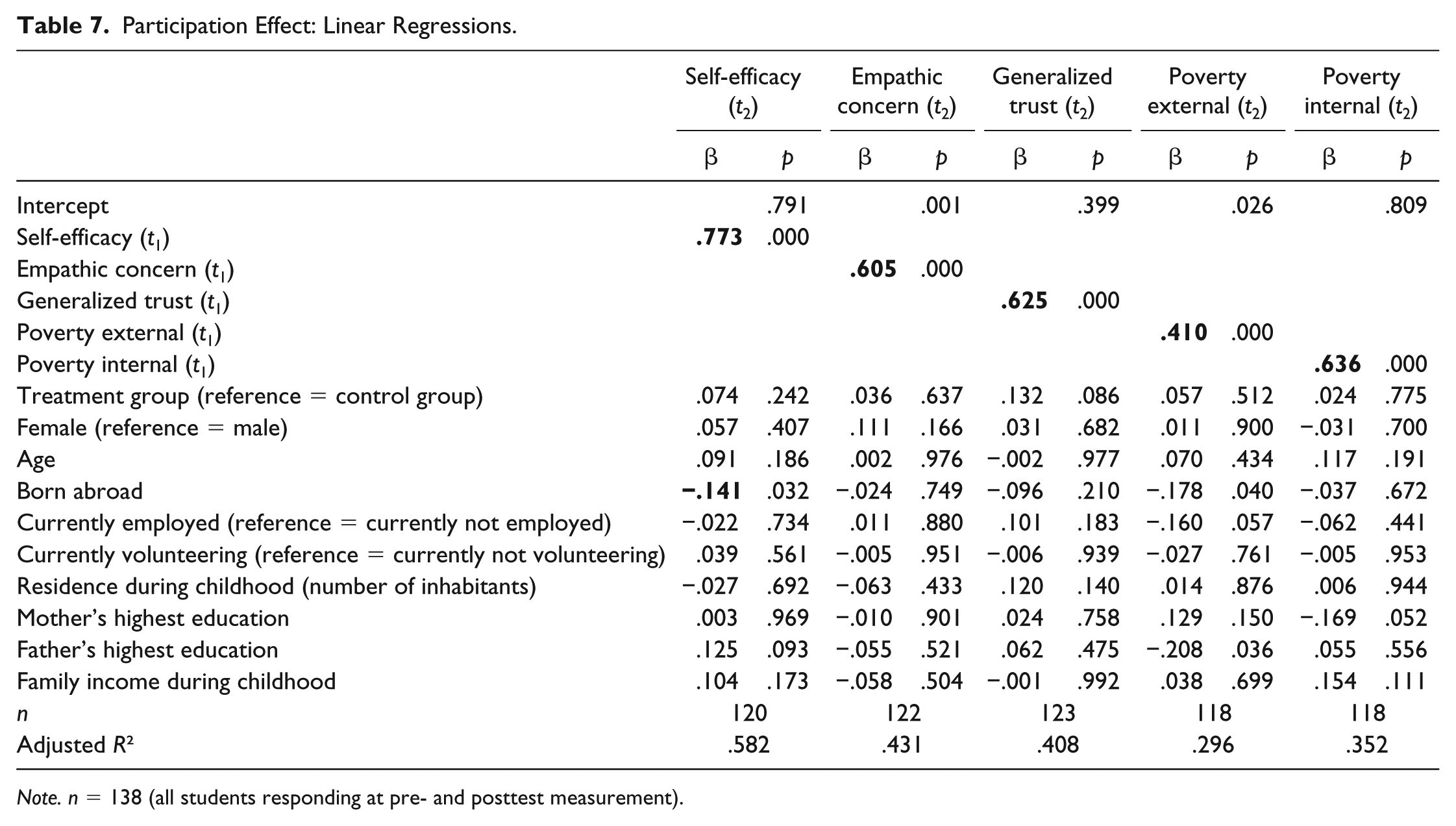
Again, we deploy multivariate analysis to explore whether socioeconomic background characteristics are associated with students’ increase or decrease in the outcome variables (Table 7). Results indicate that some of those variables influence participation effects. For self-efficacy, it is the place of birth (not abroad) and father’s education that contribute to an increase. For external attributions for poverty, it also is the place of birth (not abroad) that contributes positively, whereas father’s education and being in employment contributes negatively. For internal attributions for poverty, mother’s education has a slightly negative effect. There is no simple explanation for these effects. Father’s education and a domestic place of birth may indicate intergenerational social mobility, which is associated with perceptions of individual blame (Gugushvili, 2016). It may also indicate rather conservative milieus. 5 Mothers’ higher education, however, positively affects liberal attitudes (Noack, 2004; Zuckerman, Singer, & Singer, 1980), and is often used as a proxy for socioeconomic status (Condon & Holleque, 2013). This indicates that participation effects, though not observable for the overall group, might be working for specific subgroups depending on their socioeconomic background.
Participation Effect: Linear Regressions.
Note. n = 138 (all students responding at pre- and posttest measurement).
Discussion
With our study, we contribute to the discussion on the effects of university-based community service and inform decisions on how to implement such programs. Our first set of findings enhances the debate on whether service programs might be offered voluntary or mandatory (Chan et al., 2017). Results reveal that students who volunteer for the community service program show higher levels of empathic concern, generalized trust, and external attributions for poverty, while their level of internal attributions for poverty is lower compared with students of the control group. These results widely confirm our hypotheses and are in line with prior research: Citizens who engage in voluntary action achieve more favorable scores in many dimensions of personality compared with those not volunteering (Jiranek et al., 2013; Taniguchi & Thomas, 2011; van Tienen et al., 2011; Wilson, 2000). Our research design allows us to provide evidence that this is rather due to prior self-selection and not to volunteering itself, contributing to the discussion on the antecedents and consequences of volunteer engagement. Thus, we can infer that voluntary service programs at universities attract those students who already show better scores on social and personal domains (Finkelstein & Brannick, 2007; Mitani, 2014; Pinazo, Peris, & Gámez, 2010).
Apart from that, our results show that self-selection into the program is not related to students’ socioeconomic background. Yet, it relates with students’ gender and current volunteering. The latter is not surprising. Students who are already engaged in volunteering elsewhere are less likely to volunteer in the program at their university. Obviously, the program particularly attracts students who have not been engaged so far. As research shows that “being asked” is among the most important triggers for volunteering (e.g., Gil-Lacruz, Marcuello-Servós, & Saz-Gil, 2016; Piatak, 2016; Smith, 1994), our findings confirm that service programs at universities—though offered on a voluntary base—bring novices into volunteering. This supports the idea of offering such programs on a voluntary base.
The finding that females are more likely to self-select is in line with literature showing that females are more likely to volunteer than men (e.g., Wilson, 2000), partly explained by a gendered socialization for helping others (e.g., M. A. Brown, 2011) for gender difference in empathic concern. If university-based programs aim to have both genders equally represented in community service, it might be beneficial to offer such programs mandatory or to diversify recruitment efforts to appeal to a wide range of students, representative of the student body. For instance, to involve peers representing the range of the universities’ body of students in the recruitment process.
Our findings on participation effects do not support any of our hypotheses. Students who had participated in the community service program did show neither higher levels of self-efficacy, empathic concern, generalized trust, or external attributions for poverty compared with nonparticipants after completing the program, nor lower levels of internal attributions for poverty. We even observed minor changes within the treatment group between pre- and posttest opposite to our hypothesized directions: decreases in empathic concern and external attributions for poverty and an increase in internal attributions for poverty, although none of the three changes is significant.
At first glance, these results are puzzling as they contradict with the majority of empirical research on this topic. Yet, there is also scant literature on service programs that discusses non- or even opposing participation effects on students and provides alternative explanations (Butin, 2005; Deeley, 2010; Jones et al., 2005). Studies that do so, mostly based on qualitative approaches, investigate “the complexities that emerge when undergraduate students engage with ill structured, complex social issues present in the community service settings typically associated with service-learning courses” (Jones et al., 2005, p. 4). They particularly argue that in such settings, mainly privileged college students encounter with somehow disadvantaged individuals (e.g., by social class, ethnicity, ability or any combinations of these), which might uncover previously held assumptions and stereotypes (Jones et al., 2005). Such settings bring students into situations for which they are not appropriately prepared. In line with this argument, taking part in community service was probably disenchanting for some students, giving them their first close contact with poverty, refugees, and disadvantaged people, and opening their eyes to the failures and misbehavior of those they encountered. For instance, some program participants reported that their mentee often was late for the appointment, did not appear at all, or did not appreciate the buddies’ visit, which was highly disappointing for them. 6 Thus, exposure to and contact with refugee children led to a slight decrease in students’ favorable attitudes. These results also suggest revisiting the contact hypothesis (Allport, 1954; Rae, Newheiser, & Olson, 2015; Sigelman & Welch, 1993). Our findings reflect recent research on the contact hypothesis, which reveals that exposure to poverty strengthens both external and internal attributions for poverty (Lee, Farrell, & Link, 2004; Merolla, Hunt, & Serpe, 2011). The changes in attributions for poverty might also be explained by the fundamental attribution error (e.g., Tetlock, 1985), namely, the more closely students observe poverty, the more they will hold individual actors at least partly responsible.
Following this, the type of reflection of the service-learning experience is highly relevant for the outcomes. In a meta-analysis of 40 empirical studies, Yorio and Ye (2012) found that the outcomes on students’ understanding of social issues (but not on personal insights or cognitive development) significantly depend on the type of reflection. For our case, these findings suggest that effects might have been more in line with our expectations if structured group reflections instead of written individual reflections would have been in place (M. A. Brown, 2011; van Goethem et al., 2014; Yorio & Ye, 2012). In particular, benefits regarding attitude-related topics are said to result primarily from reflection (van Goethem et al., 2014).
Furthermore, as we found that females and those without volunteer experience are overrepresented in the program when offered on a voluntary base, it is particularly crucial to decide whether service programs should be mandatory and what credits students can earn for participating. We have discussed the pros and cons of both options above.
Of course, our study has limitations. First, we have investigated a particular type of community service: The service was individual support for disadvantaged children and participants helped at a variety of families and nonprofit organizations. The effect of the specific placement was not examined, though some placements probably produced more beneficial experiences than did others. Second, we analyzed the effects on students of business administration and economics at a university embedded in the European welfare state context. We hesitate to postulate validity of our findings far beyond this scope. Third, maybe the studied domains are too stable and trait-based, and expecting stronger changes in these domains was overoptimistic. Future research should, therefore, also focus on the change of state-based, more specific measures. One could also argue that the domains under investigation will not change immediately, but maybe within a longer time span after completing the program. Fourth and finally, the reasons for the observed changes opposing our expectations need to be analyzed in depth by more qualitative inquiry. As previous research has shown, qualitative and quantitative analyses might sometimes reveal diverging results, underpinning the need for combining both approaches to evaluate participation effects of university-based service programs.
In conclusion, our results enhance the literature that broadly confirms favorable participation effects of community service programs. We share findings that contradict with the majority of studies, shedding some critical light at the challenges for implementing service programs at universities. Overall, informing the debate about the effects of community service, our findings suggest to carefully considering the organizational context and program characteristics when implementing such programs.
Supplemental Material
Online_Appendix_(2) – Supplemental material for Students’ Community Service: Self-Selection and the Effects of Participation
Supplemental material, Online_Appendix_(2) for Students’ Community Service: Self-Selection and the Effects of Participation by Michael Meyer, Michaela Neumayr and Paul Rameder in Nonprofit and Voluntary Sector Quarterly
Footnotes
Acknowledgements
The authors wish to acknowledge and thank the members of the Monday seminar/2016 SCANCOR group at Stanford University and three anonymous reviewers for their insights and critical comments on prior versions of this article.
Declaration of Conflicting Interests
The author(s) declared no potential conflicts of interest with respect to the research, authorship, and/or publication of this article.
Funding
The author(s) received no financial support for the research, authorship, and/or publication of this article.
Notes
Supplemental Material
Supplemental material for this article is available online.
Author Biographies
 .
.
References
Supplementary Material
Please find the following supplemental material available below.
For Open Access articles published under a Creative Commons License, all supplemental material carries the same license as the article it is associated with.
For non-Open Access articles published, all supplemental material carries a non-exclusive license, and permission requests for re-use of supplemental material or any part of supplemental material shall be sent directly to the copyright owner as specified in the copyright notice associated with the article.
