




Abstract
In online peer-to-peer fundraising, individual fundraisers, acting on behalf of nonprofit organizations, mobilize their social networks using social media to request donations. Whereas existing studies focus on networks of donors to explain success, we examine the role of the networks of fundraisers and their effect on fundraising outcomes. By drawing on social capital and network theories, we investigate how social capital derived from social media networks and fundraising groups explains individual fundraising success. Using the Movember health campaign on Twitter as an empirical context, we find that fundraising success is associated with a moderate level of centrality in social media networks and moderate group network size. In addition, we find that fundraisers interact only marginally on social media but prefer to connect with each other outside these platforms and engage in group fundraising. Our article contributes to research on fundraising and social networks and provides recommendations for practice.
Keywords
Introduction
Online peer-to-peer (P2P) fundraising is an emerging practice where nonprofit organizations use a crowdfunded, decentralized approach to raise donations. Individuals supporting the organization reach out to their networks on social media and request their contacts to support them with a donation (Chapman et al., 2019; Saxton & Wang, 2014). Evidence from practice shows that online P2P fundraising plays an essential role in determining nonprofit organizations’ fundraising success (Bushouse & Sowa, 2012). Academic research has also shown an increasing interest in this phenomenon and the factors explaining its success. Extant studies show that success in online P2P fundraising is mainly determined by fundraisers’ characteristics and their donor networks (Chapman et al., 2019; Scharf & Smith, 2016). However, research has overlooked the role of fundraiser networks, that is, the relationships among fundraisers and how these affect fundraising outcomes. We argue that investigating the social connections among fundraisers is important because relationship-building among fundraisers is an essential asset for nonprofit organizations to support fundraising efforts, solicitations, resource sharing, and trust (Chapman et al., 2019; Saxton & Wang, 2014; Xu & Saxton, 2018). We draw on theories using a network view of social capital as the resources acquired from memberships in a social network (Burt, 1992; Lin, 1999) and investigate how social capital derived from fundraiser networks explains individual fundraising success.
Our empirical context is the 2014 U.S. Movember campaign organized by the Movember Foundation, a nonprofit organization that relies on P2P fundraising to raise donations for research on prostate and testicular cancer (Movember, 2014). Movember fundraisers donate money to the Foundation and solicit their networks to donate for the cause. Our unit of analysis is fundraisers who are officially registered to the Movember Foundation website and use Twitter to reach out to their donors during the campaign. Movember fundraisers can also recruit other fundraisers from their own networks and create fundraising groups (Mo Teams) through the Foundation website to join efforts in collecting donations. We combine social network analysis and multivariate regression analysis to explain fundraising success as the outcome of social capital derived from fundraisers’ social media communication networks and participation in fundraising groups. We found that fundraising success is associated with a moderate level of centrality in social media networks and moderate group network size. Furthermore, our findings show that fundraisers interact only marginally on social media but prefer to connect with each other outside these platforms and engage in group fundraising.
The remainder of the article is structured as follows. First, we review the literature on online P2P fundraising and social networks and develop our hypotheses on the influence of social capital derived from fundraisers’ networks on individual fundraising success. We then describe the research setting, data, and method. Next, we present and discuss our results. Finally, we highlight our theoretical contributions to research on fundraising and social networks and outline the practical implications of this study, its limitations, and future research directions.
Literature Review: Online P2P Fundraising and Social Networks
Fundraising is a “persuasive activity that seeks to convince donors to contribute to a worthy cause” (Goering et al., 2011, p. 229). The power of asking is considered one of the most effective techniques to solicit people and collect donations for a cause (Andreoni & Payne, 2001; Bekkers & Wiepking, 2011). Online P2P fundraising is a recent, popular form of fundraising in which individual fundraisers, acting on behalf of a nonprofit organization, mobilize their social networks, such as family, friends, and acquaintances, to ask for donations for the organization’s cause using social media (Chapman et al., 2019).
Traditional fundraising and philanthropy research acknowledges the importance of social networks to understand donor behavior (Breeze, 2017; Tempel et al., 2016). Research has mainly focused on investigating the role of social networks in determining who is most effective at giving in social media contexts (Guo & Saxton, 2014, 2016, 2018; Saxton & Wang, 2014; Xu & Saxton, 2018). For instance, Saxton and Wang (2014) find that one of the most effective determinants of giving is the size of the organization’s social media fan base of donors, which is positively associated with the donation amount received by organizations through online crowdfunding sites. Gaining social media attention from donors is also strongly related to the size of an organization’s network and high communicative interactions between an organization and its stakeholders (Guo & Saxton, 2018).
Whereas this prior work has primarily focused on the role of social networks on donation behavior, the network mechanisms at play in online P2P fundraising (i.e., in explaining who is effective at asking) have received less attention. A few exceptions exist in the literature. For example, Payne et al. (2014) find that individual fundraisers mainly receive donations from people who are already part of their existing social network of friends, family, and colleagues. The authors show that such networks have a strong, positive effect on the number of donations received but obtain inconclusive results for the total amount of donations raised. Similarly, Scharf and Smith (2016) find that the size of fundraisers’ online social networks is positively associated with more but smaller donations raised by fundraisers on Facebook causes. The authors argue that this “network effect” is explained by the characteristics of the donors caring about the fundraiser’s engagement in the cause. Chapman et al. (2019) expand these findings by showing that fundraising outcomes are associated with specific fundraisers’ characteristics, such as identification with and personal investment in the cause. Finally, Van den Broek et al. (2019) study the effect of an online campaign’s network structure on online fundraising at the country level. They show that large, low density, and highly decentralized communication network structures positively affect donations collected by fundraisers in a country.
Theory and Hypotheses
Although existing studies highlight the importance of social networks on fundraising success and help understand what characterizes successful fundraisers, we argue that investigating the social connections among fundraisers is also very important. When engaging in online P2P fundraising, fundraisers are embedded in networks with other fundraisers aiming for the same goal (Castillo et al., 2014). They build relationships not only with potential donors but also with other fundraisers involved in the cause. Relationship-building among fundraisers is an essential asset for nonprofit organizations because fundraisers’ connections support better coordination of fundraising efforts, solicitations, resource sharing, and trust (Chapman et al., 2019; Saxton & Wang, 2014; Xu & Saxton, 2018). Theoretically, networks between fundraisers can be considered as organizational networks in nonprofit organizations (Gould, 1993). In the tradition of resource mobilization theory, organizational networks are important sources of peer pressure and coordination that motivate people to actively engage in collective action (Gould, 1993; McCubbins et al., 2009; Siegel, 2009). For example, Hong et al. (2018) show that fundraisers embedded in social media networks with other fundraisers collected higher average donations in prosocial crowdfunding campaigns on Kickstarter. In addition, evidence from practice shows that nonprofit organizations increasingly promote a spirit of collaboration among their fundraisers to develop a culture based on generosity and incentives of right behaviors (O’Connor, 2011). This is in line with research on fundraising professionals and workplaces showing that collaborative environments nurture more positivity, teamwork, and creativity, all elements leading to better fundraising outcomes (Spreitzer et al., 2005). Hence, we examine how fundraisers are connected (and not only with donors) to understand fundraising success.
Our main premise is that the structure of fundraising networks leads to performance variations in online P2P fundraising. We build our theoretical arguments based on a network view of social capital (Burt, 1992; Lin, 1999). Individuals’ structural social capital represents the resources derived from their networks of relationships (Burt, 1992, 2000; Granovetter, 1973; Lin, 1999; Nahapiet & Ghoshal, 1998; Portes, 1998). Social capital helps people achieve their individual or collective goals (Portes, 1998) and acquire more resources, particularly when occupying advantageous positions in such networks (Burt, 1992, 2000; Lin, 1999).
Recent studies in nonprofit research have investigated the role of social capital in online and offline charitable giving (e.g., Cox et al., 2019; Xu & Saxton, 2018). These studies find that social capital derived from relationship-building through social media can be effectively used to mobilize resources (e.g., donations) for nonprofit organizations (Guo & Saxton, 2016; Xu & Saxton, 2018). In this study, we expand this line of work to online P2P fundraising and empirically test that fundraising success is an outcome of social capital derived from networks of relationships. First, we look at social capital directly derived from fundraisers’ communication interactions with other fundraisers (and with potential donors) in social media as the primary “organizing agents” in online P2P fundraising. Second, we focus on social capital derived from participation in fundraising groups as an additional asset to fundraising success. Although online P2P fundraising predominantly takes place using social media, evidence from practice shows that nonprofit organizations encourage fundraisers to connect with other fundraisers and collectively participate in fundraising their causes (Movember, 2014). In the next section, we discuss this distinction and present our hypotheses.
Hypotheses Development
Social media, such as Twitter, are the predominant platforms used in online P2P fundraising. They represent the “organizing agents” through which fundraisers connect and communicate in spontaneous, fast, and highly personalized ways (Bennett & Segerberg, 2012; Chapman et al., 2019; Priante et al., 2018). We consider social media as communication networks where fundraisers are nodes, and the messages they exchange are edges. Network scholars often associate network positions with the accumulation of social capital to explain individual performance in a network (Borgatti & Foster, 2003; Burt, 2000). Occupying central positions in a (communication) network allows fast and greater access to the network flow of information and resources (Borgatti & Foster, 2003; Burt, 2000; Freeman, 1979), in particular in the case of social media communication networks (Kane et al., 2014). Yet the centrality of actors in such networks does not always have a positive, linear relation with individual performance. Previous research in several fields of social sciences has found a curvilinear, inverted U-shaped relationship between network centrality and scientists’ research performance (Badar et al., 2015; Rotolo & Petruzzelli, 2013), creative performance (Perry-Smith & Shalley, 2003), and knowledge contribution (Shi et al., 2019; Wang et al., 2014). We argue that fundraisers’ central position in social media communication networks is related to their fundraising success in such a nonlinear way.
Network centrality positively relates to fundraising success because of access to resources and information diffusion. Previous research shows that being central in a communication network means having easy and fast access to network flows of information and resources because of the closeness with other actors (Kane et al., 2014; Rotolo & Petruzzelli, 2013). Central network positions signal people’s importance and popularity (Freeman, 1979), ensure high status (Ibarra, 1993; Perry-Smith & Shalley, 2003), visibility (Guo & Saxton, 2018; Xu & Saxton, 2018), and better knowledge of the network (Perry-Smith & Shalley, 2003). In addition, people who are central in large online communication networks exert control over communication flows. They can spread communication on a larger scale (González-Bailón & Wang, 2016; Jacobson & Mascaro, 2016) and diffuse information more efficiently (Kane et al., 2014). Translated to the P2P fundraising context, we argue that being central in social media communication networks fosters fundraisers’ access to resources and efficient information diffusion, thus improving their impact. Central fundraisers might experience a higher likelihood of being exposed and connected to the various disparate social circles (e.g., other fundraisers and donors) in the network (Perry-Smith, 2006). In other words, central network positions provide fundraisers with multiple paths to reach potential donors to solicit donations for the campaign because being closer to other fundraisers means being closer to their potential donors too.
However, occupying central network positions may have counterproductive effects because of information overload and the constraints that this poses to the ability to manage information flows, in particular in large and sparse social media networks (Barberá et al., 2015; González-Bailón & Wang, 2016; Kane et al., 2014). When central fundraisers experience information overload, they might have limited attention and time to establish and maintain such communicative relationships (Feng et al., 2015; Jones et al., 2004; Kane et al., 2014; Panic et al., 2016). Hence, fundraisers might fail to communicate effectively and produce superficial and less engaging responses (Jones et al., 2004). These constraints might thus inhibit fundraisers’ ability to efficiently process the relevant information flowing in the network (Kane et al., 2014) and convert such information into efficient resources (Burt, 2000), thus resulting in lower donations.
Hence, we posit that donations are higher among fundraisers with moderate levels of centrality. A fundraiser might benefit from a central position in a network only up to a certain level of centrality, after which information overload becomes overwhelming, thus constraining success. This line of reasoning suggests the presence of an inverted U-shaped relation between network centrality and fundraising outcomes. More formally, we posit as follows:
Despite the important role of social media networks in online P2P fundraising, nonprofit organizations often enable additional connections between fundraisers by encouraging the creation of fundraising groups to strengthen coordination, a sense of community, and motivation (Walker & Stepick, 2014). For example, the Movember Foundation encourages collective participation in their campaign and motivates its fundraisers to create or join fundraising groups (Mo Teams) using the Foundation website. Mo Teams are created by the voluntary initiative of a fundraiser who becomes the team’s captain and solicits others (e.g., family members, friends, work colleagues, and acquaintances) to become fundraisers and join the team to support the campaign (Movember, n.d.). The goal of fundraising groups is to build connections and strengthen camaraderie with friends, peers, colleagues, and acquaintances for the organization’s cause (Movember, n.d.).
We argue that fundraisers participating in fundraising groups collect higher donation amounts than those who participate alone because they can count on the group social capital derived from stronger social connections (Burt, 1992; Lin, 1999; Nahapiet & Ghoshal, 1998) formed within the group (Ahuja, 2000). Hence, we propose that participating in fundraising groups plays a positive role in fundraising success. More formally, we posit as follows:
Yet, we argue that the individual donation amount is positively related to the size of the fundraisers’ group only up to a certain number of social connections. Previous research has found that people in large groups might not have enough time to nurture their relationships with the other group members (Chen et al., 2016). This may weaken social connections among fundraisers (Scharf & Smith, 2016) and, in turn, lead to lower individual donations. The explanation of this effect could be that large social groups are characterized by the presence of marginal fundraisers who have a less close relationship with each other (Scharf & Smith, 2016). This line of reasoning suggests the presence of an inverted U-shaped relation between group size and fundraising outcomes. Accordingly, we posit as follows:
Method
Research Setting and Data
Our research setting is the 2014 U.S. Movember campaign on Twitter. The campaign is organized every November by the Movember Foundation, a nonprofit organization founded in 2003 in Australia to promote awareness of men’s health and collect donations for medical research. We focus on the U.S. campaign as the United States is one of the first countries where the movement spread and has had the highest amount of donations worldwide year after year (Movember, 2014). We focus on the campaign on Twitter because Twitter was an important tool used to promote the campaign in 2014 (Jacobson & Mascaro, 2016).
The Movember Foundation allows people to become official members (i.e., MoBros and MoSistas) using a free website subscription, open a personal webpage to share their fundraising activities, and link this page to their social media accounts (Movember, 2014). The type of membership to Movember is associated with online P2P fundraising as members may not always be financial contributors but actively engage others in their networks to support the cause. Our study consists of Movember fundraisers (N = 3,295) who participated in the 2014 U.S. campaign on Twitter by sending at least one tweet. The selected period stretches from 2 weeks before the beginning of the campaign (October 15) to 2 weeks after the end of the campaign (December 15).
We used data from two sources. First, we obtained Twitter data, such as users’ Twitter activity and profile description information, using access to a Twitter data grant on large online cancer awareness campaigns. The data grant consists of archival data (2008–2014) of more than 300 million tweets related to campaigns for six different types of cancer. We retrieved tweets based on the U.S. geographical location, sent between October 15, 2014 and December 15, 2014, and Movember-related hashtags (e.g., movember, mobro* mosista*, menshealth, signupmovember). This resulted in a data set of 14,970 tweets sent by 3,295 Movember fundraisers. Second, we obtained Movember data from the U.S. Movember Foundation, such as fundraisers’ donations, years of experience in the campaign, gender, and participation in fundraising groups. We merged the Twitter and Movember data by linking the members’ accounts on the Movember website to their Twitter accounts (Nguyen et al., 2015).
Measures
Dependent variable
Total amount of collected donations
The dependent variable of this study (donation amount) is the total amount of money in U.S. dollars collected by each Movember fundraiser during the campaign (October 15, 2014–December 14, 2014) through online sources. This individual amount of donation is derived from both personal donations and other people donating to the fundraisers. Not all fundraisers were successful in fundraising: A total of 19.79% fundraisers did not collect any donations. The variable ranges from US$0 to US$60,946. We log-transformed the variable to reduce skewness (Zumel & Mount, 2014), using the natural logarithm, and added a small constant (+1) to handle cases where the variable was equal to 0.
Independent variables
Centrality in social media communication networks
We used Twitter data (tweets) to build the Movember campaign communication network from which we derived fundraisers’ network centrality. We used a Python script 1 to create a directed network matrix that considers fundraisers as network nodes and turns tweets into edges. There are four types of tweets: regular tweets, replies, mentions, and retweets. A regular tweet is a message sent by Fundraiser A and does not generate any interaction; it results in a communicative edge that starts and ends with the same fundraiser. Replies, mentions, and retweets represent communicative interactions as they include the “@username” and are meant to address another user. A reply is Fundraiser A’s direct answer to User B’s tweet. A mention happens when Fundraiser A’s tweet explicitly refers to User B to draw B’s attention or alert B about something. A retweet is Fundraiser A’s copy and rebroadcast of User B’s tweet. Thus, mentions, replies, and retweets are translated into directed edges linking the sender (A) to the recipient (B) of the message. Edges are also weighted as fundraisers might mention another user in multiple mentions, replies, or retweets. We imported the resulting communication network matrix in NetworkX, a Python package developed to create, manipulate, and study the structure and dynamics of complex networks (Hagberg et al., 2018). We used NetworkX to compute fundraisers’ centrality and test H1. We used harmonic centrality, an adaptation of closeness centrality, because it is the most appropriate measure associated with fast access to network flows, as identified by both network and management literature (Kane et al., 2014; Perry-Smith, 2006; Perry-Smith & Shalley, 2003; Rotolo & Petruzzelli, 2013). We explain the reasons for using harmonic centrality in Appendix A. Harmonic centrality measures the average distance (i.e., number of steps) to access all other nodes in the network (Boldi & Vigna, 2014; Freeman, 1979). Translated to communication networks, it is the best measure to capture how easily fundraisers communicate information to other nodes. Central fundraisers’ tweets are spread through many direct and short paths, thus allowing information to flow faster and more accurately than when fundraisers are peripheral in the network (Freeman, 1979). We calculated fundraisers’ harmonic centrality adapted to directed graphs as the sum of the reciprocal of the shortest path distances from all nodes to u. The algorithm implemented in NetworkX uses Boldi and Vigna’s (2014) formula (1):

where d(v, u) is the shortest path distance between nodes v and u. The harmonic centrality variable (harmonic centrality) ranges from 0 (low centrality) to 14 (high centrality). We log-transformed the variable to reduce skewness and calculated the squared-term (Harmonic centrality2) to account for the curvilinear relation between centrality and donations.
Participation in fundraising groups
The Movember Foundation encourages collective participation and motivates fundraisers to create or join fundraising groups, called Mo Teams. Approximately, 53% of these Mo Teams were formed through individual membership (e.g., friends, family members, or residents), and 47% through organizational affiliations (e.g., companies, nonprofit organizations, or universities) in 2014. Hence, fundraisers’ group members have stronger ties in the Movember campaign context than the more casual interactions with other fundraisers on social media networks. The data set provided by the Movember Foundation included information on whether a fundraiser is associated with a fundraising group using a GroupID. We distinguished between fundraisers with and without a group (Participation in a fundraising group, 1 = yes) to provide a measure to test H2a.
Group network size
We counted and aggregated the fundraisers associated with the same GroupID to determine the size of each group as the fundraisers’ Group network size and test H2b. The variable ranges from 0 (a fundraiser participated alone in the campaign) to 817. We log-transformed the variable to reduce skewness and calculated the squared-term (Group network size2) to account for the curvilinear relation between group size and donations.
Control variables
Individual characteristics
First, we controlled for fundraisers’ sex (male, 1 = yes), given that Movember is a men’s health movement and the majority (95%) of its members are men. Second, we measured fundraisers’ resource endowment (Income). We used the 2010 U.S. Census data and calculated income as the median income associated with the zip code area where the fundraisers live. We had missing income data for certain fundraisers due to the absence of zip code information in the Movember data. For fundraisers participating in fundraising groups, we used either group income (i.e., the mean of group members’ median income per zip code) or the income related to the zip code mode (i.e., the group’s most common zip code). We treated income as missing data for the remaining fundraisers (N = 30). Third, we controlled for differences between more and less experienced fundraisers by looking at the number of years of experience in the campaign (Experience). More experienced fundraisers might be more likely to be successful than less experienced fundraisers. Finally, Movember teams are created by voluntary initiative-specific fundraisers (i.e., Team Captains), who are described as “legendary Movember supporters. Change agents. Chief motivators. Champion recruiters. [. . .] They lead by example, inspiring and motivating others to shake things up and get behind the cause” (Movember, n.d.). We created a dichotomous variable to assess whether a fundraiser is the initiator of a fundraising group (Group captain, 1 = yes) to control whether initiating and coordinating a fundraising group leads to superior individual performance.
Volume of social media activity and social media audience
We controlled for fundraisers’ volume of Twitter activity (the variable Tweets is the total number of tweets, mentions, replies, and retweets sent during the campaign) to measure the level of engagement in social media. In line with previous studies (Guo & Saxton, 2018; Saxton & Wang, 2014; Scharf & Smith, 2016), we also controlled for fundraisers’ donor network size as the size of their social media audience (the variable, Followers, is the number of followers that fundraisers have on Twitter). Both variables were log-transformed to reduce skewness.
Online and offline fundraising tactics
We controlled for the use of online and offline fundraising tactics. We built two dichotomous variables to measure the use of online external linking in the tweets: MoSpace URL (1 = yes) assesses whether fundraisers included URLs in their tweets to provide direct access to their personal fundraising page on the Movember website, whereas Social media URL (1 = yes) captures traffic in other social media platforms, such as Facebook, Instagram, and LinkedIn. To control for offline fundraising tactics, we created a dichotomous variable for whether a fundraiser organized at least one (offline) fundraising event during the campaign (Offline event, 1 = yes).
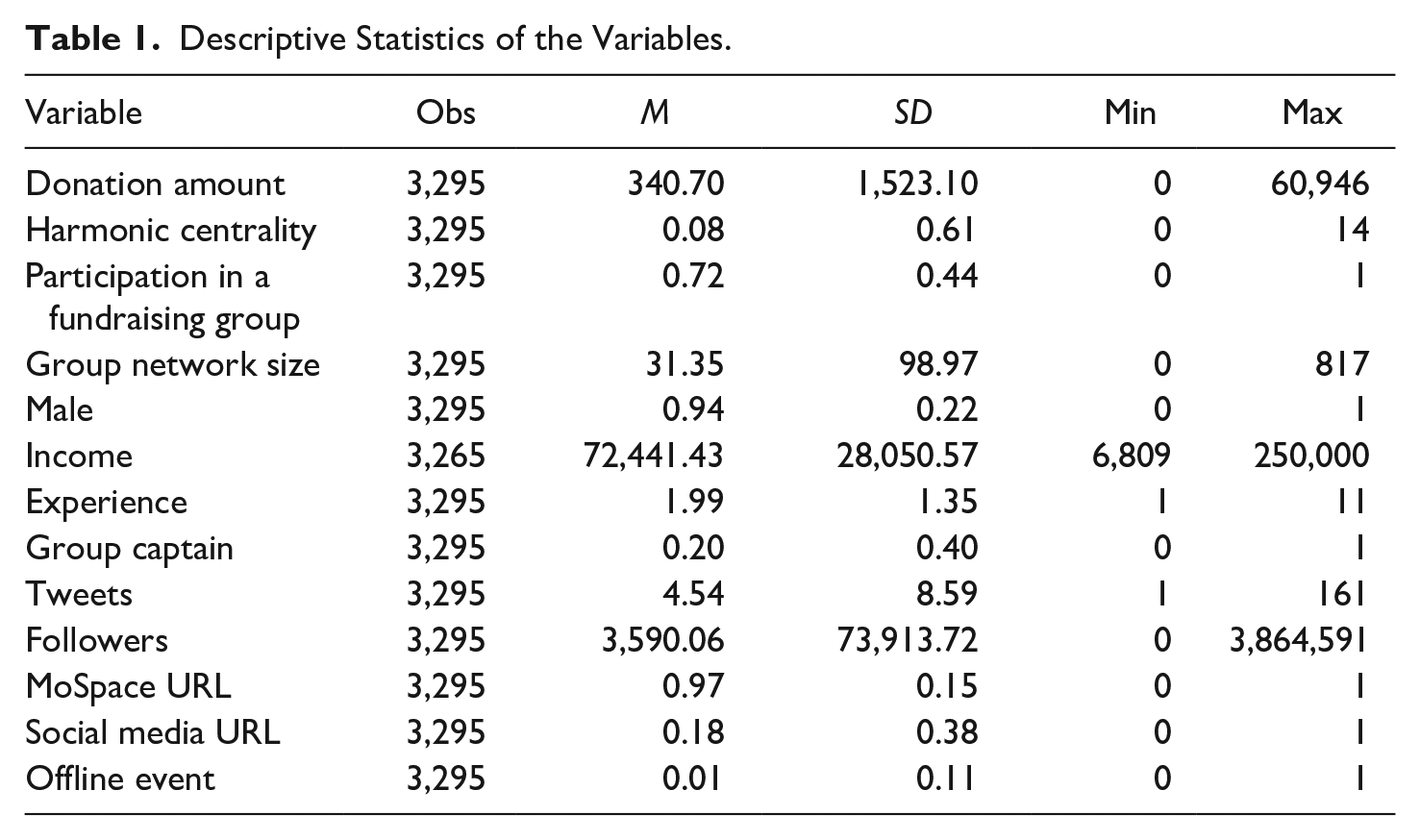
Table 1 shows the descriptive statistics, and Table 2 illustrates the bivariate correlations between the variables. Owing to some high correlation values, we checked the variance inflation factor (VIF) of each predictor as an indicator of multicollinearity (Pan & Jackson, 2008). All VIF values were below 1.4, so no multicollinearity issue was detected.
Descriptive Statistics of the Variables.
Bivariate Correlations Between Variables.
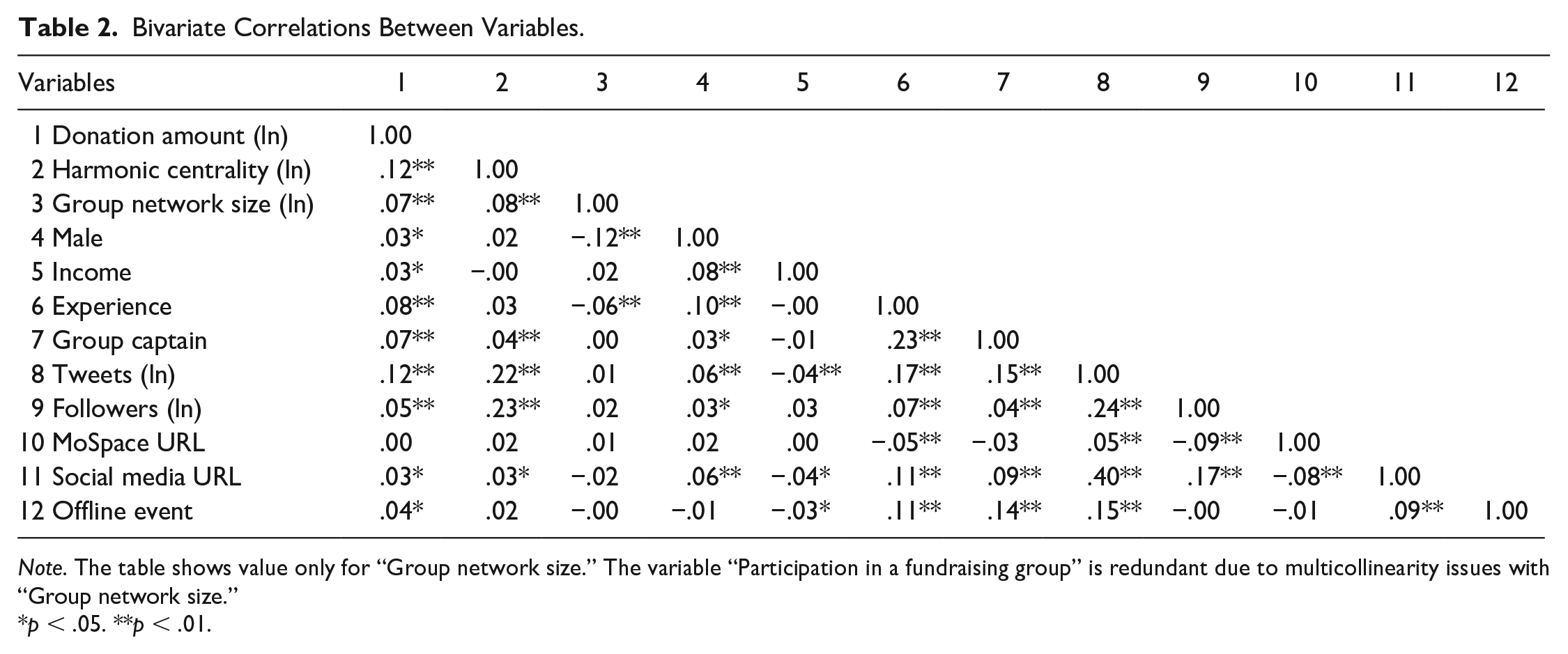
Note. The table shows value only for “Group network size.” The variable “Participation in a fundraising group” is redundant due to multicollinearity issues with “Group network size.”
p < .05. **p < .01.
Results
We conducted a multivariate analysis and used Tobit regression models (Tobin, 1958) because our dependent variable is left-censored (i.e., donations with a value of 0 all take on the value of such a threshold). In this way, we also addressed the sample-selection bias for which those people who choose to be Movember fundraisers are different in unobserved ways from those who do not. Table 3 shows the regression models and results.
Multivariate Analyses Using Tobit Regression to Explore the Relation Between Fundraisers’ Social Capital Derived From Social Media Communication Networks and Group Fundraising Participation and Donation Amounts During the 2014 U.S. Movember Campaign on Twitter (N = 3,265).
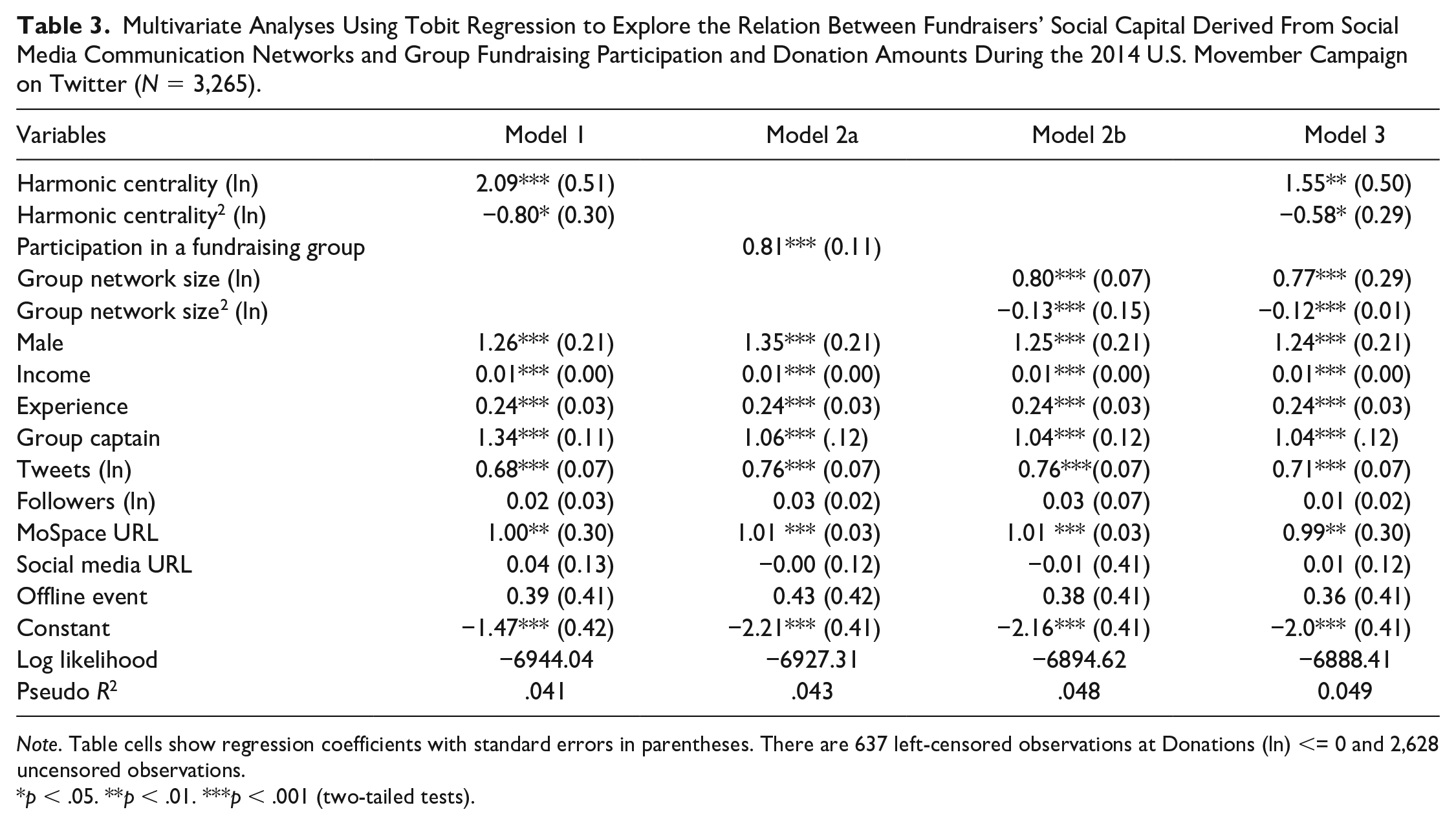
Note. Table cells show regression coefficients with standard errors in parentheses. There are 637 left-censored observations at Donations (ln) <= 0 and 2,628 uncensored observations.
p < .05. **p < .01. ***p < .001 (two-tailed tests).
Model 1 estimates the effect of fundraisers’ network centrality on donations to test H1. Results confirm the inversely U-shaped relationship between centrality and donation amounts. Fundraisers with a moderate level of centrality collect higher donation amounts. Model 2a shows the relationship between participating in a fundraising group and donation amounts. The effect is positive and significant, thus confirming H2a. Model 2b tests the effect of fundraising group size and confirms the hypothesized curvilinear effect on donation amounts (H2b). Model 3 combines Model 1 and Model 2b into a full model to determine whether the core findings of Model 1 are robust to the alternative explanatory measures presented in Model 2b. In this full model, all independent variables have the same effects on the dependent variable. 2
In all models, we find positive and significant effects on donation amounts for the following control variables: being a man, having a high income, being more experienced in the campaign, being a group captain, having a high volume of Twitter activity, and using external linking to the MoSpace fundraising page. The other control variables are not significant. Finally, we conducted robustness checks to ensure the correct interpretation of our results of the curvilinear (inverted U-shaped) effects of the independent variables on the dependent variable (see Appendix C for more details).
Discussion and Conclusion
This study aimed to investigate the role of fundraiser networks in online P2P fundraising and their effect on fundraising outcomes. By drawing on social capital and network theories, we investigated how social capital derived from social media networks and fundraising groups explains individual fundraising success. To our knowledge, this is the first study that focuses on fundraiser–fundraiser networks and considers relations among fundraisers as important assets to secure fundraising success. In this way, we contribute to nonprofit research and answer calls to address the lack of research on fundraisers and fundraising practices in contrast to the abundance of studies on donors and donation behavior (Breeze, 2017; Chapman et al., 2019).
Our findings show that fundraising success is associated with moderate levels of fundraisers’ centrality in social media communication networks (H1). This result is novel in the online P2P fundraising literature as it highlights the nonlinear relation between central network positions and fundraising success. Fundraisers occupying central positions in larger communication networks may experience a “cognitive” overload, inhibiting information processing (Feng et al., 2015; Guo & Saxton, 2018; Panic et al., 2016). Due to this overload, the positive effect of centrality might backfire on fundraisers’ ability to convert the resources derived from information flows into donations. Fundraisers might experience limited attentional capability (Rotolo & Petruzzelli, 2013) and have little time to establish and maintain communicative relationships to secure more donations. Fundraisers with positions between the core and the periphery of the network seem to be more successful as they likely experience less information pressure and can therefore exploit their communication potential more effectively to collect more donations. Burt (2000) argues that occupying such intermediate or brokerage positions is associated with “bridging social capital,” that is, the resources derived from networks of weaker ties. Such ties often allow greater access to information because they extend an individual’s breadth of existing social ties (Granovetter, 1973). Hence, we propose that future research should investigate how fundraisers can improve their communication and information network management (Jones et al., 2004) and convert it into valuable fundraising resources (e.g., donations). One way could be to investigate the effect of bridging social capital as a valuable resource to secure fundraising success in social media communication networks.
Our results also show that fundraising success is positively related to participating in fundraising groups (H2a) and are in line with the assertion that social capital derived from group participation fosters social connections between individuals (Ahuja, 2000; Burt, 1992; Lin, 1999; Nahapiet & Ghoshal, 1998). Extant nonprofit research has also found that “bonding social capital,” derived from the strength of ties within a social group, is positively associated with donation behavior (Cox et al., 2019). Strong ties are characterized by a higher level of trust and bonding power. We found evidence that Mo Teams are created within friends or work-related networks, thus pointing at preexisting bonding relations among fundraisers. Yet, when looking at the number of such connections, donations are the highest for moderate group network size (H2b). Research shows that substantial time and effort are needed to cultivate resourceful relationships, and that superficial attention poses significant constraints to the positive benefits of having several connections (Chen et al., 2016; Scharf & Smith, 2016). Our finding suggests the need to determine the optimal fundraiser’s group size to achieve higher donation amounts. Relations must be nurtured and maintained over time to make relationship-building successful for fundraisers. Hence, we suggest conducting longitudinal research to study how fundraisers can cultivate an optimal number of bonding relations with other fundraisers to increase their fundraising success.
Finally, we answer calls for more research that uses social media in the study of fundraising (Bhati & McDonnell, 2020) and, more broadly, prosocial behavior (Xu & Saxton, 2018) and social movement campaigns (Priante et al., 2018). Our findings show the importance of investigating social media networks as the main platforms used in online P2P fundraising, and network dynamics outside those platforms, to understand fundraising success. Examining fundraising groups as a more formal and organized way to connect with other fundraisers than spontaneous, highly self-organized social media networks reveals the importance of existing network connections (e.g., friends or workplaces) and collaboration through collective participation. A post hoc analysis of the dynamics at play in Twitter communication networks shows that Movember fundraisers predominantly used Twitter to communicate with people outside the Movember campaign (e.g., potential donors) to reach out to different networks. Our findings show that fundraisers interact only marginally on social media but prefer to connect with each other outside these platforms and engage in group fundraising. There is almost no overlap between the Twitter communication network and fundraising group networks. We found that 96.35% of all interactions derived from Movember fundraisers’ tweets are with Twitter users who are not Movember fundraisers. Of the remaining interactions, 2.30% are interactions with other Movember fundraisers who are part of the same fundraising group and 1.35% with other fundraisers. These findings are important because they show that social media are marginally used for communication and coordination among fundraisers and are mostly adopted for connecting with potential donors.
Limitations and Future Research
Our research has three main limitations. First, this study’s generalizability is limited due to its focus on the Movember campaign on Twitter. Therefore, our study may suffer from selection bias, a typical issue in nonprofit research using social media data (Xu & Saxton, 2018). Future research could test our hypotheses by using other types of advocacy campaigns and social media platforms. Second, we did not consider variation over time in our main effects. Future research could investigate how changes in network positions over time might affect fundraising outcomes. Third, we focused on the concept of structural social capital. Future studies could address additional dimensions such as relational social capital (Nahapiet & Ghoshal, 1998). For example, focusing on people with a coordinating role in fundraising groups, such as the Movember group captain, could deepen our understanding of the role of more “symbolic” forms of social capital related to community norms, solidarity, and trust.
Practical Implications
This study answers calls to create a stronger connection between nonprofit research and practice (Bhati & McDonnell, 2020; Chapman et al., 2019). Our findings align with practical insights about the relevance of using networks to raise donations and promote social causes to solve current social problems (Brown, 2015; Ehrlichman et al., 2015). Based on our results, we offer some key recommendations of the best practices in online P2P fundraising that can be useful for both nonprofit organizations and individual fundraisers.
Recommendations for nonprofit organizations
Our study shows that fundraisers’ networks play an important role in online P2P fundraising. Although social media seems more appropriate for donor engagement than fundraising networking (unless fundraisers properly develop communication network management skills), participation in fundraising groups plays an important role in determining individual fundraising success. We suggest that nonprofit organizations educate their fundraisers (even more) on how to harness their connections with other fundraisers and not just merely with their donors. To do so, organizations need to recruit fundraisers who are open to developing relationships with other fundraisers, particularly in groups. Hence, nonprofit organizations must encourage and support group participation and a sense of community among their fundraisers. One way could be promoting P2P fundraising in the workplace or educational and social settings. Organizations can provide fundraisers with “social technology outlays” (Bennett & Segerberg, 2012), such as web pages to share fundraising activities and collect donations among group members. Fundraising kits, including banners and template emails, could further facilitate fundraisers’ existing or new connections with other fundraisers. Nonetheless, coordinating group fundraising efforts is essential for success. Our findings show that initiating and coordinating fundraising groups—that is, being the group captain—leads to superior fundraising performance. Nonprofit organizations could convene the right people to be role models and educate them in setting an example for other group members, for instance, by providing guidelines or “digital toolkits” (Movember, n.d.).
Recommendations for fundraisers
Our findings provide useful insights for fundraisers to optimize their success and increase their impact in raising awareness for social causes. We suggest that fundraisers develop the right skills to effectively manage their networks and communication with other fundraisers and potential donors using social media. For instance, fundraisers could improve their communicative behavior by learning new information and communication management techniques (Jones et al., 2004), such as optimizing time and effort to respond to messages. They could improve their performance by teaming up with other fundraisers in social causes. Group participation can enhance social capital (connections) that plays a positive role in fundraising success. Yet, fundraisers must develop the ability to select and cultivate resourceful connections that can be managed over time. For example, they could start by nurturing a small number of connections before expanding their network.
Footnotes
Appendix A
Appendix B
Appendix C
Acknowledgements
The authors thank Prof. Edward Walker for his insightful feedback on the article, Dr. Dong Nguyen for support in the data preparation, Twitter for providing part of the tweets used in this study through the Twitter DataGrant, and the Movember Foundation (United States) for providing the individual data used in this study.
Declaration of Conflicting Interests
The author(s) declared no potential conflicts of interest with respect to the research, authorship, and/or publication of this article.
Funding
The author(s) disclosed receipt of the following financial support for the research, authorship, and/or publication of this article: This research was financially supported by the Tech4People program of the University of Twente.
