




Abstract
In this article, we introduce the concept of “engageability,” which refers to the ability of volunteer-employing nonprofit organizations to engage, motivate, and manage volunteers to maximize their potential and sustain the volunteering human resource. Engageability conceptually complements the two well-established concepts of volunteerability and recruitability. By offering this conceptual framework, we enable volunteer-employing organizations to assess the degree to which they are engaging volunteers and to make improvements in this regard. Engageability questions how organizations that have already recruited volunteers make themselves volunteer-friendly and engage volunteers effectively. Based on the literature, we offer a comprehensive framework that considers a large set of organizational practices from germane to engageability, framing them into four fundamental clusters: (a) value-based (ideological), (b) managerial, (c) physical, and (d) supportive connections. We introduce the conceptual model and provide explanation for each cluster and each with-cluster organizational practices and discuss the potential contribution of this conceptual model.
Keywords
Introduction
In recent years, volunteering research has focused on the antecedents of volunteering, including volunteer motivations and sociodemographic characteristics, experiences and consequences of volunteering, and its benefit to participants (Einolf, 2018; Hustinx et al., 2010; Ma & Konrath, 2018; Rochester et al., 2010; Shachar et al., 2019; Snyder & Omoto, 2008; Wilson, 2012). Ma and Konrath (2018, p. 1148) conclude that theories of volunteering “predominantly focus on the preconditions, motivations, and consequences of volunteering.” This approach is defined by Haski-Leventhal et al. (2010) as volunteerability—a concept that covers the willingness, capability, and availability of individuals to volunteer (see also Haski-Leventhal et al., 2017). van Overbeeke et al. (2022) and Shachar et al. (2019) argued that volunteering research primarily focuses on its antecedents or consequences, while volunteer management and practices remain a “black box.” In fact, relatively few studies offer empirical analyses of organizational contexts for volunteering, organizational and social structures that promote volunteering, or operational procedures for managing volunteers (Cnaan & Cascio, 1999; Einolf, 2018; Hager & Brudney, 2011; Haski-Leventhal et al., 2010; Nesbit et al., 2018; Studer & von Schnurbein, 2013). Furthermore, the studies that focused on volunteer management rarely focused on what the volunteer-employing organization does to accommodate volunteers and never with the intention of eliciting a comprehensive conceptual framework.
By focusing on volunteers, current research prioritizes the supply perspective over organizational demand and capacity for volunteers (Handy & Brudney, 2007). A significant resource for many nonprofit organizations (Jäger et al., 2009), volunteering often occurs at the interface of community and volunteer-management systems. Therefore, it is important to examine the organizational variables that influence the magnitude and efficacy of volunteer management (Penner, 2002). In this area, Haski-Leventhal et al. (2010) suggested the concept of “recruitability, which refers to the ability of volunteer organizations to recruit volunteers and maintain them” (p. 142). Recruitability focuses on an organization’s ability to recruit suitable volunteers, while considering its physical, technical, and geographic accessibility; the financial and non-financial resources to increase the number and diversity of volunteers; and the networks and cooperation that facilitate recruitment (Haski-Leventhal et al., 2010).
Volunteerability and recruitability have gained traction in the literature by focusing on the volunteer supply and initial relationship formation between volunteers and organizations. What is missing, however, is the theorization of volunteer experiences, engagement, motivation, and sustainability once volunteers are active within an organization. To address this gap, we introduce a third concept: engageability—the ability of volunteer-employing nonprofit organizations to engage, motivate, and manage volunteers to maximize potential and sustain the volunteer human resource within the organization.
Previous studies have shown that various organizational practices support volunteer involvement, maximize benefits of volunteering, and improve volunteer experience (Hager & Brudney, 2011; Haski-Leventhal et al., 2010; Nesbit et al., 2018; Studer & von Schnurbein, 2013). However, a comprehensive assessment of organizational practices that explain variations in engageability is missing.
In this article, we present a conceptual framework for organizational volunteering aimed at nonprofit organizations with a volunteer manager/coordinator. However, we expect other volunteer-employing nonprofit organizations will likewise benefit from the framework. The practices may be applied differently by organizations based on recruitability, size, location, target populations, culture, other missions, the organization history and its environment, and other related factors. We do not compare practices or suggest a certain prioritization; rather, we present a comprehensive framework that volunteer-employing nonprofit organizations can review and engage as needed to enhance engageability. Our framework is akin to a restaurant menu, wherein diners select the best options from the full menu to maximize their choices. Similarly, our framework allows organizations seeking to enhance engageability to review their own practices and consider the possibilities of replacements, additions, or substitutes.
To enhance engageability, our conceptual framework identifies four fundamental clusters: (a) a value-based cluster, indicating the importance of volunteering in the organization, organization values regarding volunteering, volunteer roles within the organization, and volunteer role (if any) in decision-making; (b) managerial cluster, including paid, dedicated staff for volunteer management, staff training, and knowledge of and implementation of best practices for volunteer engagement; (c) physical cluster, including adequate allocation of organizational resources to cultivate, motivate, and retain volunteers, allocation of a physical space for volunteer activities, and the technological infrastructure to effectively manage volunteers; and (d) a supportive-connection cluster, capturing the extent to which organizations are aware of and use national, regional, or local umbrella volunteering infrastructures, third-party model organizations, volunteer management consultants, and/or community-based institutions to strengthen the volunteer system.
A thorough review of the literature is essential for the development of a solid theory and component conceptual framework. Rapoport (1985) described how conceptual frameworks help us “think about phenomena, to order material, revealing patterns—and pattern recognition typically leads to models and theories” (Rapoport, 1985, p. 256).
We follow the logic applied by Hustinx et al. (2010) in their theory of volunteering. However, our aim was to theorize engageability as a new and necessary complement to volunteerability or recruitability. Indeed, volunteering is a complex phenomenon that spans a wide variety of types of activities, organizations, and sectors and is not clearly delineated. Synthesizing these perspectives into a conceptual framework offers a cross-disciplinary perspective that enacts DiMaggio’s (1995) “covering-law perspective,” which presents an “image of the world in which variables explain one another” (p. 391). Put differently, a “covering-law perspective” does not focus on prediction; rather, it finds order and structure among numerous facts and observations to present a systemized and accessible theoretical framework.
Present volunteer-management theories predominantly focus on applying Human Resource Management’s (HRM) practices to volunteer management. Although such concepts are indispensable in understanding underlying dynamics of volunteer management, they do not offer a comprehensive conceptual hybrid theory. Despite HRM’s validity, it represents only one view and should be complemented with more process-oriented accounts and attempts to “defamiliarize” and “enlighten” our knowledge by questioning conventional domain assumptions (Brudney et al., 2019; DiMaggio, 1995; Van Maanen et al., 2007). In this respect, DiMaggio (1995) argued that a “good theory” is multidimensional, and the best theories are hybrid, which result from combining different approaches.
Such a hybrid theoretical strategy may be particularly useful for conceptualizing how agencies engage volunteers as an intrinsically complex phenomenon. Engageability is a new concept that complements volunteerability and recruitability by expanding the theorization of volunteer supply and demand to include a positive, sustainable experience for those who have chosen to volunteer. Engageability focuses not on an organization’s ability to attract and recruit volunteers, but on its ability to meaningfully engage, motivate, and maximize volunteer potential.
This article, therefore, sets out to accomplish two things. First, it seeks to combine the “multiple goodness” of known practices, approaches, and principles of theorization relevant to engageability through a comprehensive and systematic framework. Second, we aim to reach agency volunteer directors and managers whose engageability is less than satisfactory. Using our conceptual framework as a map, they might assess their practices to help volunteers feel more engaged, motivated, and appreciated.
Next, we review seminal and recent works on factors affecting volunteer engagement. We introduce the framework, the four clusters, and their variables. While reviewing the relevant literature, we then discuss possible connections and overlays between clusters and explore implications for research and practice.
Organizational Practices Affecting Volunteer Engagement
The organizational characteristics that promote volunteering are referred to in different ways in the literature, such as organizational factors, components, and capabilities (Hager & Brudney, 2011; Haski-Leventhal et al., 2010; Nesbit et al., 2018; Studer & von Schnurbein, 2013). As mentioned, Haski-Leventhal et al. (2010) conceptualized “recruitability” as the different organizational components affecting an organization’s ability to recruit and retain volunteers. Hager and Brudney (2011) defined “organizational characteristics” as the features that impact organizational ability to recruit volunteers, distinguishing between “natural” and “nurturing” characteristics. Studer and von Schnurbein (2013) reviewed literature regarding organizational factors affecting volunteers and identified three main strands: the practices and instruments of volunteer management; the organizational attitudes toward volunteers, as well as the organizations’ embedded values; and structural features that limit the action space of volunteers and volunteer coordination. Nesbit et al. (2018) introduced a comprehensive framework to explain the scope of volunteer involvement both in public and in nonprofit organizations. Nesbit et al.’s (2018) framework introduces dimensions of decisions made by the organization and by volunteers, together determining the scope of volunteer involvement both in public and in nonprofit organizations. Together with literature reviews of volunteer-management practices (Alfes et al., 2017; Einolf, 2018), these four conceptual models contribute to the conceptual model presented here.
Based on these seminal papers, we propose a comprehensive framework that widens the scope of clusters that may affect an organization’s ability to keep, engage, and maximize the potential of its volunteer workforce. Our framework zooms in on nonprofit organizations and their practices, structures, and systems that promote engageability. We provide a model for nonprofit agency directors, volunteer managers, and students of volunteering to assess an organization’s engageability to foster a volunteer-oriented environment. We propose that volunteer agencies implementing practices from all four clusters are more likely to succeed in engageability.
The next part of this article will discuss the relevant practices affiliated with the reach of the four clusters. As noted above, the four clusters are as follows: (a) a value-based cluster, including among other practices the organization values regarding volunteering; (b) a managerial cluster, including paid, dedicated staff for volunteer management; (c) a physical cluster, including adequate allocation of organizational resources; and (d) a supportive-connection cluster, including relationships with other organizations regarding care for volunteers.
Value-based Cluster
The value-based cluster focuses on core ideological, philosophical, and ethical organizational discourse and attitudes regarding volunteering. According to the literature reviewed, a clear value-based cluster within an organization contributes to volunteer engageability, since it reflects the organization’s willingness to invest in volunteer engagement. This cluster is comprised of four key practices relevant to engageability: (a) the values that underlie the organization’s decision to integrate volunteers into its ranks; (b) ways these values shape the organizational culture toward volunteers; (c) integration of these values into the organizational vision, and strategic and operational plans; and (d) the centrality of volunteerism in the organization. These values come from many sources, including the faith tradition or community culture that creates and supports the organization, long-standing organizational culture, and/or beliefs of key staff (Milofsky, 2008; Nesbit et al., 2018; Schneider, 2013).
Values underlying the decision to integrate volunteers
Since volunteering is often an emotional and ethical activity, organizations wishing to integrate volunteers should actively shape organizational values and attitudes to facilitate volunteering (Haski-Leventhal & Bargal, 2008). According to Ellis (2010), efforts by organization leadership to facilitate philosophical and ethical discourse regarding reasons behind integrating volunteers can dramatically improve volunteer engageability. Such conversations frame the importance and value of volunteers within the organization and expand willingness to invest in promoting it. Conversely, in organizations where volunteers are treated as an isolated, disconnected, after-thought, they feel marginalized and unappreciated (Ellis, 2010; Hobson & Heler, 2007; Rehnborg et al., 2009), thus leading to more frequent departures (Ellis, 2010).
An organization’s reasons for integrating volunteers into its ranks are the core of the value-based cluster. The literature shows that organizations primarily integrate volunteers based on cost-benefit analyses (Chum et al., 2013), indicating that volunteers reduce organizational costs, save resources, and sometimes reduce salary outlay (Handy & Brudney, 2007; Handy et al., 2008; Handy & Mook, 2011). A singular focus on the economic value of volunteers may miss the unique benefits they bring to an organization (Metz et al., 2017). Indeed, the social, moral, and political benefits might outweigh the economic benefits (Brudney & Gazley, 2002; Handy & Brudney, 2007), and reflect ideological, strategic, and managerial decisions in addition to obvious economic ones (Handy et al., 2008; Nesbit et al., 2018; van Overbeeke, 2017).
Value-based success depends on an organization’s ability to encourage discourse among leadership, employees, board, and volunteers regarding the ideological reasons for volunteer integration. A coherent organizational vision that defines and explains the role of volunteerism as part of its general strategy makes volunteers feel welcome, motivated, and relevant (Intindola et al., 2016).
In their framework to explain the scope of volunteer involvement, Nesbit et al. (2018) identified leadership as the key organizational characteristic influencing decisions to integrate volunteers. They claim that top leadership’s involvement proved critical in shaping the attitudes, values, and culture toward volunteers. Even though this approach also appears as a best practice in most volunteer-management textbooks and guides (e.g., Ellis, 2010), few empirical studies have investigated the role of CEOs and lay leaders in shaping this ideology (e.g., Gazley et al., 2012), and most literature highlights perceptions held by volunteer managers and paid staff (e.g., Handy & Srinivasan, 2004) or volunteers (e.g., Hobson & Heler, 2007) in shaping the organizations’ approach to volunteering.
Organizational culture toward volunteers
Organizational philosophy and values toward volunteering—its mission, vision, and ideological beliefs promoted by leaders—shape organizational culture that signals the degree to which it is supportive of volunteers, which impacts engageability (Hobson & Heler, 2007). Kummerfeldt (2011) examined the impact of various volunteer-management strategies and found that including volunteering in organization vision and mission is a key strategy for successful volunteer management. Kreutzer and Jäger (2011) found that paid staff believed that professionals who bear most of the volunteer work responsibility should carry out additional significant roles, with volunteers providing additional support. On the contrary, this study found that volunteers perceived themselves as the main and central motivating force, without which services provided by the organization could not exist. Van Bochove et al. (2018) conceptualized the relationships and boundaries between staff and volunteers as two main types: (a) demarcation work, where the relationship emphasizes the differences in knowledge, authority, and reliability between professionals and volunteers, and (b) welcoming work, wherein professionals welcome volunteers into their professional domain.
Different perceptions of the role of volunteers raise questions about organizational ownership and how it should be managed. The struggle over the relative importance of volunteers versus paid staff is particularly relevant in nonprofits that have undergone recent professionalization and where leadership feels the need to reduce the influence of the volunteers because staff perceive them as “amateurs” (Nesbit et al., 2018).
Integrating volunteering into the organization’s vision statement and strategic plan
Stakeholders that are valued by an organization in any given time find their way to their vision/mission statement and their strategic plans. Incorporating volunteering in these documents signals to volunteers that they are valued. Organizational culture and values also influence way volunteers connect to the organizational vision and mission (Macduff et al., 2009). Even though an organization’s ideology is depicted in its vision and mission, we found no research on (a) the inclusion of value statements about volunteers in mission, vision, and value statements; or (b) the impact of a volunteer-oriented mission on volunteer motivation, engagement, and commitment.
Carvalho and Sampaio (2013) found that organizations that include volunteering in strategic planning demonstrated commitment to volunteers. By contrast, many organizations do not perceive volunteers as strategic assets and fail to devote the necessary effort to effectively integrate them into organization action plans (Eisner et al., 2009).
The centrality of volunteering in an organization
The extent to which volunteer contributions are central to organizational mission and activity can be an important indicator of how the organization perceives volunteers and their contributions. Carvalho and Sampaio (2013) reported that the centrality of volunteering in an organization influences the amount of attention given to volunteer management within it. The more volunteers are actively involved in promoting the organization’s goals, the more the organization usually perceives volunteering as essential to its continuity and sustainability (Carvalho & Sampaio, 2013; Hager & Brudney, 2004; Intindola et al., 2016). In addition, the more an organization values volunteer work and sees the benefit for its beneficiaries, the more it allows volunteers to carry out significant roles, leading to perceptions that it is volunteer-friendly (Nesbit et al., 2018). Volunteer participation in organizational decision-making processes also reflects perceived importance of volunteers and willingness to invest in them (Østerlund, 2013; Studer & von Schnurbein, 2013).
Managerial Cluster
Volunteer engageability through managerial cluster reveals that organizations must invest in volunteer-management resources and practices through four key practices (Alfes et al., 2017; Brewis et al., 2010; Hager & Brudney, 2005; Intindola et al., 2016; Machin & Ellis Paine, 2008): (a) a paid volunteer manager with clear scope, placement, and training; (b) implementation of a variety of volunteer management best practices; (c) management of staff and volunteer relations; and (d) diverse and flexible volunteering. This cluster focuses on findings and reports of volunteer-management practices found in most sources we reviewed. This is the most studied side of engageability; as such, many important practices will only be discussed in brief.
Paid volunteer manager—position scope and training
Many studies found that a paid volunteer manager significantly affects the organization’s ability to manage volunteers, adopt best practices, maximize benefits of volunteering, and reduce challenges (Brewis et al., 2010; Hager & Brudney, 2005; Intindola et al., 2016; Machin & Ellis Paine, 2008; Nesbit et al., 2018; Smith & Cordery, 2010). Despite the proven importance of the volunteer managers, many organizations do not employ a full-time volunteer director (Brewis et al., 2010; Hager & Brudney, 2005). Volunteer management may be a small component of a staff member role rather than their primary focus (Brewis et al., 2010). However, studies found that employees who perceive volunteer management as an additional task are less likely to devote the resources necessary for the volunteer-management practices that enhance engageability (Intindola et al., 2016).
According to Intindola et al. (2016), the location of the volunteer manager in the organizational hierarchy shows the strategic importance of the position in relation to other functionaries, which can affect engageability. Volunteer managers who are located in the lower rungs of organizational hierarchy reflect a lower priority for volunteer efforts and may reduce the impact of the volunteer program. Many volunteer managers report undervaluation of their role and importance in their organization (Brewis et al., 2010).
Formal training on volunteer-management processes is essential to improve those processes and the quality of their work (Rochester et al., 2010). Although many volunteer managers have extensive experience, not all receive professional or formal training (Brewis et al., 2010; Hager, 2004). Research found that many volunteer managers had no experience or knowledge in the field when recruited, and volunteer knowledge and experience were not required criteria for the position. Many hiring managers were unaware of the abilities and skills required to effectively manage volunteers (Brewis et al., 2010).
While the literature supports the appointing of a paid full-time volunteer manager, this is often the purview of large-scale and financially affluent organizations. Smaller organizations may aspire to have a paid volunteer manager but simply cannot afford one. For such organizations, a current employee may serve as part-time volunteer manager, so long as the work is listed in formal job responsibilities and time is allocated to it. Limited resources or other competing units within the organization may hamper willing organizations from applying many of the suggested practices; however, intentionally finding a less costly alternative may also signal commitment to promoting engageability. Grassroots and volunteer-only organizations may prefer a volunteer to coordinate the work of all other volunteers. These organizations may appoint a senior veteran volunteer as a volunteer manager and make this position formal or clearly recognizable in the organizational formal or informal hierarchy.
Human-resource volunteer management practices
Although most volunteers are willing to work and contribute to organization mission, how they are managed impacts levels of motivation, commitment, and quality work (Alfes et al., 2017). Research has revealed the positive impact of volunteer-management processes on volunteer satisfaction (Fallon & Rice, 2015; Henderson & Sowa, 2019; Rochester et al., 2010; Walk et al., 2018), their commitment to the organization (Newton et al., 2014), and their intentions to continue volunteering (Millette & Gagné, 2008). When volunteers perceive that an organization is disorganized or badly managed, they are highly likely to leave (Hustinx, 2010).
Studies link volunteer-management practices and volunteer satisfaction, the quality of the volunteering experience, volunteer retention rates, and the effectiveness of the volunteer program (Cuskelly et al., 2006; Hager & Brudney, 2004; Stirling et al., 2011). Despite its perceived importance, literature on volunteer management is fragmented, partial, and inconsistent. Furthermore, evidence-based literature regarding the effectiveness of volunteer management practices is lacking. Instead, most research focuses on ways volunteers perceive the quality of these practices (Einolf, 2018; Studer & von Schnurbein, 2013). Few theoretical texts address volunteer-management practices as a key cluster for engageability (Alfes et al., 2017; Einolf, 2018).
Most of the practical literature focused on volunteer management has been influenced by HRM literature and is well represented in the extant literature. This literature often views volunteer management as linear, beginning with recruitment, moving through volunteer induction and ongoing coordination and management, and ends in their departure (Cnaan & Cascio, 1999; Cuskelly et al., 2006; Einolf, 2018; Safrit & Schmiesing, 2012; Studer & von Schnurbein, 2013). In a comprehensive literature review on evidence-based volunteer management, Einolf (2018) found empirical support for the effectiveness of 11 best practices in volunteer management. These practices include liability insurance (included in the “physical” cluster section of our framework), clearly defined roles, job design, strategies for volunteer recruitment, screening, and matching volunteers.
Other HRM practices include providing orientation and training for new volunteers (Aisbett et al., 2015; Walk et al., 2018; Wisner et al., 2005), supervision and support, volunteer recognition, satisfying volunteer motivations, encouraging reflection, and peer support (Cnaan & Cascio, 1999; Kummerfeldt, 2011). Scant literature was found regarding the effectiveness of documenting volunteer hours, individual feedback, and creating written volunteer-management manuals though many volunteer managers apply these practices (Cho et al., 2020; Einolf, 2018; Kummerfeldt, 2011; Studer & von Schnurbein, 2013).
In a comprehensive study of U.S. organizations, Hager and Brudney (2004) examined the extent to which organizations apply best practices for volunteer management and how these practices affect the long-term retention of volunteers. They found that even though volunteer management practices are known and familiar among nonprofits, adoption is limited. Of the nine practices mentioned above, only supervision, training, and regular communication with the volunteers were largely adopted by most organizations (Hager & Brudney, 2004). In a follow-up study from 2019, Hager and Brudney (2021) commented “As we learned in 2003, nonprofits in 2019 vary widely in adoption of volunteer management practices. Standard practices to recruit and place volunteers are most common. Assessment practices are comparatively rare.” (Hager & Brudney, 2021, 5). In the 2019 study, comparatively fewer organizations had a written job descriptions for their volunteers, there were relatively low levels of investment in support for volunteer programs, recognition activities for volunteers, and training for paid staff in working with volunteers. Assessment practices remained among the least commonly adopted Management practices (Hager & Brudney, 2021).
A growing number of researchers argue that the transfer of HRM practices from employee management to volunteer management provides only a partial picture of an effective volunteer management process (Brudney & Meijs, 2009; Eikenberry, 2019; Hustinx et al., 2010). Researchers argue that these differences between volunteers and paid employees raise questions about the ability to translate human-resource practices from employees to volunteers (Alfes et al., 2017). These researchers emphasize the need to create a unique and more selective vision that enables different styles of volunteer management for organizations with different characteristics and that accounts for new volunteer trends (Brudney & Meijs, 2014; Hager, 2013; Howlett, 2010; Macduff et al., 2009; Rochester et al., 2010; Studer, 2016; Studer & von Schnurbein, 2013).
Management of staff and volunteer relations
Volunteer managers need paid staff cooperation to manage volunteer programs effectively. Organization employees must be involved in volunteer training, supervision, and feedback. However, many organizations struggle to provide sufficient staff time to monitor and engage in volunteer work (Gamer & Gamer, 2011; Gazley & Brudney, 2005; Rogelberg et al., 2010; Walk et al., 2018).
Management of staff and volunteer relations has a strong impact on engageability: It influences volunteer satisfaction, commitment, and retention. These relationships may be characterized by conflict, resulting from the staff opposition to volunteer integration into the organization. Some staff may be reluctant to work with volunteers, considering them a threat to their jobs or an added burden (Gazley & Brudney, 2005). They may have concerns about high turnover, absences and unreliability, and quality of work among volunteers (Gazley & Brudney, 2005; Kreutzer & Jäger, 2011). Staff volunteer communication may also affect the organization’s clients. Metz et al. (2017) reported that informal, egalitarian, and emotionally based staff-volunteer communication made clients perceive volunteers as reliable, honest, and internally motivated.
More flexible and diverse volunteering
The degree of flexibility demonstrated by the organization in choosing activities, how activities are carried out, timing of activities, and time required can influence willingness to volunteer and make long-term commitments (Hustinx & Meijs, 2011; Nesbit et al., 2018; Tang et al., 2009). Some volunteers are willing to commit episodically, while others will commit on an ongoing basis. Thus, volunteer-employing nonprofit organizations should make room for both commitments and adjust tasks to accommodate and retain volunteers. Low levels of formality and sense of inclusivity are associated with successful engageability (Meijs & Brudney, 2007; Stirling et al., 2011; Tang et al., 2009). Furthermore, making volunteer opportunities accessible to groups or families contributes to volunteer engagement, retention, and commitment, who derive further pleasure from volunteering with a group (Haski-Leventhal & Cnaan, 2009).
Volunteers come from all walks of life; however, more often, they come from privileged ranks (Sundeen et al., 2007). Volunteer-employing nonprofit organizations can increase engageability by intentionally supporting the inclusion of minoritized communities and groups by attending to their preferences. No less important is intentional matching of volunteer skills to relevant tasks (Falasca & Zobel, 2012; Sampson, 2006), which is perceived by many volunteer managers as the greatest challenge of their job (Knepper et al., 2015).
Physical Cluster
The physical cluster focuses on organizational resources, systems, and physical and technological spaces dedicated to volunteer engageability. According to the literature reviewed, the physical organizational practices can have significant impact on volunteer levels of frustration, commitment, satisfaction, and retention over time (Nesbit et al., 2018; Taylor et al., 2008). This cluster is comprised of six key practices relevant to engageability: (a) a dedicated budget for managing and coordinating volunteers; (b) expense reimbursement systems for volunteers; (c) liability insurance; (d) technological systems for efficient methods of connecting with volunteers; (e) a physical space dedicated to volunteer activities; and (f) marketing tools for recruiting and retaining volunteers.
Dedicated budget for managing, nurturing, and rewarding volunteers
Nonprofits that engage volunteers need to allocate resources to organize and support them; however, organizations often under-budget their volunteer program (Nesbit et al., 2018). Volunteer managers note that allocating resources required for volunteer programs is one of their biggest challenges (Gazley & Brudney, 2005). Hager (2004) showed that investing in volunteer management and volunteer benefits grow from each other, as investment brings greater benefits, and the benefits justify a larger investment.
Three out of ten U.K. organizations operate without any funding for their volunteer program, and less than half support a dedicated budget for training volunteer managers on issues related to managing and operating volunteers (Machin & Ellis Paine, 2008). Similarly, Smith et al. (2010) found 42% of responding organizations in New Zealand had no budget or their managers did not know what the budget was. In an Australian survey, one in three organizations said they did not have a volunteer management budget. Their reasons included (a) did not give it enough thought; (b) volunteer management is part of overall management expenses; and (c) management does not endorse it as a need (Volunteering Australia, 2011).
Low resource allocation and failure to budget for volunteer management impact the consistency and quality of support given to volunteers and the sustainability of volunteer programs by extension (Church & Elster, 2002; Dalgleish, 2006). The need to focus on economic survival can come at the expense of investment and development of volunteers. This may result in nonprofits losing volunteer activities and involvement (Dalgleish, 2006; Ockenden, 2007).
Lack of a dedicated budget to engage volunteers can also be a function of donor preferences. Donors and funding agencies can encourage or demand volunteering as one of their financing conditions, or alternatively avoid volunteering support, instead focusing on programs and beneficiaries (Nesbit et al., 2018).
Reimbursement system for volunteers
Another significant set of practices related to the volunteer-management budget is a reimbursement system for volunteer expenses. This includes mechanisms to cover money spent on volunteering activities such as transportation, parking, uniforms, and background checks. At the extreme end of reimbursing volunteers is stipended volunteering. (Lough et al., 2016). Stirling et al. (2011) found that an organization’s decision not to reimburse volunteers for expenses negatively related to the organization’s ability to recruit and retain volunteers.
In a study conducted in Australia (Volunteering Australia, 2011), organizations were asked whether they were providing reimbursement and whether these costs affected their ability to recruit volunteers. About 80% of organizations reported partial or full reimbursement of volunteers, and 25% noted that organization inability to reimburse expenses significantly impaired their ability to recruit volunteers over time.
Liability insurance
Under vicarious liability, organizations are legally responsible for harm caused by mistakes or misconduct of people working on the organization’s behalf (Mead, 2019). However, legislation in the United States provides legal immunity for volunteers, providing that a volunteer is immune from liability for acts performed within the scope of their volunteer responsibilities, as part of service for an organization, unless the individual acted recklessly or maliciously (Martinez, 2003; Mead, 2019). Therefore, volunteer organizations need liability insurance and a policy that reflects its particular risk exposures (Martinez, 2003).
Covering volunteers with liability insurance helps organizations address concerns around volunteer work (Einolf, 2018). Studer (2016) found that organizations that covered volunteers with insurance were more successful in volunteer recruitment and retention, whereas Hager and Brudney (2015) found that liability insurance did not affect recruitment but had a positive correlation with retention.
Technological systems for efficient methods of engaging with volunteers
The volunteer manager’s role involves building bridges between the organization, the community, and the public. The role is social, requiring communication with a variety of people; therefore, managers belong to several social networks within and outside the organization. In this sense, social media is an ideal tool for volunteer managers.
Use of information technologies can also contribute to volunteer recruitment and retention. Various technologies support recruitment, including applications or sites matching volunteers with positions, enabling easy publicity for volunteering opportunities (Falasca & Zobel, 2012; Sampson, 2006). Given virtual volunteering options, technology also enables people to volunteer without having to leave home (Eisner et al., 2009; Østerlund, 2013). Indeed, during the COVID-19 pandemic, IT volunteer management became even more critical when in-person service was ill-advised or otherwise forbidden.
Social networks and digital media such as Facebook and Twitter help organizations disseminate information about their immediate voluntary needs (S. Kim et al., 2014; Voida et al., 2012). With that said, some countries still suffer from a wide digital divide. Piatak et al. (2019) found that people with Internet access are more likely to volunteer, formally and informally, than those who do not have access.
Regarding retention, diverse technologies enable organizations to communicate with their existing volunteers in an inexpensive manner and to build social networks that connect volunteers to one another and the organization (Eisner et al., 2009; Østerlund, 2013). Technology minimizes time spent on paperwork, streamlining communication and strengthening volunteers’ sense of belonging to the organization and other volunteers (Herranz et al., 2013; S. Kim et al., 2014).
Another technological cluster facilitates organizational documentation of volunteer knowledge, placement, progress, feedback, and supervision of their volunteering career. These technologies can also enable volunteers to document and update their hours, which may facilitate communication with the organization (S. Kim et al., 2014; Voida et al., 2012). Morand (2019) reviewed 15 free or inexpensive volunteer-management software solutions, representing a small percentage of exciting new volunteer-management software programs.
A suitable physical space for volunteers
Knowledge is limited on the impact of physical space and facilities on volunteers. Few scholars mentioned adequate physical space and facilities—including access to equipment—as a sign of organizational investment, stability, clarity, and feeling “at home” (Taylor et al., 2008). Volunteers in nonprofits where there is no such access might significantly reduce the time devoted to volunteering (Swierzy et al., 2018) and report higher levels of frustration and dissatisfaction (Misener & Doherty, 2009; Rogers, 1991; Swierzy et al., 2018; Taylor et al., 2008).
Marketing tools
Volunteer managers can use marketing techniques to better engage volunteers. This means they must develop knowledge and platforms to help them market and advertise volunteering opportunities and use marketing to convey messages to existing volunteers to retain them (Bussell & Forbes, 2003; Haski-Leventhal & Meijs, 2010). One example of a relevant marketing technique is market segmentation—a tool proven effective in identifying subgroups in a potential volunteer population. For example, specific messages tailored to the unique characteristics of young people can be formulated and sent exclusively to this demographic. In a study on market segmentation in nonprofits, researchers analyzed volunteers according to the number of volunteer hours and identified a specific profile of “super volunteers” who give a lot of their time to the organization. This information helped in marketing and recruitment of additional volunteers (Randle & Dolnicar, 2012).
Supportive-connection Cluster
The supportive-connection cluster reflects different connections and collaborations that organizations create to improve the efficiency of volunteer programs. The supportive-connection cluster is comprised of four key practices relevant to engageability: (a) supportive connections with other nonprofits to promote volunteering knowledge and management; (b) supportive connections with umbrella organizations that provide assistance to nonprofits to promote volunteering; (c) supportive connections with “third-party model” organizations; and (d) supportive connections within a platform for peer learning among volunteer managers.
Effective supportive connections require appropriate network development, skills, and cultural knowledge to use them effectively. As such, supportive connections involve social capital—trust-based connections that help an organization meet its goals (Schneider, 2009).
Supportive connections with other nonprofits
Nonprofits are not only responsible for themselves and their volunteers; they are responsible for the whole organizational community, which seeks to retain, expand, and renew volunteer resources (Brudney & Meijs, 2009). This underlines the need for networking and cooperation among organizations that engage volunteers to recruit and foster effective cooperation and mobility between organizations (Brudney et al., 2019; Nesbit et al., 2018). This cooperation might also take place between competing nonprofits. This unique behavior, also called “coopetition” (a portmanteau of cooperation and competition) (J. Kim & Parkhe, 2009), might be crucial in the success of nonprofits in proper management of time and scarce resources, such as volunteers or the resources necessary to manage them (Fathalikhani et al., 2018). Such connection may even allow organizations to share their volunteer workforce when another organization is in crisis (Batard et al., 2019; Weiss, 2016). Indeed, Brudney et al. (2019) reported that volunteer managers have different managerial preferences, in part, based on their collaboration with other nonprofit organizations in their social ecology. Besides other nonprofits, supportive connections like faith-based organizations, foundations, and social and community-based organizations may play an important role in allowing recruiting and retaining volunteers. Such connections can be fostered in person and through digital tools.
Supportive connections with umbrella organizations and volunteer centers
Local, regional, and national volunteering centers are an important component of the communal volunteering cluster and a critical factor in an organization’s ability to cope in a changing and competitive environment. Volunteer centers help promote and expand communal volunteering by providing diverse support and guidance services to community organizations, political influence on stakeholders, and networking and partnerships between organizations (Gazley & Brudney, 2005; Van den Bos & Meijs, 2008). In some countries, volunteer centers recruit volunteers regionally and channel them to volunteer-seeking organizations (Brudney et al., 2005; Lorentzen & Henriksen, 2014; Osborne, 1999). Associating with such centers can simplify volunteer recruitment and enhance intentional selection.
Van den Bos (2014) found six main functions of volunteer centers, including brokering relationships between potential volunteers and organizations and opportunities; stimulating and encouraging interest in voluntary and community activity; good-practice development in working with volunteers and promoting these practices to all volunteer-involving organizations, through training and accreditation strategies; developing volunteering opportunities while working in close partnership with other voluntary agencies; policy response and campaigning to create a volunteer-friendly and volunteer-literate social policy climate; and strategic development of volunteering in partnership with other local agencies and groups. While volunteer centers in some countries are on the decline, other local institutions serve in this role. For example, many universities have volunteer-recruitment centers that link students to volunteer positions in local volunteer-seeking nonprofits (Ozawa, 2010).
Communal volunteer centers can also create a pool of volunteers willing to act when needed, and recruit volunteers according to their needs and interests from partner organizations (Hager, 2004; Nesbit et al., 2018). These functions emphasize the importance of supportive connections to volunteer centers. Rehnborg et al. (2009) suggested that getting volunteers from outside the organizations often yields more skilled volunteers who are otherwise not considering this organization as a place to volunteer.
Supportive connections with “third-party model” organizations
Haski-Leventhal et al. (2009) developed a theoretical framework—“the third-party model”—which observes ways in which government, corporations, and educational institutions enhance and support volunteering. These third-party organizations serve as intermediaries between individuals seeking volunteering and organizations seeking volunteers. These organizations may also provide the training for volunteers. Organizations that use third-party organizations to recruit and/or train volunteers should have smooth and healthy relationships with these organizations. Creating supportive connections and developing appropriate networks with third-party institutions are important practices, given the role these institutions play in the promotion of volunteering.
Governments and local municipalities
Governments may influence volunteering through legislation and development of protection acts (Brudney, 2004), by giving awards to outstanding volunteers; supporting research and knowledge development on volunteerism; supporting volunteer centers; diverting financial resources to volunteer organizations; and encouraging provision of public services through volunteer-involving organizations (Haski-Leventhal et al., 2010). All these paths strengthen the case for strong networks between organizations and governments, both national and local, that allow a coordinated and joint effort in promoting and enhancing volunteering.Gazley (2010) noted that greater collaboration between government and volunteer-employing nonprofits can increase public managers’ perceptions of success, as well as bring about real performance improvement.
Corporations
Corporate volunteering has been widely implemented by businesses (Pajo & Lee, 2011). Involving corporate volunteers may have positive consequences on organizations, including a broader business–nonprofit collaboration, addition of much needed resources, and capacity building (Roza et al., 2017). Via corporate volunteering, employees and their social circles gain access to volunteering opportunities in these organizations and may increase the volunteer pool, and diversify the knowledge and skills needed in the organization (Haski-Leventhal et al., 2010). Alongside these positive aspects, corporate volunteering may also have some harmful consequences, including the risk of reputational damage, the generation of transaction costs for organizations, and low-quality service (Roza et al., 2017). This complex phenomenon requires a strong and supportive connection between corporations and organizations to ensure effective and beneficial corporate volunteering (Haski-Leventhal et al., 2010; Roza et al., 2017).
Educational institutions
Many educational institutions, whether they are colleges, universities, or high schools, develop programs wherein students volunteer in the community. Educational institutes promote volunteering by accreditation schemes, giving appraisal and awards, expecting volunteering experience from applicants, and providing courses that enhance service learning. They can also share knowledge, promote research, and develop academic programs to teach volunteer management (Haski-Leventhal et al., 2010).
Supportive connections within a platform for peer learning among volunteer managers
Networks of volunteer managers develop their own culture—identifying good and bad practices for volunteer management—which may vary by country, region, alma mater, or other factors. Newcomers who share the same values and expectations of volunteering may be more welcome in these groups than those with different views. Peers are an excellent source for consultation and support in an organized or impromptu manner (Connors, 2011).
Many volunteer managers in the United Kingdom report contacting local or national cluster organizations for guidance, advice, and support (Brewis et al., 2010). Managers who take part in a network of professionals in their field are more open to innovative volunteer management practices, training, and guidance, and to new knowledge that contributes to their professional development. These supportive connections can also be with organizations such as the defunct U.S. Association for Volunteer Administration, a nonprofit association for those that work with volunteers in any setting, or with arrangements such as the Council for Certification in Volunteer Administration and its certification program. In various countries across the world, volunteer–manager associations and/or certification programs provide managers with knowledge, support, and political backing. Volunteer-supporting organizations can register their volunteer managers with such groups and make sure they benefit from the offerings. The need for peer support and reliance on volunteer–manager associations or network is especially relevant, as there are hardly any university courses specializing in volunteer management (Jones, 2020).
Summary and Conclusions
In this article, we reviewed literature regarding organizational volunteer practices and presented a new four-cluster categorization, as summarized in Table 1, to describe the different structures, characteristics, factors, and relationships promoting volunteer engagement in nonprofit organizations (Penberthy & Forster, 2004). We claim the presence of a relevant and suitable value-based (Ellis, 2010; Haski-Leventhal & Bargal, 2008; Intindola et al., 2016; Studer & von Schnurbein, 2013), managerial (Alfes et al., 2017; Brewis et al., 2010; Hager & Brudney, 2005; Machin & Ellis Paine, 2008), physical (Gazley & Brudney, 2005; Hager, 2004), and supportive-connection (Haski-Leventhal et al., 2010; Van den Bos, 2014) clusters that are needed when designing, planning, and implementing volunteering within an organization.
Organizational Volunteer Clusters.
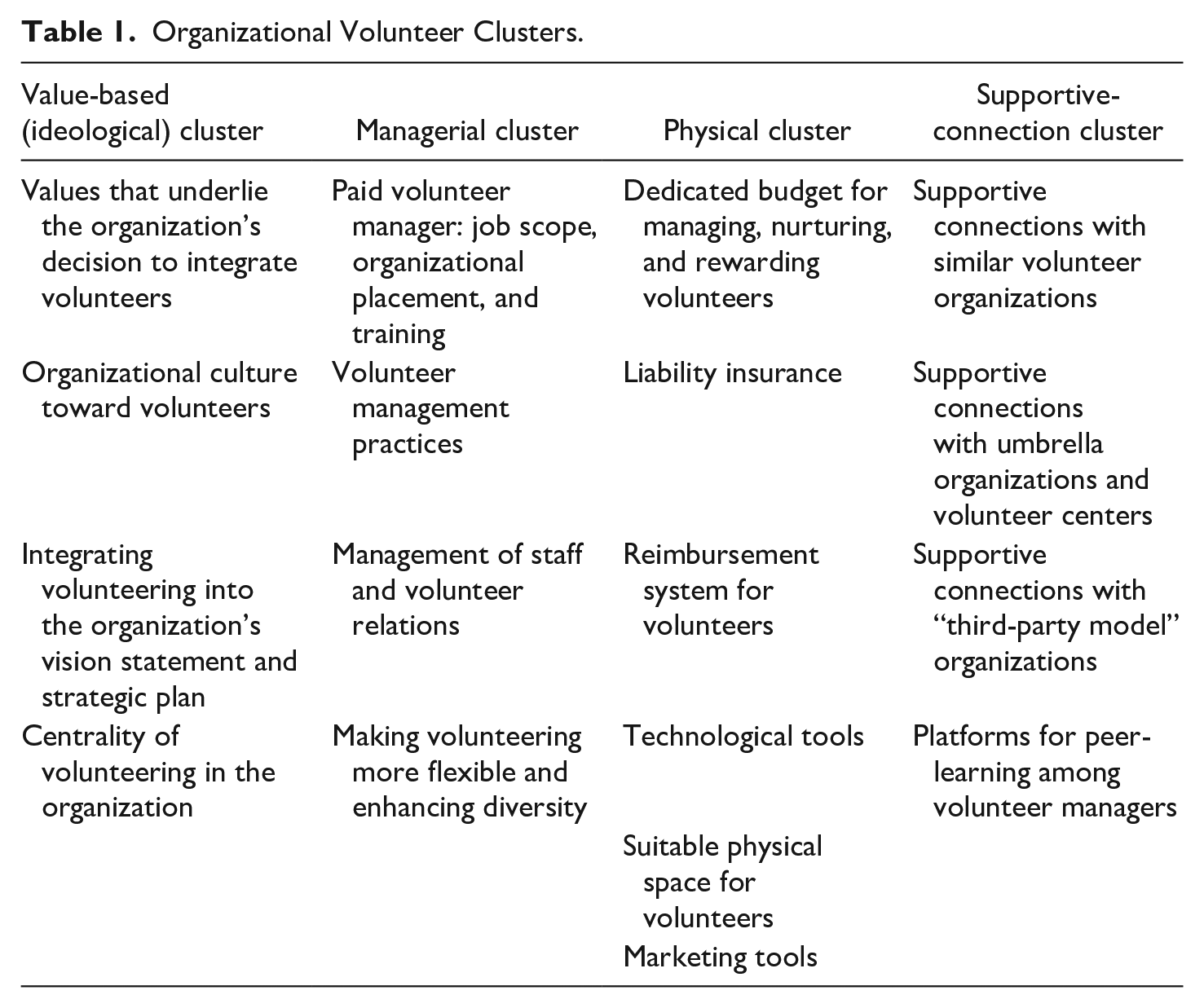
This focus on engageability may also serve to revise the way job descriptions of volunteer managers can be written. Equipped with our findings, agencies that wish to hire a volunteer manager that will lead volunteers to be successfully engaged and committed to the NPO can incorporate the four clusters and the various practices in the job description. We see the traditional role of a volunteer manager/coordinator more as a “resource manager” or even as a “friend (of the NPO) raiser.”
Not all organizations are alike, and in all organizations, there are many ways to organize and structure the organization to meet its needs. This contingency approach is also relevant to the successful use of engageability (Wadongo & Abdel-Kader, 2014). To assume that all organizations will adopt each of the listed practices in all four clusters is unrealistic. We doubt if even one organization will be able to adopt all the presented practices. To assume that all organizations of the same characteristics will adopt the same practices irrespective of their environments and history is also unrealistic. As such, the selection of any set of practices by any volunteer-employing nonprofit organization may differ based on recruitability, resources, size, history, personalities, competing organizations, and social ecology. Furthermore, at different times, different sets of practices may better fit an organization’s engageability needs. For example, an organization that suffers a reputational setback may adopt a different set of engageability practices as compared with before the crisis. As such, our conceptual framework serves as a map or a menu to select from, while considering a wide range of options, making engageability a conscious process where options can be deliberated and measuredly chosen.
Our conceptual framework can be further developed by deepening understanding of the interaction between all four clusters. At this stage, we cannot suggest whether one practice or cluster is more important than another. The level of knowledge in the field is insufficient to answer this question. We found studies that highlighted various practices, but we did not encounter enough research assessing the relative merit of certain engageability practices to provide suitable comparison. We can report that the discussed practices and their aggregated clusters are important for engageability. However, assessing relative advantages or identifying optimal core practices is a challenge for future research. Our goal was to develop a framework to logically organize the known practices, as a springboard for future research and a tool for volunteer-employing organizations aiming to enhance engageability.
We also suggest that the four clusters can overlap. It would be impossible to categorize all practices into a single cluster. We placed practices where they seemed most relevant, but many practices cut across clusters. For example, using IT can be part of physical, managerial, and connections clusters. Furthermore, for the volunteer manager, many of the practices tend to simultaneously occur. It is quite common for volunteer managers to struggle for an operating budget while simultaneously connecting with local agencies to support current volunteers. The reality on the ground is more complex and interwoven than this framework allows. Yet, when taking time from the daily grind, our framework may allow volunteer managers a birds-eye view of ways their organization can enhance engageability. Using the proposed conceptual framework of engageability, they can review one practice after the other and assess needed changes by which their organization can enhance engageability and pitch these needed changes to the NPO director or board.
Further research is also needed to examine how the four clusters may be influenced by different organizational characteristics such as the organization’s field of activity, the size of the organization, organization geographic location, age, or number of competing organizations in the same ecology. Furthermore, it would be important to investigate whether different factors within the four clusters can be valued and ranked by importance and whether some of them are more essential than others, given different organizational context. In addition, since this framework was developed in the context of volunteer-employing nonprofits, primarily focusing on professionalized organizations, we suggest further research looking into the relevance of the four clusters suggested in different organizational settings and different kinds of nonprofits such as grassroots organizations and social movements.
Given the increasing number of scholars claiming that the shift of human-resources strategies from employee management to volunteer management only offers a partial picture of an efficient volunteer management process (Alfes et al., 2017; Brudney & Meijs, 2009; Hustinx et al., 2010), future research might also look into different kinds of volunteer-management approaches and how they might affect the variables that comprise engageability.
Our contribution, in this article, is the focus on the role NPOs play in sustaining volunteering. As we showed in the early part of the paper, most literature and practice focus on the antecedents of volunteering: volunteerability and recruitability. However, regarding the role the host NPO plays, there is a paucity of knowledge. We offer the engageability conceptual framework as a theoretical means to capture the world of organizational behavior that can assist in retaining and successfully employing volunteers. Our conceptual model can practically serve as a checklist for any volunteer-employing organizations to assess its related practices. Volunteer managers can also use engageability and its component to advocate for organizational changes that will sustain and effectively use the NPO’s volunteers.
Footnotes
Declaration of Conflicting Interests
The author(s) declared no potential conflicts of interest with respect to the research, authorship, and/or publication of this article.
Funding
The author(s) received no financial support for the research, authorship, and/or publication of this article.
