




Abstract
Laws that restrict foreign funding to nongovernmental organizations (NGOs) can depress voting through two mechanisms. First, they can signal a democracy recession. Consequently, citizens might fear rigged elections where their vote will not influence who forms the next government. Second, by denying funding to NGOs, these laws can undermine NGOs’ ability to generate social capital, which is crucial to mitigate collective action problems associated with voting. Since 1990, 13 of Africa’s 54 states have enacted laws restricting foreign funding for NGOs. Drawing on the 2016 Afrobarometer survey (36 countries, 53,936 respondents), we find support for the argument that restrictive NGO laws reduce citizens’ electoral participation in national elections probably by signaling democracy recession, and not by undermining social capital that foreign-funded NGOs are supposed to generate. In fully democratic countries, respondents are around 94% more likely to report having voted in a recent national election even after controlling for restrictive NGO laws.
Introduction
Democracy is the government of, for, and by the people. Free, fair, and contested elections are a core pillar of democracy because they allow citizens to choose their government. Because representatives often want to get reelected, citizens can hold them accountable even in off-election years (Ashworth, 2012). But citizens’ engagement in the democratic process extends beyond their electoral participation. They express their views on policy issues by participating in meetings, rallies, and demonstrations, and through their communication in social and traditional media. In such expressions of participatory democracy (Pateman, 2012), citizens often work with other like-minded individuals, through collective organizations such as political parties, trade unions, and nongovernmental organizations (NGOs) that include activist organizations, nonprofits, and other types of civil society organizations.
NGOs play an important role in any democracy by providing a platform for citizens to collectively convey their political preferences to the state. In doing so, they sometimes mobilize publics for political causes (Andrews & Edwards, 2004), oftentimes in collaboration with political parties. In addition to advocacy, NGOs provide local public goods and enhance social capital (Putnam, 1995; Tocqueville, 1835–1840/1969; but see Banks et al., 2015; Edwards & Hulme, 1996). In addition to facilitating political advocacy, NGOs motivate citizens to participate in the electoral process through what we label as the “social capital” route.
Scholars debate whether it is rational for an individual to even cast a vote because the costs of voting often exceed the individual benefits the voter might derive from it. Thus, the “paradox of voting” (Downs, 1957) reflects collective action problems such as free-riding as well as the belief in individual inconsequentiality for collective outcomes (Bandura, 1986) might discourage individuals from voting in elections (Ferejohn & Fiorina, 1974). NGOs can help mitigate these dilemmas by providing the assurance that other individuals hold similar political preferences as well. They can also create a social norm that voting is a civic duty. It is therefore plausible that a strong and vibrant NGO sector can improve electoral participation by mitigating collective action dilemmas (Boulding, 2010). For instance, in Tanzania, NGOs mobilized citizens to participate in that country’s recent polls, even though the country has had the same party in power since independence and the government has been actively clamping down on NGOs in the past year. Local NGOs also played a strong role in mobilizing voters in Uganda’s 2016 national elections, despite the government’s adoption of a restrictive NGO finance law in 2015.
In the above narrative, NGOs are an important pillar of electoral democracy. We call this the Tocqueville–Putnam model of civil society, which assumes that NGOs generate social capital because they are locally rooted, are accountable to the local community, and therefore have their confidence. In the Tocqueville–Putnam model, local rootedness is the key driver of citizens’ trust in the NGO sector. It requires that NGOs generate resources locally. When local people invest resources in NGOs, they feel ownership and demand accountability from them. And NGOs have incentives to be accountable because of their resource dependence on the local community. Accountability to the local community leads to community trust in NGOs. This allows locally rooted NGOs to emerge as focal points for aggregating and articulating political preferences. And they should be able to mobilize people to vote irrespective of regime type. Take the case of Solidarity in Poland. In the 1989 elections taking place in the shadow of the military dictatorship, there was a huge voter turnout of about 65%, and voters overwhelmingly backed candidates endorsed by Solidarity, as opposed to the Communist Party.
But what if NGOs are not locally rooted because they rely predominantly on foreign funds? If they are as a result upwardly accountable to their international donors, rather than downwardly accountable to the communities they serve (Ebrahim, 2005), would such foreign-funded NGOs still create social capital and enjoy credibility among the local community? Would they be able to motivate citizens to ignore collective action issues and go out to cast their votes?
Understanding the mechanisms through which restrictive NGO laws influence voting has important theoretical and policy implications. Since the end of the Cold War, foreign funding for NGOs has increased substantially, particularly in low-income countries, including those in Africa. While much of this aid is channeled toward humanitarian relief and service provision, donors have also favored spending on projects related to democracy and good governance promotion. In most African countries, the most visible NGOs tend to rely on foreign funding.
Yet, since 1990, 13 of Africa’s 54 states have also adopted new legislation that restricts the inflow of foreign funds to domestically operating NGOs. 1 As the literature on this subject notes, governments enact such restrictions to ensure their political survival (Dupuy et al., 2015, 2016). They view foreign-funded NGOs as working with their political opponents and seek to weaken the political opposition through legal restrictions on resource inflows to NGOs. Governments succeed in doing so because foreign-funded NGOs tend to be poorly connected with the local community. Hence, when these restrictions are enacted, the local community typically has not risen in outrage and protest, certainly not outside the capital city and outside media glare. Governments do receive pushback from the international community both in terms of reputational damage and reductions in aid flows. But it seems the law-adopting governments are willing to absorb these costs for their political survival.
Anecdotal evidence suggests that these restrictions have had a major impact on the NGO sector. Dupuy et al. (2015) report that such restrictions have changed the population ecology of the NGO sector in law-adopting countries, leading to a significant decline in the number of NGOs, most notably in the numbers of groups promoting good governance, democracy, and human rights. These laws have also resulted in reduced foreign aid flows to law-adopting countries (Dupuy & Prakash, 2018). But we know little else about their domestic political effects in African states, including on citizens’ political behavior.
Two mechanisms link restrictive NGO laws to African citizens’ voting behaviors. First, citizens might view these regulations as a part of the democracy recession. With democracy recession, citizens might believe that voting is futile. Second, assuming foreign funding can create a vibrant NGO sector that enhances social capital and reduces collective action dilemmas associated with voting. Hence, restrictive NGO laws should depress voting because it enfeebles NGOs, and degrades social capital they help produce, irrespective of regime type. And the longer are such restrictions, the more severe will be the erosion of social capital and hence more pronounced will be the effect on depressing electoral turnout.
In contrast, if foreign-funded NGOs had little connection with the local communities, they would not generate social capital. If so, restrictive NGO finance laws would not have a statistically significant effect on voting, once we have controlled for the regime type. Drawing on the latest round of Afrobarometer data (Round 6, conducted in 2016, 36 countries; 53,936 respondents), we investigate the mechanism through which restrictions on foreign funding to NGOs might dampen citizens’ participation in Africa’s national elections. To identify the specific mechanism(s) through which this works, we examine models (a) with and without controlling for levels of democracy and (b) with and without controlling for NGO laws. This is because to isolate the effect of the “social capital” mechanism, our results should hold even after we control for levels of democracy, the mechanism behind the “democracy recession” hypothesis. Similarly, to isolate the effect of the “democracy recession” mechanism, our results should hold even after we control for NGO laws, the mechanism behind the “social capital” hypothesis.
Using a multilevel mixed-effects model to account for the survey design as well as country-level differences, we find that while restrictive laws reduce the probability of citizens’ voting in national elections by 68%, these results do not hold when we control for levels of democracy. Instead, the level of democracy remains significant with and without NGO laws. Indeed, we find that in fully democratic countries, respondents are around 94% more likely to report having voted in a recent national election even after controlling for restrictive NGO laws. While we do not advance a causal claim, the data suggest that restrictive NGO laws depress voting by signaling democracy recession, as opposed to undermining social capital that can mitigate collective action problems associated with voting.
NGO Laws and the Policy Context
NGOs grew rapidly in the Global South and former communist countries after the Cold War as part of Western countries’ push for democratization, economic development, and improved effectiveness of foreign aid. By some estimates, the share of foreign aid to Africa channeled through NGOs rose from just 1% in 1990 to about 20% in the late 2000s (Englebert & Tull, 2008). In part, this growth in NGO funding reflected the “aid fatigue” among Western donors that led them to devise new mechanisms to deliver foreign aid, as opposed to simply distributing it through government bureaucracies (Bauhr et al., 2013; D. Smith, 2012; but see Zaidi, 1999). This cohered with the Washington Consensus that sought to dismantle governmental control over the economy, a process that had begun in the 1980s as developing countries sought structural adjustment aid from the World Bank and the International Monetary Fund (Levine, 2002; Nelson, 1995).
Aid ineffectiveness found an obvious culprit: domestic governments of aid recipient countries. These governments were deemed corrupt, incompetent, and captured by local power structures. In contrast, donors believed that NGOs had the expertise, grassroots knowledge, and incentives to identify appropriate aid projects and beneficiaries, as well as the human infrastructure to deliver aid (Dietrich, 2013; Edwards & Hulme, 1996). By some estimates, about one fifth of all bilateral aid is now routed through NGOs: The Organisation for Economic Co-Operation and Development (OECD; 2015) puts the number at 19% for the United Kingdom and 23% for the United States, 25% for Norway, and 40% for Ireland.
Due to the massive infusion of foreign funds, the NGO sector in Africa has grown exponentially. For example, in Kenya, the number of secular foreign NGOs grew from 37 to 134 between 1978 and 1987, and the number of local NGOs grew from 57 to 133 during the same time period (Fowler, 1991). Today, the number of foreign and local NGOs active in Kenya is estimated to number more than 7,200, in addition to more than 300,000 community-based organizations (U.S. Agency for International Development, 2015). Other countries echo a similar pattern, with foreign aid influxes partially fueling the NGO boom (Chahim & Prakash, 2014).
But in the mid- to late-1990s, a curious counter trend emerged: Several developing countries began enacting laws that restricted the ability of NGOs (both foreign and domestic) to operate in their territories (Dupuy et al., 2015, 2016). Of particular interest, many laws restricted NGOs’ access to foreign funding. The Carnegie Endowment termed this as “Closing Space: Democracy and Human Rights Support Under Fire.” 2 In its annual “State of the Civil Society Review,” CIVICUS, a prominent global civil society group, notes, “The CIVICUS Monitor, our new online platform that tracks the space for civil society in every country of the world, reveals that civil society faces serious threats in 106 countries, over half of all UN member states.” 3
The restrictions these laws impose are of different types (Dupuy et al., 2016). In Equatorial Guinea and Angola, government authorization is required for locally operating NGOs to receive funding from international sources, while Azerbaijan and Belarus require organizations to notify the government regarding receipt of internationally sourced funds. Vietnam forbids the receipt of international funds that will negatively affect political order. Some governments set specific limits on the amounts of international financing organizations can receive; for instance, the Algerian government has discretionary power to set a cap on how much foreign money NGOs can legally receive, while Ethiopia has determined that human rights organizations cannot receive more than 10% foreign funding. In terms of restrictions on the use of foreign funding, Zimbabwe prohibits such funding from being used on voter education, while Rwanda allows only 20% of funds to be used on administrative expenses. Several governments require regular and extensive reporting on the receipt and use of foreign funds, such as Indonesia, Burundi, and India.
These legal restrictions certainly reflect states’ attempt to restrict the domestic political and economic space available to NGOs to function effectively, thereby denying resources to domestic political opponents. Scholars view them as reflecting democracy recession (Diamond, 2015; Plattner, 2015; but see Levitsky & Way, 2015). As the literature suggests, this crackdown reflects the confluence of Western donors’ funneling of increased levels of foreign aid through NGOs as opposed to recipient governments, the rise of rights-based approaches in advocacy that invariably pit development NGOs against local governments, the lack of domestic support for NGOs, and regimes’ political vulnerability as reflected in closeness of previous elections (Dupuy et al., 2015, 2016; but see Nelson & Dorsey, 2018).
What motivates governments to place restrictions on NGOs? After all, NGOs are supposed to promote development, bridge deficits in public goods provision, and help the underprivileged. The literature offers a political explanation (Dupuy et al., 2016). Advocacy NGOs that work to promote democratization or human rights are often critical of the domestic government. But with the rise in the rights-based approach to development that promotes equal provision of public goods and services (Cornwall & Nyamu-Musembi, 2004; Hamm, 2001), even non-advocacy NGOs (nonprofits) focused on providing merit goods and services are directly drawn into local politics. A key reason is that most developing country governments are unable to provide the requisite quality and quantity of public services. Although NGOs have historically provided public goods, the rights-based approaches they have adopted have transformed them from suppliers of public services to critics of government. For example, several NGOs hitherto devoted to supplying health services to the underserved suggest that health care is a right and therefore demand that governments supply health care to all people. Of course, governments probably cannot do so; this is an important reason why NGOs were supplying it in the first place.
As actors seeking regime survival, we expect governments to act against their opposition. And because much of NGOs’ foreign funding is routed through the formal banking sector, governments have a low-cost and reliable administrative means to deny NGOs’ access to foreign resources. Governments’ threat perception about the foreign-funded NGO sector is increased further because they recognize that governments gain legitimacy, in part, by providing public goods. When an NGO sector that is bolstered by foreign aid replaces government as the key supplier of public goods, governments feel politically insecure, especially when the NGOs are critical of the government. Not surprisingly, they have compelling political incentives to crack down on the NGO sector.
Governments would probably be wary of cracking down on a locally rooted NGO sector. Its actions could spark citizen outrage and lead to popular mobilization against the government. Evidence of this can be seen in recent violent clashes between state security forces and protestors from student groups and unions in South Africa, and in citizen protests against the Nigerian government’s approach to dealing with the insurgent group Boko Haram. Yet very few such sustained protests against legal restrictions on NGOs have so far taken place. Perhaps this is where the corrosive effects of foreign aid on the health of a civil society can best be discerned. Governments believe that internationally funded NGOs are not well-rooted in the local community and may even undermine indigenous civil society (Banks et al., 2015). Hence, they are emboldened to crack down because they anticipate little domestic backlash.
Why this disconnect between NGOs and the local community? A common criticism is that NGOs dependent on foreign funds are more responsive to donors’ concerns as opposed to the needs of the communities they serve. This means that local community views NGOs as advocating for issues that are important to Western audiences, not to local people. Second, even the public goods that NGOs supply may not be of the appropriate type, a common criticism of foreign aid.
NGOs and Voting
NGOs are voluntary associations of individuals that lie outside the direct control of both the state and market actors, and that are geared toward pursuing a common goal. NGOs can be considered as pillars of democracy especially when they provide a platform for citizens to collectively articulate their preferences. They help public mobilization for political causes. While collective action problems discourage individuals from voting in elections (Downs, 1957; Ferejohn & Fiorina, 1974), NGOs can mitigate free-riding and improve electoral participation. Per social cognition theory, the personal efficacy hypothesis suggests that individuals might not contribute to collective endeavors such as elections if they believe that their efforts will not affect the collective outcome (Bandura, 1986). Existing evidence suggests that when individuals are provided with assurances that others are contemplating similar action, they are motivated to contribute to public goods provision. The role of collective action organizations such as NGOs becomes important because they serve as assurance mechanisms that the individual is a part of a collective that is working toward common goals and hence individual actions could change the collective outcomes.
The crucial mechanism that links NGOs to voting is via the generation of social capital. Capital implies an asset that can create benefits in the future. It requires an upfront investment, with short-term sacrifices for long-term gain. The “social” aspect of social capital suggests that such assets are generated via social interactions (Dolšak, 2013; Putnam, 1995). These interactions create inter-personal trust and provide the social glue that holds communities together. According to Ostrom (1990), the concept of social capital has important implications for understanding collective action and social dilemmas. Olson (1965) saw collective action problems rooted in atomistic individuals seeking to free-ride on the efforts of others. In contrast, Ostrom views individuals involved in collective endeavors to be rooted in communities. These individuals are glued together by social capital, which changes their cost-benefit calculus for contributing to collective endeavors. For her, social ties can generate trust which allows individuals to rein in their incentives to free-ride and contribute to collective action in the expectation that others will do the same. Furthermore, social capital allows individuals to acquire a sense of agency and believe that their individual effort could shape collective endeavors.
NGOs are expected to generate social capital and allow individuals to overcome the collective action problems inherent in voting, irrespective of the political regime in which individuals function. Even in the most challenging political contexts, such as a repressive and one-party rule, African civil society groups have successfully mobilized citizens to call for and participate in elections. For instance, local civil society organizations have been actively challenging the government of the Democratic Republic of Congo to hold overdue national elections.
Broadly, if the NGO sector has deep connections with the local population, democracy recession might not depress voting. Thus, social capital effects of NGOs on electoral participation should be visible irrespective of the level of democracy. In fact, with a vibrant NGO sector, the social capital effects of the NGO sector might even boost voter participation if the electorate faces an authoritarian government. In the absence of such a vibrant and locally rooted NGO sector, voters would perceive NGO laws as signaling democracy recession and hence decide not to cast their vote.
Two implications emerge from the above discussion. If foreign funding supports the creation of social capital, a crackdown on foreign funding will depress voter turnout. And the longer such restrictions have been in place, the greater would be degradation in social capital and the more pronounced effect in depressing electoral turnout. But if foreign-funded NGOs do a poor job in creating social capital, then a crackdown on foreign funding will not depress voter turnout, even after controlling for democracy recession. Based on the above discussion, we propose the following:
The second mechanism through which NGO laws could influence voting is via signaling democracy recession. Voters may believe that new, restrictive NGO laws reflect democracy recession and the onset of authoritarianism. It might also imply that the voting will not be free and fair and that their voting efforts will not be effective in influencing who forms the next government (the “personal efficacy” hypothesis). In fact, by voting in rigged elections, citizens may even provide legitimacy to the authoritarian system. Thus, voters may decide not to vote, not because a crackdown on foreign funding has enfeebled the NGO sector and eroded their social capital, but simply because they view new NGO laws as signals of the onset of authoritarianism and possibly rigged elections (Birch, 2010). Based on the above, we hypothesize the following:
Variables, Data, and Method
We employ survey data to test the impact of the adoption of restrictive NGO funding laws on citizens’ reported participation in the most recent national elections. Africa is an interesting region to study given the region’s variation in the adoption of these laws and the large number of national and local elections being held on the continent. There is well-established literature examining how specific rules or regulations influence voter turnout by looking at national-level polling data (Blais & Carty, 1990). Although this approach has merits, it does not capture voting decisions at the level of individual citizens. If individuals are the ones who vote, understanding whether restrictive NGO laws influence their individual electoral participation requires examining individual voting behavior rather than inferring it from aggregate voting data (Kramer, 1983).
To accomplish this objective, we draw on Round 6 of the Afrobarometer survey, a representative public attitude survey about democracy, governance, and society conducted in 2016 with 53,936 adults in 36 countries in Africa. 4 The sample included in the survey is roughly split between females and males and includes slightly greater numbers of rural respondents.
Dependent Variable
Our dependent variable is respondents’ answers to the following question: “Understanding that some people were unable to vote in the most recent national election in [20xx], which of the following statements is true for you?” Answers to this question are “0 = you were not registered to vote; 1 = you voted in the elections; 2 = you decided not to vote; 3 =you could not find the polling station; 4 =you were prevented from voting; 5 = you did not have time to vote; 6 = you did not vote because you could not find your name in the voters’ register; 7 = did not vote for some other reason; 8 = you were too young to vote; and 9 = don’t know/can’t remember.”
As we are interested only in whether or not respondents voted, we first dropped response Categories 0, 8, and 9, as well as missing responses, leaving 45,343 remaining responses. From this, we created a binary variable to indicate whether respondents reported voting or not. Sub-Response Categories 3 through 7 were combined to indicate non-voting, while Sub-Response Category 1 indicates having voted. Further dropping missing and non-informative categories from the independent and control variables left 43,517 observations remaining.
We note two limitations in using this measure of voting. 5 First, it is a self-reported measure. Because we cannot assess the levels of over- or under-reporting, our model includes several control variables to account for individual and country-level variations in voting behavior. If there are factors such as gender or level of economic development that lead to systematic over- or under-reporting about voting, our control variables should be able to account for them. Second, our measure captures voting in the most recent national elections only: It does not capture voting in local elections or elections in previous years. It is possible that the impact of restrictive NGO laws on electoral participation varies between local and national elections. However, we believe that national elections are the most appropriate way to examine the impact of NGO laws because local elections tend to be driven by local issues (Berry & Howell, 2007) rather than by national issues such as national-level NGO laws. We recognize that the effect of NGO strength and the social capital NGOs generate might be more visible at the local level. Hence, our results should be interpreted in the context of national elections only.
Key Explanatory Variables
While our dependent variable pertains to 2016, both the key explanatory variables are lagged by 1 year and pertain to 2015. Our first explanatory variable is the adoption of a law that, in some way, hampers NGOs’ ability to access and use foreign funding. By foreign funding, we mean financial resources that are sourced from actors who are geographically located outside the borders of the country or countries of operation. This type of funding can be provided by private individuals (usually in the form of donations), governments of the host country or traditional donor states, other NGOs, and/or philanthropic foundations. We are concerned with legal restrictions placed on the flow of resources that originate from outside a given country’s borders but that are used within that country’s borders. These laws typically require government notification and approval for NGOs to receive foreign-sourced funds, restrict the countries from which foreign monies can be sourced, require organizations to report on the receipt and use of such funding, require that organizations channel foreign funds through government banks, cap the amount of funding that can be received, and restrict the issue areas on which organizations can operate using foreign funding.
To identify countries with these legal restrictions, we draw on the cross-national data collected by Dupuy et al. (2016) on the global adoption of restrictive NGO finance laws between 1993 and 2012. We have updated it to 2015, the year prior to the Afrobarometer survey. From 1990 to 2015, 13 of the continent’s 54 states adopted new legislation restricting the inflow of foreign funds to domestically operating NGOs. Ten of these 13 are included in the latest (2016) round of the Afrobarometer survey: Algeria (law adopted in 2012; two elections), Benin (law adopted in 2003; three elections), Burundi (law adopted in 1999; two elections), Cameroon (law adopted in 1999; five elections), Egypt (law adopted in 2014; one election), Sierra Leone (law adopted in 2009; two elections), Sudan (law adopted in 2006; two elections), Tunisia (law adopted in 2011; one election), Uganda (law adopted in 2009; two elections), and Zimbabwe (law adopted in 2004; three elections).
We estimate the effect of NGO restrictive laws on electoral participation through a binary variable to indicate whether a state adopted a restrictive NGO finance law by 2015. 6 Our challenge is to apportion variance in voter turnout between two mechanisms: social capital mechanism and the democracy recession mechanism. We also control for the number of years that have passed since a restrictive law was adopted. The reason is that the longer the restrictions are in effect, the greater should be the erosion in social capital.
Our second key explanatory variable is the level of democracy (lagged), which we measure using the Polity IV measure of regime type. This variable is measured on a 20-point scale and classifies regimes into autocracies, anocracies, and democracies (i.e., a lower score means lower levels of democracy). The intuition is that the effect of restrictive NGO laws on voting can take place by signaling a democracy recession and the onset of authoritarianism. Potential voters might infer that voting will not be free and fair and their voting efforts will therefore not be of any use.
If foreign funding supports NGOs’ ability to generate social capital, then a crackdown on foreign funding will depress voter turnout, even after controlling for the level of democracy. The introduction of the democracy variable allows us to ensure that the democracy recession mechanism is not confounding the social capital mechanisms. But suppose the NGO crackdown variable is significant in a reduced model but loses significance once the “democracy” variable is introduced. This suggests that the social capital mechanism is not influencing voter turnout. Thus, by testing models with and without the democracy variable, we can get a sense of which of the mechanisms might be driving individual decisions to vote.
Control Variables
Our models control for several individual-level socioeconomic and demographic variables that scholars report as affecting citizens’ participation in national elections (Kuenzi & Lambright, 2010). First, we control for individual perceptions of elections and democracy as well as their support for the current regime, all of which are likely to influence decisions to actually turn out at the polls. These variables include respondent views on whether voters are usually threatened with violence at the polls, whether people should be careful in what they say about politics (self-censorship), and whether people trust key government institutions (the relevant legislative body, Parliament, or National Assembly).
We also include the following measures of socioeconomic status and well-being that have been used in other studies of poverty and well-being (cf. Johnston & Abreu, 2016; Østby, 2008; Sahn & Stifel, 2000), taken from the Afrobarometer survey: the respondent’s education level, whether the respondent has a job that pays cash income, radio ownership, and how the respondent views their own present living conditions. We anticipate that voters who are better educated and economically better-off will be more willing to participate in elections, as they have a greater awareness of their democratic rights and may have more to gain economically from election-related government shifts. We further control for respondents’ age and gender. We also include a measure of access to electricity to proxy for ethnicity and location. Rural voters and marginalized ethnic groups are less likely to support the government, and they are also less likely to have access to electricity given that power supply is often used in poorer countries for political patronage during elections (Brown & Mobarak, 2009). Finally, we control for country-level indicators, using data from the World Bank’s World Development Indicators dataset: logged population size, as of year 2015; logged foreign aid per capita, as of year 2015; and logged gross domestic product per capita, in constant 2010 U.S. dollars.
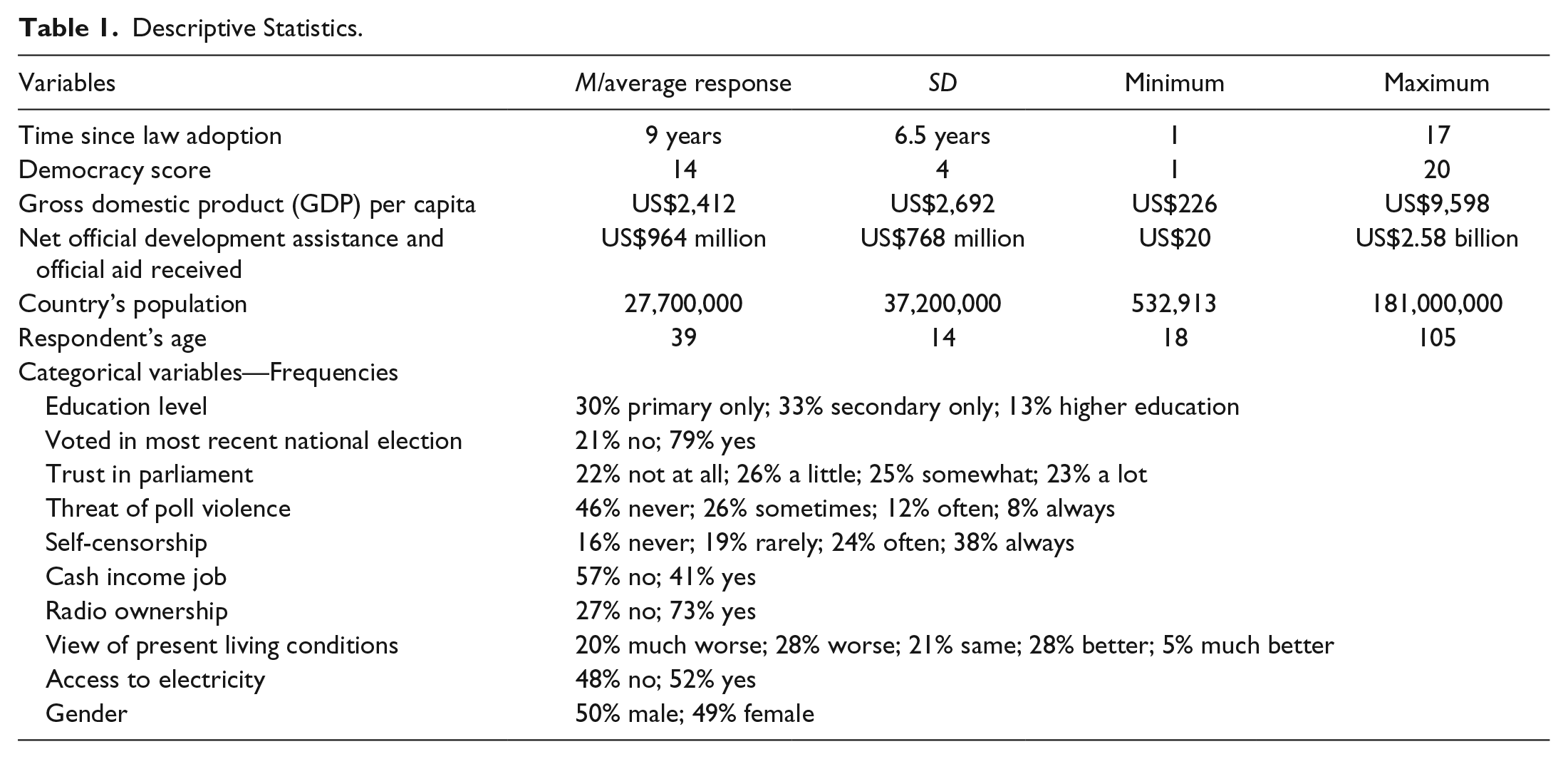
Table 1 provides descriptive statistics. Notably, a very large number of respondents (79%) say they voted in the most recent elections, and there are relatively low levels of reported electoral violence. Thus, we should expect survey respondents to not be turned away from voting.
Descriptive Statistics.
Results
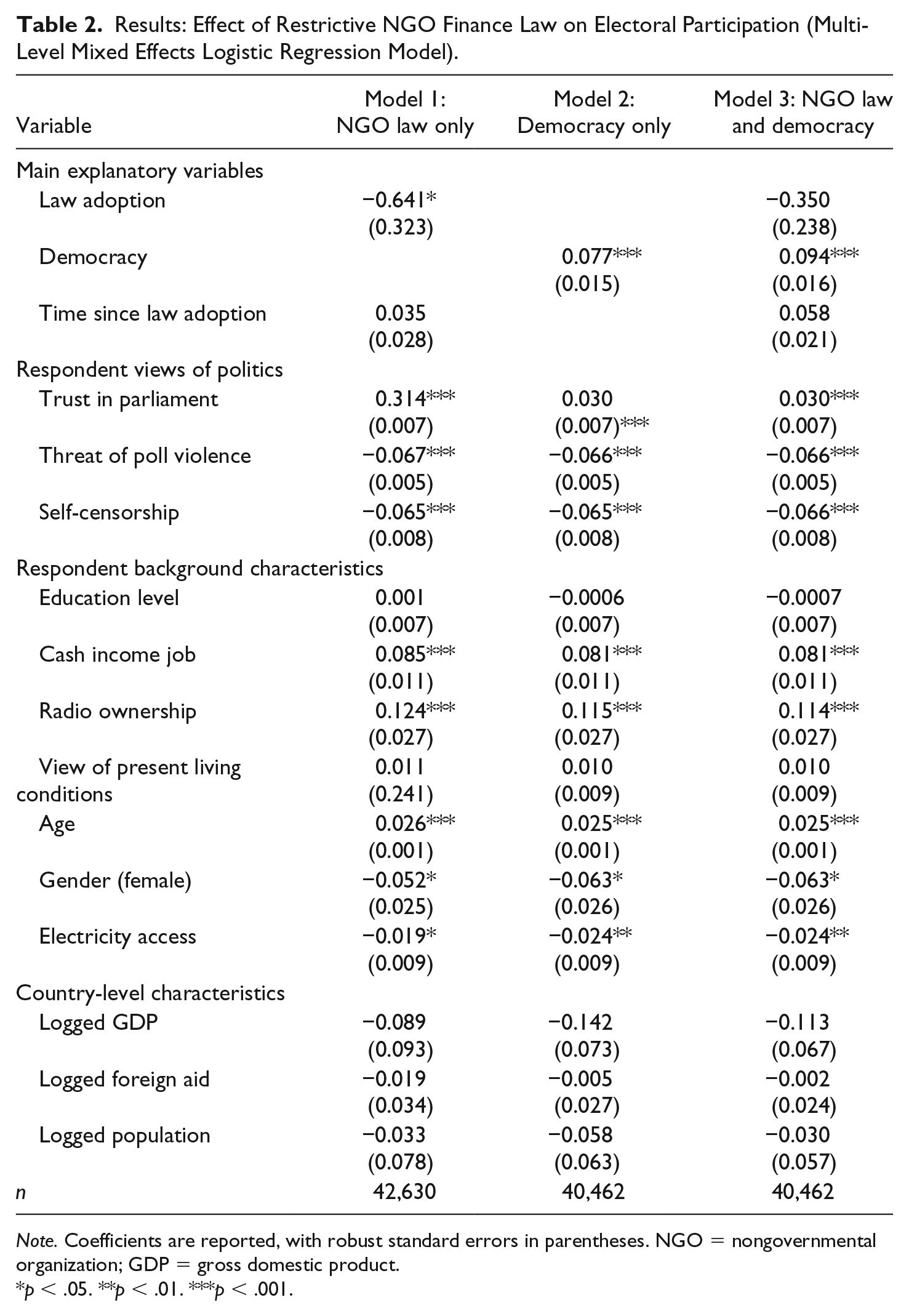
In Table 2, we present the results of three models of the relationship between the adoption of restrictive NGO finance laws, levels of democracy, and election participation. We use a multilevel mixed-effects logistic regression model. Such a model is appropriate to use with complex survey data such as the Afrobarometer survey, which is multilevel (hierarchical) in its structure, with households nested within primary sampling units, and then nested within countries. Specifically, we estimate a three-level model with random intercepts for the countries and the primary sampling units. The likelihood-ratio test comparing the model with an ordinary logistic model is highly significant for our data, supporting the use of this modeling approach.
Results: Effect of Restrictive NGO Finance Law on Electoral Participation (Multi-Level Mixed Effects Logistic Regression Model).
Note. Coefficients are reported, with robust standard errors in parentheses. NGO = nongovernmental organization; GDP = gross domestic product.
p < .05. **p < .01. ***p < .001.
Model 1 tests the effect of NGO restrictive laws while controlling for respondents’ characteristics. We do not include the “democracy” variable in this model. Consequently, the NGO variable confounds both the social capital and the regime type explanation. We also control for the number of years that have passed since the law was passed. Model 2 tests the effect of the levels of democracy (but does not include the variable capturing crackdown on NGO funding) on reported participation in recent national elections. This tests the democracy recession explanation. However, it does not control for the social capital explanation that the NGO law variable captures. Model 3 is a fully specified model because it includes both the restrictive NGO law measure (and the numbers of since it passed) and the democracy measures. In doing so, it allows us to evaluate the social capital hypothesis (NGO variable) separately from the democracy recession hypothesis (democracy variable).
In Model 1, we see that the coefficient for the NGO finance law variable is both negative and statistically significant at the .05 level. Because we employ a non-linear, logistic regression to model our binary dependent variable, we cannot directly interpret the coefficients as they are odds ratios and must be exponentiated to understand the size of their effects. The odds ratio for the law adoption variable in Model 1 is 0.52, and its exponentiated value 1.68, and thus adopting a restrictive NGO finance law reduces the probability of voting in the most recent elections by 68%.
In Model 2, we replace the NGO law measure with the Polity measure of democracy. Here we see that the coefficient for the democracy variable is positive and statistically significant at the .001 level. The more democratic a country, the more likely it is for respondents to report having voted in the most recent election. Exponentiating the odds ratio of 1.08 tells us that respondents in democratic states are 94% more likely to report having voted in the most recent election.
In Model 3, we include both the restrictive NGO law and democracy measures. Importantly, whereas the NGO variable loses significance, the democracy measure retains statistical significance at the .001 level, and its coefficient remains positive. We thus find support for the alternative hypothesis that restrictive NGO finance laws reduce citizens’ reported electoral participation by signaling democracy recession, and do not find support for the degradation of social capital hypothesis. Indeed, the number of years since the law has passed is not significant either in Model 1 or Model 3.
Across the three models, the respondent characteristics are highly significant, with the exception of respondent’s views of their present living conditions as well as educational background. None of the country-level controls are significant in any of the models. Unsurprisingly, prior poll violence and the need to self-censor one’s political views lead to less electoral participation—which provides additional support to the argument that NGO laws are viewed as signals of onset of authoritarianism and hence depress voting. Male and older respondents, those who have higher trust in the national legislative body, and those with a cash income job, who own a radio, and who report having access to electricity in their homes are more likely to report having voted in the most recent national election. This coheres with broader research that suggests that the opportunity cost to vote is much more prohibitive for poorer individuals than for richer individuals. Recall that in Africa, individuals normally have to physically line up in polling booths to vote, unlike some other countries where the transaction costs of voting have been reduced by measures such as postal ballots. Given that the exercise of franchise might entail that the individual cannot go to work, it is not surprising that urban residents and those with cash incomes are more likely to vote.
Conclusion
This article has sought to investigate two explanations about how restrictive NGO laws might influence voting. The “democracy recession” hypothesis suggests that citizens view a crackdown on NGOs, not in terms of their substantive implications on the NGO sector. Rather for them, these laws reflect the attempts of the governments to tell Western donors that they are asserting their internal sovereignty and are not willing to countenance Western norms such as democracy promotion. Thus, citizens feel that these laws signal the onset of authoritarianism and therefore are discouraged to vote.
In contrast, the “social capital” hypothesis suggests that NGO funding crackdown weakens the NGO sector and degrades the social capital NGOs are supposed to generate across regime types. Consequently, NGO crackdown depresses voting, irrespective of regime type. Yet, if the social capital argument does not hold, the restrictive law variable will lose statistical significance once the regime type is controlled for. Based on a large Afrobarometer survey covering 53,936 adults in 36 countries, we find support for the democracy recession hypothesis but not for the social capital hypothesis.
We recognize that this article has not provided a direct measure of social capital and viewed it as a latent variable. Future research could work with a direct measure of social capital to validate these findings. Our findings, although correlational, raise important policy questions. Why do we find evidence that the foreign-funded NGO sector does not appear to influence electoral participation by generating social capital? One answer might be that it is not locally rooted. As the literature on the resource curse suggests (Ross, 1999), if governments do not depend on citizens for funding, they are not accountable to their citizens (Brass, 2008; Morrison, 2010). Arguably, the NGO sector might also suffer from a type of resource curse, induced by disconnections with the local communities. The reality is that the NGO sector grew in the Global South and former communist countries largely due to economic and political support from Western donors and institutions. This involved a massive infusion of foreign funds for NGO promotion by Western powers and the multilateral institutions they dominate (Reimann, 2006). The policy expectation was that the NGO sector would become the vehicle to spread liberal norms, encourage democratization, and foster market-based development. Furthermore, Western donors probably assumed that this sector would find it difficult to raise resources internally within resource-poor countries, and therefore viewed Western financial support as an appropriate way to establish and strengthen the NGO sector.
The NGO sector (specifically, the nonprofits) also grew because it emerged as a subcontractor for the delivery of public services that were previously supplied by governmental agencies. This subcontracting trend was ideologically rooted in the domestically oriented “reinventing government” agenda (Osborne, 1993) and the internationally oriented “Washington consensus” (Williamson, 1993). During the 1980s, Western governments began relying more heavily on NGOs to deliver public services, instead of their own agencies. This reflected the Reagan–Thatcher philosophy of reducing the government’s footprint across policy spheres. In the 1990s, the “reinventing government” approach also encouraged governments to outsource service provision to NGOs. This led to the emergence of NGOs as governmental contractors, an approach that has been replicated abroad in the context of aid delivery.
Ensuring the steady flow of foreign resources requires NGOs to follow the donors’ agenda. This includes governmental and inter-governmental organizational donors as well as private foundations. Scholars note the role of the big three American foundations, Carnegie, Ford, and Rockefeller, in promoting U.S. norms during the Cold War through their foreign aid programs (Parmar, 2012). In the current epoch, there is a concern about the “Gates Effect” in public health due to the vast resources at the command of the Gates Foundation (Roberts & Enserink, 2007). Resource dependency leads NGOs to reproduce norms rooted in donor-inspired development discourse (Chandhoke, 2002). NGOs may well become an integral part of the world society (Meyer et al., 1997) but sometimes with little connection with the local society in which they are supposed to function. Not surprisingly, when governments decide to crackdown on NGOs and justify it by branding NGOs as foreign agents, there is little groundswell opposition to governmental actions. In sum, the inability of foreign-funded NGO sector to generate social capital raises the question about the wisdom of Western funding to create a vibrant NGO sector abroad. It seems that only the NGO sector that is homegrown and rooted in the local community can serve as agents of democratic consolidation.
Our article should encourage future work on electoral participation and how the institutional environment, restrictive NGO laws in our case, might affect it. For the purpose of this article, we have focused on whether the respondents voted. However, future work could examine specific factors (personal, professional, financial, or institutional) that might encourage or impede voting. After all, high levels of electoral participation are critical for the working of a democratic system, and there is policy merit in understanding how the NGO sector fits into this picture.
Footnotes
Declaration of Conflicting Interests
The author(s) declared no potential conflicts of interest with respect to the research, authorship, and/or publication of this article.
Funding
The author(s) disclosed receipt of the following financial support for the research, authorship, and/or publication of this article: Kendra Dupuy acknowledges the support received from the Research Council of Norway, which supported her work on this article as part of the project “Breaking the Backlash Against Democracy in Africa” ( ) (RCN Project 262862)