




Abstract
People are often influenced by information about other people’s behavior, that is, social information. Social information is frequently used by practitioners hoping to increase charitable giving, while the precise mechanisms through which social information works are unknown. We conducted a systematic literature review of 35 studies reporting on the effects of social information on charitable giving. We show that several studies report no or even negative effects and that a theoretical understanding of social information effects is lacking. We integrate the empirical findings in the wider fields of social psychology and behavioral economics and propose an integrative theoretical model. The model includes four mediators and three moderators that can explain positive and negative effects of social information. This theoretical framework can assist researchers to obtain a deeper understanding of social information and support practitioners in implementing giving tools in donation campaigns.
Can Social Information Increase Donation Amounts?
While the societal and scientific focus on philanthropy has increased (Schuyt, 2012), the field misses a solid theoretical framework as the literature on philanthropy is mainly empirical (Bekkers & Wiepking, 2011). This problem has implications for the usage of a specific tool often used by practitioners to increase donation amounts: social information. Social information informs individuals about the behavior of others which can be used to increase individual donation amounts (Shang & Croson, 2009). Our review of the effects of mentioning previous donation amounts shows that social information does not always result in a positive effect and sometimes even decreases donation amounts. The purpose of this article is to develop a theoretical framework that can guide future research and advise practitioners in the use of social information as a stimulant for their solicitation methods.
A number of previous studies suggest that social information is a useful tool to increase the effectiveness of philanthropic solicitation methods (e.g., Alpizar, Carlsson, & Johansson-Stenman, 2008a, 2008b; Croson & Shang, 2008; Hysenbelli, Rubaltelli, & Rumiati, 2013; R. Martin & Randal, 2008; Shang & Croson, 2009; van Teunenbroek, 2016; Van Teunenbroek & Bekkers, 2018; Vesterlund, 2003). In contrast to these findings, other studies reported no effects (Catt & Benson, 1977; Kubo, Shoji, Tsuge, & Kuriyama, 2018; Murphy, Batmunkh, Nilsson, & Ray, 2015; Shang & Croson, 2009) or even negative effects, meaning that social information decreased rather than increased charitable giving (Croson & Shang, 2008; Meyer & Yang, 2016). The use of social information, therefore, instead of increasing donations, could prove to be costly for practitioners.
From the current literature on social information effects, we cannot conclude to what extent social information affects donation amounts. Therefore, our central research question is: “Why and when does social information increase charitable giving?” The inconsistencies in the literature indicate a need for a theoretical framework that can assist researchers to obtain a deeper understanding of the mechanisms that drive effects social information on charitable giving. We conducted a systematic literature review of 35 studies reporting on social information effects on charitable giving published before January 2019. We observed a large variation in design, methods, and context between the studies and in the operationalization of social information differs between studies. Also, we observed that studies contributed limited to no effort to developing a theoretical explanation behind the (lacking) effect. As a result, we are left with a series of empirical accounts without a clear theoretical background or an explanation behind the effects (or lack of effects).
We developed a theoretical framework which is a mix of the empirical findings reported in the 35 studies, integrated with insights from classical psychological theories and behavioral economic theories. It is important to combine these two fields because experiments in both fields have shown how situations can be created to stimulate giving. For instance, psychologists have shown how humans follow social norms and often adjust their behavior accordingly (Bernheim, 1994; Festinger, 1954). Behavioral economists have shown how small pieces of information can influence decision making (Thaler & Sunstein, 2008). In addition, the 35 papers mentioned several explanations behind the (lacking) effect of social information, mostly applying insights from the field of behavioral economics and social psychology. However, the purported mechanisms were hardly explained or tested.
We propose a theoretical model with four mediating variables (presented in no order), three with a positive effect and one mediating variable with a negative effect. Our model is consistent with the finding that donors have different reasons for giving (Konrath & Handy, 2018). Social information is only one of many influences that affect giving. Also, it is likely that individuals have different reasons for (not) following social information.
First, some donors donate because they want to behave in a socially acceptable way (Bekkers & Wiepking, 2011). Social information creates social norms (e.g., Croson, Handy, & Shang, 2009; Sasaki, 2019; Smith, Windmeijer, & Wright, 2015): because other people are donating, it is apparently common to do so. Second, a related motive to give is to behave altruistically; to help others (Bekkers & Wiepking, 2011). Maybe social information increases an awareness of need: because other people are donating, there is apparently a real need for help. Third, some donors care about the trustworthiness and efficacy of a charity and search for information about the quality signals to determine if their donation will be used properly (Bekkers & Wiepking, 2011). Social information increases the perceived quality of a charity (Vesterlund, 2003): if other people are donating, they must perceive this charity of a good quality.
The fourth mechanism refers to a negative mediator. Some donors care about the perceived impact of their donation on the total amount raised by the charity (Duncan, 2004). Social information can lower the perceived impact of one’s donation: if other people are donating, my donation will not make a big difference in terms of assembling the target amount.
In addition, we propose three moderators that are expected to influence the mediated effects: (a) who provides the information (e.g., is it a source with whom we identify or not), (b) what is the content of the information (e.g., is the donation amount high or low), and (c) where is the donation made (e.g., in public or anonymously). The mediators specify why there is an effect, and the moderators specify when certain variables have a stronger effect.
Method
The core of our review is 35 empirical papers reporting social information effects, a body of literature deriving from two research fields, namely research based on psychological theories on charitable giving and research based on economic theories on public goods. Our methodological approach consists out of two broad steps: we (a) systematically reviewed the literature and (b) developed a theoretical framework.
To review the literature systematically, we used several inclusion criteria to refine our search (see Figure 1). We included only papers that contained analyses of charitable giving. We excluded papers that examined social information effects on consumer behavior, as the key goal of philanthropy is to make a contribution for the benefit of the public good (Payton, 1988) whereas consumers buy products for private consumption.
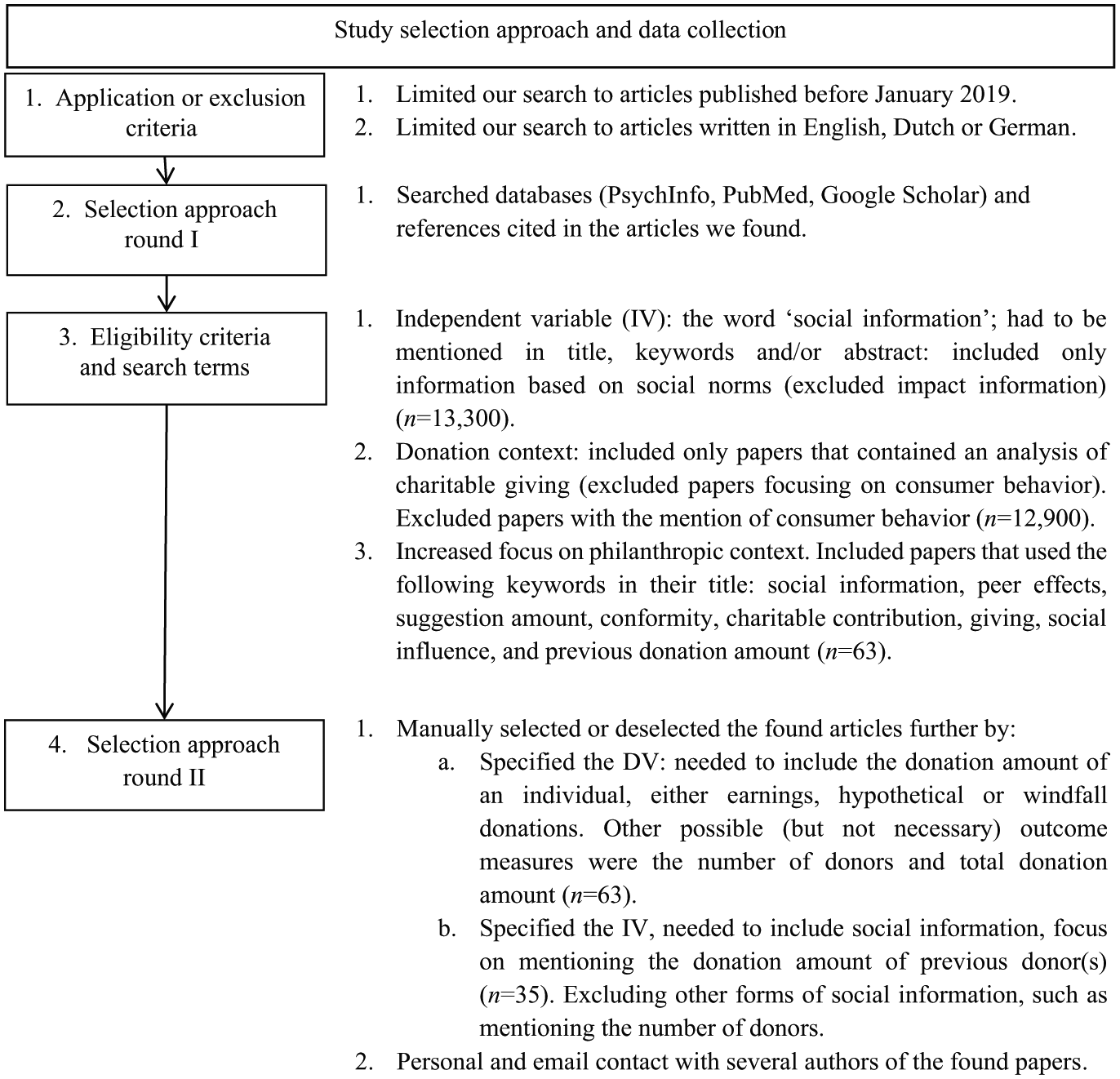
Flowchart of the selection approach.
Multiple types of social information exist, have been examined, and could provide insight into the effect of using information on another people’s behavior on giving. For pragmatic reasons in terms of the independent variable, we focused solely on social information in the form of “the previous donation amount of an individual or group,” to keep the project feasible.
The included studies were published by academics in journals, books, or working papers made publicly available before January 2019. We searched (a) academic databases (PsychInfo, PubMed); (b) Google Scholar; and (c) references cited in the articles found. We used the following keywords: social information, peer effects, suggestion amount, conformity, charitable contribution, giving, social influence, and previous donation amount. We searched for studies with these keywords in their title, keywords, or abstract, or that used a pair of possible formulations of the independent and dependent variables in their title, keywords, or abstract. This process resulted in 35 empirical papers. For each paper, we coded the research context, that is, whether it was a lab experiment, a field experiment, or a survey study, see Figure 2.
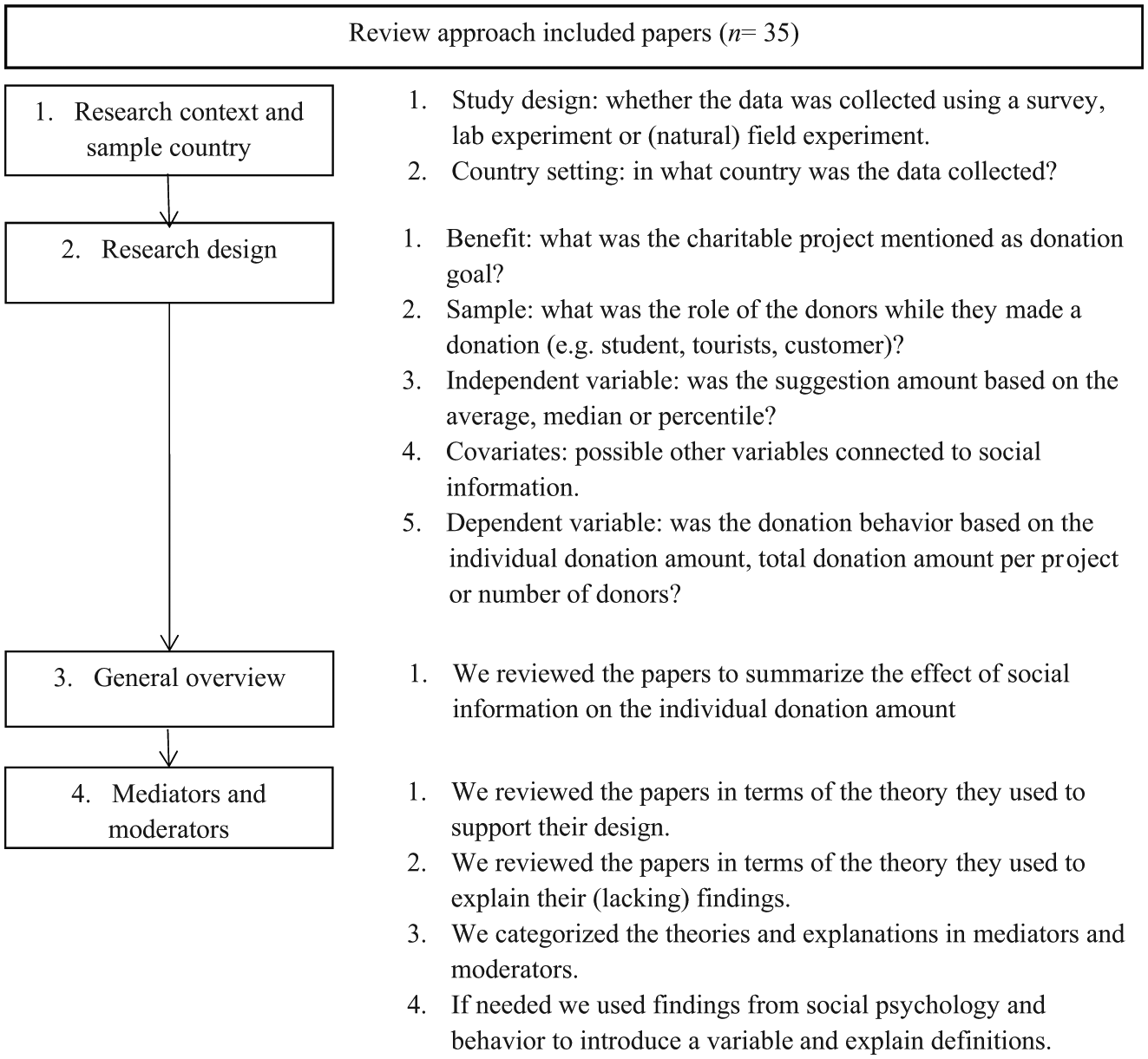
Flowchart of the review approach.
Next, we developed a theoretical framework. We reviewed each study and coded the used explanation (if mentioned) behind the effects (or, if applicable, the explanation that was provided for not finding effects).
To categorize the diverse range of explanations offered by the researchers, we used theories of social psychology and behavioral economics. For the selection of these theories, we focused on well-known theories of behavioral economics (for instance, Thaler & Sunstein, 2008) and social psychology (for instance, Cialdini, Schroeder & Kallgren, 1990) often used in research on philanthropy.
The selection method could have resulted in a bias, as papers presenting significant results are more likely to be published than papers reporting non-significant results (i.e., publication bias, Scherer, Langenberg, & von Elm, 2007). Although we did not specifically focus on published papers, we expect that more researchers have found a non-significant effect than we found and have reported in this literature review. As a result, our selection method may have resulted in an overestimation of the size and significance levels of effects (Scherer et al., 2007). While we cannot observe results from all studies that have remained unpublished, we did include seven unpublished research papers and found that these papers report similar effects in terms of the direction and significance compared to the published papers. Therefore, we conjecture that the risk of selection bias is limited.
General Overview
Several laboratory experiments (Bicchieri & Xiao, 2009; Blake, Rosenbaum, & Duryea, 1955; Cialdini & Schroeder, 1976; Goeschl, Kettner, Lohse, & Schwieren, 2018; Hysenbelli et al., 2013; Jones & McKee, 2004; Klinowski, 2015; Reingen, 1982; Sell & Wilson, 1991; Vesterlund, 2003) and field experiments (Agerström, Carlsson, Nicklasson & Guntell, 2016; Alpizar et al., 2008a, 2008b; Bøg, Harmgart, Huck, & Jeffers, 2012; Croson et al., 2009; Croson, Handy, & Shang, 2010; R. Kawamura, Ida, & Ogawa, 2018; R. Martin & Randal, 2008; Sasaki, 2019; Shang & Croson, 2006; Shang, Reed, & Croson, 2008; Silverman, Robertson, Middlebrook, & Drabman, 1984; Smith et al., 2015; van Teunenbroek, 2016; Van Teunenbroek & Bekkers, 2018) reported positive effects of social information on the amount donated. The strength of the effect on the individual donation amount varied: for example, 12% (Bekkers, 2012; Croson & Shang, 2013; Shang & Croson, 2009), 14% (Shang & Croson, 2006), 16% (Van Teunenbroek & Bekkers, 2018), and 18% (Alpizar et al., 2008a, 2008b); other studies reported no effects (Catt & Benson, 1977; Kubo et al., 2018; Murphy et al., 2015; Shang & Croson, 2009) or even negative effects on the donation amount (Croson & Shang, 2008; Meyer & Yang, 2016). While Shang and Croson (2009) found that donors to a US radio campaign donated more after they had heard previous donors’ donation amounts, Murphy and colleagues (2015) could not replicate their findings using a similar experiment with donors to a radio campaign in Alaska.
While most studies focused on examining social information effects on charitable giving report the effect on the individual donation amount, some studies also report the effect on the participation rate. Social information does not always enhance people’s decision to donate (Van Teunenbroek & Bekkers, 2018; Goeschl et al., 2018; Klinowski, 2015; Murphy et al., 2015; Reingen, 1982). However, other studies have found a positive effect on both the individual donation amount and the participation rate (R. Martin & Randal, 2008; van Teunenbroek, 2016).
In conclusion, some studies report positive effects of social information on individual donation amounts, but others report no effects or even negative effects. In addition, even if social information increases individual donation amounts, it does not always enhance people’s decision to donate. These different outcomes of using social information call for further explanations for why and when social information has an effect.
Mediators
We present four mediators; in no order (see Figure 3). The mediators do not exclude each other: they may operate at the same time.
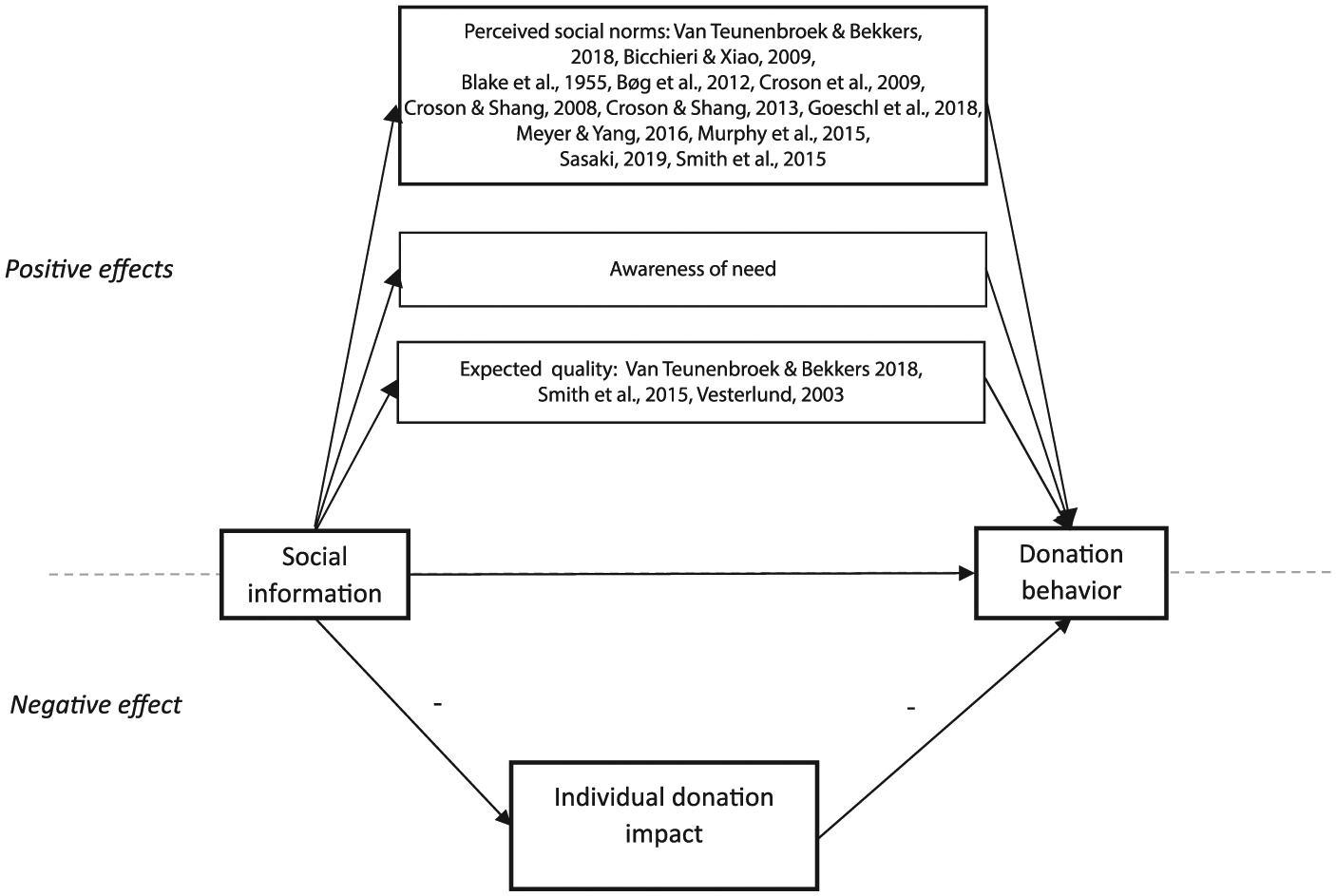
A visual representation of the proposed framework including the independent variables (IV), dependent variables (DV) and mediators (Med).
Perceived Social Norms
Human decision-making is largely influenced by social norms as they provide cues about how to behave in a given situation (i.e., descriptive social norm), including charitable donations (Cialdini, Reno, & Kallgren, 1990). “Conforming,” a term often connected with social norms, refers to social comparison stimulated by a desire to blend in, resulting in behavior adjustment: it is a social phenomenon whereby people perceive other people’s behavior as cues for acceptable behavior and adjust accordingly (Meyer & Yang, 2016). Human behavior is strongly influenced by a desire to conform to social norms (Bernheim, 1994; Festinger, 1954).
Social norms have been related to donation behavior (Bekkers & Wiepking, 2011). By making social information available, researchers try to influence the decisions of potential donors by hinting at an answer to the fundamental question: what does a person like me do in this situation? Donors who desire to conform are likely to target the modal donation amount as a reference for the acceptable donation amount (Bernheim, 1994). Most of the studies that mention an explanation behind the social information effect suggest social norms are at work (see Figure 3).
Smith et al. (2015) analyzed online fundraising data (focused on giving by peers) and found a positive effect of previous donations: a £10 increase of past donations increases donation amounts by £2.50. The researchers explain their findings by stating that social information provides donors with “the appropriate amount to give.” However, the researchers also state that the observed large and small donations imply that donors are not simply following the group by matching the amount donated most often. We would expect that if social information functions as a social norm, individuals mirror the amount, because social norms increase the individual tendency to conform (Bernheim, 1994; Festinger, 1954). Van Teunenbroek & Bekker (2018) found a similar effect studying donors to crowdfunding projects in a large field experiment: donors increased their donation amounts in response to social information, but they did not mirror the suggestion amount of €82. The researchers argue that the suggestion amount was too atypical to mirror a suggestion amount, because €82 does not resemble a commonly chosen donation amount.
Sasaki (2019) used a similar design as Smith et al. (2015): an online fundraising page mainly supported by peers. The study found that the more the last five donations resembled each other, the more likely they were to influence a new donor. It is important to note that the studies of Smith et al. (2015) and Sasaki (2019) did not contain an explicit test to measure if social information functions as a social norm.
Croson et al. (2009) conducted a laboratory experiment with students. The participants read a scenario mentioning that they donated $25 to a radio campaign; during a conversation with a solicitor, they were told that another member donated $10 or $50. Next the participants indicated how much they thought the average radio listener would donate (i.e., hypothetical donation context). The researchers found a direct effect of social information on hypothetical charitable giving, which decreased—but did not disappear—after controlling for social norms as a mediating variable. While the strength of the relation between social information and hypothetical giving is reduced by including social norms as a mediator, the mediating variable only explains a part of the relation. Social norms may thus partially explain the relationship between social information and charitable giving.
Goeschl et al. (2018) conducted a modified dictator game to research causal mechanisms that link social information with donation behavior through influencing social norms. Contrary to the study of Croson et al. (2009), the study existed out of two interconnected experiments conducted among a non-student sample with actual donations to an existing public good. The researchers followed a similar research design as Croson et al. (2009), but this time including actual donation amounts instead of hypothetical giving. The researchers included three conditions, control, low (€1), and high (€7). Only the high condition resulted in higher donation amounts, but not more donors. In addition, the researchers asked the participants what they thought other donors would donate (that is the stated belief). The researchers found similar results: social information affects donation behavior through changing the perception of the social norm. The outcome shows that social information does not only increase the donation amount (in the case of a high suggestion amount) but also increases the belief about the donation amounts of other donors. However, the stated beliefs are not fully aligned with the suggestion amount through social information: in the case of the high and base condition, the stated beliefs are higher than the actual donation amount.
There is one paper (Bicchieri & Xiao, 2009) that specifies the social information effects even further by distinguishing between descriptive (i.e., what most people do) and normative (i.e., what should be done) norms. The social information described in the previous studies conveys a descriptive social norm, because it describes the most common behavior (on average donors donate X euros) instead of how individuals should behave (you should donate around the average of X euros). The researchers found that participants in the role of a dictator (the one in control of distributing the earnings) is more likely to offer an equal split, if they read that this is often done by others (i.e., a descriptive social norm), or that an equal split is most appropriate according to dictators of previous sessions (i.e., an injunctive social norm). Interestingly, social information in the form of a descriptive social norm trumps an injunctive social norm when both are presented at the same time. Social information as described in this article refers to descriptive norms: it provides individuals with information on typical behavior in a given situation (Cialdini et al., 1990), instead of an injunctive norm which refers to what is typically approved in society (i.e., what people ought to do). Social information can change the perceived descriptive social norm, which may then change the donation behavior. While such a mediation is suggested by researchers focusing on social information effects, the effect remains unclear as previous studies have not assessed it properly.
Awareness of Need
Numerous studies examining donation patterns have shown that people must be aware of there being a need for help before they feel motived to give (more) (Bekkers & Wiepking, 2011), also referred to as awareness of need. Several field studies demonstrated that the degree of need for help increases the likelihood of helping (Levitt & Kornhaber, 1977; Schwartz, 1974; Staub & Baer, 1974).
Awareness of need can be increased if beneficiaries communicate this need to potential donors (Bekkers & Wiepking, 2011). We would expect that the implementation of social information could increase awareness of need by communicating this need to donors: “If people are willing to donate large amounts of money, there must really be a need for help and I should donate a higher amount.” However, this mechanism has not received any attention from scholars examining effects of social information.
Expected Quality
It is a classic assumption in economics that people are rational and aim to increase their utility from social interaction. We expect that people prefer to donate to projects and practitioners of higher quality, as low-quality projects are less likely to provide utility to people. People find it hard to judge the quality of philanthropic projects and practitioners (Handy, 1995; Rose-Ackerman, 1980, 1981) possibly because there are so many charities, and proper quality signals are costly (Vesterlund, 2003). If other donors contribute, donors may perceive the donation as a signal that the charity is of a good quality, which enhances the perceived trustworthiness and efficacy of that charity (Bekkers & Wiepking, 2011). Also, social information could signal that a non-profit is associated with a positive organizational legitimacy. A quality signal is important for establishing enough trust to donate (Bekkers, 2003).
One study specifically suggested that social information works as a quality signal (Vesterlund, 2003). Vesterlund (2003) suggests that donors’ social information changes the way donors think about the value of the project. However, Vesterlund did not include an explicit test of expected quality. The explanation of Vesterlund builds on the assumption that individuals have imperfect information about the quality of the charity.
Smith et al. (2015) provided an indirect empirical test to determine if social information functions as a quality signal. The researchers used by-proxy reasoning to determine if social information influenced the perceived quality of a project. The researchers based their approach on the assumption that the content of social information would be more important for “unknown” charities that were characterized by being start-ups, small-sized, involving young people, and based on overseas (Heutel, 2014). These types of charities were more likely to require a quality signal, as charities about which donors know little are probably more in need of additional information (Heutel, 2014). Social information, therefore, should have a stronger effect (Smith et al., 2015). However, Smith et al. (2015) found that the effects of social information were stronger for larger and older charities and that there were no effects of geography.
The reasoning of Smith et al. (2015) was based on the untested assumption that small, young, and overseas charities are perceived as a “risky investment.” With recent scandals relating to some of the bigger and better-known charities, however, donors might be more skeptical about the quality of these bigger and well-known charities.
Van Teunenbroek & Bekkers (2018) found no evidence to support the idea that social information functions as a quality signal in their field experiment with donors to crowdfunding campaigns. They expected that social information would be most effective in the middle of the campaign, as donors in the middle were expected to base their donation decision on the perceived quality of the project. Contrary to their expectations social information was especially effective in the beginning and end of a campaign.
Social information could function as a quality signal, by providing donors with the idea that others think that this is a good project/non-profit. While findings by Smith et al. (2015) and Van Teunenbroek & Bekkers (2018) suggest social information does not work in this way, they did not explicitly measure perceived quality. Therefore, it is still uncertain if social information functions as a quality signal.
Individual Donation Impact
None of the reviewed studies mentioned that social information could relate to a lower donation impact. However, social information does not always increase donation behavior and has even been found to decrease donation behavior in some studies (e.g., Croson & Shang, 2008, 2013; Meyer & Yang, 2016). Economists describe that donors are influenced by the estimated impact of their donation (Duncan, 2004), such that potential donors think “If other people are already donating large amounts of money, my money is less needed to reach the donation goal, and I could donate a lower amount (or not at all) to save money without appearing less important.” The impact philanthropy model claims that donors are stimulated and enjoy personally increasing the output of a public good (Duncan, 2004), possibly to appear important. Our interpretation of our impact mechanism is that impact refers to a donor’s feeling of how much their donation contributed to successfully assembling enough money to produce the public good. As a result, the attractiveness of giving decreases with each donation as it decreases the donation impact (Duncan, 2004). Providing social information, therefore, could be harmful. The feeling of making a difference also matters in prosocial behavior (Aknin, Dunn, Whillans, Grant, & Norton, 2013; Bekkers & Wiepking, 2011).
While impact has not been examined directly, there is one study that showed that group size has a negative influence on the donation amount (Scharf & Smith, 2016). This means that if the donation amount of previous donors gives individuals the feeling that the project is supported by a large group, it could have a negative effect on the individual donation amount.
Moderators
In addition to the mediators, we argue that the three W’s moderate the mediating variables: who, what, and where (see Figure 4).
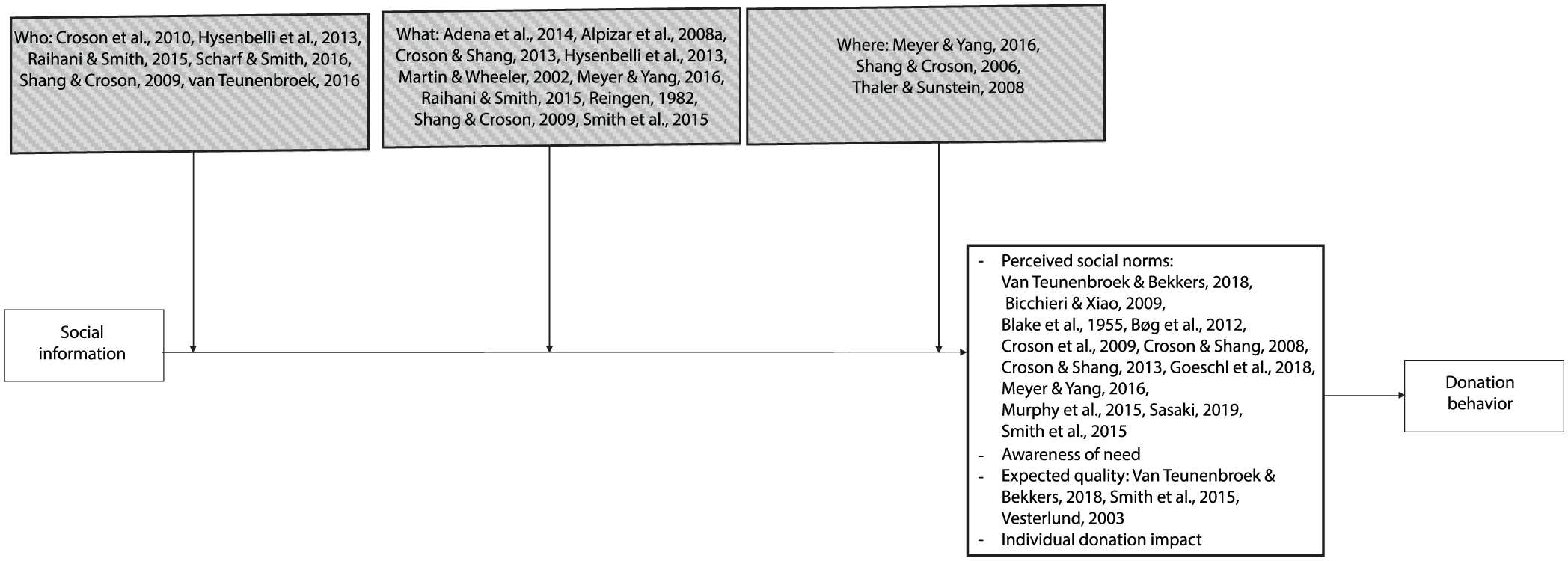
A simplified visual representation of the proposed framework including the independent variables (IV), dependent variables (DV), mediators (Med) and moderators (Mod, depicted in light gray).
Who
When people receive information, it matters who provides it: they prefer to follow information from similar others (e.g., family and friends, that is, strong ties) or people with similar attributes (Festinger, 1954). If there is a shared sense of social identification (i.e., shared identity), this is particularly influential for someone’s own decision-making (Weber, Kopelman, & Messick, 2004).
Researchers identified several ways in which a shared identity can be manipulated to increase the effectiveness of social information on donation behavior. Hysenbelli et al. (2013) conducted a laboratory experiment with Italian students in a hypothetical context: students indicated how much they would donate after reading a scenario mentioning the donation amount of previous Italian (i.e., similar identity) or German donors. The researchers found that a high suggestion amount (€90) resulted in higher donation amounts, whereas a low suggestion (€10) had no effect. A suggestion made by a similar other increased the effectiveness of the high suggestion amount, but not of the low suggestion amount.
One study suggested that although donors who make multiple donations (“prior members”) are unaffected by social information, the effect can be re-established when the solicitor connects the term “prior members” to social information in their solicitation (Shang & Croson, 2009). We suggest that, by adding the word “prior,” the researchers have increased the focus on similarity in having made a prior donation and have thus increased the sense of shared identity between the source and the target of the social information.
Croson et al. (2010) found that if social information was connected to the same gender as that of the participant, the information had a stronger effect on donations than in the mismatched condition (e.g., showing a female the donation amount of a male). Unfortunately, the study did not use a randomized control design. Therefore, we cannot be sure whether the increasing participation rate of females solicited by a female was due to gender matching. It is also important to discuss the role of attractiveness and gender in relation to donation amounts, because the gender of the donor and solicitor is a partial determinant of the donation amount (Raihani & Smith, 2015). A study analyzing online donations showed that male donors donate more when solicited by attractive females. The study also shows that males do not conform to donation amounts made by previous male donors. It is important to note that in this study the researchers focused on relatively large donations (i.e., at least twice the average and more than £50).
What
Classic economic theories argue that people respond to relative prices at all times (Sargeant & Jay, 2004). This effect can also be found in philanthropy: when the costs of giving are lowered, donations increase (Eckel & Grossman, 2003; Eckel, Tech, & Grossman, 2004). If a suggested donation amount is too high, people may perceive the amount as unfair or excessive, which decreases charitable giving (Hysenbelli et al., 2013). A suggested donation amount that is perceived as too high is probably less effective in influencing giving.
Several studies support this line of reasoning: social information based on the 99th percentile is no longer effective in increasing the individual donation amount (Croson & Shang, 2013; Shang & Croson, 2006). While a high donation amount might not increase the individual donation amount, Smith et al. (2015) found that a large donation (at least 10 or more times the average donation) does increase the number of donors. Apart from using amounts that are too high, mentioning an amount that is too low can decrease the individual donation amount (Croson & Shang, 2008; Meyer & Yang, 2016). In a laboratory experiment with students, other studies found that suggesting a high donation amount (€90) is actually more effective than suggesting a low donation amount (€10) to increase hypothetical giving (Hysenbelli et al., 2013). Unfortunately, it is unclear why exactly donors do not respond to information about very high donation amounts. Also, it is unclear when exactly the information is perceived as too high.
The amount mentioned might influence the nature of the impact mediator, changing the effect from negative to positive. We would expect that a lower suggestion amount increases the perceived impact of a donation, as there is a higher percentage of the target amount left. This means that a donor can have a higher impact. Duncan (2004) states that donors enjoy personally increasing the output of the good. We expect that a low suggestion amount makes donors feel like their gift really would be important and could have a big impact.
Where
The philanthropic literature describes that the donation context influences donation amounts. For instance, individuals are more generous in a public setting where they are observed (Van Vugt & Hardy, 2010). Charitable givers are held in high regard, and refraining from giving could damage one’s reputation (Bekkers & Wiepking, 2011). If we apply this to the “perceived social norm” mediator, we would expect that a public donation context increases the effect as people will only benefit from behaving in line with social norms if their behavior is observable. While some people might refrain from giving after seeing social information because it decreases the impact of their donation, therefore, they might still donate if the context is public. Social information is expected to be less effective in a private context, as the behavior is less observable. An exception on this is online giving where a donor can choose to publish their donation amount.
Alpizar et al. (2008a, 2008b) collected field data at a national park and found that tourists who were informed about other people’s typical donation ahead of the solicitation donated 25% higher amounts, but the effect was not significantly different from an anonymous donation context. Unfortunately, social information and anonymity were not manipulated in separate conditions, and the influence of anonymity on the social information effect, therefore, remains unclear.
A second contextual factor that could increase the effectiveness of social information is an ambiguous context. Social psychologists perceive a situation as ambiguous if there is no obvious way to behave and objective standards are unavailable. From an economic perspective, a context is ambiguous if the realized event is unknown or unique (Izhakian & Benninga, 2011). In an ambiguous context, information is an important input for decision making (Frank, 2015).
If social information affects the perception of a social norm, it is likely to be more effective in an ambiguous context (Crutchfield, 1955; Festinger, 1954), as people are more likely to compare themselves with other people in ambiguous situations (Buunk & Mussweiler, 2001; J. R. Martin & Wheeler, 2002). In an ambiguous context, therefore, social information could function as a social guideline.
For example, new donors to a radio campaign were affected by social information, but renewing donors were not (Murphy et al., 2015; Shang & Croson, 2009). As renewing donors are familiar with the context, it is not an ambiguous context to them, and, as a result, social information has a limited or no influence on this situation (Bekkers, 2012). New donors, on the other hand, are unaware of such a reference amount, and so they are looking for a social signal about the “correct” donation amount.
Discussion and Conclusion
The literature on social information has yielded several insights, such as empirical evidence for a positive effect and several methods for increasing the effectiveness of social information. However, the diversity in findings apparent in our review shows that more work needs to be done to learn to understand why effects do or do not occur. Building on the broader literature of social psychology and behavioral economics, we have sought to contribute to such understanding. We proposed a model with mediators and moderators that impact the relation between social information and donation behavior.
Our model can explain both positive and negative effects of social information. In addition, our review reveals that, as moderating variables, it matters who provides the information, what the content of the information is, and where the donor is while receiving the information. We believe this framework increases our understanding of existing research on social information effects and helps chart future research directions. By increasing our understanding of social information effects, we contribute to the further development of effective solicitation tools to increase charitable giving.
We make three suggestions for future research. Our first suggestion refers to an important empirical question that remains unanswered: the relative influence of each of the mediators—whether social information primarily affects donation behavior because it influences the perceived social norms, awareness of need, expected project/non-profit quality, or the individual donation impact—is still unclear at this point. Multiple mediators are likely to operate simultaneously, and their combinations are likely to differ across time, contexts, and donors. There are also likely to be interaction effects: awareness of need will be higher if donors find perceived social norms important. It is likely, moreover, that there are several three-way interactions between mediators and moderators. The same social information could also result in two effects that cancel each other out. For instance, social information could increase awareness of need and, therefore, have a positive effect, but at the same time decrease perceived donation impact, resulting in a negative effect. We believe that, next to testing the proposed theoretical model, identifying systematic patterns in the effects of moderators, mediators, and their interactions is an important task for future research.
Second, in addition to characteristics such as gender, personal characteristics of potential donors, such as personality traits, and socioeconomic characteristics are likely to influence social information effects. Individual characteristics, however, can only be measured but not manipulated, unlike contextual factors. Practitioners could adjust contextual factors, but not the individual characteristics of their donors. It would be fruitful, nonetheless, to study the influence of individual characteristics. A challenge for future research is to investigate how the model works with different groups of donors, by segmenting donors, for instance, based on common characteristics such as shared needs, personality traits, and socioeconomic status to identify “high yield segments”: What group of donors would profit most from using social information?
Third, we suggest that it would be fruitful to redirect efforts from trying to increase donation behavior as much as possible and develop “the most effective stimulant.” Instead we advise a focus on “clean” manipulations with proper explanations for their hypothesized effects. In other words, few studies have tried to examine potential mediators to understand “why” the effect occurs. Instead, researchers have mostly focused their attention to the moderators, to increase the effectiveness of social information. For instance, Croson and Shang (2013), Shang and Croson (2006), Croson and Shang (2008), and Meyer and Yang (2016) all focused on the question whether a large of small amount was more effective. We advise authors to also think about explanations behind these effects.
In our model we focused on mediators related to the finding people have different incentives for giving (Bekkers & Wiepking, 2011). We did consider two additional mediators not discussed in the model: the providing of a reference point and diffusion of responsibility. People tend to value prior information and use this information as a reference point for behavioral adjustments, which is also known as anchoring (Hammond, Keeney, & Raiffa, 1998). Goeschl et al. (2018) examined whether social information functions as a mere reference. If it would function as a reference point, then any number would influence donation behavior by simply working as an unconscious suggestion (i.e., a nudge; Thaler & Sunstein, 2008). Goeschl et al. (2018) found that providing donors with a random number, instead of a number based on a donation amount of a previous donor, did not influence the donation behavior. Van Teunenbroek & Bekkers (2018) argue against the possibility that social information functions as a reference point, because donors in their field experiment did not exactly donate the suggestion amount of 82.
A diffusion of responsibility could be an additional negative mediator. Social psychologists describe that the larger the group, the lower the responsibility people feel to help (Latané & Darley, 1970), as a larger group makes it easier to feel anonymous (Prentice-Dunn & Rogers, 1982), which has also been described as an increased diffusion of responsibility. If the suggested donation amount gives people the feeling that a group of people relates to the project, their donation may be perceived as less needed. In other words, social information could result in a bystander effect by decreasing people’s feeling of responsibility. Such diffusion of responsibility has not yet received any attention from scholars researching social information.
We consider one additional moderator not discussed in the model: liking. Liking refers to the finding that individuals prefer things that are connected to the self (Byrne, 1971). Based on the similarity breeds liking principle, it could be argued that if the provided information is associated with something that is connected to the self (for instance, the letter in one’s name; Bryne, 1971), it is likely to be more effective. Edwards and List (2013) found that a suggestion amount (not social information) connected to the donors’ graduation year (a suggestion of €20.03 for those who graduated in 2003) resulted in stronger tendencies to conform to the suggested amount but not to higher donations than the non-personalized suggestion of €20.00.
As we only partially based our results on empirical papers and updated this with theories from other fields, future investigation is necessary to test our proposed model and further map the effects of social information. This is in the interest of scholars who aim to help this scientific field to become more mature and of practitioners who wish to implement social information as an effective and efficient stimulant for individual donations.
Social information could have a positive effect on charitable giving, but researchers have mainly focused on demonstrating and reporting positive social information effects rather than the development of a proper theory to support the effects. In this article, therefore, we have taken the first step toward a theoretical framework by developing a model that highlights the restrictions and possibilities of social information in affecting donation behavior. The field of social information represents a vibrant area for theoretical development.
Footnotes
Declaration of Conflicting Interests
The author(s) declared no potential conflicts of interest with respect to the research, authorship, and/or publication of this article.
Funding
The author(s) disclosed receipt of the following financial support for the research, authorship, and/or publication of this article: This study was funded by the Netherlands Organization for Scientific Research (NWO), grant #314-99-105. René Bekkers was supported by the Royal Netherlands Academy of Arts and Sciences / Van der Gaag Foundation.
