




Abstract
Building on theories from different fields, we discuss the roles that volunteers can play in the generation, implementation, and diffusion of social innovations. We present a study relying on 26 interviews with volunteer managers, other professionals, volunteers, and one former volunteer in 17 (branches of) third sector organizations in eight European countries. We identify organizational factors that help and hinder volunteer contributions to social innovation. While volunteer contributions to social innovations are encouraged by decentralized organizational structures, systematic “scaling up” of ideas, providing training, and giving a sense of ownership, they are hindered by a reluctant attitude and a lack of resources . This rich, explorative study makes it a fruitful start for further research on the relationship between volunteering and social innovation.
Introduction
Social innovation, commonly defined as new solutions that meet a social need, has become an important concept in nonprofit management and public administration. Social innovations may be produced by for-profit organizations (Pol & Ville, 2009), nonprofit organizations (Jaskyte & Dressler, 2005; Perri 6, 1993; Shier & Handy, 2015a, 2015b, 2016), government bodies (Osborne & Brown, 2011), or networks of different organizations (Jaskyte & Lee, 2006; Voorberg, Bekkers, & Tummers, 2015). In this article, we focus on third sector organizations as possible drivers of innovation. As many third sector organizations explicitly aim to solve or relieve social needs, particularly among disempowered groups, it is likely that they are important actors in the production of social innovation. Many third sector organizations are strongly embedded within society, are open to social learning, and operate relatively independently from external pressures (Anheier et al., 2014). In addition to numerical assessments of the output of third sector organizations (e.g., in terms of the number of hospital beds filled or patients treated; United Nations, 2003), the concept of social innovation draws attention to the novelty of ideas and practices that third sector organizations bring into society.
The literature distinguishes a number of factors that may contribute to different types of social innovation in the third sector: (a) factors in the environment, such as the availability of information and relationships with other organizations (Jaskyte & Lee, 2006; Shier & Handy, 2015a); (b) organizational features, such as centralization, professionalization, organizational size, and functional differentiation (Damanpour, 1987; Jaskyte & Dressler, 2005); and (c) individual characteristics, such as managerial attitudes and the availability of qualified personnel (Jaskyte & Dressler, 2005; Shier & Handy, 2016). The current article focuses on the organizational features that may contribute to innovations.
Many third sector organizations distinguish themselves from other types of organizations by relying on both paid and unpaid workers. Volunteers are different from paid employees in their motivation and commitment (Cnaan & Amrofell, 1994; Musick & Wilson, 2007). Volunteers are described as the “eyes and ears” that identify new social needs (Cravens, 2014), and they are praised for introducing new ways of thinking and working in organizations (Metcalf, 2010). Despite the commonly held view of volunteers and third sector organizations as drivers of social change, it is yet unsure how volunteers play a role in the process of generation, implementation, and diffusion of innovative activities. Explicit connections between the concepts of volunteering and social innovation are scarce in the literature. Shier and Handy (2015a) do not find a strong association between the magnitude of volunteer hours in organizations and their innovative capacity. Reznickova and Zepeda (2016) argue that volunteers’ intrinsic motivations are related to their contributions to social innovation. Existing research does not explicitly distinguish and examine the ways in which volunteers contribute to social innovations within third sector organizations.
Therefore, our research question is as follows:
This research question is addressed through 26 semistructured interviews in different types of third sector organizations in eight European countries. The findings of these interviews have important implications for theory and nonprofit management. On the theoretical level, this article adds important insights on the different roles that volunteers may have in social innovations. While the literature has linked volunteering to innovation on a conceptual level (Anheier et al., 2014), with broad indicators (Shier & Handy, 2015a) and in case studies (Reznickova & Zepeda, 2016), this study offers a fine-grained analysis on volunteer roles across different organizational contexts. This will help building theory about the unique assets of volunteers in innovative processes. On the practical level, the article provides useful ideas for volunteer managers in the third sector. By examining different volunteer roles in different organizational constellations, it shows how to create the circumstances in which innovations flourish.
Literature Review
Social Innovation
A common definition of social innovation is “new solutions (products, services, models, markets, processes etc.) that simultaneously meet a social need and lead to new or improved capabilities and better use of assets and resources” (The Young Foundation, 2012, p. 18). Pol and Ville (2009) criticize this conception because it comprises all innovations that meet a social need, including business innovations. Therefore, they propose to exclude innovations that have detrimental effects on society or the environment, and to only speak of social innovation “if the implied new idea has the potential to improve either the quality or the quantity of life” (Pol & Ville, 2009, p. 881). Similarly, some authors add a focus on the empowerment of dispossessed or underprivileged social groups (González, Moulaert, & Martinelli, 2010; Moulaert, MacCallum, & Hillier, 2013).
Cnaan and Vinokur-Kaplan (2015) propose a typology of innovations based on the questions: What is being innovated, who benefits, who is the innovator, and what is the magnitude of the innovation. They emphasize that not every change is an innovation, for example, when third sector organizations adopt practices from other organizations in their environment. Different types of innovations can be distinguished. In terms of the pace of the change, we can distinguish between radical innovations, which abruptly change the ideas and practices of the field, and incremental innovations, which occur over a longer time span (Damanpour & Schneider, 2009). In terms of the object of the innovation, we can distinguish between process (or administrative) innovations, which are novelties in the bureaucratic or human resource practices of an organization; product innovations, referring to new products or services; and system (or socially transformative) innovations, which change the broader community and policy field (Damanpour, 1987; Jaskyte & Lee, 2006; Perri 6, 1993; Shier & Handy, 2015a, 2015b).
Volunteering
In the light of the current study, we focus on volunteering as unpaid labor in the context of an organization, as opposed to informal forms of volunteering. A distinctive aspect of volunteers is a motivation that is altruistic at least to some extent (Musick & Wilson, 2007). Dimensions along which analytical types can be distinguished are the background characteristics of the volunteer, the nature of the time or effort that is contributed, the type of organization to which he or she contributes, the intensity of the activity, the type of recipient, the sociodemographic characteristics of the recipient, the type of volunteer manager, the activity of the volunteer manager, and the type of rewards (Cnaan & Amrofell, 1994; Smith et al., 2016). The volunteer role is defined and coordinated by the rules of the organization, where volunteers are almost always subordinate to paid workers (Musick & Wilson, 2007).
The altruistic motivation, the diversity in tasks, and the complex relationship with professional staff make the voluntary workforce a unique aspect of third sector organizations. Besides the restriction to only look at formal volunteering, a broad perspective on different tasks and activities is necessary for understanding different volunteer roles.
Volunteer Roles in Social Innovation
Social innovation should be distinguished from technological or business innovations by its focus on social needs, empowerment, and enhancing capabilities. Nevertheless, there is a shared focus on creating impact with novel ideas. Because of this, we can take learning from other innovation models as well.
Basic models of (technological) innovation, such as the much-referenced and much-criticized “linear model” (Godin, 2006), could give some insights in the types of roles volunteers might play in innovative activities. We are aware that this model has received criticism, but for the purpose of this article, the model gives us some basic lessons which we can use to structure both this literature review and the presentation of our empirical results. The model argues that innovation goes through several stages: basic research, applied research, development, production, and diffusion. A more general formulation of the linear model would be to argue that innovation often starts with idea generation followed by development, production, and diffusion. Here, we discuss the roles that volunteers may play in these stages of social innovation.
The academic literature pays scant attention to the idea-generation, opportunity-recognition, or invention capabilities of volunteers. Nevertheless, the notion is occasionally acknowledged (see, for example, Reznickova & Zepeda, 2016). A study of Internet-mediated volunteering quotes a volunteer manager who states that volunteers have been essential in bringing new ideas and resources to the organization: “They have fresh eyes and suggestions” (Cravens, 2014, p. 59). The mere notion of bringing new perspectives into an organization is likely to generate alternative approaches. Moreover, evidence suggests that students doing voluntary community service bring in new ideas to the organizations they volunteer for, probably due to their particular knowledge and skills (Metcalf, 2010). New ideas that are especially important from the perspective of social innovation are ones that help third sector organizations identify and address social needs (Rochester, 2013; Shaw & Carter, 2007). Volunteers can generally contribute by recognizing opportunities for the organizations they work for (Monllor & Attaran, 2008). Advocacy organization could take particular benefits from volunteers that help them recognize “political opportunities” (Kitschelt, 1986).
In the development stage, volunteers can be the prime innovators. This role involves more than idea generation: It is often conceived of as the volunteer in an entrepreneurial position (Defourny & Nyssens, 2013). A particular type of volunteer-innovator is the “lead user” (Von Hippel, 1986), referring to users of a product or a service with particular needs that they attempt to address themselves. Lead users often engage in “user communities” (Von Hippel, 2001). Online platforms developing open-source software without financial gain are often mentioned as an example.
When it comes to the production stage, volunteers often play an important role in carrying out all sorts of projects—innovative or not—in third sector organizations. Implementing social innovations involves a wide range of practical tasks, and volunteers may have access to resources that are necessary for the execution of projects.
In the diffusion stage, in which “[i]deas and innovations can spread through social networks” (Nyonator, Awoonor-Williams, Phillips, Jones, & Miller, 2005, p. 28), volunteers can play a role in community mobilization. This is highly relevant for advocacy organizations: Mobilization is one of the basic strategies that social movements employ (Ling, 2006; McCarthy & Zald, 1977).
The scope and diversity of volunteers’ social networks can contribute to effective diffusions of innovations. Granovetter (1973) argues that weak ties are more efficient in spreading information, because the relationship between people who do not know each other very well is more likely to form a “bridge” between two separate networks. It is well documented that volunteers in general have more and broader networks than others (von Essen, Jegermalm, & Svedberg, 2015) and that many members or volunteers are engaged in multiple third sector organizations simultaneously (Einarsson, 2012). When volunteers connect an organization to other social spheres, innovations that are generated in the organization can be diffused effectively.
In the report by Cravens (2014), the volunteer manager we quoted earlier with regard to “fresh eyes and suggestions” adds, “They [volunteers] have the networks we need. That’s what the volunteers bring to us. They bring our organization into communities and networks into places we couldn’t reach just with staff”’ (Cravens, 2014, p. 59) Adding to the earlier comments on user communities, involving users directly could be an important way of furthering diffusion.
Organizational Factors
In a literature review, Anderson, Potočnik, and Zhou (2014) argue that innovation depends on a wide range of individual, organizational, and environmental factors. In this article, we focus on organizational factors that might contribute to organizational capacity to be innovative through volunteers. Four broad categories of influential factors are distinguished here.
First, the organization’s management can steer toward innovation. Shier and Handy (2016) find that community engagement of boards and executive leaders can contribute to developing an orientation toward social innovation. Also, a manager’s tenure and a positive attitude toward change might contribute to an organization’s innovative capacity (Damanpour, 1991; Damanpour & Schneider, 2009).
Second, the availability and diversity of resources might play a role. In general, resources are perceived as crucial to an organization’s efficacy (Pfeffer & Salancik, 1978). When it comes to innovations, the availability of (slack) resources helps organizations to take risks and afford the costs of innovations (Anderson et al., 2014; Damanpour, 1991). Resource diversity is argued to be positively associated with innovativeness (Srivastava & Gnyawali, 2011), although Shier and Handy (2015a) do not find a strong association among service nonprofits.
Third, the organizational culture can help foster social innovations. Engaging staff at all levels might shape the culture of an organization as receptive to innovative practices (Shier & Handy, 2016). A climate that is supportive of innovation, personal initiative, and psychological safety can enhance organization’s innovative capacity (Anderson et al., 2014).
Finally, features of the organizational structure like size, degree of decentralization, and the diffusion of tasks are likely to be related with innovation. Organizations that are more specialized, more functionally differentiated, more professional, larger and less centralized are generally found to be more innovative than other organizations (Damanpour, 1987, 1991). In a meta-analysis, Damanpour (1991) finds that formalization is negatively associated with innovation among nonprofit organizations, while the association is positive among for-profit organizations.
Several articles suggest that volunteers are particularly likely to operate as innovators in grassroots initiatives, as this gives them ample opportunities of developing entrepreneurial activities. The literature also distinguishes concepts like “grassroots innovation” (Seyfang & Haxeltine, 2012; Seyfang & Smith, 2007) and “volunteer social innovation” (Reznickova & Zepeda, 2016). The latter article stresses the importance of self-determination for explaining the success of innovation. Although self-determination theory is generally used in studies of volunteer motivation, there are more studies that point at the implications for organizational context, leadership, and volunteer management (e.g., Haivas, Hofmans, & Pepermans, 2012; Oostlander, Güntert, van Schie, & Wehner, 2013; van Schie, Güntert, Oostlander, & Wehner, 2015).
We may also take this focus on autonomy and self-determination as a more general phenomenon, and apply it to more established third sector organizations. This is particularly relevant in multisite nonprofits (Grossman & Rangan, 2001). The question of local autonomy is strongly related to the organizational structure. One debate in nonprofit management is whether the optimal form of working with a dispersed network of local affiliates is to set them up as “branches” or as relatively independent “franchises” (Oster, 1996). A branch is a structural part of the organization, whereas a franchise is a separate entity that operates under the organization’s heading for a predefined period. Clearly, a franchise structure leaves greater autonomy to the local affiliate, while the connection to the national office still allows for a quick diffusion of innovations to other sites and economies of scale in a more general sense (Guo, Brown, Ashcraft, Yoshioka, & Dong, 2011). Oster (1996) concludes that the higher degree of local autonomy, compared with operating as a satellite or branch office, is likely to foster entrepreneurship.
Data and Method
The data used for this article are based on 26 semistructured interviews in different types of third sector organizations in eight European countries. The main purpose of the article is explorative. This is reflected in the non-ramdom sample, which has been developed to get data from different parts of the nonprofit sector.
Sampling
As the focus of this article mainly is on the organizational level, interviews have been conducted with 15 volunteer managers and five other professionals who work with volunteers. The latter group has job titles as coordinators, managers, and strategic advisors. This has been supplemented with five interviews with volunteers and one interview with a former volunteer to get complementary perspectives. The study was carried out in eight European countries (Czech Republic, Denmark, France, Germany, the Netherlands, Spain, Sweden, and the United Kingdom).
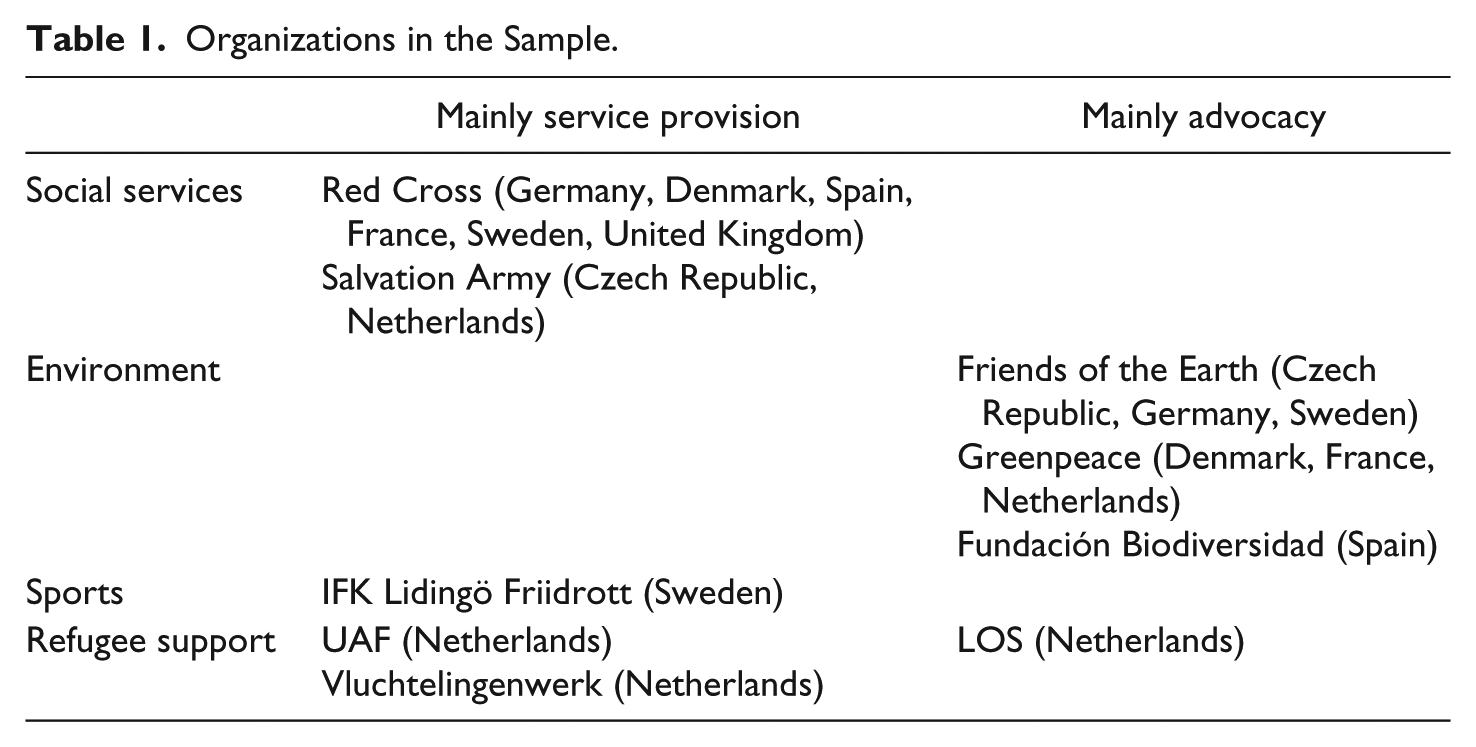
As volunteer management practices differ between organizations, the interviewees were selected across different sectors and different types of organizations. A first dimension of organizational diversity is the division between service provision and advocacy. A second dimension of diversity is the nonprofit sector in which the organization is active. We aimed to sample two organizations in each country, one service provision organization in the field of social services and one advocacy organization in the field of environment. Due to practical restrictions, we were not able to interview a representative of an environmental organization in the United Kingdom.
In addition, we examined two organizations more in depth, interviewing volunteer managers, volunteers, and a former volunteer in a sports association in Sweden and in a number of refugee-support organizations in the Netherlands. Sports is the nonprofit sector which has the largest number of volunteers in most countries. Refugee support was chosen as a sector where organizations engage in both service provision and advocacy.
Table 1 shows the organizations under study. This strategic sample provides rich data, which was well suited for the aim of exploring questions of volunteering and social innovation at the organizational level. However, it does not allow us to draw any generalizable conclusions, which was not the purpose of this study.
Organizations in the Sample.
Method
The semistructured interviews took about an hour and were conducted either face-to-face or by telephone. Semistructured, open-ended questionnaires guided the interviewers.
The interviews among volunteer managers and other professionals consisted of two parts. The first part focused on the volunteer policy of the organization. After a few introductory questions about the general characteristics of the organization and the respondent’s work, the interview continued on strategies to attract, retain, mobilize, and motivate volunteers; the attrition of volunteers; and the roles that volunteers play in the organization. The second part contained questions on social innovation. After asking the respondent to define social innovation, the interviewer introduced the concept in the way it is defined by Anheier et al. (2014). Then, interviewees were asked about the innovativeness of the organization’s mission and the roles that volunteers play in initiating and fostering social innovations. Examples of questions were as follows:
What roles do volunteers have in your organization? Also, take into account roles outside their official tasks.
Could you provide examples of social innovations where your organization contributes to or contributed to? Who took the initiative here (professionals or volunteers)?
Do volunteers play a role in innovations initiated by professionals within your organization? If yes, in what way?
How does the organization react on novel initiatives by volunteers?
Were there any things that withheld volunteers to be involved in these innovations?
The interviews among (former) volunteers consisted of three parts. The first part contained general questions on the volunteer’s work as well as questions about organizational characteristics that helped or hindered the respondent to do voluntary work. The second part focused on what helped or hindered in producing social innovations. The final part encouraged the respondent to provide tips for a better volunteer management. Examples of questions in the questionnaire were as follows:
Did the organization do anything that lowered your motivation to volunteer?
Did the organization encourage volunteers to suggest, test, or invent new ways of working?
The interviews were conducted and recorded in the local language, and a summary report of the interview was written in English, after which the findings were collected. Data analysis was done through content analysis, in which themes were coded and compared across the interviews (Julien, 2008). The core researchers identified themes that referred to either volunteer roles or organizational factors in the innovation process. The themes that emerged were discussed and analyzed, leading to a cross-tabulation of organizational factors that are related to different volunteer roles.
Results
In the organizations studied, social innovation is not a widely used term. Respondents had some difficulty defining the concept and felt that they were not explicitly working on social innovations in their daily work.
Still, almost all respondents could come up with examples of changes that they considered as social innovations. Those are mainly product and service innovations, such as specific new projects or improvements in existing activities. A few illustrative examples are a telephone service in a nonnative language (Swedish Red Cross), a School of Civic Initiative where people are educated to make them more active in public life (Hnutí Duha, Czech Republic), first aid education for partially sighted and blind people (German Red Cross), a bicycle campaign (Greenpeace Denmark), and a shelter for illegal male immigrants (Salvation Army Netherlands).
Rare examples of innovations in the current data that occur on a larger scale and aim at system-level changes are the lobby for new government policies (Czech branch of the Salvation Army) and a network to connect entrepreneurs in the field of environment with investors, publish their innovative work, and promote a financing network (Fundación Biodiversidad, Spain).
Below, we discuss two roles of volunteers in processes of social innovation that emerged from the data.
The Idea-Generation Phase: Volunteers as “Eyes and Ears”
In the stage of idea generation, volunteers may identify (changes in) social needs for which innovative solutions are necessary. Volunteer involvement in this stage often proved to be mixed with their roles as the ones who carry out a large part of the work of third sector organizations. We classified this under the role as “eyes and ears” because the volunteers are the ones who are in direct contact with clients, in the case of service provision organizations, and with the target audience, in the case of advocacy organizations. In many cases, this role is important for social innovation. Volunteers hear more than office employees, simply because they are the ones who distribute leaflets and have coffee with clients.
The Swedish Red Cross reported that the latest strategy plan was very much based on volunteers’ intelligence. Other organizations, too, explicitly make use of signals from their volunteer base.
Volunteers signal problems and lacunae in services. . . . In innovative projects, we always involve volunteers, as they are the ones executing the work we do. In those projects, volunteers report the successful and less successful elements. The organization takes notice of these reports. (Professional, Vluchtelingenwerk Netherlands)
One organizational factor emerged as being beneficial in the “eyes and ears” role of volunteers in innovation processes.
Ownership
For volunteers to detect and report developments that contribute to innovations, some sense of ownership can be beneficial.
The campaign targets are defined at a central level. Our volunteers are not contributors. . . . But they have a great autonomy in deciding how to organize their actions in the frame of our campaigns. (Volunteer Manager, Greenpeace France)
This autonomy can be important to keep people motivated. Talking about what withholds people from involvement, another volunteer manager says, Somehow the project doesn’t resonate with them, that they feel more told what to do, than coming up with the idea themselves—so there would be a lack of ownership to it . . . that the tasks are either too involved or not involved enough. They are not sort of creative and interesting enough; they feel like busy work (foot soldier tasks). (Volunteer Manager, Greenpeace Denmark)
When carrying out services and campaigns, volunteers are often reported to deliver ideas for improvement. Even if they are not the initiators of a project, volunteers are very valuable in terms of reporting what can be done better.
Since the association only has a few employees, the volunteers are involved in and are essential for all activities. Often it is a volunteer who leads a new project. . . . The association is open to new ideas and since most activities are led by volunteers, it is also those that come with suggestions for improvement. (Volunteer manager, IFK Lidingö Friidrottsklubb Sweden)
The idea that people need some sense of ownership of their activities resonates in several of our interviews. Many volunteer managers are aware that rejecting all suggestions often demotivates volunteers in their work with target groups.
The Development and Production Phases: Volunteers as Initiators
There are many innovations that are initiated and employed by volunteers on a local level. Examples in our sample are a bicycle campaign in Denmark, a “Week in the Wilderness” targeted at socially excluded people in the Czech Republic, and providing first aid education for partially sighted and blind people in Germany.
At the Dutch Refugee Council, we spoke to a volunteer who initiated a new project after she did an internship at the organization.
There is currently a large stream of refugees coming to Holland. Considering that we do not have enough volunteers to work as a supporter for every new arrival, we decided to start organizing group support sessions. . . . I started off with topics that seemed interesting, and about which I received questions during our office hours, for example relating to health insurance. I created a PowerPoint to present these issues. (Volunteer, Vluchtelingenwerk Netherlands)
This is one of the examples of an initiative from volunteers that we encountered during our in-depth exploration of Dutch refugee organizations. Another example is the human library, where people can “borrow a person” to foster meetings between people who are often unlikely to meet. This initiative was adopted by the Dutch Refugee Council, making it an example of a “spin-in” where an established third sector organization adopts a grassroots voluntary initiative.
Two organizational factors emerged as being beneficial for the success of volunteer initiatives.
Decentralized organizational structure
First, a decentralized organizational structure and the absence of strict rules help to create room for volunteer initiatives. Local groups in the Danish Red Cross, for example, have financial autonomy—although they are not allowed to accumulate money over multiple years—so they have the freedom to start new projects. The German advocacy organization BUND has a “fundamental democratic process of the selection of subjects”: The subject of brown coal mining and related environmental problems is one example that has been brought to attention by the assembly of delegates without influence of the national office. An example for opposing opinions between the assembly of delegates and the national office is the position of the BUND on Chemtrails. This has been brought up by a local group a suggestion that was supported by the national office. However, the subject has been declined as focus of the BUND by the assembly of delegates with the argument that scientific proofs are missing. In this regard the assembly of delegates is a helpful corrective. (Volunteer Manager, Friends of the Earth Germany)
This shows that some sense of autonomy at local levels can be essential in the production, exchange, and development of new ideas. To be motivated to spend time on developing new ideas, volunteers should have the feeling that they “own” the organization and its projects.
When their ideas are not used, volunteers may become disappointed. This is illustrated by the case of a French volunteer who decided to quit his work at Greenpeace, which is a very hierarchical organization in which it depends on manager’s opinions whether new ideas lead to developing actual innovations. “[The volunteer] had proposed a lot of new good ideas but none were applied, so he was bored and left” (Volunteer Manager, Greenpeace France).
Collecting and scaling up
This leads to the second organizational factor, which is a systematic way of collecting and scaling up volunteer initiatives. Platforms can be developed at the national headquarters that facilitate new initiatives. Greenpeace developed an internal online community, Greenwire, in which volunteers and other supporters can exchange ideas and organize meetings. From the part of the Red Cross Germany, an internal award has been developed for engagement to motivate volunteers to develop new ideas. Examples of nominees in 2015 are open meeting places for elderly people with cultural events and neighborly help. At the Spanish Red Cross, innovations that stem from the daily activity of volunteers are normally channeled through a good practices management system application that allows volunteers or any assembly member to record practices that are considered innovative and exportable within the organization.
Such management practices can be considered as administrative innovations by themselves but are mentioned as instruments for product innovations in the campaigns and services of the organization. By such internal structures, third sector organizations can stimulate a feeling that there are plenty of opportunities to initiate and enroll new ideas.
Respondents distinguished two organizational factors that may hinder volunteers in their roles as prime innovators.
Mission misalignment
In some instances, there is a reluctance within the organization to embrace bottom-up innovations. This is mostly related to specific new ideas of which the professional staff thinks that it does not fit the organization and its mission. There might be good substantive arguments to not embrace innovations from volunteers.
Especially advocacy organizations may be cautious with bottom-up initiatives, because every project must fit in the broader campaign strategy. They have different ways to deal with this. The central campaign team may refuse to embrace an initiative because it does not fit the organizational goals or methods. In this case, they will not let the project be a part of the organization or they will try to talk the initiator out of it. Alternatively, they may support the initiative but make sure it is not carried out under the flag of the organization. In this option, the initiative is, for example, allowed to say, “Supported by Greenpeace.”
Lack of resources
A second organizational factor that can be detrimental for volunteer initiatives is a lack of resources. An obvious reason for a low level of involvement of volunteers is that professionals simply have more time to think about new projects and to connect with other organizations to develop social innovations.
Local volunteers may not always have time to develop nice new projects, like a fair, a music project for refugee children, a festival or a community garden. There is often matters of life and death that require immediate attention. (Professional, Vluchtelingenwerk Netherlands)
While volunteers come up with many new ideas, they are rarely in a position within the organization to successfully initiate and channel innovations. In our interviews, many innovations were identified where professional staff took the initiative after which the organization mobilized volunteers to support the new activities. Examples are a platform to connect Spanish entrepreneurs and investors in the field of environmental sustainability, a School of Civic Initiative in the Czech Republic, and sports competitions for wheelchairs and developmentally challenged in Sweden.
Some projects need resources and knowledge to be developed. Talking about the Big Ask project, in which citizens are engaged to reach out to political representatives in relation to green energy policies, a Czech volunteer manager says, “Here the employees had to become the initiators of the project, otherwise the whole activity without proper know-how could end up just in ‘screaming in the squares’” (Volunteer Manager, Friends of the Earth Czech Republic).
The Diffusion Phase: Volunteers as “Voice”
Besides their direct activities, volunteers are also expected to spread the “fundamental values” of the organization (volunteer Manager, Red Cross Sweden). As they carry out most activities, volunteers may diffuse innovations through their social networks. In this sense, they also function as the “voice” of their organization. The “voice” role is often closely related to the “eyes and ears” role, which shows that social innovation is a circular process in which diffusion often leads to the generation of new ideas. This is clearly visible within advocacy organizations, where volunteers diffuse information by nature because they campaign for change in environmental policies.
Volunteers primarily work with outreaching activities. They distribute leaflets and make themselves heard and seen in other arrangements. They write letters to the editor and collaborates with other organizations and networks to form an opinion of the organization’s goals. They are on campaigns, public meetings and demonstrations. (Volunteer manager, Friends of the Earth Sweden)
One organizational factor might benefit the “voice” role in innovation diffusion processes.
Training
First, organizations might provide training and information to increase the innovative capacity. A sports volunteer said, “The possibility to attend courses and educations also makes it easier to introduce new ways of working” (Volunteer, IFK Lidingö Friidrott Sweden). A volunteer manager in an environmental organization argued, Volunteers are the ones executing campaigns and are the first to know how people react, whether a campaign finds ground at the bigger audience, what works better etc. And reversely, volunteers often get reactions from their social environment when campaigns are controversial. They like to be informed about these things to be equipped against possible critique and serve as ambassadors, both positively and negatively. (Volunteer Manager, Greenpeace Netherlands)
Volunteers often want to be well-informed about new activities to serve as ambassadors. As such, they are busy diffusing information while executing projects. The Greenpeace volunteer manager states that it is not only the organization that tries to inform its volunteers through training events and information channels, it is also the volunteers who demand to be informed. Especially in the case of complex problems like environmental issues, it is important for people on the ground to be well-informed.
Discussion and Conclusion
Discussion
Our research question was “Which organizational factors help and hinder volunteers to contribute to social innovations in third sector organizations?” This question is relevant for both volunteer managers and scholars interested in volunteer motivation and social change. Volunteers can adopt different roles in the process of generation, implementation, and diffusion of new ideas, which are often intertwined. Based on 26 interviews with volunteer managers, other professionals, and (former) volunteers in eight European countries, we have distinguished different volunteer roles in the four stages of the innovation process.
In the idea-generation stage, volunteers serve as the “eyes and ears” of an organization. Volunteers have broad social networks through which they can identify and report social needs (see Cravens, 2014; von Essen et al., 2015). Social needs are the starting point for every social innovation. A sense of local autonomy and ownership is helpful for the “eyes, ears, and voice” role. This is in line with previous research that shows that people who feel that they “own” the organization and its mission are more likely to do extra things that are not their duty necessarily (Van Dyne & Pierce, 2004). Organizations can stimulate such a sense of ownership by providing large local autonomy and internal democratic structures. This is in line with findings among for-profit organizations showing that autonomy and participative decision making increase psychological ownership (Pierce, O’Driscoll, & Coghlan, 2004).
In the stages of production and development of innovations, volunteers may work as initiators. For this role, developing a decentralized organizational structure is likely to be beneficial. Local branches in large nonprofit organizations may contribute to organizational growth (Oster, 1996) but are not likely to implement strategic human resource management practices (Guo et al., 2011). Our findings add to the existing literature on nonprofit management by showing that autonomy for local “branches” may provide space for new ideas. At the same time, a regional, national, or even global structure may be helpful in terms of collecting and scaling up new ideas. A flexible infrastructure that facilitates this has proven to be successful for organizations such as Greenpeace. Some volunteers are discouraged when “higher level” staff appear to be unreceptive to their ideas, and the hierarchical organization does not provide further chances to develop them. Previous research already showed that an organization-wide culture of social change, engaging staff from all levels, is essential for creating social innovations (Anderson et al., 2014; Shier & Handy, 2016). This is strengthened when these ideas are not supported by allocating resources for developing them further (Anderson et al., 2014; Damanpour, 1991; Shier & Handy, 2015a). Volunteers may come up with new ideas but need resources like money, time, and materials that are often controlled by professional staff. On one hand, volunteers could bring fresh perspective and develop their ideas if they have time for it. On the other hand, the work of volunteers can enable innovation among professionals, who have more time to develop new projects. A balanced division of labor is necessary here, which is in line with the observation that innovative third sector organizations are more likely to have a mix of paid and unpaid staff (Osborne, Chew, & McLaughlin, 2008).
In the diffusion stage, volunteers can serve as the organization’s “voice.” For advocacy organizations, volunteers are invaluable in spreading the organization’s values because they are the ones who partake in campaigns and protest rallies. It is helpful to volunteers if they are well-informed about the potential needs, solutions, and general policy of their organization. Volunteers from different domains stressed that training helped them to carry out this part of their work. We must not forget that social innovations extend beyond the service delivery that many third sector organizations take. Innovative forms of campaigning are just as crucial as “spreading the word” about unmet needs and new solutions. While doing such “diffusion” work, volunteers simultaneously register new ideas and needs. In this sense, the “eyes,” “ears,” and “voice” roles are inextricably connected. Social innovation is a circular process in which the diffusion of information and the contact with clients and audiences often lead to the generation of new ideas.
Limitations and Future Research
Future research should go beyond the explorative analyses we showed here and test for associations between volunteering and social innovation in more systematic ways. Three reservations can be made regarding the role of volunteers in social innovations, which may be addressed through future research.
First, depending on the type of organization, social innovation is often not a goal per se. Especially service provision organizations have missions and methods that do not require change. Innovations are often caused by external pressures, like financial problems or a strong increase in social needs. More comprehensive studies of the fields in which innovations take place may address the intraorganizational and environmental causes of social innovation.
Second, for some social innovations, volunteer involvement is not organized and not even necessary. An example of a successful social innovation in our study is Red Emprendeverde, a network with 7,000 users to connect entrepreneurs in the field of environment with investors. This project is initiated and developed by the professional staff of the Spanish Fundación Biodiversidad. Further studies should sample not only third sector organizations working with volunteers but also other types of nonprofit, for-profit, and public organizations to systematically examine the relative importance of volunteers in processes of social innovation.
Third, it might be that mechanisms that seem to promote social innovations have negative side effects. It might be, for example, that increasing autonomy for local branches of an organization reduces the cohesion in an organization, or that existing volunteers may feel threatened by the influx of many volunteers from corporate volunteer programs or other recruitment channels. Future studies should focus not only on how to promote social innovation but also on what may be lost in the process.
Conclusion
Our findings show how organizations can enhance volunteer contributions in the generation, development, implementation, and diffusion of social innovations. When provided a considerable level of local autonomy and ownership, volunteers can be motivated to contribute to projects that reach beyond their actual duty. New ideas can be supported by resources within the organization and even channeled by processes of knowledge sharing and democratic decision making. Organizational factors that may enhance volunteer contributions to social innovations include a decentralized organizational structure, the “scaling up” of ideas, providing training and giving volunteers a sense of ownership. Factors that may hinder volunteer contributions to innovations include a lack of resources and a reluctant attitude within the organization, for example, when a new project does not fit within the organization’s strategy. By identifying and exploring these mechanisms, this article adds insights on a new perspective for third sector research and offers useful tools for volunteer managers to improve the innovative capacity of their organization.
Footnotes
Authors’ Note
This article is based on Deliverable 3.4 of the European Union-sponsored project “ITSSOIN—Impact of the Third Sector as Social Innovation,” which is accessible at  . We would like to thank our partners in this project for carrying out and interpreting the interviews. The partner network consists of the University of Heidelberg for Germany, Vrije Universiteit (VU) Amsterdam and the Netherlands Institute for Social Research for the Netherlands, London School of Economics and Political Science for England, Università Commerciale Luigi Bocconi for Italy, Copenhagen Business School for Denmark, ESSEC Business School for France, Masaryk University for the Czech Republic, Universidad da Coruña and Universidad Oviedo for Spain, and the Stockholm School of Economics for Sweden. We are especially grateful to the volunteers, former volunteers, volunteer managers, and other professionals who generously contributed their effort and time in the interviews we conducted in different countries. Thanks to the anonymous reviewers whose suggestions led to a much improved version of this article.
Author Contributions
T.E., A.d.W., and R.B. wrote the introduction and the conclusion. W.M. wrote the literature review. A.d.W. wrote the empirical section. A.d.W., W.M., and T.E. collected and analyzed the data.
Declaration of Conflicting Interests
The author(s) declared no potential conflicts of interest with respect to the research, authorship, and/or publication of this article.
Funding
The author(s) disclosed receipt of the following financial support for the research, authorship, and/or publication of this article: This research was funded by the European Commission’s 7th Framework Program, Project Number 613177. R.B. is supported by the Van der Gaag Foundation of the Royal Netherlands Academy of Sciences.