




Abstract
A variety of factors which might potentially affect the severity score of rabbits’ teeth were investigated. These included the age, breed and gender of the animal as well as its cephalic index and dietary factors such as type of bowl feed and availability of hay or fresh grass. Age and cephalic index values were found to be significantly associated with the severity of dental disease, but the rabbit's gender and breed did not significantly affect this. The type of bowl feed also had an effect. However, the frequency of access to hay, fresh grass or grazing did not significantly affect this score suggesting that although some form of grass is important in the diet, the form of grass supplied to animals is not likely to affect severity scores.
Introduction
The rabbit's diet is herbivorous, and its dentition has evolved in a way to reflect this lifestyle, with incisors for nipping plant material and molars/premolars for chewing food which has been ingested. 1 However, following domestication, many rabbits are no longer provided with access to food in the form which was consumed by their wild ancestors. Therefore, although the dentition of the wild rabbit and the domesticated rabbit are basically identical, dietary habits may have impacted on the health of the teeth. 2 In addition to such changes being likely to have consequences for the digestion of their food, there are also potential implications associated with the health of the animal's teeth.
The abrasive nature of plants such as grass has an impact on the teeth of herbivores, as the teeth are constantly being worn. 1 To compensate for this many herbivores have evolved to have their teeth continually growing, although the precise nature of this varies between species. Having this continual growth can pose a potential problem of overgrowth of teeth in animals where the teeth are not worn down sufficiently by their diet. In the case of the rabbit the teeth grow continually and are classified as aradicular hypsodont. The precise extent of growth of incisors in rabbits varies depending on the breed being examined, and also on which jaw (mandibular or maxillary) within a single animal. 3 It has been noted that growth rates can be as much as 6.6 mm/week, 3 although more typical values are around 2.0 mm/week for the maxillary incisors and 2.4 mm/week for the mandibular incisors. 4 Thus, there needs to be a balance between growth rate and the rate at which the teeth are worn down. Ideally the composition of the diet should ensure that the two effectively cancel each other out leading to healthy teeth.
A number of factors can potentially disrupt this equilibrium between wearing down of teeth and their growth. These include factors such as the composition of the diet, which can have a direct influence on the general wear of the teeth,5,6 although the rate of growth and rate of wearing can often offset each other leading to the problem being counterbalanced. 5 Trying to reach this balance has prompted incorporation of compound pellets being fed to rabbits.7–9 However, wearing down of teeth by eating is not the only factor which can influence this effect since non-dietary factors, e.g., abscesses, 10 can also influence tooth wear.
The current work extends the range of potential parameters investigated with a view to identification of factors which may predispose a rabbit to dental problems.
Materials and Methods
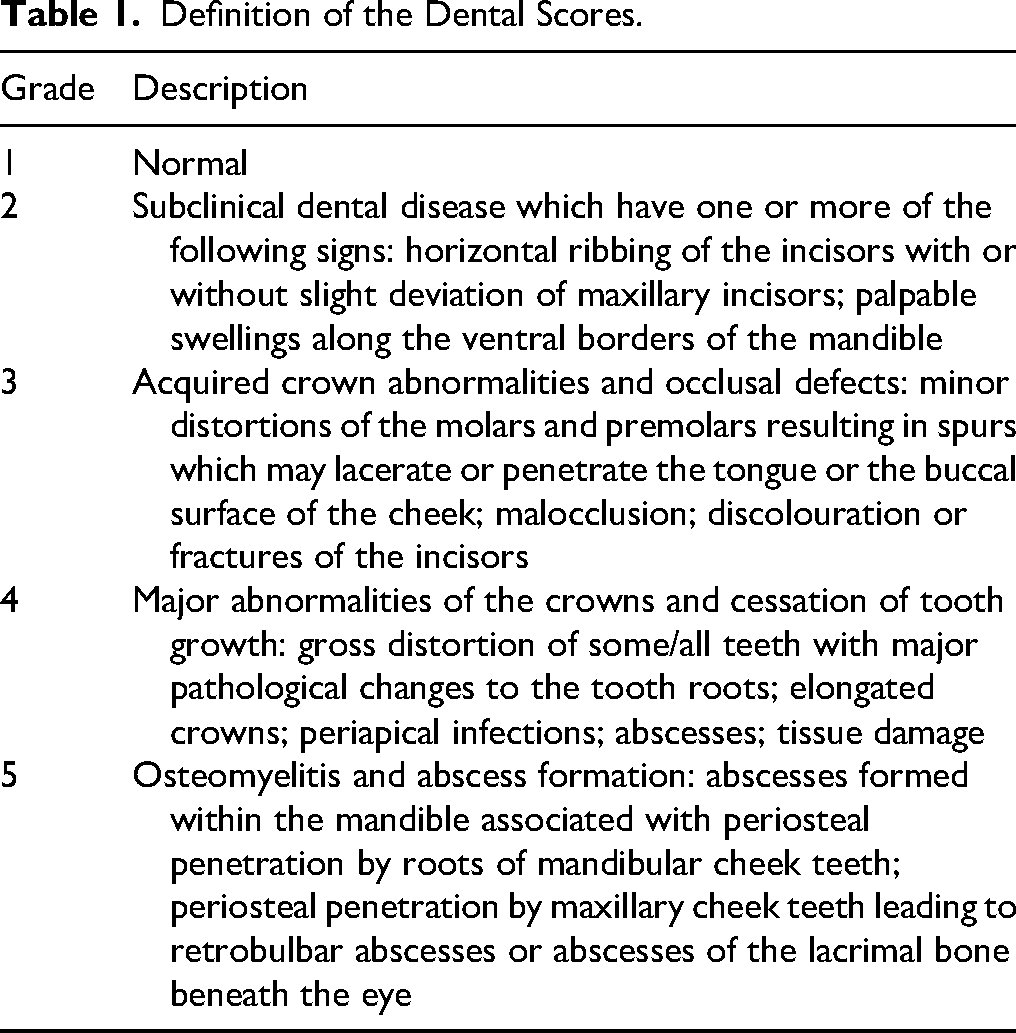
One hundred and eight rabbits were included in this study, of which 99 were presented for their routine annual health check in July and August 2011 and the remaining nine were wild animals which had been shot by a local hunter and obtained from a local butcher which were sold dead, for meat consumption. In the case of animals presented for health checks, data were only collected following consent by the owner and were then anonymised, with all animals being identified by a number. Using a grading system described previously,
11
current dental scores, together with any equivalent historical scores for older animals, were recorded. In addition, owners completed a questionnaire based on what was previously described.
12
All data collection had received prior ethical approval from within the Institute of Biological, Environmental and Rural Sciences, Aberystwyth University. Variables recorded were:
Gender of animal. Age of animal, including information from records from previous years where possible. Breed of animal. Type of bowl food normally given to the animal (i.e., muesli or pellets), although details of the brand of bowl food were not recorded. Frequency with which the animal was provided hay: daily; most days (approximately 3-4 times per week); some days (approximately weekly); never. Frequency with which the animal was given access to freshly cut grass: daily; regularly (at least weekly); only summer; never. Frequency with which the animal was given access to grass grazing: daily; regularly (at least weekly); only summer; never. Breadth of head – measured from the angular process of one mandible to the contralateral side. Length of head – measured from the angular process of the mandible to the tip of the nose (Figure 1). Dental score – grade on a scale of 1 to 5 (Table 1).
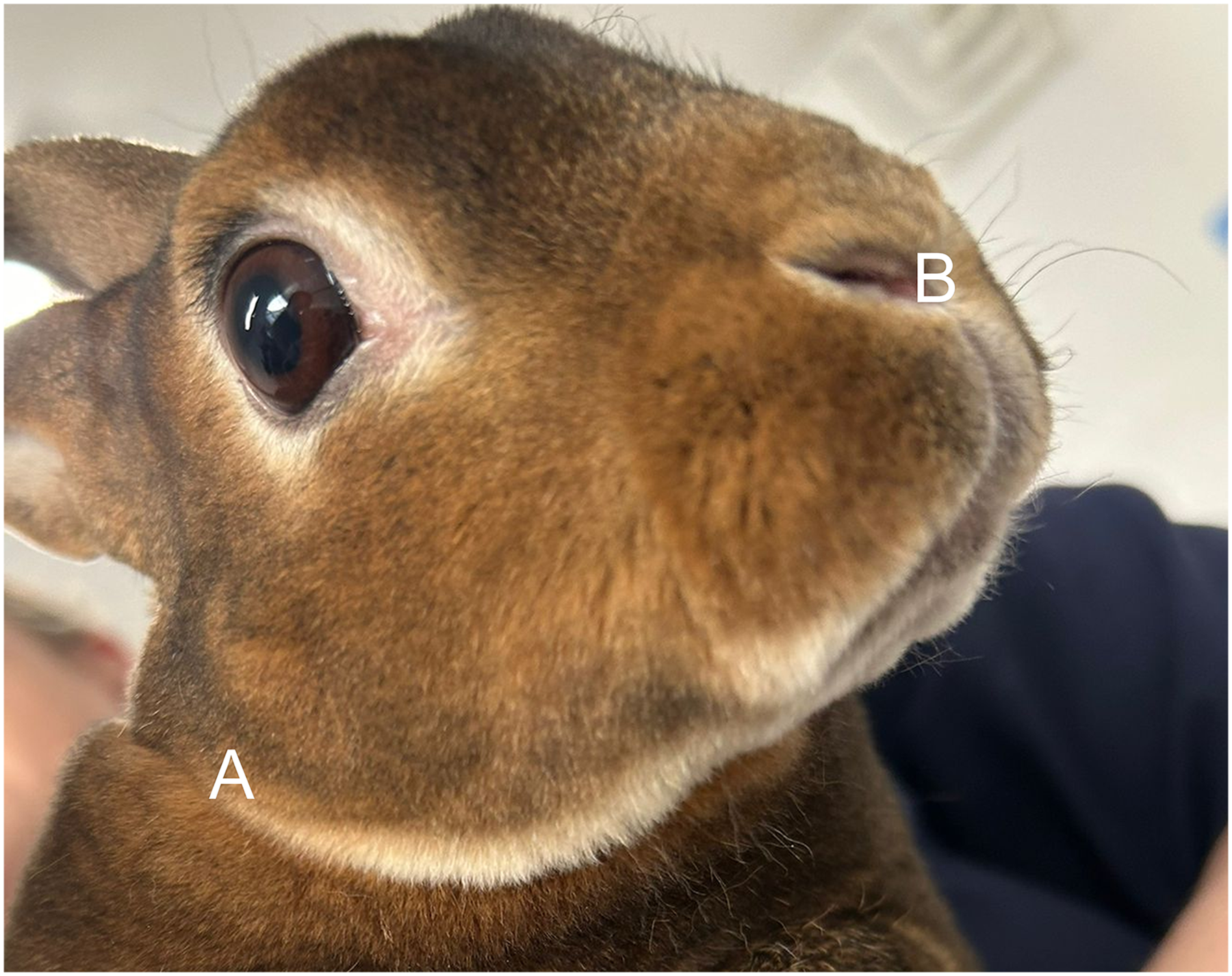
A photograph of a rabbit showing the reference points for making measurements. A) Angular process of the mandible and B) the tip of the nose.
Definition of the Dental Scores.
Measurements were obtained using a piece of string which was placed at either extremity of the area being measured. The distance was then measured against a ruler. This method was used instead of callipers as rabbits were more likely to remain stationary while being measured using string.
Based on the length and breadth of the head, the cephalic index (defined as the breadth of the head divided by the length of the skull and expressed as a percentage) was calculated for all animals. The cephalic index value allowed animals to be categorised as dolichocephalic (≤75%), mesocephalic (between 75% and 80%) or brachycephalic (≥80%). These particular borderlines allowed animals to be split into three similar-sized groups.
Statistical Analysis
Medial, modal and mean dental scores, together with standard error of the mean (SEM) were calculated for all variables. Within each variable, dental score data were checked for normal distribution, based on their Z-score. All data were found to be not normally distributed and therefore non-parametric analytical methods were used. Specifically, pair-wise comparisons between characteristics were performed using Mann-Whitney U-tests, while multiple comparisons were performed using Kruskal-Wallis tests 13 on ranked data including corrections for tied ranks.
Results
Datasets per Animal
Dental scores were recorded for all 99 animals presented for their routine annual health check. For some animals, data were available for more than just the current year. Of these cases, 47 had data for at least 2 years: of which 14 had data for exactly 2 years; 9 had data for 3 years; 4 had data for 4 years; 6 had data for 5 years; and 14 had data for 6 or more years.
Gender
Where gender was recorded, there was an even split, with 50 females and 51 males.
Breeds of Rabbits
In addition to the 9 wild animals, there was representation from 7 identifiable breeds: Dutch (9); Lop (15); Dwarf Lop (23); Mini Lop (15); Flemish Giant (10); Lion Head (15); and Rex (8).
Diet
Fresh cut grass was available to 32 animals (this included the 9 wild rabbits) daily, 33 regularly (at least weekly), 24 only in summer, and 19 were never given fresh grass. In addition, 43 were given the opportunity to graze daily (including the 9 wild rabbits), 32 were allowed to graze regularly, 25 were allowed to graze in summer, and 8 were never allowed outdoor grazing of grass. Hay was available to 71 animals daily, 6 animals most days, 15 some days and 5 were never given hay. Bowl food which was provided to all domesticated rabbits and was either in the form of muesli (28 animals) or pellets (71 animals).
Head Shapes
From the cephalic index calculations 34 animals were defined as dolichocephalic (scores ≤ 75%), 29 as mesocephalic (score between 75% and 80%) and 45 as brachycephalic (score ≥ 80%).
Severity Versus Cephalic Category
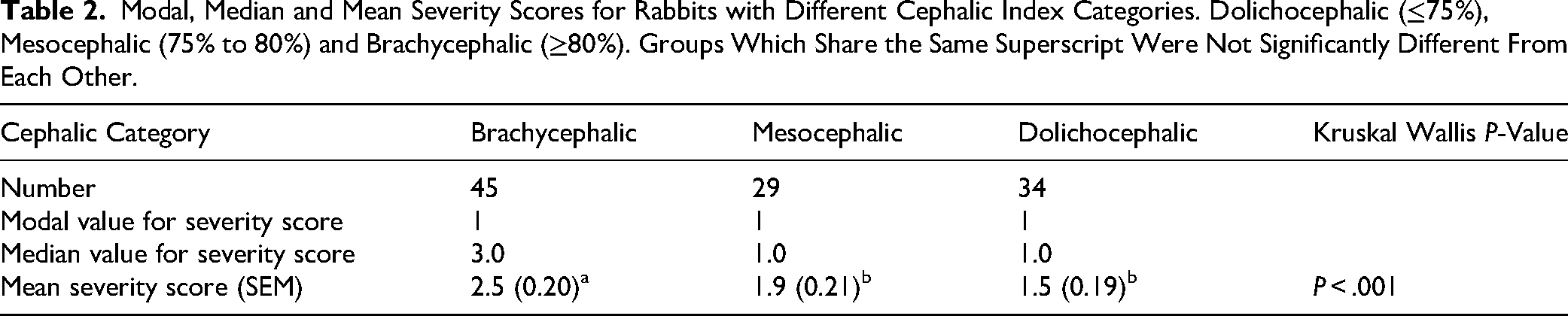
The mean, modal and median values were calculated for each cephalic category using the most recent values for each animal (Table 2). All three categories had the same modal value (i.e., 1). However, although both mesocephalic and dolichocephalic animals had a median value of 1.0, the brachycephalic animals had a median value of 3.0. In terms of mean values, a Kruskal-Wallis test detected statistically significant differences (P < .001) with brachycephalic animals having a value of 2.5 (SEM = 0.20), mesocephalic animals a value of 1.9 (SEM = 0.21) and dolichocephalic animals a value of 1.5 (SEM = 0.19). The three categories were then compared pairwise using a Mann-Whitney U-test and although the differences between mesocephalic and dolichocephalic animals was found to be non-significant (P > .05), the brachycephalic animals were found to have a significantly higher score than either of the other two categories.
Modal, Median and Mean Severity Scores for Rabbits with Different Cephalic Index Categories. Dolichocephalic (≤75%), Mesocephalic (75% to 80%) and Brachycephalic (≥80%). Groups Which Share the Same Superscript Were Not Significantly Different From Each Other.
Severity Versus Age of Animal
Severity scores were compared with the age of the animal (Table 3). A severity score was generally recorded for each of the previous annual check-ups in older animals. These values were also included for the relevant age group, meaning that in the case of many animals more than one score was used for that animal. The median score increased with time, with a value of 1.0 for animals which were either 1 or 2 years old, 2.0 for animals aged 3, 2.5 for animals at either 4 or 5 years old, and 3.0 by 6 years and over. Based on Kruskal-Wallis analysis, there was a significant difference between animals of different ages (P < .001). Pairwise comparisons using Mann-Whitney analyses showed that animals at their first annual check-up had significantly lower mean scores than older animals; 1.3 (SEM = 0.07). By age 2, the mean score was significantly higher at 1.9 (SEM = 0.18), although there was no further significant increase in mean values at ages 3 and 4, 2.1 (SEM = 0.21) and 2.3 (SEM = 0.21) respectively. However, animals aged 5 or 6, 2.4 (SEM = 0.26) and 2.7 (SEM = 0.34) respectively, had significantly higher scores. Although there was a constantly increasing trend in the mean score, there were not statistically significant increases in the mean scores from age 3 to age 6 and over.
Median and Mean Severity Scores for Rabbits of Different Ages. Groups Which Share the Same Superscript Were not Significantly Different from Each Other.

Severity Versus Gender
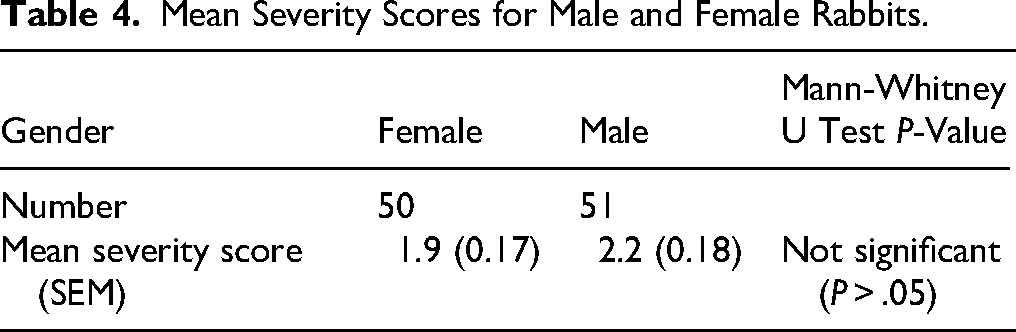
A Mann-Whitney U-test was used for the most recent value for each animal, no significant difference was found based on gender (Table 4) with females having a mean score of 1.9 (SEM = 0.17) and males a score of 2.2 (SEM = 0.18).
Mean Severity Scores for Male and Female Rabbits.
Severity Versus Frequency of Forages
The impact of frequency of accessing specific forage generally had little impact on the severity score. In terms of access to fresh grass (Table 5), all four categories (daily, regular, summer-only and never) had modal values of 1. Those which only had access to fresh grass in summer had a median score of 2.5, while the other three groups had median scores of 1.0. In addition, although the rabbits which only had access to fresh grass during the summer had the highest mean score value, this was not significantly different from any of the other three groups.
Modal, Median and Mean Severity Scores for Rabbits Relative to the Provision of Grass in Their Diet.

In terms of provision of hay as a form of forage (Table 6), for animals which had either hay every day or never at all, the median score was 1.0. However, where animals had access to hay either most days, or some days per week, the median scores were 2.5 and 3.0 respectively. They also had the highest two mean scores 2.5 (SEM = 0.62) and 2.7 (SEM = 0.39) respectively, although these were not significantly higher than for those where hay was fed every day, or not at all, where mean values were 1.9 (SEM = 0.34) and 1.7 (SEM = 0.27) respectively.
Modal, Median and Mean Severity Scores for Rabbits Relative to the Provision of Hay in Their Diet.

In terms of being allowed to graze fresh grass (Table 7), animals which never had the chance to graze had a median score of 2.0, whereas animals which had any form of grazing access had a median score of 1.0. However, based on Kruskal-Wallis analysis, there was no significant difference between the different grazing access frequencies.
Modal, Median and Mean Severity Scores for Rabbits Relative to the Access to a Garden to Allow Grazing of Grass.

Severity Relative to Either Inclusion of Muesli or Pelleted Food
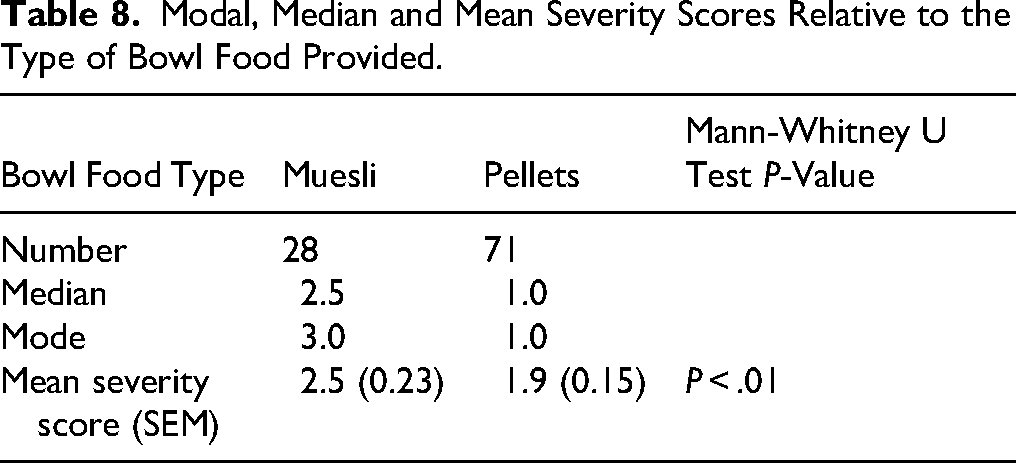
A Mann-Whitney U-test detected a significant (P < .01) effect in severity score when comparing animals which had either muesli or pelleted food as their diet, with those eating muesli having a significantly higher severity score (Table 8) with a mean score of 2.5 (SEM = 0.23) as opposed to 1.9 (SEM = 0.15) for those on pellets. In addition, those fed on a muesli-based diet had a median score of 2.5, as opposed to a median score of 1.0 for those fed on pellets, and also had a modal score of 3.0 as opposed to 1.0.
Modal, Median and Mean Severity Scores Relative to the Type of Bowl Food Provided.
Severity Scores Relative to Breed of Rabbit
A statistically significant difference (P < .05) was observed for the current scores between breeds following Kruskal-Wallis analysis. By performing pair-wise Mann-Whitney U-tests these differences were attributed to certain breeds having higher severity scores than others (Table 9). From this the highest current severity value was found in the Dutch rabbits with a mean score of 3.0 (SEM = 0.50), which was significantly higher than four of the other six breeds, as well as the wild animals. However, although higher than the mean values for the other two breeds, namely the Dwarf Lop and the Flemish Giant, 2.2 (SEM = 0.23) and 2.1 (SEM = 0.57) respectively, this was not statistically significant. It is also worth noting that the lowest mean severity score was found in wild rabbits with 1.2 (SEM = 0.15), although with the exception of the Dutch and Dwarf Lop rabbits, this was not significantly different (P > .05). However, the Dutch rabbits included some of the older animals studied in this investigation; 5 out of the 9 Dutch rabbits were in at least their sixth year. When data were re-evaluated using historical data (where available) from all animals to allow direct comparisons between animals at the same age, there was no breed significant effect (P > .05) detected for animals during either their first or second year of life, suggesting that breed of animal is not a factor which influences the severity score.
Numbers of Rabbits Per Group Showing Mean Severity Scores (SEM Values) Relative to Breed of Rabbit at the Age of Measurement, and at First Year and Second Year of Life. Breeds Which Share the Same Superscript Are Considered to Have Scores Which Are Not Significantly Different From Each Other.

Discussion
Dental problems are considered to be one of the major veterinary issues associated with rabbits. There has already been a range of work carried out describing the symptoms of dental problems 14 and also describing how to manage and control these problems. However, studies which investigate the possible factors which may give rise, or predispose animals, to these problems are less common. Some of the factors which can have an effect on dental problems include genetic predisposition, but others can be attributed to husbandry, 12 including factors such as ensuring access to fibrous material in the diet.
The factors investigated in the current work can be split into two broad categories; those which are a consequence of the diet, and those which cannot be influenced by pet husbandry (e.g., gender, age of animal). In terms of factors which cannot be influenced by pet husbandry, this work detected differences based on the age of the animal. Gender did not lead to a significant difference as although males generally had a higher severity score, the differences were not statistically significant. Therefore, it was concluded that although the gender of the rabbit has been suggested as being a contributing factor previously, 15 this was not supported in the current work.
The most recent severity scores available initially appeared to be influenced by breed, but on closer inspection this was due to animals from some breeds being older than those other breeds, and when historical data were used instead for these animals, this breed-effect disappeared. Breed is one of the factors which has been mentioned previously as a potential influence on dental problems. 15 Although it was initially apparently the case here using current records, it was not the case after taking the issue of age into account.
The other non-dietary factor investigated here, the cephalic index value, was also shown to be significant, as the general shape of the animal's head is associated with the potential for a higher severity score. Animals which were classified as being brachycephalic (i.e., had a cephalic index value ≥80%) had a significantly higher mean severity score. The reason for this difference between values in brachycephalic, as opposed to dolichocephalic or mesocephalic animals is unknown, although it may be worth speculating that the general shape of the head poses occlusal problems. The shape of the head of the rabbit has been investigated previously, including in the context of dental disease. 4 Although their work concentrated more on specific angles within the facial area, rather than cephalic indices, they also highlighted an important factor that the shape of the rabbit's skull could impact dental health. They reported that through domestication, some rabbits have developed an overemphasis of the dorsal curvature of the skull and propose that this affects the position of the incisors within the skull. In addition, they advocate further investigation of the potential relationship between the palatal angle (the angle between the palatal plane and the skull base plane) and acquired dental disease in domesticated rabbits.
There was no significant difference in the severity scores observed in terms of the frequency of being fed specific types of grass-based diet (grazed grass, fresh grass, or hay). Including some form of grass in the animal's diet is considered beneficial. However, since nearly all animals were given at least one of these three on either a daily or regular basis, the lack of differences suggests that the form in which the grass is included in the diet is not particularly important in terms of influencing the severity score of the teeth. The type of bowl food given to animals appears to have an influence, with animals fed on muesli having a significantly higher severity score than those on pelleted food. Again, the reason why pelleted food versus muesli should have an influence on the health of the teeth is unclear, although in future work it may be useful to include brand type of pellets and muesli in the analysis. It is interesting to note that in previous studies animals maintained on muesli-type mixes have more commonly been reported to suffer from PSADD (progressive syndrome of acquired dental disease), which includes factors such as acquired incisor malocclusion, facial abscesses and spurs on the cheek teeth. 15
Conclusion
In conclusion, the current work investigated factors which could potentially influence dental problems in the rabbit. It corroborates work which has previously described age as a factor. Based on the measurements taken most recently, it appeared that breed was a factor in influencing the dental score, but this masked an issue associated with the age of the animal, as animals from certain breeds in the current analysis tended to be older. When historical data were used for the older animals, breed was no longer significantly identified as a factor. In terms of diet, the form in which grass is included does not seem to influence dental problems, although provision of a pelleted supplement seems to be better than a muesli formula. Finally, to the best of the authors’ knowledge this is the first report suggesting that the cephalic index value may be associated with predisposition for dental disease in the rabbit.
Footnotes

Authors’ Contributions
EC: Conceptualisation; Data Collection; Statistical Analysis; Writing, RC: Data Collection, NM: Conceptualisation; Statistical Analysis; Writing
Funding
The authors received no financial support for the research, authorship, and/or publication of this article.
Declaration of Conflicting Interests
The authors declared no potential conflicts of interest with respect to the research, authorship, and/or publication of this article.