




Abstract
Building on recent interventions in platform work scholarship that centre social reproduction and draw attention to informal economies in the Global South, this paper advances a ‘working lives’ framework to account for the entanglements of production/reproduction, informality and precarity, and gender norms in the shaping of platform work. Based on interviews with women engaged in delivery work through digital platforms in Buenos Aires, Argentina and Delhi, India, the paper shows that women enter platform delivery work compelled by adverse socio-economic conditions and work-life histories of informality. Women organise their participation in platform delivery work, making use of its location flexibility, for and around the needs of the household. Further, they operationalise this flexibility to navigate gendered constraints, such as, curtailed radius of work to ensure safety and continued responsibility for housework and childcare. The paper, empirically novel in accounting for narratives of women in the Global South, offers the analytical framework of ‘working lives’, combining long-term and place-based perspectives with everyday perspectives, with attention to social norms, for research on platform work globally.
Keywords
Introduction
This paper builds on two relatively recent interventions in platform work research. One, a small but growing number of studies, based on long standing Marxist feminist scholarship, draw attention to social reproduction – specifically, work needed to reproduce life – in shaping, and in turn being shaped by, emerging platform economies. Studies have considered the implications of women’s disproportionate responsibility for social reproduction for their participation in platform work (James, 2022; Micha et al., 2022; Milkman et al., 2021), as well as shed light on how workers may create (new) spaces for social reproduction to navigate precarity in platform economies (Kwan, 2022; Posada, 2022). Two, scholars studying platform work in the Global South emphasise the need to consider historical conditions of work, particularly informality, to contextualise research on this ‘new’ work (Castillo Fernández, 2024; De Neve et al., 2023; Graham et al., 2017; Haidar et al., 2021; Surie and Huws, 2023). In this paper, we extend these interventions by offering a multidimensional ‘working lives’ framework for the study of platform work, combining – (a) an everyday perspective that makes visible the entanglements between production and reproduction in platform work, and (b) a long-term and place-based perspective that accounts for historical context-specific socio-labour conditions; we see these as underpinned by (c) the norms and values that shape people’s participation in platform work (Figure 1).
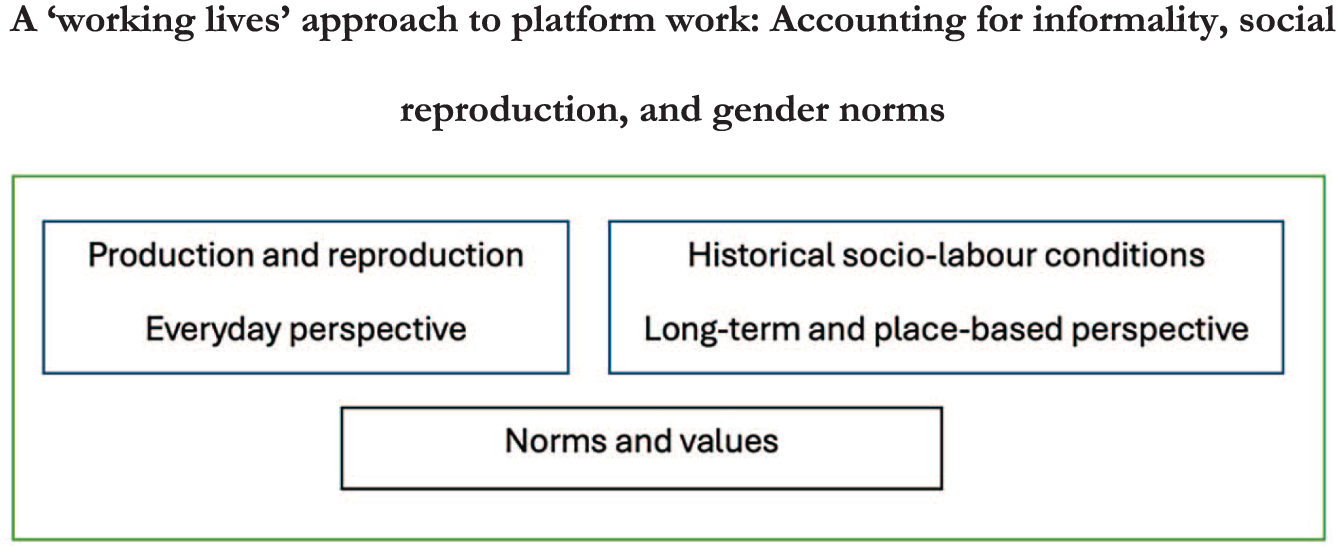
Working lives framework for the study of platform work.
The paper is based on qualitative research with women doing delivery work, mediated by platforms, in Buenos Aires, Argentina and Delhi, India. The study was motivated by the relative lack of accounts of women and particularly in the Global South in platform work research (notably in the male-dominated sector of platform delivery work) and a growing number of reports on the ‘opportunities and challenges’ for women in platform work (see, for example, Datta et al., 2023; NITI Aayog, 2022; Raman et al., 2021). Rather than adopt a similar orientation, the study’s intent was to explore the experiences of women in platform delivery work. This broadens the scope of the enquiry as experiences of work are entangled with workers’ social lives. We understand the double invisibilisation – of women and the Global South – as having consequences for the concepts and theoretical approaches that have gained dominance in platform work scholarship. 1 In both settings, platform delivery work has rapidly expanded in the context of historical large-scale informality, particularly during and following the Covid19 pandemic. 2 The number of women in platform delivery work in these contexts is still small, but growing, and we situate the slight inclusion of women in platform work in the context of historical informality and precarity, aggravated during and in the immediate aftermath of the Covid19 pandemic, that is, as ‘feminisation of survival’ (Sassen, 2002). However, it is important to note that we do not examine women’s experiences in the Global South as ‘unique’ or suggest their experiences are entirely distinct from those of other genders. Rather than take gender to be a ‘variable’, we use gender as an analytic (Parreñas and Hwang, 2023) to foreground factors that have been overlooked and undervalued in platform work research.
The paper is organised as follows: first, it reviews discussions of flexibility and precarity in platform work broadly, and platform delivery work in particular, focusing on studies that critically examine the limits to this flexibility promised by platforms. This focus is important as although flexibility has historically been claimed to be advantageous for women’s workforce participation, there has been limited gender analysis in the critical evaluation of flexibility in platform work. The paper then delves into feminist scholarship on feminisation of survival amidst expanding informalisation of economies, particularly in the Global South. This set of literature refers to manufacturing and service work, that is, it is not specifically related to platform work, but we build on it to develop analysis of platform work as an extension of conditions of informality and precarity, thus emphasising the significance of a place-based and long-term perspective for the analysis of this ‘new’ work. Next, the paper details the methodology adopted for the research. The paper primarily engages with the historically large informal economies in the two contexts – Buenos Aires and Delhi. The findings report (a) workers’ fragmented work trajectories and precarious lives that lead them to platform work, and (b) the centrality of the household in the organisation of platform work and related reproduction of gender norms. Finally, the paper concludes with recommendations for how this framework can be used for future platform work research around the world.
Platform delivery work: Flexibility and precarity
Platforms advertise themselves to workers through the promise of flexibility and autonomy. In particular, they offer flexibility in terms of the location, schedule, and amount of work, and autonomy in terms of the lack of a (human) management system (encapsulated in the ‘be your own boss’ mantra). To a certain extent, workers value and are drawn in by the promise of flexible work. Studies with young men in the Global North, such as in Belgium (Duus et al., 2023), Scotland (Gregory, 2021) and Australia (Veen et al., 2020), observe that workers engage in platform delivery work to supplement their main occupations, including studying, although the extent to which workers are able to use flexibility is limited by algorithmic control, material conditions of their work, and their social locations. For example, vulnerability is heightened for migrant workers who are commonly unable to access labour market welfare provisions (van Doorn et al., 2023; Veen et al., 2020) and subject to racism and harassment due to their ‘subservient citizenship’ (Huang, 2022b; Ivancheva and Pla, 2025; Parwez and Ranjan, 2021). Workers may also negotiate everyday risks based on their race, ethnicity, and/or social class in the form of ‘unbelonging’ (Johnston et al., 2023) in spaces where their presence may be ‘deemed problematic, transgressive or threatening’, thus limiting location flexibility.
It is also important to note global stratifications in the workers’ dependence on platforms for livelihoods, with those living in the Global South mostly engaging in this work as a primary source of income (Bansal and Arora, 2023). In China, Sun et al. (2023) find that workers who worked full-time were prioritised for orders. They show that this has, contrary to popular perception, led to the ‘de-flexibilisation’ of platform work, whereby there is ‘an increasing proportion of full-time workers with fixed hours instead of flexible schedules’ (Sun et al., 2023: 413). Besides location and schedule flexibility, Sun et al. (2023) suggest that platform work flexibility can also be understood as labour market flexibility, whereby firms/employers substitute permanent and full-time workers with casual, temporary, or contracted workers. Workers are not employees of platforms, rather they are ‘self-employed’ partners/contractors, outside of the conventional employer-employee relationship that usually entails social protection, benefits, and rights. Workers’ access to work through the platforms, and thus, their income and position is highly insecure and variable as platforms transfer the labour costs, including those of social reproduction (De Neve et al., 2023; also see Mezzadri, 2020), and risks to workers.
Empirical studies on platform delivery work in various locations highlight that labour platforms crystallise and exacerbate processes of informalisation and precarisation globally (Abílio, 2023; Mendonça et al., 2023). However, these processes neither develop nor are experienced uniformly around the world. In the Global North, the emergence of platform work is seen as a move away from the ‘Fordist bargain’ of secure waged employment, thus informalisation and precarisation refer to the ‘downgrading of employment and working conditions’ (Mendonça et al., 2023: 61). In the Global South, the informality and precarity associated with platform work is not new or unique. Indeed, the emergence of labour platforms in South Asia, Africa and Latin America has depended on and expanded substantial informal economies in these contexts (De Neve et al., 2023; Surie, 2017; Surie and Huws, 2023). But, as Bertolini et al. (2023: 15) warn us, the boundaries between ‘formal’ and ‘informal’ are not neat, and ‘digital labour platforms restructure work relationships in both the Global North and South through a process which increasingly interweaves informality and formality together’.
Despite growing scholarship that is critical of platforms’ claims of ‘flexibility’ for workers, relatively little attention has been paid to gender as an axis of inequality. Some studies highlight that women may be drawn into platform work because of its offer of flexibility, however this reproduces gender inequalities, whereby women face disproportionate responsibility for (unpaid) care and domestic work, alongside deprioritisation of their participation in paid work (James, 2022; Micha et al., 2022; Milkman et al., 2021). Others highlight occupational segregation (Bansal and Arora, 2023) and gender pay gaps (Churchill, 2024; Micha et al., 2022) in platform work. This paper builds upon these emerging approaches, but importantly rather than use gender as a variable, it takes gender as an analytic (Parreñas and Hwang, 2023) to centre social reproduction in platform research (Kampouri, 2022; Kwan, 2022). We next turn to longstanding feminist scholarship on social reproduction, focusing on gender, informality and precarity in Global South settings to advance this scholarship.
Feminisation of survival: Informality and households
Feminist scholarship has long been critical of simplistic accounts of women’s ‘inclusion’ in labour markets, showing that women’s labour force participation may lead to intensification and recomposition, alongside decomposition of gender relations to variable extents (Elson and Pearson, 1981). They have also drawn attention to the macro forces that compel and shape women’s labour force participation, particularly dispossession and precarisation of lives under neoliberalism, especially in the Global South. This has been evidenced in emerging sectors that appropriate women’s labour for exploitation, such as, export manufacturing (Dutta, 2020; Elson and Pearson, 1981) and low-paid service work (Ehrenreich and Hochschild, 2002; Otis, 2011). Although platform work, particularly delivery work, which we are focusing on in this paper, is not a ‘feminised’ sector in terms of the gender proportion of workers, it is feminised in its conditions of insecurity and precarity (Standing, 2011) that feed off precarious lives (Millar, 2017). Therefore, rather than asking questions about ‘women’ and platform work, including challenges or barriers to women’s entry in platform work and potential for future new opportunities, we adopt a gender lens to attend to how platform work is situated vis-à-vis the broader trend of feminisation of labour, and indeed feminisation of survival.
It is important to note here that location-based platform work, in contrast to web-based platform work, tends to absorb people who are already precarious, the ‘political and socio-economic vulnerable’ (Huang, 2022b: 353; also see van Doorn et al., 2023). In parts of the Global South, where there are large informal economies, this manifests in the incorporation of workers from informal economy into platform work, through the process of ‘absorption’ (Chicchi et al., 2020), or from a Marxist perspective, a ‘parasitic feeding’ (Huws, 2020) of the informal economy and labour by global capital (Míguez and Filipetto, 2021; also see Abílio, 2023; Haidar and Pla, 2021). In the Global South, women are overrepresented in informal work, this overrepresentation increases at the lower end of ‘subsistence’ informal work (Bansal and Arora, 2023; Barrientos, 2002; International Labour Office, 2018). Beyond the overrepresentation of women in informal work, informality is feminised in that it is ‘feminized figures (the unemployed, women, youth, and migrants) who go out to explore and occupy the street as a space of survival’ in response to dispossession induced by neoliberalism (Gago, 2017: 7). It is these feminised figures, who comprise the reserve army of labour, who are entering platform work, specifically location-based platform work.
This feminisation of survival emphasises the importance of the household as a site to ‘diversify livelihoods, pool incomes, and spread risk in multiple ways’ in order to make labour of various kinds available for commodity production and consumption (Ramamurthy, 2014; also see, Scully, 2016). If we follow the argument that the household, or more broadly reproductive labour is ‘the over-arching mode of all economic activity’ (Bhattacharya, 2018: 52), it is ‘dynamics in workers’ social lives rather than the nature of the job per se that matters most when it comes to employment decisions’ (Dong, 2023: 1245). Scholars note the fragmentation of work trajectories (Islam, 2021; Stevano, 2022) as workers navigate precarity of labour and life. Further, as Dong (2023) shows in the context of Foxconn workers in China, as women are being pushed towards breadwinning on the one hand, and pulled into caregiving on the other, they ‘choose’ precarious work over more formal work to navigate these roles, and as such, navigate norms and values in flux. Studies on platform work have largely overlooked the significance of the household in decision-making about participation in the labour force, instead focusing on the specificities of (algorithmic) controls and limits imposed by platforms. Using a social reproduction lens, this paper intervenes in this scholarship to account for the centrality of the household as well as gender norms and values in shaping platform work.
Methodology, research settings, and participants
This paper is based on 23 in-depth semi-structured interviews conducted with women platform delivery workers in two cities – Buenos Aires, Argentina (15 interviews) and Delhi, India (8 interviews) – for a collaborative project on gender inequalities in platform work in the Global South. The researchers’ main motivation for conducting this study was the relative lack of accounts of platform work from the Global South, and particularly scarcity of women’s accounts of platform work in the Global South. Rather than being a mere empirical lacuna, this points to the conceptual limitations of the current scholarship in understanding the shape of platform work. The study was guided by the open-ended question – What are the experiences of women in platform delivery work in Buenos Aires and Delhi? In the interviews, using the working lives approach, we asked the workers what work they did before, how/why/under what circumstances they entered platform work, what they like and dislike about it, and whether they see themselves continuing in this work.
The decision to locate the research in Argentina and India was guided by our interest in place-based analysis that accounts for historical informality, as well as by availability of research expertise and access. It is important to note that the authors have been conducting long-term research in these settings – Asiya in Delhi and Silvana and Jésica in Buenos Aires – which allowed them to bring an ethnographic sensibility to this comparison (Simmons and Smith, 2017). In the design of the study, we positioned Buenos Aires and Delhi as contexts for, rather than units of analysis (Brannen and Nilsen, 2011). Moreover, recognising the impossibility of accounting for all similarities and differences between the contexts, we focused on the similar character of large informal economies. In that, we retain Global South as an important analytic ‘as it illuminates the distribution of power in an unequal system’ (Sud and Sánchez-Ancochea, 2022: 1144), particularly pertaining to the contours of emerging platform work (Anwar and Graham, 2020; Graham, 2019; Graham et al., 2017).
In Buenos Aires and Delhi, there has been an expansion of platform work amidst large informal economies, particularly exacerbated by the crisis of the Covid19 pandemic. In both locations, platform delivery workers come from situations of vulnerability – previous precarious occupations, unemployment or migration (Beccaria et al., 2020; De Neve et al., 2023; Elbert and Negri, 2021; Parwez and Ranjan, 2021) – and are largely men. During the Covid19 pandemic, platform delivery work initially slowed down and then picked up pace again as an ‘essential’ service. People resorted to delivery work as ‘refuge’ from the adverse socio-economic situations during the pandemic (Beccaria et al., 2020; De Neve et al., 2023; Haidar and Pla, 2021).
In the Buenos Aires Metropolitan Area, the percentage of women in platform delivery work (mainly food delivery) was estimated to be 13% in 2019 and reportedly increased to 22% in 2020 (Beccaria et al., 2020). Whilst comparable data on platform delivery work is not available for Delhi, it is reported that only 2% of all platform workers are women in India, with certain platforms, such as those providing home and beauty services, highly feminised (Raman et al., 2021). To some extent, this reflects the lower level of female labour force participation in India, estimated to be 41.7% in 2023–2024 (Ministry of Statistics and Programme Implementation, 2024; in Argentina, around 52.2% of women are in the workforce; Instituto Nacional de Estadística y Censos (INDEC), 2023). Whilst not dismissing this difference, we recognise the limitations of the data available and redirect our attention to the social location and circumstances of workers that lead to their participation in platform work.
The interviews in Delhi were conducted by Asiya from July to August 2022 with 10 women delivery workers – 8 based in Delhi and 2 based in Jaipur – between the ages of 19 and 35 years. These were part of a study on women’s participation in the growing e-commerce sector. 3 Only the 8 Delhi interviews are reported in this paper. Asiya gained access to women in platform delivery work through a social enterprise called ‘Even Cargo’ (https://evencargo.in). Even Cargo recruits women from resource-poor communities by holding recruitment events/meetings in low-income neighbourhoods, provides them employability training, including lessons on how to ride a Scooty or a small motorbike, and places them in delivery work with major e-commerce companies, including Amazon and Flipkart. Although Even Cargo facilitates the recruitment, the delivery work is mediated through digital apps, which workers access using their internet-enabled smartphones. The interviews were arranged by Even Cargo and took place through phone calls. The preference for this mode of interview (rather than in-person meetings) was expressed by the women workers. The workers had little spare time and a phone call was the least disruptive to their working days. Many interviews took place when the workers were waiting to pick up parcels for delivery, or travelling to the pick-up depot, or returning home after work. The interviews lasted 40 minutes on an average and were largely conducted in Hindi, with some use of English words and phrases. The interviews were recorded with the consent of the interviewees and later translated into English and transcribed by the company Fieldscope.
The team in Buenos Aires, led by Silvana and Jésica, conducted 15 interviews in March and April 2023 using the interview guide for the Delhi interviews. These interviews were with women platform delivery workers, 19 to 49 years old, who live in the Metropolitan Area of Buenos Aires and work in the two major delivery platforms in Argentina: PedidosYa and Rappi. 4 First, the team contacted key informants from previous research who had contact with platform workers. Following the first round of interviews, the team asked the interviewees for new contacts. Selection was made according to the place of residence and age to cover as much heterogeneity as possible. The sample was composed of 30% Argentineans and 70% migrants. Previous statistical data indicates (2019–2020) that approximately 70% of delivery platform workers in Buenos Aires are migrants, particularly from Venezuela (López Mourelo, 2020). The growth of delivery platforms in the city has coincided with a recent influx of migrants from Venezuela (Beccaria et al., 2020; López Mourelo, 2020). 5 The interviews lasted 60 minutes on average and were conducted in Spanish. Both virtual and in-person options were offered to the workers and the team adapted to the women’s decision. Majority of them preferred virtual meetings because of lack of time. The respondents were given a small amount of money as a gift for their time. The interviews were recorded with the consent of the interviewees and later translated into English and transcribed by research assistants.
In both contexts, women doing platform-mediated delivery work remain a minority 6 and are particularly difficult to access through men-dominated worker networks. This is reflected in the limited number of interviews we conducted – 8 in Delhi and 15 in Buenos Aires. 7 In both settings, within this limitation, we deemed these to be sufficient for thematic saturation (Small, 2009) . The authors reviewed the transcripts, and through repeat meetings, as well as repeat readings of the transcripts, identified themes to explore further. In addition to the patterns that emerged from the 23 work trajectories (for example, the majority of women reported being either in informal employment or unemployed prior to entering platform work), the researchers’ ‘sensibility’, that is, researchers’ shared expertise in gender, class, and work in Delhi and Buenos Aires, and review of current scholarship also contributed to determining significance. With the latter, we were particularly attentive to themes that do not appear, or only appear marginally, in current scholarship. We used thematic analysis (TA) – constructivist, inductive and semantic (based on explicit verbalisations; Braun and Clarke, 2006) for the individual interviews and in doing so brought ‘the wider context (. . .) to bear on the material in order to “hear the music of society” behind the solo voice . . .’ (Brannen and Nilsen, 2011: 610). Through the case studies of Delhi and Buenos Aires, our intention is to offer not generalisations or universalisms, but different perspectives that open up different worlds, advancing connected sociologies (Bhambra and Santos, 2017: 7).
Findings
Fragmented work trajectories
In Delhi, women were recruited, trained, and supported by the social enterprise Even Cargo to enter platform delivery work, while women in Buenos Aires entered this work of their own accord, often following guidance from friends. However, what was shared across the two contexts was fragmentation in women’s work trajectories. Among the women we interviewed, some had not been in the labour market previously, some had struggled to find paid work, others had worked as nannies and domestic workers, in the hospitality industry, as well as in administration for small offices, customer service, cash desk or call centres, mostly as informal workers. Women reported an exacerbation of the crisis of livelihood during the Covid19 pandemic – some lost the jobs they were doing, others reported family members losing their jobs, with implications for sustenance of households.
Lucrecia, 8 a Venezuelan migrant in Buenos Aires, worked as an informal worker at a plant nursery, 9 to 10 hours per day, 6 days a week. Her friends encouraged her to start working on delivery platforms because ‘. . . you know that if you leave one day at eight in the morning and come back at eight at night, you will come home with good money’. When we asked her why she took this advice to enter platform delivery work, she responded, accompanied by a nervous laugh: ‘out of necessity’. Later, even after she secured a formal job as a clerk, she continued platform delivery work at nights and on weekends as her income, she reported, was insufficient to make ends meet.
Florencia, an Argentine worker, shared that prior to her entry into platform delivery work, she was: ‘a saleswoman in shops. I also distributed flyers for two years because I couldn’t find anything else. I worked for the doormen’s union . . . Eventually, I started with delivery’. In her last job as a saleswoman, she was ‘. . . moving from one location to another. They never offered me a permanent position. It was informal work’. Both Lucrecia and Florencia contextualised their entry and continued engagement in platform delivery work within their experiences of work precarity, including low and insecure income, which blurred the boundaries between informal and formal work.
The work trajectory of Meera, a mother of three in Delhi, was also, similar to Lucrecia and Florencia’s, fragmented across various kinds of precarious and informal work – I was in housekeeping before this, cooking food, etc. Then I was into baby care. I had duty until 9 pm. I couldn’t get any time off. My children were also very young back then and I was unable to give them time. Afterwards, I worked in a school. Then I came here [to platform delivery work] after I quit my job at the school.
Meera shared that she quit the job at the school because ‘In that job, there was a lot of issue about holidays. They would fire people who would take a lot of leaves’. It was in contrast to this fragmented work trajectory, in which she experienced both insecurity and inflexibility in work, she felt that with platform delivery work, there was a semblance of stability and autonomy – ‘. . . this feels like I’m working for myself’.
Other workers also reiterated the sense that platform delivery was an improvement over their previous work experiences or situations (also see Parwez and Ranjan, 2021; Surie and Huws, 2023). For example, Priya, in Delhi, said that she ‘. . . worked in tele calling for a month but later I got to know that it was kind of a fraud company; there were some issues with the salary, so I left it’.
9
In contrast to this experience, Priya assessed her income from platform delivery work as fair even though it was variable, based on the number of ‘loads’ she could deliver in a day. For the women in Delhi, the role of Even Cargo as a mediator was important in experiencing this work as ‘stable’ and even ‘permanent’. In Buenos Aires, women did not rely on a mediator for their employment, but they still, like Yamila, a 36-year-old Venezuelan migrant, argued that: My current job has improved. In my previous job I earned very little and had practically no benefits. I earn much more now and if I want to have social security I can have it, because I earn more, I can have health insurance. In the other job, if I earned and if I paid the rent, I had no money left, here I work one week to pay rent, the other for my personal things and the other one to save it and so . . . I don’t feel so tight with the income part.
Yamila had worked for 2 years in a store in customer service before transitioning to platform delivery.
Some women in Delhi reported that platform delivery work was the only option available to them. Sarita, a 27-year-old woman living alone in Delhi, said that before entering platform delivery work: ‘I was doing nothing, really. I was working here and there. I was mainly looking after the household work, just all of that stuff. I had no work’. This lack of employment opportunities was exacerbated during the Covid19 pandemic. Speaking of her family’s experience during the Covid19 pandemic, Afshan (Delhi) said: ‘That time, we couldn’t do anything. I applied for jobs, but nothing happened. Then, Even Cargo gave me the opportunity . . .’ When asked if that was the first job opportunity she had come across, Afshan confirmed: ‘Yes. And I took it’. Farzana, in Delhi, reported that her father fell ill during the Covid19 pandemic, and ‘. . . our condition was pretty bad, so I had to start working’. The only work she could find at the time was platform delivery work, and given her family’s financial crisis, she decided to take it up, abandoning the computer course that she was enrolled in at the time. The Covid19 pandemic, as such, became a crisis point during which women entered platform delivery work.
In platform delivery work in both Delhi and Buenos Aires, as is the case globally, the women did not have full access to social security or protections. As reported above, in Buenos Aires, some women engaged in formal work, through which they could avail social security. However, this formal work commonly resembled the conditions of informal work, particularly in terms of low and insecure pay. In Delhi, the women who entered platform delivery work had not had access to social security previously, having done a range of informal jobs. Dong (2023: 1233) observes with reference to manufacturing jobs in industrialising countries of the Global South that – . . . unskilled workers either have no preferences between formal industrial jobs and informal alternatives, as the former does not necessarily pay well but is more demanding (Blattman and Dercon, 2018) or are more likely to turn down or quit low-quality formal factory jobs and find better opportunities in the informal service market or start micro-enterprises.
A similar pattern emerges here, amidst large informal economies, although with slightly different contours – the women who had salaried (formal and informal) jobs quit these to enter platform delivery work, others had never had access to a stable income. We do not suggest here that fragmentation of work trajectories is unique to women (see Anwar and Graham, 2020), instead we align this with feminisation of survival in drawing attention to the circumstances in which women may be pushed into platform delivery work, as well as the gendered shape of such fragmentation in relation to social reproduction which we discuss next.
Navigating social reproduction
In addition to the issue of survival during and in the aftermath of the Covid19 pandemic, the other crisis that pushed women into platform delivery work, unsurprisingly, was that of social reproduction. Lucila, in Buenos Aires, lived with her husband and daughter. She had completed a computer programming course in the past, but after having a child, she said – Since I had the baby, I couldn’t have a job wherever it was . . . I mean, I can’t work full time, but . . . I can do it in the time I have free, so I said: “Well, I’ll give it [platform delivery work] a try” and I grabbed my backpack and went out . . . it was practical for me to do the whole process and I stayed.
In Buenos Aires, although some women had been skilled workers in their home countries (mostly Venezuela), their status as recent migrants added a layer of vulnerability and precarity (also see, Mendonça et al., 2023; van Doorn et al., 2023; Veen et al., 2020), leading them into platform delivery work. Rosa had a degree in psychology from Venezuela. When she migrated to Buenos Aires, she started working as a cashier in a full-time formal job before entering platform work: I had a formal job, I worked as a cashier in a supermarket, but my child, he is now two and a half years old and when I started working, he was one and a half years old and the person who was taking care of him could no longer look after him. I could not leave him in the kindergarten or anything else, so I stopped working as a cashier and decided to dedicate myself to working on my own time.
The women, as such, used the flexibility of platform delivery work to meet the needs of childcare. Importantly, this was not the only reason for women valuing flexibility. Indeed, in a number of accounts, it was difficult to disentangle the multiple motivations women expressed for working close to home. Lucrecia, who lived with her daughter in Buenos Aires, specifically chose to work for the platform Rappi because it enabled ‘short and fast orders’. Lucrecia explained ‘. . . that’s exactly why I chose it because I don’t like to go far away from my area and it’s very constant’. Lucrecia worked another job (in billing) during the week and was also enrolled in a digital marketing course, usually doing food delivery work on the weekends to ‘make up the month’. When she started this work, she was apprehensive about ‘. . . getting lost, although Google Maps is wonderful but getting lost in this city is incredibly easy’. With time, she had earmarked areas where she felt comfortable doing delivery work – I know the streets, I know several stores, they know me, you feel safer . . . it doesn’t mean that if you get an order and you have to go somewhere else you won’t do it, but I prefer to avoid it.
Lucrecia said she turned down orders in areas that were considered ‘dangerous’. As such, while at first glance it appears that Lucrecia entered platform delivery work so she could work around the needs of her daughter, she also relied on the location flexibility to keep herself safe. Although this resulted in her getting blocked by the platform several times and affected her ranking on the platform, with implications for her income, as a woman, she prioritised her safety, something that was reiterated by Maria, also in Buenos Aires: As I said, I have had to reject requests because of the fact that they go to places that . . . I am aware that they are slums, dangerous places, I prefer not to accept them even if they block me or pause me, but I prefer not to put myself at risk.
In addition to general safety concerns on the streets, the women were aware that they were in male-dominated work. This led to their families also expressing hesitation about them venturing afar in the course of this work. Sofia (Buenos Aires) shared: When I entered, I’m not lying to you . . . there were 15 boys and only 2 girls, one of them was me . . . and when I told my father . . . they didn’t want to know anything about me stepping on the street, they said it was too dangerous . . . there were no women.
While women in Delhi did not have to deal with the platforms blocking them as their work was mediated through Even Cargo, their families expressed similar concerns about their safety when they first set out to do this ‘new’ masculine work. Farzana said that her family was initially not supportive because ‘They were okay with girls working inside the house, but not with outside work and girls going out for that’. Similarly, Neelam’s (Delhi) father was initially opposed to this job and told her to – . . . find something which requires me to sit in one place because in this job I would just keep roaming around all day. . .He was just concerned that the daughter is going out for the first time and I didn’t even know the streets.
In recent years, particularly following the infamous gang rape of a young woman in Delhi in 2012, violence against women in public spaces in India has garnered international attention (John, 2019; Raychowdhry, 2013). In this discourse, women’s safety is attached to their confinement to the home, with ‘loitering’ in public spaces seen as not only a dangerous, but also an inappropriate activity for women to undertake (Phadke et al., 2011). It is in this context that the women’s families in Delhi expressed concerns about safety upon their entry into delivery work, which requires traversing the city. However, since women like Farzana entered this work in adverse socio-economic circumstances which necessitated additional incomes for sustenance, their families eventually reconciled with their decision to do delivery work. This reconciliation was, in part, made possible by women limiting their ‘transgressions’, thus reaffirming gender norms, through the location and scheduling flexibility of platform delivery work.
Farzana said it helped that even though she had entered work that required her to leave the house and traverse the city, she never had to go too far. The ‘hub’ where she picked up parcels from was only a couple of kilometres away from her home and she delivered in nearby areas too. This meant that ‘. . . at times, even if I am working late, returning home is not at all a problem’. Besides reassuring her family about her safety, her close proximity to work also meant that Farzana could do housework in the morning before going to the hub. This close proximity to work, Farzana emphasised, was valuable for women because ‘. . . boys don’t really have anything to be late about, us girls have so much work to do in the morning . . .’ Farzana’s account, similar to Lucrecia’s, shows the entanglements between discourses of women’s safety and the maintenance of gendered labour arrangements, highlighting the significance of understanding everyday reproduction of the social as an integral part of social reproduction (Elias and Rai, 2019; Stevano, 2022).
To some extent, these accounts appear to confirm the understanding that platform delivery work may be attractive to women because of its offer of flexibility. But it is important to note that women understood this flexibility as a limit on their work radius. The preference for work in close proximity to home, as these narratives show, was determined by gendered labour arrangements, whereby women were responsible, even as they entered the labour market under adverse socio-economic circumstances, for housework and childcare. In addition, they preferred ‘safe places’, near home or another safe point of reference, because they felt the vulnerability of being a woman in this work traversing in the city. This location flexibility that they instrumentalised to ensure their ‘safety’ and to organise their work around the needs of the household was not without costs – women reported being blocked on platforms, not being able to maximise their earnings, and having to work more days than they wanted to make up for this reduced income. This had implications for their future work trajectories. Most women, when asked whether they would continue doing this work, responded ambivalently. While they recognised that this was an ‘opportunity’ given their circumstances – lack of alternative and better work, demands of social reproduction, including maintenance of gender norms – they did not see this as a long-term option, indicating a continuation of fragmentation of work trajectories.
Discussion and conclusion: A working lives approach to platform work
This paper makes three important contributions to emerging platform work research.
First, it is among the few studies that offer the perspectives of women workers in the Global South on platform work (some examples include Komarraju et al., 2022; Kwan, 2022; Micha et al., 2022; Zhang, 2021). Much of the research on platform work has focused on delivery work, which is male-dominated, and has, as such, been shaped by the experiences of young men, particularly in the Global North. Our research with women in male-dominated delivery work, addresses this imbalance. While we recognise the limitations of the study in terms of the relatively small number of interviews, as well as its location in two mega-cities of the Global South (the dynamics of labour may vary in smaller cities and rural areas) and the extent to which we are able to detail the comparison between the two settings within the scope of this paper, the contribution lies in foregrounding the experiences of women workers in the Global South. These experiences enable engagement with the entanglements between informality, production, and reproduction, as well as reflection on the relationship of this emerging work to social norms, as discussed below. While highlighting the inclusion of women in the highly masculinised sector of delivery work, these experiences focus on the historically unequal positions in which women enter such work.
Second, it draws together a long-term and place-based perspective that accounts for histories of informality in our research settings, and in the Global South more broadly, and an everyday perspective that is attentive to the entanglements of production and reproduction in shaping emerging platform work. The workers referred to the force of informality and precarity in their and their family’s work and life histories, exacerbated by the Covid19 pandemic, in pushing them into platform delivery work. Further, they opted for platform delivery work (over other precarious work that was available to them) as it enabled them to organise it around the needs of the household. As such, we agree with Kwan (2022: 1227) that ‘women workers are drawn to on-demand platform work because of individual and family subsistence, rather than being attracted by work-family flexibility’. Besides validating a critical stance towards the claim that women’s incorporation into labour markets weakens their subordination (Elson and Pearson, 1981; Federici, 2021), this helps to understand women’s integration into platform work as an extension of feminisation of survival (Gago, 2017; Sassen, 2002). This critical approach importantly helps to steer the discussion from ‘opportunities and constraints’ for women workers to an understanding of ‘gendered genealogies of precarity’ (Kampouri, 2022) that are shaping platform work.
Third, the paper highlights the norms and values underpinning workers’ decision to participate in platform work. Enduring histories of informality mean that for workers in the Global South, platform work does not raise ‘concerns over security and the attachment to privileges once held by certain populations’ (Millar, 2017: 11; also see, Kampouri, 2022), and may even be valued as ‘better’ work as it offers some flexibility and autonomy (also see Anwar and Graham, 2020; De Neve et al., 2023). Further, while, unlike the women delivery workers in Milkman et al.’s (2021) study in the US, these women were not conforming to gender norms through participation in delivery work, their participation was still shaped by gender norms. The workers instrumentalised the flexibility of platform delivery work to limit their ‘transgressions’ by, for example, working close to home and only during daytime, even though this entailed lower earnings (and consequently longer working hours in some cases), to ensure their safety, as well as to maintain gendered labour arrangements for childcare and housework. At the same time, while the scope of the paper does not allow for this discussion, we also found that women noted some ‘freedoms’ they gained through this work, particularly in terms of mobility in the cities.
We conclude with highlighting aspects of the working lives framework which can guide future research. The framework of working lives, while developed from the vantage point of the experiences of women platform delivery workers in the Global South, is not exclusively relevant for women workers. Instead, examining histories of informality and precarity, centering social reproduction, and accounting for norms and values enables a deeper understanding of the processes shaping platform work. At the same time, the framework highlights the need to move beyond the tendency towards focusing on ‘algorithmically mediated experiences of “placeless” workers’, to pay attention to ‘gender, racial, national, and geographical positionings and histories’ (Zhang, 2021: 343). Finally, rather than take gender, or race, geography, caste, and so on, as variables, the framework advocates for a structural approach in developing axes of inequalities as analytic lenses for the study of platform work.
Footnotes
Acknowledgements
We thank the Leeds Social Science Institute, the Leeds University Business School, Instituto de Gino Germani (Universidad de Buenos Aires, and the Digital Futures at Work Research Centre (Digit) for offering us opportunities to share and gain feedback on this work. We are also grateful for feedback from peer reviewers that helped to strengthen the paper.

Ethical considerations
The study received ethical approval from the University of Leeds (AREA 21-125, April 2022).
Consent to participate/publication
Informed consent was sought from participants verbally (a verbal consent script was submitted to the ethics review). Non-essential identifying details have been omitted in the presentation of the research.
Author contributions
Asiya Islam: Conceptualised and designed the project, conducted fieldwork in Delhi, analysed the data, drafted the paper. Silvana Galeano Alfonso: Contributed to project design, managed and conducted fieldwork in Buenos Aires, analysed the data, drafted the paper. Jésica Lorena Pla: Contributed to project design, managed fieldwork in Buenos Aires, analysed the data, revised the paper.
Funding
The authors disclosed receipt of the following financial support for the research, authorship, and/or publication of this article: This research was funded by the British Academy (SRG21/21180) and the Leeds Social Science Institute. The writing of this paper was supported by the Digital Futures at Work Research Centre (Digit) (Economic and Social Research Council grant number ES/S012532/1).
Declaration of conflicting interests
The authors declared no potential conflicts of interest with respect to the research, authorship, and/or publication of this article.
Data availability statement
Given the small numbers of women platform delivery workers in Delhi and Buenos Aires, open access to full interview transcripts, which contain details about the participants’ age, location, and family members, risks compromising the anonymity of the interviewees. At this stage, therefore, we have decided not to deposit the data in an open repository. Access to anonymised and, where necessary, redacted data are available from the corresponding author on reasonable request.