




Abstract
This article presents an analytical framework that explains how militarism emerged as the prevailing paradigm in narcotic governance and its implications for human rights. The framework comprises four interconnected mechanisms—dehumanization, moralistic justifications, intensified state coercion, and a culture of impunity—that uphold and legitimize militarized drug policies. Dehumanization portrays populations as expendable threats, while moralistic narratives depict repression as necessary for maintaining public order and security. These processes enable intensified state coercion, evident in militarized policing, mass incarceration, and extrajudicial violence, while a culture of impunity protects perpetrators from accountability, consequently perpetuating cycles of state violence. This framework contributes to scholarship in international relations, security studies, and political sociology by demonstrating how states and other transnational as well as domestic actors institutionalize expanded and intensified violence in narcotic drug governance.
Introduction
Despite governmental prohibition and widespread social stigma, narcotic drug use remains a global policy dilemma (Andreas, 2019; Castillo and Kronick, 2020; Chouvy, 2019; Cruz, 2017; Global Commission on Drug Policy, 2011, 2016, 2017, 2018, 2021; Shiraz, 2013; Singer, 2008; Thoumi, 2012; Vorobyeva, 2015). In 2020, the United Nations reported that cannabis, opioids, amphetamines, cocaine, and ecstasy were the most commonly used drugs. Opioids are the most dangerous, causing 33% of deaths related to illegal drug use. Expanded militarism and public shaming have been the primary means of addressing drug use, resulting in civilian deaths and strengthening non-state criminal organizations. The global illicit demand for narcotic drugs is astounding, with 275 million people using illegal drugs at least once in 2016, marking a 31% increase since 2009 (International Drug Policy Consortium, 2018: 7). Many countries frame drug use as a criminal issue rather than a public health concern, resulting in half a million deaths annually (International Drug Policy Consortium, 2018: 8). In 2021, over 106,000 individuals in the United States lost their lives due to drug-related overdoses, including illegal substances and prescription opioids (National Institute on Drug Abuse, 2023). Globally, punitive drug laws contribute to prison overcrowding, with millions incarcerated for drug offenses. Presently, approximately 2.2 million people are in prison for drug-related offenses, including 470,000 (22%) for personal drug possession. In East and Southeast Asia, approximately 440,000 to 500,000 people use drugs for personal use (Penal Reform International, 2022).
Considering that global context, this article examines how militaristic narcotic drug regulation caused a human rights crisis and its socio-political mechanisms. I present two arguments about contemporary global drug wars: first, the war-on-drugs approach institutionalizes death and militarism as dominant policy paradigms, repressing marginalized groups based on material endowments, race, and gender. This expanded state violence paradigm stems from the false belief that these groups do not deserve comprehensive socioeconomic support, unlike the privileged elite class. Second, the war-on-drugs policy’s justification and implementation involve discourses of political membership hierarchy, undermining the dignity of its targets and dehumanizing minoritized groups. State leaders use moralistic justifications, invoking normatively desirable concepts like peace, human rights, justice, economic development, and stability to legitimize expanding state violence against dehumanized and marginalized civilians. These discourses serve as the ideational basis for criminalizing the narcotic drug issue and mobilizing state coercion against dehumanized groups. Practically, state leaders employ two main mechanisms of militarism with lethal consequences in the material realm: (1) escalated state violence prioritizing law enforcement over public health, and (2) fostering a culture of impunity protecting state agents from accountability for human rights violations.
If normative concepts are strategically deployed with the aim of legitimizing systemic violence, how do states deploy such violence? Militarization or militarism pertains to the totality of all repressive modalities that implement coercive means and all instruments of institutionalized violence: (1) to suppress drug production, distribution, and consumption; and (2) to undermine political rivalries and conflicts supposedly in the name of anti-drug policies (Andreas, 2020). Drug wars and prohibition strategies have become a significant global social issue. However, scholars of global politics have failed to pay significant attention to the concept and subject of militarism in recent debates on International Relations (Stavrianakis and Selby, 2013: 3). 1 The global drug wars and policies of the 21st century are characterized by militarism, defined as the socio-economic, domestic, and transnational relations of organized political violence (Rossdale, 2019; Stavrianakis and Selby, 2013). Militarism involves two ideas: (1) prioritizing state-sanctioned violence and coercion, such as war or policing, as crucial for policy success, and (2) the emergence of martial values such as hierarchy, authority, and social discipline in civil society (Campbell, 2018: 1). Militarism extends beyond state institutions, shaping civil society and fostering violence in non-military spheres. Geyer (1989) describes this as a contradictory process, where militaristic norms infiltrate civilian life, blurring the lines between state force and societal violence.
Global narcotic drug politics, particularly prohibitionist governance, are defined by stark power asymmetries between and within the Global North and South. While the North drives demand, the South endures militarized enforcement, perpetuating a supply-demand cycle that sustains global drug wars. Northern states reinforce elite consolidation in the South through militarization, often via foreign aid (Avilés, 2008; Regilme, 2018a, 2018b; Tickner and Cepeda, 2015). U.S. counter-narcotics aid to Colombia has fueled state repression under the pretext of fighting “narco-terrorism,” while the Dutch cannabis paradox—where sale is legal but production is prohibited—has empowered drug syndicates in Morocco and Turkey (Hofmann, 2021). Even in less militarized regimes, complicity persists: Afghanistan supplied 80% of global opium between 1990 and 2019, feeding Europe’s heroin markets, while Mexican producers dominate the U.S. trade (BBC, 2021; Hitz, 1999; Kan, 2009; McCoy, 2003). The transnational drug economy has long served geopolitical interests, with Northern democracies financing covert military operations through drug trade profits, as seen in French intelligence agencies’ opium dealings during the Viet Minh insurgency (Cockburn and St Clair, 1998; Hitz, 1999; Kan, 2009; McCoy, 2003).
As Lessenich (2019: 33) argues, Global North societies function as “externalization societies,” exporting violence and exploitation while preserving domestic stability. Yet even within the North, drug enforcement disproportionately targets racialized and low-income communities. The U.S. “War on Drugs” has operated as a tool of racial and class control, disproportionately incarcerating Black and Latino individuals under harsh sentencing laws, despite comparable drug usage rates across racial groups (Alexander, 2010; Tonry, 2011). In 2018, Black men were six times more likely to be incarcerated than white men (Mann, 2021: 45). In Europe, migrant and working-class populations face similarly disproportionate policing, as seen in France’s racialized crackdown on North African communities (Fassin, 2013). Even in ostensibly lenient drug regimes, enforcement reinforces domestic hierarchies of exclusion and punishment, underscoring how drug prohibition serves as a mechanism of structural inequality rather than neutral law enforcement.
Expanded state-sanctioned violence perpetuates global asymmetries, with drug enforcement exemplifying how coercion is unequally distributed along racial, economic, and geopolitical lines. The contemporary global order is sustained through differentiated governance, where certain populations face intensified surveillance and repression while others remain shielded (Besteman, 2020; Mattern and Zarakol, 2016; Regilme, 2023a, 2023b; Viola, 2020; Zarakol, 2017). Drug prohibition regimes reinforce these hierarchies through selective enforcement that deepens existing power asymmetries. The drug war operates as necropolitics, determining who is criminalized and expendable while insulating elites from accountability. Low-level actors—often from marginalized backgrounds—bear the brunt of punitive drug policies, while high-level traffickers, political elites, and financial institutions engaged in laundering drug profits largely evade consequences. In Mexico, militarized anti-drug operations have led to mass disappearances and extrajudicial killings of low-income individuals, while cartel leaders frequently negotiate reduced sentences or benefit from state protection. In the first 15 months of Duterte’s war on drugs, state agents and police forces killed at least 3800 individuals from low-income communities, with human rights groups reporting higher numbers (Amnesty International, 2017; Regilme, 2020; Tusalem, 2019). The complicity of powerful states reinforces this imbalance—U.S. authorities tolerate major transnational banks laundering cartel profits while continuing to fund militarized drug wars abroad. By selectively enforcing drug laws, states entrench a system where violence is concentrated on the most vulnerable, sustaining both global narcotics networks and inequalities. Militarism in narcotic governance exemplifies global necropolitics (Mbembe, 2003, 2019), subjecting some humans to live and others to die based on oppressive socioeconomic structures.
Contemporary social science and International Relations scholarship on global drug policies encompasses three key strands of literature. One strand examines the transnational political dimensions of the war on drugs, focusing on cases such as the US and South America (Bagley and Rosen, 2015; Bertram et al., 1996; Duran-Martinez, 2018; Friesendorf, 2015; Lessing, 2017; Rosen, 2012, 2014). This strand often neglects ideational discourses and normative foundations enabling state violence, and it tends to overlook global and comparative dimensions of drug wars, focusing on specific regions or countries. An exception is Zigon’s (2019) work, which explores how drug users in Vancouver, Copenhagen, and New York City resisted state militarization. The second strand investigates the historical and social impact of specific drugs (Chin, 2009; Courtwright, 2001; Dikötter et al., 2004; Gootenberg, 2008; Herlihy, 2002; Rasmussen, 2008; Schrad, 2016), providing specific historical examination of a drug but not explicitly theorizing the ideological foundations of drug prohibition regimes. An exception is Rimner (2018), who argues that global drug prohibition emerged from protests linking opium addiction to social and economic issues. The third strand examines the relationship between marginalized social identities and illicit drugs (Muehlmann, 2018; Pitts, 2019). Scholars highlight women’s roles in the over-all functioning of criminal enterprises while noting how drug use and associated illicit cultures entrench gendered hierarchies (Carey, 2014; Measham, 2002) and how illegal drug use and alcohol intake are associated with violence against women (Sheehan et al., 2013). In addition, Koram (2019) highlights the transnational nature of drug trade laws underpinned by race, while Bartilow (2020) explains how American corporations shape the militarization of global drug enforcement. Pitts (2019) demonstrates how the war on drugs follows racial, gendered, and settler-colonial logics. These studies underscore the detrimental effects of militaristic responses on marginalized groups but do not investigate states’ reasons for upholding such paradigms and their normative justifications.
My analysis addresses gaps in the literature on human rights, security studies, and International Relations. I offer a framework of militarism in drug governance, recognizing the role of ideas in state-led narcotic violence. Unlike the focus on material consequences of militarism (Kienscherf, 2014; Rossdale, 2019; Stavrianakis and Selby, 2013), I emphasize the ideological and material dimensions of state violence in narcotic governance. Rather than privileging global governance institutions and the US in forming the global drug prohibition regime (Bewley-Taylor, 2012), I highlight the influence of political leaders and elites in diffusing militarization and violent state practices as core elements of the anti-drug policy paradigm. Additionally, I develop a framework for cross-regional and global comparisons of state-led drug wars in the global South and North, addressing limitations of previous research focused on individual country cases, mainly in South America and the US (Andreas, 2019: 58; Bagley and Rosen, 2015; Bertram et al., 1996; Duran-Martinez, 2018; Felbab-Brown, 2009; Friesendorf, 2015; Lessing, 2017). Finally, this framework underscores the adverse impact of the war on drugs on human rights and the intersectional politics of dehumanization across different geographic contexts.
Mechanisms of militarism in global drug wars
In this section, I theorize the mechanisms by which militarism is employed in national and transnational nacrotic drug policies. Essentially, any political action comprises ideational justifications and material components. This means that demonstrative material practices of violence are supported and constituted by discourse frameworks and ideational processes that seek to explain and legitimize state actions. Figure 1 schematically illustrates the various discrete components of global-domestic drug wars and their relationship. Taken together, these components indicate some important propositions concerning the analytical framework of militarism in contemporary global drug wars.
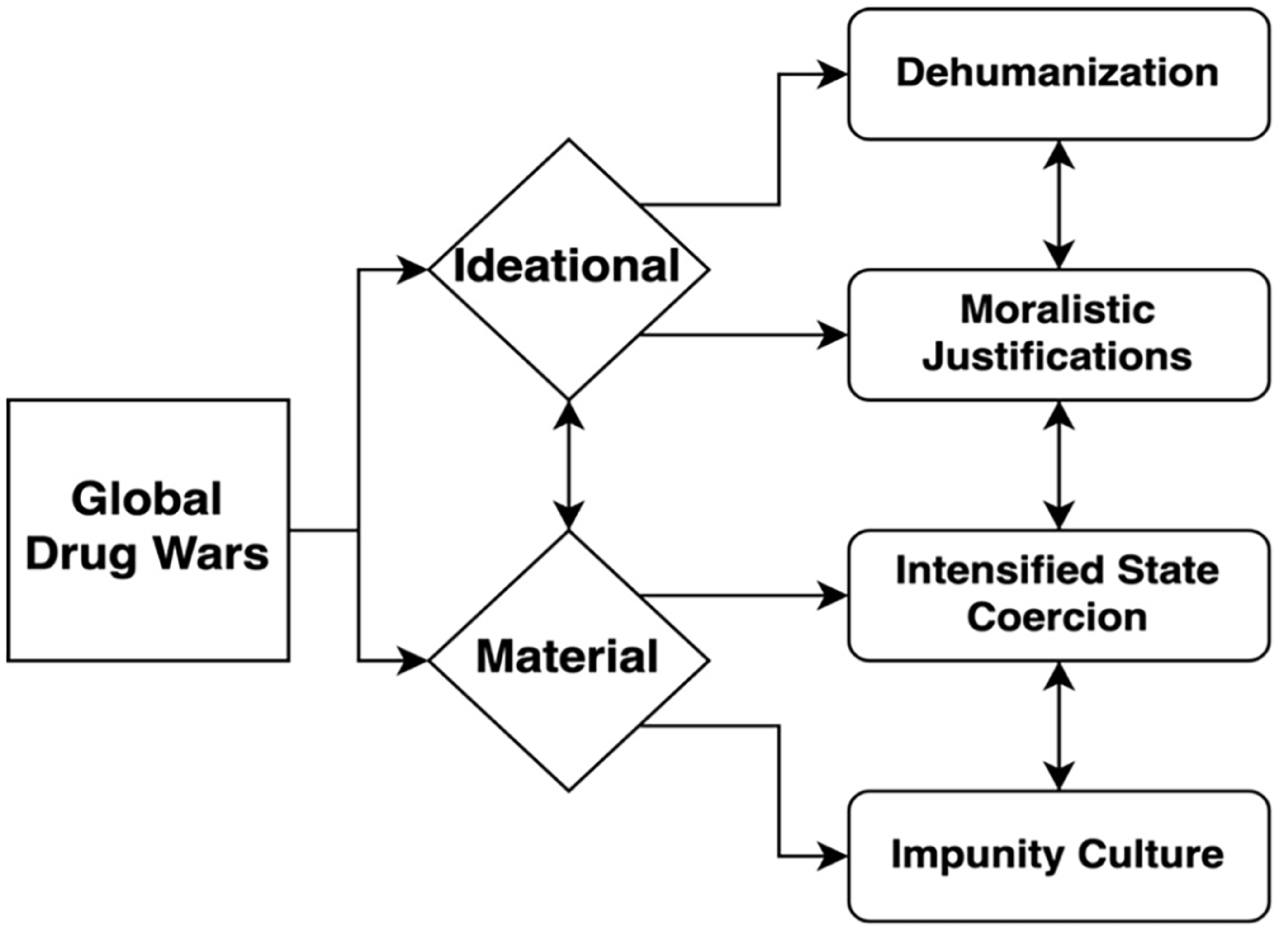
Analytic framework: militarism in global drug wars.
Figure 1 illustrates how militarized drug governance operates through interconnected ideational and material mechanisms, reinforcing militarism as the dominant governance paradigm. Ideational mechanisms—dehumanization and moralistic justifications—shape public discourse, consequently seeking to legitimize repression. Dehumanization constructs drug users and marginalized groups as threats unworthy of legal protection, while moralistic justifications frame state violence as necessary for public order or national security. These narratives enable material mechanisms—intensified state coercion and impunity culture—which translate rhetoric into action. Intensified coercion manifests in militarized policing, extrajudicial killings, mass incarceration, and other forms of state-sanctioned physical integrity rights abuses. Impunity culture, meanwhile, ensures perpetrators of state violence evade accountability. This cyclical relationship—where discourse justifies violence, and violence entrenches discourse—explains the persistence of militarized drug policies despite their detrimental and lethal human rights consequences. This framework could be used to understand political contexts where lethal repression is institutionalized and self-perpetuating.
Dehumanization
Dehumanization is a discursive practice that frames certain individuals or groups as “subhuman” or fundamentally inferior within a hierarchical social order (Smith, 2020). It manifests through discourses, beliefs, and narratives that strip targeted individuals of human dignity, thereby legitimizing exclusion and violence. This discursive violence has a clear colonial genealogy: imperial regimes routinely constructed subject populations as “less than human” to justify dispossession and domination—a logic that endures in settler-colonial contexts such as Palestine, where dehumanizing narratives underpin ongoing human-rights abuses (Atallah and Dutta, 2023). Scholars have conceptualized dehumanization through related terms, including social death (Franklin, 1983; Mawani, 2019; Patterson, 2018), depersonalization (Billig, 2002; Tajfel, 1969), delegitimization (Bar-Tal, 1990; Gesser-Edelsburg et al., 2010; Rak, 2022; Tileagă, 2007), demonization (Giner-Sorolla et al., 2011; Merry, 2003; Savage, 2013), infrahumanization (Castano and Giner-Sorolla, 2006; Delgado et al., 2009; Gaunt, 2009), sub-humanization (Teo, 2020), and moral and social exclusion (Goodale, 2016; Meyers, 1993; Opotow, 1990; Opotow et al., 2005), among others.
Dehumanization plays a central role in legitimizing violence, particularly in the context of global drug wars (Savage, 2013). By constructing certain groups as “Other”—subhuman, inferior, or undeserving of dignity—perpetrators rationalize acts such as extrajudicial killings, torture, enforced disappearances, and harassment. This process serves a dual function: first, by identifying marginalized communities as the root cause of a so-called social crisis (problem diagnosis), and second, by justifying violence against them as a necessary solution (problem resolution). Criminalized populations, particularly the poor, are framed as existential threats to societal stability, making their persecution appear legitimate and necessary.
As Kteily et al. (2015) argue, dehumanization is fundamental to intergroup relations, reinforcing domination and social stratification. While distinct from its material consequences—such as genocide and state-sanctioned violence—it functions as a prerequisite for these atrocities. Beyond drug war politics, dehumanization has been instrumental in legitimizing violence against refugees (Bruneau et al., 2018; Esses et al., 2008; Martikainen and Sakki, 2021), women (Neufeld, 2020; Vaes et al., 2011), persons with disabilities (Graumann, 2014; Parker et al., 2018), racialized communities (Hagan and Rymond-Richmond, 2008; Simon, 2016; Weiner, 2012), the economically poor (Liebenberg, 2005; Rustin, 1973), and marginalized gender identities (Bevens and Loughnan, 2019; David, 2021; Gibbs and Jones, 2013; Tipler and Ruscher, 2019).
Dehumanization begins as a psychological process, reducing individuals to non-human status, which in turn facilitates real-world violence (Mekawi et al., 2019). An expanding interdisciplinary literature confirms its direct link to physical harm and systemic discrimination (Calissendorff et al., 2019; Gani, 2021; Haslam, 2019; Kaati, 2022; Kteily and Landry, 2022; Landry et al., 2022; Murrow and Murrow, 2015; Rai et al., 2017; Savage, 2013; Smith, 2020; Zlobina and Andujar, 2021). Through these mechanisms, dehumanization not only justifies violence but actively structures political and social hierarchies, reinforcing cycles of exclusion and repression.
How does dehumanization contribute to violence and what is its connection to militarism in drug wars? While previous studies have focused on individual-level dehumanization, it is crucial to explore its role within militarism and social hierarchy. Gani (2021: 560) argued that race and militarism are intricately linked and mutually reinforcing, both relying on civilizational stratification. These imperial encounters fostered militarism, which helped maintain global hierarchies. This relationship is laden with racial stigmas of the “Other,” legitimizing military dominance through beliefs in racial superiority and framing battlefield success as proof of such superiority.
Militarism in narcotic governance is deeply intertwined with dehumanization, disproportionately targeting those at the lowest levels of racial, gender, and class hierarchies. As Gani (2021: 546) argues, contemporary militarism sustains the hierarchical legacies of European imperial hegemony, reinforcing racialized subjugation in both the Global North and South. Racial militarism operates through two key mechanisms: fleeing and transferal. Fleeing occurs when postcolonial states assert legitimacy by replicating the punitive tactics of former colonizers, using militarized governance as a marker of authority. Transferal happens when postcolonial elites internalize and impose racialized hierarchies within their own societies, shifting oppression onto marginalized groups, particularly the poor. These processes entrench militarized drug policies as tools of social control, disproportionately targeting low-income and racialized populations.
Racial militarism provides a crucial lens for understanding the global-domestic nexus of drug wars. Race, as Hughey (2015) argues, is not merely a category of identity but a dynamic process that legitimizes socioeconomic inequalities. The relationship between state violence and racialization operates as a feedback loop: racialization constructs hierarchies of belonging, reinforcing inequality, while state violence and structural disparities further entrench racial hierarchies. In global drug wars, state violence is not applied indiscriminately but is strategically deployed to reinforce existing social stratifications. The criminalization of substances has long served as a mechanism of social control, historically associating narcotics with so-called “dangerous classes” to justify repression (Chomsky, 2004: 738).
Drug wars also reinforce gendered hierarchies, with distinct and often lethal consequences for different gender identities. As a violent form of prohibitionism, they impose rigid moral boundaries, where state coercion punishes perceived transgressions. Militarized drug policies are primarily framed as wars for moral order, with public health considerations playing only a secondary role—resulting in mass incarceration and punitive enforcement, especially in economically marginalized and politically unstable regions (Roberts and Chen, 2013: 105). Beyond their racialized and class-based dimensions, drug wars disproportionately harm women, particularly poor women of color. Muehlmann (2018: 325) highlights how Black, Latina, and Indigenous women face harsher penalties for drug-related offenses than their white counterparts, underscoring how racial, gender, and economic oppression intersect in the enforcement of punitive drug laws. Although some variations exist across societies, economic hierarchies, gendered oppression, and racialization remain fundamental logics that shape the militarization of drug policies, consequently structuring how and to what extent someone is criminalized, punished, and subjected to institutionalized violence.
Dehumanization in global drug wars operates not only within states but also through transnational actors that legitimize militarized narcotics governance. The U.S. War on Drugs disproportionately targeted poor communities of color through harsh sentencing laws, aggressive policing, and mass incarceration (Alexander, 2010). Meanwhile, global South elites have weaponized state violence against marginalized populations, as seen in Duterte’s drug war in the Philippines (Regilme and Parthenay, 2023), Thaksin Shinawatra’s brutal anti-drug campaign in Thailand (Regilme, 2018a), and systemic violence against indigenous and impoverished communities in Colombia. Beyond state actors, international institutions reinforce punitive drug policies. The United Nations Office on Drugs and Crime (UNODC) and the International Narcotics Control Board (INCB) have historically promoted prohibitionist frameworks that portray drug users and low-level traffickers as criminal threats rather than individuals affected by socio-economic vulnerabilities (Jensema and Sandwell, 2018). These narratives justify militarized crackdowns while neglecting the structural drivers of the drug economy, such as poverty and inequality. The INCB has urged states to halt extrajudicial killings and reconsider capital punishment for drug offenses, exposing the tension between enforcement and human rights.
In highly stratified societies of the Global South, elites rely on state militarism to maintain dominance while framing marginalized groups as criminal or disposable. This mirrors the North’s reliance on racialized policing and punitive governance to uphold hierarchies of power. By replicating the North’s obsession with violence and exclusion, global South elites institutionalize militarized drug policies, entrenching local inequalities under the guise of law and order. Dehumanization thus serves as the ideological foundation and discursive instrument of implementation of racial militarism, sustaining drug wars as transnational projects of control, punishment, and subjugation.
Moralistic justifications
Moralistic justifications lie at the heart of public policy, especially in constitutional democracies where a semblance of public awareness, if not acceptance, is necessary for a particular political action to be deemed legitimate. There is a need for a normative explanation of why political leaders decide how they have become more urgent, particularly in the exercise of state violence. What motivates an increase in the budget for the police and military forces? Why do state authorities resort to lethal measures in their antidrug policy? I contend that public discourse plays a crucial role in enabling increased state violence, specifically drug regulation, which demands significant resources and cooperation from state and non-state actors. These discourses are necessary to support policy strategies through three key tactics: (1) justifications, (2) political personification, and (3) delegitimization.
First, normative discourses provide a set of reasons and explanations for political objectives and policy actions. They constitute a type of noncausal discussion that evaluates whether an action is good, bad, or necessary (Väyrynen, 2021: 278). These discourses function as justifications for policy approaches that often require public compliance. In practice, government leaders and their supporters deploy two kinds of discourses: cognitive (causal) and normative (Schmidt, 2008, 2010, 2011).
Cognitive ideas provide cause-effect explanations, identifying factors that supposedly generate policy problems and shaping political responses accordingly. Politicians frequently assert that drug use leads to crime, poverty, and homelessness, positioning their preferred policies as the most effective solutions. For instance, the Mexican government strategically framed drug violence as an internal conflict among drug traffickers rather than acknowledging state-led extrajudicial killings. By claiming that “drug violence is an outcome of disputes internal to the drug trade” (Wright, 2011: 719), officials deflected blame from state forces and justified militarized drug policies as a necessary response to an external threat.
Normative ideas, on the other hand, appeal to values and principles to justify political actions and mobilize public support. Concepts such as peace, human rights, and development are often invoked to underpin policy proposals, but they remain highly malleable and open to strategic framing. For example, during the Reagan administration, the U.S. government promoted a “major coordinated assault on drugs,” calling for international cooperation to combat drug production and trafficking (Reagan, 1988). More recently, in 2019, U.S. President Donald Trump signed an executive order designating drug cartels as terrorist organizations, expanding the government’s powers to impose economic sanctions and potentially justify military actions against them (Wired, 2025). Similarly, former Philippine President Rodrigo Duterte weaponized human rights rhetoric by claiming his brutal anti-drug campaign protected law-abiding citizens from “drug-crazed criminals,” portraying state-perpetrated extrajudicial killings as a moral necessity. In contrast, some transnational actors have framed drug policy through a different normative lens. During the International Day against Drug Abuse and Illicit Trafficking in June 2022, UN Secretary-General Guterres (2022) called for combating drug-related crime through a “health and human rights” approach, emphasizing creative policy solutions, global collaboration, and science-based treatment for drug users as victims in need of care rather than punishment (pp. 3–5). Even within human rights discourse, drug policy framing remains contested, as actors strategically invoke normative arguments to justify militarization or public health interventions. These examples illustrate how cognitive and normative discourses shape public perception and policy responses to drug-related issues. By framing drug use as a root cause of social disorder and invoking normative values to justify militarized interventions, political leaders garner support for policies perpetuating cycles of violence and repression. Conversely, alternative normative framings, such as advocating for health-based approaches, highlight the ideological and political struggles shaping global drug policy.
Second, political actors sometimes present themselves as embodiments of the normative ideas they invoke as justifications for their political objectives. Normative ideas can be framed in ways directly related to the users. By presenting themselves as personified embodiments of morals, political leaders seek to increase their moral standing and political legitimacy while exaggerating their capacity to deliver the needed public goods to their constituency. In September 2022, former U.S. President Donald Trump, addressing supporters in Ohio, positioned himself as a savior, claiming the government should conduct show trials and execute drug dealers, asserting that a single dealer was responsible for 500 deaths (Crosse, 2022: 10, 13). In 2019, Brazilian President Jair Bolsonaro, speaking at the UN General Assembly, portrayed his administration as a bulwark against crime and moral decay, blaming past governments for leniency toward drug traffickers. He framed his hardline policies as essential to restoring Brazil’s moral and social fabric (Bolsonaro, 2019). Similarly, in 2024, Italian Prime Minister Giorgia Meloni, at the Summit of the Global Coalition to Address Synthetic Drug Threats, positioned herself as a global defender of traditional values, calling for a united international front against drug trafficking. By linking the drug trade to broader cultural and security threats, she framed her stance as a moral imperative, reinforcing her image as a protector of Italy’s social order (Meloni, 2024). These examples illustrate how leaders use moralistic narratives to present anti-drug campaigns as existential battles between order and chaos. By embedding their policies within moral frameworks, they transform drug control from a policy issue into a justification for militarized governance.
Third, normative justifications serve to delegitimize political opponents and reinforce elite control by framing resistance as a threat to public order. In Brazil, the pacted transition of the 1980s entrenched impunity for state violence, creating a “securitized democracy” where human rights advocates were labeled “allies of criminals” and subjected to harassment and police violence (Décary-Secours, 2021: 525). Similarly, during Thailand’s 2003 war on drugs, Prime Minister Thaksin Shinawatra’s government justified over 2800 extrajudicial killings within 3 months by using moralistic rhetoric to discredit critics. When the UN condemned these abuses, a Thai Foreign Ministry spokesperson defended them as necessary, while Thaksin dismissed international pressure, stating, “The United Nations is not my father” (Dabhoiwala, 2003). He further attacked opponents’ moral credibility, arguing that critics should “direct their empathy to our children who are victims of the drug menace, instead of sounding the alarm for falling traffickers” (Cheesman, 2003: 31). The U.S. war on drugs under President Richard Nixon (1969–1974) similarly served as discursive propaganda to discredit political enemies. In a 1994 interview, Nixon’s domestic policy chief, John Ehrlichmann, admitted that the drug war was designed to target the antiwar left and Black communities. By associating marijuana with hippies and heroin with Black people, and criminalizing both, Nixon aimed to disrupt and vilify those groups, despite knowing the narrative was false (LoBianco, 2016: 4–5).
Moralistic justifications in drug wars are often crafted to persuade majority group members that militarization is the most effective policy. Criminological research in the U.S. suggests that minoritized groups are more likely to distrust state institutions than dominant groups aligned with ruling elites (Arthur and Case, 1994; Barkan and Cohn, 1998; Johnson and Kuhns, 2009). Another tactic for legitimizing illiberal policies in constitutional democracies is weaponizing legal frameworks to consolidate political power. As Gerber and Jackson (2017: 80) argue, police are authorized to use coercive violence, but its justification relies on legal statutes, professional norms, and societal expectations. Governments frequently cite new laws or reinterpret existing ones to expand state power and normalize police violence (Gerber and Jackson, 2017). Such justifications bolster the empirical legitimacy of policy strategies while presenting ruling elites as having a solid normative basis for authority and compliance (Hinsch, 2008; Tyler, 2006).
Militaristic approaches to drug regulation are often justified by framing drug control as essential for national security and social order, thereby legitimizing state violence. In the United States, former President Donald Trump leveraged the fentanyl crisis to advocate for stricter domestic drug laws and the militarization of the U.S.-Mexico border. He pressured Mexican President Claudia Sheinbaum to deploy 10,000 National Guard troops to the border to combat drug trafficking and illegal immigration (Janetsky, 2025). While international bodies like the United Nations Office on Drugs and Crime (UNODC) and the International Narcotics Control Board (INCB) do not explicitly endorse militaristic strategies, their calls for international cooperation against drug trafficking are sometimes co-opted by national leaders to justify violent crackdowns. For example, Thailand’s Prime Minister Thaksin Shinawatra invoked international drug control rhetoric to rationalize his 2003 “war on drugs,” which resulted in over 2800 extrajudicial killings within 3 months (Regilme, 2018b). Similarly, Colombia’s former President Álvaro Uribe used the global discourse on drug prohibition to legitimize aggressive military actions against drug cartels, leading to significant human rights violations (Regilme, 2018a). By presenting prohibitionist policies as necessary for global stability, these institutions inadvertently provide a framework that states can exploit to expand coercive power, entrenching militarized drug wars with devastating human rights consequences.
Intensified state and institutionalized violence
What does intensified state violence mean in the operational context of drug wars? In this case, intensified violence refers to the expansive deployment of coercion by the state (or its designated principals), which causes physical and non-physical harm to civilians purportedly linked to narcotic drugs. Sklansky (2021: 16–17) maintains that state action can be considered violent even without physical harm, as non-physical harms such as emotional assaults or the impact of racism and poverty can be just as damaging, if not more so. State forces are widespread in Medellin in Colombia (as opposed to the posh neighborhood of Chico in Bogota). State authorities deploy intensive surveillance and checks on poor residents, which suggest selective state violence that is often not captured by a paradigm of violence that focuses merely on death or physical injuries. Similarly, state leaders, such as Duterte’s persistent shaming of poor neighborhoods in Metro Manila or Trump’s public denigration of homeless people as drug addicts, speak of acts of nonphysical violence committed by the state. As human rights anthropologist Nancy Scheper-Hughes argues, “words can be like rape — they destroy you’ (Fuller, 2017: 28), while others have noted that extreme material inequalities and power differentials already constitute a form of symbolic and structural violence in society, often perpetrated by state authorities (Banko, 2022; Bourdieu, 1992; Hallett, 1998; Ho, 2007; Regilme, 2023a, 2023b; Rossiter and Rinaldi, 2018). As such, dehumanizing discourse serves as an important modality of state violence.
Militarism is a modality of institutionalized coercion in global and national drug governance, with an increasing integrative focus on narcotic drug interdiction and prohibition. 2 State agencies, including the military, police, and other national security service offices, were redirected to the drug war by central executive governments. Through cooperation, they adopted an anti-drug comprehensive approach, reasserting the state’s monopoly on the legitimate use of coercion. Drug wars serve as a logic of state domination over its subjects, transforming and consolidating state power and legitimizing political subjection through violence (Kraska, 2007; Nugent, 2010).
Second, intensified state violence constitutes the expansion of the state’s coercive apparatus through increased budgets, new security agencies, and revolving doors between state security and civilian bureaucratic leadership positions. This comprehensive approach results in mainstreaming public support for militarism and martial values, as well as the glorification of punishment, causing widespread suffering among civilian victims. Fassin (2019) notes that punishment generates “gratuitous suffering,” which serves no purpose other than causing pain. State leaders’ moralistic discourse justifies sacrificing the lives of drug war targets in pursuit of higher purposes. The aim of intensified state violence is to demonstrate sovereign power over those involved in narcotics. Legal scholar Kahn (2008) theorizes that the demonstration of sovereign power is more important than justice and that torture can be effective even without it. This results in a normative order of drug wars, including the practice of sacrifice and killing, extending beyond language and symbolism.
Expanded state violence in drug wars coincides with neglect of the state’s social welfare apparatus, as the central government allocates political capital and funds to support security agencies. This privileging of militarism and disregard for socioeconomic development is exemplified by state-led drug wars, where the presumed enemy is a social and economic force sustaining drug trade. Thaksin’s War on Drugs in Thailand (2001–2006) and Duterte’s regime in the Philippines (2016–2022) targeted activists, opposition members, and suspected drug traffickers or petty offenders. This approach failed to address the socio-economic causes of drug use and production and undermined political opposition, rather than comprehensively addressing narcotics demand (Youngers and Rosin, 2005).
Expansion of domestic state repression is sustained through inter-state cooperation, where powerful states externalize militarized drug enforcement to weaker counterparts. This transnationalization of repression is central to Robinson’s (2020) “global police state”—a system where militarization, surveillance, and counterinsurgency tactics are deployed across borders under the guise of security governance. The United States exemplifies this paradigm, funding anti-drug operations in the Global South while shielding itself from consequences of its drug consumption. In Colombia, U.S. counter-narcotics aid under Plan Colombia militarized drug enforcement, leading to extrajudicial killings, forced displacement, and paramilitary violence expansion (Avilés, 2008; Regilme, 2018a). In Mexico, the Mérida Initiative intensified state violence against alleged drug traffickers, empowering security forces accused of human rights abuses while failing to curb cartel influence. The U.S. has funded militarized drug crackdowns in Southeast Asia, including Duterte’s war on drugs in the Philippines, where U.S. security assistance indirectly bolstered police and military impunity. European states externalize narcotics enforcement by funding interdiction efforts in North and West Africa, reinforcing violent border securitization policies under the pretense of stopping drug trafficking routes. These forms of inter-state cooperation entrench a global war on drugs framework, where militarism is a transnational apparatus of control, reinforcing repression while leaving drug economies largely intact.
Impunity culture
Impunity culture refers to the unwritten sociopolitical norm that perpetrators of state violence are unlikely to face successful judicial prosecution, and if they do, the penalties are often remarkably less compared to less powerful non-state actors. This norm facilitates widespread extrajudicial killings and abuse, whereas state agents ignore their human rights obligations and other legal consequences. Impunity refers to the unlikelihood of holding perpetrators accountable through inquiry, trials, and penalties, due to the absence of institutionalized accountability (Orentlicher, 2005: 6). Impunity is not just the result of ineffective judicial institutions but can be attributed to the state’s broader systemic failures, including the legal framework, administrative apparatus, public servants, and civil society’s consent to this pattern of power (Loera-González, 2021: 5). Impunity, the lack of justice and accountability for state violence, is a significant impediment to human rights. During security crises, such as drug wars, state agents are not constrained by constitutional principles or international treaties for human rights, and impunity culture represents one of the most intractable problems in constitutional democracies (Jorgensen, 2009: 386). In societies with an entrenched impunity culture, it is difficult to expect that the state will effectively and justly punish its powerful agents when it is both the guarantor and violator of human rights norms.
Notably, only a small percentage of crimes committed during Mexico’s drug wars have resulted in justice, with the vast majority went uninvestigated and unpunished (Ingram and Shirk, 2012; Kerpel, 2007; LeClercq and Rodriguez, 2016; Lecuona, 2018; Muñoz and Frey, 2019). This highlights the failure of the criminal justice system to hold accountable those responsible for state violence, particularly in the context of US-funded drug wars in Mexico (Muñoz and Saltalamacchia, 2019). Liberal democracies deviate from their own human rights commitments by failing to bring abusive state agents to justice, thereby illustrating impunity as a deviation from constitutionalized human rights principles. Jorgensen (2009: 386) describes this lack of accountability as “official impunity,” or the inability of governments to apply state laws in a way that equally and fairly applies to both state agents and the civilian population. Impunity undermines not only the rule of law but also normative expectations about respect for human dignity and justice. Although Cheesman (2009) prefers to use the “unrule” of law as a synonym for impunity, it appears that impunity in global drug wars is not purely a deviation from or the absence of compliance with the law per se (Cheesman, 2009). Rather, impunity here pertains to the bifurcated application of the law: severe and lethal punishment awaits those at the marginalized sectors, while those at the top of the socioeconomic hierarchy remain protected.
Several factors generate impunity among abusive state agents in the context of drug wars and mass violence. 3 First, governments that implement drug wars often issue internal executive orders and policies that permit abusive actions among state agents, although such actions may be construed as human rights violations. Such state actions are repackaged as legally permissible and publicly supported, thus facilitating accountability evasion by abusive state agents. Internal norms within the state’s coercive agencies empower state agents to arbitrarily deploy their power during drug war operations, even when such actions deviate from constitutionalized human rights norms. Obedience statutes grant the police more arbitrary power, allowing them to criminalize anyone who is perceived as disobedient to state agents, who in turn, respond with force at their discretion, despite police manuals on the proper use of force (Chatterjee, 2017: 127; Martinot, 2008: 21).
Second, the historical legacies of impunity for previous human rights abuses could perpetuate impunity for ongoing and future violations, thereby creating the expectation that abusive state agents are immune to judicial prosecution and severe penalties. Impunity for abuse may be driven by a security culture that is militaristic in nature and has developed over time (Rangelov and Theros, 2019). Rangelov and Theros (2019, 408–409) argue that the “security war on terror” relies on constructing an enemy that is seen as an existential threat, which requires an extraordinarily militaristic response. This construct is continually reproduced by political authorities to maintain a state of permanent mobilization against the enemy. US-supported counterterrorism efforts under President Gloria Macapagal-Arroyo galvanized the basic foundations of Duterte’s drug wars in the Philippines, including the expansion of the security apparatus, dehumanization of drug addicts, and the possibility of suspending the rule of law to tackle the crisis (Regilme, 2021). In the case of South America, which is often pegged as a regional hotspot for drug war operations, “staggering impunity,” perpetrated by deficiencies in the justice system, is the primary cause of ongoing violence committed by both state and non-state actors (Bergman, 2018: 305). Reforming the judicial system to address police brutality in Brazilian drug war operations takes time, as “legacies of dictatorship” have resulted in aggressive mano dura tactics against “domestic insurgents” being seen as a solution to drug crimes (Costa, 2011; Fahlberg et al., 2023).
Third, a culture of impunity emerges when high economic incentives drive individuals to participate in the illicit drug trade despite the risks. Meehan (2011: 376) argues that the illegality of the drug trade paradoxically incentivizes drug consumption and trafficking, while also enabling state agents to coerce and co-opt insurgent groups by offering legal protection and financial opportunities. Bergman (2018: 249) notes that organized crime, including drug trafficking, operates on a market logic where lawbreaking is normalized and highly profitable, further fueling participation. In states where drug trafficking dominates the illicit economy, state institutions frequently collude with non-state drug actors, undermining state legitimacy and entrenching impunity. This dynamic defines narco-states, where a revolving door exists between government agencies and organized crime (Bourgois, 2018: 392). Corrupt officials facilitate money laundering, shield cartels from prosecution, and protect other illicit industries like illegal mining and logging. Bourgois (2018: 392) highlights how, in several South American countries, officials can be bribed for a fraction of the wealth amassed by drug lords, reinforcing a justice system that safeguards criminal enterprises. Weak state institutions, corruption, and inadequate public goods provision perpetuate violence, extrajudicial executions, and systematic human rights violations (Wolf, 2016: 114). In El Salvador, multisided violence—structural, symbolic, political, gender-based, and everyday—illustrates how impunity fuels state violence and accountability deficits (Walsh and Menjívar, 2016: 586). This convergence of economic incentives, corruption, and state complicity sustains a cycle of violence, further eroding the rule of law.
Fourth, a strong, independent civil society is essential in narcotic drug governance, as its absence enables state excesses in drug wars and reinforces impunity. Fahlberg et al. (2023: 9) note that feminist and anti-state violence advocates primarily demand an end to impunity rather than targeting individual drug syndicate members or corrupt police agents. In Venezuela, activists leverage social media and international courts to pressure the government, while in Colombia, they focus on restorative justice and collective memory to address past violence. However, these efforts do not indicate democratic strength but rather expose the state’s failure to apply laws equally, particularly to abusive officials. State actors and armed non-state groups involved in the drug trade have systematically weakened human rights advocates, restricting political resistance and reinforcing repression. The International Criminal Court’s investigation into former Philippine President Rodrigo Duterte’s war on drugs—the first international case addressing human rights abuses in militarized drug enforcement—illustrates the entrenched impunity that has long shielded drug war policies (Regilme, 2025). For decades, state-led violence persisted unchecked, protected by sovereign immunity, political alliances, and the normalization of militarized drug control. The fact that it took until the 21st century for such a case to emerge highlights global complicity in sustaining drug war abuses. Crucially, this case was not state-led but the result of sustained civil society activism, as human rights groups and victims’ families meticulously documented extrajudicial killings, pressured international bodies, and pursued legal action. While it signals a potential shift, it also underscores the long-standing failure of global institutions to hold political leaders accountable for human rights violations committed under the guise of narcotics control.
Conclusions
In closing, the four mechanisms—dehumanization, moralistic justifications, intensified state violence, and impunity culture—form the backbone of militarized narcotic drug governance, appearing consistently across diverse contexts as a structurally embedded cycle of state violence. These mechanisms are not incidental or independent; they constitute a self-reinforcing architecture that sustains and legitimizes coercive drug policies. Dehumanization is the linchpin—by casting certain populations as subhuman threats, the state erases their moral and legal personhood, making them expendable subjects of violence. Yet dehumanization is amplified and rationalized through moralistic justifications, which frame state repression as a necessary safeguard for public order, national security, or societal well-being. These ideational mechanisms provide the discursive scaffolding for intensified state violence, manifesting in militarized policing, mass incarceration, and extrajudicial killings. While intensified violence often stems from these justificatory narratives, it can also emerge semi-autonomously, particularly when political elites instrumentalize drug wars to consolidate power or suppress dissent. Impunity culture completes this architecture, institutionalizing state violence by shielding perpetrators from accountability, thereby normalizing brutality as an enduring mode of governance. These mechanisms unfold in a mutually reinforcing dynamic, where violence begets more violence, entrenching human rights abuses and fortifying structural hierarchies within national and global drug policy regimes.
This framework captures the structural logic of militarism in narcotics governance, showing how its mechanisms form a self-perpetuating system. By integrating ideational and material dimensions, it moves beyond simplistic cause-effect models to reveal the deep entrenchment of militarized governance. However, while it explains how militarism is legitimized and institutionalized, it does not fully account for variations in intensity—why some states and political actors escalate drug wars into mass atrocities while others adopt less extreme coercion. Still, the framework applies to broader human rights crises, from counterterrorism campaigns to anti-migrant crackdowns and authoritarian repression. Applying it to these contexts can illuminate common patterns of state-sanctioned brutality and strategies for disrupting its cycle.
Future research should explore variations in militarism across countries to understand why some states intensify drug wars while others do not. For human rights activists and drug policy practitioners, this article underscores the urgent need to challenge the global normative order that legitimizes militarized narcotics governance. Reform must prioritize harm reduction and human rights, shifting away from punitive measures that criminalize drug users toward evidence-based, health-centered interventions. By contrast, harm reduction represents an alternative approach: as Keane (2003) argues, interventions such as needle-and-syringe programs and supervised consumption sites reconceive people who use drugs as rights-bearing individuals rather than criminals, directly challenging the punitive logic that undergirds militarized drug policy. For example, in U.S. and Canadian Housing First programs, which explicitly integrate harm reduction, participants experienced a roughly 40 % decrease in overdose events and a 25 % rise in housing stability within 1 year, concrete evidence that non-coercive, rights-centered interventions both save lives and foster social integration (Watson et al., 2017). Such efforts must go beyond symbolic commitments and center the voices of those most affected, particularly financially impoverished communities of color. They must also address the enduring structural conditions fueling marginalization, including socio-economic inequalities, racialized hierarchies, and colonial legacies.
Footnotes
Acknowledgements
The author thanks the editor and anonymous reviewers of Critical Sociology, as well as colleagues at NIAS Amsterdam for their feedback—especially Marius Pieterse, Aaron Pitluck, Annelies Moors, Kate Brown, among others.

Funding
The author disclosed receipt of the following financial support for the research, authorship, and/or publication of this article: This article is the result of research conducted during the author’s sabbatical semester funded by the Netherlands Institute for Advanced Studies in the Humanities and Social Sciences (NIAS)—Amsterdam Individual Fellowship 2022–2023 and Sabbatical Grant from the Leiden Institute for History.
Declaration of conflicting interests
The author declared no potential conflicts of interest with respect to the research, authorship, and/or publication of this article.