




Abstract
This study maps latent forms of political consciousness in the contemporary working class, moving beyond a narrow focus on far-right leanings among workers. Based on in-depth interviews with German manual workers, we reconstruct how workers criticize injustices of redistribution, recognition, and representation. We show that rather than any systematic political ideology, what dominates workers’ accounts is the moral scandalization of broken promises and violated expectations. The political consciousness of workers is defined by a reactive sense of injustice centered on violations of an implicit social contract. Building on Axel Honneth and Klaus Dörre, we interpret this as symptomatic of the political horizon of “demobilized class societies”. These are societies that continue to be structured by class relations but in which class-based identities and political representation channels have fragmented. Lacking a sense of collective agency, workers retreat to a defensive position centered on warding off the transgressions of groups above (the rich, bosses, and politicians) and below (‘takers’, intruders, and cheats). Politically, the moral grammar of the demobilized working class is ambivalent and contains openings for both right- and left-wing mobilization.
Keywords
Introduction
‘Before being felt, perceived, appreciated, understood, avowed, and proclaimed aloud by both sides’, Marx (1977 [1847]: 112) writes, the class struggle ‘expresses itself, to start with, merely in partial and momentary conflicts’ remaining ‘more or less disguised, existing only in a latent state’. 1 This disguised and latent state of class conflict, beneath the radar of overt political struggles, has been the subject of a long tradition of inquiry, including the work of Thompson (1963), Scott (1992), or Bourdieu (1984). In this article, we pick up the thread of this tradition to make sense of working class political consciousness in today’s historical conjuncture of class demobilization. Empirically, our study uses interviews collected in Germany, zooming in on a fraction of the working class that has been at the center of recent public debates about working class politics: predominantly male workers in manufacturing, construction, and small trades. 2 We map typical repertoires of everyday social critique voiced by these workers, regardless of whether these forms of critique explicitly draw on a vocabulary of class or cohere into systematic political ideologies (McCarthy and Desan, 2023). Specifically, we follow Fraser (2005) in mapping how workers critique injustices of redistribution, recognition, and representation.
In our interpretation, discourses of everyday critique are central for understanding the latent political consciousness that dominated groups develop in today’s demobilized class societies (Westheuser and della Porta, 2022). This term refers to a historical conjuncture in which class relations remain formative for life chances and everyday experience, but in which cultural forms of collective class identity and political channels of class representation have become fragmented (see Dörre, forthcoming). Building on Axel Honneth (1982) and Barrington Moore (1978), we theorize how under demobilized circumstances the core of workers’ social critique lies in a sense of injustice that is defined negatively, in terms of transgressions of an implicit social contract. We argue that reconstructing the moral grammar of everyday critique offers important insights into workers’ political orientations and can help to correct stereotypical depictions of the working class as uniformly in thrall to radical right ideology.
At the latest since 2016’s ‘Trump/Brexit moment’ (Dodd et al., 2017), the ‘white working class’ of the declining manufacturing sector has become a core social figure for explaining radical right successes—both in academic studies (Cramer, 2016; Gest, 2016; Hochschild, 2016; McDermott et al., 2019) and in the political discourse of right-wing populists themselves (Mondon and Winter, 2019). A large number of studies have identified workers, particularly majority-ethnic, male, and skilled workers in the shrinking parts of the manufacturing sector as a key voter group for the radical right (Bornschier, 2018; Oesch and Rennwald, 2018; Westheuser and Lux, 2024). Interpreted as a symptom of a new divide between the winners and losers of structural change towards globalized knowledge economies (De Wilde et al., 2019; Kriesi et al., 2012; Rydgren, 2012), the overrepresentation of workers in right-wing electorates has been understood by some as a backlash of traditional ‘communitarians’ against the cultural hegemony of a highly qualified, ‘cosmopolitan’ new middle class (Norris and Inglehart, 2019; Reckwitz, 2021).
As a corrective to the premature ‘farewell to the working class’ in the 1980s and 1990s, the search for the class bases of the radical right ascendancy has produced a host of insightful analyses. At the same time, it is striking that the intense public fascination with radical right leanings among workers has not led to similarly animated discussions on the lives, identities, and struggles of the working class as a whole. The equation of workers with the radical right in public discourses threatens to narrow the view of current dynamics of class and politics. According to the German General Social Survey, the proportion of German production workers who classify themselves as right-wing has remained constant at around 20 % over the last 30 years (ALLBUS, 2018); 14.7 % voted for the radical right-wing Alternative for Germany in the 2021 federal election (German Longitudinal Election Survey [GLES], 2022). 3 Although in some preliminary polls this shot up to 38% in the 2025 elections, a large part of the German working class is still left out of a singular focus on radical right voters (see also Abou-Chadi et al., 2021: 11 ff.; Westheuser and Lux, 2024).
An equally pronounced trend in workers’ political behavior—albeit one that is much more rarely addressed—is the mass refusal of workers to participate in a system of political representation that increasingly excludes their preferences from consideration (Elsässer and Schäfer, 2023; Evans and Tilley, 2017). Yet this trend of growing political inequality also has important consequences for understanding working class political reasoning: Since workers consistently exhibit lower levels of political knowledge and interest, express a skeptical distance towards the political system, and attribute less political efficacy to themselves than the rest of the population (see below), it is doubtful whether political orientations in the working class are accurately described with the terminology of ideological party competition, such as ‘left’ and ‘right’, ‘liberal’ and ‘conservative’, or ‘cosmopolitan’ and ‘communitarian’. These terms project an ideological coherence that does not do justice to the much more fragmented, ambivalent and contradictory logic of workers’ political orientations. 4
In order to avoid these reductionisms, this study develops a theoretical and empirical strategy to capture contemporary workers’ political consciousness in all its ambivalence. Our aim is to describe the implicit grammar of political orientations under conditions of demobilization and to reconstruct the categories and repertoires that workers themselves use to make sense of politics. As explained in detail below, we approach political consciousness through the repertoires of everyday social critique working class interviewees draw on, as well as the normative expectations which form the implicit horizon of these repertoires. How do workers voice a critique of social relations, with reference to which expectations and addressed to whom? How do they articulate views of inequality and competition, changing regimes of recognition and political marginalization? What is the relationship between everyday critique and political ideology?
Empirically, we rely on in-depth interviews with predominantly male production workers in industry, crafts, and construction in Germany (Oesch, 2006, for details on the sample see below and the Appendix). As is inevitable for a qualitative study, this introduces national, gender, sectoral and other limits into our view the working class, and invites further comparative studies, for example, focused on workers in feminized service sector occupations. In addition, for lack of a comparison group, we only claim the forms of consciousness reconstruct to class-typical, without being able to gauge the extent to which they are class-specific. Despite these limitations we see the class fraction we focus on as crucial for the question of contemporary working class politics, because it has been at the center of recent discourses for exhibiting the most pronounced swing towards radical right parties (Bergfeld, 2018; Oesch and Rennwald, 2018).
Theoretically, we build on an important early work of Honneth’s (1982), ‘Moral Consciousness and Social Class Rule’. With Honneth, we localize the normative core of critique available to dominated classes in a reactive and negative sense of injustice. The scandalization of broken promises and violated claims—and not ideological positionings or cultural demarcations—are at the center of workers’ political consciousness. Empirically, our study builds on current advances in the sociology of class, labor studies and Bourdieusian cultural class analysis. Labor studies are currently seeing a revival of workers’ consciousness research. Picking up from classic studies of the post-war period (Kern and Schumann, 1985 [1977]; Kudera et al., 1979; Popitz et al., 2018 [1957]), German studies look at views of social inequality, economic crisis, and precarization (Detje et al., 2011, 2013; Goes, 2015) or at workers’ normative expectations on work and working conditions (Hürtgen and Voswinkel, 2014; Kratzer et al., 2015; Menz and Nies, 2021). In direct continuation of the classic study by Popitz et al. (2018 [1957]), a number of studies also deal with employees’ images of society, their anchoring in company experiences and their political implications (Dörre et al., 2013; Köster and Lütten, 2018; Lütten and Köster, 2019). Our study takes up this line of research and draws in particular on the work of Kratzer et al. (2015). 5
Another point of reference are studies in the tradition of cultural class analysis inspired by the work of Pierre Bourdieu (Savage, 2012). These studies examine the group-specific repertoires of categorization and demarcation by means of which inequalities are perceived and evaluated in everyday life (Lamont, 2000; Sachweh, 2012). The focus here is on the way in which objective relations are mediated and internalized through symbolic distinction and boundary-making (Jarness et al., 2019; Lamont and Molnár, 2002). 6 Particular attention is paid to class-specific relations to politics in general (Damhuis, 2020; Gaxie, 1978). This is based on the insight that the question of class-divided political attitudes toward various issues is downstream from a more fundamental question of the unequal access to the playing field of politics itself (Bourdieu, 1984, 1991). Whether or not citizens perceive themselves as authorized to have an opinion and publicly articulate it crucially shapes the form of their political consciousness, and this authorization is strongly linked to class and educational hierarchies (Laurison, 2015).
Following both paradigms, we reconstruct typical forms of working class political consciousness on the basis of cultural repertoires of critique, as well as the moral economies and constellations of social conflict and comparison invoked. We situate our analysis with a set of indicators showing what it means to speak of Germany (and other similar countries) as a ‘demobilized class society’ (next section). We present a theoretical framework for understanding workers’ political consciousness under conditions of demobilization (3) as well as our data and methods (4), and then empirically reconstruct seven typical repertoires of critique along three dimensions of justice: distribution, recognition and representation (5). This is followed by a discussion of common threads running through these repertoires and the political implications of our findings.
Germany as Demobilized Class Society
As mentioned, demobilized class societies are societies in which class continues to be a central principle of inequality and domination, but where class is absent from cultural expressions of group identity or representative claims in the political arena. Paraphrasing Thompson (1978), we can describe them as class societies without classes. As we show here on the basis of a number of indicators, Germany is such a society, in which the situation of the working class fraction we study is marked by classed economic pressures, coupled with political exclusion and a marginalization in public discourses. A number of recent studies have highlighted the increasing virulence of class differences for individual life-chances, social rights, and working conditions (Dörre et al., 2024; Holst et al., 2021; Mayer-Ahuja and Nachtwey, 2021). While the German model had long been considered successful by international standards thanks to its low unemployment rate and a strong export-led economy, economic stabilization in intensified international competition has come at a cost for the working population. The gradual erosion of corporatist and industry-wide forms of regulation was a key factor in adapting to the changed economic conditions (Dustmann et al., 2014; Nachtwey and Balhorn, 2019). The proportion of people employed in companies bound by collective agreements has fallen sharply since the 1990s. 7 From this time onwards, trade unions increasingly accepted opening clauses in collective agreements that allowed deviations from agreed working hours and wages under the premise of securing jobs and locations. At the same time, a low-wage sector emerged that was promoted by social policy, in which atypical forms of employment predominated. Studies show that this had a disciplinary effect also on skilled labor market insiders (Brinkmann et al., 2006; Dribbusch and Birke, 2014).
The erosion of nationwide collective agreements also made itself felt in incomes (Nachtwey, 2018). Price-adjusted gross hourly earnings in Germany stagnated between 2000 and 2009. Although a moderate increase has been recorded again since 2010 (Seils and Emmler, 2020), 8 a polarization of incomes can be observed at the same time. The disposable household income of the top decile increased by more than 27% between 1999 and 2018, while that of the bottom two deciles stagnated (Grabka, 2021). Since 2007, the top income decile has had a larger share of total income than the bottom half (World Inequality Database [WID], 2022). 9 According to our calculations, the average income of skilled workers in production was on average 14.5 % lower than that of the rest of the workforce; the incomes of un- and semi-skilled production workers lay 22.3 % below that of the average wage earner (Sozio-oekonomisches Panel [SOEP], 2019). 10
In addition to these structural pressures, workers are increasingly demobilized organizationally and politically. A continuous decline in trade union membership (Figure 1) corresponds with a sharp drop in strike days among German wage dependents since the mid-1980s (Figure 2). In the first half of the 1970s, the average number of strike days per worker was ten times higher than it is in the current period. This demobilization is accompanied by fragmentation and drying up of traditional channels of political representation, particularly those previously provided by social democracy (Bartolini, 2000; Gingrich, 2017; Hall, 2020). While identifying as part of the working class doubled the likelihood of voting for the German Social Democrats in the mid-1970s (see Bornschier et al., 2021: app. 5), today working class identification partly predicts voting for the radical right, but importantly also goes hand in hand with abstention from voting altogether (Westheuser and Lux, 2024: 16). As Figure 3 shows, workers in industry and crafts are much less likely to feel close to any political party than the average of the voting population, a gulf that widened massively over the course of the 2000s and 2010s. Similar trends have been shown for abstention rates and political interest (Kahrs, 2018). Workers are underrepresented susbstantively, in terms of a particularly low responsiveness of the political system to their attitudes and preferences (Elsässer and Schäfer, 2023), and in a descriptive sense, as politics is increasingly dominated by academically trained professionals. Only 3 out of 630 members of the Bundestag stated a working-class occupation in 2017, 80% of whom were academics (Schröder, 2018). Workers, and especially female workers, are also heavily underrepresented in party memberships (Niedermayer, 2020). Evans and Tilley (2017) describe similar trends in the British context as a de facto ‘political exclusion of the working class’ (see also Elsässer and Schäfer, 2022).
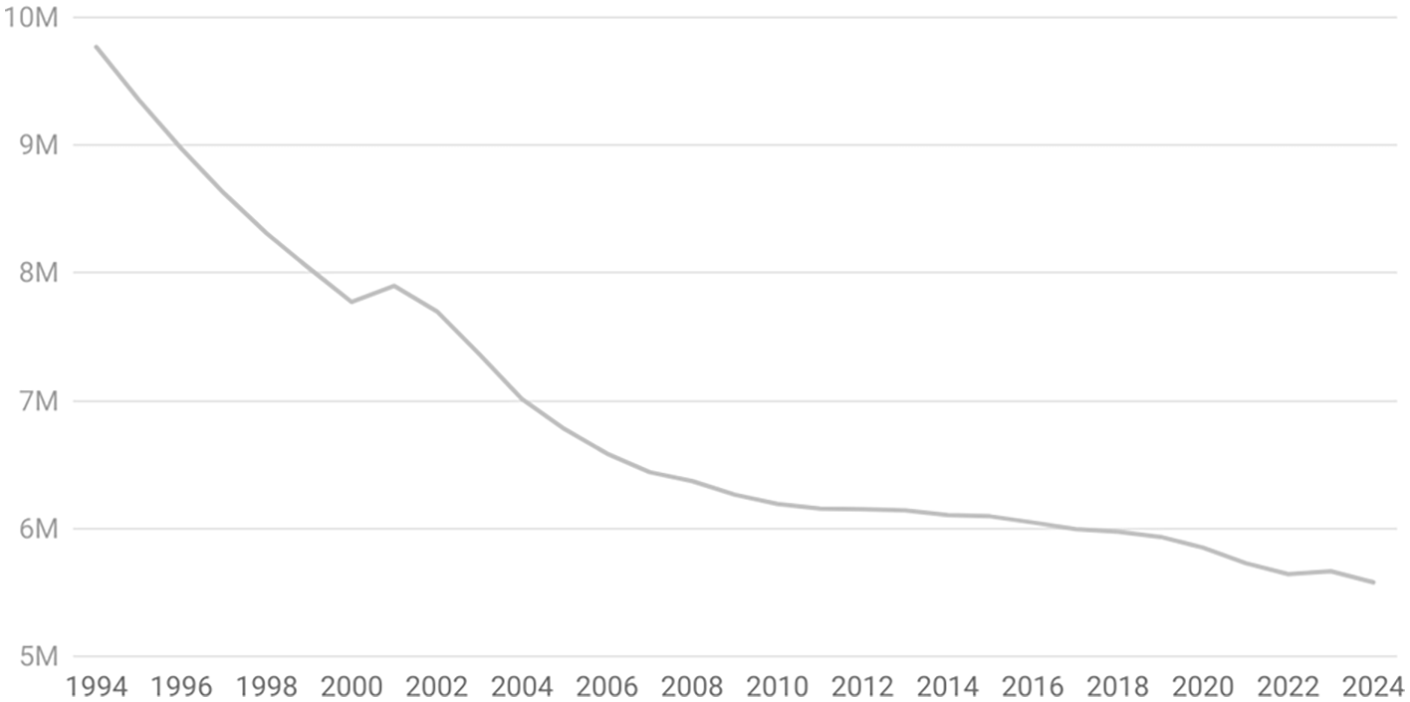
Members of the eight major German unions organized in the German Trade Union Federation (DGB), 1994–2024. The federated unions comprise around 85% of all union members.
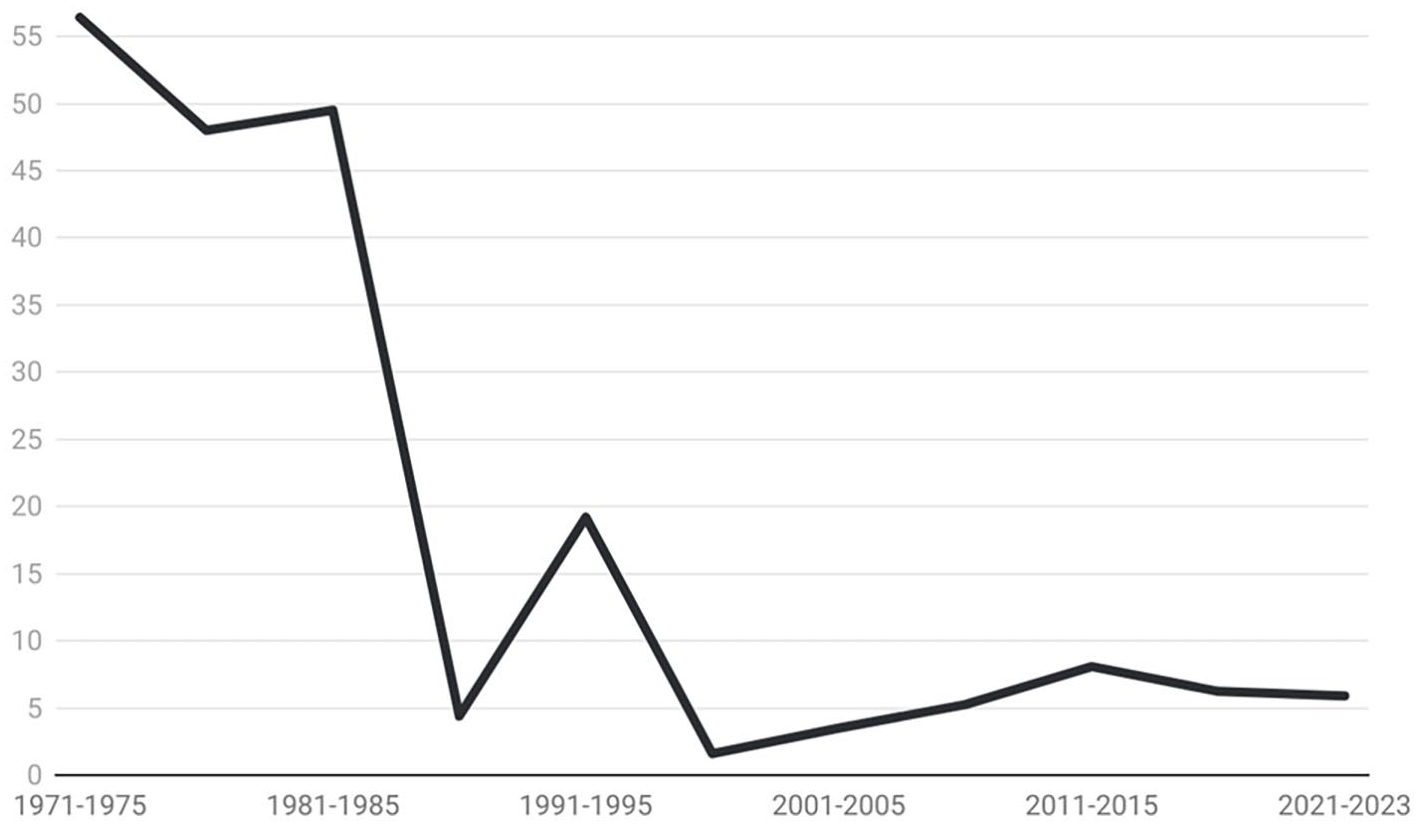
Working days lost due to strikes and lock-outs per 1000 employees, 5 years averages, 1971–2023.
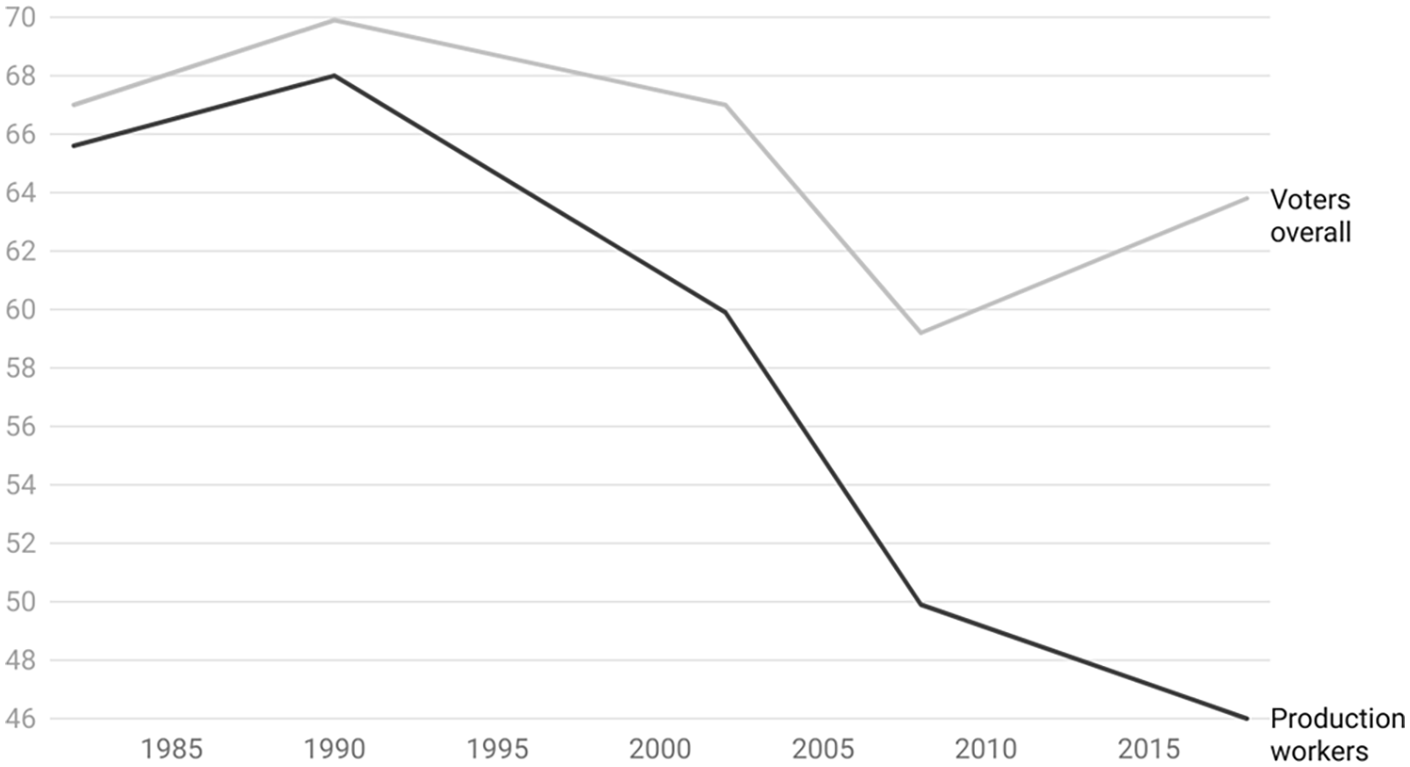
Sentiment of feeling close to any political party: Production workers (Oesch) versus overall voters, 1982–2018.
As part of the same historical arc of demobilization, workers have also virtually disappeared from political and public discourses. Figures 4 and 5 show how often the term ‘worker’ and its composites (e.g. ‘worker’s movement’) were mentioned in speeches in front of the German national parliament and a large corpus of articles published by the largest German newspapers: Both curves decline since at least the mid-1970s, from the 1990s onward, workers are virtually absent from public discourses. Importantly, the erosion of public representations of class did not necessarily go hand in hand with a disidentification with the category ‘worker’ on the part of workers themselves: Even in 2018, a majority of production workers categorized themselves as ‘working class’. At 58%, this figure was only 2% lower than 20 years earlier (ALLBUS, 2018, our calculation). Similarly, a recent study by Westheuser and Lux (2024) showed that workers were much more likely than professionals, managers or the self-employed to identify as ‘a member of the working class’ (between 70% and 80% of service and production workers self-categorized in this way). All this makes the increasing disappearance of workers from political and media discourses all the more indicative of a systematic underrepresentation of the working class in the public arena (Heath, 2016). 11 Political demobilization was also accompanied by a symbolic marginalization and disarticulation of class-specific identities, cultures and spaces of experience (Beaud and Pialoux, 2004: 321; Mooser, 1983). Significantly, the trends shown here document that (at least within the scope of postwar history) the current conjuncture marks a historical high point of class demobilization.
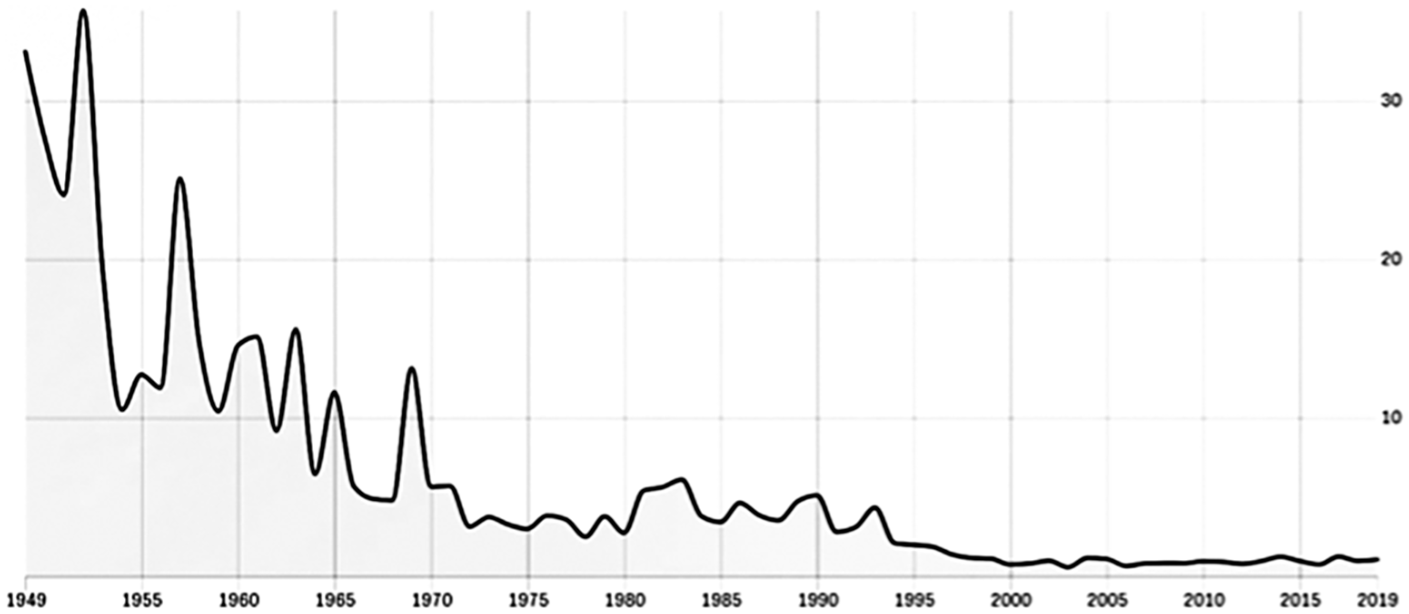
Mentions of the term ‘worker(s)’ (Arbeiter) and most frequent composites (e.g. ‘workers’ movement’) in speeches of the German Bundestag 1949–2019, frequency per 100,000 words.
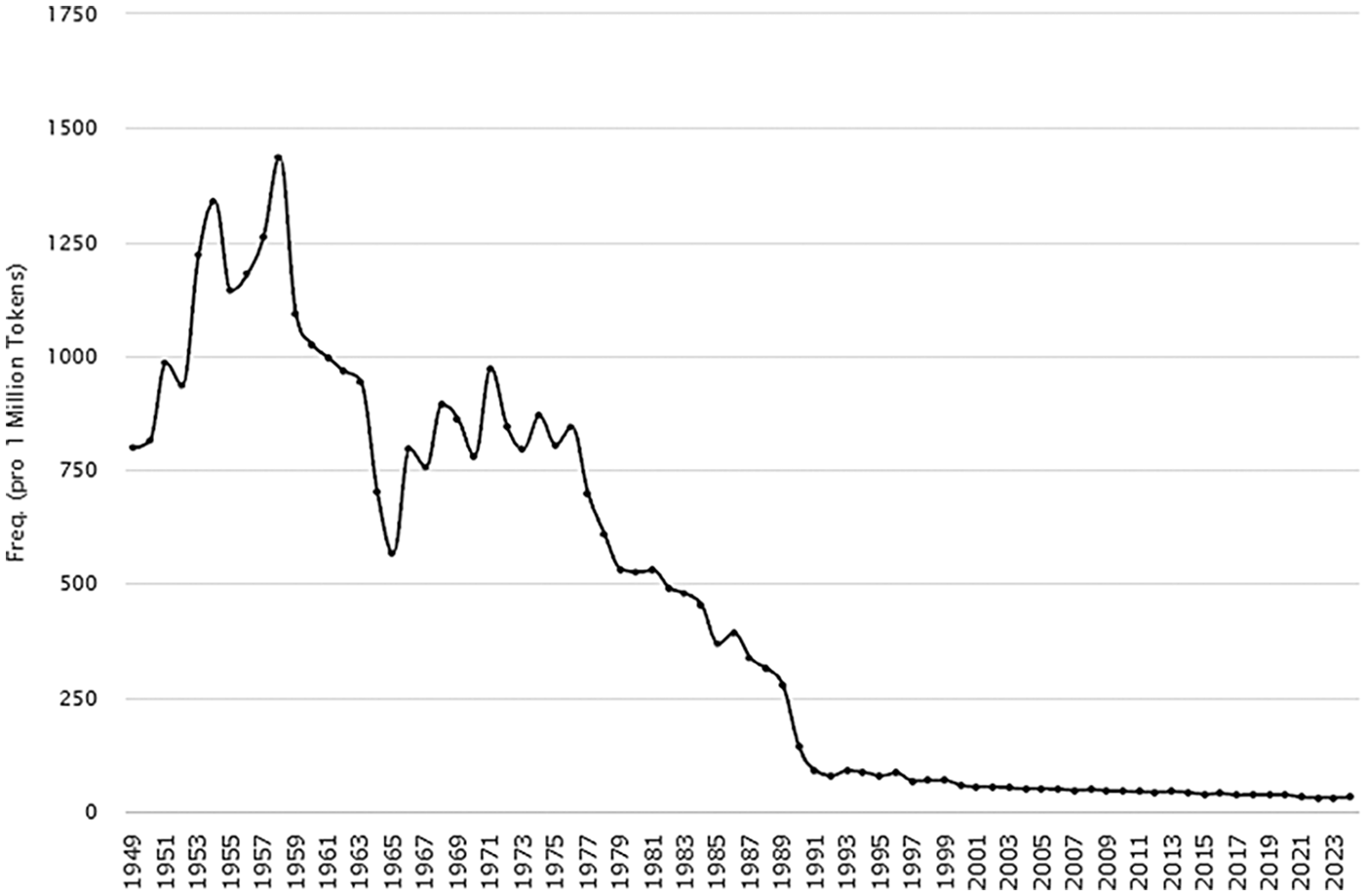
Mentions of the term ‘worker(s)’ in major newspapers, 1949–2024.
Theory: Understanding Workers’ Critical Consciousness in Demobilized Times
Summarizing these indicators, it can be said that while class differences in life chances and political representation are becoming increasingly virulent, class relations are historically disarticulated in politics and public discourse, making the class structure appear increasingly ‘opaque’ (Oesch, 2006). Dörre (forthcoming) has captured this conjuncture with the concept of the ‘demobilized class society’. For the analysis of workers’ political consciousness this creates a particular challenge. Workers’ attitudes cannot straightforwardly be read off from the positions of parties claiming to politically represent them, nor can the demobilization of class conflict be equated to a normative consent among the dominated classes. As Mann (1970: 436; 1973) observed already in the 1970s, the stability of the class order does not necessarily require dominated groups to ideologically support this order. A ‘pragmatic acceptance’ of the status quo is enough. Similarly, Chibber (2022: 68 ff.) argues that upholding class domination does not require false consciousness on the part of the dominated. Working class resistance is already made unlikely by structural facts such as workers’ dependence on their employers, the competition between different categories of workers, and the high costs associated with collective resistance, especially where collective agency through working-class organizations is weak (see also Przeworski, 1986: 133ff.).
Building on the tradition of research on latent forms of class consciousness mentioned at the outset of this article, we suggest that to capture workers’ political consciousness in demobilized class societies, we must look at forms of everyday critique beneath the surface of apparent acquiescence and pragmatic acceptance. In the words of Honneth (1982: 14), we are aiming at the submerged ‘field of moral-practical conflicts [. . .] in which old class conflicts continue to take place either in socially controlled or in highly individualized forms’ even in the absence of ‘loudly proclaimed’ class struggles. The forms of consciousness guiding these moral-practical struggles—which include everyday forms of resistance, idiosyncrasy, complaints, and critique—remain invisible to a perspective seeking to make out unifying political philosophies, abstract social theories, or false consciousness in the worldview of workers (Mann, 1970; see also Savage, 2005). Following this perspective, the latent struggles of demobilized class society become visible above all in the sense of injustice of subaltern classes, a ‘highly sensitive sensorium for injuries to intuitively recognized moral claims’ (Honneth, 1982: 15). Such everyday forms of critique reveal their moral foundations in a negative way: not in the shape of systematic visions of a better societal order, but through flagging transgressions of implicit moral boundaries (see also Durkheim, 1994 [1912]; Jaeggi, 2018; Thompson, 1971). ‘Normative claims of socially lower strata are more likely to be preserved in typical feelings of injustice than to be articulated in positively presented ideas of justice’ (Honneth, 1982: 20). As Honneth notes, only dominant groups are compelled to explicate their normative horizon in the form of generalized systems of concepts and values. The critique of dominated groups, by contrast, typically consists in what Max Weber (1972 [1922]: 533) calls a sense of “moral disapproval”, including “the murmuring of workers” and forms of “amorphous communal action” triggered by transgressions against implicit normative expectations.
Following from this, we approach the political consciousness of workers on the basis of repertoires of everyday social critique articulated by workers (Boltanski and Esquerre, 2025; Boltanski and Thévenot, 1999; Bottero, 2019). 12 Moments of critique reveal evaluation criteria, normative foundations, and social constellations salient for the critics and their claims (see also Boltanski and Chiapello, 2007). An analysis of workers’ sense of injustice reveals latent ruptures in the legitimacy of the status quo which would remain hidden from a perspective that only looks for politically mobilized discourses. Thompson (1971) famously called the structure of implicit normative assumptions made visible by moments of protest and critique a ‘moral economy’. It comprises a shared sense of the modalities, rights and duties that organize the ‘implicit social contract’ between social groups, especially between the ruled and the rulers (Moore, 1978; Scheiring, 2020). As extended to various fields by Thompson (1971), Mau (2004), or Fourcade et al. (2013), moral economies define legitimate claims as the moral corollary of a social relationship of unequal reciprocity (Sayer, 2005). To distinguish between different forms of critique, we draw on Fraser’s (2005) triad of redistribution, recognition and representation as three dimensions of justice pertaining to (a) the economic order; (b) symbolically mediated recognition regimes; and (c) the system of political representation. Building on this theoretical foundation, our analysis undertakes a mapping of workers’ everyday critique. We reconstruct the form, objects, social constellations and moral economies of critique, all of which we present as bundled in a range of recurring cultural repertoires (Lamont and Thévenot, 2000; Steinberg, 1995). Talking about repertoires makes it clear that individuals draw on pre-structured patterns of reasoning that are shared within social groups, classes and national public spheres.
Data and Method
Our analysis is based on qualitative in-depth interviews that we conducted with 30 production workers (as defined by Oesch’s (2012) class scheme covering property, qualifications, and sectoral work logics) over the course of 2019. The interviewees were employed in construction, industry and small trades. The interviews originated from two separate but closely coordinated research projects on class-specific symbolic boundary-making among German manual workers (see Beck, 2022; Westheuser, 2021). As shown by the respondent list in the Appendix, the majority of our interviewees were male and of German origin, worked as non-autonomous manual workers (including some foremen) in mostly medium-sized companies, and had vocational training. The interviewees were between 20 and 58 years old and lived in urban and rural areas in West and East Germany, with a focus on Berlin. Access was gained through field insiders, small public advertisements and by making personal contact e.g. on urban construction sites. In conducting the interviews, we followed the methodology of problem-centered interviews (Witzel, 2000) whose focus was pre-structured by theoretical considerations. With the help of an interview guide, we focused on the interviewees’ everyday working lives, self-perceptions and perceptions of their position in society, attitudes towards different social groups and political issues as well as prospects of the future. In conducting the interviews, open narrative questions were combined with ad hoc questions, immanent follow-up questions and the presentation of problems on which interviewees were asked to comment. The interviews were conducted at or near the interviewees’ workplaces, at their homes or in public places, and were recorded and anonymized. The modal length of the interviews was one and a half hours.
In the first step of the analysis we selected a broad subsample of our material containing moments of critique, using as a guide a basic rhetorical pattern of disapproval of societal or workplace realities (‘this and that is how it is. It shouldn’t be like this’). In this way, we identified around 500 relevant segments in a collected length of several hundred printed pages. In a second step, Nancy Fraser’s dimensions of justice, redistribution, recognition, and representation, served as an explorative heuristic for organizing the segments according to the main objects of critique. In a third and fourth step, we borrowed analytical tools from the documentary method (Bohnsack, 2014; Nohl, 2006) to analyze paradigmatic cases and instances of critique individually and to identify recurring repertoires by comparing between cases. Our analysis focused on the orienting frames implicit in the way interviewees articulated their critique and claims. Specifically, we sought to reformulate which aspects of moral economy respondents’ discourses tacitly presupposed in order to be comprehensible. In the fifth and final step, we deepened our understanding of these orienting frames by taking a closer look at the constellations of social reference groups constructed in various forms of critique and claims-making. From the multitude of forms of critique that crystallized in individual cases and case groups, we selected seven forms that could be reconstructed as stable and generic repertoires due to their particular frequency, internal homogeneity and external heterogeneity (cf. Braun and Clarke, 2006). The reconstructed types are not to be understood as mutually exclusive forms of consciousness to which individual cases can be assigned, as workers usually made use of a number of different repertoires.
Results
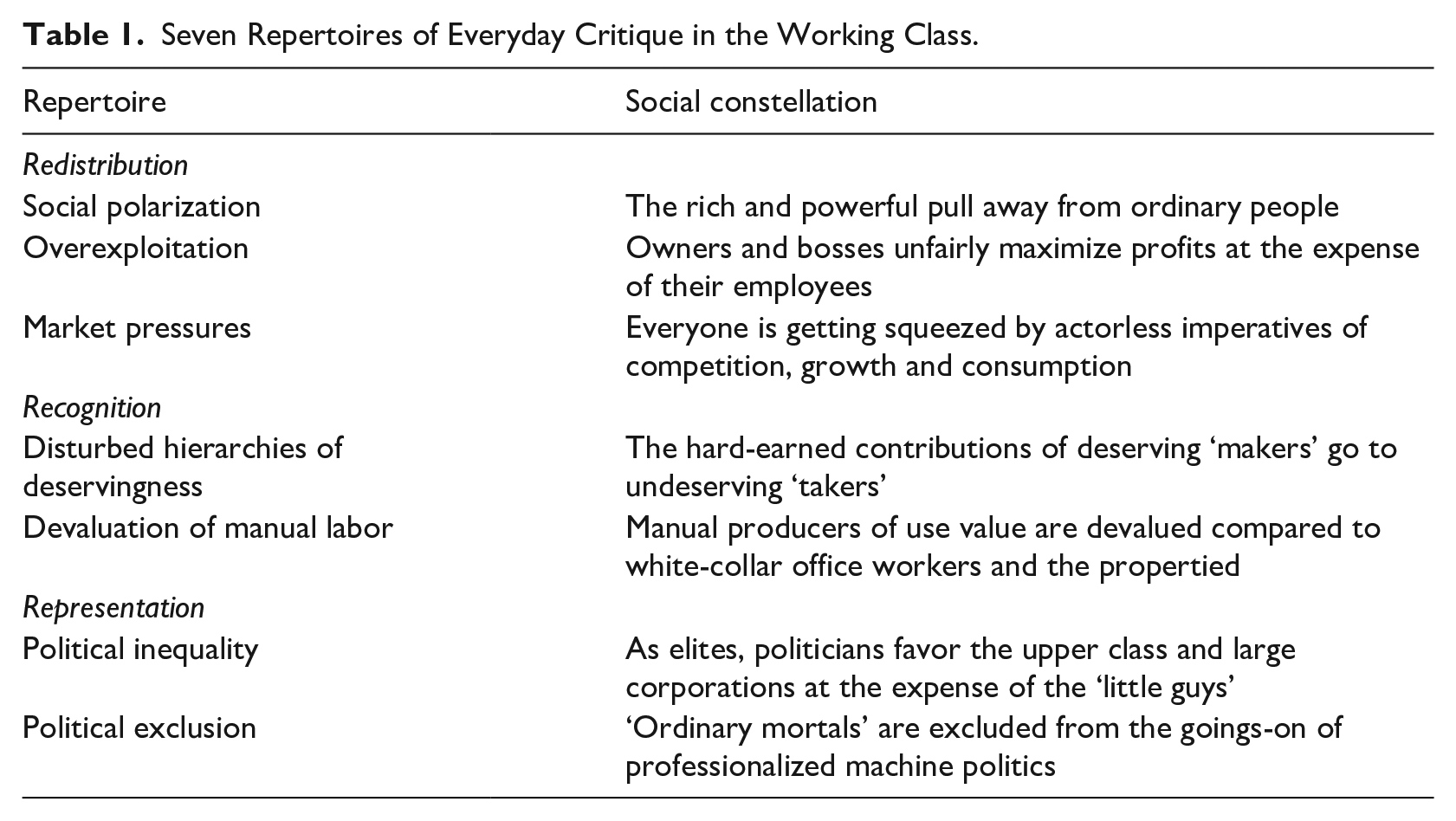
In our interviews, forms of social critique were omnipresent, voiced indignantly and with a demonstrative irreverence towards dominant groups and narratives. At the same time, the workers’ commonly combined an alert critical sense with displays of pragmatic acceptance and disillusioned subalternity. Critique and indignation were often articulated with a dismissive attitude which emphasized the inconsequentiality of one’s opinions (‘noone cares what I think anyway’). 13 In the following, we present seven recurring repertoires of workers’ everyday critique, three pertaining to distributional injustices and two each concerning injustices of recognition and representation. Table 1 briefly summarizes the repertoires. It also gives a sense of the variety of social constellations involved. Workers’ critical moral stances operate with a range of oppositions, for example, between ‘top’ and ‘bottom’, ‘makers’ and ‘takers’, manual and non-manual workers, or politicians and ‘ordinary mortals’. While political and sociological observers would view all social phenomena that workers criticize as aspects of class domination, workers themselves draw on a number of social relations that partly exceed the class logic (e.g. national citizenship), or accentuate specific aspects over others (like those of market dependence or the division of labor).
Seven Repertoires of Everyday Critique in the Working Class.
Redistribution
Injustices of material distribution were at the center of workers’ critique and were prominently mentioned in all our interviews. Respondents criticized the socially unequal disposition of income and wealth, the development of wages, but also exploitation, flexibilization, work intensification and precarization. Overall, we were able to identify three independent repertoires of critique of distributive injustices in our material, each of which places a specific critical emphasis.
‘The Higher-Ups Take It Out on the Lower Ones’: Critiques of Social Polarization
In line with the objective polarization of incomes described above, almost all respondents critique increasing distributional conflicts between the ‘top’ and ‘bottom’ of society. The sticking point is the expanding gap between the income and wealth of a small upper class, which includes owners of large companies, managers, bankers and politicians, and the ‘normal’ population. This perception of a divided society is exemplified in a statement by Marc, a trained electrician, who talks of a temporary job he once had as a waiter at a gala dinner held by a large corporation. In Marc’s narrative, the door between the ‘front stage’ of the gala and the ‘back stage’ of the kitchen becomes a sharp metaphor for an unjust social system:
On the left side of this door, you have people who work for 12, 13 euros an hour, and when you walk out the door, you suddenly have people who earn 12, 13 thousand a day. You know? Where you think to yourself, ‘Dude! Who in God’s name decided that what they do is so much better than what we do?’ And I personally think, no, man, what they do is not better [. . .]’ Just because I live in this system doesn’t mean I like it. (I02)
As done here, many segments contrast the excessive wealth of economic (and political) elites with one’s own limited means. Although higher earnings are justified by many workers as a result of special efforts, the achievements of the upper class are deemed insufficient to legitimize the extent of social inequality. The upper class is described as a closed and aloof group, far removed from the reality of ordinary citizens. Their excessive wealth is not only problematized as unearned, but also as irrational insofar as it exceeds human needs:
If the Amazon guy didn’t have 300 billion, but maybe only 5 million, he could still buy everything he wants! And with the rest he could . . . develop all of Africa, or solve all kinds of problems. (I03)
This repertoire of critique operates with a comparison of unjustified overabundance and justified but unmet needs. The excessive concentration of wealth is contrasted with deprivation elsewhere. As Lisa, an industrial painter describes,
The higher-ups take it out on the lower ones. They earn a shitload of money, go home with a pension that any normal person dreams of. And the pensioners get nothing. And that’s what doesn’t make sense to me. (I04)
The critique cited here is based on a dichotomous view of society polarized between ‘top’ and ‘bottom’, which has long been described in studies of workers’ consciousness (Dörre and Matuschek, 2013; Kudera et al., 1979; Popitz et al., 2018 [1957]). While distributional disparities are front and center in this repertoire, the exact processes behind growing income inequality usually remain unnamed. The wealth of the higher-ups is contrasted with the lives of the less affluent, but the two are connected only abstractly, through images of maldistribution: ‘If all the money is concentrated in one place then there is an imbalance’ (I03). The wealth of the rich is seen to come at the expense of others in the sense that limited prosperity is not distributed according to need and merit—but not because it is derived from the labor of others.
Accordingly, the rich are usually not contrasted with the ‘working class’, but with the ‘normal people’ of a ‘middle class’ identifiable by their ordinary, moderate and average lifestyles (see also Sachweh and Lenz, 2018; Savage, 2005). Nor is the critique primarily directed against inequalities per se, but against an excessive and unjust polarization of income. According to the underlying moral economy, great prosperity is legitimate as long as it has been earned by one’s own effort. Counter-images to the excessively rich upper class also include the ‘self-made’ rich and owners of small and medium-sized businesses who live in legitimate and more moderate luxury.
‘Wages Down and Profits Up’: Critiques of Overexploitation
In addition, there is a form of critique that is directed ‘upwards’, drawing more heavily on experiences in companies and directed against company owners who maximize their profits at the expense of workers. Low wages, work intensification and precarious employment relations are problematized in this repertoire as direct consequences of the employers’ actions and interests. For example, construction worker Torsten complains: ‘There are two of us employees [in the unit], but we have work for twenty. [. . .] The bosses become millionaires while the employees work like dogs’ (I05). The high incomes of the company owners appear here as the result of intensified exploitation of their employees through increased pressure and precarious working conditions. This critique builds on the workers’ own experience of overexploitation, as well as on empathy for particularly precarious colleagues. When discussing the danger of wage competition between native and migrant workers, one respondent states:
It’s easy to get mad at others, but you have to look a bit deeper under the surface. Ultimately, it’s the companies that bring these people in to squeeze a fortune out of them. All these construction managers, architects, large construction companies, they’re all millionaires. [. . .] And these [migrant workers] only drink tea and eat white bread at home. (I05)
In this case, the critique of clashing interests between company owners and workers diffuses fears of wage competition (Bonacich, 1972; Hürtgen, 2020). The experience of bosses enforcing excessive profit demands at the expense of the employees is seen as a general predicament potentially faced by all workers. ‘We call it the American system’, explains one worker, ‘that means: profit, profit, profit. [. . .] Profit comes before the employee’ (I06).
As in the first repertoire of critique, increasing inequalities and polarizations between those ‘above’ and those ‘below’ are problematized here as well. Despite these similarities, however, the critique analyzed here can be seen as a separate repertoire: In contrast to the critique of social inequalities of distribution, the excessive pursuit of profit by company owners is identified as a more complex causal process. Overexploitation is attributed to an increasing ‘greed’ on the part of bosses and owners, but also to politically promoted instruments, such as temporary work or the low-wage sector, which make it possible to increase profits at the expense of workers.
The relationship between ‘top’ and ‘bottom’ is thus not characterized, as it is in the first repertoire, by the competition for limited social wealth between social groups—such as the middle and upper classes—but is negotiated as a relation of unequal reciprocity between workers and bosses. The latter are expected to uphold standards of fairness, job and income security, and workload. The moral economy contained in this repertoire is not that of outright class struggle, but rather that of a systemically rooted conflict of interests that can only be pacified by mutual compromise and, above all, the moderation of profit interests. As one worker reflects with a hint of irony: ‘It’s fair if both sides get something out of it – the wealthy owners and those who. . . prostitute their labor for them. [laughs]’ (I07).
‘You’re Just a Puppet’: Critiques of Market Pressures
In addition, we were able to identify another repertoire of critique that only emerged from a close reading of the material. The starting point was the observation that various interviewees—beyond the critique of ‘those at the top’—also addressed a range of agentless systemic mechanisms as a source of injustice. This critique is based on perceptions of an acceleration of life, increased pressure and a general feeling of insecurity, which can be attributed to general social change and to the logic of capitalist competition. These processes are becoming noticeable, among others, in the world of work:
The companies hire a hundred people when they have a lot of incoming orders [. . .] so that they can quickly get the business done. And then when [demand] slows down they throw them out on the street again. [. . .] Why can’t it be instead that if I want a Mercedes and they say I have to wait for half a year, well, then I just have to wait! [. . .] [But] the customer just needs something right away and that’s all that counts. (I01)
Although criticizing the use of temp work, the respondent, an industrial worker, shows understanding for the actions of the company management, which has to assert itself in a fierce competition for customers and sales. While in the critique described above, profit-oriented company owners are held responsible for flexible working conditions and intensified exploitation, here the origin lies in the systemic constraints of competition, the pressures of just-in-time production, and growing consumer demands seeking immediate satisfaction.
As a result, life is seen to become increasingly ‘fast-paced’, following a logic of ‘always more and more and more’, as the welder Andre describes it. ‘When you see that the supermarkets are open until 9 p.m. on Christmas Eve, that is really not necessary’ (I08). In addition, employees in the construction industry in particular describe a competition in prices that also lowers wages, a downward wage spiral that, in the perception of some interviewees, is further exacerbated by the competition with migrant workers.
The depiction of a logic of competition, acceleration and pressure is generalized by some interviewees beyond the sphere of work to describe society in general. In these cases, the critique often takes on an apocalyptic tone. The landscape gardener Lukas, for example, describes an unstable ‘system’ in which coercion, competition, and the pursuit of wealth combine into a dystopian form of heteronomy:
I think that you’re just a puppet in the end. You just have to function. Everything is just becoming more and more controlled and there’s more and more pressure on people. Interviewer: And why is that so? Because there’s competition all around the world. [sighs] I think that things have just completely gotten out of hand at some point. [. . .] And I wish I could just work for myself and my family, without anyone telling me, ‘You haven’t paid two rents, so now you have to move out!’ And suddenly the whole world collapses for you. (I03)
Like Lukas’ statement, many of the workers’ accounts are permeated by an abstract sense of insecurity in the face of dependence on an unpredictable outside world. Complaints about increasing pressure to perform and a lack of social cohesion are mixed with personal fears of not being able to keep one’s own apartment. Perhaps as a consequence of the fact that the agents behind the criticized trends remain unclear, the only option for action left is a retreat to the ‘small world’ of personal and familial advancement. The main focus of the critique is a loss of control over dangerous systemic processes—whereby images of ecological collapse are also repeatedly used as evidence of the instability of a logic of increase described as systemic: ‘There will be a collapse, that’s for sure. [. . .] If we only want to grow more and more, it’s in the nature of things that there will come a point where we reach the cliff’ (I11).
The problematizations reconstructed in this repertoire initially appear as a rather heterogeneous ensemble of critiques that touches on areas such as the world of work, social coexistence or ecological crises. What they have in common is that they problematize the consequences of market-driven competition and a logic of growth (‘always more’) on the level of systemic laws and constraints (see also Dörre et al., 2013: 215ff.; Dörre, 2016). In this repertoire, the commodification of labor and its dependency on market dynamics of supply and demand, the intensification of work and the destruction of the environment, as well as the logic of capitalist competition often appear as agentless automatisms. Although it is not clear in workers’ discourses how society could free itself of these compulsions, the critique points to the way systemic imperatives contradict the needs of humans and nature.
Recognition
Besides economic disadvantage, workers also critique forms of cultural disrespect or misrecognition. As we lay out below, this typically takes the form of a comparison between the workers own legitimate entitlements as deserving manual producers of societal use value and the illegitimate claims of other, less deserving groups such as migrants, white collar office workers, or benefit recipients. We distinguish between two repertoires of critique that target recognition regimes (Lamont, 2018). While the first focuses on disrupted group hierarchies of deservingness, the second focuses on the misrecognition of manual versus white-collar intellectual labor.
‘They Get Everything’: Critiques of Disrupted Hierarchies of Deservingness
A frequently recurring repertoire draws on the moral distinction between deserving and undeserving recipients of income and state support, known from the literature on welfare attitudes (Petersen et al., 2011; van Oorschot, 2000). The way this critique works is that respondents highlight the deservingness of their own group and others close to them through the comparison to a range of socially more distant figures who act as ciphers of undeservingness. In this vein, as we saw above, the wealth of the super-rich is criticized as undeserved on the grounds that it exceeds their needs and breaks with the meritocratic principle of a reciprocity between effort and reward (Prasad et al., 2009). On the other hand, however, workers also frequently criticize that social groups below the ‘threshold of respectability’ (Rehbein et al., 2015) take advantage of state benefits beyond what would be necessary to cover their basic needs. This is criticized as coming at the expense of ‘contributors’ like the workers themselves. Refugees in particular are thought to receive state support without providing services, embodying a disturbed reciprocity between contribution and entitlement. The central conceptual metaphor of this critique is that of a scarce pool of resources which contributors replenish through their taxes and labor while outsider groups soak it by parasitic free-riding. Rathgeb (2021) aptly captures this imagined competition as one between ‘makers’ and ‘takers’. Although framed via the distribution of scarce resources, the zero-sum games involved in this imagery of group competition is fundamentally about the hierarchy of legitimate claims and entitlements, that is, about the social order of recognition and group position. Thus Lisa, a Berlin industrial painter, formulates a critique of the government in which support for refugees is contrasted with the neglect of German pensioners:
They could do more for our pensioners, or for our homeless. Build a few better houses or something. Instead, they’d rather give smartphones and God knows what to these people who’ve only been here for three months [. . .] They get everything. But still they steal. Not all of them, for God’s sake! I don’t want to tar everyone with the same brush. There are also asylum seekers who really hang in there, who learn German, work and slave, no question. [. . .] It’s just that I feel extremely sorry for all those pensioners who worked and slaved for years, and then they only get 600 Euros or something in the end. I find that really sad. To see them collect [deposit] bottles from the trash cans, that really hurts. (I04)
At least indirectly, the supposed lavishness of spending on social outsiders is criticized as hurting the hard-working deserving majority. In this repertoire of critique, the alleged favoring of undeserving social categories appears as a glaring expression of disturbed relations of reciprocity. The central moral criterion of worth in Lisa’s account is that of ‘working and slaving’ which she mentions twice. Deservingness, in other words, is defined by a willingness to work hard. That—to some extent—this principle is independent of national and ethnic distinctions is shown by the fact that it is also found in the critique of support for unemployed people viewed as unwilling to work. ‘We have to work just the same way’, Hans, a painter, complains about people who receive benefits despite not showing up for retraining. ‘If my boss tells me, ‘Hans, you have to work’, I can’t just say, ‘nah, sorry, I need to chat with my colleague for a moment’’ (I13). The deservingness of the unemployed, welfare recipients, foreigners and asylum seekers is effectively measured against the standard of the workers’ own sense of a ‘disciplined self’ (Lamont, 2000). The work imperative they themselves have internalized is turned against others suspected of having it too easy. The authoritarian undertone of this critique
14
becomes evident in the following statement:
I keep seeing people on TV who collect benefits and wait around, while some people have two jobs and can just about make ends meet. That’s crazy! These people should get bread and water! And not one cent. It doesn’t matter whether he wants to or not, he just has to work, otherwise he gets no money. That simple. Honestly, I’d kick his ass. (I01)
Whereas previous repertoires of critique targeted social groups above, the deservingness-based critique scandalizes injustices of recognition by punching down. Workers underscore their own deservingness or that of groups like pensioners, single mothers, or low-wage workers by contrasting them with the unearned gains of shirkers, cheats, and freeriders. Doing so this critique insists on clauses of the implicit social contract that center on the duty to work and the expectation of a reciprocity between entitlements and contributions (Cavaillé, 2023; Damhuis, 2020; Mewes and Mau, 2012). Implicit in this critique is a moral economy of work-centered meritocracy (Heuer et al., 2020) on which workers can base their own claims to economic participation and cultural recognition. Workers do not just criticize the state for supporting the undeserving, but also for failing to honor the legitimate claims of those who have proven their deservingness through hard work. A disturbed hierarchy of worth and entitlement must then be restored both by disciplining unworthy beneficiaries and by the state and employers providing opportunities for those who ‘work and slave’.
‘They Think You’re Dirty’: Critiques of the Devaluation of Manual Labor
A second recognition-centered repertoire of critique refers to the devaluation of manual labor in comparison to white-collar cognitive and office labor. Here, workers criticize the lack of recognition for their physically demanding and socially useful work. Here again, distributional questions relating to income and wealth are cited as central proxies of social hierarchies. Yet in our view this is best understood as a representation of recognition differences in a stratified division of labor between manual and cognitive labor. The core concern of this critique is the unjust stigmatization of manual occupations. Images of hard and exhausting work on the construction site, in the factory or in the workshop are mobilized to criticize the privileges of the ‘air-conditioned offices’ (I14):
Look at my grandpa. He walks with a limp and has constant knee pain from all the hard work, and he never earned much in his lifetime. I have to say, I think it’s unfair when someone who does physical hard labor only earns 1.5 [thousand Euros] around here, and then you go to the [company] office and people suddenly earn 3.6 just for clicking their mouse from time to time. (I16)
Respondents counter the devaluation of manual work with a self-assertive ‘producers’ pride’ in which they contrast their own productive and useful labor with what they view as unproductive office work and the ‘merely theoretical’ knowledge of academically trained superiors.
15
The sense of producers’ pride exalts ‘proper’ manual work not only for its physicality, but also for its specific virtue of creating societal use value. As Felix, a provincial bricklayer explains:
Those at the bottom are the foundation of society. It’s as simple as that. And that includes all the people with the normal jobs. [. . .] So, whether it’s the baker, the hairdresser, the garbage collector, the street cleaner, the bus driver, the truck driver. [. . .] Without them, nothing would work. And then on the other hand there are those who think with their heads, who come fresh from university and think they are entitled to hundreds of thousands [of Euros], just because they have studied five years longer. (I12)
The people who form ‘the foundation of society’, including production workers as well as those in elementary service occupations, create concrete, immediately apparent value; they make everyday life possible in the first place and ‘keep the cart running’ (I12; see also Mayer-Ahuja and Nachtwey, 2021). Yet this value is not recognized, the workers’ physical labor is subtly devalued or even openly stigmatized. One worker says of the staff of cafés where he spends his lunch break with other construction workers:
They just think you’re dirty, smelly. Sometimes it feels like they see you as a lowly prole, also because you hang around with men all the time and you talk differently than you would if you were sitting in an office. They ask you: ‘could you eat your lunch outside please?’ That quickly makes you realize you’re at the bottom of the pile. (I14)
In addition to the devaluation of ‘dirty’ work, the interviewees criticize a regime of recognition that is structured by income and the conspicuous displays of wealth (e.g. through expensive cars). Eric, an electrician, complains about the emergence of a ‘performance society: you have to be successful, make a lot of money and then you’re seen as a better person’ (I17). And another worker criticizes: ‘People categorize themselves by their salary [. . .]. I think that’s just retarded [sic]. I have to say: a homeless person can be just as smart as someone with millions in the bank’ (I16). The critical sense of producers’ pride represents an attempt by the workers to symbolically reverse the ‘recognition gap’ caused by their position in a stratified division of labor between manual and cognitive work (further marked by an increasing centrality of educational qualifications), and a society centered on economic success as a source of worth (Lamont, 2018). By defending the social value of manual labor, workers challenge the classifications of the status order that put them at a disadvantage (Savage et al., 2015: 389 ff.; Tyler, 2015). In addition, respondents also develop an idea of universal ‘humanity’ as a positive counter-image to the income-based status order. As one worker remarks: ‘Even if I drive a little Fiat and the guy up there drives a Mercedes: when we are buried, we both go into the same hole, his money won’t be of no use to him either’ (I05).
Representation
In addition to distributional injustices and recognition gaps, the lack of representation and the uselessness of politicians form a third typical register of workers’ everyday critique. Injustices of political representation are fervently critiqued even though workers at first often try to signal their great distance from politics and their unwillingness to discuss it (‘politics is not my strong suit’, I12). Indeed the feeling of political powerlessness and outsiderness and the critique of political exclusion are closely linked (see Gaxie, 1978). In line with the pattern of ‘dissatisfied democrats’ (Klingemann, 2014; Weisskircher and Hutter, 2019), ‘politics’ functions both as the authority to which workers address their critique and as the central culprit behind social grievances. Working-class critiques of the political system thus express a tension between relatively far-reaching demands on the state on the one hand, and a deep political alienation on the other. In the following, we reconstruct two widespread repertoires of critique that could be understood schematically as deficits in the output and input legitimation of the representative system. The first criticizes that the outcomes of politics favor the rich and powerful, the second criticizes that political elites are unresponsive and that ordinary people remain outsiders to a professionalized system of machine politics.
‘Just Another Lobby’: Critiques of Political Inequality
A repertoire used by numerous respondents can be seen in the complaint (directly linked to the redistribution-centered critique discussed above), that politics favors the interests of rich and powerful groups. Economic imbalances are seen to correspond with power imbalances between the ‘little man’ and the middle class on the one hand, and the rich upper class and big industry on the other. Resources and power are often seen as mutually constitutive: ‘If you have money, you have power. [. . .] That’s just how it is’ (I13). In this context, politicians themselves are often described as part of an ‘upper class’ that has lost touch with the concerns and realities of the ‘little guys’ due to their privileged material situation. The same worker who had complained about being stigmatized for his manual labor again illustrates this with recourse to his ‘dirty’ work:
The people who have power only see the upper class. Honestly, Linda, if you’re doing well, then you don’t worry about a small fry like me, do you? I would probably be the same. If the people who sit up there and govern were paid normally, they would think very differently. But nowadays the decisions are made by the so-called upper class, let’s just say rich people. I don’t think [former chancellor] Angela Merkel gets her hands dirty, nor do [other politicians]. Those people dig around in the soil when they really fancy an organic carrot in their allotment garden. But otherwise they never get their hands dirty in their lives. Because they are doing well. (I14)
In this version of the repertoire, politicians are described as themselves part of the rich and aloof upper class, whose privileged way of life alienates them from the prosaic everyday life of the normal population. Their lack of grounding appears as an explanation for the loss of recognition of the producers at the bottom (see also Noordzij et al., 2021). In a second version, politicians are not viewed as part of the upper class but as beholden to that class’ economic interests and lobbying: ‘Just look how many managers fly with the politicians when they make their state visits abroad’, complains one, ‘it’s just another lobbying event! They should listen to the average citizen more, not just to the big corporations’ (I10). Again and again, workers contrast the interests of big corporations and the general public, for example, remarking that environmentally harmful goods keep getting produced because ‘the industry wants to hold on to its profits’ (I13). Data from 2018s German General Survey (ALLBUS) show that the critique described here is widespread: 50% of production workers agree with the statement that ‘politicians only care about the interests of the rich and powerful’ (see also Detje et al., 2013: 103 ff.; Lütten and Köster, 2019: 312 ff.).
Going a bit deeper, we can identify a specific moral economy of the state and its role in balancing social interests that this critique is based on. Workers’ critique of lobbying and the cronyism of politics and big industry implicitly scandalizes a deviation from the model of the state as a mediating party in capital-labor relations, or even that of an benevolent actor defending working class interests (see also Offe, 1975). With Castel (2017) this model of the state can be identified as that of the European Social or Christian democratic ‘growth state’ of the mid-century class compromise; a state mediating between the interests of workers and those of capital through redistribution and regulation. As fiercely critical as workers speak about current political elites, it is notable that the state remains the object of extensive expectations and claims for protection and social balancing. Through their critique workers exhibit a strong, albeit disappointed, identification with a state that is charged with a compensating and balancing role it fails to fulfill. The rhetoric in which this critique is presented often implicitly gestures towards a previous era where politics was more attuned to workers’ interests. 16 However, this sense of nostalgia remains vague and without clear historical points of reference (see also below).
‘Behind Closed Doors’: Critiques of Political Exclusion
The last repertoire we will discuss here includes critical remarks about the closed and self-referential nature of the political sphere. In line with the findings cited at the beginning of this paper, workers seem to correctly register the lower responsiveness of political elites to the preferences of workers and low-wage earners. Political institutions are described as a self-referential, opaque sphere that is separate from the rest of society. As one worker describes:
As an ordinary mortal, you don’t get the slightest clue about politics. You can’t get to where politics is happening, it’s all behind closed doors. In the past, people used to meet here on the square and some guy got himself a soap box so that he would stand just a little higher and could speak. It doesn’t work like that anymore, and I miss that. (I02)
Again, the reference to an unspecified past is interesting. Marc, the worker making this statement, is in his 20s, making it clear that the bygone era he ‘misses’ is likely not something he witnessed himself. Instead, his critique seems to express the lost ideal of an accessible and locally embedded space of political efficacy with limited political inequality (the politician standing ‘just a little higher’ than the audience). In contrast to this vision, workers describe today’s politics as hierarchical, complicated, non-transparent, and inaccessible. In a cynical tone typical for many of the workers’ accounts, one respondent says: ‘Parliament does what it wants and I have nothing to do with it. I don’t think I have influence. In the end it’s them who decide how it goes. I think it’s all fake anyway’ (I05). Politicians are described as inhabiting a distant sphere impermeable to workers’ needs and claims, their habitus and demeanor is described as artificial and disingenious. At the same time, politics is seen as a sphere for which workers’ social position lack the entry requirements. ‘Politics is so far away for me’, says one respondent, ‘I feel too small for that’ (I03).
Whereas in the previous repertoire, workers’ critique was related to political inequality and an implicit social contract of political regulation and a balancing of interests, here the object of critique are forms of political exclusion. In a turn already observed by Bourdieu (1984), workers self-exclude from a system that excludes them. The normative horizon implicit in this critique is one of democratic efficacy and responsiveness. By some, this is envisioned in the form of plebiscitary democratization—for example, through referendums and an appreciation of the ‘voice of the people’—others essentially describe the ideal of a well-functioning paternalism, in which governing actors lend an open ear to the expectations of citizens without the latter gaining political agency themselves. Frequently, interviewees express the desire for a ‘fresh wind’ in a political sphere otherwise characterized by stagnation and self-perpetuation, mentioning the radical right, but also politicians of the populist left, as examples. 17 The most common conclusion of this type of critique, however, seems to be to turn away from the political sphere as a whole. ‘I don’t think much of politics anymore’, says one worker, ‘I prefer to live for myself’ (I16). Another puts it even more bluntly: ‘For me politics is like: ‘do your shit without me’ (I02).
Discussion
The aim of this study was to contribute to a more comprehensive and nuanced understanding of the political consciousness in the contemporary working class, correcting an all-too-narrow focus on working class factions mobilized by the radical right. We mapped repertoires of everyday critique along the justice dimensions of redistribution, recognition and representation, reconstructing the objects and logic of critique, as well as the moral economies forming their normative background (see Table 1 above). Rather than recapitulating all seven repertoires, we want to use this concluding reflection to highlight a number of more general aspects emerging from our findings. These concern the specific form of working class political consciousness in demobilized class societies, as well as its political ambivalence and potential openness to both right- and left-wing appeals.
The Moral Grammar of Workers’ Consciousness in Demobilized Times
As already mentioned above, a paradigmatic finding of our study is that of a highly contradictory and polyphonous structure of workers’ critical consciousness. The seven repertoires of everyday critique reconstructed here show a working class with an alert sense of injustice but without ‘ideologically constrained’ or coherently organized belief systems (Converse, 1964). Contrasting public images of a one-dimensionally regressive and ideologically right-wing working class, in the discourses of our interviewees ideas and expressions conventionally classified as ‘right-wing’ often sit side by side with such one might recognize as of the left.
By disaggregating the different elements of everyday critical consciousness in the form of distinct repertoires, our perspective comes close to Gramsci’s conceptualization of the common sense of dominated classes as ‘disjointed’, ‘episodic’, and ‘strangely composite’ (Gramsci, 1971: 324; see also Damhuis and Westheuser, 2024). 18 Against this background, we argued for locating the core of workers’ political consciousness in a sense of injustice or ‘moral disapproval’ that critically registers the transgressions of social groups above (the rich, bosses, and politicians) and below (shirkers, intruders, and cheats). The reactive scandalization of broken promises and violated expectations, rather than systematic ideological edifices, dominate as a modus operandi of workers political consciousness. Much more prominently than left- or right-wing positionings in the political field, the defense of moral economies of work, reciprocity and recognition, a sense of scarcity and producers’ pride, as well as a deep skepticism against the actions of the higher-ups inform workers’ everyday critique.
Two further threads run through most of the material in the form of background conditions shaping workers’ political reasoning. The first a deep and naturalized sense of powerlessness. As we saw, respondents combined the critique of an unjust status quo with its resigned acceptance. The predominant forms of action orientation were a critique from the sidelines or individualized strategies of opting out (‘do your shit without me’) or coping with everyday life (‘I try to look at my own little world’). A second common thread is the nostalgic aspect of workers’ political discourses. Although utopian ideas about a different society occasionally shine through at times, 19 by far the majority of critical accounts gesture towards the restoration of a normative order. It might be conjectured that the moral economy of the mid-century social compromise, with its lower levels of inequality, a recognition and political representation of manual work, continues to live on in the normative background assumptions of German workers much in the same way as feudal rights and privileges did in the early days of capitalist formation (Thompson, 1963). The difference is that in the current conjuncture, the mediation by the state obscures group relations of domination that had been tangible and personified in the ancient regime. The modern liberal state recognizes and protects the claims of individual citizens but dethematizes the group character of social interests. Its legal form of moral integration is purposely abstracted from traditional forms of obligation and reciprocity, as previously embodied in religious norms, popular traditions, or local customs. In this context, the workers’ depiction of politics as still essentially shaped by power relations between social groups ‘above’ and ‘below’ can be seen as a critical intuition cutting through this optical illusion of the liberal state. At the same time, lacking a clear personification or historical point of reference for the state’s obligations vis-à-vis the workers, the nostalgic critique of an elite capture of the state remains vague and does not carry over into a consistent view of politics as class antagonism. It is unclear when exactly the implicit social contract that now has gone off kilter ever was intact and how it got broken.
We interpret this simultaneity of an alert sense of injustice and a passivized, reactive, moral, and backward-looking basic form of political consciousness as symptomatic for the political horizon of demobilized class societies. Through the public disarticulation of class experiences, political exclusion, and the erosion of collective efficacy, workers have been robbed of the organizational and discursive means for systematically explicating their views and interests and translating them into positive demands backed by collective agency. As the traditional channels of representation and organizations of workers weakened, not only the power resources and opportunities for participation of workers dwindled, but also class narratives of a shared fate, class-based cultural environments, and political counter-proposals. The passive sense of injustice of those who complain from the sidelines is what remains. We acknowledge that this reading is an informed interpretation and a hypothesis for future studies to corroborate or refute, not something we can prove with the data here analyzed (especially since we lack a comparison with the political repertoires of more ‘mobilized’ societies). If our interpretation is correct, however, it has important consequences for both the analysis of workers’ political behavior, and for political strategies aimed at remobilizing this class.
The Political Ambivalence of Workers’ Everyday Consciousness
One of these consequences is that any understanding of political orientations in the contemporary working class should have ambivalence, contradiction, and heterogeneity at its very heart. In our study this can be illustrated by the simultaneous presence of a strongly ‘materialist’ sense of injustice seemingly congenial to left politics on the one hand, and exclusionary tendencies offering openings to radical right appeals on the other. As became clear in the presentation of our results, the critique of injustices in material distributions and socio-economic hierarchies played a very prominent role in workers’ critical discourses. Although largely disarticulated as a class conflict in the classical sense, a sense of society being structured by unequal distributions of resources and power runs as a common thread through the statements of all our interviewees. It finds expression in a critique of social polarization and practices of overexploitation by owners and management, in the critique of inhumane market pressures, in the sense of a devaluation of manual work symbolized by low wages, and in complaints about the political inequality that results from the state neglecting the interests of ordinary people compared to those of the rich and the big companies. Money is the central medium through which all three dimensions of injustice—maldistribution, misrecognition and underrepresentation—are perceived and criticized in workers’ discourses. It was also reconstructed how forms of critique centered on disturbed hierarchies of deservingness, and forms of political exclusion also originate from perceived inequalities in the distribution of social resources, for example, insofar as they categorize politicians as themselves part of an aloof ‘upper class’.
A common theme of workers’ social imaginary is the perception of a society dichotomized into top and bottom, viewed from a position at the lower—though not lowest—pole of the social hierarchy. This strong prominence of material, distributional issues and economically mediated hierarchies is important in light of political discourses that largely identifies workers with conservative positions on culture war issues. As discussed below, working class everyday consciousness offers clear points of entry for exclusionary politics, but it is also animated by a sense of material injustices that offers much greater potential for egalitarian politics than the left is currently able to realize. The critique of growing inequality, of economic-political elites and the constraints of the market and competition, corporate hierarchy and power disparities, as well as the high demands for state intervention, regulation and redistribution, opens up a multitude of points of contact for progressive politics and mobilization. Even under the surface of a politically dormant class struggle, ‘moral-practical conflicts’ over capitalist inequalities continue (Honneth, 1982: 14). This is blocked primarily by the political exclusion of workers, which is met with a profound self-exclusion. At the same time, the lack of a coherent political-ideological framing does not at all signal the impossibility of future (re-)mobilization. As Chibber (2022: 74), among others, points out, political class consciousness is less a condition than an outcome of collective organizing (see also Fantasia, 1989).
On the other hand, the numerous exclusionary impulses of workers’ critique also show overlaps between the sense of injustice and radical right appeals. Forms of exclusive solidarity (Dörre et al., 2018) clearly emerge in statements about migrants and societal outsider groups like benefit recipients. These groups serve as an object of demarcation against which workers define their own self-image as respectable, deserving producers and belonging national insiders. What makes this critique of recognition gaps open to exclusionary appeals is (a) the typical form by which one’s own well-founded entitlements are defined in contrast to the unearned claims of social outgroups; and (b) the implicit background idea of distributive group conflicts over a pool of scarce goods that is the rightful property of a national community of productive workers and is distributed by the state. In this view, migrants and the unemployed embody the zero-sum competition for a limited amount of social wealth. Their supposed unearned privilege is contrasted with the neglect of one’s own claims; one’s own willingness to work, generalized into a moral expectation, serves to distinguish the workers from foreign and domestic ‘freeriders’.
The deservingness critique is an important entry point for political appeals of radical right actors, whose positions on social policy are increasingly less centered on the reduction of welfare benefits at large, and instead mobilize precisely the authoritarian and ethnically coded juxtaposition of ‘makers’ and ‘takers’ central to the critique of disrupted recognition hierarchies (Attewell, 2020; Rathgeb, 2021). It can be assumed that such exclusionary elements of workers’ consciousness will gain in importance when the organizational and discursive destructuring of the class conflict makes a core element of the workers’ critique—the critique of the rich and the powerful—politically homeless (Dörre et al., 2018). In addition, horizontal zero-sum struggles between groups become more salient when the hope for an overall growth of social wealth dries up (Reitz and Jörke, 2021). Confined to a defensive position in which the scope of what can legitimately be hoped for shrinks, defending one’s own piece of the pie against unworthy outsiders becomes a ‘rational’ strategy.
The lack of a coherent ideological structure in everyday critique makes it understandable how exclusionary and authoritarian attitudes towards the claims of outgroups can coexist with extensive normative expectations of equality and justice. For research and public debates on the political orientation of workers, the focus on the workers’ sense of injustice offers an important corrective, because it highlights the contradictions and the fragmentation of contemporary working class consciousness. Diagnoses that describe workers as an ideologically motivated base of the radical right overestimate the coherence and unity of political worldviews in this class. Conversely, the ambivalence and inconsistency of response patterns among dominated groups, that is regularly found in survey research, can be better interpreted in light of the ‘disguised’ and ‘latent’ ideas of justice indirectly expressed in everyday forms of critique. As Honneth writes, the sense of injustice of dominated social groups ‘negatively preserve[s] [. . .] a potential of expectations of justice, need claims, and ideas of happiness’ (Honneth, 1982: 18 ff.). Reconstructing repertoires of everyday critique focalizes forms of consciousness below the radar of established political ideologies. This exposes the everyday powers of judgement of politically passivated groups which could act as seedbeds for political change. In particular, the moral outrage linked with workers’ sense of injustice could fuel the kind of collective organizing that alone could turn the latent disapproval of workers’ everyday critique into a manifest force for moral progress.
Footnotes
Appendix
Acknowledgements
We would like to thank Klaus Dörre, Nicole Mayer-Ahuja, Steffen Mau, Andreas Häckermann, Marie Grasmeier, and four anonymous reviewers for their comments on earlier drafts. For their help and encouragement concerning the English language adaptation of this study we would also like to thank Peter Ikeler; Mike McCarthy and David Fasenfest of Critical Sociology; and Ben Seyd of the Berlin Journal of Sociology.
Funding
The author(s) received no financial support for the research, authorship, and/or publication of this article.
