




Abstract
Informed by the scholarship of strategic ignorance (agnotology), this study presents a critical analysis of digital care work platforms and their business models in sustaining, reinforcing and feeding from the existing structural vulnerability of care workers. Based on extensive, international research on digital labour platforms in the UK and in Germany as part of the Fairwork project, the article makes the argument the unknowns and non-knowns workers experience regarding how pay, work allocation, rating systems, background checks or accountability systems work on the platforms end up sustaining and reinforcing precarity on care work platforms. In addition, not having a clear understanding of key aspects of working conditions inevitably impacts workers’ ability to contest them. The findings of the study can be extended to platform work in other sectors, where precarity continues to be a significant concern.
Introduction
Care work remains feminised and precarious, even when platformised. There is a growing literature that highlights the similarities between platformised care work and its non-platformised counterpart, which reveal a continuation of the highly gendered nature of the work, and lack of social protections, job security and financial security (Gerber, 2022; Hunt and Samman, 2023; Ticona and Mateescu, 2018). Yet, there remains an important gap in the literature, namely, a lack of systematic study of platform business models, even though they play an important role in shaping workers’ experience and overall working conditions on the platforms (with notable exceptions of Blanchard, 2021; Rodríguez-Modroño, 2024). In this article, we focus on the business models of care work platforms to shed light on how unstructured or semi-structured work allocation mechanisms; overall lack of clarity about the terms and conditions of work, and accountability structures in place end up sustaining and reinforcing some of the gendered elements of care work, and its precarity. This is reinforced by the fact that some care work platforms claim they are not labour platforms but rather marketplaces matching workers with clients seeking services with workers offering those services (Ticona and Mateescu, 2018), hence deferring the responsibility and accountability of working conditions to clients who seek workers on the platforms and to the workers to demand the working conditions they see fit.
There is a wide variety of digital platforms, providing or hosting a range of services, interactions and transactions, so much so that the financial model set up by platforms has come to be termed as ‘platform capitalism’ due to their network effects, data-driven monetisation, asset-light business model, overall reliance on algorithmic governance and scalability (Srnicek, 2017). In this article, we focus exclusively on digital labour platforms; companies that utilise digital technologies to mediate value-creating interactions between consumers and service providing workers (Rani et al., 2021; Woodcock and Graham, 2020). Among digital labour platforms, there are different typologies as well. Some scholars broadly differentiate between two types of platforms: cloudwork and location-based platform work; where the first stands for work that is performed entirely online with the client and the worker not needing to be in the same location (e.g. translation, transcription) and the second referring to work where the worker and the client need to be in the same location to be completed (e.g. food delivery, courier, ride-hailing; Woodcock and Graham, 2020). 1
Care work platforms mediate transactions of labour in personal, domestic or home-related services, including but not limited to cleaning, housekeeping, babysitting, childcare, elderly care, household tasks and personal grooming services. As such, we define care work as a broad range of activities that involve looking after, and caring for, the self, the home, the family and the household. In this article, we focus on care work platforms because despite growing number of studies critically exploring working conditions in digital labour platforms, research into care work platforms, remain limited; as studies often focus on ride-hailing, courier or food-delivery sectors, which tend to be more male-dominated (see Kampouri, 2022). Hence the article also aims to reflect on the overall invisibility of women workers in the platform economy, and the limited attention paid to care work platforms. Platform work scholar Al James, who studies gender on cloudwork platforms, notes that research on platform work and gender barely equals to 1% of all the studies on platform work published to date, based on his systematic review of platform work literature (GEP, 2023). The number of critical studies specifically focusing on care work is even more limited (see notably, Churchill and Craig, 2019; McDonald et al., 2024; Pulignano et al., 2023; Rodríguez-Modroño et al., 2022; Ticona, 2022; Ticona and Mateescu, 2018; Van Doorn, 2017).
Informed by studies of agnotology that provide a critical exploration of strategic ignorance in knowledge production (Croissant, 2014; Pinto, 2017; Proctor and Schiebinger, 2008) in this study, we explore the relationship between platform business models and working conditions on care work platforms. Specifically, we present an analysis that brings together a study on platform user interfaces, terms and conditions as well as interviews with platform care workers to shed light on how business models of platforms are not merely the sum of operational and revenue decisions taken by those in the high-level management of platforms, but they have direct, immediate effect on how workers experience working conditions on the platforms. Put simply, the study follows a ‘Double social life of methods’ approach, in arguing that business models of platforms help enact the working conditions which workers experience (Law et al., 2013; Law and Ruppert, 2013), as business models are ultimately a method of doing business. The business models platforms choose are not independent from the ‘hinterlands’ (Law, 2004) of the broader business ecosystems in which they are embedded, which is shaped by an environment of unsecure funding, uncertain future sustainability and unpredictable opportunities for growth and expansion. Subsequently, business models are performative: they enact the working conditions that they are set to shape and represent (Law et al., 2013). Platforms reflect the uncertainty they experience in terms of their sustainability to the workers through the unknown, non-known and other opaque elements in their working conditions, contractual arrangements and the overall deferral of responsibility for succeeding and failing in platform work. It is against this background, the strategic unknowns in the business models of platforms shape the working conditions workers experience. As such, the research offers theoretical and empirical insights into the relationship between the business models of platforms and the overall precarity of work on care work platforms.
In the next section, we first present a background of the literature on care work platforms, and introduce the theoretical framework used in this study: agnotology. Because there are currently no studies that use this framework in the literature to study care work platforms (or platform economy in general), we also provide explanations as to why the framework is particularly suitable for studying labour platforms’ business models. We then present the methodology used in collecting and analysing the data presented in the article. The subsequent sections provide an empirical analysis of working conditions in care work platforms in Germany and the UK, organised around the four main areas where workers face strategic unknowns and non-knowledge throughout their working experience on digital labour platforms. These are (1) how work is allocated, (2) how worker profile and ratings impact standing on the platform, (3) how payment and remuneration systems are structured and (4) how background checks and dispute resolution systems impact worker’s standing on the platform. We conclude in the last section, with reflections on the contributions of this paper to platform studies literature.
Agnotology and Care Work Platforms
Scholarly attention to platform work has been growing in the last decade. Especially in the aftermath of COVID-19, when many of the platforms became hyper-visible in the streets when other kinds of work disappeared or moved online, attention to platform work significantly increased. Nevertheless, despite the variety of platforms emerging in the care work sector, there has been a distinct lack of scholarly attention paid to care work platforms, as noted by geographer Al James who calculated that the total number of publications on care work amount to 1% of all the publications to date on digital labour platforms (GEP, 2023).
Our systematic review revealed that the current publications could be analysed through six main themes. First, the largest group of articles looked at platforms mediating care work through engaging in marketisation of care and its entrepreneurialisation, reproducing feminised labour relations of servitude (see Bauriedl and Strüver, 2020; Strüver, 2024 for Europe; Farias Batlle and Sánchez, 2022, for Spain; Micha, 2024 for Latin America; Tizziani et al., 2024 for Argentina; Posso Quiceno et al., 2024 for Colombia; Kalemba et al., 2024 for Australia, and Raval and Pal, 2019 for India; Kluzik, 2022 for a conceptual analysis). Second, studies explored how platformised care work still depends largely on migrant labour (Rodríguez-Modroño, 2024; Rodríguez-Modroño et al., 2022; Van Doorn, 2022). Third, some studies explored the methodological and ethical considerations when studying platformised care work (Orth and Baum, 2024; Ustek Spilda et al., 2022b). Fourth, some scholars researched the democratic governance models for care work platforms, such as ownership by cooperatives and labour associations (Farias Batlle, 2023; Fuster Morell et al., 2021). Fifth, recently, there has been some attention to how platforms control and shape public discourse about them, and potentials for worker resistance (Strüver and Bauriedl, 2022; Ticona and Tsapatsaris, 2023). Finally, sixth, there has been a growing attention on business models of digital care platforms, with most studies being published in the past year (Blanchard, 2024; Hopwood et al., 2024; Martínez-Buján and Moré, 2024; McDonald et al., 2021; Rodríguez-Modroño, 2024; also see Ustek Spilda et al., 2022a).
Overall, our analysis of the literature on care work platforms indicate that platforms shift risk and responsibilities to workers and clients, and they operate with business models that involve as little interaction and involvement with workers as possible. As Van Doorn (2022) notes, platforms present this arms-length approach to labour relations as efficient solutions to various social problems, such as channelling migrant labour into on-demand domestic work; promoting a sharing economy or coordinating altruistic citizens to deliver social care. However, despite the hype and the promise of flexibility, autonomy and the possibility to formalise what remains a largely informal labour relationship (see Kwan, 2022 for a review), platformised care work did not emerge to be any less precarious than its non-platformised counterpart (Ticona, 2022; Ticona and Mateescu, 2018).
It is against this analysis of the current literature that we decided to focus on the relationship between platform business models and working conditions on care work platforms. In an article published in the Harvard Business Review, author Andrea Ovans (2015) defines a ‘business model’ as how a company makes money. In the context of digital labour platforms, operational models could be conceptualised as the platform infrastructures that facilitate work allocation, remuneration of workers and business management, including relations with workers, clients and other public or private stakeholders. Revenue models are a subset of operational models, where the focus is more on how the platform derives revenue through systems such as commissions, subscriptions, public or private partnerships with established organisations, and private or public investment.
Initially, we tried a ‘follow the money’ approach to trace and understand how platforms raise funding and how they become profitable in the care work sector. Attempts have been made by others to explore the role that capital plays in shaping platform business models, and how financing models, such as venture capital (VC) which can act both as a financial service (to provide capital for growth and operations) and financial structure (to provide limited partnership in exchange for equity) shape platform business practices. According to Langley and Leyshon (2017), the 10-year structure of most funding agreements mean there is a dual pressure to (1) achieve profitability or demonstrate that the platform will become profitable in the future and (2) scale quickly to reach monopoly or duopoly status. Both conditions need to be met for liquidity to be achieved within the temporal window of a decade long fund. As such, platforms structure their business to shift costs and responsibilities onto workers and make systems that can adapt well in different geographies.
The generation of surplus value is obviously not limited to platforms as a business model strategy, and an integral element of all capitalistic business models. However, Van Doorn and Badger (2021) explore how surplus value creation and structured non-knowledge of specificities of the business model of platforms augment one-another to have a differential impact on worker consent in the workplace (á la Burawoy, 1979). Indeed, in Burawoy’s ‘Allied Factory’, workers were aware that the traditional heavy industry company they worked for was generating surplus value from the labour power they sold to the firm. Put simply, they were – for the most part – profit-making companies and workers could see how their labour was part of that profit equation. But in the platform economy, this is not the case. Detail of annualised accounts, profit loss and margin are difficult to find in reference to many platforms, but what we can find shows alarming rates of financial losses year after year. For example, Uber reported single quarter losses of $5 billion in 2019 (Schleifer, 2019) – part of a total annual loss of $8.9 billion. Although Uber – and many other platforms – are now becoming profitable (Jolly and Wearden, 2024), workers were ill-disposed to identify how their work formed part of a broader, profitable business.
Indeed, platform business models prioritise high growth at the expense of high burn rates (i.e. spending money faster than it is replenished) and heavy investment into penetrating new markets. Here, the unit economics often involves running at a loss (i.e. losing money while in operation) as the main goal is to ‘disrupt’ the market. However, according to Van Doorn and Badger (2021), platforms do not only conceive of unit economics in their decision-making. They observe that the ‘hidden abode’ of platform capitalism is in fact the way that platform firms – though obfuscation – create business models that valorise non-monetary and – seemingly – immaterial resources as ‘assets’. For example, the data that workers create through the performance of their work is compiled and parsed to create efficiencies in systems at scale. The ability of different stakeholders to reap the benefits of this assetisation is not equally felt across the company. The gains remain opaque to the workers whose data is used to generate them – a clear form of non-knowledge that is built-in to platform business models.
However, as companies continue to grow, fail, and consolidate through acquisitions and mergers, many are also moving closer towards a liquidity moment (Langley and Leyshon, 2017). For companies that become public – such as Uber or Deliveroo, for example – they are legally required to share information about their revenue streams, profit/loss, operating model, business risk.
However, platforms may continue to strategically disclose some information, while not disclosing others as part of their corporate valuation and profitability, especially if they are acquired by other larger companies; or if they are not publicly traded.
Other forms of non-disclosure of information or non-naming also take place on care work platforms. When considering how platforms present themselves to prospective clients on their websites, workers are not referred to as ‘workers’ or that the service they provide is called ‘work’ or ‘labour’. Instead, titles such as caregiver (Care.com; Yoopies UK), cleaner (Helpling UK), tasker (TaskRabbit) or Sweepstars (Sweepsouth) are used. This euphemistic avoidance of the term ‘worker’, and affiliated lexis, is also deployed by platforms because of the tight legal definitions that surround these words. ‘Worker’ and ‘employee’ carry connotations that have agency in courtrooms and employment tribunals, whereas ‘taskers’, ‘cleaners’ and ‘caregivers’do not.
In the same vein, the immediate revenue streams, funding basis, or revenue models of the platforms are not named; especially if they are not publicly listed firms. As emerging forms of digital labour platforms, many of the care work platforms are not publicly traded, and it is therefore not easy to find information about their profitability, current revenue structure or financial sustainability as this is considered ‘proprietary’ information and therefore protected. Indeed, platform companies frequently require restrictive non-disclosure agreements to be in place when collaborating with external partners that further limits the spread of information relating to their business models.
This all means that we could not really ‘follow the money’. But this background study led us to study the unknowns, lack of transparency and uncertainty deeper in care work platforms, from the perspective of agnotology: the study of non-knowledge. While some scholars use ignorance and non-knowledge interchangeably ( Suryanarayanan and Kleinman, 2013), others distinguish the two (Gross, 2007; Gross and McGoey, 2015) or develop different taxonomies to differentiate non-knowledge and ignorance (Aradau, 2017; Beck and Wehling, 2012; Gross, 2010). While ignorance notably has been used negatively, in this article, we use it as an analytical framework to understand what we do not know about the business models of digital care work platforms and the strategic reasons for this non-knowledge. Following Scheel and Ustek Spilda (2019), we approach the unknowns in platform operational models as actively generated forms of non-knowledge, rather than simple non-existence of information; with non-knowledge having tangible effects for workers and clients that place greater agency in the hands of the platform. Using double social life of methods and agnotology together enables us to look at the connections between workers’ lived experiences of work, and broader structural uncertainties they are embedded in, as the business models platforms operate with help enact the realities workers experience every day.
Methodology
Our study on digital care work platforms was conducted as part of Fairwork, a large-scale international study on platform work, that assesses platforms according to the principles of fair working conditions. The project uses a tripartite methodology in bringing together desk research, worker interviews and surveys and interviews with platform management, as well as data obtained from platforms directly on their company policies and practices. Desk research is utilised to initially identify the most relevant digital labour platforms operating in a country which will be evaluated and for conducting background information about the platforms, from sources such as public company reports, newspaper articles and other published research about the company. Desk research also involves analysing a wide range of primary sources, such as (publicly available) worker contracts, and/or terms and conditions, insurance policies, data protection policies, anti-discrimination policies, public statements and digital interfaces of the platform and app functionalities. Then we hold interviews with workers on their personal assessment of their working conditions. Interviews with workers are semi-structured and last between 30 minutes and 2 hours. Between 6 and 10 workers are interviewed for each platform. We aim for a stratified, purpose sampling, to obtain information as widely as possible from different groups of workers in terms of socio-economic background (e.g. age, migration status, ethnic background) and work characteristics (e.g. part-time platform work, full-time platform work, independent contractor, employed, etc.).
The care work platforms analysed for this study are based on Fairwork Germany and UK studies, conducted between 2021-2023. The platforms included in the research are Betreut.de, Helpling, Careship in Germany; and TaskRabbit, Yoopies, SecretSpa, Bubble, Blow LTD in the UK. Desk research on other companies have also been conducted such as childcare.co.uk, Care.com and Koru Kids in the UK due to their different business models. We interviewed a total of 86 care workers, 64 of whom were women (average age: 35, median age: 32). 2 We recruited workers through social media outreach, by participating in worker-led meetings and demonstrations, by soliciting services directly from the platforms as well as snowballing method. The study has received approval from the University of Oxford Central Ethics Committee (CUREC). To ensure worker anonymity in our analysis, all names have been pseudonymised, and all personal data collected during our study have been separated from the interview transcripts. Where worker information might reveal the identity of a worker, we have obscured the details of the worker further in publications, so that they would not be identifiable to the platforms, though we are aware of the limits to anonymity in platform studies (Ustek Spilda et al., 2022b).
Germany and the UK were chosen as case studies both for their similarities and differences. They are both mature market economies with comparative levels of economic development, and they have a highly developed platform economy, with a variety of platforms being represented, including care work (Fairwork, 2021, 2022; Giordano, 2022). However, they also present important institutional differences: they are generally considered to represent different varieties of capitalism in the European context, with Germany epitomising the typical coordinated market economy and the UK liberal market economy (Hall and Soskice, 2001), and their respective care regimes present relevant variations, with the UK relying more on informal and marketised care and Germany comparatively more reliant on public provisions (Bettio and Plantenga, 2004; Brennan et al., 2012; Giordano, 2022).
For this study, we also tried to trace the financial hinterlands of the care work platforms to understand the link between their financial sources and business models. However, as indicated above, this has proved to be very difficult, as financial information on companies are either highly restricted or unavailable. We also reached out to companies directly to seek information from them about the company policies and practices that might not be in the public domain, to understand their operational systems better.
In this article, we bring together worker interviews and the background information we have collected on the companies, specifically paying attention to the unknowns and non-knowns that impact on the working conditions of the workers. We define unknowns as phenomena that could be known but is not yet known due to a variety of reasons, and non-knowns as phenomena that are unknown, but the subject (in our case, workers) do not even know that they could be knowable. We aim to build links between the business models of the platforms in the macro-economic sense, and the working conditions of workers in the micro-economic sense. For this reason, the aim of the interviews has been to generate a greater depth of understanding of the lived experience of working on a platform and navigating the working conditions when black-boxed algorithms, obscure rating systems and automatic management systems may be at play. We have pierced together the data from worker interviews with the more digital aspects of platform work, following the double social life of methods (Law et al., 2013) to demonstrate how the methodological and infrastructural aspects of platform work (such as digital interfaces, policies and procedures) have an impact on the working conditions workers experience.
Strategic Unknowns of Business Models of Care Work Platforms
One of the longest established care work platforms is Care.com. The company was acquired by IAC in 2019 for $500 million, with the amount paid in cash (Crunchbase, 2024a). IAC is a media and Internet company, whose portfolio includes major brands and products like Tinder, Dictionary.com, Vimeo, Investopedia, and home services platform Handy (Crunchbase, 2024b). Once the company was acquired by IAC, there is no further information about the company’s profitability, with figures only reported in aggregate in IAC’s annual reporting. 3 Other care work platforms have raised significantly less funding, and due to their size and global reach, there is corresponding lack of publicly available information about them. Yoopies, a French care work platform, operates in 23 countries throughout Europe, as well as Hong Kong and Singapore, was founded in 2011 and has raised Series A funding of €4 million in 2017. Between 2011 and 2017, Yoopies acquired HelperChoice, Yokoro and findababysitter.com for undisclosed amounts, which might have helped them to grow their market base (Crunchbase, 2024b). Yet there is no publicly available information about the company’s current financial sustainability in different markets, the extent of its client and worker base in these countries and whether it is profit or loss-making (see also for Yoopies, Crunchbase, 2024c). This information is only shared among the investor and executive class of the firm, not with the workers whose services are the mainstay of its marketplace and who are contracted for their labour. As such, this makes it difficult for workers to identify the surplus value they are generating for the firm, something Burawoy (1979) identifies as central to workers augmenting resistance strategies and increasing their own agency. In essence, the disguising of the business models to workers is a vital ingredient in the manufacture of their consent to continue to work on the platform and abide by the rules of the workplace the company establishes.
Many of the care work platforms analysed for this article operate on subscription-based models, where both clients and workers are charged to use the platform with its full functionalities. Technically clients and workers can communicate using the platform without paying a subscription fee, but the functionalities are so restricted that it becomes practically impossible to meaningfully access jobs on the platform. Some of the limitations include putting a hard limit on the total number of messages a worker can send either in response to client ads or as a response to clients that message them directly. Furthermore, strategies are put in place to block/filter phone numbers, email addresses or any other contact details that could facilitate off-platform communication between clients and workers as a work-around to this system. Some platforms (such as Yoopies) only make it possible to see phone numbers (both workers and clients) once they have subscribed to the premium package. Another example for the subscription model comes from Betreut.de (as of 2021), where workers would pay 18 Euros per month. This would allow them to primarily to write to clients directly, without waiting for them to initiate a conversation. Especially for new workers on the platform, the ability to send messages first is key, as they would not be prioritised by search algorithms due to a lack of a substantial number of tasks already completed on the platform, as well as a lack of client ratings and reviews. Reaching to clients directly, and offeringtheir services to clients directly would help increase their chances of finding jobs that are within their hourly rate, and within an agreeable destination for work travel. Workers are also not usually allowed to provide their phone numbers before a client starts a conversation on the platform. Neither would they able to view the client’s phone number unless it is provided to them in the client-worker chat.
Subscription rates tend to be more expensive for clients than workers; not only because of the differing levels of purchasing power clients and workers might have, but because workers are expected to subscribe to the platform for longer as it is likely that they will look for (additional) jobs over a longer duration. Put simply, whereas it is expected that clients would stop searching for new workers on the platform once they find a worker they are happy with, it is likely that workers would keep searching for new clients, unless they are employed on a full-time basis by one client, to fill their work diaries; which is uncommon. While full-time work is possible through the platforms, the majority of the jobs advertised on the platforms tend to be on a short-term and limited duration basis. As such, platforms that charge a high subscription cost, but no commission on booked work or transactions made via the platform may be less concerned with worker-client relationships being taken off the platform once they have been made (see Figure 1 and Figure 2 for a comparison). Platforms that operate this model still exercise control over workers who need to satisfy platform demands, retain high ratings and satisfy the internal search mechanisms that the platform shows potential clients, but may be less concerned with clients and workers going off the platform, hence may allow communication via personal email or phone numbers.
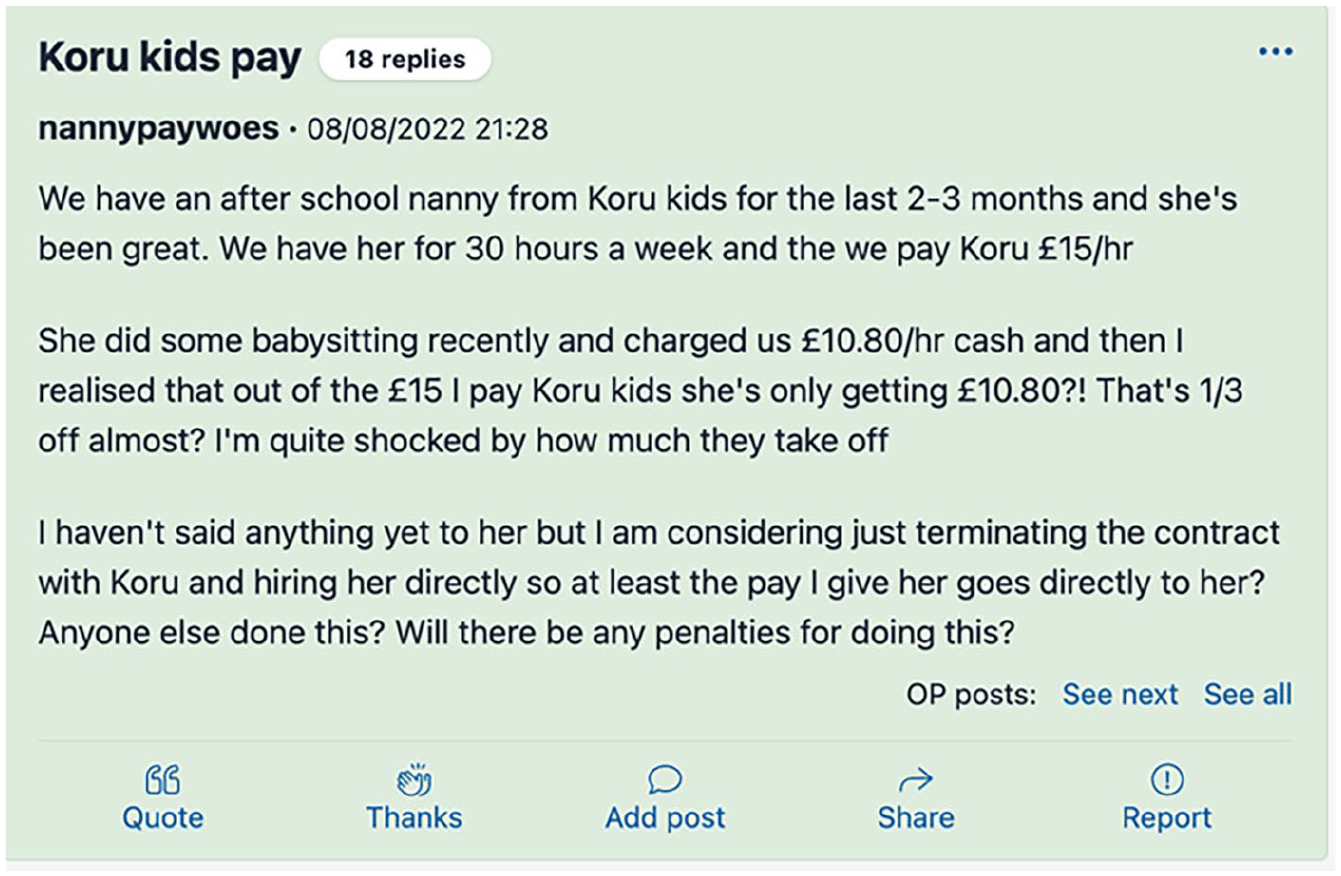
Koru Kids platform service fees.
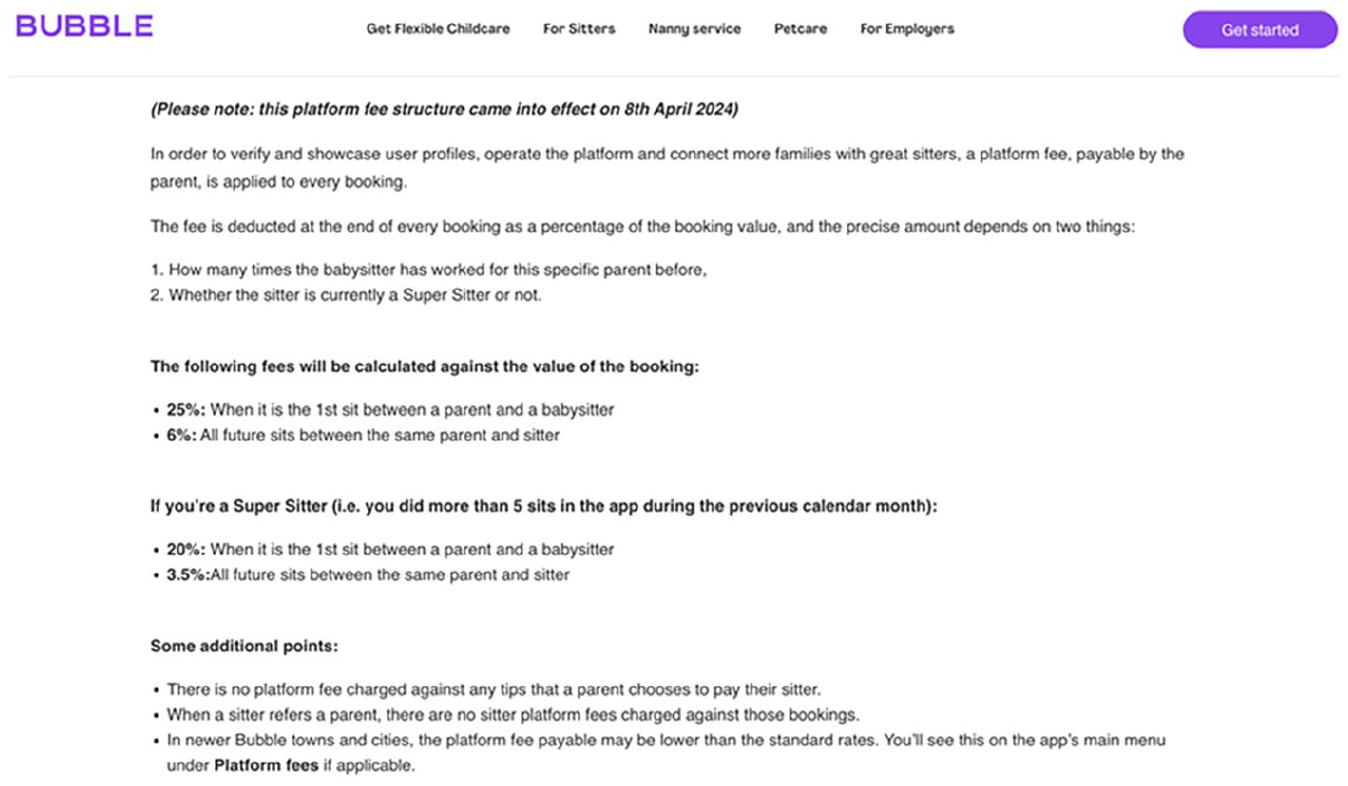
Bubble platform fee structure.
Other platforms, (such as beauty platforms Secret Spa, Blow LTD or childcare platform Bubble or Koru Kids) either in addition to -or instead of- subscription models, charge commission on any financial transaction that takes place via the platform or deduct platform service fees from workers’ rates. These often try to capture the worker-client relationship on the platform and are more restrictive against workers and clients moving away from the platform to coordinate their work. As such, however, the relationship between worker pay and platform business model is obscured, especially when workers enter into binding agreements that breaking the rules (e.g. going off the platform with a client) might risk expulsion or potential legal escalation. See Figure 1, where a client discovers the service fees Koru Kids charge on the platform and asks about the legal implications of going off the platform. Below we also share the platform fee structure at Bubble.com (Figure 2), where there is hierarchical differences between ‘sitters’ (childcare workers) who have completed five or more tasks on the platform in the past month, and those who did less, rewarding the sitters for not going off the platform in the long term.
Important to note, however, is that both workers, and clients, can come up with ways of using the platforms strategically to circumvent both the subscription, and commission costs. One such way is to find regular clients and then going off the platform, or as German workers would call, ‘going schwarz’ (black). As one Betreut.de worker interviewed explained: ‘From my perspective, having this platform where I can go schwarz, it’s a very helpful thing’. When workers go schwarz, the platform loses out on the commission and/or subscription fees To address this issue, another platform in Germany, Helpling, has recently introduced a new measure, which is a contractual employment option that is only available for workers after they sign up for a premium account (see Figure 3), which allows workers to work as a permanent household helper, get a permanent position with a contract, receive a salary that is above average for a cleaner, and even receive up to 30 days of paid leave. Workers who choose the non-premium option, on the other hand, continue to be self-employed as cleaners. They can determine how many hours they want to work (the platform advertises earning 21 Euros/hour on average on their website – but does not mention commissions) and determine their own hourly rate. Whereas the premium option is advertised as an employment contract with fixed working hours, the latter is considered by the platform, as an independent (contractor) model with 100% flexibility.
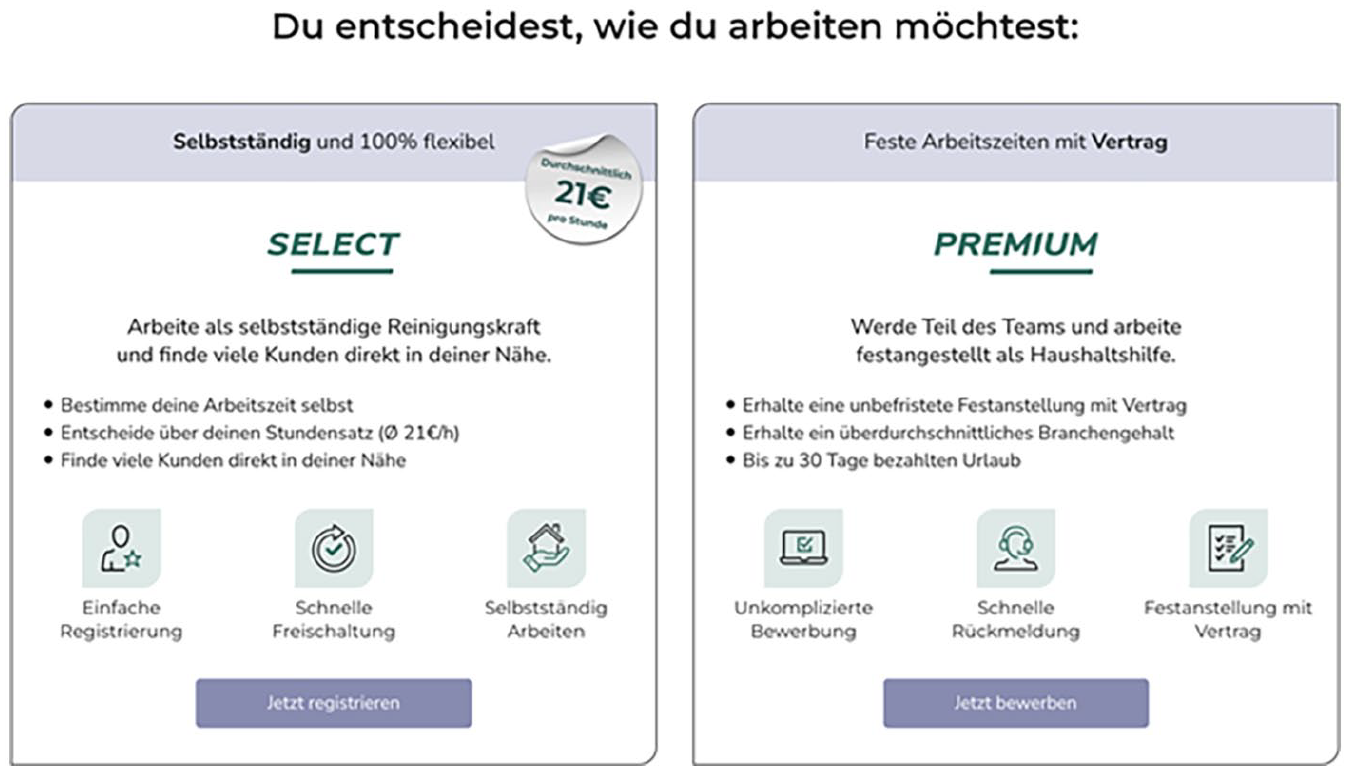
Contract-based model operationalised by Helpling.de.
To provide a broad analysis of the worker experience on the platforms, we have organised our analysis based on workers’ experience on the platforms: how they are allocated work, how worker profile and ratings work, how payment is structured and how background checks and disputes are handled. All these four aspects involve different kinds of unknowns and production of non-knowledge which keep workers in the dark, with limited ability to contest or collectivise against issues of precarity.
Allocation of Work
Algorithmic management plays a crucial role in workers’ access to jobs on the platforms. Even in platforms where workers can be paid off the platform, there are important user interface functionalities which mediate worker’s ability to reach potential clients, communicate with them and ultimately improve their overall earning potential. Winner-takes-all algorithms often entail that workers who find jobs on the platform tend to be offered more jobs, while workers who do not make successful connections on the platform tend to be de-prioritised from being shown to prospective clients and hence are offered less jobs; thus creating lock-in effects for each platform. One worker we interviewed in the UK noted that she had several other friends in her Brazilian network who have similar qualifications and work experiences both in the UK and in Brazil, yet to her puzzlement, her friends have never managed to find work through the platforms, though she did.
There is also a significant prevalence of scams and predatory client behaviour on platforms, either in the form of fake profiles of clients or fake job ads which further add to the complexity of navigating platforms for accessing actual job opportunities. Workers we interviewed on platforms where the transaction did not go through the platform interface (such as Yoopies in the UK) expressed a particular sense of uneasiness when talking about the risk of working in private homes, as they were not sure whether the jobs listed on the platforms were genuine.
Moreover, workers on care work platforms often face information asymmetries as the client-facing app and the worker-facing app offer different kinds of information. Workers, for instance, in most cases, do not see the rates charged by other workers on the platform, unless they also open a client-facing account (e.g. Helpling and Betreut.de in Germany;Yoopies in the UK). For this reason, workers who are new to the platform and need jobs and reviews to build up their accounts often ask for wages which could risk being below the minimum hourly wage to make their profiles attractive. To survive the competition on the platform, workers, in other words, may work many hours while risking not making ends meet. Indeed, we see vastly different rates being charged on the platforms when ordering worker profiles by hourly rate. During Fairwork 2022 research for instance, we saw that the Yoopies website itself suggested workers not to charge more than £8 per hour, a rate under the minimum wage, to be able to be competitive among the other workers.
On TaskRabbit in the UK, clients are given the agency to choose workers they approach with offers of work; with worker experience, photos, bios and reviews listed. In this sense, offers of work are allocated by the client, but mediated by the internal search function of the platform systems that presents clients with potential workers in a priority list (similar to how a Google search functions to prioritise certain results over others). This stands in contradistinction to other forms of platform work that have enjoyed academic attention elsewhere – such as ride-hail and food delivery – where dynamic pricing is set by the platform, and the pay offer per job becomes a point of experimentation that platforms seek to benefit from (Van Doorn and Badger, 2021). This gives workers greater agency to set fees they are happy to work for. TaskRabbit suggests a rate to users based on their experience and reviews, but workers are not obliged to adopt this rate and can opt to charge whatever they see fit: ‘The app suggests rate of 36 pounds it’s been like this probably six months maybe two months ago was 42 pounds and now it’s down to 36 pounds’ (TaskRabbit Worker 1). According to TaskRabbit (2022a)
The guidance you see is based on client market data TaskRabbit collects for your metro, task category, and experience level . . . [and whilst] you still have 100% control of the rates you set . . . Those who set competitive market rates make more than those who don’t’ (emphasis original).
While for some workers this has encouraged them to increase their rates over time for others, this dynamic encourages them to cap their fees at a much lower value in order to attract more work options, with an associated trend towards devaluing their own work and time: ‘I just do a bit more than minimum wage for the cleaning jobs because I don’t personally think that I should be paid like say, £12 an hour as a cleaner’. (TaskRabbit Worker 4). As such then, the price a worker pitches is directly related to their ability to secure work as:
The influence your rate has on your search-result ranking varies depending on the experience and prices of other Taskers in your metro and category. In metros where there’s more competition, your rate may be a larger factor than in areas where there is less Tasker competition. Your reviews and availability will continue to be important factors as well. (TaskRabbit, 2022a).
In essence, this means that factors including worker’s hourly rate, experience, reviews and levels of external competition (all also measured through these metrics) make a direct impact on where in the search they appear, and therefore how likely they are to receive offers of work. The exact details of how this functions though, remain vague; under the remit of proprietary information that TaskRabbit can adapt and change when market demands shift. Workers feel the imperative to appeal to both algorithmic systems that prioritise them in the search results shown to clients, and to appeal to the human client selecting them for the work through an appealing bio that matches their appealing rates and reviews. Hence, the non-knowledge workers experience in finding work on the platforms, both when they are successful and when they are not, enact a strategic advantage for the platforms to adapt the work allocation algorithms as they require, as well as their revenue models.
Worker Profile and Ratings
Worker profiles and ratings have a direct and tangible impact on a worker’s ability to secure tasks through a platform. In the words of SecretSpa Worker: ‘yeah absolutely clients can see reviews . . . That’s how I get clients’ and another, SecretSpa Worker, noting that:
When a customer rates me, it makes a big difference . . . I can be rated from one to five, and then the client can leave a comment. Which helps. Because a lot of my clients say to me ‘I chose you because you had good ratings’.
On other platforms, like TaskRabbit, better customer ratings are just one metric that mean a worker will appear higher in the search. As one worker put it: [If you have bad ratings] ‘You show up in the search results, much less. Your visibility to customers is reduced’ (TaskRabbit Worker). In other systems, it can impact the amount workers are paid by clients, or the amount of commission they need to pay the platform (with rates of pay increasing and rates of commission reducing as ratings improve). A Blow LTD worker reported that
when I leave an appointment, I ask customers to leave a review. Sometimes they do, and sometimes they don’t. When customers leave a good review, your scoring will go up and you will move up in the tier system. This means, you’ll get paid more.
What is clear is that ratings provide a multitude of functions that differ across different care work platforms. However, what is clearly at stake is that, apart from not being able to control how clients would rate them, workers are also not able to influence or even understand the direct implications of the ratings of their ability to secure jobs on the platforms.
Most rating systems observed in this study comprised of two forms of data generated by the client – a rating (often out of 5 stars) and the ability to add a more qualitative ‘comment’ to reflect on the worker’s performance of the task and anything else worthy of note. For Care.com, their FAQ outlines the role reviews play in differentiating caregivers (or workers) from each other:
Reviews play an important role in the Care.com community. Transparent feedback on caregivers helps families make informed hiring and booking decisions. Reviews and recommendations also help caregivers build their professional resumes and differentiate themselves from other care providers. (Crunchbase, 2024a)
What is implicit here, is that reviews constitute a vital ingredient of the competitive nature of the platform from the point of view of the worker – that positive reviews can accelerate a person’s career, and negative ones can hamper their attractiveness to clients. While information like this is buried in the FAQs of platform websites, customers are rarely told the ramifications of their reviews in-app, or at the point of reviewing the worker for the service they have received. Hence reviews operate at a space in-between knowledge and non-knowledge. While the information is freely available online, it is not presented in a location or manner than may customers will meaningfully interact with. To combat this, some workers report having embarked on a strategy of ‘educating the customers’ due to the power and significance of their reviews. For example, Blow LTD Worker reported that ‘When I leave an appointment, I ask customers to leave a review’, and that for customers who had understood the power of reviews that there was an ‘unspoken agreement’ that a positive review would be given unless something had gone catastrophically wrong.
Workers can also provide reviews for clients. However, in this case, reviews can be skewed due to the asymmetrical nature of power between the worker and the client. In the case of one Helpling worker in Germany, for example, providing a bad review for a client was not something she would resort to even in instances when she was not happy with the pay (for unpaid extra time) or the way she was treated at work. In the interview, she explained that while workers were provided with the opportunity to leave reviews for clients, many of her colleagues chose not to, for they were afraid that the clients would know the worker behind the negative review. Clients, the worker explained, also had the final say in providing a review as they could comment on the worker’s profile after reading what the worker wrote about them.
Beyond the ratings given by customers, workers were also aware of ratings that impacted their profile that were given out by the platform in relation to non-task-related metrics. For example, one TaskRabbit worker reported that: ‘I never turn down a job. It would be very rare . . . You are rated on three metrics. Mine are all 100% because I made that mistake [of not taking jobs] on another platform and it caused problems’. According to TaskRabbit, these ‘analytics’ are divided into three categories: ‘Opportunity’, ‘Tasks’ and ‘Earnings’ that are both available for taskers to view and have an active role in determining where in the worker search taskers appear. Again, there is a nuanced form of non-knowledge production at play here. While TaskRabbit (2022b) makes it clear to workers that they are measured on factors beyond the task itself (including, but not limited to:
the number of tasks you’ve completed in the past 30 days . . . The number of tasks we anticipate could have done based on your search result appearances and average position . . . How much you’ve earned in the past 30 days . . . [and] how much we anticipate you could earn based on your current potential and availability)
It is unclear as to how these metrics are calculated or the degree to which they shape a worker’s ability to move up or down search rankings. These are dynamic factors that can also relate to how you ‘compare to other Taskers in your area’ – another continually shifting target. This makes it incredibly difficult for workers to know where they stand in relation to the rest of the workforce, and therefore to understand their earning opportunity, despite the fact there appears to be very clear and abundant information made available to them and that they should be able to deduce their relative success on the platform from their reviews and ratings.
The stakes of this metric game are high, with TaskRabbit openly sharing that:
‘With each task you complete, you have the potential to be moved higher up in the search results, allowing you to be viewed by more clients and potentially booked more often. Our data shows a very clear correlation between search result ranking and number of task invitations received, so Taskers who rank higher will typically get more invitations’ (TaskRabbit, 2022b).
The mobilisation of vague terms like ‘potential’ alongside ‘very clear correlation’ creates a tension that workers must attempt to comprehend and understand in order to maximise their earnings. A strong sense of knowledge is created in regard to what kinds of behaviour will increase a worker’s chance of moving up the rankings and securing more opportunities to work. A very unclear case is given to exactly how this works, and what return on effort invested workers can expect to attain. This keeps workers in a continuously precarious position, always needing to self-discipline (and potentially self-exploit) themselves to satisfy the unknown metrics they are measured-upon by the platform. In some instances, this refers to paid activity like undertaking tasks, but in others, it refers to unpaid work such as responding to potential clients and remaining active on the platform. This important feature is not limited to TaskRabbit and is a common feature of many care work platforms, where workers are judged by their responses to ads listed publicly or their responses to negative reviews on their profiles. For instance, one Helpling worker noted that ‘Helpling have their rating for quality communication, reliability’ both unpaid aspects of the work that impact a worker’s success in the platform search function without giving details of how specifically this takes place.
Some workers even noted that they are aware that if they do not log into the platform several times a day, even when they might not have received any messages or they might not have immediate reasons to do so, they are shown less to prospective clients; so they just log in to keep an active profile. Across other platforms, workers do not actually know what the material impact of their activity is, or how their activity levels on the platform are calculated, weighed and how they affect their potential for being shown to prospective clients. They also do not know whether it is sufficient to just log in and log out, or they need to scroll through profiles, check past messages, click on new job ads (i.e. spend significant amounts of time on the platform on different engagement tasks) for them to be considered having an ‘active profile’.
This uncertainty limits workers’ abilities to work across multiple platforms (multi-app) because part of what makes them successful is their ability to build a strong profile on one. This is very difficult for people working part-time and therefore mitigates the ‘flexibility’ platforms claim to be a central tenant of their offering. Where workers do report a successful approach to working across multiple platforms, they tend to use one as their ‘primary’ platform and use others to supplement their pay when their primary platform goes quiet. For example, Blow LTD Worker notes that ‘I don’t only rely on Blow. Last week, I only earned £20 on Blow because I only did one appointment. But then, personally, I made £2,000 through Secret Spa and personal appointments’. By spreading their availability and attention across platforms, workers can make a more successful living, but this must be done with a strong strategy in mind.
Workers recalled the longevity of the impacts negative ratings had on their profile. One babysitter for Bubble reported that ‘when the parents see your profile they can see if you are 100%, so if you get some negative review, you will never be 100% positive and its going to affect your profile’ (emphasis added). Negative reviews were therefore deeply powerful in limiting a worker’s chances of securing future work. Their staying power on a worker’s profile meant that many workers across platforms reported going the extra mile to ensure they did not get a negative review because this could impact their ability to work in the future.
Aside from the very material and financial impacts of poor ratings on a worker’s ability to source and complete work, there were also emotional impacts too. One Blow LTD worker reported that:
There was this one time where the client had a bad experience with me. She said something like ‘you’re really inexperienced. you did a bad job’. Personally, I think I did a good job. I don’t know why she did because in person she was very sweet and very nice. And then it was upsetting hearing she had so much to say about on the email. She said like it wasn’t of quality and I’m just thinking like, I know I do good work. There’s a reason why I take longer than most people I’m very meticulous, I just got depressed after reading that.
Subsequently, ratings play an important role in the allocation of work and its remuneration on the platforms. Workers are aware of the role of ratings and reviews, however, what they lack information on is how exactly they are impacted by them, and if they can alter their (negative) impact at all.
Payment
There are important information asymmetries between what kind of information is asked from the workers on the platform to keep an active profile, and what information is required for clients to be able to setup an account. In addition to workers being unable to see how much other workers are charging in their area, some platforms ask them to charge as low as possible as we mentioned earlier. Even on platforms where there is some level of comparative information on other local workers, these are only averages, and not actual rates, which means workers might still not be sufficientlyinformed about the range of rates other workers might be charging for the same work, unless they also acquire a client account and check what other workers are charging in their area.
Moreover, although workers may set up clear hourly rates on the platform, their actual earnings might differ. In the case of one Betreut.de worker in Germany, the client, as the worker recalled, had asked her (in 2021, when COVID lockdowns were still relatively in effect) to pay for a PCR test in order to become a regular cleaner. The test, as the worker explained, costed her 110 Euros. Workers recounted stories of clients either asking them to lower the rates when they are messaging them on the platform, or doing so when they meet them in person for the job (if the clientsdid not have to pay via the platform to confirm a service). In the latter, workers have reported feeling ambushed and finding it difficult to decline the job offer as there are important opportunity costs at that point, such as not only foregoing a potential income, but also having paid for transport to travel to client’s home already and having had lost on other job opportunities that could have happened at that hour. This combines with the power of reviews and – by extension – the power that clients have over workers through their power to review negatively if a worker does not adapt to their needs, no matter how unreasonable.
As with many other types of platform work, payment security is one of the primary issues affecting workers on care work platforms. This is exacerbated in the case of platforms that facilitate off-platform payment between clients and workers; with non-payment as well as underpayment remaining a significant risk for workers. When platforms allow off-platform payments, they also defer any accountability for non-payment of workers to clients .
Platform policies regarding non-payment in the UK run across the full range of possible scenarios. In the case of SecretSpa, one worker reported that they are responsible for sending back some of their payment to the platform to compensate against client complaints:
Sometimes when you get complaints from clients, you get asked to take some of your pay to compensate the client. Yeah, so that’s, that’s a bit annoying . . . Oh they’ll contact you and tell you why the client was unhappy and let you explain your side of the story. But their policy is that they will refund the client the money. So that comes out from their commission.
This leaves workers greatly exposed to clients complaining after the performance of the task has taken place, even if the client did not raise an issue in the presence of the worker. After multiple of these occurrences, workers may be offered training and support to stop it happening in the future, but this means workers have to spend time on training, rather than being able to work and earn an income. In some cases, workers might be asked to re-do a job for the client (which they do not get paid for), or cover the cost of the refund for the client Some workers noted thatsome clients abuse the review and complaint system in the platforms, as they may be able to get a service for free (by way of a refund), if they sufficiently complained about it. However, it is not clear if the clients know that the refunded fee may come from workers’ pay.
In both the UK and Germany, the majority of care work platforms failed to monitor whether the workers were paid in full or in a timely manner by clients, when the transaction did not go through the platform interface. One of the workers we interviewed, working for Careship, claimed to have almost 2000 Euros of income that was not paid to them by a client in Germany. When she ultimately asked the platform to intervene, they were told to consult a lawyer, without any further help or advice, claiming no responsibility or accountability on the matter.
In addition, clients, in the case of cleaners, may misconstrue data regarding how big their flat or house is, or how many rooms it has. The worker, then, is left with two choices: either do the work for free, or do not do the work and risk a negative review. Given the precarious conditions workers live in, where keeping the job at all costs (by way of avoiding negative reviews) is a priority, most workers we interviewed chose to put in unpaid hours of labour. While workers can bring up such issues later with platforms, such as Helpling and Betreut.de, they do not receive the lost remuneration. Some of the workers we interviewed also mentioned that they did not want to chase the platforms for their losses. As one Helpling worker in Germany expressed: ‘The thing is, I know it is problematic, but it is my condition of (being an) immigrant. In Argentina, I earned what, one Euro per day’. She was fully conscious that the payment she received for the work she did was not fair. Yet, she did not want to lose the one channel that provided her an income which she considered necessary to get by in Berlin. Hence, rather than complain about the unpaid labour she had to provide, she chose to find comfort in keeping the job and chasing further tasks on the platform.
Moreover, clients, and not workers, often have the final say on how satisfied they are with completed tasks. Overall, platforms lack the necessary mechanisms to monitor client behaviour, and follow a customer is always right policy when it comes to evaluating worker grievances. This is not a naturalistic phenomenon – as platforms frequently build these evaluative and surveillance architectures for workers. Rather, it is an intentionally generated non-knowledge that illustrates their customer first orientation, dismissal of worker safety and precarity.
None of the platforms included in our study have robust monitoring mechanisms in place to keep a record of clients that consistently make complaints, or that consistently have complaints made against them. Even when clients might be reported for non-payment or underpayment by workers, it remains unknown to the workers that the platform takes an active initiative to block them from the platform. The lack of evaluative systems by platforms therefore not only leaves workers exposed to financial insecurity, but also puts them at great considerable risk; a risk that is magnified even further for female workers operating on the platform who are highly vulnerable to gendered forms of violence.
For platforms that charge commission rates, workers note that they are often not entirely sure how much exactly they will be paid at the end of a job, either because of a variable commission rate, or variable add on fees the platforms charge them after they accept a job. Worker interviews also indicate that clients often do not know how much the worker earns for each task completed. Both of these are forms of intentional non-knowledge production by the platform that seek to limit the possibilities for solidarity between workers and clients by only giving them partial perspectives of each other’s financial condition. In the case of Helpling, Germany, for example, worker interviews show that clients are unaware of commissions charged to workers, which come in addition to the service fee that the client has to pay to the platform. As of 2021, Helping, Germany, operated on a model where it would take 40% commission from the worker for the first cleaning, alongside a service fee that is charged to the client. Indeed, in many cases workers also reported not being fully clear on their own commission rates, or the broader commission structures that were in place: One SecretSpa worker reported that they ‘aren’t sure about the commission structure. I think it depends on your status on the platform [bronze, silver or gold]. I know that for the £70 service today I will be getting £51.50. So, they cut £19.50’. Another worker for TaskRabbit referred to these – and the way they are obscured from customers and workers as ‘hidden costs . . . and TaskRabbit is never clear about this’.
In other cases, workers on the same platform reported different understandings of the commission structure in place, highlighting the general lack of knowledge propagated among the workforce of the fees they charge. A Bubble worker noted that:
They pay for the hours, and they charge 10% as a fee or 7% it depends. If it’s the first time you are working for the family, if it’s between 2 to 5 sittings for the same family, and then after 6 sittings its less. I think the lowest is 3.5% if you work for more than 10 times for the same family. I don’t know exactly because I’ve never worked more than 10 times for the same family. But they explain this on the app.
Meanwhile a second worker for Bubble reported that:
No. So usually, I think it’s 10% on sit with like, a first time Family. But if you keep working with the family, it goes to 8, then seven, and then five and two and a half. I think the minimum is one point and a half. But you needed to have like 10 sits with the same family.
These commission rates are not reported to the customer (unless the customer specifically seeks the information). There is, in other words, strategic ignorance in place, where the platform obscures details on the payment model and leaves the client with the impression that the worker will get the full amount they will be paying to the platform for the service.
Moreover, the subscription model widely used by care work platforms obliges workers to pay a fee even before they are offered a job on the platform, without any guarantee that subscribing will entail finding a job on the platform. Because of their operational model, platforms limit the ability of workers to use the platform without a subscription. They do so in such a way that they do not fully indicate what would be the exact gains of paying for a subscription. As such, it is not possible for workers to find out about the comparative successful job allocation rates of subscribed workers and non-subscribed workers on the platform.
In addition, keeping an active worker profile on the platforms requires significant amounts of unpaid labour by workers. None of the platforms we analysed mention this on their apps, but all the workers we interviewed noted the amount of time they spend on filling details on their profiles, answering messages, managing their diaries on the platforms, as well as chasing payments, responding to comments and ratings on the platform. The amount of time this requires varies by platform, and by how active any given worker is on the platform in question. For those with high reviews and frequently in work, they can report small – but not insignificant – amounts of time. For example, a worker on Bubble reported that she spends ‘about 15 minutes of application time and admin for every 4 hour sit’ – a figure that reduces with repeat bookings. This encourages workers to go ‘above-and-beyond’ in early sittings to encourage clients to make repeat bookings and thus reduce the associated administration time.
The opaque pay structures presented here indicate a strategic form of non-knowledge platforms employ to keep workers both attached to the platform but also give the illusion that they are independent contractors, who can choose their time, availability and preferences on the platforms. However, what we see is a system where workers feel the need to be forever connected, charge the minimum amount they can realistically charge – even when that might be lower than their preference or the national minimum wage levels, and constantly bargain for positive reviews even at the cost of further precarisation of their work.
Background Checks and Dispute Resolution
Most of the platforms mention in their Terms and Conditions that workers are self-employed (or independent contractors) and should therefore solve their problems directly with the clients. None of the platforms we have analysed offer a formal dispute resolution mechanism between the clients and the workers, although some mention the importance of setting up an agreement before commencing the service. When platforms play an advisory role in solving issues, it is mostly related to client complaints about workers, rather than worker complaints about clients.
In Germany, for example, the two platforms we bring into this study have email and phone channels open for workers to raise work-related issues. However, when workers face a problem with a client, such as maltreatment at work, both platforms relinquished liability, asking workers to either contact the police, and/or seek legal assistance. No compensation, especially for the latter, which can be very expensive, is provided by the platforms, meaning workers may choose to not pursue legal action because of barriers to affordability. When asked who she can call on in case of a dispute, one Betreut.de worker jokingly responded: ‘My mother’.
Knowing that the platforms do not assume any liability for client misconduct, workers, then, come up with their own strategies to seek help. In the case of Helping, workers in Germany use a WhatsApp channel, ‘Syndicato’, to communicate with each other when problems arise, such as providing a list of black-listed clients that workers should avoid. Workers, in other words, create their own means to generate and share knowledge about clients that should be avoided to overcome the intentional non-knowledge created through the platform’s opaque systems.
Similarly, majority of the platforms claim that they organise background checks on the workers, requiring workers to complete their profile as much as possible with as much detail as possible. Moreover, workers are encouraged to attach a picture to their profile, arguing that profiles with pictures get more jobs. However, this is not the case for clients, who can set up accounts with little or no information or a photograph. Workers who do not possess premium accounts also cannot reach out to clients directly, unless clients initiate the conversation in the first place, thus creating a communicative imbalance and two-tier system of communication. .
Even when workers figure out some level of workarounds, they explain that they do not fully understand why some workers access more jobs on the platforms, even when they might have similar profiles, similar levels of experience, and similar levels of engagement on the platform. We argue that this is the part where platforms employ strategic unknowns about their operations, which helps them defer responsibility and accountability for lack of protections and job security on the platforms.
Discussion
In this paper, we have analysed how care work platforms in Germany and the UK make strategic choices in sharing some information with workers, and not others. By taking an agnotological approach and utilising double social life of methods as a framework, we explored how the strategic unknowns of business models of care work platforms impact on the day-to-day life of workers and the working conditions they experience on the platforms. In this section, as a way of conclusion, we discuss the key points that emerge from our analysis and our key contributions.
We argued that care work platforms are adopting a strategic mix of clarity and transparency on the one hand, and obscurity and non-knowledge on the other, to calibrate business models. We noted that care work, as opposed to other forms of platform work, still requires some level of calibration of business models, because going off the platform remains a major challenge for the platforms, as both workers and clients can request to go off the platform (and avoid subscription or other fees). The information asymmetries generated through these strategies uphold and reinforce the imbalance of power between the platform and the workers at the expense of the workers, who suffer negative consequences in terms of workload, unpaid labour, precarity and both physical and financial insecurity. While our study focused exclusively on care work platforms, in terms of the method of studying strategic unknowns and how workers experience them in their everyday work lives, the findings of the study could be expanded to other platform work, where precarity continues to be a major concern.
This article contributes to an expanding literature on care work, as it brings to light the relations between the more macro-economic aspects of platform work (i.e. platform business models) with the micro-economic aspects (i.e. lived experience of platform work). It provides a detailed look into how allocation work, worker profile and ratings, payment systems as well as background checks and dispute resolution methods present an ambivalent system of knowledge and non-knowledge. For instance, while workers do now that their work can be, and is, assessed by background checks and they can receive ratings on their performance, they rarely know how exactly these assessment metrics and checks affect their ability to obtain work on the platform, or how they can contest the systems in place, when they negatively impact them, or if they feel, they were misjudged.
A second contribution of the article is to explore the limits of what we can know as academic scholars about the financial underpinnings of platforms. As indicated earlier, the initial intention of the article was to conduct a ‘follow the money’ approach and understand how the financial hinterlands of the platforms can be traced in the business models they operate with. This has proven to be more difficult than anticipated. Our findings indicate that, there is more transparency needed overall to understand the startup ecosystem of platforms, and to understand which platforms succeed and why; and how this impacts on the working conditions of workers.
A third contribution is to expand the conceptualisation of care work. In the literature, so far care has been conceptualised only in terms of childcare, elderly care or domestic work. But across the world, platform work is expanding into a whole new array of sectors, including nursing, medical care, as well as beauty work. Considering that care work in general is highly feminised, and carries important economic assumptions in terms of informality, recognition and valuation of work, it is important to also understand how we can expand our conceptualisation of it. Our article, in that regard, has been the first in the field to make this attempt to conceptual expansion, based on what we see in the field.
As a conclusion, we state that what information (i.e. knowledge) to share and what information to withhold ultimately indicate a position of power. While workers are asked to grant significant amounts of information to platforms only to be able to open accounts and communicate with potential clients; this is not the same for the platforms (or the clients seeking services via platforms). This is why, for instance, when platforms decide to close their operations entirely, workers are often the last ones to hear about it. Similarly, when platforms change their business models, with direct implications for workers, in terms of platform fees, subscription rates or service fees, workers are not (typically) in a position to be able to feed into these decisions, and they are only able to ‘take it or leave it’. This is why, it is important to not take non-knowledge as a neutral state, but investigate how it is enacted, and strategically deployed, with significant impacts on worker’s agency and ability to challenge precarity at work.
Footnotes
Funding
The author(s) disclosed receipt of the following financial support for the research, authorship, and/or publication of this article: The author(s) acknowledge receiving financial support for the research of this article. The Fairwork Germany research has received funding from the Berlin University Alliance OX/BER Centre for Advanced Studies (CAS). The Fairwork UK Project has been supported by the Oxford University John Fell Fund, the Minderoo-Oxford Challenge Fund in AI Governance, and the University of Oxford Equality and Diversity Unit Returning Carer’s Fund.
