




Abstract
Since the rise of platform labor, food delivery, and ride hailing workers have become a visible part of cityscapes, unlike platform workers in the domestic sector. The invisibilization and economic devaluation of reproductive tasks, especially in the private sphere, has a long history.Although platforms are not likely to yield a radical transformation in this sector, qualitative changes concerning the invisibility of work outsourced by households can be observed. In this contribution, we draw from the analytical framework of (in)visibility of/in platform-mediated work and map it against our research findings on a key platform in domestic cleaning in Europe, including netnographic data and interviews with workers and clients. Using the framework as a heuristic tool leads us to a more nuanced understanding of (in)visibility in platform-mediated cleaning in perceptible, institutional, and individual terms. Moreover, we argue that the interrelations between these three layers of (in)visibility offer novel insights for making sense of worker organizing and collective action, the practices related to leaving the platform, and the issue of workers’ occupational identity of domestic cleaners. As such, the study contributes to the current debates on platform labor and domestic work, including the value-visibility relation and the role of digital platforms therein.
Keywords
Introduction
Since the rise of platform capitalism and platform labor, people on bikes or e-scooters with colorful cubic backpacks and taxis without the classic taxi sign have become a visible part of many cityscapes. However, as increasingly highlighted by feminist scholars in the field of platform labor, these gig-work platforms do not only mediate ride hailing or food delivery, but also tasks such as care work and domestic cleaning (Altenried et al., 2021; Dowling, 2022; Huws, 2019; Khan et al., 2024). Taking place in private homes renders this kind of work largely invisible. The invisibilization and economic devaluation of reproductive tasks, especially in the private sphere, has a long history and became prevalent during the industrial revolution (Komlosy, 2018). Although the advent of platforms is not likely to yield a radical transformation in this sector, we can observe qualitative changes concerning the (in)visibility of work outsourced by households. Platforms, thus, are intermediaries of market interactions (Çalışkan and Callon, 2010; Srnicek, 2017), but also expose elements of these interactions through their digital infrastructures. As technologies, we conceive them as being socially shaped (MacKenzie and Wajcman, 1999), which allows us to understand how the invisibilized and devalued patterns of ‘offline’ cleaning are inscribed in the platform interface and expressed by the means of the digital infrastructure.
The separation between what is seen as productive and unproductive work has been debated in Marxist thought and the differing Marxist feminist critiques thereof. The latter highlights the importance of reproductive work by arguing for or against its ability to create surplus value (Ferguson, 2020), ultimately also referring to how reproductive work is rendered invisible, especially if it takes place behind closed doors (Hatton, 2017; Kaplan Daniels, 1987; Lutz, 2010). The concept of invisible labor was originally coined by Kaplan Daniels (1987) precisely to refer to housework, yet it is not exclusive to this sphere. Hatton (2017), for example, discusses sociolegal, cultural and spatial mechanisms that operate both in housework and formal workplaces. These ‘intersecting sociological mechanisms’ (Hatton, 2017: 337) render various types of work more or less visible, including, for example, emotional and aesthetic work in service sector or corporate work, care work in formal contexts, or illicit work. Feminist struggles for recognizing reproductive work as work and de-gendering the social division of labor (Dowling, 2016: 453) also imply making it more visible, for example, by the ‘Wages for Housework’ movement (Dalla Costa and James, 1975; Federici, 2020). Following Dowling’s (2016) distinction between valorizing (e.g. through commodifying and marketizing) social reproduction and valuing social reproduction (in social, cultural, political, and economic terms), the platformization of domestic and care work can be seen as a new mode of the former (Kluzik, 2022). In terms of social recognition, it has been argued that the result is a further devaluation ‘of the labor of social reproduction precisely in order to extract surplus value from it’ (Dowling, 2016: 453). Platforms do that in a myriad of ways such as exploiting intersectional inequalities (Kluzik, 2022; Rodríguez-Modroño et al., 2022; Yin, 2024), externalizing risks to the workers (van Doorn, 2023), fostering ‘flexploitation’ (Bourdieu, 1998; Kluzik, 2021, 2022), subjectivization of work (Baum and Kufner, 2021; Kluzik, 2022), or fragmentation and isolation of workers (Niebler and Animento, 2023).
In this contribution, we draw from the framework of (in)visibility of/in platform-mediated work (Gruszka and Böhm, 2022) and ask the following: how can we make sense of the dynamics of (in)visibility of reproductive work such as cleaning using this particular analytical framework as a heuristic tool? What insights can we gain on the relation between (in)visibility and valuation when analyzing these dynamics in the context of platform-mediated domestic cleaning? Moreover, we inquire how such a framework can expand the understanding of platform-mediated cleaning emerging in current platform labor research. Last but not least, we aim to refine the framework of (in)visibility of/in platform-mediated work (Gruszka and Böhm, 2022). Thereby we consider the three proposed forms of (in)visibility, that is, perceptible, institutional, and individual, and map these against the findings of our study of Helpling, one of the key platforms in domestic cleaning in Europe, focusing on Berlin, Germany, in particular. The research is based on a netnographic study (Kozinets, 2010) of Helpling, encompassing a qualitative analysis of the platform content, and of functions and settings with the walkthrough method (Light et al., 2018). These insights are accompanied by qualitative interviews with cleaners and clients of the platform active in Berlin, and a small-scale survey with cleaners. Based on this rich data set, we unpack the (in)visibility of workers and their work along perceptible, institutional, and individual layers. We analyze the tensions and interactions between them and specify the role of a digital infrastructure installed by a platform company in the domestic sphere. As such, we aim to contribute to the understanding of the dynamics of (in)visibility in this particular sphere of reproductive work in its platform-mediated version. Furthermore, we add to the platform labor literature with a more nuanced discussion of existing concepts, for example, platform practices of ‘selective formalization’ (van Doorn, 2020: 51), and to feminist scholarship employing the lens of invisibility to grasp the dynamics of outsourcing domestic work (Hatton, 2017; Kluzik, 2022; Mateescu and Ticona, 2020; Ticona and Mateescu, 2018), thereby bridging the two bodies of work.
In what follows, we first outline the core analytical framework, which is discussed in the context of the state-of-the-art in platform labor and invisibility literature. Next, we account for the research context, data, and methods of the study. We then discuss the findings along the three layers of (in)visibility and show their intertwinement by making sense of three themes recurring in platform labor research: worker organizing and collective action, the practices related to leaving the platform, and the issue of workers’ occupational identity. We see these themes as pivotal for platform-mediated cleaning precisely due to the invisibilization and devaluation of work in private homes. The conclusion extracts the essence of the study, and points to limitations and future research.
Platform Labor and Invisibility
In the context of platform work, the lens of invisibility has been employed first in web-based cloud work on platforms like Amazon’s Mechanical Turk (AMT). Here, studies center on how the digital infrastructures of platforms affect the visibility of workers by rendering them bodiless and transforming them into avatars or strings of numbers (Cherry, 2016; Irani, 2015). Others refer to the unpaid tasks of AMT workers as invisible labor, such as task-searching, communicating with requesters, or managing payments (Sannon and Cosley, 2019; Toxtli et al., 2021). Few authors, situated on the intersections of sociology, media and communication, and feminist political economy, delve into the invisibility of platform-mediated domestic work (Kluzik, 2022; Mateescu and Ticona, 2020; Rodríguez-Modroño et al., 2022; Ticona and Mateescu, 2018). They set the first steps in unpacking how platforms shape and reconstitute the value-visibility relation, particularly sensitive in low-income work in domestic services, characterized by intersectional inequalities along the lines of gender and/or migration and ethnic trajectories. These characteristics are placed among key drivers behind platform growth in outsourcing domestic work, as the platform labor model ‘fit[s] perfectly in an informal, devalued, and precarious care sector’ (Rodríguez-Modroño et al., 2022: 624). Kluzik (2022) investigates platforms like Helpling, Care.com or SweepSouth, concluding that such platforms ‘act as techno-capitalist assemblages that govern invisibility and ultimately produce feminised and racialised precarity’ (p. 2). Contributing to the value-visibility debates, Van Doorn (2017) stresses the centrality of ‘sociotechnical obfuscation’ in platform practices that render workers ‘largely invisible to customers, to each other, and even to themselves’ (p. 904). Consequently, the literature conceives invisibility in connection to (in)formality of work but also as inscribed in the digital infrastructures of platforms.
The vocabulary of platform-mediated institutional and individual visibility has been introduced in the analyses of Care.com in the United States (Ticona and Mateescu, 2018). Here, institutional visibility centers on the failure of the platform to monitor the adherence of its users to the locally binding regulations on employment in private households, yet the full regulatory embedding of these practices is understudied. Individual visibility pertains to the review and rating schemes and online profiles of workers, problematized as proxies for quality assurance and trust building through digital interfaces. These interfaces are spaces where workers manage visibility, be it through a well-crafted self-description, maintaining a high rating, or using other visibility metrics pre-designed by the platform on the interface (Ticona and Mateescu, 2018). The lens of invisibility, particularly in institutional terms but also beyond, enables an engagement with the meaning of formality and informality in platform-mediated domestic work. van Doorn (2020), for example, refers to ‘selective formalization’ to describe (business) practices of platforms that ‘formalize some aspects of the gig while perpetuating and sometimes aggravating certain conditions of informality that have long characterized domestic labour’ (p. 51). This means that while platforms provide a digital solution, for example, calendar and payment management, hour count, or cancelation policies, overall, they neglect crucial aspects of a formal labor relation. Thus, the institutional visibility of domestic workers remains largely unchallenged by platforms (Gruszka and Böhm, 2022; Ticona and Mateescu, 2018).
Moreover, ‘interrupting the worker invisibility’ by organizing of platform workers and voicing their struggles is a central aspect of platform labor research, both in web-based cloud-work (Irani and Silberman, 2013) and in location-based gig-work, especially for ride-hailing and delivery-services (Kwan, 2022; Orth, 2022; Woodcock, 2021). Attempts of organizing occur in these more visible and masculinized sectors and in the feminized sector of domestic and care work, despite the difficulties for collective action faced by the workers (Baum and Carstensen, 2022; Niebler and Animento, 2023; Whitfield, 2022). Recent scholarship sheds light on worker organizing and (informal) resistance in platform-mediated domestic work, showing the ‘hurdles’ (Niebler and Animento, 2023: 690) the workers are confronted with, such as the atomization and dispersion, the lack of socialization opportunities, and their legal status. Organizing and resisting also happens, for example, with the support of political groups (Niebler and Animento, 2023) or by forging coalitions with clients (Altenried and Niebler, 2024).
Overall, studies of domestic work on platforms conclude that the visibility ‘granted’ to workers, rather than being substantial and systemic, is largely limited to rendering individual workers more visible to both the platforms and the clients (Mateescu and Ticona, 2020; Rodríguez-Modroño et al., 2022; Sedacca, 2022). They interpret visibility in the sense of formality of work, but also problematize the role of digital platform infrastructures in shaping visibility of work and workers.
The framework of (in)visibility of/in platform-mediated work (Gruszka and Böhm, 2022), central to this contribution, offers a more comprehensive approach that expands these dominant interpretations. As a heuristic tool applicable to both web-based and location-based platform work, it employs (in)visibility as an analytical category and differentiates between three layers of (in)visibility: perceptible, institutional, and individual. Accordingly, perceptible (in)visibility refers to the actual seeing of platform workers by multiple actors, including the public, clients for whom workers provide services, and other workers. Institutional (in)visibility considers platform workers from the perspective of regulatory frameworks and the degrees of formality of employment relations. Individual (in)visibility focuses on how the digital infrastructures of platforms render workers more or less visible to the client-users through rating and review schemes and online profiles. The framework conceptualizes visibility and invisibility on two ends of a spectrum, thereby stressing ‘the fluidity of what (in)visibility might mean for platform workers’ (Gruszka and Böhm, 2022: 1853). The three layers can be understood as sense-making tools within this spectrum, enabling a structured capturing of various manifestations of (in)visibility in the experiences of platform workers, highlighting the possible spheres of interaction between individual, institutional, and perceptible (in)visibility. To the best of our knowledge, analyses of platform mediation in household services through such structured approaches are still missing.
Research Context, Data, and Methods
This research focuses on platform labor in the domestic sector exploring the case of Helpling in Berlin, Germany. Generally, household-related services are characterized by low incomes, informal arrangements, and a largely feminized and migrant workforce (OECD, 2021). In the European Union (EU), about 57% of paid non-care domestic work (cleaning, gardening, doing the laundry, etc.) in private households appears to be informal, while the share in Germany is 75% (OECD, 2021). Anger and Enste (2022) find that even 90% of domestic workers in Germany work informally. Government incentives to formalize domestic services, such as tax reductions or a simplified declaration of marginally employed persons by households, have had minor effects (Enste, 2019). For households, cost savings are the main reason for hiring informal workers (Feld and Schneider, 2010). Domestic labor platforms appear to offer an uncomplicated and cheap solution, also promising to fight the black market, such as in the case of Helpling (Höhne, 2017; Koutsimpogiorgos et al., 2023).
Helpling was founded in Berlin, Germany in 2014 and is currently active in nine countries. In its home country, Helpling is available in 127 cities (Helpling, 2023b), with the largest offer in Berlin (Bor, 2021; Schmidt and Kathmann, 2017). As a venture capital funded start-up, the platform initially mediated independent contractors providing cleaning services in private households (i.e. ‘Helpling Select’ service). A few years and funding rounds later, Helpling acquired several competitors such as CleanAgents or Book A Tiger (Kapalschinski, 2019). Since 2021, the ‘Helpling Premium’ service is also available in Germany, offering an option of booking cleaners who are employed by partner companies. In the ‘Helpling Select’ service, central to our analysis, cleaner earnings are subject to the platform commission of 32% for one-time cleanings, and 39% for the first three bookings of a regular cleaning, reduced to 25% after three appointments (Helpling, 2024).
This study builds on a multi-method approach containing a variety of data sources, relating to the cleaners, the clients, and the platform infrastructure. Data collection involved desktop research and a netnographic exploration of the platform (Kozinets, 2010), 21 qualitative semi-structured interviews with cleaners and clients of the platform, which are at the center of our analysis, and an additional small-scale online survey with 28 participants. Data were collected in multiple stages, with the core phase between 2020 and 2021, and additional netnographic phases in 2024. The interviews with the cleaners centered on their working experiences through the platform, covering themes such as reasons for working as a cleaner (through the platform), working conditions (including, for example, payment or insurance issues), interaction and relations with the clients, the platform and with other cleaners (respectively, organizing possibilities). The interviews with clients helped to understand the reasons and motivations behind outsourcing domestic work (through a platform). In addition, we asked about the booking process and the reviews and ratings, leaving the platform (if applicable), the problems the clients encountered with the cleaners or the platform, and their perceptions on the cleaners’ working conditions. The online survey was conducted in 2021 and also included some open-ended questions, for example, on organizing. Given the low-response rate, the survey results were mainly used to underpin and specify the results from other data sources.
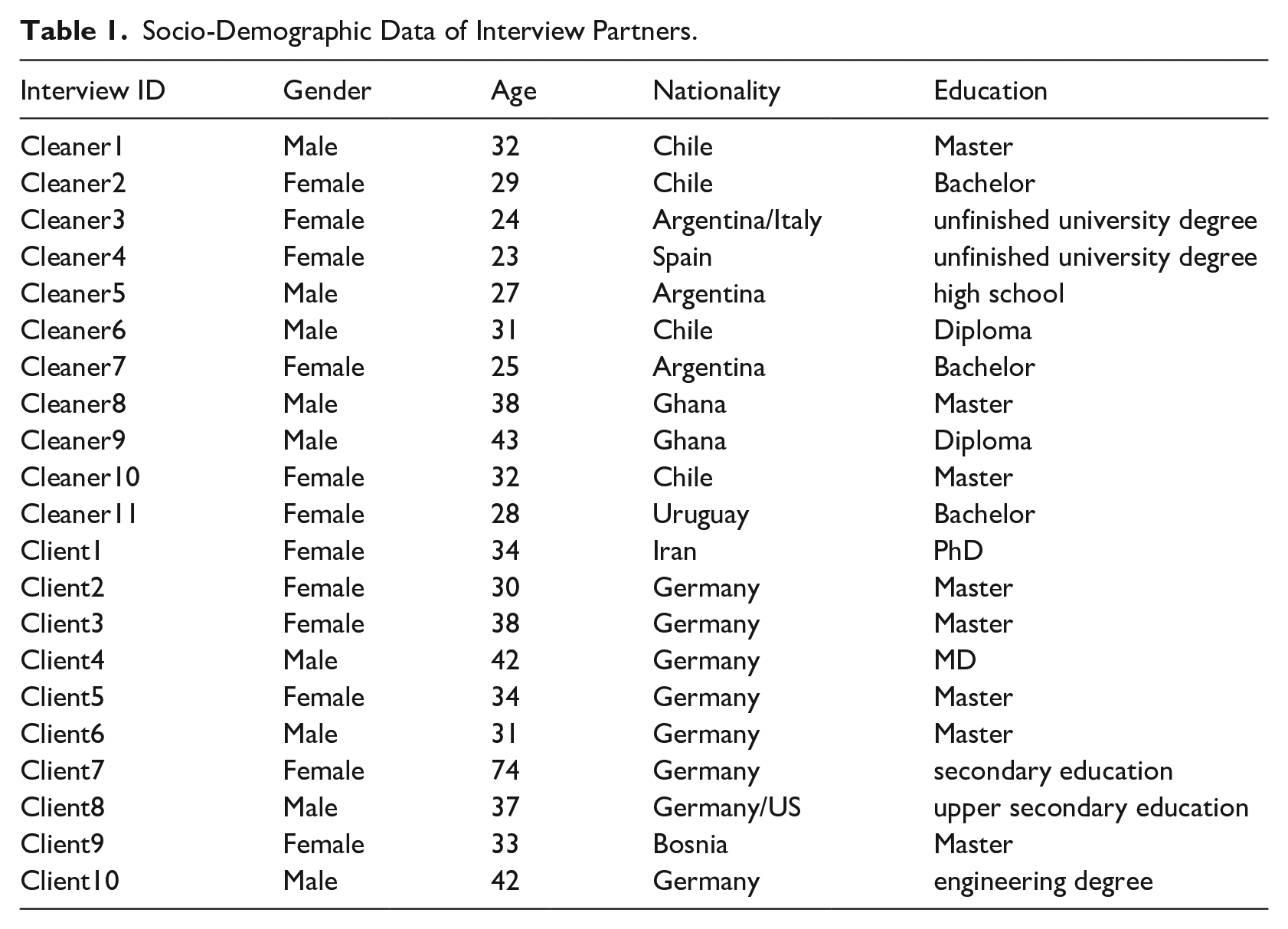
Due to the high perceptible invisibility of the interviewees, both cleaners and clients, especially in midst of the COVID-19 pandemic, we adopted a variety of sampling strategies for finding interview partners, including snowballing, posting invitations online, distributing leaflets in Berlin, booking cleaning services, and contacting clients we identified online. This resulted in a sample of 11 cleaners and 10 clients we interviewed (see Table 1 for more details). Especially the sampling strategy of booking (cleaning) services, although present in platform labor research (e.g. Fairwork, 2021), requires a thorough research-ethical reflection. To ensure voluntary participation, the cleaners were informed about the research project only after the cleaning. They received a leaflet with details of the research project and an email to contact the research team in case of interest in participation in the study. Two out of four cleaners we booked eventually reached out to us and expressed their willingness to do an interview. To compensate for our interviewee’s time, we offered shopping vouchers. Cash compensation was not possible due to university administration regulations.
Socio-Demographic Data of Interview Partners.
The qualitative data analysis of the transcribed and anonymized interviews was computer-aided with Atlas.ti. We followed a deductive–inductive coding approach, combining (1) structural coding as described by Saldaña (2009), that is, by developing a coding structure based on our research and interview questions, with (2) initial coding and memo-writing according to Charmaz (2006) to account for new themes and insights emerging from the data. Next, we structured the findings according to the framework of this paper and its three layers of (in)visibility (Gruszka and Böhm, 2022) and identified their interrelations, thereby using the framework as a heuristic tool.
The infrastructure of the platform, that is, the profiles, the review and rating or the sorting mechanisms, as well as its web presence and Terms and Conditions (T&Cs) are a prerequisite of the (in)visibility of the cleaners working through the platform and have also been a topic throughout the interviews and the survey. The walkthrough method (Light et al., 2018), seen as part of the ethnography for the Internet or the netnography (Hine, 2015; Kozinets, 2010), allows for a direct engagement with an interface of the platform ‘to examine its technological mechanisms and embedded cultural references to understand how it guides users and shapes their experiences’ (Light et al., 2018: 882). To learn about these mechanisms, we encountered the platform both as unregistered users and registered clients, documenting and mapping its content and mechanisms in research diaries and screenshots. This allowed us to approach the platform infrastructure in a dynamic manner as an interface shaping the interactions with its users and between its users, rather than a ‘static’ document. Since the homepage of the platform is tailored toward client-users, we mainly conducted the netnography from the perspective of clients. To gain insights into the perspective of cleaner-users, we included questions on the app-environment into the interviews and the surveys. A joint walkthrough (Light et al., 2018) with the cleaners was not feasible, since the interviews took place virtually due to the pandemic. The netnographic data collection requires an iterative character, as digital infrastructures of platforms change quickly. These infrastructures are ‘moldable’ (Gruszka et al., 2022: 10), since they function in an ever-changing platform ecosystem, including updates in T&Cs, extensions of business models (i.e. offering ‘Helpling Premium’), all embedded in changing policy regulations. Netnographic data were therefore collected in multiple rounds (December 2020, March 2021, and between January and May 2024). Tracing these changes in a detailed manner is beyond the scope of this article but has been subject to research (see, for example, Koutsimpogiorgos et al., 2023 for an analysis of business model adaptation and Helpling’s T&Cs in five EU countries, including Germany). Combining the research methods mentioned earlier helps us to gain insights into the ‘three-sided platform architecture’ (Schmidt, 2017: 10, own translation) consisting of the workers, the clients, and the platform.
Limitations of the research mainly relate to the interview sample, which is relatively small and created through diverse sampling strategies, rather than active theoretical sampling. As mentioned, this choice relates to the perceptible invisibility of the workers and clients also toward researchers, additionally challenged by the COVID-19 pandemic during interview data collection. Our sampling strategies led to a potentially ‘skewed’ worker sample of a relatively homogeneous group (i.e. young Latin American people, holding a working holiday visa). This issue mirrors other research on platform-mediated cleaning in Berlin (Bor, 2021; Orth, 2023), and can lead to concerns about worker representation. Although the platform operators are much more visible, we were not able to conduct interviews with them, instead we received two written statements answering a short list of questions. 1 These limitations are counterbalanced by the overall multiple sources of data, but also through the quality of the interviews, rich and extensive in information (Saunders and Townsend, 2016). This allows for an exploratory inquiry of reconstructing particular meanings and practices (Froschauer and Lueger, 2020) in light of the analytical framework of (in)visibility of/in platform-mediated work.
Unpacking (In)visibility Dynamics: Findings and Discussion
In what follows, we first unfold the findings along the institutional, perceptible, and individual (in)visibility. Next, we discuss three specific themes, namely, worker organizing and collective action, the practices related to leaving the platform, and the issue of workers’ occupational identity. We argue that using the (in)visibility framework allows us to make sense of the themes in a novel way, contributing to the current debates on the intersection of the bodies of literature on platform labor and domestic work. Overall, the findings are grounded primarily in netnographic and interview data, occasionally complemented by survey insights.
Institutional (In)visibility
Our study focuses on the institutional (in)visibility of cleaners working as independent contractors with the Helpling platform, zooming in on the organizational level of the platform company. The institutional (in)visibility of gig workers is set in broader contexts, such as sectoral conditions (Haidinger et al., 2024). Moreover, debates at the EU level affect the institutional (in)visibility of workers on platforms operating within EU boundaries. For example, the Platform Workers Directive (European Parliament, 2024), adopted in April 2024 after years of negotiations, is driven largely by seeing the need to tackle unclarities regarding the employment status of workers as indispensable for improving working conditions (i.e. increasing institutional visibility). The institutional (in)visibility of the workers in our study is, thus, shaped by multiple contexts and actors.
It also resonates with selective formalization practices (van Doorn, 2020) common among platforms that engage independent contractors and govern this relation through the platform’s T&Cs. Independent contractors are responsible for social security insurances and taxes, and are not eligible for paid vacations or sick leaves. Our netnographic study shows that the platform provides a payment management system through its infrastructure, yet the T&Cs specify that cleaners are responsible for solving payment issues with clients, if such occur (Helpling, 2023a). Helpling provides liability insurance, 2 yet it appears in Google search results with a broader slogan of ‘Book insured cleaning staff and cleaning help online’ (Authors’ translation). As independent contractors, cleaners can set their hourly rate. While literature on the topic, as well as the written statement from the platform in our data, suggests that this rate can be set within the range of 10–45 Euros (Henning, 2022), our more recent netnographic findings show that higher hourly rates can be currently found on the platform. Therefore, we interpret the payment boundaries not as fixed by the platform in their digital infrastructure, but dependent on the rates set by the workers listed in search results. This intransparency is an emblematic example of sociotechnical obfuscation (van Doorn, 2017).
The hourly earnings of cleaners in our interview and small-scale survey data spanned between 10 and 15 Euros (after deducting the commission). These earnings refer to the time spent on actual cleaning, excluding, for example, commuting, managing bookings, and communication with clients. Being unpaid for such tasks is a notorious case of invisible labor performed by platform workers in various sectors (Pulignano et al., 2023; Toxtli et al., 2021). Particularly, the commission and the long unpaid commute are criticized by the workers in our study. As shown in both client interviews and the netnographic findings, for clients, the commission remains invisible – it is not listed or explained in the T&Cs for clients (Helpling, 2022), nor visible on any of the invoices they receive. However, it often resurfaces as a topic brought up by cleaners during direct interactions with clients (see section ‘
Moreover, worker organizing is among key elements of institutional (in)visibility, crucial for independent contractors without formal representation through worker councils or unions. The platform infrastructure offers no ‘virtual’ space online for cleaners to connect, nor a physical meeting space. Some cleaners we interviewed would welcome a communication channel on the platform, yet they were aware of the futility of this wish:
They [Helpling] do not want that. [. . .] I can imagine if there would be a chat, people would start with exchanging bad experiences and then you could really see how bad the working conditions are, and then it would be possible that the workers would organize or protest. (Cleaner 1)
Including a communication channel would be an expression of the platform’s willingness to facilitate more institutional visibility in a sector struggling with worker isolation. Instead, workers attempt to self-organize, as shown by the literature (Niebler and Animento, 2023) and discussed further (see section ‘
Considering the above points, we argue that the platform facilitates an illusion of institutional visibility (in contrast to Ticona and Mateescu, 2018), relying on a workforce of independent contractors while shaping and curbing the conditions of their work both through the digital infrastructure and the provisions of the T&Cs.
Perceptible (In)visibility
Perceptible (in)visibility refers to what is seen ‘in real life’ (IRL) by different actors. In perceptible terms, delivery riders and ride-hail drivers are the most visible location-based gig-workers, making platformization of urban life almost palpable (Strüver and Bauriedl, 2022). Platform-mediated domestic cleaners (and their work) are essentially hidden from the public eye in the private sphere, constituting an invisible underlayer in the city fabric. The cleaners we interviewed wear personal clothes with no company logo, although Helpling’s website at times displayed workers wearing green t-shirts with the logo. They blend in with their surroundings, commuting with private or public means of transport, using cleaning materials provided by their clients. As one interviewee remarks,
At least a t-shirt, these are things that at least make one think that you work for somebody. [. . .] For example, if you compare yourself with other cleaners and you see that the others come with a box, with all their material, they are super professional. [. . .] If Helpling would give you gloves or some clothes as a present that would be a signal saying: ‘okay, you are not alone’. (Cleaner 1)
Wearing these t-shirts would increase the visibility of workers and the company and reduce the feeling of isolation among workers. However, it conflicts with the independent contractor model (Warter, 2017). Invisibility in the public sphere as a Helpling cleaner means that the workers are perceptibly invisible also to each other, which, in turn, makes organizing or even exchange challenging yet not impossible (Altenried and Niebler, 2024; Bor, 2021; Niebler and Animento, 2023).
The perceptible (in)visibility between the platform company and the cleaners also resurfaces in the interviews, often in the context of the platforms’ training policies which changed over time: while some interviewees watched a training video online, others had to attend an on-site training. Some stressed no direct contact at all with the company: ‘[M]y relationship with Helpling is just, download the app, put my passport, and start work. I didn’t meet nobody’ (Cleaner 3). The ties with the company are perceived as very loose. This is in stark contrast to the ties between the clients and the cleaners, where perceptible visibility is the highest. Face-to-face relations and interactions between clients and workers are discussed in our interviews extensively. This visibility stretches along a spectrum, with the two extremes of working in the absence of the client at home and being watched and managed in full exposure:
I always [. . .] hope the customer leaves and leaves me alone in the house. [. . .] it happened once, only once, but it was so terrible I didn’t want to come back again. It was this old man, and he was constantly behind me, checking what I was doing, and [telling] me the way he wanted me to do each stuff. And I couldn’t do that, I was super annoyed the whole cleaning. (Cleaner 4)
For many interviewed cleaners, the perceptible visibility means that clients are at home, moving around the house during the cleaning, shortly talking about the tasks and leaving the cleaners to their work. Being present at home is also discussed in the client interviews. This presence is accompanied with finding ways of being at the same place yet not disturbing the work of the cleaner – a task which can also have discrepant meanings for different members of the household. One of the interviewed clients describes the discomfort experienced by her partner during the cleaning, and the consequent rescheduling of the dates with the cleaner at times of the partner’s absence. In her own words, ‘[he] avoids being here. He always feels a bit shooed around’ (Client 5).
Moreover, perceptible (in)visibility pertains to whether one is seen and to how one ‘performs’ while being seen. The vocabularies of friendliness, niceness, and politeness often appear in the descriptions of cleaners by the interviewed clients and in the client-provided online reviews of cleaners, as well as in cleaner interviews. Asked to specify what makes ‘a good cleaner’, a client explains in an interview ‘I think especially when the person comes in the door and is cheerful and happy and not grumpy and takes their job seriously’ (Client 9). The workers we interviewed account for situations which demand emotional labor (Bor, 2022; Hochschild, 1983) during their interactions with clients. For example,
Well, I first, I smile A LOT, like A LOT like being sooo much nice. A little lie (laughs). [. . .] [T]alk a little bit if they want to talk, maybe some details in the cleaning, and then just [. . .] talk and smile and details and remember them that they have to put the rating. (Cleaner 3)
This shows how face-to-face interaction on the perceptible (in)visibility layer feeds back into the platform infrastructure on the individual (in)visibility layer, finding an expression in the rating process.
Individual (In)visibility
The individual (in)visibility of cleaners pertains to rating, reviews, and online profiles of workers on the digital infrastructure. Drawing on particularly the netnographic findings, we stress that beyond those elements, individual (in)visibility is also shaped by the app and web environment in which the profiles, reviews and ratings are embedded.
Star ratings have been thoroughly discussed in platform labor literature as tools of quality control and trust management, expressions of power asymmetries between different users of labor platforms (Bor, 2021: 202; Hunt and Samman, 2020; Tandon and Rathi, 2021), and as markers of visibility that affect the chances of being seen by potential clients (Bor, 2021; Ticona and Mateescu, 2018). On Helpling, the rating on cleaner profiles is composed of three equally weighting criteria of quality, reliability, and friendliness, expressed as one to five stars, with search results prioritizing higher ratings. However, the importance of the rating is questioned in our interviews by both cleaners and clients. For some clients, ratings are an important factor for choosing a cleaner, along with the reviews, as they enable clients to ‘get a bit of a picture’ (Client 10). Others describe both these metrics as irrelevant for choosing a cleaner. The cleaners interviewed recall directly asking clients for a five-star rating, or avoiding the topic if they sense dissatisfaction with the service, be it due to quality thereof or personal interaction. As mentioned, they talk about smiling and being nice and friendly as factors contributing to a high rating. As one cleaner explains, ‘if you are having a bad day as a cleaner and you are going to a customer, you need to keep that bad day at home and you go with a smiley face’ (Cleaner 8) to lower the risk of receiving a low rating. Having trustful and friendly relations with cleaners is also addressed by some interviewed clients as a factor that can complicate the very practice of rating. Referring to a long-term cleaner, a client explains,
I see my responsibility here in not writing Helpling ‘oh, she doesn’t clean well enough’. I would find this somehow disloyal, even if that would be true. So I always gave her five stars. [. . .]. I made a nice comment. I find it cowardly to discuss problems not directly but in the open [on Helpling app]. (Client 6)
Overall, this embodies the dynamics between perceptible and individual (in)visibility. Since the work itself is invisible to the platform and the scope for direct control over it is limited (contrary to, for example, tasks performed by food delivery riders), Helpling is highly dependent on the co-management of clients (Altenried and Niebler, 2024). Yet, these ‘co-management responsibilities’ are often not fulfilled, as illustrated earlier.
The search and booking processes, explored in detail through our walkthrough of the platform and in client interviews, are the first moments when cleaners become visible to potential clients in individual terms. As one of the interviewed clients puts it, the platform gives workers ‘a good opportunity to become visible’ (Client 9). A search requires no registration as a client, just basic information such as the postal code, and date and duration of cleaning. These details are what the cleaners see about the booking. A profile of a cleaner includes first name, a gender-binary avatar, hourly rate, rating, reliability badge (‘top’, ‘average’, or ‘below average’), number of completed cleanings, and experience on the platform (i.e. the time one has been registered). Clicking on a cleaner profile shows further details: a short text that most cleaners provide about themselves, client reviews, a confirmation of ID verification, a list of extra services offered (e.g. window cleaning). The reliability badge, defined as ‘how reliably the cleaner shows up for appointments’, displays additional performance details within the past 90 days. The results can be sorted according to relevance, hourly rate (lowest or highest), number of cleanings (highest vs new), and reliability. Unfavorable parameters (e.g. low ratings, low reliability) can pose the ‘threat of invisibility’, as described by Bucher (2012: 171) for Facebook, which in the context of platform-mediated cleaning means that a cleaner might become invisible on the digital infrastructure to potential clients. Furthermore, the results can also be filtered by price per hour, minimum rating, minimum cleans, and having pets in a household. As emphasized earlier, these elements of the digital infrastructure are not set in stone, but subject to modifications.
Finally, the homepage of the platform (Helpling, 2023b) features an image of a smiling female cleaner, holding a bottle with a cleaning agent, wearing a plain green T-shirt and green rubber gloves, the color palette aligning with the platform’s visual identity. Another photo on the bottom of the homepage, shows a mother with children playing in a kitchen, with a tagline ‘Julia’s #EverydayChaos’ (authors’ translation). The homepage also includes ratings of the platform itself, along with selected metrics (e.g. over one million cleans that have been delivered to over 100,000 satisfied customers). Examples of client testimonies can be found on the homepage, displaying three five-star ratings and short reviews by exclusively female clients. The presence of women on the homepage is pronounced: from the figure of a female cleaner, through an image of a chaotic scene from daily life of a mother to the reviews by female clients. This raises the question of who is envisaged by Helpling as a target client and worker? The imagery signals that reproductive work is done by women, and outsourced by women to women.
Disrupting Worker Invisibility @home
We argue that the lens of (in)visibility of/in platform labor allows us to contribute to the research on worker organizing in the sector of platform-mediated cleaning work. Specifically, we claim that the invisibilized and devalued character of feminized reproductive work increases the hurdles described by Niebler and Animento (2023), but also creates leeway due to the relational character of this type of work (Altenried and Niebler, 2024).
Workers on Helpling do not have an institutional setting for socializing, neither online nor offline, which adds to the hurdle of fragmentation (Niebler and Animento, 2023). Nevertheless, in line with other research on Helpling in Berlin, we learned from our participants that workers are organized in Spanish-speaking WhatsApp groups (Altenried and Niebler, 2024; Bor, 2021; Niebler and Animento, 2023; Orth, 2023). As described by an interviewee,
We are 200 people, and in my group we are Argentinians and some people from Uruguay. I have Chilean friends that have another group for Chileans. So it is a group [. . .] for ask[ing] things, [. . .] like how can I clean this stuff? Where can I make a free COVID test? Or what can I do with this bureaucratic things? It is a group to help each other. We are all in the same situation. (Cleaner 3)
Many participants of our survey indicated that they would like to support initiatives improving the working conditions on Helpling. Some of them take a more proactive role in these organization attempts, ‘seek[ing] to denounce Helpling’s discriminatory situations’ with the goal that ‘Helpling will change its model’ (survey, P13). While the problem awareness among the workers is rather high according to our data, collective action appears not to scale up, similarly to what Niebler and Animento (2023) find. However, additional resources are used to cope with insecurities accompanied by the invisibility of being in a stranger’s home. A worker reports that in the case of one-time cleanings, she is ‘always sending the address to [her] flat mate or [her] boyfriend’ because she thinks that the workers ‘don’t have a company backing [them]’ (Cleaner 10).
Niebler and Animento (2023) also describe more institutionalized forms of organization connected to political groups in Berlin that ‘emerged from particular migrant communities and not through social bonds formed in the workplace’ (p. 690). As in our case, these communities are mostly Spanish speaking and from Latin America. Helpling workers outside of these groups, however, oftentimes do not know any co-workers also due to the setup of the platform. The only reference point one of our interview partners had were the online profiles of other cleaners:
The platform does not give you the opportunity to talk to, I mean you can look at other cleaners’ reviews and how [much] they are charging on the app, but you can’t communicate with them. (Cleaner 8)
Seen through the lens of perceptible (in)visibility, in their day-to-day work experience, Helpling workers mostly interact with clients. This leads to the contradictory situation where some of our interviewees perceive the clients ‘as their boss’, while others forge coalitions with clients, as thoroughly described by Altenried and Niebler (2024). A prominent instance of that coalition, resurfacing especially in the interview data, is a joint decision to leave the platform.
Should We Stay or Should We Go?
The lens of (in)visibility proves insightful for making sense of why some cleaners (and clients) of platforms such as Helpling decide for an off-platform arrangement, while others remain in this setting and see a platform solution as attractive. This theme exposes the dynamics between perceptible, institutional, and individual (in)visibilities. Our interview data show that direct interactions of cleaners with clients (i.e. their mutual, high-perceptible visibility) opens spaces for face-to-face dialogue about the working conditions, for example, about the pay, the platform commission, or insurance (i.e. aspects of institutional (in)visibility). Talking about the commission seems quite common, based on our findings. For example, one client describes her reaction after a cleaner told her about the commission as follows:
After that I was shocked when I looked again to see how high Helpling’s commission share is and that they are not insured, then I thought oh dear, he [the cleaner] got a maximum of 9 euro per hour and that was very little, I think he got even less and that was the reason why I said, okay, I don’t want that. (Client 2)
For this particular client, the discontent with specific aspects of the working conditions of workers on Helpling lead to leaving the platform and transferring to Book a Tiger – a back then available alternative platform solution that provided more institutional visibility to cleaners. A cleaner interviewee discussed the platform fee with a client who concluded that ‘it does not make sense because I pay you a lot of money and you are not earning a lot of money’ (Cleaner 8). The cleaner added that
Most of us can make [an] invoice, it is the same. I can make an invoice if you want, we don’t need Helpling at all. It is without the 40% [commission], everyone wins, except Helpling of course. (Cleaner 8)
Here, the role of the digital infrastructure is limited to gaining visibility toward the clients in individual terms. Moreover, moving off the platform can be motivated by a joint dissatisfaction of cleaners and clients with the platform commission, without leading to less institutional visibility. However, this might not be the case for cleaners who cannot provide invoices – a situation confirmed by some of our interviewees, and in other studies of Helpling in Berlin, with only a fraction of all cleaners registered on the platform having uploaded a trade license (Bor, 2021). Independently, the decision to leave the platform as a result of an agreement about the platform commission being too high exposes the paradox of selective formalization (van Doorn, 2020) for platforms in sectors such as domestic cleaning, where the relation between platform users is constructed face-to-face. From the perspective of platform companies, high commissions function as a safeguard of revenue until the very same high commission leads to the loss of users.
Some workers never suggest leaving the platform to their clients, for example, because of not wanting to ‘cross this border’ or make the clients feel ‘uncomfortable’ (Cleaner 5). One cleaner expressed a concern of being discovered by the platform. The T&Cs specify that if Helpling learns about an off-platform arrangement, the workers are subject to a fine of 500 Euros (plus Value Added Tax (VAT)), with no financial consequences for the clients. While this practice can be seen as an attempt ‘to claim the monopoly of transaction’ (Koutsimpogiorgos et al., 2023: 170), an (in)visibility perspective begs the question whether such concerns with feelings of discomfort or being ‘caught’ could change, once trust between workers and clients is established, and arrangements that pertain to the institutional (in)visibility are made in a safe perceptible visibility context. Moreover, drawing from the client interview data, the ‘border’ mentioned earlier is often set on a client’s wish to avoid informal cleaning arrangements and an assumption that the platform grants this wish. This assumption is reinforced by, for example, the already mentioned Google search results that prominently center the term ‘insured cleaners’, but also by limited engagement with the T&Cs or the details of platform-worker relations laid out on the webpage. This constitutes yet another example of platform-facilitated illusion of institutional visibility, this time targeting the clients and seen as satisfactory by some of them.
Crafting Occupational Identity (Online)
Research on platform-mediated cleaning hints to the lack of an occupational identity among workers, which is also seen as related to the stigma of cleaning work (Costas, 2022; Niebler and Animento, 2023; Schürmann, 2013). According to Orth (2023), some workers also face a ‘downward social mobility’ (p. 482), for example, having to counter their own prejudices toward cleaning. Traces of such issues resurface in the interview data. For example, many workers choose this particular work because it is an easily accessible means to an end:
I’m not much into this cleaning stuff, cleaning is a necessity to come to Germany. So, I don’t want to be, I don’t want to sound like I’m not a cleaner, but I just want to make it simple. (Cleaner 9)
The stigma of cleaning work echoes in our client interviews as well, including being explicitly addressed and countered by some clients:
Cleaning in particular always has this negative connotation, but I have to say that I really respect the profession and I also really respect the people who do it [. . .]. I know that it’s a very honest and good job and that if someone does it well, they can earn good money. (Client 8)
Another reason for the lack of an occupational identity could link to the temporary limitations of working through Helpling. Studies of Helpling in Berlin show that workers oftentimes stay on the platform for a couple of months (Bor, 2021; Gerold et al., 2022), treating it (at least initially) as a ‘stepping stone or stopgap opportunity’ (van Doorn, 2020: 63). This is precisely the stage where we observe both individual and institutional (in)visibility dynamics. Despite this fuzzy (or loose) identification of workers with the job, the platform needs to ensure sufficient quality of services. This is operationalized primarily through mechanisms of individual (in)visibility such as ratings and reviews, as outlined earlier, and, thereby, heavily depends on the co-management of the clients (Altenried and Niebler, 2024). On their webpage, the platform also creates an image of professionalism, for example, through stressing the liability insurance coverage of the service (i.e. institutional (in)visibility), or the comparability of ratings and prices among workers, and the personalized choice of a perfectly matching cleaner (i.e. individual (in)visibility). This sparks expectations of professionalism that are not always met, as we learned from both cleaner and client interviews. The workers are well-aware of that
The app is basically [. . .] it is not a professional cleaning service. I mean for the price it is [. . .] you get people from all over the world doing this and sometimes those are people who are professionals, doing PhDs, or doing masters, or higher education, and they just need this for a quick buck. (Cleaner 5)
Zooming into the platform infrastructure and scrutinizing the interrelations between the cleaners’ individual and institutional (in)visibilities reveals that although cleaners seem to discard an occupational identity, we suggest that the platform crafts such an identity with the means of its infrastructure and mechanisms, making certain aspects of the cleaning work (in)visible. This is done, for example, by the decision of the platform to center stage reliability or making experience visible by pointing to the number of cleanings done, the number of regular clients, and the overall time of registration on the platform. Being able to rate cleaners along the criteria of punctuality, quality, and friendliness is also suggestive of ‘what makes a good cleaner’ according to the platform. Online profiles of workers also become a place where, as we argue, the occupational identity is constructed by workers in a platform pre-determined environment, beyond the sense of ‘crafting biographical narratives’ (Ticona and Mateescu, 2018: 4396). In these profiles, cleaners describe themselves along personal traits, such as being friendly, outgoing, or caring, presenting fun puns to show a sense of humor alongside traits such as being perfectionist, detailed, and meticulous (Gruszka et al., 2022). By describing cleaning as a hobby, cardio training, or meditation, two dynamics can be analyzed. While the cleaning is described and enriched with positive associations potentially countering the stigma described earlier, it is made invisible as work. This is also highlighted by Bor (2021: 157), who sees a reproduction of the de-qualification of domestic work by means of the clients’ comments where the workers are referred to as ‘helpers’.
Conclusion
In our contribution, we take the distinctions between what is framed as productive/unproductive (or rather reproductive) and how this relates to paid/unpaid or valued/devalued as closely tied to what is rendered visible/invisible. We scrutinize what happens when a platform mediating cleaning services enters the stage and facilitates the valorization (Dowling, 2016) of domestic cleaning work, which can be seen as a ‘neoliberal twist on wages for housework’ (Milkman et al., 2021: 370). Valorization, then, does not translate into valuation, as Dowling (2016) argues, but can yield a further devaluation of reproductive work. We delve into these dynamics by investigating shifts in the (in)visibility of platform workers on Helpling, painting a more nuanced picture thereof. Although these shifts do not accrue a radical transformation of the sector, they bring incremental quality changes (for the better or worse) that affect the everyday experiences of the workers. The interactions between the (in)visibility layers allow us to make sense of worker organizing, leaving the platform, and the shaping of occupational identities of household cleaners in a novel, granular way. For example, low perceptible visibility of cleaners on the platform hinders organizing and collective action (i.e. a core aspect of institutional (in)visibility), which is perpetuated by platform decisions to provide no online or ‘offline’ space for worker communication (corresponding to individual and perceptible (in)visibility). Furthermore, in location-based platform work such as household cleaning, the high-perceptible visibility of workers vis-à-vis clients is interrelated with their individual (in)visibility through ratings and reviews. As shown especially in our interview data, this undermines the role of the ratings and reviews as tools of quality management built into the platform infrastructure. Finally, we want to highlight that visibility does not always mean higher valuation and social recognition, same goes for the lack thereof. In some cases, being invisible can be the preferred choice, for example, when workers prefer to be perceptibly invisible to their clients during their work, or institutionally invisible to certain authorities due to issues related to resident permits or the temporality of this work, linking to the life trajectories of workers on the ‘migrantised labour markets’ (Orth, 2023: 4).
Regarding the refinement of the analytical framework of (in)visibility (Gruszka and Böhm, 2022), based on our findings, we suggest expanding the meaning of two of its layers. First, our reading of perceptible (in)visibility broadens the scope of ‘direct viewers’ of platform workers to include the platform company. Second, individual (in)visibility stretches beyond the ratings and review schemes and online profiles of platform workers. It includes the web- and app-environment through the design of the search and match functions, framings, and vocabulary in those environments, as well as the visual imagery. The feminized imagery of both workers and clients on Helpling’s homepage is a perfect point in case.
The main limitation of our study, and a challenge of platform labor studies independently of the sector, is the omnipresent element of change related to the need of adjustment to the broader ecologies in which platform companies function. Research into labor platforms often means capturing just a moment in a platform’s ‘life’. Studies of platform mediation in reproductive work are transforming from a niche to a vibrant field, populated by still unaddressed questions. Among those questions, we highlight the need for explorations of what happens ‘behind the scenes’ of platforms between the stages of, for example, decision-making, design, and implementation of various elements visible on the digital interfaces. This, however, requires an open, cooperative attitude of platform companies, and including both the management and workers on the tech-end of a given platform.
Footnotes
Declaration of conflicting interests
The author(s) declared no potential conflicts of interest with respect to the research, authorship, and/or publication of this article.
Funding
The author(s) disclosed receipt of the following financial support for the research, authorship, and/or publication of this article: This publication draws largely on the research of the co-authors within a project funded by Hans Böckler Foundation (Düsseldorf, Germany), entitled ‘Platform Cleaners. The Potentials and Risks of Platform-mediated Cleaning Services in Germany’ (Project number: 2019-367-2). Additional data beyond the project scope was also collected and incorporated in this publication.
Ethical approval and informed consent statements
All study participants took part in the data collection under informed consent, confirmed by signed written statements. Their data were anonymized. No ethical approval was required for the data collection.

Data availability statement
Due to the sensitivity of data and the importance of anonymity, it is impossible to share the interview and small-survey data in greater detail.