




Abstract
The COVID-19 lockdowns rank as the most abrupt and consequential transformations in modern state-society relations outside of wartime. One enduring puzzle of this period is the convergence of policy responses during COVID-19, despite the diffusion of power and sovereignty that has accompanied the emergence of multilevel governance paradigms. We investigate this by examining the politics of pandemic management in the context of Scotland’s devolved relationship with the United Kingdom. The paper draws on interview data with governance officials and analysis of devolved policy literature to show that presentational differences between Holyrood and Westminster’s responses to COVID-19 disguised substantive similarities in interventions and outcomes. It argues that these stylistic conflicts served to channel and offset class-based grievances and epitomise the organisation of irresponsibility: the power to disclaim accountability. This reflects the dysfunctional tension between levels of multilevel governance that incentivise superficial conflicts over scale and jurisdiction while dispersing and diffusing responsibility.
Keywords
Introduction
The COVID-19 lockdowns arguably rank as the most abrupt and consequential transformation in modern state-society relations outside of wartime. Yet whereas much of the literature focuses on explaining defiance to COVID-19 restrictions (Agius et al., 2020; cf. Brubaker, 2021; Steele and Homolar, 2019), one enduring puzzle has been the convergence of policy responses during COVID-19 despite the diffusion of power and sovereignty that comes with state transformation. This article seeks to explore the politics of pandemic management through the lens of state theory, with a particular focus on how neoliberal globalisation served less to weaken than to transform state power and its associated capacities (Bickerton, 2012; Keating, 2004; Shaw, 1997). An important feature of that transformation has been the emergence of a multilevel governance paradigm, defined as ‘the dispersion of authority to jurisdictions within and beyond national states’ (Hooghe et al., 2020: 194). Multilevel governance involves a simultaneous centralisation of authority, towards the European or transnational level, and decentralisation towards regional authorities. Much of the literature on these themes has a functionalist bias, reflecting its background in the European Union (EU) studies (Bickerton, 2012; Bickerton et al., 2015). This paper problematises this bias by illustrating the dysfunctional nature and peculiar effects of the multilevel governance paradigm in the context of COVID-19, and in doing so has the objective of illustrating that much of contemporary power consists in what Veitch styles as the ‘organisation of irresponsibility’ (Veitch, 2007; see also Beck, 1995; Giddens, 1999).
To illustrate these trends in the new emergency politics, this article explores Scotland’s devolved relationship with the United Kingdom. The UK devolution offers a useful lens on state transformation dynamics, as the devolved settlement was explicitly designed to modernise the British state in adaptation to the competitive requirements of globalisation and the multilevel paradigm emerging elsewhere in Europe (Brown and Alexander, 1999; Foley, 2022, 2023; Foley et al., 2022). In the immediate context of the COVID-19 pandemic, the United Kingdom devolved settlement emerges as symptomatic of the crisis of post-neoliberal state paradigms: Scottish nationalist hegemony within Scotland’s devolved parliament transformed relationships of functional cooperation between levels of government to those of sharp conflicts over power and jurisdiction. An emerging literature has sought to portray UK government responses to the pandemic, considering this, as part of a populist, post-Brexit ‘disaster libertarian’ bloc (Bourgeron, 2022; Ward and Ward, 2023). There has been less attention to wider state relationships within the United Kingdom, partly because of the globally successful branding of Scottish nationalist responses to the pandemic (although see Basta and Henderson, 2021; Giovannini, 2020; Morphet, 2021).
Scottish devolution was initially cast as a case of COVID-19 good governance and has been subsequently reappraised in sharply negative terms (see, for example, Foley et al., 2023). It thus sheds light on how stylistic contrasts took precedence during the pandemic’s early stages. Indeed, these contrasts between Scottish and British governance styles emerged as internationally significant during the pandemic itself (e.g. Landler, 2020; Mount, 2020). However, the overarching focus on style served to disguise stark convergences, which have subsequently emerged as publicly significant in the early stages of the twin (UK and Scottish) public inquiries into COVID-19 management. Our aim is therefore to register the implications of these emergent findings within a broader account of how contemporary states manage emergencies. This complements existing scholarship, which has drawn attention to the institutional and political dynamics of crisis management and pandemic politics (Stockemer and Reidy, 2021). What emerges from this contribution, in this respect, is the dysfunctional tension between levels of multilevel governance that led to the dispersal and diffusion of responsibility. This mode of statehood incentivises conflicts over scale and jurisdiction, but largely at a superficial level. This has the effect of combining non-cooperation with convergence, which together incentivise the organisation of irresponsibility. In a quite specific sense, we thus observe the ‘return’ of the state to address overlapping crises and to quell class conflicts. The ‘hollowing out’ of existing state structures – what has been called the ‘de-statisation of the state’ (Jessop, 2007) – has produced this complex and contradictory process which has generated conflicts that are significant departures from earlier emergency paradigms of statecraft that relied upon a centralisation of power and authority with the nation state (Jones and Hameiri, 2022; Serikbayeva et al., 2021).
Drawing from interviews with 21 Scottish governance professionals, civic leaders and civil society actors, and coupled with a thematic analysis of policy and public inquiry documentation, the argument is divided into four parts. After outlining our methods and methodology, we first historicise pandemic management against the backdrop of wider state transformations. While some spoke of the ‘decline of the state’ (Van Creveld, 1999), the reality is that the multilevel governance of pandemic management was more complex. Second, the article charts the emergence of Scotland’s emergency politics within the paradigm of multilevel, devolved governance. This was organised, philosophically, around the notion of ‘resilience partnerships’. Third, it explores the function of opposition within multilevel emergency management, noting that new types of conflict emerged, not between parties, programmes or social forces, but between governance levels. Fourth, it considers that the essence of contemporary power consists in the authority to disperse and disclaim accountability: the organisation of irresponsibility.
Methodology and Methods
Using Scotland’s devolved relationship with the United Kingdom as a case study, the paper combines desk-based research documentary analysis with 21 semi-structured interviews. Case study research allows us to engage the experience of relevant actors and to draw out their interpretations of events, but also uncover the governance structures within which they were operating: in this sense, as Harvey (1990: 202) notes, case studies can fulfil the requirement for critical social science to examine and analyse contradictions within the concrete social practices and wider structural issues associated with multilevel governance. In this sense, the case study of Scotland within the United Kingdom is not simply concerned with the complexities associated with intergovernmental relations but highlights wider patterns of state-governance during emergency situations.
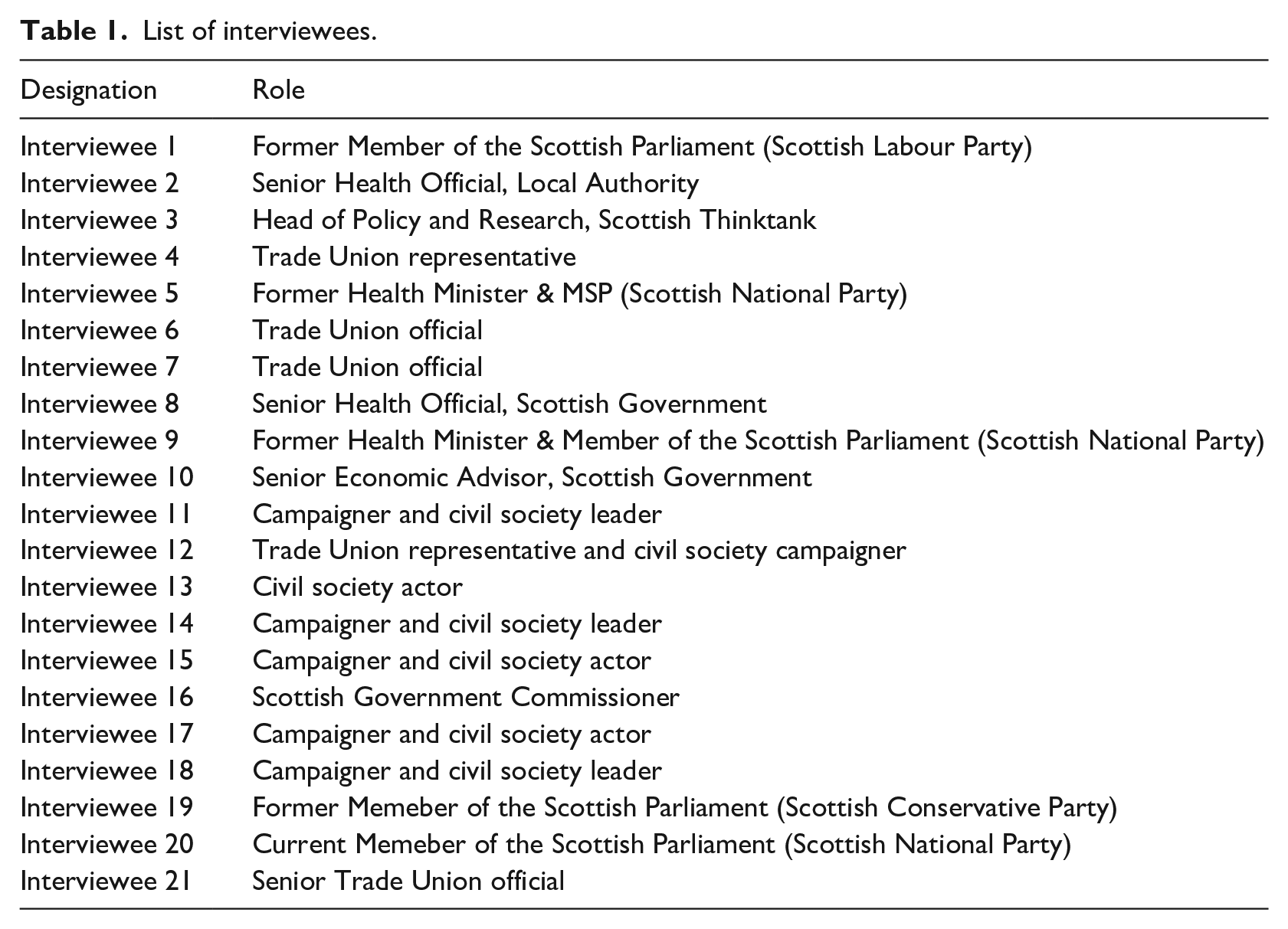
Burnham et al. (2008: 232) caution against solely relying upon one method of data collection in case study research. We therefore employed both semi-structured interviews and desk-based documentary analysis. Desk research first produced an initial, and speculative, framework based upon the in-depth study of various primary sources, including policy documents, speeches, media reporting and other grey literature (Vromen, 2018: 249). A critical and interpretative approach to the documentary analysis was conducted by, first, an initial process of thematic coding and, second, an in-depth analysis that enabled us to uncover the ‘normative baggage’ that accompanies key policy decisions (Dowding, 2015: 186). With this analysis completed, we drew upon a series of semi-structured interviews conducted with Scottish ministers, governance figures and civil society actors to illustrate the validity of our interpretation of events and policies (Dowding, 2015: 183). Interviewees were identified initially by their importance to the objectives of the research and further recruitment was achieved using a ‘snow-ball’ technique to broaden the pool of participants through referrals, enhancing the richness and diversity of the interview data (Yin, 2018). In this way, we were able to elicit particular viewpoints of both elite governance actors, senior decision-makers and prominent figures in Scottish civil society. By combining our desk-based research with these interviews, we have been able to engage the experience of relevant actors and draw out their interpretations of events, but also uncover the governance structures within which they were operating. Table 1 includes an anonymised list of interviewees and their roles.
List of interviewees.
State Transformation: From Government to (Multilevel) Governance
Many strands of social and political science have observed the dispersal of authority upwards and downwards, away from the perceived centrality of government at the level of the nation state. Within state theory, this can be conceived as a transition from government to (multilevel) governance, or from imperative coordination to heterarchy (Jessop, 2007). Notably, such shifts exerted a pronounced impact on domains traditionally considered as quintessential to sovereign states, such as securing citizens during emergencies. Before considering the particularities of the United Kingdom devolved state, we will conceptually develop the ‘organising perspective’ that informs the remainder of the empirical analysis (Dowding, 2015). Organising perspectives, according to Dowding (2015), are ‘a way of looking at the social world’ (p. 75) to help structure discussion, and has previously been employed by Andrew Gamble (1990) to ‘provide a framework for analysis [and] a map of how things relate’ (p. 405) regarding the study of British politics.
Our organising perspective has the following three interrelated components: First, governance, emerging from the limitations of traditional government, signifies a transformation in state power and authority distribution, influenced by societal pressures and class conflicts. Second, functionalist accounts of governance are ill-fitting to the era of endemic crises. Far from serving to satiate citizen-consumers, the new paradigm has allowed confused energies of conflict which often emerge as crises of ‘levels’ of authority, of which Euroscepticism and Europhilia are also symptoms (indeed, territorial conflicts within the United Kingdom are overdetermined by strains of Europeanism; see, for example, Hooghe and Marks, 2009). Third, the shift to a governance paradigm has served to radicalise and extend the traditional security function of statecraft. In addition to problems of war and espionage, a whole range of new existential risks was added to the security portfolio – in this case, pandemic preparedness; these would also partake of the ‘multilevel’ nature of governance.
In purely descriptive terms, traditional government can be considered a subset of governance, with the latter referring to the array of power relations and sources of authority, informal and formal, that contribute to policy implementation. It has thus been defined as ‘the activity of governing’ (Fasenfest, 2010), with the scholarship centring on the technology of control rather than the instruments of power (Levi-Faur, 2012). However, governance can also be considered historically, as part of a process of state transformation (Chryssogelos, 2020; Hameiri and Jones, 2022; Shaw, 1997). Literature on the latter has concentrated on how political globalisation serves not to weaken states but to transform their functions and inner relationships. Within state theory, this puts the accent back onto questions of where power lies. A contrast with traditional imaginations of government is almost always implied in discussions of governance (e.g. Bell and Hindmoor, 2009; Peters and Pierre, 1998, 2020).
Many have observed that the dissemination and diffusion of authority and power relationships that is characteristic of governance emerged, historically, to address the pressures on states issuing from the earlier paradigm. However, this contrast between government and governance is capable of multiple renderings. The dominant, implicitly functionalist paradigm emphasises the growing and increasingly diverse demands of citizens on states, issuing variously from consumerism, multiculturalism and aging populations (Pierre and Peters, 2020). Critical scholarship, by contrast, has noted that governance paradigms are founded in the failure of advanced capitalist states to reconcile class conflict (e.g. Hameiri and Jones, 2022; Jessop, 2016). In this sense, governance emerges as a flight from responsibility for the growing costs of government-based efforts to assuage social democratic demands emanating from organised working-class movements. In disclaiming and diffusing accountability, and sacrificing ‘sovereignty’ as traditionally conceived (Bickerton et al., 2006), state elites gain greater power, greater flexibility and more leeway to manage class-based expectations.
It is, therefore, no coincidence that governance emerged as a pivotal concept in the 1980s, as part of the wider breakdown in post-war embedded liberalism (Ruggie, 1982). Markets, networks and the dispersive hierarchies were regarded as its central concepts; it was linked, at first, to ‘new public management’ and ‘entrepreneurial government’ (Rhodes, 1996). While some have questioned the novelty of these arrangements (Marinetto, 2003) – a particularly important debate with respect to Scotland (Paterson, 1994) – there was a concerted effort to instal and institutionalise these systems from the 1970s onwards, breaking with earlier assumptions of the ‘modernisation’ paradigm (Keating, 2008; McCrone, 1984), which had emphasised growing centralisation over time. In conceiving of power, there was a notable break from any conception of the state as ‘constitutionalised monopoly of violence’ (Jessop, 1987). This was linked to the decline of the state’s original war-making and security functions. Much of what is now taken for granted, for instance, as the ‘welfare state’ emerges as an outgrowth of statecraft for the emergency purposes of wartime mobilisation, repurposed for the purposes of civilian improvement and inter-class pacification in peacetime (Obinger and Petersen, 2017; Titmuss, 2019; Vahabi et al., 2020; although cf. Edgerton, 2018). The governance paradigm therefore emerges during the crisis of that particular, traditional model of state power that is rooted in state sovereignty: where growing class conflict poses the prospect that political authority might be bent to the will of collective agency.
Multilevel governance research emphasises emerging relationships of cooperation, coordination and collaboration by actors across various levels of policymaking. Much of the research has sought to explain and even celebrate its successes, particularly in the context of the EU (Jessop, 2016). It thus possesses a strong functionalist bias (Börzel, 2018; Lavery and Schmid, 2021; Rittberger and Blauberger, 2018) that centres upon effective and mutually agreeable systems of problem-solving. Conversely, the critical literature has most often focused upon dysfunctional relationships that stem precisely from the new opportunity structures.
Resilience Partnerships as State-Regulatory Framework
Devolved Scotland’s political and policy response to the COVID-19 pandemic would reflect these tensions and contradictions, which may be observed in the framework established to manage emergencies – including pandemics – as part of the UK devolution settlement; and that equally emerge from the discrepancies in implementation, as the crisis grew in scale beyond what was accounted for in planning. The first empirical task for this paper is thus to demonstrate how institutions of Scottish governance developed an emergency paradigm prior to the pandemic, drawing mainly upon a range of primary, secondary and tertiary documentary evidence (Burnham et al., 2008). Three important considerations will emerge. First, a new paradigm of emergency management emerged in concert with wider processes of state transformation, and was explicitly framed as such, during a phase of UK state modernisation under New Labour. Second, the metaphor of resilience plays an overarching role in the reimagining of state and citizen responsibilities with respect to emergencies. Third, the political and economic context for multilevel disaster management was shaped by the UK-wide austerity programme (Boyle et al., 2023; Saad-Filho, 2021). These measures introduced competitive dynamics between government layers, undermining partnership and collaboration principles, while simultaneously enhancing the power of governing and ruling classes (see also Davidson, 2010; Law and Mooney, 2012). This aspect was particularly pronounced in regions with strong national identities, revealing political conflicts between these devolved governments and Westminster.
Scottish and Welsh territorial devolution emerged under New Labour as part of a package of modernisation initiatives. Devolution meant that legislative competence is assumed for the parliaments of the three minority national units (Scotland, Wales, Northern Ireland) unless a power is specifically ‘reserved’ to Westminster. These recent shifts in UK governance were often rooted in efforts to update statehood and sovereignty to reflect the perceived successes (or inevitability) of political and economic globalisation (Keating, 2004). Indeed, even if United Kingdom devolution had its specific characteristics, and reflected a characteristic ‘British empiricism’, it nonetheless was quite explicitly designed for its compatibility with multilevel governance (Bache and Flinders, 2004; Palmer, 2008). Such considerations were formulated, for instance, by two of Scotland’s leading Westminster politicians of the era:
the legislation for the Parliament’s powers set out to advance the wellbeing of Scottish people, not in the sheltered economies which gave rise to the old nation states of the past, but in the new global economy with its multilayered institutions. (Brown and Alexander, 1999: 11–12)
Thus, far from being exceptionally backward (see, for example, Edgerton, 2021), the emergent paradigm of British statehood was geared towards a modernisation process, designed in imitation of EU-style governance.
The most obvious implications of this emerged in areas of public service delivery traditionally demarcated to subnational control. However, as part of this broader modernisation agenda, areas traditionally associated with the fundamental sovereignty of states – such as emergency management – were subjected to decentralisation. A pamphlet from a thinktank close to the New Labour government emphasised the ‘brittleness’ of British society under the pressures of globalisation: ‘our everyday lives and national infrastructure work in a fragile union . . . much of our infrastructure is outmoded and archaic’; hence, ‘next generation resilience relies on citizens and communities, not the institutions of state’ (Edwards, 2009; emphasis added). In line with the devolved settlement, overall emergency management would be governed by the UK-wide Civil Contingencies Act (2004). The capacity to use emergency powers is reserved to the UK Government, with specific regulations detailing its functioning at a devolved level (Civil Contingencies Act, 2004). Most especially in the dual securitisation of immigration and terrorism risk, but also across the security agenda, New Labour would emphasise the diffusion of responsibility throughout the multilevel state, and the role of civilian vigilance.
Devolved legislators, such as the Scottish Government (2007, 2012), and their offshoots had thus engaged in significant planning for emergency contingencies, including the prospect of mass deaths linked to an influenza-like pandemic, prior to the emergence of COVID-19 in 2019/2020. Critically, this did not merely consist of a delegation of responsibility from the central UK government towards the devolved national authority. In line with Majone’s (1999) notion of the ‘regulatory state’, which highlights private–public partnerships, the role of quasi-autonomous bodies and decentralised policy agreements, the Scottish Government framed its role in emergencies as one of facilitating the interaction between responder agencies as bearers of partial expertise. It is in this context that Scotland established regional and local ‘resilience partnerships’ from 2004, facilitated by the Scottish Government, but featuring input from institutions at local level, including, but not limited to, Police Scotland, the Scottish Fire and Rescue Service, Scottish Ambulance Service, health boards, local authorities, Integration Joint Boards (health and social care), the Scottish Environment Protection Agency or the Maritime and Coastguard Agency. The Scottish Government (2019: 2) also promotes a ‘resilient communities’ agenda, providing limited resources for local community groups to engage in disaster preparation and create a ‘culture of preparedness’, albeit on a voluntary basis without formal oversight or dedicated financial support.
This emerging model of risk management, dubbed ‘Integrated Emergency Management’ (Preparing Scotland, 2016), would emphasise a twofold diffusion of responsibility. On one hand, it was diffused through levels and institutions; on the other hand, it was decentred towards individuals. The conceptual centrepiece of these new emergency management principles, as explicitly formulated by the Scottish Government, was the concept of ‘resilience’ (Scottish Government, 2012). This emphasis is itself a reflection of foregoing state transformation and the associated methodological shift in government. Resilience refers, in discussions of individuals, to ‘a dynamic process encompassing positive adaptation within the context of significant adversity’ (Luthar et al., 2000: 543); it may also refer to how socio-economic systems absorb disturbance, crucially, without undergoing a qualitative change in their nature (Cote and Nightingale, 2012).
The case of Scotland illustrates the importance of a critical reading of emergency discourse that remains alert to its potential transformation due to social pressures or class conflicts. Despite the pretensions of partnership embedded in the framework of resilience, governance relationships in the United Kingdom were being transformed by three challenges to norms embedded in the state. Post-2010 austerity in the United Kingdom served, by deliberate design (Davidson, 2010), to inculcate a generalised culture of resource competition between and within levels that created significant social pressures and class conflicts. One consequence of this was to generalise territorial antagonism. Far from restoring the legitimacy of the British state, these energies would tear apart the fabric of governance cooperation and modernisation established since the 1970s. Its most lasting consequence was Brexit, helmed by a movement explicitly seeking repatriation of powers and the restoration of parliamentary sovereignty (Bickerton, 2019). However, even prior to Brexit, a popular movement for Scottish independence centring on the 2014 referendum had served to formalise the hegemony of Scottish nationalism within devolved structures. An SNP government, formally committed to independence in an imminent future, bearing mobilised popular support, and gaining legitimacy by its opposition to Brexit, often served as the UK government’s principal antagonist.
COVID-19: The Multilevel Politics of Convergence and Divergence
Variegated and divergent state responses have been central to the politicisation of COVID-19 and include stylised comparisons between national leaders (e.g. Brazil’s Bolansaro and New Zealand’s Ardern), the role of trust and partisanship, comparative institutional regime type and state capacities (see Altiparmakis et al., 2021; Christensen and Lægreid, 2020; Greer et al., 2020; Maor and Howlett, 2020; Weiss and Thurbon, 2022). Below the level of the nation state – as other papers in this collection show (Varga and Fröhlich, 2024) – territorial and subnational decision-making processes and institutions have also been examined with the aim of establishing the extent of intergovernmental decision-making and conflict (Dodds et al., 2020; Kennedy et al., 2022; Velasco-Guachalla et al., 2022), suggesting that the comparisons were as much vertically within as horizontally between states (Brenner, 2004; Brenner et al., 2010; Jessop, 2016).
The divergent reception of Scotland’s and England’s COVID-19 policy responses are clearly reflected both in international media coverage and in measurable public attitudes. They are also among the most pronounced themes of our interview research with Scottish governance professionals and civil society figures. Quantitative evidence for this can be seen in opinion polls conducted at the height of Scotland’s first lockdown. In May 2020, Ipsos MORI (2020) polls showed strong net public support for the handling of the crisis by Nicola Sturgeon (+74%) and the Scottish Government (67%); conversely, far weaker numbers for Boris Johnson (–25%) and the UK Government (–17%). In qualitative terms, international press coverage highlighted marked divergences of style between Scotland’s First Minister, Nicola Sturgeon, and the United Kingdom’s Prime Minister, Boris Johnson: Sturgeon was praised for her ‘measured response’, as against Johnson’s ‘freewheeling approach’ (Landler, 2020); for ‘steadiness and sombre dignity’ as against Johnson’s ‘slapdash boosterism’ (Mount, 2020); or for being ‘more articulate, empathetic and speedier’ than Johnson (The Guardian, 2020). Governance and civil society interviews centred on similar framings and contrasts, although with crucial points of divergence.
Our interviewees suggested that stylistic contrasts and effective rhetorical narratives disguised substantial similarities between Scottish and UK policymaking. For example, both the UK and Scottish Government followed a similar policy of releasing hospital patients into care homes. Interviewee 1, then a high-profile Member of the Scottish Parliament (MSP), noted how this showed that the Scottish Government’s successful communication strategy did not equate to an effective public health strategy. Moreover, Interviewee 4, a trade union official working in the care home sector, felt that the Scottish Government’s communications strategy, fronted by Nicola Sturgeon during her daily press briefings, demonstrated excellent message discipline which reassured the public when compared to the messaging coming from Westminster:
I don’t think anybody would disagree that you [felt] far more comfortable listening to Nicola Sturgeon telling you what was happening than you would with Boris Johnson because . . . well, he’s just a liar, but with Nicola Sturgeon . . . there was a kind of managerial [message of]: ‘Don’t worry about it. We’ve got this under control’, even though she was essentially giving the exact same [policy approach] as Boris Johnson was . . .
Others emphasised that stylistic contrasts did have the practical effect of conveying robust governance practices and confidence in Scotland’s leadership and control over the crisis. Interviewee 2, a senior health official in local government, reflected upon the success of the Scottish Government’s communication strategy:
Largely speaking the COVID briefings were really clear, concise and quite positive. And that regularity of really senior briefings coming through was really positive and I think there probably was better clarity coming from the Scottish side, compared to the UK Government.
Interestingly, Interviewee 19, who was at the time a senior opposition MSP, interpreted such stylistic differences as representing more than simply a difference of optics or communication strategies, and instead reflects deeper differences regarding the nature of political leadership itself: between the social democratic and interventionist instincts of Nicola Sturgeon and Boris Johnson’s centre-right, libertarian instincts that clashed, and was tempered by, the apparatus of the UK Government. The significance attributed, in early coverage, to the Scottish Government’s effective communications therefore reflects the widely acknowledged importance of leadership to achieve public compliance. In this context, Scotland’s response was seen to benefit from two simultaneous national crisis framings because, as Kennedy et al. (2022) observe, citizens in multilevel polities can struggle to assign responsibility to the correct level of government. In Scotland’s case, citizens could look towards an alternative centralised source of authority to the Scottish Parliament in an emergency.
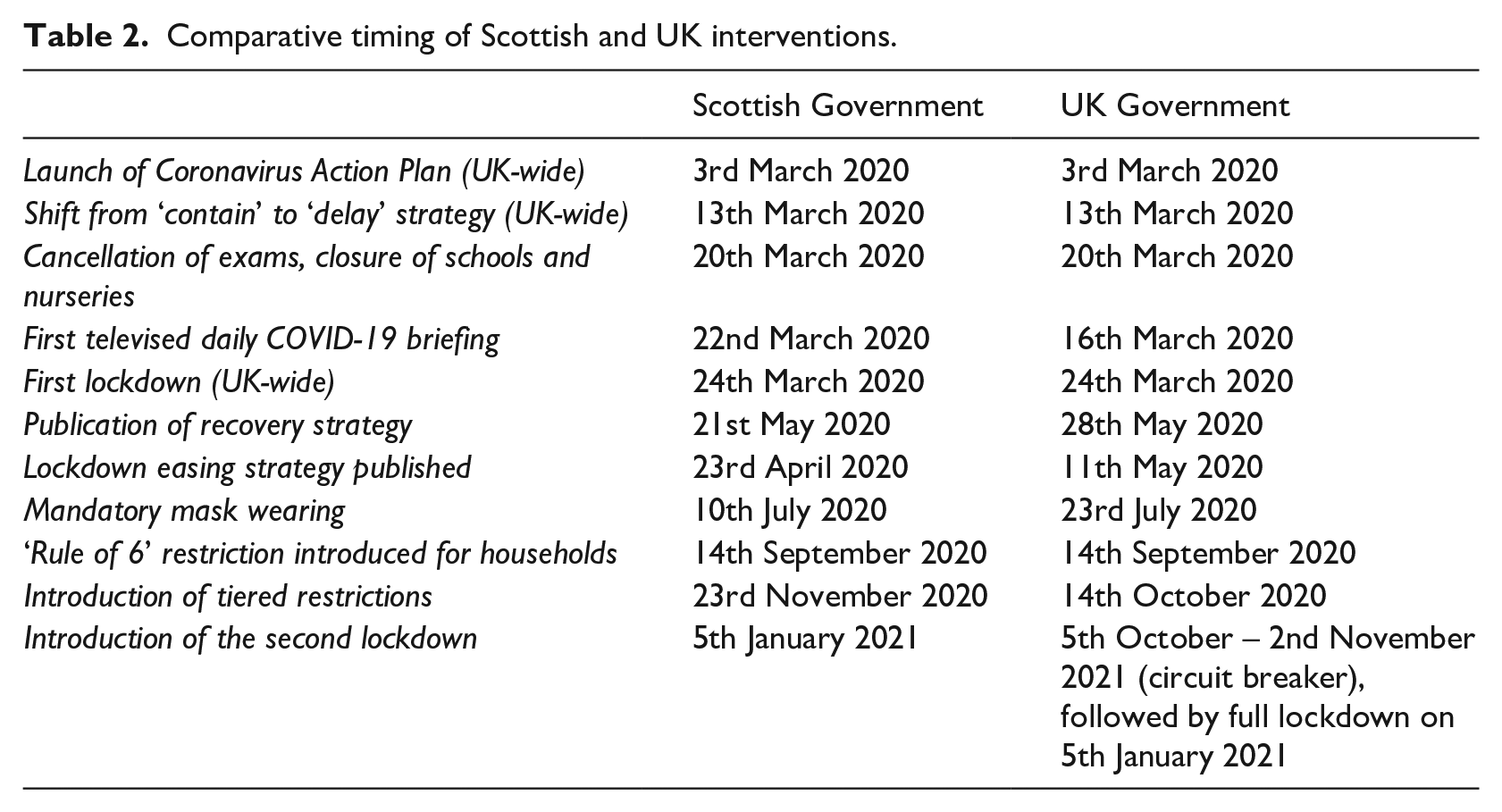
Nonetheless, Scotland quite clearly adopted similar policies to those in the United Kingdom, despite stylistic and rhetorical claims to the contrary. One largely sympathetic academic account thus concedes that ‘devolved governments implemented largely the same public health policies as the central government, and with similar health outcomes’ (Basta and Henderson, 2021: 298). Where Scotland would eventually diverge was not in policy but in timing: ‘they distinguished themselves from Westminster largely through differentiated timing in the implementation of those policies’ (Basta and Henderson, 2021: 298). The question of timing would thus inform qualitative contrasts between the Scottish Government’s caution and Westminster’s recklessness. However, even the divergences in timing largely post-dated the pandemic’s most practically efficacious decisions. As Table 2 shows, in the crucial early phase of the pandemic, most timings happened in lockstep (see also Basta and Henderson, 2021). Criticism of pandemic responses – including those made by senior UK Government officials and ministers in their evidence to the United Kingdom’s COVID-19 Inquiry – emphasises that earlier lockdowns could have prevented many deaths (e.g. Independent Panel for Pandemic Preparedness and Response, 2021). However, such claims largely rest on decision-making in these early weeks. Notably, at this point, the Scottish Government did not significantly diverge from the UK response. Italy’s lockdown begins on 9th March, Spain’s on 14th March and France on 17th March; Scotland follows the United Kingdom in establishing a national lockdown on 23rd March. The Scottish Government also followed its Westminster counterpart in establishing a framework of phases, from ‘control’ to ‘delay’. What this shows is alignment and convergence in responses to COVID-19 in this early period of the pandemic, where differences are down to timings as opposed to substantive policy divergence.
Comparative timing of Scottish and UK interventions.
There is also room to doubt that Scotland’s medical and governance establishment significantly diverged from England’s on the concept of ‘herd immunity’ (McLaughlin, 2022), although, following the end of the pandemic’s first wave, Scotland would depart from the rest of the United Kingdom. During this phase, Nicola Sturgeon’s messaging focused on ‘following the science’. However, in practice, the recommended public health measures did not diverge greatly from that produced by SAGE at a UK level, due to the close working relationship between the UK Scientific Authority Group for Emergencies (SAGE) and the Scottish Government’s (2020) COVID-19 Advisory Group, who began meeting in March 2020. Sturgeon thus rejected calls to follow Ireland’s example of an early lockdown in schools; and halted community testing and contact tracing when Scotland followed the United Kingdom into the containment phase: flanked by Sturgeon, Scotland’s Chief Medical Officer, Dr Catherine Calderwood, had dismissed community testing as a ‘distraction’ (Johnson, 2020).
In summary, the Scottish Government took many of the most consequential decisions – those during the first wave – in conjunction with the United Kingdom’s authority. Formally speaking, Scotland had the capacity to diverge, and would thus diverge as the pandemic progressed. However, it was limited in the early stages by several factors. First, state capacity limitations that reflected the overhanging legacy of austerity on pandemic planning (Boyle et al., 2023; Calvert and Arbuthnott, 2021; Jones and Hameiri, 2022). Interviewees 6, 4 and 12 – all closely aligned with Scotland’s trade union and labour movement – indicated to us that this problematised Scotland’s response on issues such as Personal Protective Equipment (PPE) and community testing. Second, Scotland lacked its own scientific authority that could rival UK-wide emergency management authorities, in so far as the Scottish Government’s (2020) COVID-19 Advisory Group explicitly aimed to ‘interpret SAGE outputs and other emerging scientific evidence in the context of Scotland’. This meant there was a close alignment between Holyrood and Westminster, as both administrations were closely following the same expert advice. Third, for Scotland’s nationalist government to move separately from the United Kingdom risked breaching the prevailing discourse of emergency solidarity. While Scotland, formally speaking, had the power to undertake lockdown measures earlier, such a move presented a political risk under conditions of devolved authority. It would have required a provocative move to close Scotland’s borders, which would have broken the message of UK-wide unity and put the SNP at odds with scientific and media opinion. More bluntly, autonomous movement carried political risk. Devolved structures tended to ensure that Scotland’s moves were benchmarked against those of the UK government. The path of least resistance was therefore to make measured, incremental moves from UK decision-making, when the emergency mood had lifted sufficiently to allow for divergence. Even in these cases, the Scottish Government did not use all the powers it had: a report produced for the Scottish Trade Union Congress was critical that the Scottish Government did not take equity stakes in private businesses whose long-term viability was threatened by the COVID-19 crisis, despite this being recommended by the Scottish Government’s own Advisory Group on Economic Recovery (Macfarlane and Berry, 2021).
What would therefore emerge in Scotland were thus qualitatively similar policies distinguished by incremental shifts in timing. What divergences did occur did so during less deadly phases of the pandemic. To allow for these modest divergences, political circumstances had to emerge that would incentivise rhetorical conflict with Westminster; likewise, the Scottish Government needed sufficient technocratic credibility to move autonomously from the scientific authorities embodied in UK emergency management. The first criticisms of the Scottish Government’s perceived deference to UK scientific authorities came from nationalist backbenchers who were pushing for greater confrontations with the UK state over Scottish independence. But scientific authorities within Scotland also came to question the United Kingdom’s directives: initially, this manifested as a critique of the Scottish Government by critics such as Professor Devi Sridhar and Professor Mark Woolhouse. It was this criticism which led to the formation of the Scottish Government COVID-19 Advisory Group, and that would eventually come to provide the technocratic authority behind a moderately more cautious approach to the lifting of lockdown measures.
Nonetheless, the impression of Scottish divergence predated any significant moves in that direction. This was detectable in public opinion surveys conducted in late April – including among anti-independence voters (YouGov, 2020). In essence, then, a national mythology of technocratic competence had already been established that would prefigure impressions of Scotland’s response to COVID-19 and would outlast the lockdowns. The multilevel structures of UK decision-making thus incentivised a largely rhetorical strategy of differentiation, which achieved sizable acclaim without the expense of significant accountability. On one hand, this suggests the long-standing breakdown of devolved structures which – in theory – had been designed to revamp and re-legitimise the UK state through multilevel partnership. Those structures had run aground after the breakdown of their premise in the Third Way neoliberal growth model: austerity had promoted zero-sum competitiveness between levels (Davidson, 2010). On the other hand, the growth of competitive logics of divergence had no corollary in rising innovation. Indeed, the new logic incentivised Scottish leaders precisely to benchmark their policies against those of the UK Government.
Emergency, Opposition and Accountability
So far, the arguments presented above have centred on convergence and divergence on the technical policy and public health directives imposed to limit the virus. However, our interview data further suggest that the lockdown and restrictions temporarily also transformed relationships between the state and citizens and also between social classes. The surface-level political story of the pandemic would centre on national, as opposed to class, conflicts embodied in the multilevel state. The effect this has upon political accountability and mobilisation help illustrate, in microcosm, the wider story of the pandemic; namely, the heightened optimism occasioned by sweeping transformations to capitalist relations during the pandemic against the reality of the restoration and even reinvigoration of capitalist exploitation after it (Lapavitsas, 2023). In this way, the multilevel UK state, particularly in its condition of reduced legitimacy, would paradoxically serve to mitigate class-related grievances.
The emergency circumstances most obviously affected devolved competencies in healthcare. During the virus’s first phase, all layers of UK governance prioritised lockdown to prevent overwhelming the National Health Service (NHS). Decisions were thus made summarily, dispensing with normal scrutiny. This also applied to decisions in Scotland, which were taken autonomously, but reinforced by the authority of Westminster. Interviewee 19 explained that
It doesn’t matter whether the emergency is public health or war or terrorism. What happens [during crises] is that Parliament enacts emergency legislation. Which means that enacts legislation very very quickly, without proper scrutiny.
As above, the most consequential early decision was to discharge untested elderly patients from hospitals into care homes. This was mandated at the level of devolved government, by the Scottish Health Secretary, with the aim of clearing capacity from hospitals. However, elderly patients were discharged without prior testing for COVID-19 during the early stages of the pandemic due to a lack of testing capacity, as Interviewee 9 told us. However, Interviewee 1, a prominent opposition MSP who left parliament in 2021, reflected that his attempts to ask parliamentary questions in order to scrutinise such policy decisions went ‘down like a bag of vomit’. Of course, the effect of these decisions had life and death implications: Scotland’s rate of care home deaths would rank among the highest in Europe; by May 2020, almost half of Scotland’s COVID-19 deaths had occurred in care homes (Dickie and Burn-Murdoch, 2020); figures suggest 33% of COVID-19 death in Scotland occurred in Scotland (Aguzzoli et al., 2021). Many staff – predominantly women, and among the lowest paid ‘essential workers’ – also died (Foley et al., 2022). Interviewee 4, who represented care home workers, recalls that care workers reported having little access to adequate PPE during the early stages of the pandemic.
In education, an overlapping crisis afflicted devolved competencies in education. School closures coincided with the normal examination diet; hence, the Scottish Government and the Scottish Qualification Authority (SQA) made the decision to cancel exams in 2020. To prevent disruption of pupil transitions to higher/further education and the labour market, authorities devised an alternative mechanism: teacher judgements of overall pupil performance replaced examination results. However, the consequence was to inflate pupil performance, especially (though not exclusively) among pupils in schools disproportionately affected by deprivation. This raised a dilemma. On one hand, the Scottish Government was formally committed to reducing the ‘poverty-related attainment gap’: the gap in academic performance between pupils in the least and most deprived communities. Indeed, this was defined as the Government’s central pre-pandemic policy priority. On the other hand, exam authorities feared that the sudden transformation in student performance would undermine the system’s ‘integrity’. Hence, the SQA devised an algorithm that systemically downgraded schools’ performances to reflect pre-COVID averages. While downgrading happened across the board, its impact on schools in deprived areas was far more pronounced. The resulting fiasco, recalls Interviewee 16, represented a failure of Scottish Ministers to incorporate adequate children’s rights affect assessments into critical decision-making. At this time, Interviewee 16 headed a statutory body that promotes and safeguards the rights of children and young people. Moreover, they noted the over-reliance of Scottish Government ministers upon information coming from public bodies such as the SQA whose advice went unchallenged. This failure to scrutinise advice led to Scottish Ministers signing off on a policy that ‘reinstated the pre-pandemic divide between the richest and poorest pupils’, as one prominent education campaigner described it (McEnaney, 2022).
Several features are notable across the health and education cases, which both occurred during the first wave of COVID-19. Decisions on both were taken under emergency duress, under the ultimate authority (albeit delegated, according to the devolved settlement) of Scottish Government ministers; and each reflected a complex tapestry of institutional accountability, but wholly operating within a devolved framework. Education and healthcare policies cut across key governance responsibilities with respect to inequality, in areas framed as Scottish Government priorities, and also concerned the rights allotted to vulnerable groups. However, there was no clear institutional accountability. The responsible government ministers and authorities successfully resisted calls for resignations and apologies – interviewees 1 and 19 were both critical of this evasion of accountability.
Both cases also highlight deeper, structural causes for this dispersal of accountability: the complex, multilevel hierarchies that are reflective of governance mechanisms that emerged during the era of globalisation. This delegation and dispersal of accountability was not simply the transmission of authority from UK-level to the devolved Scottish Government: the exams fiasco involved Scottish Ministers, civil servants and public bodies such as the SQA, while the care home crisis involved complex networks of actors, including government ministers, local authorities, health and social care partnerships and privatised care providers, not to mention regulators and trade unions. Care home privatisation had issued from motivations that reflected the ‘regulatory state’ paradigm: the issue was not simply cost – evidence suggests that nationalisation would save money – but the dispersal of liability. It would thus reflect Government efforts to ‘divest itself of responsibilities’: ‘Care homes and social care in general are far down the chain of public policy and the majority are market providers which see relatively little regulation’ (Daly, 2020: 996). Not only this, but dispersed responsibility for regulation, safety and liaison also extended to relevant trade unions, who acted as important watchdogs of patient care, as well as workers’ terms and conditions of employment. Interviewees 4, 7, 6 and 21 – all prominent trade unionists – recalled how their roles in the workplace subtly expand to include this regulatory function.
Likewise, the inherited focus on resilience as the philosophical foundation of the Scottish Government’s emergency planning and management had complex implications. Resilience, as outlined above, emerged with the aim of reconciling, at the level of individual behaviour, a persistent climate of emergency with the stability of socio-political structures and systems. The aim is to inculcate a disposition of readiness and vigilance so that increased exposure to shocks and disruptions have minimal impact on liberal-democratic normality. The Scottish Government and SQA insistence on the ‘integrity’ of the examination suggests the contradictions of such approaches. The algorithmic pursuit of system integrity meant reintroducing educational inequalities that the Government had formally committed itself to eradicating.
The problems associated with resilience and dispersal of accountability are certainly the legacy of earlier state transformations linked to the high watermark of neoliberal globalisation under New Labour. However, they also interacted in complex ways with the deliberate limitation of state capacity and responsibility that resulted from austerity, as well as the nationalist moments of the referendums of 2014 and 2016. In that context, decisions at Scottish Government level were benchmarked against those of the Conservative UK Government. Although the Scottish Government had almost full autonomy in education and health policy, many decisions occurred in parallel: the UK Government also discharged infected patients into care homes, and also used an algorithm that systematically downgraded the performance of pupils in deprived schools. This fed into the peculiar ‘politicisation’ of these problems that enabled what Interviewee 3, head of research for a prominent Scottish thinktank, described to us as the ‘management of accountability’: This, they explained, is the ‘tendency for Scottish ministers to claim as much of the credit for policy successes, while deflecting as much of the blame for policy failures, as possible’. In this sense, constitutionalised politics functioned, in practice, to depoliticise underlying questions of social inequality embedded in care home and examination structures.
Opposition, in this context, also worked in peculiar ways. As interviewees 1, 9 and 19 noted, all of whom were prominent MSPs from the three major political parties at Holyrood, normal parliamentary procedures persisted through online technologies, and opposition politicians performed customary duties of accountability; for example, on 15th April 2020, a Liberal Democratic MSP raised the risk of transferring untested elderly patients into care homes, and the examination algorithm scandal led opposition leaders to call for resignations. Equally, in the Westminster parliament, the SNP took seriously its role as the second-largest opposition force to the Conservative Government. Given the surrounding mood of national emergency and the weaknesses of the Labour opposition, the SNP often emerged as the most visible opposition to the perceived cultural flaws that the Conservative Party exhibited over COVID-19 management.
But in practice, the Scottish governance narrative was founded on a peculiarly stark contradiction. Its increased legitimacy rested on its claims to resilience: in other words, to have retained the integrity of its leadership, its robust governing structures and its unique civic dispositions during circumstances of exceptional disruption and stress. This formed a stark contrast with Westminster’s Brexit-era Conservatives, who, in many accounts (e.g. Bourgeron, 2022; Calvert and Arbuthnott, 2021), were portrayed as having pursued disruption for political ends in their project of leaving the European Union; and whose perceived absence of personal decorum and unstable leadership contrasted with the stoicism of devolved leaders. However, the SNP’s legitimacy and claims to be oppositional also rested on proposals for extraordinary state transformation. Throughout the period of COVID-19, the party remained formally committed to an imminent referendum on Scottish independence (Scottish Government, 2021). The devolved government’s claim to stand for the status quo thus ran counter to its proclaimed central project. In reconciling this, SNP MSPs would project Scottish independence as non-disruptive: interviewee 20 explained that, for he and his colleagues, a second independence reference would repair the damage of Brexit by restoring trade links with the European Union. However, during the pandemic, one of the Scottish Government’s academic economic advisors warned that independence could involve disruption that would be ‘Brexit times ten’; and political scientists warned that Brexit itself would redouble the disruptive effects of independence (Hayward and McEwan, 2022). Thus, on one hand, the SNP gained domestic and international legitimacy as stand-ins for robust and resilient governance; on the other hand, much of their domestic legitimacy rested on the pursuit of a disruptive project to break with ingrained governance structures and their attendant inequalities.
These contradictory discourses are not merely bipolar: they formed a contradictory whole. The narrative of resilience guarded against constitutional confrontation, emphasising organisational stability in symbiosis with a vigilant citizenry. However, simply standing for passive adaptation, stoicism and the status quo would have weakened the Scottish Government’s popular legitimacy. In part, that could be supplemented by an oppositional approach to constitutional changes and financial pressures issuing from London. Scotland’s institutional structure, however, had long allowed for significant autonomy in core areas linked to the governance of social inequality: even to the point of emergency management, traditionally a prerogative of nation states. Hence, legitimacy also depended on mobilisation towards a substantive goal. The orchestrated demobilisation of the lockdowns, overseen by governance professionals, thus coincided with the mobilisation of the national community towards constitutional confrontation.
Conclusion: COVID-19 Revisionism
It is crucial to note that the dysfunctions of COVID-19 governance were simultaneously functional to the reproduction of twin governing classes in Edinburgh and London. The tensions between levels of multilevel governance therefore led to the dispersal and diffusion of responsibility alongside an accumulation of power, entailing the ‘return’ of the state to address overlapping crises and to quell class conflicts. In effect, the amplified impression of stylistic conflict, issuing partly from Brexit and embodied inside a dysfunctional multilevel state authority, served to channel and offset class-based grievances. It thus epitomised the ‘organised irresponsibility’ (Veitch, 2007) of post-neoliberal governance. This finding offers some provisional insights into how undoubtedly radical transformations in capitalist state-society relations – occasioned by lockdowns – resulted in the reinvigoration of class inequality (Lapavitsas, 2023). It also illustrates the peculiar contradiction of British constitutional politics, of continuity within crisis.
The question, then, is what circumstances allowed the SNP to effectively organise irresponsibility during the pandemic. Undoubtedly, the circumstances of emergencies have always allowed for the suspension of normal opposition processes. Traditional theories of liberal democracy had seen not just the separation of powers, but also parliamentary opposition as the foundation of democratic life (Blondel, 1997; Dahl, 1965). By contrast, theorists in the line of Schmitt (2005) have seen states of emergency as a useful interpretative tool, precisely because they clear away the chatter of faux-oppositions of liberal parliamentary democracy (Agamben, 2008). The COVID-19 pandemic transformed state-society relations in a manner with little precedent outside of wartime – as the Polish contribution to this symposium makes clear (Cichecka et al., 2024). However, the legacy of prior state transformations meant that this assumed peculiar political forms: in Scotland, the combination of non-cooperation with convergence of policy incentivised the organisation of irresponsibility, and the demobilisation rather than mobilisation of social tensions. In this sense, COVID-19 lockdowns provide an apt metaphor, insofar as emergency processes led less to centralised mobilisation (cf. Malm, 2020) than dispersal, demobilisation and the cold storage of capitalist social relations.
Still, many superficial mechanisms of ‘normal’ liberal politics persisted (indeed, were ‘resilient’) despite the extraordinary circumstances of the lockdowns. The Scottish Government was thus openly criticised, without censorship, both in the Scottish parliament and in the domestic press for errors such as the care home deaths and the algorithmic downgrading of working-class pupils’ achievements. That these scandals never resulted in resignations, and – until recently – had only marginal impact on the SNP’s public standing, reflects a cushion of inherited legitimacy combined with the effect of emergencies in instilling discipline. Indeed, the SNP benefitted from its abnormal position of being both a government – insulated from many normal pressures by an emergency atmosphere – but also an opposition. Partly opposition functioned by the party’s profile inside Westminster politics. But opposition was equally expressed by the competitive political logic now inscribed within the multilevel hierarchy of UK governance. In this sense, opposition to Westminster was precisely the same mechanism mitigating against domestic accountability.
Our analysis of Scotland’s devolved relationship with the United Kingdom during the COVID-19 pandemic, as well as the broader implications of pandemic management in the context of state theory, thus illuminates significant shifts in modern governance. The pandemic has not only highlighted the resilience and adaptability of state structures against unprecedented challenges but also underscored the path-dependence of liberal multilevel governance paradigms. As we have seen, the organisation of irresponsibility, a central theme in contemporary statecraft, often invites conflicts that superficially appear as struggles over jurisdiction but fundamentally reflect deeper tensions in the alignment of state power and social class. In that context, Scotland illustrates the seductive appeal of essentially superficial and ahistorical conceptions of leadership culture.
