




Abstract
When Covid-19 broke out, many interpreted it as a crisis that would lead to fundamental changes in different areas of life. The article aims to assess whether this also applies to intergovernmental organizations (IGOs). By analysing the websites of a sample of intergovernmental organizations, we ask: How did the Covid-19 pandemic affect the behaviour of intergovernmental organizations? How can one explain this behaviour of intergovernmental organizations in response to such a major exogenous event as the Covid-19 pandemic? How can the Covid-19 pandemic be best conceptualized in terms of its impact on intergovernmental organizations? We show that the responses of intergovernmental organizations to the Covid-19 pandemic had two important features: (a) intergovernmental organizations responded in a synchronized way, and (b) the pandemic triggered wide-spread non-major adaptations to the changed environment, providing opportunities for legitimation work and minor repackaging of existing activities, but has not led to noticeable transformational change in organizations’ activities. We argue that the observed intergovernmental organization’s responses can be explained partly from rational-choice perspective and partly from sociological institutionalist perspective. Given our data, we argue that the pandemic can be conceptualized as an uncertainty shock, in terms of its impact on intergovernmental organizations.
Introduction
In 2020, a new pandemic, caused by coronavirus disease 2019 (Covid-19) broke out. It is repeatedly argued that the Covid-19 pandemic is a major crisis, leading to radical changes in many spheres of social life, institutions, and organizations. Indeed, it caused a major economic contraction (Lewis et al., 2020), and severe disruptions in trade and travel. Large numbers of workers around the world shifted to remote work and were urged or ordered to stay at home, which affected employment and consumption (e.g. Baker et al., 2020; Coibion et al., 2020; Hacioglu et al., 2020). This article is concerned with the effect of the Covid-19 pandemic on intergovernmental organizations (IGOs) – how they responded to this exogenous event, and how this event can be best conceptualized in terms of its impact on IGOs.
Previous research suggests that crises often lead to transformational change across societies and organizations, such as changes in preferences, interests, institutions, and interactions (e.g. Lipscy, 2020). Treating Covid-19 as a crisis also in the world of international institutions, researchers argued that the pandemic ‘is likely to perturb the structures and processes of global governance’ (Levy, 2021: 565). Similarly, Hay (1999) argues that crisis can be characterized as a ‘moment of decisive intervention’, in which actors realize that a decisive intervention can and must be made. Organizational change has indeed been recorded in response to the Covid-19 pandemic, for example, changes in the grantee relationships and agreements of philanthropic foundations (Finchum-Mason et al., 2020). In this respect, we expect IGOs to rethink their key tasks or strategy, reform their major organizational structures, and so on.
The Covid-19 pandemic is also viewed, especially by economists, as an exogenous shock, which brought about an abrupt change to daily work practices of many workers, now forced to work remotely (Milliken and Bechky, 2020). As an uncertainty shock, the Covid-19 pandemic resulted in a significant reduction in economic activity (Baker et al., 2020; Miescu and Rossi, 2020). Exogenous shocks, also referred to as ‘environmental jolts’ (Meyer, 1982) are unprecedented and unexpected events of abrupt environmental change, which may require organizations to respond. In fact, failure to adapt to exogenous shocks has been shown to lead to organizational demise among international organizations (IOs) (Eilstrup-Sangiovanni, 2020).
Yet, other researchers argue that the pandemic has not brought about major transformations but rather revealed and possibly accelerated some pre-existing trends in global politics and globalization (McNamara and Newman, 2020). Having reviewed the effect of the pandemic on the distribution of power, interest, and hegemonic ideas, Drezner (2020) concludes that Covid-19 will not have transformative effects on world politics. If we join these scholars and hypothesize that the Covid-19 pandemic did not constitute a life-changing crisis for IGOs, we could expect to see different types of IGO responses, such as no response, or cosmetic and superficial responses. If this is the case, how should the Covid-19 pandemic be conceptualized from the perspective of IGOs and in terms of its impact on IGOs?
In this article, we examine how the Covid-19 pandemic affected IGOs. We aim to make an empirical and a theoretical contribution to existing scholarship. First, intergovernmental organizations are important trend-setters, shaping the modern world. They are often trusted as authoritative sources of expertise and guidance in different areas of social life. Therefore, we gather empirical data allowing us to better understand the behaviour of these key actors – as global role models – in the pandemic. Second, we use these data to make a theoretical contribution to the research exploring the impacts of major exogenous events on intergovernmental organizations. While there is a rich scholarship debating the behaviour of for-profit organizations in response to various exogenous events, similar analysis conceptualizing the behaviour of IGOs is rather limited.
One way to understand the effects of the pandemic on IGOs is to look at how organizations responded to it. This article is concerned with three broad questions: How did IGOs respond to the Covid-19 pandemic? How can we explain this behaviour of IGOs in response to a major exogenous event? How can the pandemic be best conceptualized in light of the resulting organizational behaviour? Revealing how IGOs responded to the pandemic, and why they did so, will help us tailor our expectations about global governance actors, their dynamics, and behaviour in critical situations.
We do this by gathering a novel dataset on the response of 252 intergovernmental organizations. The focus is on publicly visible response, so unreported intraorganizational responses are excluded from the analysis. The data were collected from the organizations’ websites in September–December 2020.
As we show below, our data do not reveal any signs of wide transformational change and thereby do not support the hypothesis that the Covid-19 pandemic constituted a crisis for IGOs. Rather, the pandemic-related activities are predominantly cosmetic, light-touch responses to the pandemic. Based on the observed IGO behaviour, we argue that for IGOs, the Covid-19 pandemic should be mostly conceptualized as an uncertainty shock, which triggered only minor adaptations to the changed environment. It provided opportunities for conducting legitimation work but did not lead to radical change in organizations’ repertoires of activities.
Below, we first briefly highlight relevant studies, analysing organizational responses to exogenous events as shapers of organizational behaviour and sources of transformational (organizational) change, and develop hypotheses (section ‘Exogenous events as sources of organizational change’), explain our methods of data collection and analysis (section ‘Data and methods’), present the findings (section ‘Results: Public responses of intergovernmental organizations to the Covid-19 pandemic’), and then discuss these in light of existing research on organizational responses to crises, exogenous shocks, and uncertainty (section ‘Discussion’).
Exogenous events as sources of organizational change
IOs can be considered as key actors in global governance and as agents whose behaviour, leadership, and governance practices as well as their roles within the community of global governance actors are constrained by their survival strategies. In other words, we consider IOs not so much as representatives of states or other political actors, but as organizations with their own agency and relative autonomy (Ellis, 2010; Ness and Brechin, 1988). Organizations are adaptive systems whose responses to complex dynamic environments are affected by the social characteristics of their participants as well as by the varied pressures imposed by their environment (Scott, 2014). Therefore, the behaviour of IOs must be seen as a reflection of organizational strategies aimed at adaptation to the changing environment, pursuing the interests of the organizations themselves, including organizational survival (Abbott et al., 2016). In pursuing organizational goals and strategies, decision-makers follow certain logics, that is apply certain reasoning guiding their behaviour. These logics mediate the relationship between the environment and the actions of organizations (Thornton et al., 2012).
How organizations respond to crises
There is a rich scholarship discussing the diversity of crises and their impact on organizations. This literature tends to focus on governments or businesses. We apply the findings of these studies to our analysis of intergovernmental organizations, many of which share organizational features with state bureaucracies and often include for-profit stakeholders. In this literature, a crisis usually refers to ‘an undesirable and unexpected situation’, with three key situation components being ‘threat, uncertainty, and urgency’ (Boin et al., 2005: 2). According to Boin et al. (2005), an event can be qualified as a crisis if all three components are present. Changes in behaviour can often be observed because organizations need to survive, and to do so they need to respond to environmental pressures.
Broadly speaking, organizational responses can be either transformative or non-transformative. Some environmental pressures require substantive transformation to strengthen organization’s resource security, legitimacy, or authority. According to historical institutionalism, crises are ‘critical junctures’, moments of transformational change that trace a new trajectory for institutions and their activities (Capoccia and Kelemen, 2007). In a similar vein, Kingdon (2003) argued that crises can open ‘windows of opportunity’ for new policies and ideas, working in some cases as ‘catalysts of reform’ (Hall, 1993; Resodihardjo, 2009: 14). In other words, crises can have major effects on the behaviour of organizations. Governments may use crises as opportunities to implement previously impossible/halted reforms (Resodihardjo, 2009), utilizing the crisis discourse as a way to advance their agendas and narrow the selection of policy alternatives (Moury and Standring, 2017), and thus, forcing new policies onto citizens (Klein, 2007). Existing studies provide ample examples of major transformational organizational change in response to crises. Public organizations redefine their strategies and missions, decentralize and re-organize service provision, and reform their organizational culture (Rochet et al., 2008). Businesses change their marketing strategies (Ang, 2001) and engage in different kinds of organizational restructure, such as mergers and acquisitions, adoption of innovations, entering and exiting markets, changing the operational priorities, etc. (Fromhold-Eisebith, 2015; Szalavetz, 2016).
However, crises are not always associated with transformational change. Organizations may also respond in symbolic or cosmetic non-transformational ways. Transformation depends on the cost of introducing organizational change (Smart and Vertinsky, 1984) and on crisis characteristics, such as the level of uncertainty, threat, and urgency. It is the subjective perception of these aspects of an event, as well as the decision-makers’ perception of their ability to control the environment (Smart and Vertinsky, 1984) that matter for the response. Crises can be exogenous shocks, but they need to be endogenously constructed, interpreting these events as requiring change (Widmaier et al., 2007). For example, one differentiates between ‘fast-burning’ and ‘slow-burning’ crises (Boin et al., 2005; Seabrooke and Tsingou, 2019), the former being ‘instant and abrupt shocks, such as plane hijacks’, and the latter being ‘gradual and creeping, such as protracted guerrilla warfare or environmental crises, where there is political and scientific uncertainty about how to resolve the issue’ (Seabrooke and Tsingou, 2019: 470). In relation to corporations, scholars talk about the so-called ‘sticky crises’, which are particularly complex and challenging, and they are classified into different sub-types, such as longitudinal crises, ‘scansis’ (a combination of a scandal and a crisis), industry-wide crises, and so on (Coombs et al., 2020). So, in terms of conceptualizing an exogenous event, it may be helpful to consider differences between crisis and uncertainty shock, as well as other dimensions of crises.
The literature on crises pays attention to the threat that a changed situation poses for an organization’s legitimacy. According to the scholarship, when faced with a crisis, organizations are compelled to communicate strategically with stakeholders to manage legitimacy (Massey, 2001). Hence, crisis management can be equated with the management of organizational legitimacy, where legitimacy is defined as the stakeholder perception that an organization is good and has a right to continue operations (Massey, 2004). On the other hand, organizations are increasingly dependent on their public image. For example, Vestergaard (2008) notes that the development of corporate communication in recent years has brought about a fading of the division of labour between commercial and non-commercial organizations. The same could be said about IGOs, whose legitimacy is also dependent on visibility in the media (Schmidtke, 2019). Consequently, all kinds of organizations have a need to respond to crises in ways that are generally viewed as morally impeccable. Organizations that do not adapt and ‘recalibrate’ their work to the current context may end up losing legitimacy (Imerman, 2018).
Responding to the Covid-19 pandemic as a crisis
From a rational-choice institutionalist perspective, an organization’s response to crisis is based on an interest-based preference (Schmidt, 2010). Therefore, actors within an organization will follow a ‘calculus approach’ to determine whether and how a crisis requires a change within the institution (Hall and Taylor, 1996). Following the rational-choice line of analysis, we would expect that all IGOs will respond differently depending on their interests, preferences, and institutional logics. On the other hand, from the sociological institutionalist viewpoint, an organization’s response to exogenous shocks depends not only on characteristics of the crises but also on how other actors, for example the organization’s competitors or other organizations belonging to the organization’s reference group construct the event in question and respond to it. Since the Covid-19 pandemic is framed by many as a crisis that needs to be taken seriously and with due compassion, it is likely that many IGOs will act accordingly by responding to it and expressing their willingness to serve their stakeholders and the population at large.
Using these viewpoints in the case of the Covid-19 pandemic, we need to consider how to best characterize it as an exogenous event in light of the IGOs’ responses: was it deemed as a threat needing urgent action, and can it be, therefore, considered a crisis as is commonly said? On the other hand, if the threat and time pressure are not very severe, decision makers may have difficulty justifying major change (Lipscy, 2020). Transformational responses can also be impeded by crisis complexity: when a crisis is multifaceted and affects multiple stakeholders, agreeing on solutions may be challenging (Lipscy, 2020). Importantly, for transformation to be supported, the crisis needs to clearly expose the shortcoming of existing structures or institutions, which may not always be the case.
Responding to the Covid-19 pandemic as environmental uncertainty
For many IOs, the pandemic may not involve any direct threat to the organization, but involve an increase in uncertainty, where ‘a radical diversity of futures is possible’ (Stirling and Scoones, 2020). The pandemic-associated economic uncertainty was measured in different ways, for example, through ‘stock market volatility, newspaper-based economic uncertainty, and subjective uncertainty in business expectation surveys’ (Baker et al., 2020). Highlighting the uncertainty aspect of the Covid-19 event, Bel et al. (2020) analysed the agility of governments’ policy response to the pandemic in conditions of incomplete information. They found that a reduction in uncertainty (about other countries’ policy responses and the epidemic development) increased the agility of the government’s policy response.
How do organizations respond to environmental uncertainty? Taking a rational-choice lens, we expect to find that organizations take different approaches, which has an impact on organizational practices (Maiorano, 2019). Some organizations rely on pre-established routines, while others develop ad hoc strategies (Lu, 2017). Milliken (1987: 138) differentiates between three types of perceived uncertainty: ‘state uncertainty’ (when managers/administrators lack information about the nature of the environment), ‘effect uncertainty’ (when managers/administrators lack information about how environmental events will affect their organization); and ‘response uncertainty’ (when managers/administrators lack information about availability and usefulness of response options). Differences between types of perceived uncertainty have implications for the logics the organizations are likely to apply, and eventually how organizations respond to these situations. In the case of ‘state uncertainty’, organizations are likely to pursue strategies designed to protect key functions of the organization, such as creating slack resources and buffering production processes from the effects of uncertainty (Thompson, 1967). In the case of ‘effect uncertainty’, decision makers are only likely to respond if they perceive the events as likely to represent significant threats or opportunities. If decision makers are uncertain about the implications of environmental change for their organization, they may spend a lot of time and resources in analysing the threats and opportunities in planning their strategy. This may paralyse the strategic planning process (Milliken, 1987). In the case of ‘response uncertainty’, managers may imitate or copy the strategic responses of others, or, if the stakes are high, delay strategy implementation altogether, while possible alternative responses are considered. It is also likely that organizations will engage in active informational collection in order to find out how other organizations are responding (Milliken, 1987).
Intergovernmental organizations and the Covid-19 pandemic: The logics of crisis response versus the logics of uncertainty shock
Building on the literature on various organizational responses, we argue that understanding the responses of IGOs to the Covid-19 pandemic requires differentiating between two types of behavioural logics – logics of crisis response and logics of uncertainty shock. ‘Uncertainty shock’ is an event, an exogenous disruption, whose consequences ‘outstrip the dimension of predictability for the average manager’ and whose ‘uniqueness makes translating experience into learning far more difficult’ (Ballesteros and Kunreuther, 2018: 2). Organizational decision-making under an uncertainty shock is far more complicated than in events of ‘usual’ organizational crises and risks affecting single organizations (Ballesteros and Kunreuther, 2018: 3-4). Under uncertainty shock, an organization deals with multi-level, systemic phenomena, where allocating risks to the outcomes of one’s responses is practically impossible. While actively studied by economics and business scholars, uncertainty shocks have received barely any attention from international relations researchers. In relation to firms, studies showed that organizations often adopt a ‘wait and see’ strategy in response to uncertainty shocks (Bloom, 2009), by pausing investment and hiring (Bloom, 2009; Larsen, 2021). In other words, unlike common situations of crisis with high levels of certainty (e.g. scandal-related reputation damage, technological disruption, competitive struggles, etc.), where organizations are likely to react strongly, launch an organizational reform, or introduce new policies or services, an uncertainty shock is likely to cause organizations to delay taking any radical action.
Using the rational choice lens, we expect that in response to the Covid-19 pandemic, if IGOs experience the pandemic as an unprecedented crisis, a major blow that could endanger the very institution of IGO, they will predominantly pursue the logics of a crisis response, in a number of cases resulting in changes in their functional repertoires and portfolios of their activities. If, however, IGOs experience the pandemic as an uncertainty shock, they will tend to pursue the logics of uncertainty shock and will not engage in any major transformational change, possibly not issue any kind of response at all. We expect to find that in the case of a major event that presented a crisis for IGOs, at least some IGOs will publicize organizational change if not reform in response to the event. In particular, we expect to find that at least some IGOs will have moved away from publicizing their regular activities and repertoires – to advertising organizational renewal (new policies, new products and services, new processes or structures).
The IGOs’ most common functions include ‘sharing and collecting information, monitoring trends, providing forums for collective decisions and settling disputes’ (Amici and Cepiku, 2020: 16). If IGOs perceived the Covid-19 pandemic as an uncertainty shock rather than an organizational crisis, they would stick to their regular functions and activities, and we would find no declarations of change in strategy, mission, priorities, and so on. All three types of uncertainty (state, effect, and response) are relevant to Covid-19 pandemic. Therefore, we may expect organizations to refrain from any major investments or introducing any risky innovations (state uncertainty); to postpone any substantive response measures or any strategic moves, such as establishing new policies, offering new services or running any new types of projects (effect and response uncertainty). Rather, we expect IGOs do what they normally do – share and collect information, publish reports on trends in their traditional sectors of interest, provide space for communication of their usual stakeholders.
In contrast, from the viewpoint of sociological institutionalist theory, symbolic and cosmetic reactions characterized above as typical of the logics of uncertainty shock can be considered typical responses to different kinds of exogenous shocks. Based on previous sociological institutionalist scholarship, we would expect IGOs to ‘follow the crowd’ and react to the pandemic, even if only symbolically, to demonstrate their relevance and compliance with the perceived consensus that Covid-19 is a global challenge, as well as compliance with the moral norm that one has to make an effort to help mitigate the global socio-economic and health crisis.
International governmental organizations are a heterogeneous group of organizations, with different functions, capabilities, and histories, which renders broad generalizations difficult (Amici and Cepiku, 2020). Taking the rational choice perspective, we expect to see variation in responses among IGOs with different characteristics, namely size, policy scope, and response to previous pandemics. Based on Paarlberg et al. (2020), who analysed the responses of community philanthropic organizations to the Covid-19 pandemic, we expect to find that response to previous pandemics is a good predictor of whether IGOs will issue a response to Covid-19. Paarlberg et al. (2020) also find that organizations with larger assets were more likely to respond. The importance of organization’s size is also suggested by Debre and Dijkstra (2020), who find that IOs with large bureaucracies are better at resisting environmental pressures. Policy scope can also be expected to make a difference. For example, according to a study by Debre and Dijkstra (2021), who analysed a significantly smaller sample of IOs, general purpose IOs were more likely to expand their scope and instruments compared with task-specific IOs in a situation of the Covid-19 pandemic.
To summarize, we apply two lenses to conceptualize the responses of IGOs to the Covid-19 pandemic. First, taking the rational-choice lens, we could have different expectations concerning IGOs’ responses, depending on whether the pandemic was perceived as a crisis or an uncertainty shock. If it was perceived as a crisis, we would expect IGOs to vary greatly in their response (e.g. whether they respond at all, and if they do respond, how light-touch or transformational it is). If the pandemic was perceived as an uncertainty shock, we would expect to see rather little (substantive and transformational) response, if any at all. Second, taking a sociological institutionalist lens, we would expect a massive across-the-board, large-scale response, because Covid-19 has been topic number one in the news and on the international agenda, encouraging IGOs to ‘follow the flow’ and demonstrate their reaction in one way or another. At the same time, given the diversity of IGOs, their resources, and agendas, we would expect to see predominantly superficial, cosmetic responses, which would allow IGOs to avoid the conflict between internal organizational needs and external legitimacy pressures. Finally, we operationalize non-transformative responses as several types of responses (a – f) specified in the section ‘Exogenous events as sources of organizational change’. Transformative responses are operationalized as statements indicating deviations from existing IGO functions, introduction of new policies, strategies, structures, or services.
Data and methods
We analysed a sample of 252 international governmental organizations. Findings are based on the information collected from the websites of analysed organizations in September–December 2020. Analysis covers publicly visible responses. While such website-based assessment is not sufficient to evaluate the whole spectrum of organizational responses to the pandemic, since many internal organizational changes are likely to remain invisible for the public eye, this publicly visible information gives us a good idea of the important organizational activities and functions, which the IGOs themselves view important to publicize.
The list of intergovernmental organizations analysed here was retrieved from the online version of the Yearbook of International Organizations, accessed in October–November 2020. It includes two types of intergovernmental organizations: 76 global intergovernmental organizations (in the Yearbook referred to as universal membership organizations or intercontinental membership organizations); and 214 regional intergovernmental organizations (‘regionally defined membership organizations’ in the Yearbook). For each organization, data were gathered about the organization itself and its response to the Covid-19 crisis. To analyse how different organizations responded to the crisis, we collected and coded the data on organizational size; responses to previous pandemics (since these responses characterized organizations prior to the Covid-19 pandemic); and the policy scope of the organization. IGOs were coded on the basis of their aims as task-specific or general purpose.
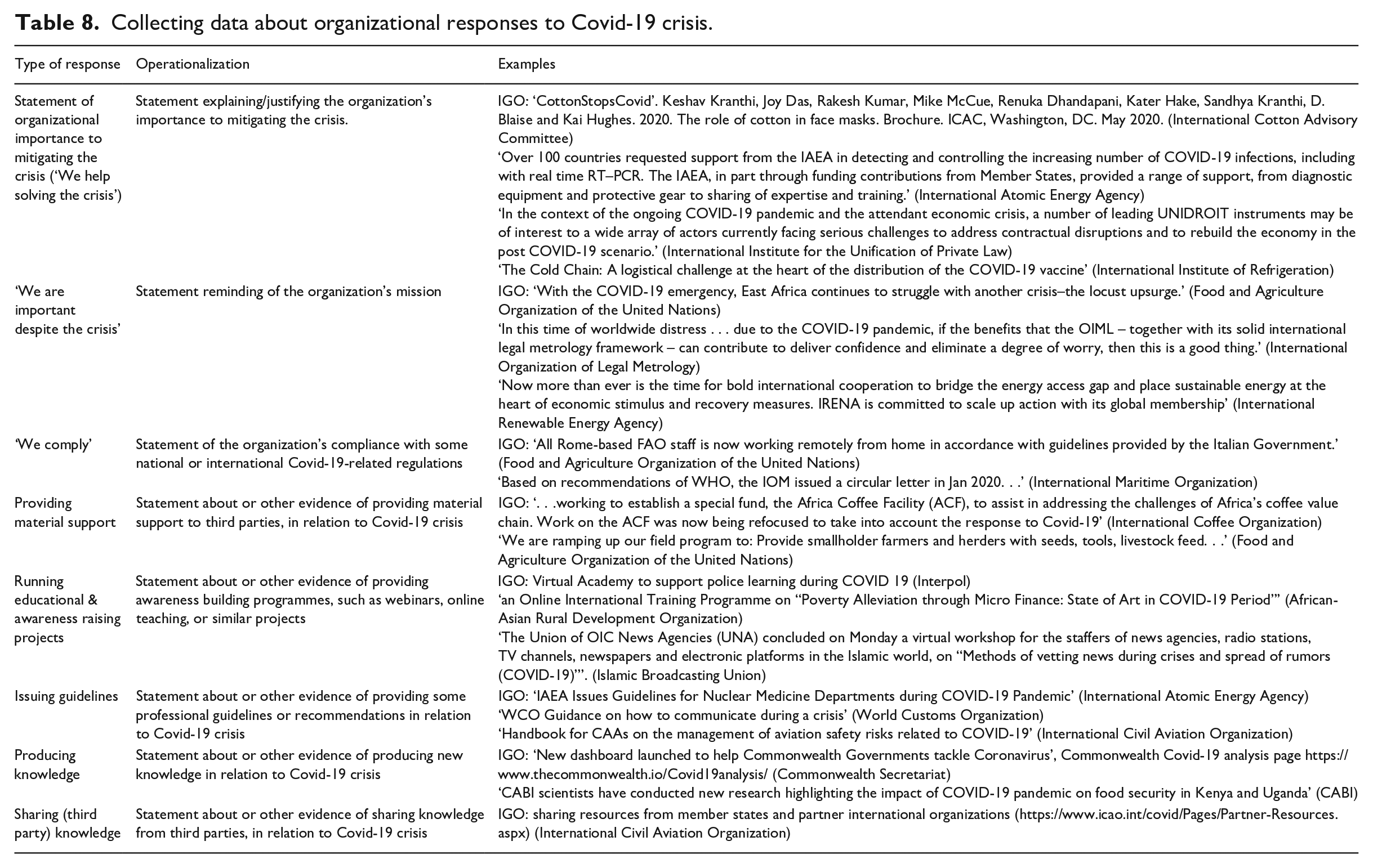
To capture the scale and scope of (public) responses to the Covid-19 crisis, we collected and coded the following data for each organization: (a) verbal responses of the organization to Covid-19 crisis: statements justifying the importance of the organization to mitigating the crisis; statements reminding of the organization’s mission, in the context of Covid-19 crisis, but not necessarily relevant to mitigating the crisis; statements about organizational compliance with some national or international Covid-19-related regulations; (b) provision of material support to third parties; (c) running educational and awareness raising project; (d) issuing guidelines to third parties; (e) producing knowledge; (f) sharing third party knowledge/information (for more details, see Table 8 in Appendix 1). We used inductive coding, that is the coding scheme was derived from the data, defined and modified during the preliminary analysis. Data for each type of response were coded in a binary way–Yes (1)/No (0).
The results presented should be taken with an important caveat in mind. The source of our data are websites of organizations. We are mindful of the fact that the information provided through organizational websites is naturally limited. Websites shed a light on those aspects which an organization decided (and had the capacity) to publicize. Websites are unlikely to reveal all aspects of organizational formal and informal structures, strategies, or routines. The absence of evidence is not evidence of the absence of certain actions or transformations. It is possible that some relevant information about IGOs’ responses to the pandemic was missed in the analysis. Various internal organizational changes, which have not been publicized, are not discussed in this article.
Results: Public responses of intergovernmental organizations to the Covid-19 pandemic
Factors affecting responses
Considering all types of responses, most IGOs responded to the Covid-19 pandemic within the analysed time period and placed it on their agenda in one way or another. Compared with responses to previous pandemics (operationalized as a mention of previous pandemics anywhere on the website), the Covid-19 crisis triggered a wider response. While 122 organizations of the analysed total sample of 252 (48%) responded to previous pandemics, 184 responded to Covid-19 (73%). This high response rate is surprising, given how diverse the analysed intergovernmental organizations are in terms of their agendas and areas of expertise. As to the size of the organization, larger size organizations were more likely to have a response (measured by any Covid-19-related statements, documents, or projects referred to on the websites). Among small IGOs, 86/159 = 54% of organizations had a response, while 49/59 = 83% of large IGOs responded; a statistically significant difference, p < 0.001. Furthermore, general purpose IGOs were more likely to respond than task-specific ones. General purpose IGOs responded 39/43 = 91%, task-specific IGOs 63/145 = 43%, p = 0.004.
We compared the organizations’ response to Covid-19 with responses to previous pandemics, including Severe Acute Respiratory Syndrome (SARS) in 2003, Influenza A H1N5 (bird flu) in 2007, H1N1 (swine flu) in 2009, Middle East Respiratory Syndrome (MERS) in 2012, Ebola in 2014, Zika virus in 2015–2016, HIV/AIDS. Those who responded to previous pandemics were more likely to respond to this pandemic too. IGOs 122/252 = 48% responded previously, of these now responded 112/122 = 92%, and those that did not 72/130 = 55%, p < 0.001. In other words, large organizations with wider policy agendas, which responded to past pandemics, were significantly more likely to respond to the Covid-19 pandemic as well. Overall, in the data, we see a widespread response to the Covid-19 pandemic among IGOs. IGOs reacted to Covid-19 noticeably more often than to previous pandemics (73% vs 48%). A diverse range of organizations responded to Covid-19 – IGOs of different sizes, policy scope, and history of response to previous pandemic. Given the relatively short time frame during which the organizations responded, one can speak about a global synchronization of response. This supports our hypothesis based on institutionalist studies.
Variation of responses
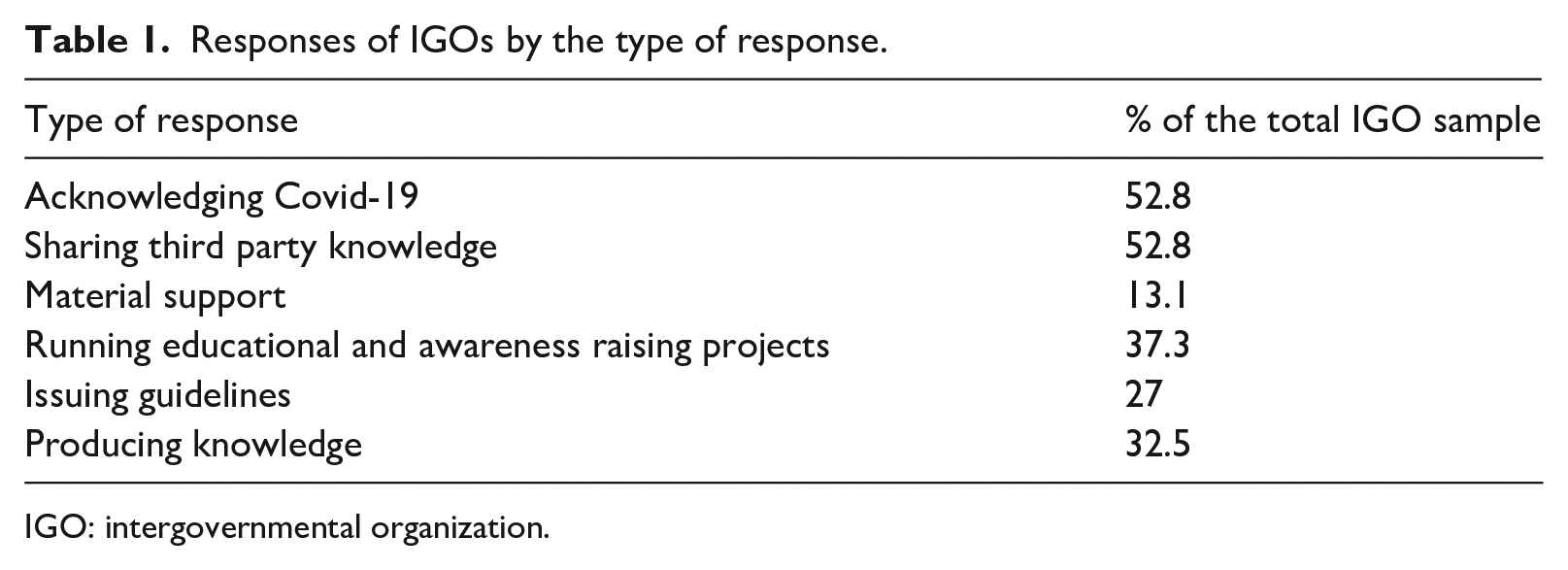
While the majority of IGOs provided a wide and synchronized response to the pandemic, there is
Responses of IGOs by the type of response.
IGO: intergovernmental organization.
By ‘Acknowledging Covid-19’, we refer to statements of three types: statements of organization’s importance to mitigating the crisis (‘We help solving the crisis’), statements reminding of the organization’s mission (‘We are important despite the crisis’), and statement of the organization’s compliance with some national or international Covid-19-related regulations (‘We comply’).
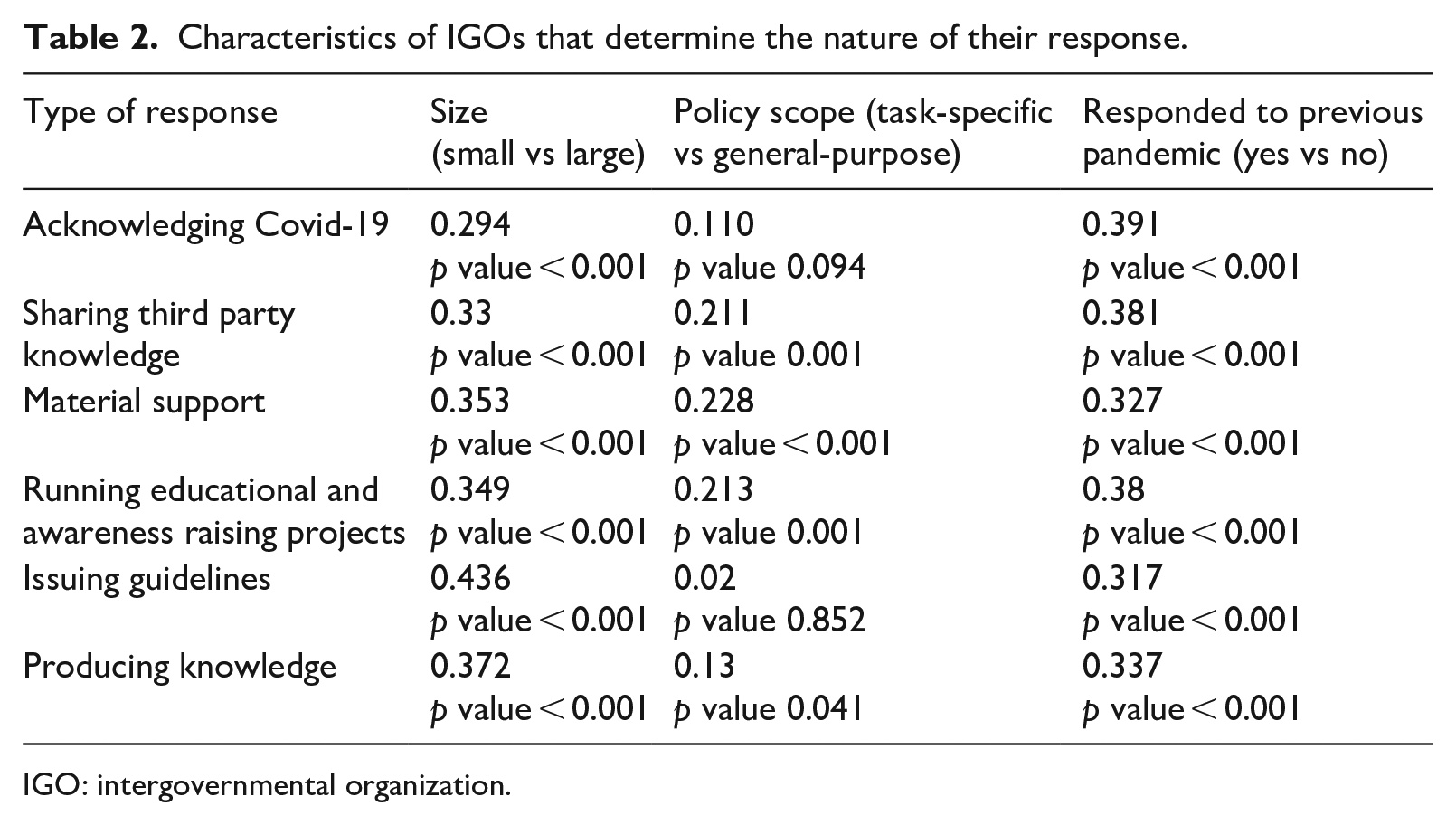
We report Cramer’s V, a measure of association on a scale 0 (no association)–1 (complete association) between the two variables, calculated from the underlying 2 × 2 contingency table (where 0.1–0.3 is small effect. 0.3–0.5 is medium effect. above 0.5 is strong effect.). It shows the correlation between the type of response and three variables–size, policy scope, response to past pandemics. We also report the p value calculated by Fisher’s exact test. As seen from the table, everything significantly correlates with size and response to previous pandemics. Bigger size or previous pandemic response make it more likely that an IGO will respond, for all types of response. The policy scope (task-specific vs general-purpose IGO) shows less association but is significant for knowledge sharing, material support, running projects, and knowledge production. In all cases, general purpose organizations are more likely to react. So, we observe that the response is a strong function of the underlying characteristics of the organization (Table 2).
Characteristics of IGOs that determine the nature of their response.
IGO: intergovernmental organization.
From the above data, we see that the response was not universal. Larger organizations were more likely to respond. This is likely to be due to larger organizations often being more financially capable, with larger budgets for public relations and website maintenance, as well as new projects and activities. General purpose organizations, that is, those with wider policy agenda, were more likely to respond, compared with task-specific organizations (91% vs 43%). This is probably due to task-specific IGOs having fixed budgets, meaning that their ability to operate out of scope is limited. Our finding agrees with results of Debre and Dijkstra (2021), who argue that the bureaucratic capacity of IOs is an important factor shaping organizational behaviour under the pandemic.
Types of responses
Notably, the significantly higher rate of response compared with past pandemics is not indicative per se of the significance of these actions in terms of transformation and organizational change. Overall, the responses seem to be in line with regular functions and repertoires of practices of IGOs, that is engaging in symbolic action, collecting and sharing information, issuing guidelines, setting international issue agenda. One could hypothesize that more IGOs would attempt to raise funds or provide material support to the communities and stakeholders they serve, as material support is an effective way to demonstrate one’s contribution to alleviating problems created by the pandemic. However, we do not see this in our data.
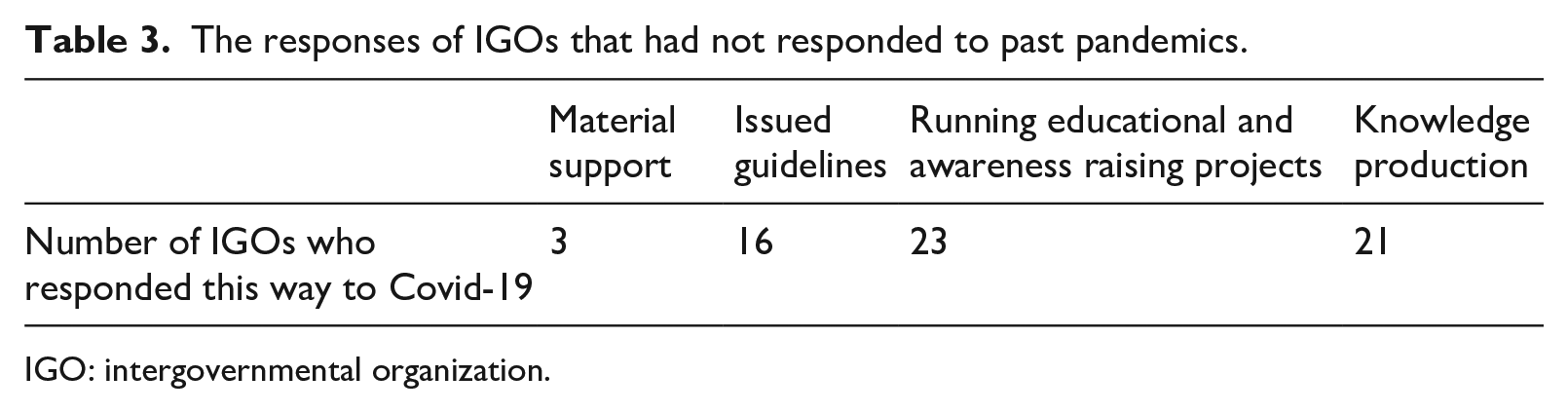
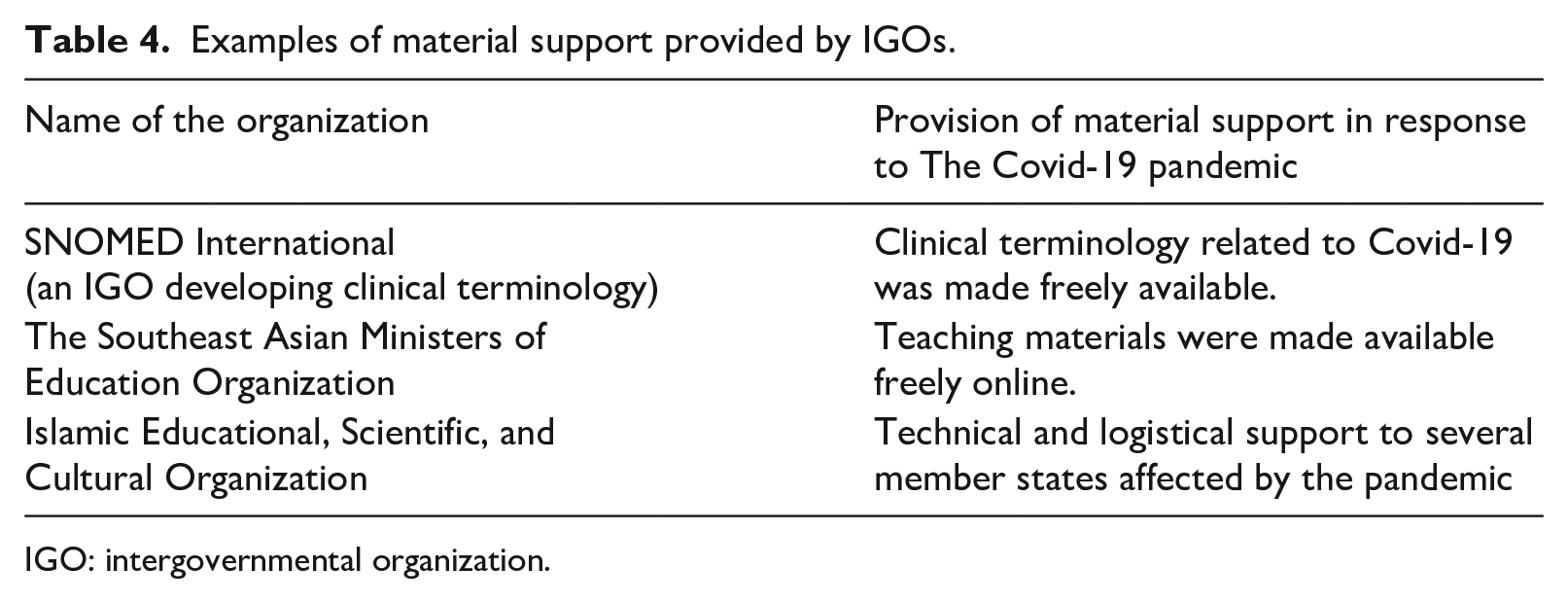
To discuss some examples in more detail, let us now consider the responses of IGOs that did not respond to previous pandemics but did respond to Covid-19 (Table 3). The number of IGOs (global and regional) that did not respond to any of the previous pandemics but responded to Covid-19 pandemic is 72 (out of 252). Of these, three IGOs provided pandemic-related material support (Table 4).
The responses of IGOs that had not responded to past pandemics.
IGO: intergovernmental organization.
Examples of material support provided by IGOs.
IGO: intergovernmental organization.
Some IGOs issued guidelines in relation to Covid-19 (Table 5). A closer scrutiny of these guidelines reveals that they tend to relate to previously existing recommendations and guidelines, and often serve to promote the IGO’s existing guidelines and service, highlighting their very existence and re-packaging them to underscore their relevance to the Covid-19 situation. For example, the guidance issued by UNIDROIT highlighted the relevance of their own UNIDROIT Principles of International Commercial Contract (UPICC): In the context of the outbreak of COVID-19 and the resulting public health and economic crises, UNIDROIT has prepared guidance as to how the Principles could help address the main contractual disruptions caused by the pandemic directly as well as by the measures adopted as a consequence thereof. (Note of the UNIDROIT Secretariat on the UNIDROIT Principles of International Commercial Contracts and the COVID-19 Health Crisis).
Examples of guidelines issued by IGOs in response to the Covid-19 pandemic.
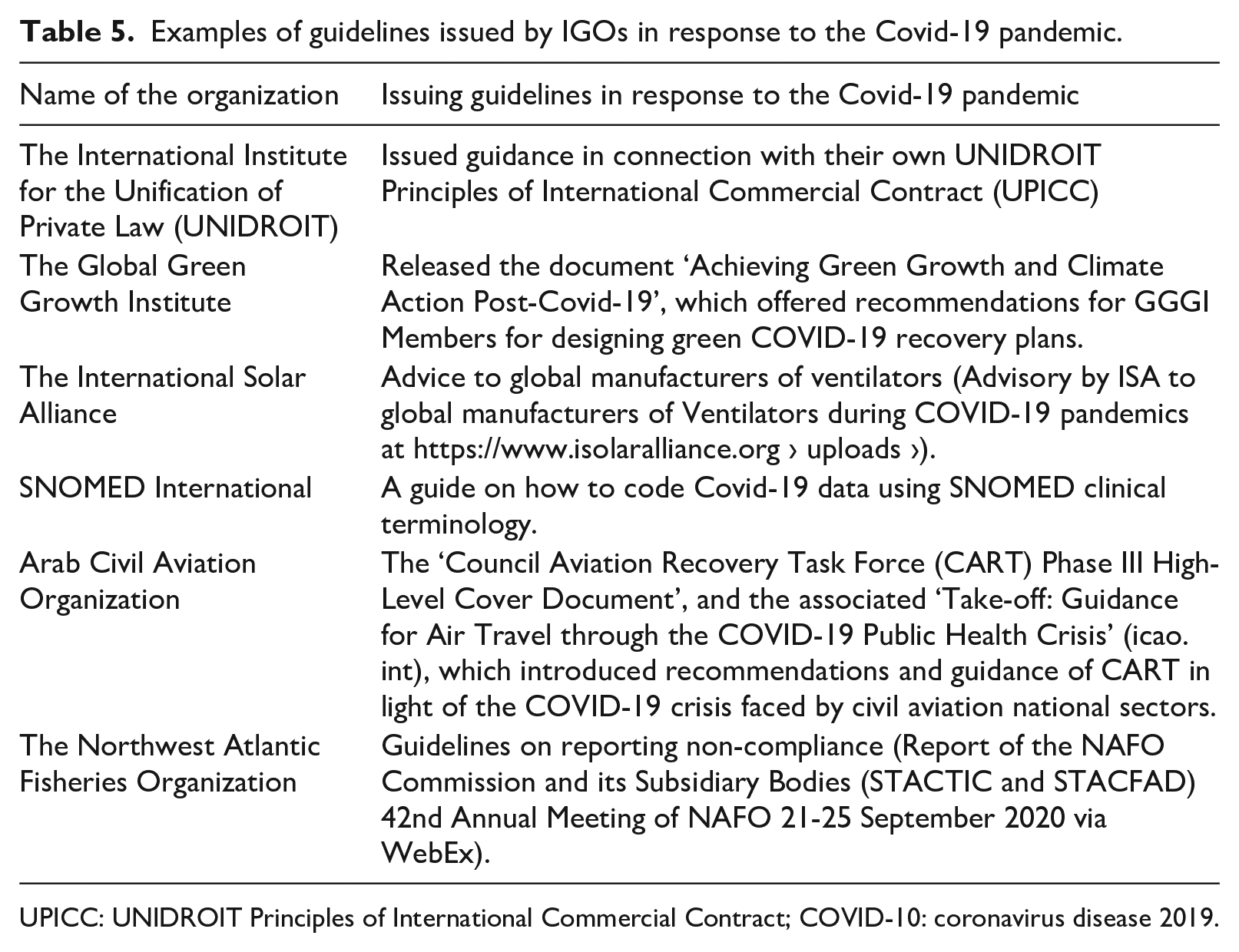
UPICC: UNIDROIT Principles of International Commercial Contract; COVID-10: coronavirus disease 2019.
Similarly, the advice issued by the International Solar Alliance urged the producers of ventilators to address the problem of unreliable power supply, by adopting a solar kit to power ventilators, and retrofitting solar kits with already operational ventilators – in other words, serving the promotion of their existing agenda. Similar response can be found, for example with the Global Green Growth Institute, SNOMED International, whose responses can be hardly qualified as transformational. Rather, they constitute marketing-like activities, aimed at the promotion, with some tailoring to the current agenda, of already existing services or products, explaining the relevance of their services in the context of the Covid-19 pandemic, and how their products can be best used in this context.
There are examples of more substantive and detailed guidelines and instructions, providing genuine answers to the problems faced by IGOs’ stakeholders, see, for example, Arab Civil Aviation Organization. Also, the Pan African Postal Union, whose beneficiary national postal organizations also faced a crisis, wrote about the Recovery Plan Guide by the UPU International Bureau. Another example of an IGO that goes beyond self-promotion and addresses issues faced by IGO beneficiaries, is the Northwest Atlantic Fisheries Organization. It developed guidelines on reporting non-compliance, to differentiate between pandemic-conditioned non-compliance and other non-compliance. Yet, these responses also fit well within the business-as-usual repertoires of the relevant IGOs, and do not bear any signs of transformational change.
In response to the pandemic, some IGOs launched educational and awareness raising projects (Table 6). As many cases show (the International Association of Supreme Administrative Jurisdictions; the International Pepper Community; Arab League Educational, Cultural and Scientific Organization; Global Green Growth Institute; International Sugar Organization), the pandemic is met with a light-touch, regular-repertoire response. Usual portfolios and activities are re-packaged to demonstrate relevance to the Covid-19 event, which can be explained through the lens of legitimation efforts. In other words, while it may seem on the surface that IGOs delivered a massive response to the pandemic, a closer investigation reveals that these activities often constitute re-framing of existing products and services.
Examples of educational and awareness raising projects launched by IGOs in response to the Covid-19 pandemic.
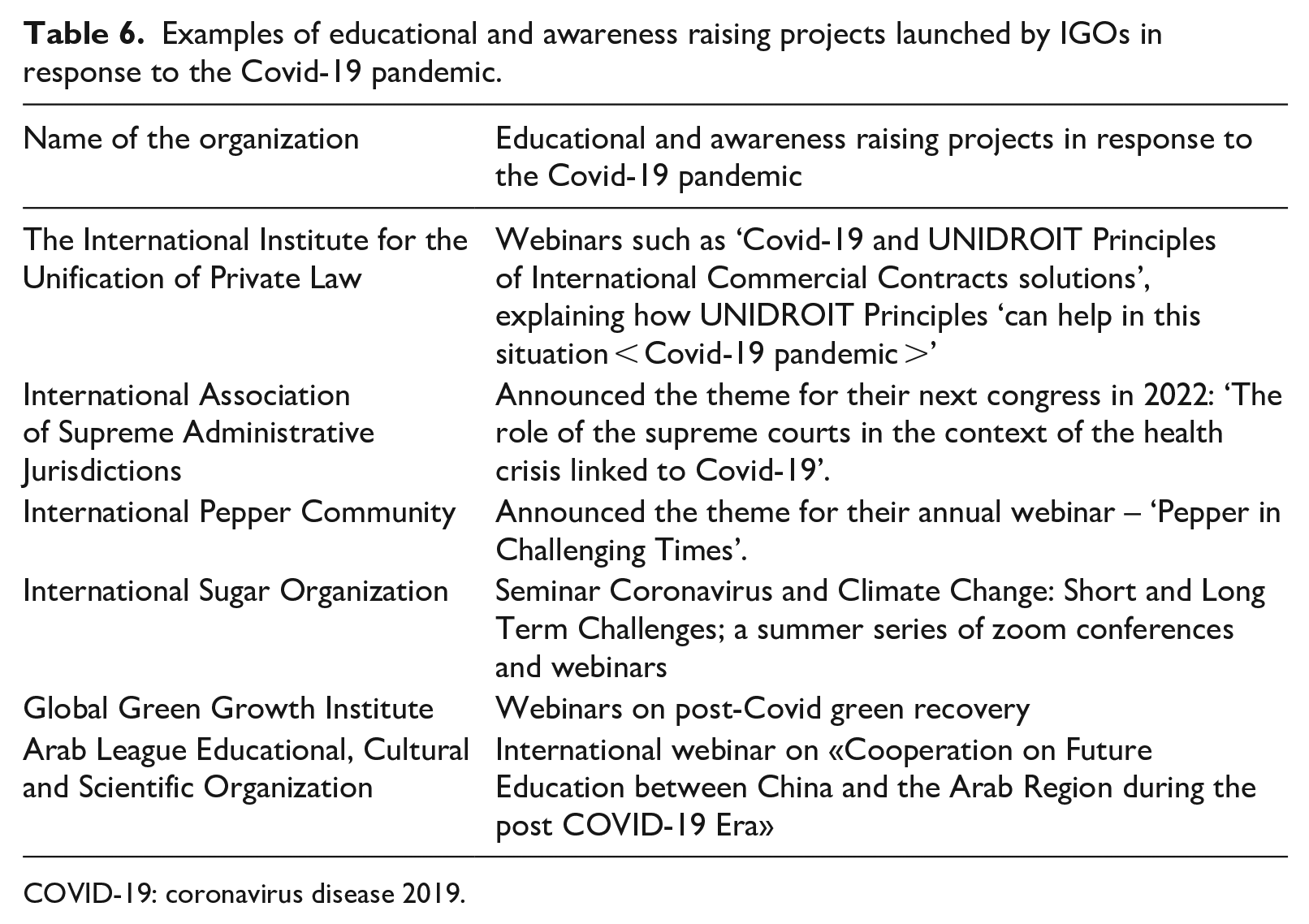
COVID-19: coronavirus disease 2019.
Some IGOs went beyond re-packaging their business-as-usual activities. The International Commission for the Protection of the Rhine responded to the closure of nature centres in the Rhine area and developed a website-based alternative to raise environmental awareness and educate school children about the nature of the Rhine basin. Unlike the above examples, this behaviour does not constitute re-packaging but adaptation of the IGO to the new organizational environment. However, even this change fits well in the already pre-existing trend of digitalization of public education services, not a departure from typical activities and general trends in the sector. Another example of a non-cosmetic response is Global Coalition against Daesh, which conducted a sanitation campaign in Raqqa City to prevent the spread of the disease, and a public awareness campaign about sanitation (https://theglobalcoalition.org/en/first-responder-teams-raqqa-covid-19/). While possibly not a typical activity for many IGOs, but part of a non-governmental repertoire, these activities were a natural extension of the emergency aid profile of this particular IGO.
In relation to knowledge production, we see similarly ordinary activity. International Organization of Vine and Wine ran a questionnaire on the impact of the pandemic; the Association of Natural Rubber Producing Countries released its Natural Rubber Trends & Statistics June 2020; International Sugar Organization included data on the market effects of Covid-19 into its Quarterly Market Outlook.
As these examples show, the Covid-19-related activity of IGOs was a moderate extension of their regular activities. There are some counter examples of IGOs significantly deviating from their ordinary repertoires, for example, the European Union increased its policy scope (Debre and Dijkstra, 2021: 3). However, on the whole, our data show that IGOs decided to stick to their core functions and usual repertoires.
Discussion
In our analysis, we asked three questions: How did IGOs respond to the Covid-19 pandemic? How can one explain this behaviour of IGOs in response to a major exogenous event? And how can one best conceptualize the Covid-19 pandemic in terms of its impact on IGOs? Our data show that the reaction of IGOs to the pandemic had two distinct features – (a) they responded en mass and in a synchronized way, and (b) the pandemic triggered many non-major adaptations to the changed environment, providing opportunities for legitimation work and minor repackaging of existing activities, but our data does not contain any evidence of major, radical structural change in organizations’ activities. The observed variation in responses is explained through size and policy scope of IGOs, as well as their response to past pandemics, which fits existing explanations of organizational behaviour in non-crisis situations
Based on these results, in this section, we interpret the logics behind the IGOs’ responses in light of theories about how organizations respond to various kinds of situations. How do the observed responses fit with the rational-choice and sociological institutionalist theory of organizational behaviour under different exogenous events?
We suggest that the observed IGO behaviours can be best explained by looking at them both through the rational-choice and sociological institutionalist lenses. Applying the rational-choice lens, the observed IGO behaviours follow the logics of uncertainty shock rather than the logics of crisis response. We argue that for IGOs, the Covid-19 pandemic presented significant and multi-aspect uncertainty, but not necessarily a major (or immediate) threat. The uncertainty created by the Covid-19 pandemic was high in length and breadth. It created uncertainty about many aspects of organizational functioning and long-term survival: the eventual impact on the demand for and costs of IGO’s services; year-ahead funding; the timing of exit from the pandemic and lifting or new imposition of restrictions; pandemic outcomes for IGO’s stakeholders: the extent to which and period over which Covid-19 will continue to generate uncertainty; who will be most affected; whether and how this will affect different funding streams for IGOs; their daily operations. As the Covid-19 pandemic broke out, decision makers did not have prior knowledge, but also could not quickly acquire necessary knowledge about the geographic and time scale of the pandemic, the depth of the consequent economic, social and political crisis, related alterations in the funding stream, medium- and long-term changes in the patterns of travel and trade, availability of their staff, emergence of new technologies, post-Covid changes in demand for their products and services, and so on. For the first several months after the start of the pandemic, there could neither be clear indications from other IOs and sectors about the consequences of choosing particular response strategies. They could not be certain about outcomes of any major organizational reforms, repurposing of their organization, etc. At the same time, there was not necessarily immediate threat to the IGOs’ survival, given that many of them have secure funding at least for 1 year ahead. The relative security of funding is an important difference from for-profit organizations, who are more likely to be forced to engage in transformational change after a few months of reduced revenues and whose less secure financial position may not allow them to ‘snooze’ for a few months in expectation that the uncertainty will resolve.
The wide-spread lack of publicized transformational change fits well with rational-choice perspective on organizational behaviour under uncertainty. If IGOs experienced the pandemic as an organizational crisis, it would be reasonable to expect that they would tend to use it as an opportunity for organizational reform and use the opportunity to advertise their organizational renewal. Under uncertainty, however, one is likely to opt for symbolic actions to demonstrate one’s commitment to resolving the situation but without committing significant resources, pursue the ‘wait and see’ strategy and avoid any structural change – as a safe option. So, on one hand, rational-choice perspective can help explain the observed IGO responses, and in particular the observed diversity of responses. Also, showing wide-spread symbolic or light-touch, rather than substantive transformational responses, our data suggest that IGOs experienced the pandemic as an uncertainty shock, whereas the extent to which they experienced it as a crisis is questionable.
The striking synchronization of IGO responses, however, can be better explained by applying the sociological institutionalist lens. In a situation of immense uncertainty, IGOs chose to ‘follow the crowd’, admit the relevance and importance of the pandemic to the activity of their organization. Possibly, the role of peer example took centre-stage, although following others who are likely to be unable to make better informed choices, may not be a rational response strategy in the sense that it is not associated with any specific risk reduction or increased benefits. In the case of Covid-19, the vast majority of IGOs felt the need to respond, even where it had little if any direct impact on their organization in particular. This strong uniformity can be a result of IGOs assuming that other organizations have more information and respond appropriately, and so a similar response is required from their organization too.
Based on previous research, our starting point was that major exogenous events do not always constitute a crisis; in some cases they can be better conceptualized as uncertainty shocks. Moreover, ‘crises’ themselves are a collection of different types of events, which can also be perceived in different ways and lead to more or less transformational effects. Given this starting point, how can the Covid-19 pandemic be best conceptualized as an exogenous event from the perspective of IGOs?
In our data (Covid-19-related statements on IGOs’ websites), we did not identify any signs of transformational change similar to that described in the crisis literature. We did not find any examples of IGOs talking about a new strategy, change of mission, or a new repertoire of organizational tasks and activities. Nor did we find examples of Covid-19-related announcements, which would indicate change in the nature of IO’s service provision, reform of organizational culture, organizational restructure, or similar.
Our data do not allow us to answer the question to what extent the Covid-19 pandemic resulted in crisis for individual organizations and whether this led to any transformational change, as we deal with public information, which is unlikely to cover changes in intraorganizational systems and routines, or information concerning changes in IGO relationships with stakeholders. It is also possible that the Covid-19 pandemic was perceived as a particular type of crisis, such as a slow-burning crisis, not requiring urgent organizational reform. However, the available data point towards the interpretation that IGOs perceived the pandemic as an uncertainty shock, with little if any transformational change at the IGO population level, whereby individual IGOs tended to retain their ordinary activity repertoires.
It is likely of course that the Covid-19 pandemic was a complex environmental event, which had different implications for different IGOs, whereby some IGOs faced not only an uncertainty shock but also a crisis (of presumably varying nature). This would mean that organizations pursue combined logics – logics of crisis response and logics of uncertainty shock. The presence of multiple logics can lead to various organizational outcomes (Besharov and Smith, 2014). In addition, the predominant intraorganizational logics vary across IGOs, whereby some IGOs follow the logics closer to those of a state bureaucracy, a political organization, an NGO or a profit-oriented organization. Our data point towards behaviour in line with the logics of uncertainty shock.
To argue that IGOs responded to the pandemic as a major crisis, one would need to answer two questions: (a) Given that by definition, ‘crises occur when core values or life-sustaining systems of a community come under threat’ (Boin et al., 2005: 2), can Covid-19 situation be interpreted as a crisis for the analysed IGO? (b) Given that by definition ‘crises typically and understandably invoke a sense of urgency’, did Covid-19 pose immediate problems for the analysed IGO? Did it evoke the perception that the threat ‘must be dealt with as soon as possible’ (Boin et al., 2005: 3)? Before these questions are answered, there is little ground to assume crisis response and transformational change as an outcome. We argue that one needs to critically scrutinize one’s assumptions about the nature and potential consequences of analysed exogenous events. Our argument is similar to the argument made by Van Hooren et al. (2014), who analysed social policy responses of several governments in the aftermath of four global economic shocks and found that fundamental change as a result of an exogenous shock is rare. Similarly, our data suggest that the implications of the Covid-19 pandemic for IGOs, and in particular for transformation of their functional repertoires and ordinary activity patterns, may not be as stark as one might expect in the wake of such an ‘unprecedented’ global event. It remains to be seen whether the pandemic will result in any significant transformations of these global governance actors. It may lead to major changes, or dissipate, without leaving much institutional or organizational imprint. We can make one step towards accurately capturing and explaining these outcomes by critically considering the nature of the exogenous event, and respective potential logics that would be reasonable for different types of IGOs to pursue.
Theorizing IGO behaviour under different exogenous events. How do IGOs respond to different types of crises, including the varying transformational response? The nature of crises and uncertainty arising from exogenous shocks can vary – in terms of threat, urgency, uncertainty, and length of time. For example, the nature of uncertainty for business created by Brexit was argued to be ‘different from that of a typical uncertainty shock because of its length, breadth, and political complexity’ (Bloom et al., 2018). We feel that in addition to better understanding IGO’s behaviour under crisis vs uncertainty shock, there is a need to go beyond this binary division, to refine our understanding of different types of crises and their implications in terms of organizational behaviour and change.
Theorizing transformational change of IGOs. Analysis of transformational change in relation to organizational functions is complicated by the existence of manifest and latent functions of organizations, and so attempts to clearly delineate what (does not) constitutes organizational functions is likely to be arbitrary. To build a robust theory of IGO behaviour and transformational change in crises and other exogenous events, one would need to improve the operationalization of transformational change.
Finally, given the methodological limitations of our study, future research could study how the pandemic affected formal and informal structures and routines within organizations, as well as different publicity strategies during the pandemic. This analysis would help better understand the role of major exogenous events in triggering different kinds of organizational change.
Footnotes
Appendix 1
Collecting data about organizational responses to Covid-19 crisis.
| Type of response | Operationalization | Examples |
|---|---|---|
| Statement of organizational importance to mitigating the crisis (‘We help solving the crisis’) | Statement explaining/justifying the organization’s importance to mitigating the crisis. | IGO: ‘CottonStopsCovid’. Keshav Kranthi, Joy Das, Rakesh Kumar, Mike McCue, Renuka Dhandapani, Kater Hake, Sandhya Kranthi, D. Blaise and Kai Hughes. 2020. The role of cotton in face masks. Brochure. ICAC, Washington, DC. May 2020. (International Cotton Advisory Committee) ‘Over 100 countries requested support from the IAEA in detecting and controlling the increasing number of COVID-19 infections, including with real time RT–PCR. The IAEA, in part through funding contributions from Member States, provided a range of support, from diagnostic equipment and protective gear to sharing of expertise and training.’ (International Atomic Energy Agency) ‘In the context of the ongoing COVID-19 pandemic and the attendant economic crisis, a number of leading UNIDROIT instruments may be of interest to a wide array of actors currently facing serious challenges to address contractual disruptions and to rebuild the economy in the post COVID-19 scenario.’ (International Institute for the Unification of Private Law) ‘The Cold Chain: A logistical challenge at the heart of the distribution of the COVID-19 vaccine’ (International Institute of Refrigeration) |
| ‘We are important despite the crisis’ | Statement reminding of the organization’s mission | IGO: ‘With the COVID-19 emergency, East Africa continues to struggle with another crisis–the locust upsurge.’ (Food and Agriculture Organization of the United Nations) ‘In this time of worldwide distress . . . due to the COVID-19 pandemic, if the benefits that the OIML – together with its solid international legal metrology framework – can contribute to deliver confidence and eliminate a degree of worry, then this is a good thing.’ (International Organization of Legal Metrology) ‘Now more than ever is the time for bold international cooperation to bridge the energy access gap and place sustainable energy at the heart of economic stimulus and recovery measures. IRENA is committed to scale up action with its global membership’ (International Renewable Energy Agency) |
| ‘We comply’ | Statement of the organization’s compliance with some national or international Covid-19-related regulations | IGO: ‘All Rome-based FAO staff is now working remotely from home in accordance with guidelines provided by the Italian Government.’ (Food and Agriculture Organization of the United Nations) ‘Based on recommendations of WHO, the IOM issued a circular letter in Jan 2020. . .’ (International Maritime Organization) |
| Providing material support | Statement about or other evidence of providing material support to third parties, in relation to Covid-19 crisis | IGO: ‘. . .working to establish a special fund, the Africa Coffee Facility (ACF), to assist in addressing the challenges of Africa’s coffee value chain. Work on the ACF was now being refocused to take into account the response to Covid-19’ (International Coffee Organization) ‘We are ramping up our field program to: Provide smallholder farmers and herders with seeds, tools, livestock feed. . .’ (Food and Agriculture Organization of the United Nations) |
| Running educational & awareness raising projects | Statement about or other evidence of providing awareness building programmes, such as webinars, online teaching, or similar projects | IGO: Virtual Academy to support police learning during COVID 19 (Interpol) ‘an Online International Training Programme on “Poverty Alleviation through Micro Finance: State of Art in COVID-19 Period”’ (African-Asian Rural Development Organization) ‘The Union of OIC News Agencies (UNA) concluded on Monday a virtual workshop for the staffers of news agencies, radio stations, TV channels, newspapers and electronic platforms in the Islamic world, on “Methods of vetting news during crises and spread of rumors (COVID-19)”’. (Islamic Broadcasting Union) |
| Issuing guidelines | Statement about or other evidence of providing some professional guidelines or recommendations in relation to Covid-19 crisis | IGO: ‘IAEA Issues Guidelines for Nuclear Medicine Departments during COVID-19 Pandemic’ (International Atomic Energy Agency) ‘WCO Guidance on how to communicate during a crisis’ (World Customs Organization) ‘Handbook for CAAs on the management of aviation safety risks related to COVID-19’ (International Civil Aviation Organization) |
| Producing knowledge | Statement about or other evidence of producing new knowledge in relation to Covid-19 crisis | IGO: ‘New dashboard launched to help Commonwealth Governments tackle Coronavirus’, Commonwealth Covid-19 analysis page https://www.thecommonwealth.io/Covid19analysis/ (Commonwealth Secretariat) ‘CABI scientists have conducted new research highlighting the impact of COVID-19 pandemic on food security in Kenya and Uganda’ (CABI) |
| Sharing (third party) knowledge | Statement about or other evidence of sharing knowledge from third parties, in relation to Covid-19 crisis | IGO: sharing resources from member states and partner international organizations (https://www.icao.int/covid/Pages/Partner-Resources.aspx) (International Civil Aviation Organization) |
Declaration of conflicting interests
The authors declared no potential conflicts of interest with respect to the research, authorship, and/or publication of this article.
Funding
The author(s) disclosed receipt of the following financial support for the research, authorship, and/or publication of this article: This work was made possible by financial support from the Academy of Finland (grant numbers 292353, 294183, 341066, and 346451), whose assistance is appreciated.
We are also grateful to two anonymous reviewers and the members of the Tampere Research Group for Cultural and Political Sociology for their comments on the earlier versions of the manuscript.
