




Abstract
Numerous sectors and institutions engage in ‘predatory inclusion’, purporting to satisfy the unmet needs of historically marginalized groups under exploitative terms. However, extant scholarship has yet to robustly examine why they target certain groups. Drawing on Black feminist Marxism, I theorize how predatory inclusion depends on precarity, and I redefine ‘precarity’ as a structural position of vulnerability to violence based on excess responsibilities and the denial of means to meet them – or, ‘alternativelessness’. I convey the usefulness of my definition of precarity and my theorization of the relationship between precarity and predatory inclusion through empirical sections that demonstrate how for-profit colleges (‘for-profits’) prey upon the alternativelessness of Black women, the race-gender demographic group with the highest rates of debt-financed enrollment in for-profits. By examining the training materials for admissions ‘counselors’ at for-profits, I illuminate how for-profits succeed at enrollment growth by manipulating the pain, urgency, and relationality of this precarity. I also reveal how descriptive statistics of Black women’s enrollment and financial need in for-profits correspond to the sector’s predation of precarity. I contend that precarity must be contested for the sake of ending the predatory inclusion of Black women and all others positioned alongside them as ideal prey.
Keywords
Introduction
Numerous sectors and institutions exploit people’s basic human needs for the sake of capital accumulation. Payday lenders and credit card providers exploit the need to pay bills amid inflation and wage stagnation (Charron-Chénier, 2020). The real estate sector’s subprime mortgages exploit the need for shelter amid housing discrimination and wealth inequality (Inwood et al., 2021). And for-profit colleges exploit the need for credentials in the new economy (Cottom, 2017). Notably, the aforementioned sectors specialize in responding to – but not resolving – the unmet needs of historically marginalized groups, engaging in ‘predatory inclusion’ (Charron-Chénier, 2020; Seamster and Charron-Chénier, 2017; Taylor, 2019). That is, they purport to satisfy the unmet needs of historically marginalized groups but offer access and services under exploitative terms that maximize their revenue at the expense of those in need, consequently exacerbating inequality. Insofar as such sectors have been shown to engage in business malpractice (e.g. deception, manipulation), they have occasionally been fined and regulated to protect consumers from predation. Yet new institutional arrangements cunningly emerge to circumvent those regulatory measures.
In this paper, I draw on Black feminist Marxism to theorize how predatory inclusion depends on precarity, and I argue that predatory inclusion will continue unless precarity is resolved. To do so, I offer a revised definition of precarity as a structural vulnerability to violence based on excess responsibilities and the denial of means to meet them. I also introduce the concept of alternativelessness to encompass that troubling coupling of excess responsibilities and denied means. Hence, precarity is a vulnerability to violence conditioned by alternativelessness (see Figure 1: Table of definitions). I ground my claims about precarity as the foundational problem which predatory inclusion aims to exploit through a focus on the ways that the private for-profit sector of US higher education has preyed on the precarity of Black women.
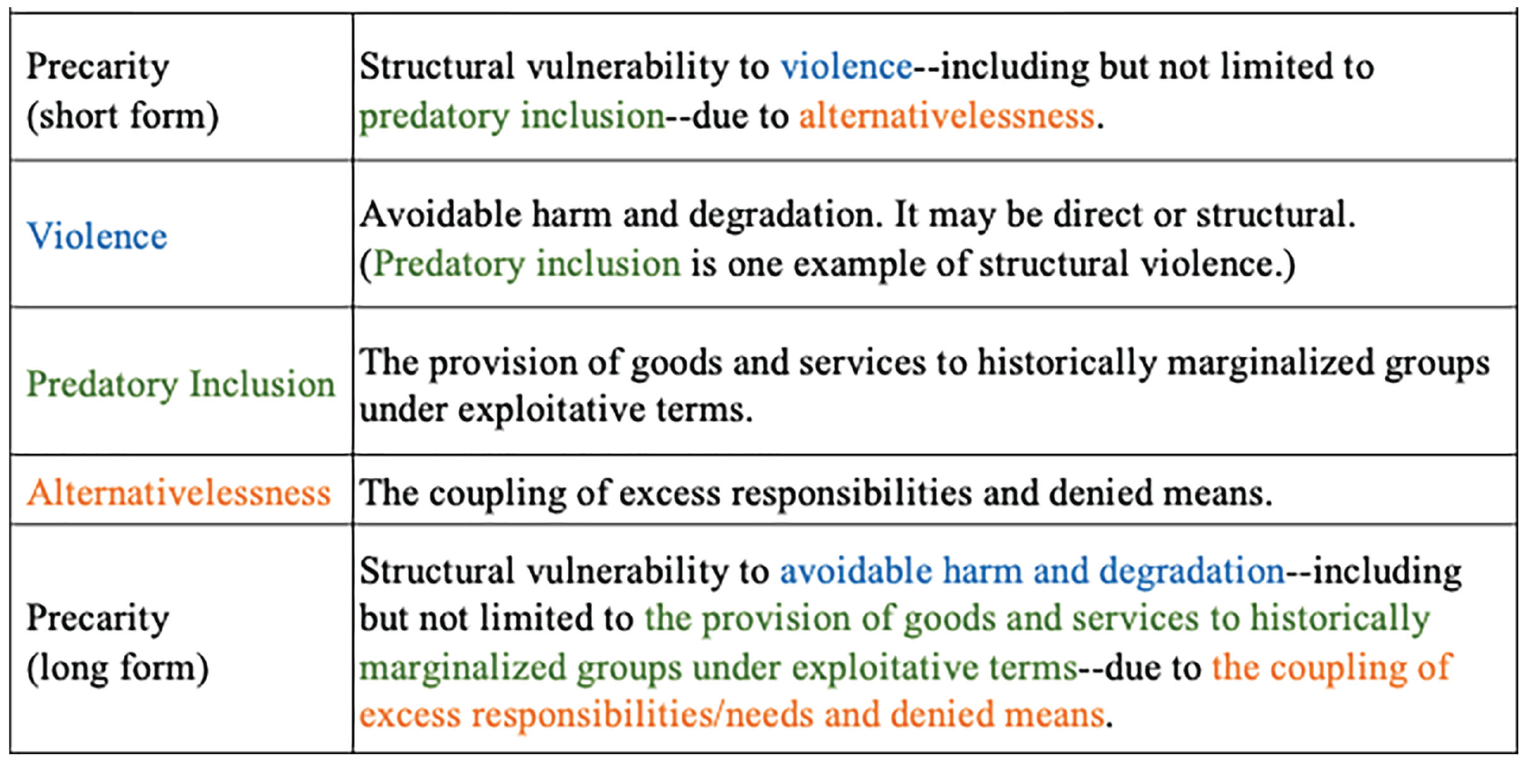
Table of definitions.
My conceptualization of precarity reveals how marginalized peoples become susceptible to capture and to enclosure in violent institutional arrangements like predatory inclusion according to the magnitude of unmet needs and the foreclosure of means to meet them. Hence, predatory inclusion targets for coercion and extraction those whose needs exceed their means.
Sociologists typically associate precarity with the proliferation of insecure, unstable, and uncertain employment and the decimation of social welfare and public services under neoliberalism, where workers bear excessive risk and minimal entitlements (Chan et al., 2019; Kalleberg and Vallas, 2018; Lust, 2021; Means, 2017). Some have considered how precarity reproduces racialized and gendered inequality, such as in COVID-19 infection rates and work–life conflict for parents (Coates, 2021; Luhr et al., 2022). From this vantage point, precarity emerges from working conditions and bears additional consequences, especially because economies of labor are always already racialized and gendered (Darity et al., 2015; Glenn, 2002; Reyes, 2022).
However, conditions other than in the field of labor may constitute precarity (e.g. housing insecurity). Furthermore, for Black people in the United States, precarity predates neoliberalism through the long-standing denial of rights, privileges, and protections. Those sources of security and stability have been reserved for (white male) people who are ontologically recognized as ‘humans’ and ‘workers’ (Hartman, 2016; Jung, 2019). Insofar as Black people have for centuries been forcibly denied the securities and stabilities owed to humans and workers for the sake of white supremacist capitalist patriarchy, Black people have experienced precarity within and beyond the labor relations that govern civil society (Glenn, 2002; Haley, 2016; Patterson, 2018; Wilderson, 2003). By attending to structural positions, my definition of precarity foregrounds racialized, gendered, and classed power relations and transcends but does not elide a traditional analysis of labor.
In this paper, I convey the usefulness of my definition of precarity and my theorization of the relationship between precarity and predatory inclusion through empirical sections that demonstrate how for-profit colleges (‘for-profits’) prey upon the alternativelessness that Black women experience. I underscore how excess responsibilities and the denial of means to meet them renders Black women particularly vulnerable, but not necessarily naïve, to predatory inclusion in for-profits.
While predatory inclusion is the focal instance of violence for this paper, it is not the only instance to which people are vulnerable when experiencing alternativelessness. According to Johan Galtung (1990), violence is ‘avoidable insults to basic needs and more generally to life’ (p. 292), effectively undermining the realization of survival, well-being, identity, and freedom. Galtung (1969: 171) also differentiates violence that is committed by a discrete actor as ‘direct violence’ from ‘structural violence’ wherein harm and degradation is ‘built into the structure and shows up as unequal power and consequently unequal life chances’. Predatory inclusion is an instance of structural violence.
In my focus on Black women, I aim to avoid essentializing identity and instead emphasize the significance of their structural vulnerability within an antiblack capitalist patriarchy and what this means for proximity to harm and exploitation in the United States. Studying for-profits offers a crucial and compelling case study for predatory inclusion given Black women’s overrepresentation in these profit-generating institutions (Baum, 2013; Iloh and Toldson, 2013), 6-year graduation rates for Black women in for-profits (19.8%) that are less than half that of Black women in public (50.0%) and private non-profit colleges (52.3%; National Center for Education Statistics, 2022), the institutions’ characteristically poor labor market outcomes (Deming et al., 2012; Eaton, 2022b), and the prevalence of unbearable student loan debt balances and defaults for its Black enrollees (Houle and Addo, 2022; Mustaffa and Dawson, 2021; Rooks, 2013; Scott-Clayton and Li, 2016). While Black women’s enrollment and attainment in higher education is certainly related to their hard work and resourcefulness in a society positioned against them, we must nonetheless critique how gendered antiblackness may involve treating Black women as a problem to profit from, even when the solution and their success suggests educational mobility.
Crucially, Black women are not the only persons exploited by for-profits. By drawing on Black feminist Marxism, I reveal how Black women are structurally situated at a nexus of oppressive forces that also readily subject others to exploitation. Accordingly, my inquiry about Black women’s lives from this scholarly tradition illuminates how multiple relations of power cooperate to produce unequal material outcomes and thus how multiple relations of power must be simultaneously contested for the freedom of all (Combahee River Collective, 2017).
The first part of this paper theorizes precarity according to a Black feminist Marxist tradition and historicizes how gendered racial capitalism positions Black women in precarity, making them vulnerable to harm and degradation (Laster Pirtle and Wright, 2021). The second part of this paper grounds my theoretical claims by examining how for-profits target Black women for predatory inclusion. Building on Cottom’s (2017) work, I distinguish how for-profits generate revenue from financial aid disbursements by coercively recruiting prospective students who have significant financial need and lack better alternatives due to failures in broader opportunity structures. I include two empirical sections on predatory inclusion by for-profits. Through an analysis of training materials for for-profit admissions recruiters, I first demonstrate that these institutions expect those who experience precarity to be vulnerable to manipulation and train their recruiters to coerce Black women into debt-financed enrollment. By considering federal student aid eligibility and enrollment data through the lens of precarity, I then demonstrate that for-profits disproportionately enroll Black women with outstanding needs and insufficient means as a profit-maximization strategy.
Black Feminist Marxism and the Political Economy of Precarity
Predatory Inclusion and the Centrality of Precarity
Sociologists of racism have offered excellent analyses of how the private sectors of real estate, fringe banking, and for-profits exploit historically marginalized peoples for capital accumulation through predatory arrangements (Charron-Chénier, 2020; Cottom, 2017; Taylor, 2019). For example, Keeanga-Yamatta Taylor (2019) contends that the real estate sector engaged in predatory inclusion as a post-civil rights alternative to categorical exclusion, whereby the sector incorporated historically marginalized groups into opportunity structures under exploitative terms. Louise Seamster and Raphaël Charron-Chénier (2017) proposed the same term to describe the malpractice of for-profits, conceptualizing predatory inclusion as market-based access ‘under conditions that jeopardize the benefits of access’ (pp. 199–200). Tressie McMillan Cottom’s (2017) work further illuminates how predatory inclusion thrives on inequality. Her accounting of inequality depicts a political economy of unmet needs vis-à-vis poverty and labor market insecurity, and she argues that this inequality in unmet needs lends itself to inequality in who needs new opportunity structures to meet those needs. In turn, the private for-profit sector of post-secondary education depends upon this inequality-induced demand for new opportunity structures and exacerbates this inequality by offering what Cottom dubs ‘risky credentials’ to groups who have been otherwise excluded from favorable markets. Under the guise of education, these for-profit institutions function as what Charron-Chénier (2020) calls ‘alternative providers’ in his elaboration of predatory inclusion. Alternative providers enter a stratified market to provide historically excluded groups a lower quality substitute that may offer short-term benefits for the consumer; however, the provider realizes long-term benefits at the consumer’s expense such that it undermines, if not negates, the consumer’s initial benefits.
This paper enriches scholarship on the political economy of predatory inclusion by foregrounding precarity as the driving force of exploitation and inequality therein. In fact, I argue that there would be no predatory inclusion without precarity. I move beyond the fact that certain demographic groups (e.g. Black, women, low income, parents) are disproportionately exploited to explain how power engenders certain people as vulnerable to and for exploitation (i.e. alternativelessness). Upon comprehending precarity as the primary basis for predation in the case of Black women by for-profit colleges, scholars can subsequently evaluate how differences in the experience and magnitude of precarity correspond to differentiated exploitation. In other words, beginning with precarity allows us to understand the devastating reality and unequal prevalence of predatory inclusion with greater precision.
Distinguishing Precarity Through Black Feminist Marxism
As noted earlier, I define precarity as a structural vulnerability to violence based on excess responsibility and the denial of means to meet those responsibilities. I elaborate on both ‘excess responsibility’ and the ‘denial of means’ in the coming subsections by drawing on Black feminist Marxist scholarship with special attention to the history of domestic work. I then operationalize my concept of precarity with comparisons steeped in the state of racial stratification to distinguish Black women’s experiences of precarity.
For those subjected to harm and degradation on account of their racialization as Black people, precarity emerges from what Christina Sharpe (2016) calls ‘the wake’ of chattel slavery, whereby Black people ‘are constituted through and by continued vulnerability to overwhelming force’ (p. 16). Put differently, blackness becomes identifiable through scenarios of racial violence – as inaugurated by enslavement but not concluded by emancipation – that reiterate dehumanization and objectification (Hartman, 1997; Smith, 2016). Sharpe’s critique of vulnerability to overwhelming force resonates with Judith Butler’s (2009) gender analysis of precarity as ‘exposure [. . . ] to arbitrary state violence and to other forms of aggression that are not enacted by states and against which states do not offer adequate protection’ (p. iii). Indeed, precarity is no less about aggressions than a lack of protection against them. Black women experience vulnerability as targets for violation and are not typically privileged for state protection and public outcry for redress, evidenced in part by the relative contempt Black women garner when experiencing racial and gender violence compared to Black men and white women (Crenshaw et al., 2015; Haley, 2016; Smith-Purviance, 2021).
My theorization of precarity is heavily informed by the rigorous efforts of a subset of Black feminists – whom I call Black feminist Marxists – to reveal racial capitalism as fundamentally gendered through comparative analyses of (labor) exploitation and person-/motherhood (Beal, 2008; Davis, 1983; Haley, 2016; Morgan, 2011; Spillers, 1987). Generally, Black feminist thought carefully investigates the positions, experiences, and knowledge production of Black women and the social construction of Black gender (Collins, 2009). Through frameworks such as intersectionality, Black feminists have innovated the study of power by revealing how it operates as a complex, interlocking system of domination and results in differentiated yet linked vulnerabilities to harm (Crenshaw, 1989; Fleming, 2018).
Within the constellation of Black feminist thought, Black feminist Marxism complicates and extends beyond a class-reductionist Marxist analysis by regarding racism and sexism as significant determinants to the specific economic situation of Black women and by refusing to reduce oppression to exploitation and vice versa (Bohrer, 2018; Combahee River Collective, 2017). Such an approach considers what Ashley Bohrer (2019) calls the ‘equiprimordiality’ of oppression and exploitation, foregrounding their simultaneous relevance and interplay to understand contemporary capitalism. Black feminist Marxism also examines and contests how capitalism – and some anti-capitalist struggles – have been arranged through relations of difference constructed at the expense of Black women both symbolically and materially (Burden-Stelly and Dean, 2022; Hartman, 2016). This ‘radical Black feminist sociology’ (Brewer, 2021) reveals how capitalism is always already racialized and gendered for everyone in ways that shape group interests and demand more nuanced, coalition-based political movements.
Grappling with ‘excess responsibility’. Excess responsibility encompasses the unreasonable amount and array of needs that political economies, civil societies, communities, and families have depended upon Black women to meet. The legacy of excess responsibility constitutes a burden that Black women bear as ‘mule uh de world’, to use Zora Neale Hurston’s (2000) phrasing from Their Eyes Were Watching God, first published in 1937. The reference to mules conjures the dehumanization of Black women as chattel while drawing attention to the ways that the world continues to depend on her exploitation. This burden on Black women has been articulated in myriad ways, such as demanding Black women to labor on both sides of the notorious gender divide (e.g. reproductive and productive) as well as across racial boundaries (e.g. Black and white; Collins, 2009; Haley, 2016). Enslaved African women, for example, were burdened not only with toiling in the fields and houses of white enslavers but also birthing, providing for, and nurturing the social and material needs of enslaved communities (Morgan, 2011; Roberts, 1999). These labors for her enslaved community were profoundly complicated by the fact that biologically and socially reproducing the enslaved also sustained and profited plantation economies (Davis, 1983). From this standpoint, excess responsibility is no less about the needs a Black woman identifies with – and which may already exceed herself – than those expectations, burdens, and demands placed upon and extracted from her for the benefit of others (Hartman, 2016).
Linked racialized regimes of capital accumulation and symbolic violence in the United States have continued to depend on Black women’s labors. For instance, Sarah Haley’s (2016) scholarship on gender and Jim Crow modernity contends that Black female gender has been constructed through coerced performances of labor and subjection to gendered racial terror. Haley compellingly demonstrates that the burdens placed on Black women to labor not only function as exploitation. These unfree performances of gendered labor also justify broader regimes of racial oppression, insofar as gendered differences among women across racial lines (e.g. white but not Black women as respectable mothers and worthy of protection) demarcate the white race as civilized, superior, and thereby fit to dominate darker peoples.
Put simply, society has burdened Black women with the responsibility of performing labor under deprecating circumstances that uphold gendered racial capitalism (Glenn, 2002, 2012). The world as we know it depends on Black women in ways that are routinely predatory (Hartman, 2016). Accordingly, ‘excess responsibility’, which I argue constitutes an important aspect of precarity, concerns all those who depend on Black women – whether for satisfying their basic human needs, capitalist greed, racist self-esteem, or wanton desires. Excess responsibility thereby implicates various modes of dependency, including but not limited to familial relations, race relations, sexual relations, and capitalist relations, especially considering their mutual constitution. Accordingly, I find the most capacious notion of ‘dependents’ to include all those and that which depend on Black women for coherence, survival, and accumulation.
Grappling with the ‘denial of means’. Precarity, or structural vulnerability to violence, is shaped by the relation between excess responsibility and a systematic ‘denial of means’. By denial of means, I refer to systems and processes that have undermined and constrained the possible ways that people can survive, meet needs, and fulfill responsibilities embraced by and/or relegated to them. Unfortunately, Black women have endured a ruthless history of denial in the United States, from the denial of Black women’s humanity (and motherhood) to the denial of humane living, learning, and working conditions (Beal, 2008; Smith-Purviance, 2021; Spillers, 1987). My conceptualization of denied means holds that this denial is no less about refusing to regard Black women as full persons than it is about refusing a just distribution of resources (Glenn, 2002), whereby full personhood is characterized by unobstructed and uncoerced access to the rights, entitlements, and benefits of a society’s social contract (Mills, 1997). Following Michael Dumas’ (2009, 2011) analysis of the cultural political economy of school desegregation in Seattle, I concur that the dual denial of personhood and resources are interconnected: Black women are denied resources because they are not regarded full persons, and they are not regarded full persons because they are denied resources.
The legacy of denial is both devastating and enduring. Chattel slavery dispossessed Africans from indigenous land and thereby a means of subsistence. Enslaved Africans were then juridically regarded as property and thereby propertyless (Harris, 1993; Hartman, 1997). They had no claim to wages. Wages were reserved for free laborers, and the recognition of full personhood was racialized by this distinction between property and labor that characterized the enslaved (Glenn, 2002). Moreover, through the domestic slave trade and trafficking of the enslaved, white enslavers systematically and routinely disrupted the kinship relations that enslaved Africans cultivated as a means of comfort, cooperation, and survival (Hartman, 1997).
During Jim Crow, emancipation from slavery was travestied by economic arrangements that coerced participation in sharecropping and domestic labor as the sole means of subsistence by foreclosing alternative means, as well as, by punishing with racial terror, imprisonment, and forced labor those who refused (Collins, 2009; Haley, 2016). Throughout most of the 20th century, Black men and women were generally denied breadwinner wages, union protections, voting rights, and equal access to favorable housing markets, public assistance, and veterans’ benefits (Burden-Stelly and Dean, 2022; Johnson, 2010; Massey and Denton, 1993; Taylor, 2019). In addition, Black peoples’ entrepreneurialism has historically received a fraction of investments, and when successful against the odds, has become subjected to racist terrorism to minimize competition and assert dominance, jeopardizing Black livelihoods (DuMonthier et al., 2017; Marable, 2015).
Ultimately, the benefits of full citizenship were severely constricted as Black people secured civil rights in the late 20th century (Taylor, 2016). Gains in employment, housing, education, and public assistance were short-lived due to the neoliberal dismantling of the Fordist welfare state and catering to private markets (Omi and Winant, 2014). President Bill Clinton’s promise of ‘the end of welfare as we knew it’ involved the reduction and retooling of public assistance for the surveillance and discipline of Black mothers, scrutinizing Black women’s parenting, and penalizing them if they had any romantic partner who could potentially offer financial support (Cooper, 2017). Black women also experience disadvantages in the economic realm of marriage; Black women have lower marriage rates, and their marriage partners tend to earn less income than them (Bowen and Bok, 2019; Collins, 2005). Finally, Black women experience rampant inequality in the private markets of employment and finance such that their income and wealth trajectories are not only reduced but also insufficient for withstanding a financial crisis, retiring, and transferring wealth intergenerationally (Brown, 2012; DuMonthier et al., 2017). Among bachelor’s degree recipients aged 60 and above, the median wealth of single Black women is approximately US$11,000 compared to US$384,4000 for single white women (Zaw et al., 2017). Similarly, the median wealth of Black women with bachelor’s degrees (US$424,000) is US$354,000 less than white women (US$778,000; Zaw et al., 2017).
My point in reviewing these instances of social and material denial is not to suggest that these wholly encompass Black women’s experiences and ways of making sense of themselves (Sharpe, 2016). Black women have a remarkably robust legacy of resourcefulness and meaning-making that defies denial, even while denial persists (Collins, 2009). Instead, my purpose for elaborating on denial is to reveal how it functions as a force within alternativelessness that encloses Black women in and relegates Black women to exploitative institutional arrangements, sometimes under the guise of opportunity and by abusing desires for education as means of mobility and freedom (Cottom, 2017; Mustaffa and Dawson, 2021).
Alternativelessness in the history of domestic work. The juxtaposition between excess responsibility and denied means results in what I call alternativelessness. That is, Black women have been exposed to predatory inclusion insofar as they have been denied viable alternatives. Given outstanding demands and the foreclosure of private resources or robust public assistance, Black women have been coerced to participate in violating and exploitative private markets and relations for the prospect of providing for themselves and their dependents.
Black women’s employment as domestic workers in the late 19th century and much of the 20th century provides a useful historical case for alternativelessness that warrants further elaboration. Under that political economy, Black women had no good options for securing a materially viable and socially respectable life (Hartman, 2016). Black women not only had to leave their homes to secure income – a taboo conditioned by the fact that Black families were denied the prospect of relying on a single income (e.g. breadwinner wages; Davis, 1983) – Black women also had systematically scarce employment prospects apart from working as domestics in white households where they would be subjected to white women’s racist deference rituals and white men’s sexual aggression (Collins, 2009; Glenn, 2002). Black women were thus left with disagreeable and detrimental options.
Widespread dehumanizing discourses about Black mothers further compounded the tensions of alternativelessness. Refusing domestic work meant failing to provide for themselves and their dependents, while entering domestic work meant ‘failing’ to be accessible to dependents (Beal, 2008). Contending with this inescapable dilemma, Saidiya Hartman (2016) writes,
As a consequence, she comes to enjoy a position that is revered and reviled, essential to the endurance of black social life and, at the same time, blamed for its destruction. The care extracted from her to tend the white household is taken at the cost of her own. She is the best nanny and the worst mother. (p. 171)
The precarity of Black women domestic workers demonstrates how certain groups have been preyed upon due to political economies that coerce participation in deprecating and exploitative opportunity structures by foreclosing alternatives.
Predatory sectors tend to target people who are low income, Black, and/or women. Fully understanding these troubling trends requires an intersectional analysis. That is, we must not only investigate the ways in which low-income Black women experience predation but more broadly how race, class, and gender structure vulnerability to predation.
Importantly, precarity should not be reduced to income level. For example, a Black woman who moves above the income threshold for poverty may not experience less precarity if her increased earnings are offset by losing eligibility for public assistance (e.g. subsidized housing, childcare) or accompanied by more people who rely on her for support. Furthermore, a white woman may experience less precarity than a Black woman at the same income level, should the former have fewer responsibilities or additional means. Disparities in income and wealth render differences in means that matter for Black women’s experiences of precarity relative to white women.
Black people have less wealth than white people at all income levels and less frequently benefit from intergenerational wealth transfers (Bhutta et al., 2020; Hamilton and Darity, 2010). Compared to white people, Black people also tend to have more poor relatives, and Black people in the middle and upper classes more readily offer their kin informal financial support than their white counterparts (Hill, 2022b; O’Brien, 2012). Moreover, kin support is notably gendered (Haxton and Harknett, 2009). Black women disproportionately sustain their communities in place of robust social safety nets, encountering a gendered ‘Black tax’ which exacerbates the racial wealth gap (Chiteji and Hamilton, 2002; Hill, 2022a). They experience precarity insofar as their meager means are depleted by excessive duties.
For for-profit institutions, precarity affords two incentives to target Black women. On one hand, for-profits are incentivized to maximize profit by maximizing the enrollment of those who qualify for the most financial aid. On the other hand, for-profits are incentivized to target for enrollment those who are most vulnerable to coercive strategies. Precarity renders Black women profitable by for-profits insofar as they have excess (financial) need and structural vulnerabilities to overwhelming force. In the next section of this paper, I briefly review extant scholarship on the expansion of for-profits and distinguish them from the rest of the higher education landscape according to their profit-maximization logics. I then make a case for the centrality of precarity to the for-profit sector’s predation of Black women by linking an analysis of their coercive enrollment practices with descriptive statistics about student enrollment and financial aid.
For-Profit Colleges and Their Predatory Practices
Distinguishing For-Profits in the Higher Education Landscape
Lower Ed is, first and foremost, a set of institutions organized to commodify social inequalities and make no social contribution beyond the assumed indirect effect of greater individual human capital. (Cottom, 2017: 11–12)
Cottom gives the name ‘Lower Ed’ to the private, for-profit sector of US higher education that rapidly expanded at the turn of the 21st century. The largest for-profit institutions are massive, publicly traded corporations with campuses across the nation and college brands such as the University of Phoenix and DeVry University. Deming et al. (2012) note that ‘almost 90 percent of the increase in for-profit enrollments during the first decade of the 21st century occurred because of the expansion of for-profit chains’ (p. 141). In their estimate, their share of the total higher education enrollment expanded rapidly since the 2000s, growing from 5%–13% between 2001 and 2009. By 2014, this sector enrolled 2.1 million students, a 225% increase since 1998 (Cottom, 2017).
Lower Ed institutions are not always recognizably different from traditional public and private non-profit post-secondary institutions (‘Higher Ed’). Their similarities advantage the former at the expense of those who attend them. According to Cottom (2017), Higher Ed ‘legitimizes the education gospel while [Lower Ed] absorbs all manner of vulnerable groups who believe in it: single mothers, downsized workers, veterans, POC, and people transitioning from welfare to work’ (p. 11). Lower Ed absorbs all those traditional Higher Ed refuses to serve through selective admissions and other institutional barriers (Hamilton et al., forthcoming). Lower Ed competes with community colleges as the most ‘accessible’ option in the entire system of higher education. Lower Ed is non-selective and has flexible course offerings similar to community colleges but has a more streamlined process for enrollment and accessing financial aid (Deming et al., 2012).
Unlike Higher Ed, Lower Ed operates to profit shareholders. Considering the rising prevalence of market-based and revenue-generating strategies for higher education writ large (Hamilton and Nielsen, 2021), the profit-making imperatives and operating logics distinguish Lower Ed from Higher Ed. Even while the institutions of Higher Ed must generate revenue to cover rising costs and decreasing public funding, the revenue generated by Higher Ed is formally designated to cover the costs of and/or be reinvested in the learning enterprise.
Notwithstanding, this distinction between profit and not-for-profit institutions does not vindicate Higher Ed. The political economy of Higher Ed institutions, especially the most selective and well-resourced, has relied on and continues to benefit from indigenous dispossession; the labor, sale, and study of the enslaved and their descendants; and ongoing legacies of residential displacement, real estate hoarding, wage theft, and much more (Baldwin, 2021; Dancy et al., 2018; Fanshel, 2021; Maldonado and Meiners, 2021; Wilder, 2014). Higher Ed institutions have also developed partnerships with third-party providers that incorporate predatory and extractive features in their contracts (Hamilton et al., 2024).
The important organizational–juridical distinction between Lower Ed and Higher Ed is that only the latter is obligated, albeit selectively compliant, with operating primarily for educational purposes and not for profit, even as they both generate revenue. For the for-profit sector, operations can be designed and undertaken to systematically generate excess revenue which is designated for distribution to shareholders. Scholars have already demonstrated that this revenue is generated through extractive profit-making organizational structures and practices (Deming et al., 2012; Eaton, 2022a; Goldstein and Eaton, 2021). I contribute to the field a framework for how predatory inclusion relies on racialized and gendered precarity.
Predation by Coercive Enrollment Practices
For-profits’ success in enrolling their idealized targets depends, in part, on predatory organizational practices that are aggressively place-based, deceptive, and manipulative. These coercive practices have been the subject of consumer complaints, debt strikes, journalism, state and agency-driven investigations, lawsuits, and academic scholarship. In terms of place-based predation, for-profits have systematically located and promoted their campuses according to the racialized geography of residential segregation, wealth deprivation, and (post-secondary) education desserts (Massey and Denton, 1993; Student Borrower Protection Center, 2021; Tate, 2008). These are sites characterized by few opportunities for economic stability, let alone upward mobility (Chetty and Hendren, 2018).
For-profits locate their campuses in systematically deprived geographies to be proximal to students qualifying for large sums of financial aid. Since calculations of financial need (loosely) consider wealth and the racial wealth gap far exceeds that of income (Gould, 2017), low-income Black people qualify on average for more aid than low-income white persons. For-profits thereby seek to maximize federal aid revenue – their most important revenue source – by minimizing the geographic barriers to entry for those racialized, classed, and gendered bodies who most need government aid. Yet, for-profits do not disrupt the racialized scarcity of quality and accessible resources – educational and otherwise. They exploit this void by marketing themselves as the solution and recruiting those desperate for supportive social structures (Cottom, 2017).
In terms of marketing, having specified advertisement targets is key to for-profits’ efficiency-oriented business model; they maximize their returns by concentrating their efforts. For-profits broadcast their ads along neighborhood billboards and through (media) networks of Black cultural production and social services (Cottom, 2017; Deming et al., 2013). They have delivered recruitment materials to establishments for veterans and welfare institutions dedicated to Section 8 housing and unemployment (U.S. Senate Committee on Health, Education, Labor, and Pensions, 2012). And they have purchased Internet data for leads and hounded the phones of their target students.
For-profits maximize their extraction of aid not only by who and where they target but how they price their programs. For-profits have notoriously profiteered from price gouging for nearly eight decades, charging excessive rates for tuition to maximize revenue from the federal government (Mettler, 2014). According to a 2012 Senate Investigation, they charge 19% more for Bachelor of Arts degrees than at flagship public universities and four times more for Associate’s degrees and certificates than at community colleges. Cellini and Goldin (2012) found that for-profit institutions that receive Title IV funds charge 78% more for tuition than for-profits that do not, arguably because their students can ‘afford’ to pay more due to their access to federal financial aid. That is, for-profits maximize their aid revenue per student both by enrolling those eligible for the most aid and by charging the highest prices (Deming et al., 2012). Some colleges even price their programs beyond what can be satisfied with federal financial aid to create a need for institutional loans which are notoriously subprime and unreasonable to repay (Consumer Financial Protection Bureau, 2015; U.S. Senate Committee on Health, Education, Labor, and Pensions, 2012).
Upon contact with their idealized targets, for-profit employees pose as empowering admissions counselors and advisers but deploy notoriously high-pressure sales tactics (Campbell et al., 2020; U.S. Senate Committee on Health, Education, Labor, and Pensions, 2012). They have wittingly deceived prospective students en masse through cunning sales pitches about program fit, costs of attendance, transferability of credits, and employment outcomes (Cottom, 2017; Goldstein and Eaton, 2021). In the paragraphs below, I demonstrate how for-profits have aggressively manipulated the pain of experiencing precarity to coerce immediate enrollment.
For-profits fully intend for the precarious to fester in and be festered by their troubles. This begins with seeking intimate insights about prospective students’ lives under the pretense of care (Campbell et al., 2020; Eaton, 2022b). In order to make the pitch and close the sale, recruiters identify ‘pain points’ and stoke that pain with probes about the duration, depth, and severity of their suffering as well as how unsuccessful they have been in resolving it thus far. According to a 2012 report by the United States Senate, an employee of ITT Technical Institute, a massive publicly traded for-profit college company, shared how she incorporated best practices of pain-based manipulation into two guides – a ‘pain puzzle’ and a ‘pain funnel’ – to decipher where vulnerabilities lay and how to exploit those vulnerabilities. She proceeded to train others to use it with a conviction that ‘proper usage of this tool can bring a prospect to their inner child, an emotional place intended to have the prospect say yes I will enroll’ (U.S. Senate Committee on Health, Education, Labor, and Pensions, 2012: 71). This same Senate report revealed that Kaplan University, another for-profit chain, dictated that the objective of recruitment calls is to discuss their prospective students’ desires and fears. The university proposed that recruiters should treat their idealized targets as an artichoke which requires ‘[peeling] back the layers’ to ‘[get] to the PAIN’ (emphasis in original; U.S. Senate Committee on Health, Education, Labor, and Pensions, 2012: 72). Their training materials explain how antagonizing pain points caters to enrollment:
KEEP DIGGING UNTIL YOU UNCOVER THEIR PAIN, FEARS, AND DREAMS . . . IF YOU GET THE PROSPECT TO THINK ABOUT HOW TOUGH THEIR SITUATION IS RIGHT NOW AND IF THEY DISCUSS THE LIFE THEY CAN’T GIVE THEIR FAMILY BECAUSE THEY DON’T HAVE A DEGREE, YOU WILL DRAMATICALLY INCREASE YOUR CHANCES OF GAINING A COMMITMENT FROM THE STUDENT! IF YOU CAN STIR UP THEIR EMOTIONS, YOU WILL CREATE URGENCY! (emphasis in original; U.S. Senate Committee on Health, Education, Labor, and Pensions, 2012: 72)
For-profits rely on affective coercion to capture their idealized targets. Moreover, these affective tactics reveal that for-profit predation exploits the relationality of precarity alongside its materiality. That is, racialized and gendered precarity is not only urgent due to its material consequences (e.g. basic needs insecurity). Precarity is also urgent because the suffering of some is tethered to others through notoriously gendered relations of responsibility and dependence, indicated most often in reference to ‘the family’. Taking advantage of this reality, for-profits train their recruiters to affectively steer the painful urgency of precarity toward enrollment as the solution to un(der)employment, difficulty in providing for loved ones, and the struggle to make loved ones proud (Campbell et al., 2020; U.S. Senate Committee on Health, Education, Labor, and Pensions, 2012).
For-profits advance on women in a moment of need. For example, one major for-profit’s marketing team conducted focus groups and leveraged the finding that their students, most of whom were women, had been traumatized by sexual violence and were looking for the ‘good-enough mother’ to help them move through it (Cottom, 2017: 107). For-profits intentionally appropriate this need for help and strategically position women as academic and support staff to signify maternal care. These staff are on the frontlines of recruitment and in direct contact with the predominantly female student body to facilitate enrollment (Cottom, 2017).
The duty of for-profit ‘support’ is the epitome of emotional labor under neoliberalism – exact and personalized, measured and (self-)directive (Cooper, 2017) – yet void of commitment and concern for the welfare of their students. According to Cottom’s (2017) participatory observations, these employees provide tough love, directing questions that illicit a pattern of ‘yes’: ‘You want your life to be better, right? You want to be independent and self-sufficient? Don’t you want to be in control of your life?’ The trick to enrollment is a trap that exploits the affective urgency of Black women in pursuit of a better life – to know and air out all the dirty laundry of living with too many responsibilities and structurally deficient means. It is ‘help’ by any means necessary to get them over their fears about another debt-financed ‘opportunity’ and into a seat. They even guide students through filling out enrollment and financial aid paperwork (Campbell et al., 2020; Cottom, 2017), a process that keeps many first-generation college students out of traditional Higher Ed (Scott-Clayton, 2017). For-profits go the extra mile to capture those with the greatest need. They sell credentials to people positioned in precarity because of pre-existing suffering and by manipulating that suffering.
Predation of Structural Aid-Eligibility
For-profit colleges generate most of their revenue, and thereby profit, from grants and loans distributed to them on their students’ behalf through federal student financial aid programs. As of 1972, for-profits have been allowed to rely on federal student financial aid, also known as Title IV funding, as a source of revenue, if they become accredited (Mettler, 2014). In turn, accredited Title IV eligible for-profit institutions make an average of 70% of their total revenue through Pell Grants and federal student loans, and 30% of for-profits make more than 80% their revenue from Title IV programs (Cellini and Koedel, 2017; Deming et al., 2012). However, this underestimates total federal support, since for-profits receive additional revenue streams for enrolling veterans (Scott-Clayton, 2017). For instance, 36.5% of post-9/11 GI Bill benefits went to the relatively small for-profit sector in the first year of the program (Deming et al., 2012; U.S. Senate Committee on Health, Education, Labor, and Pensions, 2012).
The for-profit business model is organized around enrollment growth and maximizing federal aid revenue per student at the expense of students and taxpayers because their profits depend on it (U.S. Senate Committee on Health, Education, Labor, and Pensions, 2012). Put simply, more students and more revenue per student increases profit. For-profits prey upon people positioned in precarity as idealized targets for enrollment growth for at least two sociological reasons. On one hand, for-profits relate to the precarious as particularly vulnerable to coercive enrollment practices, as demonstrated in the previous section of this paper. On the other hand, for-profits recognize that they can maximize federal revenue by enrolling those who qualify for the most federal aid. Precarity marks financial need and thereby eligibility for aid.
Importantly, to understand the relationship between precarity and financial need, we must not reduce precarity to a singular indicator like low income. That relationship is better, if imperfectly, approximated through a multi-factored model like the Department of Education’s meager ‘Estimated Family Contribution’ (EFC) which reckons with multiplicities like income, wealth, and dependency. While the federal government’s tool for calculating a students’ ability to finance their education disregards the significance of debt and underestimates wealth, its consideration of means (e.g. individual and parental income and some measures of assets) and responsibilities (e.g. having dependents) offers at least a partial depiction of precarity.
Multiple factors combine to shape the standpoint of the precarious. In fact, for-profits disproportionately enroll those who are 24 or older, benefiting from the stipulation that the applicant’s parents’ financial resources, if any, would not count toward their financial need, and older students are more likely to have dependents. Furthermore, class positionalities are racialized and gendered. Due to the racial stratification of wealth (Gould, 2017), low-income Black people qualify on average for more aid than low-income white persons because the latter tend to have more wealth. Heteropatriarchy engenders the stratification of having dependents for adults, whereby single women are four times more likely to live with their child than single men (Fry and Parker, 2021). In turn, for-profits can maximize their aid revenue by maximizing the enrollment of those racialized, gendered, and classed persons who, even by the government’s unmistakably imperfect model of ‘financial need’, tend to qualify for the most aid.
Overall, for-profits have netted large profits by siphoning federal funds from aid eligible students. One study estimated that at for-profits, ‘the size of annual net operating profits increased five-fold from over one billion dollars in 2003 to just over five billion dollars in 2011’ (Eaton et al., 2016: 525). Between 2003 and 2012, publicly traded for-profits secured profit margins of approximately 55%, compared to average profit margins of 33% across 99 major US industries (Eaton et al., 2016).
‘Having a Type’: For-Profits and Idealized Targets
More than 94% of students who are enrolled in Title IV eligible for-profit institutions pay for their tuition using financial aid (Cottom, 2017). Financial aid disbursements from the US government pose a more reliable means to profit-maximization for for-profits than expecting cash or payment plans from their precarious students. For-profits eagerly ‘support’ these students with completing their federal student aid paperwork to enroll them in unjustifiably expensive programs with zero upfront costs to the student (Eaton, 2022a; Goldstein and Eaton, 2021; Mettler, 2014). For every student that completes their financial aid forms and shows up for the first week of classes, for-profits generate revenue in the amount of tuition and fees from the student’s grant and loan disbursements. Securing federal student loan debt repayment from the student is then the government’s prerogative, at least unless these debts are canceled or sold (Mustaffa and Dawson, 2021). Consequently, generating revenue from federal financial aid functions as a mediated accumulation practice: for-profits generate revenue – and ultimately profit – directly from the federal government on behalf of students, partially from tax-payer funded grant programs and overwhelmingly from loans disbursements that students will be obligated to repay regardless of the quality, completion, or utility of a for-profit credential program.
According to training materials for recruiters at for-profits compiled by a 2012 Senate investigation, for-profits have targeted people experiencing precarity as their ideal ‘student profile’. Training materials at Vatterott, a for-profit college that enrolled approximately 11,200 students in fall 2010, detailed a ‘sales market’ consisting of ‘Welfare Mom w/Kids. Pregnant Ladies. Recent Divorce. Low Self-Esteem. Low Income Jobs. Experienced a Recent Death. Physically/Mentally Abused. Recent Incarceration. Drug Rehabilitation. Dead-End Jobs-No Future’ (U.S. Senate Committee on Health, Education, Labor, and Pensions, 2012: 66). Kaplan University’s materials feature a virtually identical list of attributes, yet the university distinguishes itself with an additionally conspicuous characterization of their idealized targets as the ‘un-der world’ of the underemployed, unsupported, and underserved. Both for-profit chains inform their recruiters that these idealized targets are ‘the reason that we are in business’.
In 2013, the California Attorney General brought a lawsuit against the Corinthian Colleges, Inc. (CCI), with similar evidence that CCI targeted those positioned in precarity. The Attorney General’s Office found in CCI’s internal documents that they described their target demographic as ‘isolated “impatient” individuals with “low self-esteem,” who have “few people in their lives who care about them” and who are “stuck” and “unable to see and plan well for future”’ (California v CCI, 2016: 2). Notably, too many of these societal experiences that Vatterott and Kaplan University search for (e.g. welfare-dependent with dependents, unmarried, unemployed, underemployed, proximate to death, abused, and incarcerated) are unforgivingly constructed, stratified, and stigmatized by gendered antiblackness. These experiences also correspond to CCI’s discourse about the precarious as struggling and in need of support which implicates vulnerability to coercion.
Having a vulnerable ‘type’ of prospective student to target is key to the efficiency-oriented marketing strategies that for-profits rely on to make billions of dollars in profits through enrollment growth. This ideal recruit is someone with a reason to ‘call now’ to enroll and change their life, someone trying ‘to get ahead’ (Cottom, 2017). The ideal recruit is someone that has excessive demands placed on her without substantive and quality means to meet them. The recruit is someone without structural supports who not only needs better opportunities but seeks self-improvement to increase the odds of qualifying for said opportunities. The target of Lower Ed has an oppressed classed, racialized, and gendered structural position as well as a desire and agency to do something about it (Cottom, 2017).
Race-Gender Trends in Enrollment, EFC, and Debt
For-profits have been dangerously successful at enrolling their idealized targets at great cost to the students. As previously mentioned, they disproportionately enroll people who are single mothers, Black, and low income compared to their share in post-secondary education overall and compared to those in public institutions (Cottom, 2017; Eaton, 2022b). The stratification of enrollment trends in for-profits raises serious concerns when comparing demographic groups based on a single axis of difference (e.g. gender, race, or class); the stratification is notably more alarming when considering numerous axes of difference simultaneously (e.g. gender, race, and class).
In this section, I draw on data from the 2016 National Postsecondary Student Aid Study on undergraduate students and graduate students by the National Center for Education Statistics in the US Department of Education. I use these data to demonstrate empirically how the for-profit sector of higher education disproportionately enrolls Black women, especially those with dependents, compared to their enrollment in the public and private non-profit sectors. I also demonstrate how Black women at for-profits have disproportionately high financial need, as indicated by Estimated Family Contributions, and accumulate greater debt burdens compared to Black women enrolled in the two other sectors.
Figure 2 illustrates postsecondary enrollment of select race-gender(binary) demographic groups across the public, private non-profit, and private for-profit college sectors. Similarly, Figure 3 depicts the rate at which these enrolled demographic groups have dependents across those three sectors. Compared to the public and private non-profit sectors, Black women generally and Black women with dependents are overrepresented in the for-profit sector. Figure 2 shows that Black women represent 19.3% of undergraduates enrolled in the for-profit sector, yet 8.4% in the public sector and 8.7% in the private non-profit sector. Figure 3 reveals that Black women represent 26.6% of undergraduates with dependents in the for-profit sector but only 13.8% in the public sector and 16.9% in the private non-profit sector. By contrast, white men are the only race-gender(binary) demographic group other than Black women to have more than a 10-percentage point difference in enrollment when comparing undergraduates enrolled in for-profits with those in the public or private non-profit sector. However, there is approximately a 10-percentage point decrease in white men’s enrollment in for-profits (14.3%) compared to their enrollment in the public (24.5%) and private non-profit sectors (26.1%).
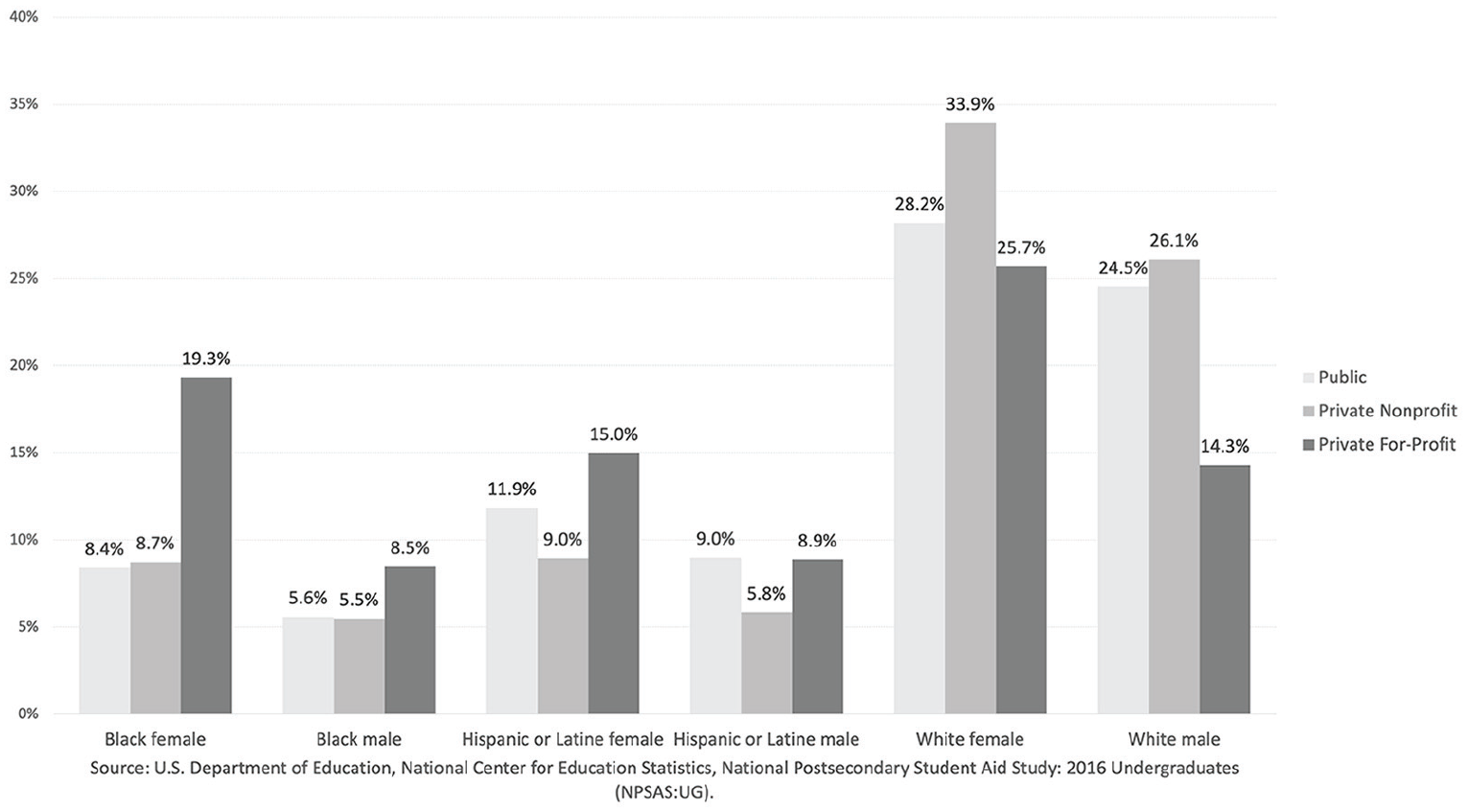
Enrollment across sectors.
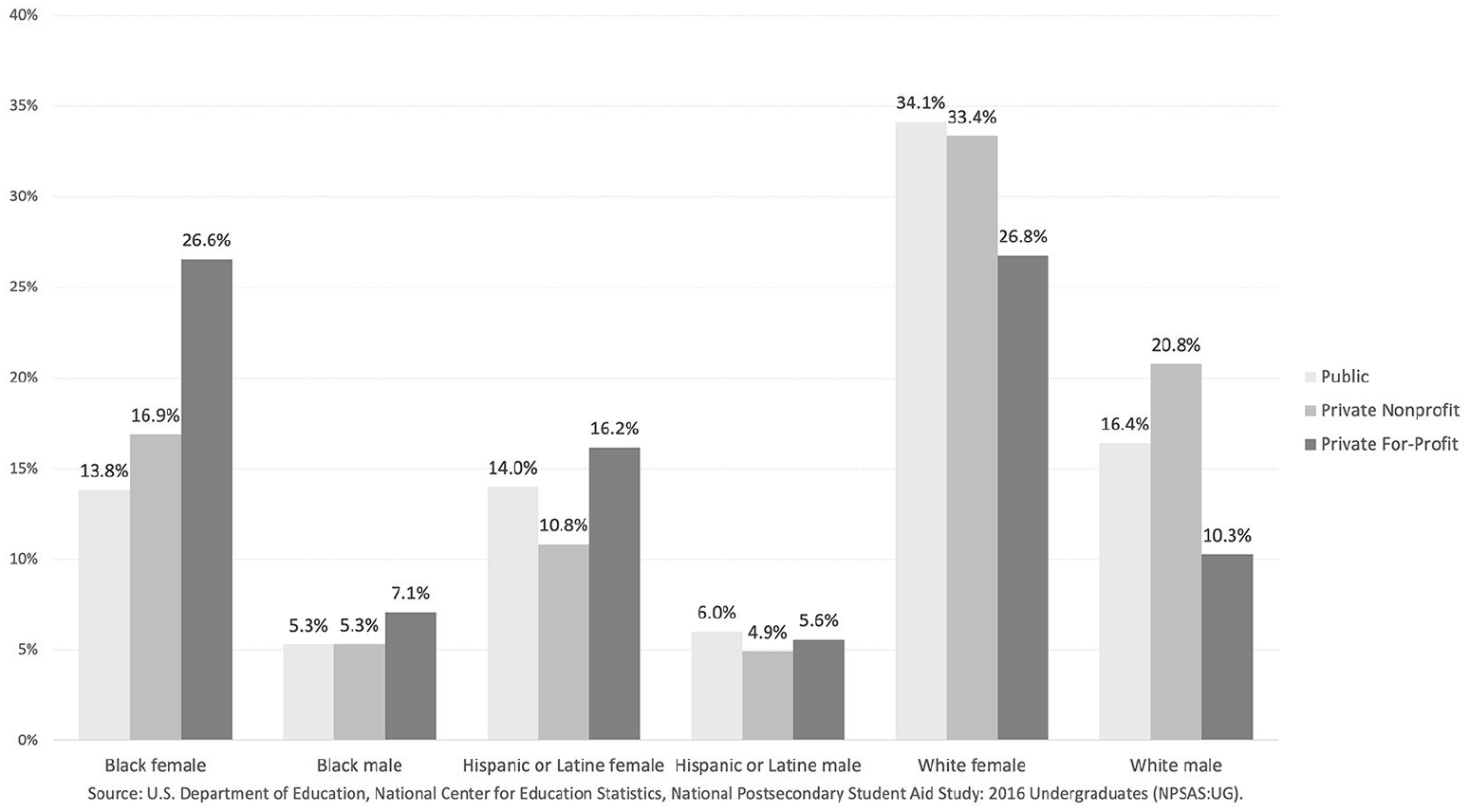
Has any dependents across sectors.
I draw attention to this overrepresentation of Black women in the for-profit sector to highlight that for-profits intently target Black women. While white women make up the largest race-gender(binary) demographic group enrolled in the for-profit sector (25.7%), they are not overrepresented in for-profits compared with their enrollment in public (28.2%) and private non-profit colleges (33.9%). In the same way, white women with dependents are not overrepresented in the for-profit sector (26.8%) compared to the other sectors (34.1%, 33.4%). The overrepresentation of Black women and Black women with dependents suggests a degree of racialized exploitation by for-profits that raises alarm and warrants explanation.
I contend that for-profits target Black women, especially those with dependents, for enrollment because they experience precarity – reflected but not fully captured in financial aid terms by having minimal, if not non-existent, Estimated Family Contributions (EFCs). Targeting those with an EFC of US$0 serves as a revenue-maximization strategy because EFC corresponds with financial aid disbursements. To the extent that Black women undergraduates, especially those with dependents, have an EFC of US$0, they qualify for a substantial amount of financial aid from which the for-profit can conveniently generate revenue.
The proportion of undergraduate students with an EFC of US$0 for select race-gender(binary) demographic groups across the three sectors is illustrated in Figure 4. Compared with public and private non-profit colleges, for-profits enroll a greater proportion of students with an EFC of US$0 across every race-gender(binary) demographic group. Moreover, Black women undergraduates are the most likely among the race-gender(binary) demographic groups to have an EFC of US$0 in each sector, and for-profits disproportionately enroll Black women undergraduates who have an EFC of US$0. Almost 59% of Black undergraduate women in public and private non-profit colleges have an EFC of US$0 while 79.6% of Black undergraduate women in the for-profit sector have an EFC of US$0.
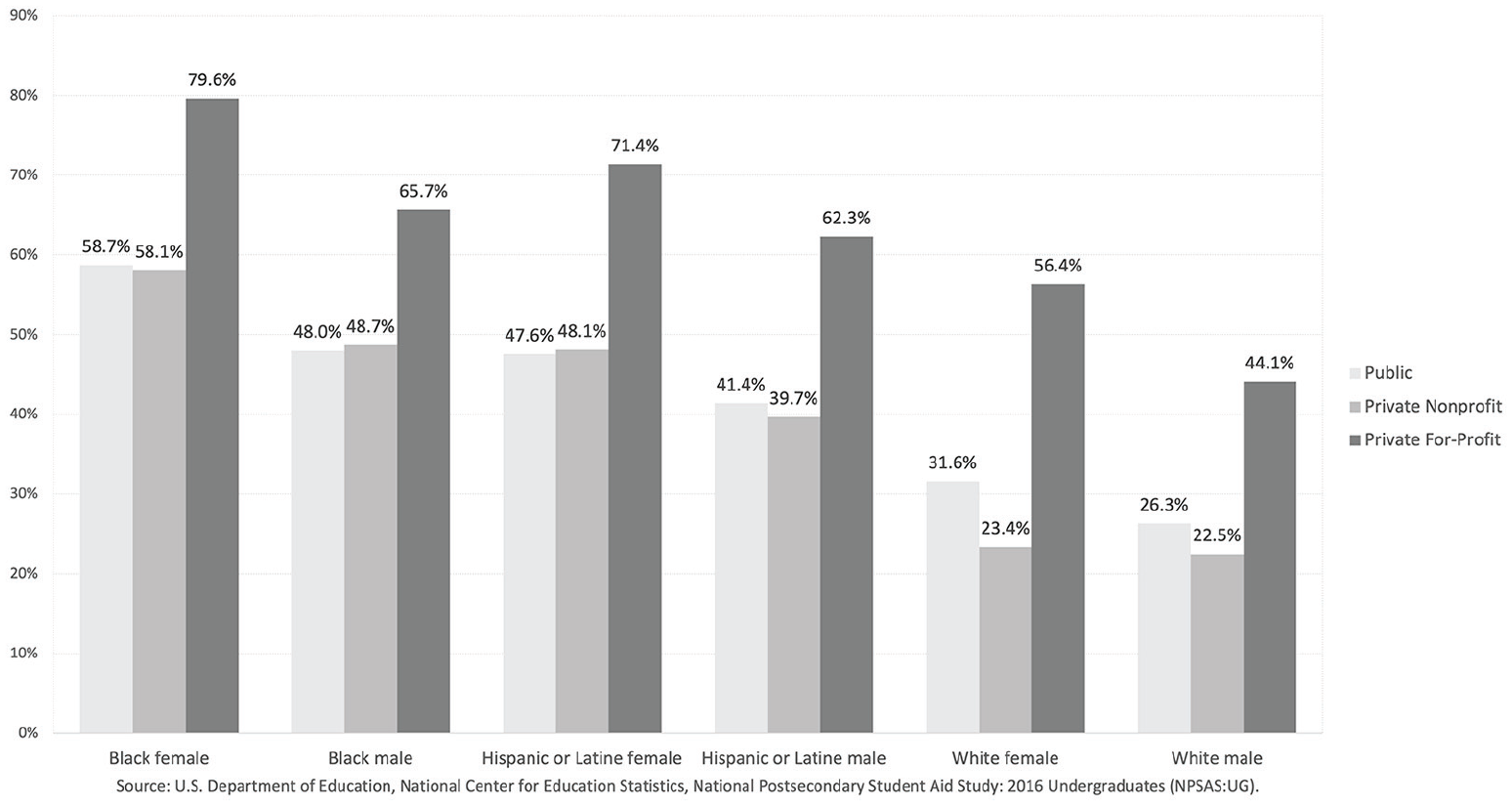
Estimated family contribution of US$0 across sectors.
Figure 5 depicts the prevalence of students from select race-gender(binary) demographic groups who do not incur debt for their undergraduate education across the three sectors. The inverse reveals the percentage of students who go into debt for their undergraduate education. Students from every race-gender(binary) demographic group go into debt more frequently in the for-profit sector than what is typical across the other sectors, reflecting the strategically higher costs and coercive pressure toward debt-financed enrollment in for-profits. Black women in for-profits are the least likely to avoid debt to finance their undergraduate enrollment (8.3%) and are less likely to avoid debt financing than Black undergraduate women in the public and private non-profit sectors (31.2%, 10.2%).
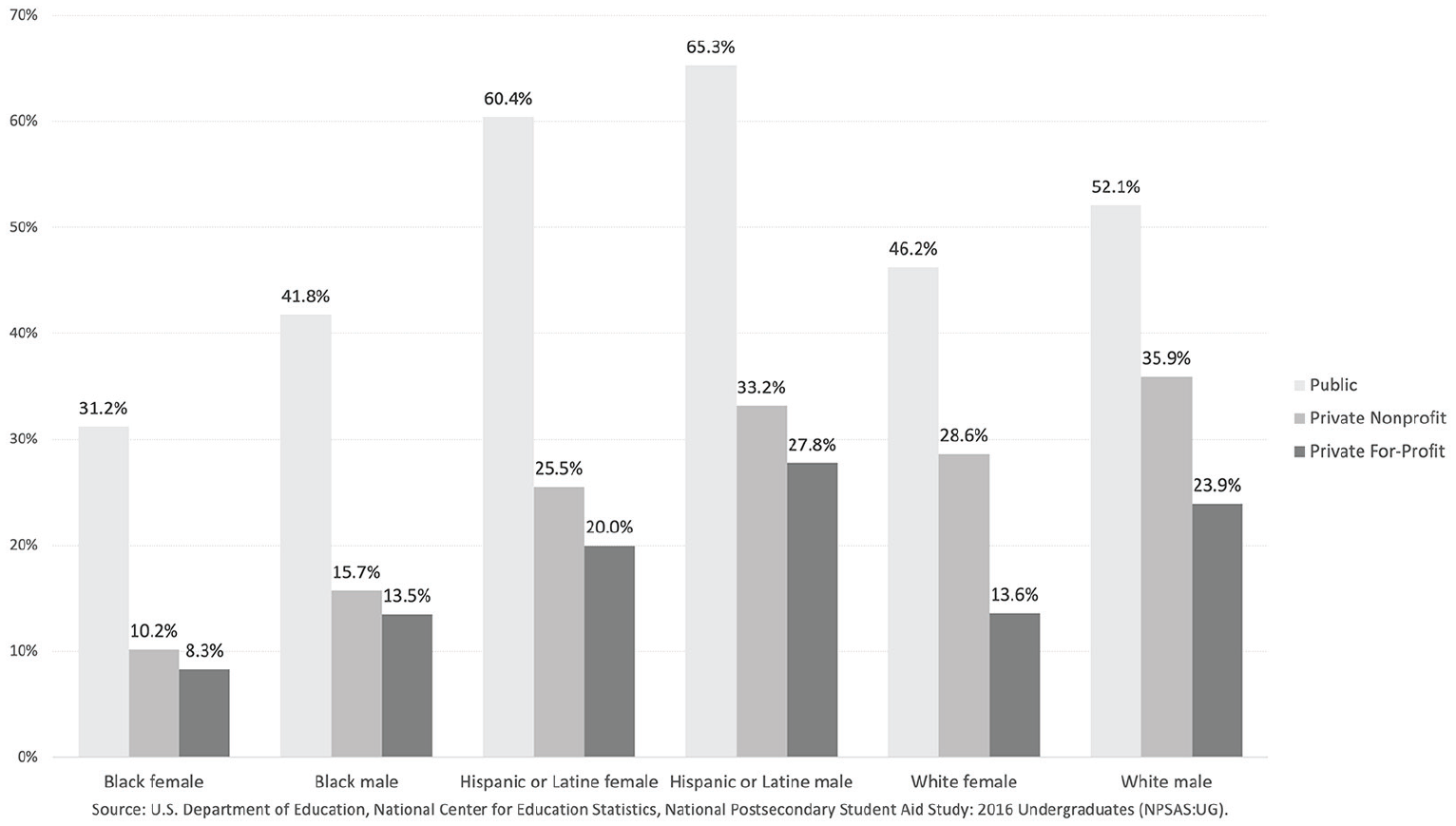
Cumulative amount borrowed of US$0 for undergraduate education across sectors.
The debt burden is distinctly worse when considering cumulative borrowing from both undergraduate and graduate education across sectors (see Figure 6). Debt burdens in for-profits exceed the other sectors, and Black women and men have the highest debt burdens in each sector. Nearly half of all Black women in for-profits (45.1%) borrow US$83,700 or more for their undergraduate and graduate education, while 23.1% of Black women in public colleges and 36.6% in private non-profit colleges borrow that much. Black women are at least 1.4 times more likely to borrow US$83,700 or more for their undergraduate and graduate education in for-profits than white women, white men, Hispanic or Latine women, and Hispanic or Latine men in for-profits.
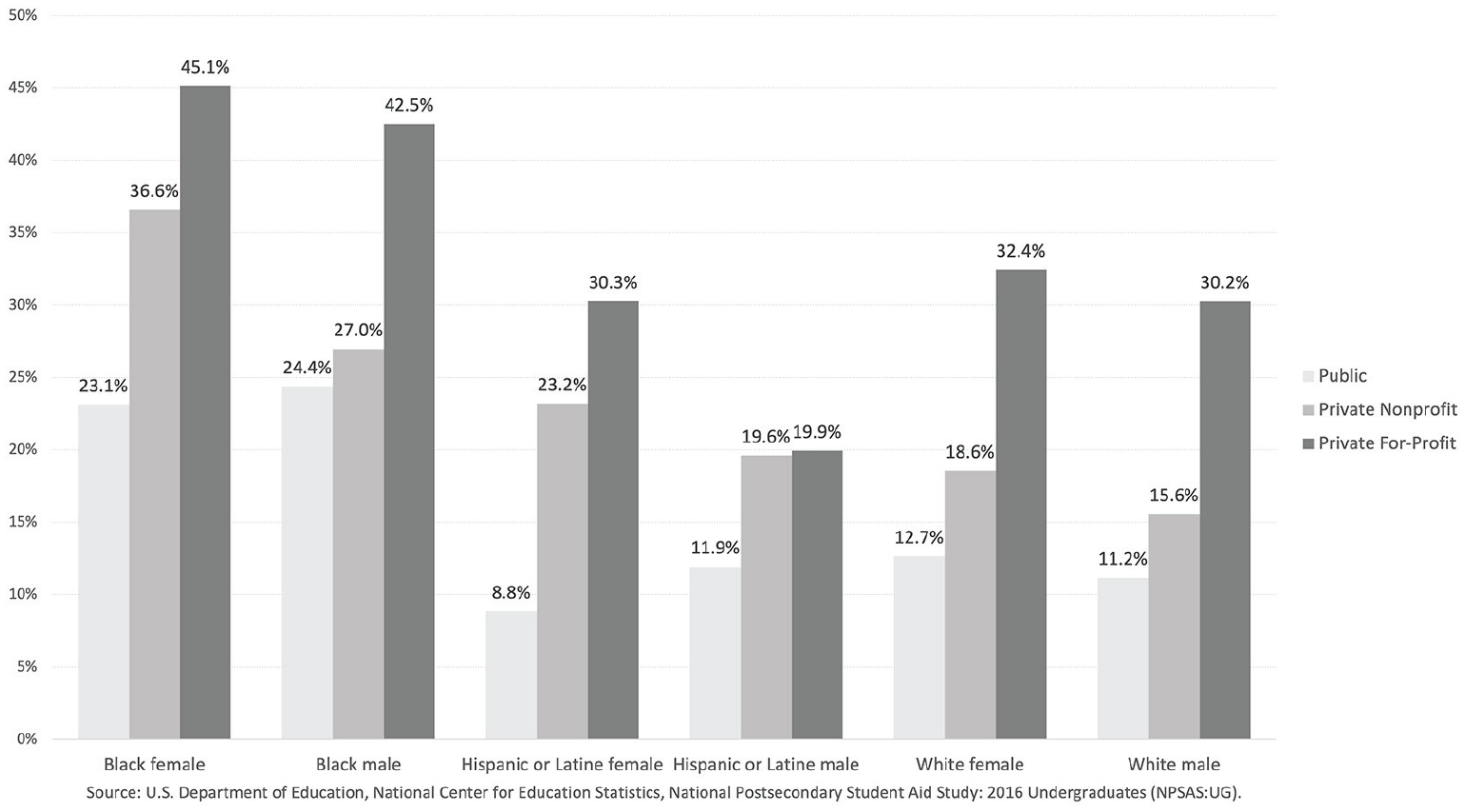
Cumulative amount borrowed of US$83,700 or more for undergraduate and graduate education across sectors.
For the sake of their profit margins, for-profits excessively enroll Black women who experience precarity and exacerbate Black women’s precarity through devastating debt burdens. This predatory trend of enrolling people with excess need and constrained means for capital accumulation is most evident for Black women but not exclusively experienced by them. By centering Black women, I have brought into focus how the predatory inclusion of Black women in for-profits revolves around precarity.
Conclusion
Predatory inclusion can be more fully comprehended by examining who institutions target and why. I have argued that for-profit colleges target Black women for debt-financed enrollment because their precarity – which registers as financial need – engenders the greatest revenue dollars per enrollee and because this precarity can be emotionally and psychologically manipulated through high-pressure sales tactics. Theoretically, this work contributes to the sociology of race and political economy by linking predatory inclusion to precarity through a Black feminist Marxist analysis. Related but distinct from understanding precarity as a state of instability and uncertainty within the field of labor, I conceptualize precarity as a structural vulnerability to violence, including but not limited to predatory inclusion, according to the disproportionality of responsibilities and means to meet them. I underscore that alternativelessness for Black women has been conditioned by an imposition of excess burdens and by the persistent denial of means to bear them.
Precarity precedes and preconditions predatory inclusion by for-profits; these predators prey upon precarity. And unfortunately, predation exacerbates precarity. Enrollment in for-profit colleges results in excessive debts without a (good) credential or higher earnings to show for it, further jeopardizing Black women’s relationships, mental health, and freedom from exploitative markets (Addo, 2014; Drentea and Reynolds, 2012; Jackson and Mustaffa, 2022; Sweet et al., 2013; Walsemann et al., 2015).
Consequently, future scholarship on predatory inclusion should not only examine the exploitative terms of access for historically marginalized groups but also the social and material conditions that incentivize targeting specific groups, rationalize deploying particular coercive tactics, and facilitate capital accumulation. My conceptualization of precarity offers analytic utility for related studies of predatory inclusion at the scale of racially oppressed communities within a national sector as well as the scale of nation-states such as Haiti that have been cornered into colonial extractive terms with multi-national financial institutions and corporations due to that nation-state’s alternativelessness (Hudson, 2017; Obregón, 2018). Moreover, scholars must not only critique the predatory practices of unscrupulous personal, organizational, or institutional actors but also the broader systems that engender vulnerability to such violence.
Ultimately, I contend that precarity must be comprehended and contested for the sake of ending the predatory inclusion of Black women and all others positioned alongside them as ideal prey. If precarity underscores a state of excess responsibilities and the denial of means to meet them, then this vulnerability to violence can be mitigated, in part, through efforts to minimize burdens and increase the means people have to live, learn, and labor freely.
Footnotes
Acknowledgements
Earlier versions of this work were presented at the annual meetings of the American Sociological Association; Society for the Study of Social Problems; American Educational Research Association; and National Women’s Studies Association. The Gender and Women’s Studies Department and the Institute for the Study of Societal Issues at the University of California, Berkeley also provided supportive environments for me to develop and workshop this material. I want to thank Leslie Salzinger, Prudence Carter, Michael Dumas, Deborah Lustig, Janelle Scott and her working group, Tianna Paschel and her working group, Laura Hamilton, and the anonymous reviewers at Critical Sociology for instructive feedback that helped me to clarify my contributions and construct them in a more compelling manner. Finally, I want to express my gratitude to Limairy Rodriguez, Joy Esboldt, and Rashad Timmons. Your enduring, enriching, and insightful companionship brings the best out of me and my scholarship.
Declaration of conflicting interests
The author(s) declared no potential conflicts of interest with respect to the research, authorship, and/or publication of this article.
Funding
The author(s) received no financial support for the research, authorship, and/or publication of this article.
