



Abstract
Racial discrimination shapes who feels debt as a crushing burden and who experiences debt as an opportunity. U.S. financial products and rules, and the ways they’re implemented, amplify this inequality along racial lines.
In their classic Black Wealth, White Wealth, sociologists Melvin Oliver and Oliver Shapiro revealed that researchers focusing on seemingly converging income differences were missing much larger wealth disparities. Not only did Black families’ wealth amount to only one-tenth of White wealth, but their wealth was qualitatively different. For instance, Black families lacked the intergenerational inheritances that subsidize things like education and down payments on homes and provide Whites with a cascade of life-long advantages. The scope of the disparity is hard to fathom: the 100 wealthiest families on the Forbes list own as much wealth as all Black Americans combined.
Despite predictions that the racial wealth gap would gradually decrease, the gap doubled in the five years of the Great Recession. Going back further, wealth researchers Thomas Shapiro, Tatjana Meschede, and Sam Osoro found that, among college-educated families, the racial wealth gap tripled to a ratio of 15:1 between 1989 and 2013. Black families’ net worth dropped by half in the same period. So while many Whites assume that the racial wealth gap arises from cultural differences like “valuing hard work,” it has become clear to scholars that structural factors are to blame (see the prolific work of stratification economists Darrick Hamilton and Sandy Darity)—cultural values have no explanatory power when it comes to exponential change in such a short time. And these changes should cause great alarm for sociologists trying to understand racial inequality.
White debt is key to racial capitalism; as an enabling force, it has often been created from Black wealth. Mortgages, after all, were first created to subsidize the slave trade.
The situation is worse than even these examples show, as traditional measures capture only some of the meaning of “racial wealth.” In fact, because Whites have an easier time using debt as an asset, our current measures understate the true extent of the racial wealth gap. That is, the most common metrics of wealth consider debt the opposite of wealth, where net worth equals assets minus debts. But in an economy increasingly reliant on debt, studying debt is essential to understand the rapid widening of the racial wealth gap. In a recent Contexts piece (Winter 2018), Raphäel Charron-Chénier and I talk about how “good debt” can be enabling and “bad debt” can be a hindrance. But “good” and “bad” debt correlate highly with what I call “White debt” and “Black debt.”
Black debt and White debt are conceptual guides to multiple racialized dimensions of debt: first, the different worlds of debt products (e.g., title loan companies versus American Express); second, differential terms on the same products, like discriminatory interest rates; and third, the differential returns on debt for White and Black families, based on factors like inter-generational wealth differences, differences in neighborhood home values, and post-graduation wage gaps. Across multiple phases in debt’s “life course” and across types of debt, these components interact to produce cumulative advantage and cumulative disadvantage. Through this lens, we begin to see how White debt represents an agreement between Whites and financial industries by which each party gains materially. White debt promotes agency and grants opportunities as an investment in an imagined better future. It can serve as an advantage for tax purposes or showing credit “worthiness.” Black debt, on the other hand, represents the negative balance sheet that must be worked through just to get to the starting line. But it is a race up an eroding hill of sand: Black debt means higher interest with lower returns. Black debt also represents the past and ongoing theft of Black assets. “Black debt” tends to target Black people and has negative outcomes. “White debt” tends to target White people and has positive outcomes. And because racial inequality is spatial, these effects compound across neighborhoods and cities.
Through financialization, debt is now a prime commodity. Certain actors profit whether or not the debt is repaid.
Bhupinder Nayyar

White debt isn’t just an advantage: White debt built and sustains White wealth. And Black debt is one more extractive mechanism to convert Black assets into White wealth. The idea that White debt magnifies White wealth may seem counterintuitive. But despite anemic moves toward pay equity, the institutions generating and preserving White wealth, from the stock market, banks, corporations, and tax havens to foundations, associations, and elite schools, are largely intact. We must look at how financial products and rules—and the way they’re implemented—amplify racial inequality through debt. Both mainstream and academic discourse tends to assume racial discrimination is only historic or vestigial. But financial gain from racial inequality is essential to late racial capitalism, and debt is a primary mechanism reinforcing Black disadvantage and White advantage.
Debt as a Growing Factor of the Economy
When we think about “the economy,” we tend to focus on positive measures like GDP, income, and wealth. Yet complex debt instruments are becoming a bedrock of our economy. In 2017, household debt rose to $13.1 trillion, surpassing our previous high of $12.7 trillion back in 2008 (100% of GDP, according to economist Yanis Varoufakis), and household interest payments peaked at $800 billion annually during the Recession. To understand this upside-down world of debt, consider how banks describe their customers and portfolios. As law professor Mehrsa Baradaran points out, banks refer to their customers’ accounts as “liabilities,” but call outstanding loans “assets.” Debt performs as an asset for banks because it creates a steady stream of interest and fee income.
Debt became more lucrative when banks sliced and diced loans (primarily on housing, but also consumer credit and student loans) into products called Collateralized Debt Obligations (CDOs), given misleadingly high ratings. Meanwhile, credit default swaps allowed other parties (or, as it turned out, often the loan holders themselves) to bet against these loans’ repayment. Through financialization, debt is now a prime commodity; certain actors profit whether or not the debt is repaid.
Debt’s role in your life depends on who you are. Debt can be thought of as a measure of economic incorporation, and Blacks and Whites are incorporated into the economy in very different ways. Charron-Chénier and I show in another recent paper that White families have more debt than Black families: higher mortgages, more vehicle debt, and more personal debt (they are twice as likely to have a credit card, for instance). As economic sociologists Marion Fourcade and Kieran Healy have shown, if the primary divide used to be credit-worthy or non-credit worthy, now there are a whole host of categories, or “classification situations,” that maximize the profit to be gained from each. Fourcade and Healy note in “Classification Situations” that classification situations produce “distinctive experiences of debt… from the exploitative to the dutiful, and from the dutiful to the almost liberating. Some feel weighed down or crushed by debt… others embrace credit as a means of asset accumulation and mobility.” Racial discrimination shapes who feels debt as crushing and who experiences it as an opportunity.
White Debt
“I’m the king of debt. I’m great with debt. Nobody knows debt better than me—I’ve made a fortune by using debt.” – Donald Trump, 2016
Some sociologists have argued that modern debt does not represent an absence—a lack of assets—but an advantage, representing market incorporation. Credit access is a status marker in the United States, with “good” credit and “good” debt valued. From the bank’s perspective, what’s better than a trustworthy indebted customer who dutifully makes monthly payments until they die? (According to anthropologist Brett Williams, banks call these customers with maxed-out credit lines “mature accounts” and prize them above all others.) White “credit” translates into the ability to buy a home, start a business, cover lean times, even live beyond your means. You can live large off good debt, build wealth, and leverage it for advantages, all without ever actually getting out of debt.
White debt can also provide a parachute with which to drop out of more exploitive debt trajectories. Overall student debt has reached $1.5 trillion, with huge consequences for young Americans’ ability to buy homes and otherwise thrive, and it has spawned whole secondary industries of debt management. White debt is of huge interest to upscale student debt refinancers like SoFi, a company that has an acronym for their ideal demographic: HENRYs (high earners, not rich yet). SoFi got started by selecting debtors from Stanford, and it explicitly targets doctors, lawyers, and MBAs—people with a lot of debt and lots of income to pay it. SoFi allows hedge funds to invest in (and speculate on) the “best-case” student debtors, segregating debt so elites can get better interest rates and terms. Their doing so leaves behind the rest of the “higher-risk” population, which, just like in an insurance market, defeats the benefits of pooling risk. And financial actors benefit from debt segregation, since it permits more precise speculation on both the HENRYs and those who are left behind.
Even though it is counterintuitive to see debt as a potential asset, White wealth has been built on a long history of state-subsidized debt. The federal government developed the low-down-payment, 30-year mortgage to turn homes into appreciating assets for White neighborhoods, thanks to redlining and other housing policies. The mortgage tax deduction, which is rarely seen as government welfare, adds to homeowners’ asset accrual. For those able to juggle credit cards, gamble the stock market with low-interest student loans, or take equity out of their home for a new investment, White debt works like a shell game. White people can take on debt with the privilege-fueled expectation that their future will be better than their present: that their income and wealth will rise continuously, that their houses will keep appreciating, that they will gain the money to pay off their debt. The expectation now is not that someone with high income would buy a house in cash, but that they would leverage their income to get a higher mortgage (according to the 2015 American Community Survey, only about a third of owner-occupied houses have no debt).
Of course, treating debt like an asset is a wager, and it doesn’t always pay off. Still, the deck is stacked in favor of Whites, who are also more likely to be protected from the consequences of indebtedness. They can more easily change the terms of their debt, either by restructuring it or leaving it behind, and that supports the fantasy of ever-increasing prospects. Economists Atif Mian and Amir Sufi show that half of new mortgage debt just prior to the Recession came from people pulling equity out of their homes to finance consumption or education—the same people also accounted for 40% of mortgage defaults. Meanwhile, before the Recession, economists Thomas Boehm, Paul Thistle, and Alan Schlottmann found Black borrowers were less likely to refinance and paid higher interest when they did. So Whites were more able to cash in on the soaring value of their homes, and they were less harmed by the post-Recession crash. In fact, Whites largely escaped culpability for the Recession, usually blamed on “undeserving” Black and Brown borrowers taking on mortgages they couldn’t afford.
When it comes to wiping the slate clean, Whites are better off, too. Individuals facing bankruptcy have two filing options: Chapter 7 and Chapter 13. Chapter 7 allows families to simply discharge debt (often within six months), but usually requires paying a lawyer’s fee up front. Chapter 13 is more onerous and garnishes all disposable income for three to five years, granting a discharge only after all payments are complete. Using bankruptcy data, scholars Jean Braucher, Dov Cohen, and Robert Lawless found in 2012 that Black debtors were steered toward Chapter 13 much more often than Whites. Using a vignette experiment, the researchers found attorneys believed “Reggie and Latisha” had better values and were more competent when they chose the harsher Chapter 13, while “Todd and Allison” were praised for choosing Chapter 7 as a “fresh start.”
White people can take on debt with the privilege-fueled expectation that their future will be better than their present.
Tony Webster, Flickr CC
Black Debt
It took all these years to get to zero in fact… That’s the red queen’s race you run this hard just to stay in place. – Jay-Z, “Legacy”
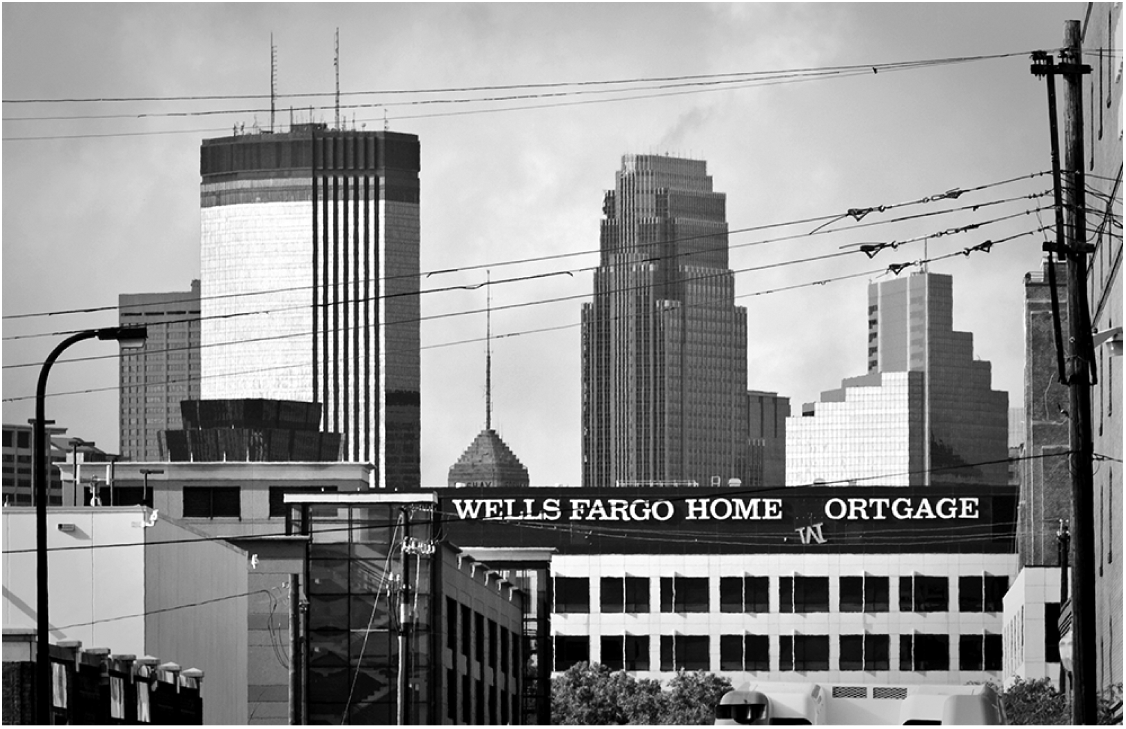
Black debt is harder to convert into an asset, has worse terms, and is much more likely to endure. Fringe banking institutions like check cashing places and payday loans have earned their bad reputation for exploitative interest rates. Poor city neighborhoods are marked by the store-front symbols of Black debt: Rent-A-Centers charging $100 a week for a bed, pawn shops, and car title loan companies. Back in 1967, Kwame Ture and Charles Hamilton wrote in Black Power: “Through the exploitative system of credit, people pay ‘a dollar down, a dollar a week’ literally for years. Interest rates are astronomical, and the merchandise—of relatively poor quality in the first place—is long since worn out before the final payment.”
Black debt also includes the racially disproportionate and rising use of collection lawsuits for small debts, as covered by journalist Paul Kiel in Propublica. (Thanks to their greater wealth, Whites are more able to draw on their family’s financial support to stop a lawsuit.) It includes municipalities’ increasing use of fines and fees for revenue generation, as sociologist Kasey Henricks and others have shown, which, along with bail, have created modern debtors’ prisons that, like other forms of punishment, primarily target people of color. In her recent book, Pound of Flesh, sociologist Alexes Harris shows the cumulative racial impact of court summonses and fines, often for minor crimes and most often for Black offenders. These financial and criminal justice worlds are increasingly intermingling; Kathy O’Neil notes that sentencing guidelines in some states are influenced by the defendant’s credit score.
Black debt is a key industry for generating White wealth. It does not build Black equity; instead it can lead to further losses (like losing your car from a title loan). Unlike credit card debt, making regular payments on payday loans doesn’t help build your credit score—although missing a payment can lower it. The interest on these forms of debt is not tax deductible. Black debt can’t be leveraged to create more wealth: it is a Sisyphean push out of a sinkhole, such that Black families’ debt is often technically less than Whites’ debt, but its impact looms larger. And with recent attacks on the Consumer Financial Protection Bureau (CFPB), mechanisms of Black debt are only going to proliferate. In February 2018, the CFPB’s new director ordered staffers to drop a lawsuit against a company that had been charging 950% interest rates to its customers. Hedge funds, like the one run by former U.S. Treasury Secretary Timothy Geithner, have made big business out of investing in predatory loans.
Racial discrimination shapes who feels debt as crushing and who experiences it as an opportunity.
Openly predatory debt mechanisms are only a fraction of the exploitative products on the market. When Black folks were excluded from mainstream debt channels, their exploitation still occurred at the local level, through people like slumlords, contract sellers, and loan sharks. Now that exploitation has been partly institutionalized, with even mainstream institutions offering fringier products. But the old ways persist too: historian Beryl Satter, who wrote a book on the supposedly-defunct practice of contract selling (where buyers must complete all payments to have any equity in their house), was shocked to see the practice reappear in places like Detroit.
In Sacramento’s “Poverty Ridge,” a payday lender signals that the neighborhood is never too far from its impoverished past.
Tony Webster, Flickr CC
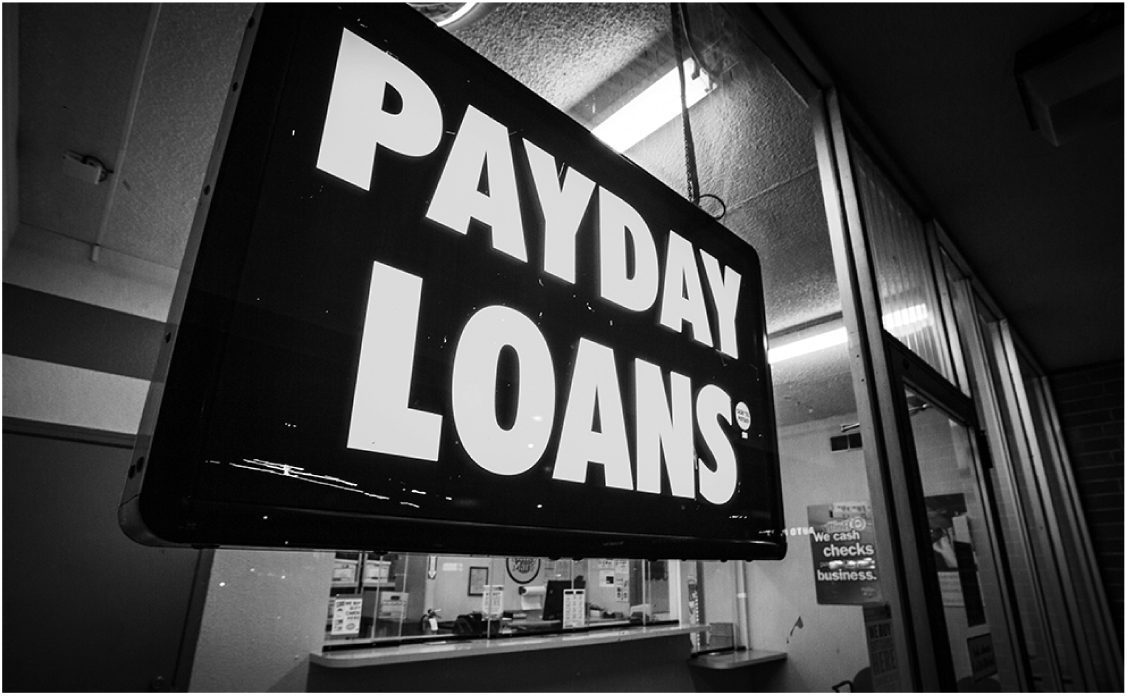
Even the primary wealth-building mechanisms of housing and education can serve to reproduce disadvantage for Black people through predatory inclusion into debt (more on predatory inclusion in a moment). Partially in response to calls to rectify prior generations of redlining and loan discrimination, predatory mortgages with high, often variable interest and overwhelming final “balloon” payments, targeted Black and Latinx neighborhoods (as did foreclosures). The rules of Black debt are different: segregation scholar Jacob Faber found that high-income Black borrowers were more likely than low-income White borrowers to get these subprime loans. In a court case over Wells Fargo’s discrimination in subprime loans, a Black whistleblower testified that bank employees had “ referred to subprime loans made in minority communities as ‘ghetto loans’ and minority customers as ‘those people have bad credit,’ ‘those people don’t pay their bills,’ and ‘mud people.’” These subprime mortgages and the Black and Brown borrowers who were steered into them have been unfairly blamed for causing the Recession. Almost makes you wonder why.
Just as predatory mortgages took advantage of Black and Latinx buyers wanting a piece of the American dream, the racially-specific changes in education debt indicate similar processes of “predatory inclusion” are at play. This term refers to the incorporation of formerly excluded communities into financial arrangements—on terms that negate the advantages of incorporation. In our paper on predatory inclusion, Raphäel Charron-Chénier and I found that Black student debt tripled from 2001 to 2013, as White families’ debt doubled. Not only do Black families have much less intergenerational wealth to cover the steep rise in college costs, but they are targeted by expensive, for-profit colleges specifically designed to maximize federal student loans and by private lenders who have been repeatedly found charging Black and Latinx borrowers higher interest. Trump and his education secretary, Betsy DeVos, want to end loan programs that benefit lower-income and minority borrowers, and they have tried to stop litigation against the most predatory for-profit college scams.
The historical precedents for Black debt show that Black people have been systematically excluded from the processes that allow one to convert debt to an asset. Consider Black enslaved people working for years to purchase freedom for themselves and their families (earning the right to start at zero). Later, debt was the key mechanism in sharecropping, wherein Black families wound up trapped by having to pay off the previous year’s expenses with the next year’s crops (all via balance sheets controlled by White overseers). USDA loans to Black farmers picked up where sharecropping left off, making loans for tractors and farm equipment that often ended up repossessed (through discrimination so extensive it resulted in a $1.1 billion settlement for Black farmers).
White debt is key to racial capitalism: as an enabling force, it has often been created from Black wealth. Mortgages, after all, were first created to subsidize the slave trade. As Mehrsa Baradaran shows in her excellent book, The Color of Money, the Freedmen’s Savings Bank was created for emancipated people as an alternative to reparations. That is, they were not granted any assets, but were encouraged to earn money through wage labor (a major concern of Reconstruction was how to get Black folks working for White folks again) and deposit it to “save” for land. But the bank was oriented only around saving, not lending, and so it left out, Baradaran writes, “the most important part of capitalism—the part where capital is able to grow and multiply through credit.” Bank management used freedpeople’s hard-earned Black wealth (the modern equivalent of around $1.5 billion) for speculation in things like risky railroad projects, real estate, and loans to friends. Eventually, this corruption tanked the bank, losing half the value freedpeople had deposited. The pattern repeated in the late 20th century, when separate studies by researchers Harriet Taggart and Kevin Smith and economist Andrew Brimmer showed bank deposits in urban and Black Northeastern neighborhoods were being used for mortgages in White neighborhoods.
Conclusion
If, as David Graeber writes in Debt: The First 5000 Years, debt is a relationship of violence, that violence falls along racial lines. Whose debt is morally stigmatizing, and whose debt is unproblematic? Because debt is considered shameful, White people don’t consider their access to credit a privilege, and Black families don’t often see their indebtedness as an injustice. We should be much more attuned to debt as a worthy subject of study and a possible key to understanding our current bewildering economy, not to mention a template for addressing racial inequality with a new platform of powerful financial regulations.
Because debt is considered shameful, White people don’t consider their access to credit a privilege, and Black families don’t often see their indebtedness as an injustice.
And what if we let ourselves imagine what Black debt and White debt could mean?
Black debt could mean the unpaid debts owed to Black Americans—not only from slavery, but the cumulative effects of redlining; wage theft and undervalued work; discrimination in hiring, schools, and housing; pogroms and the massive destruction of urban renewal; convict leasing and mass incarceration; and the uneven economic fallout of the Recession. White debt could mean the debt owed for living on serially stolen land and accruing generations of other stolen luxuries, large and small.