




Abstract
Place attachment, the emotional bond between person and place, facilitates well-being and belonging for Mexicans in the United States. However, place attachment research concentrating on Mexican populations has not explored a key site for placemaking—the ethnic enclave. Thus, we draw on 20 interviews with Mexicans in the United States to examine how individuals form close connections to La Cuatro, an ethnic enclave in California. Despite the overall positive nature of their emotional connections within the enclave, our model uncovers paradoxical and recursive outcomes. While place attachment promotes a sense of belonging within La Cuatro, these emotional bonds are deeply tied to broader experiences of social alienation in areas outside the enclave. This alienation stems from three primary factors: (1) legal status or lack thereof, (2) racialization, and (3) pervasive anti-immigrant socio-political ethos. We propose a recursive model of place attachment that considers social context to explain the placemaking processes of marginalized racial and ethnic groups in public social spaces. This model problematizes the experiences of marginalized communities, such as Mexican immigrants and their descendants, and provides a theoretical framework to examine the interplay between place and broader society.
Introduction
The United States, socially and politically, has long ostracized Mexican immigrants and their descendants (Lee, 2019; Massey, 2009). As evidenced in recent US presidential elections, during which the rhetoric of some candidates labeled Mexican immigrants as ‘criminals’ and their presence in the United States as an ‘invasion’, there is currently heightened anti-Mexican sentiment. This disproportional targeting within the United States negatively impacts Mexican individuals’ sense of belonging (Menjívar, 2006; Walter, 2021), social mobility (Massey, 2009), and overall well-being (Fleming et al., 2019). Yet, despite general patterns of social and structural exclusion, Mexican communities often persist in the United States. One process Mexican immigrant communities in the United States employ to continue developing a sense of belonging and simultaneously resist existing marginalization is that of place attachment. Specifically, the ethnic enclave 1 often enables the maintenance of group identity as well as serving as a mechanism for acquiring information, resources, and services (Abramson et al., 2006) and is, thus, ripe for the development of affective bonding to the enclave.
As people form, maintain, and negotiate emotional bonds to the geographic spaces they continually or temporarily occupy, they can develop place attachment (Lewicka, 2011). Indeed, emerging studies demonstrate that immigrant communities in the United States, particularly those who are Mexican, respond to and resist discriminatory pressures through place attachment (Arreola, 2012; Main and Sandoval, 2015; Walter, 2021). Yet, although the role and importance of the ethnic enclave on the immigrant experience is well documented (Abascal, 2017; Duranzo et al., 2016; Gilster et al., 2020; Wilson and Portes, 1980), there is little work that examines the placemaking processes of immigrants who rely on the enclave. Founded in the theoretical paradigm of place attachment and informed by research on immigrant experiences in the United States, our study highlights the significance of the ethnic enclave as a site for place attachment. Specifically, we ask: How do Mexican identifying individuals experience place attachment in the Mexican ethnic enclave of La Cuatro, a five-block business strip located in Santa Ana, California?
Drawing from 20 in-depth interviews with Mexican patrons of La Cuatro, our findings demonstrate that place attachment—vis-à-vis place dependence, place discovered, place identity, and place inherited—manifests in culturally rich ethnic enclaves, like that of La Cuatro. We argue that while the process of attachment within the enclave produces a general sense of belonging, it stems from broader social alienation premised around (1) legal status or lack thereof, (2) racialization, and (3) the anti-immigrant socio-political ethos. Ultimately, we examine the process of fostering place attachment with careful attention to theories of racialization and immigration illegality to account for nuanced emotion-based experiences of participants. We present a recursive model wherein one’s sense of belonging and one’s otherness within the contextual landscape of the United States function in relation to the other.
Literature Review
Geographic spaces are distinctly defined areas that visually and socially convey who fits inside or outside of that place (Lewicka, 2011). Yet, politics of belonging are not confined by spatial boundaries. While there are a myriad of considerations in the building of belonging, in the current study, we point to the role of illegality and racialization on the overall perceptions of immigrants and the immigrant experience, the importance of the ethnic enclave and its capacity to mitigate against anti-immigrant hostility, and the utilization of the theoretical framework of place attachment literature to offer a foundation for understanding the intersection of place attachment and the ethnic enclave.
Despite the increasing popularity of the term ‘racialization’ within sociological discourse and research, we are aware that it remains a subject of considerable conceptual and theoretical debate (Uyan, 2021). For the purpose of this study, racialization is defined as a process through which groups are perceived and understood as racial clusters and assigned racial meaning based on lineage, physical attributes, cultural norms, and other shared characteristics (Hochman, 2019; Omi and Winant, 1994). As a theoretical framing, racialization allows for the examination of lived experiences, yet often fails to identify the specific mechanisms driving the racializing process. Thus, we employ the term ‘racialization’ to describe the racial meanings and perceptions attached to Mexicans as an ethnic group with shared lineage and culture. In doing so, we account for varied lived experiences of the group, which are mistakenly categorized and treated as homogeneous, and clearly identify the underlying forces of racialization.
Legal Status and Racialization of the Latino Immigrant Experience
The racialization of immigrants and immigrant ‘illegality’ refers to the process through which certain racialized groups, often those from specific geographic regions, are stereotyped, targeted, and often disproportionately affected by laws and policies associated with unauthorized immigrants (De Genova, 2002; Menjívar, 2021; Menjívar and Abrego, 2012). Historical accounts illustrate how the condition of immigrant ‘illegality’ has been wielded against diverse immigrant groups, including Japanese, Italian, and Chinese populations (Portes and Rumbaut, 2014). More recently, Mexican and Latin American immigrants, regardless of legal status, have become the default representation of immigrants (Chavez, 2008), a process reinforced through the mechanisms of racialization (Menjívar, 2021). This process constructs these groups as outsiders in the public imagination and dehumanizes them (Chavez, 2008), making it easier for society (Flores and Schachter, 2018) and institutions to discriminate against them, both consciously and unconsciously (Asad and Clair, 2018).
Existing research delineates how both federal and local immigration policy and enforcement serve as instruments of racialization, primarily by inordinately focusing on Latinos as a racialized group (Abrego et al., 2017; Armenta, 2017). For instance, border enforcement policies predominantly concentrated on the US–Mexico border escalate ‘invader’ narratives that frame Latinos as the de facto invaders (Abrego et al., 2017; Martinez-Aranda, 2020). Similarly, amid increasing Mexican immigration and anti-immigrant sentiments in California, Proposition 187, a ballot initiative in California passed in 1994, aimed to make undocumented immigrants ineligible for public benefits like education, health care, and other social services.
This proposition, as well as other laws and policies intended to draw and enforce political and legal boundaries (see Tovar and Feliciano, 2009), disproportionately focus on Latino populations and reveal a racialization process. Within this process, ‘illegality’ is not applied solely to an individual or their behavior, but rather, targets an entire ethnic group (Menjívar, 2021; Menjívar and Abrego, 2012). This process is influenced by biased presumptions that an individual or group may speak a language other than English (Menjívar and Abrego, 2012) or ‘appear’ illegal (Armenta, 2017; Flores and Schachter, 2018). Thus, the racialized image of ‘illegality’ becomes not only a means of identification of the other, but also a politically legitimized and legally sanctioned justification for continued structural surveillance and discriminatory treatment of Latinos (Armenta, 2017).
While extant scholarship has long examined the experiences of immigrant incorporation within receiving countries (Abramson et al., 2006; Menjívar and Abrego, 2012), the political, legal, and social tension between insider and outsider status based on (legal) immigrant status, and solidified through practices of racialization, remains a defining component of one’s integration, whether successful or not, and their development of sense of belonging (Armenta and Rosales, 2019). For example, Tovar and Feliciano (2009) point to the ways racialization impacts the educational experience of immigrants and their children and how the US racial structure varies vastly from that of Mexico. Similarly, Menjívar (2006) suggests that documentation status impacts immigrant decision-making around health-seeking behaviors, vulnerability in the streets, and labor market opportunities among others. Thus, it is evident that the impacts and consequences of racialization vía legalized, socially and politically sanctioned practices can be long-lasting and far-reaching.
Contextualizing the Ethnic Enclave as Place
Considering the turbulent reception of immigrants to the United States and their experiences of consistent othering rampant within the socio-political landscape of the United States overall, the ethnic enclave can serve as a space of community, and even safety, for some immigrant populations. Enclaves have a long history within the United States as nearly all newly arrived groups have created their own enclave (Mazumdar et al., 2000). Their conceptualization ranges from that of bounded territories to views of the ethnic enclave as a monolithic community or as a ‘way station’ (Abramson et al., 2006) or ‘intermediate station’ (Mazumdar et al., 2000) as immigrant populations assimilate. Regardless, it is widely agreed that the ethnic enclave offers immigrant communities an opportunity for connection and a space for collective identity expression. The enclave then, ultimately, affords the linking by an individual to both the place left behind as well as to the new place in which one now resides.
To date, several strands of literature examining the intersection of ethnic enclaves and place attachment exist. For example, in their seminal work, Wilson and Portes (1980) argue that Cuban immigrants did not immediately assimilate to the US economy. Rather, their initial experiences in the United States predominantly revolved around an enclave economy that reflected their existing cultural, linguistic, and social capitals. Here, Cuban immigrants employed their shared forms of capital to gain access to economic resources, such as networks that led to employment. Thus, according to the theory, ethnic enclaves serve immigrants as a tool for economic mobility and, more importantly, social inclusion.
In addition, conceptual expansions later included additional complex functions of the ethnic enclave. For instance, Mexican immigrants are more likely to establish residence in or near an enclave where they have access to other Spanish speakers (Bauer et al., 2005). Moreover, language, cultural homogeneity, and ethnic-related knowledge also influence immigrant occupational attainment (Bohon, 2001). In addition to the labor market, enclaves are found to mediate immigrant naturalization (Abascal, 2017), health outcomes (Duranzo et al., 2016), and participation in neighborhood-focused activism (Gilster et al., 2020).
Yet another focus within the ethnic enclave literature examining place is that of non-residential spaces and the effect of gentrification on the ethnic enclave. For example, Tuttle (2022) examined commercial gentrification and found that a given place can exist as both a space of displacement, which Tuttle refers to as a posteriori alienation from place, and, simultaneously, as a space of safety (a priori place). In Tuttle’s work, he found that the meaning assigned is dependent on the stage of gentrification. The importance here is the way gentrification serves as a powerful mechanism that can both build and break down the place making process and experience.
Theorizing the Person-Place Affective Bond in Mexican Immigrant Communities
Recent scholarly literature on person–place relationships documents how people’s affective relations to places influence their well-being. This is particularly true for immigrant communities. For instance, a range of environments can offer Mexican immigrants various forms of safety, warmth, social ties, and serve as arenas of self-expression and resistance (Arreola, 2012; Main and Sandoval, 2015; Mendoza, 2006; Walter, 2021). These actions of fostering place attachment also serve as often subtle forms of resistance, representing attempts to counteract assimilations and cultural cleansing pressures (Walter, 2021). In contrast, however, Mexican immigrants also may struggle to employ placemaking in the United States. Cultural suppression (Walter, 2021), discrimination (Walter, 2021), urban revitalization of ethnic enclaves (Tuttle, 2022), and a lack of culturally and ethnically relevant resources (Mendoza, 2006) lead to anxiety, stress, and overall negative affect that disrupt spatial bonds and social connections. Taken together, place is a multifaceted phenomenon both capable of transposing affective harm and providing respite.
Placemaking, as a conceptual lens within sociology, is rather new. Given this, extant work in this field has, thus far, applied varying levels of analysis dependent on the topic of focus. For instance, Mendoza (2006) uses a micro-level analysis, using sense of place, mental maps, and spatial discourses, to understand Mexican immigrant’s attachment to place during transnational migration. Walter (2021) opts for a meso-level analysis, investigating how the Latinx community resists erasure through placemaking. Smith and Winders (2008), however, use a macro-level analysis to study how Latinos in the North American South navigate labor flexibility, militarized borders, and place attachment. The variability of these approaches precludes a transferable or replicable model or conceptualization of place within the field. Indeed, few studies make direct connections between micro, meso, and macro factors and their ability to interconnect and impact place attachment. In addition, focusing on general feelings of place attachment without explicating and disaggregating how and why people foster place attachment creates a boundless conceptualization of place attachment.
Given the limitations of existing models and operationalization, we offer a theoretical framework and comprehensive model that situates place attachment as an overarching process within which we may find interconnected components (Lewicka, 2014; Trąbka, 2019; Williams and Vaske, 2003). We apply components of place dependence, place discovered, place identity, and place inherited as catalysts for the development of place attachment. 2 In doing so, this work moves from a generalized and often muddled understanding of place attachment to a more nuanced and theoretically situated account that captures the paradoxical and recursive process of ascribing meaning to place across various units of analysis.
Place dependence, often the first indicator of attachment, is associated with resource availability, goal attainment, and the quality of a given place to satisfy needs in relation to alternatives (Anton and Lawrence, 2014). Place discovered encompasses an individual’s agency and capital within a space. Ultimately, one’s ability to develop and employ agency and cultural capital within a place impacts their affective ties to that place (Lewicka, 2014). Place identity points to the way in which environments inform the general identities of people and, thus, affect their interactions within a given locale (Proshansky et al., 1983). Though numerous scholars have contributed to the vast literature on place identity (Twigger-Ross et al., 2003), we adopt the conceptualization of Williams and Vaske (2003) who contend that place identity is measured through indicators of self-esteem, belonging, and the ability to express oneself freely. Finally, place inherited results from lifelong interactions and experiences within place (Lewicka, 2014). It is most prevalent among groups who spend their whole lives in a single place and have strong family connections to and in that place. Relevant to the present study, immigration complicates the process of place inherited as one’s experience of immigration indicates some period of time during which an individual did not exist within a given place.
Research Context
California’s history as former Mexican territory provides a unique landscape through which to examine placemaking. The contentious history and negotiation of ownership of the geographic lands and space suggest shifts and changes in residents’ abilities to engage in placemaking strategies. Similarly, paralleling California’s historical context, La Cuatro’s history has also long been a space of Mexican identity and culture, but rife with conflict over ownership. While La Cuatro holds remnants of its once prominent Mexican identity now, gentrification engulfed many of the Mexican-owned businesses and culture, replacing them with what participants refer to as regurgitated ‘Americanized’ versions. Considering this context, in this study, we draw from a broader examination of placemaking subcomponents by Mexican individuals in the ethnic enclave of La Cuatro. While these interviews covered participants’ experiences pre- and post-gentrification, the data presented here focus solely on participants’ place-based experiences in La Cuatro before the start of gentrification.
Located in the heart of Orange County, La Cuatro, Spanish for 4th street, is nestled in the city center of Santa Ana. The formation of La Cuatro as a Mexican space was facilitated by a combination of immigration patterns beginning in the mid-1900s that made Santa Ana a prime location for Mexican immigrants to call home, largely due to abundant agricultural and factory work in the surrounding areas (González, 2018). Through a combination of Mexican immigration and white-flight out of Santa Ana, many existing businesses in the once white-dominated area began to close. Mexican individuals saw this as an opportunity to fill the unoccupied businesses, leading to the establishment of a thriving cultural business district still commonly known today as the ethnic enclave of La Cuatro. This once majority White city is now home to one of the highest concentrations of Mexican populations in the United States (González, 2018).
Despite its diversity, Santa Ana remains at the center of a largely historically conservative county. White supremacy, anti-immigrant, and anti-Mexican sentiments run rampant. For instance, the county is known as the birthplace of the now unconstitutional and infamous Proposition 187, a California bill that sought to bar undocumented immigrants and their children from accessing public benefits like education and healthcare (Lewinnek et al., 2022). Moreover, Orange County, specifically the city of Anaheim, a Santa Ana neighboring city, initiated a $50 million lawsuit against Mexico for educating the children of undocumented immigrants (Lewinnek et al., 2022). It is in this both racially concentrated and hostile context that participants fostered affective ties to La Cuatro.
Although state officials tried to reclaim the city and the area of La Cuatro from this new and burgeoning immigrant population, the drastic increase in Mexican people made their attempts futile (González, 2018). Over time, without further interference from the city, La Cuatro transformed into a vibrant Mexican ethnic enclave and served as a safe space from individual and structural discrimination for the community.
Methods
Participant Recruitment and Sample Characteristics
The data for this study includes 20 in-depth, semi-structured interviews with Mexican longtime patrons of La Cuatro who visited the ethnic enclave at least two times per year over the past two decades. The frequent visits and longtime knowledge of and experience within the area allowed the authors to consider evolving strategies and efforts by patrons toward placemaking with consideration to temporal–spatial shifts and changes. The sample size of 20 interviews aligns with qualitative research principles (Small, 2009). We achieved data saturation within our study through 20 interviews, a point at which no new information or insights emerged from subsequent interviews, and thus obtained a comprehensive understanding of placemaking efforts within La Cuatro.
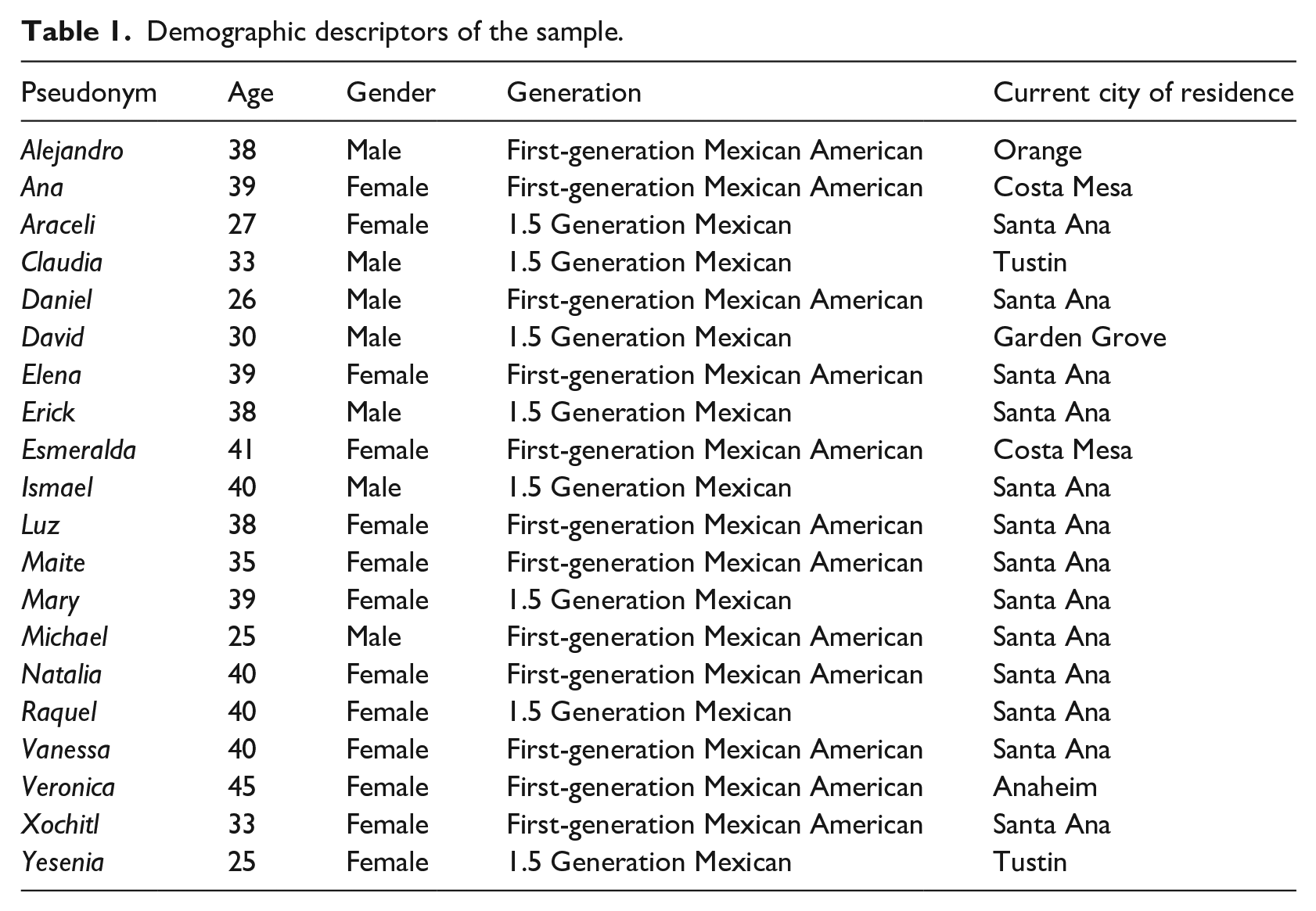
The authors launched recruitment for this study just before the Covid-19 pandemic began in early 2020, with all interviews taking place between February and May 2020. Thus, while some recruitment included more direct outreach, such as through personal networks (n = 2) and on-site recruitment in La Cuatro (n = 1), the first author recruited the majority of participants (n = 17) through snowball sampling. Fourteen participants in the sample identified as female and six as male. All participants identified as either first or 1.5 generation Mexican. For the purposes of this study, participants are identified as 1.5 generation when they arrived in the United States as children, grew up in the United States, but are undocumented. Although legal status did not determine eligibility for the study, eight respondents (40%) shared being undocumented at the time of the interview. Among participants, the average number of annual visits to the area of La Cuatro was 19 visits per year. Most participants continue to reside in Santa Ana near La Cuatro (65%), whereas a small subset lives in neighboring cities. Sample characteristics are presented in Table 1.
Demographic descriptors of the sample.
Data Collection
Both authors, collaboratively, constructed the interview guide used in this research. The first author, a bilingual Spanish-English speaker, conducted all interviews. While the majority of interviews were in English (n = 19) and only one was in Spanish, most respondents did code-switch between languages throughout their interviews. He completed four interviews face-to-face; however, due to the presence of Covid-19 and the need to respect health precautions, he conducted the remaining interviews (n = 16) via phone. For interviews that were completed in-person, participants selected the location (i.e. interviewee’s homes and coffee shops). In the interviews, participants answered questions about their experiences within and outside of La Cuarto, and their perceptions of the ethnic enclave post gentrification. The first author followed up with eight participants for clarification to accurately reflect their stories and realities.
Analysis
All interviews were audio recorded, transcribed verbatim, and, when applicable, translated from Spanish to English. Using transcriptions of the audio recordings, the authors employed a three-stage analysis process. During the initial coding phase, each author reviewed and coded, by hand, the same three transcripts. The authors then met to discuss and calibrate their analyses. Inter-coder reliability was strong. In cases where one researcher disagreed with the initial coding by the other, both authors performed a second reading, followed by discussion which led to a final coding. Next, after completing calibration, the first author used the MAXQDA program to code the remaining transcripts (n = 17) and test the coding scheme agreed upon by both authors which included the subcomponents of place attachment. Finally, based on the coding results, the authors organized codes into themes, centering the four subcomponents of place attachment in participants’ experiences with legal status or lack thereof, racialization, and anti-immigrant ethos.
Reflexivity and Positionality
Researcher positionality and reflexivity played a critical role in this project’s success. As a bi-lingual Latino male who grew up visiting the ethnic enclave of La Cuatro, the first author shared certain demographic characteristics and experiences that likely helped in establishing rapport with respondents (Becker, 1967). For instance, the shared cultural background and language capabilities facilitated the acquisition of rich data which might have suffered without these similarities between researcher and respondent. Still, the first author enacted multiple procedures to minimize the possibility of insider bias. This included post-interview analytic memos and debriefs with the second author, who, as a White, mono-lingual English-speaking female, was not familiar with the La Cuatro area prior to this research. These procedures provided an opportunity for the first author to step back and critically evaluate whether their personal details impacted participant’s answers and to, as a result, update data collection processes and consider analytic choices when needed.
Findings
To better understand how Mexican participants form affective bonds with ethnic enclaves, we apply four components of place attachment—place dependence, place discovered, place identity, and place inherited. Overall, we find that the development of place attachment occurs as a paradoxical and recursive process in which broader societal alienation augments place attachment, and, at the same time, attachment to the ethnic enclave exacerbates the felt sense of that broader outside alienation (see Figure 1). Findings show that aspects of participant experiences facilitating alienation include legal status, racialization, and pervasive anti-immigrant sentiments. Ultimately, we (1) present a model that explains how ethnic enclaves offer opportunity for place attachment, (2) present an examination of how components of place attachment (e.g. place dependence, place discovered, place identity, and place inherited) can develop and function, both singularly and in combination, to catalyze that affective bond to the enclave, and (3) situate place attachment within the broader societal landscape to critically analyze the ways place attachment within ethnic enclaves may also complicate the lived experiences of ethnic communities in broader society.
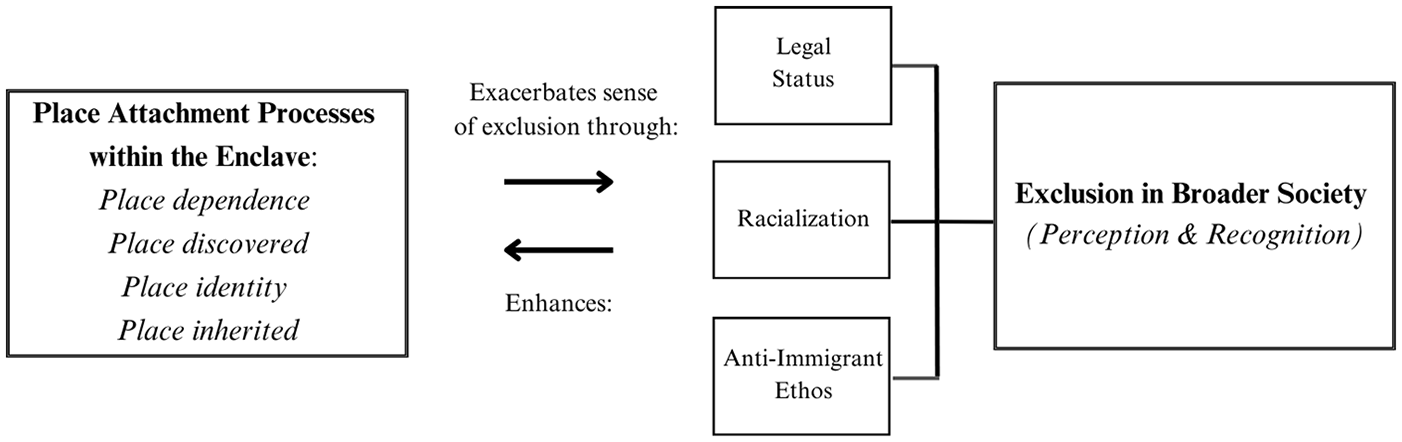
Recursive model of place attachment.
A Place for ‘True Mexicans’, Legal or Not
Participants frequently noted the abundance and importance of Mexican businesses in La Cuatro as a key motivation for visiting the area. Like other ethnic enclaves, La Cuatro provided its ethnic population with a concentration of businesses and resources that cater to their cultural needs. Given this, the ethnic enclave serves as a key site for supporting culturally and ethnically relevant goals, a factor that is critical to establishing place dependence (Williams and Vaske, 2003). For example, Maite, 35, who immigrated to the United States at the age of 7 years, regularly visited La Cuatro with her aunt and uncle. For her, and all other participants, the businesses in the area represented an authentic facet of Mexican culture. When asked to describe why she would visit the businesses at La Cuatro, Maite explained how ‘everything you could need to be a true Mexican you’d find there’.
Maite highlights how La Cuatro supported the development and preservation of authentic Mexican identity through its businesses and resources. Her words reinforce the notion that this area uniquely upholds cultural authenticity while also suggesting that places outside of La Cuatro did not reflect an accurate representation of Mexican culture. Although it is entirely possible that authentic Mexican products and businesses existed elsewhere, Maite views La Cuatro as an exclusive place where ‘true Mexicans’ like her can deeply connect with their heritage. In essence, Maite, like many others, depended on La Cuatro’s business and resources to reinforce their Mexican identity.
Considering varied sociodemographics of the community within La Cuatro, the dimension of place dependence was especially salient for undocumented individuals, a finding that adds to existing work showing that sociodemographic variables like class, age, and social status impact place attachment (Lewicka, 2011). Undocumented immigrants often face discrimination due to their inability to access and provide US-based forms of identification (Armenta and Rosales, 2019; Tovar and Feliciano, 2009). Ismael, a formerly undocumented longtime patron of La Cuatro, could not legally access a California identification card or driver’s license due to his legal status at the time. When asked for identification, he would present his Mexican Matricula Card. Outside of La Cuatro, his identification was met with resistance and hostility. When asked if he experienced similar hostility in La Cuatro, he replied: ‘[In La Cuatro] I felt comfort—the access—just like having your matricula and being able to, like, not be judged for it, and instead was just like welcomed and even celebrated’. Ismael was barred from using his Mexican ID in other places, which worked to highlight his outsider status as an undocumented individual. Thus, he developed place dependence to La Cuatro as a strategy for accessing goods that required proof of age. His dependence on La Cuatro was enhanced because his ID, which was directly tied to his undocumented status, was ‘celebrated’ within the ethnic enclave.
Yesenia’s story also illustrates this noteworthy but underexplored component of experiencing place dependence and shows how functionality can be heavily influenced by legal status and larger socio-legal barriers. Yesenia, 25 years, lived in Mexico until the age of 6 years before coming to the United States with her mother. After arriving in the United States, Yesenia and her mother encountered structural barriers due to their undocumented status, which prevented them from accessing specific resources like healthcare. In her explanation about access to these resources, Yesenia described events that took place at La Cuatro. She explained,
[The events] had booths informing [my mom and I] about the County or the businesses in La Cuatro . . . My mom suffered from diabetes, so from [those events] she could get information for programs or centers to help her either get doctors or medication cheaper cause, you know, if you’re not a [U.S.] citizen or resident, you don’t get any medical benefits. It was very helpful, especially for me too, because I was young, so I needed to go to the doctor, but sometimes it was expensive because I didn’t have insurance.
Later in the interview, Yesenia added that getting access to resources elsewhere proved difficult because her mother ‘used to work a lot during the week as a single parent . . . and didn’t drive’ because she could not obtain a driver’s license’. This suggests that Yesenia and her mothers’ ability to access resources outside of La Cuatro would have been hindered by both their undocumented legal status and Yesenia’s mother’s inability to access a driver’s license. For Yesenia and her mom, the priority and goal of attending the special events in La Cuatro was to gain access to resources to improve their quality of life. Furthermore, her use of the words ‘very helpful’ emphasizes the idea of a need for help specific to their need for these resources, which they found within the boundaries of the ethnic enclave. Yesenia also indicates an awareness by resource programs about the Mexican population visiting the area. In other words, these programs specifically targeted people like Yesenia and her mother who had recently arrived from Mexico and who were facing challenges associated with immigrating ‘illegally’ to a new country. Yesenia’s story entangles the functional aspects of place with components of ‘illegality’ in a way that contradicts claims that legal status decreases place attachment (Walter, 2021). Rather, Yesenia and Ismael’s experiences highlight the process through which place dependence is facilitated by the precarity of legal status and, in turn, heightens patrons’ awareness of this precarity elsewhere.
The Recursive Nature of Racialization
La Cuatro functioned as more than just a geographic location for participants; it became a racialized space where they learned about and internalized differing racial hierarchies (Tovar and Feliciano, 2009). Concurrently, it contributed to the racialization of ‘White’ spaces, thereby exacerbating participants’ sense of alienation. This dynamic interplay between the enclave and areas outside of it reveals a recursive process. Although the concept of racialization as a two-way process is not novel (e.g. Menjívar, 2021), we show how place serves a dual role—it is both a product of racialization and an active agent in promoting racialization. In other words, participants experienced racialization within these environments, while simultaneously racializing other spaces through their establishment of place.
Ana, a 39-year-old lifelong resident of Santa Ana, juxtaposed her experiences with racialization in and out of La Cuatro:
You obviously look Hispanic, so when you would go to certain stores like, I felt when we would go like Albertsons or Ralph’s or like those American stores, you know, I felt like people were looking at, hey, what are you doing here? At La Cuatro, people are just minding their business. You’re just there to do what you’re going to do and you just feel like you belong there.
By using the word ‘obviously’ when stating, ‘you obviously look Hispanic’, it illustrates how Ana felt as though her identity and physical characteristics as a racial outsider were ostensibly evident outside of La Cuatro. In other words, she could not hide her race, and therefore, could not hide the fact that she did not belong in certain stores. For Ana and other participants, her perceptions of race stemmed from the fact that other people ‘were looking’ at her and questioning her presence and right to visit these ‘American stores’. The way in which she distinguishes stores as ‘American stores’ through the people who patronize those businesses is also important as it reinforces the idea that certain stores, and their customers, reflected a racialized culture of which she was not part. This sense of alienation led to her feeling as though her actions were questioned by others from a different racialized group, further exacerbating feelings of being alienated based on racialized identity. In La Cuatro, however, race was not an identified reason for feeling excluded from the dominant group. This suggests that the perceptions of race in La Cuatro informed her identity as an insider of the group and fostered place identity for Ana, while also informing her place on the racial hierarchy.
Place discovered bonds are created through the employment of agency and cultural capital within place (Lewicka, 2014; Trąbka, 2019). Developing a sense of agency or using cultural capital proved difficult for participants when visiting ‘White’ or ‘American’ places outside of La Cuatro, especially for those with parents who did not speak English. In this way, La Cuatro offered its patrons more freedom to embody place discovered due to its racial homogeneity. Conversely, when visiting spaces outside of La Cuatro, which were designated as ‘White spaces’, participants describe feeling constrained by the feeling of obligation to stay near their parents. For example, Ana stated, ‘When I would go to the mall with my parents, which is, you know, more White, I knew I couldn’t leave them to go check out something else because I knew they were going to need my help’. Like Ana, Xochitl, 33, grew up bilingual with immigrant parents who only spoke Spanish. Xochitl recalls frequently visiting ‘American stores’ with her mother and feeling as though she could not leave her mother’s side in case she needed to translate. When she did translate, Xochitl expressed feeling embarrassed and judged as ‘not normal’ by people at the ‘American stores’. Ana and Xochitl’s inability to establish place discovered bonds outside of the ethnic enclave was directly tied to their parents’ reliance on them to serve as translators when visiting ‘White’ or ‘American’ places. Hence, the racial nature of various places not only constrained the agency of Ana and Xochitl, but the distinctiveness and sense of alienation through racial markers of these locations also amplified their attachment to their ethnic enclave. Thus, not only were Ana and Xochitl’s ability to enact agency in other places hindered due to their racialized characteristics, but these differences also heightened their attachment to the ethnic enclave.
The ethnic enclave of La Cuatro eliminated fears of discrimination prominently held by many immigrants (Armenta and Rosales, 2019; Menjívar and Abrego, 2012) and afforded a space for participants to exercise their agency and capital separate from their parents due to the high number of Spanish speakers. This sense of freedom, and the ability to enact cultural capital through shared language led to a sense of place discovered for both participants in this study as well as their parents who may be solely Spanish speakers. Returning to Ana, she felt at ease in La Cuatro because she knew her parents did not need a translator:
[At La Cuatro] I didn’t have to [translate] because my parents could fend for themselves . . . I could go to the candy store, and I knew [my parents] were going to be fine because they could ask for whatever they needed on their own versus going to an American store where you don’t have the language.
Xochitl expressed similar sentiments:
Other parents could go wherever they needed and get what they wanted, but for us, that wasn’t the case. But [at La Cuatro] my mom looked more comfortable there, she could be more comfortable . . . she could get what she needed . . . and that made me feel comfortable if I were to go to another store.
Both Ana and Xochitl note the difference in experiences within and outside of La Cuatro. Whereas Ana’s agency—a key indicator of place discovered—was stunted in ‘American’ spaces like malls, La Cuatro provided her a sense of autonomy and agency without feeling racialized by others. Xochitl also engages in racial othering and making a distinction between ‘American’ stores, her parents, and other’s parents. However, their times visiting La Cuatro afforded them a sense of agency outside racial othering that was exclusive to the area. While their parents may have depended on them outside of the enclave, the boundaries of La Cuatro, as a self-contained, and almost protective, ethnic enclave (Mazumdar et al., 2000), removed the linguistic barrier (Bauer et al., 2005). With the worries of their parents’ linguistic capacities eliminated, Ana and Xochitl began to safely explore the ethnic enclave by employing agency and cultural capital via language. As they continued to amass experiences separate from their parents, participants established a sense of place discovered. As Ana put it, ‘Whenever I was in La Cuatro, I knew I was golden because I could be me without my family’. However, their sense of being golden only made sense because of the exclusionary racialized experiences that they and their families faced in spaces that are perceived as American.
A Haven for Self-expression Amid Anti-immigrant Hostility
In our model, the structural inclusion of the Spanish within La Cuatro, in contrast to the anti-immigrant and anti-Spanish ethos of the broader social context, also helped participants establish a sense of place identity. All participants detailed how La Cuatro reflected a part of their Mexican identity and culture through things like medical clinics and Spanish-dubbed theaters, and how, in many cases, La Cuatro facilitated the expression of their culture, and thus a key part of their identity, free of harassment. For instance, the prevalent structural inclusion of Spanish within La Cuatro was an essential factor in developing participants’ place identity because they promoted experiences of belonging and created a haven for self-expression. However, their connection to La Cuatro was mitigated by the hostile social and political context of California at the time. Thus, their place identity bonds were heightened by experiences of linguistic othering outside of La Cuatro. For instance, Esmerelda highlighted:
When Proposition 187 passed, you were not allowed to speak Spanish; you were scolded at school. Later on, we moved into the South Coast area [a predominantly white neighborhood], so we were a lot more careful about speaking Spanish. But when you went down to La Cuatro, everybody spoke Spanish, everybody was dressed like you, looked like you—it was very welcoming.
The use of the phrase ‘scolded at school’ is important as it highlights the discriminatory and structural nature of Prop 187 and its impact on Esmerelda’s ethnic and linguistic identities. Outside of school, she was cautious about signaling to others, via her primary language, of her outsider status. But, the racial and linguistic homogeneity of the ethnic enclave allowed Esmeralda to temporarily escape immigrant-targeted xenophobia that engulfed other traditionally expected safe places like her school and neighborhood. In La Cuatro, her identities that were merely tolerated elsewhere were, conversely, reflected in others and welcomed. Ultimately, Esmeralda’s ability to develop a sense of place identity is directly connected to her perceptions of being the ‘other’ in spaces outside of the ethnic enclave. Thus, while people’s interactions within a given place inform interactions (Proshansky et al., 1983), our model shows that behaviors and interaction are also influenced by experiences within other places in relation to the ethnic enclave.
All participants noted how language was structuralized into La Cuatro while also highlighting the socio-political context and its anti-immigrant and anti-Spanish ethos. For instance, Alejandro, a 38-year-old son of Mexican immigrants, recalled experiencing many forms of discrimination when visiting places outside of the ethnic enclave. Like Esmeralda, Alejandro also mentioned the pernicious effects of Prop 187 on his sense of belonging:
I remember Prop 187 felt the same as it did during the Trump Era where Mexicans, or even people assumed to be Mexican, were targeted. I would find myself speaking for my mom when I was little because she didn’t, doesn’t, speak English. But I remember always lowering my voice when I would translate because people would give us looks when we spoke Spanish. But when we’d be at La Cuatro, I think that’s the reason why I felt we were in a safe place because I didn’t feel that, like, hostility.
Echoing Esmeralda’s sentiments, Alejandro discusses how the socio-political climate of time created linguistic barriers for him and his mother. His comparison of Prop 187 to the Trump Era is particularly noteworthy as it sheds light on the intense and continuous hostility he and others faced when outside of the ethnic enclave. Alejandro’s act of lowering his voice while translating is also important, as it reveals his subconscious compliance with the political pressures of the time. Consequently, the incorporation of Spanish use into policy worked to intensify feelings of alienation for Alejandro and other participants. Yet, La Cuatro served as a haven against the socio-political antagonism and ethos. Thus, participants interpreted their societal standing not just through their association with La Cuatro, but also by recognizing their status as second-class citizens in the face of political discrimination whenever they were beyond the spatial boundaries of the ethnic enclave.
From Ethnic Enclave to Downtown Santa Ana
The experiences of longtime Mexican patrons of La Cuatro support the claim that immigrants are more likely to establish place inherited as the length of time in a given place increases (Trąbka, 2019). La Cuarto was an important place for participants well beyond their childhood years due, in part, to the place inherited component they held. Claudia, who compared La Cuatro with her home, highlights how La Cuatro provided a sense of place inherited. Like other participants, she also frequently visited La Cuatro up until the start of gentrification. When asked what made her return to the area regularly, Claudia stated:
La Cuatro was like a close-knit community for me where you knew la señora de la fruta [the woman who sells fruit] and you knew her by name and it was like, ‘hola mija, tengo mangos’ [hi sweetie, I have mangos]. You knew the people con los [with the] flyers and the guy from the panaderia [bakery]. So, for me it was like people I grew up with, it’s like a close-knit community where everyone knew each other and pretty much everyone, in some way or another, cared about that particular community.
We see Claudia’s framing of her experience at La Cuatro through a lens of the past when she says ‘I grew up with’ in her recollection of the people and pastimes of the area. Her experiences over time encouraged the development of place inherited. As time passed, Claudia built strong connections with the enclave community and, by extension, the enclave itself.
Sadly, despite Claudia’s emerging place inherited connections with La Cuatro, she, and other participants, noted that gentrification disrupted place inherited through severed social connections. Tuttle (2022) notes that the gentrification of commercial spaces within a Mexican ethnic enclave leads to the place alienation—the disruption of place attachment. Echoing Tuttle’s (2022) claim, Claudia plainly stated, ‘gentrification erased the people, and part of my history [in La Cuatro] is gone and it’s sad’. Despite her attempts to continue fostering place inherited bonds, gentrification not only disrupted those bonds, but ‘erased’ any hope of future place attachment. Overall, the stories of participants reveal the precarity of ethnic enclaves like La Cuatro as a site for place-making amid pervasive processes of gentrification.
Discussion/Conclusion
Despite the anti-immigrant, and specifically the anti-Mexican, climates in the United States, Mexican communities remain, and even succeed, by enacting resistance to alienation and othering via placemaking processes. Drawing on interviews with longtime patrons of La Cuatro, we apply the theoretical framework of placemaking as a lens for making sense of the experiences of Mexican individuals in the ethnic enclave—a space distinctly outside of the home. This builds on extant work by scholars such as Arreola (2012) and Walter (2021), whose work examines this form of symbolic opposition primarily within the home. We, ultimately, situate our examination within the broader societal landscape which facilitates a more complete understanding of the way placemaking components and processes function both paradoxically and recursively.
Participants’ narratives indicate the establishment of place attachment vis-à-vis place dependence, place discovered, place identity, and place inherited. Our work supports Tuttle’s (2022) finding that a given place can be both a space of displacement and a place of safety, and we advance this line of inquiry by both expanding the context outside of that of gentrification and also by identifying the process of ascribing meaning to place as recursive. In this way, attachments, regardless of their positive nature, stem from—and can simultaneously intensify—an awareness of a broader social alienation. This paradoxical process shows how place attachment is both fostered through and exacerbated by participants’ experiences with (1) legal status, (2) racialization, and (3) anti-immigrant sentiment. Furthermore, our findings align with research suggesting that immigrants can foster place attachment bonds (Arreola, 2012; Main and Sandoval, 2015; Trąbka, 2019) and that those bonds are established in connection to facing backlash in spaces where immigrants are the minority (Walter, 2021). Specifically, we show that Mexican immigrants and first-generation Mexican Americans not only foster place attachment in relation to the micro-level interactions and meso-level community backlash stemming from their ethnic identity, but also from considering the macro-level socio-political climate that shapes places like ethnic enclaves. Taken together, this work extends disciplinary knowledge of placemaking processes of minority groups in spaces outside the home and provides a recursive model of place attachment to help understand how marginalized groups experience place attachment in relation to broader social landscapes within societal contexts.
Our findings oppose previous research showing that factors like legal status, or lack thereof, and assimilation pressures discouraging the use of the Spanish language can lead to a reduction of placemaking (Walter, 2021). The experiences of participants in this work indicate that, contrary to extant literature, legal status and language facilitate place attachment within the ethnic enclave. Unlike ‘American’ spaces that participants described, the ethnic enclave of La Cuatro does not require a suppression of culture as noted in other work (Walter, 2021). However, experiencing a non-restricted expression of culture within La Cuatro amplifies cultural differences in other places. Thus, the recursive model of place attachment moves away from viewing social ostracization and assimilation pressures as factors that simply reduce place attachment. Instead, we demonstrate how both marginalization and placemaking processes are multifaceted and that both can be experienced in different ways, simultaneously, depending on one’s degree of attachment (i.e. how many components of attachment are present and to what degree are they present) to a given place.
We know that Mexican individuals encounter barriers to placemaking and resist social ostracization and othering through place (Main and Sandoval, 2015; Mendoza, 2006; Smith and Winders, 2008), especially through the home (Arreola, 2012; Walter, 2021). However, this work shows that the ethnic enclave is also a key site for place attachment. While the ethnic enclave provides an abundance of resources (Bohon, 2001; Duranzo et al., 2016), it also facilitates place attachment through factors like legal status, racialization, and anti-immigrant sentiments. Fostering place attachment within the enclave parallels the claim that establishing place-based effective ties are heavily impacted by sociodemographic variables (Lewicka, 2011). Yet, examining place attachment and its underlying functions in ethnic enclaves uncovers strong and prevalent home-like bonds that inform people of their identity and community while simultaneously augmenting their outsider status in the midst of a hostile social context. Thus, by understanding the recursive nature of place attachment outside of the home, we can both fill the theoretical lacuna that permeates the field of place, and also better develop our theoretical understanding of both the placemaking processes of vulnerable groups and the salient impacts of social forces on place-person affective bonds.
Importantly, the model we introduce advances place-based scholarship by examining place attachment processes through both micro- and meso-level lenses and, also, by situating these same processes within a macro-level context. We contend that our model lends itself to applicability across varied types of place (e.g. home, communal, commercial) as it is both comprehensive in nature, while also being flexible in considering which placemaking components may be present within a place’s placemaking process and in terms of consideration varied sociodemographic factors that may both facilitate and exacerbate the simultaneous experience of attachment and otherness.
Though scholars of place, as a theoretical framework, have historically studied it through a lens of environmental psychology or geography, the consideration of place within sociology is salient given that places like ethnic enclaves are not just physical locations, but are socially constructed spaces that shape behavior, experiences, and identities and mirror cultural and social values. By studying place and place attachment through a sociological lens, we can better understand how different groups of people experience and interact with place, how place impacts social inequalities, and how power and social structures shape the creation, evolution, and use of places.
While we argue that the placemaking processes of Mexicans is an iterative process that produces discernible patterns, it is important to note that Mexicans and, by extension, Latinos are not monolithic groups. Building on the current study, we encourage future explorations of the role of colorism to investigate how place attachment experiences and the color of one’s skin intersect regardless of shared ethnic identity. In addition, an examination of place attachment processes and catalyzing forces among different spaces and varying marginalized communities will further strengthen the sociological understanding of place as recursive sites both capable of transposing harm and providing respite.
