




Abstract
Exploring the mid-sized cities of the Northeast United States, where immigrants make their homes but export their labor.

On weekday mornings, white jitney vans scurry along the streets of Paterson, New Jersey, stopping to pick up passengers. Owned by a Peruvian immigrant, their destination reads “New York City.” The vans are just one of the means of moving Paterson’s increasingly immigrant population to jobs outside the city, where the large majority of them are employed.
In the three cities that are the focus of our research—Paterson and Passaic, New Jersey and Bridgeport, Connecticut—between 75 and 87% of the employed population works outside their city of residence. These small and medium-sized cities have become the source of low-wage labor for surrounding municipalities. Once, places like this exported manufactured goods. Now they export labor, acting as de facto reservations of low-wage labor.
We use “reservation” in the sense of an area of land set aside for occupation. The price of housing in neighboring municipalities acts as an informal market-led agency of exclusion—preventing the entrance of an immigrant working class through the high cost of housing. Working-class immigrants are not forced into the small and medium-sized cities as Native Americans were forced onto reservations, nor are they excluded from more affluent municipalities by explicitly segregationist mechanisms. The barriers, instead, are “neutral” market mechanisms. But they have the same effect: concentrating immigrants and giving them few residential alternatives. These “neutral” market mechanisms help produce the growth in suburban poverty and distress exposed by recent Census data.
As their immigrant populations have grown, these cities have also experienced urban revitalization with increasing commerce, residential occupancy, leisure/entertainment venues, and better services and increased safety. Special services districts, public-private relationships, and even development corporations contribute the renewal efforts. Organizations like Paterson’s New Jersey Community Development Corporation provide resources that seek to enhance these efforts and promote the revival of these cities. All this follows roughly half a century of devitalization: depopulation; decaying downtowns; vacant storefronts; disappearing movie theaters, restaurants, and banks; and rising crime rates. It had squeezed the life and vitality out of older American cities. The influx of immigrants has begun to reverse these trends.
Immigrant-led revitalization in small and medium-sized cities does not depend on re-industrialization or even on the widespread, prior availability of semi- and low-skilled work. Nor is it accompanied at first by a decline in official poverty or a rise in real estate values. Rather, at its core, it is residential, driven by newcomers who increase the population, form new communities, and patronize small businesses and services, even as they work, for the most part outside, the city.
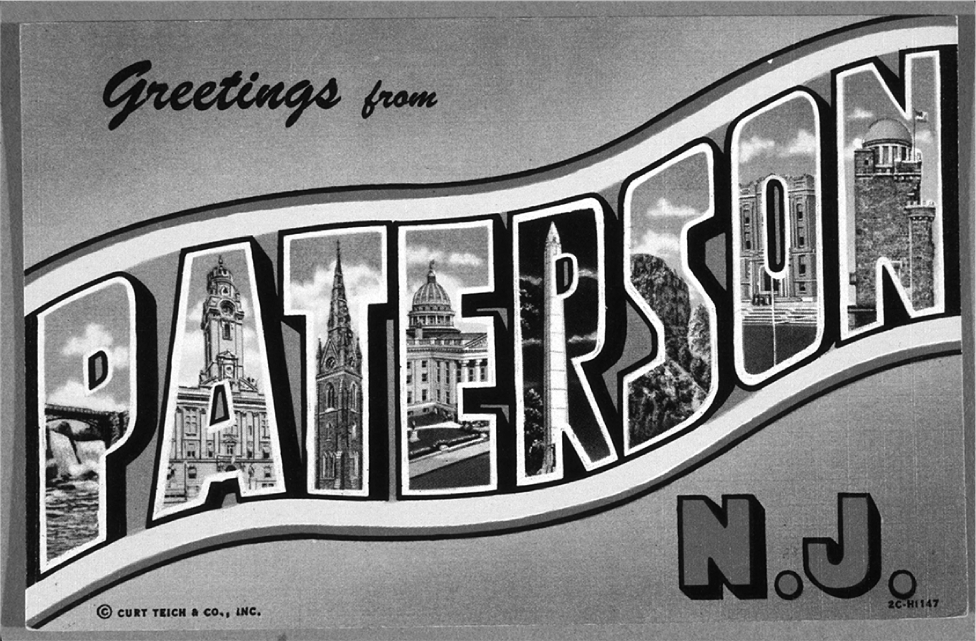
Paterson, N.J. was a classic ‘50s suburb before its late 20th century decline.
Historic postcard via GreatFallsNPS, Flickr Creative Commons
Most studies of recent immigration concentrate on the traditional immigrant ports-of-entry and on new and emerging immigrant gateways. But small and medium-sized cities house a significant fraction of the overall population and are becoming home to huge numbers of immigrants. In 2010, 61% of the U.S. foreign-born lived in municipalities with a population of less than 200,000, with 12% in cities between 100,000 and 199,000; 33% in cities and towns of 20,000-99,000; and 16% in places with fewer than 20,000 native-born residents. At least in the Rust Belt, immigration is transforming the demographics, economies, and spatial organization of towns.
The Lifecycle of Immigrant Cities
The stories of Paterson, Passaic, and Bridgeport form part of a more widespread and significant narrative. The basic facts about these cities are told easily and repeat a familiar story. Despite some variation in the total population from the early 20th century through 2010, they share similar tales of growth, decline, and rebirth. Each city’s initial boom coincided with the arrival of foreign-born residents in the early twentieth century. In 1910, the foreign-born populations composed between 36% and 53% of the cities’ population. Adding in the second generation—the children of immigrants—boosted the foreign-stock population to between 73% and 82%. Truly, these were immigrant cities. But, with the nationality-based quotas of the 1920s, the Great Depression, and World War II, immigration largely dried up. The proportion of foreign-born residents bottomed out around 1970, about the same time as the overall population. It wasn’t until the 1965 repeal of the quota legislation that the immigrant populations in each city rebounded. Today, these are once again immigrant cities. By 2010, the foreign-born comprised between 26% and 46% of these three cities’ official populations. Adding in undocumented immigrants and the children of immigrants would raise the percentage of the first and second generation a substantial, but indeterminate, amount.
Once, places like this exported manufactured goods. Now they export labor.
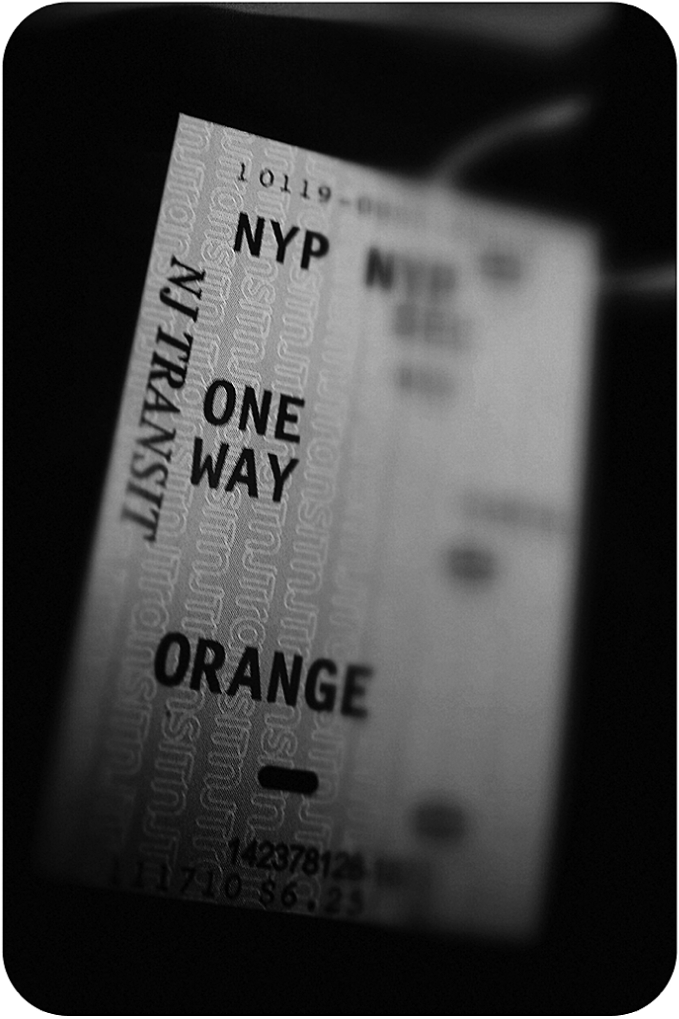
Commuting to work is the norm for immigrants in New Jersey.
Molly Stevens via Flickr Creative Commons
The initial immigrant populations of these cities came from Europe; today, they come from Central and Latin America, the Caribbean, and Asia. Bundled together, the largest group is Hispanic (at about half the population), although this label masks diversity, lumping together demographically and socially diverse groups such as Paterson’s Dominicans, Peruvians, and Puerto Ricans.
Devitalization had squeezed the life out of older American cities. An influx of immigrants has begun to reverse these trends.
Manufacturing jobs attracted immigrants in the early twentieth century. It may have been the beginning of age of the automobile, but with no public transportation immigrants needed to walk to their jobs. By necessity, these cities were both places of work and residence for their new arrivals. The availability of manufacturing work attracted and held them as 53% of immigrants worked in this industry within each city. By the late twentieth and early twenty-first centuries, this relation between work and residence changed. The availability of manufacturing work no longer served as the principal source of attraction. The manufacturing sector had declined significantly as it only employed around 6% of all residents in 2010. Instead, immigrants came to work, most often, in low wage, service sector jobs including retail, health care, human services, transportation, and construction, living in their immigrant enclaves but working elsewhere.
Going to Work
The widespread availability of buses and private automobiles enabled them to find work outside the cities in which they lived. In 2010, the proportion of employed residents working elsewhere was 80% in Paterson, 87% in Passaic, and 75% in Bridgeport. In Paterson, 16% of residents who work outside the city are employed in “Goods Producing” industries, which include construction work and small scale goods production, as well as more conventional manufacturing; 27% in “Trade, Transportation, and Utilities”, which encompasses retail; and 58% in “All Other Services”, which is where the health care and human services workers are found. The working population may be divided into three groups: residents who work outside the city, non-residents who work in the city, and residents who work in the city. In economic terms, the non-residents do best, and the residents who remain in the city the worst. The data allow us only to divide the workforce into three groups by income: $1,250/month or less; $1,250-3,332/month; $3,333/month or more. For purposes of discussion, we will call these low, medium, and high—although the latter is high only in this context. Among residents who travel outside of their city limits to work, a quarter earns low incomes and 24% high incomes. By contrast, only 21% of residents who worked in the city earned high incomes and 31% found themselves in the lowest income category.
The immigrant residents who leave their city for work each day generally lack the education (and sometimes the language skills) needed for better jobs closer to home. But they are needed and welcomed by the restaurants, nursing homes, supermarkets, construction sites, and factories in the towns and cities within commuting distance. Even with significant limitations, the labor force participation rates of foreign-born men are higher than both native-born Whites or African Americans. In a sample drawn from northern New Jersey cities in 2011, among 18 to 64-year-old men, labor force participation was 88% for the foreign-born, compared to 84% for native Whites and 67% for African Americans. Bundling incomes within households partially offsets the low wages paid to immigrants so that, taking the median for our three focal cities, foreign-born household heads earn less of the total household income (about 55%) than native-born workers (69%). Higher numbers of workers, even at lower wages, still manage to make up a decent income at the household level.
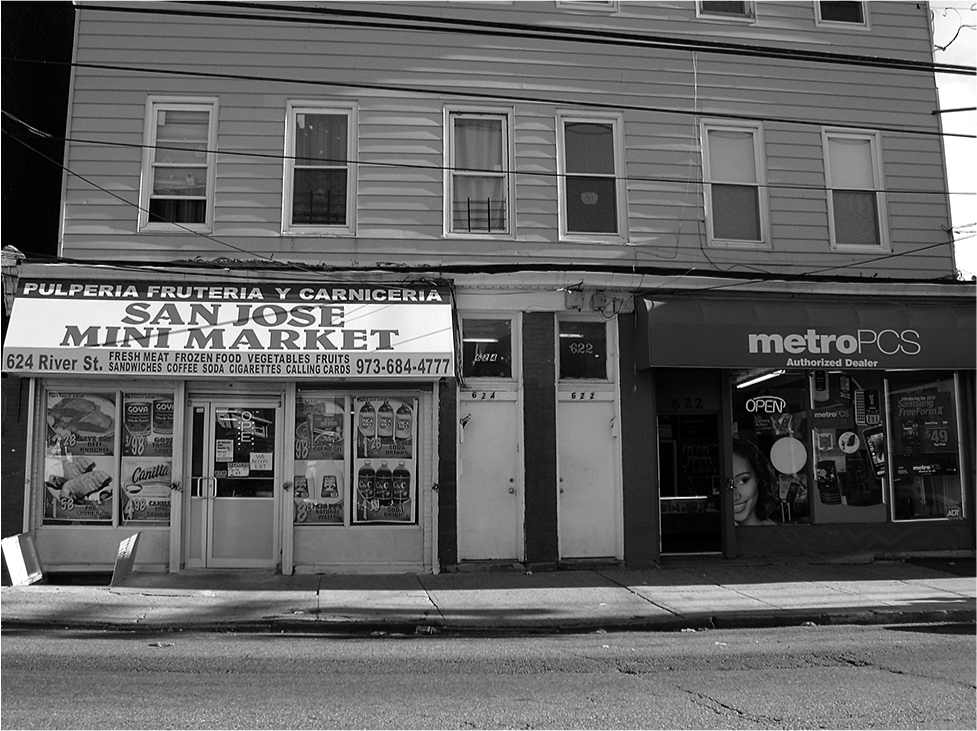
River and Market Streets in Paterson, N.J. in 2010.
Chula1809 via Flickr Creative Commons
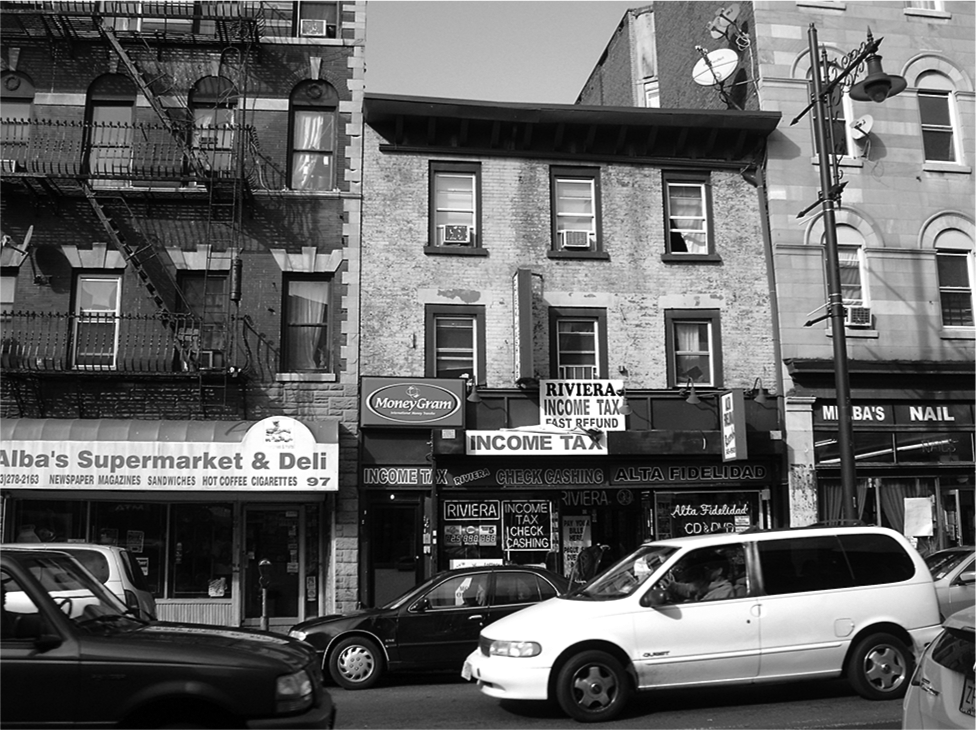
Chula1809 via Flickr Creative Commons
The exchange of workers between municipalities shows that it is not only a deficit in jobs that motivated residents of our study cities to look elsewhere for work. In Paterson, 28,011 members of the workforce came into the city each day. These cities contain many solid, middle class jobs for attorneys, teachers, police officers, firefighters, municipal officials, and health care technicians, but anecdotal evidence supported by income and occupational data shows that these “better jobs” by and large go to native-born workers from outside of city limits, as immigrants head out of town to work each day. In Paterson, anecdotal evidence is clear and consistent: departure for residence, if not always work, in the suburbs usually accompanies economic mobility for both native born and foreign born residents. One exception is city politicians. One of the upwardly mobile young city politicians with whom we talked lives in an old, downtown factory building converted into lofts.
The situation, thus, differs from the conditions discussed in the “spatial mismatch” literature. The spatial mismatch theory applies to persons already living in a city whose economy has been decimated by deindustrialization and the move of businesses to the suburbs. They are people left behind, unable to reach jobs. In the situation we describe, population growth occurs after deindustrialization; in-migrants choose cities where local jobs for them are limited in number.
Immigrant Entrepreneurs
A substantial number of immigrants have opened small businesses to meet the needs of the cities’ reborn ethnic communities. From their names, it is clear that they served immigrants: El Tempano Restaurant, Gonzalez Travel Agency, Turkish Grill and Café, De Leon Money Transfer, Arab Voice, Oficina Del Voto Dominicano. It is not clear how many of these ethnic businesses are owned by city residents and how many by ethnic entrepreneurs who live elsewhere. They do, however, provide a modest amount of low-skilled employment for local residents. Most of these small businesses are truly small. Taking the three cities together, in 2010, 50% of ethnic businesses employed just one person; 29% employed 2-5; and only 11% had more than 15 employees.
Manufacturing jobs attracted immigrants in the early 20th century. Now it’s low-wage service sector jobs including retail, health care, human services, transportation, and construction.
Driving into Paterson from the west, Main Street is lined with small businesses serving the local population. The lack of vacant storefronts is remarkable. Similarly, the automobile traffic downtown is heavy; most, though not all, storefronts are occupied with low-end retail and services, surviving despite the opening of a new downtown mall. Continuing through the immigrant neighborhoods, the observer is struck by tidy, small homes and neighborhood bodegas. There is a vibrant Arab quarter centered on the southern section of Main Street. The new residents sustain these small businesses, bring life to the streets, and inject cash into the economy.
The Criminal Element?
Industrious, family centered, often entrepreneurial—immigrants do more than provide these former manufacturing cities with a new export in the form of human labor. They also reduce crime. Indeed, immigration has exerted an astounding impact on crime rates within these cities. Looking at the crime rates per 100,000 residents across all three cities, on average, crime rates dropped by half between 1990 and 2010. Scholars including Robert Sampson and John MacDonald have discovered similar reductions in crime associated with the growth of immigrant populations, despite popular, stereotypical conceptions of the “other” as a threat.
In the U.S., cities have long been home to large immigrant populations. The shift to small and mid-sized cities is changing how we think of ethnic enclaves.
Elvert Barnes via Flickr Creative Commons
The reasons why crime has declined await additional analysis. Clearly, though, they must include fear of deportation, high labor force participation, immigrant cultures, higher marriage rates, and improved policing. The strong sense of community among recent immigrants is often cited. Regardless of why it’s happening, though, the crime drop appears to permeate beyond the immigrant community as studies indicate that the growth of an immigrant population in cities have been accompanied by decline in the crime rates of native-born residents, as well.
Revitalization means more than economic growth. It embraces civil society and civic life.
What is the significance of these trends? Why does it matter that extraordinary proportions of residents work outside the cities in which they live? First, there is a historically unprecedented shift in the relation between place of work and residence among working-class immigrants in small and medium-sized cities, which, in an ironic twist, have taken on some of the historic functions of suburbs. In post-World War II America, middle-class and affluent suburbs became classic bedroom communities. Now, this function falls to new immigrant municipalities, the de facto reservations we discussed above.
Second, the proximity of a non-resident, low-wage labor force serves nearby municipalities well. They do not have to educate the children of immigrants, pay for affordable or subsidized housing, pick up the local costs associated with poverty, or manage ethnic diversity. Instead, they can draw on a ready, flexible pool of reliable workers to care for their elderly, work the cash registers in supermarkets, wash dishes in their restaurants, clean the rooms of their hotels, and tend their lawns—all with minimal responsibility for the workers’ well-being.
From another perspective, the picture does not appear either as bleak or exploitative. In the once-struggling cities in which they live, these immigrant workers—regardless of where they are employed—bring population growth, increased tax revenues, commercial revival, and cultural vitality. They lower crime rates and drive revitalization.
Elsewhere in the U.S., domestic workers march for immigrant rights.
Annette Bernhardt via Flickr Creative Commons

To be sure, revitalization means more than economic growth. It embraces civil society and civic life. Take, for example, Union City, NJ, a small, northern New Jersey city, long ago a center of the lace-making industry. Now it’s primarily Hispanic and poor—a city much like nearby Paterson and Passaic. In his gripping account of the city’s stunning public school about-face, Improbable Scholars, David L. Kirp writes that, statistics be damned, “Union City remains vibrant.” Within the city, “civil life” thrives, nourished by immigrant enclaves with their own associations and institutions. “Despite the grim figures,” Kirp writes, “Union City would surely rank high in a survey of personal happiness.”
And let us not forget the point of view of immigrants. For them, these cities offer inexpensive housing, the security and comfort of living among co-ethnics, proximity to jobs, and an opportunity to bundle the incomes of household members. They also hold out the promise of social mobility for the second generation. These small and medium-sized cities may be ”first stops,” but they provide the first tentative steps toward the destination: the American dream.