




Abstract
Our study uses big data analysis to examine the influence of Marxism on communication studies throughout its history. We track citations of Marxist authors and the use of Marxist concepts in the titles, keywords, or abstracts of publications in the Web of Science scholarly database in the category of communication. We find that Marxian authors and ideas were almost completely absent from the mainstream of media studies until the end of the Cold War. The end of the Cold War and the Great Recession of 2008 significantly increased citations of Marxist authors. We use network analysis to identify different currents of thought or paradigmatic appropriations of Marxism within communication studies and identify five clusters of appropriation of Marx’s ideas within communication studies: Theories of Democracy, Political Economy of Communication, Critique of Power Relations, Feminism and Antiracism, and Critical Discourse Analysis.
Keywords
Ships Passing in the Night: The Parallel Histories of Marxism and Communication Studies
Karl Marx’s theories remain one of the most enduring and versatile intellectual frameworks, aiming to provide an overarching explanation of human history as well as a normative basis for a political vision of human progress. Marxian concepts are proving fruitful in providing insights into some of the most fundamental challenges facing humanity today, from climate change (Malm, 2016) to the impact of digital information and communication technologies and the power of digital platforms (Fuchs, 2019; Fuchs and Mosco, 2017). As one of the founders of sociology, his ideas have had an immense impact on the study of social conflict and stratification, power and control in the labor process, and ideology, among others.
Marx’s ideas, however, seem to have had only a limited impact on the study of communication. Dallas Smythe (1977) argued that communication was a ‘blindspot’ of Western Marxism, or rather that Western Marxism’s treatment of communication was limited and one-sided. According to Smythe (1977), Marxists viewed the mass media primarily or exclusively as vehicles of ‘ideology’—a term Smythe dismissed as ‘idealist’ and ‘pre-scientific’ (p. 1)—instead of examining materialistically the economic function of the mass media under capitalism, which is to sell the ‘audience commodity’ (p. 6) to advertisers. Although Smythe’s ideas have found some adherents, especially among communication scholars such as Robert Hackett (1986) and Sut Jhally and Robert Livant (1986), they have not significantly influenced the course of Western Marxism. If Smythe was right when he called communication a blindspot in Western Marxism, it has remained so even after the publication of his article.
In one of the rare instances when a Marxist scholar outside the field of communication addressed Smythe’s ideas, Michael Lebowitz (1986) roundly rejected the ‘blindspot paradigm’ as incompatible with Marxism. He argued that ‘the starting point reveals a complete rejection of Marx’s methodological premise’, leading to an ‘entirely un-Marxian argument with un-Marxian conclusions which follow from the initial premise’ (Lebowitz, 1986: 170). His critique is based on the claim that surplus value is created in production, while the function of advertising is to accelerate the pace of capital circulation—so the idea that audiences work, are exploited, or produce surplus value is fundamentally at odds with Marx’s theory. Or, as Lebowitz (1986) bluntly puts it, ‘The blindspot paradigm would appear to lead from a false premise to a dead- end’ (p. 171).
If critical communication scholars have not succeeded in significantly influencing the course of Western Marxism, the same is true of Marxism’s influence on communication studies. In his study of the presence of Marxism in mainstream communication journals between the years 2007 and 2011, Erdogan (2013) shows that ‘Marx and issues of the Marxist approach are mostly excluded from Media and Communication studies, and that Marx is invalidated fully or partially, evaluated negatively or criticized for various reasons if he is mentioned in an article’ (p. 141)
From the limited evidence available, it appears that Marxism and communication studies have gone their separate ways and neither cares much for the other. However, there is a lack of large-scale bibliometric studies covering a longer period of time that could be used to test this hypothesis. Our aim is to fill this gap and provide a systematic analysis of the presence of Marxism in the history of (institutionalized) communication studies in order to identify different currents of thought or paradigmatic appropriations of Marxism within communication studies and their relationships to each other. We trace the prominence of Marxist thinkers, concepts, and paradigms in the post-Second World War period and contextualize the findings in terms of institutional changes within the field itself, placing them in the context of the field’s development—sources of funding, the degree of institutionalization of different paradigms, opportunities to publish findings, and so on—as well as in the broader societal forces influencing the scientific community at the national and international levels.
Our study draws on the Web of Science (WoS) database, which we selected for two reasons. The first and most important reason is that it contains the most influential international journals. An examination of this database is particularly important because it represents the mainstream of international scientific production. The other reason is pragmatic because WoS provides structured bibliometric data covering the entire period of institutionalized communication scholarship. Nevertheless, the choice of WoS limits the applicability of the results in two ways: first, geographically, since WoS covers mainly English-language publications from the North Atlantic region; second, by type of publication, since WoS contains mainly journal articles. A combination and comparison with alternative databases such as Scopus and Google scholar would certainly enhance the results of the study, but such a task is beyond the scope of this paper. Similarly, studies focusing on regions of the world that are underrepresented in WoS for various reasons (such as Doyle, 2022; Sánchez Narvarte, 2022; for Latin America and Xiao Wu, 2022 for China) would be a welcome addition to our results.
We do not attempt to distinguish between specifically sociological and other appropriations of Marx’s ideas, as this would prove an impossible task. The sociology of media is not an established field of study with at least reasonably well-defined boundaries, and very few scholars have even attempted to define its constitutive and distinguishing features. Rather, our goal is to examine the intellectual framework created by one of sociology’s founding figures, as well as the historical development and transformative consequences it has produced in the intellectual landscape related to media and communication.
Taboo on Marx at the Founding of Media and Communication Studies
An important reason for the marginalization of Marx in mainstream communication literature can be traced to the social context in which communication studies was first institutionalized in the United States after the end of the Second World War. The overwhelming influence on the institutionalization of communication studies came from US intelligence agencies, the military, and the State Department (Gary, 1996; Pooley, 2008), as well as private foundations closely aligned with government goals, such as Ford (Simonson and Durham Peters, 2008) and Rockefeller (Gitlin, 1978: 228). By the early 1950s, some of the leading social science research institutes, such as Lazarsfeld’s Bureau for Applied Research (BASR), Hadley Cantril’s Institute for International Social Research (IISR), and the Center for International Studies (CENIS), received more than 75% of their funding from government contracts (Glander, 2000: 124; Simpson, 1994: 4), primarily from contracts with the military, which accounted for 96% of federal funding for the social sciences in 1952 (Simpson, 1994: 92). In addition, government interests shaped the research agenda through staffing, as many early pioneers of communication science had backgrounds in psychological warfare during the war and maintained their ties to the government even as they moved to private research institutions. It is significant that the four presidents of the International Communication Association (ICA) between 1953 and 1962 all had military backgrounds, while one-third of Public Opinion Quarterly editors and editorial board members were financially dependent on psychological warfare contracts (Simpson, 1994: 43).
The outbreak of the Cold War intensified hostility toward anything that could be associated with communism. It is not surprising, then, that early communication scholarship did not turn to Marx for building blocks for its theoretical foundation. Rather, the field was dominated by state and private interests in manipulating mass audiences at home and abroad for political purposes or profit. As a result, the dominant administrative paradigm focused on the persuasive potential of mass media, the dissemination patterns of top–down information campaigns, and the factors that hinder or promote successful persuasion. Even issues such as inequality in communication have been addressed in a model of communication as top–down dissemination of information from elites to mass audiences (Mance and Slaček Brlek, 2022).
The power of US hegemony after the Second World War was such that it attracted not only administrative scholars but also critical or formerly radical scholars. Franz Neumann et al. (2013) produced reports on Nazi Germany for the Office of Strategic Services during the war, while Leo Loewenthal conducted analyses of fascist radio and the press for the Office of War Information (Bogart, 1993: 378). Some members of the Frankfurt School continued to work with the US government after the war ended. Marcuse became chief political analyst for the State Department’s Central European Division, focusing on communism and the Soviet Union (Kellner, 1985: ix). Leo Loewenthal was director of research for the Voice of America (VoA) propaganda radio program between 1949 and 1955 (Bogart, 1993) and co-authored an article with Joseph Klapper, a colleague at VoA, on the role of public opinion research in ‘psychological warfare’ (Klapper and Löwenthal, 1951).
Thus, the most important representatives of the critical tradition in communication studies turned away from their Marxist roots, further diminishing Marx’s influence as a theorist of communication. The reasons for this were manifold. On one hand, there were pragmatic considerations such as political pressures not to ally with the ‘enemy’ during the Cold War, the need to secure funding, collaboration with theoretically heterogeneous scholars, and the need to adapt publications to American audiences. At the same time, members of the school were cut off from organized labor struggle by emigration and frankly disillusioned with the working class, both because of the rise of fascism in Germany, which the organized German working class was unable to prevent, and especially because of the extent of anti-Semitic prejudice in the American working class that the Studies in Prejudice project had exposed. It is no wonder that the leading school of critical thought on communication after the war had distanced itself considerably from the Marxist origins of the Institut für Sozialforschung (Jay, 1973: 205–206, 226–227; Kellner, 1975, 144–149). The decision of several artists and thinkers associated with the Institute (Bloch, Brecht, Grossman, Eisler, and others) who had not abandoned Marxism to move to the German Democratic Republic further weakened the presence of Marx in what remained of the Institute in the West (Kellner, 1975: 146).
Marx’s influence on the study of communication did not develop organically, but had to be rediscovered in the wake of the radicalism of the 1960s. Marxism proved to be a significant influence on the emerging tradition of the political economy of communication toward the end of the decade (Mosco, 2009: 7), which in its North American variant was largely driven by an interest in the workings of US empire and the role of communication in securing global hegemony. The pioneers, however, did not come from a Marxist tradition of thought. On the contrary, as Schiller (2000) noted, ‘My university education had been a shallow and superficial enterprise. The central driving forces of the economy I lived in were either ignored or left vague, to the point of meaninglessness’ (p. 19). Both Smythe and Schiller discovered Marxian scholarship as they tried to come to terms with their experiences with the power of private media corporations, with the Great Depression, and with US imperial practices abroad.
Their stories make clear that the history of the critical paradigm and of Marxism in particular, like the history of workers’ struggle with which it is inextricably linked, is a story of caesurae and new beginnings, of forgetting and remembering. It resembles the progress of proletarian revolutions, which, as Marx (1852: ch. 1) puts it, ‘constantly criticize themselves, constantly interrupt themselves in their own course, return to the apparently accomplished, in order to begin anew’. In contrast to Marx’s optimism about the inexorable march of proletarian struggle toward the inevitable moment of revolutionary victory, the history of radical communication studies is far less heroic, marked by retreats and struggles to merely defend the status quo.
In contrast to the administrative paradigm, then, the critical paradigm is characterized by the need to constantly regain what had been lost, to rediscover its history and reclaim its heritage, to take one step back in order to take two strides ahead. This paper tells the story of those rediscoveries and is at the same time an act of that rediscovery. It traces the influence of Marxist thought in order to assess not only its past significance but also its future potential as a theoretical foundation for the further development of critical communication studies.
Operationalizing Concepts and Paradigms
As in any other community, scientific communities communicate through a specialized and specific language system that enables members to communicate effectively with each other. Concepts, the basic building blocks of such a vocabulary, help reduce complexity by distinguishing between different arguments on which the community agrees. This enables the identification of legitimate and illegitimate issues and the selection of appropriate methods of inquiry (Williams, 2015 (1976): xxvii).
The field of communication studies draws on several vocabularies, that is, rhetorical, semiotic, phenomenological, cybernetic, social psychological, sociocultural, and critical (see Craig, 1999). Because of the need for more practical and economical communication among members of a particular paradigm, consensus on vocabulary is achieved through discussions of definitions, comparisons, and clarifications (Beyer, 1978: 70). Accordingly, adherents of (different) paradigms or traditions ‘/. . . / are ensnared in reciprocal controversies about their specific metaphysical basic assumptions, which ultimately constitute their only raison d’être’ (Knorr, 1975: 227).
As described by Williams (2015 [1976]), different kinds of reconceptualizations or transformations of meaning can occur in different ways. Types of transformation of meaning include obsolescence, where certain ideas or concepts become obsolete and are replaced by new ones (e.g. base and superstructure), specialization, in which ideas become more specialized and focused over time (e.g. the transition from power to hegemony), extension, in which ideas are applied to broader contexts (as in the case of public opinion), intersection, in which different concepts overlap and influence each other (as in the relationship between hegemony and ideology), and transference or masking, in which ideas are subtly shifted or reinterpreted (as in the transition from capitalism to market forces).
Recent technological advances in digitizing content and providing bibliometric metadata, as well as improvements in network analysis techniques, have enabled the exploration of longitudinal patterns in large data sets. Examples include examining the genealogy of the concept of social capital (Lee and Sohn, 2016), identifying different strands of thought in agenda-setting research (Tai, 2009), and tracing reconceptualizations of the concept of the public sphere (Rauchfleisch, 2017). Our study contributes to this line of research by analyzing the prominence of Marxian scholars and concepts in the history of (institutionalized) communication studies and identifying different strands or paradigmatic appropriations of Marxian concepts and the ways in which they interact with each other and with adjacent research traditions.
Method
Sampling
We first searched for direct references to Karl Marx or Marxism in the titles, abstracts, or keywords of scholarly publications indexed in WoS in the category of communication. Our results are consistent with qualitative histories of the field of communication as well as recent bibliographic studies (Erdogan, 2013) on the marginalization of Marx within communication studies, as only 142 publications in the WoS category of communication mention either Marx or Marxism in their titles, abstracts, or keywords.
However, an author’s influence cannot be gaged by the direct mention of his or her name alone. Especially in the case of an author as politically controversial as Karl Marx—considering that the Cold War spanned most of the period analyzed—scholars may have avoided direct references to his name for fear of consequences. Therefore, we expanded our search to find not only direct references to Marx and various classics of Marxism such as Gramsci or Luxemburg, but also articles in which concepts associated with Marxist thought are prominently mentioned. We proceeded in two steps. In the first step, we identified the most frequently occurring keywords associated with publications that cite classical Marxist thinkers (Marx, Engels, Lenin, Trotsky, Bukharin, Kautsky, Luxemburg, Gramsci, Lukacs, Althusser, and Mao). Most of the keywords that resulted from this step were too broad or vague (e.g. ‘China’, ‘human’, or ‘politics’ were among the most frequent). Therefore, we manually reviewed the results and selected those that we considered meaningful enough to use as indicators of Marxian scholarship (see Table 1). One might object that the selection of Marxian concepts to serve as indicators of Marxism contains an element of arbitrariness and that an alternative selection might yield different results. Conversely, the lack of an overarching principle that would allow deductive reasoning leading to a set of fixed and invariable Marxian concepts is obvious.
Keywords used to sample publications for the inclusion in the analysis.
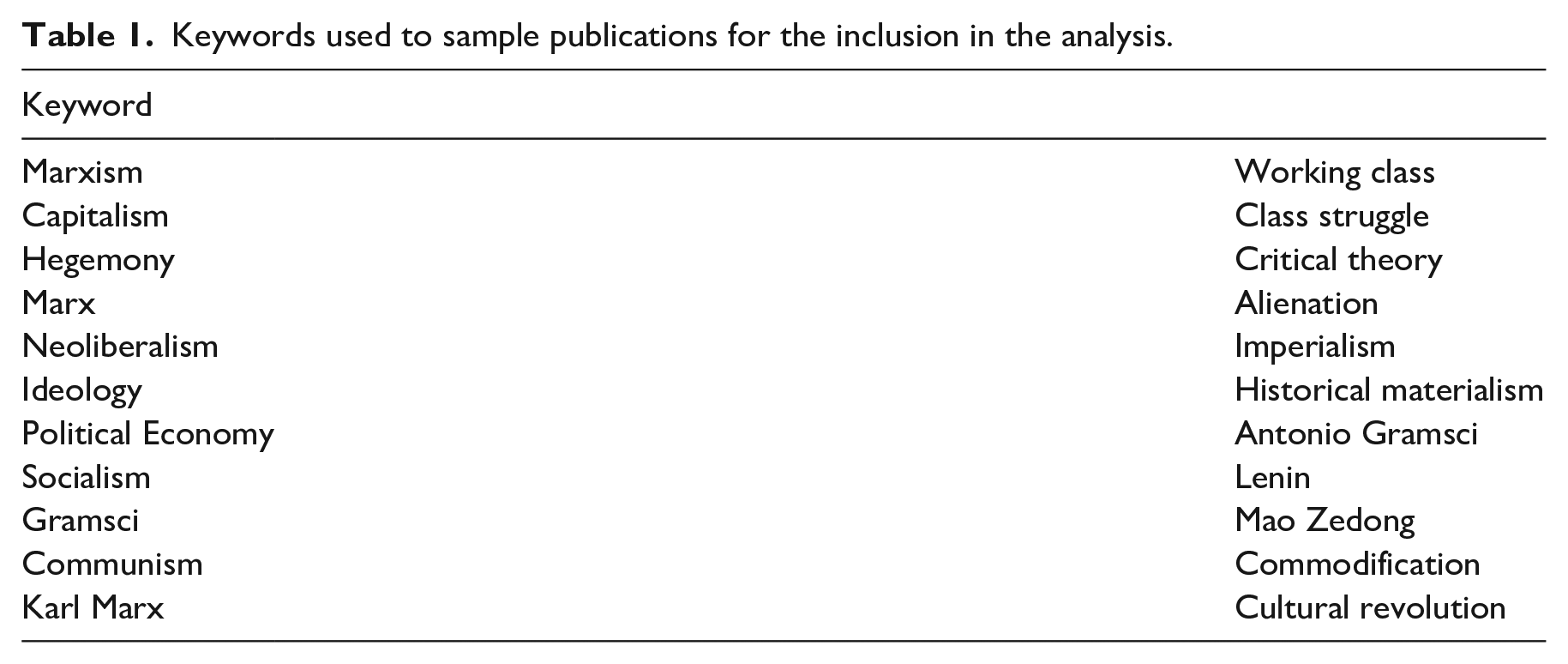
Although some of the keywords—for example, ‘hegemony’, ‘neoliberalism’, ‘ideology’, and ‘political economy’—circulate in various schools of thought, we have chosen to include them for two reasons. The first reason is that these terms are very prominently associated with Marxian thought. The second reason is that we do not want to consider Marxian thinkers in isolation, but rather to examine how Marxian thought is embedded in the broader intellectual framework, in particular how different schools of thought exchange and share ideas. Our sample will therefore inevitably include non-Marxian thinkers, but this will allow us to examine the relationship between them and Marxian schools of thought, and to consider the situation of Marxian authors and concepts within a broader intellectual framework.
The search yielded 7007 results, the vast majority of which are journal articles (5535 including book reviews, review articles, and editorial material), followed by book chapters (574), book reviews (512), and proceedings papers (285). The sample includes only 63 books, while the remainder is composed of miscellaneous materials of lesser relevance (corrections, notes, conference abstracts, etc.).
A look at the year of publication (Chart 1) shows that the end of the Cold War does not represent a significant turning point. Rather, we see a slow but steady increase in the number of publications, beginning in the second half of the 1980s, peaking in 1999, and then slowly declining until it rises sharply again in 2008 and reaches a second peak in 2018. At this point, the data already seem to confirm the thesis that Marxism has played a negligible role in the history of communication studies, since before 2009, the annual number of publications in WoS that meet the search criteria never reaches 100. In the period before 1980, there is only 1 year (1977) in which the annual number of publications in the sample exceeds 10.
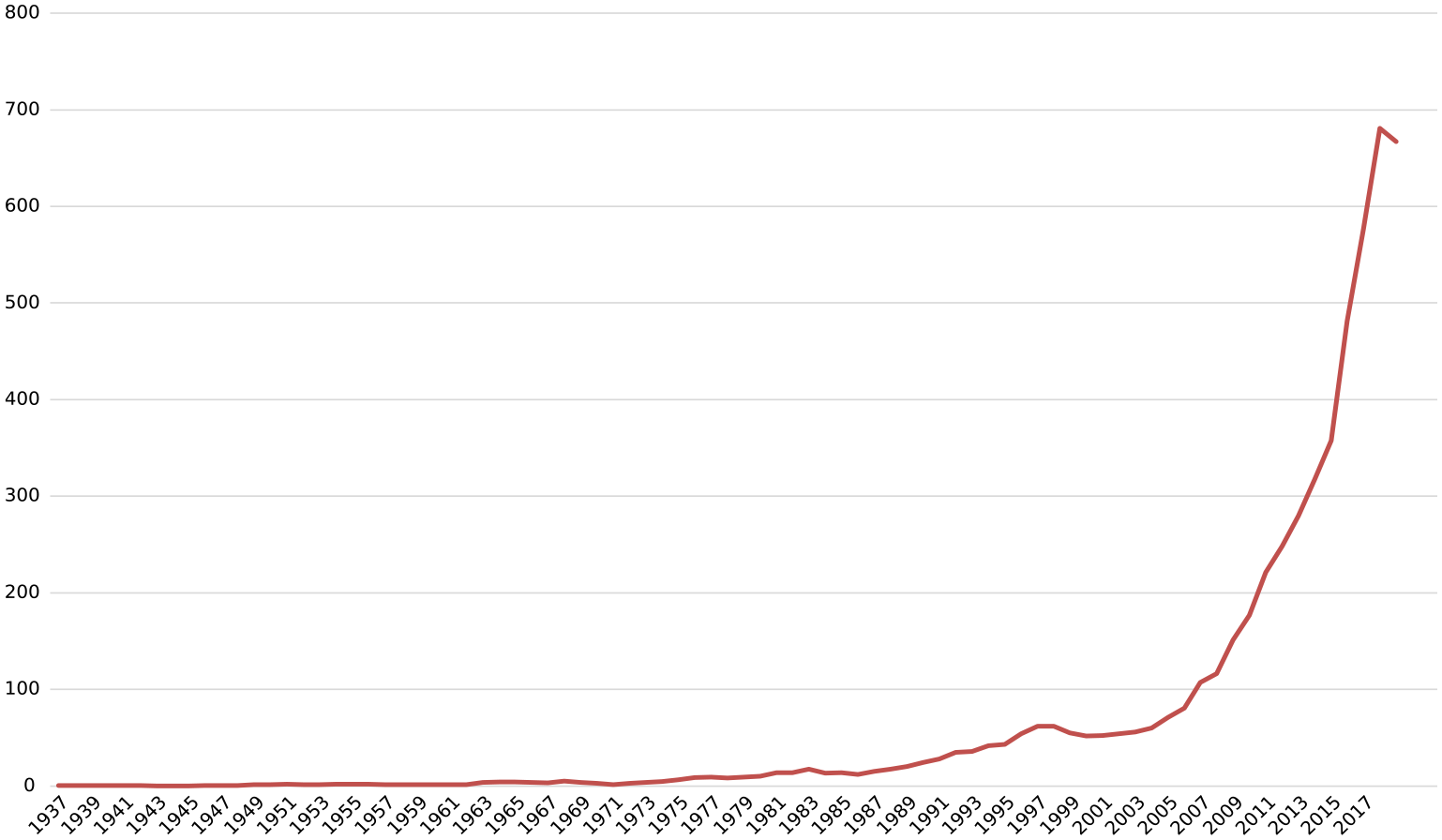
Number of publications by year (3-year sliding averages).
However, even these figures do not paint an accurate picture of the strict taboo on Marx and Marxism during the Cold War, since most of the publications included in the sample that were published before the 1980s do not belong to the Marxian tradition but were included for various other reasons. Some refer to Marx or Marxism and use Marxist terminology because they analyze the dangers that this hostile worldview poses to the American public (e.g. Krugman, 1952) or because they want to gain insight into a hostile communist nation (e.g. Bauer, 1955); a second group focuses on socialist and communist states as objects of study, especially in light of important historical events of interest to US foreign policy such as the Cultural Revolution (e.g. Broman, 1969) or changes in US foreign policy (some articles focusing on China were published after the Sino-American rapprochement, for example, Wang, 1977); finally, a third group was included because of the use of contested concepts, that is, concepts used in different ways by different research traditions. In our case, the most prominent of these concepts is ‘ideology’, which is one of the central concepts in Marxian approaches to communication but is also used by various scholars to refer more broadly to a more or less coherent set of ideas, such as the self-concept of public relations professionals (Sussmann, 1948) or simply to sets of ‘personal values and public attitudes’ (Scott, 1960: 419).
To account for the increasing number of publications indexed in WoS, we normalized the data by the total annual number of publications in the WoS category of communication (Chart 2). Now we see that much of the boom after 2008 is due to the explosion in the total number of publications in the communication category. However, the number of publications containing specified keywords grows faster than the total number of publications in the communication category during this period.
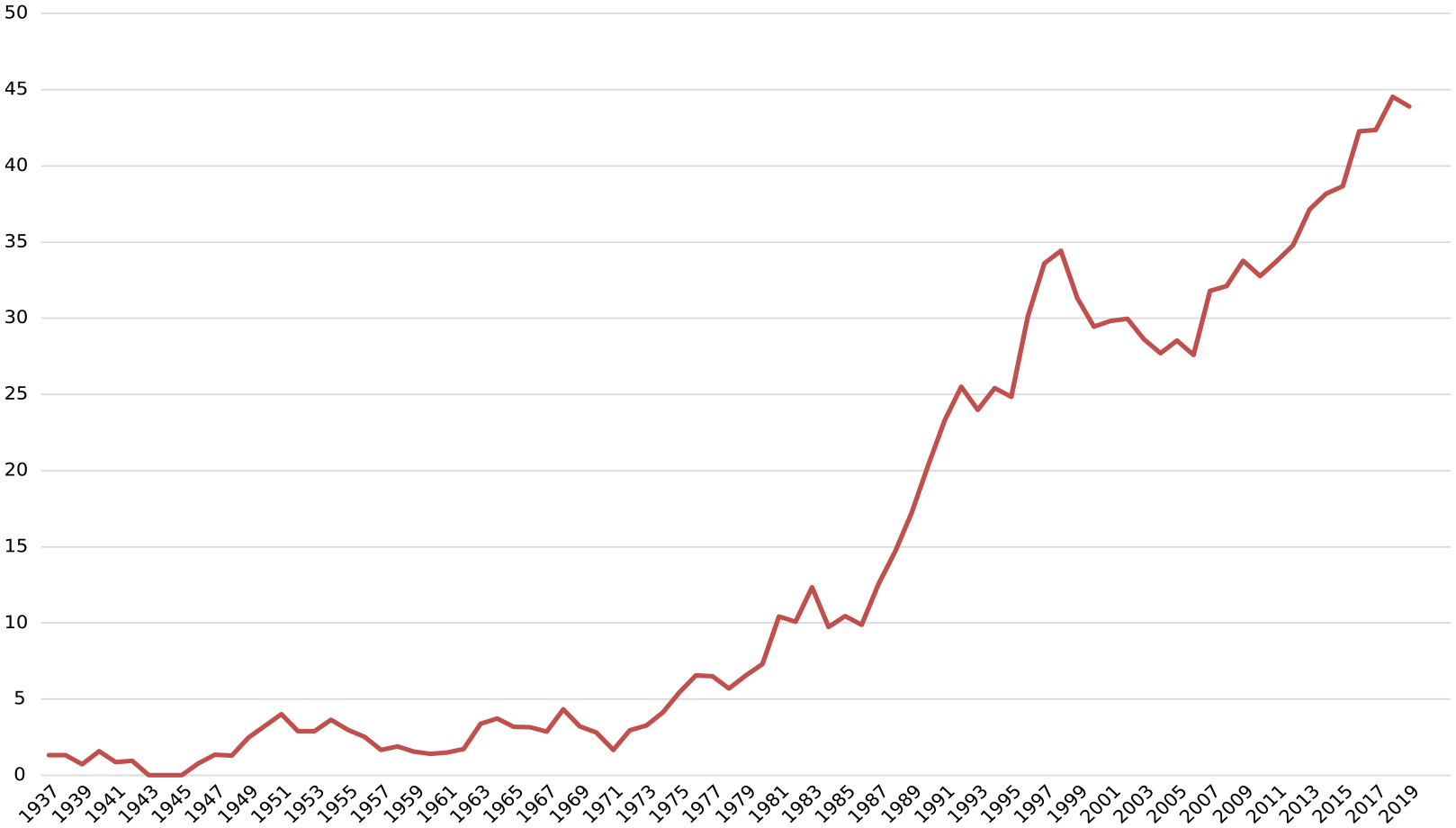
Number of sampled publications normalized by total number of publications in WoS communication category (in ‰, 3-year sliding averages).
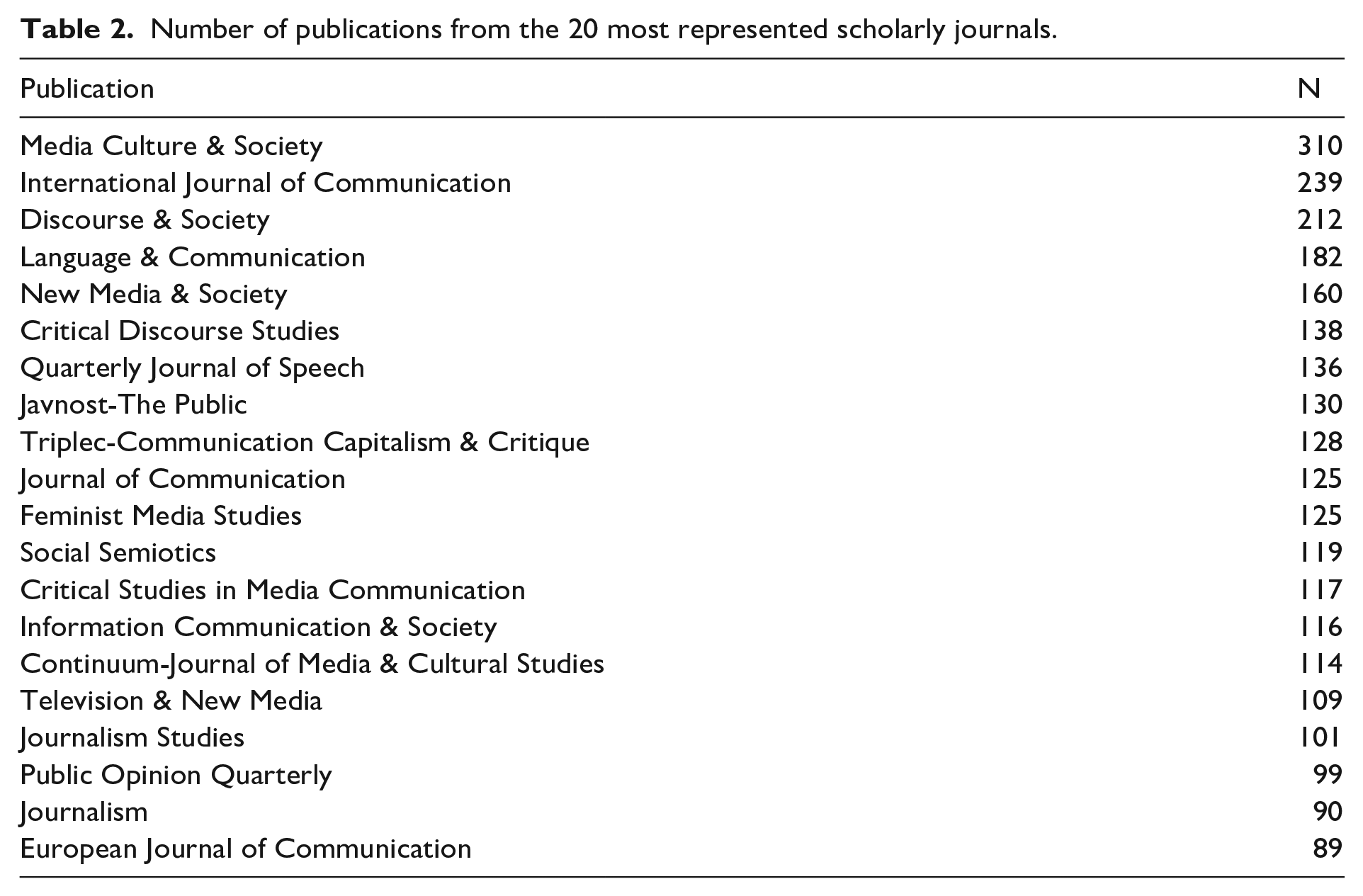
The list of most represented journals (Table 2) shows a diverse spectrum of publications, ranging from critically oriented journals (Media, Culture & Society tops the list) to several more mainstream publications (e.g. Journal of Communication, New Media & Society, and Public Opinion Quarterly) to several journals focused on language and discourse (most notably Discourse & Society), with Triple C being the only journal with a largely Marxian orientation.
Number of publications from the 20 most represented scholarly journals.
Data Preparation, Analysis, and Visualization
To identify the deeper structural and dynamic features of the conceptualizations of Marxism, the analysis identifies the patterns of co-occurrence of indicators—the most prominent concepts and cited authors in the sample of articles. Because the data from WoS on cited authors were not fully standardized and cited authors appeared with different labels (e.g. McChesney RW, McChesney Robert W, McChesney Bob, McChesney W Robert, etc.) and standardizing the entire dataset of 130,032 unique entries of cited authors would be an impossibly labor-intensive procedure, a more pragmatic approach was taken that focused only on standardizing the most prominent authors. An arbitrary cutoff was set for frequency that included a number of authors closest to 1000. This was 26 citations and resulted in the inclusion of 956 top authors, accounting for 17% of all 321,067 citations prior to the standardization process. Special attention was paid to standardizing synonyms (different name entries for the same author) and homonyms (same name entries for different authors).
To identify the subject of a given scientific paper, the list of keywords used in the articles was extracted and used to identify the concepts and traditions, of which those that occur at least five times were identified and used in the automatic search procedure to identify their presence in the titles and articles.
The visualization of the network is done with Gephi software using the MultiGravity ForceAtlas 2 energized algorithm, which distributes the nodes within the network according to the vector generated by two opposing forces: the attraction force, based on the edge weights of the nodes, and the repulsion force, generated by neighboring nodes (Jacomy et al., 2014). In this way, nodes that co-occur more frequently and co-occur with a larger number of other nodes are drawn closer together, while those that co-occur less frequently are drawn farther apart. In the graph, the size of the node labels is proportional to the eigenvector index (from 0 to 1), which represents the centrality of a given node in the network, with the maximum value indicating absolute centrality. The degree value, on the contrary, indicates importance, based on the number of unique connections to other entities in the network. The co-occurrence of concepts and cited authors in the same article is visualized by links, where the width is proportional to the frequency of co-occurrence, which is called the weight.
Clusters or groups of nodes within a network are identified based on the structural properties of the network and the distribution of edges connecting them. Modules consist of nodes with a higher concentration of strong edges among them and are separated from neighboring clusters by a weaker and smaller number of edges (Blondel et al., 2008). The modularity index measures the strength of the partitioning of the network into modules, with a higher index indicating a more fragmented network with denser connections between certain groups of nodes and weaker connections between neighboring groups. The resolution parameter, however, determines the sensitivity of the algorithm and indicates the number of modules.
Results
Prominence of Authors and Concepts
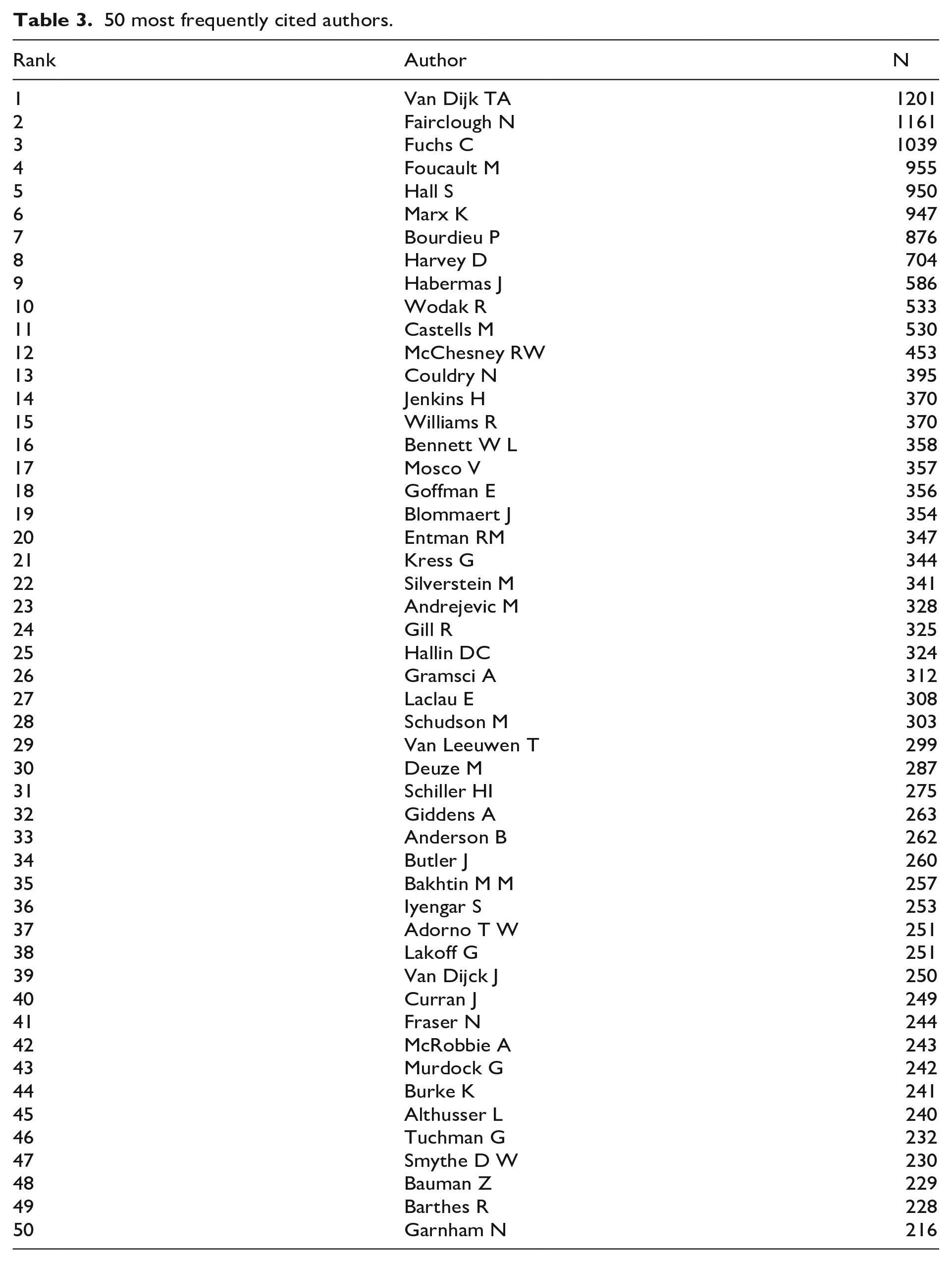
The most frequently cited scholars (Table 3) are from the critical discourse tradition, with Teun A. Van Dijk and Norman Fairclough ranking first and second, followed by Christian Fuchs. Although Marxian scholars figure prominently on the list (Christian Fuchs, Stuart Hall, Karl Marx, and David Harvey are among the top 10), the list does not consist solely of Marxian scholars or even exclusively of critical scholars.
50 most frequently cited authors.
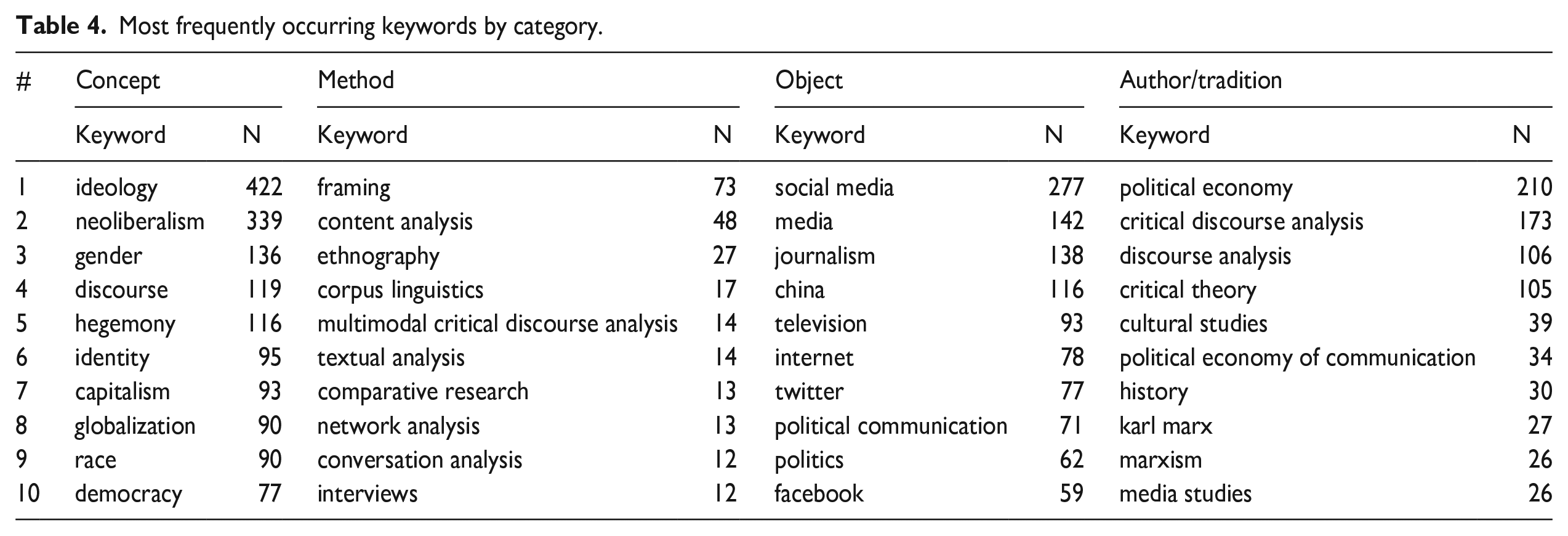
Looking at the most frequently occurring keywords by category (Table 4), 1 we find that by far the most prominent concepts are ideology and neoliberalism, while the most frequently mentioned traditions or schools of thought are political economy and critical discourse analysis. In all its various forms (critical discourse analysis, discourse analysis, cda, etc.), discourse analysis is mentioned 338 times, political economy in various forms is mentioned 279 times, while Marxism and Marxists are mentioned 124 times.
Most frequently occurring keywords by category.
If we focus specifically on the citations of Marxist authors over time (Chart 3), 2 we can see that there are almost no citations of Marxist authors until 1979. There are only 6 years in which a Marxist author is cited at least once so that an average of 0.1 Marxist authors are cited per year during this period. From 1979, the taboo against Marxism was not lifted, but it became somewhat less strict, because between 1979 and 1990, there are 5 years in which Marxists are cited at least 10 times, and the average number of annual citations in this period increases to 8.6. With the end of the Cold War, the taboo was relaxed even further, as in the period 1990–2008, Marxist authors were cited more than 50 times in three instances, with an average annual citation rate of 39.4. However, with the onset of the Great Recession, we are seeing a rapid increase in interest in Marxism, as the number of citations peaks in 2018 at 1055, and the average number of annual citations during this period is 419.7.
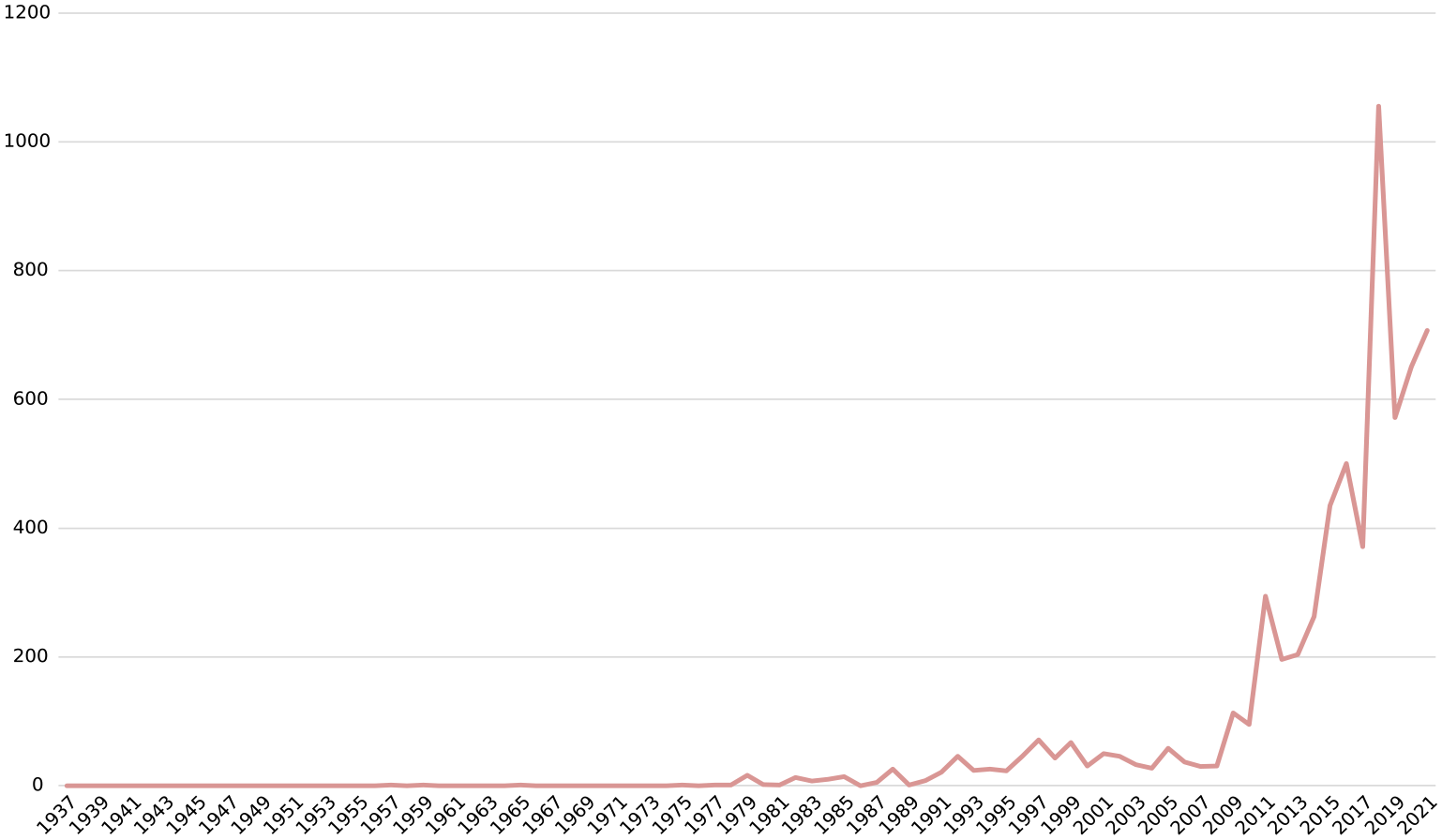
Annual citations of Marxist authors (3-year sliding averages).
If we normalize the number of citations to account for the increasing number of publications over time (Chart 4), we can see three periods. The first is the last decade of the Cold War, when citations of Marxists slowly increase. The second period is the 1990s, when we see a boom in citations of Marxists after the end of the Cold War, peaking in 1999. The 2000s represent a slump, as by 2008, the citation rate of Marxist authors has returned to Cold War levels. Finally, there is another boom in the wake of the 2008 global recession.
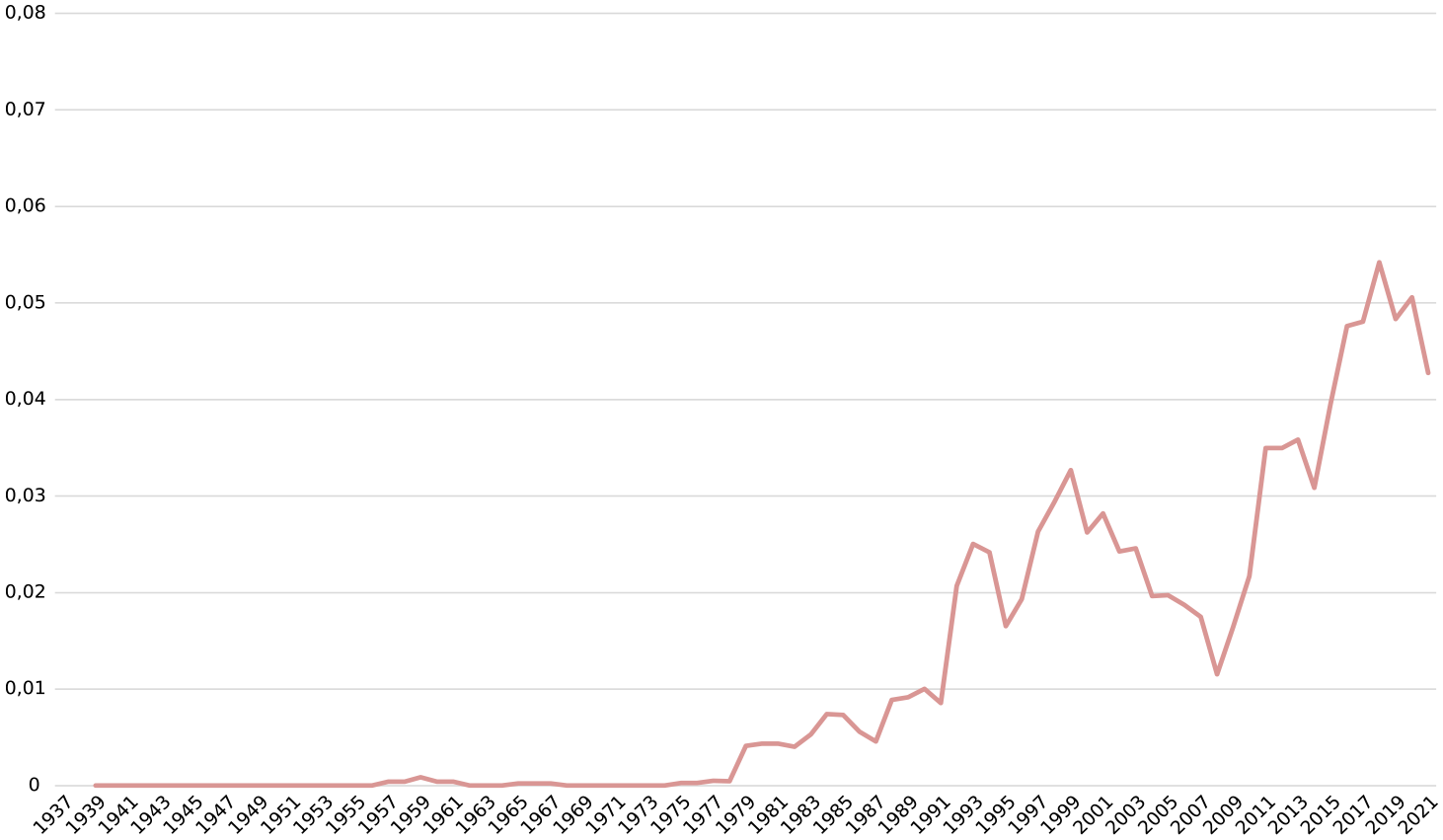
Annual citations of Marxist authors normalized by total number of publications in WoS Communication category (in ‰, 3-year sliding averages).
Four Marxists stand out from the others in the number of citations: Christian Fuchs, Stuart Hall, Karl Marx, and David Harvey. Looking at the number of normalized annual citations from 1980 onward (Chart 5), we find that the boom in the 1990s is primarily due to increased interest in the works of Stuart Hall, while the boom after 2008 is more diverse and heavily influenced by the meteoric rise of Christian Fuchs as well as renewed interest in the works of Karl Marx.
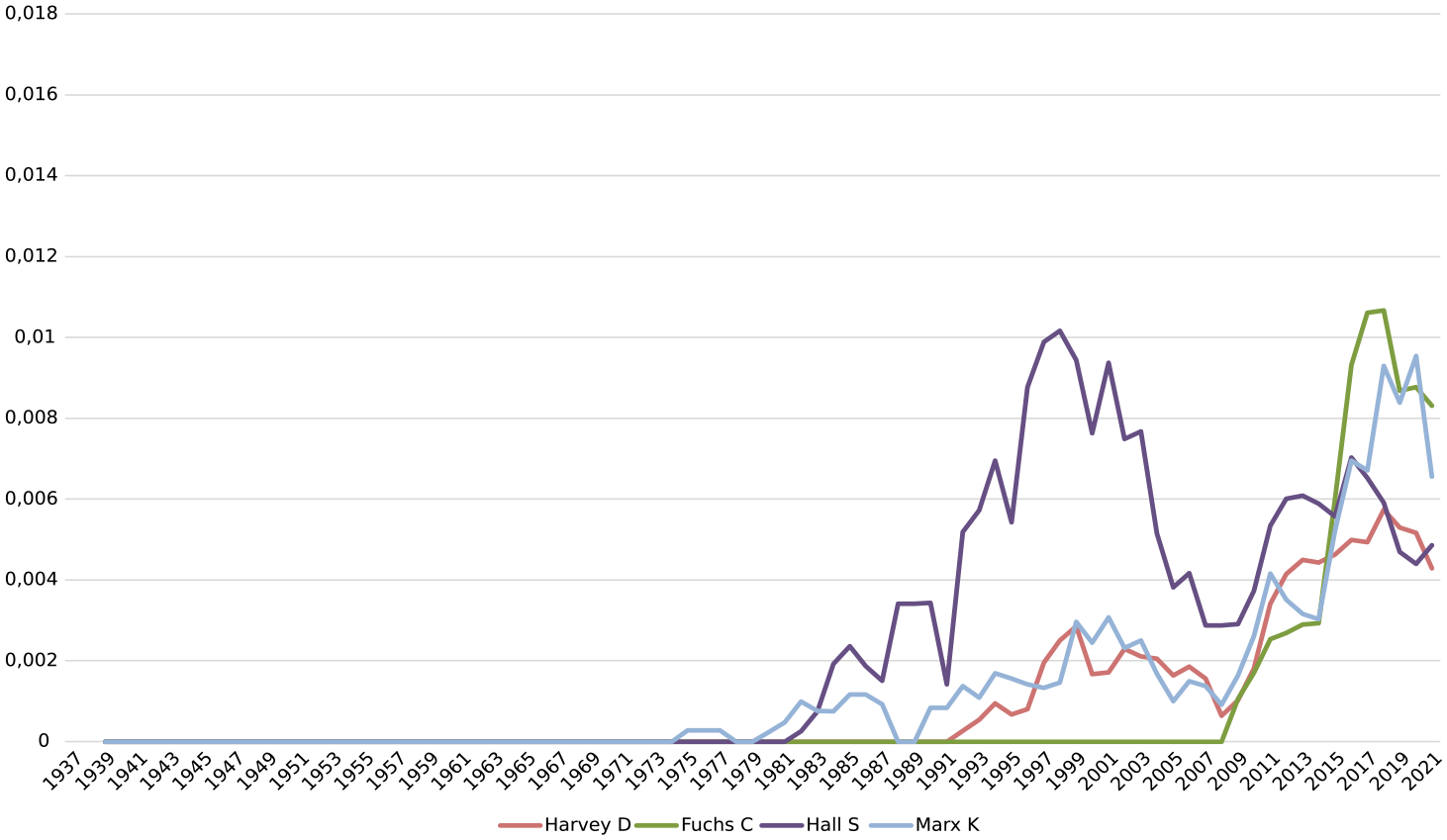
Annual citations of the four most cited Marxist authors normalized by total number of publications in WoS communication category (3-year sliding averages).
Mapping the Field: Five Clusters Shaped by Marxism
The clustering procedure performed on the entire dataset of 1007 nodes (858 authors cited and 149 concepts) connected by 173,724 links resulted in five clusters (modularity algorithm res. = 0.95; Figure 1): Theories of Democracy (purple), Political Economy of Communication (light green), Critique of Power Relations (orange), Feminism and Antiracism (dark green), and Critical Discourse Analysis (blue).
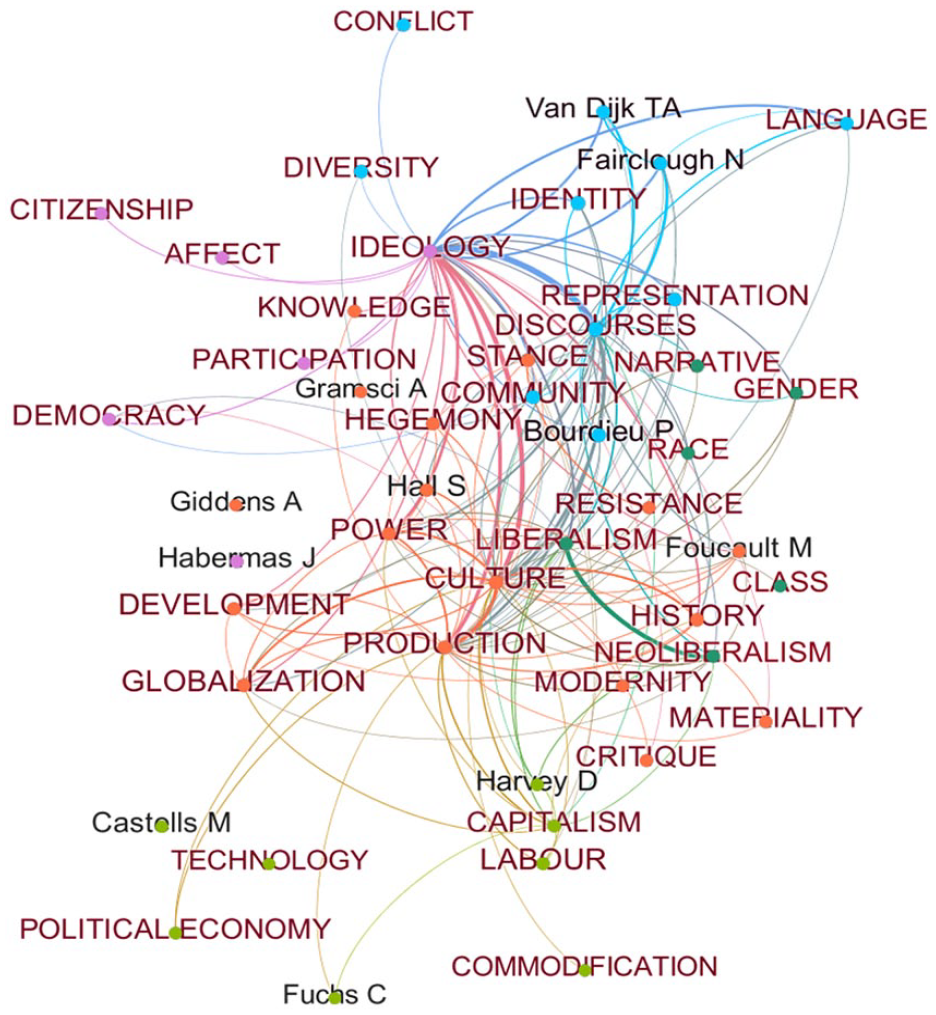
Reduced network of clustered 60 co-cited authors and concepts (min. degree = 701) and edges (min. weight = 125.8) in 7007 publications.
The five clusters can be divided into three groups according to how they relate to Marx’s concepts (Figure 2). The first group, containing only the cluster Theories of Democracy, was included in the sample primarily because of contested concepts, that is, because different research traditions use the same concepts in different ways. Such a result suggests a lack of contact between traditions rather than mutual influence. A second group, which includes the Feminism and Antiracism and Critical Discourse Analysis clusters, adopts and adapts Marxian vocabulary, but without belonging to the Marxian tradition. In this case, we see that neighboring traditions are influenced and selectively borrow concepts from Marxism while pursuing their own research agenda. Finally, we have two clusters that can be considered Marxian, namely the Political Economy of Communication and the Critique of Power Relations.
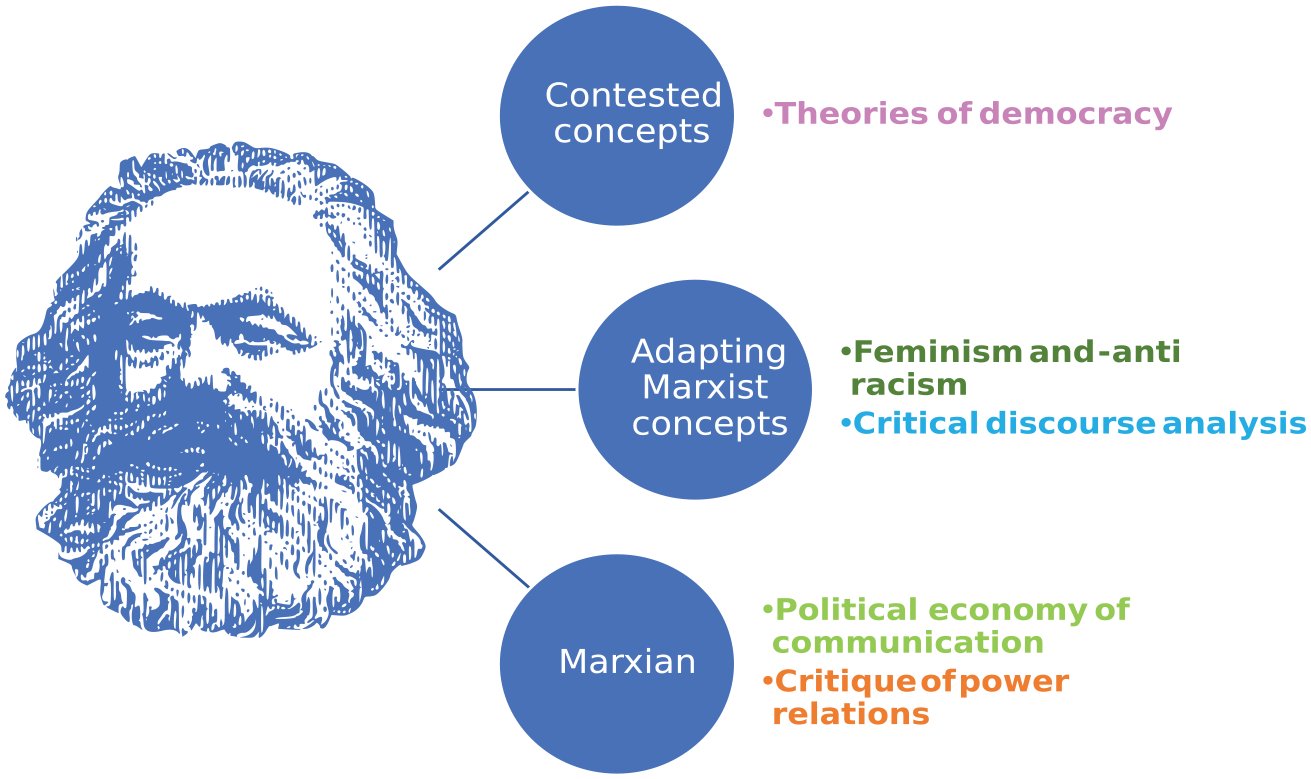
Three groups of clusters influenced by Marxist concepts.
Theories of Democracy
Centering on the concept of ideology, which is not only the most central node of the cluster but also of the entire network, 292 nodes form the largest cluster of the network. The cluster can be divided into two groups. The first is the public sphere group and includes journalism studies, theories of the public sphere, and the sociology of news. Among the representatives of journalism studies, we find M. Schudson (eigenvector centrality = 0.768), D. C. Hallin (0.765), M. Deuze (0.744), J. Curran (0.743), H.J. Gans (0.663), associated with concepts such as objectivity (0.744), ethics (0.720) and freedom (0.702). Theories of the public sphere include J. Habermas (0.908), P. Dahlgren (0.663), L. Van Zoonen (0.602), and the concepts of democracy (0.930), citizenship (0.898), public sphere (0.675), and deliberation (0.577). Finally, in the sociology of news, the authors T. Gitlin (0.740), J. B. Thompson (0.740), and G. Tuchman (0.737) are among the most prominent.
The political communication group, composed of political scientists such as W. L. Bennet (0.803), P. Norris (0.596), and S. Iyengar (0.586), is in the upper part of the cluster, with the framing theory of R. M. Entman and the agenda-setting theory of Maxwell E. McCombs and Donald E. Shaw playing an important role. At the edge of the cluster are the most prominent representatives of the political communication tradition, such as S. Iyengar S. (0.586), E. Katz (0.575), K. Krippendorf (0.504), W. Lippmann (0.494), D. A. Scheufele (0.447), J. Zaller (0.400), and P. E. Converse PE (0.294), collocating closely with the concepts of trust (0.666), populism (0.600), propaganda (0.500), polarization (0.476), public opinion (0.465), political participation (0.331), and partisanship (0.246).
This cluster is only partially related to critical theory and mostly not related to Marx at all. The reason for this lies in the use of contested concepts, in our case especially the term ‘ideology’. While it is generally used in the Marxist tradition to refer to a systematically generated false consciousness in the service of the ruling class, it is used much more neutrally in the empirical political science tradition to describe a consistent set of ideas or a worldview. The extensive use of the ideology concept by administrative scholars is perhaps best illustrated by the example of S. Iyengar, who made the fourth strongest connection to the concept within the cluster (co-occurring in 117 research articles and/or book chapters).
The division between the Theories of Democracy cluster and the Marxian clusters is based on a division between the theories of the public sphere (belonging to the former cluster) and the Political Economy of Communication (belonging to the latter) and is illustrated by the positions of the representatives of the theory of the public sphere (such as Curran, Golding, Sparks, Fenton, Schlesinger, Splichal, Cammaerts), located in the lower right section of Figure 3, and the representatives of the political economy of communication (such as R. McChesney, Y. Zhao, V. Pickard, and D. Freedman, among others), who are in the upper right section of the Political Economy of Communication cluster (Figure 4).
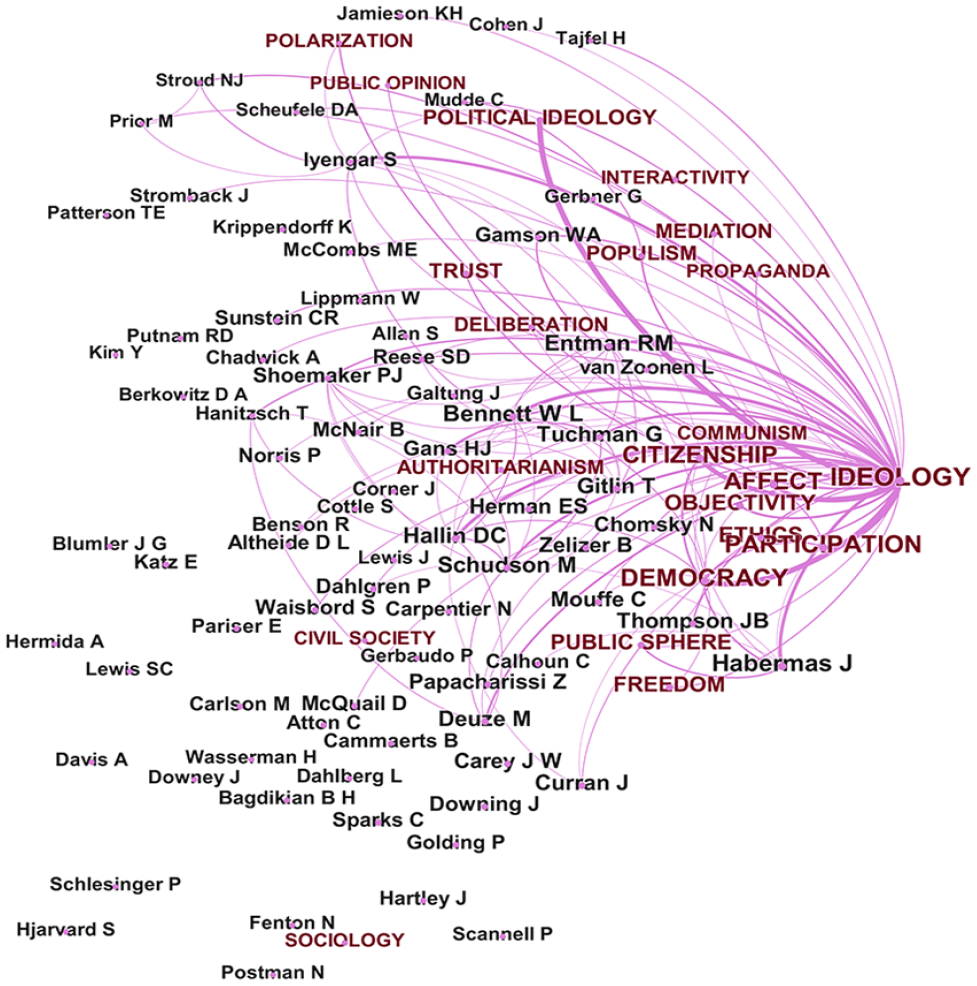
Theories of democracy cluster reduced (5% of units visible, n = 51, network reduction parameters: min. degree = 464; min. edge weight = 30.12).
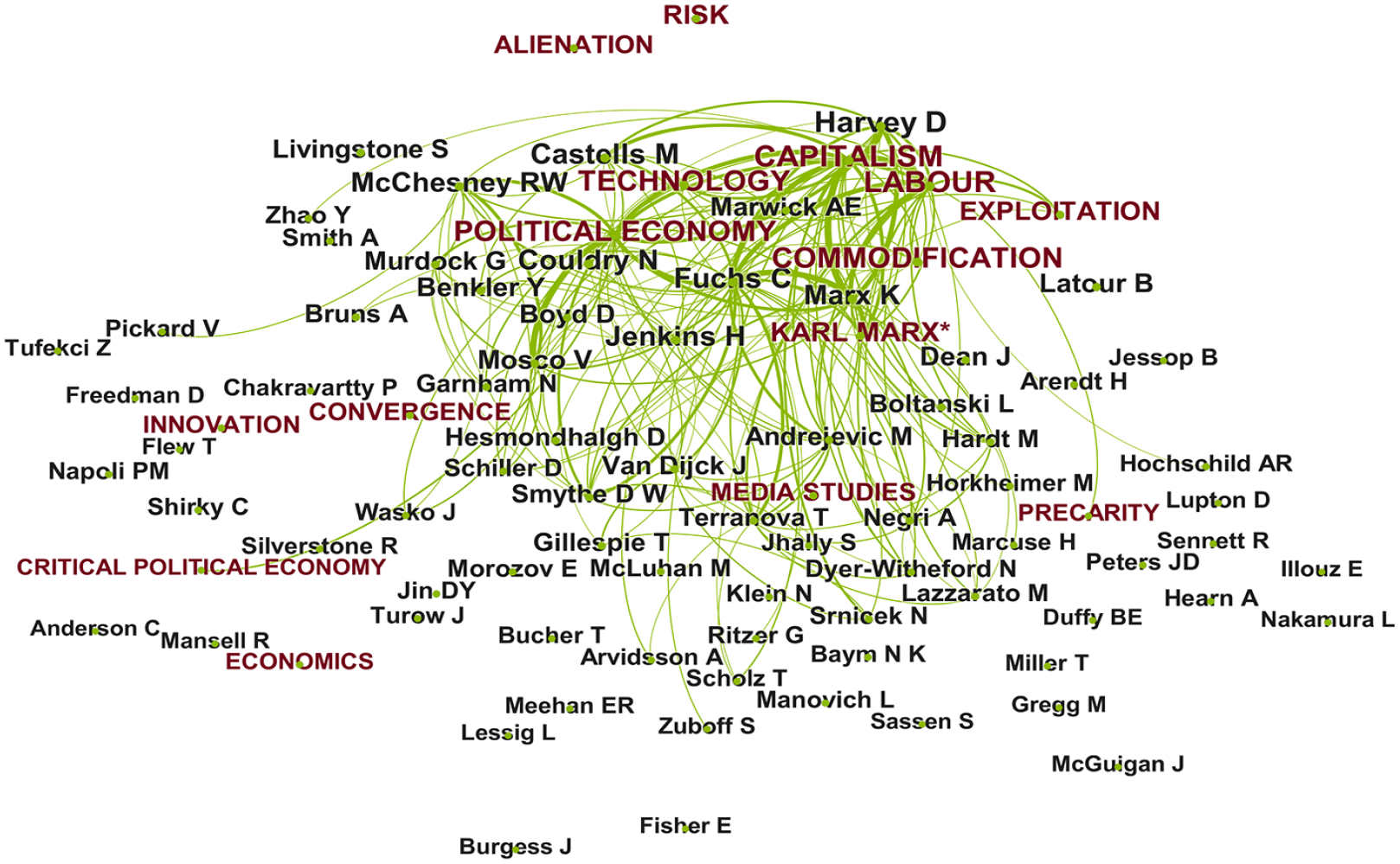
Political economy of communication cluster reduced (5% of units visible, n = 51, network reduction parameters: min. degree = 457; min. edge weight = 30.12).
This divergence is due in part to the presence of ‘mainstream’ and neutral terms that frequently co-occur with the public sphere, including ideology (43 articles), democracy (41), participation (21), citizenship (27), civil society (7), which separate the public sphere from the Political Economy of Communication cluster.
Political Economy of Communication
The second largest cluster (Figure 4) relates to the political economy of communication and contains 23% of all nodes in the network. It contains key terms from Marx’s vocabulary, such as labor (0.944), capitalism (0.924), commodification (0.863), exploitation (0.716), and alienation (0.651). In addition, this cluster also includes terms related to technology (0.862), convergence (0.602), innovation (0.572), and digital capitalism (0.409), indicating the presence of scientific thinking about the effects and changes in labor relations due to (new) technology. The cluster includes the founders of Marxism, K. Marx (0.807) and F. Engels (0.391), classical representatives of the political economy of communication such as R. W. McChesney (0.790), V. Mosco (0.746), G. Murdock (0.694), D. W. Smythe (0.688), N. Garnham (0.623), D. Schiller (0.614), and the ‘younger’ generation of scholars concerned with the problems of digital capitalism, represented mainly by C. Fuchs (0.862).
However, when it comes to technological changes in communication and labor relations brought about by (new) technologies, non-Marxist authors are most frequently represented, for example, M. Castells (0.875), H. Jenkins (0.839), and S. Livingstone (0.693).
Critique of Power Relations
The critique of power relations is a very heterogeneous cluster (Figure 5), comprising 109 nodes (83 authors and 26 concepts) from several different traditions: critique of cultural imperialism (with authors such as Oliver Boyd-Barrett, Kaarle Nordenstreng, and Daya Thussu on the left), Cultural Studies (with Stuart Hall and Antonio Gramsci at the top), Postcolonial Studies (with Gayatri Spivak and Frantz Fanon on the upper right), a number of different representatives of philosophy grouped around the keyword Foucault (with Baudrillard, Deleuze, Benjamin, Debord, and Lyotard at the bottom right), and Critical Theory (with Adorno, Žižek, and Eagleton) in the middle.
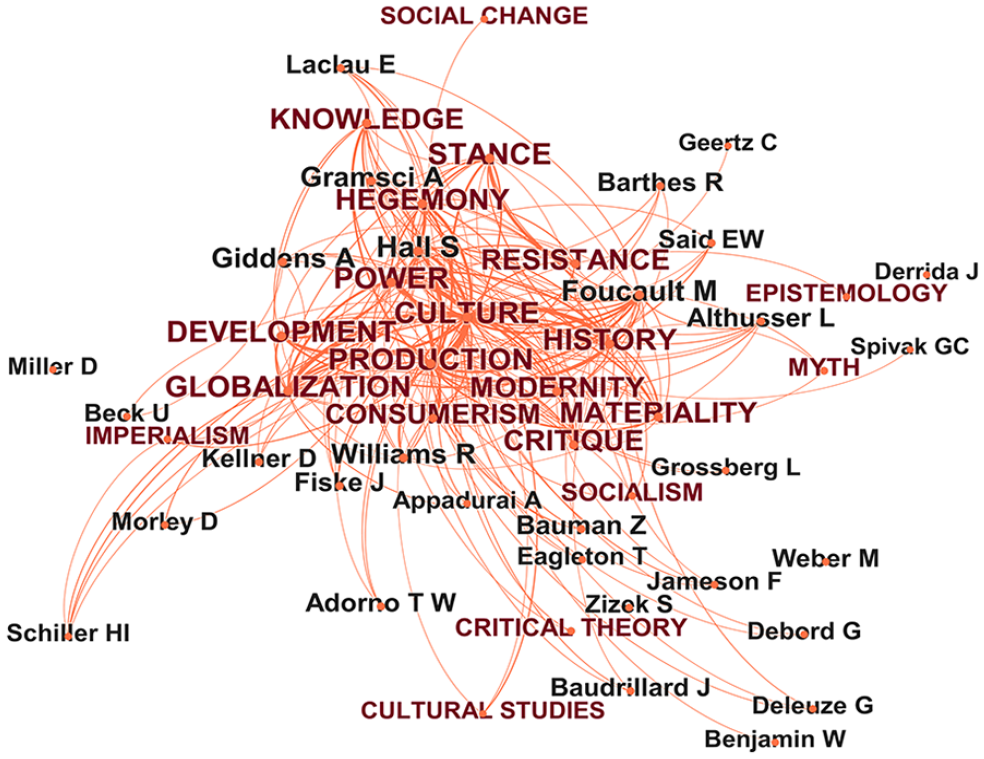
Critique of power relations cluster reduced (5% of units visible, n = 51, network reduction parameters: min. degree = 449; min. edge weight = 30.12).
Central to this cluster are concepts and authors concerned with power relations (0.991) and hegemony (0.943), reflected in the concepts of culture (0.997), production (0.993), history (0.991), knowledge (0.919), resistance (0.904), and materiality (0.902) and consumerism (0.825). The cluster’s most central concepts serve as a shared vocabulary between different strands of critical thinking, resulting in the cluster overlapping with other clusters. While the left segment of the cluster includes representatives of the international political economy of media (H.I. Schiller, D. Thussu, O. Boyd-Barrett, and K. Nordenstreng, as well as concepts denoting (cultural) imperialism), it is located between representatives of the public sphere and political economy traditions, suggesting theoretical complementarity. This is correspondingly true for the right-hand segment of the cluster, which overlaps with the cluster of Feminism and Antiracism.
Feminism and Antiracism
The overlap of the Feminism and Antiracism cluster (113 nodes/11%, Figure 6) with the previous cluster shows that feminist critique and critique of gender and racial discrimination does not emerge as a theoretically distinct tradition but is closely linked to the research subject through critiques of hegemony, power, resistance, and (post)colonial practices. While the most frequently cited author within the cluster is a Marxist-oriented feminist, Nancy Fraser (0.803), located near concepts of neoliberalism (0.920), class (0.871), and austerity (0.376), suggests a Marxist intellectual basis for critiquing the discriminatory practices mentioned above, but has not developed into a prominent Marxian current. Rather, the critique of feminist, gender, and racial discrimination is an amalgamation of various critical traditions.
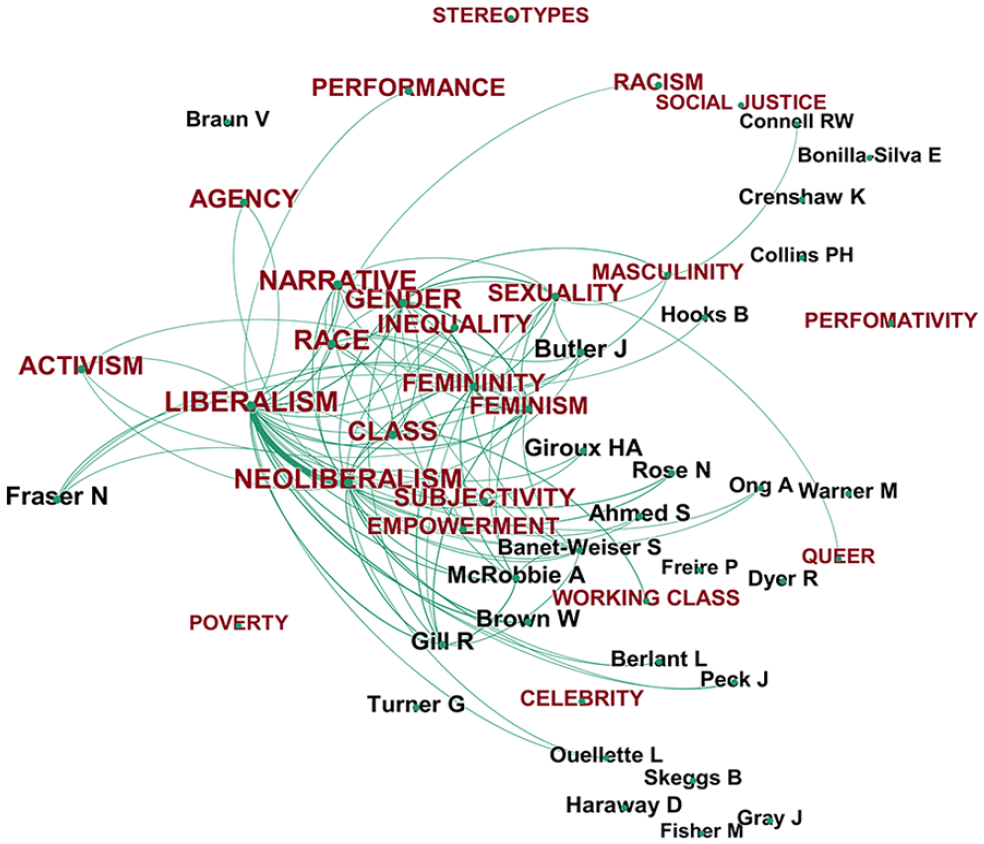
Feminism and Antiracism cluster reduced (5% of units visible, n = 51, network reduction parameters: min. degree: 322; min. edge weight = 30.12).
Critical Discourse Analysis
The Critical Discourse Analysis cluster (Figure 7) is the third largest cluster and contains 21% of the nodes (212 nodes; 26 concepts, 186 authors cited), mainly authors and ideas prominent in literary theory, literary criticism, and semiotics, such as Mikhail Bakhtin (0.624) and Gunther Kress (0.721), which also overlap with the Critique of Power Relations and Feminism and Antiracism clusters. On the side, adjacent to the Theories of Democracy cluster, the boundary is more pronounced. The most prominent common nodes with Theories of Democracy cluster appear to be shared concepts such as ideology, particularly the connections between ideology and discourses (833), ideology and language (386), ideology and identity (331).
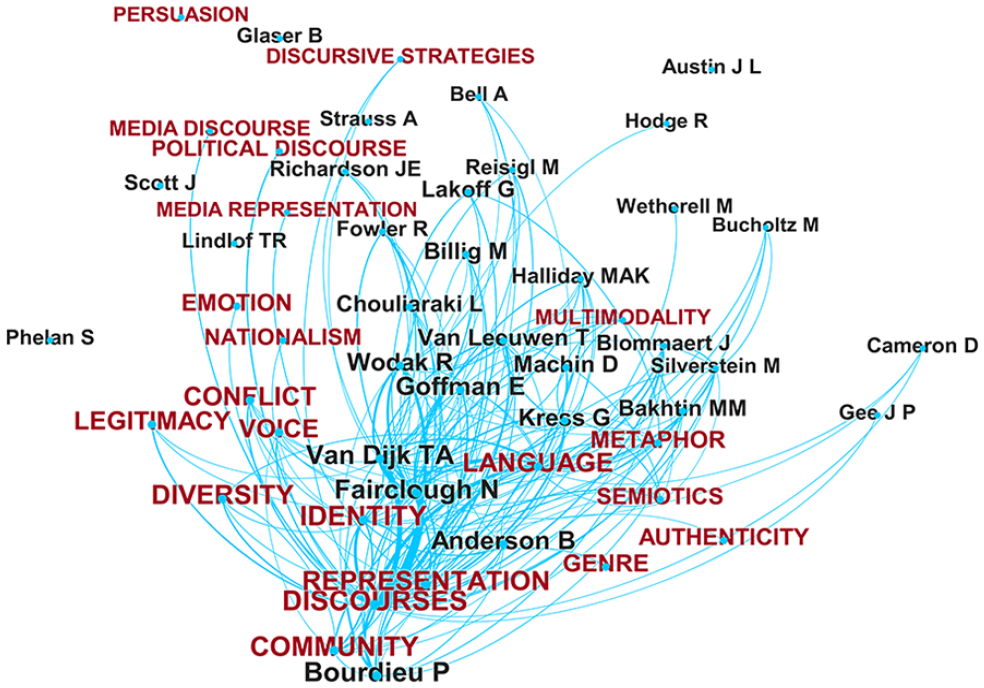
Critical discourse analysis cluster reduced (5,1% of units visible, n = 52, network reduction parameters: min. degree = 349; min. edge weight = 30.12).
The strongest connections between this cluster and the political economy cluster are between discourse and capitalism (158), D. Harvey and discourses (136), discourses and labor (92), P. Bourdieau and capitalism (76), capitalism—community (65), K. Marx and discourses (57).
The Influence of Marxian Concepts
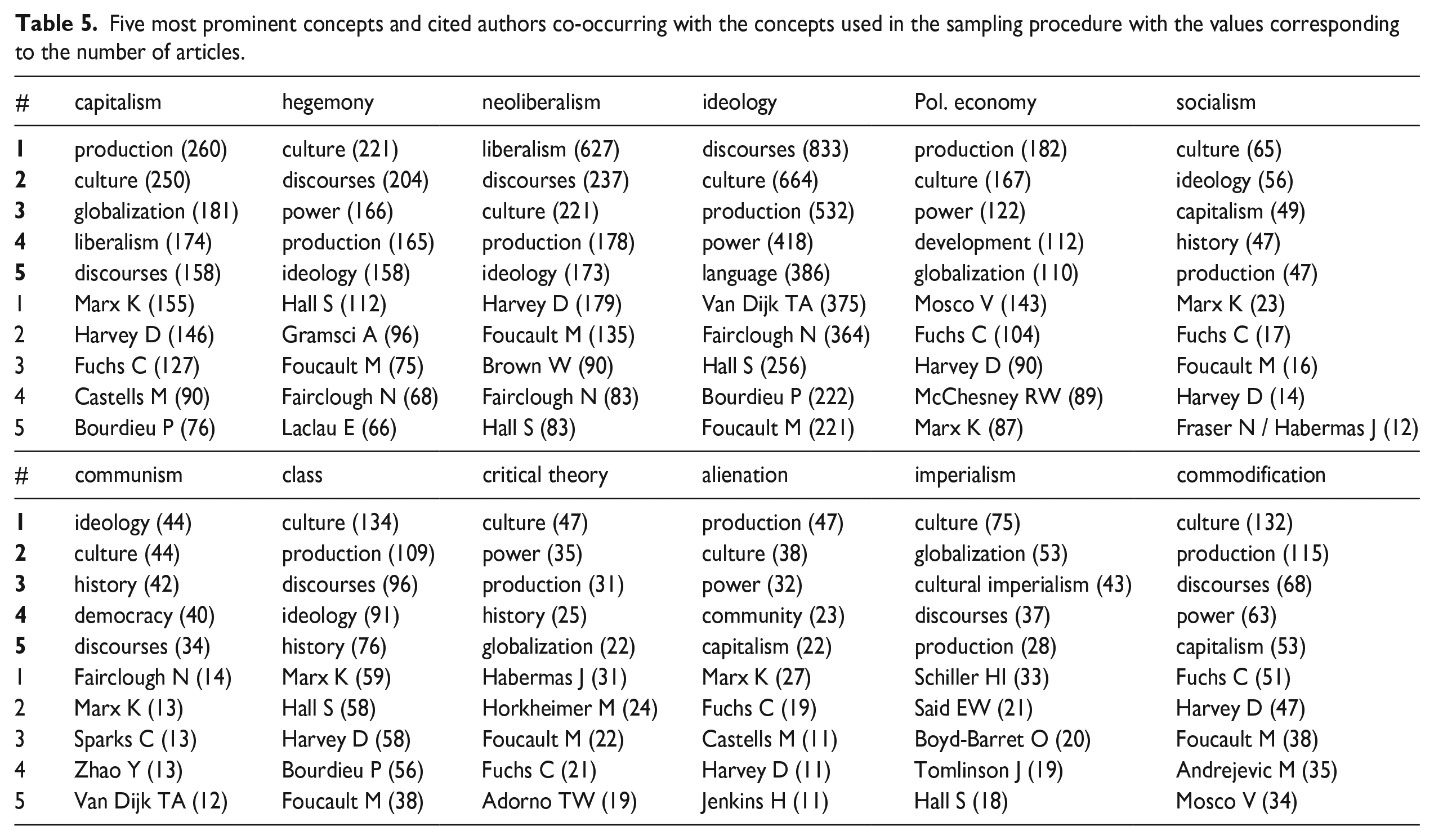
Examination of the links between most of the selected Marxian concepts used in the sampling procedure and the five most frequently cited authors and concepts shows that there is almost no Marxian concept that can be assigned to a single cluster or tradition in communication studies. The most unique concepts are those that denote specific (critical) traditions, such as political economy or critical theory. However, the results suggest that alienation could be considered one of the most unique concepts in the Marxian tradition of Political Economy of Communication. However, terms such as ideology, hegemony, neoliberalism, capitalism, imperialism, communism, and commodification frequently co-occur with concepts from critical discourse analysis and with authors from this tradition such as Teun A. Van Dijk and Norman Fairclough, indicating the extensive use of Marxian vocabulary in critical discourse analysis (Table 5).
Five most prominent concepts and cited authors co-occurring with the concepts used in the sampling procedure with the values corresponding to the number of articles.
A Renaissance of Marxian Scholarship? Summary and Discussion
We have traced the prominence of Marxian authors and concepts in the mainstream of international scientific literature as represented by publications indexed in WoS database. We find that Marxian thought is barely present in the mainstream of communication studies during most of the period, as there are only six references to Marxist authors in our sample in all years before 1979. We note that the taboo against Marxist authors and concepts slowly began to dissipate in the 1980s, when we observe few and sporadic references to Marxist authors. After the end of the Cold War, we can observe three distinct periods: a first boom in the 1990s, driven mainly by the growing interest in Stuart Hall; a slump in the 2000s, when the citation rate of Marxist authors fell back to Cold War levels; and finally, another boom after the global recession of 2008, driven by the growing interest in the works of Christian Fuchs as well as a renewed interest in the works of Karl Marx.
We note that Marx and Marxists were barely present in WoS until the second half of the 1980s. We believe that two factors played a role in this trend. The first is the Cold War, in which Marxism was associated with the ‘enemy’ and direct references to Marx could severely damage opportunities for career advancement and research funding. Two examples are the McCarthyite witch hunts in the United States and the Radical Decree passed by Willy Brand’s government in 1972, which banned political extremists from employment in the civil service and in practice closed the doors of universities to Marxist scholars (Robes, 1990: 295). Dallas Smythe (1994) was monitored or investigated five times by FBI before he left the United States for Canada in 1963—that is, before he radicalized to explicitly anti-capitalist and Marxist views in the 1970s. The second reason is that communication studies were institutionalized in the United States under the overwhelming influence of governmental—primarily military—funding, which shaped the nascent discipline’s research agenda and steered it toward the study of propaganda or, as it was euphemistically called, effects.
By the 1980s, however, Marxian thought was slowly gaining access to mainstream academic publications. By this time, the critical paradigm had been institutionalized in some universities (Birmingham and Glasgow) and students of the pioneers of political economy had entered the academic world. Critical thinking was institutionalized in new journals (notably Media, Culture & Society, the journal most represented in our sample), new schools of thought emerged (notably critical discourse analysis and social semiotics), while some traditions that had gained prominence in the 1970s reached their peak (as we show in Mance and Slaček Brlek, 2022, this was the case with the critique of cultural imperialism). In the period from 1979 to 1991, most of the publications in our sample (108 out of 168) are book reviews, which may indicate that opportunities for Marxian scholars to publish in mainstream international journals were still severely limited and they had to find other outlets for their work, while at the same time mainstream journals began to at least acknowledge the work of radical thinkers.
The end of the Cold War allowed for freer expression of Marxian viewpoints, which was reflected in a proliferation of publications featuring Marxian keywords and citations of Marxist authors. After the boom of the 1990s, there is a slump in the 2000s, as the normalized number of citations of Marxist authors falls to Cold War levels. The second Marxian boom follows in the wake of the Great Recession beginning in 2008, which, as the most significant crisis of capitalism since the Great Depression, refuted the notion of capitalism’s ultimate triumph in 1991, focused attention on capitalism’s structural weaknesses, and encouraged the search not only for critical but also for radical anti-capitalist viewpoints. Marx’s portrayal of capitalism as a system inherently prone to crisis because of its internal contradictions was seemingly confirmed by the course of history.
Our analysis shows how radical thought grows out of the soil of radical politics. As we showed in the introduction, Frankfurt School Marxism was inextricably intertwined with working class politics in Weimar Germany and could not survive when the Institute’s ties to that social context were cut. Nor can the emergence of critical theory be understood without the context of social movements, working-class militancy, and Third World challenges to US hegemony, which not only motivated scholars to seek theoretical explanations for these phenomena, but also enabled radical thinkers to gain positions in academia, as was the case with Herb Schiller (Maxwell, 2003). Similarly, the post-2008 resurgence of Marxian thought is linked to the spectacular failure of capitalism during the Great Recession and its steady descent into ecological catastrophe, which triggered a search for theories that dared to call capitalism not only flawed but a fundamentally unsustainable social system, and that sought to look beyond it for possible alternatives. The growing interest in Marx, however, was motivated not only by intellectual curiosity, but was also fueled by social movements that questioned not only austerity measures, but also the existence of a social system that was bleeding hospitals, schools, and libraries dry to pay for financial speculation run amok.
We identified five clusters: Theories of Democracy, Political Economy of Communication, Critique of Power Relations, Feminism and Antiracism, and Critical Discourse Analysis. While only two of the five clusters—Political Economy of Communication and Critique of Power Relations—have a strong Marxian presence, the other three clusters share at least some Marxist vocabulary. In the case of the Theories of Democracy, the main contested concept is ideology. The term goes back to Antoine Destutt de Tracy, who coined it in 1796 to refer to the systematic study of ideas. While Marx later took up the pejorative meaning of the term and the concept was further developed by Marxists to refer to the mechanism by which the ruling class seeks to justify its dominant position in the realm of ideas, other meanings have survived in other research traditions. In the political science tradition, the term is used descriptively to refer to more or less coherent political ideas held by individuals or promoted by political organizations, social movements, or states. In this case, the shared vocabulary cannot be taken to indicate an influence of Marxism on empirical political science or vice versa, but rather that these traditions are developing in parallel and that it is precisely the lack of contact that allows very different meanings of concepts to coexist without friction.
In the case of the Feminism and Antiracism and Critical Discourse Analysis clusters, shared vocabularies are indicative of the influence of Marxism on related research traditions. It remains to be determined to what extent the adoption and broader use of Marxist concepts in various non-Marxian traditions leads to a (re)appropriation of their meaning and a neutralization of their radical point, rendering them ineffective in penetrating ‘the armour of the Establishment’ (Marcuse, 2000 [1969]: 8, 73). As many authors note, terms such as ‘capitalism’ (Boltanski and Chiapello, 2005: ix, xi), ‘alienation’ (Williams, 2015 [1976]), ‘ideology’ (Downey and Toynbee, 2016), ‘hegemony’ (Kincheloe and McLaren, 1998), and ‘public opinion’ (Splichal, 1999) have been replaced and degraded to the point where their explanatory power has been neutralized (Downey and Toynbee, 2016) and (therefore) disappeared from the political, trade union, and journalistic vocabularies (Garland and Harper, 2012). Our analysis cannot answer the question of the extent to which Marxian concepts are transformed and reinterpreted as they are adopted by neighboring traditions. For that, the quantitative analysis needs to be complemented by more in-depth qualitative studies of the transformations that concepts undergo as they move between traditions.
Our findings support the two Marx thesis, which states that the old Marx of Capital, with its focus on economics, inspired the political economy of communication, while cultural studies wear the mantle of the young Marx, the Marx of the German Ideology and the Economic and Philosophical Manuscripts, with their focus on culture and ideology (Mosco, 2013: 24). The political economy of communication forms a distinct cluster, defined by keywords such as exploitation, commodification, labor, and capitalism. Cultural studies, however, are the center of the other Marxian cluster, defined by keywords such as hegemony, culture, and knowledge. Within this cluster, however, there is another dimension, as it includes theories of cultural imperialism as well as postcolonial studies. The presence of these schools of thought underscores the importance of Marxism in interpreting international inequalities and relations of exploitation and domination.
Although the tradition of cultural imperialism can be considered part of the political economy approach, it presents itself as a relatively distinct grouping in our analysis and belongs to the same cluster as cultural studies and postcolonialism. Cultural imperialism and postcolonialism represent significant research traditions that can only be partially traced back to Marx, but nevertheless work within a Marxian framework by relating class exploitation to imperialist and colonial exploitation and using Marxian concepts (such as cultural imperialism or the subaltern, a term borrowed from Gramsci). Even in this case, however, one could argue for a dichotomy between economics and culture, with postcolonialism focusing primarily on the cultural aspects of colonial domination and the tradition of cultural imperialism focusing more on the economic dimensions of imperialism, such as control over resources and the power of transnational media corporations.
There is another way to look at the relationship between the two clusters: in the political economy cluster, the keywords alienation, commodification, precarity, and exploitation are foregrounded, while in the critique of power relations cluster, the keywords resistance, power, and critique are foregrounded. While political economy considers the working class primarily as an object of the economic system, cultural studies focus primarily on the working class as a subject of resistance, if not revolution. The latter position can be traced to the broader project of authors such as E.P. Thompson (1966 [1963]) and Richard Hoggart (1957), who sought to validate and defend working-class culture against a very deliberate condescension of the ruling class in academia and society. Rather than interpreting the two interrelated Marxian traditions as splits of Marx’s thought that conform to a neat but ultimately artificial periodic categorization of his work, we propose that they represent the terms of the dialectical unity of the working class under capitalism as the object of capitalist exploitation and the subject of social change.
The results illustrate the difficulty in delineating a field of media sociology, as indicated in the introduction, since sociological authors and concepts are prominent in all of the identified clusters. The Theories of Democracy cluster contains representatives of both the sociology of news and keyword sociology, although the most prominent keywords come from the political science tradition. The Political Economy of Communication cluster contains Karl Marx as one of the founding fathers of sociology, but also more recent authors such as Manuel Castells, Luc Boltanski, and Arlie Hochschild, as well as a number of authors who are difficult to classify according to disciplinary boundaries (Herbert Marcuse and Antonio Negri come to mind). The Critique of Power Relations cluster also includes some key sociological authors such as Peter L. Berger, Zygmunt Bauman, Anthony Giddens, and Emile Durkheim. The Feminism and Antiracism cluster includes Luc Wacquant and Eduardo Bonilla-Silva, while the most prominent keywords such as class, inequality, gender, working class, and gender betray a strong sociological focus. Finally, the cluster of Critical Discourse Analysis, mainly influenced by literary theory, linguistics, and social semiotics, and therefore could be considered the most distant from sociology, prominently features Erwing Goffman and Pierre Bourdieu. A distinct sociological approach is not evident in our analysis. Rather, we can observe the interdisciplinary nature of critical communication studies, in which sociology plays a key role.
In conclusion, we note that the five clusters in our analysis are largely informed by approaches from the 1960s and 1970s, with Christian Fuchs emerging as the only scholar of the younger generation among the most cited authors. Moreover, many Marxian research traditions are still absent or only marginally represented. For example, labor process theory is represented in our sample, but only marginally, mainly by Harry Braverman and Michael Burawoy. Neo-Gramscian approaches, which constitute one of the most vital traditions in international political economy (Radice, 2008), are another tradition that is barely represented, as is the Marxian theorization of the social shaping of technology. We note these absences not to diminish the success of Marxian scholars who have brought Marx into the discussion and established his ideas as relevant to the study of communication. We note them to emphasize how much potential for growth and development remains, and in the hope that the increasing interest in Marx’s ideas that we have observed since 2008 is only the beginning of a flourishing Marxian tradition in communication studies.
Footnotes
Declaration of conflicting interests
The author(s) declared no potential conflicts of interest with respect to the research, authorship, and/or publication of this article.
Funding
The author(s) disclosed receipt of the following financial support for the research, authorship, and/or publication of this article: This work was supported by the Slovenian Research and Innovation Agency [grants number J5-1793, P5-0051].
