




Abstract
Different understandings of what it means to be critical in the social sciences, especially in terms of the distinction between instrumental and reflexive knowledge, can be illustrated by the ongoing conceptual disputes about the critical epistemic value of public opinion and the public sphere as the main instantiations of publicness. The concept of the public sphere has gained prominence in media and communication theory, filling a void created by the decline of critical public opinion discourse, which was overshadowed by promotional publicity and opinion polls. Initially rooted in the German concept of Öffentlichkeit, this idea was revived in the English term ‘public sphere’. Its adoption transcended disciplinary boundaries, sparking fresh critical perspectives in the study of publicness. Yet, this widespread adoption also brought about a certain dilution of the concept’s epistemic depth. The digital age, characterized by the ascendancy of the Internet and the blurring of public–private boundaries, has greatly reshaped our comprehension of the public sphere, and expanded the scope of the concept. Today, however, the public sphere concept faces a fate reminiscent of administrative public opinion discourse following the proliferation of opinion polls. At a time when society is faced with issues related to the control of digital platforms by oligarchs, reevaluation and revitalization of the concepts of the public sphere and publicness become essential for comprehending the dynamics of modern communication.
Keywords
Introduction
The rise of big data analytics, artificial intelligence, and data-driven research increases the epistemic challenges to scientific critique and critical scholarship in shaping our understanding of the world and recurring (global) crises. Even researchers without access to or interest in data are confronted with a problem-solving research orientation that raises questions from the perspective of the technology industry about how to improve or rationalize its control over the production and consumption of digitized goods and services. As several disciplines have shifted to multi-paradigmatic and multi- or trans-disciplinary perspectives, the concept of critique has been applied in many new contexts, both in relation to past knowledge and new research directions. In attempting to address new conceptualizations of critique in the social sciences, scholars may pursue two contradictory goals. On one hand, they may try to defend a kind of conceptual Procrustean bed by imposing one common understanding and avoiding the use of the terms critique and criticality for cases that do not fully correspond to it. On the other hand, they may try to increase conceptual differentiation in order to capture the different forms of critique that have been established in different fields of research. The pursuit of these goals can lead to the proliferation of diverse, even alternative, conceptual understandings of the term, as opposed to the ‘substantive’ homogeneous conceptualization of ‘Critique’ in the singular form, and the invention of specific ‘adjective subtypes’, such as epistemological, social, empirical, ethical, historical, feminist, and critique.
Different understandings of what it means to be critical in the social sciences can be exemplified by conceptual disputes about the critical epistemic value of public opinion and the public sphere as the main instantiations of publicness. Shortly after communication was placed on a map of critical sociological dispute by Durkheim and Tarde, who disagreed about the nature of sociology and particularly whether interpersonal communication should be considered a ‘social fact’ or not (2008 [1903]), critical debates about the nature of public opinion and its social and political role took the center stage. Controversies escalated with the current processes of quantification and datafication of communication, which first substantially changed the conceptualization of public opinion and then captured debates about the public sphere.
Evolution of Critical Perspectives
Epistemological (self-)critique constitutes an integral aspect of any scientific undertaking. Without a critical examination of previous conceptualizations and (one’s own) prior findings, genuine progress in science would remain elusive. This applies to all disciplines that analyze society and culture – the social sciences, from anthropology and psychology to political sciences and media studies and, of course, sociology. Historical controversies aside, sociology has undoubtedly occupied a central place in the family of social sciences, ever since Auguste Comte coined the term ‘sociology’ to denote the scientific study of human society, replacing the earlier ‘social physics’. The differences between various social sciences also include the conceptualization of critique as a specific epistemic practice, but for the purposes of this article, these differences will be disregarded. I will proceed under the assumption that critical epistemic practices in all social science disciplines share a common core in understanding scientific critique as inherently connected to social critique and social change, with the overarching objective to discern the processes and factors that either bolster or undermine potentially constructive solutions to social crises.
During the Enlightenment, the term ‘critique’ denoted a systematic examination and impartial evaluation of the foundational concepts and principles underlying a particular field of study. Implied in Kant’s Critiques – as reflected in the titles of several of his books – was the aim to establish a novel perspective on the essence of knowledge, reason, and morality. By introducing the term ‘critique’, Kant emphasized that his work did not merely offer his own viewpoints, but also subjected previous philosophical perspectives and beliefs to rigorous and systematic ‘critical’ scrutiny and evaluation. Such a general epistemological role of critique was popular in philosophical and later sociological dialogues until the early-20th century, when Tönnies employed the term in his book Critique of Public Opinion to underscore its principal objective: ‘a conceptual clarification of the thoughts about such an important sociological fact and phenomenon’. By using the term ‘critique’, he pointed out that ‘the use of language should be examined and refined . . . to shape the concept of public opinion in a clearly defined sense’ (Tönnies, 1922: vi).
Meanwhile, the conceptual understanding of critique has changed significantly. While Kant was concerned primarily with epistemology and ethics, Marx’s critique was focused on economics and society, and aimed to reveal the contradictions and oppressions inherent in the capitalist system. His critique in Capital (subtitled A Critique of Political Economy, 1867) and other works was both a critique of his intellectual predecessors and contemporaries, who failed to recognize social contradictions, and of the social contradictions themselves, which could be resolved through appropriate social action.
Following Marx’s critique of society, critique in social theory and research begins to refer to a type of research that does not primarily seek to satisfy given (dominant) interests and needs within a given social system, but also to create and develop new needs and gradually raise civic consciousness to comprehend the necessity of meeting these needs. Critique is aimed at questioning the historical preconditions of the existing state of affairs, present and future possibilities and opportunities for changing them, which are veiled in empirical social reality, and the ways of studying and changing them. One must ask, ‘whether the knowledge concerns the determination of the appropriate means to pursue a given, taken-for-granted end, or whether it involves a discussion of those very ends themselves: that is whether the knowledge is instrumental or whether it is reflexive’ (Burawoy, 2007: 139).
The distinction between instrumental and reflexive knowledge, or between purposeful or formal rationality and value or substantive rationality (Weber, 2019 [1921]: 102–103), is gaining in importance in the age of global digitalization. These two types of knowledge and rationality are mutually exclusive as ideal types, while in practice, they are often intertwined. Scientific fields differ from each other in the types of knowledge and rationality that enjoy a privileged status. Weber’s purposeful rationality is more common in the natural sciences and technology than in the social sciences. As Stahl (2012) argues, for example, ‘The vast majority of IS (information systems) research is functional in that it takes for granted the socio-economic system in which organizations use technology and does not question the justification of distributions of resources and power’ (p. 14). In contrast, a critical engagement with the competing and conflicting goals and consequences of technological and societal change and innovation based on their ‘conscious belief in unconditional and intrinsic values’ is more common, though by no means dominant, in the social sciences.
These questions have always been the subject of vigorous debates about the nature and tasks of the social sciences. The dissent between Lazarsfeld (1941) and Adorno (1945) about administrative and critical research (of radio) and the positivism dispute between Karl Popper’s ‘critical rationalism’ and ‘critical theory’ of the Frankfurt School are just two examples that pointed to many dilemmas as to whether social research should be ‘neutral’ and ‘objective’ or whether it should consciously adopt a subjective-critical perspective. Situations such as these have had a remarkable impact on the development of the social sciences, which Kuhn fails to recognize and instead conceives of scientific progress as a wholesome debate between two scientific theories or paradigms, of which only one can prevail and only rarely, they can coexist. Kuhn (1996 [1962]: 111) used the ambiguous duck–rabbit drawing (see Figure 1) as a metaphor for revolutionary progress in science, with the two aspects of the drawing representing two mutually exclusive ways of perceiving the world before and after a scientific revolution.

Is this a duck? A rabbit? Or both?
However, following Wittgenstein’s earlier use of his own schematic version of the figure to clarify the notion of ‘aspect’, Kuhn’s reference to the duck–rabbit figure in explaining revolutionary scientific progress could be more aptly used to illustrate the coexistence of different research perspectives or aspects, and interaction between them. The concurrence of alternative perspectives emphasizing different aspects of the phenomenon under study can be a ‘win-win situation’, since the plurality of paradigms does not necessarily imply that the validity of one of them is universally recognized, while the others are incorrect or outdated. Fostering a diversity of perspectives helps us think critically, see when we are wrong, and improve what we do. The ‘progress’ observed in the social sciences generally appears to be cumulative rather than paradigmatically exclusive, as the new ‘paradigm’ critically builds upon the old, rather than replaces it, through the critical and selective adoption of alternative aspects, explanations, and conceptualizations.
The plurality of competing paradigms within the social sciences gives rise to divergent interpretations regarding the roles and forms of scientific critique. Alongside these paradigms, there are also several supplementary conceptualizations or ‘adjective subtypes’ of critique, each of which holds varying degrees of relevance in distinct research approaches:
Epistemological critique examines the assumptions, beliefs, and methods employed in generating knowledge in a particular field or discipline;
Methodological critique assesses the quality and appropriateness of empirical research methods and techniques used in a particular study, along with the quality and reliability of data to be analyzed;
Historical critique scrutinizes the historical and cultural context in which research was conducted and knowledge was produced, considering how these factors influenced the results;
Ethical critique addresses the ethical implications of research and knowledge production, including the treatment of participants, confidentiality protection, and respect for human rights. As long as the core concern of ethics is protecting and promoting human emancipation and empowerment, it takes on the characteristics of a critical theory;
Social critique seeks to identify, comprehend, and analyze the functioning of social, political, cultural and economic structures, and systems of domination and oppression. On one hand, it evaluates the ways in which power and political interests shape research and knowledge production. On the other hand, it challenges prevailing ideas and power structures in society that generate inequalities and oppression to the point of crises. Social critique encourages creative thinking to foster emancipatory processes and greater equality and overcome crises.
It would be an extensive endeavor to delve into the distinctions and nuances of each type of critique or to identify specific dimensions tailored to specific research fields or disciplines. Suffice it to note that, to varying degrees, all these dimensions or types collectively constitute the comprehensive concept of ‘critique without adjectives’ within the social sciences. ‘Social critique’ holds a prominent position within this framework. The social dimension of critique highlights its intrinsic connection to crisis (Koselleck, 1988 [1959]) and underscores its politically constructive and creative role in imagining and creating (new) solutions to problems.
In addition to fostering creativity, reflexivity stands as a fundamental feature of social critique, cultivating an environment where researchers engage in self-reflection and scrutinize their experiences to challenge oppressive systems. The political dimension of social critique positions critical social sciences as inherently critical of power structures and aligned with civil society. By promoting ‘reflexivity and multiple conversations with diverse publics’, critical sociology naturally maintains a reflexive relationship with civil society, positioning critical sociologists as ‘less effective as servants of power but more effective as facilitators, educators, raising consciousness, turning private problems into public issues’ (Burawoy, 2005: 321).
In seeking answers to the questions of who research is intended for and for what purposes, critical sociology could be placed on two interrelated tracks (Splichal and Dahlgren, 2014). On one hand, by asking questions about what we know, what we don’t know, and what we might know, critical research creates epistemic outcomes that promote re-evaluation, rethinking and redirection of sociological knowledge. On the other hand, by relating to the social world and responding to widespread assumptions about harmony and consensus, critical sociology has stimulated a renewed interest in struggle and conflict, as well as in imagining a world beyond capitalism. In creating specific epistemic outcomes, critical sociology is one of the research perspectives that are not mutually exclusive but complement each other. In Burawoy’s four-tiered typology of sociological knowledge, critical knowledge can feed into professional knowledge and policy knowledge, while it is usually separated from administrative knowledge – ‘antagonistic to exploitive and at least supplementary to benevolent administrative research’ (Adorno, 1945: 230; emphasis added) – because clients are reluctant to fund research that would challenge their problem-solving orientation.
After briefly outlining my perspective on the essence and function of critique in the realm of social sciences, I can now turn to one of the most conspicuous examples of the ebb and flow of critical thinking in social research, the ongoing re-conceptualization of ‘publicness’ and its historical instantiations, encompassing publicity, public opinion, and the public sphere. This evolutionary trajectory in the examination of publicness spans over two centuries, evolving from its early advocacy of the principle of publicness as a counterforce to censorship, transitioning to meritocratic critiques of uninformed ‘public opinions’, and further navigating administrative shifts toward methodological solutions criticized by critical theorists. The journey culminates in the ‘reinstatement’ of publicness in the form of ‘the public sphere’, which, in itself, has become a focal point of substantial critique.
Public opinion scholarship can serve as a kind of litmus test for discerning historical transformations that have occurred in sociology and the broader social sciences including contemporary studies of the public sphere. Public opinion holds a significant historical role, representing a ‘complex form of societal will’, as articulated by Tönnies, and epitomizing a quintessential social-communicative phenomenon brought to life through the utilization of communication technology. Even an individual’s opinion can only be formed in communication with others, while public opinion is the outcome of technologically mediated ‘mass communication’ that connects a multitude of individuals in a specific opinion formation, public opinion. In the strictest sense, public opinion is a child of the Enlightenment, a period when earlier ideas about ‘publicity’ and the right to freedom of (opinion) expression were linked to revolutionary printing technology (Splichal, 1999). Emphasizing the role of technology does not imply technological determinism; it points to the historical fact that the public has never actively sought out new communication technologies – instead, it has always been new technologies seeking a public, as aptly observed by Brecht (1979 [1932]: 24) in the context of the ‘radio situation’. Perhaps, given the current algorithmization of communication, the time has arrived to flip the script, allowing the public to actively seek out democracy-friendly new communication technologies.
Crisis and Critique of Public Opinion
Modern (Western) democracies were founded on Enlightenment ideas of public culture, reason, and the principle of publicness, proclaiming equal participation in discussions about the common good. Public scrutiny, the test of publicness, was believed to enable achieving consistency between the truth and fairness of an opinion that is discussed in community with others, thereby increasing its subjective and objective reliability. These ideas have sparked critical theoretical debates on public opinion, challenging power structures, highlighting new perspectives for creating a more just and equitable democratic society, and justifying the need for a democratic transformation of absolutist power.
In the early phase of public opinion theory and research, the following four alternative critical conceptions prevailed: (1) In early normative-philosophical and later critical sociological theories – from Bentham and Kant to Tönnies and Dewey – enlightened public opinion was conceptualized as resulting from rational discourse aimed at the common good and the control of those in power, (2) the critique of the tyranny of the majority (e.g. J. S. Mill and Tocqueville) was concerned that public opinion might suppress dissenting views and minority opinions, (3) later critical empirically oriented sociological and psychological approaches defined public opinion in terms of latent opinions with political relevance, primarily as an instrument of control of common people (e.g. Edward Ross and Charles Cooley); (4) critical views of public opinion as a reflection of the dominant ideology were inspired by mass society theory in response to the growing influence of mass media and mass politics, which alienated individuals from one another and subsumed them in a social totality lacking cultural diversity (E. Fromm, D. Riesman, and C. Wright Mills). All four perspectives provided a critical attitude toward the empirical reality in which the public and public opinion were or ought to be formed in order to democratize it. While the early liberal perspective considered public opinion a ‘critical authority’, especially against political power, later understandings emphasized the ‘receptive instance’ (and potentially repressive consequences) of public opinion as an easily manipulated object of politics, which linked the conceptualization of public opinion as social control to empirical research on media influence on public opinion.
The foundations of a broad critical understanding of public opinion were laid in utilitarian theory. Public opinion and a free press based on the principle of publicness were considered the foundation of forming an enlightened judgment and enabling reasoned individuals to act communicatively against absolutist authority. Publicness – ‘publicity’, as it was then called – was a central concept of Bentham’s theory of law and government. In his view, ‘publicity’ with a consistent system of public control of those in power by ‘the tribunal of the public’ is the only safeguard of the democratic rule of law and the main ‘security against misrule’ (Bentham, 1791).
Around the same time, Kant (1983 [1795]: 135) asserted publicness (‘Publizität’) as the ultimate criterion of right and wrong, arguing that all actions that refer to the rights of other people, which are not guided by the principle of publicness, are both ethically and legally wrong. Publicness was seen as not only a necessary condition for the protection of citizens’ rights, but also as a criterion of rationality, because what is right must not contradict reason, and what is reasonable can always be communicated in public. Kant considered the demand for the public use of reason, epitomized in the principle of publicness, a safeguard against authoritarian restrictions on public debate, that is, against censorship, which must be guaranteed to citizens because the search for truth is consistent with the highest categorical imperative and necessary as a remedy against the fallibility of rulers. Depriving or restricting citizens’ right to freedom of expression would not only alienate the people from the government but would also make it impossible for the sovereign power representing the general will of the people to determine the effects of its actions. Moreover, freedom of public expression of opinion was considered constitutive of human freedom of thought. The communication of ideas is not something entirely external to the human production of ideas, but rather its necessary condition: without public freedom of expression, freedom of thought would also be severely restricted.
While for Kant, freedom of expression was essentially an individual ‘freedom of the pen’, Bentham already recognized newspapers and editors as the most important instantiation of freedom of expression, the basis of protection against despotism and a form of public opinion. With the new printing technology, the freedom of writing was replaced by the individual freedom of printing as the most technologically advanced form of freedom of expression. In the next stage, the freedom of the press, originally declared as a ‘right of man and citizen’, was transformed into a corporate ‘freedom of the press’. These changes paved the way for the conceptualization of the press as a constitutive part of opinion processes in society in the mid-19th century. When the discussion of publicity and the press subsequently passed from the philosophical heights to the empirical–sociological ground, this inevitably led to the critique of the material conditions of the publication of newspapers as commodities and their serious consequences for the freedom of the press. Even before the mid-19th century, Marx wrote the sharpest and most consistent critique of the (conceptual) transformation of press freedom into entrepreneurial freedom. Sociologically based empirical research was henceforth directed at practical social, economic, and political limits of the freedom of the press and expression of opinions, which restricted citizens’ inclusion in the public despite their normatively declared equality in the right to freedom of expression and the press.
Early general critiques of the ‘tyranny of the majority’ in public opinion and its manipulability, directed against its idealized normative conceptualization, were soon supplemented by a more nuanced critique that highlighted the manipulation of the media as bearers of public opinion by the state and capital, revealing the class character of the public in bourgeois society. Dewey (1946 [1927]: 31) found that the public that had originally created democratic (bourgeois) political forms had died, because
the power and lust of possession remains in the hands of the officers and agencies which the dying public instituted. . . . We have the physical tools of communication as never before. The thoughts and aspirations congruous with them are not communicated, and hence are not common. (p. 142)
Apparently, societies have made it possible for only a minority of people to ‘qualify’ for entering the public.
In his sociological Critique of Public Opinion, Tönnies demonstrated that the struggle for civil liberties, such as freedom of thought and the press, was essentially an expression of the struggle for power of the new bourgeois class. While pretending to represent the society as a whole, this class initially sought participation in the governance of the old estates and the monarchy, and eventually aspired to its own exclusive rule. Similar to Marx and Engels’ thesis that the ruling ideas are the ruling class’ ideas, Tönnies (1922: 128) noted that as the new bourgeois class became stronger, its ideas became the ‘common property of the political public’ that consisted only of the ‘educated world’. Once this goal was achieved, the ruling class became concerned with curtailing the supposedly universal freedoms for the subordinate class. As a result, the working class has to fight again against the ruling bourgeois class for the freedoms that the bourgeoisie has won for itself, even though it has declared them for everyone. Tönnies was not a radical critic of capitalism, but these contradictions did not seem solvable to him in the given capitalist system. He was convinced that the problems and contradictions of capitalism were more threatening than the problems facing the transition to socialism. He did not have any doubts about the historical need for this transition, in which public opinion as part of the future of public culture would depend on two main factors: the future of science and the social reform of newspapers.
The critical insights of the most prominent sociological theorists in public opinion in the early-20th century – for example, Tönnies and Bauer in Germany, and Dewey, Park and Lippmann in the United States – sought to explain a sharp decline of the democratic ‘public’ in the post-war period. They were mainly based on historical and political analyses, but they also explicitly referred to psychological research as a valuable resource, as important as early normative political theories.
The potential impact of these important ideas discussed at the beginning of the last century was greatly weakened by the invention of opinion polls in the 1930s. Blumer’s (1966 [1946]) definition of public opinion, which critically reflected on the shortcomings of opinion polling, represents in a sense the end of this classic sociological tradition at the time of the advent of opinion polling. In the decades that followed, critical thinking about publicness and public opinion was largely marginalized.
The invention of opinion polls had important consequences on the theoretical and applied levels of public opinion research. Its proponents believed that polling solved both the problem of empirical measurement of public opinion and its conceptual reliability, and that polls greatly improved the quality of democracy, as the statistically represented opinions of polled citizens can reach decision-makers in politics and the economy and business.
The polls were initially subjected to in-depth theoretical and methodological critique, which emphasized that the socio-critical core of the concept of public opinion had largely disappeared with the polls. Blumer (1948) criticized the polls for not taking into account the functional composition and organization of society, especially the interaction of social groups. Adorno (2003 [1964]) advocated the transformation of opinion polls from a mere technique into in-depth research of public opinion as both an object of sociology and science that investigates the objective structural laws of society. A much more radical critique of polls was provided by Marcuse (2014 [1966]) by noting that polls are isolated from the institutionalized and normalized societal repression and indoctrination that shape public opinion, allowing uncritical pollsters working in the service of those in power to ‘scientifically ascertain the public which they have contributed in making’.
Criticism of polls soon turned into a crisis of critical theorization of the public and public opinion and resigned acceptance of the sad (un)scientific fate of public which had supposedly disappeared forever with the rise of the polling industry. Public opinion no longer exists, Bourdieu lamented in his critique of polls and their social consequences. The constructive tone of Blumer and Adorno’s critique has completely disappeared, and the critique of polls has come close to the phantomization of public opinion initiated by Lippmann in the controversy with Dewey.
In contrast, a constructive tone of critique was maintained in Fishkin’s experiments with deliberative polling, which were designed as a critique of the one-way communication of the original opinion polls modeled after voting in elections. By combining the reciprocity of communication in local communities with the dispersion of participants in larger communities, deliberative polls became a valuable experimental and policy-oriented research tool for studying the psychosocial dynamics of opinion formation and expression. Participants in deliberative polls were often found to change their opinion after consultation. Despite their usefulness, however, deliberative polls can neither fully capture the complexity of the formation and expression of public opinion, nor explain the foundations of public-opinion processes, since the processes of political communication in society are not like a face-to-face communication in ‘mini-public’.
The only innovation in the conceptualization of public opinion during the era of poll dominance was Noelle-Neumann’s ‘spiral of silence’. It was conceived as an (empirical) critique of the normative-liberal theory of public opinion with the main proposition that the research of the ‘manifest functions’ of public opinion should be redirected to the ‘latent functions’. Noelle-Neumann’s (1993 [1980]) social-psychological ‘spiral of silence’ theory, which also emerged from the empirical measurement of opinion in surveys, challenged the normative-liberal tradition of public opinion studies by postulating fear of social isolation as the main driver of ‘public opinion’.
Given the prevailing commitment to opinion polls, it is not surprising that such a unique phenomenon of genuine large-scale public opinion formation and expression worldwide as the student protests of the late 1960s, has not been studied as part of the public opinion process. As a major exception, Habermas (1983 [1968]) at that time saw students as the main, if not the only, potential in ‘the withered public sphere’ to revolutionize late-capitalist societies. Critical theory and research at the time gave up the concept of public opinion altogether, as it completely lost its critical epistemic momentum through its immersion in administrative research. The only reference to public opinion was a number of polls that investigated how the student protests ‘affected public opinion’.
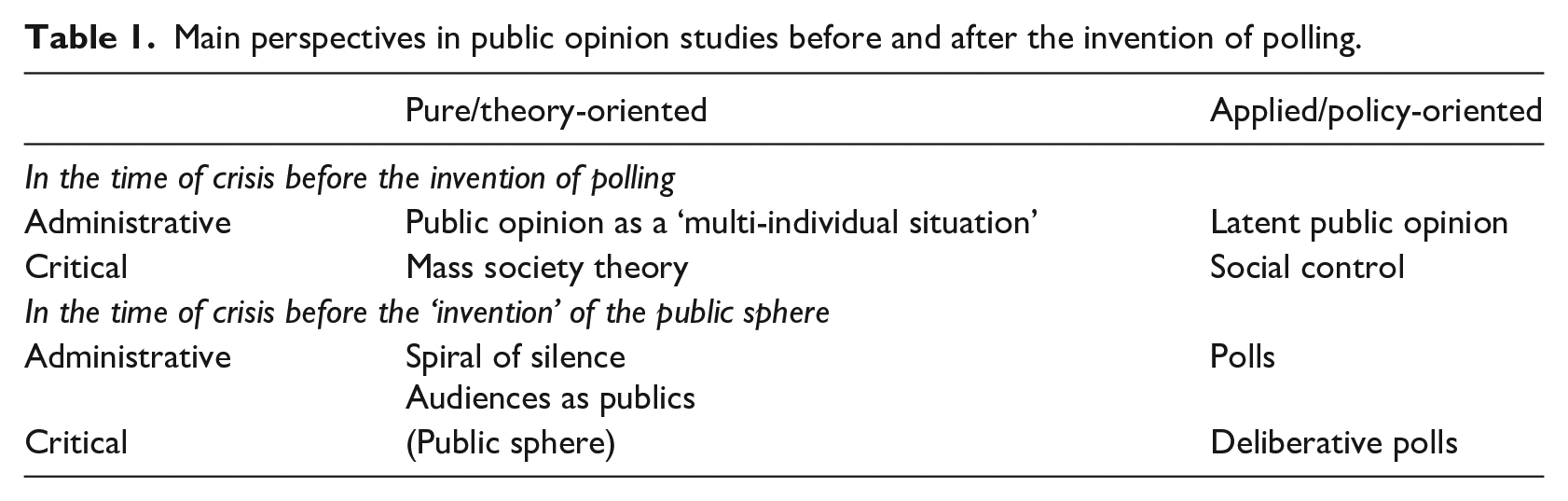
The long-lasting ontological and epistemological crisis in critical studies of public opinion and publicness – questioning the forms of their existence, how we can know about them, what the relationship between various existing concepts is, and how they can be measured – seemed to be over in the late 1980s. A new impetus came from the publication of the English translation of Jürgen Habermas’ The Structural Transformation of the Public Sphere, originally published as Strukturwandel der Öffenntlichkeit in 1962. The idea or ‘theory’ of the public sphere was believed to fill a critical gap in conceptualizations of public opinion caused by the dominance of polling (see Table 1). The new concept was widely (uncritically) accepted and seldom discussed in terms of critical epistemic value, that is, its capability to arouse criticality and provide accurate insight into critical issues in the development of democratic societies.
Main perspectives in public opinion studies before and after the invention of polling.
The Public Sphere and Its Problems: A Critique of Critique
The concept of the public sphere, despite its conceptual ambiguity and controversy, rejuvenated ideas about publicness and public which at that time were almost clinically dead concepts for critical theory. The English translation introduced the new concept at a time of remarkable technological and social change, the ‘information revolution’ and debates on the ‘new world information and communication order’. In the 1980s, satellite became a strong option for receiving television programming in many countries. From the 1970s onwards, the home computer industry grew exponentially, and in the mid 1980s, the popularity of e-mail led to an explosion of activity on the Internet. In the late 1980s, after the long struggle for freedom, the communist systems in Central and Eastern Europe began to collapse, paving the way for democratic changes.
The revolutionary social and technological changes of this period can help to understand why the English translation of Habermas’ study, three decades after its original publication in Germany and after several decades of frozen critical thinking about public opinion, has sparked a new interest in the old questions of public debate, the culture of dialogue, the democratic potential of the media, the control of power, and the power of genuine public opinion. Of course, Habermas could not have anticipated all these important social and political questions of the 1980s in his 1962 book, but the classical ideas about publicness discussed in his book were clearly in tune with key societal issues at the time of its English translation. What is more curious, however, is that while he referred extensively to the early normative tradition, he made a radical break with more recent sociological theory and the leading public opinion theorizations of the early-20th century.
Calhoun (1992) was right to predict that Habermas’ The Structural Transformation will ‘not stand as an authoritative statement’ but will be ‘an immensely fruitful generator of new research, analysis, and theory’ (p. 41). Indeed, the new concept of the public sphere that appeared in the English translation of Habermas’ book not only generated new research but also many controversies. It is somewhat strange to speak of a (critical) theory of the public sphere when the public sphere is first of all a term that arose as a by-product of the translation of the German term ‘Öffentlichkeit’ into English and only later acquired the epistemic status of a (theoretical) concept (but without a clear definition).
Not all of the conceptual confusion that led to controversies about the ‘theory of the public sphere’ is simply the result of difficulties in translating from German to English. Conceptual inconsistencies due to the occasionally unclear meaning (implicitly) attributed to the terms ‘Öffentlichkeit’, ‘Publizität’, and ‘Publikum’ were already built into Habermas’ original text. Habermas used the terms Öffentlichkeit and Publizität quite indiscriminately; for example, 10 times in the book he used the term ‘the principle of publicness’ (Prinzip der Öffentlichkeit), and another 10 times the term ‘the principle of publicity’ (Prinzip der Publizität). He aptly translated Bentham’s ‘Principle of Publicity’ as ‘Prinzip der Öffentlichkeit’ and praised Bentham for clarifying the connection between public opinion and the principle of publicness (rather than of publicity), but then just as often talked about the principle of publicity (Prinzip der Publizität). However, at that time, Publizität (publicity) in German was already clearly distinguished from Öffentlichkeit (publicness) and mainly referred (as in English) to actions of making certain information about someone or something available to the media users or clients. The indiscriminate use of both terms in German was ‘resolved’ in the English translation by the consistent use of the term ‘principle of publicity’, which, in the absence of reference to publicness and the public, contributed to the semantic stretching of the term ‘public sphere’ and the conceptual confusion it created.
An additional problem is the semantic overlap of the German terms ‘Öffentlichkeit’ and ‘Publikum’, which Habermas did not clearly distinguish in the German original. In German, as Tönnies (1922) conceptualized it, ‘Öffentlichkeit’ is either ‘ein urteilendes Publikum’ (a judging public, a social grouping) and ‘handelnde Kraft’ (an acting force), or ‘ein öffentliches Leben’ (public life, a specific state of social affairs), or its general quality (‘volle Öffentlichkeit’, a complete publicness; ‘das Licht der Öffentlichkeit’, the light of publicness). ‘Publikum’ was of course translated as ‘the public’, but ‘Öffentlichkeit’ mainly as ‘the public sphere’ even when it more likely denotes ‘an acting force’ (i.e. the public) in the German (con)text.
The intellectual lineage of the ‘public sphere’ concept can be traced back to Marx’s (1974 [1843]) conceptualization of the press as the ‘third element’ mediating between rulers and the ruled (p. 189). Habermas’ initial conceptualization of ‘Öffentlichkeit’ (publicness) suggested that it should first be operationalized in the Enlightenment public opinion tradition as the sphere of public(s). However, the English translation brought a liberalized Marx’s version of mediation between the state and civil society to the fore, promoting the liberal, rights based communicative potential of free assembly and debates. Moreover, Habermas’ (1992) later English definition of the bourgeois public sphere as ‘a network for the communication of contents and statements, that is, of opinions’ (p. 436) notably excluded the public itself. The public sphere has become the playground of various social groups, where the main “indigenous” actors are professionals and politicians of the media system, joined by lobbyists, advocates, experts, “moral entrepreneurs,” and intellectuals (Habermas, 2006: 416). In consequence, the public sphere came to be commonly conceived as a space or arena for discussing social issues, without theorizing the public as its main actor or examining ‘the contestatory interaction of different publics and identifying the mechanisms that render some of them subordinate to others’ (Fraser, 1992: 128).
Habermas’ historical analysis of (re)conceptualizations of publicness and public opinion since their early beginnings in the 17th century virtually ends in the 19th century. It does not cover the critical intellectual history created by the leading public opinion scholars of the 20th century, who moved the study of public opinion from the sphere of normative-philosophical reasoning to the field of critical sociological inquiry. Tönnies and Dewey analyzed the concrete historical circumstances and conditions of the (trans)formation of the public and the responsibility of human action for its continuous changes. Tönnies devoted large parts of his book to the rule of capital and the influence of the working class on public opinion, the exclusion of women from the public, the need for social reforms, and the perspective of socialism. Dewey (1946 [1927]: vii) pioneered a new perspective on the relationship between knowledge, technology, and human action, and considered changes in ‘material culture’ decisive in the formation of the public, particularly ‘technological factors’ generating ‘socially significant human consequences’ on a global scale. However, the influential works of Dewey and Lippmann are not mentioned at all in Strukturwandel, and Tönnies and Tarde are mentioned only in passing in a dismissive note. Among 300 books and articles suggested by Habermas for further reading, only Lippmann’s Public Opinion and Mills’ Power Elite are included, but none of the works of Dewey, Tarde and Tönnies. The neglect of the critical sociological tradition, even more than the new English term public sphere, meant a conceptual break with the critical tradition of studying the public and public opinion in the first half of the 20th century.
The neglect of a major sociological tradition is symptomatic. Similar to C. W. Mills, Habermas’ early work critically examined the historical transformation of a liberal-bourgeois publicness into a media-dominated publicness in the post-war period. In his later philosophical–linguistic turn, however, the focus shifted to the normative discursive qualities of publicness reflecting his reconceptualization of the antagonism between instrumental and communicative actions as a dualism of mutually independent domains of actions, while neglecting the material components of publicness. Administrative power serves to influence parliamentary decision-making and the interaction of organized interests, while communicative power develops beyond the parliamentary complex. Civil society as ‘a network of voluntary associations and a political culture that are sufficiently detached from class structures’ (Habermas, 1996 [1992]: 175) are seen as constituting the social basis for the public, which should preserve ‘political communication from being swallowed up by the state apparatus or assimilated to market structures’ (p. 269). This led to the (impression of) absolutization of discursive conditions of idealized formation of opinion and will in institutional arrangements and voluntary networks, neglecting their material substance and inequalities that drive historical transformations.
The rejection of the materialistic foundations of the critical sociological theory of public opinion and the public is Habermas’ most important departure from his hidden sociological predecessors. He ignored Dewey’s theory focused on the political organization of society 1 despite some obvious overlaps. For Dewey (1946 [1927]), for example, the public is the bearer of public opinion, consisting of ‘all those who are affected by the indirect consequences of transactions to such an extent that it is deemed necessary to have those consequences systematically cared for’ (pp. 15–16). In the same way, Habermas (1996 [1992]) later conceptualized ‘the political public sphere’ (die politische Öffentlichkeit) as ‘perceiving and thematizing encompassing social problems only insofar as it develops out of the communication taking place among those who are potentially affected. It is carried by a public recruited from the entire citizenry’ (p. 365).
Contrary to the studies of public opinion in the early 1900s and Adorno’s plea to capture the complexity of social conditions in the study of public opinion, Habermas avoided studying public opinion as an important societal phenomenon and instantiation of publicness, which is another common feature of Habermas and Dewey. Statistical text analysis reveals a similarity in Habermas and Dewey’s reception of the relationship between the public and public opinion in contrast to Tarde and Tönnies (Table 2).
Key publicness-related concepts in the works of Dewey, Habermas, Tarde, and Tönnies.
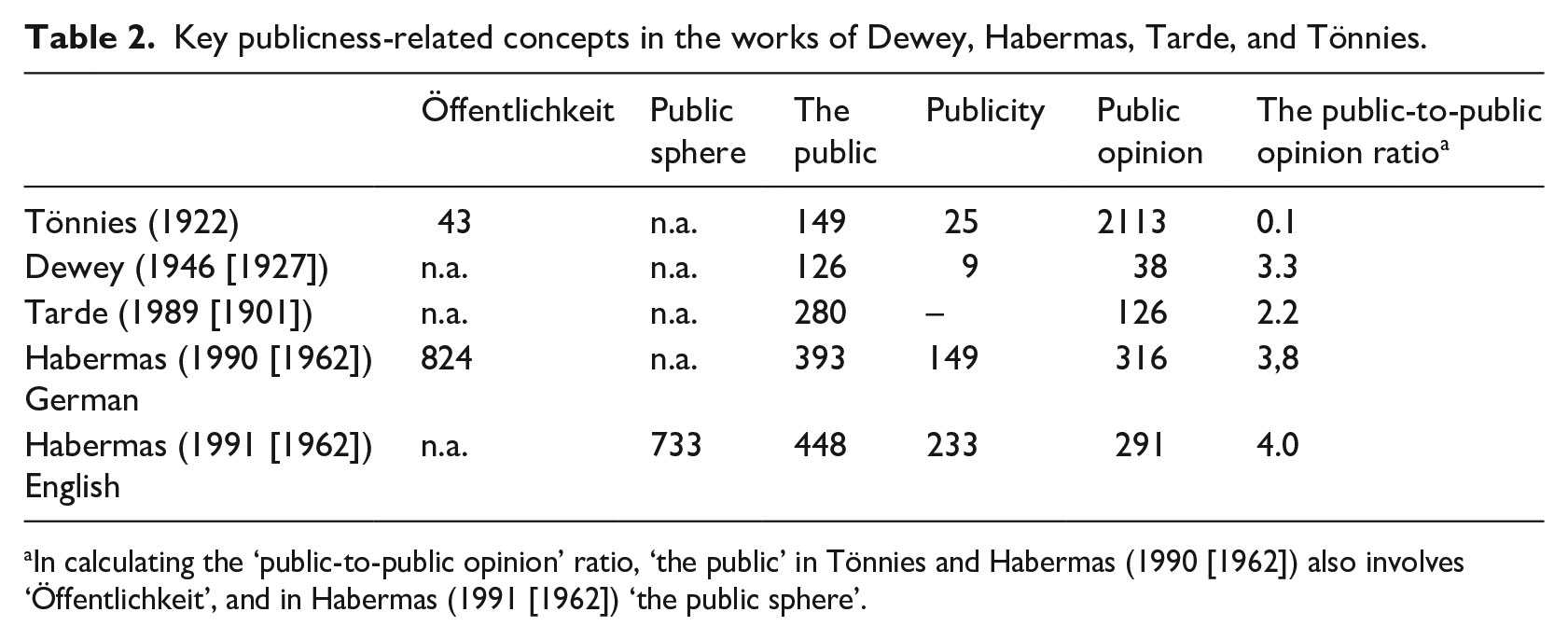
In calculating the ‘public-to-public opinion’ ratio, ‘the public’ in Tönnies and Habermas (1990 [1962]) also involves ‘Öffentlichkeit’, and in Habermas (1991 [1962]) ‘the public sphere’.
Dewey was also critical of the technological industry and its subordination to business interests, which prioritized property concerns over the common good. He referred to the ‘rule by experts’ as ‘tools of big economic interests’ (Dewey, 1946 [1927]: 108, 206) and argued that
denunciations [by men of big business and financial interests] of the ‘materialism’ of socialists is based simply upon the fact that the latter want a different distribution of material force and well-being than that which satisfies those now in control. (p. 119)
Dewey’s insights from a century ago have become increasingly apparent today, as almost all forms of socially recognized work, regardless of their nature and outcomes, involve the use of (digital) technologies, primarily driven by capital rather than the common good. The pervasive influence of technology is particularly evident in how digital technology has blurred the boundaries between work, communication, and leisure, as well as between the private and public domains (Splichal, 2018).
The role of (communication) technology and material culture championed by Dewey was only sporadically reflected in Habermas’ conceptualization of Öffentlichkeit, as Habermas view them manifestations of instrumental rationality and liked to systemic integration. This illustrates Habermas’ dualistic perspective on work and communication which, while not fully evident in The Structural Transformation, became more apparent in his subsequent works. This might explain why he appeared to ‘neglect’ the theories of his sociological predecessors. In some aspects, Habermas’ communication-theoretical reformulation of earlier critical conceptualizations of public opinion and publicness lags behind the ‘scientific utopianism’ of Marx and the later Frankfurt School. In other regards, his dialogic ethics, associated with new social movements believed to have revolutionary potential (e.g. students in the 1960s), significantly modifies traditional socialist conceptions of a better society.
Habermas was critical of Marx’s emphasis on labor and (the mode of) production as not only economic drivers but also as fundamental to human development. He criticized Marx for ‘reducing the process of reflection to the level of instrumental action’ (Habermas, 1971 [1968]: 44) by ‘throwing together interaction and work under the label of social practice’ instead of connecting the materialist concept of synthesis ‘likewise to the accomplishments of instrumental action and the nexuses of communicative action’ (p. 62). Although Habermas’ linguistic turn in critical theory aiming to reconstruct Marxist historical materialism as a communicative theory of society was more a philosophical than an empirical–political project, it resulted in the neglect of an important aspect of critical theory: in his conceptualization of emancipation, communication is detached from human material production. In his critique, Habermas failed to recognize that communication is inherently ‘material’ because of the following:
Like any other form of production, communication is always technologically mediated, not detached from historical premises and from the actual material life process of individuals.
Communication is a driving force in historical development, influencing the evolution of material production itself.
Communication performs the generic work of asserting and reproducing ruling interests and relations in society, such as the role of publicity and information control for capital.
It occupies the individual’s ‘free’ time, which becomes available after their material needs are satisfied but is also influenced by those very needs.
In his later works, Habermas reflects on the essential nature of the ‘public sphere’ – its emancipation from the realm of work and (material) production. He regarded the relative improvement in the working class’s position as tantamount to the complete elimination of the antagonism between wage labor and capital, a scenario where ‘the deprived and privileged groups no longer oppose each other as socio-economic classes’ (Habermas, 1983 [1968]: 37). This rendering of the sphere of material production as irrelevant to the ‘revolutionizing late capitalist societies’ led to a conclusion that neither the traditional class-based opposition nor any new form of deprivation could repoliticize the waning public sphere. In the 1960s, he believed that the only remaining revolutionary potential lay in the realm of communicative action, characterized by its unique discursive logic, exemplified by particular groups of university students (Habermas, 1983 [1968]: p. 40).
The discursive idealization of publicness has fostered both positive and negative receptions, making the concept of the public sphere widely accepted as part of ‘professional knowledge’ in academia (Table 3). As a result, various conceptual innovations arose alongside those introduced by Habermas, which are reflected in the emergence of adjectives in the conceptualizations of both ‘the public sphere’ and ‘the public’, partly reminiscent of Tönnies’ distinction between gaseous, fluid and solid public opinion. Eriksen (2005: 349), for example, distinguished between three types of public spheres as ‘systems of publics’ dominated by general, segmented or strong public, differing in terms of participation (open, restricted, or specialized), legitimacy basis (sovereign demos, common interests, or delegated authority), and function (opinion formation, problem solving, or will formation). Splichal (2012: 165) differentiated between crypto, proto, pseudo, and ortho-public spheres based on historical developmental dynamics and democratic transformations, ‘measured’ by their defining principle, the development of communication infrastructure, accessibility, and the nature of discursive publics.
Key conceptual themes in public sphere studies.
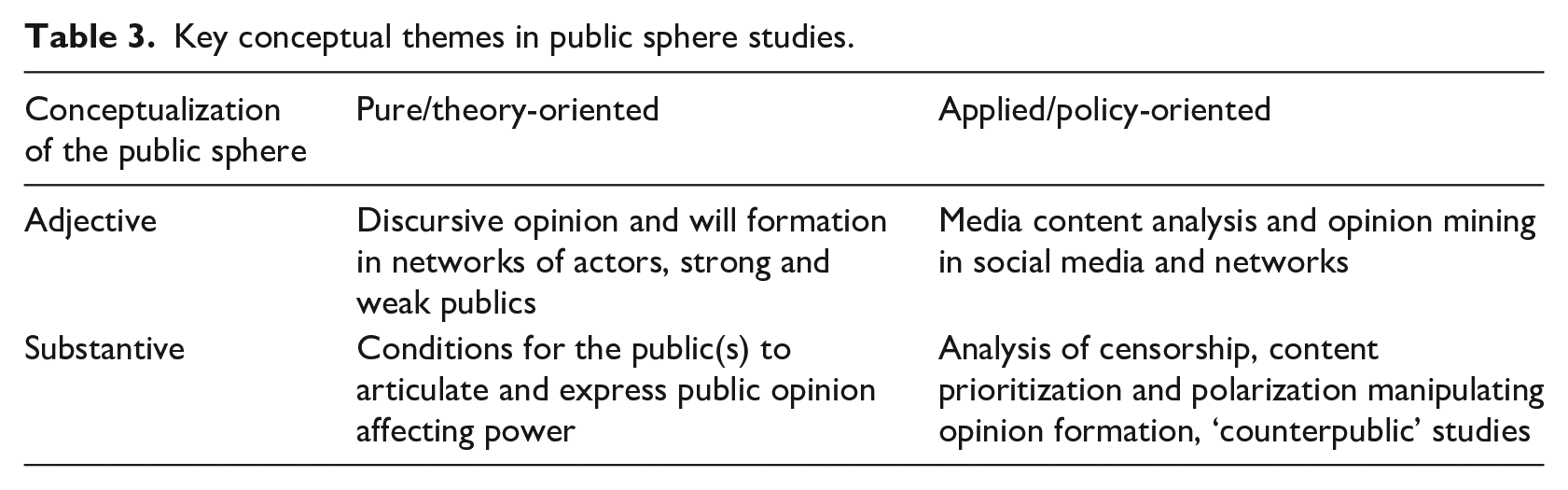
The general popularity of the adjectivization of the public sphere goes far beyond these taxonomies. It can be exemplified by a multitude of adjectives such as strong and weak, micro, global, discursive, rational, affective, counter-, issue-, proletarian, subaltern, alternative, emancipating, democratic, inclusive, participatory, collaborative, engaged, mediated, pluralistic, empowered, agonistic, responsive, accountable, transnational, networked, online, virtual, and digital public sphere and/or publics. These adjectives emphasize specific dimensions and developments of the public sphere, their functions in different domains of social life, and reflect different normative and analytical perspectives, which are difficult to classify in a comprehensive taxonomy. Moreover, they also imply the (co-)existence of their opposing forms, either as a result of historical development, for example, from weak to strong publics, or as ‘ideal forms’, for example, weak versus strong publics, but with their excessive diversity they also call into question the (critical) epistemic value of the concept.
The conceptual pluralization of the public (sphere) has reached a critical juncture, blurring the distinction between the public (sphere) and the echo chamber fostered by algorithmic communication. The notion of multiple ‘alternative’ public spheres assumes an ‘echo chamber’ effect that creates user groups exposed to and seeking content aligning with their own ‘ideologies’. This contributes to social divisions, fragmentation, and political polarization, which stand in stark contrast to the normative ideals of publicness and the public sphere.
The proliferation of adjectival modifiers and their (implicit) antipodes, which implies that virtually any form of communication can be conceptualized as constitutive of some public or public sphere, particularly in empirical research, renders the public (sphere) a floating or even empty signifier that can be interpreted to suit the desires of those who use it. The plethora of new perspectives on the public sphere, coupled with the prevalence of liberal, mediatory views that present it as a neutral forum for non-discriminatory discussion and decision-making, have raised considerable concerns among critical scholars about the narrowing of the critical epistemic horizon of the concept and its relevance for democratic theory.
Conclusion
The concept of the public sphere has spurred significant efforts to critically reconstruct and revise classical normative and sociological theories pertaining to the public and public opinion. However, a conceptual crisis has emerged within ‘public sphere theory’ as scholars narrowly focused on the public sphere itself, neglecting its broader historical and ethical roots. The critical epistemic value of the public sphere, derived from the material and ethical foundations that emphasize communication’s central role for a critical enlightened public in democratic politics, has been overshadowed by an exclusive emphasis on its universal normative validity and operational reliability achieved through opinion mining and big data analytics. Nevertheless, it would be premature to discard the idea of the public sphere as a critical concept and blindly follow the unfortunate loss of the critical concept of public opinion after the invention of polls. Instead, it is time to critically reexamine how the idea of publicness can be reinstated as a critical concept beyond normative conceptualizations, and to develop ‘a critical political sociology of a form of public life in which multiple but unequal publics participate’ (Fraser, 1992: 128).
In today’s context, profound transformations brought about by pervasive digital technologies, global communication networks and platforms, powerful corporate and government influences, highly porous boundaries between publicness and privateness, the increasingly publicly relevant private side of the public–private dichotomy, and the spread of misinformation and propaganda have raised concerns about the integrity and legitimacy of the ‘digital public sphere’. Because of these changes, questions regarding the real possibilities of societal release and emancipation of the critical potential of publicness, the public, and the public sphere have become more pertinent than ever before.
There have been limited attempts to theoretically and empirically consolidate the public sphere in its integral form, encompassing both its historical material foundations and its discursive superstructure. This lack is more comprehensible on an empirical level, as systematic research would require substantial human, technical and financial research resources, as exemplified by select small-scale initiatives such as European Media Pluralism Monitor with 200 indicators (questions) for exploratory expert interviews (EMPM, n.d.).
To address these challenges, a theoretical (re)conceptualization that transcends current epistemic controversies is required. This can be achieved by adhering to Adorno’s call to investigate the objective structural laws of society as the essence of public opinion and public sphere research. The VAARMIL model (see Figure 2; Splichal, 2022) outlines such a theoretical framework. In this model, communication technology, democratic institutional structures, and public culture constitute three solid societal infrastructural pillars of the public sphere. These pillars represent the societal resources required for a functioning public sphere.
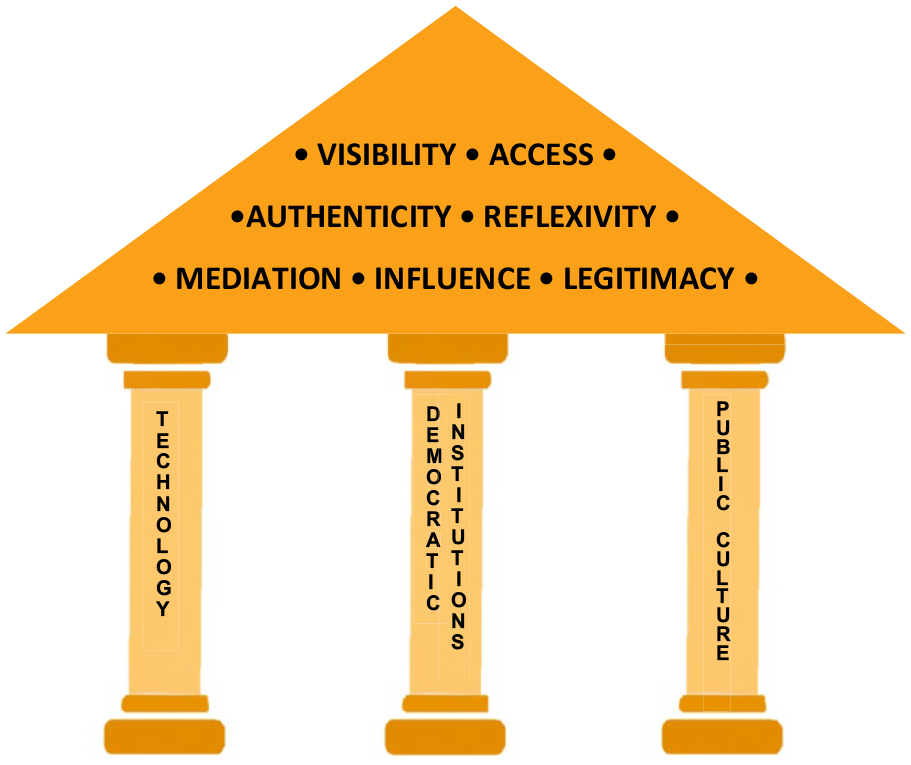
Graphic representation of the public sphere as an infrastructure of discursively generated publics and public opinion through six VARMIL components of publicness/public-worthiness (adopted from Splichal, 2022).
The public sphere, defined by its three core pillars, is essential to the formation of public(s) and public opinion as instantiations of publicness in the discursive superstructure. Publicness, in this context, comprises six principal components that encompass actions and functions, ultimately shaping the public(s) by facilitating:
The visibility of relevant content.
Access to authentic(ated) sources and documents.
The cultivation of communicative reflexivity.
The enhancement of mediativeness in communication.
The empowerment to influence decision-makers.
The legitimization of their decisions.
This model emphasizes the critical junction between normative–theoretical principles and empirical critique. It underscores the significance of acknowledging societal transformations that can foster the realization of the critical facets of publicness. Furthermore, these six fundamental functions underscore the role that (public) media should ideally fulfill within the public sphere.
The historical foundations and transformations of publicness necessitate an exploration of the potential for democratic changes, the seeds of which are hidden in the existing economic and political controversies of late capitalism. Critical theory and research must strive to unearth these latent possibilities. The analysis of concrete changes in the media structure and hypotheses about their effects on the political function of the public sphere needs to consider the economic, social, and cultural prerequisites for the formation of the public. A comprehensive understanding of the multifaceted factors contributing to the crisis of publicness in capitalist democracies, along with their vulnerability to global crises, is essential. This understanding will help us assess how the digitization of public communication influences the (dis)empowerment of deliberative opinion formation and decision-making. Furthermore, it will shed light on the role of traditional media in shaping the public and public opinion, as well as mediating between civil society and the state.
In this critical perspective, the public sphere is conceptualized as a material-institutional infrastructure of discursively generated communicative-ethical superstructure with publics and public opinion. The public sphere represents a unique configuration of visible and accessible institutional spaces with loosely defined boundaries, intended for the circulation of information and ideas, which contribute to the formation of public opinion and facilitate communicative connections between citizens and power holders within society. The concept encompasses all the material conditions that early-20th century theorists identified as integral components of the societal structure essential for the formation of the public and public opinion as intricate expressions of societal will.
Unfortunately, these material conditions largely went unnoticed in the ‘theory of the public sphere’, as they were considered irrelevant to the process of emancipation of/through communication. Critical theoretical and empirical investigations of publicness and the public sphere should aim to integrate all these aspects and dimensions, while maintaining a historical perspective, to fully reestablish their critical epistemic value.
Footnotes
Funding
The author(s) disclosed receipt of the following financial support for the research, authorship, and/or publication of this article: This publication is part of a research program Mass media, public sphere and social changes that has received funding from the Slovenian Research and Innovation Agency, P5-0051.
