




Abstract
The article discusses the reasons and conditions for the rise and fall of the popularity of the public sphere concept in scholarly discourse in four parts. The first part examines the peculiar circumstances of the emergence of the concept of the public sphere, and its rapid and widespread adoption in the social sciences. The second part discusses the complexity of the concept “Öffentlichkeit” and its English proxy “the public sphere,” and the contemporary critique of its ideological predispositions. The third part focuses on the liberalization and (operational) banalization of the concept. The final part suggests ways in which social scientists could respond critically to the challenges outlined earlier and reintegrate publicness, the public, and the public sphere into the analysis.
In contemporary social theories and empirical research, the once propulsive concept of the public sphere, as Figure 1 shows, appears to be stagnating, if not declining. There are even calls to abandon it as irrelevant to (critical) social research. Faced with such radical challenges, it is difficult to avoid a sense of “déjà vu.” Similar debates took place a century ago when the ubiquity of the term public opinion became so “disturbing” that it was even declared a non-concept. Fifty years ago, the concept of public opinion—after the rapid rise of its popularity due to the invention of polling—was declared dead in critical theory. In both cases, the epistemic value of (originally) critically conceived concepts was considered questionable for the explanation of complex communicative phenomena in contradictory social relations.
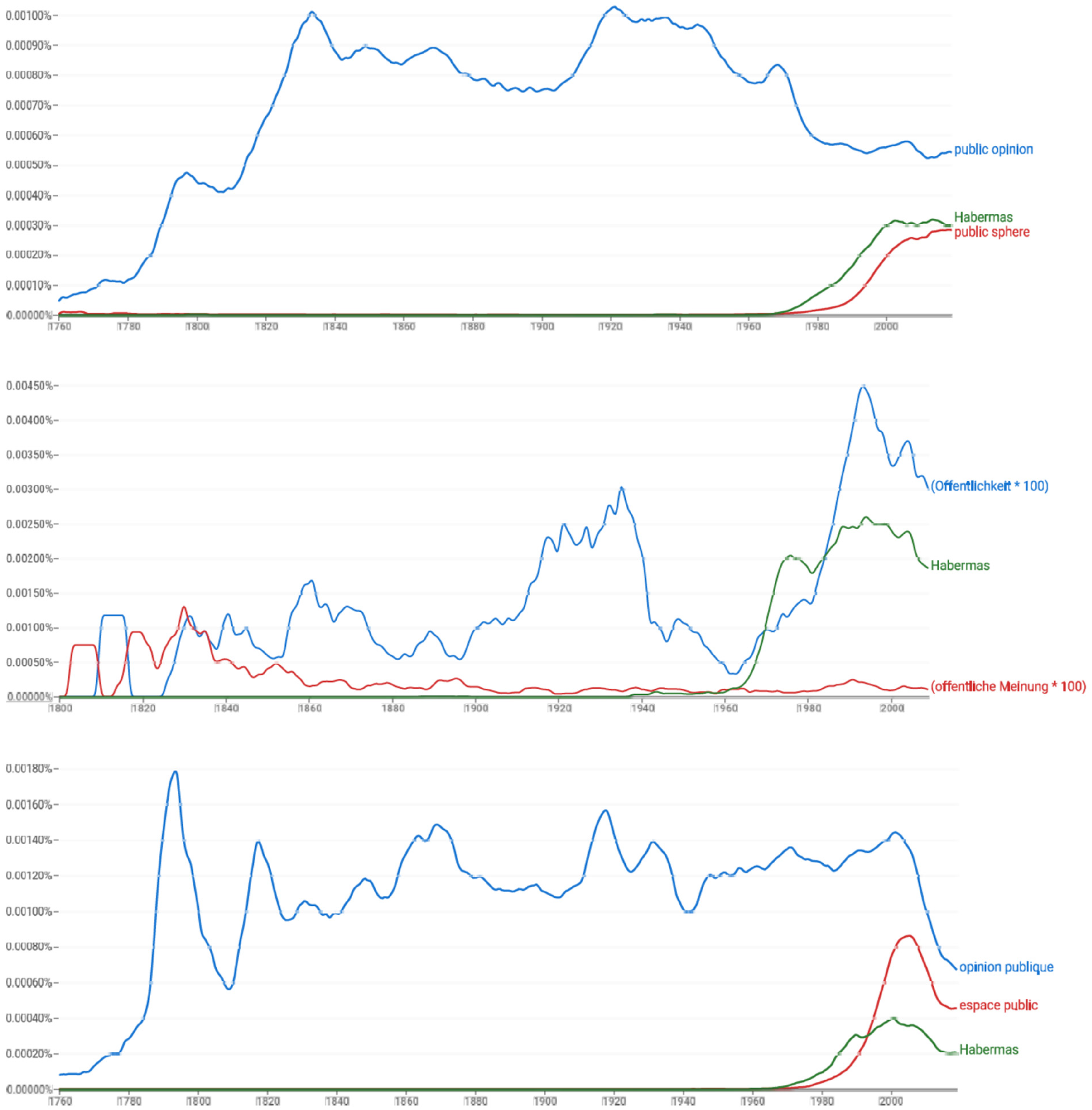
Relative frequencies of keywords public opinion, public sphere, Öffentlichkeit, and Habermas in English, German and French books (from top to bottom) published between 1760 and 2018 (source: google books ngram viewer).
This article discusses the fate of the public sphere concept in four parts. The first part examines the peculiar circumstances and reasons for the emergence of the concept and its rapid and widespread adoption in the social sciences. The second part discusses the complexity of the concept “Öffentlichkeit,” the semantic weakening of its English proxy “the public sphere” and the contemporary critique of its ideological predispositions. The third part focuses on the liberalization and (operational) banalization of the concept in the time of digitalization and datafication of communication and society. The final part suggests ways in which critical scholars could respond to theoretical and empirical challenges and reintegrate publicness, public opinion, the public, and public sphere into the analysis. The ideas condensly presented in the paper are discussed in more detail in a forthcoming book on the implications of quantification and datafication processes for a critical conceptualization of publicness (Splichal, 2022).
“The public sphere” has a unique conceptual life course. It was created, so to speak, as a by-product in the translation of Habermas's book Strukturwandel der Öffentlichkeit into English in 1989, but it is firmly rooted in the long history of ideas of publicness, dating back to the late Enlightenment and even all the way to Machiavelli, who was the first to write about the power of public opinion. The critical social perspective has long prevailed in normative political-philosophical conceptualizations of public opinion and publicity introduced by Bentham, Rousseau and Kant, but has lost momentum after the invention of opinion polls. With the public sphere, the idea of publicness has returned to the centre of critical theory, but it now appears to be marginalized by its operational banalization.
The collapse of “public opinion” and the rise of “the public sphere”
The 1960s and 1970s were a period of major social movements, public protests, and rallies around the world. Despite all obvious manifestations of public opinion and isolated attempts to rehabilitate it as a critical concept (Splichal, 1999), scholars largely dismissed the notion of public opinion as a significant factor in sociological studies on issues such as collective action and democratic governance, and/or questioned its legitimacy and efficacy as a national and transnational phenomenon (Fraser, 2007). Public opinion analysts worked mainly outside of social research, primarily interested in new ways of measurement of “mass attitudes” and their potential impact on commercial and political outcomes (Splichal, 2022). Public opinion was increasingly considered an individual and behavioral phenomenon of little significance for institutional, action- and movement-oriented social research. The decline in attention to public opinion is clearly confirmed by analysis in Google Books Ngram Viewer (Figure 1; note that the Öffentlichkeit curve is multiplied by 100).
In such circumstances, the 1989 English translation of Habermas's Strukturwandel der Öffentlichkeit originally published in 1962—following his earlier encyclopedia article “The Public Sphere” in New German Critique (1974) and French translation of the book (1978)—came as a “manna from heaven.” Due to the prevalence of the English language in scientific literature, it was the English version of the book that became the “official Habermas.” After “public opinion” lost its critical momentum and was buried in the domain of administrative polls, and “publicity” was operationally redefined in terms of persuasive communication and propaganda to be finally equated with commercial advertising, a new construct, the “public sphere,” canonized in The Structural Transformation, became the savior of critical theory in publicness studies.
The concept of the public sphere substituted the formerly prevalent critical public opinion discourse established in the grand theories of Tarde, Tönnies, Lippmann, and Dewey, and expanded across a wide range of disciplines. It was widely adopted in many disciplines focusing on citizen engagement and democratic politics, particularly in relation to the organization of public gatherings and anti-government protests (e.g. the Arab Spring, the Occupy movement, the “hacktivist” movement Anonymous). Authors have often found in the public sphere a more appealing term—not always with good reason—for what would otherwise be called “civil society,” “social movements,” “public communication,” “communication network” and, particularly, “the public” or “public opinion,” which previously prevailed in scholarly democratic discourses.
Despite the existence of three specific terms in English—publicness, the public, and the public sphere—to denote the specific components of the complex German concept of Öffentlichkeit, they have often been avoided or confused by scholarly discussions related to the “public sphere.” As Mah (2000: 167) demonstrated, many historians conceived of the public sphere in “spatialized” terms, as a domain that one can enter, occupy, and leave, but “when the public sphere is recognized as a unified entity, it is rhetorically personified, referred to as if it were a person.” Darnton (2000) found that French historians often attributed agency to “l'espace public” and “made it the crucial factor, more important than ideas or public opinion.” Failure to understand the differences between publicness, the public, and the public sphere can lead to a curious realization of the need “to consider multiple publics instead of a single public sphere,” as “‘the public’ is often conceived as an interstitial space that sits between politics, the economy, and civil society” (Stewart and Hartmann, 2020; emphasis added). Not even Dewey's and Lippmann's “publics” could escape the temptations to be renamed “the public sphere” in retrospect. Rauchfleisch and Kovic (2016: 2) used Dewey's definition of the public that, “[t]he lasting, extensive and serious consequences of associated activity bring into existence a public. In itself, it is unorganized and formless” (Dewey, 1927/1946: 67) to define the public sphere and thus “solve” the problem of the absence of the original definition.
The translation of Habermas appeared at a time that heralded hitherto unimagined technological possibilities of communication networking. Given that today almost two-thirds of the world's population can connect to each other through the Internet, it has become an appealing idea that the Internet and the unprecedented growth of public, private, and hybrid modes of communication networks can help create “online public spheres.” The Internet has not only significantly changed the way people communicate; it also had a major impact on the concept of the public sphere. It became particularly widespread when it was applied in empirical research on emerging online private-public communications networks. However, attempts to make the public sphere an operationally robust concept by specifying a more descriptive range of (online) features derived from the complex normative ideal of publicness have failed. With the ubiquitous popularity of the “online” or “networked public sphere,” particularly in empirical studies, the concept followed the unfortunate fate of public opinion after the spread of opinion polls.
Based on the wealth of data available on the Internet and the new big data analytics welcomed as the key to better understanding and manipulating human behavior, scholars seeking to discover an operationally sound definition of the public sphere were convinced that they indeed found it there. The data-driven operational definition of the online public sphere appeared as a “rescue exit” from controversial theoretical efforts for a broader conceptualization of publicness—just as more than half a century ago, survey response data convinced many that polls were the emanation of public opinion. Social media in general and Twitter, in particular, have been hailed for representing a “virtual sphere 2.0,” a “digital” or “networked public sphere,” and have become a gold mine for collecting data on “the public sphere.” By this logic, for example, clusters of highly interconnected Twitter accounts formed around specific topics were seen as “components of broader public sphericules,” and interconnected tweets and retweets on EU issues posted by EU citizens, especially when in (their non-native) English language, were presented as evidence of the existence of the Europan public sphere as “an arena for EU-wide public discourse” (@EU_PublicSphere).
The fact that the original term “Öffentlichkeit” has no equivalents in many languages, including English and French, and that the original Habermas's text could not contain a definition of the non-existing term “public sphere” (the term “öffentliche Sphäre” is used only twice in the German original) had several broadly important consequences. As an insufficiently theorized conception, “the public sphere” allowed for enigmatic and misleading characterizations. Since “the public sphere” is not a concept established by Habermas, but by his translator(s), it would be unreasonable to call it “the Habermasian public sphere” or to blame him for not defining it. Bourdieu's (2014: 306) allusion to Habermas as the author of “the public space, this detestable concept that comes from Germany,” is at least misdirected, as the concept was not “imported” from Germany but created in French and English.
The new term “public sphere” made it possible to conceive and interpret it in different ways in relation to the traditional “Anglophone” concepts “publicity,” “public opinion” and “the public,” and allowed attempts to “explain” it with spatial metaphors, for example as “arena” or “forum,” which at best-created ambiguity in the definition of the concept or, at worst, a complete lack of a viable definition. Yet its conceptual complexity and openness also enabled or triggered new research, analysis, and theories (Calhoun, 1992: 41). Although it was often subject to criticism, it was also a thought-trigger that sparked a range of diverse innovations and showed strong “resilience” to criticism.
The realm of publicness restricted by the public sphere
Öffentlichkeit/Publicness is a historical concept of remarkable vagueness with a variety of competing meanings (Negt and Kluge, 1972/1993: 17); a complex multidimensional concept for an elementary social phenomenon comparable to action, actor, association, or collectivity (Habermas, 1992/1996: 360). Öffentlichkeit is (1) an abstract concept, publicness (e.g. the light of publicness; the publicness of public authority/of the public/of opinions/of public opinion)—in principle limitless but in practice often restrained (Tönnies, 1922), closely related to freedom (particularly of the press); (2) a norm, an (organizational) principle (Prinzip der Öffentlichkeit); and (3) a method of enlightenment and a medium in which a historical subject (e.g. bourgeoisie) can articulate itself. Concurrently, Öffentlichkeit also designates two types of empirical social phenomena: (4) “the public” or “a public”—also the great public, the general public, and reasoning public in Tönnies (1922)—is the public as the acting subject or “medium of publicness” through which publicness is materialized, a social grouping or network consisting of “the bearers of publicness” practicing judgment, an organizational form of social experience, and (5) “the ‘world’ in which the public is constituted,” “the public life,” “the sphere of private people assembled as a public,” that is “the public sphere” or, what I would prefer, “the sphere of publicness.”
Öffentlichkeit/Publicness is a complex variable quality that abstracts a specific mode of relationship between people based on transparency, visibility, inclusivity (access), and reason—being in the sight of observers, made to be (or can be) seen, heard, discussed, accessed or used by everyone, or at least by many. Together with its opposite, privateness, they have become, “one of the great dichotomies … dividing a world into two spheres which together are exhaustive … and mutually exclusive”—a dichotomy as important as dichotomies war/peace, democracy/autocracy, society/community, state of nature/civil society (Bobbio, 1980/1989: 1). The separation of the two spheres is essential for the conception of modern Western societies and a condition for the development of democratic political systems discussed already by Enlightenment authors (Splichal, 2018) and thus not specifically related to the “Habermasian public sphere.” Moreover, a substantial difference exists between the public sphere referring to “the sphere of competence of political power” and the sphere of the public(s) as “the sphere where political power is controlled by the public” (Bobbio, 1980/1989: 17), which can contradict or even exclude each other, thus making the reduction of “Öffentlichkeit” to “the public sphere” even more controversial.
Widespread enthusiasm for the newly invented public sphere was soon followed by serious doubts about its epistemic validity. Unlike Öffentlichkeit / Publicness, its English counterpart, the public sphere, is difficult to grasp as an abstract normative concept. In Faktizität und Geltung, Habermas followed Dewey's conceptualization of the public as an imagined social category that communicatively brings together all potentially affected citizens (Dewey, 1927/1946: 67). In the English translation of Habermas, “The political public sphere can fulfill its function of perceiving and thematizing encompassing social problems only insofar as it develops out of the communication taking place among those who are potentially affected. It is carried by a public recruited from the entire citizenry” (Habermas, 1992/1996: 365). Clearly, “perceiving and thematising social problems” is the task that can only be performed by the people (communicatively) acting in the public sphere, that is by the public and in the public sphere, but not by the public sphere.
The loss of “the public” and “publicness” in the newly established English concept also led to the lack of a clear distinction between the two kinds of “public spheres” that Bobbio highlighted. Habermas's English conceptualization of “the bourgeois public sphere” as “the sphere of private people come together as a public” (1962/1991: 27; emphasis added) suggests that the sphere of publics is a version or a species, or emanation of the public sphere, which is tautological. In the original, in contrast, the sentence began with “bourgeois publicness” (Bürgerliche Öffentlichkeit); it tells us that the general concept of publicness could first be imagined or conceived as the sphere of public(s). However, in Habermas's later comments on Strukturwandel published only as an English translation, the definition was changed to a more liberalized version of “a network for the communication of contents and statements, that is, of opinions” (Habermas, 1992: 436), excluding the public from it, which seems an appropriate definition of the public sphere, but not of the original concept, publicness. Unfortunately, the public sphere has commonly become referred to as “a space or arena for (broad, public) deliberation, discussion, and engagement in societal issues” (De Vreese, 2007: 5), thus eliminating the public that creates and expresses a public opinion.
The loss of the public from the public sphere introduced another controversy: Is the public sphere as a “network for the communication of opinions” an infrastructure of Öffentlichkeit/publicness—or something that the public sphere presupposes as its own infrastructure? The answers we find in Habermas's interpretations are confusing, for example, that, “[t]he infrastructure of the public sphere … changed with … the collapse of surveyable public spheres” (Habermas, 1992: 436). Nevertheless, Habermas's “architectural metaphors of structured spaces,” such as forums, stages, and arenas, can be seen as examples of “public infrastructure” needed for a “linguistically constituted public space” (1992/1994: 437; Raum in original; 1992/1996: 361). “Public infrastructure” would then be the basis on which the variable “discursive superstructure” is created, including the public(s) and public opinion(s). It comprises all of the technological, social, and cultural conditions that enable, but also determine and limit communicative actions, such as communication technologies, media organizations and economics, forms of social organization, regulatory institutions, civil-social associations, and political communication culture. They include all those (in principle, empirically measurable) conditions that, according to Mills (1956/1968) should enable the emergence of a “society of publics” resulting from the discussion as the ascendant means of communication, expanded and animated by the media. It is precisely in this sense that the “old”—notably Tarde, Tönnies, and Dewey—understood a specific type of societal structure (e.g. the Gemeinschaft for Tönnies) that allows for the formation of public opinion.
Over the last 50 years, conceptions of the foundations of the public sphere and its scope have been constantly changing, but the significance of the public sphere has generally been linked to three core claims that have become central to contemporary theories of democracy and politics: first, that there are matters of concern important to all citizens and to the organization of their lives together; second, that through dialog, debate and cultural creativity citizens might identify good approaches to these matters of public concern; and third, that states and other powerful organizations might be organized to serve the collective interests of ordinary people—the public … (Calhoun, 2011: 311)
As a communicatively constructed social space between the state and civil society, the public sphere represents the infrastructure for social integration through public discourse. The main issue of criticism of “the public sphere theory” is the nature and quality of discursive integration, pointing out that the “mainstream public sphere” often oppresses oppositional groups and social movements, and pushes them—as “counterpublics”—into the “counterpublic sphere.” The prefix “counter” is misleading, though, as the “counterpublic” (sphere) is founded on the same principles as its “forerunner,” the public (sphere). The counter-public sphere is not (supposed to be) based on counter publicity (which would be an appropriate label for manipulative or instrumental publicity), but on reflexive or critical publicity, just as the public sphere is (supposed to be), but with limited visibility and access. If, historically, the public sphere and the counterpublic sphere coexist side by side, while due to limited accessibility and visibility they oppose or exclude each other, this makes them both “counterpublic” in their mutual relationship, but above all, they are both pseudo-public spheres.
The public sphere between Marxist tenets and liberalism
Controversies over the public sphere are largely related to the fact that the concept did not arise as a result of concerted theoretical efforts. Although Habermas's book plays a decisive and triggering role in the emergence of the notion of the public sphere, the core idea of the public sphere—publicness—was born neither in Habermas nor in the translation of his work into English. Its roots go back to the German Enlightenment, when Öffentlichkeit, with Kant, took center stage in critical social and philosophical thought. However, as an instantiation of publicness, the public sphere was only constructed in English (and as l’espace public in French) when it was not possible to find or create a complete semantic equivalent for Öffentlichkeit. The invention of the public sphere could be seen as a by-product, a kind of “technical solution” to the difficulties of translating the German term “Öffentlichkeit” into French and English.
The enduring debates stimulated by and not limited to Habermas's work offered a variety of (alternative) conceptualizations of the public sphere, which shifted from initial “Habermasian” counter-factual rational conceptualization of publicness to the inclusion of conflicting, agonistic, affective, and manipulative aspects of the public sphere, which were earlier discussed in the critical public opinion scholarship. Different traditions in conceptualizing the public sphere in democratic theories could be classified into four categories: representative liberal, participatory liberal, discursive, and constructionist (Marx Ferree et al., 2002), with only one of them (discursive) encapsulating the “Habermasian” model. Alternative conceptualizations of the public sphere point to their idiosyncrasies and limitations. O’Mahony (2021) identifies three critical limitations of the public sphere embedded in Habermas's communicative social theory, which are related to (1) classical sociological accounts of differentiation and integration; (2) normative interactionist, proceduralist account of democracy and democratization potentials; and (3) pathologies of reasoning and implications for lifeworld rationalization. Aubin (2014) clustered the revisions and critiques of the “Habermasian model” presented in French literature (mostly, but not exclusively, by French-speaking authors) into four groupings focused on: (1) the pluralization and fragmentation of the public sphere potentially leading to its disappearance; (2) the definition of the “common good” and “public problems,” and the exclusion of the voiceless; (3) deliberative and decisional publics (weak vs. strong publics); and (4) conceptualization of public opinion and the search for consensus. Negt and Kluge, Mouffe and Laclau, Castoriadis, Keane, Held, Calhoun, Fraser, Young, Castells, and Bohman—not to mention the scholars of the new millennium generation—are just a few of the dozens of names that have marked decades of in-depth theoretical debates that cannot be reduced to mere critiques or comments on Habermas's theory; they also relate to and draw on the “old” critical tradition of public opinion theories from the early 1900s.
In the 1990s it seemed that “something like Habermas's idea of the public sphere is indispensable to critical social theory and to democratic political culture” (Fraser, 1997: 70), but later a general objection emerged that the idea of the public sphere depends on contentious mechanisms of liberal capitalist democracy to the extent that it diverted scholarly attention from more fundamental social and economic antagonisms. Critical concerns about the social restrictiveness of the concept of the public sphere were expressed early on in the controversial conceptualization of the subaltern or counter-public sphere (and counter-publics, but not counter-publicity) that referred to marginalized social classes and categories and non-mainstream interests, for example, the proletarian and grassroots as well as far-right movements, which was also originally conceived in German as “Gegenöffentlichkeit” (Negt and Kluge, 1972/1993), as a critique of Habermas's normative idealization of the bourgeois public sphere. With the counter-public sphere brought by the English translation of Negt and Kluge (1972/1993), conceptual problems and disputes relating to the “Habermas's public sphere” were amplified.
Critical concerns about the problem of “normative maximalism” that weakens its empirical applicability later culminated in calls—similarly to earlier demands for the abolition of the concept “public opinion”—for a radical reconceptualization or even withdrawal of “the public sphere” from the scientific conceptual apparatus. It was argued that “too many sociologists […] are equipped with entirely the wrong understanding of the public sphere […] By relying so heavily on the Habermas—Kant understanding of the public sphere—the reason—morality understanding—the ‘critical’ branches of sociology are effectively seeking to steer the discipline as a whole into public policy irrelevance” (Wickham, 2012: 157, 170). To overcome this “peripheral understanding” of the public sphere irrelevant to those “doing the actual governing,” it is suggested that “a broader, more multifaceted conception of the institutional dimensions of public life” is needed (Stewart and Hartmann, 2020: 185), “a more dynamic and multifaceted vision of public communication than that provided by Habermas's ‘public sphere’ in its orthodox interpretation […] to understand the contemporary post-mass media environment” (Bruns, 2018: 322).
From the opposite critical perspective, even more, radical critiques are addressed to “this detestable concept that comes from Germany” (Bourdieu, 2014: 306), suggesting that “the ideal of a public sphere functions as the ideological support for global technoculture” (Dean, 2001: 626). In a similar but more radical vein, Fenton (2018: 33) argues that the concept of the public sphere should be abandoned as both a normative ideal and an analytical concept because a focus on the public sphere obscures fundamental economic and social inequalities and does not address “the complexities of power in the digital age.” The development of “a more minimalist account of the public sphere that maintains a normative horizon while keeping in touch with the actual reality of the public sphere” seems a possible solution (Kaufmann, 2018: 11). As the English term/concept “public sphere” did not originate as an indigenous theoretical concept, but as a (partial) translation of the German original Öffentlichkeit, it is not clear whether such calls also apply to the original and consequently to its other instantiations—the public and public opinion—with hardly conceivable consequences.
All these controversies and contradictions clearly suggest that conceptual critique and analysis of the public sphere must not be limited to Habermas's work. The rich history of publicness research traditions reveals that, in addition to Habermas, many other authors should be taken as important reference points for discussions on the public sphere. The reception and critiques of “public sphere theory,” which narrowly focus on Habermas alone, unjustifiably neglect both his predecessors and contemporaries. Dewey (1927) and Mills (1956) articulated the structural transformation of the public sphere and its outcome (the “Great Society” in Dewey, the “power elite” in Mills) in a very similar way as Habermas later did (Koller, 2012; O’Mahony, 2021), but with a critical emphasis on the social conditions that need to be changed, and retaining the categorical apparatus codified by “old” public opinion theories. In media studies at least, “more influential than Habermas's own subsequent work has been that of his English-language interpreters responding to the 1989 translation of The Structural Transformation of the Public Sphere” (Lunt andLivingstone, 2013: 88).
In his early work, Habermas saw Öffentlichkeit also in the way first discussed by Marx (1843) in his conceptualization of the press as “the third element” mediating between decision making political authorities (the “first element”) and civil society (the “second element”). Habermas's idea of Öffentlichkeit “as a sphere which mediates between society and state, in which the public organizes itself as the bearer of public opinion, in accordance with the principle of publicness” (Habermas, 1964: 221; 1964/1974: 50) is clearly reminiscent of Marx's view of the press as not only an “organ of public opinion,” but the site where the rulers and the ruled alike—“as intellectual forces” and “exponents of reason” rather than individuals—should criticize their principles and demands on equal terms, “emancipated from their authoritative officiality or private interests as citizens of the state.”
While the idea of the public sphere has its roots in Marx's conception of the press as the “third element,” it also can be seen as a bridge between Marxist theories of ideology and the liberal tradition of the free press. On the one hand, the idea of the public sphere implements Marx's critique of the invalid bourgeois idea that the press could more easily and fully achieve its freedom by enforcing laws of free economic activity based on the right to private property, arguing that it is a threat to genuine freedom of the press no less dreadful than ideological censorship, and insisting that the press should operate under its own laws. On the other hand, the idea of the public sphere promotes liberal, rights-based political theories by re-evaluating “the specificity of the political, by giving due weight to the emancipatory potential of liberal bourgeois concepts of free assembly and debate, and by shifting attention from worker to citizen” (Garnham, 2001: 12586). While such a re-evaluation made the idea of the public sphere widely accepted in the academic community, it was of particular concern to those who favored a more politically engaged emancipation project against a range of “postmodern” approaches insensitive to growing social inequality and political alienation.
Of the two traditions included in Habermas's early (German) works that conceptualize the Öffentlichkeit—an Enlightenment tradition with public opinion and Marx's version of mediation between the state and civil society—English translations brought the liberalized “Marx's version” to the fore. In this way, a new controversy arose. The concepts of public opinion and the public sphere are clearly separated and thus mutually exclusive, but they also complement each other as two specific instantiations generated by and generating publicness. In empirical terms, however, they are related in such a way that the triumph of the “liberal” public sphere as the sphere of public mediation or negotiation between different social actors diminished the role and political influence of the “original” key medium of publicness, the public, and its “product,” public opinion, intended for the control of state authorities. Habermas's early Marxist influenced position in the 1960s shifted in his later work to “combining functionalist, Weberian and pragmatist theories of differentiation, rationalization, and communication” (O’Mahony, 2021). Articulation and expression of public opinion by the public (or publics) and mediation between rulers and ruled in the public sphere are two ways or “strategies” to hold those in power accountable and legitimize their political decisions and policies, but with varying degrees of empowerment of publics.
A liberalized version of the concept of the public sphere as a discursively created space based on accessibility to all and peer relationship in a pluralistic interaction structure in which human communicative action has been replaced by (any kind of) behavior, was also spurred by the fascination with social media and the Internet in general as a proxy for the public sphere. Operational reduction of the public sphere to some basic “user-friendly” features of (online) interpersonal and group communication and infrastructural elements narrowed the scope of the concept by depriving it of any—social, economic, the discursive-political—context, specific discursive-political arrangements—the task of mediating between the governors and the governed and critical reflexivity –, and liberating it from democratic (normative) political theory. The boundary between public and private becomes blurred, as does the difference between private and public opinions expressed by individuals in social media. The online bearers of public opinion are reduced to a large “collection of loners who are never alone” because they are always connected online (Bauman, 2015).
The more liberal orientation prevailed in discussions of the public sphere, the stronger was the critique of this (re)orientation claiming that it made the public sphere irrelevant to democratic theory. Objections from the opposite perspective of “realistic sociology” refer mainly to its analytical limitations, suggesting that the public sphere is a normative concept that lacks operational reliability. The fact that there is no complete semantic overlap between “Öffentlichkeit” and “the public sphere” challenges the critiques that rationalist assumptions, gender blindness, bourgeois-centric idealization and universalization are embedded in “Habermas's theory of the public sphere.” If there is indeed a “theory of the public sphere,” it differs from the original Habermas theory of Öffentlichkeit/Publicness. If criticisms are justified in relation to “the public sphere theory,” they have less ground when—based on the assumption that no difference exists between the general and the specific concept—they are “transferred” to Öffentlichkeit. This difference is usually not recognized in claims of “rationalist fallacy” directed against Habermas's theory of rational discourse. The crux of the problem, however, is the reverse transfer of the features of the abstract normative concept Öffentlichkeit/Publicness to “the public sphere” as a concrete site or space where it is (potentially) materialized as an “operational precondition” for democracy, which is a kind of logical fallacy of illicit transference. If “liberated” from Habermas and clearly distinguished from “Öffentlichkeit,” a critique of “the public sphere theory” may be more effective.
What should be done?
Efforts to make the public sphere an operationally reliable concept by removing its main actor(s)—the public(s) formed and maintained through critical publicity in the public sphere—have led to the banalization of the public sphere, leaving the individual with her or his personal rights, freedoms, observations, and actions as the only subject of publicness. Suggestions that (more) research needs to be focused on “communicative exchanges” and big data analytics to understand “the contemporary network of online and offline publics,” without exploring the specific “offline” social conditions, circumstances, motivations, and effects of “online communication exchanges,” only deepen the banalization of the public sphere. The basic historical principles anchored in publicness are forgotten; the decoupling of the public sphere from critical publicity and the public as “the medium of publicness” brings the public sphere much closer to opinion polls than to “those communication conditions under which a discursive formation of opinion and will of a public of citizens can come about,” which are epitomized by “political publicness” (Habermas, 1962/1990: 38).
Critical and skeptical responses to the banalization of the public sphere are not difficult to understand, but radical critiques of its epistemic value do not seem justified. Proposing the elimination of the concept of the public sphere due to its semantic emptiness and insensitivity to fundamental societal contradictions is reminiscent of similarly radical critiques of public opinion in the 20th century. At that time, critical considerations of polls were followed by the unfortunate marginalization of public opinion in critical theoretical discussions of publicness, leaving critical questions about the (manipulative) nature of public opinion and its role in democracy unresolved. A comparison with those debates suggests that although perhaps too much uncritical enthusiasm has been invested in the public sphere component of Öffenticlhkeit/Publicness, this demand is detrimental, as it does not solve any problem, and in particular would not make democratic theory any more resilient to rising populisms and authoritarianisms. Moreover, as it does not also refer to the German original Öffenticlhkeit, the plea for the retraction of the English term “the public sphere” in critical social research is Anglo-centric. Not only does it concern mainly English literature, but without the term “public sphere” the German term “Öffentlichkeit”, which marks centuries of German critical social theory, could no longer be fully translated into English to be made comprehensible to English readers.
Despite all the doubts about the public sphere and fallacies in interpretations and operationalizations of the concept, we cannot ignore the fact that “the public sphere” has restored the relevance of publicness and its social-critical character that the reduction of public opinion to polls has largely trivialized. A critique of the epistemic value of the concept must be distinguished from the criticism of the historically and empirically underdeveloped forms of the public sphere, which of course includes the possibility of changing it. While recognizing that the bourgeois conceptions of publicness and its specific instantiations (public opinion, the public, and the public sphere) were not merely an unrealized utopian ideal, but also a successful ideological project that legitimized the emergent form of capitalist class rule with some concessions to the working class (Tönnies, 1922), we should not ignore the critical potential of publicness for analyzing current social and political conditions beyond the idealization of its bourgeois historical origins. None of the problems discussed above can be solved by simply withdrawing the concept of the public sphere. The idea of the public sphere should be understood as essential to the revitalization of democracy and its critique should provide, as O’Mahony (2021) argues, “new impetus to radically rethink the public sphere as intrinsic to solving contemporary problems of democracy that Habermas's more recent account of deliberative theory, with the public sphere merely supplementary, cannot fully do.”
A critical awareness of the importance of publicness (including the public sphere, publicity, and public opinion) for democratic life should lead to intensified efforts aimed at developing (1) reliable, culturally specific rather than universal operational definition(s), (2) regulatory instruments and (3) empirically usable criteria for assessing the publicness of the public sphere and societal conditions of an effective public opinion along the ideas advanced by the founders of the principle of publicness, Bentham, Kant, Marx, and Dewey. Based on their ideas, six basic components of publicness can be specified at three levels related to (1) the (infra)structural conditions of the public sphere and the “discursive superstructure” with (2) the communicative actions constitutive of the public/sphere, and (3) the functions of public opinion:
(Infra)structural conditions of the public sphere
Visibility of social actors and developments in the public sphere defines external boundaries of the public sphere in relation to the plurality of included/excluded developments, events, ideas and actors. The media must be capable to report on developments in the socio-political environment with important long-term consequences for citizens, which is the first condition for the public to emerge. Public access to the communication channels necessary for the “public use of reason” must be guaranteed to all citizens, residents, and strangers, in order to foster the formation and expression of public opinion. As with visibility, restrictions and inequalities in access discriminate between those included and those excluded and define the external boundaries of the public sphere. Reflexive and deliberative publicity is a mode of communication that fosters thinking in community with others, enhancing subjective and objective reliability of opining, and a social and ethical foundation for establishing and empowering the public as “the medium of publicness” that creates, cultivates, and maintains a democratic discursive order in the public sphere. Mediation between rulers and ruled, between state decision-making authorities and civil society to generate societal agreements and visibility of disagreements is the foundation of media autonomy and freedom, which makes public opinion operational. Influence on decision-making and regulation of public goods with significant consequences by those potentially affected by them is a fundamental “task” of public opinion and necessary to make it efficacious. Empowering publics through institutionally structured discourse, particularly in the media, enables the translation of public opinion into political will-formation and its effective implementation. Legitimizing power of public opinion is the opposite side of influencing decision-making. By influencing political decision-making processes, public opinion gives legitimacy to their actors, as it gives them public (political) relevance. Conversely, when the public-worthy actions and decisions taken by political authorities are put to the publicness test, they can be controlled and their decisions legitimized by the public, which is necessary for governments to hold accountable. Communication technology: The implementation of communication technologies is related to the empowerment of users, influences their daily routine, habits, and modes of communication, and enables new ways of accessing and controlling communication. Democratic societal structures: Forms of social and economic organization and struggle, regulatory institutions, civil society associations, media organizations and economics influence the level of publicness, especially in shaping public opinion and the mode of communication constitutive of the public/sphere. Public culture, which includes shared democratic practices, values, and norms of behavior in the public and private domain as a minimum unifying commitment to democratic principles and procedures, significantly shapes public opining and engagement as culturally contingent processes.
Communicative actions constitutive of the public/sphere
Functions of public opinion
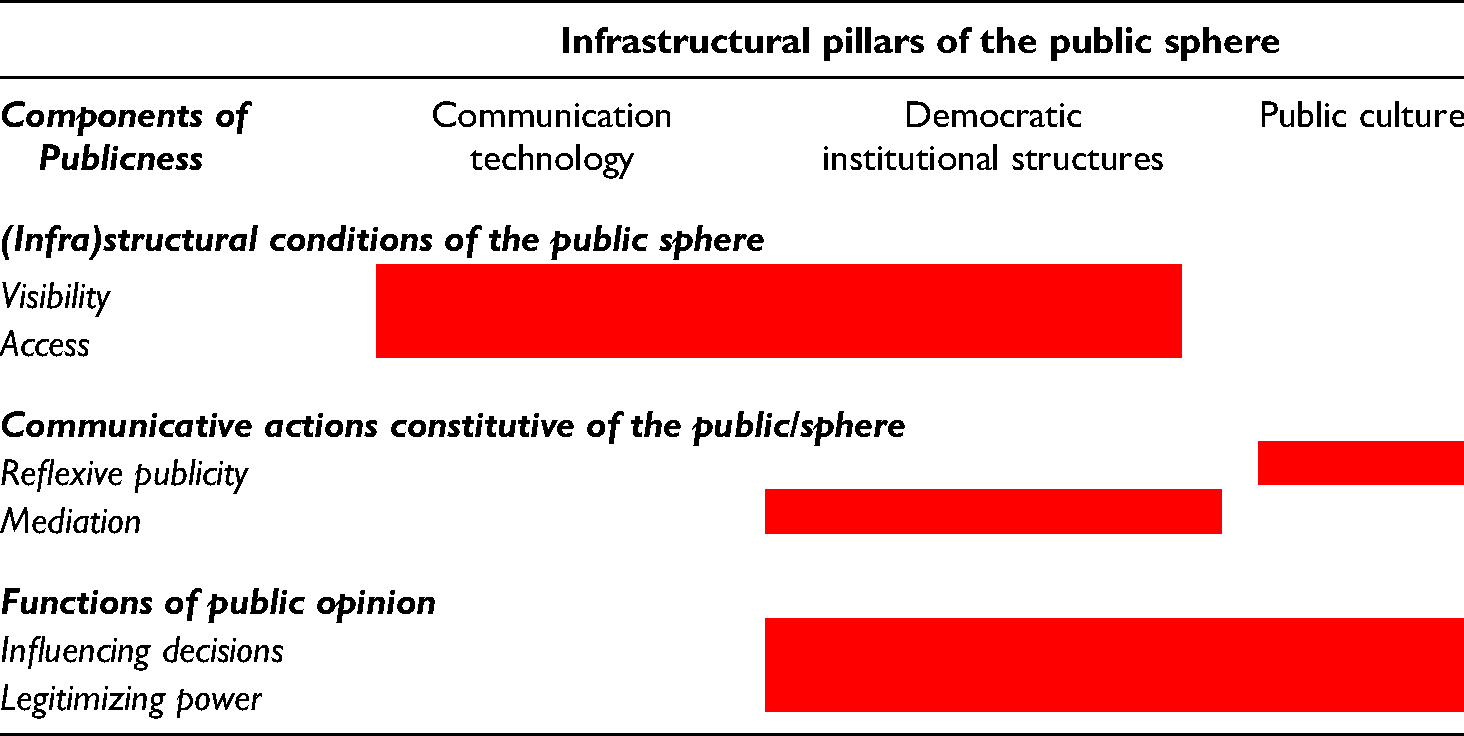
The development of a relatively stable “material culture,” as Dewey called it, and a democratic social infrastructure is essential for public and public opinions to emerge as the materialization of the normative components of publicness in the “discursive superstructure.” Communication technology, democratic societal structures, and public culture are three robust infrastructural pillars of the public sphere made up of diverse building blocks, which include:
The normative components of Visibility, Access, Reflexivity, Mediation, Influence, and Legitimacy (VARMIL) are indispensable for any democratic governance, whether considered the constitutive elements of the public sphere and publicness or independently of them. Likewise, each pillar of the public sphere has a large number of “variables” to be taken into account in an analysis aimed to explain historical changes in publicness and its diverse instantiations, publicity, public opinion, and the public sphere. Components of publicness and infrastructural variables are not binary properties being in a state of one of two mutually exclusive and highly simplified conditions, such as on/off, presence/absence, all/nothing, good/bad. Not only are there extensive “grey zones” between the extreme values of each component; the complexity of potentially conflicting components requires to view them dialectically from multiple perspectives.
The cells in Table 1 indicate the areas on which future research ought to focus, which can be illustrated by three examples from theory, history, and empirical research. One of the fundamental contradictions of the internetization of public communication is that with the rapid global increase in access to digital modes of communication, reflexive publicity is becoming (relatively) less widespread. While digital technologies increase the visibility of the socio-political environment and public access to communication channels, their influence on communicative actions that make up the public (sphere) and social functions of public opinion is rather insignificant. In contrast, democratic social structures and public culture are important in enabling and supporting citizens’ communicative actions and public opinion functions, but their impact on visibility and public access is not significant. Reflexive publicity or the public use of reason cannot be achieved other than by raising the general level of public culture, with education playing a key role.
Basic components of publicness in relation to the pillars of the public sphere (assumed close links between "variables" marked dark).
If we take a closer look at past developments, such a contradiction cannot be unexpected. As Tönnies critically pointed out in his Critique of Public Opinion (re-joined by Habermas's critics half a century later), public opinion is stratified and fragmented just like society as a whole, and so is the public sphere. Contradictions between expanding access and reducing the communication rationality and the unity of public opinion—reflecting the opposition between capital and labor, major cities and provinces, and between the educated and the people, as Tönnies pointed out—have also been the subject of controversy between Lippmann and Dewey, who agreed that the main question of democracy is whether and/or how citizens’ ability to make informed judgments and decisions can be made commensurate with an increasingly complex world in which they have to act, but neither of them found a solution to this conundrum.
The components of publicness can also be used to determine the key functions (to be) performed by the media and journalists as key “indigenous” actors constitutive of the public sphere. They do imply, but do not specify, the conditions necessary for the historical realization of these functions and the operational criteria to analyze them; they leave open the empirical question of how much specific functions and actors contribute to a vibrant public sphere in different social and cultural settings. To answer this question, comprehensive interdisciplinary and cross-cultural research efforts would be needed, as they should, in addition to the specific (normative) components of publicness, also take into account the three infrastructural pillars of the public sphere. The European Media Pluralism Monitor aimed at assessing “the risks to media pluralism” in EU countries in “normative” and “operational” terms can serve as an example of such an approach (cmpf.eui.eu/media-pluralism-monitor). The Monitor project examines a number of important aspects of the functioning of the mass media to fulfill their role of mediation between the state and civil society. The complex survey-based system includes 166 indicators measuring 43 cultural, legal, economic, and socio-political “potential risks” (variables) in four main areas of “media pluralism” related to basic protection, market plurality, political independence, and social inclusiveness of the media. A similar system of indicators can be developed for other components of publicness crossing the three infrastructural pillars of the public sphere, to which progress in big data mining and analysis can certainly make a significant contribution, provided that research is not reduced to them.
Publicness and the public sphere should be conceptualized in future research in ways that may render them more useful for both theoretical and empirical work. Radical critics have hitherto only wanted (the concept of) the public sphere to vanish, but the point is to reinterpret it from a broader societal perspective—if I falsify Marx's famous thesis. Simultaneously, the goal of critical theory is not just to (re)interpret publicness, but rather to help to bring it about. This is the question of emancipation—closely related to the Enlightenment and publicness—that Kant addressed two centuries ago. Unfortunately, he was not interested in the practical questions about what conditions have already been met and what still needs to be changed in society in order to make emancipation and publicness feasible. It is precisely these questions that need to be asked in critical research today.
Footnotes
Declaration of conflicting interests
The author declared no potential conflicts of interest with respect to the research, authorship, and/or publication of this article.
Funding
This work was supported by the Javna Agencija za Raziskovalno Dejavnost RS (grant number P5-0051 and N5-0086).
