




Abstract
The renewed interest in unearthing the structural similarities between neoliberalism’s ‘authoritarianism’ and the contemporary far-right has paid little to no attention to another critical overlap between the two: the deep aversion towards the ‘feminisation of society’. This paper aims twofold: first, I theorise the relation between gender and the state under neoliberalism as a fundamental aspect of its de-democratising project, which underscores a structural similarity between the two. Second, I highlight the role of politicising culture in both neoliberalism and the far-right. Drawing on Wilhelm Röpke’s theorisation of the cultural-symbolic and anthropological order as a political practice mystifying seemingly ‘autonomous’ political and economic orders, I show how the far-right ‘anti-gender’ culture wars are thoroughly compatible with neoliberalism. Despite the former’s rhetorical antagonism with the latter, ‘tradwives’ and bodybuilders are prime ‘authoritarian’ neoliberal subjects. I find evidence in the work of the German identitarians organised around the Institut für Staatspolitik.
Introduction
Following the new far-right resurgence globally, a renewed interest in theorising and understanding neoliberalism emerged (Cooper, 2020, 2021; Finlayson, 2021; Kiely, 2020, 2021; Slobodian, 2018b, 2019, 2021a, 2021b). Scholars have disentangled neoliberalism’s monolithic conceptions that reduced a heterogeneous and internally divided tradition to a set of abstract, historically independent tenets broadly endorsed. Instead, the rich and complex history of neoliberal worldviews has been uncovered (Brown, 2019; Callison and Manfredi, 2019; Cooper, 2017; Davidson and Saull, 2017; Davies and Gane, 2021; Kiely and Saull, 2017; Mirowski et al., 2020; Slobodian, 2018a; Whyte, 2019).
Works focusing on the ‘shared formal qualities’ (Davies and Gane, 2021: 5) or ‘the deeper overlaps and similarities’ (Kiely and Saull, 2017: 823) between neoliberalism and the far-right justifiably highlight neoliberal’s ‘de-democratisation’ (Brown, 2006, 2015; Callison, 2019), ‘authoritarianism’ (Bonefeld, 2017a; Bruff and Tansel, 2018; Hendrikse, 2018; Kiely, 2017; Rose, 2017) and the form neoliberalism reproduces its institutional frameworks – nationally and internationally – through which the economic and social/cultural spheres diverge from each other, activating far-right reaction (Davidson and Saull, 2017). They highlight the specific ‘contradictory embrace’, as Davidson and Saull put it, between the far-right and neoliberalism, the former opportunistically drawing from the existing context provided by the latter while simultaneously re-dressing the specific incompatibilities with the existing neoliberal order from which it emerges (Davies, 2014, 2021; Slobodian, 2021b; Slobodian and Plehwe, 2019).
In addition, these analyses enable us to grasp the far-right’s apprehension of neoliberalism’s ‘depoliticisation of socio-economic relations’ (Bonefeld, 2017b). However, they fall short to explain the far-right’s denunciation of neoliberalism as a global liberal elites’ project carrying out the disempowerment/depoliticisation through society’s feminisation. This point that rather than constituting a specific trend of ‘trad’ Neoreactionary (NRX) ‘incels’ consumed in online conspiracy and obsessed with building back the sphere of masculinity through compulsive bodybuilding and jaw exercises is central to the far-right’s worldview.
Gender panic is ubiquitous in the heterogeneous political ecosystem of the contemporary far-right (DiBranco, 2017; Hermansson et al., 2020; Köttig et al., 2017). Stubbs, Lendvai-Bainton and Szelewa have shown how, anti-genderism is a common trend of contemporary ‘authoritarian neoliberal’ governments in Hungary, Poland and Croatia (Lendvai-Bainton and Szelewa, 2020; Stubbs and Lendvai-Bainton, 2020). As demonstrated by the authors, the ‘repatriarchalisation’ of social relations, with a strong emphasis on reconstructing traditional gender roles, appears as the mode of ‘governing the social’ alongside the radical reconfiguration of the welfare state. Orban’s government in Hungary has banned Gender studies from schools. Family has come to replace the ‘dirty word’ ‘Gender’, while the idea of the tradwife has become commonplace in public discourse, as highlighted by a United Nations (UN) report released in 2016 (Lendvai-Bainton and Szelewa, 2020). Gender mainstreaming, LGBT (lesbian, gay, bisexual and transgender) rights and reproductive rights are seen as alien impositions from European Union elites, part of a globalist neoliberal project undermining national sovereignty. Similar tropes regarding ‘gender-science’ and ‘gender ideology’ populate the manifestos, public speeches and writings of far-right politicians and parties (Köttig et al., 2017).
In the extra-parliamentarian far-right, anti-feminism and misogyny are central to the French Nouvelle Droite’s heavily influential Identitarian Movement and the ‘international’ alt-right (Zúquete, 2018). The latter represents a rather dramatic case. The online spaces populated by the alt-right are obsessed with xenoestrogen’s loaded plant-based milk and seed oils resulting from a globalist elite plan to feminise society (Holly, 2021). They rest their case on the existence of gender-morphing frogs poisoned by chemicals spilt in the water by big pharma, which are directly linked to proliferating ‘femboys’ (Citarella, 2021b). Thus, Guillaume Faye, French Nouvelle Droite intellectual and one of the European identitarians’ political gurus, identified the ‘effeminisation and devirilisation visible in society’ as a characteristic feature of a decaying European civilisation to be challenged (Faye, 2014).
In response, the alt-right sub-culture is heavily loaded with the need for a strong remasculinisation of everything – from mewing and bodybuilding to prevent wealth redistribution (Citarella, 2021a; Price et al., 2017) to the creation of men-only online groups – the ‘manosphere’ – sometimes referred to as the ‘Männerbund’. A concrete manifestation of the latter is Jack Donovan’s (n.d.) masculine philosophy of Male Tribalism (Lyons, 2019; Order of Man, 2021). He advocates for the restoration of masculinity and male gangs through ‘androphilia’, a form of male-to-male erotic desire opposed to the effeminate gay culture’s ‘anti-male feminism’ plagued with ‘lesbians, queens and transsexuals of all religions, nationalities, and races’ (Donovan, 2012). Donovan’s ideas are influential beyond the United States, especially in the European Identitarian movement. In 2017, Donovan appeared as a guest speaker on the winter school of the German far-right’s think tank Institut für Staatspolitik (IfS), discussing about violence’s constitutive dimension of masculinity and political order (Kanal Schnellroda, 2017).
The appreciation of ‘masculine virtues’ as fundamental pillars of an organic, ethnically homogeneous political community appears alongside anti-genderism. The former emerges as the counterbalance to the perceived politicisation of ‘natural’ gender categories. Save for Cooper (2017, 2020, 2021), scholarly literature on neoliberalism and the far-right fails to seriously conceptualise gender’s role in this relation. Resulting from this theoretical lacuna, the far-right’s demand to reconstruct traditional gender values appears only as an uncomfortable vestige of reactionary politics and affects. However, why neoliberal societies, despite their ‘claimed’ erosion of gender roles, continuously engender social institutions always perceived at risk of erasure remains unsolved. This question can only be addressed by correctly understanding the ‘contradictory embrace’ between neoliberalism, gender and the far-right, an aspect I seek to develop in this paper.
A Strong State, a Free Economy and the ‘Hidden Abode’ of Reproduction
Among those engaged in uncovering the transformation of the state form under neoliberalism, Bonefeld (2013, 2015, 2016, 2017b, 2018) has provided the most succinct critique of neoliberal political economy. Bonefeld’s analysis starts from the ordoliberal’s critique of the political form of the Weimar Welfare State. Ordoliberals conceptualised the ‘crisis’ of the Weimar Republic as arising from the merging of political and economic orders and the need to ‘demassify society’ as a precondition for the disentanglement of these two orders, re-elaborating the elitist conceptions of democracy and the state that informed Italian fascism (Landa, 2018). As several scholars have demonstrated, the relevance of this structural semblance exceeds that of historical contingency, resurfacing during the 1970s and after 2008 (Bonefeld, 2017a; Kiely, 2018).
Bonefeld’s analysis reveals the political form of the neoliberal state as a Strong State, a concept that ordoliberals borrowed from Carl Schmitt (1985). For ordoliberals, as for Schmitt, the Strong State emerged as a response to the challenges posed by ‘mass democracy’, conceived as a ‘crisis of political authority’, where ‘society had taken hold of the state and dragged it down into society, making it a mass state’ (Bonefeld, 2017a: 750). The Strong State is defined as the necessary political form of neoliberal social relations. It guarantees that political and economic orders remained separate, fending off ‘politics’ from ‘greedy self-seekers’ and reproducing fetishised depoliticised socioeconomic relations as the precondition of free economic exchange. Relevant for our analysis is how Bonefeld conceptualises neoliberalism’s originality as a form of the free economy’s political practice, recentering politics as the necessary condition of neoliberalism’s ‘depoliticisation’ process, rather than as a disregard for politics by the progressive unfolding of ‘the economy’ into all aspects of life. Indeed, with Bonefeld (2003), I argue that the state’s appearance as autonomous from the economy under capitalism – almost (dis)appearance under neoliberalism – results from politically intensifying the ‘logic of separation’ between political and economic orders reproducing capitalist social relations. As Bonefeld (2017a, 2017b) puts it, ‘the assertion of state power is a condition of economic liberty’ (p. 19), and ‘free economy amounts to a practice of government’: The free economy is thus a stateless sphere under state protection; that is, the stateless sphere of private conduct amounts to a political practice of socio-economic depoliticisation. It amounts to political practices of social order. The stateless sphere of depoliticised conduct belongs to the state inasmuch as it is the state that determines the order of liberty and secures the liberal character of society in both its structure and the mentality of the economic agents, ensuring the freedom of economic compulsion on the basis of law and order. (Bonefeld, 2017b: 35, emphasis added)
Every ‘natural’ category within society appearing as such results from a political event. As Bonefeld argues, the specific neoliberal ‘logic of separation’, which endows it with its ‘authoritarian’ character, rests on the need to reconstruct politically the socioeconomic categories that guarantee this separation. For neoliberals, as Bonefeld and others argue, this means reproducing the ‘psycho-moral forces’ naturalised in the entrepreneur subject, a new ‘proletarianised’ existence furnishing ‘bourgeois society’ (Röpke, 1948). In other words, reproducing neoliberalism’s social form relies upon legal frameworks that curtail and recognise entrepreneurs as ‘free’. The state, then, should appear only, or primarily, in its form as the rule of law: enforcing the law. However, what happens then with the state’s welfare dimension?
Social reproduction must be drastically reorganised within neoliberalism between waged and unwaged activities outside the state. Within this social form, entrepreneurs represent proletarianised subjects that, deprived of the means of subsistence, endorse absolute market dependency as the sole means of their reproduction, fetishised as virtuous civilised individuals. In doing so, entrepreneurs reproduce the preconditions of an autonomous economic order. These preconditions foreclose the possibility of returning to a form of social reproduction mediated by the state, that is, the welfare state. Thus understood, neoliberalism represents a movement towards the ‘naked’ integration of proletarian’s life reproduction within capital’s reproduction. It is ‘naked’ in the sense that the welfare state must withdraw from direct material intervention in social needs, relocating these needs into the ‘economic sphere’. As I will show, this process simultaneously involves the indirect socialisation and the desocialisation of social reproduction. Here, I understand ‘socialisation’ in its double sense: as ‘aggregated social labour’ within the market carrying the peculiar ‘social’ aspect of commodity production under capitalism and as work ‘socialised’ through the welfare state.
Fully developed neoliberal social relations – that is, entrepreneurs – are the presupposition of neoliberalism’s ‘authoritarian’ form, when ‘authoritarian’ means the withdrawal of the state from social needs and the political enforcement of this withdrawal when challenged to guarantee capital’s reproduction. Therefore, neoliberalism’s reproduction rests on the possibility of reproducing the ‘naked’ market-dependent entrepreneur as the ultimate economic subject. Be that all, neoliberalism in the abstract would remain indifferent to social categories such as gender and race as long as they adhere to entrepreneurial values. At the end of this process, universalising the entrepreneur vis-à-vis developing the productive forces would erase ‘residual’ ‘pre-capitalist’ traditions and identities. The question that remains, and to which this paper turns, is, ‘Can entrepreneurs, given that enforcing the rule of law naturalises “self-responsibility” as their correct “moral infrastructure”, reproduce themselves solely within the market?’ Scholars engaged with Social Reproduction Theory (SRT) have answered this question in the negative (Bhattacharya, 2017).
As highlighted by these scholars, the individual’s full reproduction through relations directly mediated by the market would demand the complete commodification of human activities and needs to be purchased with the fruits of the entrepreneur’s labour. Whether this is structurally possible within capitalist societies – an open debate (Best, 2021; De’Ath, 2018) – this complete commodification of human needs has not been historically realised. Yet, many life-sustaining tasks previously ‘uncommodified’ have appeared in the market as the ‘service economy’ characteristic of neoliberal societies proliferated, drastically redrawing what social reproduction ‘outside’ market relations entails. As Gonzalez and Neton (2021) put it, ‘any discussion of neoliberalism would be incomplete without first examining the transformations that have occurred within proletarian reproduction over the course of the past several centuries’. Thus, the separation between politics and economy that guarantee the reproduction of depoliticised socioeconomic relations previously discussed is accompanied by the ‘structural separation between the production of goods and services for the market, on the one hand, and the reproduction of labour power on the other’ (Gonzalez and Neton, 2021). For Gonzalez and Neton (2014), this means the constantly relocating ‘reproductive’ tasks between two mutually constituted spheres, the ‘Directly market-mediated sphere (DMM)’ and the ‘Indirectly market-mediated sphere (IMM)’ (p. 63). The difference between these two spheres resides not in the tasks carried within each, constantly reorganised, but in the specific form that these reproductive tasks are organised, corresponding to different forms of domination guaranteeing the spheres’ reproduction.
On the one hand, tasks within the DMM are organised capitalistically and are objectified in commodities exchanged in the market. They are mediated by the wage, thus appearing formally as an exchange of equivalents between equals. As such, ‘market dependency, or impersonal abstract domination’ (Gonzalez and Neton, 2014: 65) progressively characterises the form of social domination within the DMM sphere. Those relations are reproduced similar to any other capitalist relation, with ‘no structural necessity towards direct violence, or planning, in order to allocate labour per se’ (Gonzalez and Neton, 2014: 65). Generally, and in as much as it pertains to the State, DMM tasks are structurally reproduced through the rule of law and its institutional forms, and the entrepreneurial society is the optimally fetishised social form.
On the other hand, IMM tasks are not directly determined capitalistically and, in most cases, remain unwaged, appearing as non-labour. Crucially, the existence of this sphere corresponds to the existence of specific activities needed to reproduce proletarian life that cannot be, have not yet been, or have ceased to be accounted for within the DMM sphere as commodities: in short, goods, services and social relations necessary to reproduce entrepreneurs’ lives unaccessible through their wages. Insofar as these tasks remain unwaged, the social domination within this sphere guaranteeing its reproduction takes a different form: ‘from direct domination and violence to hierarchical forms of cooperation, or planned allocation at best’ (Gonzalez and Neton, 2014: 65). In order to appear as unwaged non-labour against other reproductive tasks taking place within the DMM, most tasks are naturalised, constituting a ‘gendered sphere’ (Gonzalez and Neton, 2014: 68). As Fortunati (1995) observed, employing a different terminology than Gonzalez and Neton but accounting for the same process of separation: While production work is posited as being work involved in commodity production (wage work), reproduction work is posited as a natural force of social labour, which, while appearing as a personal service, is in fact indirectly waged labour engaged in the reproduction of labour power. (p. 8)
Thus, the (re)production of gender as a binary masculine/feminine is the ‘anchoring of a certain groups of individuals in a specific sphere of social activity’, the gendered sphere, containing unwaged activities nonetheless essential for the reproduction of life (Gonzalez and Neton, 2014: 78). Here comes to the fore a particular form of depoliticisation-as-domination, as ‘the social content of gender’ – that is, the tasks structurally/temporarily excluded from the DMM sphere, or following my discussion as below, ‘desocialised’ – is ‘“written upon the skin” of the concrete individuals’ (Gonzalez and Neton, 2014). A historically determined and contextually specific process, ‘gender is constantly reimposed and re-naturalised’ as specific struggles and material developments redistribute the allocated tasks between the DMM and IMM spheres – proletarian reproduction (dis)integrates from capital’s reproduction in a contradictory embrace (Gonzalez and Neton, 2014: 81).
How does this discussion of the social form of gender under capitalism relate to the Strong State as the political form of neoliberal social relations? Gonzalez and Neto’s insight in identifying the overlap between the DMM and IMM spheres is necessary for our discussion. This overlap loads with social content the form of the capitalist welfare state, organising waged, social reproductive tasks not directly mediated by the market (see Figure 1).
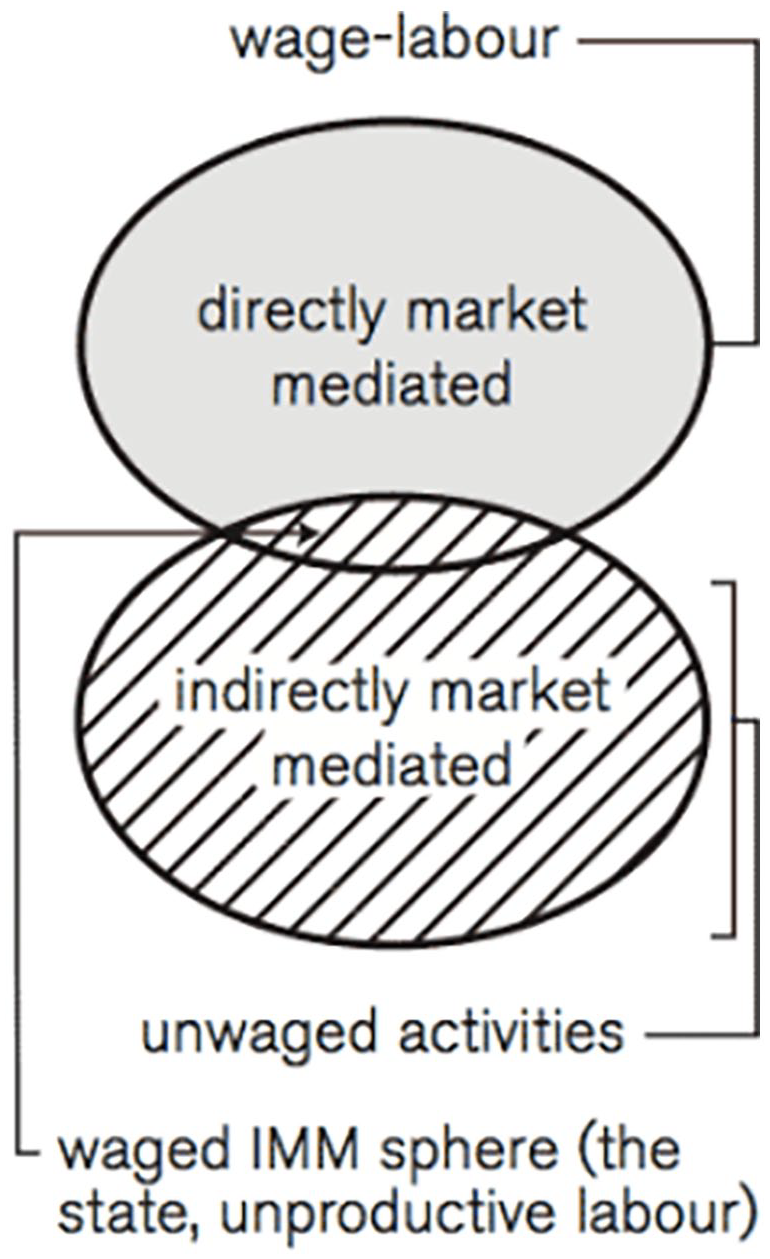
A graphical representation of the relation between the DMM/IMM and waged/unwaged spheres.
The specific form of the state thus plays an essential role in defining the social content of the gendered sphere. The fact that the state, following this discussion, necessarily appears as ‘the political’ pole of depoliticised socioeconomic relations leaves its welfare form as ‘the political’ pole of ‘naturalised’ gender relations. However, unlike the form of abstract domination mystifying the political relation through which this naturalisation takes place within the DMM – producing entrepreneurs – the gendered sphere requires ‘a higher and greater level of ideological organisation in order to make it function’ (Fortunati, 1995: 9), restoring to explicit gender violence when necessary. Lacking a legal framework that encodes entrepreneurs’ existence as formal equal subjects of exchange, politicising the cultural-symbolic order to reproduce the gendered sphere is both a necessary aspect of the ‘the logic of separation’ and the completed picture of neoliberalism’s ‘authoritarian’ rule. Thus, the cultural-symbolic order (i.e. Western Civilisation, Bourgeois order, Christian Civilisation), which in regular times must appear as the neutral expression of traditional values ‘written upon the skin’ of sexed and racialised bodies, self-reproduced, mediates the relations between ‘unequals’ within the gendered sphere. Importantly, this gender sphere must remain spatially and temporally separated from the DMM sphere (De’Ath, 2018). Therefore, the cultural-symbolic order, when operating within the gendered sphere, must appear as relatively autonomous from the economic order and logic reproducing the DMM sphere, if not at times as its opposite (i.e. the slow, safe and committed dedication to raising one’s child versus the dangerous, fast-paced, competition-ridden logic of the market). To close the circle, the structural ‘autonomy’ of the cultural-symbolic order demands that its reproduction occurs independently from the reproduction of economic relations. In its explicit authoritarian form, its political character manifests as political violence – gender and queer violence ubiquitous in the discourses and actions of far-right social formations – which paradoxically constitute the specific form of welfare policy of a ‘naked’ IMM sphere. The latter collapses into the gendered sphere to disentangle the state (political form) from society (depoliticised socioeconomic relations), supplementing the rule of law enforcement that reproduces the DMM.
Following these critiques, we can better conceive neoliberalism’s authoritarianism as a specific restructuring of the relationship between DMM, IMM and the State – or, put differently, the specific form and social content of the gendered sphere as the non-waged IMM sphere vis-à-vis the waged activities mediated by the market. As O’Brien (2017) suggested, SRT provides us with the conceptual tools to better understand the ‘casual chains that link culture, state policy, and regimes of capital accumulation’. From this perspective, state intervention in the process of social reproduction through welfare necessarily appears as the politicisation of socioeconomic relations that must appear, in its limiting form, socialised as private relations outside politics (DMM) or desocialised as biological activities (gendered sphere). Every social reproductive tasks that cannot be integrated into the DMM sphere must be naturalised in the gendered sphere, which corresponds to the constant reproduction of gender and its naturalisation in sex as a precondition for the state to exist above society. The opposite is true; the dissolution of traditional gender roles, that is, the restructuring of the gendered sphere where social reproductive activities are naturalised, threatens the preservation of ‘autonomous’ political and economic orders, but only in the case where this is not accompanied by the corresponding socialisation of these activities within the DMM sphere.
Following this last point, I argue that neoliberalism’s gender orders do not need to appear in its fully authoritarian form. Its authoritarian form, always latent, becomes apparent when the reproduction of capital fails to integrate the reproduction of the entrepreneur; when social reproduction falls outside the DMM and IMM (here as gendered sphere), and social struggles to reproduce life attempt to restructure the relations between these two by expanding the state or superseding these forms altogether. This restructuring necessarily implies a ‘re-construction’ of gender, as the DMM and gendered spheres and their interlocking with the state find a new ‘temporary’ stabilisation in ‘new’ social forms. Only then does the political precondition of naturalised social forms become unmasked as what it is. Re-naturalising sex and reconstructing gender through the politicisation of culture – the political role in the cultural reproduction of society – becomes necessary for reproducing the logic of separation between politics and the economy. We can find the awareness of this ‘contradictory embrace’ in the writings of a leading neoliberal figure, Wilhelm Röpke, whose structural semblance with the far-right’s cultural wars will be drawn below.
Röpke’s Critique of Liberalism: The Authority of Culture
Wilhelm Röpke, whose work Bonefeld refers to in his account of authoritarian neoliberalism, became a key figure of European radical conservatism, providing the basis for a ‘neoliberalism’ that grounded economic liberalisation and progress in tradition and authority (Serer, 1956; von Kühnelt-Leddihn, 1955, 1974: 200).
Concerning the reproduction of cultural-symbolic orders, Röpke emphasised how competition, as a generalised cultural logic, could not ‘improve the morals of individuals nor assist social integration: it is, for this reason, all the more dependent upon other ethical and sociological forces of coherence’ (Rüstow, 1942: 272). This is what Röpke (1942) called the ‘psycho-moral forces’ of capitalist societies (p. 83). Generalising competition outside the economic sphere derived from the liberal ‘depoliticisation’ of culture, subsuming its reproduction to the market logic – what Röpke considered detaching culture from economics (Röpke, 1960: 132). However, reconstructing the relationship between economics and culture did not mean the latter’s subordination to the former. Röpke coined ‘Liberal immanentism’ to refer to this ‘detachment’. For Ropke, Liberal immanentism fails to understand the political origin of the cultural form of free-market social relations. This must be ‘furnished from outside’ the market, as the latter’s competitive logic ‘constantly strain them, draw upon them, and consume them’ (Röpke, 1960: 142). This liberalism ‘increasingly lost sight of the necessary sociological limits and conditions circumscribing a free market’, thus endowing the free market with ‘sociological autonomy’ (Röpke, 1950: 51). This inevitably results in the politicisation of socioeconomic relations, manifested in the appearance of the welfare state, often referred to by ordoliberals as a mass state or a total state (Bonefeld, 2017b; Röpke, 1942).
This contempt for ‘liberalism’ fundamentally structures ordoliberal thought as much as it characterises how they conceptualise the political origin of those ‘autonomous’ orders: the need to construct anew, through market-conforming intervention and otherwise, the political and economic orders as interconnected and independent spheres of the social totality of capitalist relations. While the political and institutional frameworks are reproduced through the rule of law, the ‘moral framework’ or ‘anthropological framework’ associated with the psycho-moral, psycho-cultural order discussed above is reproduced otherwise. Unbound competition outside the economic sphere atomises society eroding the psycho-cultural frameworks: the ‘cohesive forces of the family and the natural social groups’ (Röpke, 1950: 52).
Röpke’s critique of the welfare state underscored the role of specific state interventions in weakening the kind of relations structuring the social totality. Those forms of political intervention redeployed as welfare state interventions into the social fabric were particularly harmful, decreasing individuals’ dependency on the market by linking them indirectly to the state, thus enlarging the task within the waged IMM sphere at the cost of transforming both the gender and DMM sphere. However, in order to revert it, a political act was needed. As he wrote in an article in 1958, If the welfare state has no built-in self-limiting capacity, then the necessary limits must be drawn from outside, lest it outgrow us and ultimately become the ruin of a free and prosperous society. (Röpke, 1969: 205, emphasis added)
As discussed in the previous section, this ‘outside’ the state is a delicate bargain between DMM and the gendered sphere in constant rearrangement with the state as the trinity of social reproduction. By demanding that the state ‘withdraw’ from social reproduction, Röpke’s difficult task resided in specifying how to combine ‘market authority’ with ‘social authority’. The latter emerges in Röpke (1948) as a source of naturalised authority without politics – ‘counterweights to the state’ (p. 99) – vis-à-vis the political authority of a strong state, to ensure that capital’s reproduction meets the social needs to reproduce life.
Cultural values, traditions and institutions, in Röpke, become a source of power without politics, reproducing the separation between the economic and political sphere as they appear, by way of ‘naturalising’ social categories where this power is encoded (i.e. race, gender, sex, sexuality, as individual and collective identities structuring society). Culture and its institutions are thus a medium for political power to appear as depoliticised social relations outside direct market dependency and state intervention. Political power is always the precondition of its absence.
The psycho-cultural framework is an indispensable aspect to redress the relation between the economic and political orders as autonomous, which, for Röpke (1960), ‘must be conquered anew each day’ (pp. 1–35). Using a trope ubiquitous in the Nouvelle Droite and the identitarian movement, Röpke (1960) tackles the discontinuity with tradition due to the collectivisation of experience brought by the Fordist, mass production/consumption, mode of accumulation, where cultural and economic orders have detached from one another.
In Röpke’s worldview, the family and the (ethnically homogeneous) organic community are the loci of moral and ethical values essential to sustaining the capitalist social order. The ‘bourgeois spirit’, politically (re)produced, is the cultural expression of the family and the community’s naturalised order (Röpke, 1960: 119, 1982), as the bourgeois order naturalises the ‘self-reliance and self-assertion of the individual taking care of himself and his family’ (Röpke, 1960: 119). Thus, the constant preservation of heteronormative gender relations appears as a precondition for the emergence of traditional family units, formally ‘autonomous’ from the state and the economy.
Röpke’s neoliberalism implies a cultural war, especially as cultural and economic orders ‘diverge’, threatening the state’s ‘autonomy’ beyond and above the economy. In the following section, I will explore the radicalisation of this argument as it takes place in the contemporary expression of the far-right.
Gender Panic and the Contemporary Far-Right: Neoliberalism Redux?
The far-right thriving in the so-called cultural wars is not a historical novelty. Metapolitics, a term employed by the Nouvelle Droite and (heretic) followers to describe their political intervention outside parliamentary politics, derives from Armin Mohler’s re-construction of the Weimar’s Conservative Revolution tradition (Griffin, 2000; Mohler and Weissmann, 2018). However, the specific reason why culture is ‘politicised’ by this new far-right is often less discussed. By constantly mobilising fundamentalist notions of culture, contemporary far-right cultural wars seek to isolate culture from political intervention altogether, bridging ‘back’ the gap between nature and nurture that ‘globalisation’ and ‘multicultural’ elites have opened. This second move is crucial if we attempt to properly conceptualise structural similarities between the far-right and Röpke’s ‘authoritarian’ neoliberalism. Far-right anti-gender, masculinist politics is an exceptional case study.
The German ‘identitarians’ around the IfS provide the most direct synthesis of ‘strong state’ and anti-gender politics. The connections between the IfS and its magazine, Sezession, and the German far-right party Alternative für Deutschland (AfD) have been publicly acknowledged. After an initial period of scepticism and public distance between the IfS and AfD, the relationships between these two changed with the Erfur Resolution in 2015 (Kubitschek, 2015). The Erfur Resolution marked the advance of the extreme-right faction of the party now dismantled, Der Flügel, led by Björn Höcke and Andreas Kalbitz. The former gained international attention as the regional leader of AfD Thuringia, where he overtook Merkel’s Christian Democratic Union of Germany (CDU) and gathered 23.4% of the votes in the state elections of 2019 (Connolly, 2019). Götz Kubitschek, co-founder of the IfS and one of the most influential far-right public intellectuals in Germany and abroad, is a close friend of Höcke. Kubitschek has not only helped design the strategic map of Der Frügel faction, but he is said to have served as the middleman between Höcke and the current leaders of the AfD, Alice Weidel and Tino Chrupalla (Amann and Müller, 2019). In 2015, Höcke participated in the congress of the IfS for the first time (IfS, 2015). The appearance of AfD politicians became commonplace in subsequent political congresses and winter and summer schools held by IfS, with Alice Weidel participating as a guest lecturer in the 2019 (Kanal Schnellroda, 2019).
The magazine’s 2021 October publication contained a dedicated article to Röpke (Udau, 2021) on an issue where they discussed, among other topics, the relation between private power and the public sphere, in a clear allusion to the preoccupation with the erasure of different ‘ontological’ orders these two occupy in their worldview.
This specific worry is a recurrent topic in IfS. In 2020, the IfS’ 21st summer academy focused on ‘state and order’. They addressed the questions of ‘How should a conservative or right-winger behave in the face of a state that has fallen prey to the parties?’ and ‘How to defend the concept of the state and what form of order to propagate?’ (Institut für Staatspolitik, 2020). Presenters in this summer school engaged with the ‘hollowed-out’ state problem, its role in constructing order, the ‘basic anthropological constants’ providing an objective basis in opposition to the increasing ‘moralising’ environment, which for them meant the dissolution of independent spheres, above all the moral and political spheres and the corresponding move towards a growing bureaucratic state (i.e. the welfare state) (Lehnert, 2020). Dimitrios Kisoudis (2020), recently appointed as Weidel and Chrupalla AfD duo’s press spokesperson, gave a speech about the ‘Rule of Law, the Welfare state and State of Order’. Drawing on Carl Schmitt’s Strong State, in a criticism of the liberal state shared by ordoliberals, Kisoudis defended how an ethnically homogeneous social order exists as the precondition of a ‘strong state’, withdrawn from society. Kisoudis (2020) blamed ‘feminists, minority representatives, gender ideologues and anti-racists’ monopolising the cultural order after May 68, undermining the separation of the political and economic orders, for which a ‘community of values’ is its precondition, thus transforming the welfare state into a totalitarian state.
These analyses abound in the magazine Sezession. Ellen Kositza, a magazine’s contributor and wife of Kubitschek, has extensively written about Germany’s decline in the birth rate, a common preoccupation of the new far-right. For Kositza (2008b), this crisis expands beyond the ‘reproductive sphere’. She writes, The sprawling and literally bottomless gender discourse has many implications. The arc that spans here ranges from fundamental identity problems, sexual and childbearing behaviour, labour market policy to the devaluation of the domestic sphere. The latter goes far beyond questions of education (beyond lost cooking skills and other housewife skills that have been degraded to a stupid cliché image anyway) and even into the question of property: those to whom the home and the hearth –terms that seem almost shamelessly naked today without inverted commas–no longer count for anything, those who do without offspring (or their upbringing), will only find what they can call their own in the world of mobile and ephemeral things. (Kositza, 2007)
In her writings, she attributes the causes of this crisis to the interlocking of capitalism’s erosion of traditional customs and state intervention, especially in child policy. Mass cultural production and mass consumption of ‘non-material’ commodities are, for Kositza (2008b), the symptoms and causes of this gender crisis. This form of cultural production characterises ‘other-directed’ societies (p. 26), where individuals primarily adopt consumer behaviour. Dictated by advertisement, embedded in constant leisure to fill the void of a culture of boredom resulting from the integration of ‘labour human force as male cog in a wheel’ –what she calls the ‘androgyny machinery’ (Kositza, 2008a: 63) – individuals’ cultural reproduction appears primarily driven by their compulsive social media usage and consumption. This process decouples sex from procreation by commodifying the former and subsuming all the affective, naturalised qualities of social reproductive work such as love, care, affection and sex into non-material commodities following a market logic.
For Kositza, it is decoupling sex from procreating that ‘renders’ gender ‘as’ independent from its biological underpinning. Consequently, it endlessly reproduces multiple genders stripped from its ‘natural’ determination in sex. Destroying society’s vertical structures results from the mainstream feminist claims on equality, the ‘gender-gaga’ ideology – both terms often employed by AfD politicians (Queerde, 2017) – denaturalises ‘tradwives’ and husbands. They are replaced instead by chronically infantile and feminised ‘child-adult’ men unable to mature and ‘liberated feminists’ who are ‘mass media stereotypes’ and ‘raven mothers’ (Kositza, 2004, 2008a, 2008b, 2015, 2020).
Mass society’s feminisation leads to the erosion of both masculine and feminine realms in a combined process. Remasculinising society becomes the indispensable path towards reconstructing natural gendered categories. Kositza’s claims could account for another example of reactionary conservatism. However, remasculinising society entails further integrating social reproduction with capital reproduction akin to neoliberalisation, as discussed in the section above. As she argues, citing Franz-Josef Wuermeling, the first Federal Minister for Family Affairs from 1953 until 1962, Prosperity for all means: freedom and self-responsibility of everyone. Prosperity has an inner meaning which . . . is not exhausted in freeing people from the worry about their material existence. Prosperity wants to enable freedom of becoming and independence of personal decisions. Prosperity aims to ensure that the citizen’s existence is not based first and foremost on the state, on the collective, but on himself. (Kositza, 2005: 40)
The re-construction of gender, mediated by the re-construction of the traditional family, appears as the necessary condition for the naked integration of individuals’ social reproduction in the market. This means withdrawing the state from both the DMM and IMM spheres, enlarging the gendered sphere, as socialising reproductive tasks via direct state intervention in family affairs as in welfare – but also through socialisation via the integration of women’s workforce – is directly exported from the ‘Marxist’ ‘cookbooks’ of the May 68 intellectual leaders: This closes the circle, as it were, to the demands made by Engels, Bebel and Horkheimer to include women in the production process. This, in turn, is a supporting element of the socialist state: Only by cutting the tight bond between mother and child, by providing child care and education in state institutions, can family structures be reliably dismantled and the free, socialist human being created in the long term. (Kositza, 2005: 40)
That is, the double socialisation of social reproductive tasks undermines the family’s position as the primary caregiver, transforming the social relations underpinning the gendered sphere and politicising the DMM sphere.
The direct relation between reconstructing the ‘natural’ gender binary and reconstructing the ‘autonomy’ of politics and economy – the Strong State – is found in Martin Lichtmesz’s writing. Lichtmesz represents the far-right identitarian movement in Germany (Zúquete, 2018: 78). In his writing, Lichtmesz has denounced gay marriage and the proliferation of gender identities as an example of ‘Cultural Marxism’.
For Lichtmesz, the ‘new world order of globalism’, the prevailing Western political system, is defined as capitalism’s economic triumph alongside Marxism’s cultural triumph. This specific ‘decoupling’ of economic and cultural orders amounts to politicised socioeconomic relations. The latter results from the increased power to shape culture and public opinion, especially if the economic logic dominates the realm of cultural (re)production controlled by the left, which he sees as the result of a ‘disappearing’ state under the laissez-faire dogma. In striking similarity to Röpke’s idea of the ‘depoliticisation of culture’ previously discussed, Lichtmesz (2014a) considers that The libertarian schema of the heroic private entrepreneur who stands in antagonism to a state that curtails his freedom is conceivably unsuitable to describe the political-economic power structures of today’s world. The idea that a completely free, ‘anarcho-capitalist’ market would automatically bring with it an ethical self-regulation of society is no less absurd than the radical-egalitarian axioms of the left. Instead, Left to its laissez-faire alone, no more gods above it, capital will inevitably proliferate like a cancer cell. It tends all by itself beyond the private enrichment of the individual, towards public, political, media and cultural power aggrandisement, control, networking and market domination. ‘Opinions’ are not a neutral terrain like consumer goods, but an instrument of power and control. (Lichtmesz, 2014a, emphasis added)
The denaturalisation of gender is a symptom and cause of the (de)politicisation of culture through the politicisation of socioeconomic relations, where ‘the left-wing extremist conceptual constructs transplanted into the organic construction of language are matched on a physical level by the rubber vagina and silicone breast implants of transsexuals’ (Lichtmesz, 2014b). In the absence of cultural-symbolic frameworks that appear as ‘autonomous’ from the economic order, culture’s ‘naturalising’ power – which mystifies politics – becomes the explicit politicisation of the economy. Thus, ‘feminist and gender ideologues’ are conceived as a ‘totalitarian’ political expression, and the survival of Western civilisation is made dependent on a ‘reevaluation of masculinity’: the political re-construction of traditional gender roles (Lichtmesz, 2014a, 2014c).
Lichtmesz draws on his ‘idol’, Hans Blüher, to conceptualise the re-construction of male and female spheres. In an article dedicated to Blüher, Lichtmesz (2006) writes, ‘The question of identity, of the meaning and essence of the “masculine” and the “feminine” per se, exerted a great fascination on Blüher’ (p. 5). Blüher was an influential figure in the Youth Movement, a fertile ground for distributing and re-elaborating conservative revolutionary ideas during the Weimar Republic (Adriaansen, 2015). His work became known beyond the circles of the youth movement with the publication of his The Role of Erotics in the Male Society (Blüher, 1912). In 1917, Blüher’s book traced the cohesive bonds that organise horizontal and vertical relations within society to the unsublimated homoerotic eros feeding a metaphysical form of male–male desire. Notably, he saw this specific hierarchical relation as the fundamental pillar of an elitist political order, with ontologically independent political and economic orders. While this male–male eros remained sexually unrealised, the male-bonding leagues (Männerbund) were endowed with state-building capacity and understood as the locus of political power, appearing independent from the more materialistic task of social reproduction, secluded in the naturalised gendered sphere to which women belonged (Bruns, 2011: 127–128; Mohler and Weissmann, 2018: 178–179). For this eros to be endowed with the capacity to reproduce a Strong State, it needed to be curtailed by the reproduction of strong masculinity, lest the feminity of the active homosexual destroyed the pure idealist bond with carnal desire.
Thus, the rationalisation of gender and sexual relations as state-building meant reproducing the ‘feminine sphere’ as necessarily depoliticised – that is, naturalised, desocialised – vis-à-vis the ‘politicisation’ of culture as seemingly detached from matters of social reproduction. The latter implies the presence of a strong state detached from the economy and the (de)socialisation of social reproduction within both DMM and gendered spheres only.
As Lichtmesz (2006) concludes, Blüher described male ‘eros’ as a double-pole drive: on the one hand, leaning towards woman and family formation, on the other towards the ‘male alliance’ and thus towards state formation. (p. 4)
Hitler’s ‘totalitarianism’ – which, for these authors, constantly resurfaces in contemporary gay politics as totalitarian politics – became manifested precisely with his persecution of homosexuals, as it undermined the social basis for the Männerbund’s ‘state-building power and culture-creating spirituality’ (Gerlich, 2014: 16) and opened the path towards the politicisation of life. National Socialism’s prosecution of homosexuality has provided a moral alibi to contemporary gay politics, where the ero’s ‘repressive desublimation’ carried out by the activities of the ‘gay lobby’ ‘uprising of sexual perverts’ has ‘turned that sublime homoeroticism, which had once been part of the cultural wealth of the Occident, into a piece of antiquarian history’ (Gerlich, 2014: 19). Build masculinity back, build a Strong State, build the economic order better.
Conclusion
In 1984, Fortunati (1995) wrote, ‘Today, non-material reproduction is the part of reproduction that is most in crisis because it is the least controllable by capital’ (p. 75). By non-material reproduction, Fortunati (1995) meant consuming commodities ‘which have no material basis: affection, sexuality, companionship, “love”, nonetheless indispensable to reproduce life as much “as is a grilled steak or an ironed shirt”’ (p. 74). These non-material goods’ special character derives from their temporal indeterminacy and simultaneous production-consumption. A ‘mother’s’ tender caress and affective support is a continuous process and, by the nature of its unending production-consumption, it defies its quantification as a specific magnitude of socially necessary labour time – for a convincing argument of the structural limitations posed by ‘non-material’ reproductive work to be subsumed by capital, see Haller (2018). The flip side of this picture is a constant moralisation of instances when ‘mothers’ fail to develop those naturalised qualities, or when they refuse to do so, as the sole mechanism to reinscribe those attitudes into fixed, biologically endowed social roles, a process that is often resisted, challenged and transformed. To this, one must include gender and queer violence that materially shape and order the social content of the gendered sphere. A historical account of the social constitution of the gendered sphere must account for the development of the relations of production, the introduction of state intervention and feminist and social struggles for life. At times, all of these undermine – by way of socialising them – the need for specific social reproductive tasks to organise within the gendered sphere. As highlighted by Fraser (2017), this is the case, if not for society as a whole, for specific class factions within a national economy or within the international division of social labour, where the global south becomes the reproductive factory of the Western world. This uncovers a contradictory embrace precisely because, as we have argued, the gendered sphere always remains indispensable for reproducing the totality of capitalist social relations. Most importantly, it must be enlarged for the state to appear as a Strong State: that is, some social reproductive tasks must be desocialised during this process, even if temporarily.
Röpke, Kositza and Lichtmesz highlight this contradiction in their writings. Röpke’s rejection of ‘bored’ mass society resembles Kositza’s. In the 1950s and 1960s, he rejected the USA Fordist mass production model – including, above all, the subsumption of non-material production into mass cultural production. Röpke populates his writing with images of a bucolic social order, where traditional families are integrated into (ethnically) homogeneous organic communities. The same is true for Kositza, who represents family life as saturated by the slow-pace, safe household space as the proper ‘workshop’ for the endless labour of educating one’s children, loving one’s husband and being a ‘tradwife’. Lichtmesz’s remasculinised society is one where the ‘real’ men’s perfectly carved, muscular bodies materialised equally perfect virtues. Writing about Mishima’s relation between the repression of homoerotic desire and his last ‘gesture’, Lichtmesz states, Through the development of his muscles, he discovered that the body possesses its own logic and language, urging pure action beyond corruptive words. The body now appeared to him as spirit made visible: the beauty of the virtues must correspond to the beauty of the body and vice versa. (Lichtmesz, 2020: 55, emphasis added)
The politicisation of these ‘cultural’ representations, which contradictorily aims at its ‘depoliticisation’ by naturalising gender, is upheld as the necessary form of mediation to reproduce the preconditions for the economy to develop as an autonomous sphere. This is the case despite them appearing as ‘antagonistic’ with the ‘nihilistic’ realm of competition, ever-increasing productivity and generalised greed exempted from any ‘social’ character as its virtue. They correspond to a cultural formation immanent to capitalism, to the naked integration of proletarian’s life reproduction and capital’s reproduction here described as the main implication of neoliberalism’s social form. Approaches that seek to develop the relationship between the far-right and neoliberalism without a complete picture of the latter’s reproduction presuppositions are thus ill-equipped to properly account for the mechanisms through which specific far-right social formations are reproduced as moments within the totality of neoliberal social relations, which deepens rather than undermines neoliberalism in its authoritarian form. White bodybuilders and tradwives appear as the cultural manifestation of the neoliberalism of the far-right.
Footnotes
Acknowledgements
I would like to thank Alexander Stoffel, Miri Davidson, Timor Landherr, Callum Sunderland and Naomi Cohen for illuminating comments and engaging conversations that have significantly contributed to this paper, as well as the anonymous reviewers for their insights and endorsement.
Funding
The author(s) received no financial support for the research, authorship, and/or publication of this article.
