



Abstract
The contemporary discourse around historical trauma and healing is site for debate and resistance in public spheres. Guided by critical scholars in language and power as well as post-and settler colonialism, this study analyzes texts and contexts of two public apologies in Canada – Chinese head tax, and residential schools for Indigenous children – to examine how historical trauma and healing were understood, and by doing so how the subject and object were re/constructed to maintain or resist social (dis)orders – postcolonial racial orders – in the past and the present of Canada. Findings included: (1) a split and temporal distance between the wrong past and the benevolent present with governments constructing themselves as the good subject reifying a sincere fiction of a liberal, benevolent, and just white-nation; (2) no acknowledgement of the cause of historical trauma, namely colonial governing; (3) ongoing construction of the other racialized population as victims/burdens/lesser citizens to current Canada; and (4) the explicit demand to collective forgetting of the past/historical trauma as current healing and inclusion. We discuss social responsibilities when historical wounds continue to leave injuries and the risk of perpetuating systemic violence to people with whom we currently share the nation all of us call home.
Keywords
The power of a sincere apology is in the satisfaction of a basic human need.
It can heal wounds of those who have been hurt. It can help establish trust. It can restore human dignity and self-respect. It can take the first step toward reconciliation.
A sincere and honest apology given can add to the sum of justice in the world
Historical trauma refers to historical oppression, cultural suppression, and colonization toward massive groups of people and the subsequent cumulative and ongoing harms and injustice on their lifespan and across generations (Kirmayer et al., 2014; Maxwell, 2019; Ortega-Williams et al., 2021). Beginning at the end of 1980s and through the 1990s, the concept of historical trauma has been widely circulated in both scholarly and grassroots community discourse about Indigenous 1 and other marginalized population health concerns and healing in North America (Brave Hart, 1993, 1999; Duran and Duran, 1995; Kirmayer et al., 2014). Critical scholars have observed debates and conflicts: A biomedical understanding of historical trauma constructs a notion of victimhood that legitimizes clinical intervention for healing whereas a sociopolitical view of historical trauma unveils systemic injustice as a cause of trauma that has to be resisted as a centre of healing (Maxwell et al., 2014). The biomedical view which originated from colonial discourses has become dominant in social and health services and policies. It has been critiqued as it continues to contribute to maintaining colonial social (dis)orders which solidify colonizers/oppressors in positions of power and subjugate others to treatment/fixing, marginalization, and containment (Maynard, 2017; Taylor, 2015). An increasing understanding of post/colonial histories of Indigenous nations and other racialized populations also demands explicit political recognition of wrongdoings and of state violence such as, a formal apology from the government and compensation to fund healing (Henderson and Wakeham, 2014; Turner, 2012).
In Canada, there have been at least fourteen major public apologies since the mid-1980s (City News, 23 May 2019; National Post, 23 May 2019). Public apology is noted as significant because ‘[A] government apology represents a formal attempt to redress a severe and long-standing harm against an innocent group’ (Blatz et al., 2009: 221). Several scholars (Blatz et al., 2009; Jeffries, 2007; McElhinny, 2016) recommend that public apology may include the following elements: (1) admission and naming of wrongdoings: since it is aimed at present and future audiences and some of these audiences may know little about historical trauma, ‘everything counting as the apology must be spelled out; nothing can be taken for granted or remain ambiguous’ (Tavuchis, 1991: 71, cited Blatz et al., 2009: 221); (2) acknowledgement of harms and sufferings in the past and present including the very core identity and cultural heritage of the target group since ‘a perception that their group is devalued is likely to damage the social identities of current members of that group’ (222); (3) expressed regret and remorse of wrongdoing; (4) an acceptance of responsibilities: explicitly asserting the responsibilities of the government and related actors to ‘help offset a common tendency to blame victims for their own troubles’ (222); (4) a request for forgiveness; (5) ‘a promise of forbearance’ (e.g., it will never happen again: 223); and (6) ‘an offer of repair’ (e.g., financial compensation and other explicit measures) that may demonstrate the government apology is sincere. We wonder how Canadian public apologies incorporated and embodied these aspects.
There have been several studies on public apologies in Canada and globally (Blatz et al., 2009; James, 2008; Le, 2016; Nobles, 2008), yet there has been little examination of contextualizing public apologies from the critical lens of historical trauma. In this article, we ask how Canadian public apologies incorporate the aforementioned aspects, and we specifically inquire with the following questions: How does the Canadian government conceptualize historical trauma and healing in their official apologies? and How does each apology position the recipients, Canadian government, and the public more broadly? According to Foucault (1982), language discursively positions and claims the power of the subject and otherizes the marginalized as the object. Since language is inherently political, its critical analysis is inevitably interpretive to unveil how politics operates. Therefore, we explore how the public apologies to historical trauma re/construct the subject and object of the past and present. In this critical discourse analysis (CDA), we are guided by existing historical trauma scholarship and its critiques which underline post- and settler-colonial racial violence as a primary cause of historical trauma (Brave Heart, 1993, 1999; Duran, 1995; Gone, 2004; Kirmayer et al., 2014). Thus, we attempt to theorize historical trauma guided by post- and settler-colonialism scholarship (Chatterjee, 2019; Mamdani, 2020; Sharma, 2020).
As illustrated in the article, we argue that underlying postcolonial racial orders that were a central cause of historical trauma to racialized population are still present and even intensified as evidenced by endless current examples of systemic racial violence, to name a few: anti-Black (e.g., the murder of George Floyd), anti-Chinese (e.g., globally during COVID), anti-Asian (e.g., Atlanta shooting), anti-Indigenous (e.g., missing and murdered Indigenous women and girls), and anti-Muslim (e.g., Quebec Mosque shooting, London van massacre) racism. Despite the endless evidence, we have often experienced somewhat innocent puzzlement of students and colleagues noting that Canada is a multicultural nation, and we are not like others (often referring to the United States especially under the Trump administration) but rather a liberal, genuine, and just people and nation, and the public apologies to racialized communities are used as examples of this tolerance. Our analysis is resisting this pervasive discourse through a critical analysis of the public apologies in an effort to create counter-discourses of resistance.
This article first presents the scholarship on historical trauma theory and post- and settler colonialism and critically discusses how to contextualize historical trauma from a post- and settler colonial lens. Next, using critical discourse analysis, we briefly explain how power is discursively represented and embodied in language to construct postcolonial racial subjects and objects and how we applied this framework in an analysis of selected public apologies to historic traumas. We present our analysis of each public apology as both a text and a context analysis. Lastly, we conclude with the implications of understanding historical trauma and healing from a sociopolitical perspective.
Historical Trauma Theory and its Critiques
In a seminal work on American Indian genocide and survival, a critical sociologist Russel Thornton (1987) provided a history of the early impacts of European contact on American Indigenous populations, describing the massive loss of life through infectious diseases and the different forms of violence which he called the ‘American Indian holocaust.’ In the 1990s, an indigenous scholar and critical social worker Maria Yellow Horse Brave Heart (1993, 1999) and psychologist Eduardo Duran (1995), used the findings from Holocaust studies of the Jewish massacre during the World War Two to develop a concept of historical trauma. They applied this to mental health services with Indigenous clients in the United States.
These historical trauma theorists made a paradigm shift in understanding trauma and healing in several ways. First, similar to feminist scholars in trauma theory (Erikson, 1995; Herman, 1992; Lewis, 1999; Thomas, 1995; Thompson, 1996), they criticized the dominant biomedical understanding of trauma and identified that pervasive violence creates psychological suffering and harm and that this harm can then be transmitted intergenerationally with cumulative impact similar to the lasting effects of the Jewish Holocaust. Second, while the feminist trauma scholars focused on sexual and gender-based violence in dyadic intimate relationships, historical trauma scholars highlighted the ongoing impact of systemic violence, specifically toward a mass group of the population. Lastly, they explicitly clarified the colonial agenda as the cause of violence in historical trauma. Ortega-Williams et al. (2021: 4) noted that historical trauma is distinctively different from other theories of collective trauma in that the root of historical trauma is in ‘the cultural survival of a people at the mass group-level from colonization to present times.’
A couple of decades later, critical health researchers revisited the divergent development of historical trauma scholarship. Kirmayer et al. (2014) identified that Indigenous peoples in Turtle Islands 2 have not only been subject to the initial trauma of conquest but have been subject to ongoing trauma through colonization with the continuous dispossession of land and relocation away from their own communities as well as ongoing disparity to their economic and political powers. Most scholars in historical trauma have highlighted that this construct is not about making a psychiatric diagnosis (e.g., post-traumatic stress disorder, PTSD) but a site to contest how sociopolitical power dynamics played out in the past and continue to play in the present (Kirkmayer et al., 2014; Ortega-Williams et al., 2021). Thus, historical trauma is ‘not an empirically validated diagnostic category, but a highly malleable hermeneutic tool, employed for making meaning out of social suffering in the present by reference to the past’ (Maxwell et al., 2014: 412). There has never been ‘post’ trauma or ‘historical’ trauma as sufferings in every aspect are alive in the present.
Critical scholars thus urge us to critically reflect on the meanings and implications of current health and social services in addressing historic trauma as an ongoing colonial project. Maxwell et al. (2014: 409) made the observation that in the Indigenous health literature in Canada, ‘it has become fashionable over the past decade to invoke “colonization” as a determinant of contemporary health problems and social suffering’ and cautioned against missing the central role of settler colonialism from this trend that ‘ostensibly benevolent interventions in the name of health and welfare have played, and continue to play, in the simultaneous assimilation and racialization of indigenous people’ (italics in original). A Native American scholar Joseph Gone (2014) thus proposed the concept of postcolonial distress over historical trauma since ‘postcolonial refers to the contemporary as much as to the historical, and distress refers to broad forms of suffering that can be much less circumscribed, persistent, and debilitating than trauma’ (Kirmayer et al., 2014: 301, italics in original).
For healing from historical trauma, several scholars proposed two common themes: (1) changing colonial orders or social dis/orders which were the source of historical trauma, and (2) fostering collective strength. For example, Blanco et al. (2016: 187) aptly note that treating individual ‘disorder’ only would be a wrong focus for healing from socially situated collective intentional violence that was a ‘social (dis)order’. Rather, they argue, the social roots of ‘pretraumatic conditions’ should be attended to and changed for healing. Similarly, Ortega-Williams et al. (2021: 7) proposed ‘a framework that simultaneously addresses individual and mass group-level growth and healing’ for people who have been subject to ongoing systemic violence and discrimination based on racial and ethnic identity to build ‘collective strength’ (10). Maxwell et al. (2014) also note that even ostensibly benevolent interventions in mental health and social services have decontextualized understanding colonialization in addressing historical trauma and have continued establishing and reinforcing racial hierarchies and boundaries. These sources and ongoing fuels of trauma continue to be inevitable barriers to healing. Healing, they argue, comes from a social process of rebuilding a collective identity through a shared awareness of histories of colonialization and its violence and oppression, which continue to operate in the present.
Contextualizing Historical Trauma in Postcolonial Scholarship
As critical scholars in historical trauma noted (Gone, 2014; Kirmayer et al., 2014; Maxwell et al., 2014; Ortega-Williams et al., 2021), there have been ongoing efforts to understand historical trauma within the context of postcolonial and/or settler colonial power relations. Le (2016: 60) notes that ‘[T]he apologies compel “a more humane image of Canada” by invoking settler racial structures of feeling, where the burden of carrying the state’s violent past. . . is replaced by the burden of managing Aboriginal healing.’ This ‘ongoing structure of settler coloniality’ is apparent in that (1) there were no acknowledgement that the wrongdoings of historical trauma resulted from colonialism; and (2) healing from historical trauma was understood as having historical trauma behind/forgotten. This was prescribed by the colonial descendants as the ‘right’ future for the nation (45). Thus, Le argues that a public apology serves as a way of ‘implementing practices of “transitional justice” in settler states such as Canada has the effect of eliding the continuing structure of coloniality’ (42) from then till now. McElhinny (2016: 59) also note that ‘any form of redress . . . is a form of containment, rather than an act of decolonization.’
To understand historical trauma layered within coloniality and postcolonialism in Canada as a white settler nation, we draw on critical scholarship on power, anti-racism, and nation-states. Using the Foucauldian construct of biopower and governmentality, Nandita Sharma (2020: 13) theorizes the Post-colonial New World Order as ‘the contemporary mode and governmentality of ruling relations’ of nation-states and argues that ‘national citizenship and immigration controls are, together, the key technologies for material and cultural realization of postcolonial biopower’ (7). We follow her definition of postcolonialism: Postcolonialism, far from ending the violent practices and relationships of colonialism, marks the ascendency of the national form of state power and its reliance on nationalist subjectivities, national forms of exclusion, and kinds of violence that nation-states carry out. Postcolonialism is thus, I argue, a form of ruling that substitutes demands for decolonization with demands for national sovereignty (14-15).
Her theorizing of postcolonialism as the current mode of ruling disguised under calls for the need for national sovereignty to justify state power and violence precisely explains the underlying politics of public apologies as illustrated later. At the centre of her theorizing, she explains the development of a hierarchical separation between National Natives as the ‘people of a place’ and Migrants as the ‘people out of place’ (4).
Sharma (2020: 7–8) argues that ‘National autochthonous discourses are a legacy of imperialism,’ which can be traced back to ‘the British Empire’s containment of the Indian Rebellion of 1857, regained by separating colonized Natives into two’: ‘Indigenous-Natives’ and ‘Migrant-Natives’. Such imperial distinctions recognizing the rights and status of Indigenous-Natives separated from Migrant-Natives (i.e., white settlers), however, she argues, profoundly re-configured politics in imagining who belong to the nation: ‘Nationalists took the imperial idea of indigeneity as a stable and static group and retooled it to fit the nations they were in the process of creating.’ In the late nineteenth century when the colonies became independent from the empires, ‘claims to national status were underpinned by claims to autochthonous belonging’ (8). Thus, being Native (i.e., white settler as once Migrant Native) become the center of being a member and even owner of the nation, especially ‘evident in the former “White Settler” colonies’: ‘Here there are two very differently situated claimants to National-Native status. Indigenous National-Natives, colonized by various European empires, maintain that they are the first inhabitants and “first nations,” while White National-Natives claim to be the “first improvers” and “first sovereigns” of these territories’ (10). As illustrated later, the government apology to Indigenous residential schools provokes and cements White settler government’s autochthonous belonging and land dispossession of Indigenous peoples (Chartterjee, 2019).
Sharma (2020: 13) also argues that ‘the deployment of the autochthonous discourses reveals a crucial feature of postcolonial power’ where racism is grounded within for the nation-state building: ‘The historical articulation between ideas of race and nation wherein ideas of national soil are racialized and racist ideas of blood are territorialized result in the formation of “neo-racist” practices’ (4) while circulating postcolonial racist discourse of foreign bodies (i.e., Migrants) represented contaminating the national body (i.e., Native-Nationals) politic. She rightfully notes that ‘This works to make the Migrant the quintessential Other in postcolonial practices of ruling’ and ‘Migrants are those people whose mobility into nation-states is regulated and restricted. Migrants are those people who are legally denied the rights of national citizenship where they live’ (4). Chinese head tax and Japanese Internment are such examples of how racialized Others who lived as residents in the nation called Canada are legally denied the rights of the nation-state.
Similarly, Chatterjee (2019: 650) urges us to see beyond the contested relationship between Indigenous self-determination and immigrant settlement as separate anti-racist efforts but rather the settler colonial projects of ‘simultaneous dispossession (of Indigenous people) and precarious incorporation (of racialized immigrants)’. Mamdani’s (2020: 25) analysis also highlights how permanent majorities and permanent minorities have been historically and politically constructed through colonialism, capitalism, and racism and eventually ‘one could reside within the borders of the nation-state while being excluded from it politically, rendered a permanent minority without rights.’ In a book, The White Racial Frame, Feagin (2020) also elaborates how pervasive white dominance and supremacy have systemically oppressed across racialized Black, Indigenous and People of Color (BIPOC). Following the work of these inspiring scholars, we argue that state violence to racialized bodies under the name of law and policy (e.g., Chinese head tax, Indigenous residential schools, and Japanese internments) is an ongoing form of settler colonialism and the politics underlying the very act of public apology as an agenda of managing racialized others are examples of postcolonial governmentality.
We wonder how these complex layers of understanding historical trauma including the acknowledgement of colonial orders past and present as well as struggles of and requirement for healing are represented and reflected in the text and context of public apologies. Furthermore, in these politically charged public apologies, we question how white settler dominance and racialized subjugated others are discursively reified or dismantled in the dichotomy of subject and object of the nation – at times under the name of National-Native versus Migrants (e.g., the public apology for Chinese Head Tax) and at other times under the split of Indigenous National Native versus White National Natives (e.g., the public apology for Indigenous residential schools) – repeating or resisting postcolonial orders in the current public life of Canada.
Methods
We follow critical scholars in discourse analysis to understand how the public apologies in Canada discursively re/define historical trauma and its healing and are constructed and corroborated to represent power dynamics and relations in postcolonial ruling. We used critical discourse analysis (CDA) because it regards language inherently political and its primary focus is on ‘the effect of power relations and inequalities in producing social wrongs’ (Fairclough, 2013: 8). Critical scholars note that power is discursively exercised in claiming ones with dominance and power as the subject/owner of knowledge, truth, and norm in society while positioning others as the object whose experiences are questioned and dismissed, and even disciplined by the subjects, consolidating social dis/orders (Foucault, 1972, 1982, 1991; Willig, 2013).
Sources of Data
There have been fourteen public apologies from the federal government of Canada as described in Table 1. Among them, we identified nine public apologies to historical trauma according to the definitions that we critically reviewed above – that is to contextualize Canada as a settler colonial country and understand historical trauma as colonial injuries to a mass group of people (Gone, 2014; Kirmayer et al., 2014). They are noted in italics in Table 1. We also selected the six apologies that occurred in the House of Commons since that governing body is more representative of the general population and therefore has more political significance. Among them, we identified four federal apologies that met with both selection categories: (1) apologies based on historical trauma and (2) being announced in the House of Commons. They were Japanese Internment, Chinese Head Tax, Residential schools for Indigenous children, and the Komagata Maru incident. Among them, we conducted critical discourse analysis of two – Chinese Head Tax, Residential schools for Indigenous children – given the current issues of anti-Asian/anti-Chinese racism during COVID and the ongoing colonial dispossession of Indigenous land and people in Canada and the recent discoveries of the remains of 215 children at the site of the Kamloops Indian Residential School in British Columbia.
A list of Public Apologies from the federal government of Canada.
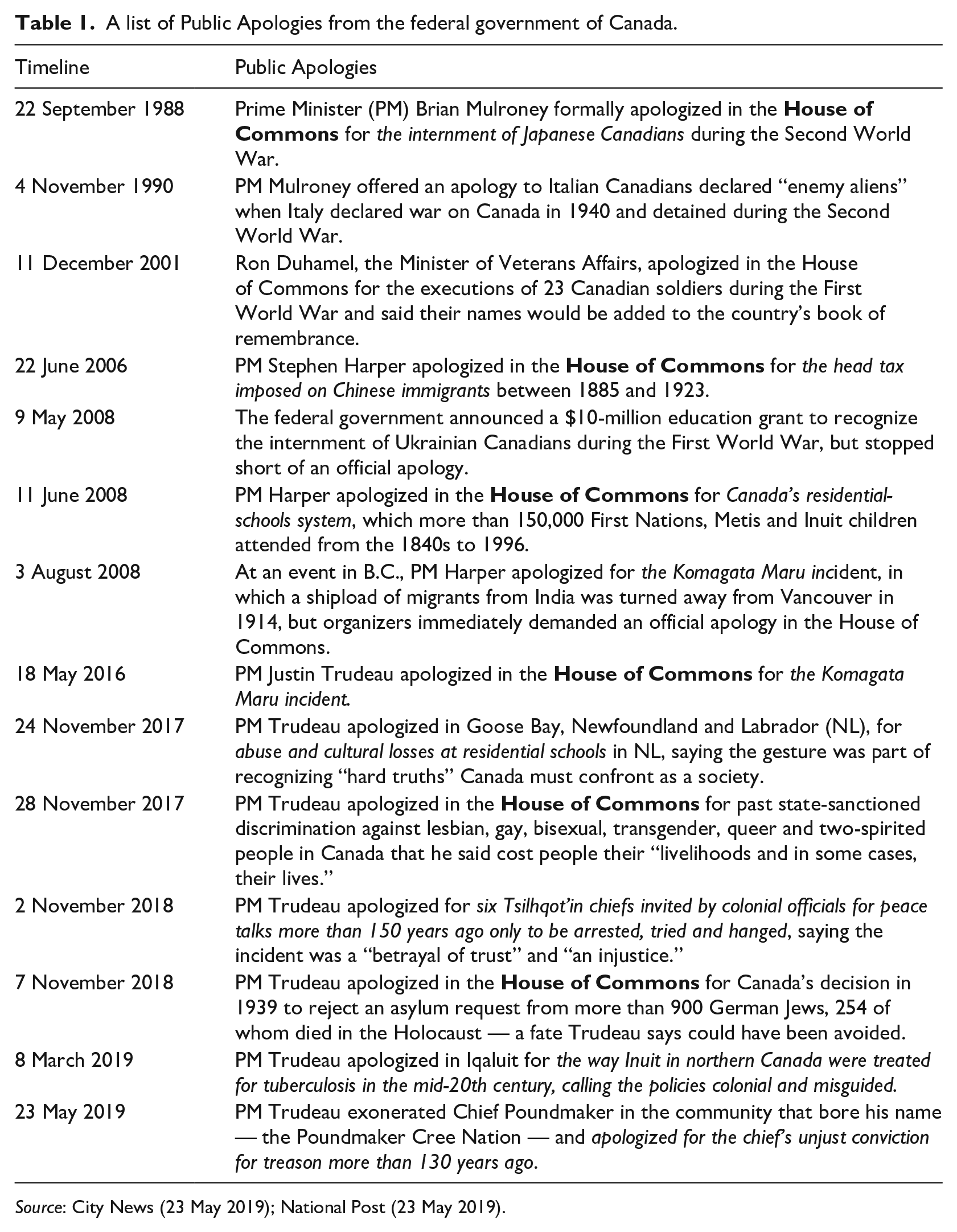
Source: City News (23 May 2019); National Post (23 May 2019).
A Method of Analysis
Using the Foucauldian metaphor of archaeology, critical analysis of discourse attempts to offer a means of uncovering the politics and complexities of power since one’s truth and their subjective position are not fixed entities but rather constructed in socio-cultural-political contexts (Foucault, 1972, 1982). In CDA, power is regarded as inherently discursive: one’s status as ‘subject’ is discursively re/constructed, through the ways in which one discursively resists, negotiates, dominates and subordinates the other. While the ‘subject’ holds power and dominance, representing a stance of truth and norm in society (e.g., naming and normalizing what historical trauma is and how its healing should be), the other is positioned as ‘object’ whose claim is questioned, scrutinized, and devalued, whose experience/presence is then differentiated from their own experience, and who is viewed as requiring discipline and education by the ‘subject’ (Foucault, 1991). Thus, critical analysis of discourse is ‘not analysis of discourse “in itself” . . . but analysis of dialectical relations between discourse and other objects, elements, or moments as well as analysis of the “internal relations” of discourse’ (Fairclough, 2013: 4).
We follow this guide to interrogate the dialectics of how power relations are discursively deployed in texts (i.e., micro linguistic analysis) and how this linguistic analysis is situated within contexts (i.e., macro social analysis). In terms of a coding process, initially the first author conducted the language analysis while the second author conducted the social analysis independently. Then, the coders switched the coding tasks and conducted a second coding independently (i.e., the first author conducted social analysis and the second author for the language analysis). In both analyses, we used the aforementioned common elements recommended to be included in public apology as the initial coding category: (1) admission and naming of wrongdoings: (2) acknowledgement of harms and sufferings in the past and present; (3) expressed regret and remorse of wrongdoing; (4) an acceptance of responsibilities: explicitly asserting the responsibilities of the government and related actors; (5) a request for forgiveness; a promise of forbearance; and (6) an offer of repair (Blatz et al., 2009; Jeffries, 2007; McElhinny, 2016). In each category, we not only code its absence or presence but also paid attention to how Canadian public apologies incorporated and embodied these aspects in language-in-use in the apology (language analysis) and its related documents to contextualize discourses deployed in the apology (social analysis).
In detail, in language analysis, the premise is that language is not neutral but socially constructed and managed into organizational structures and patterns of talk/text, which are often accomplished by selecting and invoking certain lexicons (i.e., words), grammars, and their repetitions. For example, when the admission of wrongdoing was identified we coded where in lines, using which lexicons, and what grammatical formats (e.g., using tentative or definitive clause; using emphasis added with any descriptive adverbs or not).
In social analysis, the premise is that language primarily functions as a means to legitimize and shape certain discourses, subjective positions and identities, institutional and political affiliations, and power dynamics, while marginalizing and excluding others in governing social structures (Gee, 2015; van Dijk, 1995). To contextualize social analysis, we used an iterative process back and forth with language analysis and existing literatures. We initially conducted google search (google.ca and scholar.google.ca) using key words ‘(public apology or government apology) AND (Canada)’ to identify and review both academic studies and grey literatures (i.e., government policy or media documents) related to the included Canadian public apologies. We also conducted a focused search to clarify the content of the apology for social analysis. We examined the discrepancy between what the ethnic community requested (through social analysis) and what the apology has acknowledged (language analysis). Then the coders compared the coding, discussed any discrepancies (e.g., the number of the admission of wrongdoing identified by each coder), and synthesized emerging themes as presented in the results.
Results
We present our analysis of two public apologies on historical trauma announced at the House of Commons: The Chinese Head Tax and the Residential Schools for Indigenous Children. Both apologies were delivered by Prime Minister Stephen Harper (2006–2015). Given the research objectives, the findings are presented as (1) how each apology re/constructs historical trauma and healing; and (2) how the subject and the object of public apology are positioned and negotiated to represent the power dynamics of both past and present.
Chinese Head Tax
The Chinese head tax was imposed on Chinese immigrants between 1885 and 1923 in order to impede permanent immigration and citizenship in Canada (while encouraging temporary immigration to provide low wage labour). This exclusion of permanent Chinese immigrants continued until 1947. Harper delivered a full apology to Chinese Canadians for the head tax on behalf of the Canadian nation on 22 June 2006. Appendix 1 is a full script of the apology. Numbers in front of each sentence were added to orient readers for our language analysis: S1 means Sentence 1 (first sentence) of the apology.
Language Analysis
This apology explicitly noted the Chinese Head tax as ‘historical injustices’ (S20) and detailed by providing a concrete list of wrongdoing ‘aimed solely at the Chinese’ (S26) to indicate historical trauma. The examples include an acknowledgement of the time frame unjust legislation was enacted: ‘for over six decades’ (S26) done to Chinese Canadians such as ‘repeatedly and deliberately singled out for unjust treatment (S2),’ ‘the head tax’ and ‘other restrictive measures’ (S3) ‘in an attempt to deter immigration’ (S14 & S15 including details of amounts and durations) and ‘the subsequent exclusion of Chinese immigrants’ (S21), ‘some one thousand Chinese labourers died’ (S11), ‘the stigma and exclusion experienced by the Chinese as a result’ (S18), ‘many family members were left behind in China, never to be reunited, or that families lived apart and, in some cases, in poverty, for many years’ (S19), and ‘race-based financial measures’ (S26) and an acknowledgement of ‘the racist action’ (S35).
However, compared to deploying one affective term (i.e., ‘sorrow’) twice (S21, S35) to convey their claimed sincere apology, there are several lexicons deployed to re-define and re-write the past wrongdoings as ‘an unfortunate period’ (S1) and ‘mistakes’ since ‘no country is perfect’ (S30). Furthermore, it discursively demands to put the past behind invoking adverbs in S32 (‘the head tax – a profoundly different time – lies far in our past’), locating historical trauma only in the past.
These descriptors of wrong deeds then corroborate constructing the subject in the past who ‘committed wrong’ (S31) of ‘these shameful policies of our past’ (S25) or ‘this historic wrong’ (S32). This list of the wrong deeds was then quickly linked to constructing the praise of the subject now, the current Canada, by invoking various verbs who ‘acknowledge’ (S19, S20, S25, S27), ‘recognize’ (S18, S20) ‘fully accept’ (S25), ‘realize’ (S30) and ‘compelled to right’ (S32). This praise of the subject is then explicitly noted by discursively deploying adjectives such as ‘our great country’ (S24), ‘Canadians are good and just people’ (S31), acting on ‘the decent thing’ (S32) to represent ‘a characteristic to be found at the core of the Canadian soul’ (S32) that in fact did all the wrongdoings noted earlier.
The split of the subject into – the ‘bad past’ who committed the wrong and the ‘good present’ who are acknowledging the wrong – is apparent in this apology and this is then divided into the boundary of the subject’s responsibilities. Despite the admission of intentional and systemic exclusion, racism, and injustice under our legislation then (S2: ‘. . .repeatedly and deliberately singled out for unjust treatment’) and despite the promise of never again under the current legislation (S33: ‘. . .let me assure the House . . . never allowed to happen again’), it explicitly notes that ‘This apology is not about liability’ (S23). Here, it divides the subject’s legal liability from its moral responsibility, and furthermore links the moral responsibility to discursively represent the benign image of the subject by deploying the comparative clause – ‘while Canadian courts have ruled that the head tax, . . . were legally authorized, we fully accept the moral responsibility’ (S25) to showcase that we are doing it out of good morality but there is no legal responsibility or liability. Invoking the temporal (past vs. present) and the zone of responsibility (legal vs. moral) disjuncture, this public ‘apology’ discursively puts the injustice started in the past behind and ignores the continuing current impacts on Chinese Canadians’ struggles around ‘the stigma and exclusion’ (S18) that was ‘recognized’ (S18) in this apology, thus the moral responsibility, should also be put behind.
This distancing from the ‘bad’ subject in fact set the tone of this apology from the very first sentence – ‘I rise today to formally turn the page on an unfortunate period in Canada’s past.’ Instead of beginning with the subject apologizing for the wrong (e.g., I formally make a sincere apology to Chinese Canadians about the head tax and other exclusionary measures in the past and its ongoing impact on Chinese Canadians), the subject dictates that this historical past/page should be turned/forgotten as not only the purpose of the apology but also as the direction for healing. Feagin (2020: 30)’s construct of ‘the white-crafted liberty and justice frame,’ explains this elision as an imagined liberal and just (white) nation demanding ‘collective forgetting’ (28) of wrongdoing thus building an untarnished mirage of a just Canada even while describing a history of persecution and flagrant injustice.
Another noteworthy point is how Chinese Canadians are portrayed and represented discursively in the apology. Initially, Chinese people are described as ‘immigrants’ (S3), ‘labourers’ (S4), ‘exclusively young men, these immigrants made the difficult decision . . . to pursue opportunities in a country halfway around the world’ (S5), ‘Chinese pioneers . . . in the most important nation-building enterprise in Canadian history’ (S6), and ‘Chinese immigrants persevered . . . helped to ensure the future of Canada’ (S12). Using these lexicons, Chinese people are discursively represented as young pioneers with the agency of decision and constructing the current and future of the nation.
From S14 (‘Chinese newcomers in an attempt to deter immigration’), Chinese people are hereafter described experiencing ‘the stigma and exclusion’ (S18), family separations and ‘in poverty’ (S19), and subject to the failure of being acknowledged from ‘seeing themselves as fully Canadian’ (S20). As a white settler nation, Canada consists of Indigenous populations and the rest who are all immigrants. However, by deploying the term ‘newcomers’ to describe Chinese people, they are now discursively separated from earlier immigrants (i.e., all white immigrants from Europe) who now act as the subject of the nation (i.e., National-Natives) treating racialized recent immigrants as others (i.e., Migrants), thus reifying the postcolonial order (Sharma, 2020). Divergent from the previous descriptors, the Chinese people are portrayed as subject to stigma, exclusion, experiencing broken families, on the lower rung of the socioeconomic ladder, and struggling to be viewed as fully Canadian. Critical scholars in public apologies noted the construction of victimhood (Henderson and Wakeham, 2014). We echo this point and further note that constructing the victimhood of historical trauma has also constructed a rhetoric of being the object/others of Canada in the present (i.e., not fully Canadians). This is a sharp distinction between the agency of a nation building subject who then becomes otherized as the object that is disposable and replaceable and does not fully belong to the nation (Sharma, 2020).
This observation is evident in the representation used in the lexicons. Throughout the apology, except S34 (‘we have the collective responsibilities to build a country. . .), all first-person pronouns (i.e., we and our) were used to refer to non-Chinese Canadians and the third person pronouns (i.e., they and their) are used to refer to Chinese Canadians. It is common to define the subject and the object in public policy documents. However, by deploying the pronouns strategically, this apology not only constructed the subject and the object of apology (who makes an apology to whom) but also the subject and object of the nation Canada. For example, ‘Canadians, however, are a good and just people, acting when we’ve committed wrong. And even though the head tax . . . lies far in our past, we feel compelled to right this historic wrong. . . a characteristic to be found at the core of the Canadian soul’ where we as the subject of the apology becomes the subject representing the Canadian soul and Canadians, discursively excluding and constructing Chinese Canadians as others.
Social Analysis
The Chinese community’s request for a state apology had been ongoing yet for decades various governments refused the apology. The movement to redress the Chinese head tax can be traced back to 1984 when the Vancouver social worker and Member of Parliament (MP) Margaret Mitchell raised the historical injustice against the Chinese in the House of Commons and submitted the request to repay the Chinese head tax to two individuals. This prompted 4,000 other head taxpayers and their family members to pursue redress. Since then, there have been several political responses from the Canadian government, which further ignited the redress movement. For example, in 1993 Conservative Prime Minister (PM) Mulroney offered individual medallions and a museum wing dedicated to several communities seeking redress for historical wrongs, which were rejected outright by Chinese Canadian national groups since they felt it was inadequate without an apology. Liberal PM Chrétien was elected in the same year yet did not offer an apology or redress. Then, the Chinese Canadian National Council, an organization that advocates for Chinese Canadians in their struggle to obtain redress from the Canadian government raised the matter to the United Nations Human Rights Commission and the court. They asserted that ‘the federal government should not profit from racism and that under the Canadian Charter of Rights and Freedoms and international human rights law it had a responsibility to redress this historical injustice’(CTC, 2015: 1).
However, their appeal at the Canadian court was denied. Understanding the historical backdrop described in S25 (‘Canadian courts have ruled out the head tax. . . legally authorized’) is important to contextualize this apology, in particular the context of legitimizing the avoidance of the legal liability. The human legacy of pain and suffering from this protracted historical injustice is represented in the class action lawsuit which the Chinese Canadian National Council filed against the Canadian Government in 2001. The plaintiffs sought a public apology, compensation to the descendants of the victims, and the establishment of an anti-racist foundation (Li, 2008). The plaintiffs graphically described the harm suffered by their community: significant financial loss, hardship, emotional distress, family separation, loss of companionship of spouse, child and parent, loss of opportunity and injury to dignity. . .this racially discriminatory legislation has created profound and enduring racial prejudice against persons of Chinese descent in Canada (Mack et al. v. The Attorney General of Canada, 2000: 113).
It is noteworthy that the plaintiffs identified clearly that the past infuses the present and that not only does the pain and suffering induced by the exclusion and splitting of families get transmitted through the generations but the toxic discourses which rationalize these acts of inhumanity also ‘endure as racial prejudices’ which are passed on through generations. That is exactly captured in the construct of historical trauma (Gone, 2014; Kirmayer et al., 2014). However, this claim was denied, with the rationale that charter harms which occurred prior to the charter could not be compensated. In other words, the Canadian Charter of Rights and Freedoms was established in 1982 so any wrongdoing done before then could not be on trial, thus Canada is legally not responsible for past harms.
After this lawsuit against the government was defeated, in 2005, the Liberal Government of Canada (PM Paul Martin, 2003–2006) refused to apologize but finally proposed an atonement for the Chinese Head Tax by creating a memorial fund to teach all Canadians about this injustice. This compensation offer without an apology angered many within the Chinese community (Blatz et al., 2009). Shortly after this proposal, a federal election began, and for the first time in Canadian history the Chinese Head Tax became a major election debate. Within this context, the Conservative Party took the platform and the public apology followed, with only an acceptance of moral responsibility for past wrongs. When this apology was made in June 2006, only 20 survivors of the Chinese Head Tax were alive, approximately 10% of the people who requested the state apology in the early 1980’s (CTC, 2015).
In this apology, there is no acknowledgement that these discriminatory colonial values of White entitlement and superiority continue to haunt Canadian multicultural ideals. Noted are compensatory ‘symbolic payments’ (S28) and a promise to establish funds for ‘past wartime measures and immigration restrictions on ethno-cultural communities’ (S29). However, the importance of establishing an anti-racist foundation was not even addressed although this had been requested by the Chinese Canadian National Council (Li, 2008). There is no recognition that the legacy of this longstanding profoundly discriminatory colonial racism is ongoing and has indeed most recently resurfaced in the reinvigoration of anti-Asian, anti-Chinese racism during the Covid19 pandemic (World Health Organization, 2020).
Indigenous Residential Schools
In 2008, the Canadian Federal Government made an apology to Indigenous people for the century of residential schools (see Appendix 2 for the full script), which forcefully took away over 150,000 Indigenous children from their families and communities from 1894–1998 (FRTRCC, 2015).
Language Analysis
In the beginning of the apology, the wrongdoings/historical trauma by the federal government and religious groups (S8: Anglican, Catholic, Presbyterian or United churches) are explicitly named. For example, ‘very young children were often forcibly removed from their homes, often taken far from their communities’ (S9), ‘Many were inadequately fed, clothed and housed’ (S10), ‘All were deprived of the care and nurturing of their parents, grandparents and communities’ (S11), ‘First Nations, Inuit and Métis languages and cultural practices were prohibited in these schools’ (S12), and ‘some of these children died while attending residential schools and others never returned home’ (S12). The cumulative impacts of historical trauma are clearly noted: ‘the consequences of the Indian residential schools policy were profoundly negative and that this policy has had a lasting and damaging impact on aboriginal culture, heritage and language’ (S13). Also, assumptions that drove historical trauma are explicitly noted: ‘the assumption aboriginal cultures and spiritual beliefs were inferior and unequal’ (S5) and ‘some sought, as it was infamously said, “to kill the Indian in the child”’ (S6). Across this apology, the clause of ‘we apologize for having done this’ is repeated three times (S21, S22, S23) and its multiple variations: ‘we apologize to Aboriginal peoples’ (S20), ‘we apologize for failing to protect you’ (S24), ‘sincerely apologize and asks the forgiveness’ (S29) and ‘we are sorry’ (S25, S30) are deployed. This type of clause ‘we apologize for. . .’ and its repeated use discursively corroborates the subject’s claim that the apology is ‘sincere’ (S29) and the subject is benign in delivering this apology.
The residential schools were the centre of this apology. Noteworthy are the descriptors of the residential schools that discursively position conflictual notions, rather than being represented as a unified meaning in Canadian history. On the one hand, the discourse describes ‘historical trauma’ as noted above, and on the other hand ‘a sad but inevitable action for assimilation at that time’ is communicated. For example, the residential schools were noted as ‘a sad chapter in our history’ (S2: similar to the description in the Chinese Head Tax apology ‘to turn the page’), the past government’s ‘obligation to educate aboriginal children’ (S3) to meet ‘primary objectives of the residential schools system. . . to assimilate them into the dominant culture’ (S4), and even ‘spoken positively about their experiences’ (S14) by some former students at residential schools.
A list of detailed descriptions of the wrongdoings related to the residential schools was discursively noted as simply by-products of bad policy and its implementation: ‘this policy of assimilation was wrong, has caused great harm’ (S7), ‘an educational system in which very young children were often forcibly removed’ (S9), ‘the consequences of the Indian residential schools policy were profoundly negative’ (S13), ‘this policy has had a lasting and damaging impact on aboriginal culture, heritage and language’ (S13), ‘The legacy of Indian residential schools has contributed to social problems’ (S15), and ‘these institutions gave rise to abuse or neglect and were inadequately controlled’ (S24). By representing residential schools as bad policy, there is no admission of imposing the colonial assumption that ‘aboriginal cultures and spiritual beliefs were inferior and unequal,’ its ‘obligation to educate aboriginal children,’ or the state’s responsibility in creating and implementing this policy. Rather, the responsibilities of these wrongdoings were discursively transferred to implementation of this ‘policy’ and ‘these institutions’ – there was a crime yet no perpetuators as if there is racism yet no racist (Bonilla-Silva, 2018) – the colonizers are once again hidden (Lightfoot, 2015). If this policy did not highlight assimilation, its consequences/great harms unknown, or the government was not informed of what these institutions did, was it still acceptable to have government education values that exclusively aimed to abolish the language and cultural practices of certain racialized groups while promoting this policy as assimilation towards national unity? This performance of apologies as public speech acts favorably positions the subject as compassionate, remorseful, and ‘aware of’ and ‘acknowledging’ the issues but does not acknowledge or apologize for the underlying assumptions and values that drove the residential schools – that is colonial dominance.
There are several lexicons used as descriptors of Indigenous people, their experiences and their culture, discursively constructing not only the object receiving the apology but also the object otherized in the past and present of Canada. Some are deployed to praise qualities of the object, such as ‘survivors’ (S16) with ‘extraordinary courage’ (S16), ‘resilience’ (S17), ‘the strength of their cultures’ (S17), ‘rich and vibrant cultures and traditions’ (S22) and ‘working on recovery’ (S28). However, more prominent descriptors of the objects are ‘inferior and unequal’ (S5) inevitable to ‘assimilate them into the dominant culture’ (S4), carrying something to be killed in the child (S6), harmed (S7), ‘inadequately fed, clothed and housed’ (S10), ‘deprived of the care and nurturing’ (S11), damaged (S13), ‘tragic’ (S14) ‘helpless children’ (S14), ‘powerless families and communities’ (S14), ‘suffered’ (S16), ‘powerless’ parents (S25) and carrying ‘the burden of this experience’ (S26), cumulatively constructing their identity as victimhood and burdens as they are ‘social problems. . .today’ (S15). Le (2016: 47) thus argues that ‘Harper’s apology rhetorically focuses on the work of Aboriginal healing which invokes imperialist fantasies of the ‘white man’s burden’ . . . placing Aboriginal peoples in the role of the patient, and Canada in the role of the objective doctor.’
Compared to the apology for the Chinese Head Tax, there is more focus on the object, yet their victimhood appears to be centred and meanwhile the government’s legal and systemic responsibilities are veiled. Discursively, the old government was noted to ‘play a role in the development and administration of these schools’ (S3) rather than the main perpetrator of historical trauma. This point is again highlighted in S20 (‘Canada’s role in the Indian residential schools system’).
Furthermore, by deploying the first pronoun of ‘we’ not to refer to the subject but to merge both the subject and the object, a subtle but fundamental linguistic change occurred regarding how to address the past wrongdoing/historical trauma for healing now and in the future. By claiming that ‘we are now joining you on this journey’ (S28), Indigenous people who have experienced the actual genocide and its perpetuator/observer are joined/merged, which cannot be shared but it claims it is in S35 – ‘the knowledge of our shared history.’ Here, deploying autochthonous discourse, Indigenous and White National Natives were merged which can be traced back to a British Empire’s tactic to contain the colonized in colonies (Sharma, 2020). In the section referring to healing for historical trauma from S31 to S35, the first pronouns (i.e., us and our: S32 ‘. . . gives us a new beginning. . .’and S35 ‘. . . our shared history. . .’) are used again to deploy the merged ‘we’ but at times referring non-aboriginal people only (i.e., the subject), thus discursively erasing the object (i.e., aboriginal people) from the merged ‘we’ once again. For example, referring to the Indian Residential Schools Truth and Reconciliation Commission (TRC hereafter), ‘this commission presents a unique opportunity to educate all Canadians on the Indian residential schools system’(S34) – here it is less explicit who all Canadians are – both Indigenous and non-Indigenous people or only non-Indigenous people. The next sentence continues, ‘It will be a positive step in forging a new relationship between aboriginal peoples and other Canadians, a relationship based on the knowledge of our shared history’ (S35) – indicating Indigenous and non-Indigenous Canadians separated but merged. Then, immediately followed this merge is to rush for ‘a desire to move forward together’ and to ‘contribute to a stronger Canada for all of us’- here it is unclear if this urge to move away from historical trauma is a consensus between the subject and object or a claim that the subject is imposing on the object by deceptively deploying the lexicons of ‘all of us’ and ‘together’. Once merged under the autochthonous discourse, Indigenous Native Nations and their past are merged and sterilized, and White Native Nations retooled and take over as the owner of the nation-states thus reifying a postcolonial ruling relation (Sharma, 2020)
Unaddressed was ‘how’ the government is going to ensure that the ‘attitudes that inspired residential schools’ will not occur again. The apology notes ‘the absence of an apology has been an impediment to healing and reconciliation’ (S19). Before directly addressing healing in the future, from S19 it seems to set a tone that because the apology is made now, the healing should be in place to ‘move forward together in partnership’ (S32), even as the ‘desire to move forward together’(S35). Therefore, on the one hand, the apology fully accepts the residential schools as historical trauma but on the other hand, it misses addressing the main theme of historical trauma – the postcolonial governmentality agenda – in healing.
Social Analysis
For many decades, the Union of British Columbia Indian Chiefs decried the government’s refusal to express remorse, emphasizing the healing effects of an apology: ‘We are extremely disappointed that the current government does not understand the significant role an apology would have in the healing and reconciliation process for our people’ (cited in Blatz et al., 2009: 233). The end of the twentieth century saw a rise in Indigenous politics in the four settler states of Canada, the U.S., Australia and New Zealand. In 1996, the Royal Commission on Aboriginal Peoples recommended that a national process of reconciliation was needed and yet it was not in place until 2010 when the Truth and Reconciliation Commission (TRC) of Canada was initiated (and the final report from this was published in 2016). The United Nations Declaration of the Rights of Indigenous People was approved by the United Nations General Assembly in 2007 but notably all four settler states refused to sign it. Canada claimed that it was in conflict with Canadian constitutional law and only grudgingly signed it in 2010 stating that it was aspirational and not binding. State apologies and visions of reconciliation became shared state responses to demands from Indigenous people for recognition and treaty acknowledgement – Canada led the way in 2008 and was followed in 2009 by Australia and the United States (Turner, 2014). Even with the apology in place, at no point did Harper acknowledge the status of First Nations people as the original occupants of Canada, nor did he detail the wider colonial genocidal agenda of the residential schools, despite the fact that these two issues were the main foundations of the Report of the Royal Commission on Aboriginal Peoples (1996).
Despite no clear government actions showing contrition for the lengthy tradition of colonial racist policy, the aboriginal people were asked to treat their seven generations of facing state violence as a ‘sad legacy’ solely residing in the past, and they were urged to begin ‘forging a new relationship’ and assured that we would ‘move forward together.’ In no place, is there a story of Indigenous people healing through recognition of their First nation status and movement towards strengthening and regenerating their community resource systems. Maxwell (2014: 409) highlights the significance of closely analyzing the relationship between settler colonization and Indigenous people’s health and wellness both historically and currently. He notes that the agenda of elimination which has characterized the relationship between the settler state and Indigenous Nations remains unchanged and ‘this “logic of elimination” manifests as historically and spatially variable forms, but commonly transmutes from the brutal violence of the frontier into a “logic of assimilation” more consistent with the rule of law structuring enduring settler societies.’ Our analysis of the apology concurs with this as there is no respect for Indigenous autonomy communicated and the focus is on the absorption or assimilation of Indigenous people into Canadianness by deploying autochthonous discourses and prescribing elimination through invisibility (Maxwell, 2014; Sharma, 2020).
APTN National News headline on 10 September 2015, Harper’s 2008 residential school apology was ‘attempt to kill the story’, addresses this politics of performing a public apology (Barrera, 2015). Paul Bunner (2015), the heard speechwriter in Harper’s PM office, wrote an article entitled, The Genocide that failed, where he discussed the 2008 apology: ‘The best that can be said of Harper’s apology is that it was a strategic attempt to kill the story and move on to a better relationship between Natives and Non-Natives,’ and ‘Unfortunately, it only appears to have deepened the conviction that Church and State conspired not only to “kill the Indian in the child,” but also to physically exterminate the whole race. The Aboriginal grievance and entitlement narrative continues to gather momentum.’
When TRC tried to investigate federal government records regarding the residential school system which were held by the National Archives of Canada, they were frustrated by legal and bureaucratic roadblocks that protected the federal government from scrutiny, which thus continuously killed the story (FRTRCC, 2015). Despite the definitive clause ‘There is no place in Canada for the attitudes that inspired the Indian residential schools system to ever again prevail,’ there has been overwhelming data evidencing racist state policies against indigenous populations, communities, and lands. For example, the rate of violent victimization among Indigenous people in Canada is over double that of non-Indigenous people (Wilson-Raybould, 2019) and while Indigenous people account for five percent of the population, they form 30% of the federal inmate population and Indigenous women account for 42% of women in custody (Bellrichard, 2020). Heartbreaking evidence includes that on 27 May 2021 the Tk'emlúps te Secwépemc First Nation reported discovering undocumented deaths of 215 children as young as three years old at the site of the Kamloops Indian Residential School in British Columbia (Dickson and Watson, 2021). Under the name of the law and assimilation policy, Canadian government not only attempted to “kill the Indian in the child,” but also killed our children.
Conclusion
The findings illustrate how the core component of historical trauma – the postcolonial agenda – is not only reified discursively in the texts of the two public apologies we examined but is also contained socio-politically into the contexts that surround them. Although the systemic wrongdoings of historical trauma were noted, their traumatic impacts were discursively evoked to paradoxically promote both the biomedical view of treating them as victims and the postcolonial discourse of constructing them with deficit identities, thus legitimizing the otherizing of racialized others. Meanwhile, what we observed across the public apologies was a distinct split and a placing of temporal distance between the wrong past and the benevolent current governments, thus building the construction of the good subject Canada – the benevolent, just and liberal white-nation and furthering the deficit discourse of wounded object less than others who must be tended and taken care of.
Making victims’ psychological suffering (i.e., a biomedical view of trauma) the focus and highlighting ‘moving towards healing’ thus elide the history of state violence, systemic racism, and colonialism and exempt the Canadian State from responsibility to change. This is very troubling since influential political documents such as these public apologies set the tone in public space claiming what historical trauma is and how healing should proceed while the practice of otherizing racialized people through often subtle state perpetuated violence continues unremarked and unchanged. Thus, performing public apologies becomes a technology of governing dominance and control to contain domestic conflicts with ‘racialized others’ and to claim the legitimacy of the White Settler state’s postcolonial governmentality (Sharma, 2020), while erasing its wrongdoings (e.g., residential schools of Indigenous people, and Chinese head tax), concealing differences and re-writing history.
Why should we care? Canada was the first country to announce a multicultural national policy and in response to public pressure has since made public apologies to many racialized communities. This apparent acceptance of her wrongdoing has been pervasively deployed as evidence of the dominant public discourse of Canada as a tolerant, benevolent multicultural society and this then serves to pre-empt critical thinking and acknowledgment of ongoing discrimination of racial groups in Canada. Ongoing racism against Chinese and anti-Asian sentiments during the pandemic as well as the recent finding of the remainas of 215 Indigenous children and probably many undocumented and still buried under the nation called Canada are not separate and unrelated to ongoing state violence. Guided by the critical scholarship on historical trauma, the nation states, and postcolonial racist orders (Gone, 2014; Le, 2019; Maxwell, 2014; Sharma, 2020), we suggest that critical attention and reflection be paid to the fragility of the ruling discourses on Canadian innocence. The Truth and Reconciliation Commission and the Canadian Chinese National Council have put forward action recommendations for the Canadian government which receive minimal attention in the wake of dominant discourses which suggest that Canada has no current responsibility. Being active and vigilant to watch how these action items are achieved, ignored, and/or transformed is the responsibility of all Canadians. Our paper is part of ongoing witnessing to resist postcolonial governmentality and we invite readers to join us.
