




Abstract
This article examines how the online Kenyan press constructs ‘radicalization’ and how youth challenge these constructions. Using Critical Discourse Analysis (CDA) through NVivo, the author analyzed two corpora, one of news texts and the second composed of transcripts from two focus group discussions conducted with youth in Mombasa. The analysis shows the media persistently depoliticize youth by constructing them as a dangerous ‘Other’. In contrast, youth challenge this image by claiming political agency through (re)defining their identities using language and material practices. The construction of actors in discourses of radicalization highlights a specific understanding of radicalism and violence, and impacts framing of the Preventing/Countering Violent Extremism (P/CVE) agenda. The author concludes by showing the implications of the different constructions of youth identities and how youth legitimately enact agency within these bounds. This article raises crucial questions on the practices of meaning-making by individuals and media actors.
Keywords
Introduction
This article analyses the media discourses on ‘radicalization’ and how youth in Kenya negotiate them. For years, Kenya has grappled with insecurities, including post-election violence, resource-based conflicts and terrorism. The deadliest attacks in Kenya include the 1998 embassy bombings, the 2013 Westgate Mall attack, 2015 Garissa University College attack, 2015 Lamu and Tana River attacks and the 2019 DusitD2 attack. These attacks left hundreds dead, thousands injured and livelihoods destroyed. This saw a growth in Kenya’s counterterrorism architecture. Kenya has become an anchor-state and ally in the Global War on Terror (GWoT). It adopted legislation curtailing terrorism financing, preventing/countering radicalization and violent extremism, and initiated (inter)national military operations targeting al-Shabaab.
Kenya’s integration into global counterterrorism circuits has resulted in importing the concept of ‘radicalization’ into Kenyan government policy, media and civil society. The rise of the Islamic State of Iraq and the Levant (ISIL) and al-Shabaab that are ‘almost exclusively associated with youth under the age of 25’ (Awan, 2016: 88) has underscored the role of youth in violent organizations. With the United Nations Security Council Resolution 2250 declaring ‘radicalization’ among youth as a global threat to stability and development, there has been a proliferation of media and scholarly interest in this subject. Academic research has focused on frames of terrorism at the international level (Norris et al., 2003; Schaefer, 2006). Fewer studies examine how these international discourses are locally translated and resisted, particularly in states where violent organizations operate.
This study contributes to this debate by analyzing how ‘radicalization’ in Kenya is framed, providing insights into emerging (counter)narratives about radicalization through a critical discourse analysis (CDA) of online media texts and data from focus group discussions (FGDs) with young people in Mombasa.
The article has five sections: the first section situates the study within the body of research on youth and terrorism, and reflects on the theoretical positions informing the role of discourses in constituting identities. Section two discusses the relationship between the Kenyan government and its Coastal population, emphasizing how this relationship informs the local debates on radicalization. The third section outlines the methodology used, while the fourth section presents the results from analyzing texts and FGD data. The overall finding was that ‘radicalization’ and its principal frame of ‘youth as dangerous’ draws on locally shared contextual narratives about Muslim communities and the Coastal region’s historical experiences. The last section reflects on the implications of this identity construction in counterterrorism.
Research on youth and terrorism
Studies on radicalization in Kenya draw from two interrelated frameworks. Some studies conceptualize radicalization as connected to a youth bulge. Urdal (2007) claims developing countries undergoing demographic transitions coupled with poor governance, political and social inequalities are prone to civil conflict and terrorism. Relying on demographic characteristics, this approach views countries in North and sub-Saharan Africa as having structural conditions conducive for political violence. ‘Youth bulge’ arguments are rooted in racial, gender and cultural stereotypes (Hendrixson, 2004) that propound a narrative of black/brown youth as political/security threats. However, youth bulge remains the conceptual lens for developing policies for ‘third-world’ countries without questioning local and global socio-economic power relations.
Other studies approach radicalization as a product of biographical and social-psychological factors (Botha, 2015). Studies linking radicalization to cultural relationships (social networks) develop risk-indicator models categorized into social background-focused, social psychology-focused and behavioural-focused. These models recommend (c)overt remedial policies aimed at controlling ‘at risk’ youth. Such policies have extended surveillance and policing into homes, schools and spaces deemed ‘hot spots’.
Studies informed by youth bulge and cultural approaches adopt the transitional phase ‘youth’ ‘as a universal experience connected to biological and physiological developmental phases of human beings’ (France, 2000: 321). This transitional phase ignores politico-cultural differences within and across countries. Youth is assumed to be a problematic period. The aforementioned studies confine identity construction to age processes. Gabsi (2019) rearticulates that identity construction is an ongoing complex process influenced by people’s socio-cultural contexts. The boundaries of youth identity are both politico-economically and culturally defined in societal practices, limiting the available choices of what it means to be youth.
Identity and discourse in knowledge production
Considering these contributions, I approach ‘youth’ as a socially constructed identity. The process of identity construction is situated within its socio-historical, economic and politico-cultural contexts, mainly because African societies are rooted in a gerontocratic order (Smith, 2011), with adulthood reserved for rich elite men and a few older women while the rest are considered minors (Ebata et al., 2006). Youth is a negotiated identity, produced through social relationships, and fluid across time and space.
Smith (2011) argues that interpersonal practices – rites of passage, school-to-work transition and starting one’s family – shape youth access to full membership in society. Poverty and prolonged periods of unemployment in sub-Saharan Africa prevent youth from ascending to adulthood. Engaging with violent organizations such as al-Shabaab is their attempt to gain access to restricted domains rather than ‘generational rebellion’ (Leonardi, 2007: 391). These interpersonal practices are embedded in diverse power relations that restrict the choices available for youth and decisions about what it means to be young.
Kenyan conceptions of youth are shaped by ethnic, religious and politico-historical developments within Kenya. While the methods used by youth-led initiatives to instigate political transformations – e.g. the Mau Mau resistance – are questionable, youth’s role in fostering political change in Kenya is widely acknowledged (Ojiambo, 2017). However, unlike older generations, youth are seen as confrontational (Botha, 2014) and threatening to the status quo. This confrontational behavior functions beyond the boundaries of socio-cultural norms and thus youth are labeled as a risk. This identity construction process relies on ‘summoning of difference, the relativization of the self as against the “other” imagined as separate, outside – and perhaps also as marginal, inferior and dangerous’ (Kennedy, 2001: 3).
Crafting the ‘self’ and ‘other’ in the ‘new terrorism’ debate has primarily occurred in the media arena. Terrorism coverage emphasizes cultural frames differentiating ‘us’ from ‘them’ in the international media (Gerhards and Schäfer, 2014). Islam is portrayed as a violent religion and Muslims as fanatics (Omanga, 2013). Also, the media ‘frames’ violent women in contrasting ways to men. Men are portrayed as political agents, while women are depoliticized as actors (Conway and Mclnerney, 2012; Nacos, 2005). Coverage linking Islam to terrorism has increased Islamophobia (Von Sikorski et al., 2017) and has mobilized support for discriminatory policies including the 2017 United States travel ban (Wolfe, 2018) and Kenya’s 2016 Somali refugee refoulement policy that would otherwise be considered unconventional (Mwangi, 2018b).
Contextualizing ‘radicalization’ in Kenya
The Coastal region of Kenya has a complex history. By mid-19th century, European missionaries, abolitionists and explorer expeditions coincided and justified imperialism, facilitating the 1895 declaration of Kenya’s Coastal strip as a British protectorate (Ndzovu, 2014). Race, religion and class structured relations, access to jobs and leadership positions during colonization by the Omanis, Portuguese and British, culminating in different forms of exclusion (Mwakimako, 2003). Since the unification of the Coast with Kenya, ensuing secessionist campaigns have generated unlikely alliances, at times aligning Africans with Arabs and, at other times, Africans against Arabs (Willis and Gona, 2012). Both sides have historically been nervous about one another with Arabs regarding African nationalists as ‘inferior’ and ‘outsiders’, while African nationalists considered Arabs ‘non-indigenous’, aiming to perpetuate racial privilege (Ndzovu, 2014: 37). These indigeneity and migration politics continue to structure Kenya’s Coastal politics.
In the 1980s, civil society and churches’ efforts led to multipartyism, creating new spaces for organizing. Using this opportunity, local Coastal politicians instrumentalized grievances that resulted in violence targeting non-Coastal communities (Willis and Gona, 2012). The administration responded heavy-handedly, banning the Islamic Party of Kenya (IPK) and labelling it a ‘radical Islamic’ group (KHRC, 1997; Ndzovu, 2014), hence delegitimizing IPK’s activism and framing Muslims as ‘troublemakers’ and ‘unpatriotic’.
After 9/11, the ensuing ‘war on terror’ increased tensions between Kenya’s government and its Muslim communities, accused of colluding with ‘Islamist’ groups. Coupled with renewed secessionist calls by Mombasa Republican Council (MRC) that draw on indigeneity, perceptions of Coastal people as ‘not fully Kenyan’ (Prestholdt, 2011: 7) and Muslims as a problem have increased. The government continues to curtail separatist efforts, politicizing and labelling them as ‘radical fundamentalists’ and ‘al-Shabaab affiliates’. In 2015, Muslim-run NGOs (Muhuri and Haki Africa) were labelled ‘sympathisers/financiers of terrorism’ (Mohamed, 2015). They faced restrictions for criticizing violations of human rights (HR) and international law, and exposing corruption in the security forces (Kiai, 2015).
Within this context, Coastal youth are characterized as ‘radicals’ and ‘extremists’. Several studies show increasing radicalization of Coastal youth (see Badurdeen, 2018; Botha, 2015; Khalil and Zeuthen, 2014; Mogire and Mkutu, 2011). However, given Kenya’s position as a key regional player in GWoT, emerging radicalization frames require further scrutiny. Coastal politicians have condemned characterizations of youth as ‘radicals’ through agenda setting, law-making and implementation of policies (Ndzovu, 2014). Non-state actors influence political discourse through lobbying, advocacy and demonstrations (Fidh, 2014). Such contributions/coping mechanisms are manifestations of agency.
Agency is the ability to undertake action. It is enabled and constrained by socio-cultural and physical conditions that are themselves a product of human actions (Bandura, 2006). In this view, actors (re)shape socio-cultural structures and systems; and these structures and systems organize and constrain the choices and actions available to individuals. This view of agency provides insight into understanding youth’s coping abilities and resourcefulness, and it makes it possible to view youth as actively contributing to the (counter)terrorism agenda rather than being passive targets of interventions. Adding the descriptor ‘political’ to agency illuminates how agency is about contesting power relations as much as it is a social act.
Theoretical approach
Studies on terrorism coverage often employ framing theory. Entman et al. (2009) identify two basic definitions of framing. The first views framing as the ‘central organizing idea . . . for making sense of relevant events, suggesting what is at issue’ (Gamson and Modigliani, 1989: 3). However, this conceptualization ‘provides an insufficient basis for consistent measurement or theory’ (Entman et al., 2009: 175–176). The second definition focuses on the functions of frames where frames are socially shared organizing principles used to define problems, propose solutions and make moral judgements (Entman, 1993). De Vreese (2005) distinguishes between issue-specific and generic frames, the former covering specific topics and the latter appearing across multiple topics and contexts. Generic frames can be episodic or thematic, with episodic depicting social issues as isolated events using human interest stories, and thematic situating issues within a wider context (Iyengar, 1991). Accordingly, framing involves ‘selecting some aspects of a perceived reality and constructing messages that highlight connections among them in ways that promote a particular interpretation’ (Entman et al., 2009: 176). Framing occurs at the cultural, communicators, text and recipients level (Entman, 2004).
In terrorism studies, Cooper (2001) argues for approaches that nuance the concept of terrorism. Kavoori and Fraley (2006) find that the salience of the concept in the news and public discussions on security influences public attitudes. This is due to repeatedly framing terrorism as a new social problem (Norris et al., 2003) thus heightening perceived threat levels compared to familiar threats, even when the new problem is statistically less dangerous (Sjöberg, 2005). Thus, terrorism is not self-evident but informed by power and authority (Cooper, 2001). I use framing to identify how radicalization is defined/problematized in terms of its causes, solutions and evaluations.
Methodology
I conducted a textual analysis of news (national and regional) and FGD transcripts. I sampled news from three Kenyan outlets: Daily Nation (DN), Standard Digital (SD) and The Star (TS) that publish both national and regional news, and have the highest readership (Newman et al., 2020). I omitted regional publications (e.g. Coast Observer) because they were not accessible online. Both DN and TS are right-leaning on political diversity, while SD is left-leaning (Omanga, 2013). These positions shift, depending on who is in power. Significant shareholders of DN and SD are political elites with government ties, whereas TS is privately-owned. I assessed articles containing the word ‘radicalization’ from January 2015 to December 2018. I selected this period because of increased al-Shabaab recruitment activities and Kenya’s growing counterterrorism architecture (Mazrui et al., 2018).
Running a keyword search with radical and youth across the three outlets returned 746 articles. Using Riffe et al.’s (2014) event-constructed sampling strategy, I organized the news under major discursive events (see Figure 1). Each year, I focused on two events with the highest number of publications (see Figure 1).
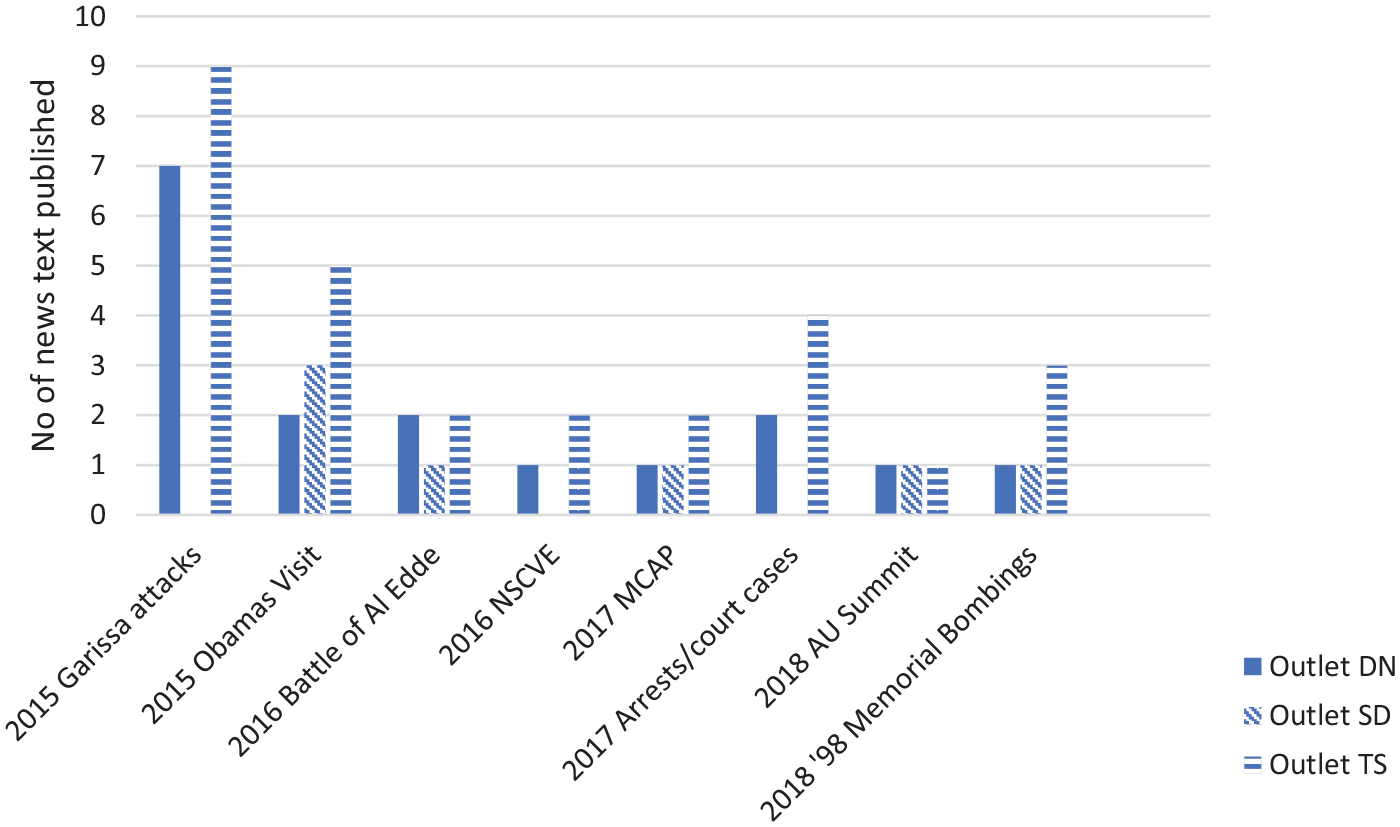
Distribution of news across outlets.
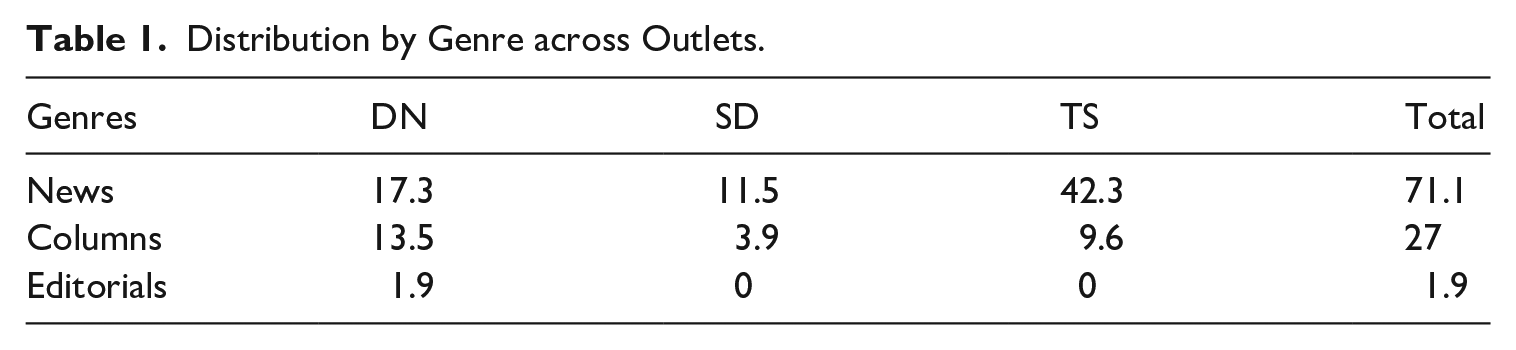
I gathered news published 5 days following the event. The final sample had 52 articles (see Table 1) and the unit of analysis was an individual news text.
Distribution by Genre across Outlets.
FGDs probed how youth conceptualize radicalization and interpret the information they read in the news. Two FGDs, purposively targeting grassroot community-based organizations implementing P/CVE in Mombasa, were conducted in the summer/fall of 2019. Including youth’s views, specifically those benefiting and implementing P/CVE was important as it allowed the inclusion of marginalized voices of subjects often framed as extreme in media and political discourses. Each FGD comprised five participants aged between 18–35 years and diverse by gender, ethnicity, religion and employment status to tease out contrasting opinions. Each session lasted 2 hours and was audio-recorded.
Data analysis
The audio-recordings were translated, transcribed, imported into NVivo and coded for attributes and language. Attributes, e.g. type of article (news story, columns, editorial), edition (daily or weekend edition) and outlet (DN, SD, TS) were assigned to news texts to allow for cross-comparisons. Datasets were thematically analysed using CDA. CDA is a form of social and critical analysis for examining ‘the relations between discourse and other aspects of social life’ (Fairclough and Fairclough, 2018: 1). CDA adopts an ethico-normative stance, involving a critique of actions and truth claims based on the premise that discourses define the parameters available to describe a phenomenon and the possible (re)actions (Jørgensen and Phillips, 2002). CDA helps to expose how texts report ‘radicalization’ by deploying words and metaphors embedded in local discourses, thus shaping how radicalization is understood.
Coding in NVivo proceeded in four steps. Initial reading examined when the term ‘radicalization’ is used, in what context and how it is used. Codes were created summarizing the texts’ main subject, types of sources and the framing devices (vocabulary, metaphors and arguments) that referred to radicalization in terms of its causes, consequences, solutions and the moral evaluations (reasoning devices) with an aim to code textual contents and annotate on how language was used.
Developing themes looked for patterns and connections in the language and wording used in the texts. Analysis probed how events were characterized: What metaphors were used? Who were the main actors in this discourse? What social situations are they portrayed in? What aspects about the subjects are foregrounded/backgrounded? What assumptions drive these descriptions? This aimed at identifying common themes, issues, media/participant frames and traits characterizing social actors.
Searching for connections across themes, applied strategies of abstraction, polarization, contextualization and function to map out how themes fit together (see Smith et al., 2009). These strategies examined: similarities and differences between media and participant frames; conceptual elements highlighting localized understandings; and the purpose themes fulfilled within the specific text. Finally, searching for patterns across units/cases explored relations of themes across texts to highlight shared concepts and demonstrate how meaning is negotiated.
Results
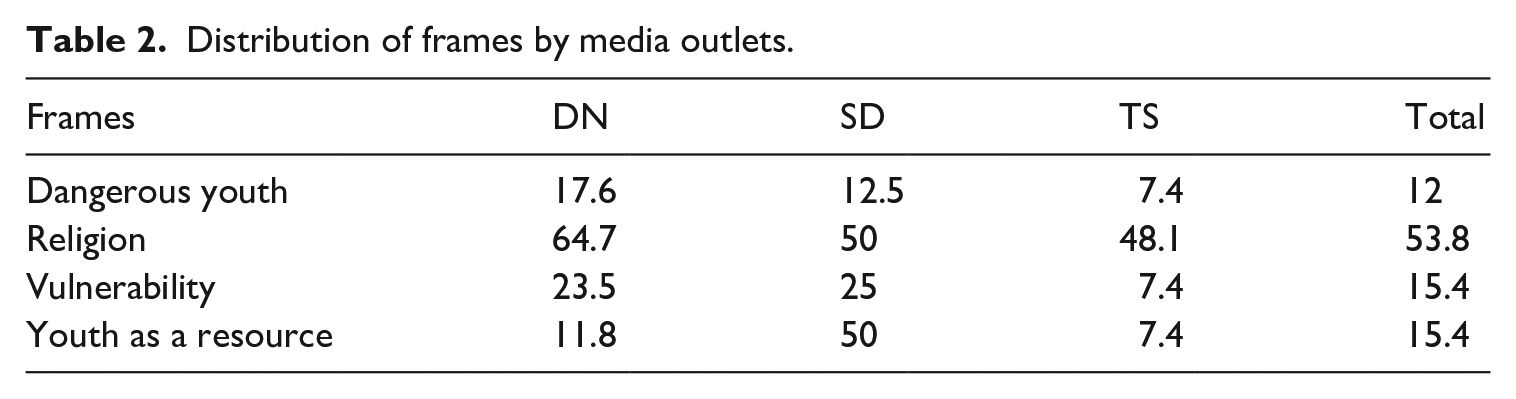
The news texts were heterogeneous, drawing on discourses of security, governance, unemployment, social welfare, religion and policing, among others. The media and participants drew on a few central frames (see Table 2) to interpret radicalization. Prevalent frames included: (i) association of religion with terrorism vs radical as a political construct; (ii) characterization of youth as a dangerous and violent ‘other’; (iii) perception that youth are vulnerable to manipulation by powerful others; and (iv) positive potential/contribution of youth in society.
Distribution of frames by media outlets.
The ‘religion’ vs ‘political’ frame
This frame highlights ‘religion’ as the leading cause of radicalization in Kenya. It occurs in 54 percent of news, with 37 percent explicitly connecting Islam and extremism. For instance, Mwangi (2018a) (TS) claims an ‘increase in the numbers of young people being radicalized . . . particularly true in the Muslim community. Many are rapidly joining extremists’ groups, Al-Shabaab and posing a (serious threat) to Kenya’s future security’. In 29 percent of news, the references to religion are implicit and refer to spaces/places/names associated with Muslims and Islam, e.g. Oketch (2017) (SD) quoting a politician states: ‘Some years ago radicalization of youths in Mombasa was being done in broad daylight in some mosques’.
Religion was also relevant in delineating the perpetrators and victims’ identities, especially in Christian victims. Victims were portrayed as ‘innocent’ and ‘heroes’ by foregrounding their positive qualities, thus viewing their death as a sacrifice. Sometimes this frame also mentioned other aspects such as economic and political marginalization as causes of terrorism, but they often came in second and weaker. This frame solidifies the stereotype of terrorism as ‘inherent to Islam’, thus suggesting: ‘vetting preachers and what they teach in madrassas’ (Mutambo, 2015a) (DN) as a countermeasure.
In contrast, FGD participants problematized the ‘religion’ frame. Unlike the media where the words ‘extremism’ and ‘radicalization’ were used in singularity, participants delegitimized the use of these words. For Participant B (PB, FGD Kisauni, June 2019): extremism could mean having extreme views on anything and does not have to be linked to al-Shabaab . . . al-Shabaab is a new group but before them we had Mungiki, Mashifta, many others . . . they are all against the government system. But some of these groups were never called ‘extremist’ . . . so who does the naming and how do they arrive at it? Even when you speak openly like this you could be called a radical.
And Participant A (PA, FGD Kisauni, June 2019) argued: There is a lot of politics in the language of P/CVE. That is why any kind of violence or even human rights activism happening in Mombasa can be categorized as religiously motivated . . . But when these same people go to Kisumu, they will call similar groups there extremist (in quotes) but base it on ethnicity because in Kisumu ethnicity is more salient as is religion here.
To examine ‘radicalization’ and ‘extremism’, participants drew comparisons: between locations and between violent groups such as al-Shabaab, Mashifta and Mungiki, and HR activist groups. For them, characterizing groups as ‘extremist’ politically drew on contextual, cultural and socio-political factors and historical narratives. In Mombasa, the religion frame resonated with narratives of identity, geography and belonging. PB and PA characterize the terms as pejorative labels deployed to justify unconventional responses, delegitimize claims for social justice reforms and silence criticism. While media framing reinforced dominant discourses on terrorism that orientalize Islam and Muslims (see Croft, 2006), FGD participants used the ‘religion frame’ to highlight the politics of naming, thus exposing inconsistencies of the dominant discourse.
‘Dangerous youth’ frame
Another frame made references to the danger posed by youth. The ‘dangerous youth’ frame was present in 12 percent of news. It is deployed through the concept of ‘youth radicalization’ and draws on the ‘new terrorism’ jargon to make sense of youth actions. This frame demarcates society into a binary of ‘us’ vs ‘them’, the former depicted as peaceful and the latter as violent. This frame refers to all youth as ‘dangerous’, but there are also overt references to Coastal and North-eastern youth. Muslim youth are considered dangerous because of their behaviours. Mghenyi (2015) (TS) echoes Member of Parliament Awiti’s argument that ‘it has become the norm for youth to carry arms into mosques and later attack innocent people’. The most important feature in this frame is its appeal to identity as the basis for action.
A total of 10 percent of news individualized ‘dangerous youth’; for example, Elkana (2017b) (TS) writes: ‘Four suspects arrested in Mombasa on radicalisation claims . . .Yayha Salim, Mohamed Anguso, Abdhallah Ramadhan . . .’. In the remaining 90 percent, coverage oscillates between collectivizing youth with labels and metaphors characterizing them as violent, including ‘Muslim radicals’, ‘extremists’, ‘fanatics’ and ‘militants’, among others; and indirectly referring to them using words used to indicate circumstances that often affect/involve youth, e.g. ‘radicalization’, ‘crime’, ‘unemployment’ and ‘poverty’. This process is called nominalization. Nominalization occurs when ‘a clause describing an action or event (involving participants, a process and circumstances) is transformed into a noun phrase’ (Richardson, 2017: 260). Even when actors are omitted, the meaning of the clause does not change because it is created by drawing from other texts. Hence, terms such as ‘terrorism’ and ‘religious extremism’ are often undefined because, on their own, they still function to invoke the familiar claims embedded in the ‘new terrorism’ discourse and oriental traditions (Jackson, 2007) whereas ‘radicalization’ is a social problem affecting the youth cohort.
In 95 percent of news, youth were engaged in negative activities such as ‘attacking’, ‘killing’, ‘hate-preaching’, ‘rioting’, ‘striking’ and ‘carrying arms’. In contrast, elite actors, e.g. politicians, were portrayed in positive agent roles in 95 percent of news. Kagwanja (2016) (DN) reports that ‘President Uhuru Kenyatta launched Kenya’s national strategy to counter violent extremism . . .’, whereas Elkana (2017a) (TS) portrays police in the action of enforcing the law. Both examples foreground the president and police’s actions, thus activating their roles.
There are variances in how this frame depicts men and women. Kariuki (2015) (DN) observes that contemporary ‘terrorists’ are more dangerous because they are young men who are ‘well educated’, ‘adjusted to urban culture’, have ‘promising careers’ and come ‘from elite backgrounds’. In contrast, Otieno (2017) (TS) highlights an activist’s sentiment that . . . women have been victims of violent extremism, but, today, they are the perpetrators . . . Women are overwhelmed in trying to understand the dynamics of violent extremism. Most do not understand the Islamic religion because religious leaders do not give adequate answers.
Whereas men engaging in violent extremism are rationally calculating political actors, women’s participation is momentarily acknowledged before being minimized by directing the reader’s attention to women’s naivety: their lack of religious knowledge and understanding of the conflict. The frame suggests ‘weeding out the al-Shabaab’ (Mutambo, 2015b) and ‘draining the swamp of terrorism’ as countermeasures (Kagwanja, 2016). Differences in framing obscure the category of women as violent actors behind broader ideas linked to victimhood while hypervisibilizing men as violent actors based on dominant assumptions of men as perpetrators. This reproduces heteronormative gender stereotypes and fails to recognize the diversity of actors in contexts of political violence. Such framing also occurs in other global studies on news coverage of women in violent organizations (Sjoberg et al., 2011).
In comparison, the FGD participants used the ‘dangerous youth’ frame but in different ways. Participants found media’s generalization of youth as ‘dangerous’ as flawed because it assumes youth are a homogeneous group; therefore, they are all extremists and violent. Participants distanced themselves from this generalization in different ways. PD (FGD Likoni, October 2019) said: I am not dangerous and just like those young people out there and you. It is sad to know that this is what people think when they see us . . . I am hard-working, we are hard-working young men and women and so are most youth out there. We all have our flaws. But . . . the media frequently shows negative things about youth.
PD differentiated herself from the ‘dangerous youth’ category by emphasizing her positive traits (hard-working). PD reflects on youth diversity and uses this reasoning to distance herself and most youth from the ‘dangerous’ category. PE (FGD Likoni, October 2019) echoes this by adding ‘people need to remember that the so-called ‘dangerous’ youth are a small minority of young people and should not be used to define all of us.’ Like the media, these participants relied on a binary framing of identities. They reinforced their identities as youth by creating an external ‘other’, considered radical or extremist. By distancing themselves from the media’s ascribed categorization of perpetrators/dangerous, the participants redefine and reclaim the ‘Us’ category. PC (FGD Kisauni, June 2019) recalling his experience added: this whole aspect of terrorism and radicalization has tainted the image of youth . . . I travelled to Nairobi for work and at some point . . . I went . . . to buy a soda . . . I ran into two police officers, and I was arrested. I was literally in my pyjamas, I explained to them . . . but they refused . . . explaining I revealed that I was from Kisauni and had arrived in Nairobi to attend a workshop. The minute I shared those details I regretted it. Their response was ‘Kisauni! Young man, so, you are the radicalized guys who have run away from there to hide here?’ I was very upset by this characterization. Because I was not running away from anything . . . my geographical origin should not define who I am . . . I want to be judged as Me, not by the snippets you see on the media or the claims you hear. I told them if they wanted to arrest me, they could go ahead and do it and that I know my rights and I will not be intimidated.
PC also uses an ‘us’ vs ‘them’ binary. Reflecting on his encounter, PC brings up power relations between youth and police officers in Kenya. Despite not breaking the law, the police relied on ideas about age, masculinity and geography to culturally construct PC as a ‘dangerous other’. PC utilizes the ‘us/them’ binary to voice suspicion about the media’s coverage and resulting policing of youth. He feels that the media characterizes youth as dangerous based on limited information. He thinks many youths, including himself are misjudged based on such coverage.
The ‘vulnerability frame’
The vulnerability frame appeared in 15 percent of news, 12 percent of which were by the DN editorial and column genres. The frame links vulnerability to age, unemployment, poverty, education, geography and cultural factors. It described the types of individuals most prone to radicalization or factors that make individuals susceptible. While these factors could be legitimate, as Badurdeen (2012) demonstrates, we still need to question such views as they are often ‘coloured by our perspective of the righteousness of the war’ (Browne, 2018: 136).
This frame was deployed, first, through vocabularies such as ‘vulnerable’, ‘poor’, ‘unemployed’, ‘idleness’ and ‘lack of educational opportunities’. Second, through human-interest stories, e.g. in DN editorial ‘Let’s honour students; they didn't die in vain’ and DN news article ‘Terrorist was a gifted, obedient student’. The texts used stories that reference the names of victims and perpetrators of the Garissa University attack. Rephrasing Neuman et al. (1992), human-interest stories can evoke positive or negative feelings from audiences. This frame portrayed youth as powerless victims who are often manipulated by a ‘powerful other’ (politicians, religious clerics, teachers) with ‘terrorist’ or political intentions. Ngwiri (2017) (DN) claims: The youth in general are susceptible to influences that run counter to the ones held dear by their parents and other adults. They are at an age . . . impressionable and if not guided . . . they become confused about their own identity and their place in society. Therefore rebellion to parental and societal authority seems to occur naturally to them.
The claim assumes that youth is a phase accompanied by confusion, lack of wisdom and experience. In this phase, youth are naïve and need guidance from adults; otherwise, they get manipulated into harmful activities by powerful others. The frame advises parents and teachers to ‘look out for strange signs in children’ to counter radicalization in time (Onyango, 2018) (TS). This claim erases youth agency by rejecting their political commitments. Views of youth (exclusively) as helpless reinforce youth victimhood ideas and silence comprehensive understandings of youth experiences outside the lens of victimhood. Youth victimhood viewpoints stem from constructions of child soldiers (Rosen, 2005), linked to cultural and ethical beliefs about the ideal ‘child or youth’ (Burgess and Burton, 2010).
Participants also challenged the vulnerable frame by crafting their identities through dress code and mannerisms. While most participants were casually dressed, I was interested in two male participants PA and PB. PA wore a pair of faded-ripped jeans inspired by mainstream fashion trends and considered unkempt in the traditional sense. PA’s hair was shaved short at the back and twisted into finger coils at the front. PB wore a kanzu,
1
which was not surprising given that it was a Friday. I soon realized that PB was the most educated among his peers in matters of religion because his colleagues referred to him as ‘ustadh’ (teacher) during the session. He paired his robe with a haircut like PA’s, a not so common combination. Locally, the haircut and PA’s dress code are associated with ‘wahuni’ (criminal) lifestyles. I assessed their thoughts on this association and PA (FGD Kisauni, June 2019) remarked: this attire is associated with wahuni (criminals) so when people see me, they will think oh he is dressed like a criminal and of course this means they will think I am dangerous. But should this worry me? No, it does not, I am a young man trying to enjoy my youth.
PB (FGD Kisauni, June 2019) added, they probably look at me and get confused because my robe reveals my religious identity, but my hairstyle signals something else. But I like it, I am trying to live my best life while age allows it. I do not want to let others define how I can dress or walk or talk. I can dress like this and still be more law-abiding than the next guy in a suit.
Mainstream fashion trends inspire the way both participants carried themselves. However, it also stressed manifest youth subcultures in the specific othering they went through. In Mombasa, ‘muhuni/mkora’ (criminal) refers to nonconformists concerning behaviour and general mannerisms. In this regard, anything that deviates from socio-cultural norms is regarded as criminal behaviour. Both participants are easily dismissed as criminals because of their dress code. These participants’ appropriation of the ‘dangerous’ identity (re)produces stereotypical ideas about youth. Still, they challenge these by ascribing value and meaning to being young and having freedom of expression/choice. Their dress code indicates their engagement with global consumer culture. The participants also use ‘unconventional’ fashion to enact their identities. As PB observes, wearing a suit does not make you law-abiding, just like wearing ripped jeans should not make you a criminal.
‘Youth as a resource frame’
Another alternative frame was ‘youth as a resource’. It was predominant in 50 percent of SD columns. This frame views radicalization as caused by structural rather than personal issues. Mogambi (2018) (SD) views youth crime as rooted in ‘corruption, which negatively impacts economic growth, encourages police harassment of youths, limits education and job opportunities for those who refuse to pay bribes’.
Radicalization and youth crime are political rather than individualized issues. The frame emphasizes that radicalization and youth crime are consequences of (in)direct exclusion of youth from political, economic, social and cultural spheres. The frame depicts institutionalized corruption as a ‘cancer’ (Franceschi, 2015) (DN) that causes insecurity and ‘negative ethnicity . . . as a great ally of corruption and instigator of ethnic genocide, civil wars, massacres and insecurity’ (Wamwere, 2015) (TS). Corruption and negative ethnicity polarize society, with most youth being disadvantaged. The frame proposes that youth potentials can be tapped by ‘fighting’ corruption and negative ethnicity (Franceschi, 2015) (DN). This frame also proposes that ‘changing attitudes about the role of young people in society . . . must be a fundamental principle of youth development’ (Mogambi, 2018) (SD).
The participants used the ‘youth as a resource’ frame to articulate their roles and contributions in society. PD saw herself as ‘hard-working’, while PC stood up to the police and resisted unlawful treatment. Both exercised agency by creating oppositional identities that cast them like ‘adults’.
Discussion and implications
I analysed the dominant frames on radicalization, how they become embedded in Kenyan media content, how they actively produce identities for the subjects they portray and how Kenyan youth challenge these frames. The coded news and FGD data generated four dominant frames that share similarities and differences in mainstream media and FGD participants: religion, vulnerability, dangerous youth and youth as a resource.
Similar frames appear in other studies (Botha, 2015). The frames highlight religious clerics’ role in introducing youth to violent ideologies/organizations. Botha found that: a religious figure introduced 34 percent of respondents to al-Shabaab, 59 percent of respondents listed ‘Islam’ as their primary identity, 97 percent considered Islam to be under threat, 49 percent of whom identified the threat as the government, 18 percent as external and 24 percent as Christianity. International Crisis Group (2014) identify poverty, unemployment, marginalization, unaddressed historical injustices and police profiling as factors making Mombasa youth vulnerable to radicalization. Khalil and Zeuthen (2014) added age and ethnicity as other relevant factors that increase Coastal youth’s vulnerability. ‘Women’s vulnerability’ to forced recruitment is also compounded by forced marriages, marital status and lack of awareness (Badurdeen, 2018: 163).
The media frames did not provide such a comprehensive view, instead they relied on specific assumptions, metaphors and narratives about ‘youth’, ‘Islam’ and ‘the Coast’ to examine radicalization. These assumptions are expressed through rhetorical devices quoting the news source or journalist voice. In TS, youth are depicted ‘as [habitually] carrying arms into mosques and later attacking innocent people’ by Nyali Member of Parliament Hezron Awiti, and mosques are metaphorically described ‘as still act[ing] as hideouts for criminals’ (Mghenyi, 2015). These devices draw on cultural constructions about youth embedded in the youth bulge meta-narrative.
This frame further draws from norms about ideal youth as one who traditionally conforms to societal expectations embedded in gerontocracy and patriarchy (Burgess and Burton, 2010). These relations maintain social order in most societies, thus, the ‘carrying arms’ youth is not normative. A few days after the Garissa University attack, the media magnified ‘terrorist profile’ and exaggerated the threat’s scope by framing young Muslims as dangerous ‘others’. This construction set in a moral panic leading to increased security patrolling the Coastal region (Honan, 2015).
Furthermore, the metaphor describing mosques ‘as still act[ing] as hideouts for criminals’ demonizes Muslims and the spaces they frequent. In radicalization discourses, this metaphor holds appeal because it is connected to everyday ideas about terrorism in Kenya. It evokes familiar claims of ‘Muslim terrorists’ vs ‘Christian victims’ and events such as the killing of several controversial Muslim clerics, including Abubakar Shariff Makaburi, and the November 2014 raids of Musa and Sakina mosques on suspicion of being linked to terrorism. These raids by the Anti-Terror Police Unit (ATPU) claimed to have interrupted ongoing training of ‘militants’, seized weapons, radicalization materials and an al-Shabaab flag (BBC, 2014). These raids were followed by riots over several days and criticisms against ATPU over the excessive use of force. Rearticulating Marks (2018), metaphors are not just linguistic features, but also carry latent meanings. This metaphor arouses ‘deep cultural fears’ about Islam and Muslims (Jackson, 2005) by foregrounding a religious reading, thus ignoring political questions of injustices, inequalities and HR violations at the Coast, and how these enable radicalization. The depiction of youth as ‘dangerous’ and the metaphor also function to legitimize interventions that seek to culturally shape ideal youth.
Youth perceptions concerning radicalization are shaped by subjectivity and structural issues like a reaction to culturally defined ideas of being young. The participants experienced ‘othering’ by media and society which portrayed them as ‘dangerous’ and ‘criminals’. This legitimized youth’s profiling and increased religious intolerance (HRW, 2016). Some participants appropriated the ‘dangerous’ identity and ascribed value to it, insisting that dress code or age should not be used to judge one’s character. Referring to ‘guys in suits’ and ‘law-abidingness’ in the Kenyan context draws on narratives about powerful elites ‘who engage in dishonest practices . . .’ and ‘often manipulate . . . the rule of law and often go unpunished’ (Awiti and Orwa, 2019: 423). This exposes the unequal standards of young vs adults and rich vs poor, where youth moral transgression is often labelled deviancy whereas there is widespread apathy when it comes to ‘adults’.
Some youth refused the ‘dangerous youth’ label and instead projected it to ‘minority’ youth engaging in extremism. While attempting to show diversity among youth, the mere categorization of minority youth as ‘dangerous’ reifies dominant discourses that continue to harm youth collectively. First, it implies youth’s monopoly on violence, assuming that there are no other groups engaged in violence. Second, the characterization ‘dangerous youth’ in many ways avoids confronting the foundations of violence in Kenya which are rooted in structural issues and the ‘changing expectations among youth regarding their obligations and responsibilities’ (Burgess and Burton, 2010: 18). Distancing themselves and projecting the characterization to the minority does not change much because the characterization is already part of a framework that criminalizes the youth identity. Instead, some youth’s outright rejection of this characterization is a more effective approach to challenging the framework of policies/practices and addressing the real structural conditions that underlie radicalization.
Most participants and some news texts viewed radicalization and extremist as products of structural issues. Participants saw the use of terms like ‘extremist’ and ‘radical’ as an exercise of power over those of different religious, ethnic and political affiliation. Using the words (re)produced mainstream beliefs about which actors, societies and regions are, by nature, ‘violent’ and ‘unpatriotic’, and thus must be controlled. This finding is also reflected in global studies examining the politics of language on terrorism and counterterrorism (see Baker-Beall et al., 2015).
On the part of media discourses, radicalization assumptions construct specific identities of the ‘other’ which are used to control youth in several ways. For instance, labelling them deviants reinforces societal norms about ideal youth, normalizes surveillance and policing of youth and certain spaces, and individualizes radicalization, thus absolving the state of any responsibility. Despite this, youth articulate their agency by resisting such characterization and adopting strategies to challenge unjust practices. The study exposed the emerging narratives and counternarratives, thus offering an alternative view of radicalization.
Continuing to think of radicalization as a problem of specific identities has consequences for counterterrorism and P/CVE, the material conditions young people live in and the broader structuring of generational relations which continues to subordinate youth in Kenya. Heavy-handed counterterrorism and collective punishment of the Coast and North-eastern Kenya reinforce stereotypes of Muslims as ‘extremists’ (Mogire and Mkutu, 2011), and fail to address historical injustices, inequality, poverty and corruption which influence and limit the choices available to young Muslims and Youth more generally. It is such developments that enable al-Shabaab narratives to gain resonance in these regions.
Footnotes
Acknowledgements
I am thankful to Maura Conway, Walt Kilroy, Erika Biagini, Pepijn Westen, Loise Macharia, Job Mwaura, Adel Cheong, Arpita Chakraborty, the special issue editors, and the anonymous reviewers for providing helpful feedback on drafts of this article.
Funding
The author disclosed receipt of the following financial support for the research, authorship, and/or publication of this article: This research was funded by the Faculty of Humanities and Social Sciences, DCU Postgraduate Research Student Journal Publication Scheme. The author declared no potential conflict of interest.
