




Abstract
Background/Objective
Data in terms of how dynamic changes of muscle mass and function affect mortality in end-stage kidney disease (ESKD) patients undergoing dialysis have led to inconclusive results. The main goal of this research was to determine the association between dynamic deterioration of muscle mass and function and all-cause mortality in ESKD patient on continuous ambulatory peritoneal dialysis (CAPD).
Methods
Eligible ESKD patients on CAPD were prospectively included, and followed up at 3-month intervals in the tertiary care center for 2 years. Dynamic deterioration of muscle mass and function during a 12-month follow-up period before patients enrolled was the exposure of interest. The deterioration of muscle mass and function was identified utilizing the criteria set by the Asian Working Group on Sarcopenia in 2019 (AWGS 2019). Primary outcome was defined as the all-cause mortality during the next 2-year follow-up period. Kaplan–Meier analysis with log-rank test was used to compare overall survival between groups. Association of dynamic deterioration of muscle mass and function with all-cause mortality was examined by employing Cox proportional hazards models. A sensitivity analysis was also conducted to examine whether the potential association was modified.
Results
A total of 217 eligible patients on CAPD were included. The prevalence of dynamic deterioration of muscle mass and function was 42.9% (93/217), of which that evolving to sarcopenia (nonsevere sarcopenia or severe sarcopenia) from nonsarcopenia was 24.9% (54/217) and that evolving to severe sarcopenia from nonsevere sarcopenia was 18.0% (39/217). A total of 35.0% (76/217) participants died during the 2-year follow-up period, of which the group with deterioration of muscle mass and function was 50.5% (47/93), and the group without deterioration was 23.4% (29/124), with an absolute difference of 27.1% (95%CI 14.5%–39.7%). Kaplan–Meier survival curve revealed that the participants with dynamic deterioration of muscle mass and function had a worse survival rate than those without deterioration (log-rank test, χ2 = 17.46, p < 0.001). After adjustment for potential confounding factors, the dynamic deterioration of muscle mass and function was still significantly associated with increased risk of all-cause mortality (hazard ratio [HR] = 2.40, 95%CI 1.44–4.00, p = 0.001). In sensitivity analysis, the relationship between dynamic deterioration of muscle mass and function (nonsarcopenia to sarcopenia vs without deterioration) and all-cause mortality was consistent (HR = 4.01, 95%CI 2.22–7.22, p < 0.001). Nevertheless, no significant relationship was found in participants who evolved to severe sarcopenia from nonsevere sarcopenia (HR = 1.41, 95%CI 0.72–2.74, p = 0.313).
Conclusion
This research demonstrated a significant association between dynamic deterioration of muscle mass and function and higher risk of mortality in ESKD patients on CAPD, and we recommend individualized lifestyle intervention that may be implemented to intervene in the progression of their muscle mass and function across the health care spectrum.
This is a visual representation of the abstract.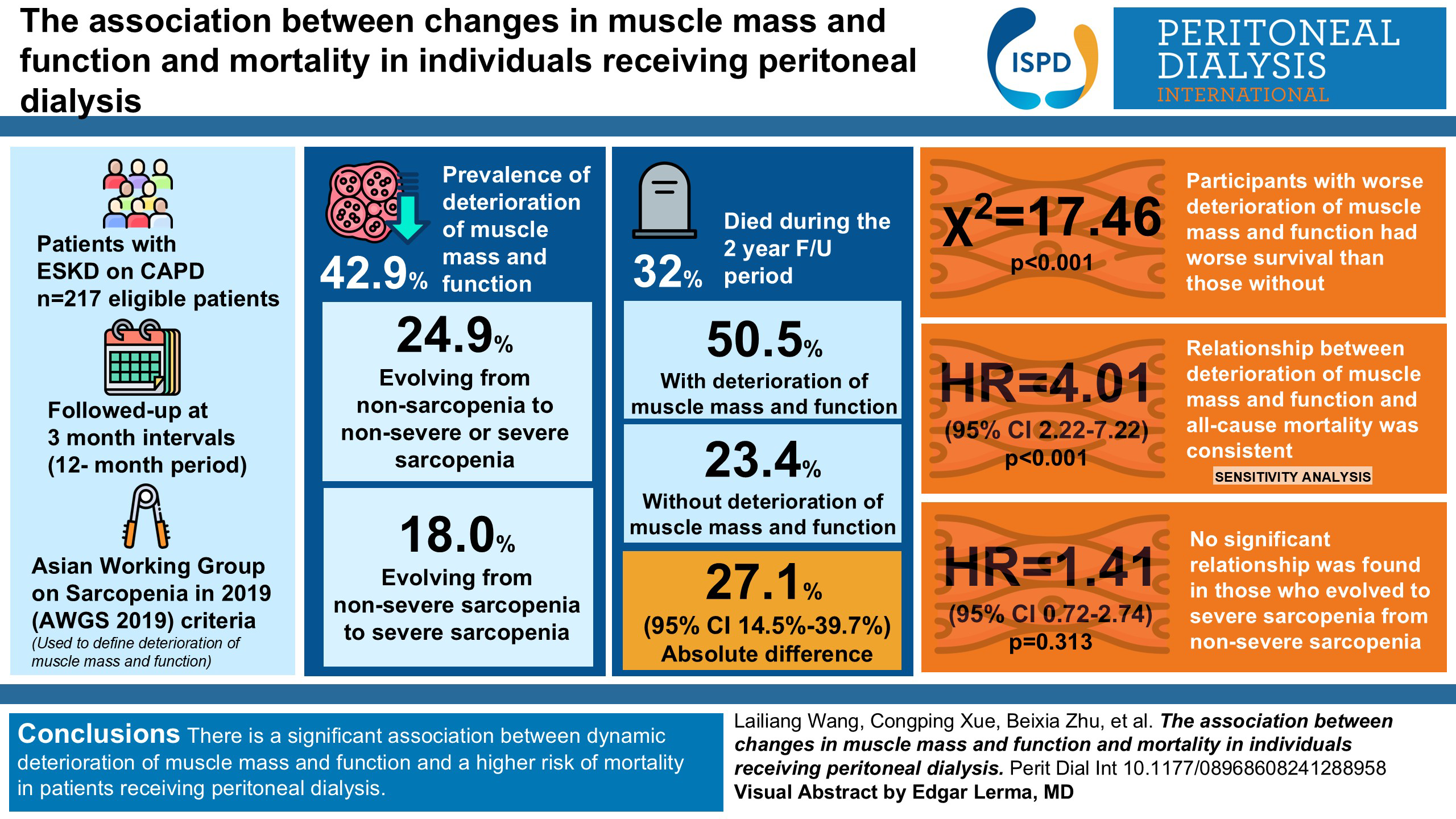
Get full access to this article
View all access options for this article.
References
Supplementary Material
Please find the following supplemental material available below.
For Open Access articles published under a Creative Commons License, all supplemental material carries the same license as the article it is associated with.
For non-Open Access articles published, all supplemental material carries a non-exclusive license, and permission requests for re-use of supplemental material or any part of supplemental material shall be sent directly to the copyright owner as specified in the copyright notice associated with the article.
