



Abstract
Education policy has long been analyzed as a cycle where various actors influence different stages. However, few such studies have focused on identifying and interrogating the specific moments that shape an education policy’s overall equity trajectory. This article uses Bowe, Ball, and Gold’s policy cycle as an exploratory theoretical framework, focusing on the historic Review of Funding for Schooling (2011) in Australia, which evaluated the nation’s school funding policy. The authors concentrate on the Context of Text Production phase of its policymaking process, and consider the implications for equity. From this work, the authors highlight two “critical moments” that they argue significantly influenced how the appointed panel approached equity. Their theorizing of a “critical moment” offers valuable insights for researchers and stakeholders seeking to understand or influence education policy.
Introduction
School funding and equity are central to contemporary global debates about what constitutes a just, fair, and high-quality education (Darling-Hammond, 2015; Di Gregorio & Savage, 2020; Perry, 2024; World Bank, 2018). Largely, this is thanks to the influence of the Organization for Economic Cooperation and Development [OECD] through its Programme for International Student Assessment 1 (PISA) testing. Over more than two decades PISA has ranked the performances of countries’ education systems in areas such as equity, overall expenditure, and the performance of their students in reading, mathematics, and science. A key impact of these rankings has been the emergence of a culture of competition between many OECD member nations: particularly concerning the outcomes of their students (Rizvi & Lingard, 2010). This competitive environment has led to a shift in the school funding and equity discussion toward how government money is spent by schools to improve student outcomes; rather than on the specifics of dollar amounts that have shaped debates of the past (Darling-Hammond, 2015; O’Brien et al., 2023; Savage, 2020).
The current global focus on school funding and equity is an extension of a long term trend in which national governments have consistently understood public funding as a crucial tool for schools to pursue equity and social justice (Darling-Hammond, 2015; Favero & Kagalwala, 2024; Hogan et al., 2022). Consequently, schools have for decades been positioned as responsible for mitigating broader inequities and disadvantages despite the fact they largely manifest from complexities occurring beyond the school walls (Brooks, 2012; O’Brien et al., 2023; OECD, 2012, 2023; Savage, 2011). There is also the well-established research finding that access to adequate resources positively influences students’ educational attainment (Dhaliwal & Bruno, 2021; Hogan et al., 2023; Kenway et al., 2024; Morgan, 2022; Morgan & Amerikaner, 2018; Rawolle, 2013).
Using Australia as a case study, the purpose of this article is to examine how a national review of school funding policy, the Review of Funding for Schooling [the Review] (Australian Government, 2011), addressed equity, and to explore the lessons that can be learned by individuals and organizations aiming to influence and improve equity through education policy. Our focus on a national government review of funding for schooling is important and timely, because as Gerrard et al. (2017) argue: funding is a central instantiation of what is considered to be of public worth. It is exemplary of Easton’s (1953) framing of policy as an authoritative allocation of values. Government funding decides, in the crudest of terms, ‘who gets what’, and is thus a fundamental articulation of the values of government. (p. 505).
Elsewhere, Windle (2014) reminds us that government-initiated inquiries and reviews are pivotal moments in public policymaking because they bring together a diverse range of stakeholders, interests, and discourses.
The Review was the largest national inquiry into funding in Australia since 1973. It sought to overhaul Australia’s patchwork approach to funding, reverse declining student performance trends, and address growing inequalities. Despite these grand aims, the Review’s overarching equity aspirations have not been realized. Inequalities persist (O’Brien et al., 2023), and political interests continue to influence funding processes, with funding agreements subject to the winds of political cycles, party changes, and lobby groups (Sinclair & Savage, in-press). Given the scale of the Review, and the fact it has failed to improve equity in Australian school funding, we still see it as providing a powerful window into equity and schooling funding policy in the current global times, even a decade after its public release in 2011.
This article is structured in five sections. It begins with an overview of school funding policy and equity in Australia. The next section considers the policy cycle theoretical framework and critical policy perspective that informs the study, which is followed by the section that explains our case study methodology. We follow this by sharing the findings from our empirical work which include the importance of the Terms of Reference for setting limits and constraints for equity. The article concludes with a presentation of an emergent theoretical perspective, the “critical moments” for equity, and a discussion of the implications for research and policy engagement for the future.
School Funding Policy and Equity in Australia
The Australian education system has three school sectors: public, Catholic, and Independent sectors, all of which receive government funding. At the time of the Review in 2010, the percentage of enrolments of all Australian students for these three sectors were 66%, 20%, and 14%, respectively. These figures remain steady in 2024. The public school sector is the largest and oldest sector in Australia. The sector cannot charge compulsory fees and 29% of these schools enroll high concentrations of disadvantaged students while only 8% enroll high concentrations of advantaged students (O’Brien et al., 2023). The Catholic school sector is the second largest in Australia. The sector provides mainstream education with religious instruction and has operated in Australia since the first half of the 19th century (Greenwell & Bonnor, 2022). In contrast to the public school system, 4% of its schools enroll high concentrations of disadvantaged students with 12% enrolling high concentrations of advantaged students (O’Brien et al., 2023). The Independent school sector often represents particular community groups or business interests, and some (but not all) have religious affiliations (Connors & McMorrow, 2015). Only 6% of Independent schools enroll high concentrations of disadvantaged students with 29% enrolling high concentrations of advantaged students (O’Brien et al., 2023). In view of this, it is little surprise that government funding for the Catholic and Independent school sector has been the subject of heated and ongoing debates that show no sign of disappearing (Keating & Klatt, 2013).
A peculiarity of Australia’s current funding settlement is that the federal government has increasingly favored non-government schools over recent decades (Sinclair & Savage, in-press). This is due, in part, to the specifics of Australian federalism and its Constitution in which the Australian states and territories are responsible for public schooling in their jurisdictions: the country has six state and two territory based public education systems. Consequently, since federation in 1901, debates about funding have historically been concentrated at the state and territory (subnational) scale (Savage, 2020). Given the federal government has no legal authority over public schooling, it instead has concentrated on supporting the expansion of non-government schools through funding policies. As pointed out by several scholars (Kenway, 2013; Rowe, 2023, Savage, 2023), the fact the Australian federal government has increasingly favored non-government schools over public schools in its funding policies has been unhelpful in terms of improving equity.
The current bilateral funding agreements 2 provide an example of the state of inequity in the Australian education system (Sinclair & Savage, in-press). Specifically, we focus on how they maintain inequitable processes against the backdrop of a national call for more equitable outcomes (“equity and excellence” has been the number one goal of the nation’s education system since 2008). Under current agreements, the state and territory governments are expected to contribute 80% of recurrent funding for public schools, while the federal government is expected to add 20%. In contrast, the federal government is expected to fund 80% for non-government schools, while the states and territories share is set at 20%. It is important to foreground that although these are the agreed targets, in 2023, all but the Australian Capital Territory (ACT) failed to fund the full 80%. This situation has left 98% of public schools underfunded, while almost all non-government schools, received at least the full 100% of their funding targets (O’Brien et al., 2023). Kenway et al. (2024) argue that this inequity is compounded given the multiple revenue streams available to non-government schools such as enrolment fees, fundraising, and investment returns.
In view of the above, Thompson et al. (2019) have gone as far as to describe school funding policy in Australia as a “wicked problem” (p. 2). While this is perhaps a dramatic turn of phrase, we largely agree with this assessment given the existence of the three school sectors, the different funding models at the federal and state levels, and the subsequent politics and vested interests of the school sectors and levels of governments that characterize this complex policy landscape (Lingard, 2000). Keating (2011) presciently saw the Review as the latest iteration of school funding battles that had thwarted previous attempts at equitable funding reform in Australia. To help us pursue our research aims, and deal with the complexity of the Australian school funding landscape detailed so far, we draw from Bowe’s et al. (2017) policy cycle framework, first published in 1992, and focus on one of its three phases of policymaking.
A Critical Theoretical Perspective for Examining Equity in School Funding Policy: The Policy Cycle
The policy cycle approach to policy analysis has a long tradition in critical education policy studies, and has had “ongoing significance since its publication” with researchers using it to study a variety of education issues worldwide (Lingard & Sellar, 2013, p. 265; Winton, 2013). While there are various ways that scholars explain stages of the policy cycle, for Bowe et al. (2017) it is made up of three interrelated policymaking contexts: the Context of Influence, the Context of Text Production, and the Context of Practice. Ball (1994) later added the Context of Outcomes and the Context of Political Strategy. One of the strengths of Bowe’s et al. (2017) policy cycle is that it helps analysts understand a somewhat predicative series of stages through which policies travel as they are conceptualized and enacted.
For Bowe et al. (2017), and those who have built on their theorizing, the Context of Influence is the first of the original three contexts and is put forward as the spaces in which different groups contest the definition and purposes of education. For example, policy stakeholders may debate policy problems and their proposed solutions, and interest groups advocate for their preferred policies or against policies of political opponents (Piazza, 2017). The aim is to understand what is going on before the policy production process begins or, in other words: “where policy is normally initiated” (Minh Ngo et al., 2006, p. 227) and how these events may eventually influence policy processes and the final written policy text.
The Context of Text Production is the second of three policymaking contexts in the original policy cycle framework (Vidovich, 2007). Highlighting the importance of this context, Bowe et al. (2017) point out that the meaning and direction of a policy is open to influence during the text production process. Consequently, the final policy text that results is viewed as the outcome of struggle and compromise “to control the meaning of policy through its representation” (Bowe et al., 2017, p. 21). The analysis also considers the specific actors involved in producing the final policy text and how they have influenced the process via their political ideologies (Bowe et al., 2017). This work recognizes that policy texts are shaped in important ways by the struggles between stakeholders who want to control the direction of an education policy in a certain way. In short, the policy text(s) produced in the text production process represent the policy.
The Context of Practice is the third of the three policymaking contexts. It focuses on where a policy directs its attention and the audiences and arenas it seeks to influence and reform (Bowe et al., 2017). This context also examines the spaces from which a policy’s problem or issue emerges and then focuses on the direction and targets of its proposed solutions. In this way, the analytical focus is on where the consequences of a policy are experienced (Gulson, 2011). Two years after the publication of the policy cycle heuristic, Ball (1994) expanded the initial policy cycle heuristic by adding two more contexts of policy analysis (Vidovich, 2007).
The first of these two is the Context of Outcomes. This context is primarily concerned with policy effects and calls for examining how policy impacts educational and social inequality (Sinclair, 2022). The research that emerges from this context helps inform the framing and approach to the final context: the Context of Political Strategy.
The purpose of this fifth and final context is to help ameliorate the inequities identified across the policy trajectory by proposing strategies to improve practice in the future: for example, a lack of access to resources, opportunities, and so on (Piazza, 2017). This context has a connection to the Context of Outcomes in that it “is concerned with identifying strategies to tackle the inequalities” (Vidovich, 2007, p. 289) identified there (Ball, 1994; Lingard, 1996; Minh Ngo et al., 2006). It encourages the policy researcher to identify a set of political and social activities that may improve practice, and tackle inequities produced or reproduced and or created by the policy.
By framing the Review using Bowe, Ball, and Gold’s policy cycle, we situate our research alongside previous efforts of scholars like Vidovich (2007) and Piazza (2017) who have used this framework to work “on the cusp” (Vidovich, 2007, p. 286) of modernist post-structural perspectives on state and political power. In this way, our approach to policy analysis reflects the notion that a discursive analysis of power needs to intersect with a structural analysis to capture the policymaking process accurately. Thus, our approach combines both discursive and structural notions of power (Piazza, 2017). We follow these scholars to make the case that debates about what sound education policy looks like and the social, economic, and political structures at the time shape the education policymaking process in key ways.
Our selection of the policy cycle to frame and study the Review reflects the trend of education researchers using a range of critical theoretical frameworks and methods in their work to examine how education policies challenge or perpetuate inequality and inequity (Diem et al., 2014; Winton, 2019). We have also followed other scholars (see, Apple, 2019; Ball, 1994; Molla, 2021; Winton, 2010), by using critical approaches to locate both inequality and power in the education policymaking process, and then going further to help transform any identified inequitable conditions of education. For Ball (1994), this is the work the Context of Political Strategy in the policy cycle is designed to carry out.
Case Study Research Design
This article emerges from a larger 5-year qualitative case study, which critically examined the policy cycle of the Review of Funding for Schooling (2011) final report. This larger project focused on the Review’s policy cycle as a whole and amassed 48 public records—including government inquiries, interviews, legislation, policy texts, press releases, and public speeches—and produced 39 personal records—for instance, media articles and political opinion polls (Sinclair, 2022).
In this paper, we examine one of the Review’s five policy cycle contexts: the Context of Text Production. Given its parameters and scope as an analytical lens, we, for the most part, focus on “the construction and development” of the Review’s final report because the “final policy text should be viewed as the outcome of struggle, compromise and efforts to control the meaning of policy through its representation” (Bowe et al., 2017, p. 21). In order to do this, we draw on the Review’s final report (Australian Government, 2011), and its appendices as our primary data sources. In the Appendices A and G, the Review panel documented key elements of their policymaking process:
Appendix A: Terms of Reference for the Review of Funding for Schooling (Australian Government, 2011, p. 225-226)
Appendix G: Public submissions (Australian Government, 2011, p. 244-254)
We also draw on five other public records. They include the following:
Two Public Speeches
Gillard (2010a, April 15). [Speech] A future fair for all—school funding in Australia. Address to the Sydney Institute.
Boston (2016). [Speech transcript] Dr. Paul Brock Memorial Medal. Address to the Australian Council for Educational Leaders. http://www.acel.org.au/acel/ACEL_docs/Branches/NSW%20Events/2016/ACEL_NSW_Awards_Speech_WEB.pdf
One Media Release
Gillard (2010b). Expert panel for school funding review [Media release] Australian government. https://ministers.dese.gov.au/gillard/expert-panel-school-funding-review
One Open Letter
Gonski (2011, November 20). The Review of Funding for Schooling. Australian government.
One Academic Book Chapter
Bentley (2017). Other people’s children: School funding reform in Australia. In T. Bentley & G. C. Savage (Eds.), Educating Australia: Challenges for the decades ahead (pp. 330-348). Melbourne University Press.
We take what McCulloch (2004) calls an in-depth documentary analysis approach to our collected data. The first step was to revisit the data that was a priori coded for the Review’s Context of Text Production during the larger study. Given the purposes of this paper, we checked if any data was missing and if any further data needed to be collected. We then analyzed our collected data from an equity perspective looking for instances of what Diem et al. (2014) call the roots and development of policies, the creation of winners and losers, any intended solutions to problems of equity, and how actions of policymakers may reinforce the dominant culture. We also sought to understand how the Review’s construction was shaped by any underlying ideologies; and uncover elements of social stratification, such as the distribution of power, resources, and knowledge in policy development and enactment. This work corresponds to the theorizing of Bowe et al. (2017) of the Context of Text Production, which they argue focuses on agenda-setting and policy formulation stages of the policy cycle.
To ensure internal inter-rater reliability, we both coded data separately, and then compared emergent codes and reflected continuously and reflexivity was maintained throughout the research process. This approach aimed to strengthen the internal coherence and reliability of our study.
Findings: The Review of Funding for Schooling’s Context of Text Production Phase of Policymaking
Federal Education Minister Julia Gillard announced the Review of Funding for Schooling (2011) on 15 April 2010 (Gillard, 2010a). It sought to overhaul Australia’s patchwork approach to funding, reverse declining student performance trends, and address growing inequalities (Savage, 2020; Thompson et al., 2019; Windle, 2014). The Review’s Terms of Reference were set by the federal government and tasked the panel with providing recommendations “on the future funding arrangements for schooling in Australia” beyond 2013 (Australian Government, 2011, p. 225). It is known colloquially as the “Gonski Review” because the then federal Labor government appointed David Gonski AO, a prominent Australian businessperson and public figure, to chair its five-person panel.
Drawing from Bowe et al.’s (2017) Context of Text Production theorizing, we argue the Review’s final policy text was the outcome of various stakeholders attempting “to control the meaning of policy through its representation” (p. 21) before the Review panel even began its work. Specifically, we show how the Review’s approach to equity was the outcome of struggle, compromise, and efforts to shape it early in the Review’s text production processes. Further, our analysis also demonstrates how the creation of the Review’s final report reflected many of the prevailing goals, arguments, and discourses framing education policy elsewhere (see, Piazza, 2017; Savage, 2020; Winton, 2019). Analytical attention is also drawn to specific actors who sought to “structure the possible field of action” (Foucault, 1972, p. 220) for the Review and its panelists’ work, and how the way that a policy process is constructed creates what Diem et al. (2014) call winners and losers.
An Infamous Promise that Shaped Equity in Australian Schooling for Decades to Come
Federal Education Minister Julia Gillard, during her announcement of the Review, promised that “no school would lose a dollar as a result of the review” (Gillard, 2010b, p. 1). This declaration did not appear in the official written Terms of Reference but it did not stop the panel from putting it into practice. Gillard’s promise meant that regardless of the Review’s findings, no Catholic or Independent school would lose a dollar of government funding—even if vast inequity was revealed between public and non-government schools. In doing so, Gillard ensured that inequity would remain part of the school funding policy settlement for the foreseeable future (Sinclair & Savage, in-press). Years later, Review panel member Dr Ken Boston would publicly lament that the no school will lose a dollar constraint as “an albatross around the neck of the panel” (Boston, 2016, p. 2).
Put another way, the federal government constrained the Review panel’s possible field of action even before it began its work. In 2017, almost 7 years after the infamous promise, Education Minister Julia Gillard’s Deputy Chief of Staff admitted as much, suggesting this concession was an attempt to mollify the Independent school sector organizations. Pointing to the campaign by the Independent school sector organizations that “destroyed Labor’s school funding policy at the 2004 election,” he said the promise that no school would lose a dollar was “politically necessary to prevent meltdown” from their representatives, and agreement between the Review panel’s five members would have been difficult in the absence of this concession (Bentley, 2017, p. 341). For Bentley (2017), if the non-government school sector felt their funding privileges would be threatened by the Review: it would be doomed from the beginning.
To head off any campaign by their political opponents about a “hit list” (Harrison, 2010, p. 1), the then Prime Minister Gillard reiterated the ALP’s promise to the Independent schools that their taxpayer funding was not under threat. She went further in her autobiography, admitting that “at the outset, I sought to neutralise potential hit-list style politics. . .. Because I lived haunted by echoes of the 2004 election campaign” (Gillard, 2014, p. 257). This promise was the beginning of several concessions to the non-government school sector across the Review’s policy cycle that limited its equity impact (Sinclair, 2022). The influential framing mechanism for the Review, the Terms of Reference, is our next focus of analysis. The Terms of Reference for a policy process are a convention that lays out the scope of the work for a panel and delineates how the people and groups identified in the Terms will work together in the pursuit of a shared goal or set of goals (Australian Public Service Commission, 2021).
The Review’s Terms of Reference
A draft version of the Review’s Terms of Reference [the Terms] was released for public comment by the Australian government on 30 April 2010. The Review panel received 44 submissions, with 27 of those were published publicly. Drawing on Lasswell (1958), who reminds us that social and political forces influence the “when and how” (1) of public resource distribution, we explore the “who” as well as the “when” and the “how” in relation to the Review’s submissions to the Terms public submission process below.
The first part of the analysis builds on our analytical approach used elsewhere where we analyzed the representation of the school sectors across the Review’s appointed panel and its consultation process with stakeholders. We found these processes to disproportionally favor the non-government school sector’s across the Review’s Context of Text Production (Sinclair & Brooks, 2022). In the same way, here, we use the specifics of the school sector enrolments, and their differences and inequities of enrolments as a CPA lens. Thus, the submissions were divided into four categories:
The Review panel received 44 submissions in total and as Table 1 shows, 27 of them were available to the public. Table 1 also highlights that the Independent school sector provided 41% of the school sector-based submissions (11/27 overall) to the process compared to their overall student enrolment percentage of 14% of Australian students. Interestingly, the table shows that the public school sector provided 18.5% of school sector submissions (5/27 overall) for 66% of Australian student enrollments. In comparison, the Catholic sector was closer to being evenly represented at 14.8% of submissions for 20.8% of student enrolments (4/27 overall). Given these submission trends, it is intriguing that 17 of the submissions were not released publicly as those stakeholders opted to remain anonymous.
Terms of Reference: Written Submissions to Panel by School Sector. 3
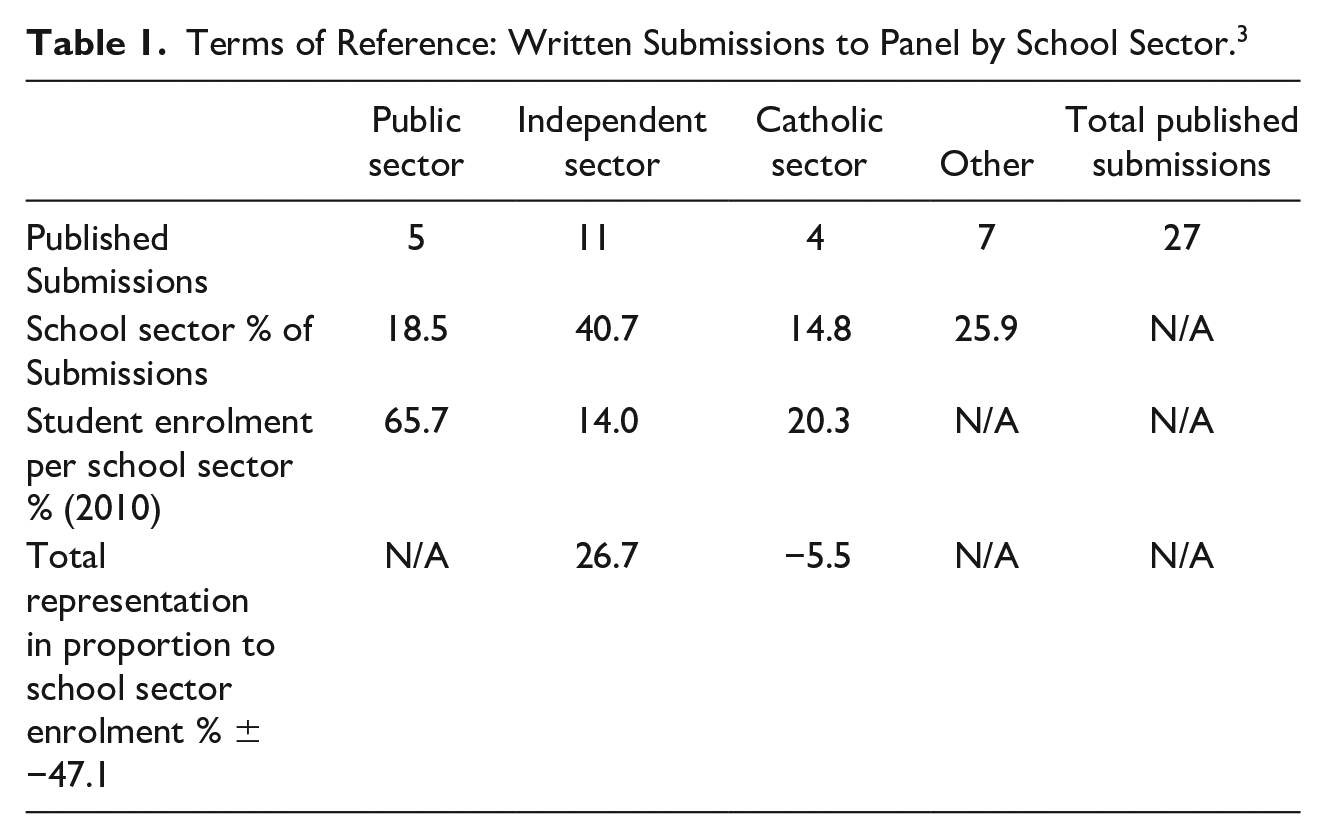
The publication and non-publication of the submissions in response to the draft Terms reflect Bowe, Ball, and Gold’s (2017) assertion that, in the Context of Text Production, “Most of these struggles go on behind closed doors but occasional glimpses of the dynamics of conflict are possible” and that “what is at stake” via framing devices like the Terms “are attempts to control the meaning of policy through its representation” (p. 21).
At the same time, we see the disproportional representation of school sectors in the Terms submissions process as reflecting broader trends in social stratification across school sectors and their enrollments discussed earlier. Collins (1971) argues that dominant social status groups hold economic, political, and symbolic power, and their success depends on using their social and cultural capital in strategic ways. Collins’ work helps us explain the disproportional representation of the Independent school sector in contributing to the public submissions process for the Terms.
The final Terms were given to the panel on 9 July 2010 and provided a vantage point from which the panel would have to view the purposes of both education and school funding. The Terms contained four subgroups: Supporting Education Outcomes; Allocation of Funding; Funding Mechanisms; and Accountability and Regulation. Taken together, they tasked the panel with reviewing school funding arrangements in Australia (Australian Government, 2011, p. 225-226), requiring them to: provide recommendations to the Minister with responsibility for school education on the future funding arrangements for schooling to move Australia towards achieving a funding system for the period beyond 2013 which is transparent, fair, financially sustainable, and effective in promoting excellent educational outcomes for all Australian students. (p. 225)
The Terms were another example of the federal government seeking to constrain the possible field of action for the Review and its panelists’ work. Both in the final report and public comments after it was released, the Review’s panel members provided evidence to support this claim, making clear the influence of the Terms on their work. For example, in his letter to the Minister upon sending the Review panel’s final report, Chair, David Gonski, highlighted that: The panel has been conscious of delivering a comprehensive response to our Terms that would allow you and the Australian Government time to consider the changes you wish to make for funding arrangements for schooling in Australia for the period beyond 2013. (p. xi)
And in the Executive Summary: “For the purpose of this report and to adhere to the Terms, the panel has focused on funding for schooling and its impact on outcomes as they are currently measured by governments both nationally and internationally” (p. xiii).
Elsewhere, in their final report, the Review panel went out of their way to acknowledge the limits of their brief: The panel accepts that resources alone will not be sufficient to fully address Australia’s schooling challenges and achieve a high-quality, internationally respected schooling system. The new funding arrangements must be accompanied by continued and renewed efforts to strengthen and reform Australia’s schooling system. (p. xix)
The final Terms were published in Appendix A of the Review’s final report (Australian Government, 2011, p. 244-245) and the first of the four subgroups was titled: “Supporting Educational Outcomes” and had two sections. The first section focused on: The role of funding arrangements in supporting improved educational outcomes, including: a) links between school resourcing and educational outcomes; and b) funding allocation mechanisms that address current barriers to educational achievement such as English language proficiency, Indigeneity, location, disability, and special needs, and other disadvantaged groups such as low socioeconomic areas and other concentrations of disadvantage. (p. 225)
The instruction for the panel to view funding through the prism of “improved education outcomes” set down the foundations for the Review process. These instructions had important implications for the development of its policy cycle because the panel had to respond to a set of questions implicit in framing the Terms. For instance, with “improving education outcomes” being the focus: how would education outcomes (outputs) be measured, and who should be trusted to measure them? What does improvement in education outcomes look like? Who decides? How are Australian students currently performing? Which benchmarks are to be used to judge this? The fact that the panel would go on to rely on standardized global and national measurements of education performance to respond to these implicit questions is unsurprising.
Elsewhere, the focus on the “links between school resourcing and educational outcomes” echoes Easton’s (1953) definition of policy as the “authoritative allocation of values” (p. 1) as there are a variety of ways funding can be channeled for schools. This linkage is significant because it is based on the theory of outcome-based education (OBE), which sets each part of an educational system around the attainment of a goal (Morcke et al., 2013). Put another way, rather than analyzing processes and inputs, the focus is on the final result: working back from the outcome. Peer-reviewed research shows that leaders of education systems worldwide are increasingly following this theory, prioritizing their students’ education outcomes, particularly their performance in standardized tests (Rizvi & Lingard, 2010; Savage, 2020; Spring, 2014).
So much so, equity in schooling in the PISA is measured in terms of the correlation between student background and their performance on standardized tests (OECD, 2023). Despite the well identified weaknesses in standardized testing and comparing national education systems that are framed by different cultural, linguistic, and economic contexts (Kohn, 2000; Rzivi & Lingard, 2010), it is little surprise that the Australian federal government framed the Terms in a way that sought to shift the school funding model in Australia from a focus on providing inputs to a focus on instrumentalizing school funding to produce specific education outcomes.
Next, the Terms linked funding and “barriers to education achievement” for individual students by identifying five subgroups of disadvantage: “as English language proficiency, Indigeneity, location, disability, and special needs, and other disadvantaged groups such as low socioeconomic areas and other concentrations of disadvantage” (Australian Government, 2011, p. 225). By framing the Terms in this way, it left the panel with few alternatives as to how they could define equity in schooling given the established focus on education outcomes previously and the explicit emphasis on five equity groups in Australian society.
Also, by explicitly linking achievement/outcomes and funding to the background of students, the Terms mirrored the arguments of policymakers advocating for neoliberal school reform (Dumas, 2016; Freidus & Ewing, 2022; Piazza, 2017). The rationale for this reform approach is that a focus on education outcomes can highlight pockets of underachievement, thereby allowing for the targeting of resources to ameliorate disadvantages and providing explicit strategies to improve performance in those areas—rather than system-wide and or structural reform. This approach to identifying education disadvantages relies on education performance measures of school systems like PISA that focus on students’ backgrounds and their correlation to education performance (Rizvi & Lingard, 2010). The Terms focus on five categories of disadvantage and linking them to achievement (outcomes) captured and put into motion public policy trends already at work in the Australian federation (Savage, 2020).
The second section of the “Supporting Educational Outcomes” subgroup of the Terms instructed the panel to focus on “The roles of families, parents, communities, and other institutions in providing or supporting educational partnerships with schools.” (Australian Government, 2011, p. 225). This direction provided the scope for the Review Panel to consider the broader impacts on education outcomes and wider challenges facing Australian schools, teachers, and students. Subsequently, they conducted an Australia-wide consultation process that included stakeholders across industries and school sectors.
The Terms next subgroup was the “Allocation of Funding” which included two sections. The first was: “The roles of the Australian and state and territory governments in providing funding for schooling” (p. 225) involved the panel examining the school funding arrangements and funding contributions from the different levels of government in Australia. This focus allowed the panel the opportunity to address Reid’s (2009) and Savage’s (2020) point that at the time, there was wide criticism of the then school funding arrangements, particularly the roles of the federal and state governments in funding schools.
The second section called for a focus on: The baseline level and allocation of funding for schools, including:
(a) costs of ensuring all students have access to a world-class education;
(b) factors influencing growth in costs and whether current indexation arrangements are appropriate
(c) supply and demand considerations including the likely growth and distribution of demand and student need, based on current student enrolment trends and projections;
(d) cost drivers of school funding, including teaching, capital, technology, and other costs of schooling;
(e) place of voluntary and Independent contributions and other income sources in school funding arrangements for government and non-government schools; and
(f) role of government funding in providing parents with choice among diverse schools (p. 225)
We focus specifically on points a, e, and f, given that the remaining points are, for the most part, concerned with the mechanics of school funding calculations, which is beyond the scope of this article.
The focus on the “(a) costs of ensuring all students have access to a world-class education” was a powerful framing mechanism because it required the panel to situate Australia’s funding arrangements in line with global developments: what Rizvi and Lingard (2010) call the ongoing “globalizing of education policy.” When linked with the focus on education outcomes, the aim of “ensuring all students have access to a world-class education” left the panel few choices other than to rely on global education testing organizations to assess what this system might look like and by what standard—of education outcomes—a world-class education might be measured.
In this way, the Terms constructed a review that emphasized the importance of adapting Australian schooling to globalization (Brooks & Normore, 2010); gave the panel little choice but to rely on the OECD and other global organizations as arbiters of education quality (Spring, 2014), and positioned a national approach to education policy as a way to ensure Australia’s future citizens are competitive in global economic markets (Savage, 2020).
Similarly, “(e) place of voluntary and Independent contributions and other income sources in school funding arrangements for government and non-government schools” and “(f) role of government funding in providing parents with choice among diverse schools” combined to limit how the panel could approach equity in Australian schooling. In combination, these focus areas confirm school choice as a key feature of the Australian education system, which Hogan and Thompson (2020) and Windle (2014) argue has been front and center of the nation’s school funding policy for decades. Elsewhere, O’Brien et al. (2023) provide evidence to suggest it has been a primary driver of inequity in the Australian education system. Despite this, point (f) framed the non-government sector neutrally when it could have instead prompted the panel to explore its role in widening the equity in schooling divide and consider what could be done to address this (Eacott, 2024; Hogan & Thompson, 2019). This subtle concession to the non-government school sector left the panel with few options regarding sector-specific recommendations and justified them not doing so.
Next was “Funding Mechanisms,” it was the third of the Terms four subgroups. It focused on: The most effective means of distributing funding for schooling, including:
(a) the different funding models used in states and territories and relevant overseas examples, especially in high-performing school systems, and how these may link to outcomes in their respective education systems;
(b) the best funding mechanism(s) for delivering optimal educational outcomes, financial efficiency and sustainability, including whether a basic entitlement for every student is required and how this could be defined and determined;
(c) ways to increase the simplicity, transparency and effectiveness of school funding arrangements, including the forms of school- and system-level autonomy within those arrangements that best support improved educational outcomes; and
(d) the transitional assistance that should be offered to schools in making the transition to any new system. (p. 226)
The instruction for the panel to consider the funding models of “high performing school systems” both within Australia and overseas and how these may link to outcomes meant there were again few options the panel could draw on as reference points for assessing the outcomes of overseas school systems—outside of the OECD via its PISA test and analogous tests like Trends in International Mathematics and Science Study (TIMSS) and Progress in International Reading Literacy Study (PIRLS).
Further, the requirement that the panel focus explicitly on the link between funding and “delivering optimal education outcomes, financial efficiency, and sustainability” and the requirement to consider how such a model might look, added to the previous instruction to focus on providing a “world-class education” for each student. This set “material constraints and possibilities” (Bowe et al., 2017, p. 21) for the panel on how “optimal education outcomes” might be measured, compared, and improved moving forward in the Australian education system. Also, the requirement for the panel to focus on “financial efficiency” supports Cochran-Smith’s (2020) point that neoliberal tenets are now framing public policy areas like education previously considered outside of the reach of economics.
At the same time, across the “Funding Mechanisms” subgroup, the language of finance is put to work in a way that mirrors Savage’s (2022) argument that neoliberal based “economic and market-based ways of thinking about and doing education” (p. 1) are increasingly “natural to many” (p .1). For instance, point (b) links with (c) to focus on reforming school funding arrangements in ways that “increase the simplicity, transparency, and effectiveness of school funding arrangements” that “best support improved educational outcomes” (p. 226). The words “transparency” and “effectiveness,” in our view, function as synonyms for accountability and performance in this context and illuminate how neoliberal reform has reimagined school funding from an increasingly economic, rather than a mostly social, point of view (Giroux, 2010; McLaren, 2005; Spring, 2019.
The Terms’ fourth and final subgroup was titled “Accountability and Regulation.” It stated that the panel should consider: What forms of accountability, transparency and regulation are necessary to promote high standards of delivery and probity among schools receiving public funding, and the data required to monitor and assess these standards of delivery and educational outcomes. (p. 226)
The recurring theme of education outcomes being the lens through which any recommendations were to be filtered by the Review panel is again present as was the language of business this time in the form of accountability and transparency. There is also the encouragement of competition through the promotion of “high standards” and the call for accountability through data collection and surveillance, which we see as another example of neoliberal tenets that encourage citizens to compete and view education in largely economic and financialized terms (Argent et al., 2022; Brown, 2019; Hall & O’Shea, 2013; Savage, 2022).
Implications of the Terms of Reference for Equity
Overall, we argue the Terms were constructed in a way that meant there were “material constraints” (Bowe et al., 2017, p .21) placed on the Review’s panel concerning how it could address what Bulkley (2013) considers the politically fraught topic of equity. In practice, this meant it had little scope to change the status quo. Indeed, our analysis has shown that the Review’s final Terms were in large part the result of a series of critical moments that ensured the panel focused on certain things and enabled certain actions, while simultaneously omitting, constraining or obscuring others. All of which impacted the equity trajectory of the Review in historically significant ways.
First, the “no school would lose a dollar” promise was an example of what Diem et al. (2014) would call the process by which the winners and losers of a policy are decided. The upshot of this was that the non-government sector’s funding levels would, at a minimum, remain intact, rendering them clear winners. In this case, the loser was the disadvantaged elements of the public school sector because less money was now available to address the challenges faced by these schools on multiple fronts identified by Argy (2007), further entrenching education disadvantage.
Second, by framing school funding as primarily concerned with improving education outcomes, the Terms limited the possibilities and scope of the panel’s work. These included the limitation of the voices the panel could take into consideration and those they would either have to ignore or give symbolic acknowledgment to during the consultation process. In addition to the reforms the panel could and could not consider, and how the panel in their final report may position the contested notion of equity in schooling.
Third, the way the Terms were framed ensured it was also a policy mechanism by which to drive particular federal governmental agendas in the domain of schooling. For instance, improving Australia’s ranking in global education tests like PISA, and instrumentalizing the funding of schools to progress neoliberal tenets of human capital production and economic growth and productivity in the Australian economy through lifting student outcomes.
In sum, the Terms enabled all of the above while, at the same time, being positioned by Gillard (2010a) and colleagues as pursuing a fairer and more equitable school funding model for Australia. In combination, these three implications demonstrated the importance of the Terms in influencing the direction of the Review’s policy cycle. Put a different way, a different set of Terms, written, for instance, by public school principals working in less advantaged schools or the Independent school sector representatives from elite schools, would have likely resulted in a different set of Review aims and therefore policy processes, recommendations, and framing of equity in schooling. As we have argued so far, the Terms of Reference constrained the Review panel’s work in key ways. The next section discusses how they shaped the Review panel’s definition and then operationalization of equity.
The Review’s Conceptualization of Equity in Schooling: What’s in a Definition?
The Review’s panel conducted an extensive public submission and consultation process in which they acknowledged multiple perspectives on equity were put forward (Australian Government, 2011). However, at least in terms of how equity could be defined in the final report, our analysis in this paper suggests these equity discussions were symbolic at best, and perhaps detrimental to producing an equitable policy outcome given the power and resource differences between participants as well as their vested interests. In the end, the Review panel foregrounded their equity in schooling definition on page 136 of the final report.
They defined equity in schooling as: “ensuring that differences in educational outcomes are not the result of differences in wealth, incomes, power, or possessions” (Australian Government, 2011, p. 136), aligning with key elements of the Terms analyzed earlier. In view of this, it was little surprise the definition the Review panel settled on—despite the authors’ attempts throughout to create distance from an equity as outcomes perspective and acknowledge the wider social and economic influences on and purposes of schooling—was a narrow outcomes-based equity in schooling conceptualization (Gerrard et al., 2017).
However, this definition was not just symbolic, as has been argued elsewhere, it would go on to underpin the key recommendation of the final report for a new funding model: the School Resource Standard (Sinclair, 2022). This new funding model comprised a minimum per-student resource standard with added loadings for groups of students whose education outcomes suggest they have higher needs, and neatly fitted within the narrow scope of the Terms. In our view, with a different set of Terms, the Review recommends a different school funding model.
Critical Moments in a Policy’s Cycle
The Context of Political Strategy is the final of the five analytical frames of the policy cycle heuristic (Piazza, 2017). Its purpose is to propose strategies to improve future practice and ameliorate inequalities in and across the policy cycle; such as a lack of access to resources, representation, opportunities, and so on (Ball, 1994; Vidovich, 2007). Given the purposes of this paper, we sought to draw out insights from our analysis that could influence policymaking toward more equitable processes and outcomes in the future (Brooks & Normore, 2010; Cohen-Vogel, 2005; Diem et al., 2019). These aims provided the impetus for the key contribution of this paper, which is our theorizing of the notion of a critical moment in the Context of Text Production of the policy cycle. So what renders a moment “critical”?
We argue it is its capacity to shape the trajectory of the policy process either toward or away from equity in historically significant ways. We define a critical moment as a specific point, or set of points, and/or an event, or a set of events, that significantly impacted the development and construction of the policy cycle in a way that affected its equity trajectory and outcomes. In this way, a critical moment represents a juncture that may include one or more of the following: where possibilities and constraints are established for equity, important strategic and political decisions are made, key stakeholders are engaged [or not], and the direction of a policy cycle concerning equity are determined.
In framing the notion of a critical moment, it is important to clarify how our theorizing both builds, and simultaneously differs from the concept of the path of dependency. Mawhinney (2013) illustrates how the concept of a path of dependency emerged several decades ago from the theoretically informed investigation of historical institutionalist accounts of policy change. The theory of the path of dependency focuses on how policy changes occur by considering how events in a policymaking process are connected. Kay (2003) points out that a process is considered path-dependent if initial moves in one direction produce further moves in that same direction. In other words, the order in which things happen affects how they play out—they are self-reinforcing; the trajectory of change up to a certain point constrains the trajectory after that point. For Kay, path dependency is a process that constrains future choice sets. He cites North (1990, p. 98–9), At every step along the way there are choices—political and economic—that provide. . .real alternatives. Path dependence is a way to narrow conceptually the choice set and link decision-making through time. It is not a story of inevitability in which the past neatly predicts the future.
The reference to North by Kay (2003) on “choice sets” and “decision making” reminds us of the origins of the path of dependency in economics. It is here that our theorizing of a critical moment for equity departs from the theory of the path of dependency. Our theorizing draws from critical education policy studies (Diem et al., 2014) given its concern for improving equity in education policy. While the path of dependency emphasizes the influence of historical decisions, institutional inertia, and policy legacies on the current trajectory of public policies, our critical moment theory highlights specific points or events within the policy process that have a significant impact on the direction and outcomes of policies in relation to equity goals and outcomes specifically. The former is broad and explanatory and as Ostrom (2019, pp. 39–41) points out: it does not provide a general list of variables. In contrast, our theorizing of a critical moment is equity and futures focused, specific in its identification of variables (moments), and concerned with the past as a way to influence the here and now as well as the future. Our first critical moment focuses on the Terms of Reference for a policy process.
Critical Moment One: the framing of the Terms of Reference for a policy process
The analysis presented in this paper suggests policymakers use the Terms of Reference to open possibilities and set limits and constraints on a policy’s cycle. These can be both positive and negative for equity, and come in the form of both written and verbal framing devices. The former is binding while the latter is non-binding. We argue the written contents of the Terms are critical because they frame the policy cycle in certain ways and may predetermine the outcome or at a minimum constrain the possibilities of the policy process before it officially even begins. Indeed, this is fundamental purpose of putting together a Terms of Reference. Thus, they provide insight into the purpose of the policy process and the extent to which it can initiate substantive change. Is the policy process symbolic, or does it have the scope to reform policy and improve equity? Similarly, what possibilities do the Terms open and or close for equity? Do they predetermine the equity outcomes of a policy process? What are the dominant discourses framing them? Which discourses are excluded? These are important questions to ask of any Terms of Reference. It is also worth noting that, often, but not always, a draft set of the Terms may be open for public comment before they are finalized—this was the case for the Review—allowing the opportunity to influence them toward improved equity in schooling.
The verbal constraints on the Terms we argue are less important because anything outside of the written terms such as spoken promises or directions by politicians or statements making specific claims about what the policy process will do or not do are non-binding. In other words, the panel conducting the process is not officially required to follow them. For example, in the Review case, the panel could have developed a funding model that best estimated the needs of each school and school sector. They should have left it to the federal government to ensure that its promise that “no school would lose a dollar” in the way the model was implemented (as it subsequently did with the Schooling Resource Standard or SRS model). Instead, the Review panel designed their funding model to try to arrive at an estimate that would mean no school or school system would “need” less than their existing funding. This is an important distinction and it represented a defect in the Review of Funding for Schooling (2011) final report.
The fact the panel enacted this verbal promise, that was not written down anywhere, suggests those chosen to conduct policy work, particularly when equity is on the agenda, are crucial for any national review of education policy. In our view, had the Review’s panel been made up of members who were not associated with school sector interests, they may well have ignored this promise and left it to the federal government to sort out post-review. However, while the verbal “no school would lose a dollar” promise was non-binding and had no legal grounding, in practice we acknowledge it had considerable symbolic power. The promise signaled the federal government’s intentions and fears to the panel, while also reflecting broader power dynamics at work in Australian education (Windle, 2014).
Critical Moment Two: Conceptualization and Operationalization of Equity
The way equity is defined and operationalized across a policy cycle is our second critical moment. Echoing Savage (2013), this critical moment encourages both researchers and education stakeholders to ask “which equity” (p. 198) when the concept—or an analogous term like fairness or equality—first appears in discussions and policy given its multiple meanings and political nature. However, we go a step further to argue that researchers and equity-minded stakeholders must examine how equity and similar types of terms and concepts are not only defined but also operationalized in the current policy moment.
Furthermore, when an equity definition, like the one selected by the Review panel, which embodied economic and a narrow definition of equity in schooling that did not capture the full picture of current and past differences and inequities, where possible, it must be challenged. Although it is perhaps blue sky thinking, we suggest that before future policy cycles begin concerning school funding, there should be the convening of committees to establish equity in schooling definitions relevant to the education system’s context, history, and challenges—although we acknowledge that this process in practice would be politically contentious. In the Review case, equity was framed through the narrow lens of outcomes and student background. While the acknowledgment of the latter was positive, the outcomes focus obscured the role of education experiences, and past inequities that continue to have lingering effects, and the importance of the processes that produce education outcomes. In our view, given the limitations of the panel’s equity in schooling definition, the Review’s failure to positively impact Australian students’ equity outcomes was predictable (O’Brien et al., 2023; OECD, 2023; Thomson, 2021).
In summary in this article, we have sought to contribute to the education policy literature the notion that the equity outcomes of the policymaking process are shaped by “critical moments” that are identifiable and open to influence during the Context of Text Production phase of the policy cycle. We have argued that these critical moments shape a policy cycle’s overall equity trajectory, for better or worse, in historically significant ways and are connected to those that precede them.
Looking ahead, our initial exploratory theorizing of a “critical moment” would benefit from equity-minded stakeholders taking proactive measures in real time to shape education policy processes toward equity and then identifying additional critical moments. We hope our initial exploratory theorizing in this paper can influence national school funding policymaking, and possibly education policymaking more broadly, toward greater equity, and continue to provoke further theorizing, dialogue, and analysis.
Footnotes
Declaration of Conflicting Interests
The author(s) declared no potential conflicts of interest with respect to the research, authorship, and/or publication of this article.
Funding
The author(s) received no financial support for the research, authorship, and/or publication of this article.
