



Abstract
Federal policy in the United States has urged high schools to expand offerings in career and technical education (CTE) coursework to address persistent gender inequities in science, technology, engineering, mathematics, and medical (STEMM) fields. Unfortunately, gender composition in engineering and health sciences CTE enrollment is highly imbalanced and reflects postsecondary and labor market trends. Using data from the High School Longitudinal Study of 2009, we use decomposition techniques to examine which student, family, and school factors explain gender-imbalanced enrollment in STEMM-focused CTE courses. The results indicate student occupational expectations were the largest contributor to gender gaps across content areas.
Careers in science, technology, engineering, mathematics, and the medical or health sciences (STEMM) represent approximately one quarter (23%) of the U.S. workforce (Okrent & Burke, 2021). Jobs in these fields have long been regarded as well-paying and stable, with median annual wages more than double those of non-STEMM occupations and unemployment rates at nearly half that of other professions (Bureau of Labor Statistics, 2020; Okrent & Burke, 2021). However, STEMM fields are also highly gender imbalanced. While women represent nearly half (48%) of all American workers, they only represent 27% of those employed in STEMM overall, 25% of those employed in computer-related occupations, and 15% of those in engineering (Martinez & Christnacht, 2021). Conversely, women are overrepresented in STEMM health services occupations, where men instead represent only 25% of workers (Bureau of Labor Statistics, 2021). These wide gaps in gendered participation begin early along students’ educational pathways into STEMM.
From as early as elementary school, girls are less likely to be placed in accelerated math courses (Hemelt & Lenard, 2020), and by high school, girls report lower interest in math and sciences courses and earn substantially fewer credits in STEMM-related fields (Cunningham et al., 2015). These gaps persist into college, through degree attainment, and into the workforce (Cimpian et al., 2020), where girls are most often sorted into predominantly female and lower-paying fields, like medical assisting (Institute for Women’s Policy Research, 2013; Malin et al., 2014) and boys are sorted into higher-paying, more mathematically intensive fields like computer science and engineering (Committee on Equal Opportunities in Science and Engineering, 2013; Toglia, 2013).
To combat this gender sorting, educational policy has focused on ways to prepare female students for workforce participation in STEMM fields before college begins. One noteworthy example is the federal Perkins legislation (i.e., the Carl D. Perkins Strengthening Career and Technical Education for the 21st Century Act, most recently authorized in 2006 as Perkins IV and in 2018 as Perkins V), which governs and provides funding for secondary and postsecondary career and technical education (CTE) programing. High school CTE courses are designed to align career-applicable skills with academically challenging coursework in high school and are of particular interest because of their extensive reach and clear linkages to college and career opportunities (Gottfried et al., 2014; Fluhr et al., 2017; Leu & Arbeit, 2020; Malin et al., 2014). On average, nearly every student takes at least one CTE course before high school graduation, and roughly 25% of students take a concentration of three or more CTE courses in a given career cluster (Arbeit et al., 2017).
As it relates to gender equity in STEMM, the most recent reauthorizations of Perkins (in 2006 and 2018) include two particular calls to action: (1) equalizing access to CTE for underrepresented populations, including females, and (2) increasing STEMM coursetaking through the expansion of STEMM-CTE course offerings (also known as “applied STEM-CTE”). STEMM-CTE courses focus on applying math and science skills in more relevant ways and fall into 3 of the 16 broad CTE clusters: engineering technology, information technology, and health sciences (Bradby & Hudson, 2007). 1 Courses within the STEMM-CTE curriculum provide students with the academic and technical skills necessary for employment in high-skill, high-wage, and high-demand careers in STEMM fields, whether that be with or without a college education (Plasman et al., 2021). In addition to supporting the expansion of STEMM-CTE course offerings, Perkins also requires states to collect data on participation in nontraditional CTE fields, including engineering technology and health sciences, and formulate plans to improve participation rates. 2 In these ways, CTE coursework was conceptualized as one mechanism to reduce gender-based segregation in STEMM occupations (Fluhr et al., 2017). Yet, while access to STEMM-CTE coursework has been linked to a variety of positive outcomes across the educational and workforce pipeline (Gottfried & Plasman, 2018; Gottfried et al., 2021; Dougherty & Lombardi, 2016), enrollment in STEMM-CTE remains just as gendered (Fluhr et al., 2017; Hamilton et al., 2015), meaning high school CTE courses could actually exacerbate—rather than reduce—existing gender gaps in related STEMM occupations.
A diverse body of prior work has extensively documented gendered STEMM-CTE coursetaking patterns (Bottia et al., 2018; Leu & Arbeit, 2020), yet none have specifically interrogated why a gender gap itself persists in high school STEMM-CTE coursetaking or identified what student, parent, or school factors may explain why these gender gaps exist (and vary) across STEMM-CTE domains. Additionally, much of the extant literature exploring gender gaps in high school STEMM and STEMM-CTE coursetaking fails to consider that these imbalances apply to both genders (Lufkin et al., 2007; Malin et al., 2014; Sikora, 2019) and that a lack of educational opportunities in nontraditional STEMM fields affects both male and female students. To respond to these gaps in the literature, the aim of our study is to interrogate contributors to gender gaps in STEMM-CTE enrollment across two of the most gendered course clusters in these applied science fields: Engineering Technology (engineering-CTE) and Health Sciences (health-CTE). 3 Drawing upon previously developed frameworks exploring gender equity in CTE (Lufkin et al., 2007) and STEMM coursetaking more broadly (Raabe et al., 2019), we examine a theoretically-informed set of student, family, and school factors. Specifically, we ask the following research questions:
How do student, family, and school characteristics relate to participation in engineering-CTE and health-CTE for male and female students in high school?
Which of these factors best explain the gender gaps in engineering-CTE and health-CTE participation in high school?
Methodologically, we answer these questions by analyzing a nationally representative sample of high school students, as sourced from the High School Longitudinal Study of 2009 (HSLS:2009). Leveraging an extension of the Kitagawa-Blinder-Oaxaca decomposition method, we explore the contribution of student, family, and school factors to the gender gaps in STEMM-CTE coursetaking. In doing so, we not only contribute to the growing work on high school coursetaking in the applied sciences but also quantify and document why gender disparities persist in engineering-CTE and health-CTE fields. Such information is critical, as these gaps contribute to existing gender disparities in national STEMM workforce participation despite existing federal and state policies targeted directly at improving gender equality.
In what follows, we provide a deeper discussion of the STEMM-CTE landscape and include a review of student, family, and school factors that have been conceptually and empirically linked to students’ gendered course enrollment patterns in STEMM and CTE. We then discuss the sample, data, and methods that facilitate our decomposition analysis and present our results with a specific focus on overall predictors of engineering-CTE and health-CTE coursetaking and features that help explain observed gender gaps in these domains. We conclude with a discussion of these findings and their implications for policy, practice, and future research.
High School STEMM-CTE Coursework
There are two distinct strands of courses in the STEMM high school curriculum: academic and CTE. While traditional, academic STEMM courses (i.e., algebra and biology) are typically taught from a theoretical approach that stresses procedures, observation, and computation (Gottfried et al., 2014), STEMM-CTE courses emphasize the application of math and science concepts in more practically-relevant ways. These courses incorporate quantitative reasoning, logic, and problem-solving skills and underscore how traditional math and science concepts directly relate to college and career opportunities in STEMM fields. As previously described, our study focuses on participation in the two most gendered clusters in the applied science fields: engineering-CTE and health-CTE. Examples of engineering-CTE courses include surveying, drafting fundamentals, electrical engineering, and computer-assisted design and drafting. Health-CTE courses include dental science, health assisting, phlebotomy, and physical therapy.
A host of prior research has established a clear link between CTE coursetaking and a wide range of outcomes, including high school achievement, improved odds of graduation, higher probabilities of enrolling in college, and higher wages (e.g., Plasman et al., 2019; Bishop & Mane, 2004; Bonilla, 2020; Bozick & Dalton, 2013; Kemple & Willner, 2008; Stone et al., 2008; Theobald et al., 2019). Concerning the role of STEMM-CTE courses, existing research suggests strong links to numerous outcomes along the STEMM pipeline, including advanced traditional STEMM coursetaking in high school, selecting a STEMM major in college, and ultimately picking a STEMM-based career (Gottfried, 2015; Plasman et al., 2019; Lee & Burkam, 2003; Sublett & Plasman, 2018). As it relates to gender, Gottfried (2015) found that females who take more STEMM-CTE courses have greater odds of taking advanced mathematics and science courses when compared to male students. These findings suggest that STEMM-CTE coursetaking in high school may be especially important for females, who have been shown to perceive many STEMM fields as lacking real-life applications (Baker & Leary, 1995; Sax, 1994, 2001).
Given the sustained efforts of Perkins to promote gender equity in STEMM-CTE, it would be logical to expect greater gender integration in historically segregated STEMM fields in the form of increased nontraditional participation (Fluhr et al., 2017). However, despite such reform efforts, gendered participation in STEMM-CTE remains pervasive and reflects labor market trends (Fluhr et al., 2017). Studies using national and state-specific CTE enrollment data have found that female students continue to be overrepresented in health-CTE, while male students are overrepresented in engineering-CTE (Dougherty, 2016; Fluhr et al., 2017; Hamilton et al., 2015). Given that STEMM-CTE courses have the potential to be a vital tool in the gender-based desegregation along the STEMM pipeline (Fluhr et al., 2017), it is essential to examine why gender gaps in STEMM-CTE course clusters continue to persist.
Predictors of Gender Gaps in STEMM-CTE Coursetaking
For our decomposition analysis to effectively attribute gender differences in STEMM-CTE coursetaking to observable student, family, and school factors, the model must be well specified with independent variables of importance and a rich set of controls (Bielby et al., 2014). To identify these predictors, we draw from Lufkin et al.’s (2007) framework on gender equity in CTE and Raabe et al.’s (2019) Social Pipeline perspective on preparation for STEMM fields more broadly. Lufkin et al. (2007) explored a host of contributors to gender gaps in CTE for women in traditionally-male dominated fields and for males in traditionally-female dominated ones. Among others, the authors found that important predictors of students’ entry into nontraditional subjects for their gender included students’ attitudes and stereotypes, school and classroom climates, and student self-efficacy.
Beyond individual student and school features, Raabe et al. (2019) argued that students’ perceptions and decisions about coursetaking and career entry more broadly are informed by a dynamic network of individual factors, socially defined gender roles, peer influence and exposure, and occupational segregation. Beyond girls and boys not seeing themselves reflected in their CTE and STEMM instructors in those “nontraditional” fields (Healy, 2019), the authors posited that students’ own gender, socioeconomic status, parental education and occupation, individual career plans and perceptions, and self-efficacy combine to play important roles in understanding decisions to enroll in STEMM coursework and pursue STEMM careers.
By connecting these related frameworks on gendered CTE coursetaking and STEMM enrollment more broadly to other prior works, we identified that gender gaps in engineering-CTE and health-CTE enrollment can be attributed to features within four discrete categories, including socio-demographic measures, family characteristics, academic history and attitudes, and school characteristics.
Socio-Demographic Measures
Prior works have shown that student-level socio-demographic characteristics, including race/ethnicity, English language classification, and disability status, are not only related to students’ CTE coursetaking (Plasman et al., 2017; Callahan et al., 2010; Kanno & Kangas, 2014; Laird et al., 2009; Tyson et al., 2007) but each may also conceptually contribute to gender gaps in engineering-CTE and health-CTE enrollment. Some theorists posit that beliefs about gendered abilities are not homogenous across different cultures and communities (Riegle-Crumb & Peng, 2021), and previous studies have found that gender stereotypes about STEMM abilities and beliefs regarding the masculinity of certain STEMM fields manifests differently across different cultural, racial, and ethnic groups (Denner et al., 2018; O’Brien et al., 2015; Purdie-Vaughns & Eibach, 2008). For example, some studies have found that for black students, early gender-role socialization is often less stereotypical, and the identification of STEMM fields as masculine is less common among black female students than their white peers (Ghavami & Peplau, 2013; O’Brien et al., 2015). That said, research on Latinx youth suggests that traditional gender stereotypes regarding math and science abilities may be strongly endorsed among Latinx communities (Denner et al., 2018), which may influence nontraditional STEMM-CTE coursetaking in high school.
Family Characteristics
Research suggests that children as young as 6 years old begin to eliminate career choices because of their gender, and such beliefs are often the result of family characteristics including socioeconomic status, parents’ occupation and education level, and parental expectations for postsecondary education (Domenico & Jones, 2007). Such factors have also been linked to CTE coursetaking and can further help explain gender gaps in our setting (Clark & Pearson, 1986; Grandy, 1998; Wang, 2013). Indeed, prior works have underscored the importance of parental college and career expectations on students’ STEMM enrollment (Anaya et al., 2022). Beyond this, gendered beliefs about STEMM may vary across social classes (Riegle-Crumb & Peng, 2021). For example, studies have found that individuals from higher socioeconomic families may be more inclined to reject traditional gendered stereotypes when compared to individuals from lower socioeconomic backgrounds (Davis & Greenstein, 2009; Kulik, 2002; Marks et al., 2009). However, some research suggests the opposite pattern, namely that higher-socioeconomic status families are more likely to encourage their children to engage in highly gendered activities in school (Lubienski et al., 2013), which may influence students’ beliefs and enrollment in nontraditional STEMM fields.
Academic History and Attitudes
In addition to connecting students’ prior academic performance to subsequent coursetaking and achievement in STEMM (Anaya et al., 2022; Plasman et al., 2017; Clewell & Campbell, 2002; Maltese & Tai, 2011; Pajares & Miller, 1994), prior works have also strongly identified gendered beliefs in self-efficacy and occupational expectations and connected these differences to students’ subsequent achievement and persistence in STEMM fields (Riegle-Crumb & Peng, 2021). Although male and female high school students tend to exhibit similar levels of academic performance in STEMM subjects, it has been well established that female students report lower levels of science and math self-efficacy (Correll, 2001; Wilkins, 2004). Such discrepancies restrain the number of females entering mathematically intensive fields (Correll, 2001; Law, 2018; Riegle-Crumb & Peng, 2021), and have been known to perpetuate gender inequities in STEMM-CTE coursetaking (Lufkin et al., 2007).
Previous literature has also documented that teenage occupational expectations are a powerful predictor of educational attainment and occupational outcomes (Beal & Crockett, 2010; Law, 2018), and aspirations to work in STEMM fields are powerful predictors of major selection in STEMM fields for both males and females (Morgan et al., 2013). That said, previous research utilizing decomposition techniques has found that teenage occupational expectations are the largest contributor to gender gaps in science coursetaking among high school seniors (Sikora, 2019), the selection of mathematically intensive STEMM majors in college (Legewie & DiPrete, 2014; Morgan et al., 2013; Sassler et al., 2017; Sikora, 2019), and transitions into STEMM occupations (Sassler et al., 2017). Such findings illustrate that occupational expectations not only contribute to gender differences in STEMM fields at the postsecondary and career levels, but that they also influence student decision-making and coursetaking in high school.
School Characteristics
High school characteristics, including school type, demographic characteristics of the student body, region, and urbanicity, have been known to influence student participation in CTE programing (Arbeit et al., 2017; Dougherty et al., 2019; Gottfried et al., 2021; Dougherty, 2016; Erickson et al., 2008; Lufkin et al., 2007). For example, students attending rural high schools are more likely to pursue CTE-related programs of study than students attending non-rural high schools (Lent et al., 1994), however, there are often differences between rural and non-rural students in respect to which specific field of CTE they choose to study (Erickson et al., 2008). A recent study exploring national trends in high school CTE participation found that while students attending rural schools were more likely to earn credits in agricultural CTE courses, they were less likely that suburban students to earn STEMM-CTE credits (Arbeit et al., 2017). Additionally, participation in math, science, and technology courses has been attributed to a number of high school characteristics, including school climate, the availability of resources, and current teaching practices for math and science (Clewell & Campbell, 2002). A host of prior works have not only linked these school characteristics to differences in academic STEMM coursetaking (Bottia et al., 2018; Carbonaro & Covay, 2010; Fowler & Walberg, 1991; Kelly, 2009; Monk & Haller, 1993; Schiller & Muller, 2003; Schneider et al., 1997; Teitelbaum, 2003) but also to gendered participation in CTE. For example, Lufkin et al. (2007) theorized that characteristics of the school climate, including discrimination and bullying, may be driving gender inequities within nontraditional CTE coursetaking.
In all, prior evidence suggests a combination of student, family, and school factors relate to students’ CTE course enrollment behaviors and help explain differences in coursetaking by gender. This underscores the need for analyses to holistically consider how each individually and collectively contributes to these persistent gaps (Gentry et al., 2007). While many of these prior studies have additionally identified students’ gender as a predictor of enrollment and persistence in STEMM-CTE coursework, none have specifically examined what explains the gender gap itself. That is, none have sought to identify what student, family, or school factors may explain why these gender gaps exist (and vary) across different STEMM-CTE domains. 4 Our study leverages these prior works as predictors of engineering-CTE and health-CTE coursetaking and then specifically examines how differences in coursetaking between male and female students are attributable to these student, family, and school factors.
Method
Data and Sample
Our decomposition analysis of gender gaps in engineering-CTE and health-CTE enrollment in high school relies on data from HSLS:09. This dataset follows a national cohort of ninth-grade students in more than 900 public and private schools through high school and into college, capturing a rich host of student and school measures. We relied on data from the baseline year when ninth-grade students, parents, teachers, school administrators, and school counselors were surveyed. Over the course of the 2013 to 14 school year, HSLS collected transcript data when the majority of these students had completed high school. Transcripts were available for approximately 87% of the students who participated in the original baseline year sample in 2009. Importantly, these transcript data include full information on each student’s coursetaking history, allowing us to identify engineering-CTE and health-CTE enrollment patterns for our sample of students.
In this study, our analytic sample is limited to only include students with complete transcript information and is adjusted for survey nonresponse in the baseline year of data collection, representing approximately 16,480 students. We used a high school transcript probability weight provided by NCES to maintain the national representativeness of the sample. This weight was chosen to account for high school transcript nonresponse and survey item nonresponse from the 2009 base year and 2013 to 14 update. In reporting our results, per NCES rules, all sample sizes have been rounded to the nearest 10 to provide disclosure protection for the restricted-use data.
A common limitation of federally administered surveys is missing data related to key variables of interest. It cannot be assumed that these data are missing completely at random, so we employed multiple imputation to address the missing values. Specifically, missing data were imputed in Stata/SE 16.0 using multiple imputation by chained equations (MICE) to impute 20 sets of plausible values for variables that contained missing data for observations with nonzero weights (Royston, 2004). With multiply imputed data, our decomposition analysis—the analytic approach to address our second research question—must be conducted independently on each set of imputed data. The resulting 20 sets of estimates were aggregated to obtain the final estimate of the statistics and their respective standard errors (Little & Rubin, 2002). This is consistent with methods employed in prior work that combines multiple imputation with decomposition analyses (Law, 2018; Redding & Baker, 2019; Sikora, 2019). For more information regarding the distribution of missing values in our sample that were imputed, see Appendix Table 1.
Measures
STEMM-CTE course enrollment
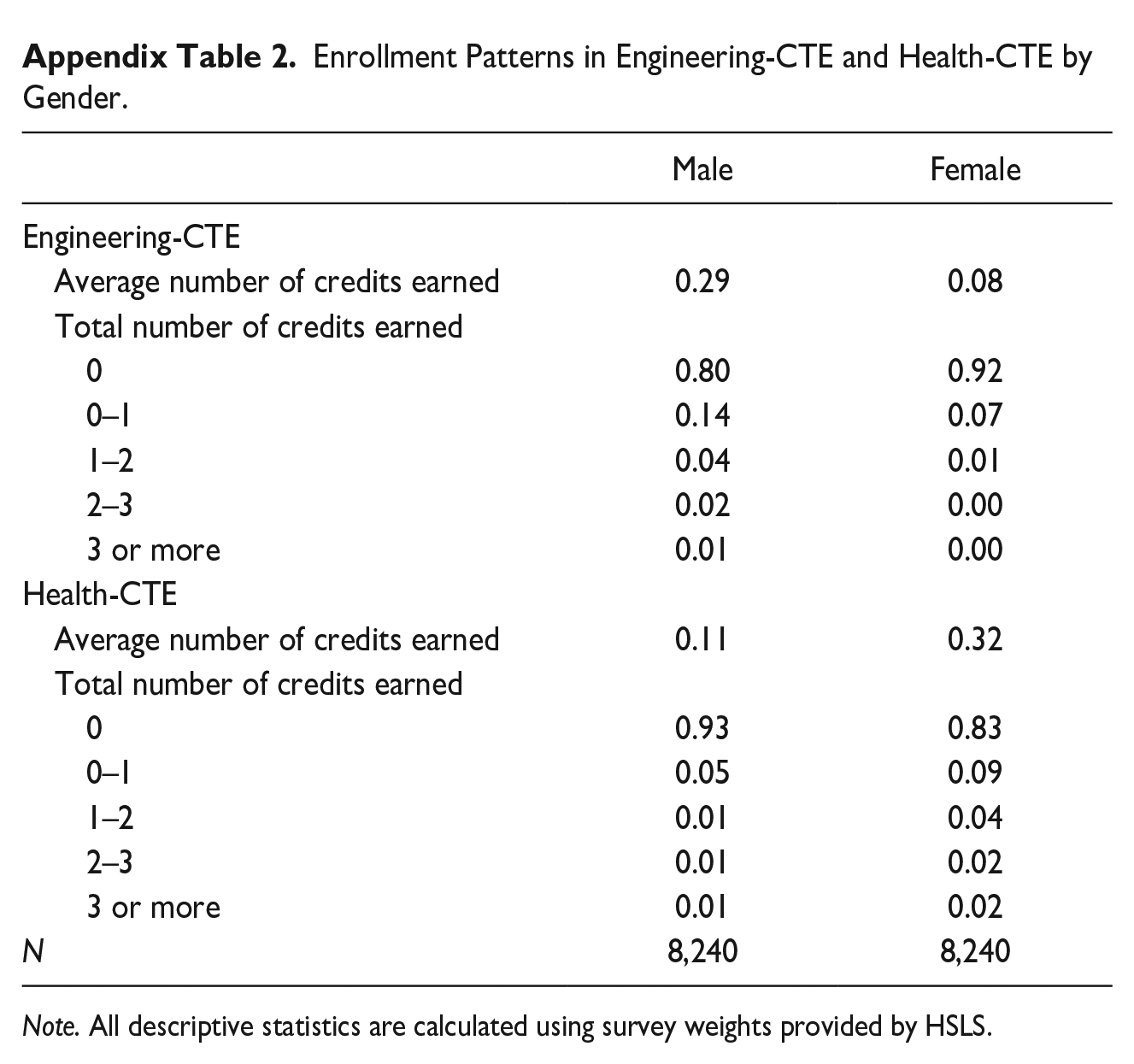
This study focused on two key dependent variables: enrollment in engineering-CTE and health-CTE courses in high school. Using transcript data, we determined which courses students took, how many credits they earned, and the grades earned in each course. HSLS provides standardized codes for every class, allowing us to identify courses that fall into the engineering-CTE and health-CTE categories using the high school CTE taxonomy (Bradby & Hudson, 2007). To quantify engineering-CTE and health-CTE enrollment, we created two binary variables to indicate whether a student had ever earned credit in either category based on their transcript data. If the student ever earned any engineering-CTE or health-CTE credits in high school, they were assigned a value of 1 on the respective indicator variable (either engineering-CTE or health-CTE), and 0 otherwise. For more information regarding engineering-CTE and health-CTE enrollment patterns in our sample, see Appendix Table 2.
Key independent variables
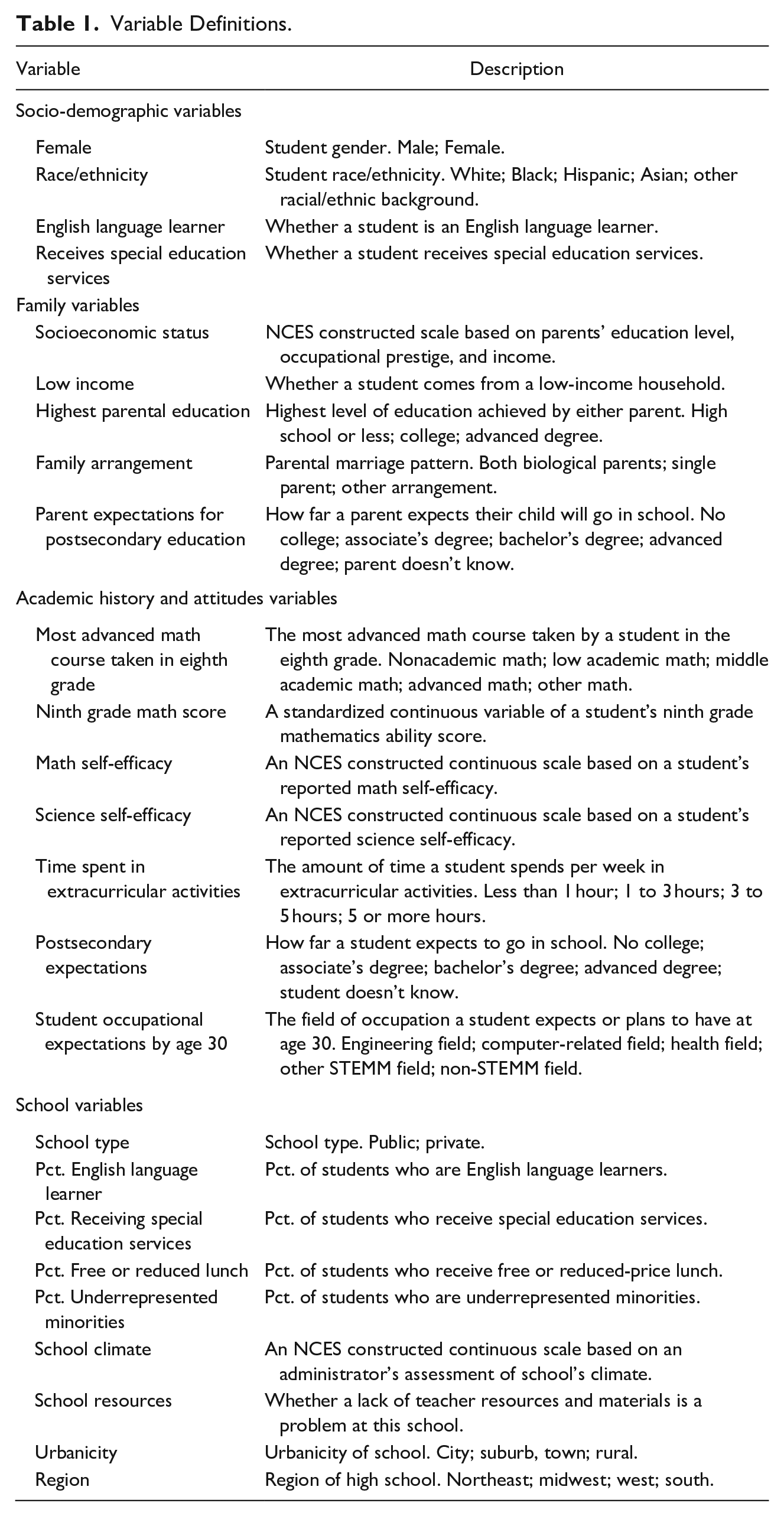
As described above, we identified that gender gaps in engineering-CTE and health-CTE enrollment can be attributed to features within four discrete categories, including socio-demographic measures, family characteristics, academic history and attitudes, and school characteristics. We selected individual variables within these categories by synthesizing prior works exploring individual, family, and school characteristics associated with enrollment in high school CTE and STEMM coursework. A combined list with specific information on each variable can be found in Table 1.
Variable Definitions.
Socio-demographic measures
Our student-level socio-demographic measures include gender, race/ethnicity, English language learner status, and receipt of special education services.
Family characteristics
We observed the following features of students’ families: socioeconomic status, low-income status, highest level of parental education, family arrangement, and parental expectations for postsecondary education. Low-income students are those with family income less than twice the federal poverty threshold, a definition previously used by the National Center for Children in Poverty and the Working Poor Families Project using American Community Survey data (Jiang et al., 2015).
Academic history and attitudes
Students’ past academic performance and individual perceptions about their abilities were captured with indicators for the most advanced math course taken in eighth grade, students’ ninth grade math score, math self-efficacy scale, science self-efficacy scale, reported time spent in extracurricular activities, students’ postsecondary expectations, and students’ occupational expectations (Clewell & Campbell, 2002; Maltese & Tai, 2011; Pajares & Miller, 1994). To classify the most advanced math course taken in eighth grade, we created a series of indicators to group courses into five major subdivisions following the mathematics coursetaking classifications recommended by Burkam and Lee (2003): (1) non-academic courses; (2) low academic courses; (3) middle academic courses; (4) advanced academic courses; and (5) other courses. To classify occupational expectations, we relied on student responses from the baseline year data collection, where students were asked what job or occupation they expected to have by age 30. These responses were coded by HSLS:09 using the 2010 Occupational Information Network - Standard Occupational Classification (O*NET-SOC) 2-digit codes. There was a total of 24 expected occupational fields in the data. To classify these occupations, we created a series of indicators to group occupations into five major subdivisions: (1) engineering fields; (2) health fields; (3) computer-related fields; (4) other STEMM fields; and (5) non-STEMM fields.
School characteristics
We also collected the following characteristics of students’ high schools: school type, percent of students who are classified as English language learners, percent of students who receive special education services, percent of students receiving free and reduced lunch, percent of underrepresented minority students, school climate, school resources, urbanicity, and region.
Analysis Plan
To document gender gaps in engineering-CTE and health-CTE enrollment and the factors related to these gaps, we relied on logistic regression and decomposition analyses. We first examined how our student, family, and school factors were associated with participating in engineering-CTE or health-CTE during high school. We fit the following logistic regression model to data for student i in school j:

where
While the logistic regressions described above allow us to estimate the gender disparities in engineering-CTE and health-CTE course enrollment while controlling for other factors, they do not help identify the extent to which student, family, and school characteristics explain these gender gaps. As such, we conduct a decomposition analysis to evaluate the cumulative role of gender in engineering-CTE and health-CTE enrollment.
The Kitagawa-Blinder-Oaxaca (K-B-O; Blinder, 1973; Kitagawa, 1955; Oaxaca, 1973) decomposition technique decomposes the estimated “gap” in a continuous dependent variable between groups into two portions: the explained variation (i.e., differences in characteristic levels) and unexplained variation (i.e., differences in predicted coefficient values). First, we posit a standard regression model for the ith student in the jth school who belong to group F (i.e., females) or M (i.e., males):

where

where the first portion on the right-hand side of the equation represents the explained variation in the gap (i.e., portion due to differences between males and female in their observable characteristics,
Given the dichotomous nature of our dependent variables, we employed an extension of the of the K-B-O technique for logit and probit models developed by Fairlie (2005) and extended by Sinning et al. (2008). We used the fairlie module in Stata (Jann, 2006) to explain the mean differences in engineering-CTE and health-CTE participation between female and male students in our sample. This decomposition method is becoming increasingly popular in education research and has been used to document gender gaps in access to elite universities (Bielby et al., 2014), racial/ethnic gaps in college major selection (Redding & Baker, 2019), racial gaps in college completion (Flores et al., 2017), and more (Ammermueller, 2007; Polidano et al., 2013; Sanfo & Ogawa, 2021).
This decomposition technique requires equally sized samples of females and males (Fairlie, 2005). As such, a random subsample of males is drawn and matched to the smaller sample of females based on their predicted odds of enrollment in engineering-CTE and health-CTE. Because the results may be sensitive to the characteristics of the random subsample of males used in the matching, we report the average estimates of 1,000 subsamples. Additionally, because the results of a decomposition analysis may be sensitive to the ordering of the covariates (Fairlie, 2005), we randomize the order of the covariates in all 1,000 replications.
Consistent with previous studies utilizing this technique, we take caution in the interpretation of the unexplained portion of the gender gap. It is argued that in well-specified models, the unexplained portion of the gap is the result of gender-based discrimination (e.g., labor-market hiring practices; Blinder, 1973; Oaxaca, 1973). That said, the unexplained portion of the gap can also be attributed to the contribution of unobserved variables. While we included a full set of independent variables associated with enrollment in CTE and STEMM courses, we acknowledge that unobserved variables (i.e., teacher characteristics, measures related to motivation) may inherently influence selection into engineering-CTE and health-CTE courses. Therefore, we report a single measure of the unexplained portion of the gender gap and focus the discussion of our results on the contributions of the independent variables to the explained portion of the gender gap in engineering-CTE and health-CTE enrollment.
Results
Descriptive Statistics
Table 2 presents the means and standard deviations for male and female students in our sample. We also report the differences in male and female sample means and note whether there was a statistically significant difference and provide t-statistics in parentheses. As expected, these results provide descriptive evidence of highly gendered STEMM-CTE enrollment and present noteworthy differences in several measures between male and female students.
Descriptive Statistics.
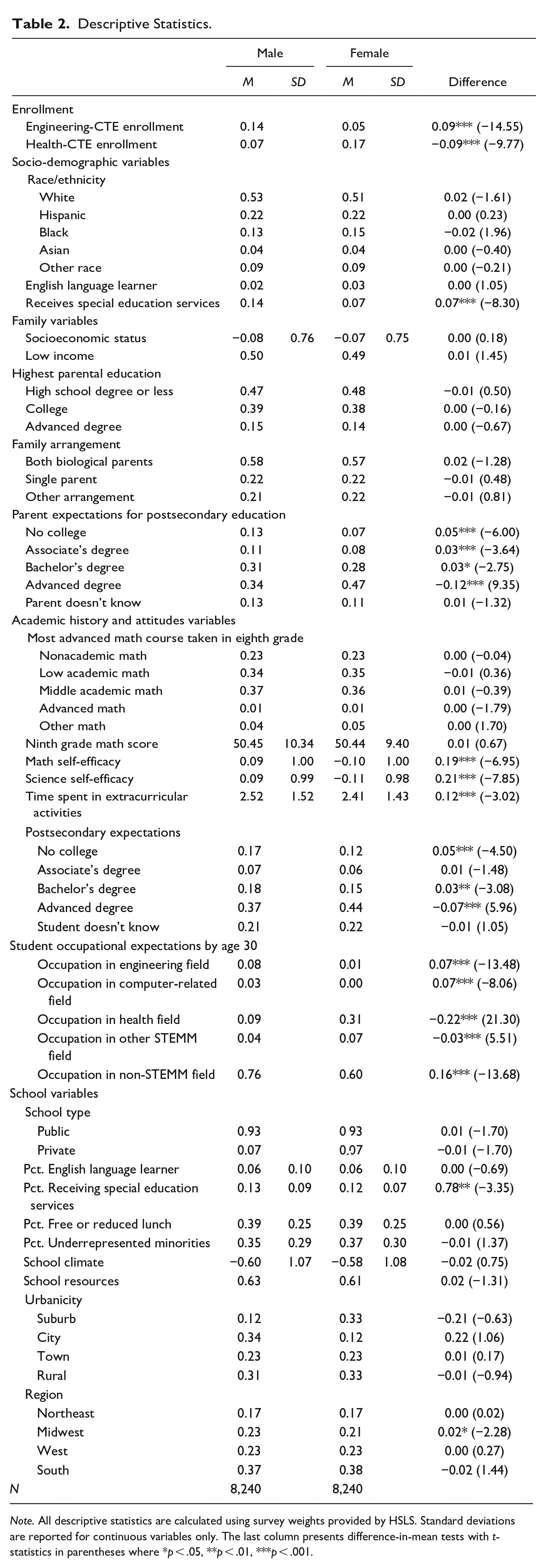
Note. All descriptive statistics are calculated using survey weights provided by HSLS. Standard deviations are reported for continuous variables only. The last column presents difference-in-mean tests with t-statistics in parentheses where *p < .05, **p < .01, ***p < .001.
Of importance, there were significant gender differences in student and parent expectations for postsecondary education. Specifically, female students and their parents had higher expectations of advanced degree attainment. Not surprisingly, male students reported significantly higher average values of math and science self-efficacy, which is of importance given that gendered beliefs in self-efficacy can influence entry into “nontraditional” fields and decisions to pursue STEMM coursework and STEMM careers (Raabe et al., 2019; Riegle-Crumb & Peng, 2021). Lastly, the most significant difference in characteristics between male and female students observed is related to occupational expectations. Namely, male students were more likely to report expectations of careers in traditionally male-dominated STEMM fields (e.g., engineering, computer-related fields). In contrast, female students reported higher expectations of careers in traditionally female-dominated STEMM fields (e.g., health, other STEMM fields). These occupational expectations mirror enrollment in engineering-CTE and health-CTE as well as gendered workforce participation in STEMM fields more broadly (Martinez & Christnacht, 2021).
Regression and Decomposition Results
Engineering-CTE
Table 3 presents the findings from our model predicting enrollment in engineering-CTE in high school. Each column represents a unique logistic regression, where the sample of students used is designated at the top of the column. The coefficients represent the odds of a student having enrolled in engineering-CTE in high school. Coefficients are presented with clustered standard errors in the parentheses next to each coefficient estimate. All independent variables are labeled in the first column of the table. The results from the regression analysis predicting enrollment in engineering-CTE are discussed in conjunction with the results from the nonlinear decomposition analysis examining gender gaps in engineering-CTE enrollment in Table 4. Following Fairlie (2005), we report estimates of the individual contribution of each independent variable to the gender gap. Additionally, we report the subtotal for each of the four sets of measures (socio-demographic measures, family characteristics, academic history and attitudes, school characteristics).
Predicting Enrollment in Engineering-CTE.
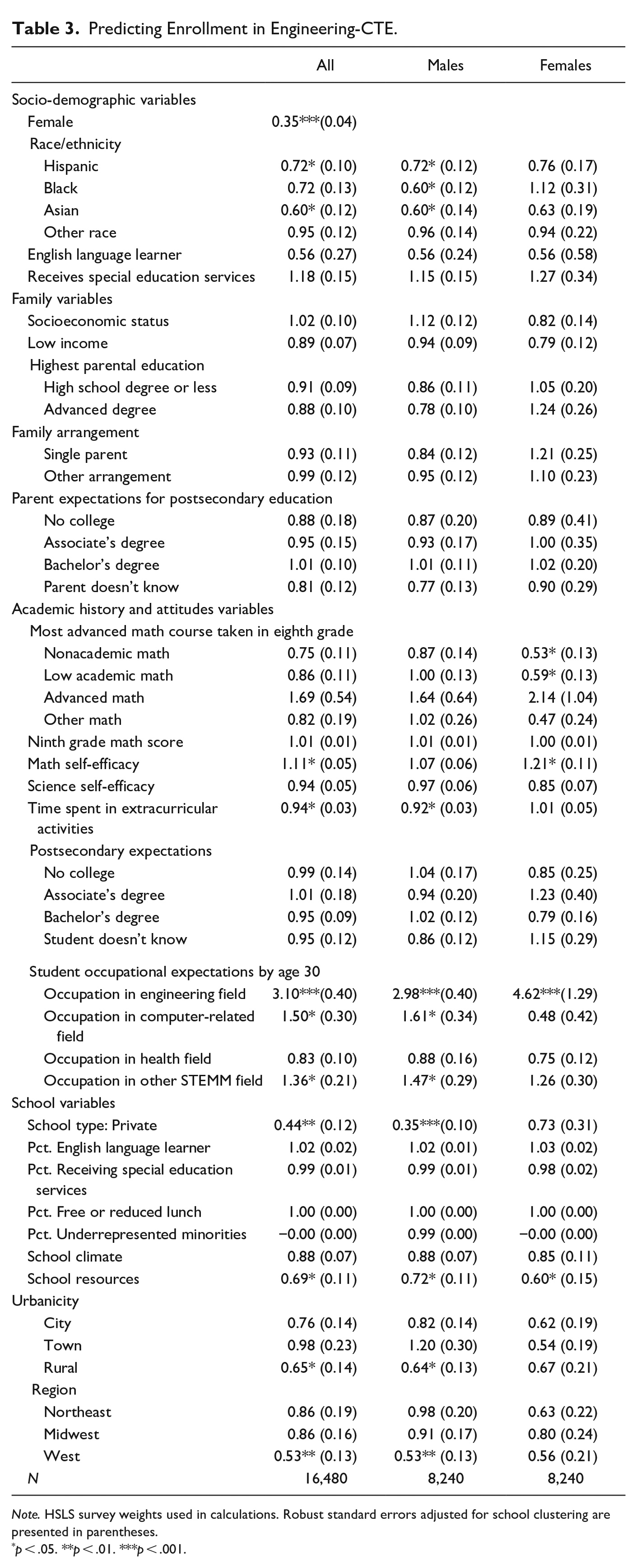
Note. HSLS survey weights used in calculations. Robust standard errors adjusted for school clustering are presented in parentheses.
p < .05. **p < .01. ***p < .001.
Decomposition of Gender Enrollment Gap in Engineering-CTE.
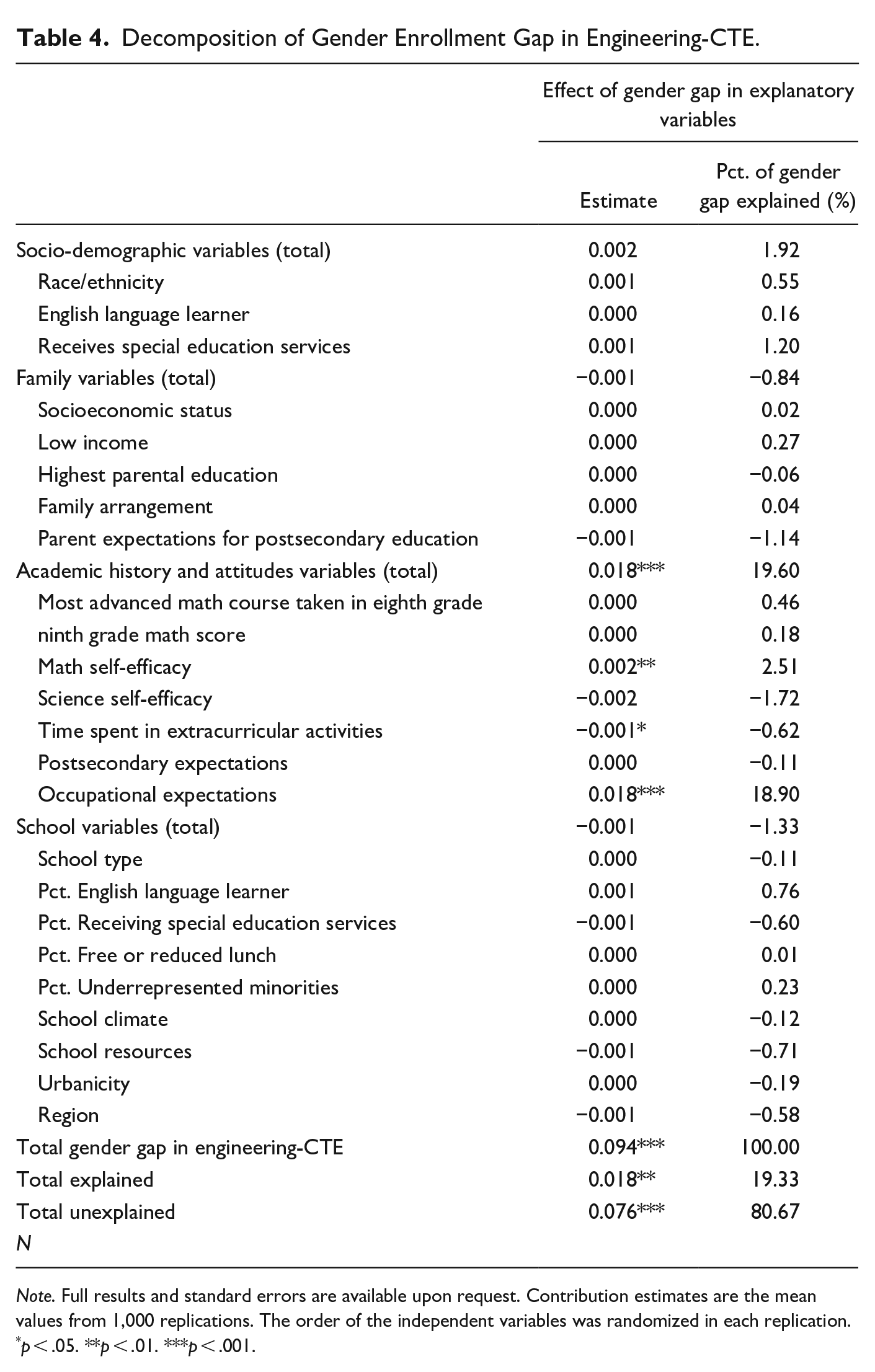
Note. Full results and standard errors are available upon request. Contribution estimates are the mean values from 1,000 replications. The order of the independent variables was randomized in each replication.
p < .05. **p < .01. ***p < .001.
To begin, note that the engineering-CTE enrollment rates for males and females indicate a male-female gender gap of 9.4%. In our nonlinear decomposition model, differences in the independent variables explain 19.3% of male-female enrollment gap, while the unexplained portion accounts for the remaining 80.7% of the gap.
Next, we discuss estimates of the individual contribution of each independent variable to the explained portion of the gender gap and the subtotal for each of the four sets of measures. It is important to note that when the male-female enrollment gap is positive, as is the case with enrollment in engineering-CTE, an independent variable with a positive coefficient can be interpreted as widening the male-female gender gap. Alternatively, an independent variable with a negative coefficient can be interpreted as shrinking the gender gap. That said, because the overall gender gap still advantages males, we instead interpret these reductions as a constrain on the actual gender gap (Bielby et al., 2014).
The socio-demographic variables did not significantly contribute to the male-female enrollment gap in engineering-CTE. Although the results from the regression analysis suggest differences in race/ethnicity were predictive of enrollment in engineering-CTE (Table 3), these differences were not large enough to contribute to the gender gap in engineering-CTE enrollment.
The contribution of the set of family variables to the male-female course enrollment gap in engineering-CTE was not statistically significant. Although the results from the descriptive analysis suggest differences in parental expectations for postsecondary education across genders (Table 2), these differences were not large enough to contribute to the gender gap in engineering-CTE enrollment. Taken together, these results imply that differences in family variables do not primarily drive the male-female enrollment gap in engineering-CTE.
The set of academic history and attitudes variables explained 19.6% of the male-female enrollment gap in engineering-CTE, accounting for the majority of the explained portion of the course enrollment gap. Differences in reported math self-efficacy between males and females explained 2.4% of the gender gap. This is not surprising, given that male students were more likely to report higher level of math-self efficacy (Table 2), and this measure was predictive of enrollment in engineering-CTE (Table 3). Differences in occupational expectations made the largest individual contribution to the gender gap in engineering-CTE enrollment, explaining 18.9% of the gender gap. Males were much more likely to expect to have a career in an engineering field (Table 2), and expecting a career in an engineering field significantly increased the odds of participating in engineering-CTE (Table 3). Taken together, these results indicate that occupational expectations may be driving male students’ enrollment in engineering-CTE in high school. The only academic history and attitude variable that significantly benefits females is involvement in extracurricular activities, which is related to a 0.6% reduction in the gender gap. This is not a surprising finding, given that females reported less time spent per week in extracurricular activities (Table 2), and this measure decreased the odds of enrollment in engineering-CTE for males (Table 3).
Finally, the contribution of the set of school variables to the male-female enrollment gap in engineering-CTE was not statistically significant. Similarly, none of the individual independent variables made any significant contributions to the gender gap. While previous research has found school characteristics to influence high school CTE and STEMM coursetaking behaviors, these factors are not driving the male-female enrollment gap in engineering-CTE.
Health-CTE
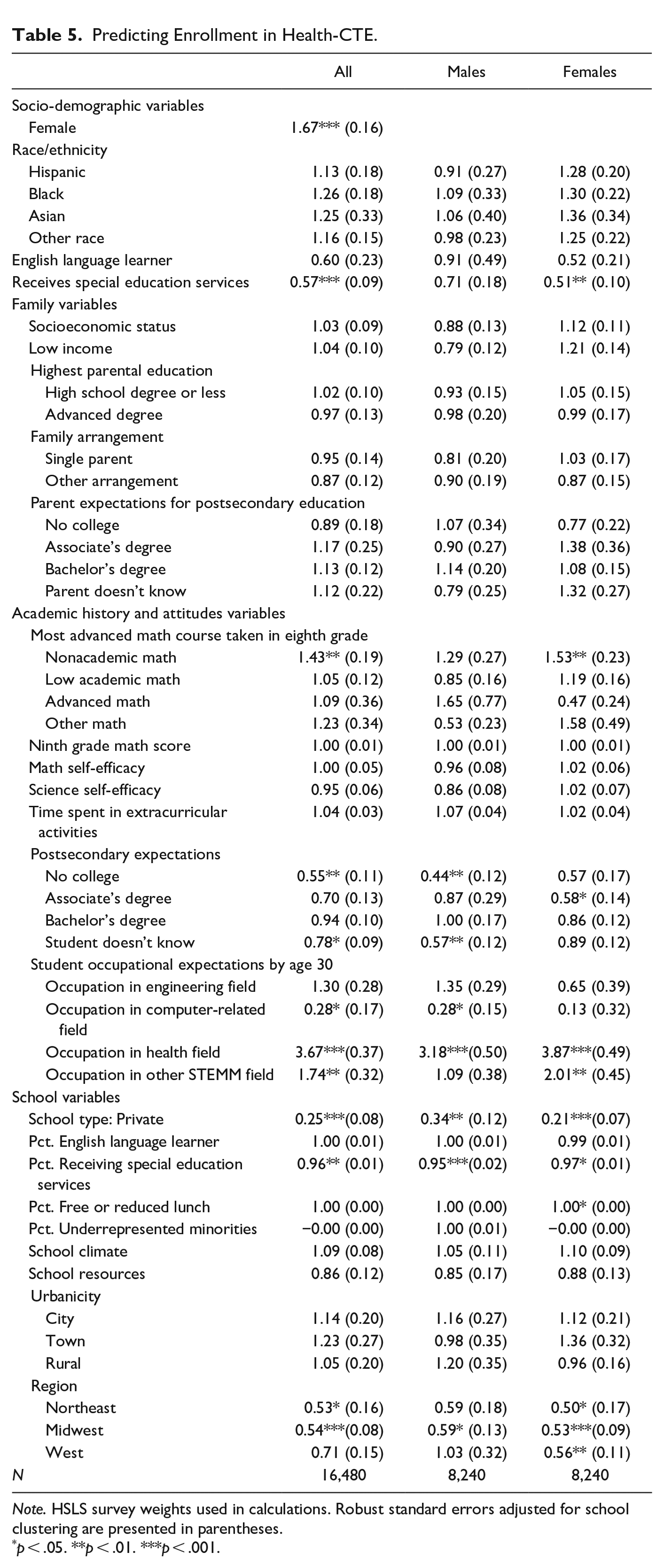
Table 5 presents the findings from predicting enrollment in health-CTE in high school. The results from the logistic regression analysis predicting enrollment in health-CTE are discussed in conjunction with the results from the nonlinear decomposition analysis examining gender gaps in health-CTE enrollment in Table 6. These tables are constructed analogously to Tables 3 and 4, respectively.
Predicting Enrollment in Health-CTE.
Note. HSLS survey weights used in calculations. Robust standard errors adjusted for school clustering are presented in parentheses.
p < .05. **p < .01. ***p < .001.
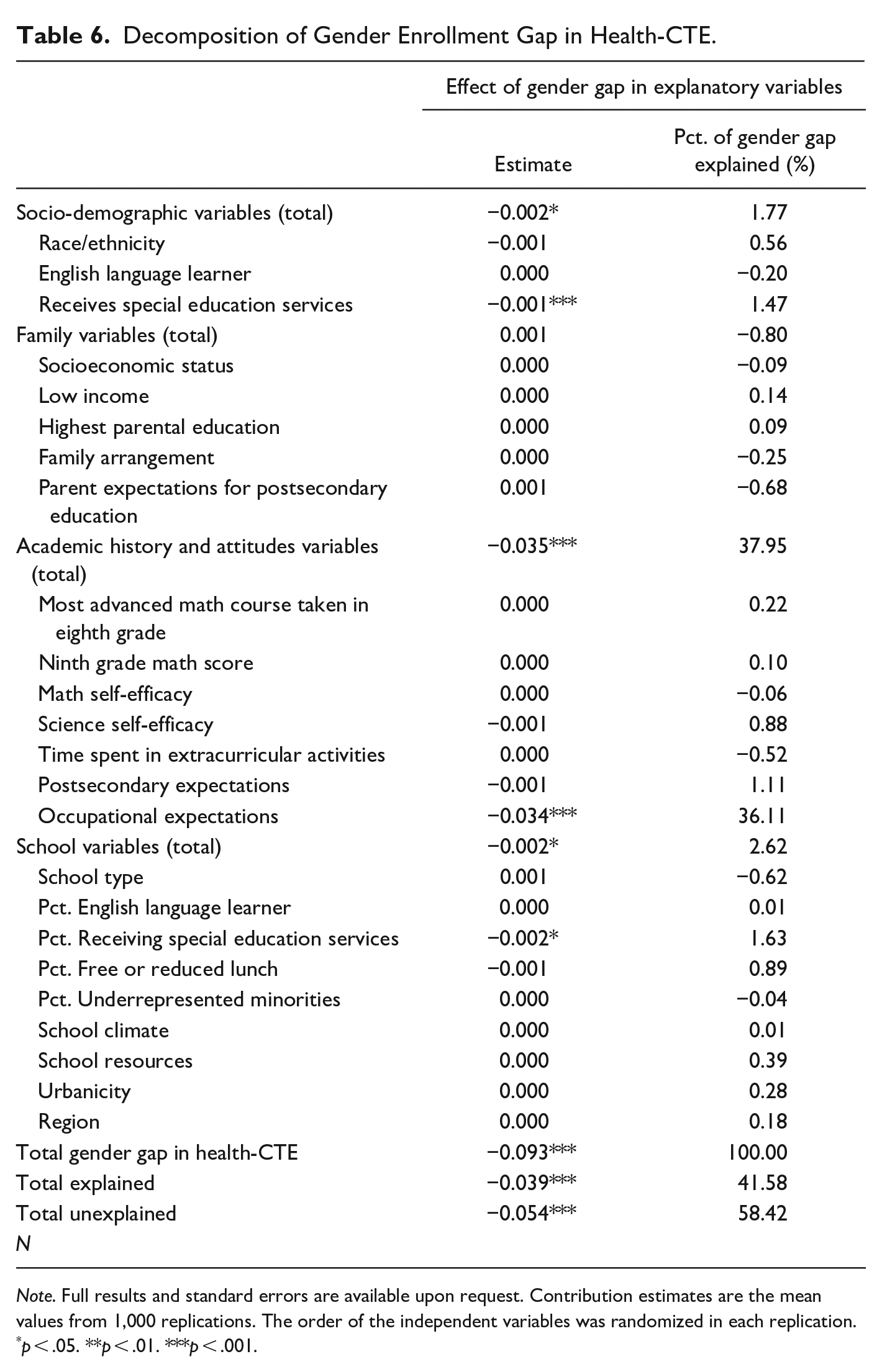
Decomposition of Gender Enrollment Gap in Health-CTE.
Note. Full results and standard errors are available upon request. Contribution estimates are the mean values from 1,000 replications. The order of the independent variables was randomized in each replication.
p < .05. **p < .01. ***p < .001.
The health-CTE enrollment rates for males and females indicate a male-female gender gap of −9.3%. In our nonlinear decomposition model, differences in the independent variables explain 41.6% of male-female enrollment gap, while the unexplained portion accounts for the remaining 58.4% of the gap.
Next, we discuss estimates of the individual contribution of each independent variable to the explained portion of the gender gap as well as the subtotal for each of the four sets of measures. It is important to note that when the male-female enrollment gap is negative, as is the case with enrollment in health-CTE, an independent variable with a negative coefficient can be interpreted as widening the male-female course enrollment gap while an independent variable with a positive coefficient can be interpreted as shrinking the gender gap.
To begin, the set of socio-demographic variables explained 1.8% of the gender gap in health-CTE enrollment. The receipt of special education services explained 2.0% of the gender gap. Given that the proportion of male students who receive special education services is nearly twice that of females (Table 2), and female students who receive special education services are less likely to enroll in health-CTE (Table 5), these results suggest that the male-female enrollment gap in health-CTE would be closer to zero if male and female students were equally represented in special education.
The contribution of the set of family variables to the male-female enrollment gap in health-CTE was not statistically significant. Additionally, none of the independent variables made any significant contributions to the gender gap. The distributions of the family variables did not have any strong effects on the probability of participating in health-CTE (Table 5), suggesting that differences in family variables do not primarily drive the male-female enrollment gap in health-CTE.
Similar to the results of the decomposition of gender gaps in engineering-CTE enrollment, the set of academic history and attitudes variables accounted for the majority of the male-female enrollment gap in health-CTE, explaining 38.0% of the gender gap. Once again, occupational expectations made the largest individual contribution to the male-female enrollment health-CTE gap, explaining 36.1% of the gap. Females were much more likely to expect to have a career in a health or other STEMM field (Table 2), and these characteristics significantly increased the odds of participating in health-CTE (Table 5). These results suggest that student occupational expectations are the main driver of gender gaps in health-CTE and may help explain female students’ enrollment in health-CTE in high school.
The set of school variables in the model explained 2.6% of the male-female enrollment gap in health-CTE. Of the individual contributions of each independent variable, only one measure made a statistically significant contribution to the gender gap. Namely the percent of students who receive special education services. Although school variables (i.e., school type, region, urbanicity) were significant predictors of enrollment in health-CTE (Table 5), the estimated male-female course enrollment gap in health-CTE was not significantly not driven by differences in the other school variables.
Discussion
In an effort to address the pervasive gender gaps in STEMM workforce participation, determining ways to encourage the persistence of students in nontraditional STEMM fields has become a focus of educational policy. Investments in high school STEMM-CTE programs serve as one means to promote gender-based desegregation of STEMM occupations (Fluhr et al., 2017), as these courses focus on applying traditional math and science skills in more practically-relevant ways and provide clear linkages to college and career opportunities in STEMM fields (Leu & Arbeit, 2020; Malin et al., 2014). Despite policy efforts to promote gender equity in STEMM-CTE, patterns of enrollment remain heavily gendered and reflect postsecondary and labor market trends (Fluhr, 2014; Hamilton et al., 2015; Leu & Arbeit, 2020). While gender differences in STEMM-CTE participation have been well documented, prior to this study, no work had examined why these gender gaps exist (and vary) across different STEMM-CTE domains.
In this study, we document the landscape of high school coursetaking in two of the most gendered course clusters in the applied science fields using a nationally-representative sample. We began by synthesizing prior works to identify specific individual, family, and school factors predictive of enrollment in engineering-CTE and health-CTE courses. Then, the results from our decomposition analysis allowed us to address whether these measures also served as explanatory factors for gender differentials in coursetaking. While our results provide evidence of some the of the contributions to the gender gaps in STEMM-CTE course enrollment, the findings perhaps raise more questions than they answer. Unequivocally, however, our results point to the fact that persistent gender imbalances exist—for both men and women—in enrollment of STEMM-CTE courses in high school. If the goals of federal legislation (e.g., Title IX and Perkins V) is to address gender equity in education and ultimately in workforce and earnings opportunities, it is necessary to acknowledge that current gender disparities continue to persist—specifically, as we found in this study, in male-imbalanced engineering areas and female-imbalanced health sciences areas and for different reasons.
Our paper makes three contributions beyond previous analyses. First, research investigating gendered participation in high school STEMM courses has predominately focused on examining gender gaps in traditional academic STEMM courses. Given that STEMM-CTE coursetaking in high school can have substantial impacts on an individual’s future college and career choices, research investigating gender gaps in STEMM coursework should extend to (and perhaps focus on) the applied sciences. Second, we disaggregate STEMM-CTE fields and investigate gendered enrollment in engineering-CTE and health-CTE courses and compare them with one another. This extends previous research that has almost exclusively focused on high school STEMM domains that are only affected by female underrepresentation, and allows us to identify factors that contribute to both female and male underrepresentation in the STEMM-CTE course clusters with the largest gender gaps. Lastly, we leverage a decomposition approach that has yet to be applied to understanding gender differences in STEMM-CTE enrollment. Rather than isolating gender as a single explanatory factor, this approach allows us to take a more comprehensive and holistic approach to compare the relative importance of multiple factors that shape gender gaps in the applied sciences.
Overall, there were three main findings related to our research questions. First, we found that gender differences in occupational expectations were the largest contributor to gender gaps in both fields, and explained 18.9% of the total gender gap (or 97.9% of the explained gender gap) in engineering-CTE enrollment, and 36.1% the total gender gap (or 86.8% of the explained gender gap) in health-CTE enrollment. This finding supports prior research that has found occupational expectations to be the largest contributor to gender gaps in 12th grade science coursetaking among students in Australia (Sikora, 2019) and extends the current base of research that has almost exclusively focused on the role of occupational expectations in contributing to gender gaps in STEMM fields at the postsecondary and career levels (Law, 2018; Legewie & DiPrete, 2014; Morgan et al., 2013; Sassler et al., 2017). While our results suggest that career aspirations were the largest contributor to gender gaps in both fields, holding counter-stereotypical beliefs regarding occupational expectations (i.e., females’ expectations of entering engineering) was significantly associated with enrollment in nontraditional STEMM-CTE courses for both genders. Identifying students’ career expectations as a key contributor to course enrollment in gender-imbalanced STEMM-CTE fields not only center an unexplored domain in existing literature on STEMM-CTE but also provides policymakers and researchers alike with actionable information that could inform future interventions investigating ways to strengthen career education before high school.
Second, our findings suggest that gender differences in reported values of math self-efficacy explained 2.5% of the total gender gap (or 11.1% of the explained gender gap) in engineering-CTE enrollment. Despite displaying similar measures of math ability, as evidenced by eighth grade math coursetaking and ninth grade math scores, male students reported significantly higher values math self-efficacy than females. This finding is in line with previous literature that suggests a lack of self-efficacy may contribute to gender inequities in STEMM-CTE (Lufkin et al., 2007) and women’s underrepresentation in mathematically intensive STEMM fields more broadly (Eccles, 2011; Riegle-Crumb & Peng, 2021; Wang & Degol, 2013). That said, the results from our logistic regression showed that math-self efficacy was predictive of enrollment in engineering-CTE for female students, suggesting that developing positive self-efficacy may serve as an avenue to help female students persist along the STEMM pipeline and enter traditionally male-dominated STEMM fields.
Lastly, while the purpose of this study was to investigate whether gender gaps in STEMM-CTE enrollment could be explained a set of a theoretically and empirically informed factors, a considerable portion of the gender gap remained unexplained in both STEMM-CTE domains. The K-B-O decomposition approach enables us to determine the impact of gender differences in observable characteristics on the gender gap in STEMM-CTE enrollment (the explained portion of the gap), as well as the impact of gender differences in the effect of those attributes (the unexplained portion of the gap). Because our descriptive and regression analyses found relatively little significant differences in socio-demographic, family, and school characteristics by gender and with respect to enrollment in STEMM-CTE, it is not suspiring that these measures did not yield substantive contributions to the explained portion of the gender gaps in STEMM-CTE enrollment. While it is difficult to provide a direct interpretation of the unexplained portion of gender gaps in STEMM-CTE enrollment because it also includes the effects of unobserved factors, Buchanan et al. (2018) suggests that the greater the portion of the gap that is significantly unexplained, the greater the existence of gendered processes. Although definitive statements are beyond the scope of the current study, we speculate the existence of biases, and the intersection of such gendered processes with key socio-demographic and family characteristics, may be perpetuating gender gaps in STEMM-CTE enrollment. An important goal for future research should be to understand what factors can bridge this remaining portion of the gender gap in both engineering-CTE and health-CTE enrollment.
In all, we identify several factors that could be the focus of ongoing research and future policy, including many features that consistently contribute to unequal STEMM-CTE course enrollment in high school, all of which are likely to persist into students’ college major choice and subsequent careers. The National Science Board (2010) reported a troubling decline in the number of American students pursuing STEMM in higher education where, in our economy, the number of jobs requiring training in STEMM is expanding. The consequences of the factors that contribute to these gender patterns within high school pose notable issues in light of research stressing the importance of diverse educational and work environments which are more likely to foster creativity, innovation, and productivity (Carnvale et al., 2011; Clark Blickenstaff, 2005).
Conclusion
Our research has implications for policy and practice. The results are important for policymakers as they consider new or revised educational policies to support the pursuance and persistence of men and women into non-traditional STEMM fields. Educational policymakers certainly need to understand the effects of imbalance in STEMM in high school on long-term outcomes. Yet, there is less attention being paid to the STEMM pipeline when it comes to the applied sciences as embodied in STEMM-CTE coursework. As mentioned in the introduction, numerous studies have found positive effects of STEMM-CTE coursetaking. But, understanding two issues—not just the “effects of” but also who access these courses—will make for better-informed policy decisions that promote short- and long-term success for women in engineering and men in health science fields.
As for practice, the findings here certainly call for ways to support educational practitioners in their efforts increase gender equity in STEMM course enrollment. First, districts, school counselors, and teachers should work toward increasing the awareness of nontraditional career opportunities in STEMM fields for both males and females. Research has shown that career exploratory programs, job shadowing opportunities, and mentor programs with nontraditional role models can increase students’ interest and knowledge of STEMM careers (Lufkin et al., 2007; Malin et al., 2014), which can in turn help students build confidence in their ability to persist into college and careers in nontraditional fields. Secondly, high school teachers and administrators with goals of enhancing the preparation of students for STEMM careers need concrete data on patterns of STEMM coursetaking and how coursetaking itself can potentially contribute to the gender gaps in STEMM. Educators and leaders must pay attention to the way that schools might inadvertently perpetuate gender stereotypes when it comes to discussing course enrollment plans with both male and female students.
Limitations
There are several limitations in this study that can be used for future research endeavors. First, while this study examined patterns of coursetaking (and potential predictors), it was based on secondary data analysis. While quantitative data is not a limitation in its own right per se, this does limit the study from examining in-depth perspectives and motivations for coursetaking from a qualitative sample of students. Future research might further examine the patterns in this study through a qualitative study of high school students, by gender. Second, while HSLS:2009 allowed us to determine whether or not students enrolled in STEMM-CTE courses in high school, the data set does not provide information on the full CTE offerings at each school. Therefore, we were unable to control for how many STEMM-CTE course offerings the students had access to. Future research might explore the different STEMM-CTE coursetaking options available at high schools in the U.S., and how this relates to gender gaps in the applied sciences. Third, while this study had data on schools, there were no measures about STEMM-CTE teachers, as they were not available in the dataset. Hence, it was not possible to determine how differences might have arisen due to teacher characteristics. Further research might examine a state or district dataset that includes teacher data paired with student coursetaking data. Finally, because the data followed one cohort of high school students, it was not possible in this study to examine changes in trends over time. Again, a state or district dataset might best be coupled with this current study in order to compare the findings from these rich, contextualized data with an administrative but more longitudinal dataset.
Footnotes
Appendix
Enrollment Patterns in Engineering-CTE and Health-CTE by Gender.
| Male | Female | |
|---|---|---|
| Engineering-CTE | ||
| Average number of credits earned | 0.29 | 0.08 |
| Total number of credits earned | ||
| 0 | 0.80 | 0.92 |
| 0–1 | 0.14 | 0.07 |
| 1–2 | 0.04 | 0.01 |
| 2–3 | 0.02 | 0.00 |
| 3 or more | 0.01 | 0.00 |
| Health-CTE | ||
| Average number of credits earned | 0.11 | 0.32 |
| Total number of credits earned | ||
| 0 | 0.93 | 0.83 |
| 0–1 | 0.05 | 0.09 |
| 1–2 | 0.01 | 0.04 |
| 2–3 | 0.01 | 0.02 |
| 3 or more | 0.01 | 0.02 |
| N | 8,240 | 8,240 |
Note. All descriptive statistics are calculated using survey weights provided by HSLS.
Declaration of Conflicting Interests
The author(s) declared no potential conflicts of interest with respect to the research, authorship, and/or publication of this article.
Funding
The author(s) received no financial support for the research, authorship, and/or publication of this article.
