




Abstract
Background/Context:
Career and technical education (CTE) coursework in science, technology, engineering, mathematics, and medical/health (STEMM) fields has been supported by policy makers as a way to align the secondary-to-postsecondary-to-career pipeline. Yet, in the research, the focus has been on whether STEMM CTE coursetaking in high school predicts college-going or whether it predicts employment for non–college goers. Little attention has been paid to whether STEMM CTE coursetaking in high school aligns with college employment opportunities.
Purpose/Objective/Research Question/Focus of Study:
This study investigates the relationship between one promising educational practice—STEMM career and technical education (STEMM CTE) coursetaking—and outcomes along students’ college employment pathways. Specifically, we asked the following research questions: Does taking more STEMM CTE courses in high school link to “general” college employment outcomes? Does taking more STEMM CTE courses in high school link to “STEMM-specific” college employment outcomes? How do these relationships vary across important student subgroups, namely, those identified by the National Science Foundation as traditionally underrepresented in STEMM fields: low-income students, students with learning disabilities, women, and Black and Hispanic students?
Research Design:
We relied on data from the High School Longitudinal Study of 2009 (HSLS). Administered by the National Center for Education Statistics (NCES), HSLS is the most current, nationally representative data set that follows a cohort of more than 20,000 ninth-grade students across the United States throughout high school and after graduation. Our regression analyses relied on data collected during the baseline year school-level survey (2009), the high school transcript update (2013), and student-level surveys from all four data-collection waves (2009, 2012, 2013, 2016).
Conclusions/Recommendations:
Using these national data, we find that taking more STEMM CTE courses was associated with a higher chance of having a STEMM job during college and having higher expectations for future STEMM employment, though not with general employment outcomes such as wages. The findings were different for students from some underrepresented backgrounds in STEMM fields, and implications are discussed.
Employment in science, technology, engineering, mathematics, and the medical or health sciences (STEMM) represents approximately one quarter (23%) of the U.S. workforce (Okrent & Burke, 2021). Jobs in these fields have long been regarded as well-paying and stable, with median annual wages more than double those of non-STEMM occupations ($89,780 vs. $40,020 in 2020), and unemployment rates nearly half those of other professions (2% vs. 4% in 2019; Bureau of Labor Statistics, 2020; Okrent & Burke, 2021). STEMM occupations also provide critical support to national competitiveness in defense, health, and technology, among others (National Science Board, 2018).
The Bureau of Labor Statistics (2020) has projected that employment levels in STEMM will rise by more than 1 million jobs through 2030 (a 10.5% increase from approximate current levels), vastly outpacing growth in other areas. Given the importance and growth of STEMM employment, strengthening pathways for individuals into related education and training programs, and subsequently into STEMM jobs, is of great individual and collective importance and has been the center of much public policy attention (National Science Board, 2014; President’s Council of Advisors on Science and Technology, 2012). Specifically, schooling investments in STEMM across a variety of elementary, secondary, and postsecondary programs have been seen as one viable mechanism to increase the persistence of individuals in STEMM fields (National Science Foundation, 2020). This study investigates the relationship between one promising educational practice—STEMM career and technical education (STEMM CTE) coursetaking—and outcomes along students’ college employment pathways. Specifically, we asked the following research questions:
1) Does taking more STEMM CTE courses in high school link to “general” college employment outcomes?
2) Does taking more STEMM CTE courses in high school link to “STEMM-specific” college employment outcomes?
3) How do these relationships vary across important student subgroups, namely, those identified by the National Science Foundation as traditionally underrepresented in STEMM fields: low-income students, students with learning disabilities, women, and Black and Hispanic students?
Given that 93% of those employed in STEMM fields have at least some education or training beyond a high school diploma (Funk & Parker, 2018), the pursuit of a stronger STEMM pipeline from high school to college in STEMM has been seen as one viable mechanism to increase student persistence in STEMM-related fields (Association of American Universities, n.d.; Manduca et al., 2017; National Academies of Sciences, Engineering, and Medicine, 2020). However, fewer than one third (28%) of bachelor’s degree STEMM graduates ultimately go on to work in a STEMM-designated field (Day & Martinez, 2021), suggesting a weak secondary-to-postsecondary STEMM pipeline into employment. This motivates our first two research questions.
These pathways have also been shown to unequally sort students from underrepresented groups out of STEMM fields altogether, such as students with disabilities or those from low-income families (Gottfried et al., 2021; Plasman et al., 2021), by gender (Funk & Parker, 2018) or by race and ethnicity (Chang et al., 2014). These realities suggest that there may be weaknesses in or inequalities along existing STEMM education and employment pathways that fail to connect STEMM and STEMM-related students to related stable, high-wage careers—hence, motivating our third research question.
High School STEMM CTE Coursework
Course Taxonomy
There are two strands of courses in the STEMM high school curriculum: academic and CTE. Academic STEMM courses include traditional math and science courses, such as algebra and physics. They are typically taught from a theoretical approach that stresses procedures, observation, identification, documentation, and computation (Gottfried et al., 2014). In contrast, STEMM CTE courses focus on applying math and science skills in more practically relevant ways and underscore how traditional math and science concepts map directly onto college and career opportunities. These STEMM CTE courses fall into three general areas. First, there is engineering, which includes classes such as computer-assisted design and drafting, as well as drafting fundamentals. Second is the information technology cluster, which includes classes such as website design and computer programming. Third, health sciences courses include dental science, health assisting, physical therapy, and sports medicine.
Prior Research
In the area of high school CTE coursetaking, without considering the specific STEMM CTE field, taking more CTE courses has been shown to have positive relationships with high school achievement and educational persistence (e.g., Bishop & Mane, 2004; Bonilla, 2020; Bozick & Dalton, 2013; Hemelt et al., 2019; Kemple & Willner, 2008; Plasman et al., 2017; Stone et al., 2008). For instance, Gottfried and Plasman (2018) found strong, consistent evidence that students who take more CTE units in high school are more likely to graduate from high school in four years and are less likely to drop out. In two other studies, Dougherty (2018) and Brunner et al. (2021) found that being admitted to specialized CTE schools that provide greater numbers and variety of CTE courses improved high school graduation, test scores, and, in the latter case, employment and earnings through age 23. Similarly, Theobald et al. (2018) found that taking more CTE courses was linked to higher chances of on-time graduation. As for labor outcomes, less is known about the link between high school CTE coursetaking and employment outcomes. Earlier works have demonstrated that participating in CTE in high school has positive employment benefits (e.g., Bishop & Mane, 2005; Meer, 2007; Neumark & Rothstein, 2006), and more recent work by Dougherty et al. (2019) found that taking more CTE coursework in high school positively predicted higher initial employment and wages. Finally, some recent research also suggests that CTE coursetaking in community college is linked to stronger employment outcomes (Grosz, 2020; Stevens et al., 2019; Xu & Trimble, 2016).
With regard to the role of STEMM CTE courses in particular, existing research suggests strong links to academic outcomes for students. Gottfried et al. (2014) found a significant, positive link between applied STEM coursetaking and 12th-grade math achievement. Taking more STEMM CTE courses has also been linked to higher odds of advanced traditional math and science coursetaking in 11th and 12th grades, as well as higher odds of selecting a STEM major in college for the average student (Gottfried, 2015; Plasman, Gottfried, & Klasik, 2019).
Finally, there is some evidence that taking STEMM CTE in high school is particularly important for underrepresented groups. For instance, for low-income students, taking more STEMM CTE classes in high school has been shown to predict higher school engagement levels (Plasman et al., 2021). Similarly, for students with learning disabilities, taking more STEMM CTE courses in high school was associated with higher feelings of STEMM self-efficacy and increased odds of high school graduation (Plasman & Gottfried, 2018; Plasman et al., 2022; Sublett & Plasman, 2017). Linking to their postsecondary careers, students with learning disabilities who took more STEMM CTE courses in high school were also more likely to consider, and ultimately declare, a STEMM major in college (Freeman et al., 2023).
As the topic relates to women, Gottfried (2015) found that women who take more STEMM CTE courses have greater odds of taking advanced mathematics and science courses when compared with male students. These findings contribute to the notion that STEMM CTE coursetaking in high school may be especially important for women, who have been shown to perceive many STEMM fields as lacking real-life applications (Baker & Leary, 1995; Sax, 1994, 2001).
Only two known studies have examined STEMM CTE for Black and Hispanic students. In Dougherty and Macdonald (2020), coursetaking patterns for STEMM CTE were examined. Black students were more likely to take STEMM CTE classes compared with White students, and Black and Hispanic students were more likely to take health classes within the STEMM CTE category compared with other areas of STEMM. In Plasman and Gottfried (2022), there were null findings with regard to the effect of taking STEMM CTE courses on high school outcomes for Black and Hispanic students. To be clear, taking the courses did not harm students’ outcomes, though a lack of positive findings suggested that STEMM CTE courses did not close gaps between racial and ethnic groups. Given that only two studies to our knowledge exist, this present study makes a contribution by examining STEMM CTE for groups of students who are not only underrepresented in STEMM CTE, but also underrepresented in the research literature itself.
Current Study
A host of prior works have consistently documented that taking more STEMM CTE courses is associated with better outcomes, such as achievement, especially for those from underrepresented groups. We build on these existing works in three key ways. First, we do not ask how many courses might be linked to student outcomes; instead, we investigate the STEMM CTE courseload across students’ entire high school coursetaking patterns—that is, the share of STEMM CTE coursework as a proportion of total STEMM coursework, academic and CTE. While taking more STEMM CTE units has positive benefits, STEMM CTE research has not yet considered the share of STEMM CTE to total STEMM courseload.
Second, while career outcomes have been examined in past work, no research in STEMM CTE has focused on employment during college. Given that the majority of college students have some form of employment while enrolled (Perna & Odle, 2020), these would be the most proximal employment experiences after high school completion and represent opportunities for students to apply their high school STEMM CTE knowledge to relevant part-time or entry-level positions.
Finally, while prior studies have examined underrepresented groups, these investigations have focused on only one group at a time. In this study, we examine multiple groups collectively. Specifically, we explore how increased exposure to STEMM CTE coursework in high school influences these outcomes across student groups traditionally underrepresented in STEMM according to the National Science Foundation: students from low-income backgrounds, students with learning disabilities, women, and Black and Hispanic students.
Conceptual Framing
Drawing from prior work on STEMM and CTE coursetaking (Gottfried & Plasman, 2018; Gottfried et al., 2021), we discuss three primary mechanisms by which the increased share of STEMM CTE coursetaking could influence students’ subsequent college employment. First, we know that CTE courses prepare students for success in college and jobs through (1) exposure to a structured collegelike curriculum and work activities and (2) the development of critical thinking, reasoning, problem-solving, and other skills necessary for both college and employment success (American Institutes for Research, 2013; Gottfried, 2015; Gottfried et al., 2016; Plasman & Gottfried, 2018; Plasman et al., 2021). Through this knowledge transmission and skill formation, high school CTE courses provide foundational knowledge and skills for success in future work experiences, and exposure to such curricula and similar skill development have been shown to boost students’ immediate high school outcomes and subsequent college-going behaviors (Bozick & Dalton, 2013; Heckman & Rubinstein, 2001; Oakes & Saunders, 2008; Schargel & Smink, 2001). Given these foundations, we hypothesize that students with a greater STEMM CTE courseload (i.e., those with higher shares of STEMM CTE coursework across their high school experiences) will have stronger STEMM college employment outcomes from increased engagement with these knowledge transmission and skill formation activities in high school. Furthermore, given their STEMM knowledge and skills, such exposure should not only allow students to excel in college-level STEMM courses but also equip them to secure and succeed in STEMM-related work activities while enrolled. Higher paying work experiences while in college have the potential to increase the benefit of work (i.e., higher hourly wages) in the short term, while building experience to facilitate transition to future full-time work.
Second, STEMM CTE courses leverage relevance and reinforcement by providing students with these benefits and early successes in traditional STEMM subjects alongside STEMM CTE activities. This not only helps students exhibit success, develop self-efficacy, and begin socialization within STEMM—which, prior works have shown, are predictive of subsequent coursetaking and engagement (Gottfried, 2015; Plasman et al., 2017)—but also does so with real-world relevance by connecting this academic knowledge to postgraduation careers and jobs (Partnership for 21st Century Skills, 2010; Plank et al., 2008; Stone & Lewis, 2012). This provides an immediate view of the STEMM pathway, which may not be present in other general fields (e.g., English) or even other non–CTE STEMM fields (e.g., biology; Marks, 2000). We posit that students who have this pathway visualized and who experience early success along it are more likely to engage in STEMM employment-focused activities, particularly students who have an increased share of STEMM CTE coursework in high school and are repeatedly exposed to such reinforcement and signaling opportunities. This includes an extension into any work-related activities for students who work while enrolled in college, such as employment on or off campus in a STEMM-related field, given their increased STEMM exposure and skills. Furthermore, many STEMM CTE courses may be aligned with rapidly growing dual-enrollment and dual-credit programs (Zinth, 2018), which allow students to earn college STEMM credit for their work in high school. Such credit accumulation would accrue in greater ways to students with a higher share of STEMM CTE coursework and not only further signal academic capabilities but also provide students with early progress toward a postsecondary credential, thereby increasing subsequent college-going pursuits (Hemelt et al., 2020).
Finally, STEMM CTE courses also embed a high level of academic engagement consistent with other CTE courses. CTE courses have been characterized as more engaging than traditional academic coursework, given their focus on applied problems and use of hands-on activities (Bozick & Dalton, 2013; Gottfried et al., 2016; Plasman et al., 2021). These higher levels of student engagement have been linked to other positive high school, college, and employment outcomes (e.g., American Institutes for Research, 2013; Kemple & Snipes, 2000; Partnership for 21st Century Skills, 2010). Thus, we hypothesize that students whose high school curricula comprise a greater share of STEMM CTE—that is, a greater exposure to such engaging courses with direct links to subsequent outcomes—would exhibit stronger STEMM college employment outcomes.
In all, these mechanisms—skill formation, relevance and reinforcement, and academic engagement—collectively situate students within a defined STEMM field and provide them with the requisite knowledge and applied experiences to continue along this pathway during their journey. This early and applied exposure establishes a clear, knowledge-and-skill-focused pipeline from high school and into college and employment. Given these realities, this study asks how the increased share of each of these benefits through greater shares of STEMM CTE courses (as a proportion of total STEMM coursetaking) links to students’ college employment. Ongoing work suggests that high levels of investment in a specific CTE field, including STEMM CTE, are associated with higher probabilities of post–high school employment in those fields, though this has not been examined for those in college (Plasman, 2019).
Method
Data
We relied on data from the High School Longitudinal Study of 2009 (HSLS). Administered by the National Center for Education Statistics (NCES), HSLS is the most current, nationally representative data set that follows a cohort of more than 20,000 ninth-grade students across the United States throughout high school and after graduation. The baseline year survey was administered in fall 2009, when students first entered high school. A first follow-up was conducted in spring 2012, when students were finishing 11th grade. A brief data collection update was conducted in fall 2013—several months after expected high school graduation—to gather high school transcripts and survey students on college plans. Finally, a second follow-up took place in 2016. In this last round of data collection, students who continued to college after graduating high school would be in their third year of postsecondary education. Our analyses relied on data collected during the baseline year school-level survey (2009), the high school transcript update (2013), and student-level surveys from all four data-collection waves (2009, 2012, 2013, 2016).
To address missing values, we imputed 20 data sets to resemble the original distribution of observed variables (Royston, 2004), and we imputed all variables, dependent and independent, used in the analysis. Multivariate normal distributions were assumed, and Stata 16’s MI impute procedure was used to generate the imputed data sets. In the reporting of our results, per NCES rules, all sample sizes have been rounded to the nearest 10 to provide disclosure protection for the restricted-use data used in the analysis. Note that the high school transcript probability weight provided by the NCES, W4W1W2W3STU, was used to maintain the representativeness of the sample. Given our focus on high school coursetaking and student-level responses from multiple survey rounds, this weight was chosen to account for high school transcript nonresponse and survey item nonresponse from the base year, first follow-up survey, 2013 update, and second follow-up survey. Additionally, given our focus on college employment outcomes in this study, our sample was limited to students who ever attended college by the time the second follow-up survey was administered in 2016. Our final analytic sample included approximately 9,340 students with nonzero student-level weights.
Measures
STEMM CTE Coursetaking
Our key predictor of interest was built using a careful accounting and application of the high school transcript data in our data set. NCES collected high school transcripts for students in 2013, when most students had completed high school, and degree verification was complete. Transcript data included full coursetaking histories, grades received, and units earned. Course record files were calibrated to indicate Carnegie units as a standardized measure of units earned, such that one Carnegie unit is equivalent to a course taken every day, one period a day, for an entire school year. Complete coursetaking files were available for approximately 87% of the students who participated in the original baseline year sample in 2009. We conducted several checks to ensure the accuracy of the transcript data—identifying and addressing mismatches between credit earned and grade received, duplicate record identification, and compatibility between credits earned and the school’s calendar system (i.e., semester, trimester, etc.). We then merged the transcript data with survey data at the student level.
NCES provided standardized course codes for every course in which a student participated in high school. These codes allowed us to identify courses that fell under the STEMM umbrella more broadly (i.e., science, technology, engineering, mathematics, and medicine), as well as those that fell into the STEMM CTE categories as identified in the high school CTE taxonomy (Bradby & Hudson, 2007). Following Plasman, Gottfried, and Klasik (2019), we defined STEMM CTE courses as those that fell into three CTE categories: engineering technology, information technology, and health sciences. While previous research has focused primarily on coursetaking in engineering technology and information technology clusters, we chose to include health sciences in our definition of STEMM CTE to align our work with recent updates to the classification of CTE clusters (Plasman, Gottfried, & Klasik, 2019; U.S. Department of Education, 2019).
With this information, we could thus determine the total number of units each student earned in STEMM and, separately, STEMM CTE coursework. Given that we are interested in the relationship between the share of STEMM CTE coursetaking (to total STEMM coursework), and general college employment and STEMM-specific college employment outcomes—and knowing that students may additionally or concurrently enroll in academic (non-CTE) STEMM courses while in high school—we focused on students’ share of STEMM CTE courses by computing a ratio that represents STEMM CTE credits (i.e., the total STEMM CTE credits that a student earned) to total STEMM credits (i.e., all academic and STEMM CTE credits that a student earned). In this regard, our key independent predictor was the proportion of STEMM CTE units that a student earned as a fraction of their entire STEMM units in their high school portfolios.
Rather than focusing on the count of STEMM CTE courses or units, which could be directly limited by the number of courses offered at a school, using our ratio allowed us to observe relative exposure of STEMM CTE based on the STEMM CTE and academic STEMM classes that a student took in a school. That is, the ratio identified the proportion of STEMM credits that were delivered in the more applied, CTE manner and that we hypothesized would have more tangible connections to career activities when compared with other STEMM courses. As discussed next, we also controlled for total academic STEMM coursetaking.
Focal Samples: Traditionally Underrepresented Populations in STEMM Fields
One of the goals of our study was to determine whether there were any differences in the relationship between the coursetaking ratio of STEMM CTE units to total STEMM units in high school and college employment opportunities and STEMM-specific employment outcomes for traditionally underrepresented students in STEMM fields, as identified by the National Science Foundation. Here, we explain how we identified these key groups of students in our sample.
Low-income students
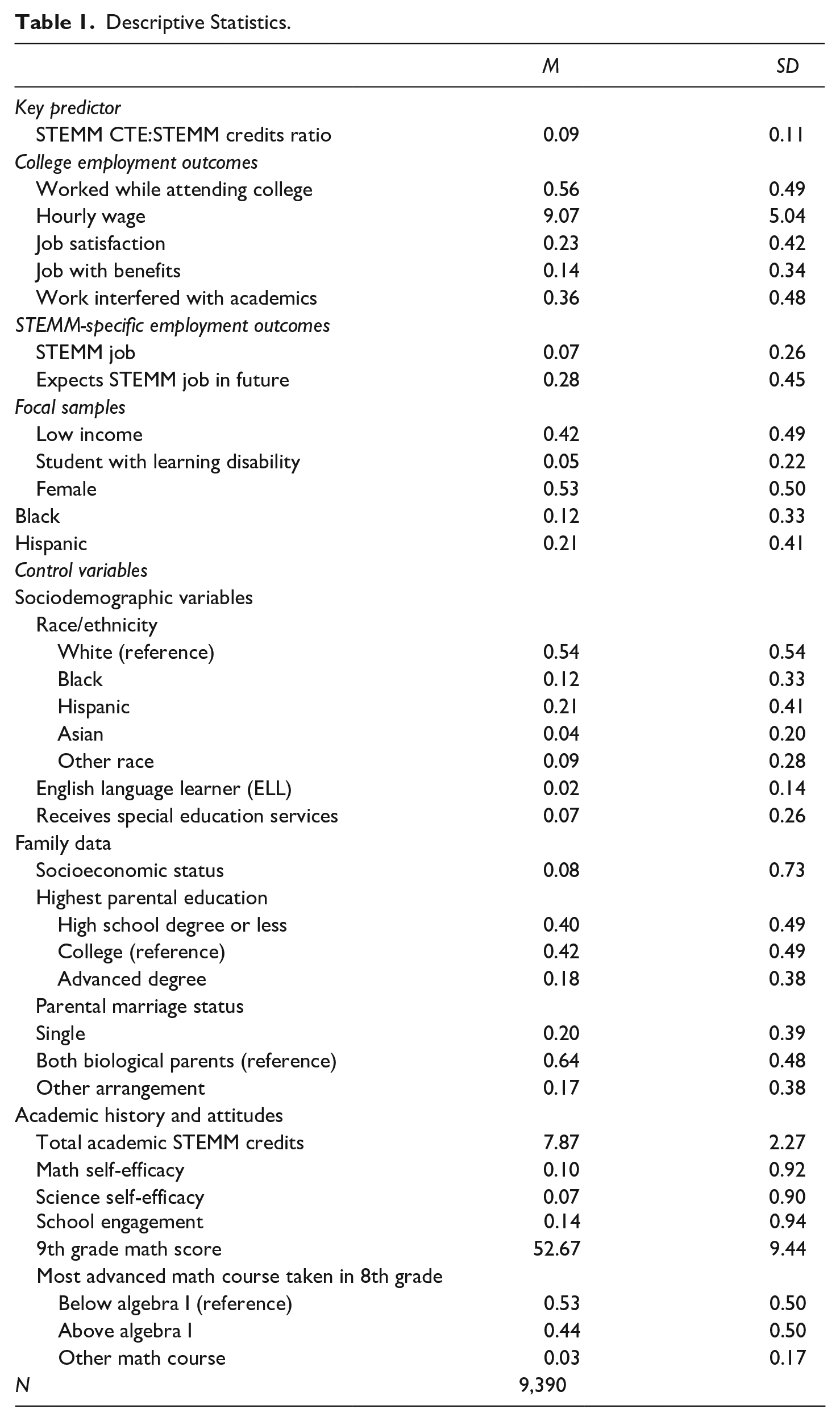
We identified low-income students as those students with family income less than twice the federal poverty threshold—a low-income definition previously used by the National Center for Children in Poverty and the Working Poor Families Project using American Community Survey data (Jiang et al., 2015). HSLS codes income with income-range bins, which did not allow for a direct observation of exact family income. Therefore, we used the upper limit of the income bin as the cutoff for poverty identification, such that if this upper limit for an individual fell below the chosen cutoff, they were identified as low-income. From this variable, we created a binary indicator equal to 1 if the student was reported as low-income, and 0 otherwise. Our sample included n = 3,940 students (42%) identified as low-income.
Students with learning disabilities
We identified students as having a learning disability based on parent responses to NCES regarding whether a doctor, healthcare provider, teacher, or school official had ever diagnosed their child with a specific learning disability. From this variable, we created a binary indicator equal to 1 if the student was reported to have a learning disability, and 0 otherwise. This definition was consistent with Gottfried et al. (2021). Approximately 5% of the individuals in our final analytic sample were classified as having a learning disability according to the parent survey responses (n = 460). Prior research that used other nationally representative data to explore high school coursetaking for students with learning disabilities has identified a similar share of students with learning disabilities (Gottfried et al., 2021; Shifrer & Callahan, 2010).
Women
HSLS recorded student birth sex from the baseline-year student questionnaire, parent questionnaire, and school-provided sampling roster. From this variable, we created a binary indicator equal to 1 if the student was labeled in the data set as female, and 0 otherwise. Roughly 53% of the individuals in our final analytic sample were labeled as female in the data set (n = 4,940).
Black and Hispanic students
HSLS reports race and ethnicity from the base year of data collection. From this file, there was a variable notating students’ race and ethnicity. From this, we created indicators for whether students were Black or Hispanic. Approximately 12% of the students in the sample were Black (n = 1,130), and 21% were Hispanic (n = 1,970). Note that in the data set, it was not possible to distinguish between Hispanic and Latinx—only Hispanic was provided.
General College Employment Outcomes
Worked while attending college
In the second follow-up survey in 2016, students were asked if they worked sometime between July 2012 and February 2016 while they were attending college. From this variable, we created a binary indicator equal to 1 if the student indicated that they worked while attending college, and 0 otherwise.
Hourly wage
We relied on two variables from the second follow-up survey in 2016 to create a single variable identifying hourly wage—amount earned and earning unit (e.g., hourly, monthly, annually). These variables correspond to a student’s current job (as of February 2016) or their most recent job. Following Plasman (2019), if a student reported monthly earnings, this value would be divided by 168 (the average number of hours worked in a month, assuming 8 hours per day across 21 workdays per month). If a student reported annual earnings, the value was divided by 2000 (the average number of hours worked in a year, based on a 40-hour workweek across 50 weeks per year). Following this procedure provided a standardized value to compare across individuals (Plasman, 2019), though we recognize the limitations of assuming that the jobs were full time. It was not possible in the data set to distinguish between full time and part time, so we had to rely on prior literature to guide our assumptions.
Job with benefits
We relied on two variables from the second follow-up survey in 2016 to create a single variable that indicates whether a student received benefits through their job—receipt of health insurance benefits and receipt of retirement or financial benefits. These variables corresponded to a student’s current job (as of February 2016) or their most recent job. From these variables, we created a binary indicator equal to 1 if a student reported that they received health benefits or retirement/financial benefits from their job, and 0 otherwise.
Work interfered with academic performance
In the second follow-up survey in 2016, students were asked whether or not their work schedule interfered with their academic performance in college. Original categories were 1 = strongly agree; 2 = agree; 3 = disagree; and 4 = strongly disagree. From this variable, we created a binary indicator equal to 1 if the student strongly agreed or agreed that their work schedule interfered with their academic performance in college, and 0 otherwise.
STEMM-Specific College Employment Outcomes
STEMM job
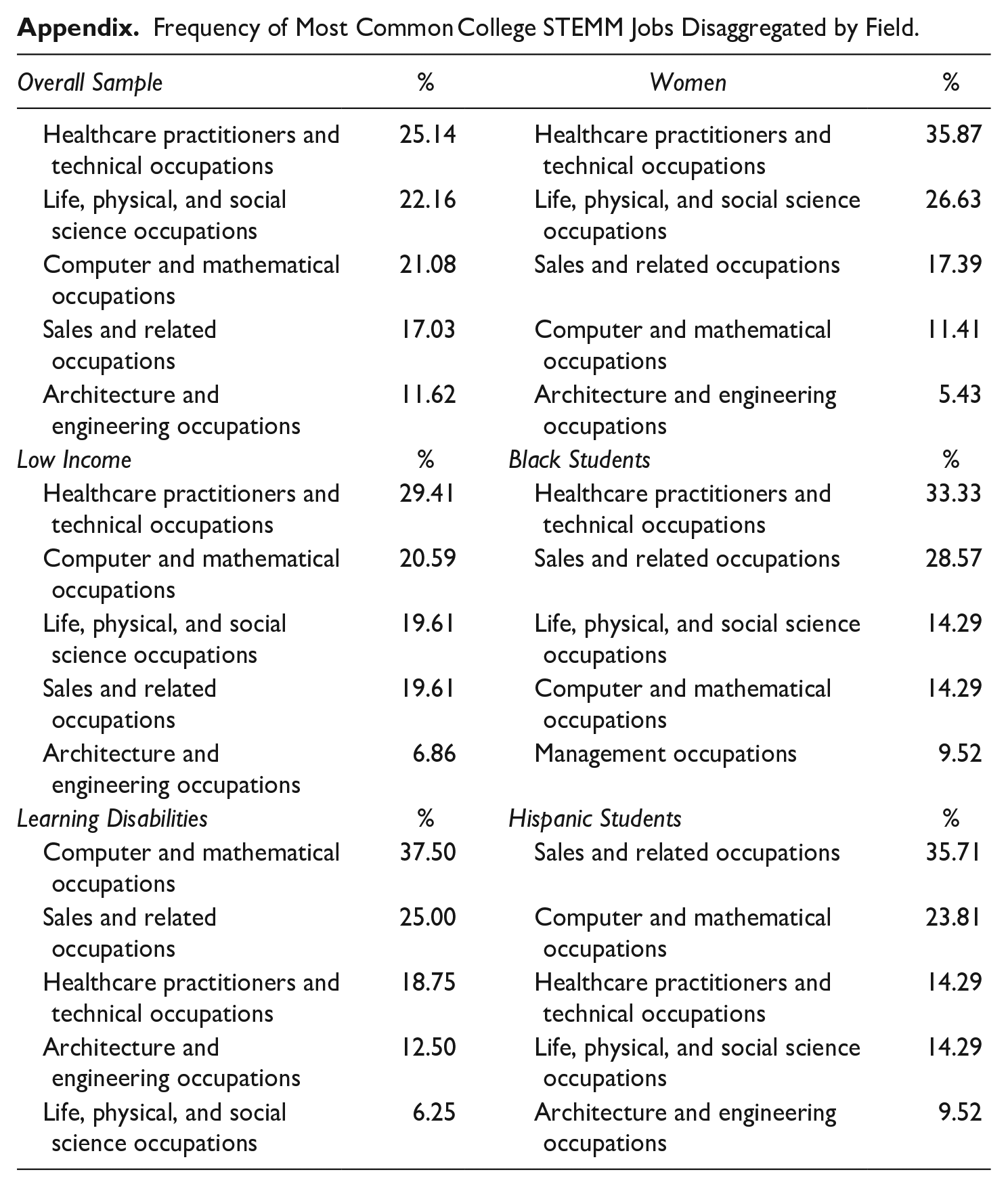
In the second follow-up survey in 2016, students were asked to report their current job title (as of February 2016) or their most recent job title. Using the Bureau of Labor Statistics STEM classification based on Standard Occupational Classification (SOC) codes, NCES created a composite variable indicating the STEM subdomain for the occupation if applicable. From this variable, we created a binary indicator equal to 1 if the student was classified as having an occupation in a STEMM field (e.g., life and physical science, engineering, mathematics, information technology occupations, health occupations), and 0 otherwise. The Appendix presents the frequencies of the most common STEMM jobs in college for the overall sample as well as for the student subgroups that we evaluated.
Expects STEMM job in future
In the second follow-up survey in 2016, students were asked what job or occupation they expected to have at age 30. Using the Bureau of Labor Statistics STEM classification based on Standard Occupational Classification (SOC) codes, NCES created a composite variable indicating the STEM subdomain for the occupation if applicable. From this variable, we created a binary indicator equal to 1 if the student was classified as having an occupation in a STEMM field (e.g., life and physical science, engineering, mathematics, information technology, and health occupations), and 0 otherwise.
Control Variables
Table 1 presents the list of control variables that we use in this study, consistent with those used in prior studies of CTE coursetaking in high school using nationally representative data sets (Adelman, 2006; Bozick & Dalton, 2013; Gottfried, 2015; Gottfried et al., 2014, 2021; Long et al., 2012). These variables include sociodemographic variables (gender, race/ethnicity, English language learner status, if the student receives special education services at school); family data (socioeconomic status, highest level of parental education, parental marriage status); and academic history and attitudes (total academic STEMM units earned in high school, math self-efficacy scale created by NCES, science self-efficacy scale created by NCES, school engagement scale created by NCES, ninth-grade math score, most advanced math course taken in eighth grade). Total academic STEMM units represent the total number of units earned in STEMM courses that are not classified as CTE (i.e., algebra, biology, physics). To classify the most advanced math course taken in eighth grade, we created a series of indicators to group courses into three major subdivisions: (1) below algebra I; (2) above algebra I; and (3) other math course. Given that math courses are highly differentiated and sequentially organized, previous research has found that taking algebra I in eighth grade allows students to transition into more advanced math coursetaking in high school (Austin, 2020; Schneider et al., 1997).
Descriptive Statistics.
Analysis Plan
All three research questions relied on the same analytic approach. For each question, we began with the following model to obtain ordinary least squares estimates of our key relationships of interest:

where Y represents our college employment outcome of interest for student i in school j. STEMMi represents the ratio of STEMM CTE units to total STEMM units completed in high school. The predictors denoted by S, F, and H represent the sets of control variables described earlier, namely, student demographics (S), family measures (F), and academic history and attitudes (H). Finally, the error term was clustered by school to account for the nesting of students within high schools. When Y was a continuous measure, the model was linear, where the coefficients represented an increase or decrease in the given outcome (i.e., hourly wage). When Y was binary, we chose linear probability models over logistic regressions as motivated by recent research (Gomila, 2020), and the coefficients represented a percentage point increase or decrease in the likelihood of a student completing a given general or STEMM college employment outcome.
When considering the baseline model (Equation 1), one issue that could arise when comparing students across schools is the presence of unobserved school-level differences. It was highly likely that students in different schools differed in meaningful ways. The omission of the nuances of the school environment as related to STEMM CTE coursetaking (e.g., course offerings, resource availability, graduation requirements, or a focus on STEMM or workforce development), coupled with our set of outcomes, may have caused bias in the estimation of how STEMM CTE coursework linked to college employment opportunities or STEMM-specific employment outcomes. For instance, schools may offer different CTE or STEMM CTE courses and may simultaneously prepare students for careers beyond high school. However, this was not a function of the STEMM CTE course itself, but rather a school policy. Therefore, in this study, a school fixed-effects strategy was a more stringent attempt to remove potential unobserved school-level biases. To account for such differences, our first model (Equation 2) was revised to include school fixed effects:

where
Results
Research Question 1
Our first research question asked whether the ratio of STEMM CTE units to total STEMM units in high school was linked to general college employment outcomes. For this question, we fit four separate models, each corresponding to one of our four outcomes. The independent variable of interest across all models was STEMMi—the ratio of STEMM CTE units to total STEMM units that a student completed in high school. The results can be found in Table 2, where we present estimates and standard errors for our school fixed effects models. Our findings show no association between general college employment outcomes and the ratio of STEMM CTE units to total STEMM units in high school.
Predicting General College Employment Outcomes.
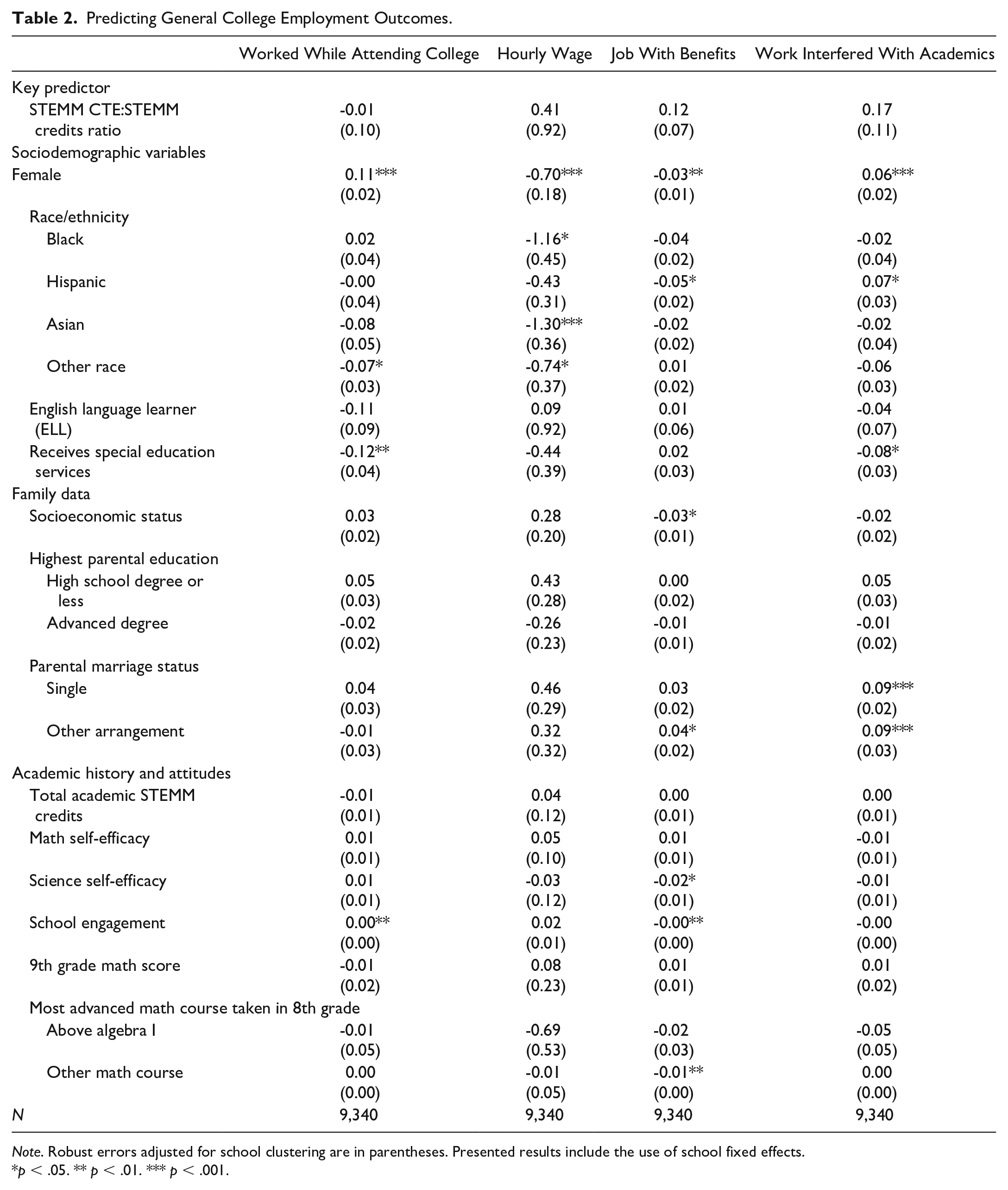
Note. Robust errors adjusted for school clustering are in parentheses. Presented results include the use of school fixed effects.
p < .05. ** p < .01. *** p < .001.
Research Question 2
Our second research question asked whether the share of STEMM CTE coursetaking in high school was associated with STEMM-specific college employment outcomes. We explored two outcomes, and our modeling approach was identical to that identified in Research Question 1, and our results are presented in Table 3.
Predicting STEMM-Specific College Employment Outcomes.
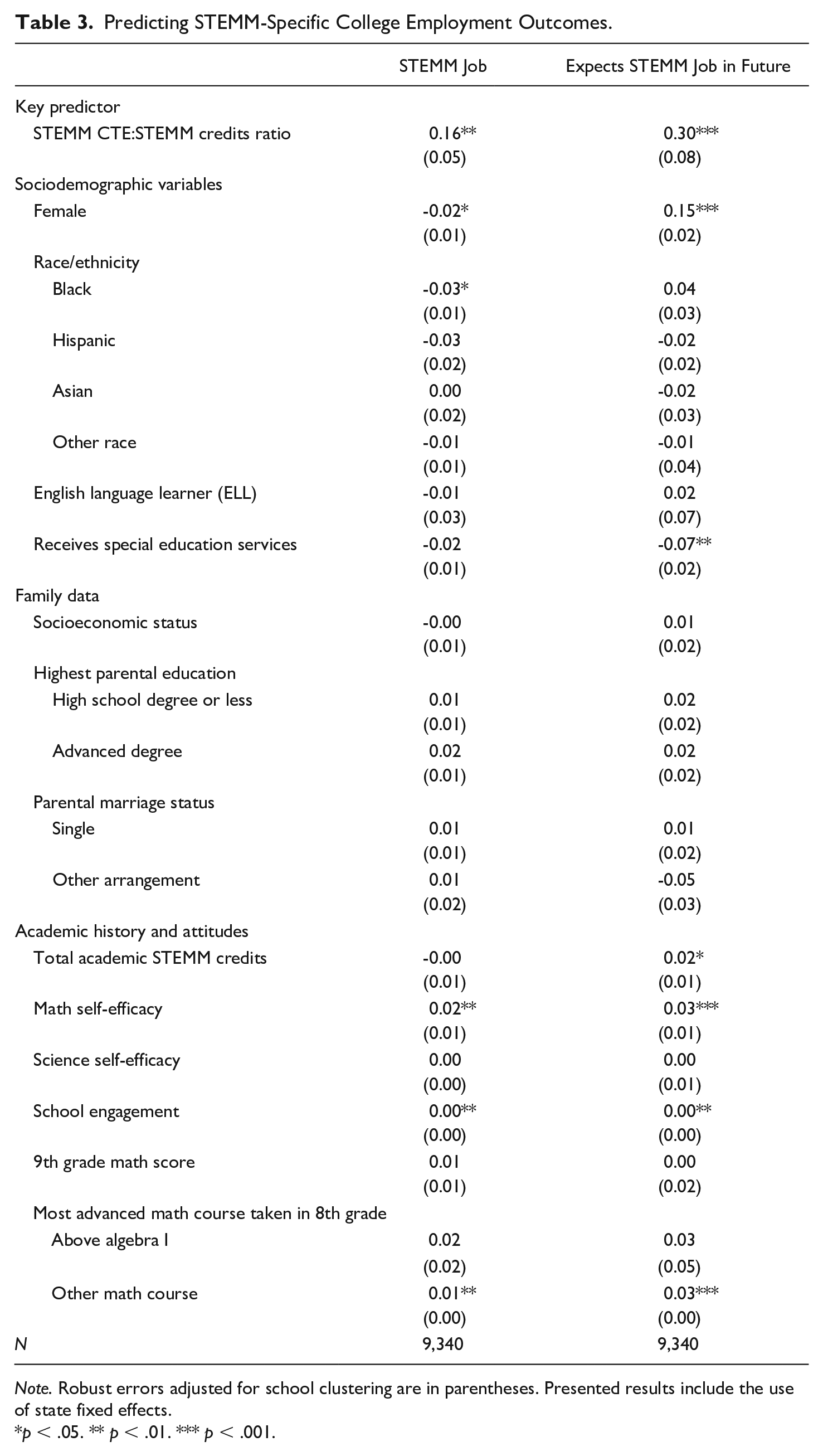
Note. Robust errors adjusted for school clustering are in parentheses. Presented results include the use of state fixed effects.
p < .05. ** p < .01. *** p < .001.
In Table 3, both models had a statistically significant coefficient for the ratio of STEMM CTE units to total STEMM units in high school. High school students who took more STEMM CTE units as a fraction of their total STEMM units were more likely to have held a STEMM job while enrolled in college. In addition, high school students who took more STEMM CTE units as a fraction of their total STEMM units were more likely to have higher expectations of having a STEMM job in the future (after college). This is noteworthy: Across Tables 2 and 3, these outcomes are unique in that they are the only ones that directly map onto STEMM from secondary into activities that took place during postsecondary years. In other words, we see that employment outcomes in college align with the intended sector of the CTE coursework in high school.
Research Question 3
The final goal of this study was to determine whether there are any differences in the relationship between STEMM CTE coursetaking in high school and college employment outcomes for traditionally underrepresented students in STEMM fields. Specifically, our third research question asked whether the relationship between STEMM CTE coursetaking and our outcomes differs for four key groups of students: (1) low-income students, (2) students with learning disabilities, (3) women, and (4) Black and Hispanic students.
For this analysis, we replicated the models from Tables 2 and 3 but included an interaction term between each subgroup and our key independent predictor variable, the ratio of STEMM CTE units earned to total STEMM units earned in high school. For example, when investigating whether there were any links between STEMM CTE coursetaking and our college employment outcomes for women, we included an interaction between the binary female variable and the STEMM CTE units ratio, allowing us to see whether the previously identified relationship was different for women relative to men. In doing this, we hoped to get a better understanding of the relationship between STEMM CTE coursetaking and our selected outcomes by gender.
Table 4 presents these findings. The columns represent the outcomes from Tables 2 and 3. The rows represent different interactions that were explored, including the main indicator for that subgroup, the STEMM CTE ratio, and the interaction between subgroup indicator and STEMM CTE ratio. Note that each interaction set came from a separate regression where the interaction was explored, so that there were seven interaction models run for each subgroup, designed by the outcome.
Results for Group Differences of Traditionally Underrepresented Populations in STEMM Fields.
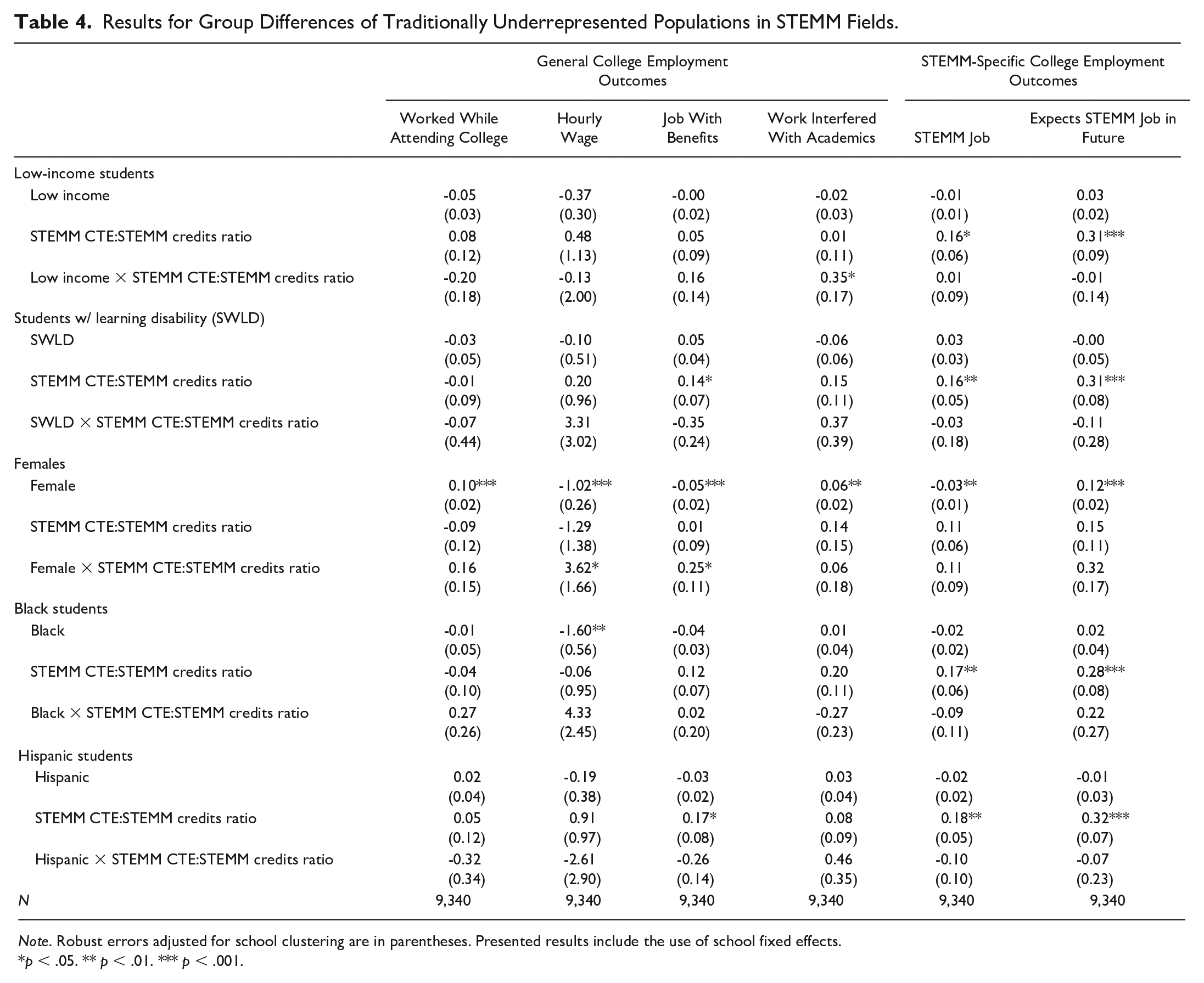
Note. Robust errors adjusted for school clustering are in parentheses. Presented results include the use of school fixed effects.
p < .05. ** p < .01. *** p < .001.
The first grouping of columns explores general college employment outcomes. There is a general lack of statistical significance on the interaction terms (the third row for each subgroup) for students from low-income backgrounds, students with learning disabilities, Black students, and Hispanic students. In other words, for these populations of interest, there are generally no specific links from having taken a higher proportion of STEMM CTE units in high school on general college employment outcomes. There are no consistent patterns of statistical significance across the set of outcomes for either group. For women, however, the interpretation is different. Looking at the final row of the table in the first grouping of columns suggests that women who take a higher share of STEMM CTE units in high school have stronger general college employment outcomes compared with men who have the same STEMM CTE coursetaking ratio. This is evidenced by the statistically significant coefficients on the female × STEMM CTE to total STEMM credits ratio variable in two of the general college employment models: hourly wage and job with benefits. Those two outcomes are higher for women than for men at the same level of the STEMM CTE units ratio.
The last group of columns explores STEMM-specific college employment outcomes. As evidenced by the STEMM college employment estimates in the table, there do not seem to be any systematic differences in the associations for any of the specific populations of interest, relative to the main differences for their respective reference groups. These null findings are shown by the lack of statistical significance on any of the interaction terms, while the main STEMM CTE ratio estimate did remain statistically significant.
Discussion
The growing demand in the STEMM labor market, in conjunction with calls for increased diversification in the STEMM workforce, has led high schools and postsecondary institutions to explore ways to strengthen the STEMM pathway from high school to college and career. STEMM CTE may serve as one means to help enhance this pipeline. Specifically, STEMM CTE courses are designed to help students develop new skills, provide relevant learning opportunities, and enhance engagement (Gottfried & Bozick, 2016). As such, students who are exposed to a greater share of STEMM CTE coursework may be better situated to persist along the STEMM pathway. However, before this study, no work had examined how the effect of relative exposure (i.e., the ratio of STEMM CTE units to total STEMM units) may promote STEMM persistence through encouraging college employment, particularly for students from traditionally underrepresented communities.
Given the growing body of research on the benefits of taking STEMM CTE coursework in high school (e.g., Gottfried, 2015; Gottfried et al., 2014; Plasman, Gottfried, & Klasik, 2019), the need for students to be college and career ready upon high school graduation (National Science Board, 2014), and the need for STEMM-trained employees (Bureau of Labor Statistics, 2020), this study is both relevant and timely. The two most recent reauthorizations of the federal policy governing CTE (the Carl D. Perkins Act) in 2006 and 2018 placed an emphasis on enhancing training in technical skills related to STEMM fields for populations traditionally underrepresented in these areas. This research provides evidence for whether this policy emphasis is being realized across a set of observable outcomes.
Our analysis provides three main insights. First, we identified that a higher ratio of STEMM CTE (to total STEMM) coursework was not related to a span of general college employment outcomes. The fact that there is no significant relationship with these general employment outcomes shows that a higher share of STEMM CTE is not a helping factor—but is certainly not a hindering factor either—for general measures of college employment.
Second, students with a higher STEMM CTE share in high school were more likely to be employed in a STEMM job in college and were more likely to express expectations that they would hold a STEMM job in the future. This may be evidence that STEMM CTE not only helps students see the relevance of this coursework as it relates to later career opportunities—an important factor in ultimately improving the STEMM pathway into later careers—but also may give them relevant work-related skills that make them better candidates for those jobs when they apply for them.
Finally, there were insights when it came to differences by subgroup. Despite finding no relationship between STEMM CTE share and general employment outcomes for students from low-income backgrounds, students with learning disabilities, Black students, or Hispanic students, there were meaningful differences in the association for one student group of interest, namely, women. It appears that women benefitted on a range of general college employment measures after taking a greater share of STEMM CTE units as a fraction of total STEMM units. Yet, the Appendix also suggests that women were most commonly employed in health- and medical-related jobs in college. Hence, these findings together provide insights into how STEMM CTE might help to close employment gaps across several general measures, but at the same time might continue to propagate inequities in STEMM if the college jobs being taken by women are mostly in the health and medical professions.
That said, no STEMM-specific employment benefits were specific to any subgroup. The lack of statistical significance on the interaction coefficients in Table 4 suggests that every group we explored appears to benefit similarly from participation in STEMM CTE when it comes to STEMM college employment outcomes. Because STEMM representation is lower for these key student groups on average, it does not appear that the relative share of STEMM CTE to total STEMM coursework is in itself a mechanism for closing gaps in STEMM representation based on our analyses.
Together, these findings demonstrate the importance of STEMM CTE coursework to the STEMM pipeline, at least through the transition from high school to college. This link bolsters prior work that has identified the connection between high school STEMM CTE coursetaking and STEMM CTE coursetaking and credentialling in college (Plasman et al., 2017; Plasman, Gottfried, & Klasik, 2019). To these prior findings, we add evidence that students with a higher STEMM CTE share are more likely to find employment in STEMM fields in college. This finding indicates that not only does STEMM CTE coursework in high school have the potential to help students develop an appreciation for the real-world application of STEMM skills, but this appreciation translates to job opportunities in college that likely continue to develop students’ STEMM interests and skills. If these college work experiences then translate to postcollege education and career choices, high school STEMM CTE coursework may indeed be an integral part of the STEMM pipeline.
The fact that there were no differences in general college employment outcomes between students with different STEMM CTE shares of their total science and math coursetaking may still suggest a potential benefit of STEMM CTE. Though students in college may not be earning more during college, students with a higher of STEMM CTE were more likely to be employed in a STEMM job in college, lending further evidence as to the potential link between STEMM CTE coursework and the overall STEMM pipeline. Further, given that CTE coursework has been commonly viewed as less rigorous than traditional coursework, the fact that students are enrolling in college and finding college work at similar rates regardless of how much of their science and math coursework comprises CTE courses speaks for the case that CTE coursework is on par with traditional coursework as far as college employment is concerned. In light of this and prior work outlining additional benefits of STEMM CTE participation (Plasman et al., 2022; Plasman & Gottfried, 2018; Plasman et al., 2021), STEMM CTE participation should not be considered lower quality.
Similarly, though there were no significant interaction effects for any of our observed subgroups when it came to STEMM-specific employment outcomes, these results demonstrate that the share of STEMM CTE coursework is not exacerbating differences in STEMM representation for traditionally underrepresented groups even though it is also not reducing such differences. As a result, the need to diversify the STEMM workforce continues, particularly through encouraging students to pursue careers in nontraditional fields (i.e., women in engineering), given that discrepancies in specific STEMM careers by gender have been particularly well documented (Funk & Parker, 2018). Given prior work identifying the STEMM CTE benefits for groups traditionally underrepresented in STEMM (Plasman & Gottfried, 2018; Plasman et al., 2021, 2022), federal, state, and local policies should continue to emphasize the expansion of STEMM CTE access to these groups, and schools should work to encourage STEMM CTE participation for all student groups.
Limitations and Future Work
Despite making the best use of available data, our analyses are not without limitations. First, based on data availability, we were unable to determine whether students pursue STEMM-related careers after college. We are hopeful that future waves in the HSLS series will follow students into career, as has been done in prior national data sets. This would allow for a more complete understanding of the STEMM pathway from high school to college to career. The federal push for states to develop longitudinal data systems will also likely provide a resource to explore such questions at the state level as the systems are put in place.
Second, we do not know exactly why students choose to participate in STEMM CTE in high school and how their experiences in these courses may influence later STEMM trajectories. This is one of the most difficult aspects related to evaluating the effects of CTE participation in general in the United States. We did explore the demographic characteristics of our samples (based on quartiles of the STEMM-CTE ratio), and those characteristics did not differ. Therefore, we believe that underlying characteristics must explain motivations. To provide this more in-depth contextual insight, qualitative studies exploring student perspectives as to motivations and experiences may shine light on key differences between STEMM CTE participants and nonparticipants.
Third, while this study examined the ratio of STEMM CTE courses, we did not examine tradeoffs or opportunity costs compared with all courses that a student might have taken in high school. For example, future research might examine implications of taking more STEMM CTE courses compared with other courses—namely, what a student is not taking when enrolled in more of these practical, applied classes. This leaves open the opportunity to determine not only coursetaking and their outcomes, but also what implications coursetaking patterns might have for other courses that students can or cannot take as a result.
Finally, though HSLS does include a large sample of students from across the nation, sample sizes quickly diminish when exploring individuals with certain intersecting identities who demonstrate STEMM CTE coursetaking patterns. Through the use of state longitudinal data systems, some of these issues related to sample sizes could be solved, allowing for a more detailed look at the experiences and outcomes related to intersectionality. This would help shine additional light on how diversity and inequity may be playing out in STEMM fields.
In sum, our study explored how the share of STEMM CTE units compared with total STEMM units related to a set of college employment outcomes. The use of this ratio as a measure of overall exposure to STEMM CTE provides a novel look at how these courses may relate to later student outcomes associated with the STEMM pathway from high school to college and career. Considering the apparent disconnect along the STEMM college-to-career pathway (Day & Martinez, 2021), access to and participation in STEMM CTE during high school may serve as one way to approach this issue at an earlier stage in the pathway. While this study does present evidence that work still needs to be done to improve diversity in STEMM persistence, it also shows that the push to increase the accumulation of STEMM technical skills through programs and actions as outlined by the Perkins Act may be moving the needle in the right direction.
Footnotes
Appendix
Frequency of Most Common College STEMM Jobs Disaggregated by Field.
| Overall Sample | % | Women | % |
|---|---|---|---|
| Healthcare practitioners and technical occupations | 25.14 | Healthcare practitioners and technical occupations | 35.87 |
| Life, physical, and social science occupations | 22.16 | Life, physical, and social science occupations | 26.63 |
| Computer and mathematical occupations | 21.08 | Sales and related occupations | 17.39 |
| Sales and related occupations | 17.03 | Computer and mathematical occupations | 11.41 |
| Architecture and engineering occupations | 11.62 | Architecture and engineering occupations | 5.43 |
| Low Income | % | Black Students | % |
| Healthcare practitioners and technical occupations | 29.41 | Healthcare practitioners and technical occupations | 33.33 |
| Computer and mathematical occupations | 20.59 | Sales and related occupations | 28.57 |
| Life, physical, and social science occupations | 19.61 | Life, physical, and social science occupations | 14.29 |
| Sales and related occupations | 19.61 | Computer and mathematical occupations | 14.29 |
| Architecture and engineering occupations | 6.86 | Management occupations | 9.52 |
| Learning Disabilities | % | Hispanic Students | % |
| Computer and mathematical occupations | 37.50 | Sales and related occupations | 35.71 |
| Sales and related occupations | 25.00 | Computer and mathematical occupations | 23.81 |
| Healthcare practitioners and technical occupations | 18.75 | Healthcare practitioners and technical occupations | 14.29 |
| Architecture and engineering occupations | 12.50 | Life, physical, and social science occupations | 14.29 |
| Life, physical, and social science occupations | 6.25 | Architecture and engineering occupations | 9.52 |
Declaration of Conflicting Interests
The author(s) declared no potential conflicts of interest with respect to the research, authorship, and/or publication of this article.
Funding
The author(s) disclosed receipt of the following financial support for the research, authorship, and/or publication of this article: This research was supported by two research grants from the Institute of Education Sciences at the U.S. Department of Education: R305A180096 and R324A190202.