




Abstract
Research has yielded much evidence that investing in postsecondary interventions increases retention and success for Hispanic/Latinx undergraduates. This study examines one such intervention, funded by Title V and implemented at a large public Hispanic-Serving Institution, developed to improve semester-to-semester retention. Faculty and peer mentors facilitated a set of workshops for probationary students and students in a core university course that connected self-regulatory skills for college success to those for career success. Students participating in the workshop intervention were compared to a control group of students who did not participate. Findings showed that in comparison to the control group, students in the intervention had higher retention rates, regardless of probationary status or student classification, along with higher rates among students with lower GPAs. Implications of the study are discussed in relation to “servingness” at HSIs.
Keywords
The present work describes a project funded by Title V through the U.S. Department of Education (DOE) aimed at increasing the retention of undergraduate Hispanic students. While the current study demonstrates the impact of the program on students at an individual Hispanic-Serving Institution (HSI), it is important to view the study in terms of the broader impacts of similar programs across HSIs aimed at the advancement of Hispanic/Latinx postsecondary students. Doing so allows for reflection on the concept of servingness at HSIs, that is, what it means to serve Hispanic/Latinx students at Hispanic-Serving Institutions (Garcia et al., 2019; Gonzalez et al., 2020; Núñez, 2017; Rios, 2019). The value of the current study is to contribute to the need for more research that examines the link between institutional funding at HSIs and Hispanic/Latinx students’ outcomes (Perez, 2020; Villarreal & Santiago, 2012). Furthermore, the study prompts an examination of how singular programs or interventions, such as those funded by Title V, aimed at student success must be mapped onto a multidimensional framework of servingness (Garcia et al., 2019) to evaluate an institution’s commitment to Hispanic/Latinx students. More specifically, the program in the present study aims to equip students with methods for navigating college toward retention. Yet, the university bears responsibility for the outcomes and overall impact of the program, if the program is appropriately contextualized within the institution’s vision of servingness. Based on this premise, the approach of this paper is to first provide background on Title V programs as a particular investment in Hispanic/Latinx student success, followed by a description of the conceptual basis for the Title V program examined in this study, then a discussion of not only the quantitative findings of the study but also the implications of the findings for institutional servingness.
Background of Title V Programs
The Title V – Developing Hispanic-Serving Institutions (DHSI) Program funds selected eligible HSIs to increase educational opportunities and attainment for Hispanic students through specific types of projects (U.S. DOE, 2020). HSIs, first defined by the 1992 Higher Education Act, are accredited non-profit degree-granting institutions with 25% or more total undergraduate Hispanic full-time equivalent (FTE) student enrollment (Villarreal & Santiago, 2012). For HSIs to be eligible for DHSI funding, they must also meet a specified threshold of enrolled students receiving need-based financial aid, and low average FTE educational and general expenditures (U.S. DOE, 2020; Villarreal & Santiago, 2012). The types of projects funded by the DHSI Program include student support services, academic tutoring or counseling programs, faculty development, purchase of educational materials, scientific or laboratory equipment, and instructional facilities, among others (U.S. DOE, 2020).
A report by Excelencia in Education (Santiago et al., 2016) examined the investment of Title V funds at HSIs over the past 20 years. More than half of the awards have been directed to projects on faculty and curriculum development or student support services (Santiago et al., 2016). Title V grants represent a very small percentage (about 1–2%) of an institution’s overall annual budget, with an average annual grant of $510,000 (Santiago et al., 2016). The number of HSIs nearly doubled between 1995 and 2014, and just over half of these institutions have received at least one DSHI grant. The report concluded that while a broad association exists between Title V institutional capacity-building and an increase in Hispanic students’ educational opportunities and attainment, more research is needed to show direct links between DHSI funding and student success (Santiago et al., 2016).
In a study of 4-year HSIs, Perez (2020) found that grants and educational investments were positively associated with degree attainment for Latinx students. The sample included 76 4-year institutions, which were the only HSIs that had 25% or more undergraduate Hispanic students enrolled in fall 2012 with 1,000 or more enrolled students. The results of the study showed HSIs that had received a Title V grant were more likely to have an increased percentage of bachelor’s degrees awarded to Hispanic students. Interestingly, Title V grants were not a significant predictor of graduation rates for Hispanic students. This finding might be explained by the attendance patterns of Hispanic students who may stop out of college and extend the time to degree (Perez, 2020), making degree conferral a more informative outcome than graduation rates.
Apart from research on Title V initiatives, a considerable amount of research shows positive outcomes for Hispanic/Latinx students participating in academic support programs. Research on programs involving undergraduate research experiences, summer orientation, first-year seminars, and honors colleges has reported student gains in retention, GPA, and degree completion at HSIs or with Hispanic/Latinx student samples (Connolly et al., 2017; Jarzombek et al., 2017; Shuster et al., 2019). This study assesses student retention following the implementation of a short-term program involving other research-based practices.
Conceptual Basis of the Program
The focus of the support program in the current study is on self-regulatory skills, the connection of those skills to both college and career success, and reinforcement of those skills by faculty and peer mentors. These elements—self-regulatory skills, career relevance, peer mentoring, and accessible faculty mentors—have been shown in previous research to contribute to college attainment (Bembenutty, 2011; Thibodeaux et al., 2017; Wibrowski et al., 2017). The intervention combined these elements in an effort to increase student retention.
Self-regulated learning refers to self-directed beliefs and processes that learners use to perform academically (Zimmerman, 2008). Self-regulated learning involves setting goals, finding and using strategies, monitoring one’s progress, and evaluating one’s performance (Zimmerman, 2008). Self-regulatory processes incorporate environmental structuring, help-seeking, and holding oneself accountable for learning (Kitsantas, 2002, as cited in Cohen, 2012). Individuals differ in the extent and quality of their self-regulatory processes (Cohen, 2012). Learners who effectively self-regulate aim toward goals, are motivated, complete tasks on time, and acquire new skills (Cohen, 2012). In postsecondary settings, self-regulated learning is especially important as students take on greater responsibilities and are expected to independently identify and set goals, develop future plans, and manage their achievement of those goals (Bembenutty, 2011). For first-generation college students who need to understand the college system, it is important to develop “cognitive maps” to navigate how to succeed; such maps can guide students on how to self-regulate (Torres, 2006). Moreover, for first-generation and Hispanic/Latinx students who must balance life activities including work and family, self-regulatory skills are key for maneuvering academic life (Thibodeaux et al., 2017). Interventions to teach self-regulatory strategies to college students in orientation programs or first-year experience courses have shown success, in terms of improved GPAs, higher retention rates, and increased graduation rates (Thibodeaux et al., 2017; Wibrowski et al., 2017).
In both secondary and post-secondary education, some research has argued for the importance of transferring particular skills from academics to the workplace (Kivunja, 2015; Savitz-Romer & Rowan-Kenyon, 2020). Self-regulation is one among a set of similar skills viewed as important not only for academic achievement but also for career success. These skills have been collectively referred to as employability skills, workplace-ready skills, soft skills, non-cognitive skills, or 21st-century skills, with some arguable distinctions between terms (Bowman et al., 2019; Hora et al., 2018; Savitz-Romer & Rowan-Kenyon, 2020). Self-regulation has been represented in these skillsets more specifically as time management, self-discipline, goal-setting, and self-motivation; related skills include perseverance, self-efficacy, adaptability, conscientiousness, and willingness to learn (Kivunja, 2015; Savitz-Romer & Rowan-Kenyon, 2020). Research indicates that both universities and employers desire these skills, yet there is variation by discipline and occupation in which skills are prioritized (Savitz-Romer & Rowan-Kenyon, 2020). Our program intended to demonstrate to students the relevance of self-regulatory skills used in college for career readiness.
The program in the current study sought to integrate another practice shown to bolster the achievement of Hispanic/Latinx and first-generation college students: mentoring from faculty and peers. In a study of undergraduates at a large 4-year HSI, connectedness to faculty was found to be directly related to the intent to remain in college and actual retention (Sass et al., 2018). In a separate program aimed at Latinx and African American sophomore college students, peer mentoring contributed to persistence rates that surpassed the average for all Latinx and African American sophomores over the three years prior to the program (Simmons & Smith, 2020). A peer-mentoring program at another HSI showed that mentees reported greater university integration and connection over the course of the program, compared to students not in the program (Moschetti et al., 2018). An urban HSI observed increased retention and degree completion among Hispanic students following the implementation of multiple interventions partially funded by Title V grants, consisting of peer-mentoring, faculty mentoring through undergraduate research, and exposure to career options (Carpi et al., 2013). Numerous studies beyond these have established that faculty mentoring and peer support play significant roles in advancing Hispanic/Latinx student achievement (see Cerezo & McWhirter, 2012, for a review).
Research Objectives
This study sought to document the outcomes of a Title V-funded program aimed at increasing undergraduate student retention through a workshop on building skills for academic success, integrated with career relevance and guidance from faculty and peer mentors. In doing so, the present study aims to (1) test the efficacy of this short-term success skills intervention for student retention, and (2) draw implications from the results about federal funding for HSIs directed at Hispanic/Latinx student retention, as well as about how such funded programs must be placed within institutional frameworks for servingness. Thus, the primary research question is: to what extent does a Title V-funded, skills-based intervention impact student retention, in terms of semester-to-semester enrollment, accounting for factors including GPA, probationary status, and classification? Secondly, what do the results of the intervention suggest about investment in student programs at HSIs and coordination of Hispanic/Latinx student success initiatives by institutions?
Methods
Research Context
The context of the present study is a public 4-year HSI located in the southwest along the U.S.-Mexico border. In addition to the current DHSI-funded project, the institution has been the home to various student success initiatives in recent years, with evidence of positive impacts on student performance and persistence (Collins et al., 2017; Daniels et al., 2016; Espinoza & Genna, 2021; Jin et al., 2019).
Intervention
The academic success skills workshop consisted of elements from interventions shown in previous research to increase success for students of color and first-generation college students. Primarily, the intervention focused on developing skills for self-regulated learning, namely, clarifying goals, reflecting on successes and challenges, developing realistic plans through identification of resources and pathways, and creating a sense of self-accountability. Activities in the workshop highlighted the value of these skills not only for academic success but for career success as well. Faculty and peer mentors facilitated the workshop to foster connections with student participants.
The intervention was presented to students under the title “Staying on Track” as a workshop to promote the skills necessary to be successful in college and how these skills are valuable for their future careers. Each session was small (3–7 students) and facilitated by a university professor and student peer-mentor. Students conducted multiple exercises on identifying their strengths, challenges, and how to use their strengths to overcome challenges. The professor and peer-mentor began each session with these exercises using their own personal examples. Students were also asked to identify personal and university resources important for their success. Students reflected on their responses in a writing exercise, and then shared their responses with fellow workshop participants.
In a second set of exercises to reinforce self-regulation skills, students were asked to develop post-workshop action plans. Students were instructed to list three sets of action items on color-coded cards: three things they will begin doing (green card), three things they would spend less time doing (yellow card), and three things they will stop doing (red card). The green card entries included items like maintaining a daily planner with assignments and test dates for the semester. Example items on the yellow card included restriction of social media use to after studying is completed and limit the number of paid work hours. The red card included things like stop keeping a smartphone in front of the student when studying and stop delaying meeting with professors when the student is having trouble with courses. Students were advised to review the cards each day to improve their chances for academic success. They were also advised that once the items on the cards became habits, they should erase the newly formed habits and replace them with other items and continue thinking about how to improve their chances for success using the techniques taught during the workshop.
The last part of the workshop required students to make the connection between their action plan and future career success through a writing exercise that they shared with other participants. The following is an example: My profession will require that I keep track of assignments and complete them by deadlines. Developing this skill in college will benefit me at work. My employer will also expect for me to ask questions when I don’t understand something, so I need to get used to asking professors for clarification.
Participants
Participants in the study were students enrolled in a course required for the core curriculum during spring 2019. Course sections were divided into those belonging to the intervention group that received the academic success skills workshops, and the other sections belonging to the control group. Course sections received the same university course material, apart from the academic success workshops provided only to the intervention group. Additionally, first-year students not enrolled in the course who were on academic probation were required to attend the workshops along with the students in the intervention group. In total, 593 students participated in the study, 31.0% of which were in the intervention group (n = 184), and the remaining were in the control group (n = 409). The large majority of undergraduates at this HSI are Hispanic/Latinx (83%), and the core course was reflective of the university demographics.
Variables
Institutional data were utilized for the study, as approved by the university’s institutional review board. Student data on the variables of interest were requested from the university’s institutional research office for those students who had participated in the intervention group and those who were in the control group in spring 2019. No student names or other personally identifying information was included in the dataset provided to the researchers. The university’s institutional research office replaced student names and identification numbers on course rosters with codes appropriate for statistical analysis. Students participating in the intervention group were coded as 1 and students in the control group were coded as 0. Participation in the intervention workshop was the main predictor variable for the study.
Data were also obtained for student retention, the dependent variable, which was operationalized as enrollment in the next regular semester following the study (fall 2019). Student retention was coded as 1 if a student enrolled in fall courses or coded as 0 if a student did not enroll for fall term.
Other variables of interest were included as controls, which may contrast with the intervention as alternative explanations for student retention. One such variable is academic performance in terms of GPA. It is possible that retention could be impacted by student performance during the semester in which students participated in the study, or by students’ past performance. For all students in the sample, data were obtained for both overall GPA and GPA for the semester of study participation (spring 2019). Both overall GPA and spring semester GPA were categorized according to the following ranges: level 0 included GPA values lower than 1.00; level 1 included GPA values greater than 1.00 and less than 2.00; level 2 included values greater than 2.00 and less than 3.00; level 3 included values greater than 3.00 and less than 4.00; and, level 4 included only GPA values of 4.00.
Additional control variables included for possible effects on retention were student classification, academic probation, and length of enrollment at the university. Freshman classification was coded as 1 and all other classifications were coded as 0. Students on academic probation were coded as 1 and all other students were coded as 0. Length of enrollment was operationalized as the time since first enrollment at the university, coded by year and semester, such that lower values indicated a longer time interval.
Results
Descriptive Statistics
Students classified as freshmen represented 90.7% of the sample, and students on academic probation comprised 34.2% of the sample. Overall GPA and spring semester GPA (categorized as level 0 to level 4) each had a median value of 2 for the entire sample. The overall retention rate (i.e., enrollment for fall semester courses) was 67.6%.
Data Analysis
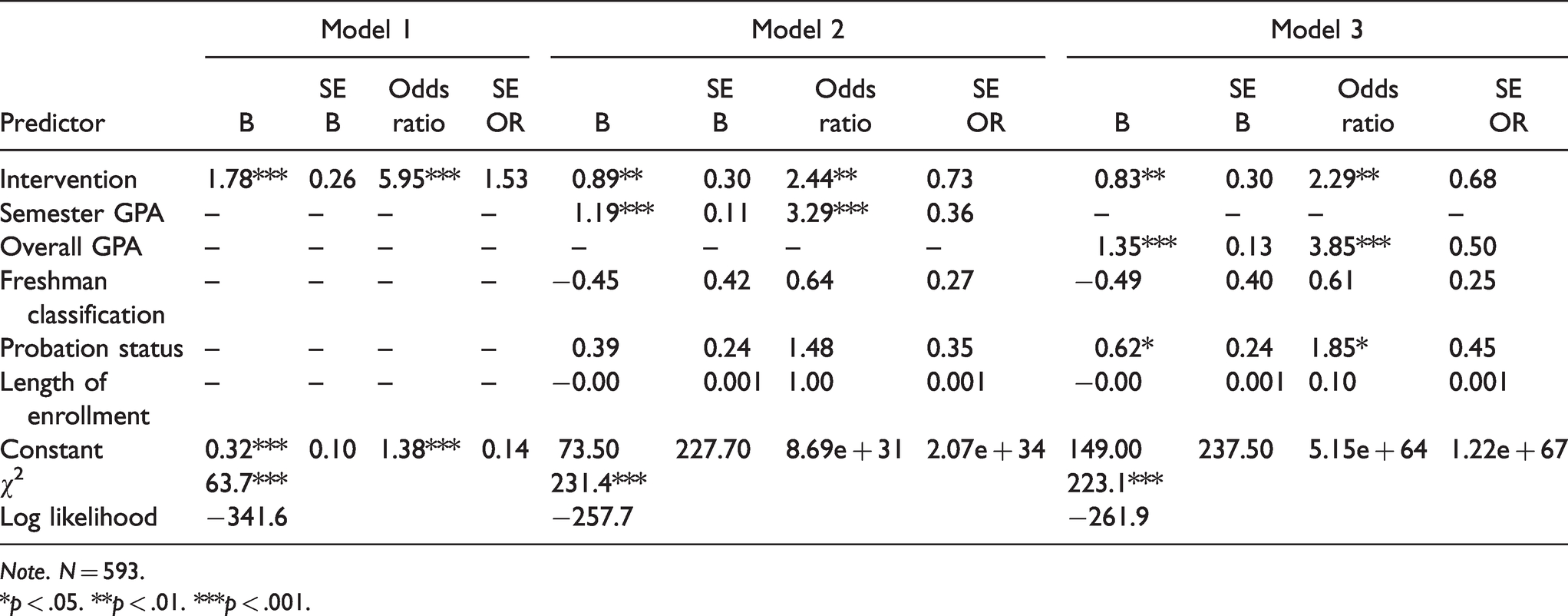
To test the effect of the intervention on student retention, we conducted a logistic regression analysis given the dichotomous nature of the dependent variable (see Table 1). Results for the baseline model (Model 1) showed that participation in the intervention significantly predicted retention, operationalized as enrollment the following semester (p < .001). Model 2 added the control variables of semester GPA (level 0–4 categories), freshman classification, probation status, and length of enrollment. Semester GPA significantly predicted retention (p < .001), while the remaining control variables were not statistically significant. The intervention remained a statically significant predictor of retention (p = .003). In Model 3, overall GPA was substituted for semester GPA, which yielded similar results as the prior model. Participation in the intervention was a statistically significant predictor of retention (p = .005), as was overall GPA (p < .001). The other control variables were not significant.
Logistic Regression Models Predicting Retention.
Note. N = 593.
*p < .05. **p < .01. ***p < .001.
Follow-up analyses were conducted to determine the degree of impact of the intervention on retention by student classification and probation status for students with median semester GPAs. Using the Model 2 estimations, we determined that participating in the intervention improved the probability of enrolling the next semester by 16.3 percentage points among freshmen not on academic probation and with median GPAs (level 2). Among freshmen on academic probation, the change in probability improved by 13.0 percentage points. For other students in the intervention who were not freshmen and were not on academic probation, there was a 12.5 percentage point improvement. For non-freshmen on academic probation, the improvement was 9.5 percentage points. This pattern of findings suggests that students on academic probation did benefit from participating in the intervention, but not as much as their non-probationary peers.
Next, we examined the probability of retention (enrollment in the next semester) for students that did not participate in the intervention (the control group) across the different levels of semester GPA (see Figure 1). Students in the control group who earned a GPA that semester of less than 1.00 (the zero category) had a 28.6 percent chance of enrolling the next semester. For students in the control group with a level 1 GPA, the probability increased to 56.9 percent. The likelihood increased significantly (greater than 80 percent) for students with a level 2 or higher GPA. Thus, students with the lowest grades that semester who were not in the intervention group had the least likelihood of enrolling in courses the following semester.
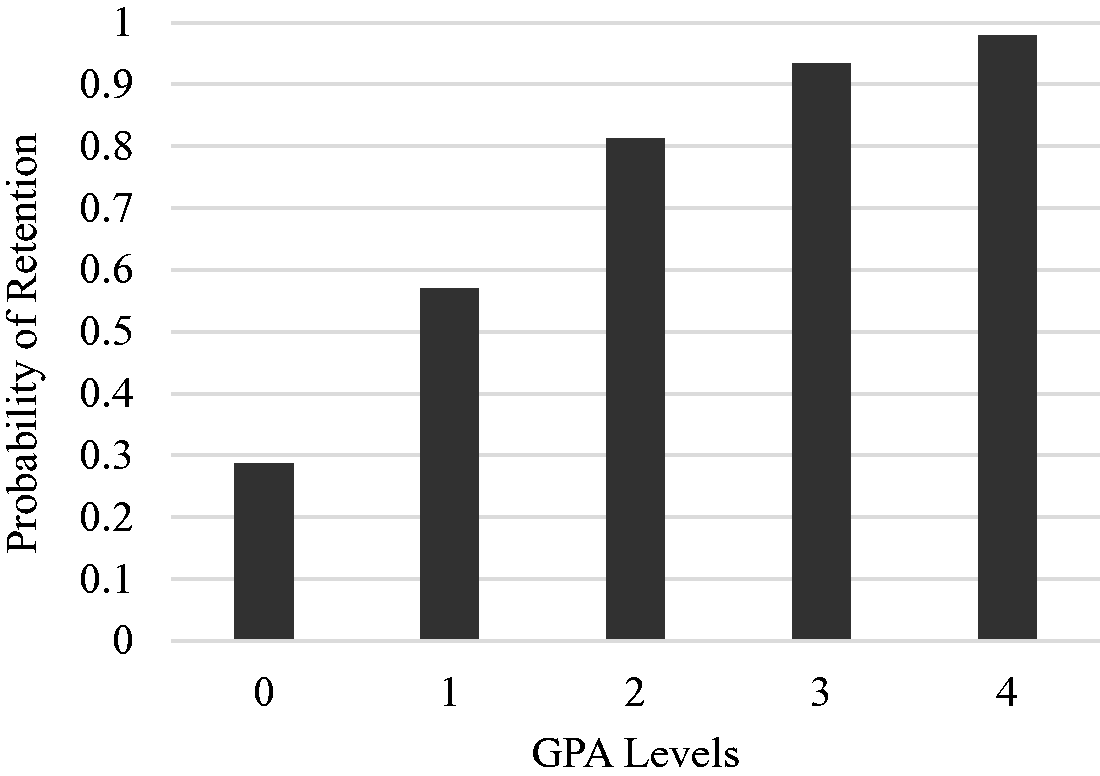
Probability of Retention by GPA Levels for Control Group Participants.
We further investigated the relative impact of being in the intervention group versus the control group on retention for students at each of the semester GPA levels. Figure 2 shows that the relative effect of the intervention is much larger for students with lower GPAs than for students with higher GPAs. Students with a level 0 GPA who participated in the intervention were 20.9 percentage points more likely to enroll the following semester than students at the same level in the control group. This means that the probability of student retention increased from 28.6 percent (for the control group) to 49.5 percent (for the intervention group). The relative probability of retention for students with a level 1 GPA was 19.4 percentage points, an increase from 56.9 percent (for the control group) to 76.4 percent (for the intervention group). The relative increase in the probability of retention with the intervention was 10.1 percentage points for level 2 GPA students, 3.75 percentage points for level 3 GPA students, and 1.22 percentage points for level 4 students. In other words, students with lower GPAs were more impacted by the positive effects of the workshop intervention on retention than were students with higher GPAs.
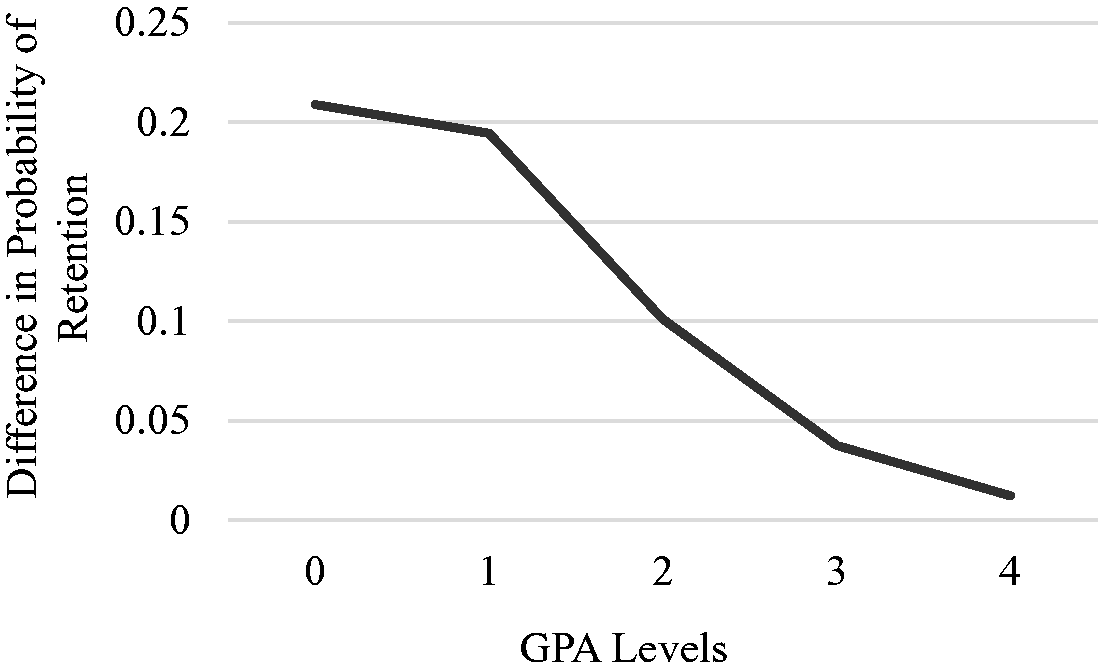
Difference in Probability of Retention for Intervention Group vs. Control Group by GPA Levels.
Discussion
The aim of the present study was to test the efficacy of a Title V-funded intervention to increase retention at an HSI and to examine the findings within the context of federal and institutional support for Hispanic/Latinx student success. The intervention was developed to coach undergraduate students on using and sustaining self-regulatory skills to overcome challenges. The skills were linked to their importance for long-term success in their careers. Students engaged with faculty and peer mentors who modeled their own challenges and use of these skills.
The results of the study showed that this type of intervention contributed to increasing retention among the undergraduates who participated. Students in the intervention group were more likely than control group students to enroll in courses the following academic semester. This finding applied to students on academic probation and freshmen in the intervention group as well, two groups known from previous research to be at-risk for withdrawal. Most encouraging was that the intervention appeared to benefit the lowest-performing students most, that is, those with the lowest semester GPAs. The probability of returning to the university for fall term courses was increased by participation in the intervention for students at all academic levels, but especially for those struggling academically.
Beyond the scope of the present study, our research could be expanded to investigate how the different elements within the intervention functioned to influence retention. For instance, the workshop demonstrated how self-regulatory skills transfer from academic work to professional work, which could have been a source of motivation for students. Students may have been motivated to practice self-regulatory skills because of their applicability beyond college. Research has posited that motivation drives self-regulation and perseverance (Bembenutty, 2011), and perhaps in this case, retention in terms of enrollment the following semester. Faculty and peer mentors may have also been motivating influences. More systematic testing of the different elements within the intervention could clarify their effects on retention. Additionally, the collection of qualitative data could offer insight into students’ responses to various aspects of the intervention. While the present study did engage students in writing exercises about their plans for future goals, this student work was not collected as qualitative data, but such data could easily be incorporated in future research.
Further, the present research could benefit from an experimental and longitudinal design. In this study, because assignment to the intervention group was not random (occurring instead according to course section), the results should be interpreted with caution. Students in the intervention group may have benefitted from attention not provided to students in the control group, and any unintended distinctions between the course sections could not be controlled. It would be ideal to administer the intervention to a randomly assigned group of students and to offer the control group an alternative set of activities unrelated to the intervention. This study focused on a short-term intervention where retention was measured semester-to-semester, much like other studies in the college retention literature investigating the efficacy of brief interventions and outcomes over an academic semester or year (e.g., Carpi et al., 2013; Cerezo & McWhirter, 2012; Shuster et al., 2019). To determine the lasting effects of the intervention on students’ progress through degree completion, the study could track student retention, as well as students’ practice of self-regulatory skills, career orientation, and sustained contact with peer mentors and faculty.
Despite some limitations to the design of the study, the findings underscore conclusions from similar studies that federal investment in Hispanic-Serving Institutions contributes to gains in student retention (Perez, 2020; Villarreal & Santiago, 2012). This study is one among many others demonstrating that funding of student support programs yields positive outcomes for students at HSIs, who are disproportionately from low-income and disadvantaged backgrounds, placing them at risk of struggling and dropping out of college (Contreras & Contreras, 2015; Perez, 2020). The present study contributed to the expanding evidence that relatively simple interventions, yet based on best practices for postsecondary success, can support degree attainment for Hispanic/Latinx students.
Beyond this evidence, current academic discussions address how to connect interventions and support programs to the broader meaning of servingness at Hispanic-Serving Institutions (Garcia et al., 2019; Gonzalez et al., 2020; Núñez, 2017; Rios, 2019). Garcia et al. (2019) systematically reviewed extant research on HSIs to advance a multidimensional framework of servingness in HSIs. Two central dimensions identified in prior research (Garcia, 2017) for describing servingness were (1) student outcomes (i.e., graduation, employment) and (2) organizational culture (i.e., programs, services, campus climate). Garcia et al. (2019) extended this view of servingness to include external influences on serving (e.g., legislation, boards, community), internal structures for serving (e.g., mission, leadership, diversity plans), student experiences within structures (validating and racialized), and student outcomes (both academic and non-academic). This conceptual framework challenges us as HSI faculty, administrators, and researchers to consider where our work fits within our institution’s collective efforts to serve Hispanic/Latinx students. We should consider how our institution defines (and re-defines with change and time) the multiple dimensions comprising this framework. Undertaking these considerations may be a productive step toward unifying efforts (Title V programs, student affairs, academic advising, research, etc.) within the institution aimed at postsecondary success. Developing and implementing programs with the expectation that students will increase their retention and achievement levels is in the long-term unproductive if the larger framework of servingness at HSIs is ignored or under-utilized. Taking stock of how efforts to advance Hispanic/Latinx student achievement connects with institutional priorities and purpose as a whole hearkens back to the significance of why the Title V Program was originally established.
Footnotes
Declaration of Conflicting Interests
The authors declared no potential conflicts of interest with respect to the research, authorship, and/or publication of this article.
Funding
The author(s) disclosed receipt of the following financial support for the research, authorship, and/or publication of this article: This project was funded by the U.S. Department of Education, Developing Hispanic-Serving Institutions Program – Title V, Grant award #P031S140110.
