



Abstract
We examined 45 academic integrity policy documents from 24 publicly-funded universities in Canada’s four western provinces using a qualitative research design. We extracted data related to 5 core elements of exemplary academic integrity policy (i.e., access, detail, responsibility, approach, support). Most documents pointed to punitive approaches for academic misconduct and were based on the notion that academic misconduct results from a lack of morals. One university used the term “contract cheating,” although nearly all categorized the outsourcing of academic work as plagiarism. Details about educational resources and supports to increase student and staff understanding of academic integrity and prevention of academic misconduct were sparse. This study signals the continuing punitive nature of academic integrity policies in western Canadian universities, the reluctance to address contract cheating directly, and the need to revise policies with deeper consideration of educative approaches to academic integrity that support students and academic staff.
Action must occur at all levels of our educational communities in order to foster cultures of integrity. Embracing academic integrity and its fundamental values of honesty, trust, responsibility, fairness, respect, and courage “enable[s] academic communities to translate their ideals into action” (International Center for Academic Integrity, 1999, p. 17). This action should include multi-pronged approaches to deeply understand our students, how they learn, and the factors that facilitate and impede their learning (Bertram Gallant, 2008; Carroll, 2007; Morris, 2018). Educators must also review and redesign their teaching and assessment practices continually. A multi-pronged approach requires that institutions support the efforts of their faculty by providing them with professional development opportunities to encourage continued growth of their teaching skills (Morris, 2018). At a broader level, it is crucial that postsecondary institutions develop holistic academic integrity strategies. A holistic academic integrity strategy necessitates the review and revision (Freeman, 2013), or in some cases the development, of aspects of policies or statements of principles that serve to support students and academic staff (Higher Education Academy [HEA], 2011; Morris, 2018).
Policy-making (Axelrod et al., 2011), including academic integrity policy (Eaton & Edino, 2018), is rarely studied in Canada’s postsecondary sector. Borne out of the call to elevate the field of academic integrity research, including policy research, in Canada (Eaton & Edino, 2018), the present review was initiated to help fill a large gap in our current understanding of academic integrity policy in postsecondary education in Canada. The goals of our research were to locate the governance and policy documents pertaining to academic integrity of publicly funded universities in western Canada, describe their overall conceptualization, and understand the support mechanisms in place to promote integrity while preventing and addressing academic misconduct. Because contract cheating (i.e., the outsourcing of scholarly work to a third party and then submitting that work as one’s own; Quality Assurance Agency for Higher Education [QAA], 2017) has become of critical importance in postsecondary education, we also examined whether and how this specific type of academic misconduct is addressed within academic integrity policy. We begin our policy review with overviews of the legal foundation and governance structure of Canadian universities in Canada (Jones, 2002; Jones et al., 2004), the importance of strong formal systems in decreasing unethical behaviour (Smith-Crowe et al., 2015), and the five core elements of exemplary academic integrity policy (Bretag, Mahmud, Wallace, et al., 2011).
Overview of Higher Education Policy Development
To understand the academic integrity policies of postsecondary education in Canada more fully, we begin with a brief summary of the legal foundation of Canadian universities, the formal structures of university governance, and how both relate to policy development. Canadian universities are “legally chartered as private not-for-profit corporations . . . private in the sense that they are not owned by the state . . . [but are] publicly supported institutions . . .” (Jones, 2002, p. 15). Since the 1950s, the primary model for university governance in Canadian universities has been bicameralism with authority shared between an administrative governing board and an academic senate or equivalent. University policy networks also include the central administration of the university, faculty associations, and student organizations (Jones, 2002; Jones et al., 2004). Differences in university governance and policy networks exist across Canadian universities (MacDonald, 2018), in part because postsecondary education is partly funded by provincial governments (see Kirby, 2007).
Under normal circumstances, members of various groups report that the university governance structure works quite well but imbalances can occur during times of financial strain or when dealing with other pressing issues (Jones et al., 2004). University support personnel have also reported great concern over the influence of some members of the governing bodies when decisions that affect the interests of the broader university community are required. Concern arises when these members do not declare their conflicts of interest and do not abstain from important votes and/or are resistant to changes that would benefit the university community as a whole (Jones et al., 2004). These issues may have significant impact on the development of thoughtful and effective policy-making and revision, particularly as they apply to supporting students and faculty in the area of academic integrity.
Effective policy development and refinement may also be influenced by the policies and procedures related to policy-making itself and the degree to which the policy cycles are adhered. Policy-making has been described as a process that is “struggled over” (Ozga, 1999, p. 1), and involves contemplation, action, and evaluation (Carleton University Macodrum Library, 2020) or “identification and definitions; policy research and analysis; generating policy solutions and alternatives; consultation; developing policy proposals; policy implementation; policy monitoring and evaluation” (PolicyNL, n.d.). In tertiary education in Australia, an elongated policy cycle has been described as involving “identification and confirmation; preliminary consultations; drafting; benchmarking; consultation; revision; compliance checking; endorsement; approval; communication and publication; implementation, compliance, and evaluation; and review” (Freeman, 2013, p. 5). An important concern regarding government and non-government policy cycles is the limitation in “policy analytical capacity” for evidence-informed policy-making, which is characterized as “an effort to avoid policy failures and enhance the potential for policy success through policy learning” (Howlett, 2009, p. 157).
Integrity Policies and Analyses
Formalized (documented, standardized, and visible) policies that have been carefully developed and implemented are vital to an organization as they facilitate significant decreases in the extent of unethical behaviour that can occur, particularly when the informal (less visible) systems (e.g., pressures from peers) to act unethically is high (Smith-Crowe et al., 2015). Because formal and informal systems are at play in every organization, including higher education institutions, development of effective formalized policy for academic integrity necessitates understanding the informal or underlying organizational culture. Thus, representatives from faculty, student, and administrator groups must be involved in the academic integrity policy-making process so that a true representation of the underlying culture can be taken into account (Smith-Crowe et al., 2015; von Dran et al., 2000). During the academic integrity policy-making process, stakeholder groups must develop clear and specific definitions of academic integrity and misconduct, appeal to students’ sense of personal integrity, reduce temptations to engage in academic misconduct, support instructors and their development as good teachers, and impose appropriate consequences (Pavela & McCabe, 1993, p. 28). These stakeholder groups must then actively encourage participation from all university community members to enact it successfully (von Dran et al., 2000) to ensure that policies are more than mere “window dressing” (McCabe et al., 1996, p. 471).
Large scale reviews of academic integrity policies and systems at postsecondary institutions have been conducted in the European Union (EU) (Foltýnek & Glendinning, 2015; Glendinning et al., 2013, 2017) and Australia (Bretag et al., 2011; Grigg, 2010). Glendinning et al. (2013) examined policies and procedures for detecting and handling cases of student plagiarism in 27 EU countries and surveyed administrators, instructors, and students regarding the effectiveness of the policies and how they were developed, reviewed, and updated. Large variation in the maturity of policies and systems for academic integrity was found. Not surprisingly, policies from some countries showed great advances whereas others were outdated. Survey data also suggested that outdated policies and procedures were due, in large part, to the lack of support for enacting the values of academic integrity. In some cases, threats to researchers who worked to elevate the importance of academic integrity, advance research, and improve policy in certain EU countries were present.
Policies only have a chance of being effective if all stakeholders, including students, are aware of them. Foltýnek and Glendinning (2015) reported that 50% or more of students in 17 countries were aware of the existence of policies and procedures for plagiarism, however, in seven countries less than 50% of students were aware of such policies and in one country, none of the students were sure if policies existed. In six southeast European countries, details on the implementation of academic integrity policies were scarce and communication about them appeared to be lacking, suggesting that these policies may be ineffective in preventing academic misconduct (Glendinning et al., 2017).
Bretag, Mahmud, East, et al. (2011) analyzed the publicly available academic integrity policies of 39 Australian universities and specifically looked for the ways in which standards of academic integrity were communicated and how policies enabled best practices in teaching and learning, in addition to providing details on the administrative processes for responding to academic misconduct. The authors found that similar proportions of academic integrity policies communicated punitive elements as educative approaches, suggesting an overall “ideological shift is gradually taking place” in higher education (p. 4). Mixed messages, however, were also a concern particularly when titles and introductions to policies were focused on educating students about academic integrity and good learning practices, but the remainder of the documents provided many more details about investigation procedures and consequences for engaging in academic misconduct.
From this research, Bretag, Mahmud, Wallace, et al. (2011) identified five core elements of exemplary academic integrity policy: access, approach, responsibility, detail, and support. Access refers to the ease with which a document can be located, read, and understood by all members of the educational institution, including students. Approach refers to the extent to which a document communicates the importance of academic integrity and the educational support required to teach, learn, and live by its values. Ideally, academic integrity policy is applicable to all members of the university community and each member shares responsibility for upholding the values of academic integrity. The presence of extensive detail to facilitate understanding of academic misconduct, including the provision of definitions and procedures for identifying, reporting, and investigating academic misconduct, and descriptions of appropriate consequences for engaging in unacceptable scholarly behaviour. Finally, exemplary policy provides support in the form of references to procedures, educational and training resources, and professional development opportunities for students and educators.
In Canada, we used Bretag, Mahmud, Wallace, et al.’s (2011) five core elements of exemplary academic integrity policy as a framework to review the academic integrity policy documents of publicly funded colleges in Ontario paying particular attention to the way in which contract cheating was described and categorized (Stoesz et al., 2019). An important finding was the use of indirect language in policy, particularly when referring to contract cheating, which Bretag et al. (2011) argued creates confusion for students and academic staff as they attempt to read and follow policy. Contract cheating is a serious form of academic misconduct that is a growing worldwide problem (Khan et al., 2020), therefore, it is important that postsecondary education policies are up to date with current understanding of issues in education and reflect the serious nature of particular acts of academic misconduct.
Present Research
This study builds on our previous research on academic integrity in Canada, which focused specifically on Ontario (Stoesz et al., 2019). Western Canada often identifies itself as unique region within Canada and as particularly distinct from Ontario, although whether this uniqueness is evident in academic integrity policy at the postsecondary level has yet to be determined. We undertook the present research to analyze the overall conceptualization of academic integrity within and across publicly funded universities in Canada’s western provinces to determine whether contract cheating is specifically addressed within the policy documents, and to understand the support in place to promote academic integrity and prevent and address academic misconduct. Clearly defining contract cheating in policy, why it is a serious academic integrity violation that must be addressed, and how instances are dealt with are actions recommended by a number of postsecondary organization around the world [Australian Government: Tertiary Education Quality and Standards Agency (TEQSA), 2017]. We primarily used the work of Bretag and colleagues (Bretag & Mahmud, 2016; Bretag, Mahmud, East, et al., 2011; Bretag, Mahmud, Wallace, et al., 2011) as a framework for our policy review, and also consulted materials from TEQSA (2017) and HEA (2011) where relevant.
Methods
Selection of Postsecondary Institutions
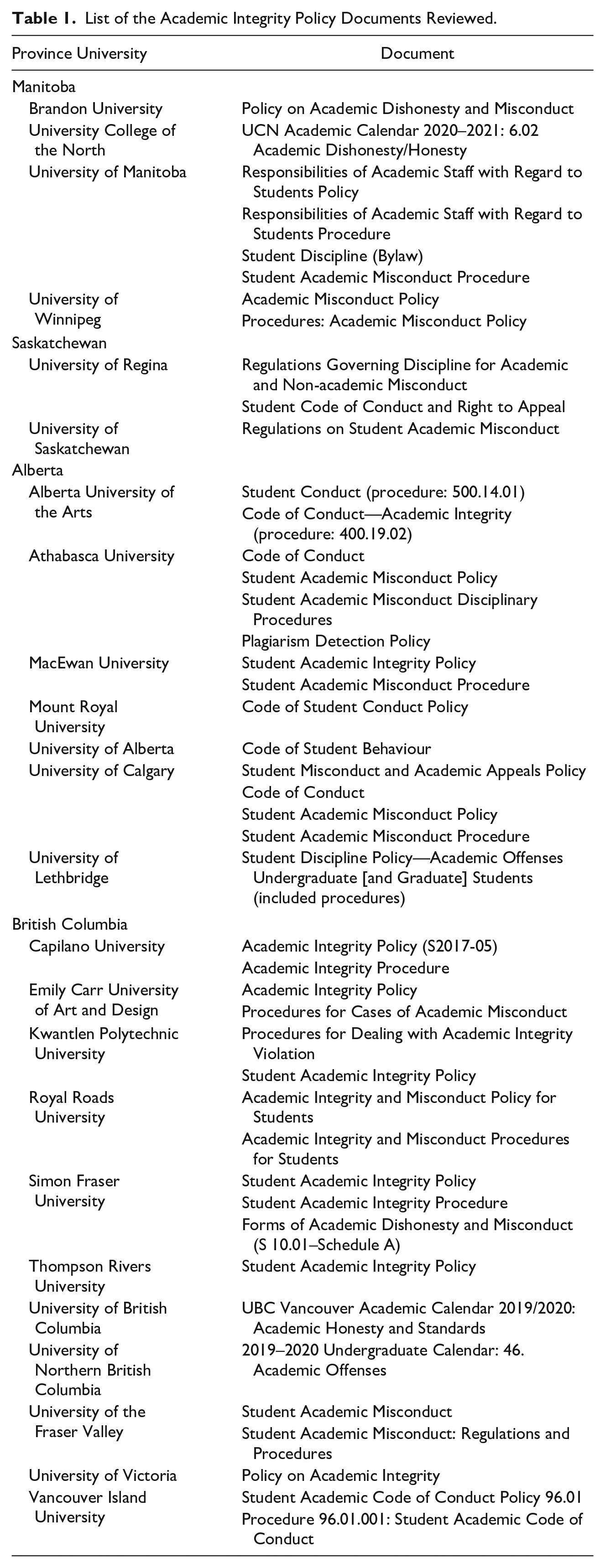
We limited our review to the documents of publicly funded postsecondary institutions in the four western Canadian provinces that are legally recognized as universities and regulated by provincial legislation but are autonomous in their governance (Jones, 2002). We referred to the Directory of Educational Institutions of The Canadian Information Centre for International Credentials (cicic.ca) and verified these results through comparison with the listings on each provincial governments’ education department website. We further restricted the universities to those whose official language of instruction is English. Application of these criteria resulted in the identification of 24 publicly funded postsecondary universities in western Canada (see Table 1).
List of the Academic Integrity Policy Documents Reviewed.
Selection of Documents
We restricted our review to policies, procedures, and guidelines (see Table 1) (Freeman, 2013) from parent universities and not from their affiliated or federated universities or colleges. Document searches were conducted initially by a research assistant using each institution’s web search function or by inserting the name of the institution and the words “academic integrity policy” into Google’s search bar. This first wave of document retrieval (May–June 2019) resulted in the collection of 42 documents. During the data extraction and analysis phases, a second wave of document retrieval (December 2019–January 2020) conducted by the first author captured an additional 22 documents that were not found in the initial search but were either mentioned in the first set of retrieved documents or replaced the originally retrieved document because it was the updated version. Inspection of the collection of 64 documents revealed that 19 did not contain information about academic integrity or were duplicates. In total, 45 documents were included in our academic integrity policy review. Similar methodology has been used in previous work (Bretag, Mahmud, East, et al., 2011; Grigg, 2010; Stoesz et al., 2019).
Data Extraction and Analysis
We extracted and coded information related to the five core elements for exemplary academic integrity policy as described above (Bretag, Mahmud, Wallace, et al., 2011). Falling under access, we extracted information about the type of each document, revision dates, and review cycles (see also Grigg, 2010). Falling under approach and responsibility, we noted the title and the presence of policy principles within each document and its intended audience, respectively. Under detail, we searched for information about academic misconduct and how these were categorized. Based on previous research (Stoesz et al., 2019), we expected that the term “contract cheating” would not be mentioned in most documents, but that the behaviour would be described. Thus, we coded these descriptions by the categories of misconduct that they fell under within each document. We coded student support by the categories of workshops, online modules, awareness campaigns, learning resources, and disciplinary resources. Finally, we coded support for academic staff by the categories of workshops, online modules, awareness campaigns, teaching/learning resources for promoting academic integrity and/or assessment design, and disciplinary resources.
The second author designed the overarching study, details of which are available on the Open Science Framework (Eaton, 2019). The first author extracted the data from all of the retrieved documents. With instructions and training from the first author, each of two research assistants extracted the data for half of the total number of documents. In this way, the data extraction process for each document occurred twice. These procedures helped to ensure that the team included all the relevant details for analysis.
Results
Access
We located and downloaded 41 documents as easy to print and read files (i.e., PDF or Word). The content of one set of policies and procedures, however, was restricted to a webpage and the content was copied and pasted to a Word document to facilitate our analysis. Five documents were difficult to locate online and required additional clicks beyond the search result. We coded 20 documents as policies, 14 as procedures, 2 as regulations, 8 as codes of conduct, and 4 as other (three academic calendars, one schedule) for a total of 48 classifications. One document contained both the policy and the related procedure, and two documents were coded as policies and codes of conduct.
Thirty-seven documents provided the dates that the documents came into effect (Range: July 1979–September 2019). Sixteen documents reported revision dates and/or revision effective dates as of 2005 (n = 1), 2012 (n = 2), 2015 (n = 2), 2016 (n = 3), 2017 (n = 3), 2018 (n = 4), and 2019 (n = 2). Dates were not reported in three documents. Twelve documents reported the date for the next review (Range: December 2012–September 2028). Nine documents provided an indication of their policy review cycle as annual (n = 1), every 5 years (n = 4), or every 10 years (n = 4).
Approach
We coded titles, which communicate the overall intent of a document, based on the specific words used in them. Twenty titles contained the negatively-framed words of dishonesty/misconduct, discipline, and plagiarism detection; 21 titles contained the positively-framed words of integrity, conduct, and responsibility; and 3 titles used a mixture of negatively- and positively-framed words of dishonesty/honesty, integrity/violations, and integrity/misconduct. We identified 13 principles in 43 documents. Two to six principles were identifiable in the 31 documents of 22 universities, with “punitive,” “academic integrity/values/standards,” “procedural fairness,” and “education” rounding out the top four (see Table 2). Details regarding the meaning of these principles and how they guided the development of the document or justified inclusion of certain types of information about academic integrity were not included within the documents. We were unable to identify policy principles in two documents.
Policy Principles Identified in the Academic Integrity Documents of Publicly Funded Universities in Western Canada.
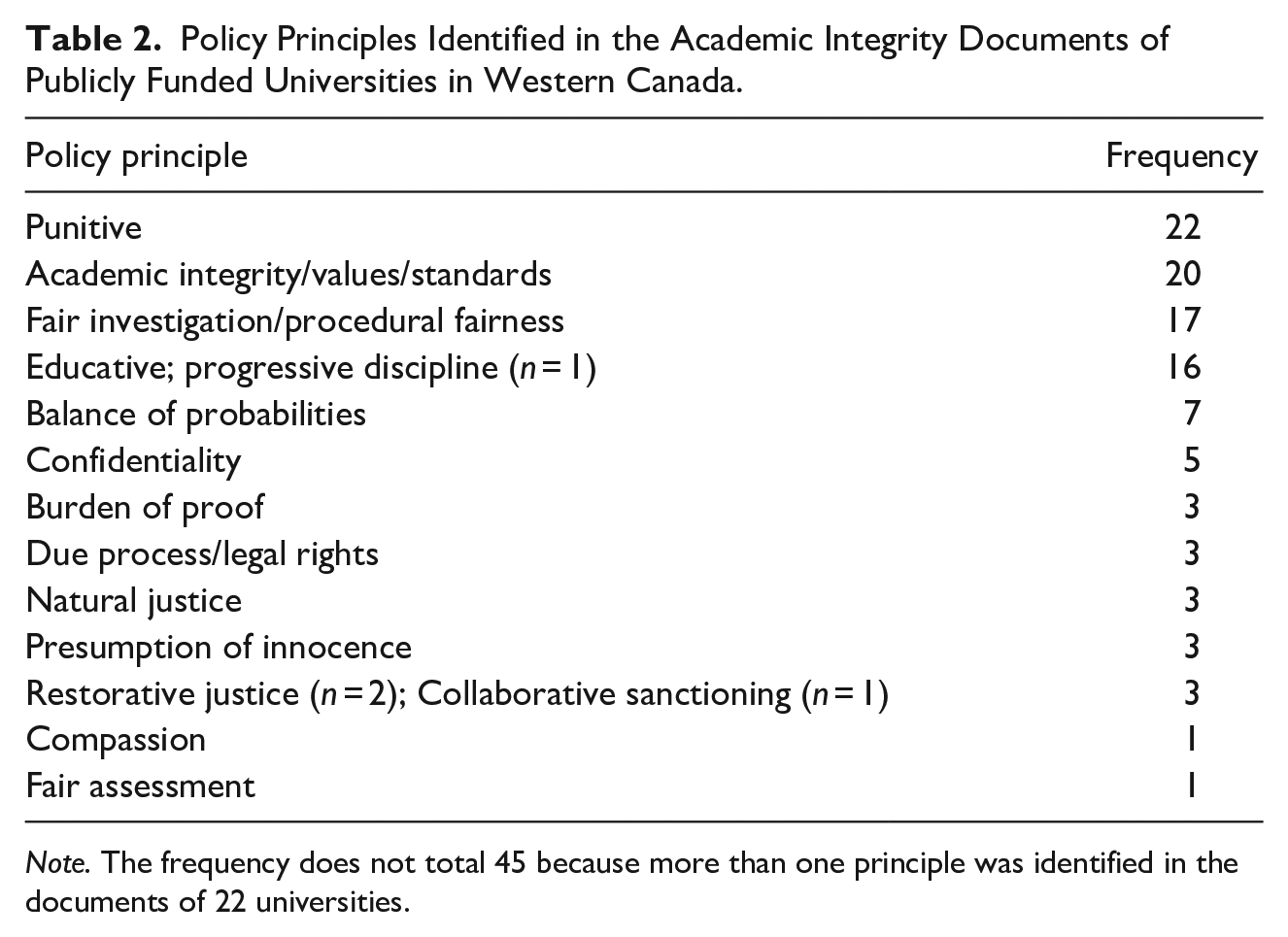
Note. The frequency does not total 45 because more than one principle was identified in the documents of 22 universities.
Responsibility
Of the 45 documents, we identified numerous target audiences including students (n = 18), academic/teaching staff (general) (n = 5), faculty/instructors (n = 8), all members of the university community (n = 21), and/or administrators/The University (n = 9). Although many documents identified that all members of a university community are responsible for upholding the values of academic integrity, the documents largely contained details of the violations that students must not engage in and instructions for instructors and administrators to follow when misconduct is suspected. In six documents, instructors were deemed responsible for taking reasonable measures to promote academic integrity by educating students about academic integrity and implementing appropriate teaching and assessment practices, and in four of these, students were responsible for understanding academic integrity and the universities’ policies and practices regarding academic misconduct. In most documents, the onus was on the student to learn about and understand such policies and instructors’ responsibility was to confront students and/or report academic misconduct when observed.
Detail
We extracted a broad range of categories of academic misconduct included within each document, with the most common being “Plagiarism,” “Cheating,” and the general category of “Academic misconduct/dishonesty” (see Table 3). Within the documents, we searched for the term “contract cheating.” Only one document included the term with the definition: “Contract cheating A form of severe academic misconduct consisting of outsourcing or attempting to outsource academic work to a third party” (MacEwan University, 2018, p. 1). Although 22 universities did not use the term in their documents, we found clear language describing “contract cheating” in 13 documents from 10 universities. Phrases such as “seeking credit for work they did not do, ” “purchasing or otherwise acquiring,” and “hiring others to complete your work” were used to describe outsourcing behaviour. These descriptions were categorized as plagiarism (n = 12), cheating (n = 9), inappropriate collaboration (n = 2), collusion (n = 1), fraud (n = 2), and general academic misconduct (n = 5). One document rated the act of submitting an assessment completed by a third party on a scale of severity (i.e., Level 3 and 4 Academic Misconduct). In 20 documents, the language that could be interpreted as outsourcing was indirect and/or unclear and was categorized as plagiarism (n = 15), cheating (n = 8), inappropriate/unauthorized collaboration (n = 2), collusion (n = 1), personation (n = 1), and general academic misconduct (n = 7). Eleven documents had insufficient information for coding purposes.
Frequencies of Categories of Academic Misconduct Identified in the Academic Integrity Documents (N = 45) of Publicly Funded Universities in Western Canada.
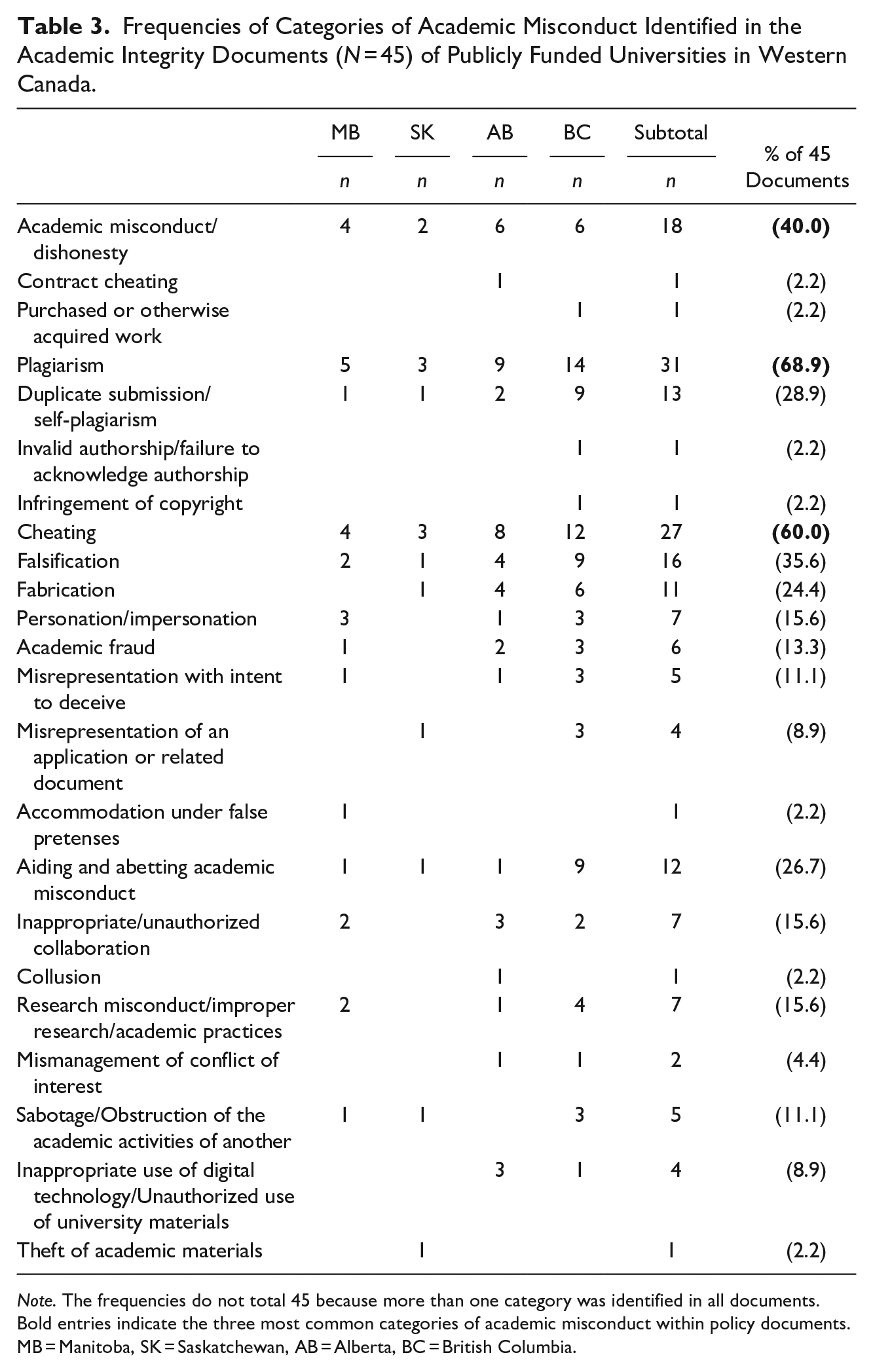
Note. The frequencies do not total 45 because more than one category was identified in all documents. Bold entries indicate the three most common categories of academic misconduct within policy documents.
MB = Manitoba, SK = Saskatchewan, AB = Alberta, BC = British Columbia.
Support
Forty-two documents provided limited information related to support systems for university instructors; of these, 41 listed support for the disciplinary process, which included reference to other policies, procedures, and forms. Four documents listed support for teaching and learning to promote academic integrity and one referred staff to workshops.
Thirty-eight documents provided limited information about educational resources and on campus support for students, with 37 of these listing supports for the disciplinary process, including reference to other policies and procedures (n = 16), statements about the provision of the presence of a support person at hearings (n = 11), and the right to appeal decisions (n = 7). Only 11 documents referred students to educational resources, including directing students to seek support from their instructors (n = 1), writing/communication centers (n = 1), and instructors and library services (n = 1). Four documents referred students to workshops (n = 2), online modules (n = 1), and awareness campaigns (n = 1). There was little association between the expectation that students would teach themselves about academic integrity and misconduct policies and resources provided for their learning.
Discussion
The overarching purpose of our review was to understand how academic integrity is conceptualized within policy documents of the universities in Manitoba, Saskatchewan, Alberta, and British Columba, Canada. We also searched for details regarding contract cheating and how this form of academic misconduct is described and addressed within the policies of western Canadian universities. A final goal was to understand how various university stakeholder groups are supported in understanding academic integrity and preventing and dealing with academic misconduct when it arises. A deep understanding of current academic integrity policies, including how they align with recommendations can serve to inform their future development. Key findings are discussed below.
The overall tone and details of the majority of the documents that we reviewed, including those stating that values of integrity and/or educative approach served as the foundation of the policy, were focused on policing, reporting, investigating, and sanctioning student engagement in academic misconduct. These results are similar to those reported in the academic integrity policy review of publicly funded colleges in Ontario, Canada (Stoesz et al., 2019) and universities in Australia (Bretag, Mahmud, East, et al., 2011). Together, these findings are disappointing as strong cases have been made previously for the importance of education about the values of academic integrity, supporting ethical decisions in scholarly work (HEA, 2011; Morris, 2016; Morris & Carroll, 2016), and that education-based approaches be threaded throughout academic integrity policy (Fishman, 2016).
Our findings also suggest that the thoughts and conversations of those involved in policy-making for academic integrity and academic misconduct were based largely on morality. Moral discourse can be identified in policy documents by their “use of law- or crime-related language (e.g. theft, breach, copyright)” (Adam et al., 2017, p. 19). Universities often frame academic integrity and misconduct (MacLeod & Eaton, 2020) and specifically “plagiarism as a consequence of a student’s lack of morals, or lack of academic skills, resulting in a lack of adherence to rules and regulations, thereby intertwining a moral and a regulatory view” (Adam et al., 2017, p. 22). Although the primary goals of educational policy and accompanying procedures are to inform faculty, staff, and students of their responsibilities, establish boundaries, and guide or regulate behaviour (Clark et al., 2012), one challenge for policy-makers is to bring a sense of balance to such documents to communicate a multi-faceted (and multi-stakeholder) approach to academic integrity and academic misconduct (Morris, 2018).
Our examination of academic integrity policies revealed that only one university used the term “contract cheating;” however, nearly all documents described outsourcing behaviour using either direct or indirect language, categorizing it most often as a form of plagiarism (see also Ellis et al., 2018). Contract cheating is a serious threat to education standards (QAA, 2017); therefore, it is crucial for universities to acknowledge this threat in their policies by defining contract cheating explicitly, providing detailed reporting and case management procedures, and training academic staff on how to spot contract cheating (TEQSA, 2017). In general, details for academic misconduct dominated all academic integrity policies that we reviewed, but specific detail about how to identify contract cheating was not provided. We must resist, however, the “moral panic” (Bertram Gallant, 2008) response to contract cheating because doing so often leads to implementing detection techniques over strategies to prevent contract cheating and focus on learning for the many students who are not engaging in this serious form of academic misconduct (Walker & Townley, 2012). To inform educative and values-based policy, policy-makers must pay attention to the reasons why most students do not outsource their assessments (Rundle et al., 2019), which include high levels of motivation to learn, perseverance, grit, and self-control when opportunities to cheat become available (Amigud & Lancaster, 2019; Rundle et al., 2019).
Another essential characteristic of policy that may overlooked by a university is whether relevant documents can be found easily. Policies that are challenging to locate may be viewed as unimportant, particularly by the students and instructors who are expected to abide by them (Bretag et al., 2011). Moreover, although many documents stated that all university community members are responsible for adhering to the policy, about one quarter linked this responsibility directly to educational resources and on campus supports (e.g., modules, tutorials, workshops, professional development activities). Educational resources, such as academic integrity tutorials, can be effective for improving students’ attitudes and knowledge about academic integrity (Stoesz & Yudintseva, 2018; Stoesz & Los, 2019). Guides to available supports would have also provided evidence of meaningful education-based academic integrity policies. An important challenge for universities is to engage students in the process of learning about policy, what it means, and how to abide by policies because few students may take the time to read such documents (Exposito et al., 2015), even when versions of them have been included within general academic calendars. Because engagement in contract cheating begins as early as junior and senior high school (Eaton & Dressler, 2019; Stoesz & Los, 2019), educating students through a robust orientation process before they begin their first year as a postsecondary student is also essential.
Limitations and Future Research
Our study has revealed important trends in academic integrity policy of western Canadian universities; however, we acknowledge its limitations that could be addressed in future academic integrity research in Canada. We delimited our analysis to publicly funded universities in western Canada and did not consider the size of the institution nor the type of programs offered to students. Context or program specific considerations can play important roles in shaping academic integrity policy. For example, large universities with a broad range of programs might need to consider faculty or departmental level policies for academic integrity to highlight specific examples of acceptable and unacceptable behaviours (e.g., practicum placements, apprenticeships). We also did not quantify our findings to conduct statistical analyses across provinces or between select institutions, which may be an important next step in this work. Evidence that policy is indeed effective for promoting academic integrity and preventing misconduct can be difficult to obtain. An examination of the relationship between the formal and informal systems within higher education institutions in relation to academic integrity is important to understand the effectiveness of policy (Smith-Crowe et al., 2015). By surveying students, instructors, and administrators, one could begin to explore the conditions under which the pressure to act unethically is high (informal) and how weak and strong policy (formal systems) is complicit in academic misconduct or promotes academic integrity, respectively (Glendinning et al., 2013; Smith-Crowe et al., 2015). Evidence from various research avenues could further justify the importance of well developed and implemented formal policy and procedures.
Conclusion
Every publicly funded university in western Canadian university has an academic integrity policy; however, many have focused predominantly on punitive measures to address breaches of integrity after they have occurred. In order to move toward the multi-pronged approaches that academic integrity scholars have been advocating for more than a decade (Bertram Gallant, 2008; Carroll, 2007; Morris, 2018), existing policies must be revised to reflect a deeper consideration of educative as well as a disciplinary approaches to academic integrity. As such, it is important that educational resources and supports are developed and made available, and for policy documents to indicate what resources are available and how they can be accessed. Policy-making and understanding policy are not straightforward and require significant time, effort, expertise, and other resources (Howlett, 2009; Ozga, 1999). Creative exemplary academic integrity policy for higher education in Canada requires that relevant stakeholder groups (i.e., students, instructors, and administrators) from across Canada work together to create a comprehensive framework for guiding the creation and implementation of such policy. A framework to guide effective policy-making should be based on education research (Gillies, 2014) and allow for consideration of the unique environment, culture (Smith-Crowe et al., 2015), and on-the-ground conditions (Howlett, 2009) of individual higher education institutions.
Footnotes
Declaration of Conflicting Interests
The author(s) declared no potential conflicts of interest with respect to the research, authorship, and/or publication of this article.
Funding
The author(s) disclosed receipt of the following financial support for the research, authorship, and/or publication of this article: Funding for open access publication of this article was provided by the University of Calgary.
