



Abstract
In the present study we consider whether certain pre-service teachers (PSTs) particularly benefit from high-quality student teaching experiences. To conduct these analyses, we connect student teaching and K-12 workforce data for six educator preparation programs (EPPs) and assess whether placement school and cooperating teacher characteristics predict the effectiveness of early-career teachers. Results show that high-quality student teaching placements especially benefit PSTs with lower GPAs and narrow effectiveness gaps between teachers with lower versus higher GPAs. These findings call for closer partnerships between EPPs and school districts and suggest that EPPs may wish to prioritize placements for PSTs with lower GPAs.
Introduction
Each year, educator preparation programs (EPPs) across the United States take on a monumental task—working with K-12 partners to secure student teaching placements for approximately 125,000 pre-service teachers (PSTs; Title II Data Tools, 2019). 1 As the culmination of multiple semesters of university coursework and field experiences in K-12 schools, student teaching is a scaffolded opportunity for PSTs to gradually assume a lead teacher role under the supervision of university-based faculty and a cooperating teacher (i.e., the teacher-of-record). This hands-on experience allows PSTs to further develop their instructional and classroom management skills and become better prepared for the demands of teaching.
Anecdotal and empirical evidence confirms the importance of student teaching. Anecdotally, teachers report being satisfied with their cooperating teacher and student teaching experience and often highlight student teaching as the most valuable component of their preparation program (Anderson & Stillman, 2013; Ronfeldt & Reininger, 2012). Empirically, recent work finds that characteristics of the student teaching school and cooperating teacher predict the effectiveness of early-career teachers. Specifically, early-career teachers are more effective after student teaching in a high-quality learning environment and with a highly-effective cooperating teacher (Goldhaber et al., 2017, 2020; Ronfeldt, 2012, 2015; Ronfeldt et al., 2018).
The importance of student teaching provides a strong rationale for EPPs and their K-12 partners to make high-quality placements. Building from prior work on teacher learning and student teaching placements (Feiman-Nemser, 1983; Kraft & Papay, 2014; Louis & Marks, 1998; Ronfeldt, 2012, 2015; Ronfeldt et al., 2015; Zeichner & Gore, 1990), we define high-quality placements as those occurring in rich learning environments for adults and students. Such environments are places where teachers frequently collaborate and wish to stay (Goddard et al., 2007; Ronfeldt, 2012) and where K-12 students are engaged and making significant achievement growth (Loeb et al., 2012; Ronfeldt, 2015). Cooperating teachers help create rich learning environments by the quality of their instructional practices and the quality of coaching they provide PSTs (Matsko et al., 2020).
While all PSTs deserve a high-quality placement, the need may be especially salient for certain PSTs. In particular, PSTs who are struggling in their preparation program—relative to more successful peers—may especially benefit from a high-quality learning environment and a highly-effective cooperating teacher (Brand & Xie, 2010). If these PSTs especially benefit from high-quality placements, EPPs may wish to prioritize their placements. This prioritization would be one strategic approach to overcome the many challenges in assigning PSTs to schools and cooperating teachers (Goldhaber et al., 2018; St. John et al., 2018). Therefore, to examine student teaching placements and their role in the development of early-career teachers, we answer the following questions:
(1) Do characteristics of the student teaching school and the cooperating teacher predict the performance of early-career teachers?
(2) Do results vary by the academic performance of early-career teachers?
To answer these questions we leverage 5 years of student teaching data from six EPPs in North Carolina. We link these student teaching data to administrative files from the North Carolina Department of Public Instruction (NCDPI) to identify characteristics of student teaching schools and cooperating teachers and to assess the performance of PSTs as early-career teachers. Our analyses contribute to a growing body of student teaching research through replication and extension. Specifically, we replicate prior studies to assess whether previous student teaching results hold in a new setting (Goldhaber et al., 2017, 2020; Ronfeldt, 2012, 2015; Ronfeldt et al., 2018). We extend prior studies by asking whether certain PSTs particularly benefit from high-quality placements. Our analyses give EPPs and school districts guidance about the characteristics of placement schools and cooperating teachers that predict teacher performance. Furthermore, our analyses may help EPPs prioritize placements for certain PSTs.
Background
The Challenge and Promise of Student Teaching Placements
Recent research shows that student teaching placements are challenging to arrange yet valuable to the development and future effectiveness of PSTs. Part of the challenge in arranging student teaching experiences comes from the large number of placements that EPPs need to make and the requirements for those placements. EPPs in the United States need to place approximately 125,000 PSTs each year, and often, states/districts regulate the types of schools and cooperating teachers with whom EPPs can make placements. For example, North Carolina now requires that cooperating teachers have (1) a license in the field of licensure for the PST; (2) at least 3 years of teaching experience; (3) earned ratings of at least “Accomplished” on the state’s teacher evaluation system; and (4) met or exceeded expectations for student achievement growth. Making such placements can be a strain on EPP resources and K-12 schools in the area.
More specifically, it can be challenging for EPPs to secure high-quality student teaching placements (i.e., rich learning environments for adults and students) because (1) placements are dependent on the willingness of K-12 schools and in-service teachers to serve; (2) in-service teachers often lack the training and incentives to mentor PSTs; (3) EPPs and districts have not established formal and centralized processes for making placements; and (4) information asymmetries exist between EPPs and school districts. That is, EPPs do not know how and why cooperating teachers are selected and K-12 schools lack information on PSTs to make thoughtful matches (Goldhaber et al., 2018; St. John et al., 2018). Together, these challenges may lead to suboptimal placements.
These suboptimal placements matter because of the importance of student teaching. PSTs randomly assigned to a high-quality placement 2 rate their student teaching experiences more favorably than peers assigned to a lower-quality placement (Ronfeldt et al., 2018). Graduates of EPPs that exercise greater oversight in the placement process are more effective as beginning teachers (Boyd et al., 2009). Most relevant to the present study is a developing body of research on student teaching placement sites. These studies link characteristics of placement sites and cooperating teachers to future outcomes for PSTs. Findings from these studies support our definition of high-quality placements. Ronfeldt (2012, 2015) finds that early-career teachers are more effective and more likely to remain in teaching if they student taught in schools characterized by higher levels of teacher retention, teacher collaboration, and school-level value-added. Likewise, studies show that early-career teachers are more effective—that is, have higher value-added and evaluation ratings—if they were mentored by a cooperating teacher with higher value-added estimates and evaluation ratings (Goldhaber et al., 2020; Ronfeldt et al., 2018).
Why Student Teaching Placements May Matter
Underlying these positive results for high-quality placements is a view of student teaching as a valuable opportunity for authentic, practice-based learning. One lens through which to conceptualize this learning and the role of high-quality placements is Bandura’s self-efficacy model. This model posits that individuals’ self-efficacy expectations are most malleable early in learning—that is, the formative learning stage that PSTs and early-career teachers occupy—and that self-efficacy expectations are shaped by vicarious and mastery experiences (Bandura, 1977).
As defined by Bandura (1977), vicarious experiences are those in which self-efficacy is formed through the live and symbolic modeling of practice. PSTs have vicarious experiences as they observe cooperating teachers manage a K-12 classroom, enact instructional strategies, and assess learning. Likewise, PSTs have vicarious experiences as they receive coaching and feedback from their cooperating teacher. Vicarious experiences can also occur as PSTs interact with other teachers in grade/departmental meetings and professional learning communities. In addition to vicarious experiences, self-efficacy is formed through mastery experiences in which learners successfully model and perform tasks themselves (Bandura, 1977). PSTs have mastery experiences as they gradually assume greater responsibility for planning, management, instruction, and assessment in the student teaching classroom. Importantly, Bandura’s model is directly relevant to our work since teacher self-efficacy predicts teacher effectiveness (Goddard et al., 2000; Hoy & Spero, 2005). By improving PSTs’ self-efficacy and effectiveness, we also expect high-quality vicarious and mastery experiences to influence persistence in the teaching profession (Goldhaber et al., 2011; Henry et al., 2011).
While vicarious and mastery experiences may influence the effectiveness of all PSTs, it is possible that such experiences will be more valuable for certain PSTs. Building from work in K-12 and higher education showing that lower-performing students particularly benefit from educational interventions (Angrist et al., 2012; Brand & Xie, 2010; Edwards, 2012), we hypothesize that PSTs with lower GPAs will especially benefit from high-quality student teaching placements. GPA is an imperfect proxy of performance; however, it is possible that PSTs with lower GPAs will benefit more because they are making up for past deficits in knowledge and/or skills (relative to PSTs with higher GPAs). Likewise, PSTs with lower GPAs may benefit more due to differences in learning styles—that is, they may struggle to master content through traditional classroom delivery but excel in a hands-on learning environment (Kolb & Kolb, 2005). Practically, our focus on heterogeneous effects is motivated by the challenges EPPs face in securing high-quality placements at scale. If high-quality placements particularly benefit certain PSTs, this might allow EPPs and their district partners to prioritize placements for those individuals. With this prioritization, EPPs and districts could more readily establish placement procedures, reduce information asymmetries, and target recruitment, training, and incentives for cooperating teachers.
Method
Research Sample
To conduct these analyses, we received 5 years (2011–12 through 2015–16) of student teaching placement data from six EPPs in North Carolina. These EPPs are geographically distributed across the state, including urban and rural locations. The EPPs include a minority-serving institution, and together, account for more than 50% of the teachers prepared in North Carolina. For PSTs, these student teaching data include a unique identifier, demographic information, and cumulative GPA at the university. These data also detail when the PST student taught, in what K-12 school the PST student taught, and the name of the cooperating teacher.
We connect these student teaching data to administrative files from the NCDPI to identify characteristics of the K-12 schools in which student teaching occurred and characteristics of the cooperating teachers assigned to PSTs. Specifically, by knowing the student teaching school and semester/year for student teaching, we identified a set of placement school characteristics for each PST. Likewise, by knowing the name of the cooperating teacher and when/where student teaching occurred, we identified demographic, credential, and prior effectiveness measures for each cooperating teacher. We detail these placement school and cooperating teacher measures in the Student Teaching Characteristics section.
We follow PSTs into the teaching workforce in North Carolina to examine whether student teaching characteristics predict the performance of early-career teachers. In particular, we analyze teacher performance data from the 2012 to 2013 through 2016 to 2017 years and focus on early-career teachers (former PSTs) with less than 3 years of experience. We prioritize first, second, and third-year teachers because this is when the effects of educator preparation are more relevant (Goldhaber et al., 2013) and the time period in which North Carolina teachers hold an initial license. Overall, our full dataset includes 7,999 PSTs matched to 1,432 student teaching schools and 6,019 unique cooperating teachers. Of these 7,999 PSTs, our analytical sample consists of the 6,053 (75.67%) PSTs who became a teacher in North Carolina public schools during our study period (2012–13 through 2016–17). Sixty-nine percent of these 6,053 teachers have a value-added estimate in at least one study year; ninety-one percent of these teachers received evaluation ratings from their school principal in at least one study year.
Outcome Measures
We assess whether characteristics of student teaching schools and cooperating teachers are associated with two different measures of early-career teacher performance: value-added to student achievement and evaluation ratings. To examine teachers’ contributions to student achievement, we analyze Education Value-Added Assessment System (EVAAS) estimates from North Carolina’s early grades reading exam (K-2); end-of-grade (EOG) exams in mathematics, reading, and science (3–8); end-of-course (EOC) exams in algebra I, biology, and English II 3 ; and final exams across a range of secondary grade subject-areas. For the early-grades reading exam and EOG exams in mathematics and reading, estimates come from the EVAAS multi-variate response model (MRM), a random effects model that accounts for students clustering within teachers within and between years. For all other tests, estimates come from the EVAAS univariate response model (URM), a random effects model that adjusts for the clustering of students within teachers and controls for at least 2 years of prior student test scores (Wright et al., 2010). To ease interpretability of this measure, we standardized EVAAS estimates within test and year across all North Carolina teachers. We interpret results as the association between student teaching school or cooperating teacher characteristics and a percentage of a standard deviation in teacher-level value-added.
We acknowledge the limitations of value-added measures. There are concerns regarding the validity and reliability of value-added estimates (AERA, 2015), with certain studies exclusively focused on limitations to EVAAS (Amrein-Beardsley, 2008; Ballou & Springer, 2015). Furthermore, scholarship shows that value-added is only one facet of teacher effectiveness (Kraft, 2019). Despite these concerns, we assess teacher value-added—as a measure of effectiveness for early-career and cooperating teachers—since it is a policy relevant measure of teacher performance that is predictive of short and longer-term outcomes for students (Chetty et al., 2014). In addition, we consider value-added because prior studies show that cooperating teacher value-added predicts early-career teacher performance (Goldhaber et al., 2020; Ronfeldt et al., 2018).
Given concerns that value-added is only one facet of teacher effectiveness, we also examine teachers’ instructional practices and broader contributions to the school by assessing their evaluation ratings from the North Carolina Educator Evaluation System (NCEES). NCEES is a statewide evaluation process in which school principals rate K-12 teachers on up to five teaching standards: Teachers Demonstrate Leadership (Standard 1); Teachers Establish a Respectful Classroom Environment for a Diverse Group of Students (Standard 2); Teachers Know the Content They Teach (Standard 3); Teachers Facilitate Learning for Their Students (Standard 4); and Teachers Reflect on Their Practice (Standard 5). School principals collect teacher submitted artifacts and conduct at least three formal observations (with pre- and post-conferencing) of early-career teachers throughout the year. At the end of the year, principals and teachers have a conference and teachers receive summative ratings of either not demonstrated (1), developing (2), proficient (3), accomplished (4), or distinguished (5) on each standard. 4
For our primary analyses, we create a composite evaluation score by summing early-career teachers’ ratings across all five teaching standards. We create this composite rating since analyses of NCEES ratings—using correlations, Cronbach’s alpha, and factor analysis—indicate that school principals rate teachers on a single construct rather than five distinct standards. 5 We standardized this composite rating across all North Carolina teachers who have ratings on the five evaluation standards. This allows us to interpret results as the association between student teaching school or cooperating teacher characteristics and a percentage of a standard deviation in composite evaluation ratings. Additionally, this means that coefficients for both of our outcomes are in comparable units—that is, a percentage of a standard deviation in teacher-level performance.
Student Teaching Characteristics
In analyses, we focus on the following characteristics of student teaching schools: the percentage of economically-disadvantaged and racial/ethnic minority students, suspension rates, school achievement growth, teacher retention rates, and a measure of teacher collaboration. We examine the percentage of economically-disadvantaged and minority students because these may be proxies for educational resources—for example, school funding, effective teachers—associated with high-quality learning environments (Goldhaber et al., 2015). Likewise, we consider student suspension rates since orderly environments better promote adult and student learning (Noltemeyer et al., 2015). We include school achievement growth given prior work showing that early-career teachers are more effective after student teaching in a high value-added school (Ronfeldt, 2015). Furthermore, in-service teachers develop more rapidly in high value-added schools (Loeb et al., 2012). Together, these studies suggest that high value-added schools may be more likely to offer high-quality vicarious and mastery experiences to PSTs. We operationalize this measure with indicators for placement schools that exceed, meet, or fail to meet expected student achievement growth in a school year.
Following Ronfeldt (2012, 2015), we consider teacher retention at the placement school. This is a proxy for schools that are easier-to-staff and where teachers want to stay—that is, potential indicators for high-quality learning environments. To create this measure we exclude retirement eligible teachers from the sample and calculate the percentage of teachers who return to the school in the following year. To account for any temporal anomalies, we generate placement school retention rates as 3-year rolling averages and standardize this measure for analyses. Lastly, given the connections between teacher collaboration and teacher learning (Ronfeldt et al., 2015; Zeichner & Gore, 1990), we include a teacher-reported measure of teacher collaboration at the placement school. We create this collaboration measure by aggregating to the school level teachers’ responses to two items from a statewide working conditions survey. 6 We standardize this teacher collaboration measure for analyses.
The cooperating teacher characteristics that we include in analyses fall into one of three categories: demographics, credentials, and measures of prior performance. We focus on the prior performance of the cooperating teacher (rather than current year performance) because hosting a PST may boost or adversely influence cooperating teacher effectiveness (Goldhaber et al., 2018). 7 The demographic measures are indicators for female and racial/ethnic minority. For cooperating teacher credentials, we consider teacher experience, National Board Certification (NBC), graduate degrees, and teacher licensure exam scores (e.g., Praxis). We include these credentials since they are associated with teacher effectiveness, and as such, may identify high-quality learning environments for PSTs (Clotfelter et al., 2007; Cowan & Goldhaber, 2016; Papay & Kraft, 2015). We also consider whether the cooperating teacher was prepared by the same university as the PST. Alumni of the same EPP may create richer learning environments if they are more familiar with EPP coursework and practices. PSTs may also find it easier to acclimate and practice teaching if their instructional practices are similar to those of the cooperating teacher.
Finally, for measures of prior performance, we include cooperating teachers’ value-added estimates (EVAAS) and evaluation ratings on the Leadership and Facilitating Student Learning Standards. 8 When available, we use an average of cooperating teachers’ value-added estimates and evaluation ratings from the previous two school years. Value-added estimates and ratings on the Facilitating Student Learning standard likely represent the instructional effectiveness of the cooperating teacher. Ratings on the Leadership standard, which includes indicators for working with colleagues and mentoring, may (in part) represent the coaching ability of the cooperating teacher. With these competencies—instructional and coaching effectiveness—we contend that cooperating teachers help create high-quality vicarious and mastery experiences for their PSTs.
For each EPP in our sample, Table 1 displays descriptive data for PSTs who become teachers in North Carolina public schools during our study period. 9 In our sample of six universities, PSTs are predominantly female, and with the exception of EPP 3, a minority-serving institution, predominantly white. The middle panel of Table 1 shows that student teaching school characteristics vary across EPPs. Since EPPs often arrange student teaching experiences in close proximity to the university (Krieg et al., 2016), these differences may reflect the location of the EPP and the demographics and labor markets of the surrounding area. Differences may also be attributable to the mission of the EPP and to the characteristics and preferences of the PSTs it prepares. Like the placement school data, the bottom panel of Table 1 indicates that cooperating teacher characteristics vary across EPPs. Universities typically place PSTs with experienced and well-credentialed cooperating teachers—these teachers averaged 13 to 15 years of experience, many held NBC and/or a graduate degree, and their licensure exam scores (standardized) were generally above the statewide mean. Effectiveness data show that cooperating teachers generally had prior year value-added estimates above the statewide mean and prior year evaluation ratings near “accomplished” (level 4).
Characteristics of PSTs, Placement Schools, and Cooperating Teachers.
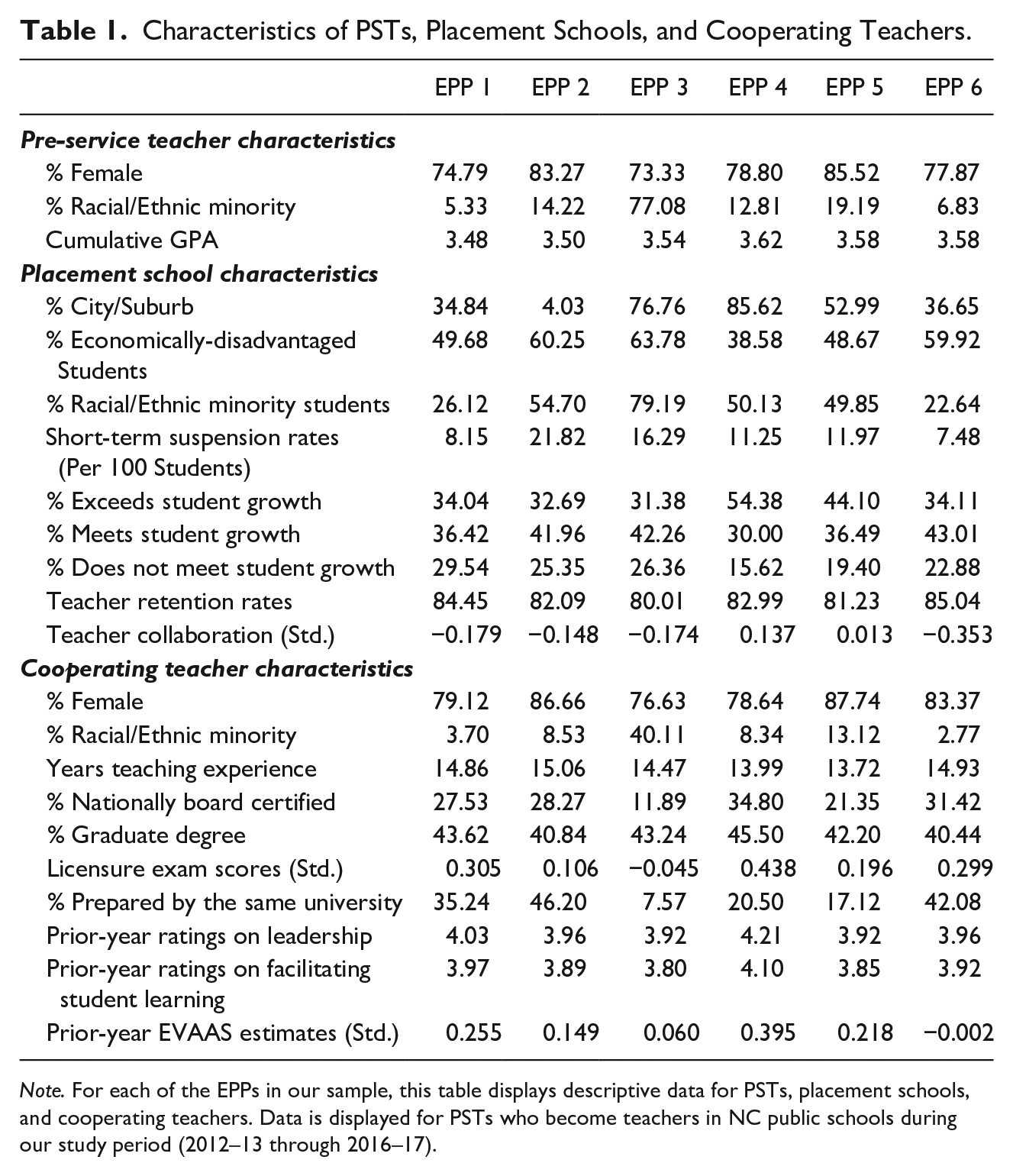
Note. For each of the EPPs in our sample, this table displays descriptive data for PSTs, placement schools, and cooperating teachers. Data is displayed for PSTs who become teachers in NC public schools during our study period (2012–13 through 2016–17).
Measuring the Academic Performance of Pre-Service Teachers
We focus on cumulative GPA to assess whether the associations between student teaching characteristics and teacher effectiveness vary by PSTs’ academic performance. Cumulative GPA is available for all PSTs in our sample and it is one measure of the extent to which PSTs are succeeding in their program. A limitation of this measure is that we do not know the particular areas/competencies in which PSTs are strong or struggling. Future work may benefit from more granular measures (e.g., ratings from practicum experiences) of PSTs’ knowledge and skills.
While subjectivity exists in course grades, cumulative GPA captures all assessments of PSTs’ knowledge and skills during their preparation program. Several studies have demonstrated positive relationships between GPA and measures of teaching effectiveness. In particular, a meta-analysis of 123 studies found undergraduate cumulative GPA to be a significant predictor of teaching effectiveness (D’Agostino & Powers, 2009). More recent work from Washington, D.C. shows that cumulative GPA predicts teacher value-added and evaluation ratings (Jacob et al., 2018). Cumulative GPA is also positively associated with edTPA scores, a high-stakes performance assessment completed by PSTs during student teaching (Evans et al., 2016). Our own descriptive checks indicate that cumulative GPA predicts PSTs’ edTPA scores, EVAAS estimates, and composite evaluation ratings. Specifically, a one standard deviation increase in cumulative GPA (approximately 0.37 GPA points) is associated with a 6.5% of a standard deviation increase in value-added estimates and a 7.8% of a standard deviation increase in composite ratings. These associations support our focus on GPA as an indicator of success and readiness to teach. Because grading procedures may vary across universities and time, we standardized PSTs’ GPA by EPP and graduating year. 10 Using this standardized GPA measure, we also placed PSTs into GPA quartiles. This allows us to assess whether associations between student teaching characteristics and teacher performance differ for PSTs in the bottom, middle, and top GPA quartiles. 11
Table 2 displays characteristics of PSTs, student teaching schools, and cooperating teachers by PSTs’ GPA quartile. We test for statistically significant differences between (1) PSTs in the bottom versus middle GPA quartiles and (2) PSTs in the top versus middle GPA quartiles. These data show that PSTs in the bottom GPA quartile are more likely to be male and non-white; those in the top GPA quartile are more likely to be female and white. Average GPAs range from 3.03 in the bottom quartile, to 3.57 in the middle quartiles, and 3.95 in the top quartile. With a few exceptions, placement school characteristics are similar across the GPA distribution. On average, suspension rates are higher in the placement schools of those in the bottom GPA quartile and lower in the placement schools of those in the top GPA quartile. PSTs in the bottom GPA quartile are more likely to student teach in a school that exceeded expected achievement growth; PSTs in the top GPA quartile student teach in schools with slightly higher levels on our teacher collaboration measure. Cooperating teacher characteristics are generally comparable across GPA quartiles. PSTs with higher GPAs are more likely to have a female cooperating teacher and less likely to have a cooperating teacher from the same EPP. PSTs with top quartile GPAs are matched to cooperating teachers with slightly higher prior-year ratings on the Facilitating Student Learning standard. Overall, these data suggest that PSTs with lower GPAs are not sorted into more challenging student teaching schools or matched to less well-credentialed or less effective cooperating teachers.
Characteristics of Placement Schools and Cooperating Teachers by PST GPA.
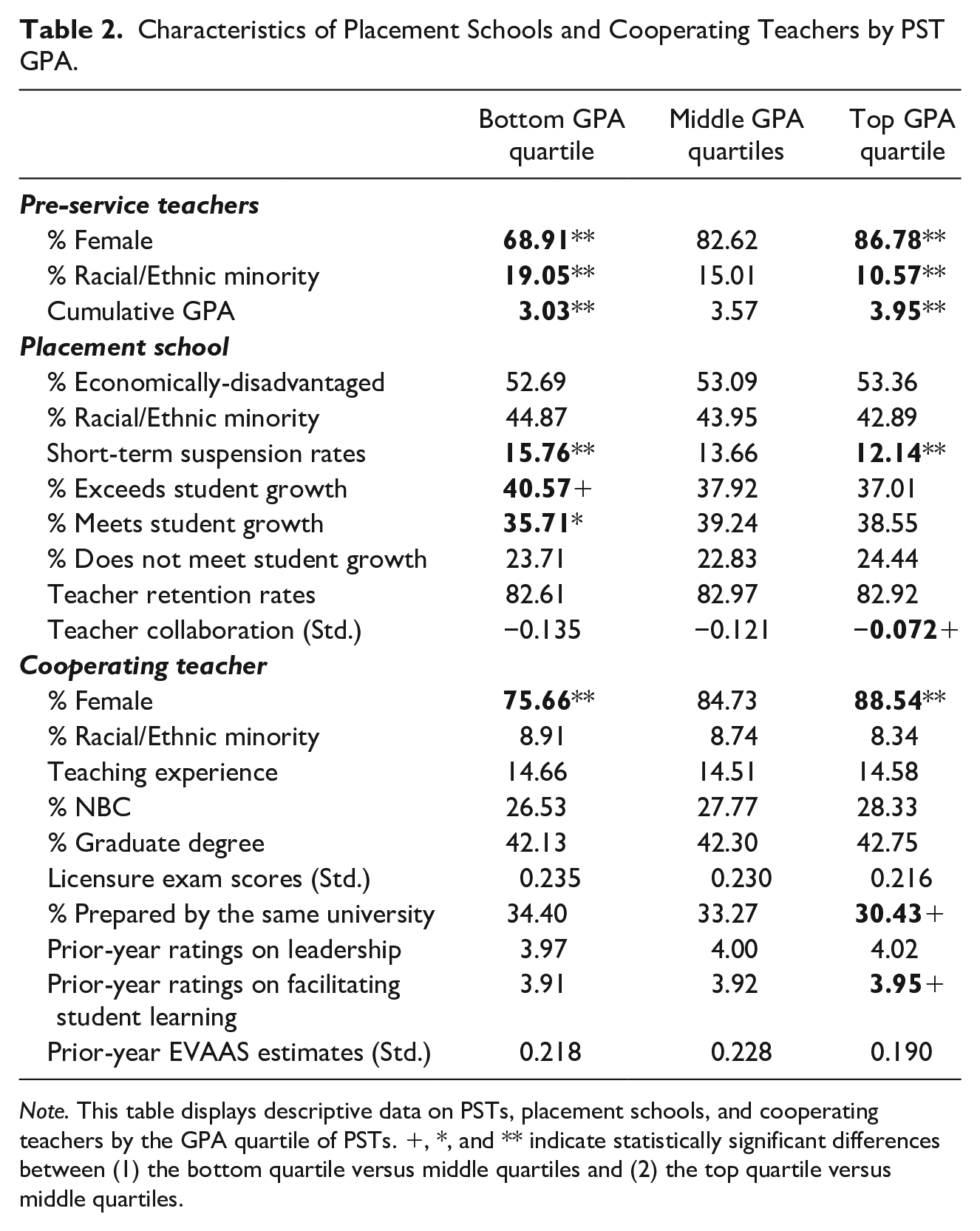
Note. This table displays descriptive data on PSTs, placement schools, and cooperating teachers by the GPA quartile of PSTs. +, *, and ** indicate statistically significant differences between (1) the bottom quartile versus middle quartiles and (2) the top quartile versus middle quartiles.
Analyses
We aim to isolate the associations between placement school and cooperating teacher characteristics and the performance of early-career teachers. To do so, we must adjust for characteristics of the PST, the EPP, and the K-12 schools in which early-career teachers work (i.e., in-service schools). At the level of PSTs, we are concerned that those with greater knowledge and skills sort into higher-quality placements. This worry is partially allayed given the descriptive data in Table 2. At the level of EPPs, we are concerned about several potential confounders: program recruitment and selection, the quality of program coursework and early field experiences, coaching and other supports from the EPP during student teaching, and unique features of the districts and schools in which EPPs place PSTs. Essentially, we are concerned that PSTs with high-quality student teaching experiences may have enjoyed other high-quality preparation components that are related to teacher effectiveness. Finally, at the K-12 school level, it is possible that in-service school characteristics are related to the quality of student teaching experiences and outcomes for early-career teachers.
Considering this range of potential confounders, our preferred analytical approach is a linear regression model controlling for characteristics of the pre-service/early-career teacher, characteristics of the in-service school, and an EPP fixed effect. The teacher characteristics include demographics (indicators for female and racial/ethnic minority), cumulative GPA, experience (indicators for second and third-year teachers in reference to first-year teachers), and year fixed effects. 12 Controlling for cumulative GPA is one way to address selection concerns and allows us to assess whether GPA is related to early-career teacher performance. Following Goldhaber et al. (2017), we include a parsimonious set of in-service school controls: school level (e.g., elementary) and the percentage of economically-disadvantaged students and racial/ethnic minority students. In model extensions, we substitute these school controls for a school fixed effect. We display these school fixed effect results in the Supplemental Appendix. Most importantly, by including an EPP fixed effect, we adjust for selection into programs and account for other programmatic features that may bias our results. This means we assess the extent to which variation in placement school and cooperating teacher characteristics, within EPPs, predicts variation in the performance of early-career teachers from the same EPP.
There are two approaches for entering our focal student teaching measures into models: (1) one at a time, to examine bivariate relationships with teacher performance; and (2) all measures in the same model, to identify independent relationships between student teaching characteristics and teacher performance. For our primary analyses we prefer to enter all characteristics into the same model. Because only a subset of cooperating teachers has prior-year value-added, we estimate a separate model that includes this covariate. As a specification check, we estimate models in which we enter each placement school and cooperating teacher characteristic into a separate model. These bivariate results are available in the Supplemental Appendix.
All analyses include our teacher and in-service school controls and cluster standard errors at the teacher level to account for dependence in teacher performance within and between years. We specify our regression equation below. Here,

We extend prior research by estimating separate regression models for PSTs in the bottom, middle (quartiles 2 and 3 combined), and top GPA quartiles. These analyses control for the same set of teacher and in-service school covariates as in Equation 1 and include an EPP fixed effect. These models test whether the coefficients for PSTs in the bottom, middle, and top GPA quartiles are different than zero—for example, whether PSTs from the bottom GPA quartile with a highly-rated cooperating teacher are more effective than peers from the bottom GPA quartile without such a cooperating teacher. We also use post-estimation tests to assess whether the coefficients for PSTs in the bottom GPA quartile are significantly different from the coefficients for PSTs in the middle and top GPA quartiles.
Results
Do Characteristics of the Student Teaching School and Cooperating Teacher Predict the Performance of Early-Career Teachers?
Table 3 displays results from our replication analyses—that is, whether findings from prior student teaching research hold in a new setting. Comparing within EPPs, the top panel of Table 3 shows that early-career teachers have value-added estimates nearly 9% of a standard deviation higher if they student taught in a high value-added school relative to a school that did not meet growth. To put the magnitude of this coefficient into perspective, we note that the average gain in teacher EVAAS estimates between the first and second-year of teaching is 17% of a standard deviation. As such, this result is approximately 50% of the effectiveness difference between first and second-year teachers. Results also show modest benefits to student teaching in schools with more racial/ethnic minority students. A 10 percentage point increase in the percentage of minority students at the placement school is associated with a 2% of a standard deviation increase in teacher value-added.
Placement School and Cooperating Teacher Characteristics and Early-Career Teacher Performance.
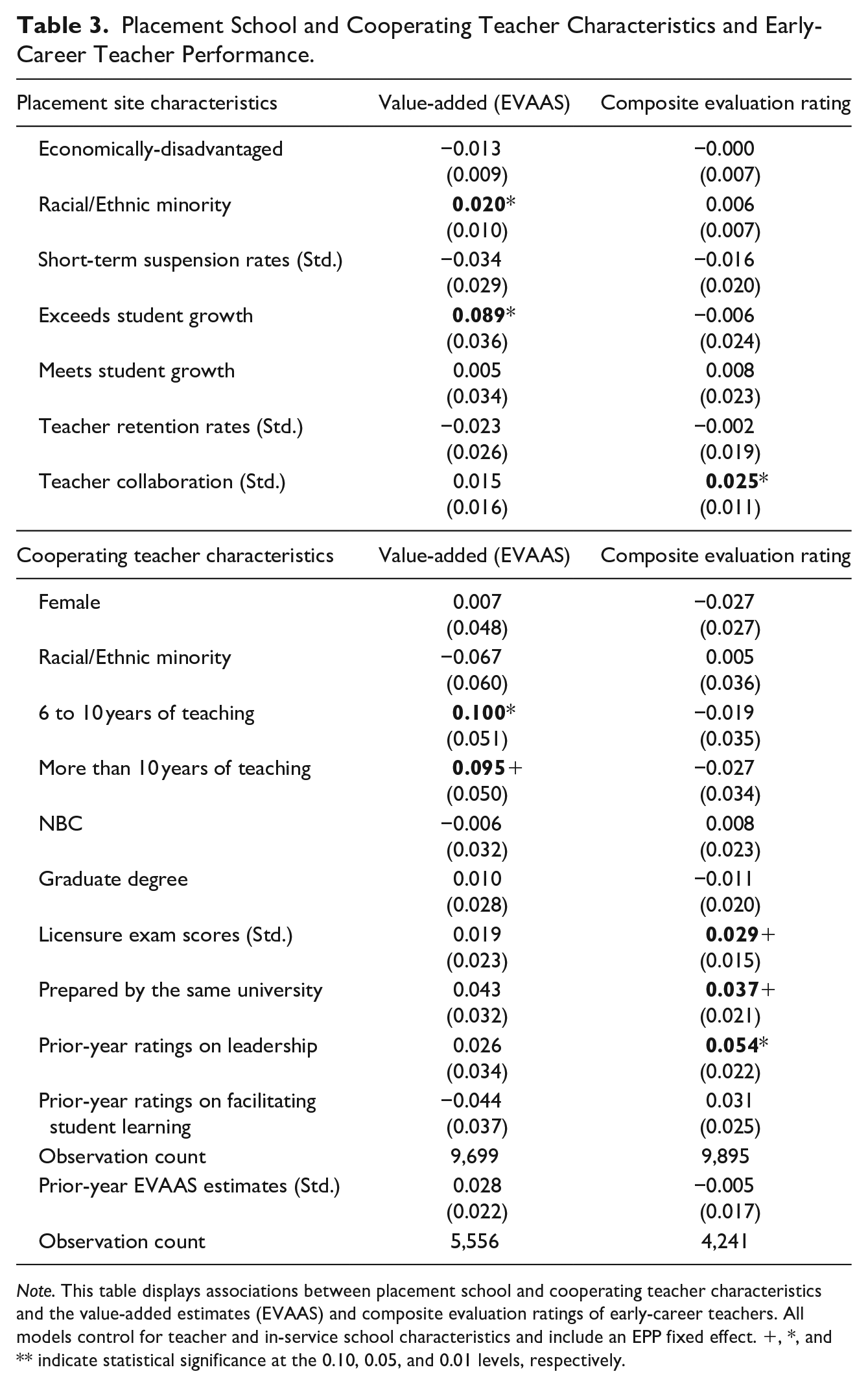
Note. This table displays associations between placement school and cooperating teacher characteristics and the value-added estimates (EVAAS) and composite evaluation ratings of early-career teachers. All models control for teacher and in-service school characteristics and include an EPP fixed effect. +, *, and ** indicate statistical significance at the 0.10, 0.05, and 0.01 levels, respectively.
Evaluation results show that a one standard deviation increase in teacher reported collaboration at the placement school predicts composite ratings 2.5% of a standard deviation higher. This result is quite modest in size, as the average difference in composite evaluation ratings between first and second-year teachers is 37% of a standard deviation. The top panel of Supplemental Appendix Table 3 shows that estimates are comparable when each placement school characteristic is entered into a separate model. In models that include an in-service school fixed effect (Supplemental Appendix Table 4), we find that teacher collaboration at the placement school predicts higher value-added estimates and evaluation ratings for early-career teachers.
The bottom panel of Table 3 displays estimates from models assessing whether cooperating teacher characteristics predict the value-added and evaluation ratings of early-career teachers. Comparing within EPPs, value-added results indicate that cooperating teacher experience predicts early-career teacher effectiveness. Relative to PSTs matched to cooperating teachers in their first 5 years of teaching, those matched to cooperating teachers with more experience are approximately 10% of a standard deviation more effective. None of the remaining cooperating teacher credentials predict teacher value-added. Results show that measures of cooperating teacher performance are unrelated to early-career teachers’ value-added estimates. However, bivariate results at the bottom of Supplemental Appendix Table 3 indicate that a one standard deviation increase in cooperating teachers’ prior-year EVAAS estimates is associated with a 4% of a standard deviation increase in teacher value-added.
Turning to evaluation ratings, the bottom panel of Table 3 shows that early-career teachers earn significantly higher composite ratings when their cooperating teacher had higher licensure exam scores, graduated from the same EPP, and had higher prior-year ratings on the Leadership standard. For example, a one-point increase in cooperating teachers’ prior-year ratings on the Leadership standard is associated with a 5.4% of a standard deviation increase in the composite rating of early-career teachers. Since the Leadership standard includes indicators for working with colleagues and mentoring teachers, this result may suggest that cooperating teachers’ coaching skills benefit PSTs. Results are generally comparable when we enter each cooperating teacher characteristic into a separate model (Supplemental Appendix Table 3). In doing so, we find that prior-year ratings on the Leadership and Facilitating Student Learning standards predict higher composite ratings for early-career teachers. School fixed effect results at the bottom of Supplemental Appendix Table 4 show that early-career teachers have higher value-added estimates and evaluation ratings when their cooperating teacher graduated from the same EPP.
Do Results Vary by the Academic Performance of Early-Career Teachers?
Tables 4 and 5 display results from our extension analyses—that is, whether certain PSTs especially benefit from high-quality placements. Comparing within EPPs, Table 4 shows that early-career teachers in the bottom GPA quartile have higher value-added estimates if they student taught in schools that exceeded expected growth, where teachers report higher levels of collaboration, and where suspension rates are lower. Likewise, PSTs in the bottom GPA quartile earn higher evaluation ratings after student teaching in schools that met growth, where teachers report higher levels of collaboration, and where suspension rates are lower. Few placement school results are statistically significant for PSTs in the middle and top GPA quartiles.
Placement School and Cooperating Teacher Results by GPA Quartile.
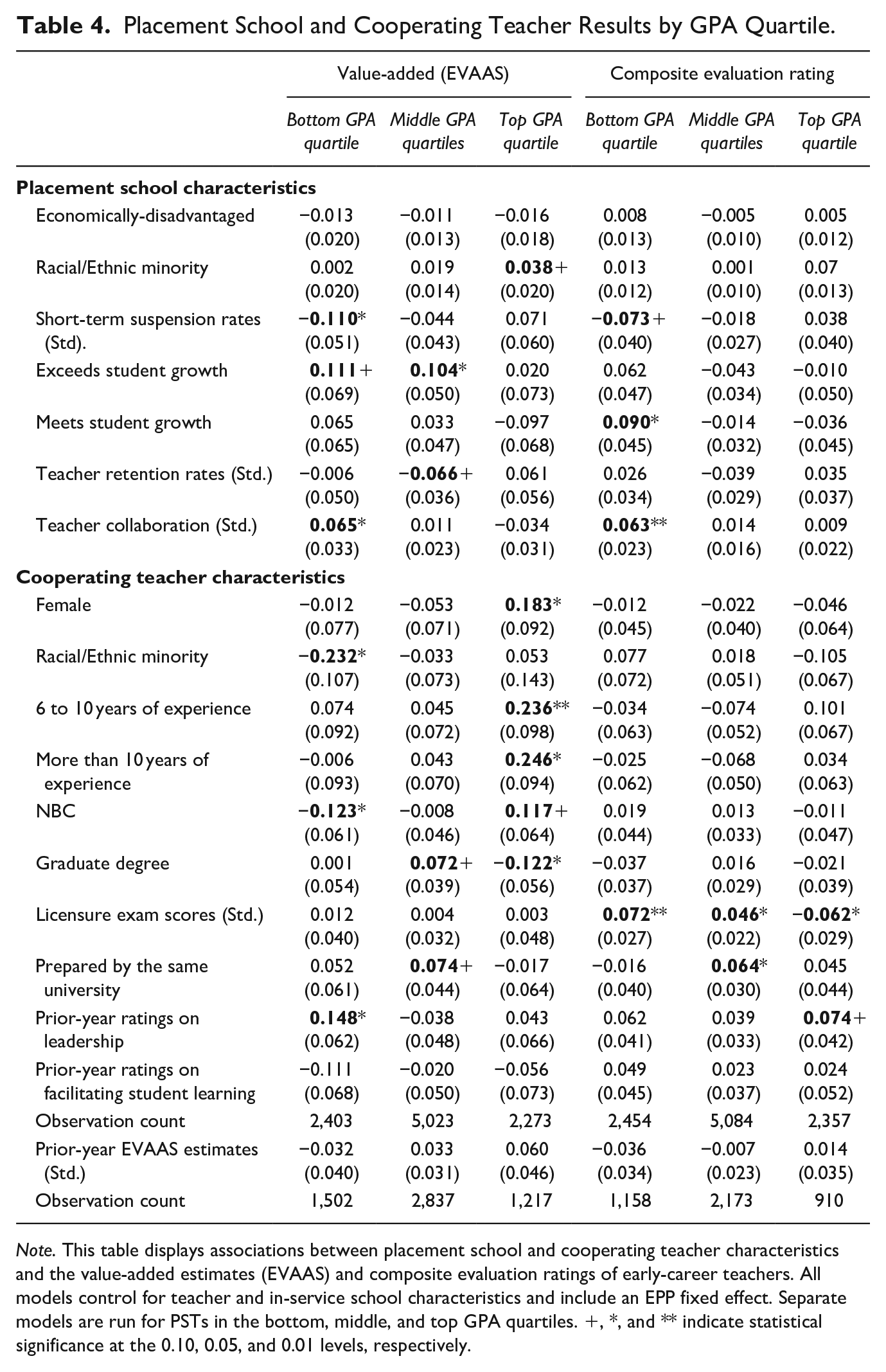
Note. This table displays associations between placement school and cooperating teacher characteristics and the value-added estimates (EVAAS) and composite evaluation ratings of early-career teachers. All models control for teacher and in-service school characteristics and include an EPP fixed effect. Separate models are run for PSTs in the bottom, middle, and top GPA quartiles. +, *, and ** indicate statistical significance at the 0.10, 0.05, and 0.01 levels, respectively.
Do Placement School and Cooperating Teacher Results Differ by GPA Quartile?
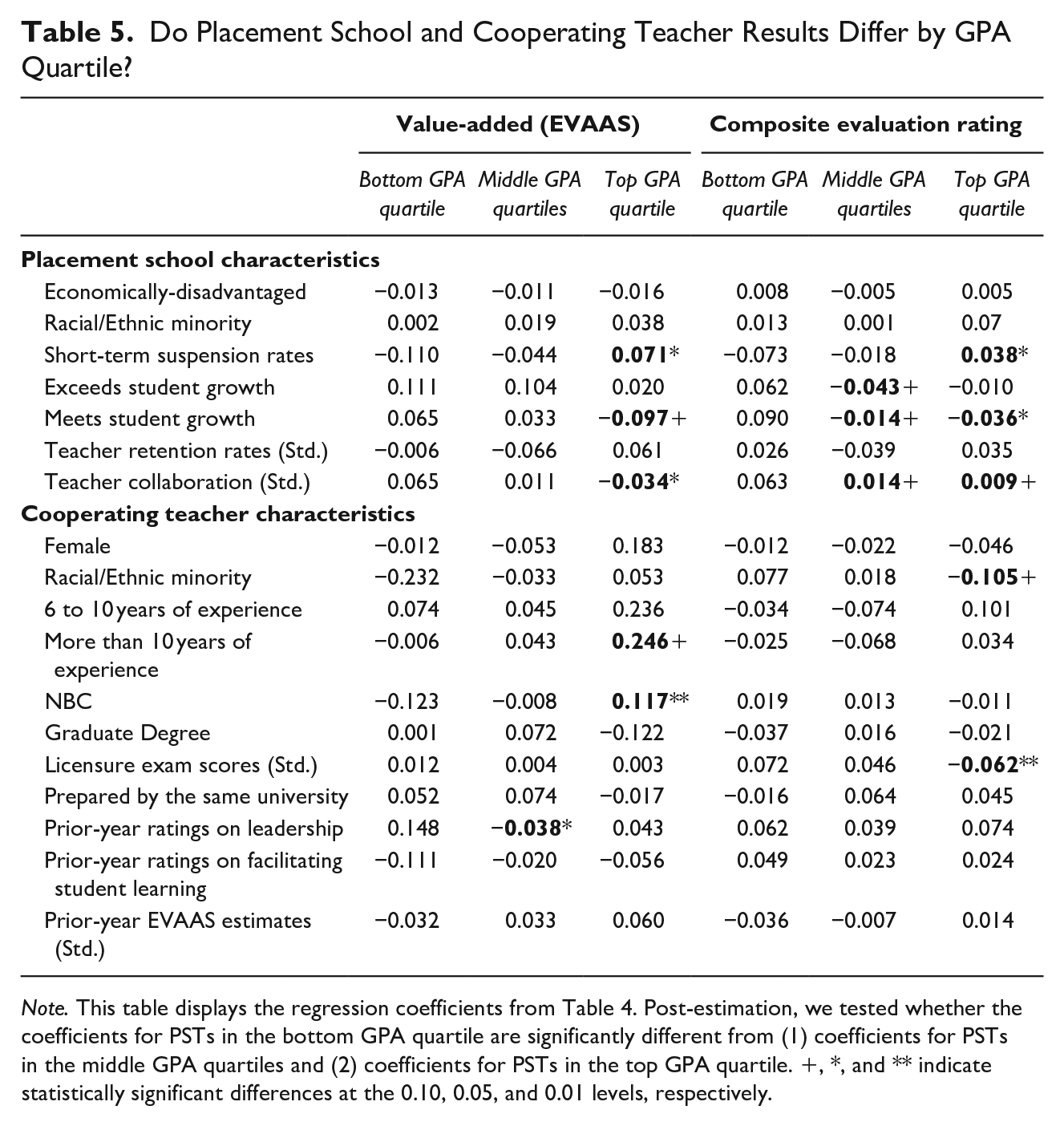
Note. This table displays the regression coefficients from Table 4. Post-estimation, we tested whether the coefficients for PSTs in the bottom GPA quartile are significantly different from (1) coefficients for PSTs in the middle GPA quartiles and (2) coefficients for PSTs in the top GPA quartile. +, *, and ** indicate statistically significant differences at the 0.10, 0.05, and 0.01 levels, respectively.
The bottom panel of Table 4 displays cooperating teacher results for each GPA quartile. Teachers in the bottom GPA quartile have higher value-added estimates if they were matched to a cooperating teacher who was rated higher on the Leadership standard. Those in the bottom GPA quartile also earn higher evaluation ratings when their cooperating teacher had higher licensure exam scores. However, early-career teachers from the bottom GPA quartile have lower value-added estimates when their cooperating teacher held NBC or was a racial/ethnic minority. Estimates suggest that teachers in the middle GPA quartiles are more effective if their cooperating teacher was better-credentialed (e.g., higher licensure exam scores) or graduated from the same EPP. Those in the top GPA quartile benefit from cooperating teachers who have more experience, who hold NBC, and who earn higher ratings on the Leadership standard.
Table 5 displays results from post-estimation tests that assess whether estimates for PSTs in the bottom GPA quartile significantly differ from estimates for PSTs in the middle and top GPA quartiles. These tests confirm that PSTs in the bottom GPA quartile particularly benefit from high-quality placement schools. For example, the coefficients for suspension rates, meeting expected growth, and teacher collaboration significantly differ between PSTs in the bottom and top GPA quartiles; coefficients significantly differ between PSTs in the bottom and middle GPA quartiles for school achievement and teacher collaboration. Differences across GPA quartiles are less robust for cooperating teacher characteristics. However, results indicate that PSTs in the bottom GPA quartile especially benefit from a cooperating teacher with higher ratings on the Leadership standard (relative to middle GPA quartile peers) and from a cooperating teacher with higher licensure exam scores (relative to top GPA quartile peers).
As a further extension, we test the extent to which a high-quality student teaching placement narrows the gaps in teacher effectiveness between those with lower versus higher GPAs. In particular, we assess whether PSTs in the bottom GPA quartile who student teach in a high-quality learning environment or with a highly-rated cooperating teacher perform comparably to peers with higher GPAs. For reference, the top panel of Table 6 displays the average effectiveness differences between teachers with bottom quartile GPAs (reference group) and their peers in quartiles 2 to 4. As previously established, we find that early-career teachers with higher GPAs have higher value-added estimates and evaluation ratings. The remaining panels of Table 6 present results from models in which the reference group is teachers from the bottom GPA quartile who had a high-quality student teaching placement. We compare these PSTs to (1) those from the bottom GPA quartile without such a student teaching placement and (2) all those in the remaining GPA quartiles (who may also have had such a student teaching placement). All models control for teacher and in-service school characteristics and include an EPP fixed effect.
Student Teaching as an Intervention for PSTs in the Bottom GPA Quartile.
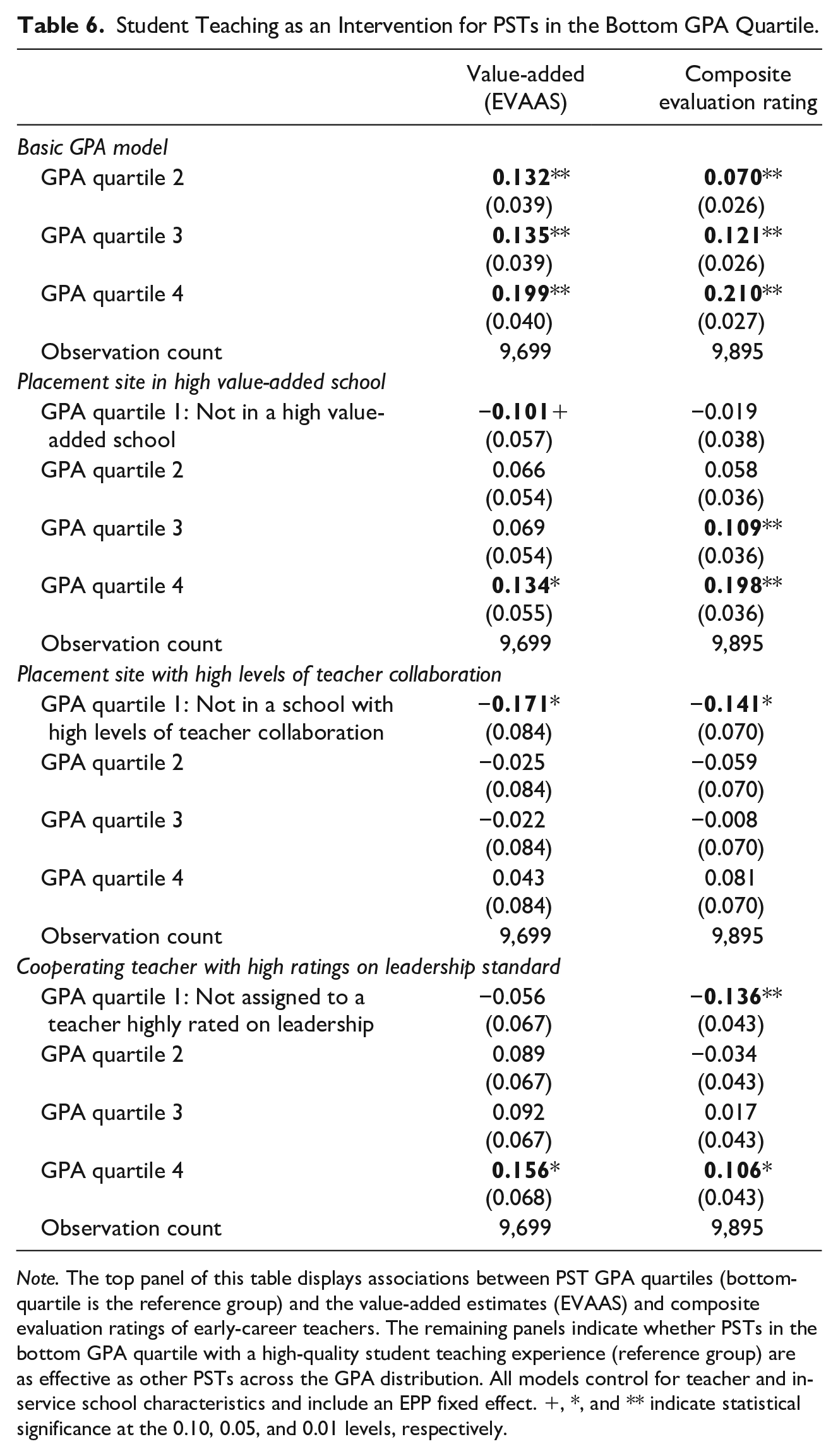
Note. The top panel of this table displays associations between PST GPA quartiles (bottom-quartile is the reference group) and the value-added estimates (EVAAS) and composite evaluation ratings of early-career teachers. The remaining panels indicate whether PSTs in the bottom GPA quartile with a high-quality student teaching experience (reference group) are as effective as other PSTs across the GPA distribution. All models control for teacher and in-service school characteristics and include an EPP fixed effect. +, *, and ** indicate statistical significance at the 0.10, 0.05, and 0.01 levels, respectively.
Results in Table 6 suggest that high-quality placements narrow and sometimes close effectiveness gaps across the GPA distribution. Teachers from the bottom GPA quartile who student taught in a school with high levels of teacher collaboration (i.e., values greater than one standard deviation above the mean) outperform peers from the bottom GPA quartile without such an experience and perform comparably to peers from quartiles 2 to 4. PSTs from the bottom GPA quartile who student taught in a high value-added school (i.e., exceeding expected growth), perform comparably to peers from GPA quartiles 2 and 3 for value-added and GPA quartile 2 for composite ratings. Likewise, teachers from the bottom GPA quartile placed with a cooperating teacher who was highly-rated on the Leadership standard (i.e., those earning the top rating of “Distinguished”), perform comparably to peers from GPA quartiles 2 and 3.
Discussion
We assessed whether high-quality student teaching placements predict the performance of early-career teachers and whether the impact of such placements differs according to PST GPA. Conceptually, this work is motivated by studies connecting learning environments and coaching to teacher development (Kraft & Papay, 2014; Louis & Marks, 1998; Ronfeldt et al., 2015; Zeichner & Gore, 1990) and research showing how vicarious and mastery experiences shape self-efficacy and effectiveness (Bandura, 1977; Hoy & Spero, 2005). Practically, this work is motivated by a desire to provide EPPs and school districts with evidence to inform placement practices. This is especially salient given the challenges in making high-quality student teaching placements at scale (Goldhaber et al., 2018).
Consistent with previous student teaching studies (Ronfeldt, 2012, 2015), we find that early-career teachers have higher value-added estimates if they student taught in a high value-added school and higher evaluation ratings if they student taught in a school with higher levels of teacher collaboration. This suggests that vicarious and mastery experiences in high-quality placement schools matter. Results for cooperating teacher characteristics are less consistent with prior work. Previous studies show that cooperating teachers’ value-added estimates (Goldhaber et al., 2020; Ronfeldt et al., 2018) and observational ratings (Ronfeldt et al., 2018) predict the performance of early-career teachers. We find that early-career teachers earn higher evaluation ratings if they were mentored by a more highly rated cooperating teacher. Results for cooperating teacher value-added are less robust. It is unclear why the results for cooperating teacher value-added differ from those in previous work, however, one possibility is the ways in which EVAAS estimates diverge from the value-added approaches used in prior studies (Ballou & Springer, 2015). Future analyses should continue to assess how cooperating teachers’ instructional effectiveness and coaching acumen influence PSTs.
Our most novel contribution is assessing whether certain PSTs particularly benefit from high-quality student teaching placements. These analyses build on K-12 and higher education research showing the importance of high-quality learning environments to those with lower levels of prior performance (Angrist et al., 2012; Brand & Xie, 2010; Edwards, 2012). We find that PSTs with bottom quartile GPAs particularly benefit from high-quality learning environments—that is, those where students exceed/meet expected achievement growth, suspension rates are low, and teachers collaborate with each other. These teachers also benefit from a cooperating teacher with higher prior-year ratings on the Leadership standard. Moreover, our results indicate that high-quality student teaching placements may narrow effectiveness gaps between those with lower versus higher GPAs. For example, early-career teachers from the bottom GPA quartile who student taught in a school with high levels of teacher collaboration performed comparably to peers with higher GPAs. These results highlight the potential for high-quality student teaching placements—with their vicarious and mastery experiences—to boost the effectiveness of PSTs who may be less ready to teach. Extensions of this foundational work could include a more detailed examination of GPA (e.g., major GPA, GPA for coursework in pedagogy), complemented by additional measures of teacher candidate knowledge and skills (e.g., practicum ratings, observation ratings). These granular data may better identify which PSTs particularly benefit from a high-quality student teaching experience.
Before discussing implications for policy and practice, it is important to consider our limitations. One potential limitation is generalizability to other settings. Our data come from a large and diverse state and account for a majority of those prepared to teach in that state. Nonetheless, continued research should replicate our work, especially the focus on differential effects by PST characteristics. Our analyses also make several assumptions that are important to explicate. These include an assertion that PST GPA is a proxy for teaching knowledge and skills and an assumption that unobservable characteristics of PSTs, placement sites, and in-service schools do not bias estimates. Our final limitation is one of omission. Like recent research in this area, we do not assess whether characteristics of university field supervisors predict outcomes for the PSTs they supervise. These university faculty are an important part of the learning triad in student teaching—that is, the PST, cooperating teacher, and field supervisor (Zeichner, 2010). Future empirical work should consider field supervisors, especially as more EPPs redesign the position to provide richer feedback to PSTs and form deeper partnerships with K-12 districts.
Moving forward, there are two main implications of our work. First, in conjunction with previous studies on student teaching placements, our findings call for EPPs and school districts to form closer partnerships focused on making evidence-based placements and providing cooperating teachers with the necessary training and resources for the role. In particular, results suggest that EPPs and K-12 districts should identify a set of schools with high-quality learning environments in which they want to make placements. Within these select schools, EPPs and K-12 districts should then identify, recruit, and train in-service teachers with the required skills—that is, instructional and coaching—to serve as cooperating teachers. Such partnerships are not easy, as they require EPPs and K-12 districts to frequently communicate, establish coordinated systems, share data, and build a sense of collective responsibility for PST development. While challenging, EPPs and K-12 districts should be highly invested in this mutually beneficial work, especially since many PSTs (45% in one recent study) secure their first teaching job in the district in which they student taught (Krieg et al., 2016).
Second, our results suggest that EPPs may wish to prioritize high-quality placements for PSTs with lower GPAs. To be clear, we contend that all PSTs (and their future schools/students) deserve a high-quality student teaching placement. The partnerships described above are a way to make progress towards that goal. However, to the extent that EPPs and K-12 districts do not yet have the capacity to make these placements at scale, our evidence suggests that EPPs should prioritize placements for candidates who may be less ready to teach. These individuals benefit more from high-quality placements than their peers with higher GPAs. Such a targeted approach would have complications—districts would need to support prioritizing placements for PSTs with lower GPAs (rather than PSTs with stronger academic records) and cooperating teachers might need additional training and resources to support these PSTs well. Despite the potential complications, this strategic focus may help EPPs and their K-12 partners overcome logistical challenges and information asymmetries in the placement process. There may also be important equity and diversity implications with this prioritization, as PSTs with lower GPAs are more likely to be male and identify as a racial/ethnic minority.
Student teaching is an essential component of teacher preparation that can be improved with more systematized and evidence-based placements (Anderson & Stillman, 2013; Goldhaber et al., 2018). We provide evidence regarding the characteristics of those placements and the PSTs who benefit most. This work is directly relevant to EPPs and K-12 districts who want to deepen partnerships and act strategically to strengthen teacher pipelines.
Supplemental Material
Online_appendix – Supplemental material for Placed for Success: Which Teachers Benefit from High-Quality Student Teaching Placements?
Supplemental material, Online_appendix for Placed for Success: Which Teachers Benefit from High-Quality Student Teaching Placements? by Kevin C. Bastian, Kristina M. Patterson and Dale Carpenter in Educational Policy
Footnotes
Acknowledgements
We appreciate our partner institutions in North Carolina for providing their student teaching data and for their valuable feedback throughout the research process. We thank the North Carolina Department of Public Instruction for administrative data and the Belk Foundation for providing funding for this research.
Declaration of Conflicting Interests
The author(s) declared no potential conflicts of interest with respect to the research, authorship, and/or publication of this article.
Funding
The author(s) disclosed receipt of the following financial support for the research, authorship, and/or publication of this article: The author(s) received financial support for this research from the Belk Foundation.

Supplemental Material
Supplemental material for this article is available online.
Notes
Author Biographies
References
Supplementary Material
Please find the following supplemental material available below.
For Open Access articles published under a Creative Commons License, all supplemental material carries the same license as the article it is associated with.
For non-Open Access articles published, all supplemental material carries a non-exclusive license, and permission requests for re-use of supplemental material or any part of supplemental material shall be sent directly to the copyright owner as specified in the copyright notice associated with the article.
