



Abstract
In today’s and tomorrow’s world, people will be required to work longer. At the same time, their employment future will become increasingly insecure due to technological advances and obsolescence of acquired knowledge and skills. This means that something needs to happen in the education and training of our youth. Using a group concept mapping (GCM) procedure, experts in different fields (educators, educational researchers, human resource professionals, etc.) from primarily Europe and North America generated 239 ideas with regard to the trigger statement: “One specific way to prepare youth to make effective and efficient use of information skills to optimally function in tomorrow’s labour market is . . . .” The generated ideas were sorted into 15 thematic clusters (i.e., Critical Thinking, Skills Transfer, High-Level Thinking, Competences, Metacognition and Reflection, Efficacy [Self-Image] Building, Learn in Authentic Situations, Integrate School and Profession, Collaboration, Teacher Professionalization, Information Literacy, Redesign the School, Literacy, and Numeracy, Information Skills, and Learn for the Future) and then rated with respect to their importance and ease/difficulty of implementation. The results showed a disconnect between what was important and ease of implementation with highly important clusters judged to be difficult to implement and vice versa. This led to the definition of a 3-stage approach to adapting education to prepare youth for shortly nonexistent/not yet existing professions.
Keywords
In a world where there is a longer (i.e., increasing retirement age) and ever more insecure employment future (i.e., decreasing shelf-life of jobs trained for, invention of new and unforeseen jobs/professions), something needs to happen in the education and training of our youth. According to The Future of Jobs: Employment, Skills and Workforce Strategy for the Fourth Industrial Revolution from the World Economic Forum (2016a), disruptive changes to business models are profoundly affecting the employment landscape. Today’s most in-demand occupations or specialties were nonexistent 5 to 10 years ago, the pace of this change is accelerating and the shelf-life of employees’ existing skill sets are decreasing. We, thus, need to better anticipate and prepare ourselves and our youth “for future skills requirements, job content and the aggregate effect on employment . . . to fully seize the opportunities presented by these trends—and to mitigate undesirable outcomes” (p. 3). The Organisation for Economic Co-Operation and Development (2017) notes that it is imperative that we ensure that our youth is “equipped with the right type of skills to successfully navigate through an ever-changing, technology-rich work environment . . . to continuously maintain their skills, upskill and/or reskill throughout their working lives” (p. 2). These scenarios, including the differences between previous technological “revolutions” and the present one, is also shared by the International Labour Organization (2017) in their report Global Employment Trends for Youth 2017: Paths to a Better Working Future which notes that the latest “disruptive” technologies such as artificial intelligence, robotics, the Internet of Things, and 3D printing “are now taking on non-routine and complex manual and cognitive tasks that previously could be done only by humans since they require flexibility, judgment and common sense” (p. 37). The World Economic Forum (2016b) notes that education and training has traditionally needed a lot of time to design and develop the “training systems and labor market institutions needed to develop major new skill sets on a large scale” (p. 20). In conclusion, this approach is not an option!
In the Netherlands, the PO-Raad (2017; Elementary School Council) has vented its worries in a memo Nú investeren in onderwijs van morgen: Manifest voor ICT in het funderend onderwijs [Invest in education for tomorrow now: Manifesto for ICT in foundational education] stating that new jobs, new ways of working together, and new technologies necessitates preparing children now in elementary and secondary education “for the future with the knowledge and skills that will allow them to optimally function in a digital society” (p. 1).
Against this background, there is much discussion and confusion as to what knowledge, skills, and attitudes are necessary to prepare the youth for the problems associated with the uncertainties of the labor market and the consequences thereof. What is clear is that students need a strong knowledge and skills foundation for future-proof learning (Kirschner, 2017; Walma van der Molen & Kirschner, 2017), which is defined as the acquisition of knowledge, skills, and attitudes necessary to continue to learn in a stable and enduring way in a rapidly changing world. The term future-proof learning and not what many erroneously call 21st-century skills was chosen for two reasons. The first is that there is little consensus as to what these 21st-century skills are or how many there are. For example, the number and type of skills has increased from four in 2009 which they define as the critical systems necessary to ensure 21st-century readiness for every student (Partnership for 21st Century Skills, 2009; see Figure 1) to, at last count, 16 in 2016 (World Economic Forum, 2016b; see Figure 2). The second reason is that almost all of these so-called 21st-century skills are repackaged skills that have been just as important in previous generations and centuries (i.e., creativity, problem solving, working together, etc.).
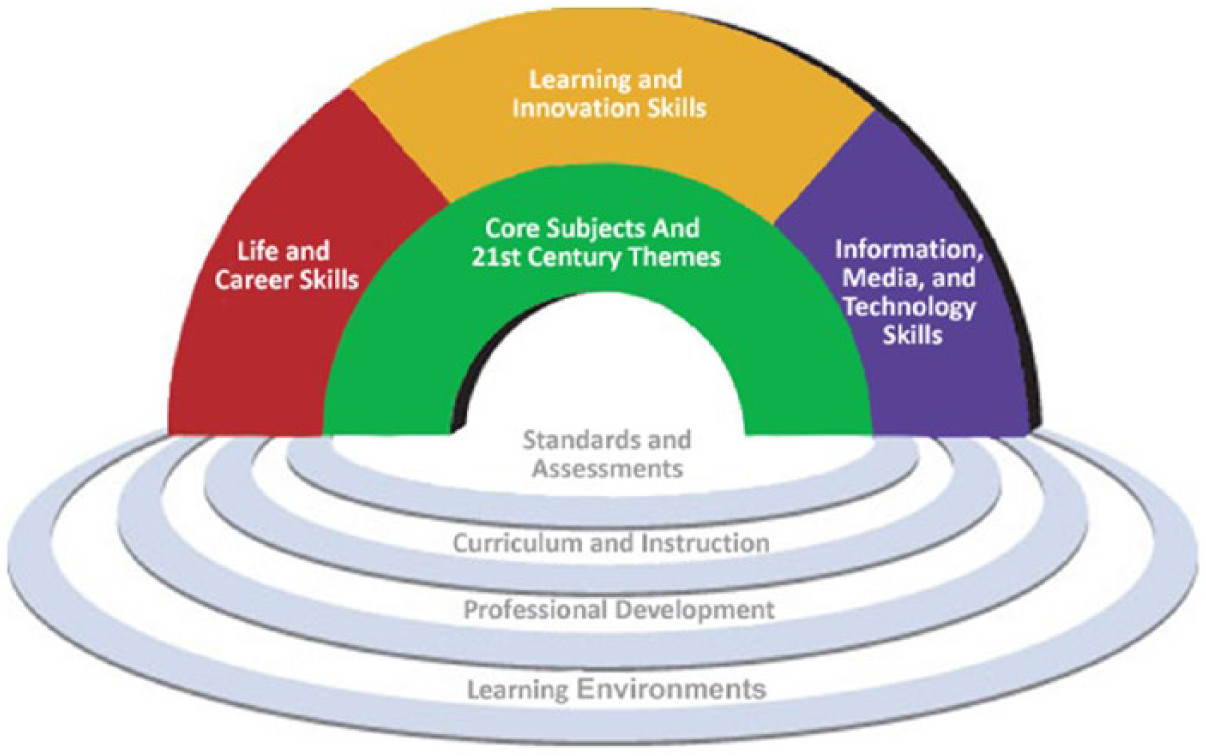
Partnership for 21st Century Skills (2009) Framework for 21st-Century Learning.
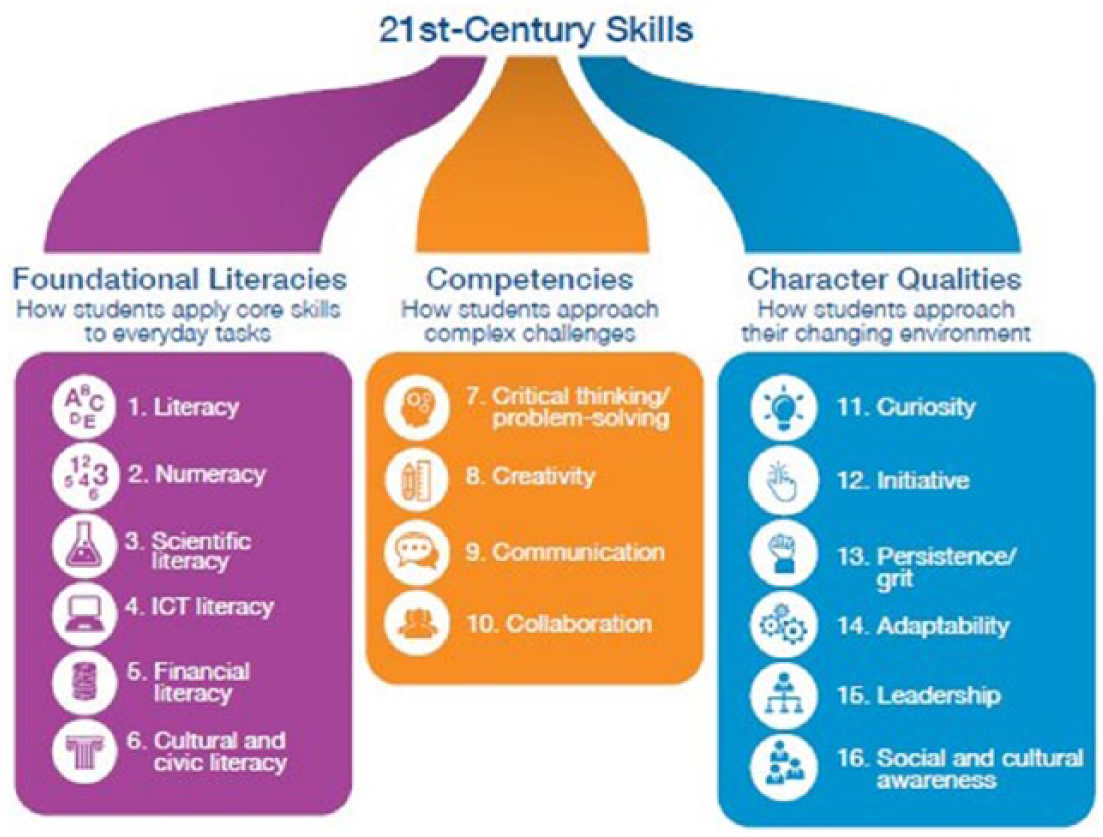
World Economic Forum (2016b): Students require 16 skills for the 21st century.
There are a number of major problems with all of the discussions of 21st-century skills. Although it would go too far afield to discuss this fully, the major problems with the enumerated skills are that many of the skills mentioned
have been required and exhibited since the first people in Mesopotamia (Tigris and Euphrates triangle) cultivated grains from grasses leading to communities, trade, cities, division of labor, and so on and possibly even before. These skills include problem solving, critical thinking, communication, and collaboration.
are not skills at all (e.g., creativity, leadership, grit, adaptability, etc.) but are rather traits/characteristics, which were always needed (see above) but which also cannot be taught.
With this in mind, actually, due to the explosion of information and information sources available today coupled with the lack of a quality guarantee for the reliability of that information (i.e., the function that libraries/librarians fulfilled for available information sources; see, for example, Georgetown University Library on evaluating Internet content 1 ), the only skills that are really 21st century are
Information literacy 2 : Also known as information problem-solving skills (Brand-Gruwel & Stadtler, 2011; Brand-Gruwel, Wopereis, & Vermetten, 2005), including searching for identifying, evaluating (the quality and reliability of information sources), and effectively using the information that has been obtained and
Information management: The ability to capture, curate, and share information (Al-Hawamdeh, 2002).
The school and/or the educational system have an important task in all of this, but it is not clear whether they are either prepared for or equipped to do the job. The primary reasons for this doubt are (a) schools reacts to changes in the labor market too slowly to incorporate the necessary changes in the curriculum, (b) schools are poorly equipped, both materially and in terms of the competences of those in the schools (i.e., teachers, administrators) to carry out the task of preparing their students for their uncertain (labor) future, and (c) the use of ICT is not well integrated in education, and it is questionable whether teachers have the necessary ICT knowledge and skill set to help students to learn in a future-proof way (Kirschner, 2017; Wetenschappelijke Raad voor het Regeringsbeleid, 2013).
With regard to the third reason, advances and availability of computers, software, developments in techniques to analyze large data sets (i.e., data analytics), and machine learning are making it increasingly possible for machines to carry out increasingly complex and intelligent tasks. These technologies are also becoming less expensive, so that they are better available and can be more broadly used and not only for routine tasks.
Up to and including the end of the 20th century, the automation and computerization of jobs was primarily aimed at routine physical and cognitive tasks (see the left side of Figure 3; adapted from Frey & Osborne, 2013). Now and in the predictable future, through advances in computers, software, data analytics, and machine learning, this trend is moving to the areas of both nonroutine physical and cognitive tasks (see the right side of Figure 3). Such developments mean that in the foreseeable future, fewer people will be needed for nonroutine physical and cognitive professions.
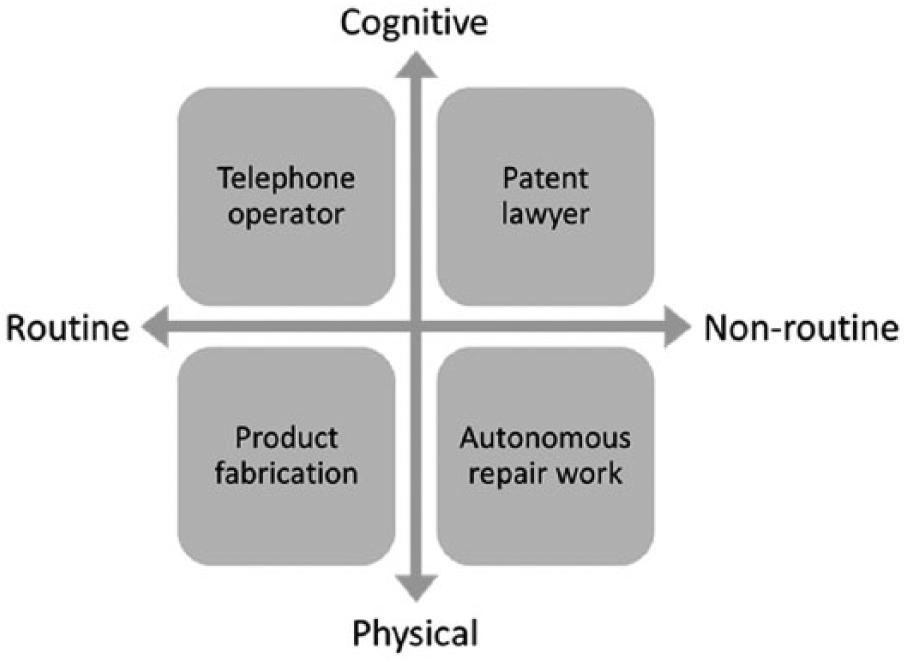
The four quadrants of professions with respect to character (routine vs. nonroutine) and type of work required (physical vs. cognitive).
This view, however, is not undisputed. Although many feel that the new “revolution” will be highly disruptive leading to massive job elimination, there are others who do not share this view noting that it could lead to massive job creation, though of different types of jobs. The National Academies of Sciences, Engineering, and Medicine’s report Information Technology and the U.S. Workforce: Where Are We and Where Do We Go from Here? stated that although 65% of the respondents to a Pew Research Center survey expected that robots and computers would “definitely” or “probably” do much of the work currently performed by humans by the year 2065. Of this same group, 80 percent expressed the expectation that their own jobs will “definitely” or “probably” still exist at that time. (p. 18)
The report notes that “it is not known whether new technologies will automate and replace workers in existing tasks more rapidly than the economy as a whole (driven by various factors, including automation) creates new demands for labor” (p. 5). The National Academies conclude that it is difficult if not impossible to predict the net effect as it is easier “to anticipate how new technologies will automate existing tasks than it is to imagine tasks that do not yet exist” (p. 5).
It is not only highly plausible, but seems also to be the case, that many students in programs at vocational secondary schools are being prepared for jobs that—either through physical or virtual robotization (in the form of Internet-bots)—will evaporate in the short term. According to the MBO Raad (2017) 3 [Dutch Vocational Educational Council], of the 475,000 students enrolled in vocational secondary schools in 2016, 14.8% (±70,300) were enrolled in the area of Hospitality Services and Agriculture and 11.4% (±54,150) in Business Services. This means that almost 125,000 are enrolled in programs that educates them to work in service (e.g., travel agents, banking services, hotel services), financial administrative (e.g., bookkeeping), or juridical/law (e.g., law clerks) professions/industries where there is a big chance that the jobs that they do will be automated and, thus, will no longer be relevant in the short or middle long term (Deloitte, 2016).
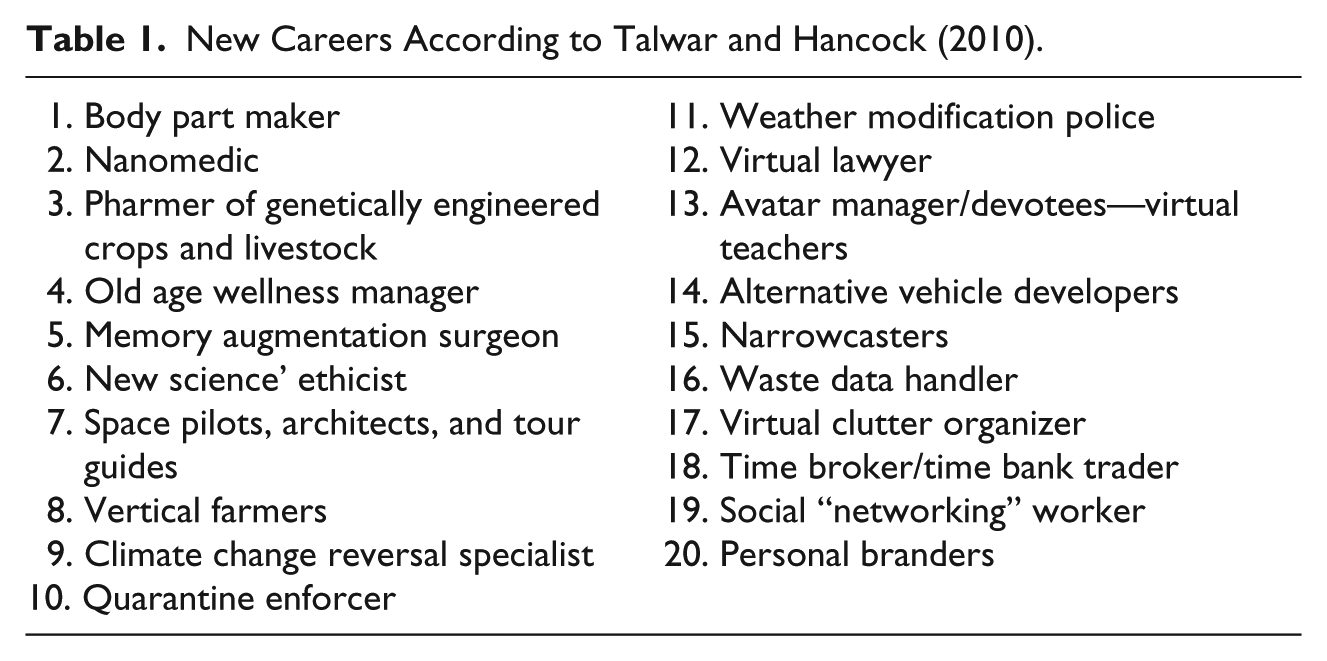
Talwar and Hancock (2010), for example, presented a description of 110 future jobs in their report The shape of jobs to come: Possible new careers emerging from advances in science and technology (2010-2030). Table 1 presents 20 of the new careers that they feel may be possible.
New Careers According to Talwar and Hancock (2010).
In addition to these new, at this moment often difficult to imagine, professions, there is also a growing trend in the rate of professional obsolescence. Obsolescence (Kaufman, 1974), a notoriously diffuse concept, is the degree to which professionals lack the up-to-date knowledge or skills necessary to maintain effective performance in their current or future work roles. According to De Grip (2004), “Obsolescence of human capital belongs to the heart of the economic challenge the Western economies face” (p. 2). According to Thijssen and Walter (2006), obsolescence is the depreciation of human capital; human qualities that are not maintained. This depreciation can be in terms of knowledge, skills, abilities, attitudes, insights, visions, and views. In short, there are a diversity of work-related qualities that can become outmoded and/or outdated; obsolete. Another way to say this is that obsolescence is the degree to which workers/professionals miss the necessary up-to-date knowledge and skills to effectively function in their present or future work situations. Thijssen and Walter differentiate three types of obsolescence:
Technical skills obsolescence: Depreciation of human capital attributable to changes in or around workers themselves. It emerges when a person simply loses their command of certain skills, such as physical or mental capacities (wear), or because, temporarily or permanently, available skills are used insufficiently, or not at all (atrophy).
Economic skills obsolescence: Depreciation of human capital caused by external changes due to a range of technological, organizational, and labor market developments. These can be (a) job-specific when the skills required for a job change where the person can no longer satisfy the changed job requirements; (b) due to a decline in demand for certain skills on the labor market, for example, when there is shrinking employment in a given sector; and (c) due to redundancy, reorganizations, and job cuts.
Perspectivistic obsolescence: Depreciation of human capital caused by a person’s outdated perspectives and views on work-related and occupational trends. This leads to a loss of appreciation of one’s skills by management and coworkers. The worker is seen as old-fashioned, inflexible, or as a misfit.
The question, thus, is, How can we best prepare our youth so that they can cope with the insecurity of the future and avoid obsolescence? To this end, a research project was carried out to try to solve this problem with special emphasis on ICT skills as (a) many, if not most, of the disruptive changes affecting the future of jobs and professions (e.g., AI, robotics, machine learning) are
Method
Group Concept Mapping (GCM)
To answer the research question, GCM (Kane & Trochim, 2007; Trochim & McLinden, 2017; see also Stoyanov, Jablokow, Rosas, Wopereis, & Kirschner, 2017; Stoyanov & Kirschner, 2004) was employed. GCM is a mixed methods participative research methodology that facilitates a group of stakeholders to arrive—in an objective way—at a shared vision regarding a particular issue (e.g., What are specific ways to prepare youth to make effective and efficient use of information skills to optimally function in tomorrow’s labor market). The participants are involved in activities they are used to carrying out: generating ideas, sorting ideas into groups, and rating ideas on some values (e.g., importance of an idea and ease of implementation of an idea). After they independently and anonymously generate, sort, and rate ideas, two advanced multivariate statistical techniques—multidimensional scaling (MDS) and hierarchical cluster analysis (HCA)—aggregate the individual contributions to identify patterns in the data and show the common understanding of the whole research population or subpopulations thereof on the issue under investigation. GCM shows how ideas are related, how they are grouped into more general categories, how much emphasis is given to each idea and a category, and how stakeholders differ in their perspectives. It also suggests short-term and long-term actions. Visualizations of the results such as concept maps, pattern matches, and “go-zone” help the user to easily grasp the meaning of the findings.
GCM has advantages above other methods for expert consultation—either face to face or online—such as questionnaires, interviews, affinity diagrams (K-J method), or classical concept mapping. In GCM, the information is not created by the researcher and given to participants (in contrast to questionnaires). Participants, who are the knowledge holders, generate and structure the content themselves. They are considered and treated as coresearchers, not as respondents. There is only one round of structuring the data (different from classical Delphi). As participants work independently and anonymously of each other, it is better possible to minimize the negative effects of group dynamics (i.e., when participants either noncritically accept others’ solutions or unproductively reject the others’ structuring and prioritizing of ideas) compared with focus group and Delphi. Some of the challenges/problems associated with the data analysis of interviews such as its time-consuming nature (i.e., translating recordings to written text), and its flawing due to nonuniform coding decisions or researcher-driven predefined classification schemas (i.e., subjectivity) which can be either nonexhaustive or impose biases. Furthermore, GCM does not need interrater discussion to arrive at an agreement between researchers nor is there a need to calculate interrater reliability which is required by interview analysis. In GCM, participants and not researchers code the content when they sort the ideas they themselves have generated into groups and then label them. A multivariate statistical analysis aggregates the individual coding schemas across the participants to objectively reveal patterns in the data as thematic clusters. Consensus, thus, is not forced but emerges naturally from the data, in contrast to affinity diagrams.
Our experience shows that people often confuse classical concept mapping and GCM. Each of these two approaches is considered an external representation of individual or group cognitive processes in learning, problem-solving, or decision-making situations. The difference is that in classical concept mapping, the participants draw the map themselves and delineate the relationships between ideas. In GCM, the structure of relationships between ideas emerges objectively from the data (brainstorming, sorting, and rating) by performing quantitative operations—MDS and HCA (Jackson & Trochim, 2002; Kane & Rosas, 2018; Stoyanov et al., 2017). Table 2 summarizes the main steps in carrying out a GCM study.
GCM: Phases, Activities, Roles.
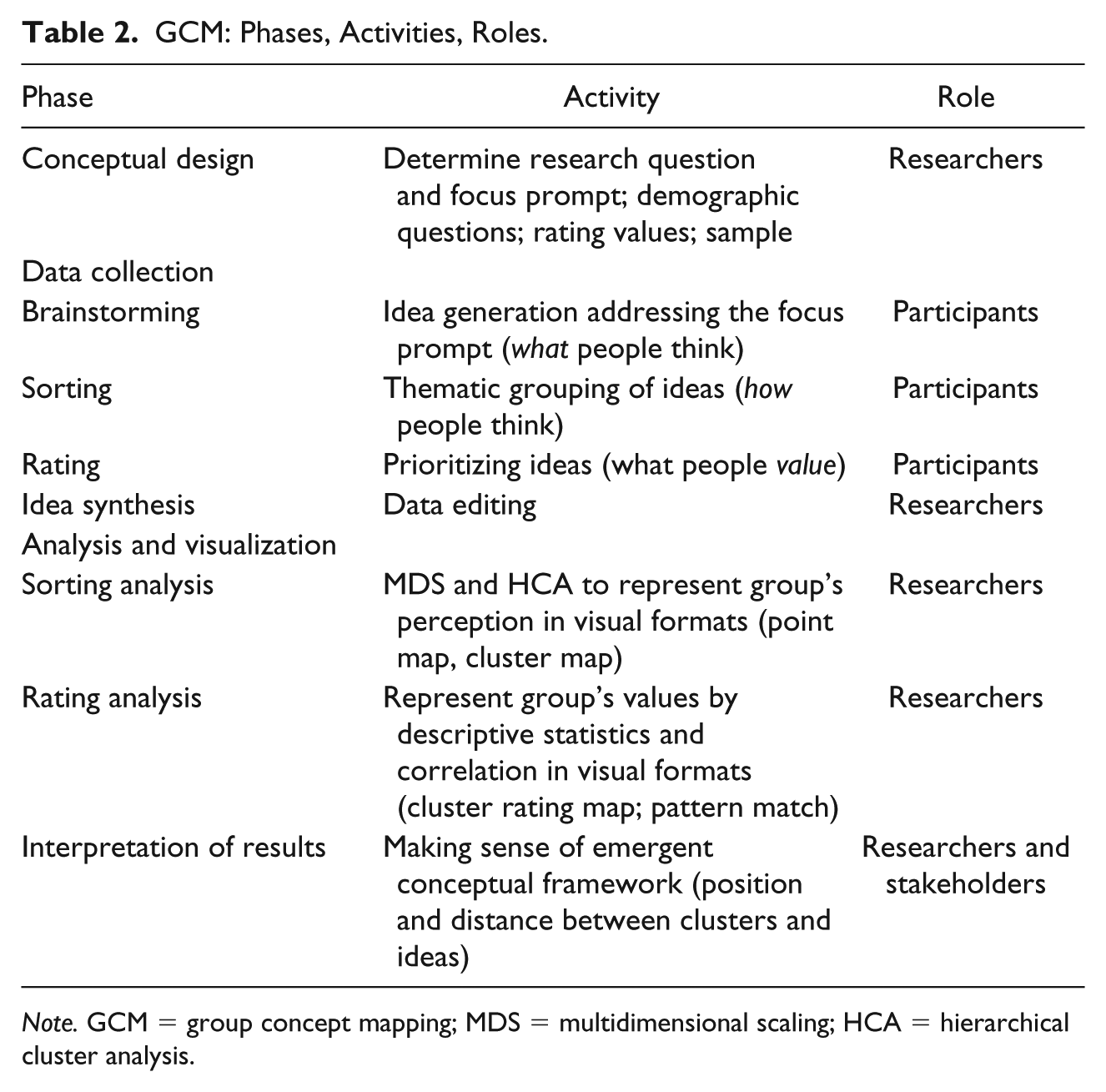
Note. GCM = group concept mapping; MDS = multidimensional scaling; HCA = hierarchical cluster analysis.
Participants
In total, 95 experienced experts from Europe and North America, representing different professional fields and functions (see Table 3 for the areas of expertise, fields, and job functions) registered to the study’s web environment, The Concept System® Global MAX™ (2016), specifically created to facilitate an asynchronous online collection and analysis of the participants’ input. A snowball technique to determine and approach the experts was used. The primary criteria for choosing the original experts were (a) authorship of articles and reports on the topic being studied, (b) experience and expertise in the fields of education, training, and work (e.g., senior staff of relevant research institutes, HRM departments in large industries, policy makers at the national level), and (c) principals/heads of schools involved with the problem being studied. Of the 95, 61 contributed to the brainstorming, 42 to the sorting, 42 to the rating on importance, and 35 to the rating on implementation.
Demographics.
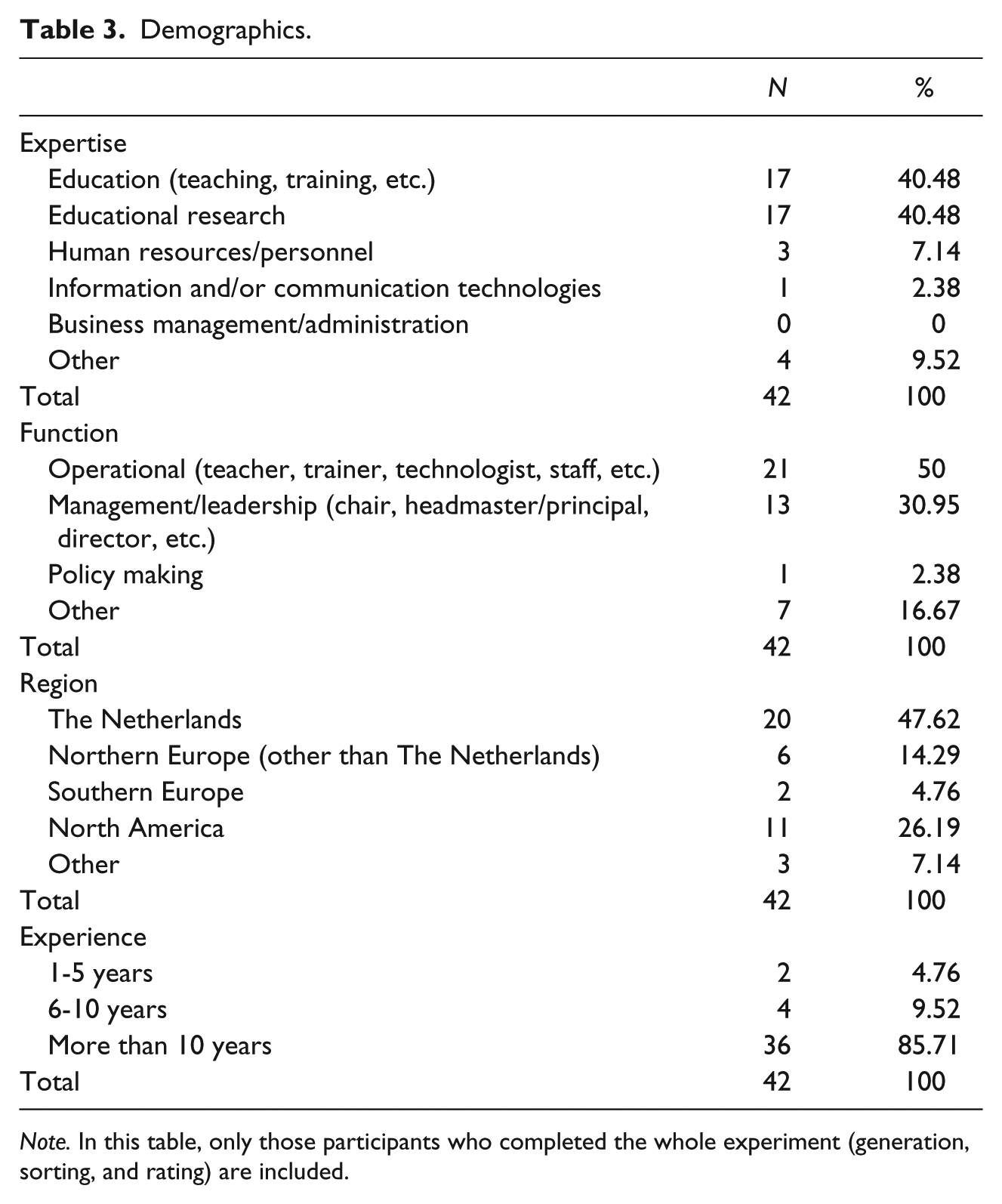
Note. In this table, only those participants who completed the whole experiment (generation, sorting, and rating) are included.
The decrease in the number of participants involved in different activities is natural and common for GCM projects (Rosas & Kane, 2012). What is more important here is that the sampling structure, as described above, for all activities remains the same. The number of participants for sorting is sufficient to draw meaningful conclusions as the saturation level has been established at 30 to 35 people (Rosas & Kane, 2012). Ratings add some additional information to the sorting analysis, which is the primary GCM type of analysis.
Procedure
The procedure included the following steps:
Online idea generation. The participants were asked to brainstorm as many ideas as possible, completing the following focus prompt (i.e., trigger statement): “One specific way to prepare youth to make effective and efficient use of information skills to optimally function in tomorrow’s labour market is . . .” The participants received 4 weeks for this activity.
Idea synthesis. In this step, a group of four researchers (i.e., lead researcher and three assistants all well versed in secondary vocational education) screened all of the ideas generated to (a) obtain a list of unique ideas, with only one idea represented in each statement (i.e., elimination of doubles of an idea, splitting ideas consisting of compound statements, etc.); (b) ensure that each statement is relevant to the focus of the project (i.e., eliminate irrelevant statements); (c) reduce the statements to a manageable number for sorting and rating (i.e., eliminate synonyms); and (d) ensure that statements are clear and understandable across the entire stakeholder group. During this phase, statements are not prioritized, selected based on perceived value, or deleted based on preconceived notions. Consensus was achieved with the three assistants on all changes.
Idea sorting. Participants were asked to group the synthesized list of ideas/statements based upon their own perception of similarity of meaning and then give each group a name. In addition, they were instructed not to create categories according to priority or value, such as “Important,” “Hard to Do,” or “Easy to Apply.” Categories such as “Miscellaneous,” “Junk,” or “Other” for grouping together dissimilar statements were also prohibited. The participants could put a statement alone in its own category if they thought it to be unrelated to all of the other statements.
Idea rating. Participants were asked to rate the statements based on two different criteria, namely, (a) relative importance of each statement about specific ways to prepare youth to make effective and efficient use of information skills, using a scale ranging from 1 (relatively unimportant) to 5 (extremely important), and (b) how difficult/easy a statement is to implement in practice, using a scale ranging from 1 (very difficult) to 5 (very easy). The participants were given 4 weeks for completing the sorting and rating with a reminder after the second week.
Data analysis. Analysis of the data included multivariate statistics such as MDS and HCA plus correlations and descriptive statistics.
Interpretation of the results. The researchers then interpreted the results and discussed them with an advisory board to validate their interpretation of the data.
Results 4
Idea Generation and Synthesis
The participants produced 239 ideas during the idea generation phase. After splitting those that contained more than one idea, the overall number increased to 253. These ideas were then subjected to idea synthesis, carried out by four researchers. The principal investigator first reviewed all of the statements and assigned keywords to each of them. Next, the keywords were used to define each statement as a code word, so the statement can be considered with the statements under the same higher order category. The outcome of the coding was reviewed by the other three researchers. Then the statements were sorted by code word–forming clusters or groups of statements after which all four researchers individually reviewed the statements in each group in detail, making a proposal for retaining or rejecting statements by highlighting them with different color (red = to be omitted; yellow = not sure; and green = to be kept). The results of this exercise were compared and discussed by the group of researchers; consensus was achieved on all statements. The criteria for the selection of statements were as follows: (a) Is the statement relevant to the focus prompt? (b) Of similar statements, which is the most representative one (which says it best)? and (c) Can the statement be rated (which helps to confirm focus and understanding)? Finally, the selected statements were edited for clarity and neutrality (e.g., avoid jargon, spell out acronyms); negative expressions of an idea were removed; and the grammar was, where necessary, revised to ensure syntactic consistency among the statements though the language of the participants was preserved as much as possible. Idea synthesis involves the editing and not the analysis of the data. Its main purpose is to ensure that all ideas address the focus prompt and are clear and understandable for all participants who will be asked to sort and rate them. The idea synthesis ended up with 109 statements that were uploaded back to the software system The Concept System® Global MAX™ (2016), randomized, and made available to the participants for sorting and rating. The full list of ideas/statements can be found in Appendix A.
Analysis of the Sorting Data
The first outcome of the GCM, which is a result of the MDS analysis, is a point map representing each statement as a separate point on a two-dimensional (X, Y) space (see Figure 4). MDS operates on the raw sorting data as collected in a similarity matrix to convert the qualitative sorting judgment of the participants into quantitative information. A similarity matrix consists of as many columns and rows as the number of sorted statements (i.e., here 109 × 109) and aggregates all individual similarity matrices. An individual matrix accommodates the raw idea groupings of an individual participant. If two items have been grouped together, a “1” is assigned in the cell, otherwise it is “0.” The value for any pairs of statements in the total similarity matrix indicates the number of participants who grouped these two statements together.
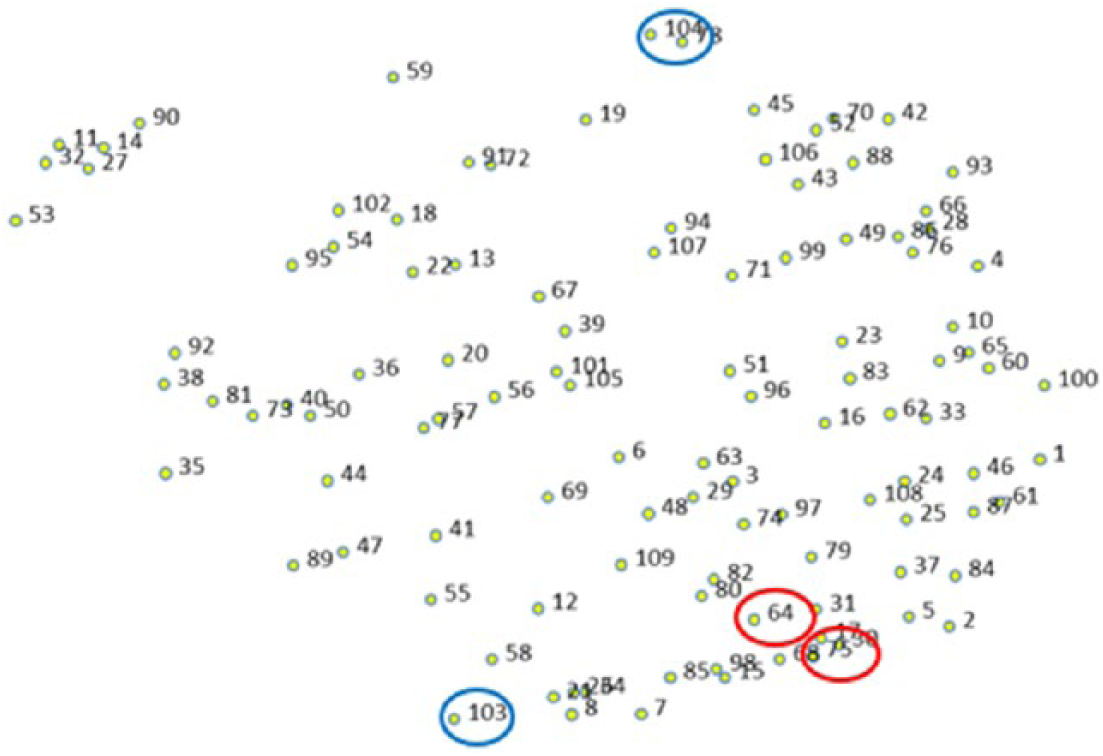
Point map.
The map of this project shows all 109 ideas and how they are related with more similar ideas proximally located in the two-dimensional space. For example, Statement 64 “focus on metaskills (learning how to learn, creating self-awareness regarding competences)” and Statement 75 “develop self-directed learning skills” are positioned close to each other, suggesting they are close in meaning (red ovals in Figure 4). However, Statement 103 “focus on personal goals and self-trust to reach them” and Statement 104 “stop building schools, start building eco-systems as places where children learn and develop” are far away from each other indicating a different meaning (blue ovals in Figure 4). MDS assigns each idea a bridging value (BV; between 0 and 1) after computation of the map. The BV is a measure of the degree to which a statement was sorted with its neighbors. A lower BV means that more participants grouped the statements with ideas around it, whereas a higher BV indicates that the idea has been sorted together with statements further apart. MDS also produces a statistic, called stress index (a value between 0 and 1), to indicate the extent to which the concept map reflects the raw sorting as represented by a binary similarity matrix. In this study, the stress index is .26, which is not only in the accepted range but also quite good in terms of reliability of the results (Rosas & Kane, 2012).
To make the interpretation of the data more meaningful, agglomerative HCA of the MDS X-Y coordinates was used to distinguish themes emerging from the data. This statistical procedure treats each idea (i.e., point on the map) as a cluster in itself at the very beginning (i.e., 109 clusters) and successively step-by-step merges (i.e., agglomerates) pairs of ideas or groups of ideas until all ideas are combined into one cluster.
To decide on the number of clusters, typically the procedure starts with 20 cluster solutions until reaching five (a practical heuristic based on research and practice with GCM; Kane & Trochim, 2007). A recent meta-analytical study (Rosas & Kane, 2012) suggested reducing the number of steps from 16 to five. The suggestions for different cluster solutions were checked starting from 16-cluster solution and arriving at a five-cluster solution assisted by a simulation, embedded in the software, which produces a replay map (see Figures 5 and 6).
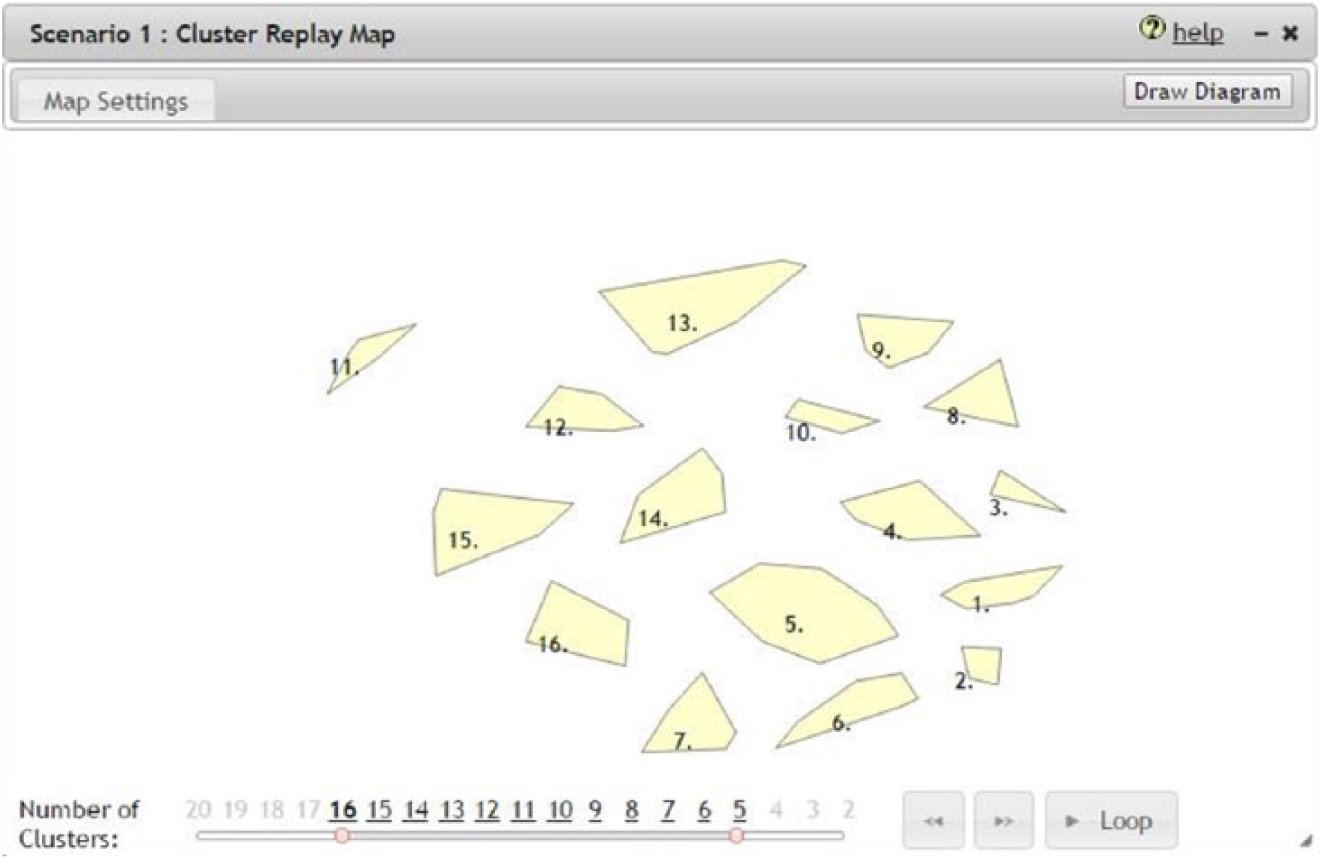
Replay map for 16 clusters.
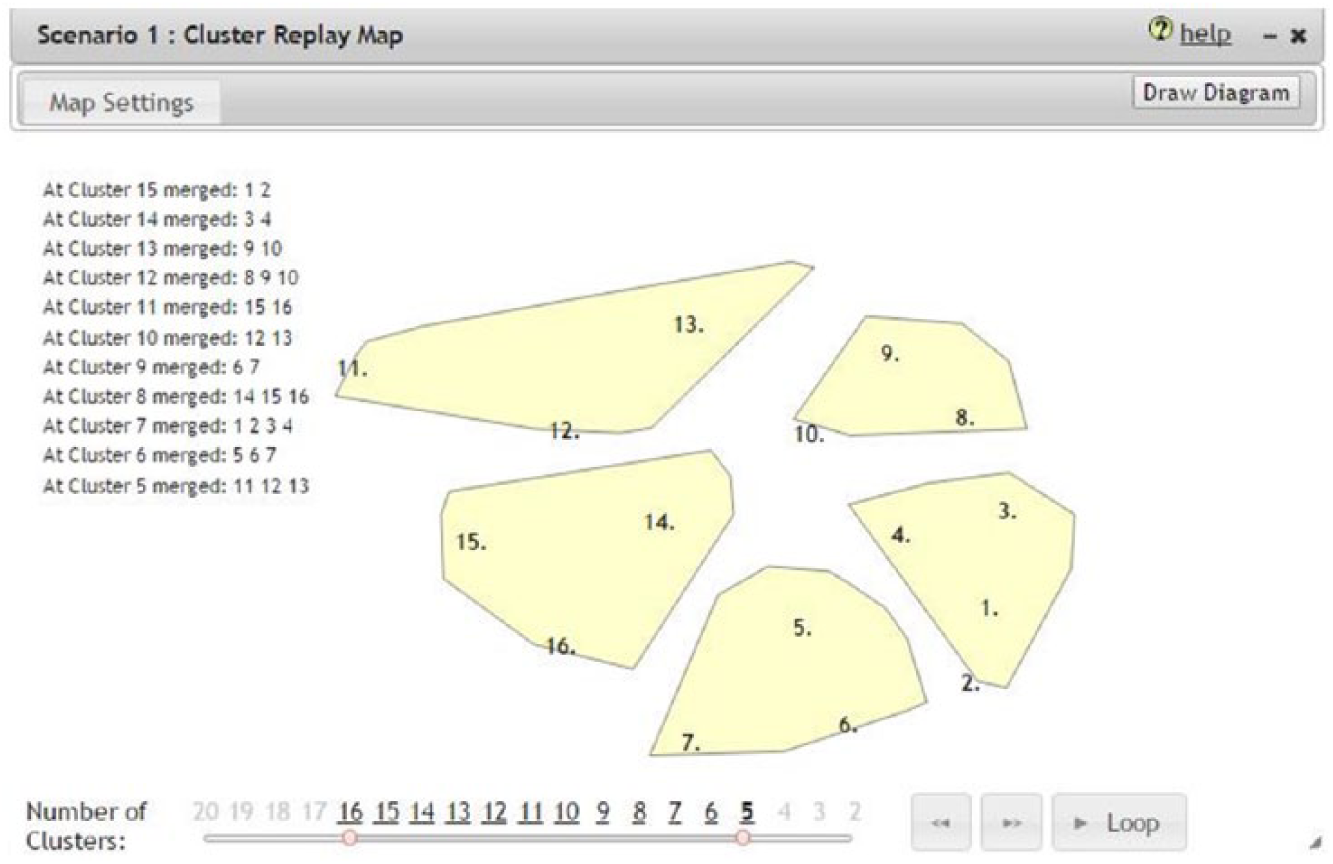
Replay map for five clusters.
In general, there is neither a right nor a wrong number of clusters but rather a solution that the researchers feel most comfortable working with, where a balance is struck between showing a bigger picture while also providing sufficient detail. Two researchers independently went through all suggestions for merging clusters using a checklist with options “Agree,” “Disagree,” and “Undecided.” Typically the cutting point of “Agree” and “Disagree” in both checklists should be considered a sort of criterion for deciding upon the final number of clusters (for more details, see Kane & Trochim, 2007). In this particular case, the researchers consistently agreed on merging clusters at the first step. The conclusion was, thus, that a 15-cluster solution reflects the best possible way of clustering the data for the purposes of the study (see Figure 7).
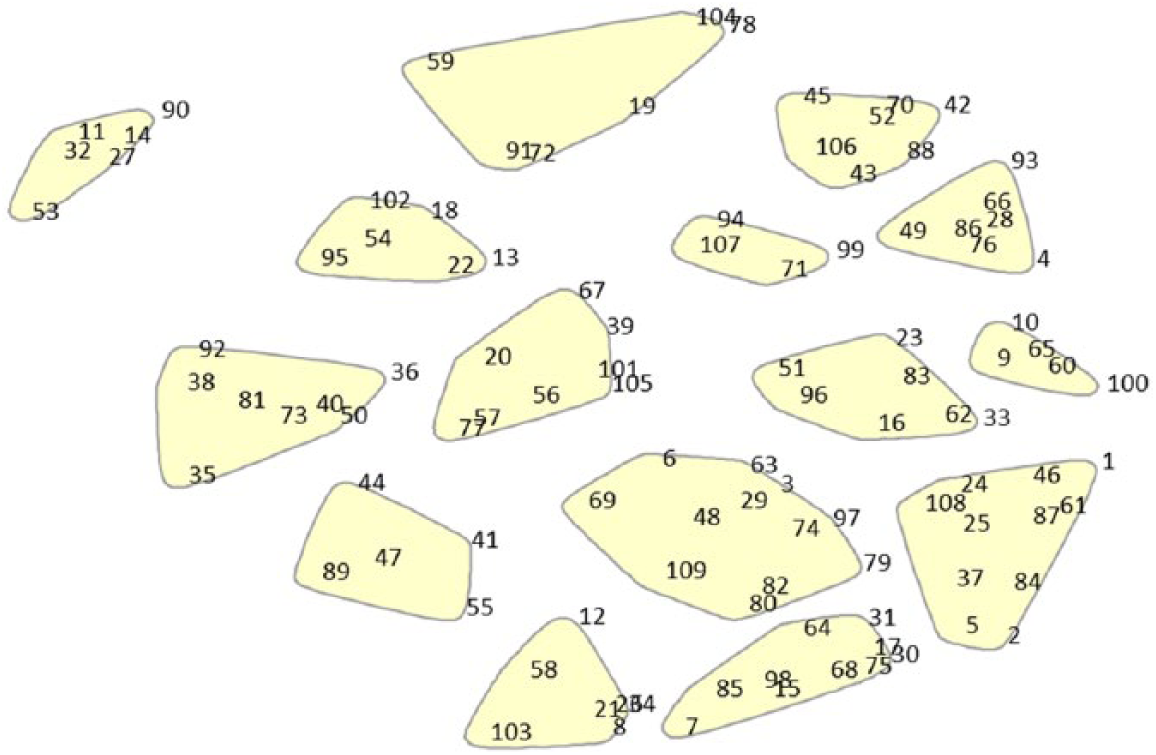
15-cluster solution with point map.
The next step in making sense of the data was to attach names to the clusters. We combined the three possible ways of doing this, namely, by (a) reviewing the content of a particular cluster to identify the meaning that the majority of the ideas in the cluster represent, (b) looking at the BVs of the ideas in a cluster—those with lowest BVs express the meaning of a cluster best, and (c) checking suggestions given by the Concept System software, which applies a mathematical centroids-based algorithm to identify the closest fitting cluster label. The following names were given to the clusters: Critical Thinking, Skills Transfer, High-Level Thinking, Competences (KSA; Knowledge, Skills, Attitudes), Metacognition and Reflection, Efficacy (Self-Image) Building, Learn in Authentic Situations, Integrate School and Profession, Collaboration, Teacher Professionalization, Information Literacy, Redesign the School, Literacy and Numeracy, Information Skills, and Learn for the Future (see Figure 8). Table 4 presents some representative statements for each clusters.
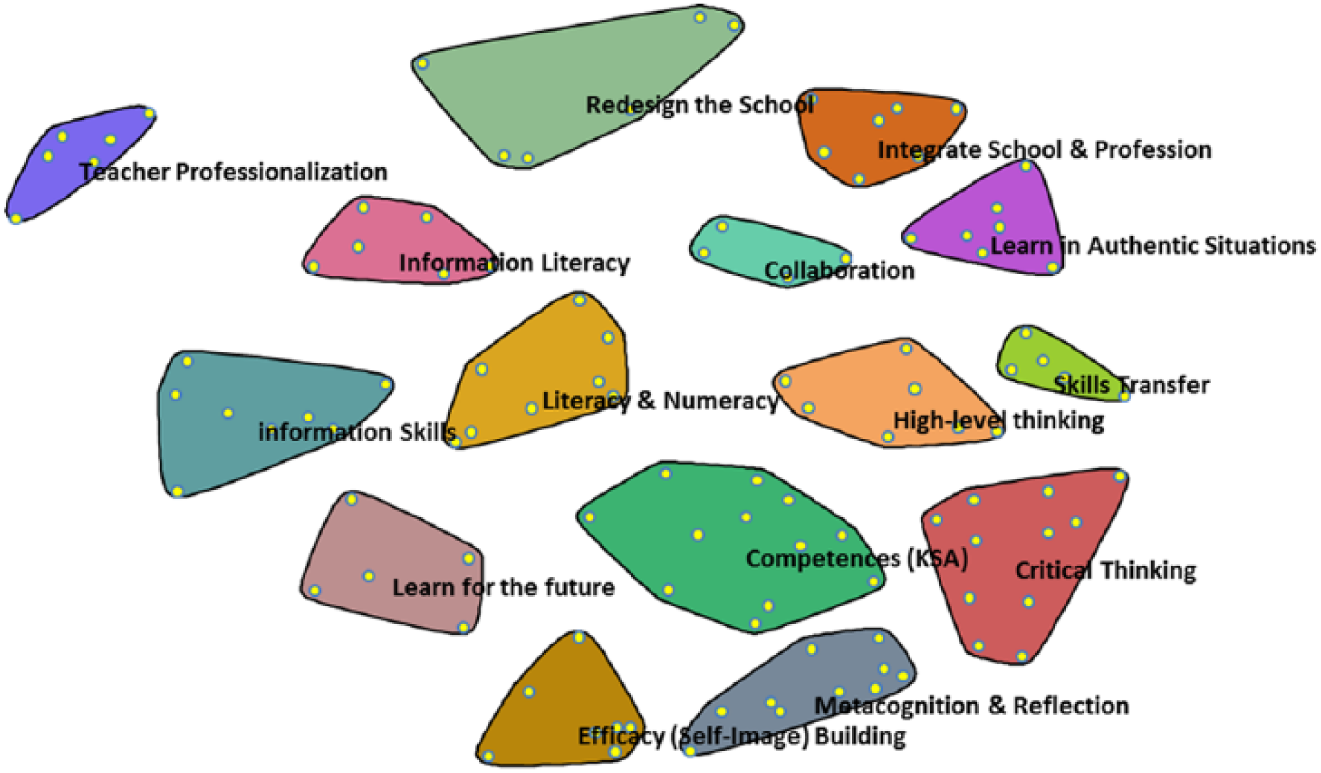
Cluster map named.
Clusters With Representative Statements.
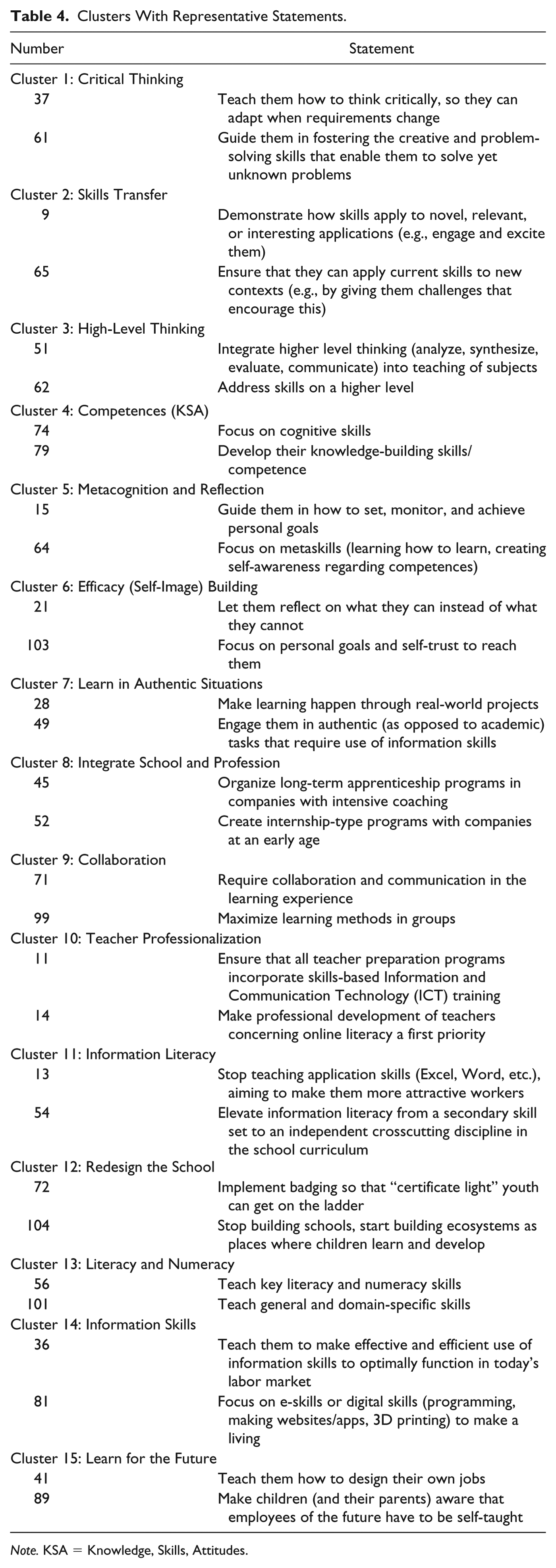
Note. KSA = Knowledge, Skills, Attitudes.
The most coherent cluster are Competences (KSA) and Metacognition and Reflection, both with a cluster average BVs of .07. This means that the participants agreed most consistently on grouping the statements in this cluster. The cluster next on the list on this criterion is High-Level Thinking (BV = .13), followed by Literacy and Numeracy (BV = .15), Learn in Authentic Situations (BV = .17), and Critical Thinking (BV = .18). The highest BV (.55) belongs to Teacher Professionalization. A little lower BVs can be found for the clusters Learn for the Future (BV = .49) and Redesign the School (BV = .44). More details are presented in Appendix B.
Analysis of the Rating Data
The analysis of the rating data provides additional information (see Figure 9; the range of average values is divided into five layers: 1 = lowest; 5 = highest). The clusters that score high on importance are Metacognition and Reflection (M = 4.11), Skills Transfer (M = 4), Critical Thinking (M = 4), and Learn in Authentic Situations (M = 3.9). Redesign the School scores the lowest (M = 3.07), followed by Learn for the Future (M = 3.16), Information Literacy (M = 3.24), Information Skills (M = 3.27), Teacher Professionalization (M = 3.31), and Literacy and Numeracy (M = 3.33).
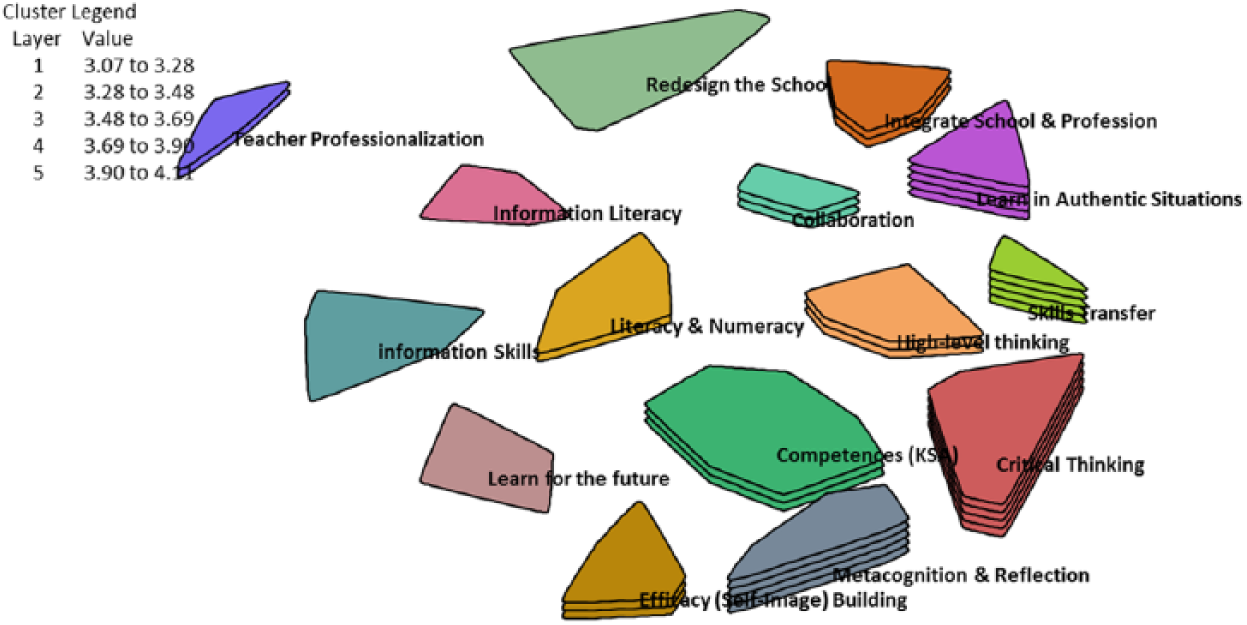
Cluster rating map “importance.”
Redesign the School is rated as the most difficult to implement (M = 2.44), followed by Integrate School and Profession (M = 2.71), Critical Thinking (M = 2.98), and Skills Transfer (M = 2.99). The easiest to implement are the statements in the clusters Literacy and Numeracy (M = 3.63), Information Skills (M = 3.54), Collaboration (M = 3.40), Competences (KSA; M = 3.35), and Learn in Authentic Situations (M = 3.32). See Figure 10.
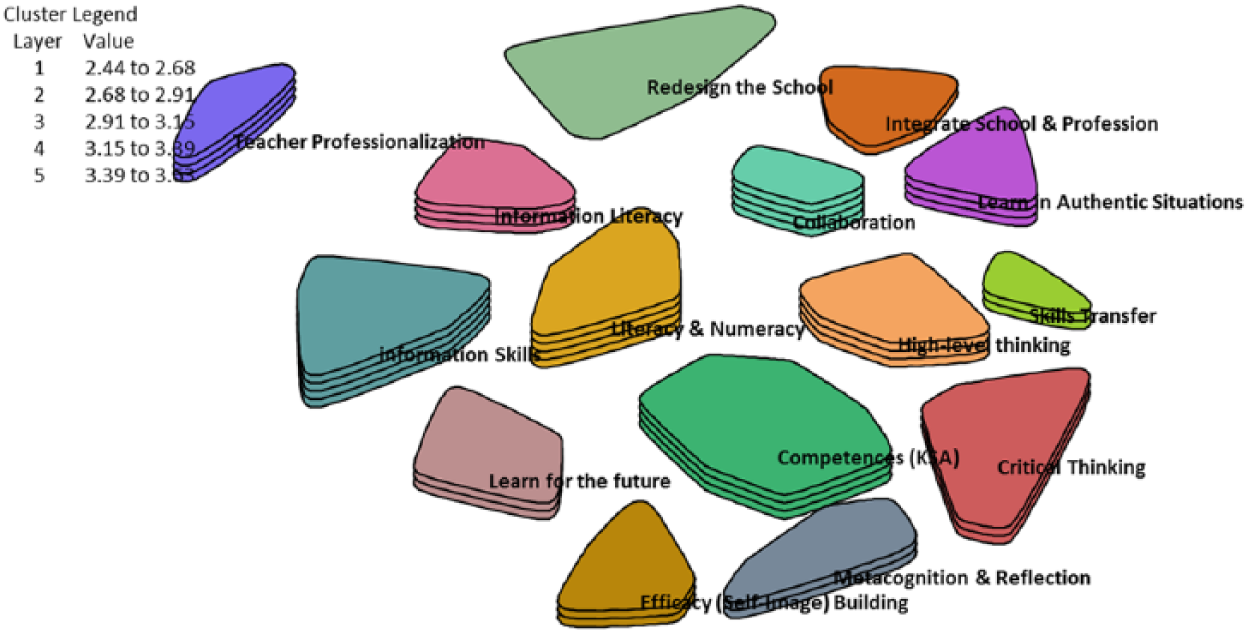
Cluster rating map “implementation.”
The ladder graph, called pattern match (see Figure 11), shows the relative position of clusters when compared with each other on the average rating of the two values. As is evident, some of the clusters score relatively high on one value but relatively low on the other. On the left-hand side of the “ladder,” the clusters are ranked with respect to how important the respondents deemed them to be, whereas on the right-hand side the same is done for how feasible they are, that is, how easy/difficult they are to implement. On the ladder, the most important and the most easily implemented are at the top, decreasing in importance, and feasibility toward the bottom. What is apparent is that what people call “higher-order skills (Metacognition and Reflection, Skills Transfer, and Critical Thinking)” are considered the most important clusters of ideas, but that these skills are at the same time seen as rather difficult to implement. In contrast, the respondents found that the easiest clusters to implement are those that deal with the so-called 21st-century skills (Literacy and Numeracy, Information Skills, and Collaboration), but that these skills are at the same time ranked fairly low in importance with respect to what schools need to do. Redesign the School lies at the bottom of both scales. The correlation (Pearson product-moment) between the two rating values is very low (r = .01). This means that there is virtually no correlation between the ratings of importance and the ratings of implementation difficulty. A significant difference was detected between the mean values of importance and implementation at a cluster level as follows: Critical Thinking, t(20) = 10.81, p < .001; Skills Transfer, t(8) = 5.11, p < .001; Competences, t(22) = 2.42, p < .05; Metacognition and Reflection, t(18) = 9.44, p < .001; Efficacy, t(12) = 2.77, p < .02; Learn in Authentic Situations, t(12) = 7.33, p < .001; Integrate School and Profession, t(12) = 4.89, p < .001; and literacy, t(14) = −2.5, p < .05.
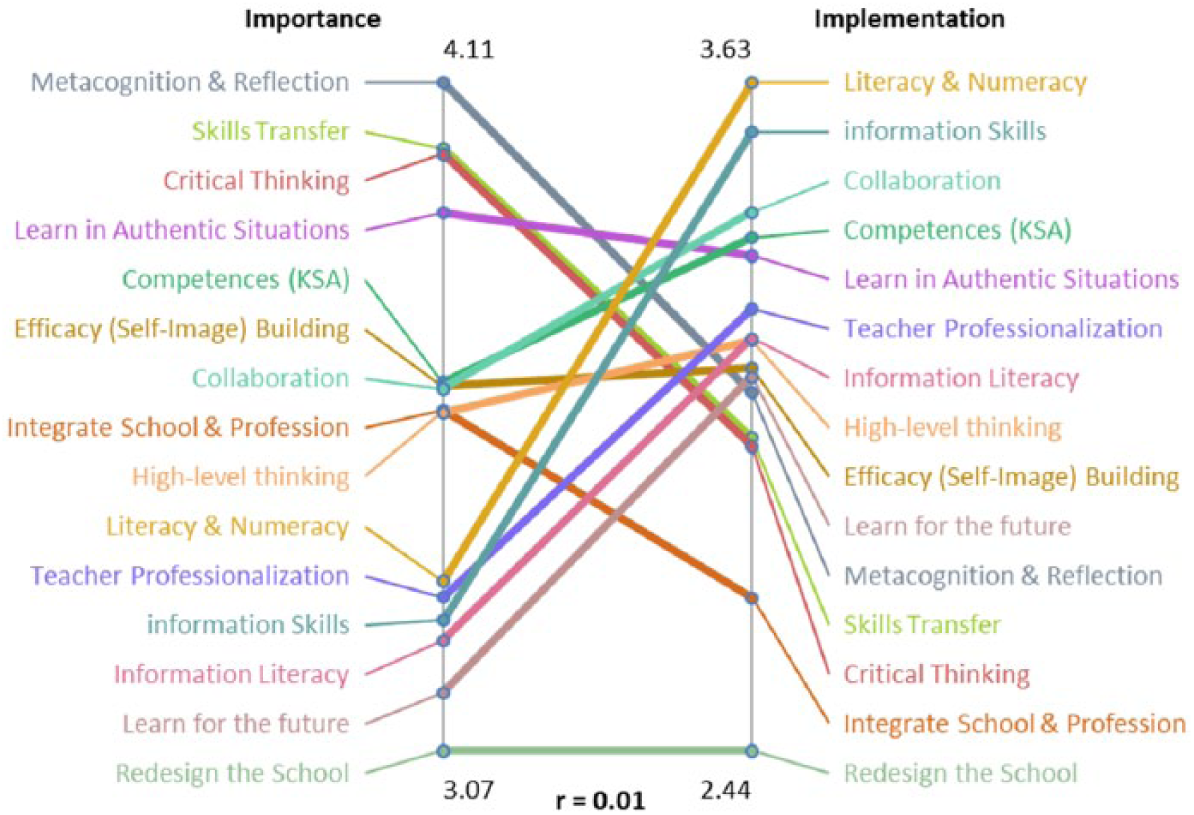
Pattern match importance vs. implementation.
Pattern matching also can be used to compare the ratings of different groups of participants. For example, the participants from the Netherlands do not differ in their ratings on importance and implementation from representatives of the other countries (rimp = .81; rimpl = .83, respectively; see Figure 12).
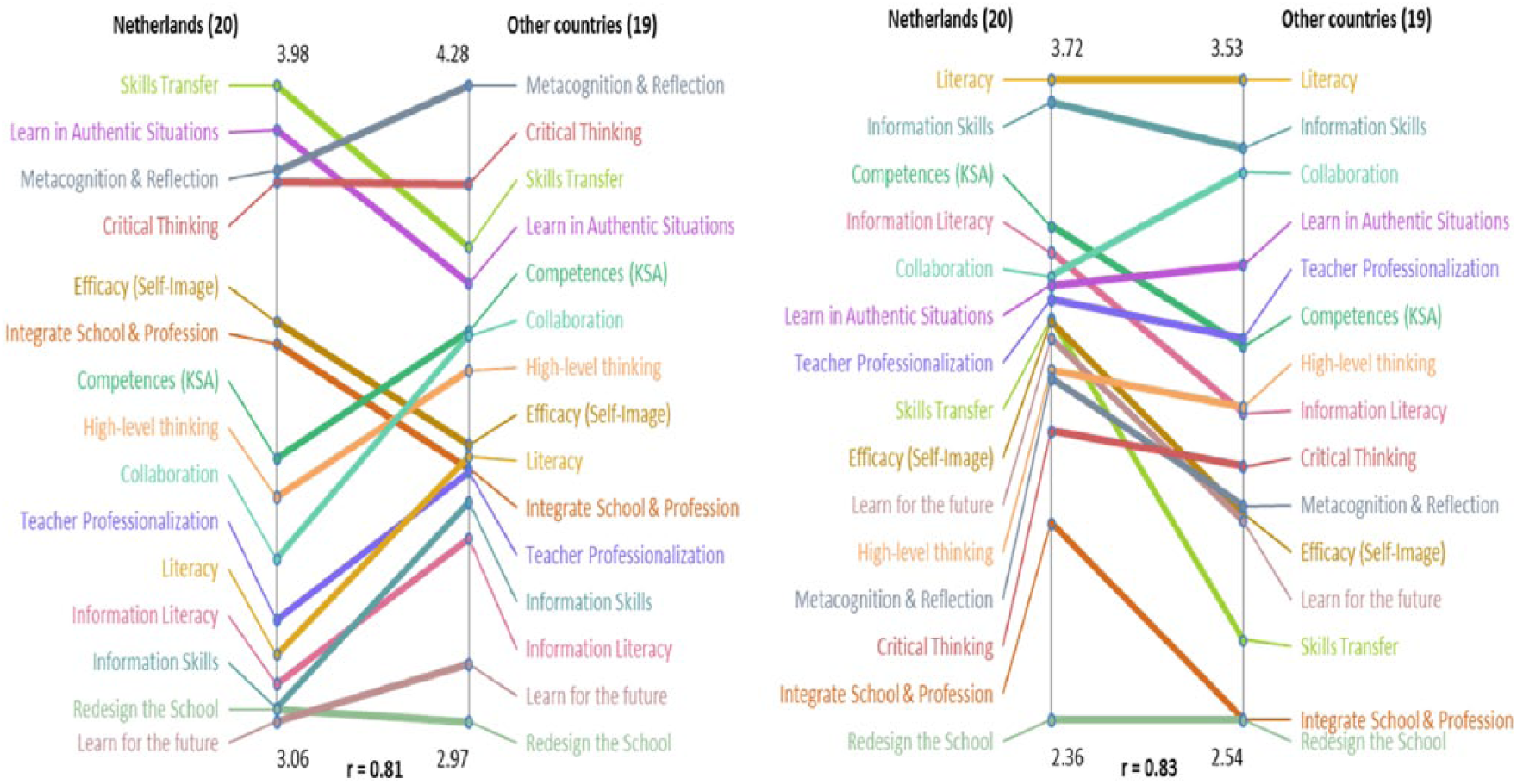
The Netherlands vs. other countries (importance—left; implementation—right).
There is also a strong relationship between the scores of operational and managerial function participants (rimp = .88; rimpl = .73; see Figure 13).
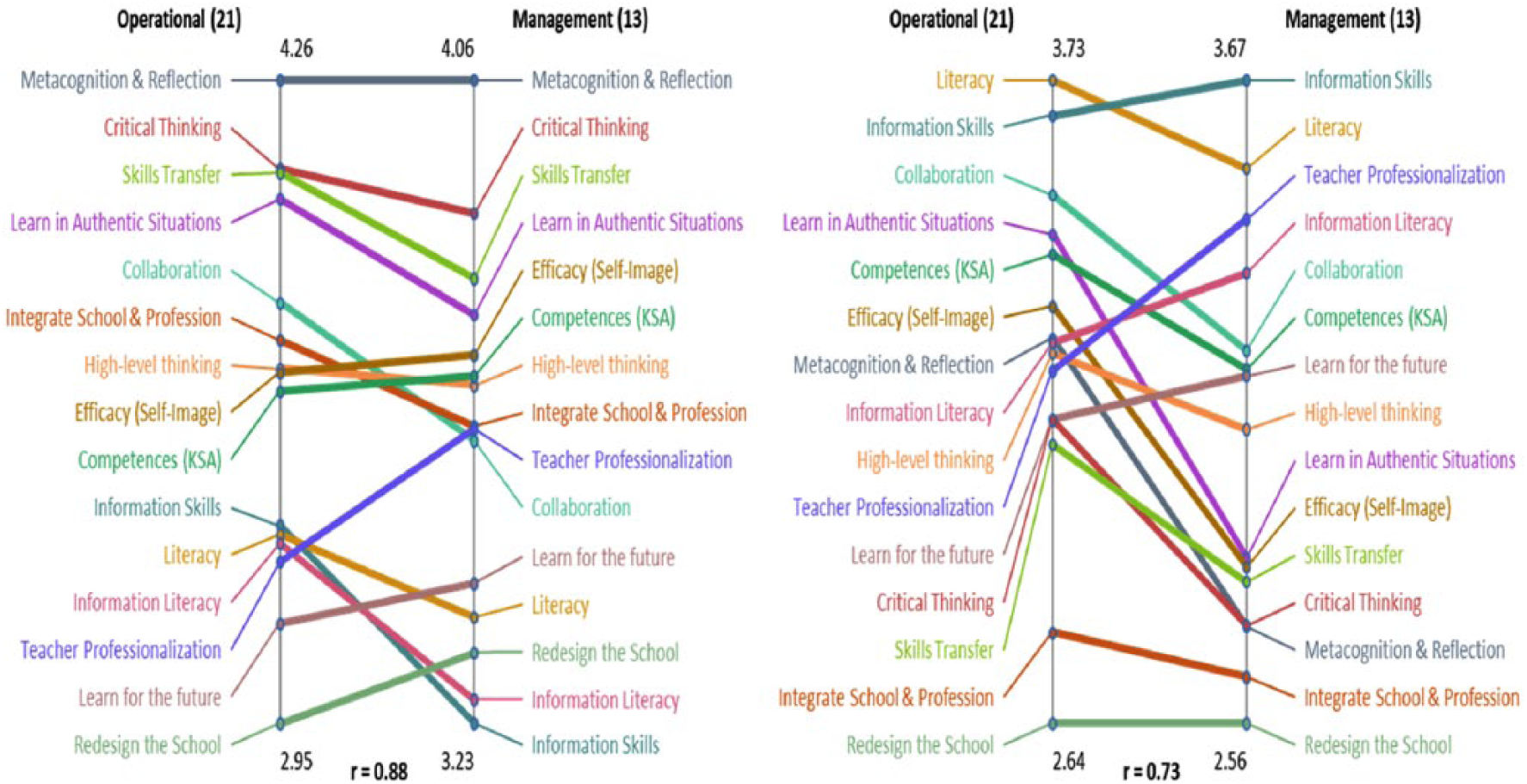
Operational vs. managerial function (importance—left; implementation—right).
Conclusions/Discussion
The results of the research clearly show the dilemmas that education faces. Changes deemed desirable by different groups of experts are not always easy to achieve, whereas changes that are less “important” in their eyes are judged as relatively easy to achieve. As noted, developments in the labor market have a major impact on how young people will work in future. It is no longer real to expect that the knowledge gained in the initial education will last for a lifetime. Further education and retraining will be something that needs to be carried out many times in one’s career as relevant knowledge and skills become inadequate to carry out a specific function or even obsolete. Most importantly, metacognitive skills are seen as important, with young people needing to be able to reflect on their own learning process and achieve their own goals, monitor their progress toward those goals, and achieve them. It provides an important basis for learning for nonexistent professions and lifelong learning.
However, education does not seem to be up to this challenge (yet) as much education is still given from a narrow approach to learning in which cognitive learning with an emphasis on knowledge reproduction gets the most attention. Teachers themselves also have their own ideas, attitudes, and expectations about what is good in education (Richardson, 1996; or they are guided by curriculums and end terms determined by others), and in this constellation, direct knowledge transfer in a classical setting plays an important role. This form of education does not have to disappear. Knowledge and skills transfer remains of great importance; without a solid foundation, further education, retraining, and lifelong learning is impossible. However, according to respondents, it is also important that more attention be paid to other forms of learning, in which metacognition can take place in which skills can be developed and applied in new and preferably authentic situations, focusing on self-knowledge and reflection that stimulate learning and development.
Looking at the feasibility of the above, changes that build on existing learning practices are relatively easy to achieve. More attention should be paid to broad literacy, and information skills are seen as a necessary addition to achieve future-proof learning (defined earlier as the acquisition of knowledge, skills, and attitudes necessary to continue to learn in a stable and enduring way in a rapidly changing world (Kirschner, 2017; Walma van der Molen & Kirschner, 2017).
It is positive to see that learning is seen in authentic situations as important as reasonably achievable. This is where students start working with real-life issues in companies and social issues in society, working toward solutions with other students in projects. This seems to be a first step toward education that provides space for future-proof acquisition of knowledge and skills, where they are able to practice information skills in an application-oriented and meaningful way and where cooperation and collaboration occurs. To achieve truly future-proof learning, a next step in this direction will be necessary. Only then can there be room for metacognition, skills transfer, critical thinking, and a positive self-image. This all leads to the following conclusions.
Conclusion 1
Cognitive and metacognitive skills are critical. There are five clusters (Critical Thinking, High-Level Thinking, Competences, Metacognition and Reflection, and Efficacy (Self-Image) that emphasize the need for developing cognitive and metacognitive skills. These clusters could be interpreted as a continuum from relatively more concrete cognitive skills to more generic personality competences. At the concrete, cognitive skills pole is the cluster Competences. Critical Thinking is next to it. A step further to the other end is High-Level Thinking. Metacognition and Reflection could be positioned further. At the very other end are ideas included in the cluster “Efficacy (Self-Image).”
It is clear that the experts think that, when we want to take steps to prepare our youth for effective and efficient use of information skills, we need to do more than just taking concrete information problem solving skills into account. They clearly state that we should also work on having them acquire cognitive and metacognitive skills, as well as transferring these skills to different domains and learning to think critically. These skills allow them to reflect on their learning process, enable them to set their own goals, and monitor the progress on these goals. This forms a strong and important foundation for learning for nonexisting jobs and lifelong learning. It is important to note that these same experts also indicate that the ideas in these clusters are relatively hard to implement.
Conclusion 2
There is a need for a strong relation between learning and authentic situations. As discussed in Van Merriënboer and Kirschner (2018), authentic learning situations focus on learning tasks based on real-life authentic tasks as the driving force for teaching, training, and learning. The basic idea behind this focus is that such tasks help learners integrate knowledge, skills, and attitudes; stimulate them to learn coordinate constituent skills; and facilitate transfer of what is learned to new problem situations. These tasks are meaningful and representative for the tasks that a professional might encounter in the real world. Such an approach allows learners develop a holistic vision of what is learnt in relation to what is needed in a (future) profession. There are three clusters indicating the need for a strong relation between learning and “real-life situations,” namely transfer of skills, learning in authentic situations, and integration of school and profession. They are perceived to be important and relatively hard to implement.
Conclusion 3
Redesigning schools and professionalization for teachers is relatively unimportant. Redesigning schools scores lowest, both on importance and feasibility. It seems to suggest that there is not a need, at least in short term, for radical changes in curriculum and school organization (e.g., “demolishing the walls between the subjects in schools” and “stop building schools, start building ecosystems”) for developing basic and advanced cognitive and metacognitive skills. The participants in the study recognized the need for improvement in teacher training as well. A separate cluster Teacher Professionalization was identified, although the scope of the ideas in this cluster is mainly limited to using ICT. The cluster also scores relatively low on importance. The two clusters redesigning schools and professionalization for teachers should not be interpreted only by reviewing the statements they consist of but in relation and a broader context made by the other clusters. Radical changes in school organization are perhaps not needed but the focus should be shifted toward developing cognitive and metacognitive skills, linking learning with authentic, real-life situations and selecting (or developing) methods for learning and teaching that match such educational contexts and goals. Teacher training should reflect these changes.
Consequence
A consequence of all of this could be that educational policy should approach the renewal/revision of the educational curriculum in the schools as a 3-stage procedure spanning a longer period of time (we should think in terms of 15 years to effectuate these changes).
The first stage, consisting of moderately important changes what are relatively easy to achieve (so-called low hanging fruit), entails laying a good foundation for the students which will allow them to function in and understand the world around them. This means taking care that they have mastered the necessary knowledge (i.e., declarative, conceptual, procedural, metacognitive) and skills for the future. These are the blocks that we can build on. This can be seen in Didau’s Taxonomy (See Figure 14).
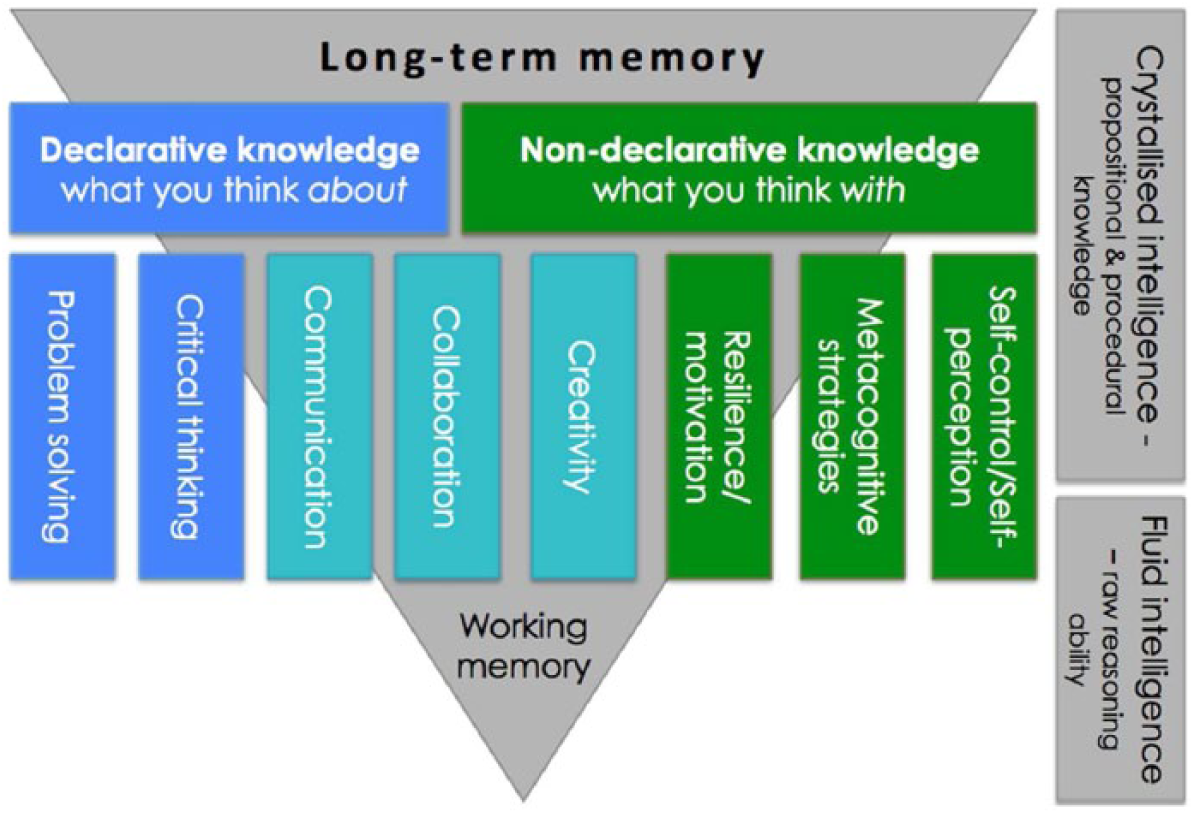
Didau’s Taxonomy (Didau, 2017).
The second stage is aimed at bringing learners to a higher level of thinking and working such that they develop a feeling that they can do things with what they have learned (efficacy building), that they have the necessary competencies (knowledge, skills, attitudes) at their disposal, so that that they can continue to learn (i.e., lifelong learning), can work with others with different knowledge and skills to solve problems or carry out tasks.
The third and final stage of achieving highly important changes which are considered fairly difficult to achieve must be last in that it takes more time to achieve but also because it builds upon the first two to help learners become able to think in a metacognitive way and reflect on about what they know and can (What do I know to solve this problem or carry out this task? What do not I know? What do I need to know and/or learn? Where/how can I acquire the needed knowledge and skills?), the transfer of the skills that they already have to new domains and think critically.
This approach is not only meaningful, solving an important educational and societal problem, but is also necessary seeing as how the third-stage builds upon the second, which in turn builds on the first! It requires a systematic approach and policy makers/politicians who are able to make a long-range plan and then stick to it until it is carried out and not fall prey to hypes and be swayed by “sexy” daily issues.
Some Final Remarks
This is a first attempt at defining what is necessary to define what is needed to prepare the youth of today for nonexistent/not yet existing jobs and professions primarily carried out in one region with a limited variety and number of stakeholders. As such, the research reported here is a first step toward determining priorities and setting up a timeline to achieve them. More research is definitely needed. First, this research needs to be scaled up to include more stakeholders from more sectors such as government, labor unions, industry, and so forth and more regions (e.g., Australasia, the Indian subcontinent, Africa, and South America). Second, there is a need for additional flanking research with respect to the costs involved in achieving the goals, the legislative measures required to achieve the goals, and the societal impact of those measures.
Also, as the National Academy of Sciences report concludes, it is up to us, as societies and communities, to create the sort of world where decent work will be available for all. This means that we must take any and all steps needed to prevent all of the different forms of obsolescence. This, however, is not the sole responsibility on educators and schools. National and international governments and governing bodies, companies, trade and labor unions, and so forth also need to help shoulder this problem and become part of the solution and not part of the problem if we wish to ensure that people will have continued access to satisfying work. If and only all of these bodies and interests join forces to make sure that the youth of today and tomorrow learn for not yet existing jobs and are given the opportunity to continue to learn throughout their ever increasing life expectancies, can we create a stable and satisfying workplace and population.
Footnotes
Appendix
Clusters and Statements.

| Number | Statement |
|---|---|
| Cluster 1: Critical Thinking | |
| 1 | Focus on the concepts and approaches that can be adapted to specific situations (e.g., inquiry methods) |
| 2 | Give them the skills for continuous learning to remain competitive and relevant |
| 5 | Emphasize the importance of flexibility and adaptability |
| 24 | Teach them how to build their own new knowledge from a variety of means and sources |
| 25 | Equip them with a broad repertoire of using creative methods |
| 37 | Teach them how to think critically so they can adapt when requirements change |
| 46 | Teach a process for discovery and experimentation, the basics for permanent learning |
| 61 | Guide them in fostering the creative and problem-solving skills that enable them to solve yet unknown problems |
| 84 | Teach them critical thinking to enhance their problem-solving capabilities |
| 87 | Developing complex problem-solving skills |
| 108 | Help them identify how skills can translate into various fields |
| Cluster 2: Skills Transfer | |
| 9 | Demonstrate how skills apply to novel, relevant, or interesting applications (e.g., engage and excite them) |
| 10 | Organize learning so that they use knowledge for solving complex authentic problems |
| 60 | Teach them how to solve problems individually and in groups about varying real-life problems |
| 65 | Ensure that they can apply current skills to new contexts (e.g., by giving them challenges that encourage this) |
| 100 | Build knowledge structures at a level of abstraction and the skills to restructure knowledge to solve new problem types |
| Cluster 3: High-Level Thinking | |
| 16 | Give them training in Agile Thinking and managing projects |
| 23 | Have them to propose not-yet-existing professions and then decide which skills they would need in those professions |
| 33 | Focus on the learning process instead of (only) on the results of a task or project |
| 51 | Integrate higher level thinking (analyze, synthesize, evaluate, communicate) into teaching of subjects |
| 62 | Address skills on a higher level |
| 83 | Have them produce information themselves |
| 96 | Design assignments that focus on developing critical thinking skills |
| Cluster 4: Cognitive Skills (KSA; Knowledge, Skills, Attitudes) | |
| 3 | Focus on 21st-century skills such as communication, creation, safety, and problem solving |
| 6 | Develop their capability of collectively learning in social media environments |
| 29 | Teach them foundational competencies that will extend their knowledge “as needed” in the future |
| 48 | Focus on competence development (combination of knowledge, skills, and attitudes) |
| 63 | Coach them on basic skills (e.g., collaboration, ICT literacy, solving problems, presentation skills, social skills) |
| 69 | Let them get familiar (trough training and exercises) with an entrepreneurial and inquisitive attitude |
| 74 | Focus on cognitive skills |
| 79 | Develop their knowledge-building skills/competence |
| 80 | Develop their coregulation skills |
| 82 | Incorporate self-assessment as a regular part of assignments |
| 97 | Train in creativity |
| 109 | Stimulate social skills (e.g., coordination, emotional intelligence, service orientation, negotiation, persuasion) |
| Cluster 5: Metacognition and Reflection | |
| 7 | Emphasize personal accountability |
| 15 | Guide them in how to set, monitor, and achieve personal goals |
| 17 | Focus on preparing students for being lifelong learners |
| 30 | Help them develop ways to continually broaden skills throughout life |
| 31 | Develop metacognitive skills: cognitive flexibility |
| 64 | Focus on metaskills (learning how to learn, creating self-awareness regarding competences) |
| 68 | Make them capable of monitoring, assessing, and developing their own skill set |
| 75 | Develop self-directed learning skills |
| 85 | Focus on self-awareness, reflexivity, and critical thinking as a continuous process of self-development |
| 98 | Have them reflect on their learning |
| Cluster 6: Efficacy (Self-Image) Building | |
| 8 | Build strong personalities and identities that can be flexible enough to build a portfolio career |
| 12 | Give children trust for challenging tasks |
| 21 | Let them reflect on what they can instead of what they cannot |
| 26 | Have them learn what they are good at to give them confidence |
| 34 | Acquaint them with their own unique talents so that they can utilize them to “the max” |
| 58 | Help them to use information for their own goals and purposes |
| 103 | Focus on personal goals and self-trust to reach them |
| Cluster 7: Learn in Authentic Situations | |
| 4 | Let them learn in a practical way |
| 28 | Make learning happen through real-world projects |
| 49 | Engage them in authentic (as opposed to academic) tasks that require use of information skills |
| 66 | Have them work in school on real projects, compare their project choices in groups, then repeat |
| 76 | Give them purposeful project-based learning assignments to create knowledge products |
| 86 | Integrate skills in meaningful/authentic tasks |
| 93 | Let them experience skills in all spheres of life (school, leisure, sport, culture, science, government, etc.) |
| Cluster 8: Integrate School and Profession | |
| 42 | Respond to the developments outside school by connecting to problems in society and future work |
| 43 | Eliminate teaching of skills detached or loose from context/meaning |
| 45 | Organize long-term apprenticeship programs in companies with intensive coaching |
| 52 | Create internship-type programs with companies at an early age |
| 70 | Give them the opportunity to have a real-life workplace experience |
| 88 | Integrate in-school and out-of-school learning |
| 106 | Try out different kinds of professions |
| Cluster 9: Collaboration Skills | |
| 71 | Require collaboration and communication in the learning experience |
| 94 | Integrate skills across curricula, as transversal skills |
| 99 | Maximize learning methods in groups |
| 107 | Teach the importance of connecting professionally with others throughout their working lives |
| Cluster 10: Teacher Professionalization | |
| 11 | Ensure that all teacher preparation programs incorporate skills-based ICT training |
| 14 | Make professional development of teachers concerning online literacy a first priority |
| 27 | Ensure that teachers are provided with ongoing ICT refresher development opportunities |
| 32 | Educate parents on how education should change to prepare kids for the future |
| 53 | Enhance teacher IT skills |
| 90 | Make sure teachers are able to assess domain-independent skills |
| Cluster 11: Information Literacy | |
| 13 | Stop teaching application skills (Excel, Word, etc.) aiming to make them more attractive workers |
| 18 | Integrate programming in the curriculum in primary education |
| 22 | Expose students to various new technologies to help them understand the exponential nature of technological developments |
| 54 | Elevate information literacy from a secondary skill set to an independent crosscutting discipline in the school curriculum |
| 95 | Integrate information skills (e.g., information management, ICT skills, media savvy) in the curriculum |
| 102 | Develop a new national curriculum addressing 21st-century skills |
| Cluster 12: Redesign the School | |
| 19 | Demolish the walls between the separate subjects taught in schools |
| 59 | Discourage education programs for professions that are very likely to disappear (e.g., accountancy, retail sales, telemarketing) |
| 72 | Implement badging so that “certificate light” youth can get on the ladder |
| 78 | Link education and training institutes and companies to identify relevant skills for the future labor market |
| 91 | Acknowledge that it is about didactics and pedagogics |
| 104 | Stop building schools, start building ecosystems as places where children learn and develop |
| Cluster 13: Literacy and Numeracy | |
| 20 | Teach them how information skills can be used in vocational education to select and process information |
| 39 | Organize training in design thinking |
| 56 | Teach key Literacy and Numeracy skills |
| 57 | Teach students (about) entrepreneurship |
| 67 | Scaffold instruction for specific information literacy skills |
| 77 | Focus on how to curate information |
| 101 | Teach general and domain-specific skills |
| 105 | Focus on deep knowledge in a particular discipline |
| Cluster 14: Information Skills | |
| 35 | Remove the illusion that all required skills are new or old ones are obsolete in “new jobs” |
| 36 | Teach them to make effective and efficient use of information skills to optimally function in today’s labor market |
| 38 | Teach digital literacy |
| 40 | Teach professional communication skills |
| 50 | Teach them to critically assess the quality of information on the Internet |
| 73 | Equip them with maker skills (e.g., prototyping, 3D printing, design, sourcing) |
| 81 | Focus on e-skills or digital skills (programming, making websites/apps, 3D printing) to make a living |
| 92 | Teach basic computer programming as a core requirement |
| Cluster 15: Learn for the Future | |
| 41 | Teach them how to design their own jobs |
| 44 | Train in team dynamics |
| 47 | Understand information skills as KSAVE: Knowledge, Skill, Attitude, Values, Ethics |
| 55 | Challenge them to meet new standards |
| 89 | Make children (and their parents) aware that employees of the future have to be self-taught |
Acknowledgements
This project was carried out with the help of NSVP Innovatief in Werk (Netherlands Foundation for Psychotechnique—Innovative in Work) and was carried out as part of a research fellowship at the Netherlands Institute for Advanced Study in the Humanities and Social Sciences. Assistance in carrying out the research and analyzing the data was given by Francien H. Miedema, George van Sluis and Maud Hendrickx.
Declaration of Conflicting Interests
The author(s) declared no potential conflicts of interest with respect to the research, authorship, and/or publication of this article.
Funding
The author(s) received no financial support for the research, authorship, and/or publication of this article.
