




Abstract
Using a qualitative longitudinal design, we investigated the emotional and identity processes during involuntary career change due to job loss or health issues. Twelve career changers were interviewed twice at a 1-year interval. Findings revealed the complex interplay between two retrospective and proactive processes, namely, loss and restoration orientations, as career changers simultaneously construct a valid narrative about their loss and reestablish a new work-related identity. Processes relating to narrative identity, emotions, strategies, and social enactment were found to underlie the loss and recovery identity process. Emotions acted as signals of the identity loss and recovery process and drivers of the career change process. Overall, our study unravels the interplay between emotions, identity, and adaptation processes during challenging career transitions and sheds light on the heterogeneous responses to career disruptions, raising practical implications for guidance and counseling.
Introduction
The rupture was really hard…It was like giving up my deepest identity, which was…heartbreaking. And then, well, as soon as I’d mourned that, I got back on my feet and said to myself, “well, what am I going to do now?” (Agathe, 49, former oceanographer)
Research on career transitions has primarily focused on normative transitions, such as the passage from school to work and from work to retirement (Akkermans et al., 2024; Sullivan & Al Ariss, 2021). However, there is increasing recognition that transitions extend beyond normative life stages and encompass multidirectional, sometimes radical movements, such as multilateral transitions (e.g., upward, downward, or horizontal), re-entries, or exits from the labor market. This attention to less socially expected transitions reflects various interrelated trends, ranging from increased competition and globalization to changing societal norms, demographic changes, and technological advancements (Sullivan & Baruch, 2009).
Despite recognizing the multifaceted nature of career transitions, the existing literature has mostly adopted an agentic perspective, emphasizing voluntary, self-directed transitional processes (Akkermans et al., 2024) fueled by concepts such as boundaryless and protean careers (Briscoe et al., 2006; Sullivan & Baruch, 2009). This agentic view can oversimplify the challenging experiences of other types of career transitions, especially involuntary ones. Among these, involuntary career change—that is, unanticipated circumstances forcing individuals to change their occupation and sector—has been coined as one of the most complex career events (Carless & Arnup, 2011). According to Maitlis (2022), three types of events can lead to an involuntary career change. First, lay-offs in a saturated job market may hinder individuals from securing employment within the same sector (e.g., Daskalaki & Simosi, 2018). Second, critical health issues—such as accidents, and physical or mental health issues—can compromise the ability to perform certain tasks and prompt a career change (e.g., Kulkarni, 2020). Third, migration to a host country that does not recognize prior qualifications or experience may necessitate an involuntary career change (e.g., Palic et al., 2023). However, literature remains limited in both its scope and the processes involved. With regard to its scope, most studies have focused either on a particular event, such as job loss (e.g., Blustein et al., 2013; Lent et al., 2023), or on specific populations, such as artists (Hennekam & Bennett, 2016), veterans (Kulkarni, 2020), or athletes (Arvinen-Barrow et al., 2019). As a result, these studies fail to provide a comprehensive understanding of the experiences of involuntary career change, as well as their development over time. With regard to the processes involved, although the challenging nature of this transition is acknowledged (Brazier et al., 2024b), its relational (Masdonati et al., 2022) and career decision-making processes (Brazier et al., 2024a), or career adaptability (Rudolph & Zacher, 2023), little is known about the psychological processes that individuals undergo when faced with an involuntary career change. More specifically, we lack evidence on the emotional and identity processes associated with involuntary career change, and on the social dynamics underpinning them.
In this paper, we draw on the work-related identity loss and recovery theory from Conroy and O’Leary-Kelly (2014) to explore the identity and emotional processes underlying involuntary career change. This theory is particularly relevant as it positions the crucial role of emotions in the complexity of identity dynamics during involuntary career change. Additionally, given the inherent dynamic nature of identity processes (Ibarra & Barbulescu, 2010; Shepherd & Williams, 2018), longitudinal designs are required to capture subjective dynamics and transitional processes (Haynie & Shepherd, 2011). Therefore, we implemented qualitative longitudinal research (Neale, 2021) with 12 involuntary career changers in Switzerland interviewed twice at a 1-year interval. Specifically, we focused on involuntary career changes resulting from two of the three types of triggers described by Maitlis (2022), that is, job loss associated with limited employment prospects and health issues. Indeed, both job loss and health-related challenges are considered as disruptions that compel individuals to “re-establish a coherent life narrative” in various ways (Maitlis, 2022, p. 1).
Despite differing triggers, both groups were analyzed together, as health-related challenges and involuntary job loss are well-documented drivers of career disruption and identity loss (Baldridge & Kulkarni, 2017; Barthauer et al., 2020; Beatty & Joffe, 2006; Blustein et al., 2013; Daskalaki & Simosi, 2018; Suzanne et al., 2023). Our focus was on shared emotional and identity-related processes across these contexts (Ibarra & Barbulescu, 2010), excluding migration-related changes, which involve distinct realities (e.g., the coexistence of a professional, personal, and geographical transition) requiring separate study (Brazier et al., 2024a).
This study makes several contributions. First, it provides an in-depth exploration of identity processes during involuntary career changes, offering insights into the subjective experiences of these less-studied transitions (Masdonati et al., 2022). Second, we elucidate the importance of emotions during identity loss and recovery, enriching our understanding of the interplay between identity, emotions, and career changes. Finally, our research underscores the importance of narrative development in the process of recovering from challenging career events and reconstructing a new self and identity, thereby adding empirical depth to existing narrative research and identity theory (Conroy & O’Leary-Kelly, 2014; Ibarra & Barbulescu, 2010; Shepherd & Williams, 2018).
An Identity Loss and Recovery Perspective on Involuntary Career Change
Identities refer to the narratives about the meanings individuals attach to themselves, which they use to create a sense of self-continuity (Dutton et al., 2010; Gecas, 1982; Gergen & Gergen, 1988). Identity narratives are continuously rewritten, especially as role transitions occur (Ibarra & Barbulescu, 2010), and act as sensemaking tools, helping individuals to explain why changes occurred (Maitlis, 2022). Moreover, these identity narratives are enacted in the social environment (Ibarra & Barbulescu, 2010): they are created internally but are then shared, negotiated, refined, and validated with and by others—that is, identity narratives are inherently social. Identity narratives are also bounded in time: they are constructed in the present, anchored on past experiences, and projected into the future as ideal and ought selves that function as self-guides (Conroy & O’Leary-Kelly, 2014).
Because it challenges individuals’ beliefs, meanings, and values, an involuntary career change can disrupt their identity equilibrium (Conroy & O’Leary-Kelly, 2014; Petriglieri, 2011; Maitlis, 2022). This disruption creates a negative discrepancy between their current self (e.g., unemployed, disabled, or ill) and an ideal or ought self (e.g., employed, in a desired profession), leading to a perceived work-related identity loss. Stated otherwise, involuntary career change involves a “loss” of identity, forcing individuals to abandon their prior occupational identity and find an alternative one (Shepherd & Williams, 2018).
As our introductory quote suggests, identity loss immerses involuntary career changers in a disorientating identity disequilibrium that motivates them to engage in “identity work” to make sense of their loss and reestablish their identity (Ibarra & Barbulescu, 2010). This identity work encompasses a reevaluation and reconstruction of their self-concepts and identities. When people face transitions, especially unplanned, they enter a liminal space, oscillating between their past and potential future identities. Within the liminal space, they identify and try out “provisional selves,” a form of adaptive identity experimentation (Ibarra & Barbulescu, 2010; Kulkarni, 2020). Identity experimentations and narratives within the liminal space can take two distinct and successive orientations: first, a loss orientation, then, a restoration orientation (Conroy & O’Leary-Kelly, 2014; Stroebe & Schut, 2010). The loss orientation is focused on the past and revolves around the loss stressor: Individuals are cognitively and emotionally focused on the loss event and making sense of it (Hennekam & Bennett, 2016). They reappraise their previous roles and identities, which are gradually abandoned and relinquished. The restoration orientation is future-oriented: Future possible identities are progressively identified, anticipated, and enacted (Ashforth & Schinoff, 2016; Markus & Nurius, 1986; Nazar & Van der Heijden, 2014).
Emotions During Loss and Restoration Orientation
According to Conroy and O’Leary-Kelly (2014), emotions play a critical role in identity narratives within the liminal space, as they drive the experimentation of provisional selves and provide the context within which identities are relinquished, explored, and enacted. In particular, emotions are pivotal during the loss orientation phase. Because the involuntary career change creates a loss event and identity discrepancy, it possibly generates negative emotions such as shock, anger, or grief (Hennekam & Bennett, 2016). The intensity of emotional reactions depends on the magnitude of the discrepancy between involuntary career changers’ actual and future self: Losing one’s job will provoke more negative emotions if it is considered as a dream job (i.e., ideal self) than if it is considered one way of making a living. Moreover, the coexistence of multiple discrepancies can lead to multiple negative emotions. For example, not being able to pursue one’s dream job (i.e., ideal self-discrepancy) along with the inability to be considered as the “breadwinner” in the family (i.e., ought self-discrepancy) might trigger anger and shame, respectively. Regulating the negative emotions that occur at the early stages of an involuntary career change seems crucial to resolving the identity discrepancy and creating a post-loss identity (Conroy & O’Leary-Kelly, 2014).
Emotions are also associated with the restoration orientation phase. Contrary to loss orientation, the restoration orientation is future-oriented: Individuals engage cognitively and emotionally with their possible future identities, contemplating the question, “Who will I be from now on?” Some differences in emotional dynamics are noteworthy between the loss and restoration orientations. In the loss orientation, emotions are directly tied to the loss event and characterized by immediate and intense reactions. In contrast, emotions within the restoration orientation are focused on the identification of possible selves, their experimentation, and the enactment of an emerging identity narrative. In the case of involuntary career change specifically, these emotions are thus oriented toward the strategies to deal with the change (e.g., retraining and job search), the experimentation of provisional occupational selves (e.g., trying out new activities), or the social validation of identity narratives that are enacted with others. Consequently, emotions in the restoration orientation tend to be less intense and more diffuse than loss-oriented emotions that focus on the loss event (Conroy & O’Leary-Kelly, 2014). Finally, restoration-related emotions are also more likely to be positive in nature as they are associated with identity experimentation and possibly valued provisional selves. This can imply the coexistence of both positive and negative emotions linked, respectively, to loss and restoration, leading to emotional ambiguity (Dutton et al., 2010).
Post-loss Identity
The liminal space created by the involuntary career change and, more specifically, the associated work role identity loss, is overcome when negative emotions are regulated and both loss and restoration narratives have been validated (Conroy & O’Leary-Kelly, 2014), ideally resulting in identity re-equilibrium. However, not all individuals succeed in achieving identity re-equilibrium. In their model, Conroy and O’Leary-Kelly (2014) proposed three prototypical identity status outcomes of work-related loss and recovery: loss orientation syndrome, identity stabilization, and adaptive identity development.
First, loss orientation syndrome refers to individuals’ being stuck in a liminal space because of the rumination of negative thoughts and emotions about loss (Nolen-Hoeksema et al., 1994). As persistent negative thinking prevents the individual from fully developing a new identity narrative, they remain in a state of identity ambiguity (Conroy & O’Leary-Kelly, 2014). Being stuck in a loss orientation syndrome is, therefore, likely to lead to increased negative emotions, emotional exhaustion, and lower well-being. Second, identity stabilization occurs when involuntary career changers exit the liminal space with a post-loss identity but have not experienced a significant identity change. This happens, for instance, when involuntary career changers quickly regulate the negative emotions associated with loss and rapidly identify a future career project. Third, involuntary career changers experiencing an adaptive identity development not only exit the liminal space with a post-loss identity but also experience significant growth (Dutton et al., 2010). This last outcome is more likely to happen in circumstances that involve a large discrepancy between the actual self and the self-guides. Career changers successfully regulate their negative emotions and go through several cycles of loss and restoration orientation, which increases the occurrence of positive emotions and the development of valid narratives around loss and orientation.
Present Study
The narrative approach of identity and the loss and recovery perspective suggest that the identity work of involuntary career changers is far from linear or straightforward (Beech et al., 2016; Hoyer & Steyaert, 2015). Drawing on Conroy and O’Leary-Kelly’s (2014) framework, involuntary career changers have to deal with the initial shock of being forced to change—letting go of their previous work roles, regulating their negative emotions, socially validating a loss narrative, and reconstructing a new occupational identity—and manage their career change process—building provisional selves and future self-guides, coping with emotional setbacks, and adjusting to a new identity. In the present study, we aim to understand the identity and emotional processes underlying involuntary career change. This general aim is reflected in three research questions: 1. How do loss and restoration orientation processes associated with involuntary career change unfold and interact over time? 2. What role do emotions play in loss and restoration orientation processes? 3. How do the loss and restoration orientation processes contribute to post-loss identity construction?
Methods
Research Design
We implemented a qualitative longitudinal research design to fully capture changes in emotional and identity dynamics among involuntary career changers (QLR; Neale, 2021). Our research is rooted in the constructivist paradigm, which stresses the importance of meaning-making in apprehending realities and recognizing their mutliplicities and subjective nature (Ponterotto, 2005). It also acknowledges the temporal nature of meaning-making processes and posits that meaning is not immediately apparent but must be uncovered through “deep reflection” (Ponterotto, 2005, p. 129). This perspective is thus appropriate for understanding emotional and identity dynamics, as these are internal and evolving processes to which individuals attribute meanings.
Procedure
We recruited participants through 13 public and semipublic institutions providing career counseling to adults in Switzerland. Career professionals (e.g., career counselors and job coaches) from these institutions introduced the project to their clients undergoing an involuntary career change. They provided the research team with the contact details of interested clients, who then arranged an online meeting. The inclusion criteria were to have begun an involuntary career change within the year at the moment of the first interview and participate in two interview waves. The exclusion criterion was to be in a career change situation due to migration issues (e.g., lack of qualification recognition by Swiss authorities). Upon informed consent, 12 involuntary career changers were interviewed twice within 1 year. A 12-month interval was chosen to cover a sufficient period of time for participants to experience and reflect on relevant developments in their transition processes. While job loss and an obligation to change career represent discret events, the emotional and identity dynamics associated with it often unfold over an extended period (Conroy & O’Leary-Kelly, 2014). Data saturation was collectively agreed (Sim et al., 2018). At the end of the first interview (T1), they consented to be contacted again 1 year after (T2). Considering the emotional features of involuntary career change, we paid specific attention to participants’ well-being during interviews by asking them, at the end of it, how they felt and if they had any concerns.
All interviewers were trained vocational psychologists and could provide institutional resources in case of emotional distress. Following Neale’s (2021) recommendations, we investigated their reflexivity at T2 to explore whether participation affected them. We sent them an intermediary report, summarizing aims, context, findings, and next steps, to ensure continuity and ethical collaboration, in line with QLR’s ethic of care and reciprocity (Frésard et al., 2022; Neale, 2021). The interviews lasted 67 to 148 minutes (T1, M = 109; T2, M = 95). Four researchers performed the interviews (i.e., the three authors and a master student). The analysis was conducted by the three authors—a PhD student (CÉB), a postdoc (MP), and a professor (JM)—all specialized in vocational psychology, with between 5 and 24 years of experience in qualitative research, career transitions, and QLR (Masdonati et al., 2024). No researcher experienced an involuntary career change; the first author (CÉB) made a voluntary career change from teaching to psychology. We reflected on our positionality and potential biases as academics, acknowledging our privilege to shape our own careers. We monitored our assumption about the emotional difficulty of such transitions, discussing it regularly to avoid bias in the analysis. Interviews were conducted in French, and the quotes were translated and back-translated using software to ensure accuracy in English. The university ethics committee approved the research program (N°C_SSP_052021_00003), which includes several complementary studies (Brazier et al., 2024a, 2024b, Masdonati et al., 2022, 2024). This article is the first to examine identity and emotional dynamics.
Participants
Demographic characteristics of participants
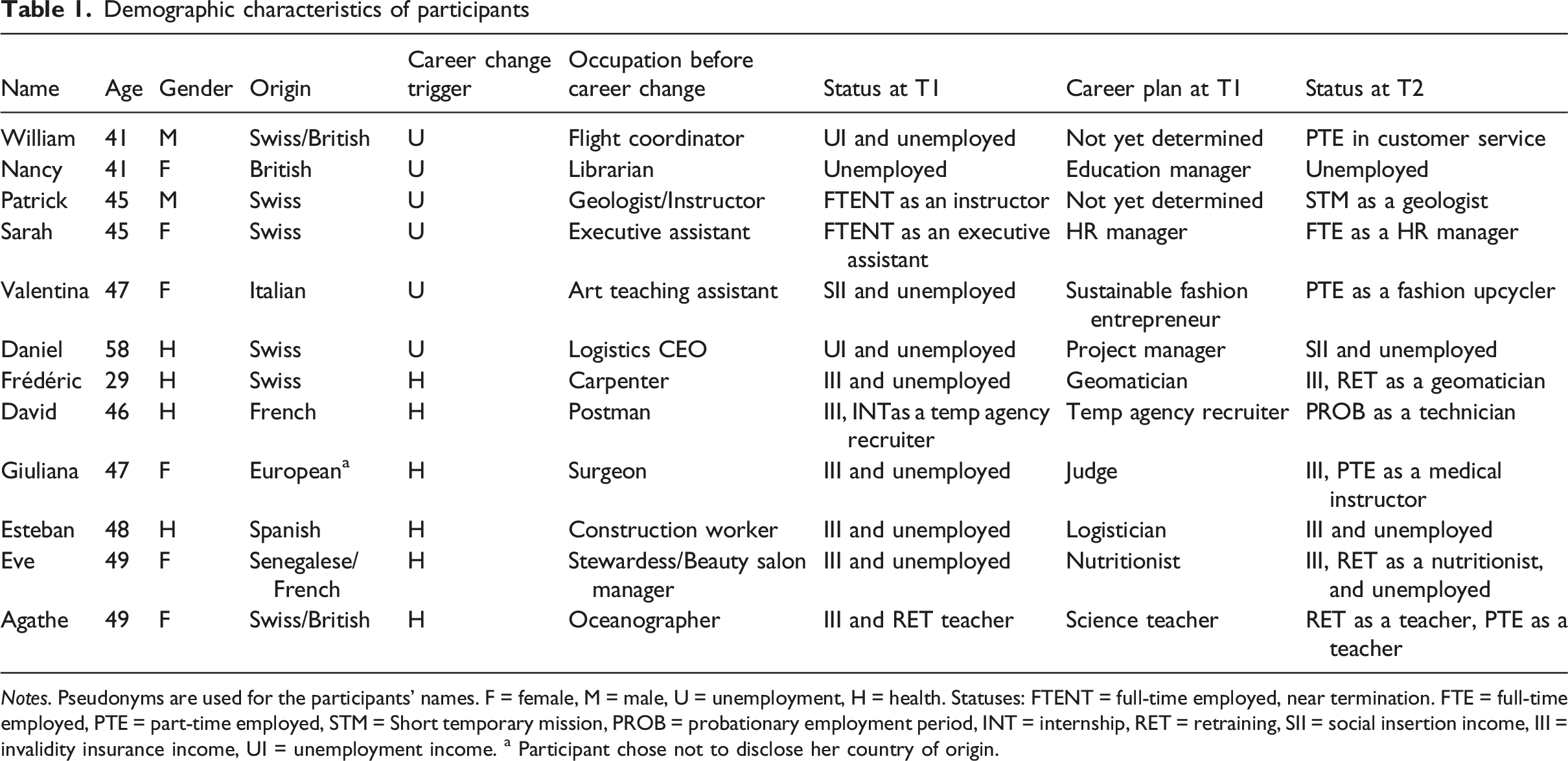
Notes. Pseudonyms are used for the participants’ names. F = female, M = male, U = unemployment, H = health. Statuses: FTENT = full-time employed, near termination. FTE = full-time employed, PTE = part-time employed, STM = Short temporary mission, PROB = probationary employment period, INT = internship, RET = retraining, SII = social insertion income, III = invalidity insurance income, UI = unemployment income. a Participant chose not to disclose her country of origin.
Interview Protocols
The interview guidelines were developed by the first (CÉB) and last (JM) authors, refined through expert feedback, and piloted by the first author (CÉB) at each wave. The interview guidelines comprised seven sections. The first section delved into participants’ socio-demographic characteristics (e.g., age, family, and legal status). The second section explored their career history and plans at T1 (e.g., “In the past, what made you change jobs?”) and their evolution over the past year at T2 (e.g., “How has your career change situation evolved since our first discussion?”). The third section investigated how participants perceived, explained, and experienced the career change process (e.g., “What did you say to yourself when you learned that you had to change careers? What did you feel at that moment?”). The fourth section focused on the influence of career change on their personal and social identities (e.g., “How does your career change also change how you see yourself as a person?”). The fifth section explored factors facilitating or hindering the career change process (e.g., “What is standing in your way?”). The sixth section addressed participants’ relationship to work (e.g., “How important is work in your life?”). The seventh section delved into the relationship with education of participants undergoing retraining (e.g., “What expectations do you have of the training process?”). For the present study, we primarily focused on answers in the third and fourth sections, precisely addressing emotions and identity issues. However, when necessary, our analyses covered the rest of the interview to gain the most accurate picture of each participant’s situation.
Data Analysis
The analysis was conducted by the three authors. We implemented an abductive temporal thematic analysis (Neale, 2021) to examine whether and how our data aligned with Conroy and O’Leary-Kelly’s theory (Halpin & Richard, 2021). The abductive approach, which is the cornerstone of QLR (Neale, 2021), consisted of a two-phase process. In a first deductive phase, we structured the material according to the themes derived from Conroy and O’Leary-Kelly's (2014) theoretical model. In a second inductive phase, we traced the evolution of these themes between T1 and T2. This combination of a predefined theoretical framework with an analysis that allows for the identification of evolving patterns aligns with qualitative approaches that integrate existing theoretical models while remaining open to emergent themes (e.g., Garriott et al., 2023). The addition of processual patterns to the identification of predefined themes has the potential to enrich the initial theoretical model. Following Neale’s (2021) and Vogl et al.’s (2018) recommendations for QLR, we performed a four-step analysis that kept a balance between cases, themes, and processes and implied within-case and cross-case comparisons.
Step 1: Case Description
Definitions of (sub)themes, processual threads, and participants concerned
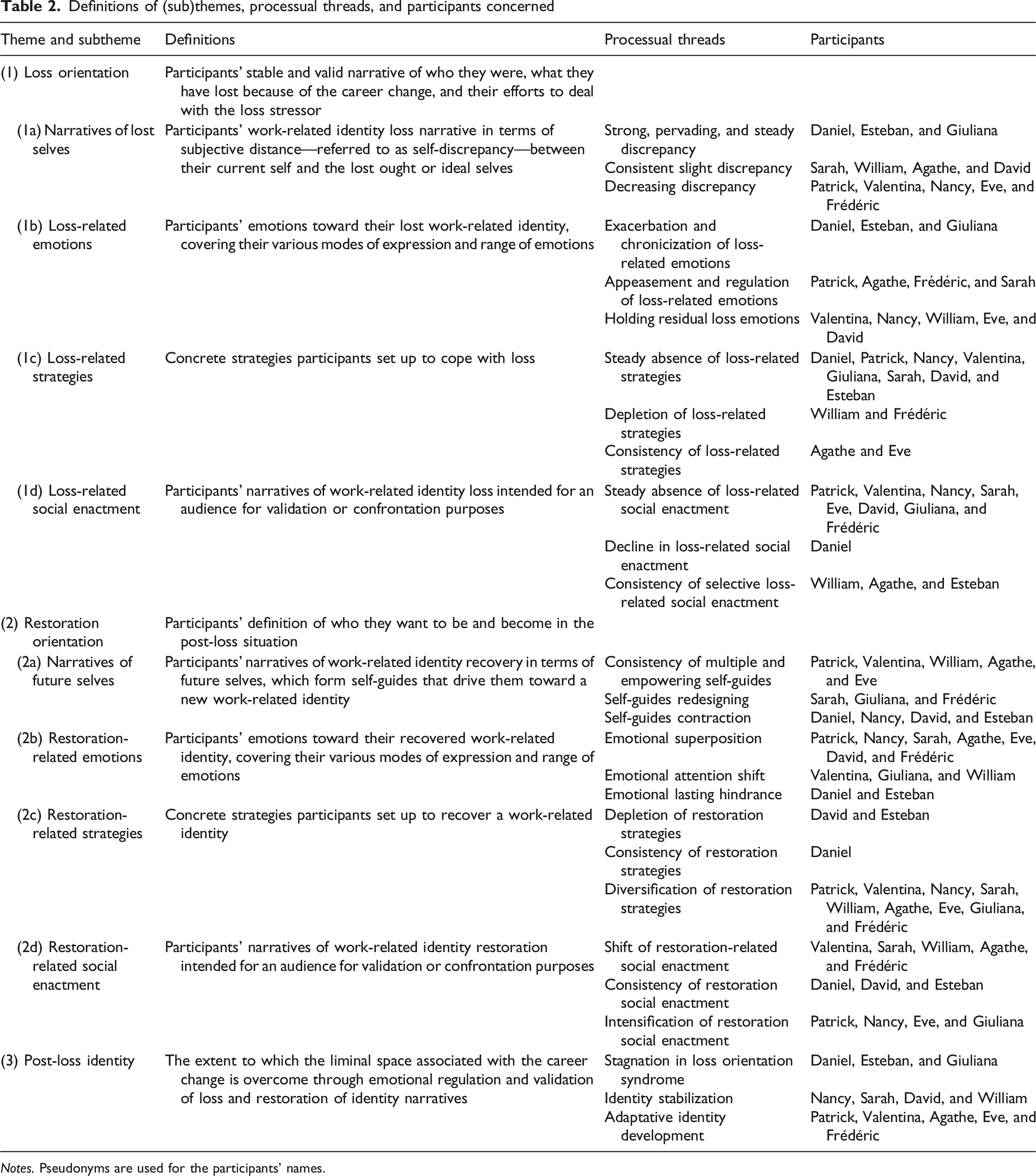
Notes. Pseudonyms are used for the participants’ names.
Step 2: Case Comparison
Based on the pen portraits, we implemented a grid analysis technique (Neale, 2021) to compare each case across time. This technique consisted of summarizing how the (sub)themes manifested in each participant through a grid that organized themes vertically and time horizontally. This visual grid allows us to compare the data of a single individual at T1 and T2 side by side, creating “a condensed visualization that shows how processes and key themes are interwoven for each case” (Neale, 2021, p. 289). The authors produced three grids collectively; the first authors (CÉB) and (MP) did the remaining grids, and the three authors discussed the results, with returns to raw data when needed.
Step 3: Case Processes Analysis
We identified each participant’s T1–T2 processes. This implied reading each grid and highlighting how a (sub)theme evolved through time for each participant. We used a tracking process technique (Neale, 2021), which involves analyzing each grid by addressing processual questions such as: “What emerges, increases, ceases through time,” “What remains constant, “How changes are interrelated,” “What are the sequences, the continuities, and ruptures.” Authors (CÉB) and (MP) reviewed each grid to uncover processual threads for each theme and participant (Table 2).
Step 4: Processes Comparison
To compare processes across cases, we grouped individuals presenting similar configurations of processes and explored how each group related to Conroy and O’Leary-Kelly’s (2014) identity status outcomes (Table 2). Individuals were not all definitely stabilized in a given status, but they clearly tended to move toward one specific status. Authors (CÉB and MP) met five times to discuss these comparisons and submitted their result to the last author (JM) for discussion and collective validation.
Trustworthiness
We ensured trustworthiness by following Morrow’s (2005) constructivist criteria for constructivist research in counseling psychology: credibility, transferability, dependability, and confirmability. Credibility was strengthened through prolonged participant engagement, reflexive writing after each interview, and multi-analyst perspectives. Transferability was addressed by stating the study’s limitations and our positionality. Dependability was ensured by clarifying how results were generated and aligning theory and methods with the research question. Confirmability was achieved through iterative data revisits and team discussions. Additionally, in line with qualitative longitudinal research (QLR), we balanced case-specific, thematic, and process-oriented perspectives (Masdonati et al., 2024; Neale, 2021).
Results
Participants’ identity and emotional processes were structured according to the three themes (i.e., loss orientation, restoration orientation, and post-loss identity) and 11 subthemes (four within loss and restoration orientation and three within post-loss identity) that we identified in the first step of the analysis. Table 2 provides an overview of these themes and subthemes, their definition, and associated processual threads. In the following sections, we describe and illustrate each theme and subthemes through participants’ quotes, including processual threads on how they deployed between T1 and T2.
Loss Orientation
Narratives of Lost Selves
The event of loss led participants to experience significant discrepancies between their current, ideal, and ought selves. For example, Agathe (49, former oceanographer) lost her “deepest identity” as an oceanographer, which was her ideal self as an “environmental activist” and her ought self as the family breadwinner. This resulted in a “heartbreaking” “rupture.” For some participants, these discrepancies were strong, others slight, but they also evolved differently; some pervaded in other aspects of their lives, and others decreased or remained constant. Over time, three of them experienced a strong, pervading, and steady discrepancy in multiple identity features. For example, Esteban (48, former builder) mentioned at T1 the impossibility and absolute necessity of “a stable job. . . a normal situation.” This situation led him to experience ought self-discrepancies related to his social role and his responsibilities as the family’s breadwinner: “Because. . . people normally all the life, they work. Now, . . . my work stoppage. . . it’s catastrophe. ...my role [for my orphaned brothers], I paid a lot of things. . . I can’t [now].” At T2, his situation did not evolve; his health deteriorated, and he could neither work nor have leisure or social life, “Every time I think about getting my old life back. But the reality is, it’s different. . . . My situation is worse. . . [It’s difficult] not to do anything, nothing, nothing.” Four other participants narrated a consistent slight discrepancy that remained over time. For example, William (41, former airline manager) expressed an ideal self-discrepancy at T1: “I’d actually been passionate about aviation since I was 12…I set aside aviation [now], . . . which is very difficult, it’s hard to let go of that.” At T2, he found a job in customer services but stated: “[this new job], it’s not actually a wow job that I absolutely want, but it’s something, at least. . . this passion [of aviation], I find it hard to forget completely.” William’s experience illustrates the simultaneity of loss (his passion for aviation) and recovery orientations (his new job in customer services). Finally, five participants related a decreasing self-discrepancy, which can be explained by their progress in implementing their new career plan between T1 and T2. Nancy (41, former librarian) was unemployed at T1. She expressed the difficulty of not having a role beyond being a mother, which creates both ought and ideal self-discrepancies: “It’s so difficult... . . . not to have a life other than my family, . . . not to earn money. [My parents] say things like, ‘Why aren’t you working?’” At T2, she had just finished a part-time contract as an archivist and felt “more comfortable here in Switzerland” when employed.
Loss-Related Emotions
Discrepancies led participants to feel a wide range of emotions, often negative (sadness and anger) but also positive (hope and relief), which evolved over time. They reported either a specific emotion or a general state, for example, describing their overall situation as emotionally demanding. Three participants experienced an exacerbation and chronicization of loss-related emotions, such as anger, shame, guilt, sadness, and powerlessness. For example, both at T1 and T2, Giuliana (47, former surgeon) narrated her loss with several strong emotions. At T1, for example, she reported: After the accident, I realized that it was impossible [to perform surgeries], so I experienced defeat, pain, sadness, . . . the feeling that I’m lost. . .. I experienced the mourning pain. . .[leaving] every patient is a grief, and that destroyed me.
A year later, her emotions are still the same: “It makes me suffer a lot. . .There are moments of great distress. . .I’ll never stop [being a doctor]. . .I could never never never!”
Four other participants went through an appeasement and regulation of loss-related emotions. Agathe (49, former oceanographer) explained at T1 how her identity loss was emotionally difficult: I had a pretty serious depression, so it took a while to get back on my feet, . . . it was extremely difficult because I really lost my identity. . . And it was really mourning. . . because I identified myself completely with my work, and that left a huge void, . . . with a lot of doubt, fear, uncertainty.
At T2, her grieving process seemed resolved: “And then, well, as soon as I got over that, I got back on my feet and said to myself, ‘well, what am I going to do now?’” Discrepancies led five other participants to experience loss-related emotions that could not be appeased entirely through time. Their restoration process was marked by holding residual loss emotions. For example, at T1, Eve (49, former beauty salon manager) was “disappointed” and had “a big pinch in the heart” to let go of the salon in which she had invested all her money and which she considered “her baby.” While at T2, she focused on preparing for her new career as a nutritionist, she still regretted her salon and the possibility of working with her family: “I’m disappointed that all of a sudden, I wasn’t able to do everything I wanted to do because of my illness, [I bought] the salon with the idea that my sister would come and work with me.”
Loss-Related Strategies
Both at T1 and T2, eight participants did not mention any strategy to cope with the loss associated with their career change, reflecting a steady absence of loss-related strategies. Two participants reported a depletion of loss-related strategies. For example, only at T1, William (41, a former airline manager) mentioned having attended a workshop to deal with his identity loss: “[Mourning], that’s a little bit what we learned in this course…there are lots of stages, and I haven’t quite reached the end of this stage to forget completely and move on to something else.” Finally, two participants kept the same strategies over time, illustrating a consistency of loss-related strategies. For example, Eve, 49, a former beauty salon manager, pursued psychotherapy dedicated to this problem, “because it’s really something that helped me to talk about this career change, with my psychotherapist.”
Loss-Related Social Enactment
Participants enacted and talked about their situation to others and interpreted their feedback. However, eight of them reported a steady absence of loss-related enactment. They referred to no loss-related social enactment at all at both times. For example, at T1, David (46, former postman) said: “[My wife and I] we don’t talk too much about that [professional situation] ... I’m not someone who likes to talk about my problems.” At T2, his loss-related enactment did not evolve: “I don’t talk about myself, so if I’m not asked, I don’t talk about [my professional situation].” One participant, Daniel (58, former businessman), reported a decline in loss-related enactment over time. While he used to speak about his situation at T1, and at T2, he reported feeling progressively abandoned and, consequently, stopped sharing: I don’t talk about it much. . . because. . . I don’t want it to be the only topic of conversation every time I’m with someone. . . psychologically, it’s what allows me to cope. I don’t have it on my mind from morning to night, choking me.
Finally, three participants remained constant in their way of sharing their loss with selected others, showing a consistency of selective loss-related enactment. For example, at T1, William (41, former airline manager) used to share with colleagues, but not his parents: I don’t want to scare [my parents]. . . I’ve kept in touch with some former colleagues. .. . It brings back good memories. . . [also] a certain anger, a certain injustice. . .So it’s a bit of a yo-yo, up and down, but it’s good to know that there’s another person going through exactly the same thing.
At T2, he continues not to share his experience with his family but only with other people in the same situation whom he met at a workshop provided by unemployment services.
Restoration Orientation
Narratives of Future Selves
Participants’ narratives about their future selves illustrated their professional self-guides and the directions they wanted for their careers. Five participants revealed a consistency of multiple and empowering self-guides. For example, Patrick (45, former geologist instructor, whose contract was nearing its end due to the impending closure of his company) referred at T1 to several self-guides concerning work values (e.g., “integrity,” “intellectual stimulation,” and “usefulness”), working conditions (e.g., having a decent salary “enough to live… and simply be able to save a bit”), and balance (e.g., being a better contributor to his household—he said he wasn’t “adding enough water to the mill”—and settling down permanently in Switzerland). All of these self-guides remained the same at T2. By contrast, three participants changed part of their self-guides’ content, resulting in self-guides redesigning. For example, at T1, Frédéric (29, former carpenter) mentioned self-guides such as aiming at interests’ continuity (“technical” and “building”), values (“carpenters’ camaraderie,” “helping people,” “ecology,” “sustainability,” and autonomy), and stability (in his “career,” “health,” and “emotions”). He specified that he wanted “to find a new job so I can be more at ease with my health.” At T2, his self-guides changed only in his values. While keeping altruistic and sustainability values, he distanced himself from “carpenter’s camaraderie,” which he reinterpreted as “machist attitudes.” This camaraderie conveyed “mancaves” brutality incompatible with who he is now as a geomatician: It’s changed completely…I’m not the same person I was a year ago. Working on construction sites … I wouldn’t like that at all… [This image] of a brute … closed off emotionally…the stereotype of the alpha male, macho ... being a caveman, … this way of being is no longer mine…With all this renewal, frankly, I’ve really questioned myself and really changed my attitude and how I was me… I started afresh.
Finally, four participants revised their self-guides to make them closer and more reachable, which we labeled self-guide contraction. For example, at T1, Esteban (48, single, former builder) mentioned self-guides that extended into the long-term and covered the whole of his life (settling permanently in Switzerland, buying a house, getting married, starting a family, owning a grocery store, and offering prospects to his potential children). He was also ambitious, specifically about his career (developing his career, learning new skills and languages, and conserving his interest in logistics). At T2, he only aimed to be professionally active, and stay in Switzerland: “I’ll stay and live here... I’m not optimistic... I’m realistic... I’ve changed my way of thinking... and [now I want to] integrate into the job market as quickly as possible.”
Restoration-Related Emotions
Participants expressed their emotions toward their new professional identity in various ways. As with loss-related emotions, restoration-related emotions were reported either specifically (e.g., joy and fear) or as a general state (e.g., challenging emotions). Seven participants’ restoration-related emotions showed a progressive superposition of positive to negative emotions over time, leading to simultaneous ambiguous feelings. We qualified this movement as an emotional superposition. For example, Nancy (41, former librarian) mentioned at T1 “discouragement,” “feeling not confident and competent enough,” and “obstination.” At T2, she referred to positive anticipations toward “learning something new,” felt more “confident,” and was “happy” to have been able to work as an archivist. Nevertheless, she also experienced “stress,” “fear,” and “anxiety” toward her career path. She mentioned periods of “ups and downs” and more mixed emotions: “[finding a new job] scares me, but. . . I had a good experience this year, so... Maybe with a year’s experience [I feel] a bit more positive.” Three participants changed the object of their emotions, which we labeled emotional attention shift. Whereas at T1, they concentrated their emotional narratives on the career change challenges, at T2, they focused on the success of their new career plan. For example, at T1, Giuliana (47, former surgeon) felt “anger,” “injustice,” and “desperation” toward institutional barriers that prevented her from becoming a judge. At T2, her restoration emotions shifted to the meaningfulness of teaching the next generation of surgeons, which she associated with “passion,” “love,” “happiness,” and a sense of “greatness.” Finally, two participants experienced lasting negative emotions toward restoration, which was labeled emotional lasting hindrance. For example, Daniel (58, former businessman) felt both at T1 and T2 “frustration,” “anger,” “disappointment,” and “lack of respect” when he unsuccessfully applied for jobs. Consequently, at T2, he felt discouragement: “Frustrating... but that’s just how it is, and I have to deal with it. . . At some point, you put in so much energy that even the job search itself becomes... exhausting.”
Restoration-Related Strategies
Participants engaged in concrete strategies to reach their potential new careers (e.g., seeking support, getting information, or retraining in a wide range of settings, formal or informal). Over time, two participants showed a depletion of restoration strategies. For example, Esteban (48, former builder) identified a possible new career as a “logistician” and sought information, retraining, and jobs. At T2, his strategies were depleted due to health deterioration: “I received... a medical certificate that says I’m not allowed, not at all, to work. . . I canceled my [German] class because I had another surgery and it’s not possible.” One participant showed a consistency of restoration strategies. Daniel (58, a former businessman) tried to apply for jobs both times, “which resulted in 0 responses.” He pursued attempts to network online while participating both times in unemployment “so-calling” service workshops that provided no “solution to [his] problem.” At T2, he stated: “I feel like I’ve already gone through all the solutions. I think you have to persevere.” Finally, nine participants deployed more varied restoration strategies over time and adapted them to their process, showing a diversification of restoration strategies. For example, Frédéric, a 29-year-old former carpenter, related to T1 identification strategies, such as seeking career counseling, and exploration strategies, including doing internships. At T2, he switched to concretization strategies to learn and develop new skills through formal and informal learning. His strategies were to “find an apprenticeship” but also to ask his invalidity service advisor for assistance in accessing “language” or “computer” classes. At T2, he perceived his change of strategies and stated: “I’d say [involuntary career change] is like people who start their own business. . . who really have to look everywhere, it’s really almost a 24-hour job. . .I’d work all day on the phone.” Consequently, Frédéric related to himself as an “entrepreneur of [his] career” that “change[d] the way [he] was before.”
Restoration-Related Social Enactment
Participants narrated their restoration to others in diverse ways that evolved through time. Five participants operated a shift of restoration-related enactment. They went from a phase of collecting feedback while exploring to a phase of selecting specific feedback while implementing their plans. For example, Valentina (47, a former art teacher assistant) organized several Zoom brainstorms with all her friends worldwide at T1: “The brainstorming. I dragged all my friends down.…. I’m very open when there’s a problem.” At T2, she was employed in sustainable fashion. She was more selective in her social enactment: “I already have like worries and fights…in my head…[some people] are very supportive, whom I listen to, I’ve decided to cancel whatever isn’t supportive.” In contrast, three participants showed a consistency of selective restoration enactment over time, including not enacting it to anyone at all. David (46, former postman) explained at both T1 and T2: “I don’t have much support because…I don’t confide…. so people have this idea that I don’t actually need it…But there are times when I might need it.” Finally, four participants demonstrated an intensification of restoration enactment. For example, Eve (49, former beauty salon manager) shared at T1 with health professionals and relatives. At T2, she diversified her audience and also enacted with her trainer and peers at the nutritionist retraining and the association of patients having her disease: “Every time, [in] the pathology course… I have something to share from my experience.… About nutrition, … I try to give advice [in the association].” Her enactment was well received and participated in validating her professional identity as a nutritionist.
Post-Loss Identity
Post-loss identities and associated (sub)themes and processual threads
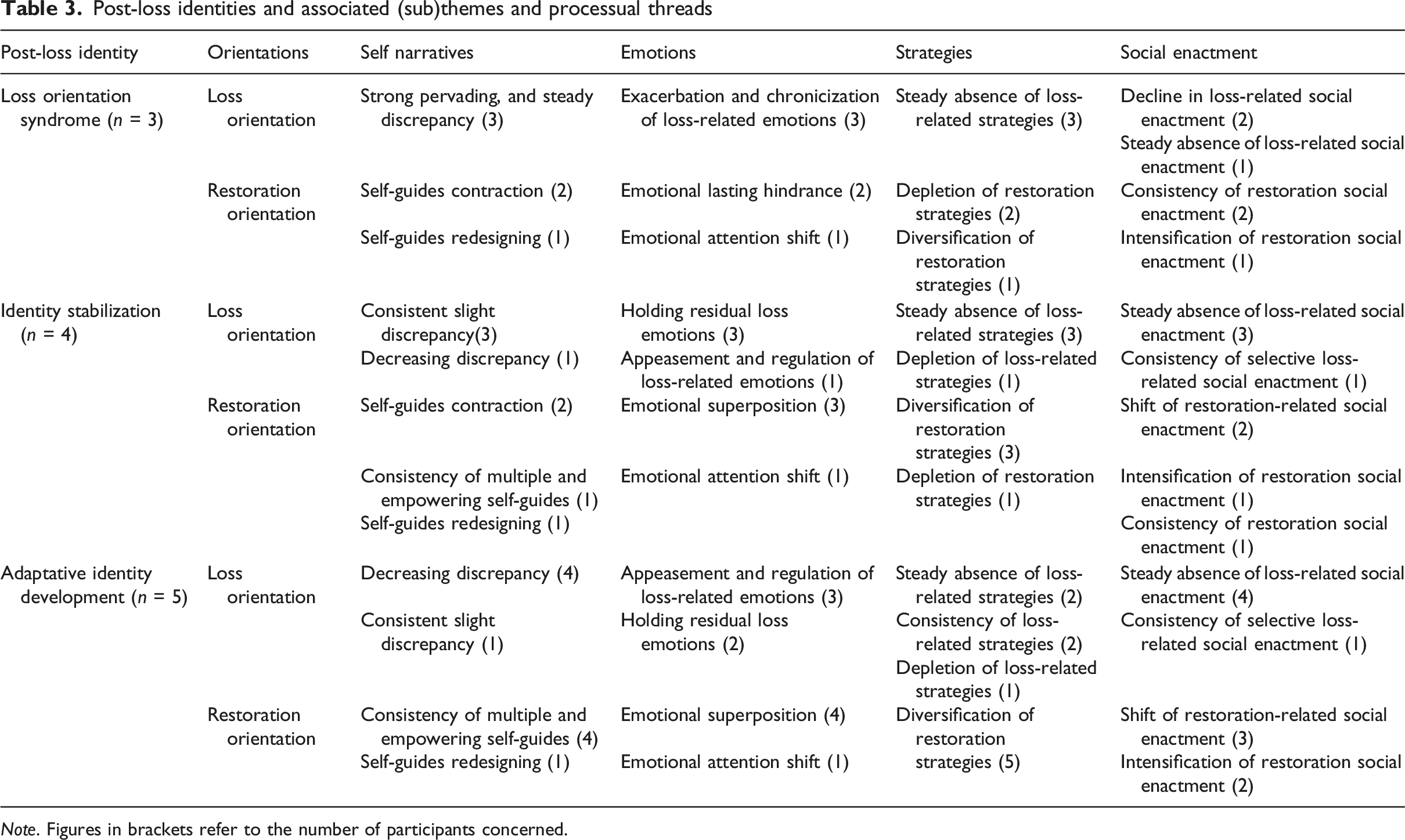
Note. Figures in brackets refer to the number of participants concerned.
Stagnation in Loss Orientation Syndrome
Three participants, Esteban, Daniel, and Giuliana, seemed to stagnate in loss orientation. The loss associated with involuntary career change led them to a strong pervading and steady discrepancy that chronicized and exacerbated loss-related emotions such as anger, sadness, guilt, powerlessness, discouragement, and combativeness. To face these difficult emotions of loss, they implemented no strategies. In parallel, they avoided sharing their loss or diminished its social enactment over time. Emotions were not processed and prevented participants from engaging in restoration. In their restoration orientation, they were drawn to reduce their self-guides or redesign them to be more reachable. Their restoration was hampered by a residue of emotions associated with the loss and depletion of restoration strategies. Daniel (58) is an emblematic case of this identity status outcome. Daniel’s discrepancy between his past self as a businessman and his present self as unemployed remained strong and pervaded in different aspects of his life (leisure, social, and emotional). His chronicized loss emotions could not be appeased (e.g., disheartened, discouraged, and resigned) and he withdrew from social enactment and had no loss strategies to face the situation. He then reduced his future self-guides over time, passing from being a “leader,” “mentor,” “independent,” “active,” and “combative” person at T1, to “getting stable” and “holding on” at T2. Daniel held emotional hindrances (e.g., frustration and anger) that prevented him from sharing his restoration and changing his restoration strategies. In this identity status outcome, while emotions played a significant role both in loss and restoration, participants stagnating in the loss orientation syndrome tried to appease their self-discrepancies by reducing the projection of their future selves. This reduction possibly occurred because concrete strategies and support were ineffective over time.
Identity Stabilization
Four participants, Nancy, Sarah, David, and William, leaned toward identity stabilization. The loss event created a slight self-discrepancy that remained over time and generated residual loss emotions. Their strategies to cope with loss and loss enactment were absent or decreasing. The evolution of their self-guides within the restoration orientation was diversified: they contracted (Nancy and David), redesigned them (Sarah), or conserved (William) their self-guides. All these participants experienced increasingly varying emotions over time, leading to emotional ambiguity. They diversified their restoration strategies but also enacted their identity in various ways: they intensified (Nancy), shifted (Sarah and William), or remained selective (David) in their enactment. Nancy is an emblematic example of this identity stabilization status outcome. Her self-discrepancy decreased over time: the distance between her past self as a librarian and her actual self as an unemployed mother reduced thanks to a brief professional experience as an archivist. She held loss emotions over time and realized she “loved” being a librarian. She implemented no strategies to face the loss and did not share it, experiencing “solitude.” However, she reduced her self-guides, passing from “being useful,” having a job, and a “career progression” to having a job in “adequation” with her skills. Her brief experience allowed her to superpose positive emotions (e.g., confidence and happiness) to negative emotions (e.g., stress, fear, and anxiety), leading to more nuanced and ambiguous emotional states. She diversified her restoration strategies and intensified her restoration social enactment. She is in her process to stabilize her lost identity narrative (librarian) and to explore new reachable identities in line with her projected self-guides (archivist). Overall, for participants in this status, emotional residue, superposition of positive and negative emotions, and mixed emotions revealed emotional ambiguity. These emotions possibly nurtured a diversification of restoration strategies and enactment. They were more prone to strategic activation, to explore or concretize their new career while sharing their nascent identity more openly or in a more targeted way.
Adaptive Identity Development
Valentina, Frédéric, Patrick, Agathe, and Eve experienced an adaptative identity development. The loss associated with the involuntary career change created a major discrepancy that decreased over time. Their emotional processes were varied: they appeased and regulated (Agathe, Patrick, and Frédéric) or held residual loss emotions (Valentina and Eve). Their loss strategies ranged from having no strategies at all (Patrick, Valentina) to the consistency of certain strategies (Agathe and Eve) and depletion of strategies (Frédéric). Most of them did not enact their loss. However, their restoration orientation showed a strong consistency of multiple self-guides associated with the development of mixed emotions. All of them diversified their restoration strategies. They shifted to a more targeted enactment (Valentina, Agathe, and Frédéric) or intensified the restoration enactment (Patrick and Eve). An emblematic case is that of Frédéric: He experienced a decreasing discrepancy between his past self as a carpenter and his current self as a person with invalidity at T1 and a geomatician apprentice at T2. He redesigned his self-guides, reinterpreting carpenters’ values as undesirable. He also appeased his emotions toward loss (e.g., “relief to leave”) and superposed positive (“relief” to join a new profession) and negative emotions (“stress”) toward restoration. He diversified his strategies and shifted his enactment. All these shifts and changes led him to acknowledge being a completely new person who started “afresh” through the involuntary career change experience. Overall, within this status, emotions did not follow a script; participants were not hindered in their recovery strategies and did not need to reduce their discrepancies: They could keep the numerous self-guides that were enacted. Finally, in contrast with previous statuses, this group showed more variety in loss-related strategies: they sought specific support dedicated to loss at some point in their involuntary career change.
Discussion
This qualitative longitudinal study drew upon narrative research and the theoretical model of identity loss and recovery theory (Conroy & O’Leary-Kelly, 2014) to explore the emotional and identity dynamics during involuntary career change. Through a QLR (Neale, 2021) with 12 participants, our findings contribute to the literature by shedding light on the nuanced and dynamic experience of these overlooked career transitions, often experienced as disruptive events (Carless & Arnup, 2011; Masdonati et al., 2022).
Our findings provide the first empirical exploration of Conroy and O’Leary-Kelly’s (2014) model of work-related identity loss, revealing the multifaceted, dynamic, and emotional nature of identity processes during involuntary career change (Ibarra & Barbulescu, 2010; Shepherd & Williams, 2018). Indeed, involuntary career changes disrupt individuals’ identity equilibrium through the loss of work-related identities, which creates a discrepancy between their actual identity and their ought or ideal selves (Conroy & O’Leary-Kelly, 2014). This discrepancy elicits intense, mainly negative emotional reactions. It also propels individuals into a process of identity work in which they strive to attach meaning to the lost career and construct a coherent narrative that defines their past selves (Ibarra & Barbulescu, 2010). That is what Conroy and O’Leary-Kelly call a loss orientation process. Yet, involuntary career changers simultaneously enter a parallel, future-oriented identity work, through which they identify self-guides that drive their efforts toward a valid and coherent future self. That is, they enter a restoration orientation process. Our qualitative longitudinal approach allowed us to observe that these two orientations encompassed similar processual threads relating to identity narratives, emotions, strategies, and social enactment. Finally, articulating these processes enabled us to highlight the way in which people undergoing career change reflected on three post-loss identity configurations: loss orientation syndrome, identity stabilization, and adaptive identity development.
Loss and Restoration Orientations: Contrasted, Simultaneous, and Intertwined
Three defining characteristics of the identity loss and recovery processes experienced by involuntary career changers stem from our results. First, despite encompassing close processes, identity narratives of loss and restoration orientations were contrasted, mainly because of their distinct temporal orientation. The identity narratives in loss orientation revolved around the loss of the former occupation, and involuntary career changers were cognitively and emotionally focused on making sense of this loss. In contrast, the restoration orientation was future-oriented and led career changers to identify self-guides and anticipate future possible identities (Ashforth & Schinoff, 2016; Markus & Nurius, 1986). Consequently, loss-oriented identity narratives were very circumscribed and centered on the loss event and were characterized by either steady or decreasing discrepancies over time. Conversely, restoration-oriented narratives were more diffuse and volatile, with career changers either redesigning, magnifying, or constraining their future selves through diverse self-guides. Thus, identity discrepancies during involuntary career change can only be understood by considering both the lost and the anticipated, hoped-for identities. In other words, dealing with the liminal period of career change involves not only reducing the discrepancy by letting go of the former identity but also engaging in future self-guides. Moreover, the loss and restoration orientations are contrasted not only in terms of identity narratives but also in terms of the emotions they arouse. Emotions during loss orientation were primarily symptoms of the loss event, indicating that the individual had entered a state of liminality (e.g., shock, disorientation, and grief). Simultaneously, emotions such as anxiety, anticipation, and fear also acted as signals, warning individuals about the need to reduce uncertainty toward the future, engage in identity work, and find a valid narrative about the loss, or that a valid narrative was not achieved yet as in the case of emotional residue. Emotions also had a signaling function in restoration orientation. For instance, upon experiencing positive events (e.g., internship) or identifying a future possible self and clear future path, emotions such as hope were indicative of individuals’ moving on in the restoration orientation. In contrast, during restoration orientation, emotions such as confidence and passion acted as drivers and energized individuals in their efforts to cope with the career change process. These findings are consistent with previous considerations on the emotional features of career transitions (e.g., Shepherd & Williams, 2018) and bring additional evidence regarding their enactment.
The second defining characteristic of the identity loss and recovery processes relates to their simultaneity, which empirically supports the theoretical proposition of Conroy and O’Leary-Kelly (2014). Indeed, participants simultaneously tried to make sense of their lost identity while exploring provisional future selves. While identity narratives about loss were prominent at the start of the career change, participants tried on and experienced possible future selves in parallel. At an emotional level, this simultaneity is reflected in the coexistence of loss-oriented emotional experiences, such as grief, disorientation, and anger, and future-oriented emotions, such as anxiety, fear, and hope. Simultaneity also seems to operate on post-loss identities. Our results tend to indicate that in order to achieve a positive post-loss identity (i.e., identity stabilization or adaptive identity development), participants decreased their identity discrepancies by simultaneously relinquishing their former roles, accepting their current liminal identity of involuntary career changer, and sometimes redesigning their self-guides. These simultaneous processes allowed them to produce a valid narrative both about the loss and possible future selves.
The third defining characteristic of the loss and restoration orientations concerns their intertwinement, with the four processes in both loss and restoration orientation being intricately interwoven and reciprocally influenced by one another. Albeit observed in all three identity trajectories, this is particularly exemplified by individuals showing stagnation in loss orientation syndrome: the steadiness of their identity discrepancies is interacting with chronicized and exacerbated loss-related emotions (i.e., enduring grief), but also few strategies and low social enactment. This interaction also ventures to restoration-related narratives with few alternative possible selves and persistence to project themselves in similar careers or activities (e.g., surgeon, instructor surgeon, and volunteer physician). In addition, loss and restoration orientations are also temporally intertwined. Participants who were able, over time, to engage in the restoration orientation based on a validated loss orientation narrative (i.e., a decreasing or slight discrepancy) and regulated loss-related emotions (e.g., appeasement) were those attaining an adaptive identity development. Their validated and regulated loss orientation allowed them to focus on identifying possible selves (Markus & Nurius, 1986), exploring provisional selves (Ibarra & Barbulescu, 2010), and developing a valid restoration narrative. Conversely, other participants oscillated between loss and restoration orientations. They were engaging in their restoration orientation before having fully regulated their loss-related emotions (e.g., anger or sadness), thereby experiencing some emotional residue and returning to loss orientation. This might explain why some participants were not fully open to identifying possible selves that deviated from their lost identity. These instances of residual loss emotions were generally accompanied by oscillations between the loss and restoration orientation, as participants realized the need to reenact identity work toward their loss and regulate their loss-related emotions before moving on again to the restoration orientation. These processes were evident in both identity stabilization and adaptive identity development. Thus, our findings echo previous research suggesting that achieving a stable identity can be observed from oscillations between past and future identities (Stroebe & Schut, 2010).
Taken together, our findings offer an empirical refinement of Conroy and O’Leary-Kelly’s (2014) model of work-related identity loss and recovery. Using a qualitative longitudinal design, we show that loss and restoration orientations can coexist. We further specify these orientations through the model’s four processes—narrative, emotional, strategic, and social enactment—highlighting the complexity of managing emotions and self-discrepancies. Finally, we extend the model’s view of emotions by showing how they may persist, transform, and coexist, serving as symptoms, signals, and drivers of adaptation.
Limitations
Two main limitations are noteworthy in the present study. First, our recruitment through public and semipublic institutions restricted the scope to involuntary career changers receiving institutional support; future studies should diversify recruitment to include those outside these networks. Second, although longitudinal, our design covered only an early stage of the transition. At T1, all participants were still in the early phases of their involuntary career change. They were at varying points—some still exploring new directions, others just beginning retraining or internships, and some only recently informed of impending job loss—yet all remained emotionally affected, expressing loss, uncertainty, or vulnerability. This indicates that identity disruption was still ongoing, regardless of modest practical progress. One year later, some had achieved stability while others continued searching, suggesting that our post-loss identity typology is provisional and should be tested over longer time frames. Extended longitudinal research (Neale, 2021) could capture involuntary career changes through to completion.
Practical Implications
The qualitative longitudinal approach used in this study underscores the extended time often needed to navigate involuntary career change and reveals “invisible” aspects of these transitions. We show that substantial identity work can occur even without active job search strategies, as individuals reconstruct meaningful narratives about past and future selves. Career professionals, institutions, and policymakers should therefore provide flexible job search and retraining options, while allowing time to process loss and explore possible selves. Moreover, our study highlights the pivotal role and functions of emotions when dealing with involuntary career change. The distinct emotional dynamics pointed out in our study call for different types of career support. When chronic negative emotions stem from loss, career counselors should recognize their clients’ emotional struggles and consider referring them to more intensive psychological support. Importantly, individuals reaching a stabilized or adaptive identity often used loss-related strategies (e.g., psychotherapy, grief-focused courses, and peer exchanges aimed at developing narratives about both lost and future selves), suggesting such activities could be integrated into career services to address work-identity loss. When ambiguous emotions emerge over time as a sign of identity work, counselors can help clients explicit these ambivalences and develop concrete steps to deal with them. Finally, when emotions serve as a driving force for career change, counselors can harness this motivation to help clients implement the meaningful plans associated with positive emotions. Overall, these results suggest the relevance, for career counselors, of supporting the processes of emotion regulation during career transitions, in order to facilitate the identity work that these transitions involve.
Conclusion
Involuntary career changes represent disruptive events in individuals’ lives that provoke intense emotions, force them to relinquish their former identity, enter a liminal space where they strive to make sense of their lost identities, explore future possible selves, and reestablish a post-loss identity. This study revealed the multifaceted and dynamic nature of identity and emotional processes underlying involuntary career change. More specifically, our study showed that involuntary career changers engage in both loss and restoration orientations, looking backward toward their former identities and moving forward to possible future identities. These two orientations involve contrasted, simultaneous, and intertwined processes that were shown to result in three post-loss statuses: stagnation in loss orientation syndrome, identity stabilization, and adaptive identity development. Our study contributes to the career development literature by shedding light on the importance of emotions and narrative development during disruptive and challenging career transitions and brings important practical implications.
Footnotes
Acknowledgments
We thank the following associations, public institutions and foundations that have accepted to relay our call for participation: Office Cantonal d’Orientation Scolaire et Professionnelle (OCOSP) du canton de Vaud, Oeuvre Suisse d’Entraide Ouvrière (OSEO) Vaud, Société Coopérative Démarche, Fondation Mode d’Emploi, Association CORREF, Établissement Vaudois d’Accueil des Migrants (EVAM), Ingeus, Fondation Qualife, Association Découvrir, Atelier93, Fondation IPT, Centre de Bilan de Genève (CEBIG), and Association des Demandeurs d’Emploi (ADE) Lausanne.

Funding
The authors disclosed receipt of the following financial support for the research, authorship, and/or publication of this article: Swiss National Science Fund (100019_192429).
Declaration of conflicting interests
The authors declared no potential conflicts of interest with respect to the research, authorship, and/or publication of this article.