




Abstract
Although research on work transitions is extensive, little is known about the specific challenges of involuntary career changes. This study focused on how people articulate push, pull, anti-push, and anti-pull factors when facing an involuntarily triggered career change. We conducted 19 semistructured interviews with people forced to change careers due to health issues, migration, or unemployment in Switzerland. Through a consensual qualitative analysis, we showed that career changes were driven (i.e., facilitated or inhibited) by participants’ interests, values, or skills. This resulted in five types of processes of career change, depending on whether participants were aiming to maintain their values, update their values, transpose their interests, resuscitate forgone interests, or valorize their skills despite the involuntary nature of the change they were undergoing. Overall, findings stressed individuals’ struggle to regain a sense of control when having to face a career change. Limitations and implications are discussed.
Keywords
Since the mid-1980s, careers have become decreasingly linear and predictable (Chudzikowski, 2012; Sullivan & Al Ariss, 2021). Traditionally, two transitions prompted career paths: the passage from school to work (e.g., Schoon & Heckhausen, 2019) and from work to retirement (e.g., Froidevaux et al., 2018). In the contemporary context, transitions multiply throughout the lifespan (Fouad & Bynner, 2008), and cover mobilities (e.g., upward or horizontal mobility, demotion), exits from (e.g., unemployment), and late reentries into the labor market (Heppner & Scott, 2006). These transitions might be variably anticipated and desired (Heppner & Scott, 2006; Masdonati et al., 2017)). They can be moments of taking control of one’s life at work or, in contrast, make it more precarious (Liu et al., 2012).
Career change, also referred to as occupational change (Feldman & Ng, 2007), is a form of career transition consisting of moving to a new occupational field or a new organization along with a work role modification (Ibarra, 2006). A career change implies then moving away from “a typical career progression” (Carless & Arnup, 2011, p. 80). Career changes can be voluntary or involuntary (Zacher, 2019). Changes are involuntary, for example, when the person is forced to find a new occupation for health issues, sectoral unemployment, or non-recognition of a foreign qualification (Masdonati et al., 2017). Involuntarily triggered career changes are critical since they can jeopardize the workers’ control over their career path (Fouad & Bynner, 2008; Guest & Rodrigues, 2015). However, little is known about the process of involuntary career change. More specifically, no research has investigated the factors that drive the career choices stemming from these career changes. In the present paper, we address this gap by exploring what facilitates or hinders the career choice process of people who experience an involuntary career change in Switzerland, a country with a high level of occupational mobility (Federal Statistical Office [FSO], 2020). In so doing, we aim to capture the ways in which career changers strive to regain a sense of control over their careers.
Involuntary Career Change
While voluntary career changes are self-initiated, involuntary career changes are triggered by unwanted, generally unexpected events (Fouad & Bynner, 2008). The literature shows that three main types of events can prompt involuntary career change. First, health problems may prevent the person from performing their job and force them to find a new occupation where their health issues are not a barrier (Masdonati et al., 2017). Second, redundancy can trigger a career change when the labor market is saturated and workers cannot find a job in their occupational field (Gardiner et al., 2009). Third, migration can lead to involuntary career change when the host country does not recognize migrants’ former skills and diplomas, forcing them to identify—and train for—a new occupation (Palic et al., 2023).
Involuntary career changers may encounter several obstacles in navigating their transition. These obstacles include a lack of time, control, information, as well as emotional, social, and financial support (Fouad & Bynner, 2008). Individuals may also experience institutional barriers, such as limited access to retraining and counseling services (Masdonati et al., 2022). In need of a rapid source of income, they may be forced to choose a career option without the possibility of making an informed choice (Fouad & Bynner, 2008). In addition, work reentry can involve several broader concerns, most notably for migrant people, such as integration in a host society (Fedrigo et al., 2023) and social recognition (Farashah et al., 2022).
Existing studies on involuntarily triggered career change have explored the challenges of specific populations, such as veterans (e.g., Kulkarni, 2020), artists (e.g., Hennekam & Bennett, 2016; Maitlis, 2009), and athletes (e.g., Arvinen-Barrow et al., 2018). This line of research highlighted that involuntary career changes can engage individuals in emotionally intense transition processes (Arvinen-Barrow et al., 2018), often take time (Maitlis, 2009), and are institutionally embedded (Kulkarni, 2020). However, little is known about the general processes underlying involuntary career changes, independent of the characteristics of a specific occupation or career challenge.
Understanding the Process of Career Change
Career transitions refer to “moves across different types of boundaries, that can create both minor discontinuities and major interruptions in an individual career” (Chudzikowski, 2012, p. 298). Career transition processes have been studied through different perspectives that address, for example, reasons for career transitions (e.g., Masdonati et al., 2017), phases of transitions (e.g., Barclay et al., 2011), and adjustment to these transitions (e.g., Anderson et al., 2012). One of these perspectives focuses on the articulation of push and pull factors that underly a career transition process (Zimmermann, 1996). Push factors refer to what motivates someone to leave their current situation, whereas pull factors refer to what attracts someone to a new situation. For example, Zimmerman (1996) showed that the expatriation process implied both incentives to leave a former country and to move to a new one. Addressing involuntary career change through a push-and-pull-factors perspective seems relevant because, beyond the involuntary trigger, people might be more or less committed to the transition process, depending on their attachment to the job they leave and the desirability of the one they prepare to enter.
However, focusing exclusively on push and pull factors is insufficient to describe the specific challenges of involuntary career changes. Indeed, given their involuntary nature, we expect that these changes are not only characterized by motivations to leave the old job and begin the new job but also by forces that inhibit individuals’ involvement in the change process. The push, pull, anti-push, anti-pull (2PAP) model adds two factors to the push–pull model that can inhibit the career change process: anti-push factors, referring to what ties someone to a previous situation; and anti-pull factors, referring to what repels someone from a new situation. Initially developed by Mullet et al. (2000) to address students’ geographic mobility, this model has been used to study specific adult career transitions, such as athletes’ transitions (Defruyt et al., 2020), transitions to retirement (Chevalier et al., 2013; Fernandez et al., 2006), and work-to-school transitions (Soidet & Raussin, 2019). This line of research stressed the major role that continuity of goals plays in career transition processes (Chevalier et al., 2013). Moreover, the 2PAP model was used to understand career transitions whose intentionality is ambiguous, such as athletes’ decision to retire, which entails both voluntary and involuntary drivers (Defruyt et al., 2020). Surprisingly, literature using the 2PAP model mainly focused on intentions to change (Chevalier et al., 2013; Defruyt et al., 2020) or retrospective narrations of change (Soidet & Raussin, 2019). Yet, we believe this model is also relevant for studying ongoing transition processes.
The 2PAP model allows moving beyond an approach to career change that focuses solely on its more or less voluntary triggers (Soidet & Raussin, 2019). Instead, it emphasizes the very process of a career change and the articulation of factors that facilitate or inhibit this change. In particular, reading career change processes through the 2PAP lens can help understand how people attempt to regain personal control over their career, a concept that refers to “an individual’s beliefs, at a given point in time, in his or her ability to effect a change, in a desired direction, on the environment” (Greenberger & Strasser, 1986, p. 165). Indeed, given their unintentional nature and the barriers faced by people going through it, an involuntary career change might be conceived as one of these events that disrupt the general sense of control over career choices (Guest & Rodrigues, 2015). However, despite not having decided to change career, involuntary career changers might attempt to shape the transition process itself and the career choices it underlies. In other words, while they cannot control the fact that they have to change careers, they can try to control the process and direction of that change, including choosing an occupation that aligns with their personal and professional goals.
Current Study
While voluntary career changes have been extensively studied, involuntary career changes have been overlooked. Yet, involuntary career changers may encounter several and specific difficulties during their transition, such as a lack of time and loss of career control, alongside contextual barriers (Fouad & Bynner, 2008; Sullivan & Al Ariss, 2021). In contrast to voluntary career changes, which are essentially driven by combinations of push and pull factors, involuntary career changes might also be characterized by career-related inhibitors (i.e., anti-push and anti-pull factors) that make the transition more challenging. Hence, the research question addressed in this paper is: How do people forced to change careers proceed in choosing a new occupation? To answer this question, we draw on the 2PAP model, given its appropriateness to study adult career transitions (Chevalier et al., 2013) and ambiguous career decision-making processes (Defruyt et al., 2020). Specifically, we aim to understand how facilitating and inhibiting factors articulate and drive changers’ career choices. Ultimately, tackling this question provides information on how these people attempt to regain control over their careers (Guest & Rodrigues, 2015).
To address the research question, we explored the experiences of workers in French-speaking Switzerland who had to change careers because of one of the three main reasons for involuntary career change: health problems, sectoral unemployment, or qualification recognition. Switzerland is a trilingual country of 8.7 million inhabitants, with an efficient economy, a dynamic labor market, and low unemployment (Masdonati et al., 2019). However, inequalities in access to the labor market and working conditions persist for women and tend to increase for people of foreign origin, young adults, older workers, and low-qualified workers. According to Hofstede’s classification, the Swiss culture can be qualified as rather individualist, motivated towards achievement and success, and indulgent (What about Switzerland? 2023). A national survey on job mobility showed that, annually, one out of every five workers experienced a career transition (Federal Statistical Office [FSO], 2020). This transition can be due to several reasons, such as changes in childcare, dismissal, retirement, accident, and end of contract. However, little is known about the intentionality underlying these changes, which confirms the need to explore this dimension in greater depth.
Methods
To reach an in-depth understanding of the push, pull, anti-push, and anti-pull factors of involuntary career change processes, we chose a qualitative approach with semistructured individual interviews. Given its exploratory nature, the study is grounded in a postpositivist paradigm (Morrow, 2005), recognizing each trajectory’s singularity while considering that experiences may share similarities (Ponterotto, 2005). Our university ethics committee approved the project (project number C_SSP_052021_00003).
Participants
Demographic Characteristics of Participants.
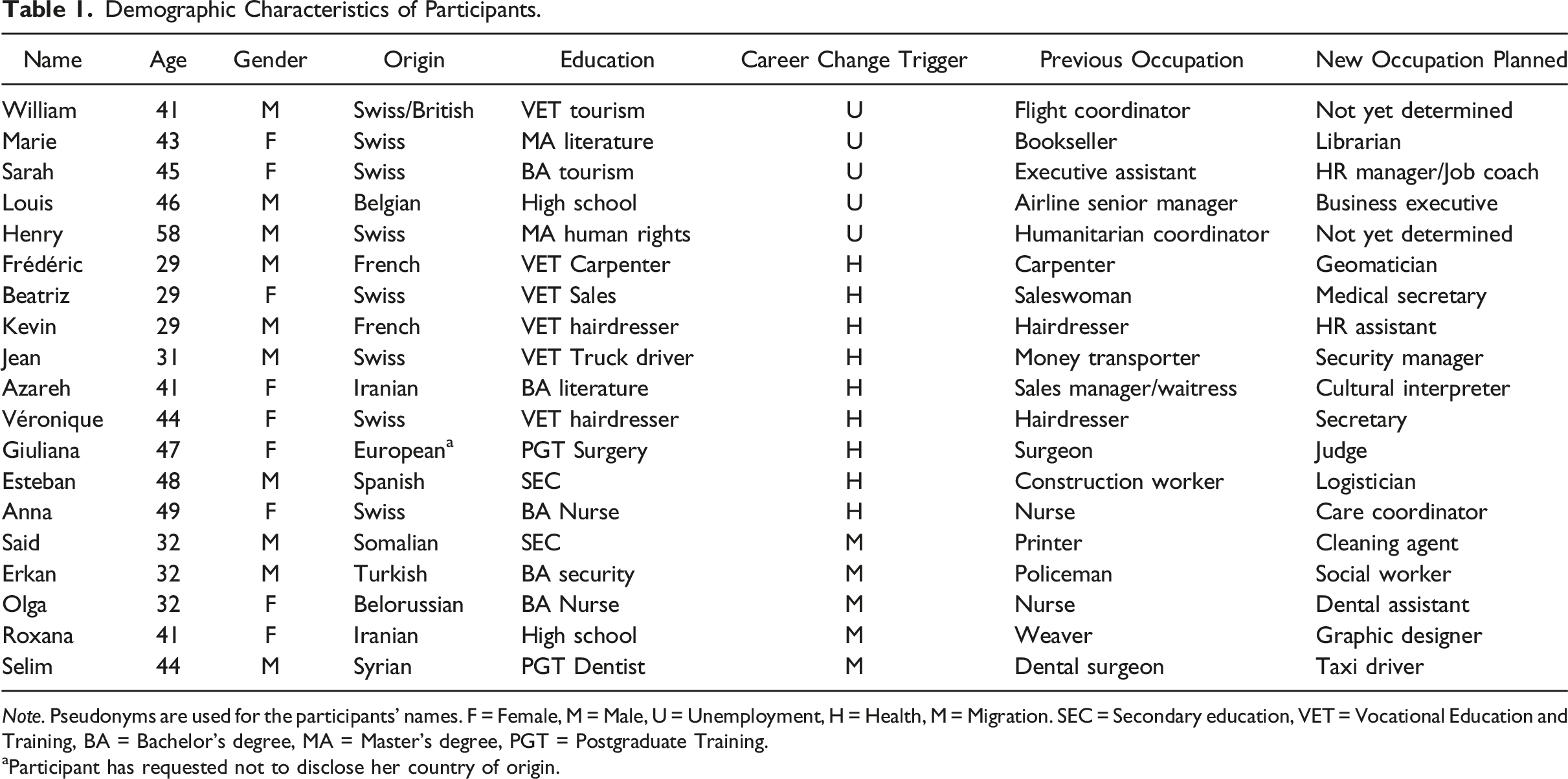
Note. Pseudonyms are used for the participants’ names. F = Female, M = Male, U = Unemployment, H = Health, M = Migration. SEC = Secondary education, VET = Vocational Education and Training, BA = Bachelor’s degree, MA = Master’s degree, PGT = Postgraduate Training.
aParticipant has requested not to disclose her country of origin.
Procedure
We contacted 13 public and semipublic institutions in Switzerland that offered adult employment integration programs. After receiving permission from the institutions’ management, we presented our study to career counselors and job coaches working with career changers who met the inclusion criteria. The coaches and counselors provided contact details of interested and eligible participants, and we scheduled one-on-one video conference interviews (Archibald et al., 2019). Each participant was recruited voluntarily and agreed to participate with informed consent. We reached 29 potential participants, and 23 answered positively and 19 were analyzed. Four interviews were consensually discarded because participants did not exactly meet our inclusion criteria. Two of them were undergoing an involuntary transition but without any change of occupation, which distances them from our definition of career change. For two others, it became clear during the interview that their oral French was insufficient for effective communication. An intermediary report was sent to thank our participants and partner institutions (Brazier et al., 2022).
Three team members conducted the interviews in French, lasting 66–146 min (M = 99). Interviews were recorded and fully transcribed. To preserve confidentiality, we pseudonymized participants’ names with respect to their national origins and anonymized other names, locations, and companies’ information in the transcriptions.
Interview Guide
We divided the interview guide into seven parts (see Appendix A). The first part focused on participants’ demographic information. The second part focused on participants’ career paths (jobs, events, subjective career situation, and previous and current career situation). The third part concerned the involuntary career change (reasons, importance, associated feelings, anticipation, perceived continuity, if any, and reversibility). We also asked them to discuss on a table of push, pull, anti-pull, and anti-push factors through four sentence completion tasks: “About my former profession, I am going to miss…” (anti-push); “I am glad I no longer have…” (push); “In my new profession, I fear…” (anti-pull); “In my new profession, I am looking forward to…” (pull). The fourth part focused on vocational, personal, and social identity and possible selves. The fifth part encompassed resources and barriers. The sixth and seventh parts investigated participants’ relationships to work and training. To ensure the participants’ well-being, we ended the interview by asking them if they wanted to add anything, how they felt after the discussion, and whether they had questions. The interview guide included institutional resources, such as emergency psychiatric contacts, that could be shared with participants if needed. In addition, all interviewers are also qualified psychologists who are able to manage possible distress during the interviews.
For the purpose of the current study, we mainly focused on the third part of the interview. We specifically analyzed the answers participants provided to the push, pull, anti-push, and anti-pull sentence completion task. When the information provided during this task was insufficient to depict fully the articulation of facilitators and inhibitors of career change processes, we sought further details in previous parts of the interview.
Analysis
Our analyses were informed by the principles of consensual qualitative research (CQR; Hill et al., 2005), which was tailored for an abductive, process-oriented procedure. Recent research in vocational psychology has shown the relevance of CQR in studying major work and life transitions, such as women and migrants’ work integration processes (e.g., Autin et al., 2018; Fedrigo et al., 2023; Scalise et al., 2019) and retirement (e.g., Záhorcová et al., 2021). Conventional CQR is deployed in three distinct steps: domains identification, construction of core ideas, and cross-case analysis. To address our research aims, we modified the standard CQR procedure in two ways. First, inspired by existing CQR in the field of career development (e.g., Li et al., 2021; Tate et al., 2015), we opted for an abductive rather than an inductive approach and organized our analysis within a predefined theoretical framework (i.e., the 2PAP model). Second, to reflect the processual nature of involuntary career changes, in addition to core ideas, we focused on identifying patterns of articulations between push, pull, anti-push, and anti-pull factors, which we called “drivers.” Our cross-case analysis consisted of identifying and grouping “processes” within drivers. Previous works based on the 2PAP model informed this second modification (Soidet & Raussin, 2019).
Research Team
The research team comprised five members, aged 26 to 45, all White, and affiliated with the University of Lausanne. Four members were PhD students (three women, one man) in diverse stages of their theses in vocational psychology. They had previous experience in consensual qualitative research together and were responsible for coding the data. The fifth member was a professor in vocational psychology and an expert in qualitative research with experience in CQR. As an auditor, he gave feedback on the codebook the coders provided, mediated disagreements in the analysis, advised the first author in the analysis, and supervised the writing. The auditor and the first author guided the team through the process, which comprised six meetings to perform analysis, lasting 3–4 h each. Following Hill et al. (2005), we met a first time to discuss our possible biases in this study. Based on the team’s work experiences, we highlighted sensitivity to the theme of migration and health situations and the influence of our training as career counselors and volunteers with this population. We also considered differences in career control and adaptability, advocacy, and social justice awareness regarding our academic trajectories. As academics, we acknowledged we had opportunities and means to make career choices, deploy adaptability when facing obstacles, and exert control on our careers. None of us had experienced an involuntary career change. The analysis procedure consisted of going through the CQR steps as Hill et al. (2005) suggested and we adapted them for the study aims: domains identification (i.e., identifying 2PAP factors within each participant), core ideas (i.e., providing each participant’s drivers based on the articulation of their 2PAP factors), and cross-analysis (i.e., comparing and grouping drivers in processes).
Domains Identification
The first author went through each interview transcription and identified the four domains of push, pull, anti-push and anti-pull factors. Then, all the coders independently read three interviews to apprehend how these factors manifested in these participants. Based on this careful reading, the team met a second time and concurred that each participant had an articulated pattern of push, pull, anti-push, and anti-pull factors (2PAP). Thus, the team agreed on the necessity of considering each participant’s articulation of the four factors as a meaning unit to preserve the complexity and uniqueness of their career change processes. Following the example of Soidet and Raussin (2019), we then focused our analysis on each participant’s driver as we considered it as an articulated whole instead of artificially separating push, pull, anti-push, and anti-pull factors. We submitted the rationale of this analysis strategy to the auditor, who validated it.
Core Ideas
Each team member wrote a case summary of the articulation of 2PAP factors for three to four participants. During this step, following Hill and colleagues’ (2005) recommendations, we stayed close to the participants’ words. Based on the case summaries, the coders outlined the key 2PAP markers of each participant to generate core ideas and drivers (i.e., patterns of articulations among these markers). For example, Erkan’s 2PAP summary included the following core ideas: political context as a push; and same skills studied, social contact, and capitalized migration experience as pulls; previous training investment, skills adequation, and social recognition as anti-pushes; and skills deficit as anti-pulls. Erkan’s driver was then related to Skills. How this driver manifested in Erkan’s new career choice was a career change process. His process was thus considered to refer to an articulation of factors revolving mainly around skills and experiences in a context of sociopolitical influences. It was labeled “valorizing skills and experiences.” After the third meeting, where the research team discussed the core ideas and drivers identified, each coder independently reviewed and validated the analysis of another team member through rotation. The first author reviewed each synthesis and incorporated the team’s suggestions. Finally, the core ideas and driver labels were exposed to the auditor for validation.
Cross-Analysis
During the cross-analysis stage, as Hill et al. (2005) suggested, the team gained in abstraction by being more interpretative. The coders independently read the 15 case summaries and driver labels and they grouped similar main drivers of articulations of 2PAP factors. During the fourth and fifth meetings, each coder submitted their grouping to the research team, and convergences and divergences were reviewed. The research team agreed on a final classification of participants into three types of drivers and five processes of career change (see Results section). Although individuals could refer to different types of drivers, the coders were easily able to identify a dominant driver for each participant consensually. Frequencies within each type and subtype were calculated. Because the cross-case analysis step was directed toward identifying typologies, our goal was not to contrast core ideas, processes and drivers based on their frequency, as is the case in conventional CQR. For this reason, frequencies were provided for informative purposes but not used to understand our data. The first author returned to raw data to ensure this classification was consistent with each case. In a sixth and final meeting, the classification was discussed with the auditor, who sorted out slight discrepancies and recommended a few changes, such as revisions to the drivers’ labels, and processes, to gain precision.
Trustworthiness
Following Morrow’s (2005) suggestions, we ensured trustworthiness through parallel criteria related to the postpositivist paradigm in qualitative research: credibility, transferability, dependability, and confirmability. We preserved credibility by writing first impressions, syntheses, and reflexivity after each interview and by the interactions of the four coders during data analysis. We reached transferability by stating our biases, origins, and relations to the topic and addressing the study context and limitations. We guaranteed dependability through the auditor’s work and the detailed description of the analysis procedure. We secured confirmability through intensive exchanges within the team and several returns to the data at various stages of the analysis to challenge our results.
Results
Drivers and Processes of Involuntary Career Change.
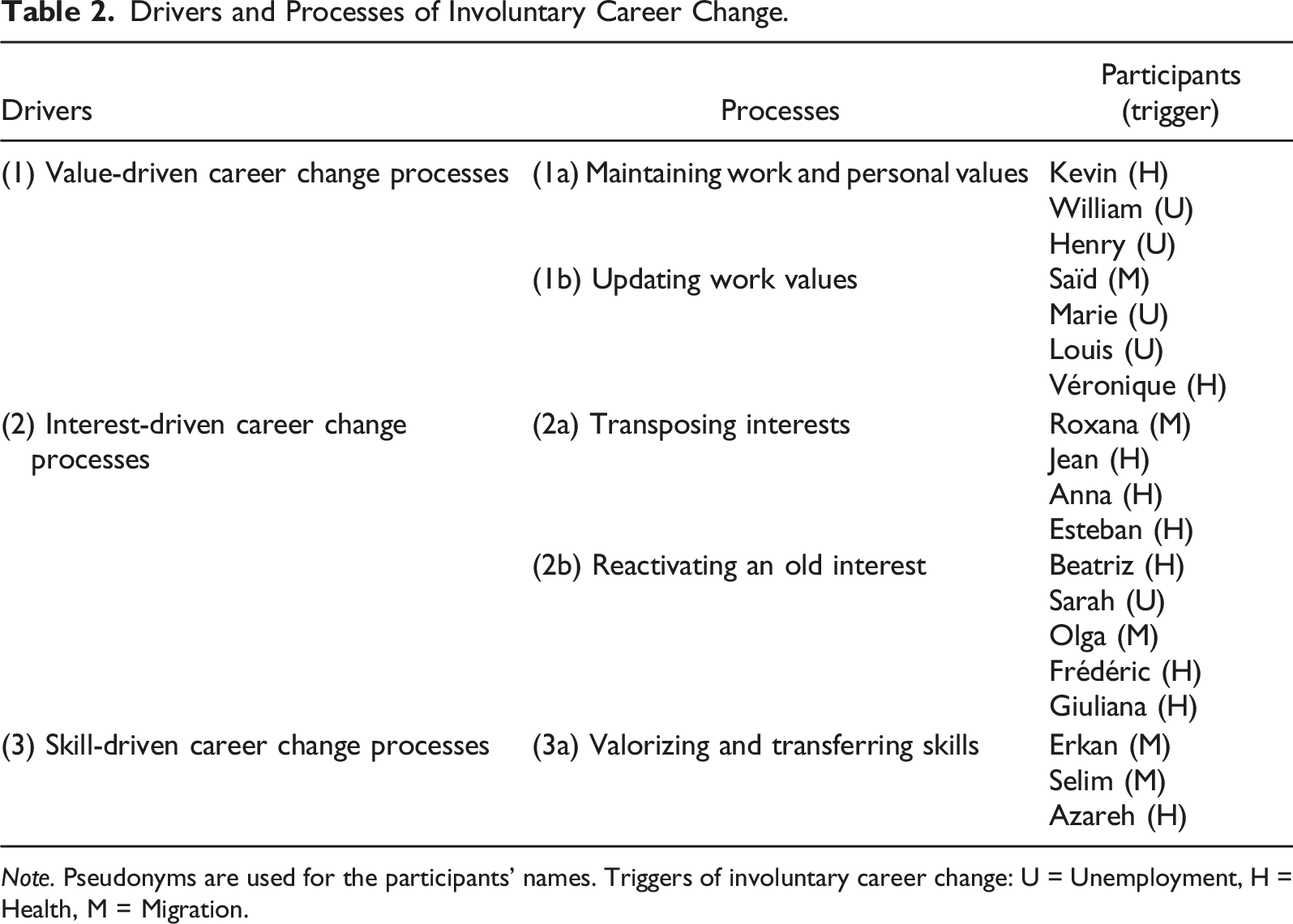
Note. Pseudonyms are used for the participants’ names. Triggers of involuntary career change: U = Unemployment, H = Health, M = Migration.
Value-Driven Career Change Processes
Processes and Core Ideas of Value-Driven Career Change.
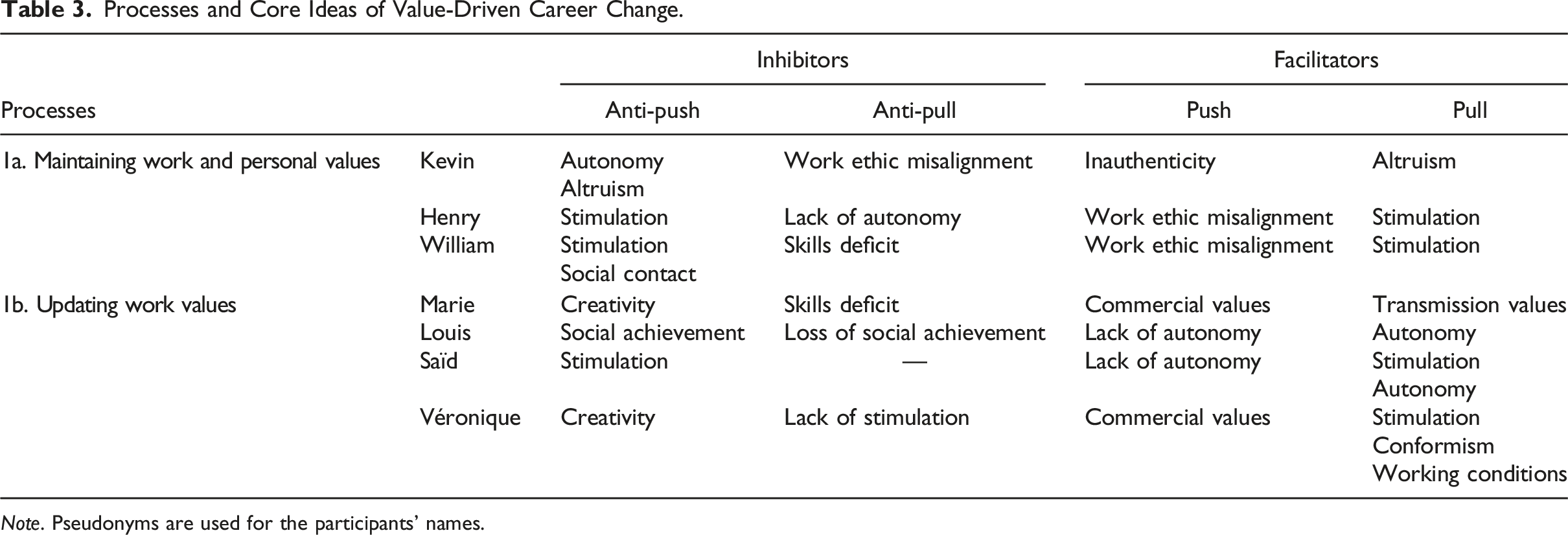
Note. Pseudonyms are used for the participants’ names.
Maintaining Work and Personal Values
For three participants, the struggle to maintain continuity in their work and personal values marked the career change process. For example, Henry (58, a former humanitarian coordinator forced to change careers because of employability issues) was happy to leave an unethical work environment but feared losing the stimulation and autonomy of his previous job. He consistently aspired to find in his new career the same stimulation he benefited from in the humanitarian sector. Henry said, It’s all this excitement…and all this newness. The fact that there’s…no routine there. I mean, you work 2 years in [African country], and then you go to [European country] for 2 years. I mean you’re rediscovering something totally new; it’s super interesting! . . . What…I could be happy about is learning something new, that’s right!
Avoiding value misalignment was also crucial to these participants. For example, while inhibited by the fear of losing autonomy and altruism, Kevin (29, a former hairdresser forced to change due to an allergy to HR assistant) was happy to leave a job where he could not be authentic. Kevin stated, “I’m glad I don’t have to fake it with some people who exasperate me. . . Spending 3 hours doing highlights with a client whose boots I have to lick and that I can’t stand.” However, his career change process was inhibited by the fear of experiencing personal value conflicts in terms of loss of autonomy and altruism, but also work ethics misalignment in his new career. Kevin explained, If anything scares me, it will be the lack of respect for my own values. . . If I have to work for a company where I see that there is injustice . . . I don’t fear many things in my new profession, except the nonrespect of values that, for me, are mandatory . . . and nonnegotiable.
In sum, these participants’ processes show that work and personal values played a significant role in their career change experience. The perspective of preserving values facilitated the career change process, whereas the fear of value misalignments inhibited it.
Updating Work Values
Four participants’ career change process were facilitated by the perspective of updating their work values or were inhibited by the impossibility of doing so. Unlike the previous process, this process mainly focused on attempts to embrace new values. For example, Marie (43, a former bookseller having to transition to library work because of unemployment issues) was happy to access an occupation valuing culture and literature transmission over commercial values. Marie stated, “Booksellers promote the books at the level of the product, and then the librarians promote the reading, the practice, the culture—the patrimonial side. . . What counts is to share knowledge or culture, not to sell books.” However, participants’ reflections around values were not so univocal and contrasted, and the desire to update work values could also align with the fear of losing other work values characterizing the former job. This was the case for Louis (46, a former senior manager in an airline forced to change his career due to unemployment), who simultaneously aspired to a job where he could benefit from more autonomy and feared losing the social achievement and prestige associated with his former job. Louis stated, What I will miss about my former profession is the business card. . . You were proud to work for the company. . . Finally, you brought your business card with you; it impressed people. . . Freedom. That is, I decide what I do…it’s the freedom to do as you want finally. To invent the life that goes around you, that’s freedom. So, no boss and [having] freedom are clearly what I will gain in this career change.
In the first process, the career change process primarily revolved around preserving value stability, whereas participants in the second process were predominantly driven by a quest for new, fulfilling values or a shift in values. All individuals reassessed their work values and identified occupations that could potentially fulfill them. Otherwise said, a change in values acted as a deterrent (i.e., an inhibiting factor) in the first process and as an attraction (i.e., a facilitating factor) in the second.
Interest-Driven Career Change Processes
Processes and Core Ideas of Interest-Driven Career Change.
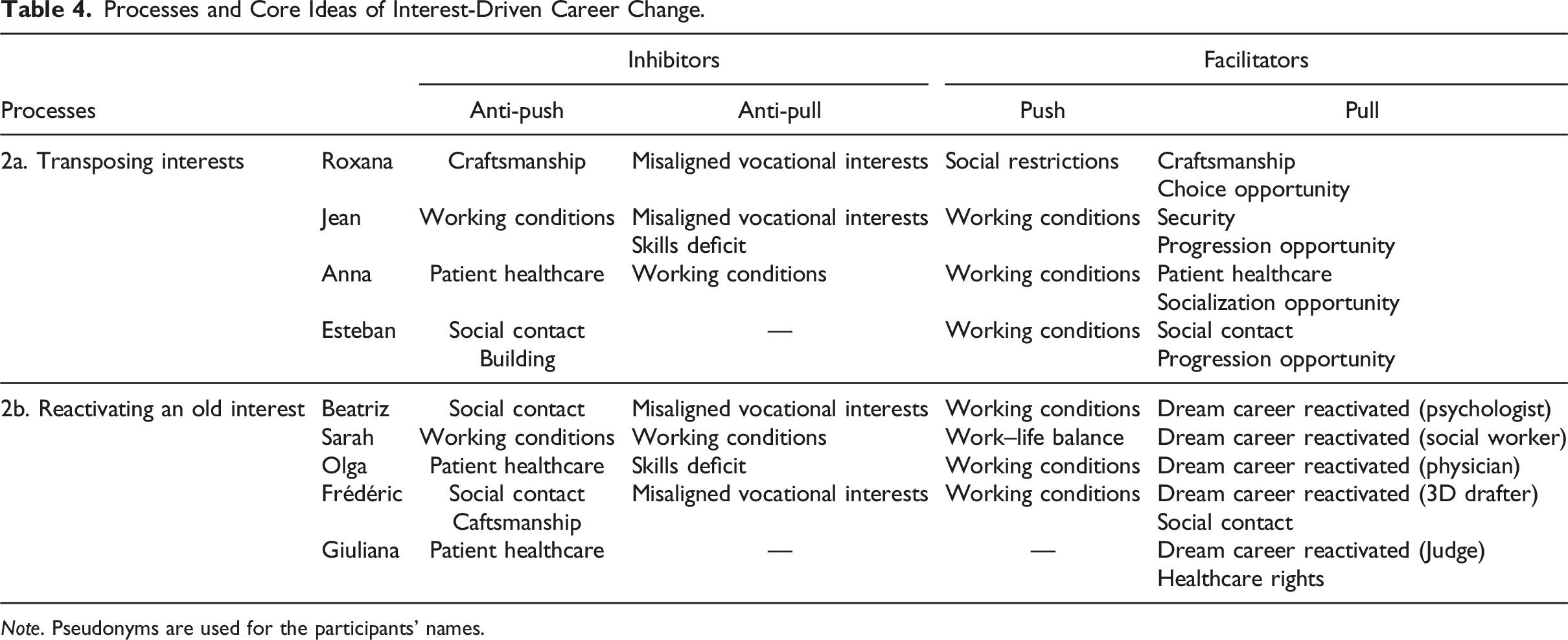
Note. Pseudonyms are used for the participants’ names.
Transposing Interests
The first process within interest-driven processes concerns involuntary career changers who sought to transpose into their new occupation professional interests that characterized their former occupation. These participants also reported they wanted to take the opportunity of having to change careers to move toward a broader range of possibilities and leave a restrictive environment. This double movement of interest transposition and broadening of opportunities was found, for example, in the words of Jean (31, a former money transporter forced to change into security management due to an accident). While working conditions both pushed and “antipushed” Jean, he was drawn by the opportunity to maintain a career aligned with his interests in the security domain, but also by the opportunity to pass from an operational to a managerial role. Jean explained, [What] changes a lot and what I find very pleasant…is that it’s a whole other way…of functioning. . . It’s a position higher than what I was doing before. It’s quite different, the missions are different. And I’m also happy because, at this level of the job, everything is explained. . .. If the management wants something, it will explain to me why they need it…but when you’re at the bottom of the ladder, they say to do this because it has to be done; they won’t tell me why.
This was also the case for Roxana (41, a former weaver forced to change careers due to migration and she was planning to become a graphic designer), who both enjoyed and missed craftsmanship and the calm and meticulous artistic work. While the same fear of career interest misalignment inhibited Roxana’s process, she was happy to step out of her previous limits. Roxana stated, I think [retraining is] very good for me because, in my country, there is no choice . . .for me to do something like this work, for all women. But here I can choose, I can learn. There are many choices for me.
In sum, redesigning the same career interests in a more valued occupation that overcomes certain previous constraints may facilitate the process of an involuntary career change.
Reactivating an Old Interest
The second process within interest-driven career change processes relates to a reactivation of a previously dormant vocational interest. For five participants, while the potential loss of interesting tasks inhibited the change process, the possibility of getting closer to an abandoned vocation facilitated it. When considering her possible new occupation as a medical secretary, Beatriz (29, forced to change due to chronic illness) feared monotony and not being able to meet some of the interests she could meet when she was a saleswoman, such as customer contact and advice. In contrast, her new career plan appealed to her because it also represented the possibility of being in a work environment that partly allowed reviving her abandoned vocational interest as a psychologist. Beatriz stated, If I had stayed there [in her European country of origin, left when she was a teenager], maybe I would have pursued my dream of being a psychologist, so, in both cases, yes…there is something that broke something. [About the involuntary career change], … At the beginning, I really wanted to go to prisons, to youth shelters, well…[because] I couldn’t do my psychology degree…I wanted to sneak into a place where I would have felt good as a psychologist, you could say.
The same pattern occurred with Sarah (45, forced to change from executive assistant to HR or job coach because of unemployment issues), who associated her new career plan with her former vocational interest as a social worker: [16 years ago], my objective was to work for a year in an institution to discover this field [of secretary] and then to do a training course at the social school. But it turns out that…I started, I found a job…in the rather administrative sector. . . Well, [now] I see myself more as a social worker, except that I don’t have the training [laughs]. So…a little bit of social work that allows me to help people but [as a] job coach or…uh, HR manager.
Thus, old, abandoned passions drove the career change process toward an occupation that was perceived as close to it and reachable. While both focused on interests, these two processes imply different articulations of facilitating and inhibiting factors. Transposing interests’ process refer to an objective, short-term continuity of interests in which people change to similar occupations with greater control over their lives. In contrast, reactivating interests’ process seem to refer to a long-term subjective continuity: People return to past vocational dreams and try to change to an occupation that is as close to those dreams as possible.
Skill-Driven Career Change Process
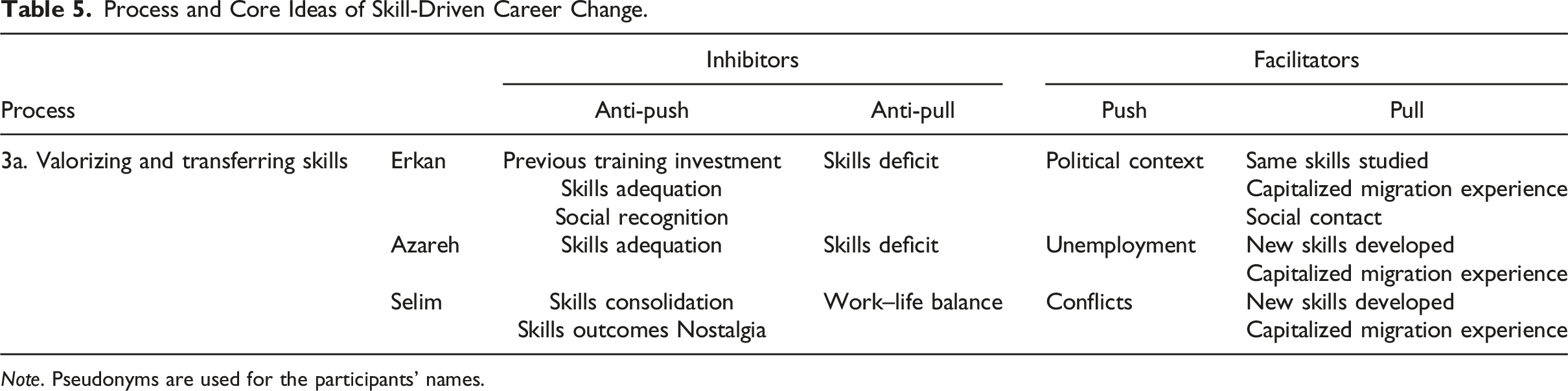
Process and Core Ideas of Skill-Driven Career Change.
Note. Pseudonyms are used for the participants’ names.
Valorizing and Transferring Skills
Skill-driven career change processes associated with one process covering situations where the challenge was to value and transfer past skills into a new occupation. Thus, the impossibility of transferring skills inhibited the career change process. This was the case for Erkan (32, a former policeman forced to change to social worker due to migration): “More or less, I try to value the skills that I have acquired, but I can say it’s a loss…of my training as a policeman, you see.” In addition, interviewees mentioned they feared having skills deficits regarding language barriers. This prevented them from achieving a new stimulating career or finding a job with comparable requirements to their former occupation. Again, this was the case for Erkan: “It…scares me a little bit, sometimes because…even though I’m told that…‘you can express yourself, you can get by,’ but it’s not enough.”
Within this process, the lack of opportunity to consolidate specific skills in their new career also inhibited the change process. For example, Selim (44, a former dental surgeon forced to change to taxi driver) related the loss of skills progression: “I organized…my life for this work…every year there’s a conference, a congress…to [which] I went to represent [to train, to get inspired, and see new things].”
Facilitators of these participants’ career change processes also linked to skills. For example, Erkan was happy to study the exact subjects again as at the police academy but also to reintegrate his migration experience into his new career as a social worker: The human contact…because I tell myself that I am a person at ease in contact with people. . .If I work, for example, in the future as a social worker with refugees [and] with migrants, I think I understand their…experiences better. I can [have] more effective empathy.
In sum, aspiring to an occupation where one can draw on skills developed in the former occupation or build on the experience of migration might facilitate the change process. In contrast, a lack of recognition of experiences or qualifications and language issues seem crucial inhibitors of this process. Figure 1 summarizes drivers and processes. Drivers and Processes that facilitate or inhibit the Career Choice of Involuntary Career Changers.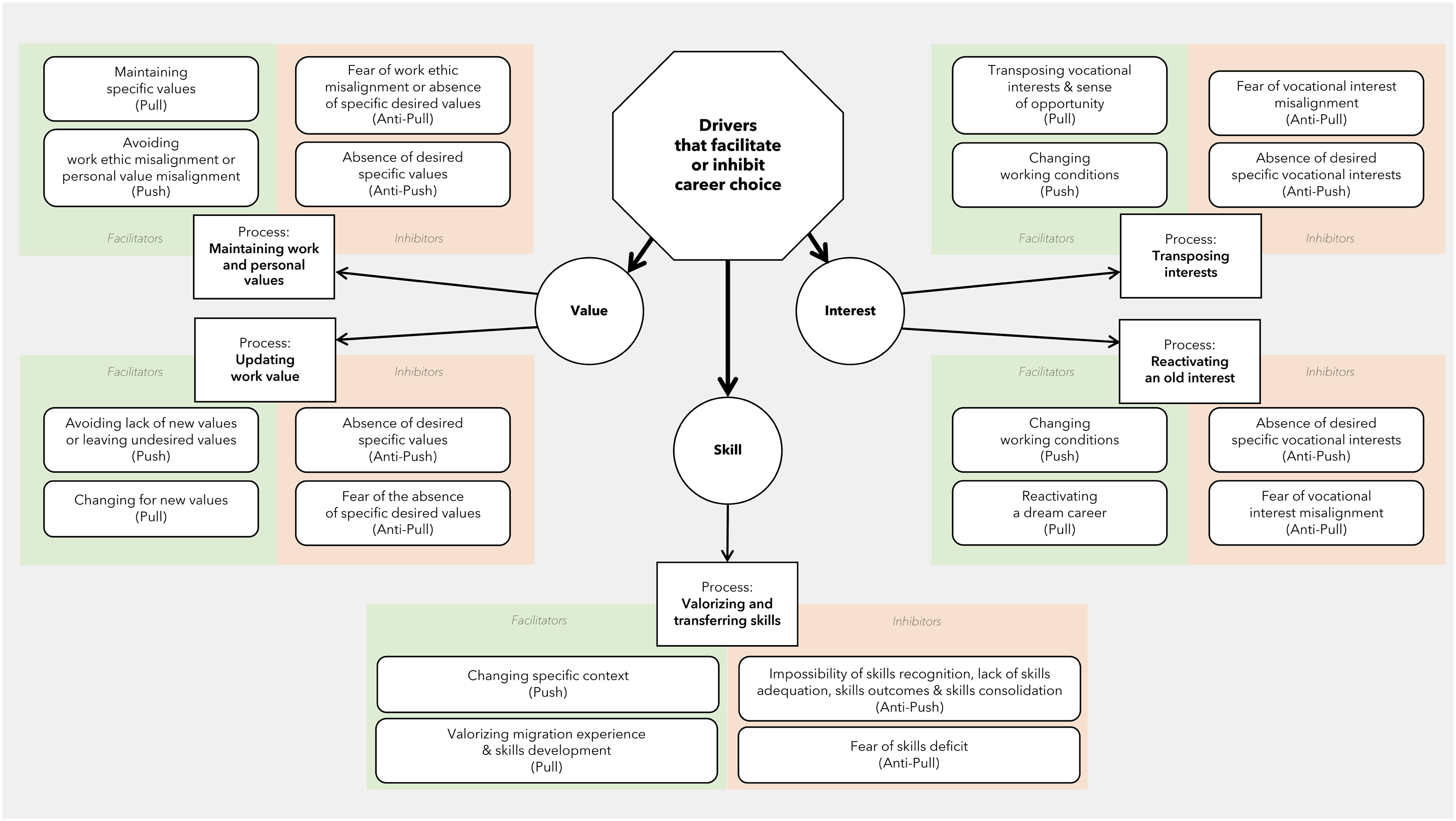
Discussion
Our aim was to provide a better understanding of how individuals forced to change careers proceed in choosing a new occupation through the lens of the 2PAP model (Mullet et al., 2000). Findings highlighted a vast array of different articulations of facilitators and inhibitors that characterize involuntarily triggered career change processes. Values, interests, and skills were guiding threads to participants’ experiences and conveyed diversified processes for choosing a new career. Indeed, we identified three types of drivers and five processes of career change. Value-driven career changes covered two specific processes: those of participants aspiring to maintain their preferred values in their new occupation, and those of participants aspiring to update certain values and to embrace new elicited work values. Interest-driven career changes also covered two types of processes: those of participants aiming to transpose their former interests to a new career, and those of participants reactivating a dormant career interest. Skill-driven career change processes specifically concerned skilled migrants who struggled to find a career aligned with their qualifications and that values their migration experience. A general observation was also that participants were all under the influence of various and complex configurations of facilitators and inhibitors in their career change process. Nevertheless, every participant misses a feature from his or her previous occupations and feared these regrets prevented them from experiencing a new satisfying career. These results echo previous studies that applied the 2PAP model to the transition to retirement (Chevalier et al., 2013) and midcareer retraining (Soidet & Raussin, 2019). What seems to differentiate our findings from those of earlier research is that the involuntary nature of the career change trigger in this study likely resulted in more intense struggles for participants to perceive control over their situation. These results lead to several observations on how people try to regain control over their careers.
The Struggle to Recover Career Control
Despite being forced to change careers, some participants aspired to maintain coherent values, interests, or skills throughout the career change. Others tried to retrieve what they had lost, such as a dormant career interest or a high-skilled profession. These dynamics can underlie participants’ attempts to regain control (Guest & Rodrigues, 2015) over the process and outcome of the career change while they had no control over its triggering.
Each process of career choice seems to refer to specific forms of attempts to recover career control. First, career changers who sought to maintain their elicited values (process 1a) also aspired to work in environments that better promoted their own ethics and personal values. This aspiration can be understood as an effort to increase control over their careers. Second, updating a new favored value in a career choice (process 1b) might be understood as an opportunity to gain back some control, especially for those participants who aspired to more autonomy in their new career. Third, participants aimed at transposing their interests into their new occupation (process 2a) were drawn by the perspective of broadening their career opportunities, which can also represent a means to enhance control over their career. Fourth, reactivating a dormant career interest (process 2b) eventually allows participants to feel closer to their dream career and regain a sense of control over their trajectories in the long run. Fifth, the pull factors of skill-driven career change processes (process 3a) included drawing on the migration experience in a new career to help others facing migration challenges. Turning what one has learned during an adversity experience into a career plan is an attempt to transform a constraint into a choice. However, participants experiencing skill-driven change processes seemed to put more effort into strengthening their sense of control than the other participants did. Their process refers to struggles mainly focused on how not to lose control over their careers rather than on increasing it. Should this observation be supported by other studies, it would further confirm that the migrant population’s professional integration challenges are of major importance (Farashah et al., 2022; Fedrigo et al., 2023).
One common thread in these processes is that the attempts to regain control over one’s career involved identifying what was most salient in one’s career change process and eventually relinquishing less significant facets. For some participants, these salient aspects were their values; for others, their interests; and for others, their skills: Efforts to regain control were channeled around these facets of change. This process of focusing on specific aspects of career change might reveal the existence of selected forms of continuity, echoing previous research on the career change of injured veterans, whose narratives revealed a search for continuity of goals, values, or work (Kulkarni, 2020).
Limitations and Future Research
The present study has four main limitations. First, at the time of the interviews, participants were at diverse stages of implementing their career change. Some were still considering multiple career options, while others were already on the verge of starting retraining in their new career. This might have affected their perceptions and recollections of their transition experience and how they shared their experience with the interviewers. For example, participants with clearer plans, such as those already enrolled in a retraining program, might have had a more accurate picture of pull and anti-pull factors than those who were still uncertain about their next career step.
Second, we reached out to our participants through diverse public and semipublic institutions that delivered career coaching and counseling and supported occupational integration in varied ways and intensities. For example, some participants had met with a career counselor twice a month for a year, while others had only benefited from a few meetings; some were supported in their search for an internship, while others were undergoing a comprehensive skills assessment. Participants who attended intensive, high-quality programs might have been more likely to share a more positive and accurate experience of change than those who did not receive such support. To address both the first and the second limitations, future research should either target a more homogeneous population or address these temporal and institutional variations within the sample.
Third, the articulation of facilitators and inhibitors of involuntary career changes might vary over time, particularly because these changes often last for a long period (Maitlis, 2009). Thus, our research is limited to a momentary analysis of this articulation, which prevents us from understanding how it unfolds over time. Longitudinal qualitative research would help fill this gap and provide insight into how the struggle for maintaining or regaining control and the hierarchization of needs evolve during the career change process.
Fourth, our analyses did not address the variety of emotions associated with participants’ career change process and the struggle to regain control over their career. For some participants, the career change offered a new start and prompted positive emotions despite being involuntarily triggered. In contrast, others felt a sadness at being forced to abandon a career in which they had invested a great deal. Thus, further research could address emotions in work-related identity loss and recovery (Conroy & O’Leary-Kelly, 2014).
Practical Implications
Career professionals supporting involuntary career changers, such as career counselors, coaches, and HR managers, might adopt a subjective and nuanced approach to this phenomenon. Indeed, individuals might be torn between the facilitators and inhibitors of change, which could hinder a successful transition. Thus, it seems important to understand accurately how people experience an involuntary career change and how they perceive what attracts and repels them toward change. In this sense, it is essential to identify what is most central to a person undergoing career change, between their values, interests, and skills. Based on this, support should be focused on the driver that is most significant for them. Moreover, our findings suggest that particular attention must be given to involuntary career changers’ sense of control and strategies to increase control despite the fact that the career change was not chosen. Finally, the migrant population encounters specific challenges and may need more tailored and intensive support. This could involve giving visibility to their struggle and advocating for the recognition of their skills, prior experiences, and qualifications.
Conclusion
Our study showed that diverse articulations of push, pull, anti-push, and anti-pull factors shaped involuntary career change processes. These articulations revealed various types of career change drivers depending on what individuals emphasized in their careers (i.e., values, interests, or skills). Beyond their specific process, all participants seemed to attempt to regain a sense of control over their careers despite having to cope with an involuntarily triggered career change. However, their career control was constrained and limited to what they considered salient in their career.
Footnotes
Acknowledgments
We thank the following associations, public institutions and foundations that have accepted to relay our call for participation: Office Cantonal d’Orientation Scolaire et Professionnelle (OCOSP) du canton de Vaud, Oeuvre Suisse d’Entraide Ouvrière (OSEO) Vaud, Société Coopérative Démarche, Fondation Mode d’Emploi, Association CORREF, Établissement Vaudois d’Accueil des Migrants (EVAM), Ingeus, Fondation Qualife, Association Découvrir, Atelier93, Fondation Intégration Pour Tous (IPT), Centre de Bilan de Genève (CEBIG), and Association des Demandeurs d’Emploi (ADE) Lausanne.
Declaration of Conflicting Interests
The author(s) declared no potential conflicts of interest with respect to the research, authorship, and/or publication of this article.
Funding
The author(s) disclosed receipt of the following financial support for the research, authorship, and/or publication of this article: This study is supported by Schweizerischer Nationalfonds zur Förderung der Wissenschaftlichen Forschung (100019_192429).
