




Abstract
Networking is a viable career self-management strategy. Most studies so far in the networking domain have focused on long-term consequences and used a between-person trait approach. To address recent calls for more time-oriented approaches in career research, we extend the existing research by conducting a diary study over five consecutive working days (N = 59 employees). Specifically, we examined the within-person relationship between networking and career-related outcomes (i.e., task performance and career optimism). Further, adopting a motivational approach, we investigated whether need for affiliation moderates the daily networking career-related outcomes association. Our findings lend support to the moderating role of the need for affiliation in the relationship between daily networking and both daily task performance and daily career optimism. Our study connects motivation research with networking research by means of a dynamic approach that helps to understand the short-term effects of networking.
Networking refers to goal-directed behavior aimed at creating, cultivating, and utilizing interpersonal contacts (Gibson, Hardy, & Buckley, 2014). In today’s work environments with flattened hierarchies, globalization, and outsourcing practices, researchers have posited that self-management of one’s career becomes increasingly important (Sturges, 2008). Networking as a viable career self-management strategy enhances people’s access to resources (Porter & Woo, 2015). Accordingly, earlier research has connected networking with a myriad of positive outcomes (Ng & Feldman, 2014; Ng, Eby, Sorensen, & Feldman, 2005; Volmer, Orth, & Wolff, 2018; Wolff & Moser, 2010).
However, existing research has predominantly considered the consequences of networking over longer periods (i.e., months or even years), whereas the immediate effects of networking have been largely neglected. We focus on a short time frame and examine networking on the daily level. Our within-person approach thereby responds to recent calls to pay more attention to career success as an emergent process evolving as a function of time and experience (Heslin & Turban, 2016) and contributes to the very few studies examining networking experiences at the daily level (e.g., Baumeler, Johnston, Hirschi, & Spurk, 2018; Volmer & Wolff, 2018). Considering the immediate effects of networking is important as effects at different levels (within-person and between-person) may differ (Bolger, Davis, & Rafaeli, 2003; McCormick, Reeves, Downes, Li, & Ilies, in press). The within-person effects of networking are scarce but would be helpful for researchers and practitioners alike in order to ascertain whether daily networking is advisable and has positive immediate effects.
In addition to the scarcity of within-person research in networking research, the results of the positive associations of networking with people’s career success raise the question whether these are valid in the same way for all individuals. Networking research has investigated the role of personality in the context of networking (Forret & Dougherty, 2001; van Hoye, van Hoft, & Lievens, 2009; Wanberg, Kanfer, & Banas, 2000; Wolff & Kim, 2012; Wolff & Moser, 2006), yet knowledge of the role of personality still appears to be limited. Earlier research has focused almost exclusively on the trait approach (e.g., McCrae & Costa, 1997), which mainly describes how individuals act, think, and feel in a general manner. We here adopt a motivational perspective (e.g., Schultheiss, Strasser, Rösch, Kordik, & Graham, 2012) and focus on implicit motives. Implicit motives “generally sustain spontaneous behavioral trends over time because of the pleasure derived from the activity itself” (McClelland, Koestner, & Weinberger, 1989, p. 690) and thus address the why of networking. Explicit motives contain a stronger cognitive component and are conscious responses to specific situations (McClelland et al., 1989). Implicit and explicit motives usually correlate only weakly with each other and predict different behaviors (Kehr, 2004b; McClelland, 1987; McClelland et al., 1989; Schultheiss et al., 2012). We are interested in implicit motives with a focus on the affiliation motive, as we believe that not all our behavior is conscious and assume that differences in the unconscious affiliation motive may explain why not all people might necessarily benefit from networking in the same way. People high in need for affiliation strive to be with other people (McClelland, 1987), which we regard as an important explanation for why networking may not have potential beneficial consequences for everyone. Existing within-person networking research has investigated networking as a predictor of work–nonwork enrichment (Baumeler et al., 2018) and career-related outcomes, job attitudes, and well-being (Volmer & Wolff, 2018) yet has neglected moderators as a possible way to answer the question whether everyone benefits from networking on a daily level.
While there is research on the role of the Big Five traits (McCrae & Costa, 1997) for networking as outlined previously, to the best of our knowledge, we are only aware of one study (Wolff, Weikamp, & Batinic, 2018) that has investigated implicit motives. Wolff et al. (2018) examined implicit motives as determinants of (trait) networking, whereas we include the implicit affiliation motive as a moderator in the daily networking career-related outcomes relationship.
We investigate task performance and career optimism as career-related outcomes of daily networking as central indicators of immediate career success. Task performance refers to employees’ fulfillment of formal requirements (Sonnentag, Volmer, & Spychala, 2008) and is of high significance for organizations and individuals alike. The tendency for individuals to “expect the best possible outcome or to emphasize the most positive aspects of one’s future career development” (Rottinghaus, Day, & Borgen, 2005, p. 11) is described as career optimism. It has been linked to a variety of positive career-related outcomes such as career aspirations, choice, exploration (Rottinghaus et al., 2005), and academic satisfaction (McIlveen, Beccaria, & Burton, 2013).
This research makes two main contributions to the existing literature. First, our within-person approach contributes to the networking career success literature by shedding light on the short-term effects of networking and its immediate consequences for changeable, career-related outcomes. Second, we connect career research with motivational research in order to understand whether everyone benefits from daily networking.
Hypotheses Development
Daily Networking and Task Performance
Networking is defined as the extent to which individuals proactively engage in building and maintaining social contacts that they consider beneficial for their work or career (Forret & Dougherty, 2001; Wolff & Moser, 2009). Examples of networking can be meeting for an informal lunch or asking others for a favor (Wolff & Muck, 2009). Regarding networking behavior as a set of behaviors (Frese, Fay, Hilburger, Leng, & Tag, 1997) highlights the fact that networking is a malleable behavioral tendency affected by individuals’ motivation rather than being a stable, dispositional construct (Wolff, Moser, & Grau, 2008; Wolff & Moser, 2009). Empirical evidence shows a high within-variability of networking on a daily level (46% and 70.14% within-person variance of networking, respectively; Baumeler et al., 2018; Volmer & Wolff, 2018).
The relationships individuals build and maintain via networking create a network that they can turn to for social support, ideas, advice, or sponsorship (de Janasz & Forret, 2008; Wolff & Moser, 2006). Social support, in turn, is generally considered to directly promote well-being and performance and to buffer against the negative effects of job demands (Bakker, Demerouti, & Verbeke, 2004; Viswesvaran, Sanchez, & Fischer, 1999). Asking a colleague for advice with regard to a certain task can help to conserve resources by reducing time spent searching for possible solutions but also gives access to valuable information one might otherwise not have had. Accordingly, social support enhances task performance due to assistance received and access to key information that enables individuals to perform their tasks more successfully (Sparrowe, Liden, Wayne, & Kraimer, 2001; Thompson, 2005). Building on these findings, we hypothesize the following:
Daily Networking and Career Optimism
Social support enhances employees’ ability to satisfy a variety of personal needs such as a building self-confidence and clarification of career goals. Moreover, supportive relationships with others increase the likelihood of receiving key “inside” information that creates awareness of potential opportunities and produces a feeling of empowerment in the organization (Forret & Dougherty, 2004; Ragins, 1997).
By alleviating stress, providing additional resources, and enhancing individuals’ self-efficacy and control perceptions, social support has also been shown to enhance the ability to cope with career-related changes (Duffy, 2010; Garcia, Restubog, Bordia, Bordia, & Roxas, 2015; Wang & Fu, 2015). This ability, in turn, is linked to an optimistic outlook concerning one’s (future) career (Rottinghaus et al., 2005). As opposed to dispositional optimism, career optimism is more malleable and subject to change (Rottinghaus et al., 2005; Spurk, Kauffeld, Barthauer, & Heinemann, 2015). Accordingly, we assume positive short-term consequences of networking. In a study by Volmer and Wolff (2018), daily networking was positively associated with daily career optimism, and career optimism showed substantial within-person variability (39.66%). In sum, we hypothesize the following:
The Moderating Role of the Affiliation Motive
As distinguished by McClelland’s (1987) human motivation theory, there are three basic motives: the affiliation, the achievement, and the power motive. The affiliation motive is linked to the need to establish and maintain social relationships (e.g., McClelland, 1987; Murray, 1938) and thus closely related to networking. The incentive that is the basis of the need for affiliation is the positive feeling of being socially involved (Brandstätter, Schüler, Puca, & Lozo, 2013).
People high on need for affiliation have the desire to be socially involved. When entering social interactions, they will exhibit behaviors with the potential of making them more affiliative (Dufner, Arslan, Hagemeyer, Schönbrodt, & Denissen, 2015; McClelland, 1987). For example, a person with a high need for affiliation may engage in socializing behavior when meeting a stranger in order to create a feeling of warmth and closeness. Moreover, individuals with a high need for affiliation are likely to devote more time and reciprocal services to their interpersonal relationships (Teng, 2015; Weinberger, Cotler, & Fishman, 2010), thus strengthening these ties (Granovetter, 1973). Furthermore, individuals with high affiliation needs also appear to promote an atmosphere of trust, which in turn is an important factor for effective networks (Levin & Cross, 2004). We thus assume that people high on the affiliation motive differ from people low on the affiliation motive to the extent to which networking affects their task performance and career optimism. Taken together, we propose the following hypotheses:
Method
Procedure
We recruited participants by means of flyers distributed via e-mail and presented the study as a study on networking. Participants first responded to a general online survey including dispositional network behavior and motives. After 1 week, participants completed two online surveys daily for five consecutive working days. We collected data on daily networking at the end of each working shift and data on career optimism and task performance at bedtime. Participants generated an identification code in order to match the questionnaires. To increase compliance, we offered an anonymized general feedback report.
The response rate ranged between 95.9% for daily networking (278 complete surveys of a maximum of 290) and 91% for task performance (264 complete surveys of a maximum of 290). Overall, the average response rate was 92.5%.
Sample
A total of 59 employees took part in our study (we excluded one participant due to a missing general survey). The participants (N = 58) worked in different industrial sectors in Germany, mainly as office workers (29.3% held a managerial position). Participants (50% female) were on average 35.95 years old (SD = 12.57) and had on average 8.06 years of job tenure (SD = 9.09). Working hours per week ranged from 20 to 60 h. The majority of participants held a university master’s or doctoral degree (44.8%), followed by participants who had completed basic or secondary school graduation (30.9%) and had completed an apprenticeship (20.7%).
Measures
Person-level variables
Networking
We measured networking with the 44-item German Networking Scale by Wolff and Moser (2006). Participants were asked to assess their general networking on a 4-point Likert-type scale (1 = not at all to 4 = entirely). Sample items were: “I use internal events to make new contacts” and “I inform myself about what colleagues from other departments are working on.” Cronbach’s α was .91. Wolff and Moser (2006) demonstrated that networking was positively correlated with the level of work relief (r = .29, p < .01), strategic information (r = .35, p < .01), and networks (i.e., number of persons offering either work relief or strategic information).
Affiliation motive
We used the Multi-Motive Grid (MMG; Sokolowski, Schmalt, Langens, & Puca, 2000) to assess the need for affiliation motive. The MMG is a validated, pictorial test (Langens & Schmalt, 2008) and has been used in the organizational context in the past (Kehr, 2004a; Sokolowski et al., 2000; Wolff et al., 2018). An example of a picture with a high arousal potential for affiliation only shows people dancing at a disco. Participants were provided with 12 statements representing motivational tendencies (e.g., “one is happy to meet other people” for affiliation). Participants indicated whether these statements fitted the picture (0 = no and 1 = yes). We calculated the sum score of the statements relevant for the need for affiliation motive (α = .62). Cronbach’s α of implicit motives has been shown to be low (−.02 to .43, Schultheiss, Liening, & Schad, 2008) but higher for the MMG (.61; Sokolowski et al., 2000) because participants’ responses to the pictures need not be scored.
Control variables
We controlled for gender (1 = male, 2 = female), age, tenure, and networking as trait. All these variables were assessed in the general survey.
Day-level variables
Networking
Following the procedure proposed by Volmer and Wolff (2018), we measured daily networking with 8 items (on 6-point Likert scales ranging from 1 = not at all to 6 = entirely) adapted from Wolff and Moser’s (2006) Trait Networking Scale. Sample items included “Today I actively engaged in building or intensifying new contacts” and “Today my contacts were beneficial concerning business matters.” Cronbach’s α was .89 across the 5 days and ranged from .87 to .91.
Career optimism
Following the procedure proposed by Volmer and Wolff (2018), we measured career optimism with 3 items from the German version of the Career Future Inventory (Rottinghaus et al., 2005; German version by Spurk & Volmer, 2013). Participants were instructed to rate their daily career optimism on 5-point Likert-type scales ranging from 1 (totally disagree) to 5 (totally agree). A sample item included “Today, after work, I am happy about my professional development.” Across the 5 days, Cronbach’s α was .90 and ranged from .85 to .95. As shown by Spurk and Volmer (2013), career optimism was related positively to both career (r = .55, p < .001) and job satisfaction (r = .42, p < .001), demonstrating its convergent validity, as well as negatively to neuroticism (r = −.47, p < .001), thereby supporting its discriminant validity.
Task performance
We assessed task performance with 7 items adapted from Williams and Anderson’s (1991) In-Role Performance Scale. Participants were instructed to rate their daily task performance on 5-point Likert-type scales (1 = totally disagree to 5 = totally agree). A sample item included “Today I accomplished the tasks that were expected of me.” Cronbach’s α was .84 across the 5 days and ranged from .82 to .86. As demonstrated by Williams and Anderson, these items correlated with two other job performance subscales, that is, organizational citizenship behaviors targeting the individual (r = .52, p < .05) and the organization (r = .55, p < .05).
Results
Data Analysis
Due to the hierarchical structure of data with days nested within persons, we tested our hypotheses using multilevel modeling in Mplus version 6.12 (Muthén & Muthén, 1998–2010), maximum likelihood estimation with robust standard errors, and full-information maximum likelihood. Daily variables represent the within-person level of analysis (Level 1), whereas dispositional variables, including personal motives, dispositional networking, and controls, constitute the between-person level of analysis (Level 2). Person-level predictor variables were centered at the grand mean, and day-level predictor variables were centered at the respective person mean.
Preliminary Results
Means, standard deviations, and intercorrelations of all measures are presented in Table 1. To analyze whether multilevel modeling was appropriate, we examined the amount of between-person and within-person variance of the variables. Within-person variance in this study (career optimism: 37.2%; task performance: 47.8%; daily networking: 55.9%) indicated that it was appropriate to apply multilevel modeling.
Means, Standard Deviations, and Intercorrelations.
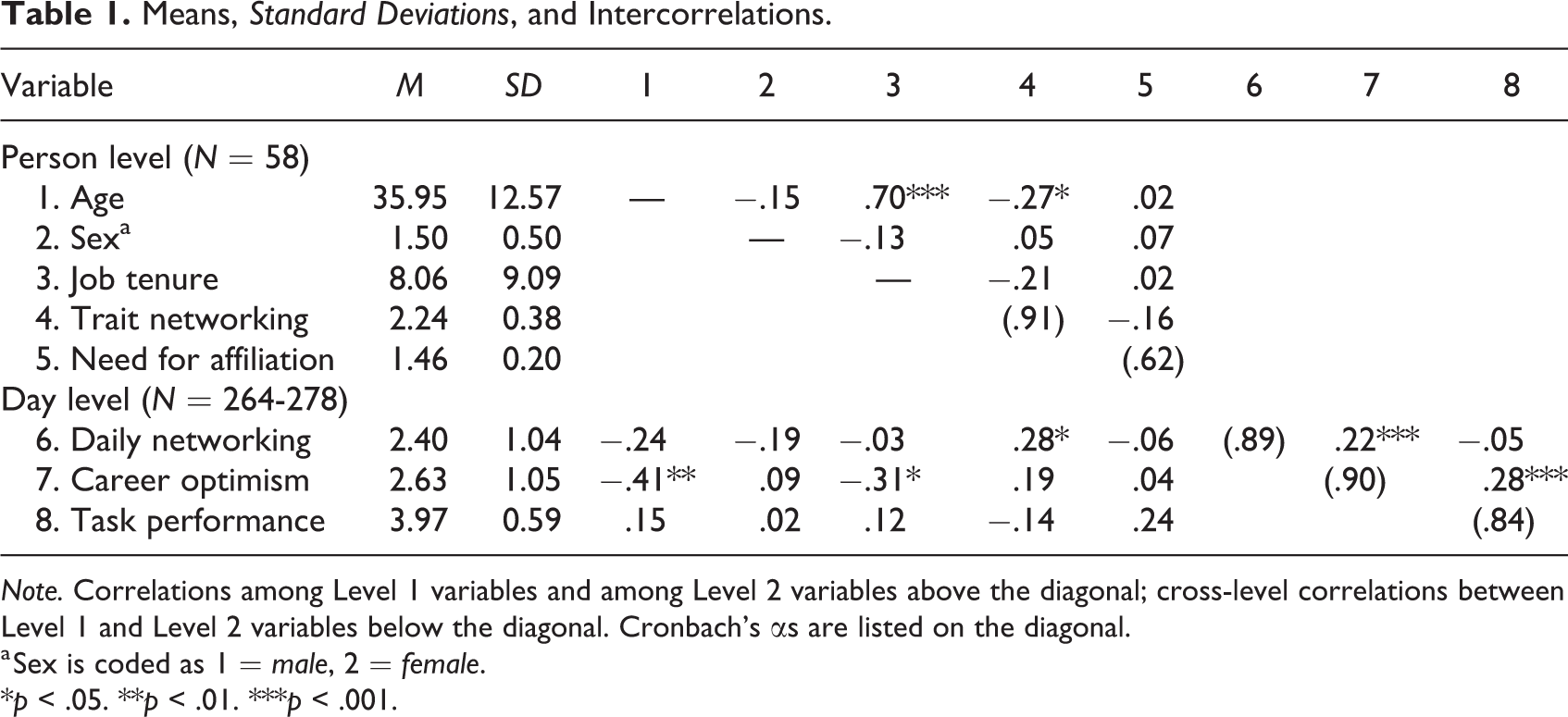
Note. Correlations among Level 1 variables and among Level 2 variables above the diagonal; cross-level correlations between Level 1 and Level 2 variables below the diagonal. Cronbach’s αs are listed on the diagonal.
a Sex is coded as 1 = male, 2 = female.
*p < .05. **p < .01. ***p < .001.
Hypotheses Testing
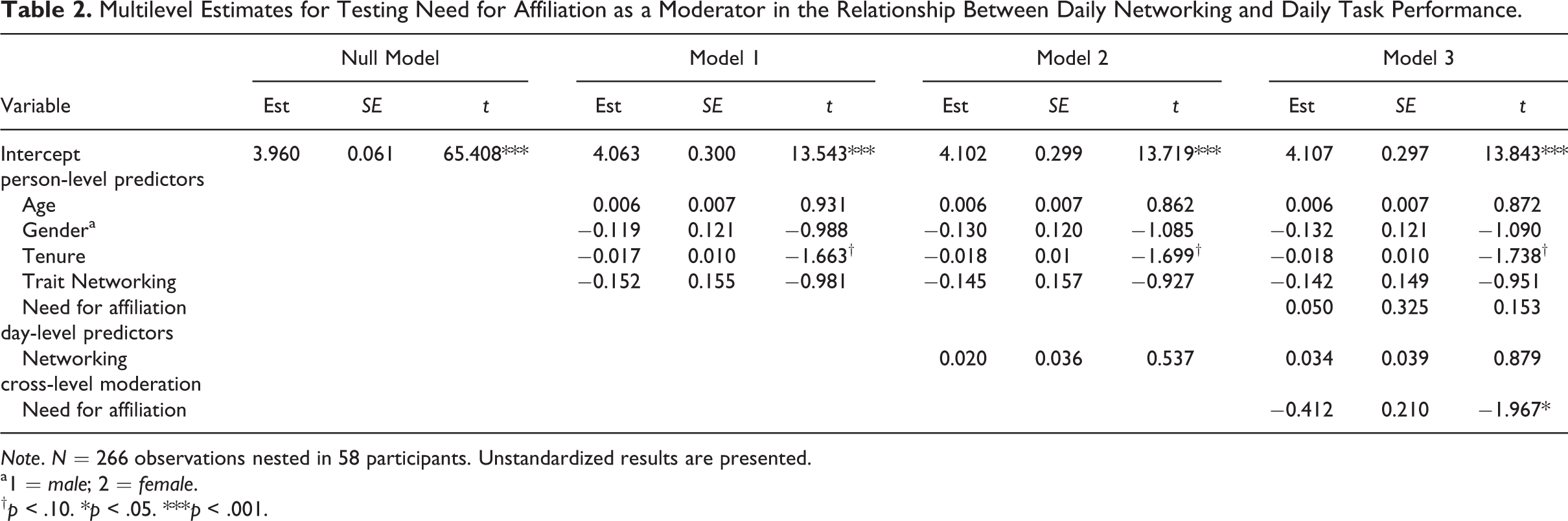
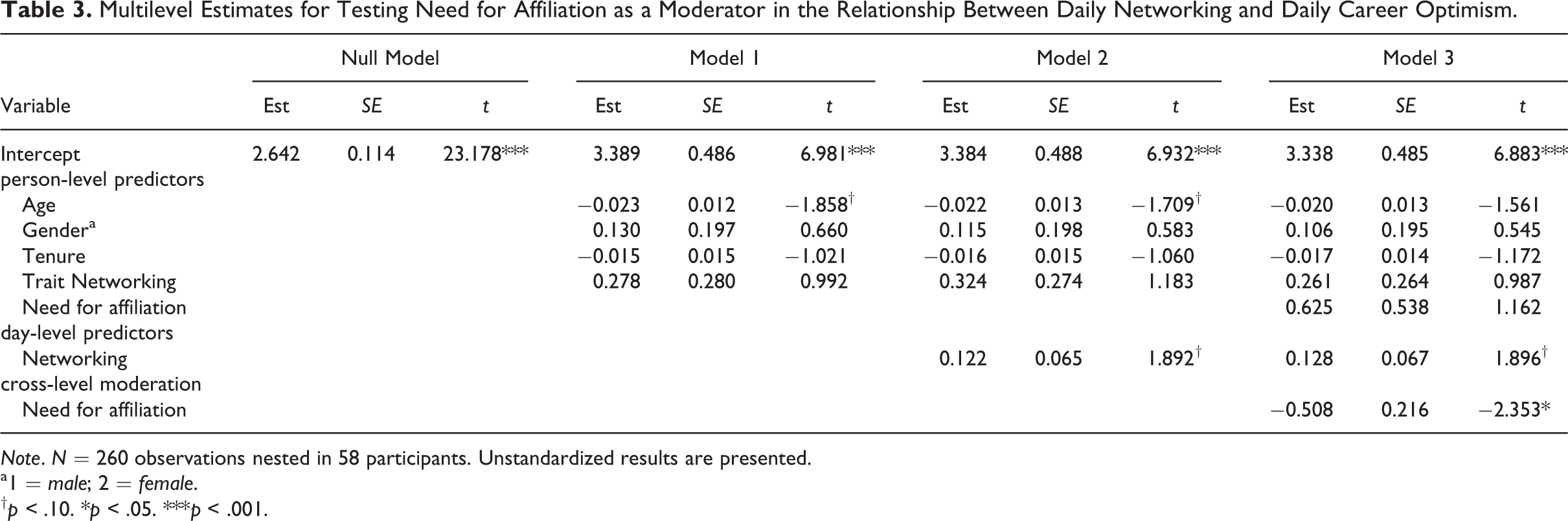
To test our hypotheses, we conducted several multilevel analyses. In our first step, we started with a null model in which the intercept was the only predictor. In a second step, we included control variables at the person level (i.e., networking as trait, gender, age, and job tenure as predictors; Model 1). Then, to test our Hypotheses 1a and 1b, we included daily networking as a day-level predictor (Model 2). Finally, to test the cross-level effect, we applied a random slope model with need for affiliation as a person-level moderator (Model 3). In all four models, the two dependent variables (i.e., career optimism and task performance) were considered simultaneously. All results are shown in Table 2 (task performance) and Table 3 (career optimism).
Multilevel Estimates for Testing Need for Affiliation as a Moderator in the Relationship Between Daily Networking and Daily Task Performance.
Note. N = 266 observations nested in 58 participants. Unstandardized results are presented.
a1 = male; 2 = female.
†p < .10. *p < .05. ***p < .001.
Multilevel Estimates for Testing Need for Affiliation as a Moderator in the Relationship Between Daily Networking and Daily Career Optimism.
Note. N = 260 observations nested in 58 participants. Unstandardized results are presented.
a1 = male; 2 = female.
†p < .10. *p < .05. ***p < .001.
In Hypothesis 1, we predicted that daily networking would be positively related to task performance (1a) and career optimism (1b). Analyses indicated that day-level networking was not significantly linked to task performance (γ = 0.02, SE = 0.04, t = 0.54, p = .591). The link between daily networking and career optimism tended to be positive (γ = 0.12, SE = 0.07, t = 1.89, p = .058). Taken together, only Hypothesis 1b was (at least tentatively) supported.
Hypothesis 2 predicted respectively cross-level moderation between within-person relationships of daily networking and task performance (2a), and career optimism (2b). To test Hypothesis 2, we entered need for affiliation as a cross-level moderator in our analyses. The results indicated that need for affiliation moderated the relationship between daily networking and task performance (γ = −0.41, SE = 0.21, t = −1.97, p = .049) as well as between daily networking and career optimism (γ = −0.51, SE = 0.22, t = −2.35, p = .019). Figures 1 and 2 illustrate the moderation effects: Employees with high need for affiliation (sample average + 1 SD) benefited especially from daily networking. Employees with low need for affiliation (sample average − 1 SD) showed no change in career optimism due to daily networking and even tended to report less task performance after days with high networking scores. As we hypothesized stronger effects for employees with high need for affiliation but positive effects for all employees, Hypotheses 2a and 2b could be only partially supported.
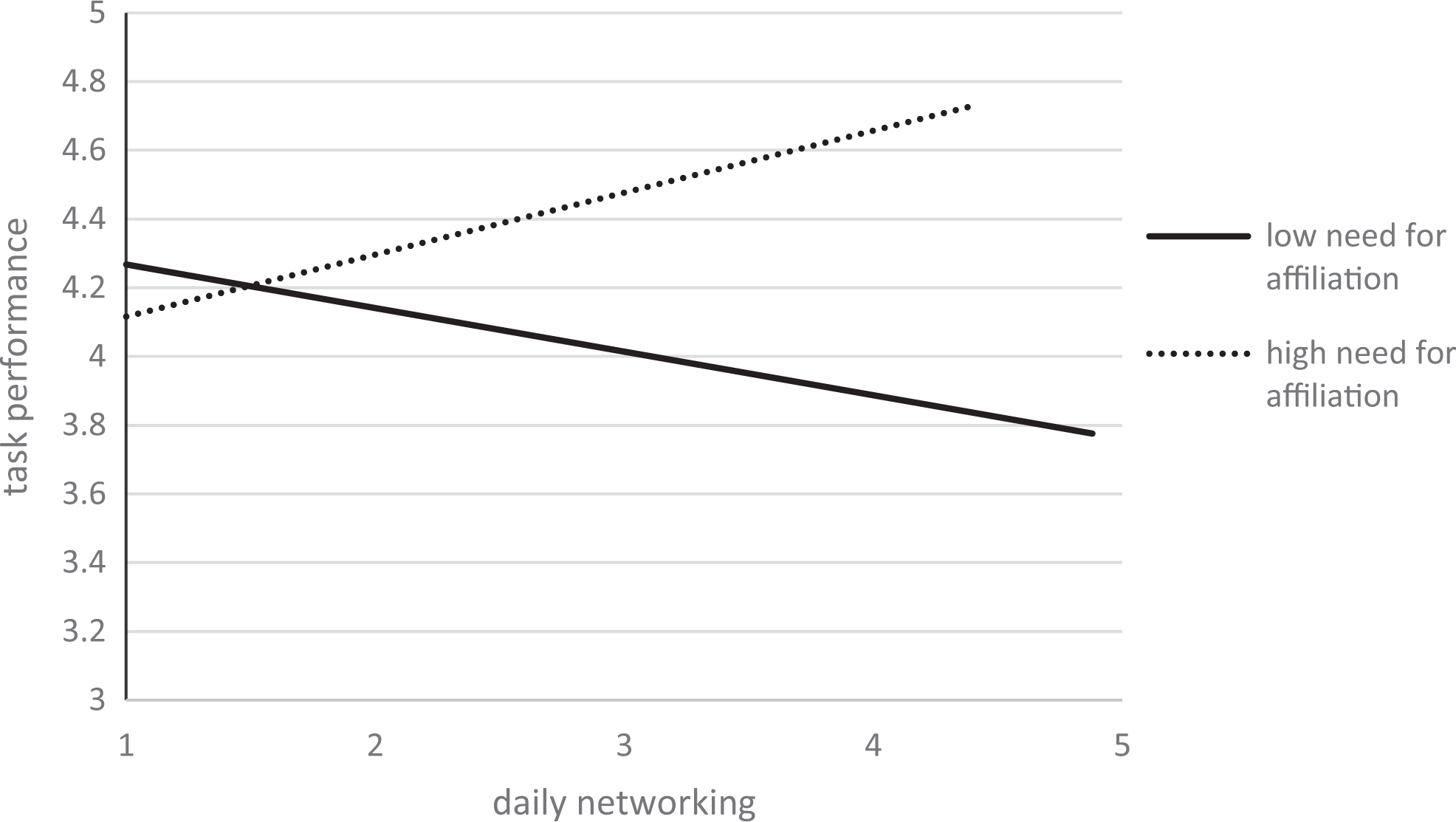
Need for affiliation as moderator of the relationship between networking and task performance on a daily level.
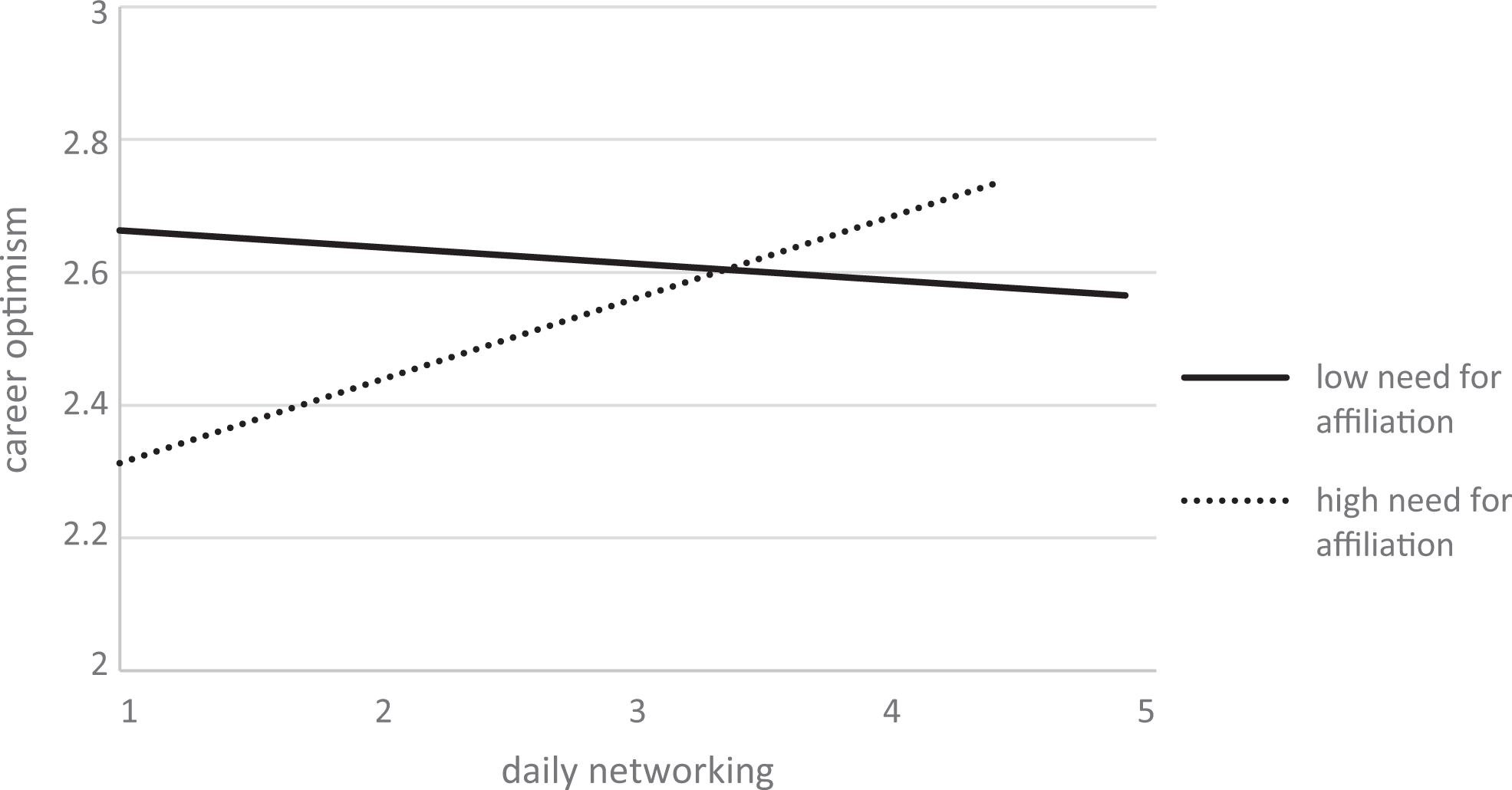
Need for affiliation as moderator of the relationship between networking and career optimism on a daily level.
Discussion
The first aim of our study was to contribute to the limited number of studies on within-person effects of networking (Baumeler et al., 2018; Volmer & Wolff, 2018). We assumed that day-level networking would be related to day-level career-related outcomes (i.e., task performance and career optimism). Our second aim was to integrate motivational research with career research. Thus, we investigated whether need for affiliation as a dispositional motive would moderate the daily networking-career-related outcomes associations.
Our findings showed that daily networking was marginally positively related to daily career optimism, but not to daily task performance. The first finding replicates (at least tentatively) earlier findings (Volmer & Wolff, 2018). The present sample includes various occupations, whereas the sample of Volmer and Wolff (2018) included exclusively academics, which may explain the only tentative confirmation of a positive daily networking–career optimism relationship. The nonsignificant finding between networking and daily task performance can be attributed to the fact that networking is also resource consuming, with detrimental effects on immediate task performance. This explanation corresponds to those reported in studies focusing on a single networking incident (Casciaro, Gino, & Kouchaki, 2014; Wingender & Wolff, 2019) and reporting the negative consequences of networking.
As discussed in earlier research (e.g., Forret & Dougherty, 2004; Kuwabara, Hildebrandt, & Zou, 2016), the effectiveness of networking may also be influenced by factors inherent in the individuals themselves. Our results revealed that need for affiliation moderated the relationship between networking and task performance. Accordingly, individuals with a high need for affiliation can use the strong ties they build when networking as a resource to improve their task performance. Surprisingly, for employees with low need for affiliation, our results revealed not only weaker but even negative effects of networking on task performance. This moderation effect may explain why networking and task performance were not significantly related when excluding possible moderators. This underlines our previous theorizing that networking not only provides but also consumes valuable resources such as time and energy (Heslin & Turban, 2016; Porter & Woo, 2015). People low in affiliation motives generally show less appreciation for interpersonal interactions and are thus less likely to experience networking as a meaningful activity. Blustein’s (2011) relational theory of working questions the view of agentic individuals in career research who are able to make self-determined choices in their working lives. Instead, Blustein (2011) argues for the importance of interaction with others and conceptualizes working as a foremost relational act. In this vein, the task performance of individuals with a high level of individual agency might even suffer from high daily networking engagement as they feel distracted and interrupted by others. Another explanation could be that the beneficial effects of networking on task performance have another tipping point (a week or a month) and could not be observed within the time frame of our diary study.
Finally, need for affiliation also moderated the relationship between networking and career optimism. As expected, employees with high need for affiliation benefited from networking. Interestingly, career optimism seemed to be independent of the daily network experiences of employees with low need for affiliation. Seeing networking as an opportunity to enhance one’s career is therefore crucially dependent on one’s attitude to social interactions.
Our within-person study on implicit motives (i.e., need for affiliation) extends the existing between-person research on implicit motives traits (Wolff et al., 2018) that identified the need for achievement (i.e., the striving to do things better) as the key predictor for networking in general. Yet in terms of consequences of daily networking, we find that people with a high level of daily networking together with a high affiliation motive benefit most with respect to immediate career outcomes.
Practical Implications
Essentially, our results imply that daily networking may be something of a double-edged sword. Individuals with high need for affiliation appear to benefit with regard to task performance and career optimism, while those with low need for affiliation experience either no or even detrimental effects. Accordingly, building on the findings from the present study networking should be recommended, but with restrictions: People with low need for affiliation—who generally show less inclination and appreciation for social involvement—should not force themselves to engage in networking activities. Instead, valuable career- or job-related information could be obtained from alternative sources. Certain job characteristics can promote an individual’s centrality in the network without the individual having to actively engage in networking—for example, holding a position which requires the dissemination of information within the organization (e.g., personnel officer). This not only increases access to valuable information but also the individual’s visibility and indispensability within the network—without the person having to actively engage in networking activities. This does not have to be a stable characteristic of one’s formal position but can be acquired by volunteering for certain tasks or being a member of a particular group (especially one whose other members are well connected). For career counseling, knowledge of individuals’ motives and how they interact with individuals’ networking might help to tailor customized training and provide individual advice. Knowing that not all individuals have the same incentive structure, given their implicit motives, might induce organizations to implement additional incentives and to communicate rules or standards for relationship arrangements in organizations. For example, organizations can set goals for the number of monthly networking activities.
Limitations and Future Research
Some limitations should be conceded. First, building on earlier research (Volmer & Wolff, 2018), we measured daily networking solely with 8 items. However, networking can be understood as a complex construct, indicating that also on a daily basis the assessment of the complete scale might have led to a more differentiated understanding of networking and its effects on different outcomes. Second, as our study included mainly office workers from Germany, future research should consider the sample characteristics (e.g., academics, entrepreneurs vs. office workers) and further individual characteristics (e.g., hyposensitivity to social inclusion; Vanhalst et al., 2015) as an explanation for differences between our study findings and the few earlier studies on the within-person effects of networking (Baumeler et al., 2018; Volmer & Wolff, 2018). Third, our self-reported data may be prone to common method bias (e.g., Podsakoff, MacKenzie, Lee, & Podsakoff, 2003). However, self-report measures are an appropriate way to investigate the subjective career success indicators that we measured in our study. For implicit motives, we need to rely on participants’ self-ratings. However, future studies should consider including other-rated task performance ratings, for example, from colleagues or supervisors. Fourth, we focused on the affiliation motive as we regarded the social component to be central for networking outcomes. However, we recommend the inclusion of the “Big Three” (Schultheiss & Brunstein, 2001, p. 72) when examining the role of motives for networking outcomes. Moreover, as our focus was on implicit motives representing unconscious associate networks (Kehr, 2004a), a comparison with consciously accessible explicit motives would be informative. Finally, future research should include personality traits (McCrae & Costa, 1997) when examining the role of personal variables in networking outcomes.
Conclusion
The present study integrates research on implicit motives with career research and sheds light on the question of whether all people benefit from networking. The findings show that particularly those employees with a high affiliation motive associated with a high appreciation for social involvement benefited from daily networking with respect to task performance and career optimism. Integrating motivational research with career research seems to be a promising research avenue and we hope that our research will stimulate future research in this direction.
Footnotes
Declaration of Conflicting Interests
The author(s) declared no potential conflicts of interest with respect to the research, authorship, and/or publication of this article.
Funding
The author(s) received no financial support for the research, authorship, and/or publication of this article.
