




Abstract
The literature on part-time employment suggests that this type of employment hampers career advancement especially for women. Conversely, role congruity theory suggests that part-time employment hampers career advancement for men. In view of the often confounded nature of gender and job status in research, we studied the main and interaction effects of job status and gender on perceived job alternatives and four subdimensions of organizational career growth. The data (N = 211) revealed (1) a main effect of job status on job alternatives: compared to part-time employment, full-time employment leads to more perceived job alternatives; (2) an interaction effect of job status and gender on career goal progress, ability development, and promotion speed: men working part-time experienced less progress, development, and promotion speed than men working full-time and women in general. These results are explained by gender-role incongruence and challenge the idea that part-time work affects women in particular.
Gender inequality in the workplace is a highly topical issue (Global Gender Gap Report, 2016). To increase equality in terms of career opportunities and advancement, more flexible work arrangements have been introduced, such as part-time work. This type of work is now common in a great number of countries, although women use this form of flexible work arrangement more often than men. That being said, part-time work also seems to have its drawbacks in terms of career growth: People who work part-time seem to receive fewer opportunities to grow in their current and future jobs. However, in research supporting this notion, the effects of part-time work and gender are often confounded, as only women are studied. Conversely, role congruity theory suggests that it is not women, but men who would suffer in terms of career growth when working part-time. In the current study, we investigated the independent and interactive effects of job status (working part-time vs. full-time) and gender on people’s organizational career growth; the extent to which an employee perceives and values the career development opportunities that are available within his or her current organization (Weng & McElroy, 2012).
Practical and Theoretical Relevance
In the past few decades, the labor force participation of women in many industrialized countries has increased tremendously. Still, compared to men, women tend to hold mainly part-time positions (cf. Higgins, Duxbury, & Johnson, 2000; Kaiser, 2007; Schreiber, 1998). Part-time positions are positions in which people work a reduced number of hours, compared to working the maximum number of contractually possible hours (cf. Barnett & Hall, 2001). In the Netherlands, as much as 43% of the working population works part-time (which is the highest percentage in the world), with other countries following at a distance (e.g., Austria 29%, Iceland and Switzerland 28%, and the United States 27%: OECD.org; statista.com). Most part-time jobs are occupied by women. In the Netherlands, for example, close to 66% of women work part-time (Eurostat, 2016). Dutch women work part-time in order to combine career and care and because a dual-income model is not necessary to enjoy a comfortable life (Portegijs & Keuzenkamp, 2008).
Part-time jobs are seen as a panacea aimed at combating gender inequality (cf. Blazquez Cuesta & Moral Carcedo, 2014). Deciding to work part-time has benefits for parents with children: They can maintain career momentum and a professional identity, they can continue to develop relevant skills and professional expertise, it eases a transition back to full-time employment in due course, it builds economic security, and it is a way to balance work and caregiving responsibilities (Kropf, 1998). The majority of part-time workers do so in order to be able to combine work and childcare responsibilities (Blazquez Cuesta & Moral Carcedo, 2014; Higgins et al., 2000). Of course, workers can have other reasons for working part-time (e.g., are not willing to work full-time or need the income; Higgins et al., 2000). So this study will focus on the question whether job status, part-time working, and gender influence organizational career growth.
Organizational Career Growth
Recent research carried out by Weng and McElroy (2012) introduced a shift of focus from career growth seen in terms of an individual’s lifelong career (Ng, Eby, Sorenson, & Feldman, 2005; Seibert, Kraimer, & Liden, 2001) to what has become known as organizational career growth. Organizational career growth reflects both a worker’s perceptions and the organization’s efforts in advancing an individual’s career (McElroy & Weng, 2016). The concept of organizational career growth within a particular context is crucial and ideal for answering our research questions, because workers do not necessarily retain their job status across organizations.
Based on Weng and Hu (2009) who proposed that employee career growth could be captured by four factors, in this study, organizational career growth is approached from a multidimensional perspective. This perspective combines the dimension of an individual employee’s career efforts and the dimension of willingness on the part of the organization to reward the employee for these efforts. The term “efforts” refers to career achievements, the acquisition of new knowledge and experience, and the development of new skills. “Willingness” on the part of the organization refers to employee rewards, for instance, in terms of promotion and pay rises. Organizational career growth is described in four subdimensions: (1) career goal progress, describing the fit of the job with a worker’s career goals; (2) professional ability development, describing the extent to which the job enables professional development; (3) promotion speed, describing the probability and speed of promotion within the organization; and (4) remuneration growth, describing the relative speed at which a worker’s salary increases (Weng, McElroy, Morrow, & Liu, 2010).
Part-Time Working
It is unclear what the impact of a part-time job status is on organizational career growth. Many researchers have argued that part-time work limits workers’ advancement opportunities (Barnett & Hall, 2001; Higgins et al., 2000; Hill, Martinson, & Ferris, 2004; Thorsteinson, 2003). Often, part-time workers are seen by others as less committed (Kropf, 1998) and less deserving of career advancement (cf. McDonald, Bradley, & Brown, 2009), but we cannot yet formulate firm conclusions about whether they actually are less committed or less involved (for overviews, see Clinebell & Clinebell, 2007; Whittock, Edwards, McLaren, & Robinson, 2002).
Part-time workers are thought to be less visible and to have less time for development and mentoring and therefore more likely to miss out on high-profile assignments and critical responsibilities (Cohen & Single, 2001; Kropf, 1998), all of which are essential to career advancement. Evidence for such reduced career advancement or personal growth in part-time work mainly stems from in-depth interviews with women who work part-time, who report reduced advancement opportunities (cf. Higgins et al., 2000), and who believe that their job status puts their career on hold (cf. Durbin & Tomlison, 2010).
1
Considering this line of literature, one would conclude that part-time work has negative effects on organizational career growth. This leads to:
Role Congruity Theory
What is important to note about the previously reported literature is that the factors “gender” and “job status” were often confounded. Most studies investigating the effects of job status on various outcomes were assessed among women only. On the basis of these results, we cannot therefore draw any firm conclusions as to whether job status influences career growth in general or whether there is something specific about women who choose to work part-time.
A more theoretical perspective on the issue of part-time and full-time employment is offered by role congruity theory (Eagly & Karau, 2002). This theory extends Eagly’s social role theory of sex differences and similarities into new territory (Eagly, Wood, & Diekman, 2000). It explains that gender-role congruent behavior is more favorably evaluated than gender-role incongruent behavior. And just as individuals have expectations about how women and men should behave in general (i.e., about their social roles), they also have expectations about how women and men should behave in a particular work setting. These expectations are thought to be based on gender stereotypes that “stem from the traditional roles that men and women have historically occupied” (Rudman & Phelan, 2010, p. 192). Men are often still perceived as the breadwinner and women as the homemaker (Sheridan, 2004). As such, a key proposition of social role theory is that the majority of beliefs about the sexes pertain to communal and agentic attributes; women are perceived as communal but not very agentic, whereas men are perceived as agentic but not very communal (Eagly & Karau, 2002). On the basis of role congruity theory, it can be proposed that the larger the congruence is found to be between how agentic a work role is defined and to what extent a gender fulfills its agentic requirements, the more likely it becomes that such combinations elicit favorable evaluations.
Part-time jobs seem to possess more communal attributes, as they were initially created to combine home and work life (Portegijs & Keuzenkamp, 2008; Sheridan, 2004). Women occupying a part-time job will not raise eyebrows; there is congruence between the attributes of the work role and the person occupying the role. If women work, they are expected to work part-time (Eagly & Steffen, 1986). In contrast, men occupying a part-time job will raise eyebrows, because their communal work role is incongruent with their perceived agentic attributes and role as breadwinner. Men working part-time are perceived as less agentic (Eagly & Steffen, 1986; Vandello, Hettinger, Bosson, & Siddiqi, 2013), and this could influence how their environment responds to them, which in turn could influence the opportunities they receive for career growth. In fact, studies conducted in a time when part-time work was still quite a new concept revealed that part-time work for men was considered unacceptable (Herzog, Bachman, & Johnston, 1983), and men in high school only expected to ever work part-time while studying (Tittle, 1982).
If we continue this line of thought, it could also be argued that full-time jobs are seen as more agentic (i.e., they are associated with leadership and responsibility; McDonald et al., 2009) and thus that women working full-time might be perceived as incongruent with expectations. However, full-time working women are perceived to be just as agentic as their male counterparts (Bosak, Sczesny, & Eagly, 2008; Eagly & Steffen, 1986). Therefore, we do not expect incongruity between men and women working full-time (unless one specifically investigates workers in leadership roles; see Eagly & Karau, 2002, for an overview). Additionally, incongruity is expected more for part-time working men than full-time working women because those men clearly deviate from the descriptive norm (fewer men work part-time than women work full-time; Gutek & Morasch, 1982).
Three studies already investigated the effects of job status or gender, or a combination of these factors, on career advancement. First, a study on the effect of ambition on job level and career satisfaction, the number of work hours, and the use of work–home arrangements was found to be predictive of how satisfied employees were with their career; neither gender nor the interaction between gender and work hours predicted this outcome (Dikkers, van Engen, & Vinkenburg, 2010). Second, a study on organizational career growth in a sample of Chinese workers found an association between gender and remuneration growth (Weng et al., 2010). Third, interviews held among British nurses revealed that female part-time nurses were less satisfied with their opportunities for promotion than male part-time nurses (Whittock et al., 2002).
In view of previous findings, we could thus expect an interaction effect between job status and gender. This is why we set out to study whether there are indeed quantifiable differences in the career advancement of part-time and full-time employees and especially if there are differences between men and women. This leads to:
Thus, we expect the relationship between job status and career development in general (encompassing both job alternatives and organizational career growth; McElroy & Weng, 2016) to be moderated by gender, but it is unclear which direction that interactive effect will have. Based on the literature on women working part-time (Durbin & Tomlison, 2010; Higgins et al., 2000), one would expect that part-time work negatively impacts career development, especially so for women. Based on role congruity theory (Eagly & Karau, 2002), one would expect that part-time work negatively impacts career development, especially so for men. In the current study, we test these hypotheses and test the competing hypotheses in the literature on the direction of the interaction effect between job status and gender.
Method
Sample
To obtain a diverse sample of part-time and full-time workers across different sectors, but especially across companies, we used nonrandom accidental sampling. For our data collection, we approached executive students enrolled at Nyenrode Business University and colleagues from the banking sector. Participants were approached via e-mail, Facebook, and Localweb or contacted in person, and they were invited to fill in an online questionnaire. Completing the questionnaire took about 15 min.
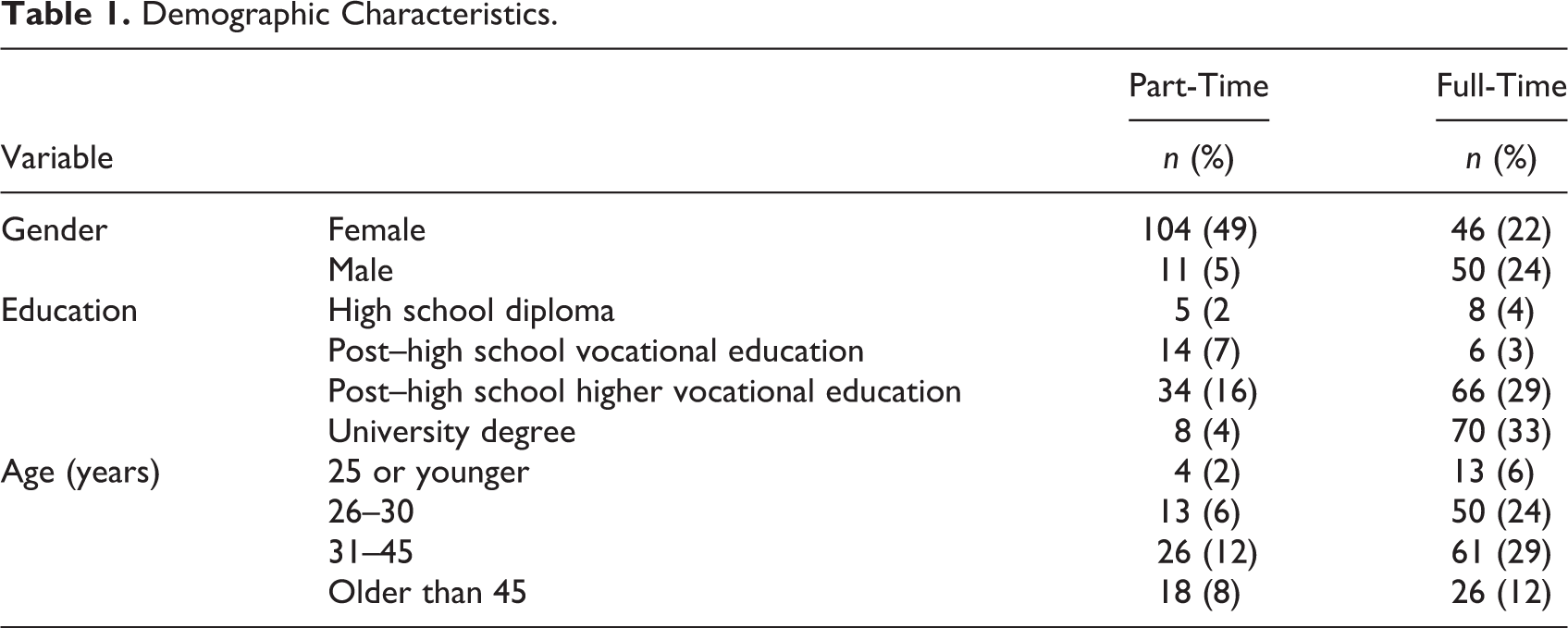
A total of 906 surveys were distributed to working individuals across the Netherlands. After removing subjects with missing data and checking unengaged responses, we retained a sample set of 211 questionnaires (54.5% male, Mage = 36.51, SD = 10.71), out of 291 questionnaires received (23% response rate). Participants worked in a variety of sectors, including business and personal service sectors (51%), industry (8%), retail and wholesale businesses (8%), and care (7%). Sample characteristics are shown in Table 1.
Demographic Characteristics.
Procedure
Podsakoff, MacKenzie, Lee, and Podsakoff (2003) offer numerous suggestions to reduce the risk of common method bias, a potential risk in the current study. To minimize this bias, the following procedures were applied in our investigation (cf. Lindell & Whitney, 2001; Kline, Sulsky, & Rever-Morriyama, 2000, p. 418): (1) The criterion variable consisted of a variety of subcriteria or items because the personal definition of the criterion variable could play an important role. Offering varied opinion options ensured the desired inclusion of wider perspectives and thus a wider scope of the investigation. (2) Anonymity was guaranteed, and instructions explicitly stated that answers would not be interpreted as “correct” or “incorrect.” (3) Items running the risk of mutual “contamination” were grouped on the basis of a comparison of shared characteristics in such a way that individual items were specifically introduced; whenever required, differences with previous sets of items were explained clearly. (4) The criterion and predictor variables were explicitly included in different sections, and the items were explicitly grouped for every scale. In this way, we aimed to reduce respondents’ consistency bias as much as possible.
Measures
Predictors
In the Netherlands, part-time work is classified as working 35 hr or less (Dutch Central Bureau for Statistics, 2016). Other countries use similar rules, but sometimes classification is slightly different; for example, part-time work can be considered to be less than 35 hr, as is the case in the United States, Iceland, and Norway (bls.gov; OECD.org). In the survey questionnaire, participants reported their number of contractual hours per week. Everyone who reported working 36 or more hours per week was coded as working full-time (1); all other responses were coded as working part-time (0; Dikkers et al., 2010). Participants also reported whether they were male (0) or female (1).
Dependent variables
In the questionnaire, we measured the variables of interest in the order presented below. 2 All items in the questionnaire were answered on a 7-point Likert-type scale (1 = completely disagree, 7 = completely agree), unless otherwise indicated. The measurement instruments were examined by exploratory factor analysis (EFA; principal axis factoring). The criteria used were Kaiser–Meyer–Olkin > .5, total variance explained > 50%, Cronbach’s α > .7, and item total correlation > .3 (based on Costello & Osborne, 2005).
Perceived job alternatives
We measured perceived job alternatives with 3 items: (1) “If I want to, I can easily get another job,” (2) “There are enough other jobs on the market that I could fulfill,” and (3) “If I quit, it will be difficult for me to find another job” (reverse coded). These items were loosely based on items used to assess “perceived opportunities” (e.g., Weng et al., 2010). The scale proved reliable (Cronbach’s α = .88; all α’s presented were calculated for this particular sample).
Career growth
Participants completed the scales designed by Weng, McElroy, Morrow, and Liu (2010) to measure the four dimensions of career growth. Career goal progress was measured with 4 items (e.g., “my present job moves me closer to my career goals”; Cronbach’s α = .92), professional ability development was measured with 4 items (e.g., “my present job encourages me to continuously gain new and job-related skills”; Cronbach’s α = .95), promotion speed was measured with 4 items (e.g., “my promotion speed in the present organization is fast”; Cronbach’s α = .76), and remuneration growth was measured with 3 items (e.g., “my salary is growing quickly in my present organization”; Cronbach’s α = .90).
Control variables
We also collected data on the participants’ gender, age, education level, organizational tenure, the number of hours actually worked per week, their level in the organization, and the current level in their aspired career. The current level in the organization and the current level in their aspired career were assessed with the following questions: “If you split up your organization into seven levels, in which 7 represents the highest level within the organization and 1 the lowest level, how would you qualify the organizational level of your position?/how would you qualify your current position?” (7 = highest level, 4 = intermediate level, 1 = lowest level; van der Meij, Schaveling, & van Vugt, 2016).
Because, as was found in the literature review, evidence for differences in commitment to work between part-time and full-time employees is mixed, we included a measure of commitment as a control variable. Work commitment was measured with 4 items (e.g., “How committed are you to your work?”; Klein, Cooper, Molloy, & Swanson, 2014).
Data Analyses
We investigated the effects of job status, gender, and their interaction on perceived job alternatives and career growth in five separate regression analyses in which we included the control variables in the first step and the main effects of job status (0 = part-time, 1 = full-time) 3 and gender (0 = male, 1 = female) in the second step. This allowed us to investigate whether there are main effects of job status and gender on perceived job alternatives and career growth above and beyond differences in those outcomes caused by differences in age, education, and commitment to work. In a third and final step, we introduced the interaction term between job status and gender, which allowed us to test whether there were differences in how men and women perceived their career advancement in the two job status types. In case of a significant effect, we performed simple slope analyses.
Results
Correlations
Table 2 reports all means, standard deviations of the variable, and correlations between the variables. All outcome variables related to career growth were positively and significantly related to one another, rs(211) = >.29 <.69, all ps < .001. They were also all positively related to perceived job alternatives, rs(211) = >.15 <.40, all ps < .05.
Means, Standard Deviations, and Correlations Among Study Variables.
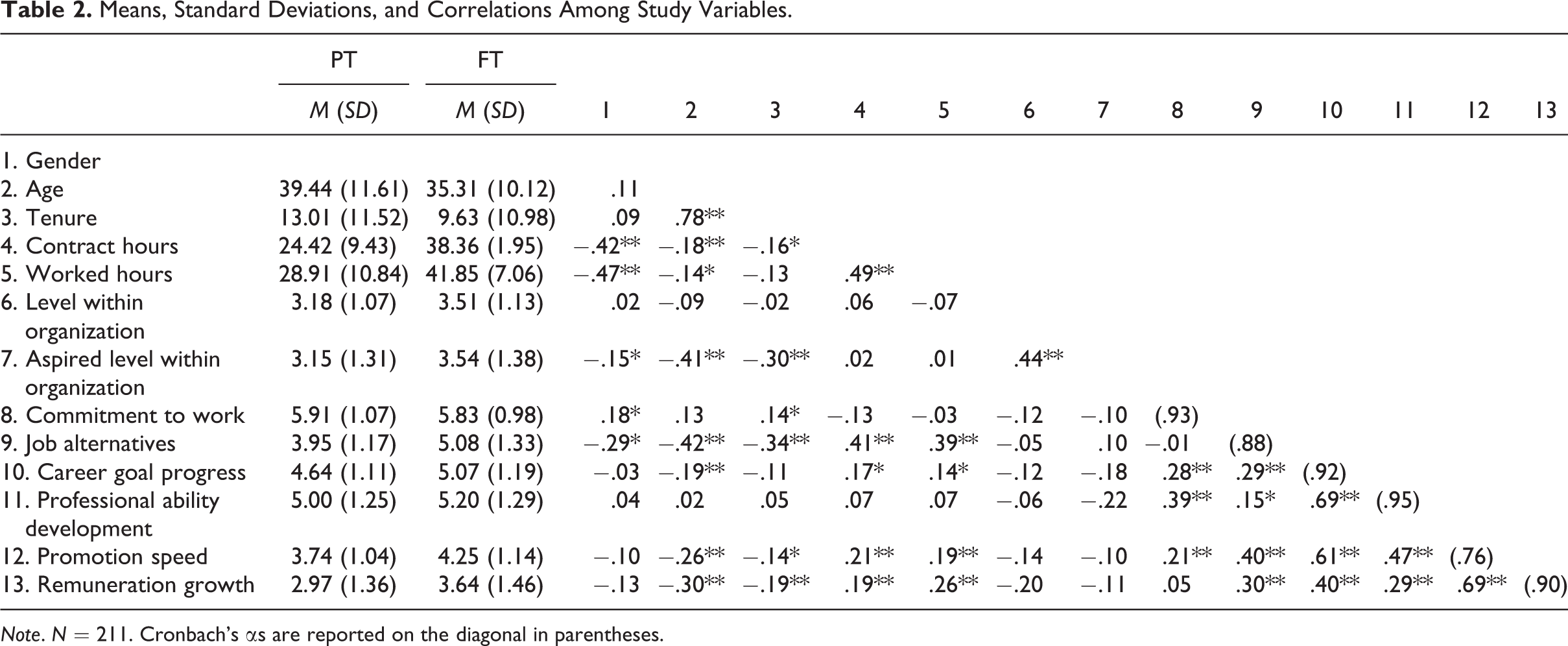
Note. N = 211. Cronbach’s αs are reported on the diagonal in parentheses.
Regarding the control variables, age was found to be negatively related to most of the outcome variables and so was tenure. Tenure and age were highly correlated, r(210) = .78, p < .001, indicating strong multicollinearity. One possibility of dealing with multicollinearity is performing an exploratory factor analysis (EFA), but with respect to the character of the variables this is impossible. A second possibility is choosing between the two variables. We decided to include age, not tenure, as a control variable in the regression analyses.
Work commitment was found to be positively related to career goal progress, r(210) = .28, p < .001; professional ability development, r(210) = .39, p < .001; and promotion speed, r(210) = .21, p = .002, and thus included as a control variable in the remaining analyses. Because the level of education was not evenly distributed across participants working part-time and those working full-time (as can be seen in Table 1), we decided to also include education as a control variable.
Perceived Job Alternatives
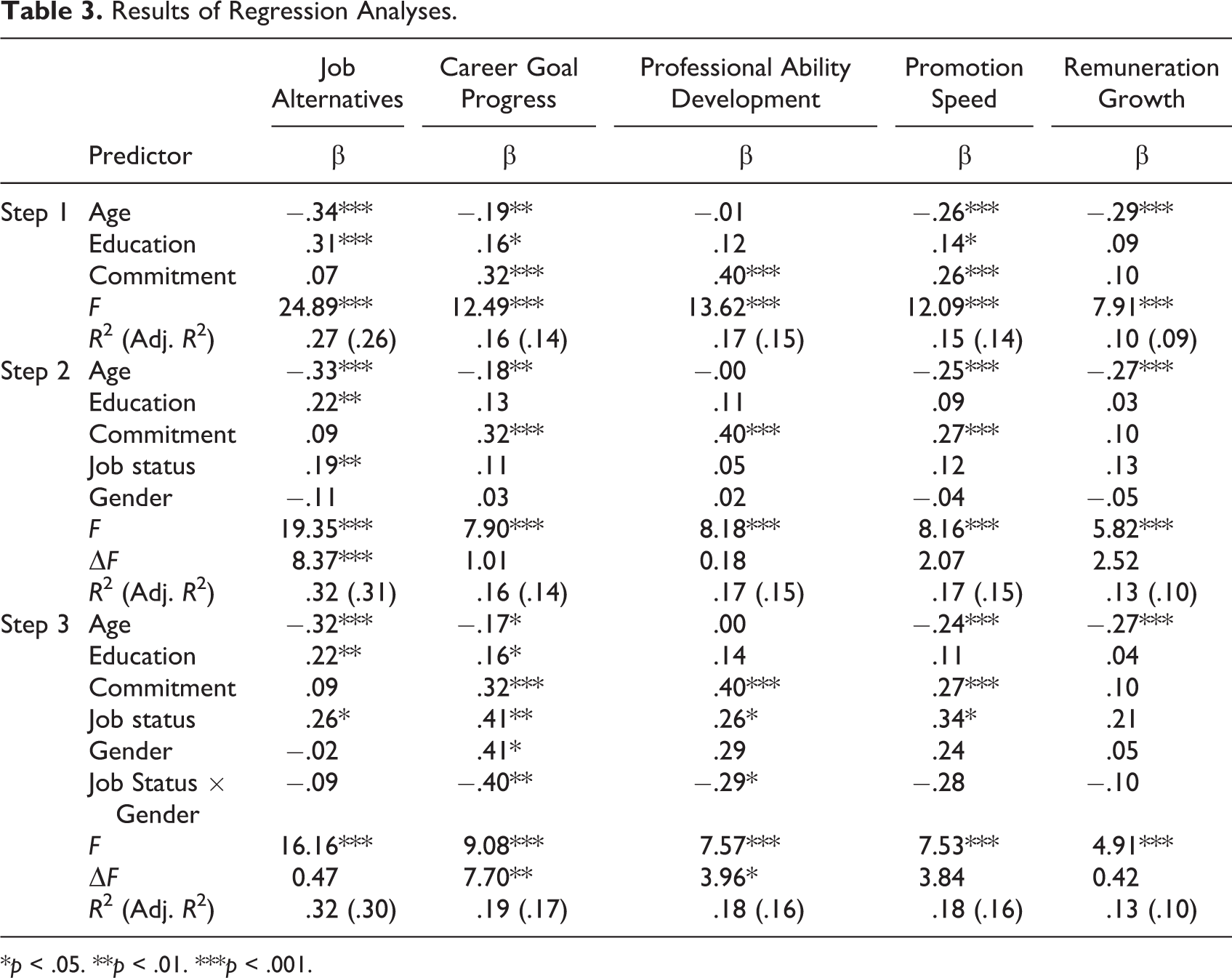
The control variables had a significant effect on perceived job alternatives (R2 = 27; F = 24.89, p < .001); this was caused by the effects of age (β = −.34, p < .001) and education (β = .31, p < .001). In Step 2, we found that entering the main effects of job status and gender significantly added to the model (R2 = .32; ΔF = 8.37, p < .001). This was caused by job status (β = .19, p < .01), not by adding gender to the model (β = −.11, p = .108). Adding the interaction term did not add to the model (R2 = .32; ΔF = 0.47, p = .494; see Table 3).
Results of Regression Analyses.
*p < .05. **p < .01. ***p < .001.
Career Goal Progress
The control variables had a significant effect on career goal progress (R2 = 16; F = 12.49, p < .001); this was caused in part by the effects of age (β = −.19, p < .01) and education (β = .16, p < .05), but mainly by work commitment (β = .32, p < .001). Entering the main effects of job status and gender in Step 2 did not add to the model (R2 = .16; ΔF = 1.01, p = .364). Adding the interaction term in Step 3 did add significantly to the model (R2 = .19; ΔF = 7.70, p < .01). The interaction effect had a significant effect on career goal progress (β = −.40, p < .01), and in this step, compared to Step 2, the main effects of both job status (β = .41, p < .001) and gender (β = .41, p < .01) also became significant (see Table 3). Simple slope analyses (cf. Schubert & Jacoby, 2004) revealed that women working part-time and women working full-time did not differ in their reports of career goal progress (simple slope, β = .08, p = .363). Men working part-time reported less career goal progress than men working full-time (simple slope, β = .45, p = .002; see upper panel in Figure 1).
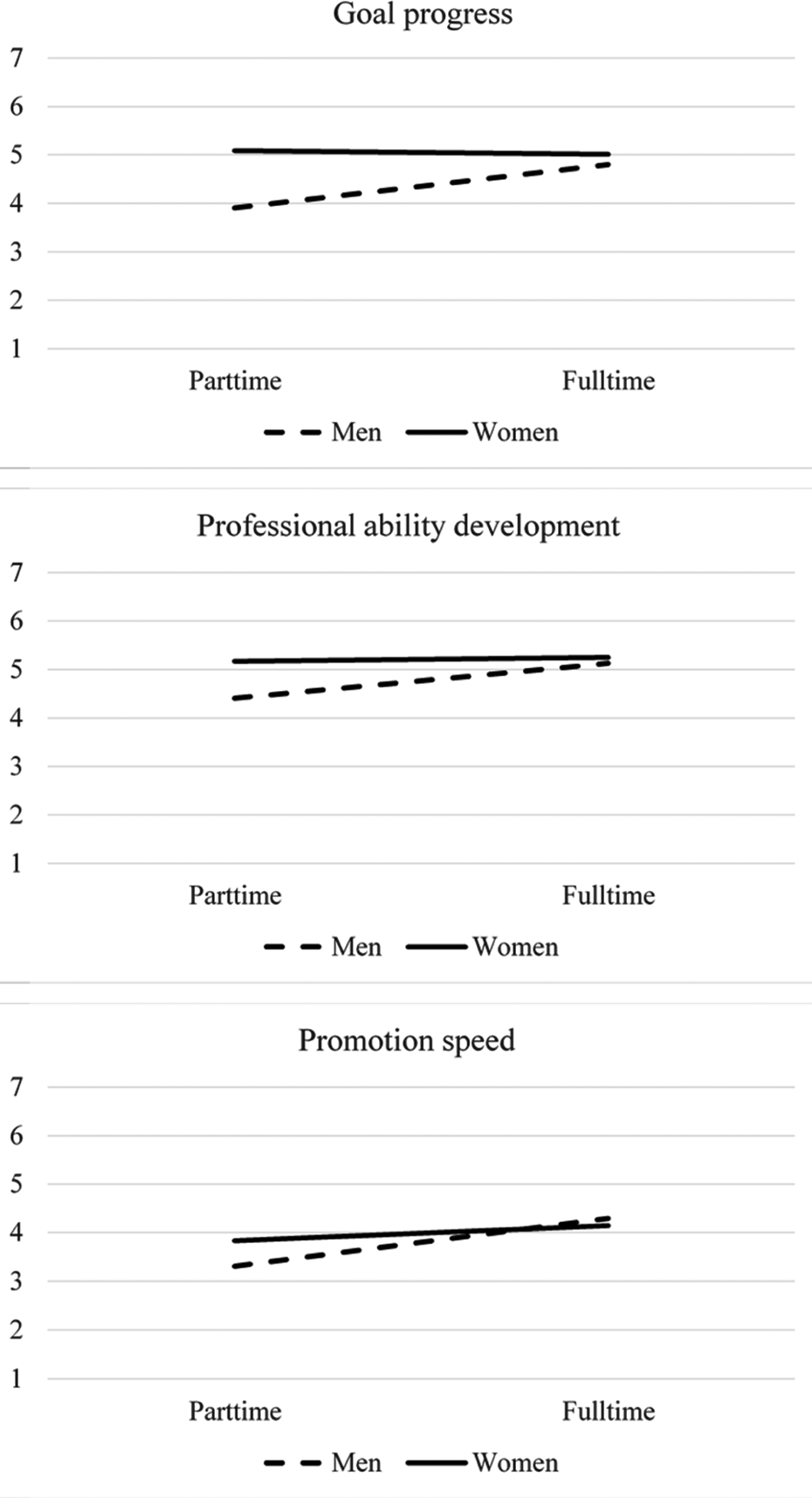
Interaction effects of job status and gender on career goal progress, professional ability development, and promotion speed.
Professional Ability Development
The control variables had a significant effect on professional ability development (R2 = 17; F = 13.62, p < .001); this was caused by the effect of work commitment (β = .40, p < .001). Entering the main effects of job status and gender in Step 2 did not add to the model (R2 = .17; ΔF = 0.18, p = .836). Adding the interaction term in Step 3 did add significantly to the model (R2 = .18; ΔF = 3.96, p = .048). The interaction effect had a significant effect on professional ability development (β = −.29, p = .048), and in this step, the main effect of job status also became significant (β = .26, p = .049; see Table 3). Simple slope analyses revealed that women working part-time and women working full-time did not differ in their reports of professional ability development (simple slope, β = .04, p = .646). Men working part-time reported slightly less professional ability development than men working full-time (simple slope, β = .27, p = .061; see middle panel in Figure 1).
Promotion Speed
The control variables had a significant effect on promotion speed (R2 = 15; F = 12.09, p < .001); this was caused in part by the effects of education (β = .14, p = .039), but mainly by age (β = −.26, p < .001) and commitment (β = .26, p < .001). In Step 2, we found that entering the main effects of job status and gender did not add to the model (R2 = .17; ΔF = 2.07, p = .129). Adding the interaction term in Step 3 had a nonsignificant effect on the model (R2 = .18; ΔF = 3.84, p = .051). In this step, the interaction effect had no effect on promotion speed (β = −.28, p = .051), and the effect of job status on promotion speed became significant (β = .34, p = .012), which suggests that those who work full-time experience a faster promotion speed than those working part-time (see Table 3).
Although the interaction effect was nonsignificant, we ran simple slope analyses to inspect the direction of the effect. The analyses revealed that women working part-time and women working full-time did not differ in their reports of promotion speed (simple slope, β = .16, p = .172). Men working part-time reported less promotion speed than men working full-time (simple slope, β = .49, p = .006; see lower panel in Figure 1).
Remuneration Growth
The control variables had a significant effect on remuneration growth in Step 1 (R2 = .10; F = 7.91, p < .001); this was caused by the effect of age (β = −.29, p < .001). In Step 2, we found that entering the main effects of job status and gender did not add to the model (R2 = .13; ΔF = 2.52, p = .083), nor did entering the interaction effect in Step 3 (R2 = .13; ΔF = 0.42, p = .516).
Discussion
We set out to test whether part-time work, compared to full-time work, hampers organizational career growth. In doing so, we wanted to make sure that the observed effects would be due to job status and not confounded by gender. Therefore, we also included gender as a predictor as well as an interaction term between job status and gender to check whether men and women experience differences in career growth depending on their job status. We controlled for work commitment, age, and education level. The data revealed a main effect of job status on perceived job alternatives, such that participants in part-time jobs perceived fewer job alternatives compared to those in full-time jobs, supporting Hypothesis 1.
We also found main effects of job status, such that part-time workers experience less career goal progress, professional ability development, and promotion speed, supporting Hypothesis 2a, 2b, and 2c. These main effects were qualified by interaction effects between job status and gender, supporting Hypothesis 4. Simple slope analyses (Figure 1) revealed that men working part-time experienced less career goal progress, less professional ability development, and less promotion speed than their full-time working counterparts. For women, there were no differences between those working part-time and those working full-time. These findings answer our research question: According to this study, there is an interaction effect of job status and gender, that is to say men working part-time experienced less career goal progress, less professional ability development, and less promotion speed than their full-time working counterparts. We did not find an effect of job status on remuneration growth, so we can conclude that no support was found for Hypothesis 2d.
The significant interaction effects between job status and gender suggest that working part-time for men has a negative effect on organizational career growth. Part-time working men experienced less career goal progress, less professional ability development, and less promotion speed than men working full-time and women working either part-time or full-time. These data are in line with predictions that can be based on role congruity theory (Eagly & Karau, 2002). This theory predicts negative effects when people occupy gender-incongruent roles. Men, seen as agentic, who take on a part-time job, which is conceptualized as more communal, act in an incongruent manner. Down the line, this can influence coworker perceptions, potentially self-fulfilling prophecies and treatment in the organization, resulting in stunted career advancement.
The data shed a different light on the assumed negative effects of part-time work on career advancement among women. In this sample at least, part-time working women, compared to women working full-time or working men in general, do not experience negative effects of their job status on their organizational career growth. This supports role congruity theory, such that men suffer from stigmatization when working-part-time, while no such consequence exists for the role-congruent women (Bosak et al., 2008; Eagly & Steffen, 1986; Vandello et al., 2013).
The reason for why our data might diverge from previous findings might be due to the fact that the present study was quantitative in nature and included both male and female employees, whereas studies revealing mainly drawbacks for women were often theoretical or qualitative in nature (e.g., semistructured interviews; Durbin & Tomlinson, 2010), focused on part-time working women solely, or only compared part-time and full-time female employees (e.g., Higgins et al., 2000). It is also important to note that these data are self-reported and that perceptions of organizational career growth might not align with actual career advancement.
The good news is that men may be able to reverse the negative effects part-time work may have on their perceived career growth. Recent research has revealed that only men, not women, can get away with gender-role incongruent behavior if they do so in a clever way, by actively addressing their gender-role incongruity (Meijs, Lammers, & Ratliff, 2015). Men could thus explicitly address and explain their incongruent choices and their role. Others will then be more understanding and regard this particular example as a “special case.” Unfortunately, this approach will not change gender roles in society, but only the perception of the individual concerned (i.e., through subtyping; Weber & Crocker, 1983).
Limitations and Future Research Directions
Our research was subject to several limitations, the first being common method bias and its cross-sectional design. As described in the method section, suggestions offered by Podsakoff and Organ (1986) to prevent common method bias associated with self-reports were adhered to as much as practically possible. Second, although the results we found for men are interesting, they are based on a very small sample. Future studies investigating the effect of part-time work on careers and controlling for gender effects should attempt to obtain an equal division between men and women working part-time. Although challenging, because few men work part-time, we believe it is crucial to reliably establish whether part-time work is particularly disadvantageous for men’s career prospects. Third, this study only investigated the effects of job status and gender on career growth. Many other factors may impact this outcome, such as ambition, career aspirations, or job function. It would be interesting to include such factors in future research.
The observed interaction effects of job status and gender were less strong on promotion speed (p = .051) and absent for job alternatives (p = .494) and remuneration growth (p = .516). All four dimensions of organizational career growth were positively correlated (all rs > .29). Recently, researchers have abandoned the strict four-dimensional structure of organizational career growth, because they often find that promotion speed and remuneration growth are highly correlated (e.g., Biswakarma, 2016; Weng & McElroy, 2012). Our data give evidence to be careful with combining these dimensions. In our sample, the two are also highly correlated, r(211) = .69, p < .001, but we do find very different patterns for the two dependent variables. Why would there not be an interaction effect on remuneration growth in this particular sample? The particular items for remuneration growth suggest that people compare their own remuneration growth to an external benchmark (e.g., “Compared with my colleagues, my salary has grown more quickly.”). It could be the case that this nonfinding can be attributed to cultural differences. In the Netherlands, talking about one’s salary is taboo, especially so among colleagues (Stepstone, 2011). The scales to measure organizational career growth were developed in China (Weng & Hu, 2009) and tested with Chinese samples (Wang, Weng, McElroy, Ashkanasy, & Lievens, 2014; Weng et al., 2010; Weng & McElroy, 2012). Anecdotal evidence suggests that talking about one’s salary in China seems less of a taboo issue (e.g., Lu, 2008). Cultural differences in the extent to which people are aware of their relative standing in terms of salary may thus alter the interpretation of this dimension of organizational career growth.
Finally, this study needs replication in different samples. We mentioned that interviews held among British nurses revealed that female part-time nurses were less satisfied with their opportunities for promotion than male part-time nurses (Whittock et al., 2002). The current study shows that men in particular experience hindrances in terms of career growth by being employed part-time. A possible explanation may be found in effects caused by the overall situation in the nursing profession: Employees in the health-care sector are mostly women. The majority of our sample does not work in nonprofit sectors (such as care, education, and government) where many more men work part-time, but rather in profit sectors. It may be that profit companies experience the effects of the adage “working part-time is bad for your career” more strongly.
Practical Implications
On the basis of social role and congruity theory (Eagly & Karau, 2002), congruency between how agentic a work role is perceived to be and the extent to which a worker lives up to these agentic expectations determines how favorable the evaluations of the worker will ultimately be. The greater the incongruence, the less favorable the worker is perceived. Furthermore, people in higher ranked positions are expected to work full-time (cf. McDonald et al., 2009); as a consequence, part-time working men seem particularly unqualified for these higher positions. According to role congruity theory, it would promote gender equality in the job market if people considered it normal and appropriate that women are just as likely breadwinners as men and that men are just as likely part-time homemakers as women. Our beliefs about the role of men and women, in other words our stereotypes, need to change. This is rather difficult in view of the fact that stereotypes are resistant to change (Weber & Crocker, 1983), but it is necessary for gender equality to become a given.
Another approach, and one that could be more workable, would be to change the valuation of communal characteristics in workers. Organizations are shifting away from a traditional view on roles at higher levels of organizations and moving toward a more flexible perspective on roles and ways of organizing (Volberda, 1998). Today, a more communal role is expected from leaders. If this trend continues, existing gender roles could become more congruent with leader roles and roles at higher organizational levels as a result of a redefinition of these roles. Female leaders climbing the career ladder should experience less prejudice and increased acknowledgment of their effectiveness. In addition, men working part-time should experience reduced prejudice and gain increased representation and acceptance over the course of time; they would then no longer experience negative effects in terms of their career development.
Final Remarks
In conclusion, the present study revealed that part-time employment, in comparison to full-time employment, hampers perceived job alternatives, especially for men. In contrast with the idea that especially women suffer from the drawbacks of working part-time, we did not find any negative effects for women working part-time compared to men and women working full-time.
Footnotes
Acknowledgments
We are grateful to Carmen Schapink for her assistance in developing the instrument and collecting data.
Declaration of Conflicting Interests
The author(s) declared no potential conflicts of interest with respect to the research, authorship, and/or publication of this article.
Funding
The author(s) received no financial support for the research, authorship, and/or publication of this article.