




Abstract
Family firms enjoy strong reputations, but deep ties between family and business make them vulnerable to reputational threats. We examined the psychological ownership (PO) gap between family and nonfamily employees and its effect on reputational defense behaviors, theorizing stewardship climate as one way to inspire nonfamily employees to defend the firm’s reputation “like family.” Using a multisource study of Irish family firms, we show that stewardship climates elevate nonfamily employees’ PO, motivating them to defend the firm’s reputation. Our study validates a new firm-level measure of reputational defense behavior and reveals the power of stewardship, especially when reputation feels threatened.
Reputation, defined as “the general level of favourability across stakeholders” (Deephouse & Jaskiewicz, 2013, p. 355), is a critical asset for any organization. In family firms, reputation is also deeply tied to the owning family’s legacy and identity (Dyer & Whetten, 2006; Pauceanu et al., 2025). While family firms are often perceived as trustworthy, socially responsible, and long-term oriented (Beck & Prügl, 2018; Jaufenthaler et al., 2023; Zellweger et al., 2013), the inseparable link between family and business makes them vulnerable to reputational threats (Rondi et al., 2023). Recent corporate scandals underscore these risks, such as Volkswagen’s “Dieselgate,” which damaged the Piëch and Porsche families, and legal disputes at Samsung, which cast a shadow over the Lee family. Such instances highlight the importance of having strong defenders of the family firm and its reputation.
Research shows family employees often act as natural stewards (Davis et al., 2010; Madison et al., 2016) who should defend their firm, but broader employee engagement might be necessary to successfully protect the firm’s reputation, especially when threatened. A recent review of trust and reputation in family firms suggests that “crises represent additional important and relevant research areas . . . such as a pandemic, an economic crisis or an organisational crisis” (Chaudhary et al., 2021, p. 156). Research reveals actions family owners can take to increase nonfamily employees’ contributions (e.g., Bernhard & O’Driscoll, 2011; Medina-Craven et al., 2021), but it is unknown whether any such actions are strong enough to bring their contributions on par with those of family employees, or whether anything can be done to encourage nonfamily employees to defend the firm’s reputation (hereafter: reputational defense) “like family,” especially in times of heightened perceived reputational threat.
We propose that psychological ownership (PO), defined as feelings of possessiveness toward an object (Pierce et al., 2001), provides an answer. PO theory suggests employees will protect what they feel belongs to them (Pierce et al., 2001). Employees who feel PO toward “their” firm have better job performance, perform more pro-organizational behaviors, and have greater job satisfaction (L. Wang et al., 2019; Zhang et al., 2021). Research shows, however, that actual legal ownership amplifies these effects, suggesting a “PO gap” between those with and without legal ties 1 ; those with legal ownership ties naturally have greater PO (Chi & Han, 2008; Chiu et al., 2007). In family firms, this suggests nonfamily employees, who lack ownership ties, feel less PO and will be less likely to defend the firm’s reputation. A key question is what might close the gap to help nonfamily employees feel (i.e., PO) and act (i.e., reputational defense) on par with family employees—especially in times of reputational threat?
To explore this, we surveyed CEOs and employees of Irish family firms, probing differences in PO and reputational defense behaviors between family and nonfamily employees. According to theory, PO motivates employees to engage in territorial behaviors, which are actions aimed at marking and defending that which they perceive as “theirs” (Brown et al., 2005; Pierce et al., 2001). Because employees with legal ownership ties have greater PO (Chi & Han, 2008; Chiu et al., 2007), nonfamily employees who lack such ties should be less willing to defend a firm they do not, in fact, own. Drawing on stewardship theory (Davis et al., 1997), we introduce stewardship climate as a firm-level moderator that motivates nonfamily employees to feel and act like family, especially when the firm’s reputation is under perceived threat.
Our research offers three core contributions. First, we introduce reputational defense as a critical behavioral outcome in family firms and validate a firm-level measure of reputational defense for use in future research. Prior work focuses on territorial behaviors as selfish turf wars over individual possessions within the firm (e.g., protecting workspaces, ideas, relationships; Brown et al., 2014; Gardner et al., 2018). By shifting the focus to the firm as the target of possession, we move away from viewing territorial defense as negative and dysfunctional behaviors to be mitigated (Brown & Robinson, 2011; Zhang et al., 2021) toward positive acts that safeguard the firm’s reputation.
Second, we surface stewardship climate as a factor that motivates nonfamily employees to feel and act like family. A stewardship climate fosters inclusion, delegation, cooperation, and intrinsic motivation (Neubaum et al., 2017), helping nonfamily employees feel invested. Research reveals managerial actions that elevate nonfamily employees’ PO (Bernhard & O’Driscoll, 2011; Sieger et al., 2011), organizational identification (Hsueh et al., 2023; Medina-Craven et al., 2021), and pro-organizational behaviors (Matherne et al., 2017; Ramos et al., 2014) but left open the question of whether such actions are sufficiently strong to bring nonfamily employees’ feelings and actions on par with family employees. Family employees are natural stewards of the firm (see Madison et al., 2016) because “blood is thicker than water” (Davis et al., 2010: 1110). We go beyond prior studies by explicitly benchmarking nonfamily employees against known maximums (i.e., family employees) to show that the benefits of firm-level stewardship climate do not merely increase ownership feelings, but that such a climate can act to “thicken the water” enough to close the PO gap and thereby encourage nonfamily employees to actively defend the firm’s reputation “like family.”
Finally, we answer the call by Chaudhary et al. (2021) to investigate how family firms manage reputation-damaging threats. The timing of our data collection amid the COVID-19 pandemic, when some companies reported heightened reputational threats (Forbes, 2020), underscores the practical importance of understanding this phenomenon. Findings reveal that stewardship climates enable nonfamily employees to develop strong PO and defend the firm like family, especially in times when their help is most needed.
Theoretical Background
Family firms go to great lengths to establish and promote favorable reputations (Chaudhary et al., 2021). Family control (Deephouse & Jaskiewicz, 2013), taking a long-term view (Sundaramurthy, 2008), and investing in philanthropic initiatives (Berrone et al., 2010) enhance the favourability of family firms’ reputations. Such reputations endow family firms with numerous benefits, such as increased customer trust and loyalty (Beck & Prügl, 2018; Sageder et al., 2015) and stronger stakeholder relationships (Sundaramurthy & Kreiner, 2008), which contribute to sustained competitive advantages (Lizama et al., 2021) and successful transmission of legacy across generations (Gomez-Mejia et al., 2025).
Accordingly, family firms should benefit disproportionately from actions that enhance and protect the firm’s reputation. One potentially important set of actions are what we call reputational defense behaviors. Such behaviors might include employees talking positively about the firm and asking others not to speak negatively. Territoriality research suggests employees engage in territorial defense behaviors when something they feel a sense of ownership toward is under threat (Brown & Robinson, 2011). Often viewed as negative and dysfunctional behaviors (Brown & Robinson, 2011; Zhang et al., 2021), prior research focused on territorial behaviors aimed at inanimate objects (Brown et al., 2014; L. Wang et al., 2019) and relationships with subordinates (Gardner et al., 2018). For instance, an employee might lock their office door to prevent theft, or a presenter might copyright their slide deck to discourage others from taking their ideas. Territoriality research, however, has yet to examine territorial behaviors focused on the firm overall. Focusing on territorial behaviors aimed at defending the firm’s reputation suggests that such behaviors can serve a positive purpose. Given the importance of reputation for family firms (e.g., Lizama et al., 2021), understanding the conditions under which employees will protect the firm’s reputation is particularly relevant.
Theory and evidence point to PO, defined as the “sense of ownership” employees feel toward a target, as the source of territorial behaviors. Emanating from research on employee-owned companies (Pierce et al., 1991), PO theory (Pierce et al., 2001) suggests employees develop a strong sense of responsibility for objects they perceive as “theirs,” even in the absence of actual legal ownership. Feelings of ownership motivate employees “to protect, to care and make sacrifices for” objects they feel a sense of ownership over (Pierce et al., 2001, p. 303).
Although PO is a critical antecedent of territorial defense behaviors (Brown et al., 2014; Zhang et al., 2021), a growing body of family business research shows that nonfamily employees are generally less attached than family employees, whether measured as organizational identification (A. E. James et al., 2017; Medina-Craven et al., 2021), commitment (Davis et al., 2010), or PO (Henssen et al., 2014), and nonfamily employees perform fewer pro-organizational behaviors (Madison et al., 2021; Ramos et al., 2014). This disparity points to a critical “gap” between family and nonfamily employees, one that might be particularly critical in times of threat. While nonfamily employees can develop attachment-related feelings (Bernhard & O’Driscoll, 2011; Matherne et al., 2017) that are strengthened by participative leadership (Bernhard & O’Driscoll, 2011), perceptions of justice (Sieger et al., 2011), and proactive corporate social responsibility (Hsueh et al., 2023), and these feelings, in turn, increase intention to stay (e.g., Zhu et al., 2013) and pro-organizational behaviors (e.g., Bormann et al., 2021), it is unknown whether such factors improve nonfamily employees intentions and behaviors enough to close the gap and induce them to “act like family,” especially in times of duress (see Chaudhary et al., 2021), raising an important question regarding what managers might do to close the gap and motivate nonfamily employees to feel and act like part of the family.
Hypotheses Development
Research shows family firms have advantages establishing and sustaining positive reputations (Deephouse & Jaskiewicz, 2013), and one way they might do this is by encouraging all employees, whether family or nonfamily, to engage in protective reputational defense behaviors. However, research suggests a gap between family and nonfamily employees’ organizational citizenship behaviors (OCBs: Madison et al., 2021) and work engagement (Ramos et al., 2014), wherein family employees do more. If such a behavioral gap extends to reputational defense, it might undermine family firms’ ability to harness all their employees in reputational defense. To test whether such behavioral gaps extend to reputational defense, we predict:
Researchers attribute behavioral gaps between family and nonfamily employees to differences in the way they think and feel about the family firm (e.g., Matherne et al., 2017; Medina-Craven et al., 2021), and territoriality research points to feelings of PO as the emotional antecedent to territorial defense behaviors (Brown et al., 2005; Brown & Robinson, 2011). PO differs from other attachment-related constructs such as organizational identification by including a strong sense of possessiveness (Van Dyne & Pierce, 2004). Employees who feel PO toward the firm view it as “theirs”; the firm is an extension of the self (Pierce et al., 2001). Organizational identification, in contrast, involves viewing the self as an extension of the firm (Ashforth & Mael, 1989). A recent meta-analysis reveals PO as the more important predictor of employee behavior, theoretically because feelings of possessiveness exert powerful control over behavior (Zhang et al., 2021).
According to PO theory, there are three central routes through which employees develop PO: the ability to (a) control, (b) have intimate knowledge of, and (c) invest in an object (Pierce et al., 2001). Applying PO theory underscores how family and nonfamily employees have unequal access to these routes. First, family members’ typically maintain high levels of equity ownership (Chrisman et al., 2012) and attach high importance to preserving strategic and financial control (Berrone et al., 2012), thereby limiting control options for nonfamily employees (Barnett & Kellermanns, 2006). Second, family employees have more detailed knowledge of the firm (Miller & Le Breton-Miller, 2006), developed from a young age through dinner table conversations (Jaskiewicz et al., 2015) and family role modeling (de Groot et al., 2022). Nonfamily employees lack such access (Tabor et al., 2018). Finally, family members invest deeply, often to the point where their sense of self is inseparable from the firm (Lumpkin et al., 2008); nonfamily employees typically lack the same opportunities to invest. PO theory thus suggests that while family employees develop robust PO, nonfamily employees are disadvantaged, leaving them to cultivate less PO. This suggests a PO gap wherein nonfamily employees experience lower feelings of PO. Stated formally:
Family employees’ greater control, access to knowledge, and opportunity for personal investment should result in a deep sense of PO, which in turn motivates them to defend the firm. Evidence shows that family employees are highly dedicated to the firm and feel a sense of responsibility toward it (e.g., Chirico & Bau, 2014). Such dedication and sense of responsibility emerges from their strong PO and, consistent with evidence associated with inanimate objects (Brown et al., 2014) and workplace relationships (Gardner et al., 2018), should ultimately result in defending behaviors toward the firm. Conversely, nonfamily employees’ less developed PO (Hypothesis 2) should produce less desire to defend the firm and result in fewer reputational defense behaviors (Hypothesis 1), making PO the mediating mechanism through which differences in defensive behaviors emerge between family and nonfamily employees. Thus:
Closing the PO Gap: The Role of Stewardship Climate
If, on average, nonfamily employees’ PO is less poinant and results in less reputational defending (Hypothesis 3), it raises questions about whether managers at some family firms have found ways to help nonfamily employees feel and act like part of the family. We submit one answer is found in stewardship theory, which asserts that firms can be structured so all employees are intrinsically motivated to place the firm’s interests first (Davis et al., 1997). A stewardship approach inspires employees to act in the firm’s best interest by shaping both psychological and situational factors. The psychological factors include (a) intrinsic motivation as a basis for rewards, (b) encouraging strong organizational identification, and (c) exercising knowledge-based rather than coercive power (Davis et al., 1997; Neubaum, 2013). The situational factors include (a) an orientation toward involvement, (b) prioritizing collectivist over individualistic goals, and (c) fostering low-power distance (Davis et al., 1997; Neubaum, 2013).
Scholars have leveraged these theoretically derived factors to suggest stewardship practices have an ambient effect across the firm, resulting in a stewardship climate wherein managers leverage rewards based on intrinsic motivation and foster employee engagement through participative decision-making, delegation of work tasks, and emphasis on teamwork (Neubaum et al., 2017). The core components of a stewardship climate theoretically align with the routes to PO: (a) sense of control, (b) intimate knowledge, and (c) investment of self (Pierce et al., 2001). First, including employees in decision-making and work tasks fosters employee autonomy and participative decision-making (Riordan et al., 2005), which decreases power distance and enables greater control over jobs tasks. Indeed, discretionary power in decision-making is associated with enhanced PO (Zhang et al., 2021). Second, employees’ ability to participate in decision-making and work tasks enables greater access to information and thus more intimate knowledge (Liu et al., 2012). Finally, emphasizing cooperation among team members and intrinsically motivating them by expressing appreciation fosters organizational identification, increasing employees’ willingness to invest themselves in the firm and its goals.
In family firms, stewardship climates are known to increase citizenship behaviors among nonfamily employees (Bormann et al., 2021) and enhance firm-level innovation and performance (e.g., Eddleston & Kellermanns, 2007; Zahra et al., 2008), but it is unknown whether such improvements are sufficient to close gaps between the way family and nonfamily employees feel about and act in the family firm. A. E. James et al. (2017) showed that stewardship climates help nonfamily top managers perform like family managers, suggesting the potential for regular employees to similarly respond to stewardship climates (cf. Medina-Craven et al., 2021). Thus, we build upon ties between stewardship and PO to theorize that stewardship climate moderates the PO gap by disproportionally affecting nonfamily employees. Actual ownership is a key antecedent to PO (Chi & Han, 2008; Chiu et al., 2007), placing family employees with ties to actual ownership near the upper end of feeling like an owner. For them, there is little to gain from a stewardship climate. For nonfamily employees, however, a stewardship climate provides a way to exert control, gain knowledge, and invest oneself (i.e., the routes to PO): stewardship climates offer a pathway toward PO without the aid of birthright or marriage into the family.
When a stewardship climate raises nonfamily employees’ PO, these employees should, consequently, rally to the firm’s defense. A good steward is someone who places the firm’s interests above their own (Davis et al., 2010; Hernandez, 2012). While this is assumed to come naturally for family employees (Chirico & Bau, 2014; Madison et al., 2016), we submit that stewardship climates are important for converting nonfamily employees into psychological owners (i.e., first-stage moderator), making them feel as though the firm is “theirs.” Such PO should heighten nonfamily employees’ sense of responsibility toward the firm (Pierce et al., 2001), spurring their willingness to defend it. Without a stewardship climate, nonfamily employees might lack opportunity to develop sufficient PO, providing little intrinsic motivation for reputational defense. Thus, we posit that under conditions of strong stewardship climates, nonfamily employees will feel more as though they own the firm. Increased PO should, in turn, transmit to reputational defense behaviors. We therefore expect that:
Defending Under Threat
PO theory argues that perceptions of threat catalyze employees’ willingness to engage in territorial behaviors aimed at protecting what is “theirs” because a threat to one’s “territory” can feel like a personal threat (Brown et al., 2005; Pierce et al., 2001). Not surprisingly, research shows that perceived threats elicit feelings of anger that catalyze territorial behaviors aimed at defending inanimate objects (Brown & Robinson, 2011). Considering that reputations are “lifelines” (Wei et al., 2017), especially for family firms where the family name and legacy are tied to the firm (Gomez-Mejia et al., 2025; Pauceanu et al., 2025), perceived threats to the family firm’s reputation should strengthen the association between PO and reputational defense.
Based on the theory predicting threats intensify the connection between PO and territorial behaviors (Brown et al., 2005), we anticipate that employees’ sense of ownership and the first-stage moderating impact of stewardship climate become even more critical in driving reputational defense when the firm is under perceived reputational threat. While family employees should eagerly defend what is legally theirs (i.e., the family firm), nonfamily employees must be embedded in a stewardship climate to feel a similar sense of PO toward a firm that is, in fact, not theirs (i.e., Hypothesis 4a). A stewardship climate fosters nonfamily employees’ sense of PO, which is needed to respond with reputational defense of “their” firm when it comes under perceived reputational threat. A stewardship climate should simultaneously enhance nonfamily employees’ feelings of PO and motivate them to protect the family firm’s welfare in response to hearing others put it down. Nonfamily employees working in family firms that lack a stewardship climate will not, in contrast, develop the feelings of ownership needed to defend the family firm under threat. Accordingly, we theorize that only nonfamily employees operating in high-stewardship climates will stay the course and defend their organization under perceived reputational threat. Taken together, we propose the following integrated hypothesis:
Method
Sample and Research Design
We contacted family firms (i.e., companies owned by a family, with family involvement in management, and who self-identified as a family firm; Miller et al., 2007) affiliated with the family business center of a large research university in Ireland. We focused on small- and medium-sized family firms (i.e., fewer than 500 employees; Small Business Administration, 2020) because they are most common, thus affording greater generalizability. Data collection took place during the peak summer months of 2020.
We used a multisource survey design where employees described their psychological states and CEOs reported on employees’ reputational defense behavior, thus helping alleviate common method bias (Podsakoff et al., 2003). While having CEOs nominate employees for participation might increase potential for sample selection bias, this was an appropriate trade-off given the opportunity to minimize common method bias. Indeed, 23% of the 77 comments we received from employees in an open-ended question were critical of management, suggesting sample selection bias is not a major issue, and we made an appropriate trade-off.
The small and medium-sized nature of sampled firms provided CEOs with greater opportunity to directly witness employee behavior. We asked CEOs who agreed to participate to nominate “. . . a mix of family and non-family employees with whom you work regularly.” Because family firms often have family members who are owners but not employees, we were explicit in asking that nominated family members be employees. To further ensure employee status, we also asked respondents of the employee survey about their tenure and position.
We obtained complete data from 49 small- and medium-sized family firms ranging from 5 to 350 employees, with an average of 83.69 (SD = 92.06). While the small number of firms might appear to make it more difficult to detect significant effects, this is offset by the multilevel nature of the data (Level 2 N = 49; Level 1 N = 156). Prior multilevel research examining climate on individuals’ behavior found significant effects with Level 2 sample sizes ranging from 11 to 50 (e.g., Chowdhury & Endres, 2010; Lam & Mayer, 2014). Firms were on average 49.18 years old (SD = 37.70) and represent diverse industries (e.g., accommodation & food services, retail, transport & storage, construction) and ownership generation (i.e., 22.45% were first-generation owners, 59.18% were second generation, and 18.37% were in their third generation or later).
The 49 CEOs were 51.02 years old (SD = 10.92), on average, and had 23.69 years (SD = 10.58) of firm experience. Most were male (69.4%) and part of the owning family (87.8%). Of the 230 nominated employees, 156 responded (68% response rate). An independent samples t-test revealed no significant difference in reputational defense behaviors between those employees who were nominated and participated versus those who were nominated and did not participate, suggesting response bias is not a concern, t (228) = −0.73, p = .47. Of the 156 employees, approximately 80% (n = 125) were nonfamily and 20% (n = 31) were family. This ratio is consistent with prior research; “nonfamily members constitute approximately 80% of the labor force in family firms” (Tabor et al., 2018: 54). The average employee age was 41.37 (SD = 10.07) with an average tenure of 12.39 (SD = 10.33) years; 51.9% of employees were male.
Measures
All items were 5-point Likert-type scales (1 = strongly disagree to 5 = strongly agree) unless otherwise stated.
Nonfamily Employees
Employees were asked whether they were a member of the owning family. We coded family employees as 0 (the comparison group) and nonfamily employees as 1.
Psychological Ownership
PO was measured on the employee survey using the commonly used four self-referenced items from Van Dyne and Pierce (2004; e.g., Brown et al., 2014; Gardner et al., 2018; L. Wang et al., 2019). A sample item is: “I feel a very high degree of personal ownership for this organization” (α = .83).
Stewardship Climate
We measured stewardship climate with the 18-item stewardship climate scale developed by Neubaum et al. (2017; α = .90). A referent-shift consensus approach was used (Chan, 1998); employees were asked to what extent the statements reflect other employees’ beliefs about the firm. This approach helps ensure that climate reflects generalized employee beliefs rather than personal beliefs. Sample items include: “Managers’ decisions are influenced by employees’ input” and “Cooperation among team members usually helps solve problems.” The stewardship climate scale developed by Neubaum et al. (2017) captures six dimensions: intrinsic motivation, organizational identification, use of power, collectivism, involvement orientation, and power distance (reverse scored). The scale was originally validated as a composite measure reflecting overall climate, rather than as separate subdimensions. Consistent with this approach, and in line with how other scholars have used the scale (Bormann et al., 2021; Gamage & Tajeddini, 2022), we computed a single measure of overall stewardship climate by averaging responses across all six dimensions.
An average of 3.18 employees within each firm responded, which prior research has shown is sufficient for aggregation (e.g., Tracey & Tews, 2005). Although the intraclass coefficient value, ICC(1) = .08, was low, the within-group agreement index (mean rwg = .71) was acceptable (L. R. James et al., 1984). As shown by Bliese et al. (2018), aggregating to the group level with low ICC(1) values is appropriate in mixed-effects multilevel models such as ours. Any bias due to low group-mean reliabilities is conservative in that it makes it more difficult to find cross-level effects (Bliese, 2000). ICC(2) was .21, which is common when there is a small number of employee respondents per firm (Bliese, 2000; Hong et al., 2016). A small number of employee respondents was, in part, necessitated because CEOs had to rate each nominated employee in addition to providing information about the firm. Overall, given ICC(2) is in a common range (Hong et al., 2016), the referent-shift approach, and the small firm size of sampled firms, we are confident that our measure reflects the firm’s overall climate rather than siloed team climates.
Reputational Defense
We used an adapted version of Brown’s (2009) territorial defending measure, which was originally designed to assess behavioral defenses of physical workspace. As detailed in the Appendix, we adapted Brown’s (2009) items to focus on the firm’s reputation and conducted additional validation efforts to develop a brief 3-item scale measuring employees’ defensive behaviors regarding the firm’s reputation. CEOs provided ratings of employee reputational defense, which was reasonable given that CEOs were asked to nominate employees with whom they worked with regularly. A sample item is: “Made it clear they will defend this company’s reputation” (1 = never, 5 = always; α = .71).
Reputational Threat
Because there are no existing measures of reputational threat toward the firm, we used Brady et al.’s (2017) scale, shifting the referent for each item from “a co-worker” to “the company” (α = .95). Because our study took place during the summer months of 2020, which may have increased the chances that firms faced reputational threats related to COVID-19 challenges, we contextualized our questions by stating: “The following questions are about instances in which others talked about the family business you work for. Since the COVID-19 pandemic, how often did others . . .”: Participants were then provided with the list of items, such as: “heard others share a negative impression of something the company has done” (1 = never, 5 = always). While the reputational threat measure had a relatively small intraclass coefficient value, ICC(1) = .12, the within-group agreement index (mean rwg = .91) demonstrated strong agreement among employees (L. R. James et al., 1984). ICC(2) was .31. Together, these statistics support aggregating reputational threat to a firm-level variable in a mixed-effects multilevel model such as ours. Aggregating reputational threat to the firm level reduces the influence of any single employee’s perceptions and thus reduces concerns that individual-level PO is endogenously driving collective threat perceptions.
Control Variables
At the firm level, CEOs provided information on firm size, which we measured using the natural logarithm of total employees (Chrisman et al., 2012). Employees in large firms have fewer interactions, which might influence their PO and responses to stewardship climates. At the individual level, employees provided information on their tenure. Employees in our sample had relatively long tenures (M = 12.39), but there were no significant differences between family and nonfamily employees, t(155) = −1.21 p = .23. Tenure was controlled because longer-tenured employees have more intimate knowledge (Pierce et al., 2001) and exhibit greater territorial behaviors (Gardner et al., 2018). Although PO is a unique construct due to its possessiveness component, PO, organizational commitment, and organizational identification are all “attachment-related” constructs (Zhang et al., 2021). To ensure PO is driving employee behavior, we controlled for organizational commitment using the Klein et al. (2014) measure (α = .94) and organizational identification using the scale developed by Mael and Ashforth (1992; α = .77), both captured on the employee survey. Finally, we controlled for stock ownership with a dummy variable (0 = no stock ownership, 1 = stock ownership) to ensure that PO and not actual legal ownership was driving employee behaviors.
Results
Table 1 presents means, standard deviations, correlations, and reliabilities. Prior to testing the multilevel model, we examined variance components and assessed the measurement model. The intraclass coefficient was .08 for PO and .30 for reputational defense, suggesting there is sufficient variance attributable to clustering (Bliese, 2000) and justifying multilevel modeling to reduce risk of Type I error (Snijders & Bosker, 2012). A six-factor multilevel confirmatory analysis was run with PO, reputational defense, organizational commitment, and organizational identification modeled at Level 1, and stewardship climate and reputational threat modeled at Level 2. This multilevel factor analysis confirmed that our proposed model fit the data well, χ2 (321) = 546.64, p < .001; Comparative Fit Index (CFI) = .89; Tucker–Lewis Index (TLI) = .87; Standardized Root Mean Square Residual (SRMR)within = .06; Root Mean Square Error of Approximation (RMSEA) = .07, and better than other models where PO and organizational identification were combined, χ2 (324) = 705.19, p < .001; CFI = .81; TLI = .78; SRMRwithin = .09; RMSEA = .09, PO, and commitment were combined, χ2 (326) = 931.54, p < .001; CFI = .70; TLI = .66; SRMRwithin = .14; RMSEA = .11, and PO, commitment, and organizational identification were combined, χ2 (324) = 814.18, p < .001; CFI = .76; TLI = .72; SRMRwithin = .13; RMSEA = .10. These results demonstrate strong discriminant validity and confirm our proposed modeling approach.
Descriptive Statistics and Correlations Among Study Variables.
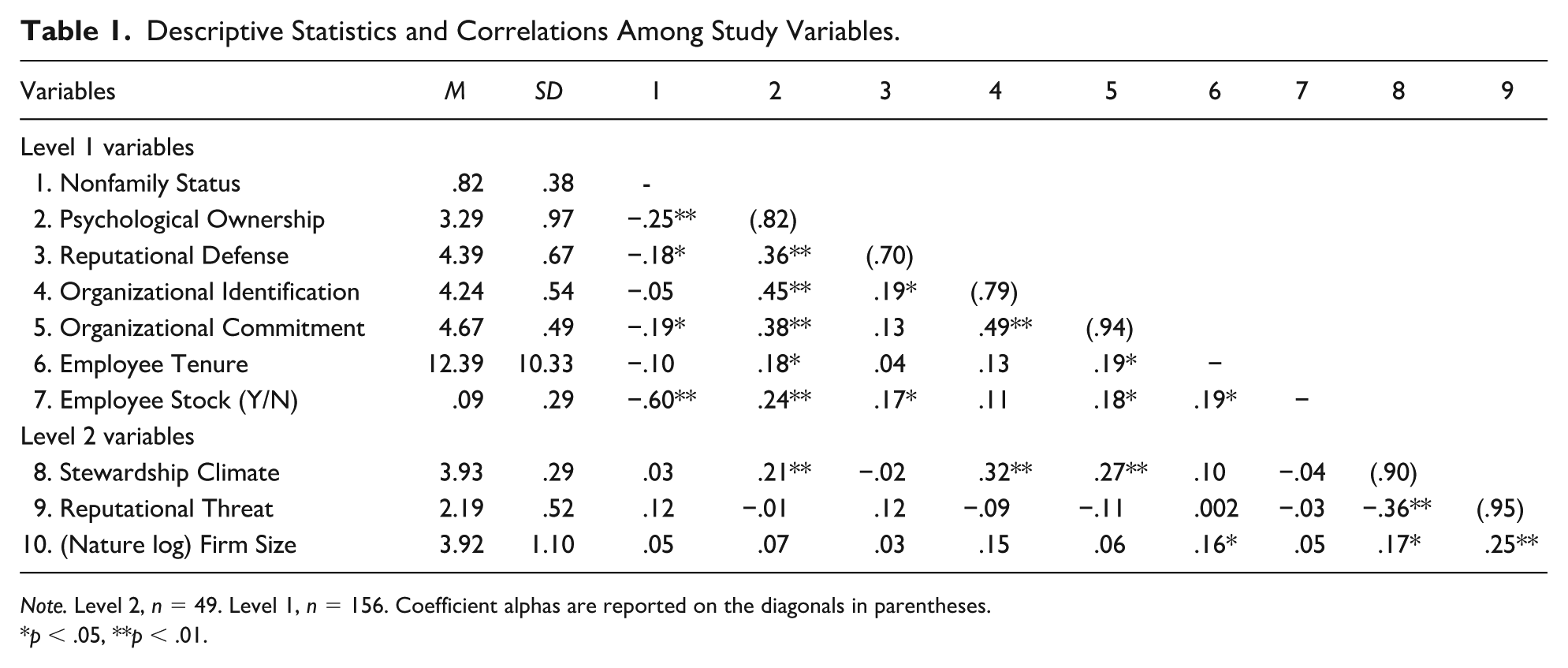
Note. Level 2, n = 49. Level 1, n = 156. Coefficient alphas are reported on the diagonals in parentheses.
p < .05, **p < .01.
To test the hypotheses, we used multilevel path analysis in Mplus 8.4 (Muthén & Muthén, 2017). All models were estimated using maximum likelihood with robust standard errors and the CLUSTER command in Mplus to account for non-independence. Following best practices, we group-mean-centered individual-level predictors and grand-mean centered firm-level predictors (e.g., Enders & Tofighi, 2007). To test Hypotheses 1-4b, we ran a 1-1-1 moderated mediation with a Level 2 first-stage moderator (i.e., stewardship climate) using a two-level fixed effects model with two random slopes. To test the final integrated hypothesis, we ran the same base model plus a Level 2 second-stage moderator (i.e., reputational threat). The moderated mediation hypotheses were tested by examining conditional indirect effects (Hayes, 2017) with 90% Confidence Intervals as recommended by Preacher et al. (2010; see also: Deng & Leung, 2014; Sheridan & Ambrose, 2022; Taylor et al., 2019). Results are reported in Tables 2 and 3, and Figure 1 provides a visual representation of the multilevel path analysis results.
Results of Multilevel First-Stage Moderated-Mediation Path Analysis.
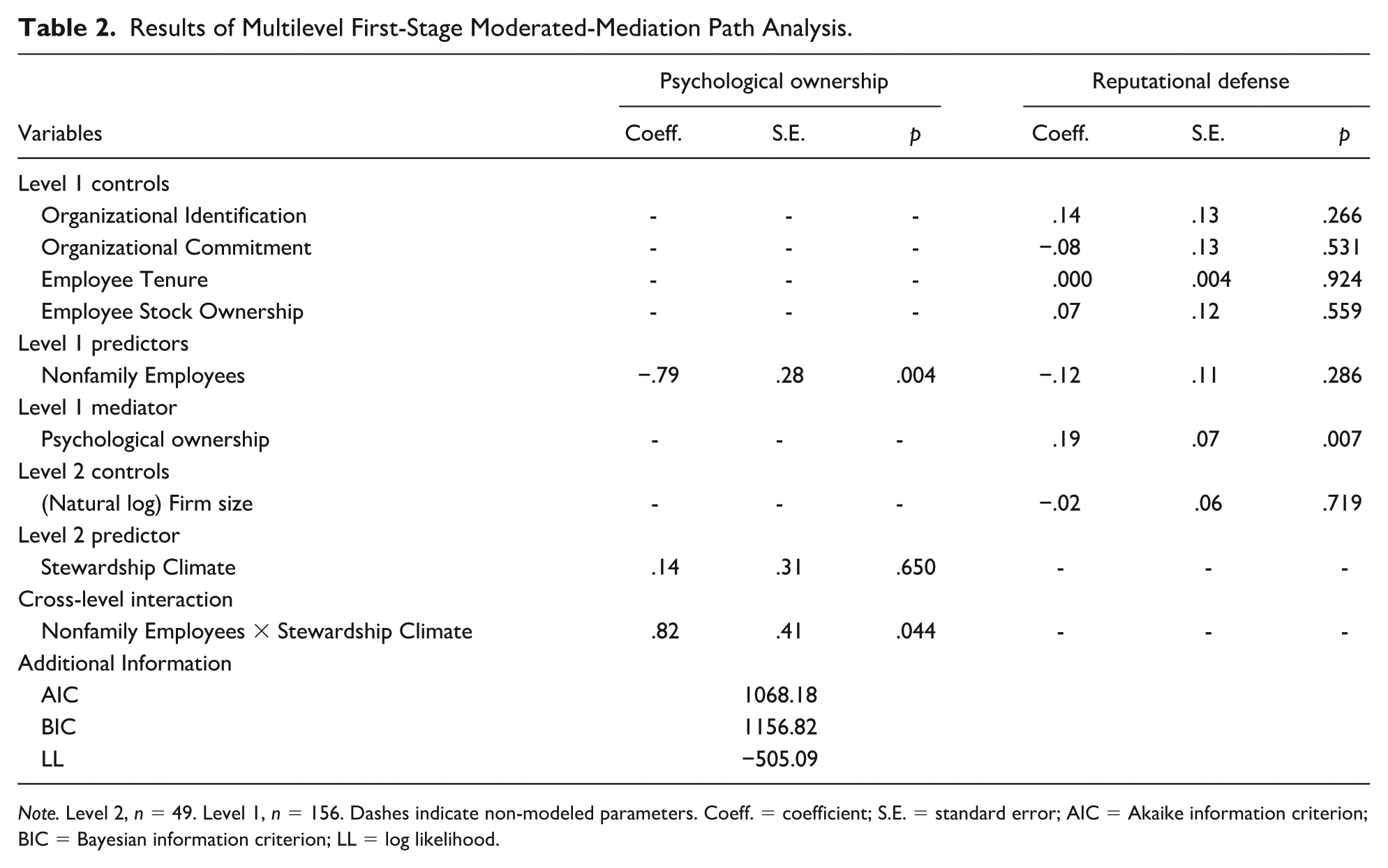
Note. Level 2, n = 49. Level 1, n = 156. Dashes indicate non-modeled parameters. Coeff. = coefficient; S.E. = standard error; AIC = Akaike information criterion; BIC = Bayesian information criterion; LL = log likelihood.
Results of Multilevel Dual-Stage Moderated-Mediation Path Analysis.
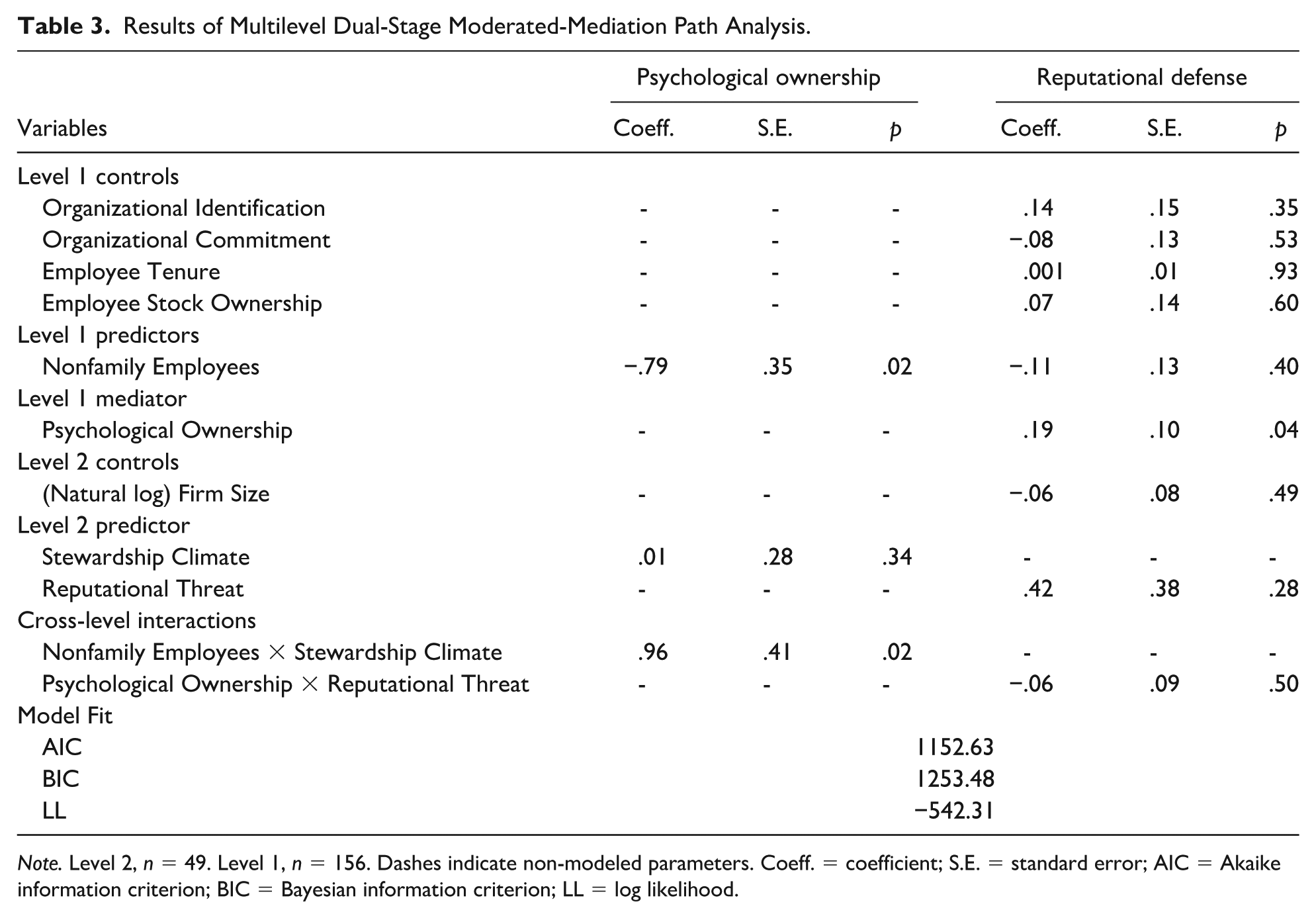
Note. Level 2, n = 49. Level 1, n = 156. Dashes indicate non-modeled parameters. Coeff. = coefficient; S.E. = standard error; AIC = Akaike information criterion; BIC = Bayesian information criterion; LL = log likelihood.
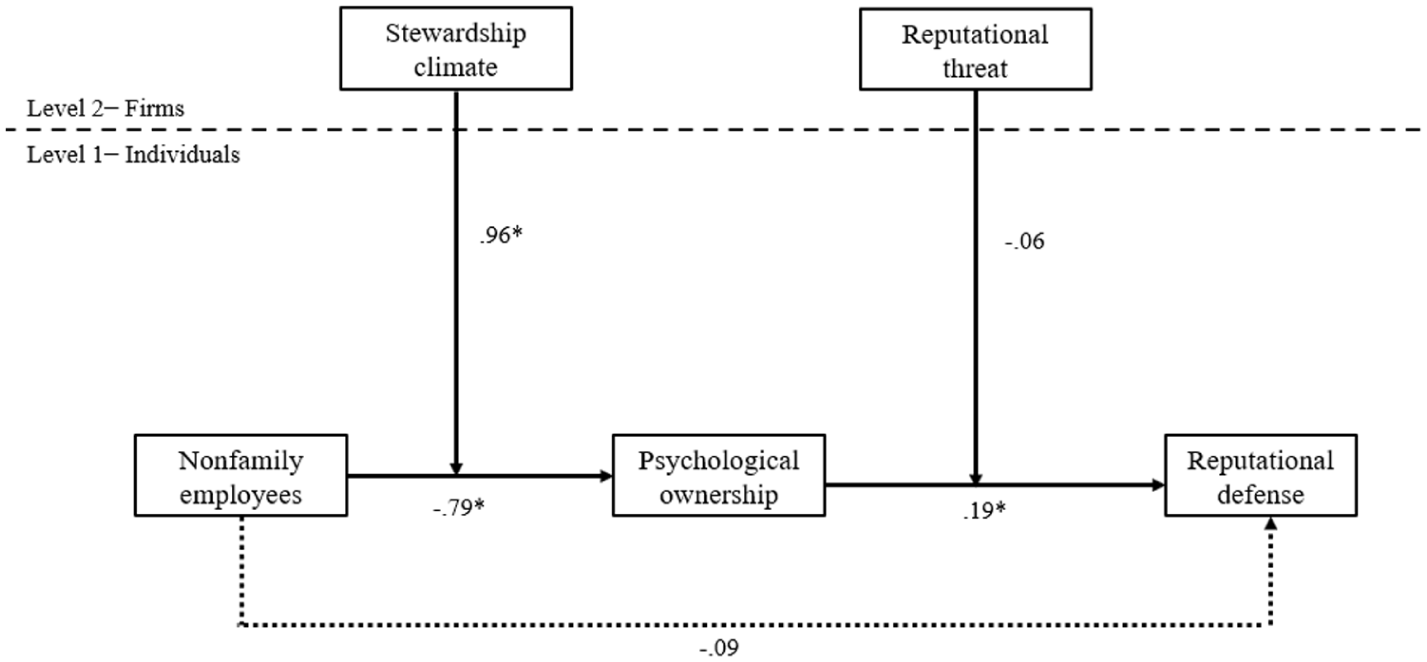
Results of the Dual-Staged Moderated-Mediation Multilevel Path Analysis.
As shown in Table 2, the direct relationship between nonfamily employees and reputational defense was negative but not significant (γ = −.12, p > .05), providing no support for Hypothesis 1. However, consistent with Hypothesis 2, nonfamily employees reported significantly lower PO toward the family firm compared to family employees (γ = −.79, p < .01). Supporting Hypothesis 3, PO significantly mediated the relationship between nonfamily employees and reputational defense (estimate = −.15, p < .05, CI90% [−.27, −.04]) indicating that nonfamily employees’ lower engagement in reputational defense is explained by their reduced PO. This pattern—significant mediation despite a nonsignificant direct effect—suggests full mediation (Aguinis et al., 2017), consistent with PO being a key driver of defensive behaviors.
Hypothesis 4a predicted that the nonfamily employee−PO relationship is moderated by stewardship climate. As shown in Table 2, the cross-level interaction was significant (γ = .82, p < .05); Figure 2 depicts the simple slopes at high and low (±1 SD) levels of stewardship climate (Preacher et al., 2006). Among employees in low-stewardship climates, there was a strong negative relationship between nonfamily employees and PO (−1 SD, simple slope = −1.05, p = .001) suggesting a significant PO gap between family and nonfamily employees. Under high-stewardship climates, however, there was no significant difference in PO between family and nonfamily employees (+1 SD, simple slope = −.54, ns). Thus, the positive effect of stewardship climate appears to attenuate the negative relationship between nonfamily employees and PO—to a point where the PO gap between family and nonfamily employees is rendered nonsignificant at high levels of stewardship climate. Hypothesis 4a is supported. Under conditions of high-stewardship climates, nonfamily employees feel PO like part of the family.
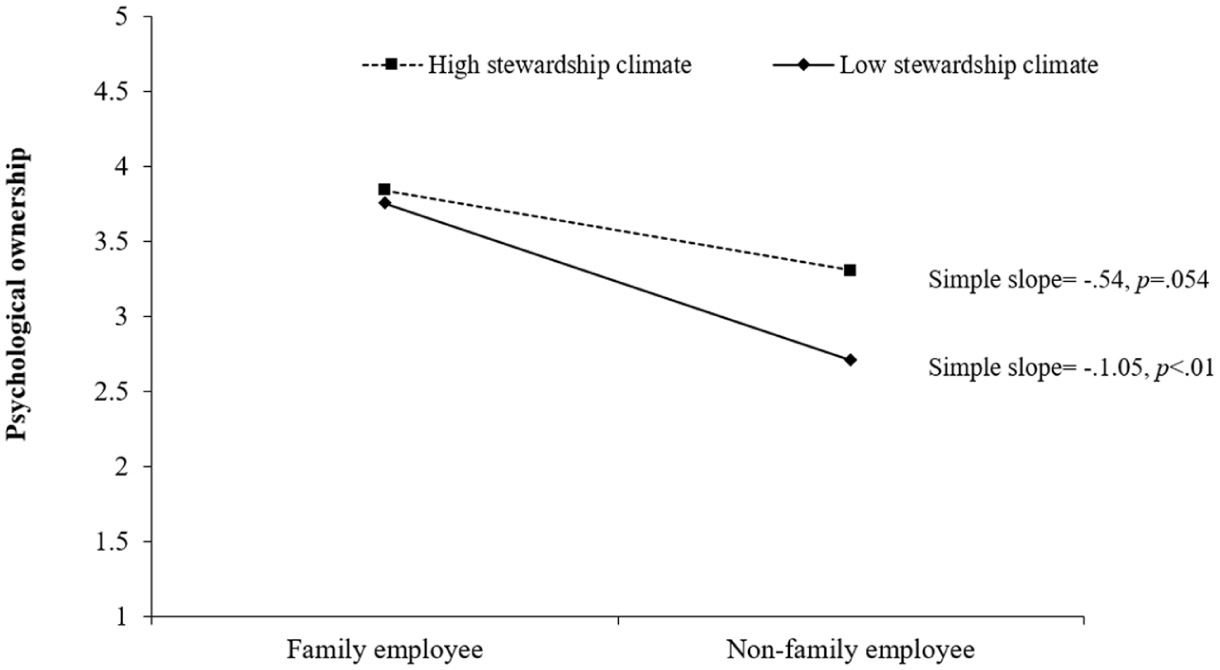
Cross-Level Interaction of Stewardship Climate on Random Slope Between Nonfamily Status and Psychological Ownership.
Hypothesis 4b predicted that the indirect effect of nonfamily employees on reputational defense via PO is first-stage moderated by stewardship climate. The indirect effect of nonfamily employees on reputational defense via PO was significantly more negative for nonfamily employees in low-stewardship climates (−1 SD, estimate = −.20, p < .01, CI90% [−.34, −.07]) than in high-stewardship climates (+1 SD, estimate = −.10, p > .10, CI90% [−.21, .001]), supporting Hypothesis 4b. Upon closer examination, results suggest nonfamily employees in high-stewardship climates display reputational defense behaviors on par with family employees.
Finally, we examined whether nonfamily employees’ reputational defense behaviors are maintained when they are needed most—under reputational threat. As seen in Table 3, we re-ran the base model plus a Level 2 second-stage moderator. The integrated hypothesis predicted the indirect effect of nonfamily employees on reputational defense via PO is least negative for nonfamily employees embedded in high-stewardship climates and under high reputational threat. To test for the dual-stage conditional indirect effects, we examined effects at high and low (± 1 SD) levels of stewardship climate and reputational threat. The indirect effect of nonfamily status on reputational defense via PO was significantly more negative for nonfamily employees in low-stewardship climates and under high reputational threat (estimate = −.17, p = .066, CI90% [−.33, −.02]) compared to nonfamily employees in high-stewardship climates and under high reputational threat (estimate = −.08, p = .192, CI90% [−.18, .02]). 2 Findings suggest that in high-stewardship climates, nonfamily employees are just as likely as family employees to defend the family firm against reputational threats, supporting Hypothesis 5.
Post Hoc Supplementary Analyses
To ensure that family employees’ stewardship perceptions were not driving results, we calculated stewardship climate using only nonfamily employee responses. Results for all hypotheses involving stewardship climate mirror reported results.
It was important to control for organizational identification to ensure that PO was driving the results, but organizational identification is also included as one of the six dimensions in the stewardship climate scale (Neubaum et al., 2017). To make sure this overlap was not affecting results, we removed organizational identification as a control (rather than altering the validated stewardship scale); the direction and significance of the results remained unchanged.
We had CEOs nominate and report employees’ reputational defense behaviors, which might have introduced sample selection bias if CEOs selected employees with higher PO. The numerous negative comments employees made about management in open-ended questions lead us to believe we made the appropriate trade-off between risks of sample selection bias versus common method bias, which would have been likely had we asked employees about their own reputational defense behaviors. Nevertheless, as an additional robustness check, we controlled for employees’ position with a manager dummy code (0 = front-line workers, 1 = managers); managers might have greater PO, on average. Results do not change in significance or direction.
Discussion
Reputation is a critical asset that, in family firms, is uniquely tied to the owning family’s identity and legacy (Gomez-Mejia et al., 2025; Pauceanu et al., 2025). This deep entanglement makes family firms both highly trusted (Beck & Prügl, 2018) and uniquely vulnerable to reputational threats (Rondi et al., 2023). While prior research has examined antecedents and benefits of family firms’ reputations, less is known about how they defend their reputations when challenged (Chaudhary et al., 2021). Using multisource data from 49 Irish family firm CEOs and 156 employees, we offer stewardship climate as a context that motivates nonfamily employees to feel and act like part of the family, and we show that such effects hold under perceived reputational threat. Doing so offers three contributions.
First, we contribute the construct of reputational defense as a type of defending behavior aimed at protecting the firm’s reputation, and we provide a validated adaptation of an existing scale (Brown, 2009) scholars can use to advance territoriality research aimed at defending the firm (see Appendix). Prior work has examined territorial behaviors focused on objects inside firms, such as workspaces, ideas, and relationships (Brown et al., 2014; Gardner et al., 2018). Such behaviors have been viewed as the “dark side” of PO (see Zhang et al., 2021), associated with negative performance appraisals (Brown & Zhu, 2016), and not being a team player (Brown et al., 2014). In their original theorizing, however, Brown et al. (2005) suggested that territorial behaviors might also have positive effects. By shifting the focus to territorial behaviors aimed at defending the firm’s reputation, we challenge the traditional view of territoriality as selfish or dysfunctional (Brown & Robinson, 2011; Zhang et al., 2021) and instead highlight its positive organizational role.
Second, we reveal stewardship climate as a context that motivates nonfamily employees to feel and act like family. Many scholars have acknowledged stewardship as a theoretical framework uniquely suited to family firms (e.g., Eddleston & Kellermanns, 2007; Madison et al., 2016). However, family employees naturally feel and act like stewards, leaving a gap between them and less-attached nonfamily employees (e.g., Ramos et al., 2014). Prior research showed that family firms benefit disproportionately from stewardship climates (e.g., Neubaum et al., 2017) and that certain managerial actions can increase nonfamily employees’ attachment (e.g., Bernhard & O’Driscoll, 2011; Hsueh et al., 2023; Medina-Craven et al., 2021; Sieger et al., 2011) and pro-organizational behaviors (Bormann et al., 2021), but it was unknown whether any such actions are sufficient to close the attachment and behavior gaps between family and nonfamily employees. By benchmarking against family employees (who naturally have high PO and will defend the firm), our findings extend these literatures by showing stewardship climates greatly “thicken the water” (cf., Davis et al., 2010)—enough to close the gap so that nonfamily employees feel and act like family. Results show family employees generally exhibit high PO and willingly engage in reputational defense. For nonfamily employees, these depend on the strength of the firm’s stewardship climate; only those in high-stewardship climates close the PO gap, enabling reputational defense behaviors on par with family employees.
Third, we answer the call by Chaudhary et al. (2021) for more research on reputation recovery in family firms. Research has focused on antecedents of strong family firm reputations, including governance (Deephouse & Jaskiewicz, 2013), social responsibility (Berrone et al., 2010), and product quality (Kashmiri & Brower, 2016), but largely overlooked the role of internal defenders in protecting reputations during crises. Results indicate stewardship climates increase resilience by elevating nonfamily employees’ PO, which in turn encourages reputational defense behaviors when they are most needed—in times of reputational threat.
Future Research Implications
Introducing reputational defense as a territorial behavior focused on the firm raises new questions for future inquiry. Unlike our portrayal of positive reputational defense, for example, T. Wang et al. (2017) apply theory about territoriality to explain how excessive product patenting sends a negative signal to future R&D partners because such behavior can be interpreted as possessive and exploitative. Thus, there appears to be merit in investigating the types of firm-level territorial behaviors managers and employees might engage in and isolating the contexts in which each has positive versus negative effects.
Our focus was on the benefits of stewardship climate for PO and defending behaviors, but it seems likely that such benefits extend widely. For example, stewardship climates might also have direct positive benefits for employee health and well-being. Scholars have documented the deleterious effects of crises on employees’ well-being (e.g., Trougakos et al., 2020), and given the timing of our study, we received comments from employees in our survey describing “soul destroying” negative effects of COVID-19 on mental health.
Our study reveals the power of stewardship climates in shaping PO but leaves open the potential for a bidirectional relationship between stewardship climate and PO. While stewardship climate is typically viewed as a managerial practice that fosters PO (Hernandez, 2012), prior research suggests that family firm CEOs who develop strong feelings of ownership may, in turn, engage in reinforcing and sustaining stewardship behaviors (Henssen et al., 2014). Longitudinal studies could help determine whether stewardship climates initiate a self-reinforcing cycle wherein employees with PO actively support and perpetuate the very climate that nurtured their ownership feelings, ultimately strengthening stewardship behaviors across the firm.
We focused on PO because of its possessiveness component and links to territoriality and found a strong connection with reputational defending that holds under threat. Several studies of employees in family firms investigate organizational identification rather than PO (e.g., Hsueh et al., 2023; Medina-Craven et al., 2021), raising questions regarding when the effects of these otherwise similar constructs might diverge. One possibility worthy of future study is the potential for a threat to trigger a sense of guilt-by-association and identity crisis among employees with organizational identification but not PO (Mael & Ashforth, 1992), which is quite different from the defensive behaviors sparked by PO (Brown & Robinson, 2011).
Our findings also have implications for the growing research on nonfamily employees within family firms. Because family employees exist in finite numbers compared to nonfamily employees, the retention of loyal nonfamily employees is crucial (Tabor et al., 2018). Our study reveals one way nonfamily employees can be made to feel like “part of the family,” but there are likely other factors that interact with stewardship climate to affect key outcomes. For instance, friendships with family employees appear to foster nonfamily employees’ identification with the firm and reduce turnover intentions (Vardaman et al., 2018), and these effects might be stronger in firms with stewardship climates. On the other hand, our study took place during the COVID-19 pandemic, and recent evidence suggests that family owners often sacrifice nonfamily employees (e.g., layoffs) during a crisis to preserve transgenerational control (Bertschi-Michel et al., 2023), which might destroy any sense of stewardship among remaining employees. Thus, future research might benefit from measuring stewardship climate as a contextual factor that changes the impact of other firm-level factors on nonfamily employees’ attitudes and behaviors.
Finally, our findings have practical implications because they suggest managers can build stewardship climates to close the PO gap between employees with and without ties to actual ownership. Given that stewardship climates also exist in nonfamily firms (Neubaum et al., 2017), future research might benefit from investigating whether our findings generalize beyond family firms. As one CEO in our study suggested: “number 1 advice—be fair to your employees and they will always be on your side, even during pandemics.”
Limitations
As with all research, several limitations merit discussion. First, we acknowledge the trade-off we faced between two potential biases. By asking CEOs to rate nominated employees’ reputational defense rather than using employees’ self-reports, we minimized risk of common method bias but exposed the study to potential selection bias due to CEOs nominating (non-random) employees with whom they worked regularly. However, the frequency of negative unsolicited comments (23%) gives confidence this was an appropriate trade-off and that results are not unduly biased by responses from favored employees. Second, although our data is multilevel and multisource, which reduces endogeneity and common method bias concerns, we cannot draw strong conclusions about temporal ordering. We showed the strength of the relationships among stewardship climate, PO, and reputational defense but leave it to future research utilizing multiple waves of data to establish causality. Third, theory suggests the null result for Hypothesis 1 predicting a direct relationship between nonfamily employees and reputational defense is because the effect is fully mediated by PO (cf. Brown et al., 2005). An alternative is simply that the size of any direct effect is small and our sample of nonfamily employees (N = 125) relative to family employees (N = 31) is not large enough to detect it. Fourth, Pierce et al. (2001) theorized that employees with longer tenures have higher PO, so results are logically stronger in contexts such as ours where tenure is longer (M = 12.39 years). We therefore caution that findings might not hold in a sample of new employees who have not had time to invest themselves and gain the intimate knowledge necessary to develop PO. Finally, our survey included an average of three employees per firm. While sufficient for aggregation (Tracey & Tews, 2005), it raises the question of whether stewardship climate reflects a firm-wide phenomenon or is more indicative of subgroup climates. This concern is mitigated by our focus on small and medium enterprises and the inclusion of employees across different organizational levels, but future research should explore how subgroup climates emerge based on employees’ varying responses to managerial leadership.
Conclusion
Especially in times of threat, family firms rely on strong internal defenders to protect their reputations. Our study underscores the role of stewardship climate in fostering PO among nonfamily employees, empowering them to defend the firm as if it were their own. By identifying stewardship climate as a key factor in closing the PO gap, we offer new insights into how family firms can engage their entire workforce to defend the firm’s reputation. We hope these findings spark further research on how to inspire nonfamily employees to feel and act like family, ultimately enhancing firms’ resilience in times of crises.
Footnotes
Appendix
Declaration of Conflicting Interests
The authors declared no potential conflicts of interest with respect to the research, authorship, and/or publication of this article.
Funding
The authors received no financial support for the research, authorship, and/or publication of this article.
