




Abstract
Different social exchange relationships among family members and between family and non-family stakeholders influence individual, group, and family-firm outcomes. Although many studies provide insights into social exchange relationships in family businesses, these studies are scattered across multiple literatures. Using the lens of social exchange theory, we review and organize 74 such studies. After discussing what is known and what gaps remain, we juxtapose our review with new theorizing about social exchanges to elicit research opportunities for family business research and for leveraging the family business context to “give back” to social exchange theory.
The different social exchanges among family members and between family members and non-family stakeholders work together to shape individual (Barnett et al., 2012; Lee et al., 2019; Madison et al., 2021), group (Chrisman et al., 2021; Ensley & Pearson, 2005), and business outcomes (Eddleston & Kellermanns, 2007; Karra et al., 2006; Zhu & Kang, 2022). For example, high-quality social exchange relationships between parent predecessors and designated successors facilitate (Brockhaus, 2004; Cabrera-Suárez, 2005; Daspit et al., 2016) and low-quality relationships harm succession processes (Cabrera-Suárez, 2005; Umans et al., 2021) and post-succession innovation (Zybura et al., 2021). Likewise, high-quality social exchange relationships between family leaders and non-family managers increase employees’ organizational citizenship behaviors (OCBs; Pearson & Marler, 2010) and elicit non-family employees’ support for family goals (De Massis, 2012); low-quality relationships fuel distrust (Pearson & Marler, 2010). These are just a few examples of the relevance of social exchanges in family firms. Family members develop and maintain distinct exchange relationships with various exchange partners, and the configuration of these relationships makes up the family firm. Social exchange relationships are central to understanding how families shape family firms.
Many studies investigate specific relationships and relational attributes in family businesses, but such investigations are scattered across management literatures, including entrepreneurship, organizational behavior, and strategic management. Making things worse, studies in different literatures apply different theories—such as leader-member exchange (LMX) theory in organizational behavior and agency theory in strategic management (cf. Arz, 2019; Karra et al., 2006; Pagliarussi & Rapozo, 2011). For example, some researchers draw on agency theory to highlight the asymmetric nature of altruism in family relationships (e.g., Lubatkin et al., 2005) and on stewardship theory to highlight the selfless aspects of altruism (e.g., Eddleston & Kellermanns, 2007). Another challenge is that much research on social exchanges in family firms does not draw on the rich theoretical foundations provided by the social exchange theory (SET), which is the most powerful and widely used theoretical framework for understanding interpersonal behaviors among researchers outside family business (Cropanzano & Mitchell, 2005). This disconnect has left family business scholars reinventing the proverbial wheel, sowing confusion, and unable to “give back” to SET. Such research might, for example, offer an opportunity for integrating agentic and stewardship views of altruism or help build a theory regarding how reciprocal exchange relationships evolve.
To help connect studies of social exchanges in family business and build stronger links between family business and mainstream SET research, we reviewed 74 articles from 20 journals that address different exchange relationships in family firms. While research on social capital 1 in family businesses was previously reviewed (Stasa & Machek, 2022), research on social exchanges, through which social capital emerges, has not. In a second step, we contrast research exploring social exchanges in family business with recent advances in SET to identify three promising yet under-researched themes—changing families, multi-foci social exchange relationships, and emergent states—that we leverage to construct a future research agenda.
Our primary contribution is a description and critical evaluation of what has been learned about social exchanges in family business. This evaluation is important for researchers interested in leveraging SET or any of its core concepts to advance knowledge about how social exchanges among family members and between family members and non-family stakeholders shape family businesses (and vice versa). Our second contribution is a research agenda that emerges from juxtaposing what we know about social exchanges in family firms with recent SET theorizing. Exposing these gaps is important because social exchanges are strong and influential within family firms; they help distinguish among families and the ways they shape family firms (Combs et al., 2020; Jaskiewicz & Dyer, 2017). The research agenda is also important because the rich and heterogeneous social exchanges found in family firms furnish a promising context for researchers to “give back” to SET (Jaskiewicz et al., 2020).
Social Exchange Theory
The basic premise of SET is that many behaviors can be explained by the ongoing interactions between partners that develop into either low- or high-quality relationships characterized by shared rules and expectations for the exchange of economic and socioemotional resources (Blau, 1964; Emerson, 1976; Homans, 1958). Social exchanges occur between individuals (e.g., incumbent and designated successor) or between individuals and groups (e.g., employee and family).
The explanatory power of SET relies on three fundamental attributes (Cropanzano & Mitchell, 2005): (a) rules that serve as relational guidelines for social exchanges, (b) relationships that develop via ongoing interactions, and (c) resources that are exchanged. First, interactions between partners are subject to “rules” of exchange, which serve as relational guidelines (e.g., Gouldner, 1960; Meeker, 1971). These rules, also known as norms, form the basis of both individual and group exchanges and include altruism, reciprocity, and generalized versus restricted exchange norms. Second, social exchange relationships can be characterized as either high or low quality and can be moving in either direction (Cropanzano et al., 2017). They start with one actor initiating a positive (negative) action followed by the target actor’s positive (or negative) response, which is known as the reciprocating action (Cropanzano & Mitchell, 2005; Lawler, 2001). A series of positive reciprocal exchanges may transform an economic transaction into a high-quality social exchange relationship (Cropanzano et al., 2017). Third, social exchange resources are exchanged in a relationship; they can be economic (i.e., financial benefits) or socioemotional (i.e., benefits that concern one’s standing; J.Martin & Harder, 1994). Economic resources are typically universal (i.e., general value, independent of source) and tangible, whereas socioemotional resources 2 tend to be particularistic (i.e., valued only by those involved) and symbolic (Cropanzano & Mitchell, 2005).
SET is a powerful theory for understanding the heterogeneity of family firms because it makes no assumptions about the family and, therefore, provides a holistic framework for analyzing interpersonal relationships within any family and between any family, or any family member, and any of its non-family stakeholders. In addition, family firms provide a rich context for applying SET because of the different social exchanges among family members and between family and non-family members. Individuals who are part of the family and the family firm are likely to develop various exchange relationships. Their repeated exchanges allow for the development of expectations, shared schemas, and common language (Daspit et al., 2016), which are vital in explaining the evolution of each relationship and its implications for the family business.
Scope of Review
To review research on social exchanges in family business, we conducted a systematic search of family business articles focused on (a) social exchange in general or (b) at least one of the three fundamental elements of social exchange: rules (i.e., norms), relationships, and resources. To ensure that our review is systematic—structured, comprehensive, and transparent (Denyer & Tranfield, 2009), we followed the approach suggested by Hiebl (2023) and Bettinelli et al. (2022), which builds upon the work of Tranfield et al. (2003). Our keywords were informed by prior social exchange reviews (Cropanzano et al., 2017; Cropanzano & Mitchell, 2005) 3 and well-established keywords for identifying family businesses (Combs et al., 2020; Qiu & Freel, 2020). A comprehensive list of keywords is shown in Table 1, along with the number of articles generated at each step of the search process.
Search Protocol.
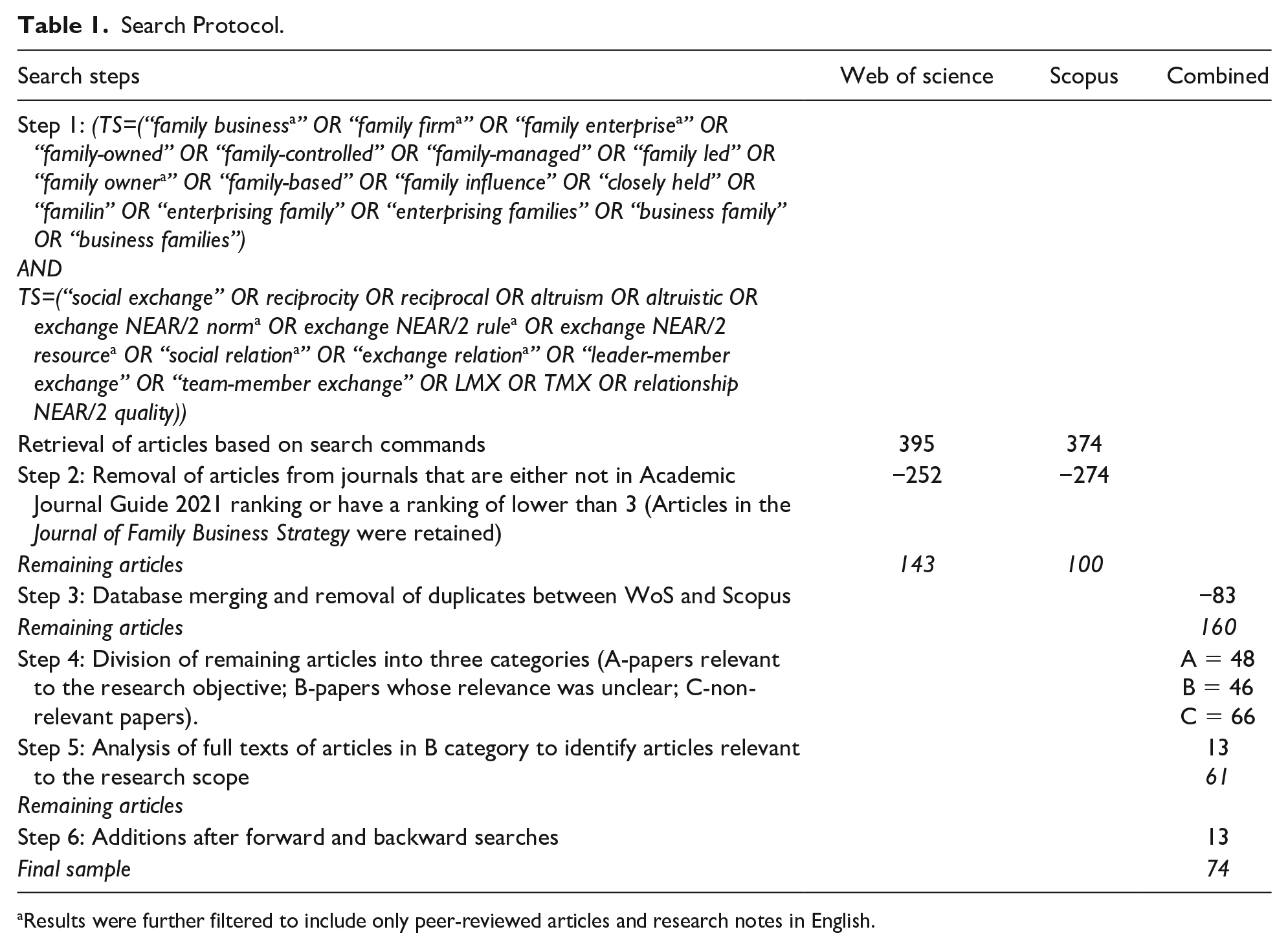
Results were further filtered to include only peer-reviewed articles and research notes in English.
We began our search by using relevant keywords to retrieve peer-reviewed articles and research notes from the Web of Science and Scopus databases. 4 We restricted articles to those published in journals that had an Academic Journal Guide ranking of ABS-3 or higher (e.g., Bettinelli et al., 2022; Su & Daspit, 2022). However, in line with previous reviews of family business topics, we retained articles published in the Journal of Family Business Strategy, given their relevance to the family business domain (e.g., Combs et al., 2020; Su & Daspit, 2022). We then merged the lists of articles from Web of Science and Scopus before removing duplicates. Following Bettinelli et al. (2022), the first author then read the articles’ abstracts and keywords and divided them into three categories: (a) articles relevant to the scope of the review, (b) articles whose relevance was unclear, and (c) clearly irrelevant articles. 5 The first three authors then analyzed each article in the unclear “b” category before including or excluding it. After these steps, we were left with 61 articles. Because keyword searches can miss relevant research, we conducted a backward search (e.g., Su & Daspit, 2022) by perusing the reference lists of the 61 articles and a forward search by identifying articles citing them (Hiebl, 2023). 6 This step resulted in 13 additional articles, leading to a final sample of 74 articles published in 20 journals between 2001 and 2022. Of these, 31 are conceptual and 43 empirical (12 qualitative and 31 quantitative).
We followed best practices in prior reviews in management and family business (Combs et al., 2020; Michael-Tsabari et al., 2020; Su & Daspit, 2022) by analyzing and coding each of the 74 articles with respect to: article type (e.g., conceptual, quantitative, or qualitative), theories (e.g., agency theory, SET), scope of analysis (e.g., family, business), social exchange attributes (e.g., rules, relationships, and resources 7 ), and key findings. 8 We then identified the specific aspects of the SE attribute under investigation, leading to the following categorization: (a) rules—altruism, reciprocity, generalized versus restricted exchange; (b) relationships—high- versus low-quality; and (c) resources—economic versus socioemotional. Each article was then inductively coded for antecedents and outcomes and by specific exchange partners (among family members and between family and non-family members). Figure 1 shows our organizing framework and summarizes the status quo of knowledge on social exchanges in family businesses.
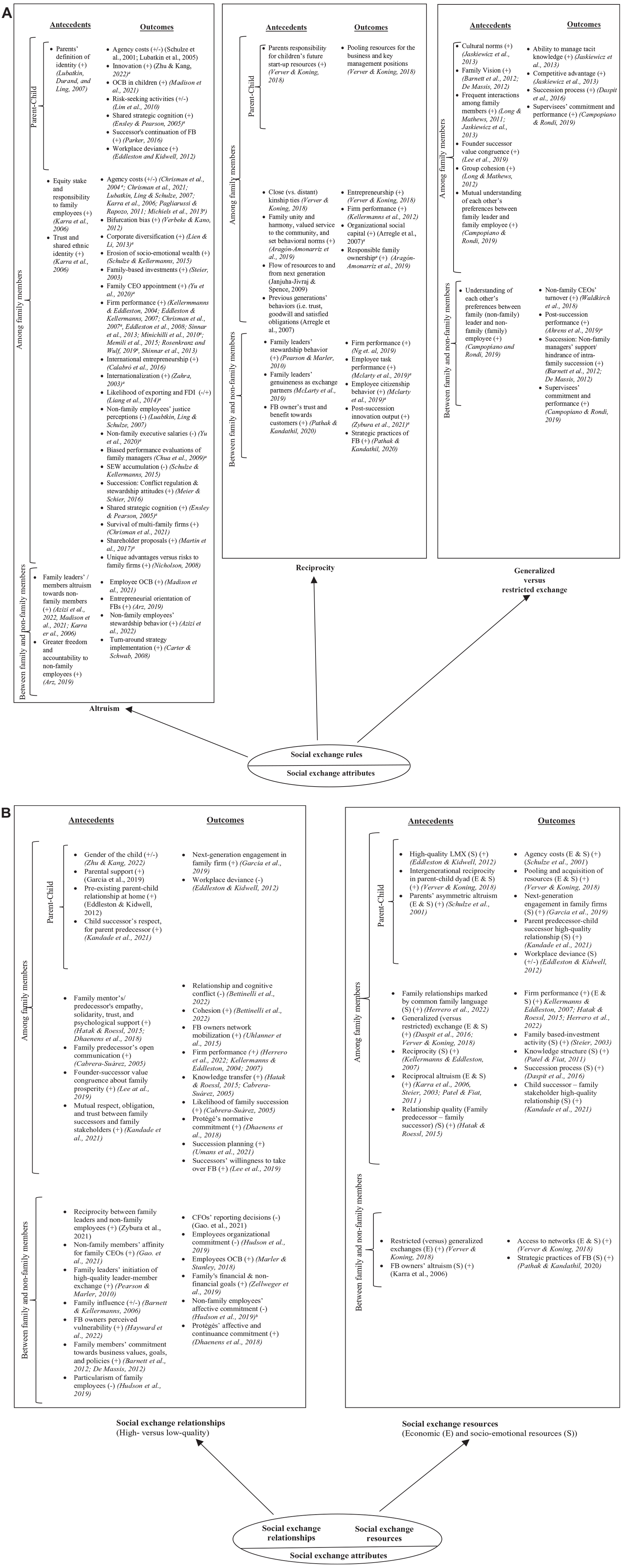
Integrative Review of Social Exchange in Family Business Context.
Social Exchange Rules
We identified 60 article that describe three types of social exchange rules (norms): altruism, reciprocity, and generalized versus restricted exchange.
Altruism Norms
In our sample, altruism is the most studied social exchange rule (i.e., covered by 39 out of 60 articles). Research on altruism defines it as a concern for the well-being of others above oneself (Lubatkin et al., 2005). Altruism is more prevalent and stronger among family than non-family members, which can be traced to Darwinian evolutionary psychology (Nicholson, 2008). Although none of the reviewed studies explicitly applied SET, studies that adopt a stewardship perspective describe reciprocal altruism wherein exchange partners reciprocate altruistic behaviors. Studies that adopt an agency perspective, in contrast, describe asymmetric altruism wherein exchange partners do not reciprocate. We divide and review studies according to whether they investigate antecedents and outcomes of altruism among family members versus between family and non-family members.
Altruism Among Family Members
Many studies focus on parent-child social exchanges. Lubatkin et al. (2007) define three specific types of altruism in parent-child dyads based on parental identity: family-based, paternalistic, and psychosocial. Family-based (or parental altruism; Eddleston & Kidwell, 2012) is a form of asymmetric altruism where parents co-define their identity with their children’s, prioritize children’s interests, are extra generous, and fail to punish/redirect their children. Paternalistic altruism is also asymmetric. Parents identify strongly with their individual identity and work to impose their values and interests on their children. Exchanges depend on what parents perceive to be best and involve quick discipline and redirection of deviant behaviors. Psychosocial altruism, in contrast, is symmetric because it is reciprocal. Parents avoid providing children with instant gratification and instead offer intangible resources (e.g., love, nurturing, security) to develop children’s psychological and social growth. Children internalize the parents’ social norms, are less likely to view resources as entitlements, and more likely to reciprocate parents’ altruistic behaviors.
Family-based altruism is the most studied norm in the reviewed studies. Family-based altruism is asymmetric (children’s interests take precedence), satisfying children’s needs and nurturing a sense of entitlement without imposing discipline (Lubatkin et al., 2007). Rooted in agency theory, Lubatkin et al. (2005) explain that such altruism limits parents’ ability to exercise self-control, causing parents to be overgenerous, stifling children’s motivation to work hard, and promoting entitlement and free-riding. Lim et al. (2010) theorize that such altruism can increase otherwise risk-averse parent-owners’ risk-taking behavior when they perceive that firm performance is below aspirations. Schulze and Kellermanns (2015) theorize that family-based altruism fuels tensions among adult siblings because each cares more about their own children than their siblings’ children, thereby eroding the family’s stock of socioemotional wealth (SEW, the affective value the family receives from its control of the firm; Gómez-Mejía et al., 2007). In sum, such altruism can nurture excessive risk-taking among parents and tensions among adult siblings.
Asymmetric family-based altruism among family members can also impact non-family employees. By over-favorably evaluating and compensating family employees (Chua et al., 2009), family owners discriminate against non-family employees (Verbeke & Kano, 2012), causing higher agency costs (e.g., free-riding family members; entrenchment of ineffective family managers; Chrisman et al., 2004) and increased perceptions of procedural and distributive justice violations among non-family employees (Lubatkin et al., 2007). Minority shareholders are similarly concerned about the danger of asymmetric altruism: The longitudinal study by G. Martin et al. (2017) on U.S. public family firms finds that the appointment of a family CEO when firm performance is subpar—an act of family altruism—upsets minority shareholders.
Although the negative effects of family-based altruism appear difficult to mitigate, the study by Michiels et al. (2013) involving 527 privately held U.S. family firms shows that mechanisms such as incentive pay can reduce self-serving problems due to family-based altruism. In addition, not all family firms make decisions based on family-based altruism. Steier (2003), for example, used case vignettes to describe how families’ investment decisions in new ventures are based on a continuum ranging from family altruism, which are funded based on family membership and a lack of formal monitoring, to market logic, which are funded based on their viability and monitored through contracts and boards.
Another stream of studies describes positive effects of what Lubatkin et al. (2007) called psychosocial altruism in the context of parent-child relationships; it is more broadly called reciprocal altruism (Eddleston & Kellermanns, 2007; Minichilli et al., 2010). Most of these studies adopt a stewardship perspective and argue that the recipient of altruistic acts will be willing to reciprocate in the future. Parker (2016) theorizes that parent-owners acquire greater resources (both tangible and intangible) hoping a child will reciprocate by taking over the firm. The survey by Ensley and Pearson (2005) of 224 top management teams (TMTs) shows that parental TMTs (i.e., including a parent and one or more children) have higher shared strategic cognition (i.e., consensus in understanding of strategic directions) than other familial TMTs, suggesting that parents’ altruism spurs children’s reciprocal behavior in the business. The case study by Karra et al. (2006) on a multi-national family business similarly demonstrates that close family members who altruistically receive equity and responsibility go the “extra mile” for the business. More distant kin-employees can also show reciprocal altruistic behavior when family business owners show and emphasize their shared ethnic identity (Karra et al., 2006).
Reciprocal altruism has many positive outcomes for the family and the family firm. Zhu and Kang (2022) explain that such altruism enables parents to (a) adopt a long-term orientation that promotes risk-taking and investment in innovation and (b) provide successors with decision-making power and authority to innovate. Rosenkranz and Wulf (2019) theorize that such norms lower conflict among family employees. The 10-year study by Meier and Schier (2016) of a public family firm in France confirms the theorizing and finds that reciprocal altruism between family members belonging to different family branches enables the family to regulate their conflicts and pursue stewardship behaviors on important topics (e.g., dividends, external financing). Memili et al. (2015) theorize that reciprocal altruism improves a firm’s performance, which is supported by the work of Eddleston and Kellermanns (2007) involving 107 respondents from 60 family firms. The authors show that reciprocal altruism increases cooperation and collaboration in participative decision-making processes, which strengthens family members’ motivation and organizational commitment and increases a firm’s performance. Reciprocal altruism among family members reduces information asymmetries and aligns interests between current and next-generation members, increasing the family’s support for risky strategies, such as internationalization (Calabrò et al., 2016; Liang et al., 2014; Zahra, 2003).
However, the performance benefits derived from reciprocal altruism can vary. The study by Shinnar et al. (2013) of 513 U.S. family firms finds stronger performance benefits from reciprocal altruism in African and Mexican American than in Korean-American family businesses. One reason for differing benefits is that the prevalence of reciprocal altruism norms can lead to an overreliance on trusted family members. Analyzing 421 founding family firms in China, Yu et al. (2020) show that nuclear family members sharing strong (reciprocal) altruism norms and values, such as trust, support, and loyalty, are more likely to select family over non-family CEOs. Reciprocal altruism’s positive association with firm performance is also more pronounced in environments rich in technological opportunities that require greater cooperation, information exchange, and commitment (Eddleston et al., 2008). Finally, the case study by Pagliarussi and Rapozo (2011) suggests that reciprocal altruism norms have limited reach; they aligned the interests of the much-smaller first generation, but not much-larger subsequent generations.
Altruism Between Family and Non-Family Members
Altruistic norms between family members can extend to non-family employees and other stakeholders. Family members’ altruistic social exchanges motivate them to act altruistically toward non-family employees, propelling altruistic behavior among the latter. The study by Azizi et al. (2022) of 163 Iranian family firms shows that family members’ altruistic behavior toward non-family employees promotes co-operative, altruistic, and citizenship behaviors. Similarly, Arz’s (2019) study of a German family business shows that altruism between family members and non-family employees fosters an involvement orientation (i.e., decentralized decision-making, transparency, and trust), which leads to an empowerment climate that increases entrepreneurial orientation.
Strong reciprocal altruism norms between family managers and non-family employees offer advantages to family firms. Cater and Schwab (2008) study two family firms and show that such altruism increases firms’ abilities to implement retrenchment strategies when in crisis (e.g., employees accept pay cuts). Along similar lines, the study by Madison et al. (2021) of 209 family CEO-employee dyads indicates that family CEOs’ altruism involving care, loyalty, and trustworthiness encourages non-family employees to reciprocate by engaging in OCB.
While there are no studies on asymmetric altruism between family and non-family members, one study suggests that the detrimental asymmetric altruism can spread across families in multi-family firms, which are “owned and managed by members of a small number of families” (Chrisman et al., 2021, p. 907). Specifically, family A’s asymmetric altruism toward their family members nurtures conflicts with the other family and leads the latter to copy the former (e.g., overpaying their own members).
In summary, both asymmetric and reciprocal altruism norms are common among family members, and reciprocal altruism norms can extend from family members to non-family employees and other stakeholders. Research shows that asymmetric altruism is associated with negative group (e.g., procedural justice violations; Lubatkin et al., 2007) and business outcomes (e.g., higher agency costs; Chrisman et al., 2004), whereas reciprocal altruism is associated with positive group (e.g., employee OCB; Madison et al., 2021) and firm outcomes (e.g., entrepreneurial orientation, superior firm performance; Arz, 2019; Meier & Schier, 2016). However, a closer examination of why some families develop and propagate reciprocal altruism norms while others promote asymmetric altruism remains absent. Such knowledge might explain contradicting altruism-related predictions from agency theory (e.g., Lubatkin et al., 2005) and stewardship theory (e.g., Kellermanns & Eddleston, 2004). Changes in families, due to family events (e.g., divorce) and different family structures (e.g., number of children living with parents at home), and variation in families’ perceptions of non-family employees (e.g., non-family employees as extended family) might also help explain variations and changes in relationship attributes (e.g., closeness, frequency of interactions), altruism norms, and business outcomes.
Reciprocity Norms
Reciprocity is the most prevalent social exchange norm in management research (Cropanzano & Mitchell, 2005), yet it remains relatively understudied in the context of family business. Reciprocity describes an interdependent relationship between two exchange partners wherein A’s contributions to B are contingent upon B providing reasonably equivalent benefits to A in return (Gouldner, 1960). Reciprocity thus implies social exchange relationships tend toward a balanced state of exchange over time (Gouldner, 1960). In contrast with reciprocal altruism (where there is a willingness to make personal sacrifices that may or may not be repaid), the underlying rationale of reciprocity is that exchange partners choose to invest in the relationship because the contributions by each side will eventually even out.
Reciprocity Among Family Members
The previous section described parent-child relationships as governed by asymmetric or reciprocal altruism. Adopting a longer time horizon, however, reciprocity research introduced intergenerational reciprocity, which is the idea that parents expect reciprocity toward future generations rather than themselves. A special case is bounded intergenerational reciprocity wherein children give back to their parents in the distant future (Janjuha-Jivraj & Spence, 2009). Using 12 case studies of Cambodian business families, Verver and Koning (2018) find that parental responsibility for children’s future business resources induces bounded intergenerational reciprocity such that children show loyalty toward their parents by continuing the family business. Arregle et al. (2007) argue that the behaviors of previous generations in terms of trust, goodwill, and satisfied obligations set the precedent for the current generation’s reciprocity toward the next, ensuring stability of family values and behaviors over time. Consistent with this theorizing, the study by Aragón-Amonarriz et al. (2019) of Mexican family firms shows that the founding generation, guided by norms of intergenerational reciprocity, maintains family unity and harmony, values service to the community, and sets behavioral norms that are adopted by the next generation. Verver and Koning (2018) caution, however, that such intergenerational reciprocity only applies in close kinship relationships. In more distant kinship relationships (e.g., based on shared family name, history, language and culture, etc.), exchanges are more direct and require immediate exchanges of equally valuable goods and services.
Intergenerational reciprocity norms carry positive implications for the family firm. Verver and Koning (2018) explain that reciprocity nurturing loyalty and moral obligation motivates family members to pool resources necessary for long-term investments into new ventures. Furthermore, the study by Kellermanns et al. (2012) of U.S. private family firms reveals that family members’ reciprocity is related to higher family-firm performance. One reason is that reciprocity-based exchanges encourage members to discuss ideas, expectations, and feedback, enabling family members to navigate (process and cognitive) conflict, thereby leveraging the positive aspects of (process and cognitive) conflict to enhance a firm’s performance (Kellermanns & Eddleston, 2007).
Reciprocity Between Family and Non-Family Members
Pearson and Marler (2010) argue that family leaders’ stewardship behavior drives employees to reciprocate. 9 When non-family employees feel that the family supervisor is a genuine exchange partner, employees reciprocate with stronger task performance and OCBs (McLarty et al., 2019). With respect to other stakeholders, Pathak and Kandathil (2020) use 66 interviews with owners and customers of small-sized Indian family-based grocery stores (kiranas) to show that owners’ initial practices of trust and benefits toward customers (e.g., free home-delivery, extended credit) are reciprocated via customer loyalty. The study by Ng et al. (2019) of 150 family firms in the UAE shows that reciprocity-based exchanges between family members and non-family stakeholders enable family firms to strengthen their managerial capabilities, which improves a firm’s performance. Zybura et al. (2021) suggest that such resources are valuable. They argue that reciprocity norms between family predecessors and non-family stakeholders are vital for family successors to get access to non-family stakeholders’ resources needed to increase innovation output after succession.
In summary, reciprocity initiated by family business owners/leaders is considered central to relationships across family generations and between the family and the business’s employees, suppliers, customers, and other stakeholders. Within families, reciprocity appears strongest for close ties and facilitates entrepreneurship and better firm performance (Kellermanns & Eddleston, 2007; Verver & Koning, 2018). Parental reciprocity norms toward children can be reciprocated decades later, suggesting that instances of altruism between parents and children might not be as asymmetric as previously thought but are merely reciprocity taking place over decades. Conditions under which intergenerational relationships are characterized by reciprocity versus altruism thus require more attention. As with altruism norms, examining heterogeneity in families may help tease apart variation. For instance, differences in intergenerational solidarity between parent-child and grandparent-grandchild dyads (Silverstein & Bengtson, 1997) might help shed light on the distribution of intergenerational reciprocity versus asymmetric altruism. In addition, the presence of many actors with different reciprocity norms suggests merit in adopting a “multi-foci perspective” that acknowledges each actor’s different and unique social exchange relationships with others (Lavelle et al., 2007). Such differences, for example, might reveal (bounded) intergenerational reciprocity in some parent-child dyads and asymmetric altruism in others.
Generalized Versus Restricted Exchange Norms
A generalized exchange describes a situation wherein Actor A at Time 1 provides a benefit to Actor B but receives the benefit from Actor C in the future (Lawler, 2001). Put differently, generalized exchange norms describe indirect reciprocity involving contributions without any pre-set direct or immediate return between partners (Long & Mathews, 2011). Conversely, restricted exchange norms describe a form of reciprocity that is direct and transactional in nature (Lawler, 2001), motivated by self-interest, contractual by design, and focused on relatively immediate returns (Long & Mathews, 2011).
Generalized vs. Restricted Exchange Among Family Members
Generalized exchange norms are often applied broadly to family relationships, and they imply that contributions will be returned via another person. Studies assume that families are contexts in which generalized exchange norms prevail (e.g., Ahrens et al., 2019) and theorize the antecedents of these norms in families (e.g., Jaskiewicz et al., 2013). Long and Mathews (2011) theorize that frequent interactions among family members and the generational transfer of family values regarding altruism, stewardship, and succession foster group cohesion, leading to shared generalized exchange norms in these families. Jaskiewicz et al. (2013) add that cultural norms, which foster moral obligations to reciprocate, also foster generalized exchange norms in families. Barnett et al. (2012) explain that a strong (vs. weak) family vision in terms of transgenerational sustainability and family commitment nurtures family cohesion and shared goals, supporting the development of generalized exchange norms among family members. Lee et al. (2019) similarly argue that founder-successors’ value congruence at high (vs. low) levels of family prosperity (i.e., the willingness to work hard and improve family honor) encourages the understanding of family business goals, leading to shared generalized exchange norms. Finally, Campopiano and Rondi (2019) argue that family supervisors and family employees who value SEW develop stronger bonds and generalized exchange norms, but disagreement about the importance of SEW yields restricted exchange norms.
Generalized exchange norms benefit individuals, groups, and the family firm. Generalized exchange norms between family supervisors and family employees strengthen the relationship between family employees’ commitment and work performance (Campopiano & Rondi, 2019). Daspit et al. (2016) explain that generalized exchange norms between family successors, predecessors, and other family members help family predecessors and other family members transfer important tacit knowledge to the successor, improve the training and development of the successor, and reduce information asymmetries. Because these norms foster trust and understanding between family members, they also increase family firms’ ability to transfer, utilize, and protect tacit (non-codifiable) knowledge, which can improve competitive firm advantage (Jaskiewicz et al., 2013).
Generalized vs. Restricted Exchange Between Family and Non-Family Members
Between family members and non-family employees, restricted exchange norms predominate, but generalized exchange norms can evolve under certain circumstances. Campopiano and Rondi (2019) theorize that dyadic exchanges between family and non-family employees can move from restricted toward generalized exchange norms if both parties have a thorough understanding of each other’s unique preferences (i.e., family members focus on SEW, and non-family members focus on financial wealth). Daspit et al. (2016) extend this view to non-family stakeholders (e.g., advisors), positing that norms of restricted exchange can, over time, become norms of generalized exchange in the context of succession. De Massis (2012) theorizes that a strong family vision (including transgenerational intentions and family business commitment) helps families establish generalized exchange norms in the firm. The family’s ability to impose its vision and norms, however, is weakened when the goals of other groups (i.e., non-family employees and shareholders) diverge from those of the family coalition.
Generalized exchange norms between family and non-family employees and among family members benefit non-family CEOs, the family, and the family business. Waldkirch et al. (2018) argue that generalized exchange norms among the current generation, the next generation, and the non-family CEO reduce the likelihood of non-family CEO turnover because the current generation appreciates the non-family CEO’s efforts to help the next generation. Barnett et al. (2012) and De Massis (2012) theorize favorable family outcomes. They suggest that generalized exchange norms in the family firm and a shared family vision foster inclusive and just decision-making processes, thereby increasing non-family managers’ perceptions of organizational support and procedural justice. The authors argue that such outcomes are important to gain non-family managers’ support during intra-family succession. Finally, the study by Ahrens et al. (2019) of 804 CEO successions in Germany suggests that generalized exchange norms between the outgoing family CEO, the family, and non-family stakeholders encourage the latter to extend trust, loyalty, and support to the incoming family CEO, which leads to superior firm performance after succession.
In sum, a common yet stereotypical assertion is that family members adopt generalized exchange norms, and non-family employees favor restricted exchange norms (e.g., Ahrens et al., 2019; Long & Mathews, 2011). Unfortunately, this research remains largely conceptual, pointing to the need for empirical research to test the conditions under which generalized exchange norms are feasible, especially between less-studied dyads such as family and non-family employees and among non-family employees (Daspit et al., 2016). Assuming that it is difficult to maintain generalized exchange norms with all non-family stakeholders, future research needs to identify the factors that determine how far family members’ use of generalized exchange norms can extend, who can be included within this circle, and resulting implications for employee and firm outcomes. The multi-foci perspective within SET posits that employees form different perceptions of justice, support, and trust about different actors (e.g., family leaders), which then dictates the social exchange norms they apply (Lavelle et al., 2007). This perspective might also help explain how generalized and restricted exchange norms between family members and among family and non-family employees evolve over time.
Takeaways From Research on Social Exchange Rules in Family Businesses
The use of different theories has led to contradicting outcomes regarding asymmetric altruism norms. Stewardship theory research points to potential benefits of altruism norms in terms of family members’ selfless behaviors (e.g., Kellermanns & Eddleston, 2004), but agency theory research warns of potential downsides in terms of free-riding (e.g., Lubatkin et al., 2005). Because most altruism research remains conceptual, empirical research to reconcile and refine competing predictions is timely and warranted. The identification of moderators that help explain conditions under which altruism (and other social exchange norms) yields stewardship versus agency outcomes seems particularly promising.
Reciprocity is another vital SE rule, but family business research on the topic remains surprisingly scarce. Similarly, our review revealed knowledge gaps regarding generalized exchange norms among non-family employees and restricted exchange norms among family members. While there are studies on the prevalence of particular social exchange norms between family and non-family members, each norm has been studied in isolation, ignoring the roles of other social norms (e.g., the role of reciprocity instead of altruism norms in parent-child relationships) and how bundles of social exchange norms collectively shape dyadic exchanges, families, and their businesses. More research is also warranted to understand the drivers of different SE norms. The multi-foci perspective appears promising in this context. By capturing and distinguishing different social exchanges within the same family business, this perspective can help researchers understand how family members can maintain different SE norms in their exchanges with various family and non-family employees.
Social Exchange Relationships
Twenty-six studies deal with SE relationships by focusing on relationship quality (i.e., high vs. low) among different family business actors (e.g., parent, child, family, non-family). 10
Relationships Among Family Members
Parents shape the quality of their relationship with their children by the type of support they offer. 11 Garcia et al. (2019) argue that when children perceive that parents provide support in the form of instrumental assistance, career-related modeling, and verbal encouragement, it increases their family business self-efficacy (i.e., belief in their ability to lead the family business) and motivation to lead the family business. Eddleston and Kidwell (2012) similarly argue that the parent leader-child relationship in the family shapes the parent leader-child LMX 12 relationship in the business. Children with stronger (vs. weaker) parent-child relationships have high (vs. low) LMX with parents and become a part of the in-group (vs. out-group), enjoy more benefits, and showcase stronger commitment to the parents and the family firm; children in the out-group experience less cooperation and support, explaining their higher likelihood of workplace deviance (Eddleston & Kidwell, 2012). The study by Kandade et al. (2021) of Indian family firms echoes these insights. They find that high-quality social exchange relationships between a child-successor and a parent-predecessor are driven by the former’s respect of the latter. The study by Lee et al. (2019) of 102 Chinese family firms shows that founders’ and successors’ value congruence leads to high-quality relationships. Chinese parents, however, are more likely to develop high-quality social exchange relationships based on mutual support and protection with daughters than with sons because women in China typically lack authority outside the family, causing parents to be over-protective of their daughters (Zhu & Kang, 2022).
High-quality relationships reduce predecessors’ uncertainties about successors’ future behaviors: The laboratory experiment by Hatak and Roessl (2015) with 107 Austrian undergraduates and Cabrera-Suárez’s (2005) multiple case study find that high-quality relationships between predecessors and successors allow the former to effectively share more information with the latter. In line with these claims, Dhaenens et al. (2018) suggest positive family mentor-protégé exchange relationships foster normative commitment among protégés. High-quality social exchange relationships encourage predecessors to support, mentor, and entrust successors with more information and responsibilities (Hatak & Roessl, 2015; Kandade et al., 2021; Umans et al., 2021) and to be more patient with them (Cabrera-Suárez, 2005). Such relationships also help family CEOs discuss their expectations with successors, increasing successors’ participation in decision-making and helping succession planning (Umans et al., 2021). Such relationships also increase the willingness of successors to take over the firm (Lee et al., 2019) and the chances for transgenerational succession (Cabrera-Suárez, 2005). Successors can extend high-quality relationships to other family stakeholders if there is mutual respect and obligation and reciprocal trust (Kandade et al., 2021).
High-quality social exchange relationships among family members can also benefit the family firm. The study by Uhlaner et al. (2015) of private Dutch family firms shows that high-quality relationships among family owners have positive effects by motivating each family owner to leverage their external network for the firm’s benefit. The study by Herrero et al. (2022) of 93 Spanish family firms similarly shows that more exchange relationships between family members working inside and outside the family firm are associated with higher family-firm performance. Lower social exchange relationship quality among family members, in contrast, reduces agreement about the right business strategy (Ensley & Pearson, 2005) and nurtures relationship conflict (Bettinelli et al., 2022).
Relationships Between Family and Non-Family Members
Family leaders play a pivotal role in initiating and maintaining high-quality social exchange relationships with non-family employees. Pearson and Marler (2010) theorize that when a family leader initiates high-quality LMX with employees, exchange contributions (i.e., sharing concerns about employee welfare, desirable job vacancies, and employment opportunities) encourage employees to reciprocate with trust, commitment, and pro-social behaviors. Similarly, family members’ generalized exchanges with non-family managers nurture latter’s positive perceptions of procedural justice and organizational support (Barnett et al., 2012; De Massis, 2012). Too much family influence, however, can lead to perceptions that human resource practices are unfair, lowering non-family employees’ justice perceptions and the relationship quality between family and non-family employees (Barnett & Kellermanns, 2006). Finally, Hayward et al. (2022) propose that family-firm-owners’ perception of vulnerability to economic and socioemotional losses encourages them to be more grateful and committed to external resource providers (such as suppliers and clients), resulting in higher-quality social exchange relationships with them.
Non-family members can also initiate high-quality exchanges. Gao et al. (2021) theorize that non-family executives can initiate high-quality relationships with family CEOs by exhibiting loyalty, support toward mutual goals, and affect toward the CEO. Zybura et al. (2021) suggest that reciprocity norms between outgoing CEOs, family members, and employees lead the latter to extend high-quality social exchange relationships to incoming family CEOs.
High-quality relationships yield numerous employee, group, and firm-level outcomes. The family mentor–non-family protégé relationship fosters affective commitment (i.e., protégés are involved in and emotionally attached to the family firm). The non-family mentor–family protégé relationship fosters continuance commitment (i.e., protégés are aware of the costs of leaving the family firm; Dhaenens et al., 2018). High-quality relationships between family and non-family groups improve a family’s ability to maintain control and use family and firm resources more effectively, but such relationships also improve family’s willingness to use their control to achieve family-centered non-economic goals (Zellweger et al., 2019).
Pearson and Marler (2010) point out that family leaders often maintain different LMX relationships with family and non-family employees: When the family employee in-group gets preferential treatment, non-family employees (the out-group) reduce trust and reciprocal stewardship behaviors. However, if non-family employees can maintain friendship ties with family members (the in-group), it increases their OCBs (Marler & Stanley, 2018). The study by Hudson et al. (2019) of 415 Chinese employees (66 worked in family businesses) similarly shows that excluding non-family employees from the family group is costly; particularism (when employees cannot be part of the favored group, i.e., the family) undermines employer-employees’ exchange relationship quality because it negatively impacts non-family employees’ justice perception, reducing their organizational commitment.
At the extreme, however, high-quality relationships can also have negative implications. The study by Gao et al. (2021) of 81 Chinese family and non-family firms finds evidence of greater unethical reporting behavior (i.e., exaggerated earnings) when Chief Financial Officers (CFOs) and CEOs of public family firms share high-quality relationships. The authors explain that when CFOs like and feel loyalty toward CEOs, they are more likely to engage in tasks and duties that serve the dyadic relationship, even if those tasks and duties are unethical.
Takeaways From Research on Social Exchange Relationships in Family Businesses
Studies highlight substantial heterogeneity in social exchange relationships among family members and between family members and non-family employees. While the relationship quality in parent-child dyads depends upon altruism norms (Lubatkin et al., 2007), the relationship quality within the larger family (e.g., between the designated family successor and other family members) depends on their level of mutual respect and trust (Kandade et al., 2021). High-quality relationships are also possible between family leaders and non-family employees. To develop such relationships, the family leader needs to initiate the social exchange, and employees need to reciprocate over time (Pearson & Marler, 2010).
Generally, high-quality relationships are associated with positive outcomes such as children’s commitment to the business (Eddleston & Kidwell, 2012), successful succession outcomes (Garcia et al., 2019), and higher employee loyalty (Dhaenens et al., 2018). Conversely, low-quality relationships are associated with negative outcomes such as workplace deviance (Eddleston & Kidwell, 2012) and lower risk-taking (Lim et al., 2010). Going one step further, a few studies note that family leaders maintain different relationships with various family and non-family members (Pearson & Marler, 2010). In fact, family members can only develop high-quality relationships with some exchange partners, and researchers still lack knowledge about how and why family members form different relationships with different family and non-family employees and the consequences thereof, which suggests merit in drawing from SET’s multi-foci perspective (Lavelle et al., 2007). Also, although family business research has explored social exchanges between individuals, research is still lacking on social exchanges between individuals and groups (e.g., top management, family, board, investors), suggesting merit in research drawing on team-member exchange (TMX). Little is also known about the dynamics of social exchanges and the factors that cause shifts between high- and low-quality relationships over time. This seems particularly important considering the many ways families are changing (e.g., increased divorce rates, blended families).
Social Exchange Resources
Although the exchange of economic and socioemotional resources is common in family business contexts (e.g., Herrero et al., 2022; Karra et al., 2006; Pathak & Kandathil, 2020; Schulze et al., 2001; Steier, 2003), only 13 articles in our review pinpoint the specific resources exchanged among family and between family and non-family members. Underlying norms and relationship quality influence which resources are exchanged (Mitchell et al., 2012). Economic resources are exchanged in contractual and short-term relationships following restricted exchange norms, whereas socioemotional resources tend to be exchanged in long-term and open-ended relationships that follow generalized exchange norms (Cropanzano & Mitchell, 2005; Mitchell et al., 2012). Below, we describe the antecedents and outcomes of particular resource exchanges.
Resources Exchanged Among Family Members
Asymmetric altruism, intergenerational reciprocity, and relationship quality dictate the nature of resources exchanged between parents and children. In case of family-based asymmetric altruism, parents overgenerously shower kids with economic resources, which are not reciprocated by the children, leading to weaker relationships and higher agency costs in family firms (Schulze et al., 2001). Conversely, the case study by Verver and Koning (2018) reveals that intergenerational reciprocity norms create more balanced relationships in which children provide socioemotional resources (e.g., support) to parents, and parents secure economic and socioemotional resources for their children’s future. Mutual exchanges of socioemotional resources are most common in high-quality relationships. Eddleston and Kidwell (2012) argue that high-quality parent-child relationships lead parents to offer more socioemotional resources, which increases children’s felt obligation to the firm and lowers their workplace deviance (Eddleston and Kidwell, 2012). Exchanging such resources also increases successor engagement in the business (Garcia et al., 2019).
In the wider family, reciprocal altruism can lead to a more balanced exchange of resources wherein family owners share resources (typically economic resources such as ownership), and recipient family members are expected to reciprocate if a future opportunity occurs (often socioemotional resources like trust and loyalty; Karra et al., 2006). However, Verver and Koning (2018) show that exchanges of certain particularistic and symbolic socioemotional resources, such as offering management positions (status) and expertise (information), only occur among closely tied family members and are based on generalized exchange norms. Daspit et al. (2016) echo these insights, explaining that open-ended and trust-based generalized exchanges best support knowledge transfers from incumbents to successors. Family members with more distant kinship ties tend to exchange concrete and universal economic resources such as materials and credit (money) in restricted exchanges (Verver & Koning, 2018). The relationship quality thus dictates the nature of resources exchanged among family members (e.g., Hatak & Roessl, 2015), although a common family language can facilitate the exchange of socioemotional resources (Herrero et al., 2022).
The exchange of certain resources between family members also supports important business outcomes. The exchange of socioemotional resources, such as the transfer of knowledge between family members, is associated with the creation of knowledge structures (Patel & Fiet, 2011), which in turn facilitates the succession process (Daspit et al., 2016). In addition, family members’ exchange of socioemotional resources (e.g., information) in high-quality relationships strengthens the positive (and weakens any negative) effects of family conflicts on a firm’s performance (Kellermanns & Eddleston, 2007).
Resources Exchanged Between Family and Non-Family Members
Norms of restricted exchange are more prevalent among family and non-family managers, leading to exchanges of economic resources (Verver & Koning, 2018). However, such restricted exchanges can also serve as a pathway for initiating the exchange of socioemotional resources (e.g., trust) because clear contractual obligations and defined roles reduce information asymmetries, supporting the development of such exchanges over time (Daspit et al., 2016). For example, Karra et al. (2006) describe how a family business owner’s altruism motivated him to advance an economic resource (money) to non-family contractors and employees to emphasize his socioemotional resources toward them (i.e., trust and support). 13 The exchange of socioemotional resources in restricted exchanges also shows the promise of advancing more generalized exchanges over time. Pathak and Kandathil (2020), for example, show that the exchange of economic resources (the paid home-delivery of groceries) between shopkeepers and customers generates trust that lets their relationship evolve from a restricted to a reciprocity-based exchange over time.
Takeaways From Research on Social Exchange Resources in Family Businesses
Resources have received the least attention of the three attributes of social exchange in both the family business and the wider organizational literatures (Cropanzano & Mitchell, 2005; Walumbwa et al., 2020). Nonetheless, the limited amount of research shows interlinkages between different SE attributes. For example, reciprocity, generalized exchanges, and high-quality relationships support the exchange of socioemotional (as opposed to economic) resources. Socioemotional resources, in turn, help develop the underlying exchange norm (i.e., from restricted to generalized) and relationship quality (i.e., from low to high). Thus, future research should focus on resources to improve our understanding of how family members bundle and exchange socioemotional and economic resources and the long-term implications thereof.
The resource theory of social exchange by Foa and Foa (1980) offers one approach for even deeper understanding of resource bundles in family firms. The theory dissects socioemotional and economic resources into six categories—love, status, information, money, goods, and services. In addition to pinpointing more precisely what exactly is exchanged between partners, researchers could gauge the kind of relationships and behaviors exchange partners exhibit toward each other based on the specific resource (bundles) they exchange (Mitchell et al., 2012) and under what conditions the exchange partners are loss averse regarding their socioemotional resource bundles.
The exchange of resources also demonstrates the promise of explaining the evolution of relationships from restricted to generalized or reciprocity-based exchanges. One promising approach is combining the type of relationship (social vs. economic) with the norms of the exchange (generalized vs. restricted; Cropanzano & Mitchell, 2005). 14 The resulting four combinations are (a) generalized exchange norms in a social relationship, (b) restricted exchange norms in a social relationship, (c) generalized exchange norms in an economic relationship, and (d) restricted exchange norms in an economic relationship. These distinctions offer fertile ground for future inquiry. For instance, generalized exchange norms in economic relationships (e.g., family leaders showing support and trust in non-family employees) may help decipher when non-family employees feel like family members (Hsueh et al., 2023). Distinguishing these relationships and studying their antecedents and outcomes can add important nuance. The heterogeneity of exchanges among family and between family and non-family employees makes family businesses a viable context for such research.
Finally, future research should integrate research on all three key social exchange attributes because most studies have only considered one or two of these three attributes (e.g., links between altruism norms and relationship quality or relationship quality and resources exchanged). Joint consideration of social exchange rules, relationships, and resources might provide clarity on the unique combinations of emergent states that result from the interplay among the three. For instance, researchers might find out which norms help some relationships increase in quality more quickly, supporting the exchange of specific socioemotional resources.
Discussion and Future Research Agenda
Our review reveals that important progress has been made regarding the use of social exchange rules in family businesses, especially norms involving altruism (Karra et al., 2006; Lim et al., 2010; Lubatkin et al., 2007), and the impact of such norms on the family firm (e.g., Eddleston & Kellermanns, 2007; Lubatkin et al., 2005), its strategic actions (e.g., Calabrò et al., 2016), and its employees (e.g., Barnett et al., 2012). Some progress has also been made describing key resources that are exchanged (e.g., Daspit et al., 2016; Verver & Koning, 2018) and the nature of family-to-family and family-to-non-family employee relationships in family businesses (e.g., Lee et al., 2019; Pearson & Marler, 2010), although much of what has been theorized remains untested. The organizing framework shown in Figure 1 highlights where progress has been made to date.
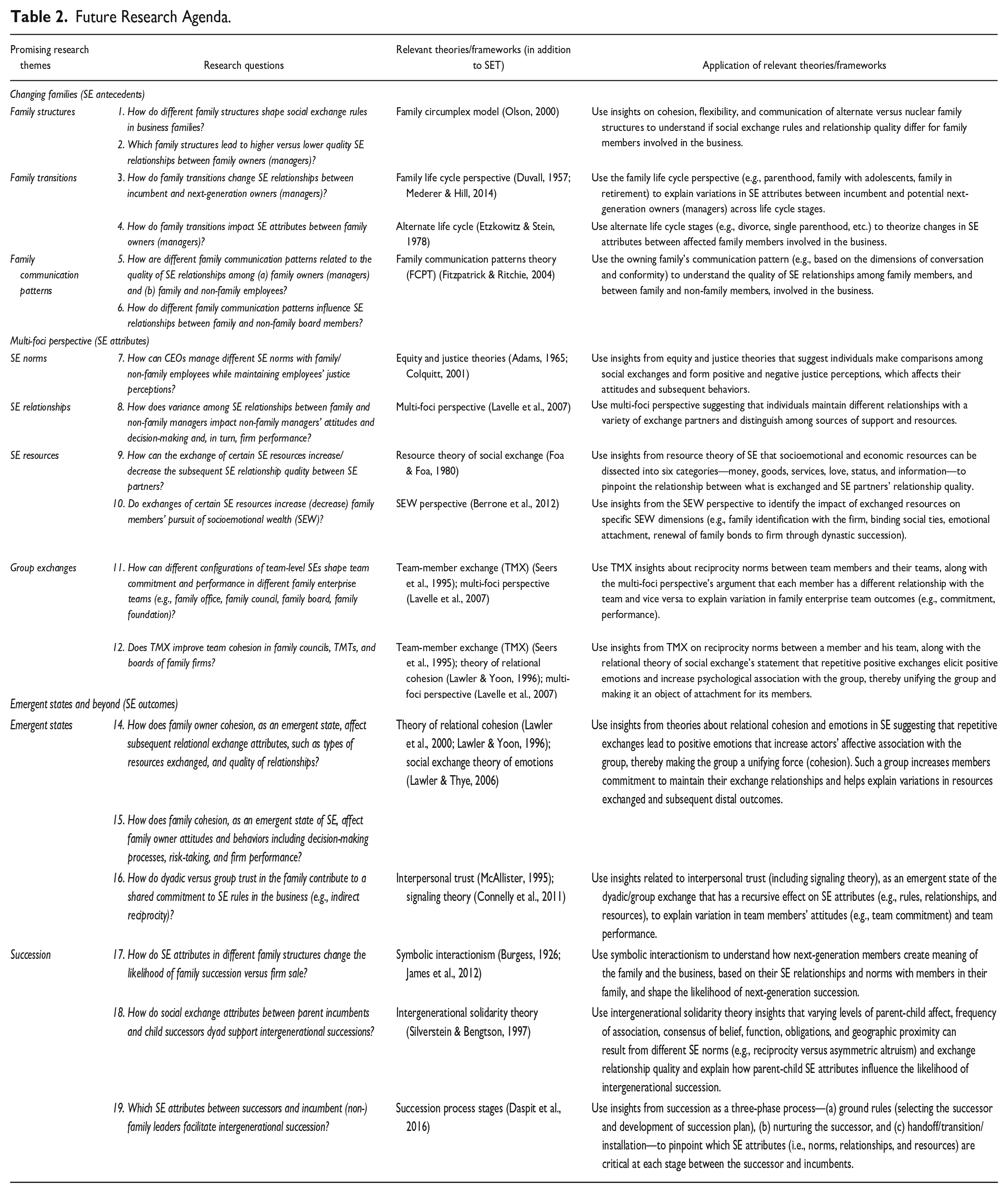
As we described “takeaways” from the reviewed articles studying each of the three SE attributes, we noticed three reoccurring themes that we believe point to a rich set of future research opportunities: (a) changing families, (b) multi-foci relationships, and (c) emergent states. Drawing on family science and organizational behavior research on SET, Table 2 organizes selected research questions under each theme and explains how they might be addressed.
Future Research Agenda.
Changing Families
Families are changing rapidly around the globe (Jaskiewicz & Dyer, 2017), and these changes have important implications for how social exchange relationships evolve in business families. The U.S. Census describes the decline of the nuclear family in the United States since the 1970s and the simultaneous rise of “modern” families—including cohabiting couples, same-sex relationships, and single-parent households (Vespa et al., 2013). U.S. Census data from 2019 show that 50% of U.S. adults live with a spouse (compared to 56% in 2001 and 70% in 1969), while 8% of households are unmarried co-habituating couples (compared to 4% in 2001) (U.S. Census Bureau, 2020). The 2020 U.S. Census data show that although most children live with at least one biological parent, 19% live with either adoptive, step, foster, or grandparents (U.S. Census Bureau, 2021). As sociologists and psychologists show, these changes are transforming individual relationships within and across families (Drapeau et al., 2000; Silverstein & Bengtson, 1997; Steinbach & Hank, 2018).
These changes almost certainly also affect social exchanges in family businesses by influencing the rules applied, the quality of relationships established, and the type of resources exchanged. For example, members of modern family structures such as step and cohabiting families might have less-frequent and less-relevant contact between children and parents (Gilligan et al., 2020; Van der Pas & Van Tilburg, 2010). High-frequency exchanges more often lead to positive sentiments and increase relational cohesion between actors, thereby increasing mutual commitment (Cook et al., 2013). On the other hand, biological siblings are known to have more conflict than step or half siblings (Gilligan et al., 2020; Steinbach & Hank, 2018), so high-frequency contact does not always translate into high-quality social exchanges within a family. Future research is needed to uncover conditions under which different family members develop more positive versus negative social exchanges across an increasing spectrum of actors living and working in an increasing variety of family settings within and across societies.
These relationships are further complicated by family transitions such as parents’ divorce, death, and/or remarriage (Jaskiewicz & Dyer, 2017). Divorce, for example, reduces the frequency of contact between parents and children and among children, leading to less harmonious and more conflict-laden relationships (Drapeau et al., 2000; Van der Pas & Van Tilburg, 2010). In line with the difficulty of daily collaboration following divorce, Jaskiewicz et al. (2021) find that a higher divorce rate reduces the performance benefits of family management (relative to just family ownership) across countries. Because of the number of family relationships affected, family transitions might complicate efforts to understand how family members’ social exchanges develop and impact the family firm. However, such transitions are also often exogenous shocks that might present methodological opportunities to isolate specific social exchange relationships (e.g., parent-stepchild) from other endogenous family characteristics (e.g., cohesion).
Finally, because of the intimate overlap between family and business, family business scholars are in a unique position to “give back” to SET by investigating how changing families impact important individual outcomes (Jaskiewicz et al., 2020). For example, organizational behavior scholars have long been interested in how employees manage the interface between work and other aspects of life (Wayne et al., 2017), and how employers’ actions impact employees’ work-life balance (Lapierre et al., 2018; Vaziri et al., 2022). Family business scholars might contribute by focusing on the other direction: How do changes in the family impact work-life balance, how is such balance managed, and with what consequences for the work of the parents (and their adult children)?
Multi-Foci Relationships
The multi-foci perspective points to unstudied but important aspects of social exchange relationships that are highly relevant to family businesses. It recognizes that individuals maintain different relationships with a variety of exchange partners (Lavelle et al., 2007), which can impact their attitudes and decision-making, and in turn, a firm’s performance.
When studying social exchange rules, researchers often assume that norms of altruism, reciprocity, or generalized exchange apply homogeneously within the business family, often spilling over into other parts of the family and business, and that relationships governed by these rules are superior to more transactional exchanges (Ahrens et al., 2019; Zybura et al., 2021). The assumption of homogeneity was always questionable, and seismic changes in family structures and lives make it more important to question this assumption conceptually and empirically (Jaskiewicz & Dyer, 2017; Silverstein & Bengtson, 1997). Family business involves a wide range of individual and group actors, from family and non-family managers and employees to a variety of family members (e.g., parents, siblings/half-siblings, children/stepchildren, aunts, uncles, and cousins), each of whom connects in different ways.
According to the multi-foci perspective, high-(low-)quality relationships are associated with high (low) identification and commitment toward exchange partners (Lavelle et al., 2007). Applied to family businesses, each family firm is likely influenced by a unique configuration of individuals, each with a unique set of social exchange relationships in the family and/or business. For instance, despite parent-child (e.g., father-son) conflicts, some families will be functional and their businesses successful because a third family member (e.g., the spouse and mother) shares high-quality relationships with both and is therefore able to mediate between them. Thus, in cases where a family’s configuration of relationships interacts in ways that deviate from more homogeneous families, researchers are in danger of making incorrect predictions. The multi-foci perspective can help prevent such errors and provide a more nuanced understanding of the micro-foundations of family businesses (De Massis & Foss, 2018).
The prevalence of many different relationships in family businesses also means that individuals’ comparisons among social exchanges are likely to be meaningful. Equity theory proposes that individuals can perceive exchanges as just or unjust based on comparing their input-output ratios to others in the workplace (or the family), which leads to positive or negative distributive justice perceptions (Adams, 1965; Colquitt, 2001; Colquitt et al., 2001). Negative justice perceptions are linked to low-quality LMX (Park et al., 2015). Our review shows that healthy social exchange relationships within families often extend to non-family employees (e.g., Arz, 2019), especially managers (e.g., De Massis, 2012). The potential for some family members to share generalized exchange relationships while others possess more restricted exchange relationships introduces the potential for different LMX relationships between family members and non-family employees, which could generate judgments of unfairness as described by equity and justice theories. Variance in social exchange relationships among family members and non-family employees, along with resulting equity comparisons among employees, might impact their attitudes (i.e., commitment and identification; Hsueh et al., 2023), decision-making, and firm performance and thus merits future inquiry.
The presence of multi-foci social exchange relationships in family businesses also implies variance in the resources exchanged. The two-part taxonomy of resources—socioemotional and economic (Cropanzano & Ambrose, 2001)—has some parallels with research suggesting that family firms’ strategic choices can focus on the preservation of SEW over the maximization of financial wealth (Gómez-Mejía et al., 2007). Cropanzano and Ambrose (2001) suggest that socioemotional resources are more likely to be exchanged in high-quality SE relationships. However, socioemotional resources can also be exchanged in restricted exchange relationships as part of an effort to increase relationship quality (Cropanzano & Mitchell, 2005). These ideas map directly onto the family business where family members sharing high- (low-)quality SE relationships with each other might focus on different strategic decisions to maintain their family’s socioemotional (financial) wealth. Knowing that some family members are eager to develop generalized exchanges with non-family employees, including managers (e.g., Ahrens et al., 2019), raises questions about whether these members also share SEW with non-family employees and at what economic cost to the family business.
While most of our review focused on one-on-one relationships, organizational behavior researchers have extended the multi-focal view to include group relationships in team settings (Banks et al., 2014; Seers, 1989; Seers et al., 1995). While LMX is often used to explain dyadic interactions between leaders and employees, TMX focuses on horizontal interactions between individual members and their team (Banks et al., 2014). TMX is defined as “the reciprocity between a member and his or her team with respect to the member’s contribution of ideas, feedback, and assistance to other members and, in turn, the member’s receipt of information, help, and recognition from other team members” (Seers et al., 1995, p. 21). Strong TMX indicates a high-quality relationship between the focal individual and other team members.
Family business systems are comprised of families, often divided into households, and top management teams, often comprised of family and non-family employees. Organizational behavior research shows that TMX relationships are distinct from LMX relationships and offer incremental validity above and beyond the effects of LMX (Banks et al., 2014; Seers, 1989), so it will be important to also assess team-level social exchanges and their impact on the family and the business. Indeed, recent research shows that families often own multiple organizations such as the focal family businesses, family start-ups, a family office, and a family foundation that form an ecosystem that collectively contributes to their economic and SEW (De Massis et al., 2021), suggesting that multiple teams involving actors from different groups (e.g., families, non-family shareholders, employees, professional advisors) across multiple family enterprises need to be considered simultaneously. The presence of so many diverse but interconnected teams also gives rise to opportunities for family business researchers to give back to SET by taking steps toward a theory of how different configurations of team-level social exchanges shape team- and organization-level outcomes across connected organizations.
Emergent States
Organizational behavior research points to emergent states as intermediate outcomes of social exchange processes that are yet to draw the attention of family business researchers (Marks et al., 2001; Rapp et al., 2021). Family business researchers tie different aspects of social exchange relationships to important organizational (e.g., firm performance; Kellermanns et al., 2012), group (e.g., conflict management within family branches; Meier & Schier, 2016), and individual (e.g., employee OCB; Madison et al., 2021) outcomes. Organizational behavior scholars, however, have begun to focus on emergent states as the immediate outcomes of interpersonal processes within a dyad or group (Marks et al., 2001). Examples include trust, cohesion, empowerment, confidence, and shared cognition (Korsgaard et al., 2015; Mathieu et al., 2008; Rapp et al., 2021). These do not represent interactions or actions between exchange partners, but rather are proximal outcomes of exchanges that are incorporated into the continuing relationship (Marks et al., 2001). Emergent states are a relatively new focus, and research is ongoing to establish how they emerge from and influence subsequent interpersonal processes and impact more distal outcomes such as team performance (Beal et al., 2003; Marks et al., 2001), individual performance, and satisfaction (Seibert et al., 2004). The evidence thus far suggests that emergent states are relatively fluid and influenced by contextual factors (team diversity, organizational culture; Rapp et al., 2021), input variables (team design, team composition, and team leadership; Rapp et al., 2021), and ongoing interpersonal processes (conflict management, motivation, affect management; Marks et al., 2001). For instance, low group cohesion might make it more difficult to manage existing relationship conflicts among members, thereby further lowering cohesion in the group, sequentially increasing relationship conflict (Marks et al., 2001).
Emergent states appear highly relevant to family businesses at the group (or team) and dyadic levels for explaining the iterative nature of exchanges and the more distal group and firm outcomes. Family cohesion, which signifies connection, affective commitment, mutual support, and a sense of belonging among family members (Barber & Buehler, 1996; Lansberg & Astrachan, 1994), provides one example of a potentially important group-level emergent state. Frequent positive exchanges among family members elicit favorable emotions while reducing individual uncertainty, which increases psychological association with and cohesion within the family (Lawler, 2001; Lawler et al., 2000). Reciprocal obligations among members and the group’s ability to ensure fulfillment of these obligations also grow family cohesion, which can increase the prevalence of generalized exchange norms (Long & Mathews, 2011). These insights suggest that emergent states might help explain the attributes of exchanges needed to impact the quality and norms of subsequent exchanges. Future research might examine, for example, how family cohesion as an emergent state affects subsequent relational exchange attributes, such as types of resources exchanged and important outcomes such as family owners’ attitudes and behaviors toward family succession.
At the dyadic level, trust provides an example of an “emergent property of the dyad” (Korsgaard et al., 2015, p. 48); trust is “bidirectional, wherein each party is at once a trustor and a trustee” (p. 48). Dyadic trust is a state that is influenced by contextual factors, input variables, and exchange partner interaction. For example, asymmetries in individual-level antecedents of trust (e.g., propensity to trust, power dependence) may cause trust asymmetries (Graebner, 2009) that create negative outcomes when individuals realize that what they thought to be a generalized exchange resulting in trust was, in fact, a restricted exchange. Like cohesion, trust is an emergent state that merits future inquiry because it can help explain the more immediate changes in social exchanges and the more distal outcomes in the family and its business.
As with the other broad themes in our research agenda (i.e., changing families and multi-foci social exchanges), family business scholars are in a unique position to contribute to research on emergent states. Unlike in work-only settings where social norms and business policies restrict the extent to which employees act out their emotions, family settings are often characterized by strong emotions and freedom to act on them (Astrachan & Jaskiewicz, 2008; Bee & Neubaum, 2014). Thus, it seems that family firms are a context where still-unidentified new emergent states might be more visible, easing researchers’ efforts to identify the full set of relevant emergent states and trace them back to their social exchange attributes.
Conclusion
We described and summarized what we know about social exchanges in family businesses to date (see Figure 1). Our review also revealed a rich tapestry of future research opportunities, describing a wide variety of social exchange relationships in family business settings, how such relationships emerge, and the consequences of such relationships for the family and the business. We tied these research opportunities to three overarching themes—(a) changing families, (b) multi-foci SE relationships, and (c) emergent states (see Table 2). Pursuing this future agenda offers opportunities for scholars to learn more about social exchanges and their effects within family businesses but also to “give back” (Jaskiewicz et al., 2020) to SET. As our review shows, researchers have already made a great deal of progress, albeit spread across different business domains and often without drawing on SET. We hope that pulling together and summarizing SE research provides a foundation for scholars willing to accept the challenge of deciphering the complex web of social relationships in family businesses and the business families behind them.
Supplemental Material
sj-docx-1-fbr-10.1177_08944865241273435 – Supplemental material for Social Exchanges in Family Businesses: A Review and Future Research Agenda
Supplemental material, sj-docx-1-fbr-10.1177_08944865241273435 for Social Exchanges in Family Businesses: A Review and Future Research Agenda by Ritu Virk, A. J. Corner, James G. Combs and Peter Jaskiewicz in Family Business Review
Footnotes
Acknowledgements
We would like to thank our Editor, Josh Daspit, and the rest of the editorial team (Kristen Madison, Mattias Nordqvist, and Philipp Sieger) for their excellent and constructive feedback to help us improve the article.
Author’s Note
James G. Combs is also affiliated to University of Ottawa, Ottawa, ON, Canada.
Declaration of Conflicting Interests
The author(s) declared no potential conflicts of interest with respect to the research, authorship, and/or publication of this article.
Funding
The author(s) received no financial support for the research, authorship, and/or publication of this article.

Supplemental Material
Supplemental material for this article is available online.
Notes
Author Biographies
References
Supplementary Material
Please find the following supplemental material available below.
For Open Access articles published under a Creative Commons License, all supplemental material carries the same license as the article it is associated with.
For non-Open Access articles published, all supplemental material carries a non-exclusive license, and permission requests for re-use of supplemental material or any part of supplemental material shall be sent directly to the copyright owner as specified in the copyright notice associated with the article.
