




Abstract
Resilience attracts increasing attention across scientific domains, particularly in the context of family businesses, for which the ability to navigate adversity is pivotal for transgenerational success. This systematic literature review investigates 87 publications on organizational resilience in family businesses. Our analysis highlights four distinctive themes of family business resilience: (1) defining family business resilience, (2) long-term orientation and family values, (3) resource and capability endowments, and (4) demonstration of resilience and learning. We contribute to family business research by providing a novel framework and integrated definition, accompanied by a future research agenda.
Introduction
Resilience, broadly defined as a positive adjustment to adversity (Sutcliffe & Vogus, 2003), has become a key factor in explaining how various entities can maintain healthy functioning in complex and challenging environments (Raetze et al., 2022; Southwick et al., 2014). For instance, the concept has been used in reference to children who are able to become well-functioning adults despite experiencing severe childhood adversity (Wright et al., 2013), ecological systems able to absorb environmental changes (Walker et al., 2004), or communities able to adapt to natural disasters (Cutter et al., 2014). Given that competitive landscapes and organizational environments have become increasingly complex as well, as indicated by the increased number of crises in shorter periods of time, such as geopolitical clashes, the COVID-19 pandemic, economic downturns, climate change, and natural disasters (Amann & Jaussaud, 2012; Linnenluecke & Griffiths, 2015; Orhan, 2022), resilience has also attracted increasing interest in management research and related disciplines (Hillmann, 2021; Raetze et al., 2022; T. A. Williams et al., 2017).
In family businesses as a special and the most prevalent form of organization worldwide (La Porta et al., 1999; Tsoutsoura, 2021), resilience is particularly important for several reasons. First, family businesses are especially vulnerable to crises as they experience more resource constraints (De Massis et al., 2018) and diversify less (Gomez-Mejia et al., 2010). Likewise, family businesses are affected not only by external challenges (Soluk et al., 2021), but also by internal ones, such as conflicts between family members (Harvey & Evans, 1994), difficulties in succession planning (Morris et al., 1997), and issues regarding family dynamics and communication (Schmidts, 2013). Second, given the strong overlap between the family and business systems, resilience-triggering events (e.g., crises, conflicts) occurring in the business domain can spill over to the family, and vice versa, thus triggering critical downward spirals (Crouter, 1984). At the same time resilience is particularly important for family businesses as they aim to stay well-functioning and competitive so that next generations can take over a successful business (Lumpkin et al., 2010); the capacity to overcome challenges, however, is a prerequisite for this long-term sustainability (Azouz et al., 2022; Chrisman et al., 2011).
Despite the additional challenges and adversities that family businesses face, empirical evidence shows that family businesses are often more resilient than non-family businesses (e.g., Amann & Jaussaud, 2012; Ding et al., 2021; Eckey & Memmel, 2022). These findings create a scholarly puzzle (Alvesson & Kärreman, 2007) and indicate that there might be an idiosyncratic way of how family businesses develop and enact resilience (Azouz et al., 2022; Danes et al., 2009; Jaskiewicz et al., 2015). To better understand this puzzle, this article provides a comprehensive, systematic literature review of the literature on family business resilience to develop an understanding of organizational resilience in family businesses and to identify opportunities for future research. We hence pose the following research question:
We systematically analyze the current state of this field by reviewing 87 articles focusing on resilience in the family business context. Based on our review, we identify four fundamental themes that distinctly characterize the resilience of family businesses and which we use to organize our synthesis of prior research: (1) defining family business resilience, (2) long-term orientation and family values, (3) resource and capability endowments, and (4) demonstration of resilience and learning. Moreover, our findings uncover shortcomings in the literature, including the application of diverse, yet partially conflicting theoretical perspectives, as well as the application of oversimplified measurement and methodological approaches.
With our review, we offer three main contributions. First, we consolidate prior research and establish the basis for resolving the puzzle of resilience in family business. More precisely, aiming at explaining the how of family business resilience, we develop a framework highlighting the idiosyncrasies of family business resilience. Our comprehensive framework goes beyond the mere assembly of puzzle pieces—it reveals the underlying connections and intricacies, providing the missing key to a deeper understanding of family business resilience, and thus to a new perspective that enables these businesses to survive and thrive in the face of adversity. Second, our research reveals that family business resilience research has developed heterogeneously and that there have been no comprehensive attempts to understand the specific nature of family business resilience. When conducting our review, different perspectives on family business resilience emerged, some of which were borrowed from other fields (e.g., psychology, ecology, supply chain management, and engineering; see, e.g., Acquaah et al., 2011; Darnhofer, 2010), and few of which were explicitly developed for the family business context (e.g., Danes et al., 2009; Stafford et al., 1999). This piecemeal approach limits the ability to build a comprehensive understanding as well as to compare prior research (Podsakoff et al., 2016). We contribute to family business research by providing an inclusive understanding of family business resilience and proposing a cohesive definition of family business resilience, designed to supplant the preceding fragmented approach. Third, as our systematic literature review highlights gaps in the current state of the literature, we contribute by providing an agenda for future research. We point out research questions relevant to the field of family business research as well as the field of organizational resilience research, thereby enabling inbound and outbound theorizing (Jaskiewicz et al., 2020). This approach addresses a critical gap in understanding how the broader field of organizational resilience can draw on the family business literature to enrich established theories (Holt et al., 2018) and enhance our understanding of organizational resilience, which encompasses both family and non-family businesses. Similarly, we encourage the transfer of organizational resilience findings to family business research, facilitating a mutually beneficial exchange of insights between both research fields.
Resilience in Organizations
Our review focuses on family business resilience from an organizational resilience perspective. Organizational resilience has received increasing attention from management scholars in recent years (Hillmann & Guenther, 2021; T. A. Williams et al., 2017) who applied diverse perspectives, such as responses to external threats, organizational reliability, and the adaptability of business models (Linnenluecke, 2017; Raetze et al., 2022). Resilience is generally understood as a combination of capabilities that enable organizations to cope effectively with disruptive events. According to prior resilience research, these capabilities develop over time and through experiential learning (Giustiniano et al., 2018). More specifically, T. A. Williams et al. (2017) have defined resilience as “the process by which an actor (i.e., individual, organization, or community) builds and uses its capability endowments to interact with the environment in a way that positively adjusts and maintains functioning prior, to, during, and following adversity” (p. 742). Within the context of organizational resilience, scholars have proposed different stages, such as anticipation, coping, and adaptation (Duchek, 2020; Raetze et al., 2022). These stages interact and occur in response to disruptive events, allowing organizations to identify threats, develop creative solutions, and explore new possibilities. The literature on organizational resilience highlights a range of capability endowments and routines that contribute to resilience. Organizational-level capability endowments can be behavioral, cognitive, emotional, or relational in nature and may manifest in different stages of a crisis (Lengnick-Hall et al., 2011; T. A. Williams et al., 2017). Behavioral capability endowments refer to the action alternatives, behavioral repertoires, and organizational design elements that enable an organization to process and share information, perform work tasks, and navigate challenges, ultimately enhancing resilience, specifically adaptability in the face of adversity (T. A. Williams et al., 2017). Furthermore, these capabilities encompass improvisation and resourcefulness, allowing organizations to utilize available resources effectively. Cognitive capability endowments encompass constructive conceptual orientation, deep knowledge, and expertise that enable individuals and organizations to effectively apply their understanding, overcome disruptions, and creatively resolve challenges, by swiftly assimilating new information and adjusting assumptions about their environment, thus enhancing adaptive responses and preventing problems from escalating (Lengnick-Hall et al., 2011; T. A. Williams et al., 2017). Emotional capability endowments encompass mental resilience and self-regulation that empower individuals and organizations to effectively manage adverse situations by cultivating emotional fortitude, such as optimism, hope, and emotional attunement, thereby contributing to positive work-related outcomes and enhancing overall resilience (Luthans et al., 2005; T. A. Williams et al., 2017). Finally, relational capability endowments involve social connections that enable resource access and exchange, playing a vital role in guiding actions during adversity and facilitating positive functioning. These capabilities, including building and receiving trust, network relationships, and establishing bonds, provide a foundation for activating cognitive, behavioral, and emotional capacities, crucially impacting resilience outcomes in challenging circumstances (Colquitt et al., 2011; Gittell, 2008).
Method
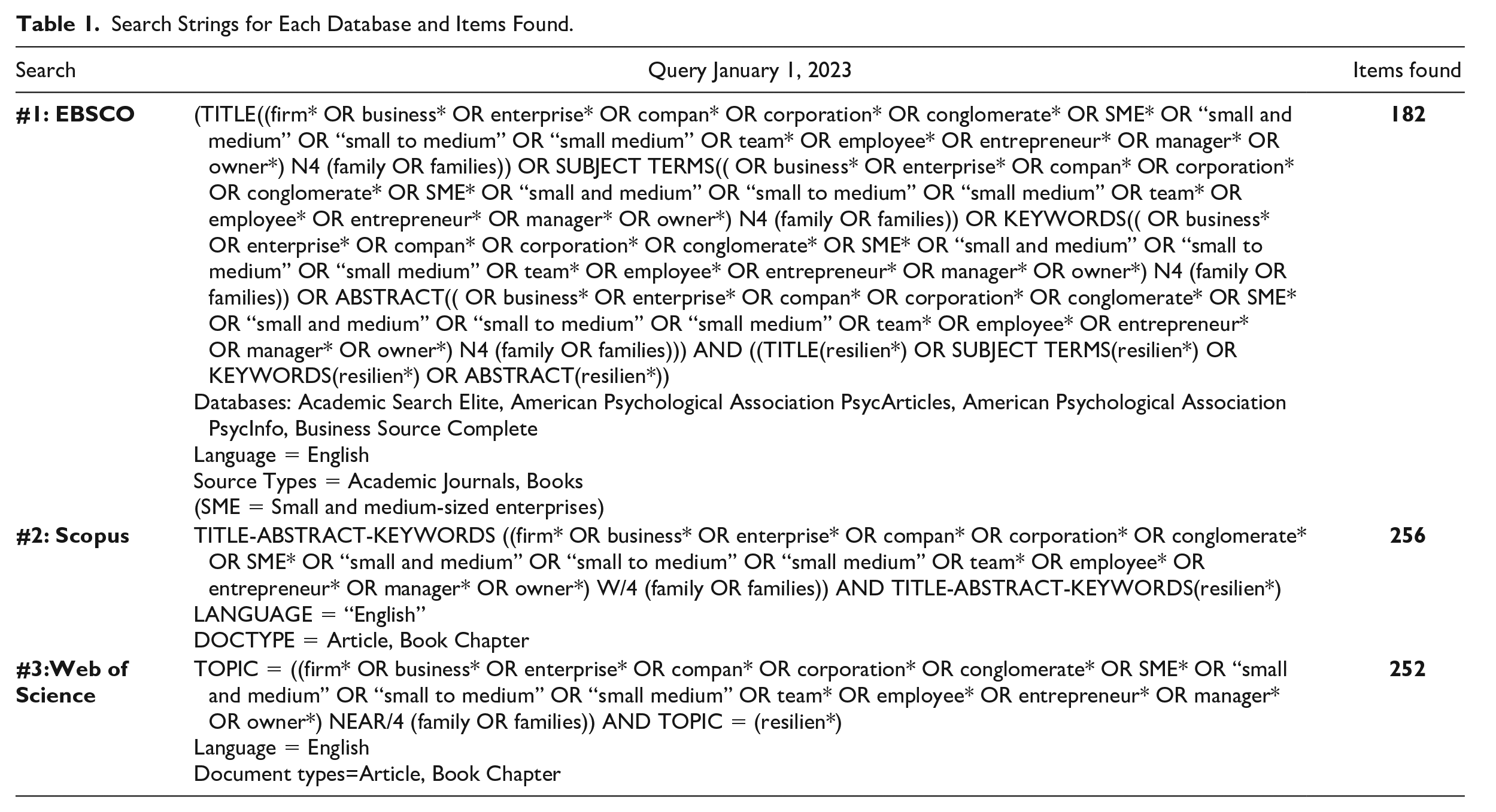
This study is based on a systematic literature review (Aguinis et al., 2023; Hodgkinson & Ford, 2014)—an approach that has been advocated as adequate for identifying and appraising extensive bodies of literature with efficiency and high quality (Tranfield et al., 2003). In addition, we chose this approach to minimize the subjectivity of review and analysis (Hodgkinson & Ford, 2014). We further relied on best practices for conducting systematic literature reviews in the field of family business research (for examples, see Magrelli et al., 2022; Randolph, Alexander, et al., 2022; Stasa & Machek, 2022). The overall literature search and selection process is illustrated in the flow diagram presented in Figure 1. We systematically searched for relevant articles by combining the term “resilien*” with terms that indicate the context of family businesses. For the latter, we applied the NEAR/4 operator to combine the terms “family” or “families” with various terms displaying the focus on firms or lower-level entities working within them (e.g., firm, business, enterprise, small and medium, etc.). We created specific search strings (see Table 1) and searched in title, abstract, and keywords within the interdisciplinary databases Web of Science, EBSCO, and SCOPUS. To ensure scientific quality, we only included articles published in peer-reviewed academic journals and edited research-oriented books. We did not restrict our search to a specific time span. Our initial sample encompassed 395 articles after the exclusion of exact duplicates.
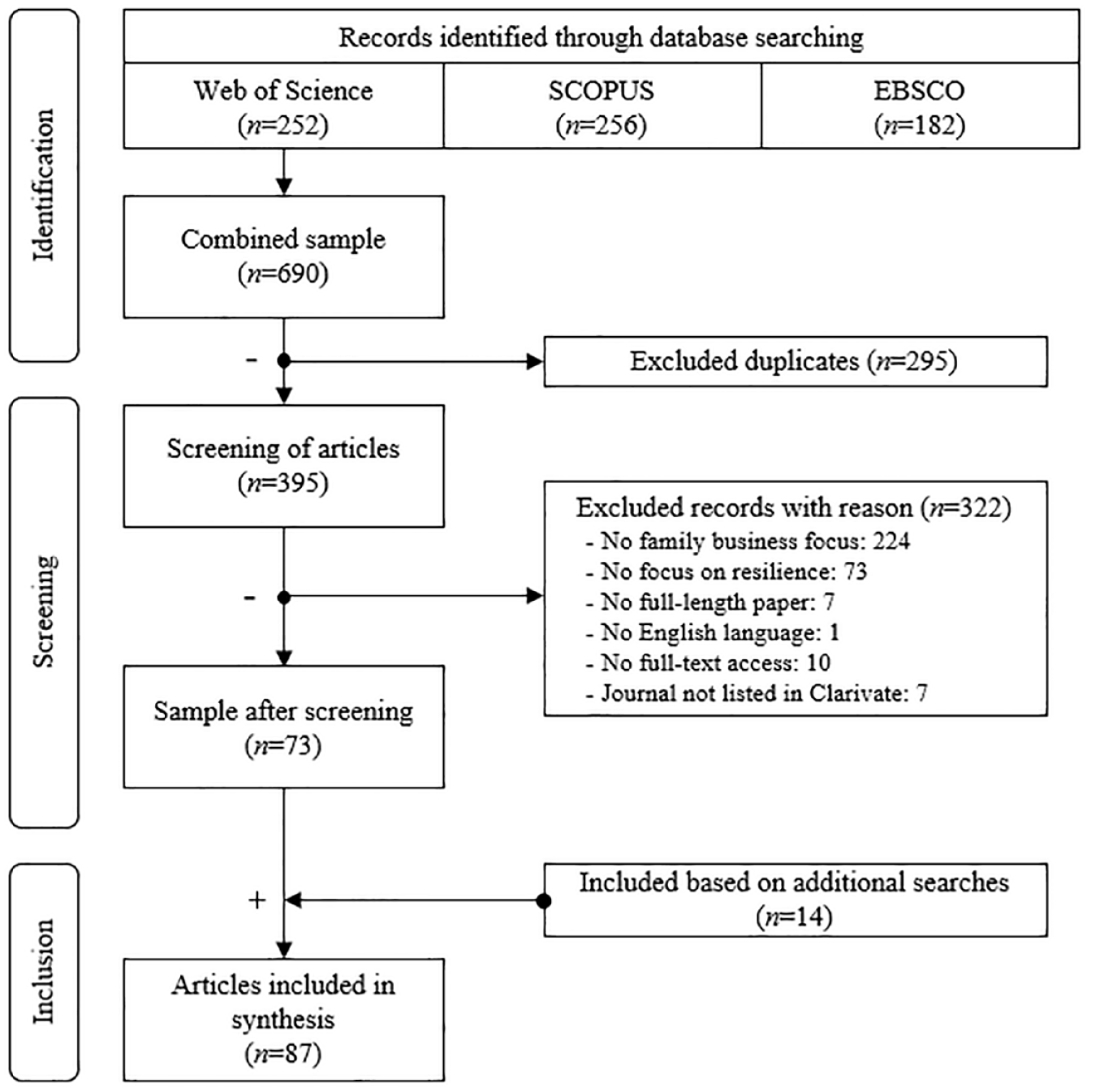
Flow Diagram.
Search Strings for Each Database and Items Found.
In the next step, we screened the 395 identified articles (Becheikh et al., 2006). We excluded articles if they (1) did not focus on resilience as a central concept, 1 (2) did not focus on family businesses, (3) were not written in English, (4) were not a full-length conceptual or empirical study, or (5) were not available as a full-text manuscript despite intense efforts to access them (see flow diagram for complete exclusion and inclusion numbers). The screening was performed by the first and second authors in close collaboration over several rounds (e.g., Aguinis et al., 2023). Challenging cases were discussed within the whole author team until mutual agreement was reached, resulting in a sample of 73 articles. Recognizing that even the most effective search strings may inadvertently overlook certain elements, we also followed the invisible college and ancestry approaches (Cooper, 2015; Vogel, 2012) to identify additional articles. We followed citation trails (Calabrò et al., 2019), contacted subject-matter experts through the Family Enterprise Research Conference LISTSERV email distribution list (more than 800 subscribers worldwide) (Strike et al., 2018), and searched for articles in Google Scholar. This step yielded 14 additional articles. Thus, our final sample consisted of 87 articles starting with the seminal work of Danes et al. (2009) and ending in December 2022. 2
Finally, we systematically analyzed and coded all articles within our sample. For so doing, we leveraged a two-step approach. The first step resulted in a descriptive analysis (Tranfield et al., 2003). Following recent recommendations, this process evolved iteratively and involved several rounds of coding (M. H. Anderson & Lemken, 2023) as well as intensive discussions among the author team (see concept of communicative validity; Kvale, 1995). Based on best practice review articles in the family business context (e.g., Magrelli et al., 2022; Randolph, Alexander, et al., 2022; Stasa & Machek, 2022), we organized the literature according to the following elements across all articles: theoretical perspectives, definitional approaches of resilience in family business and its measurement, level of analysis, methodology, sample description and context, key findings, and future research suggestions. Initially, the first and second authors independently read all 87 articles to become familiar with the sample. Then, the first author performed an initial round of coding which was carefully reviewed by the second author. Next, the first and second authors refined the descriptive analysis over several coding meetings (Fernald & Duclos, 2005). Subsequently, in a second step and as part of the thematic analysis (Tranfield et al., 2003), we proceeded to inductively identify and code themes that were of critical importance in the reviewed papers and were distinctive within the family business literature. Again, an iterative process unfolded, with both, first and second authors independently identifying key themes. Through collaborative deliberation and successive refinements (Kvale, 1995), we collectively distilled four key themes: (1) defining family business resilience, (2) long-term orientation and family values, (3) resource and capability endowments, and (4) demonstration of resilience and learning. Across the coding process, the third and fourth authors acted as external “devil’s advocates” to challenge the assumptions of the authors who had coded the material (MacDougall & Baum, 1997). An overview of all studies building the sample, including the result of the descriptive analysis, can be accessed in the online appendix.
Unveiling the Distinctive Dimensions of Family Business Resilience
To summarize the key findings from our literature review, we developed a framework, which is shown in Figure 2. It encompasses the following four key themes: (1) defining family business resilience, (2) long-term orientation and family values, (3) resource and capability endowments, and (4) demonstration of resilience and learning. Our review of the literature reveals a lack of consensus on definitions of family business resilience, with different interpretations ranging from attribute- and resource-based to outcome- and process-oriented approaches. We propose a comprehensive, process-oriented definition tailored to family businesses to address this conceptual fragmentation. Our literature review further reveals that the long-term orientation and family values of family businesses are the main drivers for their resilience. Embedded within the DNA of family businesses, the long-term orientation and family values serve as the foundation of their resilience, exerting influence over subsequent resource and capability endowments, and shaping the eventual demonstration of resilience. Building on this, the literature shows a strong emphasis on the inherent resource and capability endowments that family businesses possess, which are creating strong social capital (Theme 3.1), involvement of the owner-manager (Theme 3.2), and capacity for strategic renewal (Theme 3.3). Resource and capability endowments are established prior to encountering adverse and challenging circumstances (t−1) and show their potential when adversity hits. This is where the demonstration of resilience unfolds (t0) and refers to the evidence that entities that have faced substantial adversity showcase positive adjustment (outcome following process) (Britt et al., 2016; Hartmann et al., 2020). Subsequently (at t+1), organizational learning occurs, enabling the family business to leverage the experience of coping with, adjusting to, and overcoming forthcoming adverse situations. Hence, a self-reinforcing cycle is set in motion, as experiences drawn from previous crises can lead to modifications (e.g., expansion) in the resource and capability endowments. In the following, we synthesize the existing literature along the four identified themes.

Conceptual Framework on Family Business Resilience.
Theme 1: Defining Family Business Resilience
Our analysis revealed a broad range of conceptual interpretations and definitions of family business resilience in the reviewed articles, highlighting the necessity for a unifying conceptualization that can, in future, guide the field of family business resilience. Despite the widely recognized complexity of the resilience concept (e.g., Raetze et al., 2022; Southwick et al., 2014; T. A. Williams et al., 2017), more than one-third of the articles in our sample did not provide an explicit definition of (family business) resilience. Within the remaining 55 articles, we observed a notable diversity of conceptual definitions. Thirty-eight articles directly (n = 21) or indirectly (n = 17) cited a definition from earlier works, while 17 articles introduced their very own definition either by combining various existing definitions (n = 11) or by suggesting a completely new one (n = 6). Only seven definitions have been used more than once. These definitions originated from family business research (Conz et al., 2020; Danes et al., 2009), research on management and organizational behavior (Lengnick-Hall & Beck, 2009, 2005; Lengnick-Hall et al., 2011; Sutcliffe & Vogus, 2003), and research on social-ecological systems (Walker et al., 2004). Moreover, scholars have adopted definitions from a variety of other disciplines, such as ecology, engineering, psychology, and entrepreneurship. This plurality is in line with the general lack of universally accepted definitions of resilience (Hillmann & Guenther, 2021). Moreover, this multitude of conceptual interpretations has also been mirrored in various operationalizations of resilience. Surprisingly, outcome-based measures have taken the forefront in family business resilience studies, while outcome-based conceptualizations are notably less common (see also Theme 4).
In the following, we categorize the definitions used in family business resilience research, building on categorizations used in extant organizational resilience research (i.e., attribute- and resource-, outcome-, and process-based approaches according to Fisher et al., 2019). Definitions based on attributes and resources refer to factors that “can be drawn upon to help with adversity if/when it occurs” (Fisher et al., 2019, p. 588). This understanding is, for instance, immanent in definitions building on the Sustainable Family Business Theory (SFBT). As a systems-based theory, SFBT emphasizes the sustainability of family businesses, asserting that both short-term business viability and family functionality contribute to this sustainability (Danes et al., 2009). The theory highlights the interplay between family and business systems, particularly at the interface between them, where disruptions occur, resources are managed, and roles are negotiated. SFBT underscores the importance of maintaining resource resilience during stability to effectively address challenges during times of change or disruption. Definitions based on this theory recognize the significance of resource intermingling, multi-dimensional evaluation of achievements, and the interaction between family firms and their communities, considering both normative and non-normative disruptions as influences on family business sustainability (Brewton et al., 2010; Danes et al., 2009; Danes & Stafford, 2011). Here, “family firm resilience capacity refers to a “stock” or “a reservoir” of individual and family resources that cushions the family firm against disruptions” (Danes et al., 2009, p. 336), which include family functional integrity, family structural integrity, and the family’s established pattern of adjusting to disruptions. Further articles in this category conceptualized family firm resilience as a set of attributes. For instance, Ingram and Bratnicka-Myśliwiec (2019) argue that family firm resilience is a two-dimensional capability (i.e., community robustness and creative agility). Moreover, several studies leveraged the work of Lengnick-Hall and Beck (2005) and argued that resilience consists of cognitive, behavioral, and contextual dimensions. Common to all these conceptualizations is that resilience is seen as something that exists before adversity strikes.
Moreover, several definitions refer to a “pattern of outcomes [italics added] that one might expect if adversity has been successfully managed” (Fisher et al., 2019, p. 588). Particularly, authors studying family farms consider resistance and perseverance as the result of demonstrated resilience and emphasize the retention of (business) functioning (e.g., Darnhofer, 2010; Doeksen & Symes, 2015). This perspective is adopted from research on socio-ecological systems, where resilience is usually defined as the capacity to absorb disturbances (Walker et al., 2004). Others considered resilience as bouncing back or recovery from adversities. While bouncing back is found only in those family firm studies that take an individual-level perspective based on positive psychology (Memili et al.,2014, 2013; Wall & Bellamy, 2019), the larger part of articles refers to the ability to recover from situations that could threaten the family business’ existence (Campopiano et al., 2019; Conz et al., 2020; Moreno-Menéndez et al., 2022; van Essen et al., 2015), usually based on definitions originating in organizational behavior and management research (e.g., Lengnick-Hall & Beck, 2005).
Resilience-related processes represent “what resilient [entities] actually experience and do in the context of adversity” (Fisher et al., 2019, p. 590) and are reflected in some of the definitions in our sample. For example, following a socio-ecological conceptualization of resilience (Marshall & Schrank, 2014; Walker et al., 2004), some studies use the reorganization of the family business to maintain functioning under adversities as a process element (Darnhofer, 2010; Wiatt et al., 2021). Danes et al.’s (2009) definition also includes a process component in that they emphasize that collective creativity is used to “solve problems and get the job done” (p. 336), a conceptualization that has been adopted in several studies (e.g., Anggadwita et al., 2022; Brewton et al., 2010; Engeset, 2020). Two more studies (Mihotić et al., 2023; Salvato et al., 2020) have drawn on a recent definition of organizational resilience by Lengnick-Hall et al. (2011, p. 244) to describe family businesses “developing situational responses” and engaging in “transformative activities” to “capitalize on disruptive surprises.”
Overall, our review shows that definitions used for family business resilience are scattered. We conclude that the field of family business resilience would benefit from a comprehensive definition that encompasses both outcomes and resource flows, justifying our introduction of a specific process-based definition tailored to family businesses in response to the lack of a unified conceptualization in the literature. Building on established concepts from organizational resilience research, incorporating a process-oriented approach to defining family business resilience is crucial as it captures the dynamic and ongoing strategies that family businesses employ to navigate challenges and disruptions (Anggadwita et al., 2022; Azouz et al., 2022; Fisher et al., 2019). While an ability, capability, or capacity approach may seem appropriate to capture the potential of resilience, the actual demonstration of resilience is missing within this conceptualization. In sum, most former approaches focus on inherent attributes, rather than emphasizing dynamic processes (Luthar et al., 2000), which involve learning from crises and adapting positively (Beech et al., 2020). Recent research, however, supports a process view, recognizing resilience within a temporal context that includes reaction to adverse stimuli and subsequent coping efforts (Azouz et al., 2022; Smith et al., 2023). Furthermore, a definition that underlines the significance of different stakeholders, including the family, individuals (e.g., owner or owner-manager), and the organization itself is needed because family businesses often have intricate interdependencies among these units of analysis. The definition by Danes et al. (2009), which adopts a capacity perspective, seems closest to the desired state of a valid conceptualization of family business resilience as it emphasizes the importance of individual and family resources. However, this definition lacks concrete outcomes (i.e., short- vs. long-term) and a distinction between the types of adversity (i.e., persistent stressors vs. discontinuous events). Furthermore, we consider a broader specification of processes (as opposed “to solve problems,” p. 336) to be more applicable and in line with the current state of research on organizational resilience (i.e., often referred to as more general processes to positively adjust despite adversity). In addition, an all-encompassing definition that considers the long-term orientation and resource balance between family and business systems within family enterprises, in line with the goal of a successful intergenerational business transfer (Lumpkin et al., 2010), would provide a more accurate representation, particularly given that this intergenerational focus is a defining characteristic of family businesses, a feature lacking in standard definitions of organizational resilience. Based on these considerations and our findings of missing elements that future research needs to investigate (see below), we propose a novel conceptualization and define family business resilience as the process of positive individual, family/non-family group, and organizational adjustment to persistent stressors and discontinuous events, supported by idiosyncratic resource endowments, leading to the functional and structural integrity and functioning of the family business in the short term and to family business longevity in the long term.
Theme 2: Long-Term Orientation and Family Values
The literature on family business resilience agrees that the long-term orientation, a central component of their cognitive capabilities (Lumpkin & Brigham, 2011), is a main driver of their resilience (n=36) (e.g., Acquaah et al., 2011; Amann & Jaussaud, 2012; Beech et al., 2020; Calabrò et al., 2021). Long-term orientation has been named the “key differentiator” (Moreno-Menéndez et al., 2022, p. 430) that distinguishes resilience in family firms from that in non-family organizations. Family businesses exhibit a unique sense of responsibility toward past and subsequent generations, perceiving the business as a cherished heirloom that demands carrying the burden of preserving it for future generations (Smith et al., 2023). This long-term orientation is substantiated by various theoretical foundations that explain family businesses’ behavior and strategic decision-making (Davis et al., 1997; Le Breton-Miller & Miller, 2009). For instance, stewardship theory emphasizes responsible and sustainable resource management for the benefit of future generations, aligning well with the family businesses’ desire to preserve the firm’s legacy across generations (Brunelli et al., 2023). Furthermore, the socio-emotional wealth (SEW) perspective (Gomez-Mejia et al., 2007) suggests that family businesses prioritize non-economic attributes, such as reputation, identity, binding ties, and emotional attachment to the business, over mere financial gains, which also affects their reaction to adversity (Eckey & Memmel, 2022). Specifically, the pursuit of SEW drives family businesses to prioritize the long-term health and well-being of the business, contributing substantially to their resilience during adverse times. The long-term orientation of family businesses manifests itself in several ways. For instance, family businesses tend to build enduring relationships with stakeholders, including customers, suppliers, and employees (Gomez-Mejia et al., 2011). These trustful relationships foster higher levels of loyalty and commitment from stakeholders, creating a safety net during economic downturns and contributing to the firm’s overall resilience (Miller et al., 2008, 2009).
In addition, family values, defined as deeply held beliefs and principles (Distelberg & Blow, 2010), along with other aspects of cognitive capabilities, seem to play a pivotal role in strengthening family businesses’ resilience as they determine long-term goals such as stable revenues, a good reputation, and shared identity (Hammouda & Basly, 2020). Family values, which include loyalty, trust, commitment, willingness to work hard, severe austerity, wage sacrifice, and altruism, form the bedrock of a family business and create a strong sense of cohesion and unity (Eckey & Memmel, 2022; Hammouda & Basly, 2020; Minichilli et al., 2016). The transition of values and deep trust fosters commitment to the firm’s success and continuity, acting as a cushion during times of crisis (Gomez-Mejia et al., 2011; Miller et al., 2008). Moreover, family values affect leadership styles in family businesses (Hall & Nordqvist, 2008). Strong commitment to family values fosters responsible and ethical leadership, as family members are motivated by the desire to protect the family’s reputation and legacy (Aronoff, 2004). Such responsible leadership contributes to the long-term sustainability and resilience of the family business, because it ensures that the cultural coherence and harmony necessary for effective decision-making and adaptation are upheld, fostering a stronger foundation for enduring success (Hall & Nordqvist, 2008). In this vein, the founders or, in later generations, the owner-managers play a central role as leadership is influenced by their long-term vision, allowing them to anticipate future events and shape the company’s trajectory accordingly (Alonso, 2016).
In addition, research has shown that the long-term orientation of family businesses fosters knowledge-sharing, transgenerational learning, and investment in firm-specific routines for identifying opportunities, which further foster resilience (Conz et al., 2020). Long-term orientation, however, does not only concern the future; yet as a multi-dimensional construct involving futurity, continuity, and perseverance (Czakon et al., 2023), it also considers the firm’s long past. The weathering of past crises (e.g., financial crises, wars, family internal conflict) provides family businesses and owner-managers with the experience and confidence to also master future crises (Jaskiewicz et al., 2015). Moreover, research suggests that family values play a crucial role in the succession planning process (Handler, 1994). Family values encourage family businesses to invest considerable effort in grooming and preparing the next generation to take over leadership roles, ensuring the firm’s stability and resilience over generations (Letonja & Duh, 2016; R. I. Williams & Mullane, 2019). The emphasis on a seamless transition of leadership reflects the family’s commitment to long-term business continuity.
Research also reveals that the long-term focus on non-economic family goals such as maintaining ultimate control allows family businesses to operate with more organizational slack, which may be perceived as inefficient in stable times, but contributes to greater robustness in the face of unanticipated shocks (Eckey & Memmel, 2022). Thus, this slack can be seen as family business investment in the future to build a strategic renewal capacity. Family businesses often align strategic decisions with non-economic goals and the firm’s mission, reflecting their commitment to preserving family values and legacy over generations (Chrisman et al., 2005; Dyer & Whetten, 2006). During times of economic downturns, this focus on SEW and family-centered non-economic goals might have a positive effect on a firm’s performance, signaling to investors and external stakeholders the intention to react quickly and take any necessary measures required to keep the business afloat (Eckey & Memmel, 2022). In addition, studies also show that family businesses, due to their long-term orientation, often exhibit higher levels of risk aversion (Bürgel et al., 2023). They are more inclined to stay in stable and traditional markets (de Groote et al., 2023) and resist early and resource-intense adoption of disruptive technologies (König et al., 2013). While this risk aversion may limit growth during economic upturns and is dangerous in case of ultimately successful disruptions, it acts as a protective measure during downturns, generally enhancing family businesses’ resilience (Calabrò et al., 2021; Le Breton-Miller & Miller, 2022). Their cautious approach to risk management can help family businesses weather turbulent economic times more effectively (Bürgel et al., 2023). Family-centered non-economic goals encourage patient capital and long-term investments, safeguarding the family’s investment from transient turbulences (Campopiano et al., 2019). When facing uncertainties or unanticipated major shocks, family firms consciously consider socio-emotional and financial performance-driven logic, enhancing their resilience (Czakon et al., 2023).
Theme 3: Resource and Capability Endowments
With the understanding that long-term orientation and family values are the main drivers of resilience in family businesses, exploring how they shape resilience is crucial. Within the family business resilience literature, a substantial emphasis is placed on the distinctive resource and capability endowments (n = 65) that arise from and are intricately interwoven with family businesses’ long-term orientation and family values. In line with the resource-based view (Habbershon & Williams, 1999) and the SFBT (Danes et al., 2009), resource and capability endowments provide family businesses with the capacity to effectively withstand crises and adversity (e.g., Brewton et al., 2010; Danes et al., 2009; Mzid, 2017). Below, we will focus on three pivotal resource and capability endowments that emerged from our review: building and sustaining strong social capital (Theme 3.1), involvement of the owner-manager (Theme 3.2), and the capacity for strategic renewal (Theme 3.3).
Theme 3.1: Building and Sustaining Strong Social Capital
Most of the articles we have reviewed (n = 38) emphasized that the strong social capital that family businesses build over time acts as a central resource endowment that can be utilized for resilient responses to adversity (e.g., Azouz et al., 2022; Mahto et al., 2022; Mihotić et al., 2023). Referred to as “social capital” in the context of family business resilience (Nahapiet & Ghoshal, 1998; Stasa & Machek, 2022), the endowment of relational capability can be described as the reservoir of goodwill and robust relationships between family members and their external stakeholders, enabling them to facilitate actions and create value across generations (for a recent review on social capital, see Stasa & Machek, 2022). Social capital arises from history, trust, respect, loyalty, and altruism between family members, employees, and external stakeholders (Hammouda & Basly, 2020; Rodriguez et al., 2013; Smith et al., 2023) and can hence be seen as a consequence of family businesses’ focus on long-term orientation and family values. 3
Studies on family business resilience have shown that family businesses with strong social capital are more likely to receive support from stakeholders (e.g., government, banks, and families) during difficult times, such as payment facilities or extended credit terms (Mahto et al., 2022). Social capital also supports knowledge accumulation, fostering a valuable exchange across generations within family businesses. For instance, a newly entering family member can combine and extend existing owner-managers industry expertise, thereby adding value to both the family business and the customer (Alonso & Kok, 2021). Further studies highlighted the important role of strong family ties and respect (Discua Cruz et al., 2019; Engeset, 2020), but also the role of family members’ relationships with external stakeholders (Mzid, 2017; Mzid et al., 2019) as key factors in their ability to absorb shocks, implement collaborative strategies, and cope with disturbances, ensuring survival. Amaral and Da Rocha (2023) empirically revealed that the development of social capital (through constant contact with customers) was considered the most important resource for small businesses’ survival during prolonged disruptions. Other studies examined different facets and forms of social capital. For example, Azouz et al. (2022) defined religion as a form of social capital and found, based on an ethnographic study of a Middle Eastern faith-led family firm, that religious beliefs fostered business family resilience (i.e., family spiritual resignation, family capital mobilization, and family optimal arbitration). Studying Croatian family businesses from manufacturing and service industries, Mihotić et al. (2023) distinguished between social capital in retrospective (i.e., targeted use of social capital to maintain organizational functioning) and prospective ways (i.e., use of social capital in a strategic way to adapt to new circumstances). Their findings revealed that firms adopting a retrospective approach mitigated disruptions by maintaining their presence in familiar markets and adhering to familiar business models from before market disruption, thereby demonstrating resilience. Conversely, family businesses with a prospective approach leveraged their social capital to capitalize on emerging and novel opportunities (i.e., bouncing forward) that emerged in the wake of the disruptive event. Furthermore, studies have shown that family internal social capital, in particular, fosters trust, respect, and love among family members and can be transferred to the business setting, promoting cooperation and flexibility (Brewton et al., 2010). It also attracts other family resources to the business and serves as a reliable source of resilience during disruptions (Danes & Stafford, 2011). Overall, it becomes evident that social capital plays a critical role in mobilizing and effectively transforming resources into mechanisms that facilitate positive adaptation—a dynamic that can be observed both in times of crisis and in more stable periods.
Theme 3.2: Involvement of the Owner-Manager
Another group of studies (n = 16) identified the owner-manager as a pivotal resource that helps generate family business resilience. Considering the owner-manager’s ultimate authority within the family business, it is reasonable to assume that their personal characteristics, resources as well as their relational, cognitive, behavioral, and emotional capabilities will shape the strategic choices and decision-making processes within their firm (Finkelstein & Hambrick, 1990). The owner-manager as central family business member is hence an important research area (Santoro et al., 2021; Wall & Bellamy, 2019). From a theoretical perspective, agency theory suggests that owner-managers demonstrate a strong and enduring commitment to their firms (McConaughy, 2000), in line with the long-term orientation arguments provided above, and aim to protect both the family’s wealth and reputation by quickly addressing any external threats (Minichilli et al., 2016). Such swiftness in reaction characterizes family business owner-managers, as they would particularly suffer from failure (Cater & Beal, 2014), leading to higher levels of resilience. For instance, late or even no reaction to crises might entail the loss of family wealth, a negative public perception of the family name, and the endangerment of the family’s legacy (Calabrò et al., 2021). Hence, it is in the owner-manager’s best interest to weather the storm and lead the family business effectively (Mahto et al., 2022)—in contrast to non-family managers who might simply start looking for new job opportunities—which makes owner-manager involvement in the form of quick and effective reaction patterns and leadership a valuable resource for resilience in family businesses.
How resilient family businesses act in adverse situations depends on how the owner-manager understands resilience. This understanding is shaped by his or her view and interpretation of the world (Conz et al., 2020). In addition, personal characteristics and traits of owner-managers influence resilient behaviors in family businesses as resilient owner-managers could equip their employees with a resilient mind-set (Santoro et al., 2021). Investigating 195 small family businesses, Santoro and colleagues (2021) elucidated a positive correlation between the owner-managers inclination toward personal resilience and the subsequent impact on employee-level resilience. Moreover, studies revealed a positive relationship between family owner-manager experience (i.e., years in the industry) and firm-level resilience (Stafford et al., 2010; Wiatt et al., 2021). Further studies identified owner-manager attributes such as their entrepreneurial mind-set, willingness to work hard, low-risk aversion, and decision-making flexibility as drivers for organizational resilience in family businesses (Casprini et al., 2023; Engeset, 2020; Hammouda & Basly, 2020). Moreover, in their qualitative study on micro and small firms, Sakellarios et al. (2022) found that owners’ self-initiative, financial acumen, and intrinsic motivation (i.e., passion, drive) allowed them to engage in resilient actions during the global economic crisis between 2007 and 2008, resulting in firm survival. Others found evidence for individual attributes of family owners being linked to their individual-level resilience (Wall & Bellamy, 2019) and proposed that such individual-level resilience may lead to leadership resilience (e.g., personalized communication, alertness, and stewardship) and ultimately imply firm-level resilience (Hadjielias et al., 2022). Another potential individual-level attribute driving resilience in family businesses is the owner-manager’s gender. For instance, Casprini et al. (2023) focused on how different types of growth goals led to proactive organizational resilience in family-run wineries, contingent on the owner-manager gender. In women-led wineries, organizational resilience was influenced by quantitative growth goals, such as profit and turnover, while in nonwomen-led wineries, it was influenced by qualitative growth goals, emphasizing innovation, product quality, and brand. Focusing on the cognitive capabilities of family business owner-managers, Czakon et al. (2023) found that the sensemaking (i.e., the reframing of the experience of major crisis events into a successful survival story) depended on the owner-managers memory of past events and generational involvement (see also Jaskiewicz et al., 2015; Zehrer & Leiß, 2019).
Ultimately, it should be noted that the owner-manager also plays a crucial role in building and sustaining social capital. Memili et al. (2013) showed that owner-managers play an influential role in leadership by establishing and shaping the vision and culture of the family business; they disseminate historical information and provide information on the context throughout the organization (i.e., among family and non-family employees), which can lead to high-quality relationships and trust, and hence develop social capital more than typically observed in non-family businesses.
Theme 3.3: Capacity for Strategic Renewal
In addition to social capital and owner-manager resource endowments, extant studies (n = 11) focused on strategic renewal capacity as a factor shaping the resilience of family businesses. The capacity for strategic renewal in family businesses can be considered an example of a behavioral capability endowment because it encompasses the action alternatives and organizational design elements that enable these businesses to adapt, innovate, and navigate challenges, contributing to their overall resilience. It pertains to a firm’s ability to envision future prospects, and it encompasses not only the ability to absorb external disruptions but also acknowledges that firms, in particular family businesses, necessitate innovation through the exploration of novel solutions, new ventures, or a reevaluation of management methodologies (Mzid, 2017). In other words, through the capacity for strategic renewal, family businesses invest in the future before a crisis hits. This helps them to be ready to adapt when adversity actually hits. Focusing on the strategic renewal capacity, several studies scrutinized the time before a discontinuous event and analyzed family firms’ processes aiming to reduce firm vulnerability and/or increase its ability to respond to disruptions (Crespi-Vallbona & Plana-Farran, 2022; Demmer et al., 2011; Doeksen & Symes, 2015). Further studies found that family businesses used proactive strategies to increase resilience: By seizing market opportunities, they changed and/or innovated before adversity occurred and thus reduced risks and were prepared for future adverse events (e.g., González & Pérez-Uribe, 2021; Lin & Wen, 2021).
The way in which strategic renewal is shaped in family businesses is closely linked to their social capital and their owner-manager. Particularly in times of crisis, the network of relationships that family businesses have, including external partners (i.e., external social capital), makes it possible to exploit synergies with companies in the same difficult situation (Amaral & Da Rocha, 2023; Azouz et al., 2022; Mzid et al., 2019). Even in the case of conventionally competitive business environments, family businesses support each other, for example by forming partnerships to overcome the crisis together. Here, too, long-term orientation takes precedence over direct competition—a behavior that is less evident in non-family businesses in crisis-like situations (Mzid, 2017). However, these social networks may not only come from within the firm but also from the owner-managers themselves. The owner-manager’s personal skills (e.g., ingenuity, awareness of innovation, and curiosity) combined with her or his social network can provide advantages in developing knowledge structures (e.g., information regarding local market conditions, competition, and technological trends) necessary for successful opportunity identification (Mzid, 2017; Stafford et al., 2013), and thus for resilience.
Theme 4: Demonstration of Resilience and Learning
Resource and capability endowments only hold value when they are effectively put into action—translated into processes that demonstrate resilience, ultimately yielding positive outcomes. In comparison to the exploration of resource and capability endowments, this theme has garnered relatively less attention in the family business context (n = 24). Nonetheless, there are preliminary discoveries in this domain that warrant further in-depth exploration. There are two aspects to this last theme: (1) the demonstration of resilient behavior resulting in positive outcome trajectories (n = 17), and (2) a recursive learning cycle linking the successful overcoming of adversity to the restoration of depleted/invested resource and capability endowments (n = 7). While processes and outcomes emerged as a very important theme in our inductive coding, authors, surprisingly, did not often distinguish between family firm-idiosyncratic processes and outcomes and those that could also be found in other organizations.
For instance, in line with general organizational resilience literature, family business resilience literature has highlighted resilience processes such as the creation of space for common reflection and activity diversification (Mzid, 2017), adaptation of the business model by changing the value proposition of the firm (Brunelli et al., 2023), or leveraging new marketing and distribution channels such as digital social media channels or delivery services (Anggadwita et al., 2022). Regarding the subsequent outcome trajectories following the demonstration of resilience, most family business resilience studies measured resilience indirectly via short-term, firm-level outcomes. For example, studies based on secondary data used superior financial performance (compared to non-family businesses) during or following adversity as indicator for the demonstration of resilience (Amann & Jaussaud, 2012; Ding et al., 2021; Eckey & Memmel, 2022; van Essen et al., 2015). Additional variables included firm success (Wiatt et al., 2021), firm survival (Iborra et al., 2019), and firm entrepreneurial orientation (Moreno-Menéndez et al., 2022).
Focusing on family business idiosyncrasies, processes often used by family businesses were the exploitation of slack resources from within the business family (e.g., Campopiano et al., 2019; Hadjielias et al., 2022), but also the acquisition of external resources, for instance, by hiring temporary help or asking others for support (e.g., González & Pérez-Uribe, 2021; Pomeroy, 2015). Also, various interpersonal processes such as open and honest communication and employee-focused leadership have been leveraged by family businesses to maintain trustful relationships during adversity (e.g., Campopiano et al., 2019; Mihotić et al., 2023; Zehrer & Leiß, 2019). This is particularly evident in family businesses, as the long-term focus encourages investment in trusting relationships, as these contribute to the sustainability of the business. In contrast, non-family businesses may prioritize short-term profits over building long-term relationships (Miller et al., 2008). Another process involved the accumulation and transfer of intergenerational knowledge to achieve resilience within the family business (e.g., Alonso & Kok, 2021; Discua Cruz et al., 2022; Zehrer & Leiß, 2019). For instance, the study by Discua Cruz and colleagues (2022) found that women actively encourage the sharing of unique business insights from one generation to the next, thus fostering closer family ties. This transfer of knowledge was facilitated through the mentoring of younger family members by senior ones, with families often residing near their businesses. Consequently, children were immersed in the family business environment from an early age, guided by their mothers to understand its fundamental aspects and engage in joint decision-making. Another example of a unique resilience process within family businesses was presented in a study by Azouz and colleagues (2022) Their research delved into the impact of religiosity within the family on the resilience of family-owned businesses. More specifically, family business resilience unfolded in distinct phases, starting with the “resistance phase,” where families draw on their faith and trust in destiny to passively confront adversity, subsequently setting the stage for the “rebound phase,” characterized by proactive resource mobilization driven by their religious commitment to assist others and foster trust relationships. Throughout, the family’s religiosity, particularly “feeling of god’s presence” and “showing mercy to others,” guided their responses to adversity, promoting mutual assistance, trust, and pivotal decisions to ensure ongoing success and resilience. Regarding the outcomes following the demonstration of resilience, only a few studies measured family business idiosyncratic outcome variables. For instance, Jang and Danes (2013) measured role interference of family business owners. More specifically, they investigated why and how family business owners experienced interference between their roles within the family and the business. The study found that the patterns of adjustment strategies used by owners explained most variation in role interference. When family resources were used for the business, this often led to role interference. The study also showed that the number of hours worked by the owners and their spouses in the business had a significant impact on role interference. When both worked long hours in the business, interference increased, but if the family had effective coping strategies, it decreased. Another example involved the measurement of entrepreneurial culture across generations (Hanson et al., 2019; Jaskiewicz et al., 2015). These studies have revealed that entrepreneurial culture is shaped by factors such as relational ethics, as demonstrated by the work of Hanson and colleagues. In addition, the concept of entrepreneurial legacy plays a pivotal role, involving the reimagining and communication of the family’s past entrepreneurial successes. This, in turn, serves as a motivating force, encouraging present and future generations to actively engage in entrepreneurial and strategic endeavors (Jaskiewicz et al., 2015). Ultimately, our analysis shows that the unique characteristics of resilience processes and outcomes in family businesses remain largely unexplored.
Responding to adversity also offers the opportunity to develop new insights via feedback loops and learning. Learning and feedback loops are dynamic processes and are especially crucial for intergenerational family businesses (Mzid, 2017). These can be seen as expansion of endowments, meaning in this context that firms leverage their experience that allows them to learn from the crisis to be prepared for future adversities. A very small set of articles (n = 7) focused on feedback and learning processes once the family business’ response to adversity has ended (Anggadwita et al., 2022; González & Pérez-Uribe, 2021; Hammouda & Basly, 2020). Some family businesses engaged in reflection processes following adversity to learn from failures and become better prepared than before for future challenges (Mzid, 2017; Prasad et al., 2015). These reflection processes can enhance the accumulation of knowledge and can together with the transformation of explicit knowledge (i.e., systematic and formal) into tacit knowledge (i.e., valuable, hardly transferable, and built through firsthand experiences) lead to efficiency gains, new product development and ultimately to the increased resilience of the family business (Alonso & Kok, 2021). Tacit knowledge is particularly important when facing unforeseen events that explicit knowledge might not fully address. Ultimately, gleaned through learning processes, some case studies found that family businesses that demonstrate a high awareness of weak signals can proactively engage in the identification of disruptions and changes, which allows them to respond to threats at an early stage, minimize their impact or even capitalize on them (i.e., anticipation) (e.g., Ingram & Glód, 2018; Mzid, 2017).
Discussion and Agenda for Future Research
Beyond summarizing the current state of literature, our systematic review provides three main contributions to (family business) resilience research. First, echoing the proposed aim to lay the foundation for solving the puzzle family business resilience represents (i.e., how do family business idiosyncrasies unfold in the context of organizational resilience?), we contribute to the family business resilience literature by highlighting that the family business-specific resource and capability endowments seem to be the key to their superior resilience compared to non-family businesses, despite the unique challenges they are likely to face. These endowments seem invisible in stable times but become strong enablers of organizational resilience in times of crisis (e.g., Eckey & Memmel, 2022; Stafford et al., 2010). The main driver for the development of such resilience resources is the idiosyncratic long-term orientation and family values of family businesses and their impact on family capital (e.g., patient capital, activation of social capital in times of crisis, loyal and committed employees; Calabrò et al., 2021; Campopiano et al., 2019), on the involvement of the owner-manager (e.g., Hadjielias et al., 2022; Santoro et al., 2021), and on the capacity for strategic renewal (e.g., Anggadwita et al., 2022; Mzid, 2017). These resource and capability endowments are utilized during times of hardship and adversity to facilitate the demonstration of resilience. This, in turn, naturally results in a positive or resilient outcome, subsequently fostering (intergenerational) learning.
Second, we contribute by providing a comprehensive understanding of family business resilience based on the current state-of-the-art of resilience research, which has been missing so far due to the lack of a clear conceptualization (Caza et al., 2020). To date, resilience in family businesses has been conceptualized in very heterogeneous ways. It is therefore not surprising that this diversity of conceptualizations has also led to empirical studies being carried out in theoretically and empirically inconsistent ways. This finding highlights the necessity for a more nuanced and at the same time unified understanding of resilience within family businesses. Building upon the integrated definition that we introduced above, we contribute to the family business literature by proposing an expanded framework for understanding resilience in family businesses, encompassing all relevant elements of organizational resilience. By including a process understanding, adversity triggers, different outcome categories, and a multilevel perspective, we strive for a comprehensive and robust conceptualization of family business resilience, thereby enabling future research to develop more coherently. This dynamic process perspective is also in line with recent conceptualizations of resilience outside the field of family business research (Fisher et al., 2019; Raetze et al., 2022; T. A. Williams et al., 2017). Therefore, this conceptualization can further contribute to future cross-fertilization of family business research with resilience research in other fields of study. Overall, we note that family business resilience represents a distinct form of resilience. The inclusion of the family system introduces an added layer of complexity (Handler, 1989), resulting in scenarios where a family business might exhibit organizational resilience due to the effectiveness of its system-wide processes and procedures in mitigating adversities and crises. However, despite organizational resilience, the family may decide to part ways due to significant disagreements and disputes, opting to sue each other or sell the business as a result (Alderson, 2015). In this scenario, the resulting outcome is a lack of resilience for the family and, ultimately, their business.
Third, we contribute to resilience research within the field of family business research and beyond by providing an agenda for future research, as outlined below. Our systematic literature review has revealed several pathways for future research on family business resilience linked to underrepresented themes within our framework. In the following future research agenda, we will integrate insights from the more mature research on organizational resilience. By doing so, we contribute to the literature on family business resilience by bridging the gap between family firm studies’ focus on the relationship between resilience resources and firm economic outcomes (e.g., Campopiano et al., 2019; Eckey & Memmel, 2022; Iborra et al., 2019), and organizational resilience studies’ emphasis on the process and multilevel nature of resilience (Fisher et al., 2019; Raetze et al., 2021; T. A. Williams et al., 2017). This approach provides valuable opportunities for interdisciplinary knowledge exchange and cross-fertilization for both fields (i.e., inbound theorizing; see future directions 1 and 2). Subsequently, we will discuss another future research direction that arose due to a notable shortcoming in the current understanding of family business resilience. This shortcoming involves a predominant emphasis on comparing the financial superiority (i.e., resilience) of family and non-family businesses, while neglecting family business heterogeneity (see future research direction 3). As such, we develop an agenda for future research on family business resilience by addressing the main gaps identified in existing research. Research in these areas will help future scholarship to embrace the complexity of family business resilience, which will contribute to further understanding the puzzle that family business resilience might still partly represent. Table 2 provides a summary of the future research agenda and concrete research questions.
Future Research Questions.
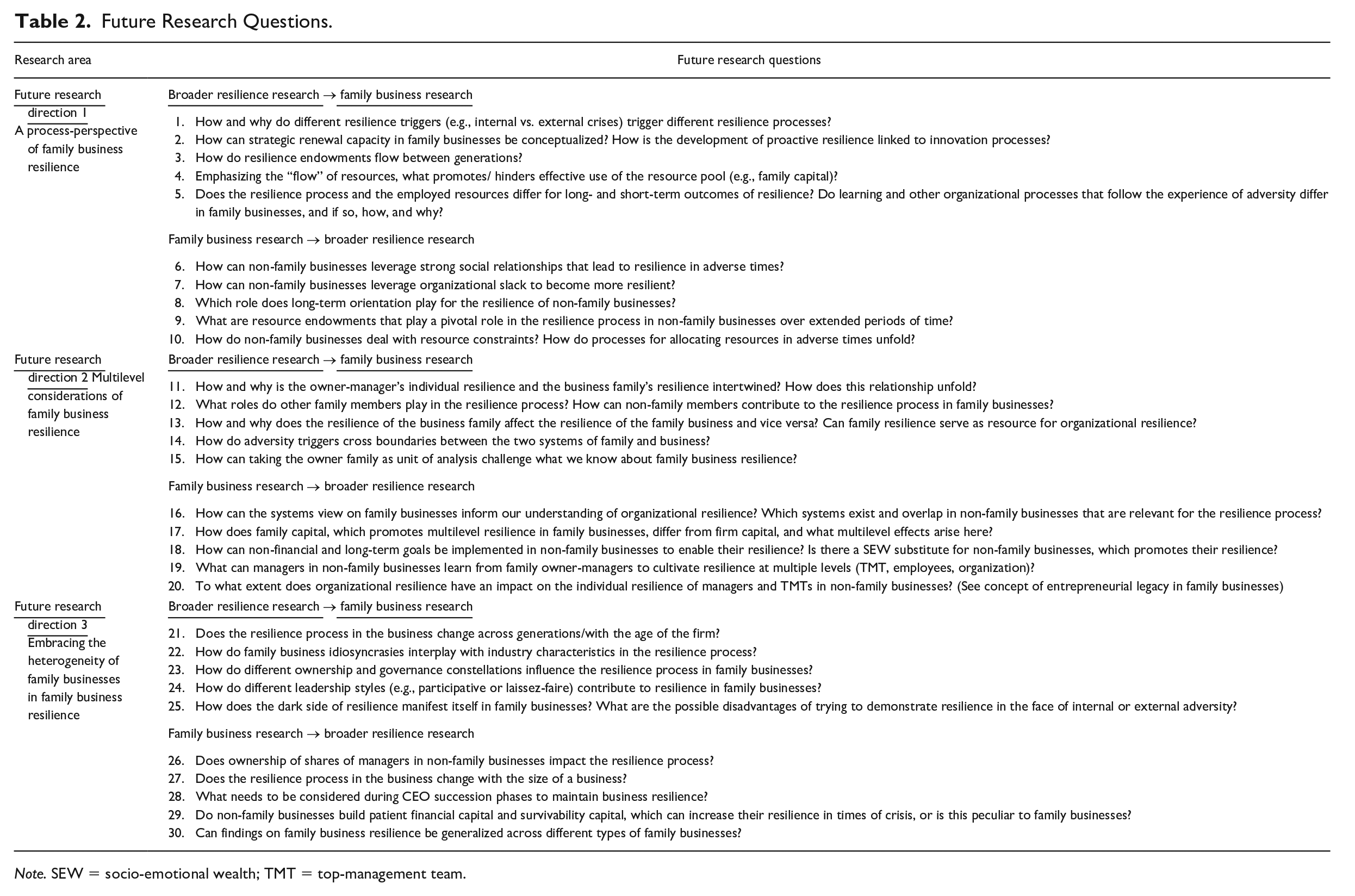
Note. SEW = socio-emotional wealth; TMT = top-management team.
Future Research Direction 1: A Process Perspective of Family Business Resilience
Various studies from the domain of organizational resilience have highlighted the importance of viewing resilience as a process (e.g., Fisher et al., 2019; Raetze et al., 2022). Organizational resilience scholars published different process models aiming at explaining how organizations prepare for, deal with, and learn from adversity (e.g., Duchek, 2020; Fisher et al. 2019; T. A. Williams et al., 2017, p. 591) argued that “the process-based perspective appears to be the best candidate for the actual embodiment of resilience, as it is through the process and mechanisms of responding to adversity that resilience is ultimately manifested.” Other studies agreed and stated that “the process perspective is inclusive of trait, capacity, and outcome perspectives” (Hartmann et al., 2022, p. 3) enabling to view resilience and its mechanisms holistically to achieve positive adjustment under adversity (Raetze et al., 2022). By shifting the focus from demarcated resilience aspects to resilience processes, we can delve into the dynamic “flow” of resource endowments, complementing the existing emphasis on their “stock” nature in family business literature (T. A. Williams et al., 2017). In the upcoming research agenda, we will address the key components of the process perspective that have not yet received substantial scholarly exploration. These components include adversity triggers, the capacity for strategic renewal, resilience processes, and the demonstration of resilience.
Adversity Triggers
Family businesses are dual systems combining the family and business systems (Swartz, 1989), adding additional complexity to an already complex phenomenon. There are various interactions between both systems related to resilience that unfold at different points in time and have rarely been addressed in previous research (Danes & Stafford, 2011; Haynes et al., 2019; Stafford et al., 1999). For instance, we found that most of the investigated adversity triggers referred to external challenges that were not idiosyncratic to family businesses and were primarily large in scale (e.g., COVID-19, economic and financial crises, natural disasters, climate changes, and general threats arising from dynamic environments). Surprisingly, only a few studies looked into family business-idiosyncratic adversities such as retirement, generational change, illness or sudden death of family members (e.g., Danes et al., 2009; Engeset, 2020; Moreno-Menéndez et al., 2022). The existing studies that deal with the challenges of succession (Morris et al., 1997), conflicts within the business family (Harvey & Evans, 1994), or the sudden departure of important (business) family members (Heinonen & Ljunggren, 2022), have not taken a resilience perspective, that is, the extent to which the entities concerned perceive, deal with, and respond to these adverse circumstances. Moreover, because of the various cross-level connections in family businesses, there might be a higher risk for the occurrence of event clusters and event chains (Morgeson et al., 2015), a topic worth deeper analysis. For instance, business crisis may trigger family conflict and vice versa (Qiu & Freel, 2020), resulting in a vicious cycle challenging the family business. Considering the current focus on external challenges and events in family business resilience literature, future research should investigate how the resilience of family businesses can be understood and effectively fostered in the face of internal adversities, such as family-related transitions and challenges. Furthermore, it would be important to understand how different types of crises are perceived by different actors within the family business and whether and how resilience processes differ depending on the type of crisis (e.g., internal vs. external crisis).
Capacity for Strategic Renewal
While studies acknowledge that the capacity for strategic renewal is positively related to family business resilience (e.g., Anggadwita et al., 2022; González & Pérez-Uribe, 2021; Mzid, 2017), the specific factors and mechanisms that shape and determine this capacity for strategic renewal still need to be understood. One reason for this research void may be the lack of, especially qualitative, longitudinal observations of family businesses, as the capacity for strategic renewal—by definition—is developed before adversity hits. Exploring which specific leadership qualities, decision-making processes, and organizational structures enable successful strategic renewal capacity and lead to proactive resilience provides an important avenue for future research (Raetze et al., 2022). Furthermore, it would be interesting to find out which explicit methods family businesses leverage to cultivate their capacity for strategic renewal. For example, scenario planning, trend analysis, and market intelligence (Huss & Honton, 1987) might be helpful measures to foster strategic renewal. The unique dynamics of family businesses, including intergenerational transitions, succession, and family involvement, could substantially contribute to the cultivation of strategic renewal capabilities, consequently enhancing resilience. Future research could, for example, investigate if and how intergenerational transitions serve as catalysts or impediments to strategic renewal endeavors and explore the role of the alignment or mismatch of family values with strategic renewal strategies. Surprisingly, existing literature has primarily explored the capability for strategic renewal solely within the context of external challenges—for instance, examining how a business model can be adapted proactively to endure future crises. However, in the context of family businesses, a compelling avenue of research lies in understanding the impact of strategic renewal on the family system. In essence, scholars might consider the extent to which the family unit needs to strategically realign itself to proactively address internal family dynamics; an example scenario could be proactively managing the unexpected departure of a key family member. Finally, an interesting paradox arises in relation to risk propensity, a component of strategic renewal capacity, which is tied to the concept of resilience. As previously mentioned, family businesses commonly exhibit heightened risk aversion, acting as a safeguard during periods of economic volatility (Bürgel et al., 2023). Moreover, they tend to adopt new disruptive technologies with caution, displaying a deliberate approach (König et al., 2013). This raises the question of how to sustain a strategic renewal capacity while effectively reconciling these contrasting tendencies and fostering resilience.
Resilience Processes
Although the literature on resilience in family business has acknowledged that resilience is an ongoing process (Brewton et al., 2010; Fisher et al., 2019) rather than a static feature, only few studies have leveraged the process approach for empirical analysis. So far, researchers have only begun to explore this aspect of family business resilience primarily using (retrospective) case study designs (e.g., Darnhofer, 2010; Mihotić et al., 2023; Pomeroy, 2015). As a result, these investigations have mostly provided descriptive presentations of broad process categories related to family business resilience (Amaral & Da Rocha, 2023; Anggadwita et al., 2022; Czakon et al., 2023). Although process research of this kind is valuable for initiating discussions on the underlying mechanisms, related studies do not address the full complexity of resilience, as they do not consider the diversity of adversity triggers, immediate consequences, and ways resilience processes emerge via interpersonal interactions. Moreover, a lack of clarity persists in current process-related family business resilience studies, calling for further examination into the intricacies of the resilience process. The coordination of individual resilience mechanisms among decision-makers and implementation teams remains elusive. For instance, the processes involved in implementing cost-reducing measures in response to the COVID-19 pandemic (i.e., resilience response), the participants involved in resilience-related actions, the decision-making approaches, and the potential of the respective decisions to result in resistance and thus, the need for additional resilience, remain unclear so far. Furthermore, we recognize that although some studies have already started to adopt qualitative longitudinal research designs to explore resilience in family firms (Amaral & Da Rocha, 2023; Azouz et al., 2022; Hadjielias et al., 2022; Mahto et al., 2022; Smith et al., 2023), most longitudinal studies in our sample are quantitative in nature. As a result, these studies do not explain why resilience develops over time or how family businesses can balance short-term survival and long-term sustainability. For instance, although family-run businesses lagged behind non-family businesses during economic upturns, they weathered recessions better than their non-family business counterparts (Bloch et al., 2012). This observation extends the premise that family businesses navigate with constrained resources (De Massis et al., 2018), as their unique structure compels them to either deliberately preserve resource endowments to master crises or mobilize latent resources when faced with adversity. This finding highlights that family businesses prioritize differently than non-family businesses by focusing on balance between family and business systems. To grasp and understand the dynamics in family businesses in their depth and across generations, further longitudinal studies are needed. In this sense, qualitative in-depth analyses could also identify differences in resilience trajectories between family firm generations (Smith et al., 2023), as resilience is a process that grows and develops over time (Wildavsky, 1988).
Demonstration of Resilience
Many studies in our review measured resilience as an outcome (e.g., Acquaah et al., 2011; Bürgel et al., 2023) and operationalized it as financial performance (typically compared to non-family businesses) (e.g., Brunelli et al., 2023; Minichilli et al., 2016). Only a few studies looked at other resilience outcomes, such as innovation, survival, and longevity (e.g., Crespo et al., 2023; Randolph, Memili, et al., 2022; Stafford et al., 2010, 2013). In future resilience research on family businesses, it is crucial to delve deeper into key outcomes of demonstrated resilience that are central to, and idiosyncratic for, the unique organizational form of family businesses and long-term oriented objective of passing on a healthy business to the next generation (Lumpkin et al., 2010). While performance indicators such as financial performance play a crucial role in measuring resilience in other businesses, it is important to also consider outcomes that are specific to family businesses, such as the motivation and ability of a successor to run the business, family-firm balance, emotional attachment to the firm, preservation of SEW, and harmony within the business family (Kotlar & De Massis, 2013). By examining both short-term and long-term outcomes (Fisher et al., 2019), we believe that these family business-specific questions can be answered. Moreover, research needs to deal with the question if learning, and other organizational processes following the experience of adversity, differ in family firms and if so, how, and why. Overall, we advocate for future research to explore the diversity of ways of demonstrating resilience and outcomes of resilience, and to conduct empirical investigations to provide a more comprehensive understanding of resilience in family businesses. Simultaneously, research on family businesses opens opportunities for the broader field of organizational resilience. For instance, investigating mechanisms to cultivate enduring (internal) social capital, leveraging organizational slack, or examining critical resource endowments in the resilience processes of non-family businesses could yield valuable and intriguing insights.
Future Research Direction 2: Multilevel Considerations of Family Business Resilience
Organizations are frequently defined as social, multilevel systems that are composed of units or teams involving different individuals (Burton-Jones & Gallivan, 2007). Scholars have highlighted the various ways in which factors can influence each other across levels of analysis (Kozlowski & Klein, 2000). Likewise, the concept of resilience has been applied at and across levels of analysis in organization science as well as related areas (e.g., Raetze et al., 2021, 2022). Family businesses, owing to their idiosyncratic decision-making, provide a unique context to scrutinize and potentially extend or adapt findings on multilevel resilience (Beech et al., 2020). Multilevel resilience looks at the interaction of resilience at different levels, mostly at the individual, group, and organizational levels. Scholars have argued that more research is needed around cross-level antecedents and outcomes of resilience (King et al., 2016; Linnenluecke, 2017; Raetze et al., 2021).
Thus far, only a few family business studies have investigated the resilience of individuals (Hadjielias et al., 2022; Santoro et al., 2021; Wall & Bellamy, 2019). This is surprising, as family businesses as social systems strongly depend on the individuals (i.e., individual family members as crucial sources of human capital) of which they are composed and these impact the performance outcomes of these businesses accordingly (Habbershon et al., 2003). As such, more research is needed on the resilience of individuals in family business settings. This primarily involves owner-managers, whose central role we emphasized as a key theme in the previous chapter (Feltham et al., 2005). Given that adverse events at the firm level can significantly impact owner-managers’ personal well-being (Haynes et al., 2019), it becomes crucial to comprehend the resilience factors that contribute to the well-being and productivity of owner-managers during challenging times. Understanding these factors is paramount as they can play a critical role in the success and survival of family businesses. In addition, the resilience of other family members and non-family employees, including those forming the top-management team (TMT), needs deeper investigation as they can play an important role in the success of family businesses (Bormann et al., 2021; Vallejo, 2009). Previous works have also highlighted that such individuals (as human resources) are an important antecedent of (family) business resilience (Brewton et al., 2010; Danes & Stafford, 2011; Mzid, 2017). That said, family members and non-family employees can only act as resilience resources, when they are able to successfully adapt to adversity themselves. As such, understanding how individuals develop resilience in the family business context is an important topic to address.
In the literature we reviewed, the resilience of small collectives hardly received any attention. Again, this is surprising given that research on the resilience of dyads and teams has gained increasing importance in other domains of research, including organizational resilience (Raetze et al., 2022; Stoverink et al., 2020). Business families are a promising research context for group-level analysis, as they are closely connected to the family business and as various interdependencies during adversity exist. For instance, the way business families organize private and work roles or central family transitions may influence the business family’s resilience capacity (Conz et al., 2020). Likewise, the resilience of the business family might be linked to individual and firm outcomes (e.g., owner-manager work-life balance, work satisfaction, firm succession). Beyond that, work teams, especially TMTs, shape the family business, as “family businesses, by definition, are founded and led by teams rather than by individuals, and these teams are responsible for the development and implementation of the firm’s decisions” (Neubaum, 2018, p. 266). Because of the important function of these units, it is important to understand how TMTs can create and maintain resilience, as well as the influence of team resilience on important outcomes. In family business research, the general focus has been on family CEOs (Fang et al., 2021), while team dynamics just recently gained attention (e.g., Schell et al., 2022). However, family business research also offers insights that organizational resilience research can use to broaden its own field. For example, family business research can inform our understanding of how (multiple) systems in non-family businesses relate to organizational resilience. Research on owner-managers can also provide lessons on cultivating resilience across various levels in non-family businesses and shed light on how organizational resilience impacts the resilience of managers and TMTs.
Future Research Direction 3: Embracing the Heterogeneity of Family Businesses in Family Business Resilience
Recent research has acknowledged the heterogeneous nature of family businesses, a facet that has often been overlooked in the past (Rovelli et al., 2022). A more holistic perspective is needed that should encompass the examination of resilience through the lens of various facets, including the diverse types of family business organization, firm size, ownership and management structures, varying family goals, generations, as well as family unique resources (Daspit et al., 2021; Wright & Kellermanns, 2011). Understanding heterogeneity in family businesses “is essential for scholarly progress as it helps identify populations of entities . . . about which generalizations can be made (Chrisman et al., 1988; McKelvey, 1982)” (Daspit et al., 2021, p. 297). In other words, we need to focus more on the differences among family businesses that might be even more salient than those between family- and non-family businesses (Chrisman & Patel, 2012). This will facilitate a more comprehensive and detailed examination of family business resilience.
In their literature review on family firm heterogeneity, Daspit et al. (2021) develop a framework that distinguishes areas in which heterogeneity is evident in the family business literature. Family firms differ in their family-centered (more family-centered vs. less family-centered) and temporal (short-term vs. long-term) focus and differentiation factors include topics such as succession, SEW, family ownership and management, firm size and growth, internationalization, and employee relations, among others. Le Breton-Miller and Miller (2015) highlight that certain family businesses, but not all, excel in accumulating human capital, transmitting tacit knowledge, leveraging reputation, and fostering relationships and resources due to their long-term orientation and familial bonds. These capabilities drive success in certain industries. This prompts the question of whether family businesses in specific industries cultivate resilience in distinct ways. Therefore, to fully understand the underlying mechanisms of family business resilience, we need to understand how these differences among family businesses are linked to the resilience process. These questions also hold value for family businesses with different sizes, different generational involvement, and different ownership and management structures. For example, smaller family businesses, which are often characterized by strong family influence (Wright & Kellermanns, 2011), could leverage unique family-specific drivers and resources that potentially confer an advantage during crises, as we noted above. However, the resource limitations inherent in smaller enterprises could pose challenges to their resilience in such times (Parker & Ameen, 2018). Larger family businesses, in contrast, might experience a weaker family effect but possess greater access to resources and capabilities including diversified product lines, larger customer bases, and stronger financial backing (Gilbert, 2005). Studying how resilience processes unfold in these different forms of family businesses might be worthwhile to be studied. Moreover, the question of which ownership and management structures contribute most to the resilience of family businesses in times of adversity remains unanswered. For instance, the number of family members involved in the ownership and management of the firm as well as the presence of non-family members might affect resilience in the respective firms. Researchers have examined common governance setups, revealing for instance the increased potential for entrenchment and poor performance when family control is high (R. C. Anderson & Reeb, 2003). The impact of family involvement in management varies substantially across firms, on the one side decreasing agency costs but on the other side, in some firms, raising challenges due to asymmetric altruism (Chrisman et al., 2004; Schulze et al., 2001). Notably, some studies suggest that family management, rather than ownership, closely correlates with financial and nonfinancial results, with external CEOs leading to more efficient processes (Eklund et al., 2013; Westhead & Howorth, 2006). These observations raise the question of how various ownership and management structures affect the resilience of family businesses. To validate these partly contradicting predictions, innovative research approaches such as configurational research designs, including qualitative comparative analyses, could be applied. These methods hold the potential to identify the specific family business configurations that demonstrate particularly high and particularly low levels of resilience.
Finally, we noted above that family businesses can draw on specific family capital such as financial, human, and social capital to develop resilience (e.g., Brewton et al., 2010; Danes et al., 2009; Engeset, 2020). However, it is important to consider that the family business’ unique combination of resources (referred to as “familiness”) (Habbershon & Williams, 1999), in theory, can have both, positive and negative effects on resilience (Daspit et al., 2019). Yet, as our review has shown, previous research has focused exclusively on the positive aspects of familiness on resilience and overlooked the negative aspects. For instance, tacit knowledge, as part of human capital, may provide a valuable source of competitive advantage that is difficult to replicate and hence foster resilience. However, it could also serve as a barrier, as it is challenging to disseminate throughout the organization, which could hinder growth (Zellweger, 2017). Similarly, relying on the family as the primary source of financial capital may impede innovation and growth and thus harm resilience because it impedes swift reaction to adversity, as the family’s wealth is typically limited due to the significant investments in the firm. Contemplating about the role of family business heterogeneity also can serve as starting point for challenging existing knowledge on resilience beyond the family business context. For example, TMT succession processes, different constellations of ownership, or size effects may generally have an impact on (multilevel) resilience processes.
Conclusion
Given the many challenges and adversities faced by family businesses, which are the backbone of most economies, their resilience is of paramount importance. In addressing our research question, we found that the cornerstone of family businesses’ resilience lies in their inherent long-term orientation and family values. This foundation influences other aspects of the resilience process, including the resource and capability endowments, the ways in which resilience is demonstrated, and the resulting outcomes. Furthermore, we identified that the literature on family business resilience is very heterogeneous in terms of methodological and measurement approaches, theoretical perspectives, and conceptual definitions. This imbalance so far hinders future research in producing conceptually sound insights. We hope that our process definition of resilience in family businesses will serve as a guiding framework for future empirical studies. We also believe that our future research agenda, integrated with organizational resilience research, has the potential to enable both inbound and outbound theorizing.
Footnotes
Declaration of Conflicting Interests
The author(s) declared no potential conflicts of interest with respect to the research, authorship, and/or publication of this article.
Funding
The author(s) disclosed receipt of the following financial support for the research, authorship, and/or publication of this article: Yasin Yilmaz acknowledges financial support from the EQUA Foundation.

Supplemental Material
Supplemental material for this article is available online.
Notes
Author Biographies
References
Supplementary Material
Please find the following supplemental material available below.
For Open Access articles published under a Creative Commons License, all supplemental material carries the same license as the article it is associated with.
For non-Open Access articles published, all supplemental material carries a non-exclusive license, and permission requests for re-use of supplemental material or any part of supplemental material shall be sent directly to the copyright owner as specified in the copyright notice associated with the article.
