




Abstract
Nonfinancial outcomes (NFOs) are goals, objectives, performance indicators, or other results, effects, and consequences not operationalized in terms of direct monetary value. The most salient NFOs for family businesses represent socioemotional considerations that are unique to the family’s decisions and behaviors; yet there are hundreds of different outcomes that can be classified as nonfinancial, with numerous implications for family and nonfamily businesses. With the objective of advancing knowledge of NFOs, we review 267 articles containing 322 NFOs, synthesize our findings by classifying the NFOs into quadrants, discuss how they are utilized in the extant literature, and suggest future research opportunities.
Introduction
“. . . the overall success or failure of the family firms can be completely understood only when the nonfinancial outcomes that are relevant and meaningful to families and their firms are understood.”
Most people agree that family businesses differ from nonfamily businesses. Fundamentally, family businesses maintain a different purpose than nonfamily businesses that is based on the pursuit of unique, family-related aspirations and strategic goals; such goals often include the desire to survive and generate wealth across generations, and to influence their immediate communities for the better (Gomez-Mejia et al., 2011). As scholars continue to develop a more sophisticated understanding of family businesses, there is considerable interest in aspiring beyond more generalizable financially based outcomes (e.g., earnings, profit margin, return on assets) in favor of more specific and applied measures that encompass or focus on the unique nature of family businesses (e.g., family social capital, succession success). Indeed, as clearly communicated in the opening quote by Holt and colleagues (2017), it is necessary to consider nonfinancial outcomes (NFOs)—goals, objectives, performance indicators, or other results, effects, and consequences not operationalized in terms of direct monetary value—if we are to fully understand how and why family businesses behave and perform as they do.
Of course, not all NFOs are specific to family businesses. Researchers have long maintained the importance of NFOs that can be applied to all types of organizations. For example, Kaplan and Norton (1992) developed the Balanced Scorecard framework over three decades ago to help managers identify and customize outcome measures from perspectives that extend beyond the financial to include customer viewpoints, internal processes, and innovation and learning. The Balanced Scorecard, still extensively taught in business schools and applied by many organizations today, was predicated on the idea that traditional financial measures, such as return on assets and earnings per share, may give delayed and misleading signals that lead to suboptimal strategic decisions. This argument remains germane in the modern business world, with executives, managers, and business scholars recognizing the need to account for salient nonfinancial and measurable outcomes. Indeed, in August of 2019, the Business Roundtable—a group of CEOs from major corporations—declared that corporations should no longer give shareholders top consideration, but that the interests of all stakeholders should be served (J. S. Harrison, Phillips, & Freeman, 2020). This effectively recognizes a shift from a focus on financial to NFOs. Examples of key NFOs include customer satisfaction, product adoption rate, and innovation. Also, businesses are more inclined to measure and report NFOs such as sustainability, corporate social responsibility (CSR), and climate impact than ever before (Governance & Accountability Institute, Inc, 2022). So, while the achievement of NFOs will presumably support the overall financial health of the organization, many NFOs represent results or consequences that are good in their own right. In other words, the creation of value involves both financial (i.e., pertaining to monetary receipts and expenditures or money matters) and nonfinancial considerations, and both apply to all types of organizations. 1
In the case of family businesses, nonfinancial considerations often include more context-specific measures; these are commonly discussed in terms of family socioemotional wealth (SEW). SEW—also known as affective endowments—refers to the noneconomic utilities of a business that can be utilized by owners and, as such, serve as the primary frame of reference for the management of the family business (Gomez-Mejia et al., 2011). Family businesses are, therefore, motivated by the desire to preserve or enhance family SEW when making strategic decisions (Berrone et al., 2012). Essentially, it is the level of concern for the family that separates family businesses from nonfamily businesses, as well as creating heterogeneity across family businesses; family businesses differ from one another in terms of goals, values, governance configurations, family involvement, and many other ways (Daspit et al., 2021). As such, it is these nonfinancial aspects that have proven to be essential in differentiating and highlighting the uniqueness of family businesses (e.g., Chua et al., 1999). Well-documented family-oriented NFOs include: autonomy and control (P. D. Olson et al., 2003); family cohesiveness, supportiveness, and loyalty (Sorenson, 1999); harmony, belonging, and trustful relations (Sharma & Manikutty, 2005); pride (Zellweger & Nason, 2008); and family name recognition, respect, status, and goodwill in the community (e.g., Tagiuri & Davis, 1992).
Although recognized as significant and important, it is clear that NFOs are part of a broad designation that covers many distinct topics and research issues. Such breadth requires a detailed evaluation and synthesis to effectively move forward in a field of study (e.g., Rovelli et al., 2022). Addressing this need, our review systematically analyzes 267 family business articles containing 322 NFOs (283 unique) over an 11-year timeframe (2012–2022). In doing so, we make three important contributions. First, as discussed in more detail below, we provide a comprehensive, yet concise definition of NFOs; this effectively provides guidance to our review as well as to practitioners and scholars exploring related topics and phenomena. Second, we identify, organize, clarify, and synthesize the extensive and divergent set of NFOs that are represented in the literature. Our intent is to provide researchers, including those operating within and outside of the family business domain, with a consistent and functional organizing framework that reveals key conceptualizations, utilizations, and operationalizations. Since NFOs represent an extremely broad and diverse set of constructs and variables that are simultaneously complex, ambiguous, and overlapping, a logical framework is necessary to understand and assess NFOs in a meaningful way. Systematically, our review organizes the multifaceted and complex nature of NFOs across the recent family business literature, thus building on previous research that highlights the importance of this area of study (e.g., Holt et al., 2017; Yu et al., 2012).
As a third contribution, we discuss how and in what ways, a deeper understanding of NFOs can benefit family business scholars through future research. Foundationally, the study of family businesses is predicated on the notion that it is the family that makes these organizational forms distinctive—for instance, providing family social capital (FSC) or goodwill (e.g., Arregle et al., 2007)—and should be examined in unique and specific ways. Without a better understanding of NFOs, particularly those that are contextually specific to the family, the ability to assess NFOs in a meaningful way is hindered (Holt et al., 2017). As such, our review proposes a more nuanced perspective whereby future research can approach NFOs in a way that expands the scope and boundaries of the field.
Methodological Considerations
Our initial search of the family business literature reveals that our understanding of NFOs is unclear and incomplete; basic definitions are inconsistent or nonexistent. Furthermore, the extant literature includes a wide range of nonfinancial concepts commonly used synonymously, including those related to goals (Tagiuri & Davis, 1992), motivations, rewards, perceptions of success (P. D. Olson et al., 2003), dimensions (Sharma, 2004b), indicators (Elbanna & Child, 2007), and measures (Zellweger & Nason, 2008). Even the term “outcome” is generally applied ambiguously, for which we found no universal (or commonly quoted) definition. Some scholars use the term “nonpecuniary” to refer to outcomes that might be desirable to family members (e.g., Amit & Villalonga, 2014), while others employ the term incentives (e.g., Chandler, 2015) or objectives (e.g., Symeonidou et al., 2022).
Due to the quantity and diversity of research involved, it is understandable that there is not a single, agreed upon definition of NFOs. That said, it is necessary and valuable to consider what qualifies a construct or variable as an NFO to gain a deeper understanding of how and in what ways NFOs are being utilized across the literature. Without a more complete and consistent definition, scholars will continue to talk across one another rather than among one another. Therefore, as an initial step in mitigating the continued fragmentation of NFOs in the family business literature and toward a convergence on a more universal understanding of NFOs, we offer the following definition, which is intentionally based on Zellweger et al. (2013) and Holt and colleagues (2017): NFOs are goals, objectives, performance indicators, or other results, effects, and consequences not operationalized in terms of direct monetary value.
Using this definition and rooted in the argument that a better understanding of previous work is required for a field to progress (Dyer & Sánchez, 1998), we rely on three basic assumptions to establish initial boundaries for this review. First, we separate financial from nonfinancial variables based on the former having a direct, tangible, and monetary value (i.e., cash equivalent); we assume all other variables to be nonfinancial (Zellweger et al., 2013). Second, we assume that outcomes represent results, effects, or consequences that are, ultimately, “meaningful” to the family or family business (Holt et al., 2017, p. 186). As such, the outcomes codified in this review are dependent variables often applied at the firm or family levels of analysis. For although individual- and group-level NFOs—as well as higher levels of analysis such as industries or nations—are important and prevalent, relevance and direct application to the family and/or family business is assumed as it is the context for the studies in our review. Fundamentally, the scope of our effort is grounded in Berrone et al.’s (2012, p. 259) argument that nonfinancial factors are “the pivotal frame of reference that family-controlled firms use to make major strategic choices and policy decisions.” Finally, the timeframe of our review is assumed to align with, but expand upon, previous efforts, particularly Yu et al. (2012, p. 45), who called for “greater attention” to nonfinancial goals and nonfinancial performance in future family business research. Hence, given that more than a decade has passed since several important publications in 2012, it is appropriate to take stock and identify gaps in the extant literature by assessing the current state of NFOs.
Method
Sample
To capture the current state of relevant research, we searched the following prominent journals that publish family business articles: Academy of Management Journal, Administrative Science Quarterly, Entrepreneurship Theory and Practice, Family Business Review, Journal of Business Venturing, Journal of Family Business Strategy, Journal of Management, Journal of Management Studies, Journal of Small Business Management, Organization Science, and Small Business Economics.
We initially identified 935 articles published in these journals over the 11-year period starting in 2012 and ending in 2022. We chose 2012 as the starting point for our systematic review because it was a logical follow-up to Yu et al. (2012), who examined financial and nonfinancial dependent variables in family business research. We wanted to focus exclusively on NFOs and extend their efforts in terms of both breadth and depth. An 11-year period is similar to other studies such as Sharma (2004b) and Yu et al. (2012). We utilized Web of Science and EBSCO Host to identify the initial batch of articles for possible inclusion by searching for the word “family” in the abstract to determine if the article might examine family businesses. If the word “family” appeared, the full text of these articles was then manually screened for possible inclusion in our review based on the following criteria: (a) it must study family business, (b) it must be empirical, and (c) it must investigate at least one NFO, as defined previously.
Following Evert et al. (2016), we considered quantitative, qualitative, and mixed method studies with the intent of testing research questions, assessing models or hypotheses, or building propositions. Potential NFOs were identified by considering operationalization; if the operationalization was exclusively or primarily nonfinancial in nature, the NFO was included in our review. 2 We focused on empirical articles to ensure NFO operationalizations could be screened for qualification; hence, our search criteria intentionally excluded conceptual articles. Ultimately, the final sample consisted of 267 family business articles containing 322 NFOs (283 unique); articles were predominantly published in Journal of Family Business Strategy (99), Family Business Review (54), Entrepreneurship Theory and Practice (42), and Journal of Small Business Management (23).
Coding Procedure
Given the wide breadth of research on NFOs, we initially arranged our review around the Family Firm Outcome (FFO) model (Holt et al., 2017). The FFO model consists of four nonfinancial categories: (a) family-specific nonfinancial external outcomes, (b) firm-specific nonfinancial external outcomes, (c) family-specific nonfinancial internal outcomes, and (d) firm-specific nonfinancial internal outcomes. However, as our review progressed, we recognized that the FFO model did not fully align with the goals of our review since the FFO was primarily employed to identify and define key outcomes for future testing, rather than offer insights on the utilization and operationalization of NFOs in the extant literature. For example, the FFO model’s family-specific nonfinancial internal outcomes category contained 14 NFOs, 11 of which did not appear in our sample of articles; the remaining 3 NFOs in this category appeared just 3 times in the unique NFOs we coded. Thus, we reimagined a classification scheme into four quadrants that built on Holt et al.’s (2017) categorizations; these quadrants increased our ability to understand the nature of the NFOs utilized by scholars. Moreover, our scheme is in line with Neubaum and Micelotta (2021), who highlighted context-specific versus context-free approaches. In a context-specific approach, a specific organization type (i.e., family businesses) is the focus, whereas a context-free approach is generalizable and applicable to a wider range of organizations. Our categories include: (a) family business specific macro, (b) generalizable macro, (c) family business specific micro, and (d) generalizable micro. Key information and coding criteria with respect to the four quadrants are discussed below and visually depicted in Figure 1.
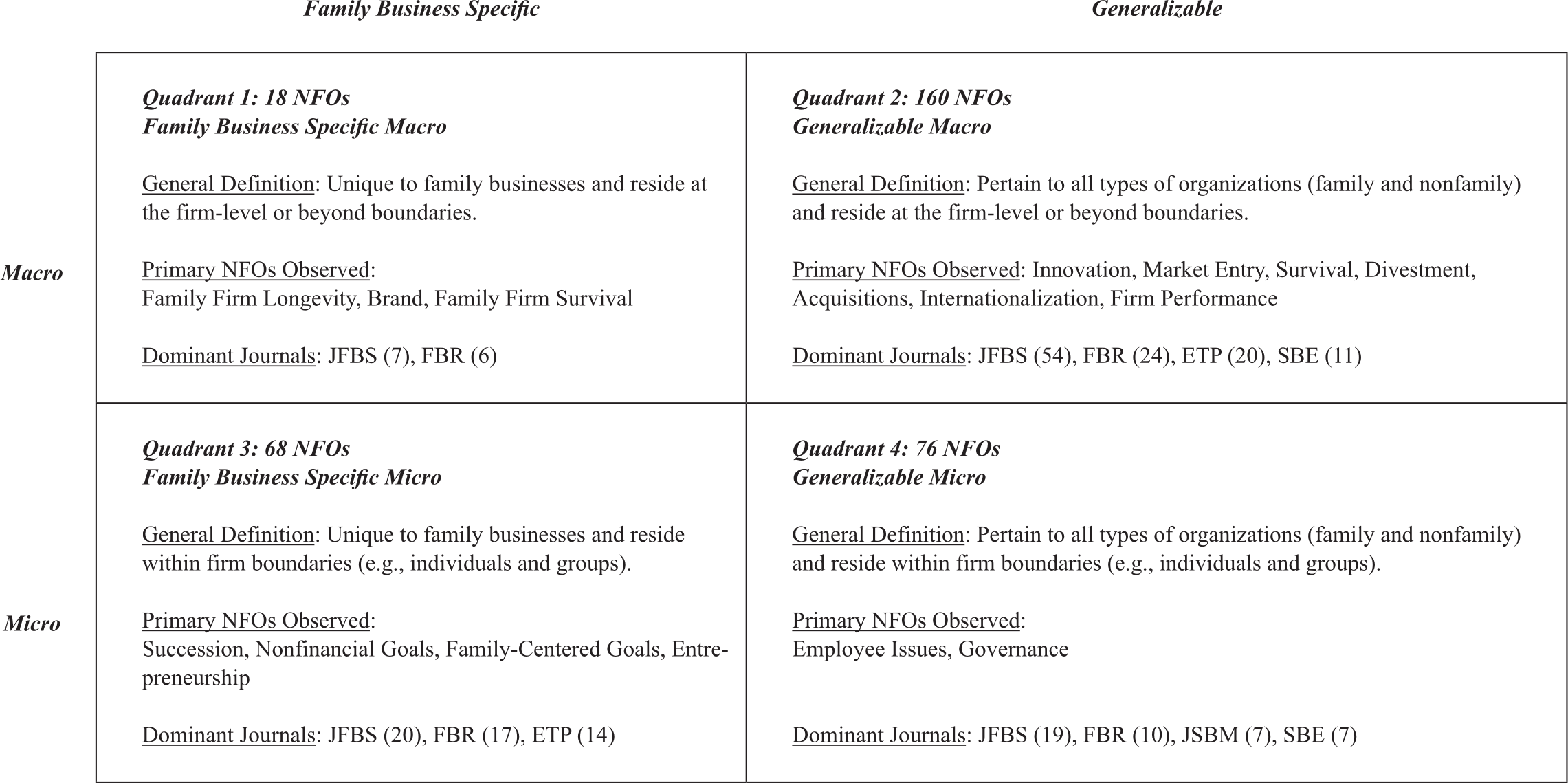
Characteristics of Studies Involving NFOs.
The coding process involved several meetings of the authorship team to discuss the classification scheme and the four quadrants. Once the process was agreed upon, two authors jointly coded every article, with the operationalization of the NFO as the primary determinant for quadrant placement. In cases of disagreement, coders discussed the issue with a third author until quadrant placement was agreed upon. NFOs were classified as family business specific only if the NFO measured a goal, objective, or other outcome type that was explicitly and directly related to the family and its influence on or within the family business. For example, Gimenez-Jimenez and colleagues (2021) used the NFO succession intention, which addresses succession as a phenomenon unique to family firms that captures the plan or intent of children to take over the business from a parent or parents. In this study, a multi-item scale was developed to measure this intent, using such items as “My professional goal is to become a successor in my parents’ firm,” and “I am determined to become a successor in my parents’ firm.” NFOs that were not employed to address a unique outcome associated with a family business were instead classified as generalizable, meaning they may apply to any business organization—family or nonfamily firms (e.g., turnover intentions). NFOs were then additionally classified as micro or macro; micro if the NFO measured an outcome focused on the individual or group level, and macro if the NFO resided at the firm/organizational level or beyond (e.g., industry or country level outcomes). For instance, family harmony (e.g., Farrington et al., 2012) was coded as a group-level NFO (micro), whereas international acquisitions (e.g., Strike et al., 2015) was coded as an organizational-level NFO (macro).
Discussion of Findings and Research Opportunities by Quadrant
Our basic coding results are summarized in Table 1. The following sections synthesize these details and discuss opportunities for future research; these are organized by quadrant. 3
Summary of Nonfinancial Outcomes by Quadrant and Method.
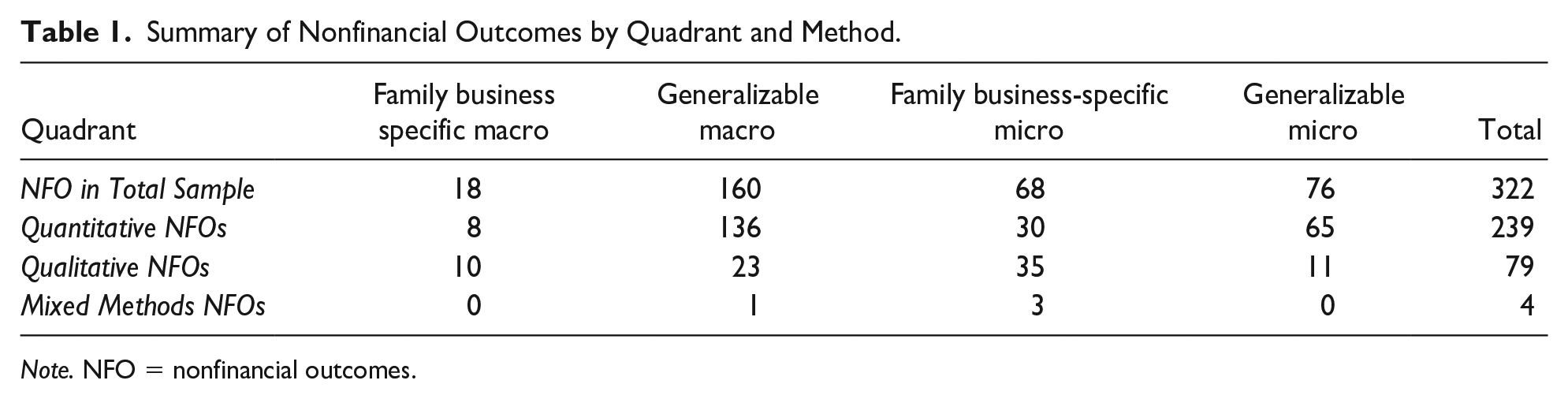
Note. NFO = nonfinancial outcomes.
Family Business Specific Macro
Findings
The family business specific macro quadrant contains NFOs that are unique to family businesses (i.e., not relevant in the nonfamily business domain) and operationalized at the firm level or above. This quadrant is largely neglected by scholars, with only 18 NFOs appearing in articles we reviewed.
Two NFOs in this quadrant specifically considered longevity in family businesses, where longevity implies continuous involvement of the family (Haag et al., 2023). The first study, by Pieper and colleagues (2015), used five multifamily businesses to inductively identify the founding conditions underlying family businesses and how such conditions are carried forward—through imprinting—to influence multifamily organizational longevity. Their findings suggest, in part, that what happens in the early founding stages of a business sets it on a path that is difficult to break and can often persist across generations—long after the founders have departed. In the second study, R. King and Peng (2013) utilize pecking order theory to examine the industry determinants of control longevity of family firms, operationalized as the number of years a firm has been in existence. Their study of 211 family firms reveals that three industry characteristics—cyclicality, capital intensity, and growth—serve as the primary contributing factors to loss of control by the family. This includes events such as mergers and acquisitions (M&A), and internal restructuring.
This quadrant also contained NFOs that specifically deal with family business brands, which are conceptualized according to three views: (a) identity, what organizational members believe to be true about the firm; (b) image, how the firm is portrayed to stakeholders; and (c) reputation, how others perceive the firm (Astrachan et al., 2018). In this vein, Sanchez-Ruiz et al. (2019) employed a configurational perspective to study the effects of FSC on family identity in the community, while Van Gils and colleagues (2019) examined the relationship between family involvement and family firm image among 340 Dutch family firms. Although these studies examined identity and image, this quadrant did not contain any NFOs related to reputation; such an omission is concerning given the role of reputation to SEW and the importance of the SEW perspective to the field over the last decade and more (e.g., Berrone et al., 2010).
Qualitative methods were employed to study 55% of the NFOs in this quadrant, the highest percentage across all quadrants. Qualitative methods are particularly appropriate for researchers to answer “how” and “why” questions (Eisenhardt, 1989) and for theory building (Lambrecht, 2005). NFOs related to survival of the family firm—differentiated from survival of nonfamily firms based on the family firm’s ability and requirement to balance the needs of the family and the business (Carlock & Ward, 2001; Ward, 1987)—were a central theme in this quadrant; for example, Hadjielias and colleagues (2022) conducted abductive logic-based interviews in 23 small Cypriot family firms and found that psychological and situational context-sensitive motivating mechanisms explain how and why FSC changes to enable survivability in response to external crises. Psychological factors were also a key aspect of family firm survival in a study of 20 small, family-owned dairy farms. Glover and Reay’s (2015) comparative case study found that farmers’ short-term strategic choices during times of challenging financial conditions were strongly influenced by their emotional attachment to animals and assets. Finally, family dynamics, which is a “pattern of behavioral interactions among family members” (Cater et al., 2016, p. 302), was utilized to explore family business outcomes (i.e., the business continued, a new business was formed by a successor, or the original business closed) in a case study involving family succession teams from 19 firms. They found that successor teams achieve favorable family business outcomes when the teams focus on substantive conflict, while negative outcomes result when the teams focus on relationship conflict. Collectively, this set of studies focused on firm-level outcomes; however, they also reveal interesting connections with psychological and behavioral dimensions among family members.
Research Opportunities
Generally, we found limited evidence of scholarly inquiry in this quadrant, relative to others. Yet, this space offers up opportunities for research, and we encourage family business scholars to consider how looking at family specific outcomes, at the firm level or beyond, may enhance our holistic understanding of family businesses. In particular, our review found an emerging family business research stream is investigating institutional logics—the interrelationships among institutions and organizations in a societal context (Thornton et al., 2012)—that influence family businesses and the objectives they pursue. For example, Aparicio and colleagues’ (2017) institutional logics-based study interviewed family business experts to identify 43 family business goals, aggregated into 17 dimensions, that correspond with business- or family-oriented goals, family-oriented noneconomic goals, and business-oriented noneconomic goals. Within this framework, scholars could focus future research on NFOs that parse out the influence of social, cultural, and political pressures on family firm goals such as strategy implementation; such efforts would help clarify the institutional logic footprint as an important step in better understanding the complexity of family businesses.
Scholars can also expand the body of knowledge with respect to control longevity. We acknowledge that family control has long been viewed—generally in a positive light—as one of the fundamental differences between family-owned firms and organizations utilizing other forms of ownership (Cressy & Olofsson, 1997; Gersick et al., 1997); family businesses are also often considered assets to be handed down to the next generation rather than wealth to be consumed (Casson, 1999). From an NFO perspective, control longevity can be influenced by opportunism and conflict when, for example, family feuds or sibling rivalries emerge (R. King & Peng, 2013). This potential dark side to control longevity could manifest in various ways in family businesses and their stakeholder relationships; future research should therefore seek a dialogue among family business scholars and tap into the antecedents of control longevity’s dark side. Moreover, qualitative work could help determine the extent to which, for example, family characteristics—such as leadership styles of owners and managers—might operate as a buffer against dark side pitfalls of control longevity desires in family businesses.
Additional research opportunities in this quadrant involve the utilization of NFOs that assess or address quasi-family or extended family members, whose activities and decisions can influence outcomes for the firm and beyond (Karra et al., 2006). For instance, examining NFOs related to the influence of quasi-family members (e.g., sons- or daughters-in-law who become family insiders (Lee et al., 2003)) may offer an interesting area to explore since quasi-family members present unique challenges for family firms seeking to form external partnerships and acquire talent (Karra et al., 2006).
Finally, NFOs that capture certain influences on the development and perpetuation of family firm image—the impression that is projected to stakeholders outside the firm (e.g., Dyer & Whetten, 2006)—have been mostly neglected. Existing studies primarily utilize NFOs related to the positive impact of family firm image as a competitive advantage to support family firm performance (e.g., Zellweger et al., 2012) and customer loyalty (Binz et al., 2013). However, such studies do not consider how family firm image is potentially affected, for example, by environmental dynamism, which is considered the degree of uncertainty, complexity, and change imposed by the external environment (e.g., Baum & Wally, 2003). We suggest scholars direct research efforts toward a better understanding of how family firm image is influenced when families operate in hostile or dynamic environments versus less dynamic and less competitive environments.
In sum, NFOs in this quadrant—remarkably underrepresented in our review—require more focused attention by researchers; we optimistically note that the relatively small number of NFOs in this quadrant also underscores ample future opportunities. Table 2 contains additional research ideas for this quadrant as well as the other three quadrants.
Select Empirical Research Opportunities Involving Nonfinancial Outcomes in Family Business Research.
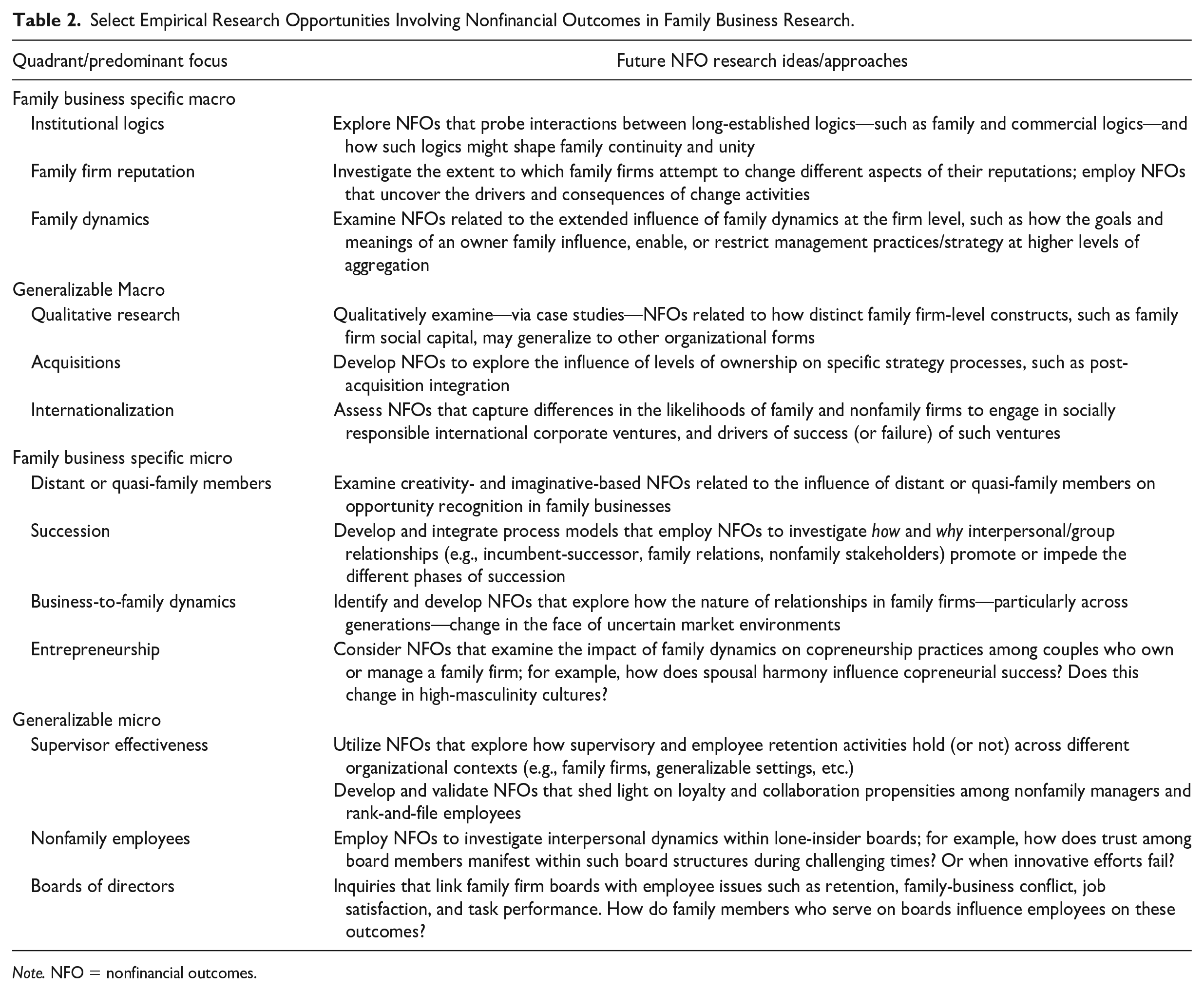
Note. NFO = nonfinancial outcomes.
Generalizable Macro
Findings
The generalizable macro quadrant contains NFOs that are not unique to family firms (i.e., pertain to all types of organizations) and reside at the firm level or beyond, including firm-to-firm nonfinancial performance measures such as growth and innovation. NFOs in this quadrant are particularly important because they inform comparisons that reside at the heart of family business research, where the basis for the entire field of study is largely premised on the difference between family and nonfamily businesses (Payne, 2018). These NFOs appeared 160 times (136 quantitative, 23 qualitative, and one mixed methods study) in this quadrant, representing 50% of the total number of NFOs from our sample of articles.
A deeper look reveals that research over the last decade has commonly focused on innovation-related topics, which is associated with 40 NFOs in this quadrant; such NFOs include innovation performance (Muñoz-Bullón et al., 2020), innovative behavior (Ingram et al., 2016), innovativeness (Gast et al., 2018), and product innovation (Mazzelli et al., 2018; Zybura et al., 2021), among others. The overarching questions of whether family firms are innovative—often relative to their nonfamily counterparts—and which factors contribute to innovation-related NFOs dominated these studies. Summarizing the literature well, the meta-analysis by Duran et al. (2016) found that family firms are generally more reluctant to invest in innovation yet, simultaneously, make up many of the world’s most innovative enterprises. Their analysis of patents, patent citations, and patents as a percentage of R&D across 108 primary studies from 42 countries substantiates that family firms do, in fact, demonstrate greater innovation output than nonfamily firms.
The behavioral agency model and SEW were commonly utilized as the foundation for innovation-related NFOs in this quadrant. In one example, Chirico and colleagues (2020) utilized the mixed gamble logic (SEW vs. financial tradeoff) of the behavioral agency model to investigate the relationship between family ownership and IP protection through patents. They found that SEW costs outweigh financial benefits of patents at low to medium levels of family ownership, while these same financial benefits outweigh SEW costs at higher levels of family ownership. Another study incorporating an SEW perspective, by Diéguez-Soto et al. (2016), found that the motivation to preserve SEW diminishes the willingness and ability to accomplish continuous technological innovation, which was operationalized as product and/or process innovation over a 3-year period.
Beyond the behavioral agency and SEW perspective, several other noteworthy perspectives were used to investigate innovation-related NFOs. For example, digital business model innovation—often utilized as an independent variable—was employed by Soluk and colleagues (2021) to investigate dynamic capabilities and environmental dynamism as antecedents. Two other studies used a corporate governance lens to investigate innovation outcomes in family firms. The first, a study by Arzubiaga et al. (2018), analyzed boards of directors to investigate their impact on ambidextrous innovation. Their findings suggest that boards can simultaneously hinder and enhance the firm’s ability to turn entrepreneurial orientation into ambidextrous innovation—hindering it when the family is involved and enhancing it through the board’s strategic tasks and resource provision. In contrast, the second study examined innovation to reveal degree of family ownership, as well as the generation of the family, decreases innovative output, while family business institutional ownership nurtures innovative output (Decker & Günther, 2017). Moreover, Werner and colleagues’ (2018, p. 213) finer-grained examination of generational innovation output across 1,870 SMEs found, in part, that the third generation of family SMEs is “the least likely to produce innovation output.” Collectively, these studies highlight the complex interplay of factors that influence innovation in family firms.
Seven studies in our sample considered NFOs related to market entry; such NFOs were commonly associated with decisions related to joint venture and wholly owned subsidiaries, entry timing, and new industry entries. This literature stream largely focuses on the unique challenges faced by family firms in this area, relative to nonfamily firms, such as ownership, the mixed gamble tradeoff, and transgenerational sustainability issues. For example, research utilizing transaction cost economics (Sestu & Majocchi, 2020) indicates that family ownership is a key component of international entry mode choice, not only for multinational firms but also for local firms. NFOs in this quadrant also highlight the tradeoff that family firms consider between SEW and financial wealth. For instance, Fuad et al.’s (2021) study of 221 Indian firms revealed that family-controlled firms are early movers with respect to entry timing during cross-border acquisitions; this NFO was utilized to examine SEW benefits in terms of transgenerational sustainability and continuity of the core business.
Seven other studies in our sample considered NFOs related to the type of firm survival, exit, subsidiary divestment, and decisions to delist from stock exchanges. Stafford et al. (2013) used sustainable family business theory to explore the relationship between the adaptive capacity of family business owners on long-term firm survival and growth. Incorporating behavioral aspects, such as families acting “as mortar that connects communities, individuals, and firms and creates effective functioning” (Stafford et al., 2013, p. 190), their findings suggest that family leadership remaining consistent between stable times and disasters was associated with decreased likelihood of survival, and implies that family leadership can benefit from more adaptive capacity.
NFOs related to acquisitions—used to deepen “resource sets by both adding to existing areas of strength and extending resources into new areas” (Haleblian et al., 2009, p. 474) and improve innovation capabilities (Karim & Mitchell, 2000)—represent another important outcome in this quadrant. We discovered 10 articles employing acquisition-related NFOs; a wide range of theories, including the behavioral agency model, agency theory, and efficiency theory was utilized in this subset of research. According to the behavioral agency model, family firms face a mixed gamble when making strategic decisions, which refers to the tradeoff between the family firm’s desire to make financially advantageous decisions and its preference for SEW preservation (Fuad et al., 2021). Such a mixed gamble approach was used by Hussinger and Issah (2019), in the context of acquisitions, to reveal that family firms are more likely than nonfamily firms to engage in related firm acquisitions, and that this relationship is stronger when family firms are performing above certain aspiration thresholds. Their findings further suggest that family firms carefully consider the financial and SEW benefits of related firm acquisitions, whereas nonfamily firms tend to only consider the financial benefits related to this event. The mixed gamble approach was also used by Gomez-Mejia et al. (2018) examination of family firm acquisitions and assessment of likelihood of acquisition and relatedness of acquisition; their findings revealed a negative relationship between family control and likelihood of acquisition, but that this effect is attenuated when firms perform below certain aspiration levels. Gomez-Mejia et al. (2018) suggest that SEW and financial considerations are aligned, rather than at odds, when performance is below aspirations, and this alignment drives acquisition activity. Although these studies acknowledge the broad importance of related firm acquisitions, they highlight the importance of acquisition-related NFOs for family business research; namely, that acquisition decisions must be considered alongside both family performance aspiration levels and fulfillment of SEW, both of which are unique to the family business domain.
Nine NFOs in this quadrant focused on internationalization-related NFOs. Although financial considerations are widely assumed to play a role in the decision to go international, Calabró et al. (2016, p. 681) referred to this choice as “a tricky and very demanding decision process” that not only includes human and financial aspects but also impacts a firm’s long-term orientation and strategy to preserve and enhance legitimacy. As Calabró et al. (2016, pp. 679–680) note, “despite the increasing interest on this topic, it is not clear what does really matter in the internationalization of family businesses.” Whereas one study operationalized the internationalization process as a discrete event (i.e., number of countries exported to; Arregle et al., 2017), notably, we found two qualitative studies in this quadrant that examined NFOs related to the decisions and drivers of the internationalization process. The first, by Calabró et al. (2016), utilized a multiple case study approach of four Italian firms to investigate the impact of incoming generations of family members on the decision to explore and exploit international opportunities. They found that “the new generation’s knowledge, competences, and enthusiasm made a decisive contribution to the FB’s internationalization” (Calabró et al., 2016, p. 692]. The other, a study by Felzensztein et al. (2019), conducted a comparative case study that utilized interviews to investigate drivers and barriers to family winemaker internationalization; their findings suggest that independent trade associations have a positive impact on accelerating the internationalization process. Collectively, these studies demonstrate that internationalization-related NFOs offer a powerful way to inform the processes of internationalization—rather than the event itself—and serve as a critically important link in understanding the many ways internationalization revitalizes family businesses, such as through increased employment opportunities for family members (Calabró et al., 2016).
Although this quadrant contains NFOs that apply to all organizations, the increasing significance of SEW across several studies was noteworthy (e.g., Chirico et al., 2020; Diéguez-Soto et al., 2016; Fuad et al., 2021; Gomez-Mejia et al., 2018); such studies examined NFOs related to innovation, firm survival, and acquisitions within the context of the mixed gamble tradeoff involving SEW preservation and financial gain. Clearly, family business scholars are utilizing perspectives central to the family business literature, such as SEW, to investigate the impact on important NFOs—such examinations will serve to better differentiate family and nonfamily businesses, even in cases where the NFO itself applies to all organizations.
Our review also discovered a substantial number of studies focused on top management teams (TMTs), the important strategic decisions they consider, and related outcomes that impact nonfinancial aspects of business performance. For example, a particular segment of NFOs were used to examine major firm- or corporate-level strategic decisions such as acquisitions (e.g., Diéguez-Soto et al., 2021; Hussinger & Issah, 2019; Worek et al., 2018), entry mode (e.g., Kao & Kuo, 2017; Pongelli et al., 2016; Sestu & Majocchi, 2020), and diversification (e.g., Defrancq et al., 2016; Dou et al., 2020). Research in this quadrant also examined NFOs that consider performance aspects extending beyond the firm level, such as civic wealth creation (Lumpkin & Bacq, 2022), CSR (e.g., Madden et al., 2020). Despite these advances, our review found that research in the generalizable macro quadrant continues to be primarily focused on organizational-level outcomes that compare family and nonfamily firms. Although there appears to be some movement away from family/non-family comparative studies, more research is needed that uses appropriate NFOs to examine the many facets of family firm heterogeneity.
Research Opportunities
None of the SEW-related studies shared above used qualitative methods such as case studies to understand the “why” behind the NFO in question. As such, we see the need for a wider application of qualitative designs that could inform the field in a richer way. For example, Kurland and McCaffrey’s (2020) use of SEW as a community-level construct in on-site interviews with family farm owners in the Lancaster, Pennsylvania area provides an exemplary starting point for scholars to investigate new connections that may exist between SEW and other NFOs.
Although numerous acquisition-related NFOs (e.g., firm acquisitions, likelihood of acquisition, related firm acquisitions) were employed across our dataset, there was a noticeable absence of NFOs related to the post-acquisition integration phase, which takes place following agreement with the seller and closure of the deal (D. King et al., 2020). This phase often involves “clashes of organizational cultures, systems, or strategies and because of the loss of key executives in the acquired firm” (Ranft & Lord, 2000, p. 296). D. King et al. (2020) note that post-acquisition integration issues are not commonly addressed by family business researchers, a finding that our sample of NFOs bears out. Thus, this phase remains a promising area for investigation. Future research might consider potential NFOs in this area such as post-acquisition integration quality and retention rates of top executives. Furthermore, as Ranft and Lord (2000) noted, the post-acquisition integration phase highlights the importance of the transfer of knowledge-based resources (e.g., technologies and capabilities) to the acquiring firm. Other possible-related NFOs could include successful technology transfer (the degree to which the integrated firm’s technical systems operate flawlessly, measured as percentage of time systems are fully operational) and capability integration (survey items asking about how knowledge-based resources from the acquired firm have contributed to the operational effectiveness of the merged firm; Ranft & Lord, 2000). We note that case studies involving observations and semi-structured interviews also hold promise here in terms of developing such NFOs and better understanding their antecedents.
With respect to internationalization-related NFOs, one avenue for future inquiry lies in the study of national corporate governance differences (i.e., shareholder rights versus employee rights in the home and host countries) in cross-border M&A. Given failure rates of up to 70% in this context (Communicaid, 2017), researchers would be well-served to develop NFOs focused on family business’ internationalization success (based on years of post-merger survival). For example, future inquiries might consider NFOs that seek to better understand the determinants of international expansion, such as international new venture success, such a study could follow extant literature and operationalize this NFO as the number of years the venture remains in business (Jiang et al., 2020). From a qualitative approach, researchers could likewise examine international new venture success via semi-structured interviews that better explain relationships between generational impacts and new venture success; such work would align with Cirillo and colleagues (2022), who drew on generational theory to examine the relationship between family millennials and export intensity in the context of Italian family firms.
Another research opportunity involves the development of more robust NFO operationalizations. For example, internationalization and acquisition NFOs are often operationalized with simple counts (e.g., Arregle et al., 2012 [number of countries exported to], Strike et al., 2015 [dummy, performed an international acquisition or not], Hussinger & Issah, 2019 [dummy, conducted an acquisition in a given year or not], Diéguez-Soto et al., 2021 [number of acquisitions carried out by a firm in a given year], Requejo et al., 2018 [dummy, acquisition took place or not]). Although simple counts can suffice in certain research designs, finer grained operationalizations that employ validated scale development processes, for example, would be valuable to knowledge development across the literature. One opportunity in this quadrant lies in NFOs such as foreign employer attractiveness; in particular, we highlight Newburry, Gardberg, and Sanchez’s (2014) effort employing unique scale items such as respondents’ thoughts about potentially working for the employer and how much the employer cares about employees.
Future research, we believe, will benefit from efforts to utilize multidimensional NFOs. Such NFOs hold promise because they reveal more profound and justified relationships in family business settings (e.g., Dekker et al., 2015). Arregle et al.’s (2017) meta-analysis offered a step in this direction, operationalizing the internationalization NFO using 10 different variables grouped into five categories; likewise, Michael-Tsabari et al.’s (2014) contribution triangulated data from multiple company websites, press articles, media coverage, and family documents to longitudinally investigate how generational entrepreneurial behavior—a multidimensional NFO—emerges in response to business and family challenges. Taken together, these studies offer insights, as noted in Table 2, on how future scholars might employ multidimensional NFOs to fruitfully examine (a) the mechanisms through which the family influences macro-level business phenomena and (b) how such phenomena are reflected across family businesses over time.
Our review found that NFOs related to artificial intelligence (AI) also represent a topic primed for new investigations. AI generally refers to cognitive tasks that can be completed by machines (Davenport, 2018), linking concepts such as data with learning objectives (through algorithms) with desired objectives (Kemp, 2023). One potentially fruitful area of exploration may be found in the relationship between AI and innovation—such investigations might consider NFOs related to exploratory innovation, likelihood to introduce a product innovation, process innovation, or innovation results. Such NFOs could also be employed to better understand how AI influences certain innovation-related outcomes or to contrast firms utilizing AI for innovation activities and those that are not. Other investigations might consider the relationship between AI adoption in the recruitment and selection process by examining NFOs based on voluntary employee turnover.
Finally, only nine NFOs in this category were related to CSR or corporate social performance (CSP). This was surprising, given its recent increased emphasis in organizations (Dick et al., 2021). Methodologically, most of these studies focused on NFOs that considered perceptions among firm members or examined firms directly; for example, Dick et al.’s (2021) CSR study conducted surveys among Polish company executives to garner insights on CSR engagement, while Marques et al. (2014) investigated the same NFO using 12 Spanish family firm case studies. A notable exception was C. Cruz and colleagues (2019), who examined firms’ sustainability ratings using CSRHub. Their approach not only captured internal employee perceptions but also those of external stakeholders. Future research utilizing such NFOs should emphasize internal and external perceptions to better understand the relationships between CSR and CSP.
Family Business Specific Micro
Findings
This quadrant contains NFOs that are unique to, and occur within, the boundaries of the family firm; such NFOs are typically employed to investigate individuals or groups acting within family firms. These NFOs are arguably the most central to family business research, where “unique, family-related aspirations and goals” (Holt et al., 2017, p. 182) are pursued. Indeed, our review found that NFOs in this quadrant were often considered with respect to their significance to the family, or to the extent to which the family values and identifies with such outcomes. The family business specific micro category accounted for 68 NFOs, including 35 qualitative, 30 quantitative, and 3 mixed methods.
NFOs related to succession, which refer to the often-complex process of passing control to the next generation in family businesses, comprised 26 NFOs in this quadrant. Generally, succession was examined in simplistic ways, such as Campopiano et al.’s (2020) employment of a categorical variable to capture succession intent. Other studies focused on how succession was conducted; Schell et al. (2020) utilized signaling theory to examine intra-family CEO successor selection, noting the importance of how signals are sent and received by family members facing a succession event. Other succession investigations focused on elements of the process; Jaskiewicz et al. (2016), for example, followed an institutional logics approach in a study of 21 German family wineries to examine how families’ pursuit of continuity and unity—as part of the family logic—influence succession outcomes.
Another group of studies were related to the important area of nonfinancial goals, which represent the distinct vision, attitudes, and intentions of families (Chrisman et al., 2014). Such studies considered factors related to the prioritization, setting, and adoption of goals by the family. For example, Chrisman et al. (2012) leveraged the behavioral theory of the firm and stakeholder theory to investigate the effect of family involvement on the adoption of family-centered noneconomic goals (i.e., family harmony, social status of family, linkage between business and identity of family). Similarly, Kotlar and De Massis (2013) examined family-centered goal setting processes among organizational members, finding that goal diversity must be properly managed for members to collectively commit to family-centered goals. This line of goal-related research has also been extended to include nonfamily members. For example, Cabrera-Suárez and colleagues (2015) examined the influence of structural and FSC on the NFO establishment of corporate goals related to nonfamily stakeholders among a sample of Spanish family firms.
Finally, two studies investigating entrepreneurship utilized the family, rather than the business, as the unit of analysis. The first study, by A. Cruz et al. (2013) examined formation and membership of family entrepreneurial teams (FET) from a social capital theory perspective. Utilizing multiple case studies involving seven FETs, they found, in part, that shared vision to serve as stewards of the family’s assets played an important role in the FET formation process; FET membership was also linked to dimensions of social capital, with FET members demonstrating high levels of trust and strong identification with each other. In addition, Eze et al. (2021) examined transgenerational entrepreneurship in the context of religion and traditions in three subregions of Nigeria. Their study found that transgenerational entrepreneurship was enhanced in monogamous marriages where wives of male business owners transfer values, information, and experience to children. Conversely, transgenerational entrepreneurship was diminished in polygamous marriages where wives were found to instill conflicting values in children.
Research Opportunities
Several research opportunities exist to advance theoretical and empirical knowledge in this quadrant. First, while the importance of succession (e.g., Campopiano et al., 2020) is widely accepted among family business scholars, few have focused on family member behaviors associated with the succession process. In particular, transgenerational succession intentions (TSI) as an NFO—the desire to pass control of the family business to future generations so the family continues to control and sustain the business (Chua et al., 1999)—is a key construct still in need of refinement that goes beyond unvalidated single-item (e.g., Sanchez-Ruiz et al., 2019) or adapted scales from other fields of study (Gimenez-Jimenez et al., 2021). Extant literature has yet to provide a definitive understanding of this NFO, although various kinds of intention have been suggested, including incumbents’ attitude toward intrafamily succession (e.g., De Massis et al., 2016).
Our review indicates that better developed operationalizations of TSI are needed; such methodological progression would allow scholars to predict succession behaviors more accurately toward a better understanding of this essential NFO (Chua et al., 1999). Echoing an earlier call by Pearson et al. (2014), we encourage scholars to devote more attention to issues of construct validity and reliability—efforts in this area would ensure TSI-related research converges on the most important theoretical facets of TSI, and lead to more impactful investigations. Future research could, for example, attempt to triangulate TSI responses of a single family member with other data sources or perspectives—perhaps qualitatively—toward a more holistic understanding of the tenets of TSI. Of note, we hope to see researchers integrate more process models—which seek to explicate the sequencing of events that result in some outcome—in future TSI-related investigations. Such designs are better equipped to examine how and why TSI informs succession-related events as they occur within, between, or across the various phases of the succession process.
Better understanding how and why families engage in entrepreneurship is also an area that holds potential for future scholarship. Although past research has examined family factors (e.g., family unity—Eddleston et al., 2012) that are linked to entrepreneurship in family firms, we encourage scholars to employ NFOs that seek to examine how the motivation and ability to act entrepreneurially are passed to the next generation. A recent qualitative exemplar by Jaskiewicz et al. (2015) introduces entrepreneurial bridging—where older generations manage operations so that the younger generation can pursue opportunities—as an NFO; this outcome may explain how families pass along an entrepreneurial legacy and perpetuate next generation entrepreneurship toward an overall theory of transgenerational entrepreneurship. In this regard, Jaskiewicz et al. (2015) provide a rich roadmap for future research, particularly as scholars seek NFOs that examine the extended influence of family relationships on entrepreneurial potential.
Although our review shows that family entrepreneurship research has widely studied the interactions between immediate family members and the structures they take on (e.g., copreneurial decision-making—Hedberg & Danes, 2012; formation of family entrepreneurial teams (A. Cruz et al., 2013), these interpersonal dynamics may play a more significant role than first thought and highlights future opportunities. In other words, family dynamics in the context of entrepreneurship may indeed transcend traditionally-examined relationships between mother and daughter, or father and son. Given this, we cannot think of a more important cause in which to employ NFOs that lead to a deeper analysis of entrepreneurship in and among family businesses; indeed, a closer look at this quadrant reveals a trend of NFOs coming from qualitative studies. Perhaps this is explained by the relatively nascent nature of the research stream, whereby appropriate measurement scales have yet to be developed. Hence, since quantitative measures that account for family dynamics will ultimately lead to improved understanding of entrepreneurship in family firms, this approach should also serve as a stepping off point to interesting opportunities for future NFO development, as outlined in Table 2. Such NFOs might even span levels and time, and hopefully lead to more predictive, functional conclusions within the quadrant.
Generalizable Micro
Findings
The final quadrant contains NFOs that are not unique to family firms (i.e., pertain to all types of organizations), and that reside within the boundaries of the firm (e.g., individuals and groups within organizations). Because these NFOs could be associated with all types of organizations, they are differentiated from family-specific roles and responsibilities found in family systems (e.g., D. H. Olson, 2000) and interactive practices found in family relationships (e.g., family values, ideologies, traditions) that are foundational to a range of family institutions (James et al., 2012). Such NFOs are important to better understand since they offer a critical basis for comparisons between family and nonfamily firms, and often serve as catalysts for finer-resolution heterogeneity investigations that consider, for example, categorical (qualitative descriptors) and variational (quantitative variation) differences in micro-level topics (Daspit et al., 2021).
There were 76 NFOs assigned to this generalizable micro quadrant; this quadrant is the second most populated of the four after the generalizable macro quadrant. Of the 76, 65 were identified in quantitative studies, while 11 were from qualitative. Predominantly, studies with these NFOs were associated with the organizational behavior literature, focusing on such outcomes as job satisfaction, turnover, and task performance. For example, Block et al. (2015) utilized utility theory and the theory of compensating wage differentials in their study of job satisfaction in over 47,000 family and nonfamily employees. Their findings suggest a degree of positive emotional value for family members who work in their family’s business; such value serves as a critical link between employer and employee goals. Also, in a study employing job characteristics theory, Lauto et al. (2020) investigated differences in job satisfaction between self-employed founders and family business successors, finding that the “condition” of being a successor is negatively associated with job satisfaction. Collectively, NFOs associated with job satisfaction have enabled family business scholars to highlight findings related to family-work conflict in nonfamily firms and differences in the emotional value between family and nonfamily employees working in family businesses.
In other research related to job satisfaction, Christensen-Salem and colleagues’ (2021) multi-study effort considered the emerging perspective that family firms are undesirable places to work compared with nonfamily firms. Their employment of a scale to assess employee thriving revealed that employees in family businesses, in fact, “feel that they are much better ‘taken care of’ than their counterparts in nonfamily firms” (Christensen-Salem et al., 2021, p. 2). With respect to employee task performance, McLarty et al. (2019) integrated social exchange theory and SEW to investigate nonfamily supervisor influence on employee task performance, finding that nonfamily supervisors that align themselves with a family firm’s SEW focus are associated with lower employee task performance. Their findings emerge based on the notion that employees can experience cognitive dissonance when the motivations behind nonfamily supervisors’ prioritization of SEW—when they are unlikely to benefit from it—are unclear. Relating to employee turnover-related NFOs, Vardaman and colleagues (2018) used a social network perspective to investigate nonfamily employees’ turnover at a family-owned service company, finding that organizational identification of nonfamily employees is negatively associated with turnover. This set of studies suggests that employees desire to be cared for; collectively, they inform broader research on employee-focused NFOs and provide the field with a more holistic understanding of the workplace. Yet, we did not find any utilization of NFOs in related areas such as job stress or job burnout, which could contribute to our understanding of family firms’ cultivation of fair and equitable work environments (e.g., Kurtessis et al., 2017).
Ten NFOs were found in inquiries related to boards of directors, which function as a key internal governance control mechanism (Walsh & Seward, 1990) and are considered a distinct source of family firm heterogeneity (Daspit et al., 2021). One study by Cannella et al. (2015) utilized social identity theory and organizational identity to investigate board composition. Specifically, they considered how family firms (i.e., firms with multiple family members) and lone-founder firms (i.e., firms with no other family members) are associated with three NFOs related to board interlocks: outside director prior experience, outside director service, and outside director turnover. Their findings suggest there are significant differences with respect to the nature of interlocks between family and lone-founder firms, further contributing to our knowledge of family firm heterogeneity. Another study set out to determine if family councils could fill roles in three key corporate governance mechanisms: ownership role of the shareholders’ meeting, monitoring role of the board, and the leading role of the CEO. Results of this study show that family councils influence a significant part of the ownership and monitoring roles, and to a lesser degree, the leading role of the CEO (Gnan et al., 2015).
Research Opportunities
Given the prevalence of employee- and board-focused NFOs in this quadrant, we identified several research opportunities; these are summarized in Table 2. First, although our review found several NFOs related to employee-focused topics such as job satisfaction and turnover, we noticed an absence of NFOs associated with supervisor effectiveness. This is surprising since such NFOs are important to improved scholarly understanding of micro-level phenomena, such as employee retention concerns. NFOs related to supervisory effectiveness could be employed, for example, to examine the so-called “Great Resignation,” that saw nearly 24 million employees quit their jobs in the United States between April and September 2021 (Sull et al., 2022). Moreover, a Gallup survey found that nearly half of employees were considering changing jobs (Maese & Saad, 2021). We also note a similar absence of NFOs that might be used to consider the impact of supervisors on different generations of employees (e.g., “Baby Boomers,” “Millennials,” and “Generation Z”). Hence, we encourage scholars to develop and utilize NFOs that focus on the above issues; such research may enhance family and nonfamily business competitiveness by not only enhancing employee performance but decreasing employee turnover. In the same vein, we suggest that the use of NFOs may be conducive to investigating important human resource issues such as the recruitment, selection, and retention of nonfamily employees, since ambitious, career-oriented individuals are less likely to apply for family firm employment (Tabor et al., 2018).
Only five NFOs from our sample of articles quantitatively examined—via scales—NFOs related to organizational identification, organizational commitment, and organizational citizenship behaviors (OCBs). Future research could qualitatively examine the differential influence of organizational identification and organizational commitment on OCBs and attempt to tease out the respective influence of each. Another idea is to examine the influence of OCBs—individually and at the group level—and the relative impact they have on organizational outcomes such as culture, retention, and CSP.
We found four NFOs from our sample that utilized scales to investigate employee turnover. As such, an opportunity exists for researchers to go beyond scales and simple counts by conducting a richer set of investigations via employee or ex-employee interviews to better understand the specific drivers behind turnover. Although this research methodology is more challenging to conduct due to accessing this population, it is potentially more valuable for scholars and organizations, as it allows researchers to probe with follow-up questions to get at the foundation of these issues.
We found just one article that examined the NFO political networking; Ge et al. (2019) investigated the substitution effects of family ties for political ties in emerging markets in China. Emerging markets are characterized by institutional voids (absence or ineffective formal market institutions) and involve family members who mobilize and engage with government officials to reduce uncertainty and gain access to resources. In this domain, future research is needed to investigate the substitution effects of family ties and political ties in other political environments, whether politically (e.g., authoritarian, democratic) or culturally (e.g., high versus low power distance). Such insights could help firms better understand how to navigate these environments more effectively.
Finally, 10 NFOs in this quadrant were associated with the important role of boards of directors, such as director experience, service, turnover, and the boards’ monitoring role. Although studies in this quadrant revealed the influences of family composition and family councils on these board-related NFOs, we think further NFO development in this realm is patently important since boards have the critical task of providing advice to TMT members and approving strategic initiatives (Zorn et al., 2017). One potential approach in this quadrant, and detailed in Table 2, could consider NFOs related to lone insider boards, which are boards that include just one inside employee, typically the CEO (Zorn et al., 2012). This is the dominant board structure in over half of publicly traded firms. Prior research has examined lone-insider boards as an independent variable, finding that lone-insider boards lead to excess CEO pay, a pronounced TMT pay gap, and higher rates of financial misconduct compared with other boards (Zorn et al., 2017). However, we are not aware of any studies of lone-insider boards in the family business context. Researchers could study lone-insider boards as an NFO by examining the antecedents of this board structure to ultimately determine how some of the negative effects of this board structure can be mitigated.
We also suggest inquiries that link family firm boards—which include family members who span the boundary between approving strategic initiatives and working with employees below the board level—with employee issues such as retention, family-business conflict, job satisfaction, and task performance. Family members who serve on family firm boards have a unique opportunity to impact behaviors due to their interactions with employees below the board level (e.g., McKenny et al., 2014). Such influence presents additional intrigue when considered vis-à-vis research suggesting family members are treated as if they are altruistic, whereas nonfamily members tend to be treated as untrustworthy, self-serving agents (De Massis et al., 2016); perhaps scholars can begin to examine how the influence of family board members might alter this dynamic and whether there are connections to negative employee outcomes.
Discussion of Findings and Research Opportunities
In addition to the quadrant-specific findings shared above, our systematic review uncovered five key issues that emerged across the entirety of our sample: (a) the use of generalizable NFOs, (b) definitions, (c) NFOs and multilevel research, (d) mixed-method designs, and (e) temporal considerations.
Use of Generalizable NFOs
First, with just 27% of the reviewed NFOs specific to family businesses, we surmise that family business researchers tend to focus on unique family-specific variables and constructs as antecedents rather than outcomes. This issue may be a result of the traditional desire of family business scholars to differentiate and compare family and nonfamily firms. By examining outcomes that are applicable to all types of organizations, causal differences can be explored. However, as the family business field moves forward, a better understanding of the uniqueness of family businesses, relative to one another, implies that family specific NFOs are becoming increasingly important. The results of our review align with Craig and Salvato’s (2012) posit that family business scholars may be hindering development of the field by restricting outcomes to only those that are generalizable to all organizations. Ultimately, to help the field advance, we encourage devotion of additional scholarly attention on NFOs that are family business specific. In this way, we can better understand the antecedents that drive family-related outcomes at the micro and macro levels.
Definitions
Our review found much uncertainty regarding definitions of NFOs. Consistent definitions are important because they “represent researchers’ shared understanding of an abstract entity” (Miller, 2023). Inconsistent or unclear definitions, however, lack precision and make it difficult for researchers to conduct meaningful investigations (Wacker, 2004). In our review, several articles examined job satisfaction but approached this NFO from different definitional perspectives. For example, Block et al. (2015, p. 188) utilized a widely accepted definition of job satisfaction as “. . .the extent to which people are satisfied or dissatisfied with their jobs in general and with the different aspects of their jobs (Spector, 1985, 1997),” while Lauto et al. (2020, p. 486) adopted Benz and Frey’s (2008) approach that such satisfaction is “a direct measure of procedural utility.” Other studies such as Kwan et al. (2012) and Khanin et al. (2012) did not provide an explicit definition of job satisfaction for the reader. Despite these definitional challenges, our review suggests researchers have an opportunity, going forward, to emphasize the use of more consistent NFO definitions such that family business scholars converge on a more precise understanding of these important NFOs and their attributes.
NFOs and Multilevel Research
Across our sample, we were encouraged to find studies that employed NFOs to understand the interrelations within, between, and around the family business; this included research using cross-level models, where independent constructs and dependent constructs occur at different levels of analysis (e.g., Klein & Kozlowski, 2000). For example, Arzubiaga et al. (2018) utilized individual CEO survey responses to evaluate the NFO ambidextrous innovation at the firm level; in a similar vein, Kotlar and Sieger (2019) elevated entrepreneurial behavior among individual managers to derive a more nuanced understanding of firm-level corporate entrepreneurship in family businesses. Indeed, NFOs that consider different levels of constructs in terms of individual family members, the family, and the firm itself may require the application of multilevel modeling techniques; such guidance goes beyond the scope of this review (see McKenny et al., 2014 for helpful suggestions). Yet, we encourage family business scholars seeking to employ NFOs in future multilevel research to remain cognizant of methodological challenges posed by such designs—such as when data is gathered at one level of analysis, then applied at two or more levels, or the misspecification hazard that emerges when a construct is operationalized at one level but used to represent a construct conceptualized at a different level. Operationalization of constructs in multilevel studies is also a perpetual challenge. Despite these methodological hurdles, our review recognizes the future potential for richer multilevel theorizing with NFOs, appropriate for the nested nature of family firms, that link multiple levels related to family- and firm-level decisions, behaviors, and relationships. One exemplar to share was Nordstrom and Jennings (2018), who drew conclusions based on data collected from ethnographic observations and interviews at the individual level to examine familial well-being, a family-level NFO, within Hutterite colonies.
Mixed-Method Designs
Researchers may also want to consider more mixed-method designs that combine quantitative and qualitative aspects in the same study “for the broad purpose of breadth and depth of understanding and corroboration” (Reilly & Jones, 2017, p. 185). Given our dataset contained only four articles that utilized mixed method designs (i.e., Akhmedova et al., 2020; Cleary et al., 2019; Hafner & Pidun, 2022; Hanson et al., 2019), we see an opportunity for researchers to perhaps conduct more research, that, for example, utilizes quantitative results to frame qualitative research to gain deeper insights and explanations of findings (Reilly & Jones, 2017). Such a mixed-method approach to NFO-related research would be valuable, especially in cases where research findings using one method are counterintuitive or where theory is not yet fully developed (Sharma, 2004a). Future mixed-methods researchers would benefit from drawing on Harrison and Reilly’s (2011) specific analysis techniques, such as triangulation of findings, to overcome the weaknesses inherent to studies that employ single-method designs (Molina-Azorín et al., 2020).
Temporal Considerations
We found a limited number of studies that specifically considered NFOs that might be used to inform temporal topics. In particular, our review highlighted opportunities for scholars to consider how, why, and in what ways NFOs change over time, such an approach would be particularly useful, for example, in the context of examining the emergence and development of family-driven goals. Indeed, although researchers have found that complexity exists in the setting of nonfinancial goals in family firms (Cabrera-Suárez et al., 2015), goal hierarchy for SEW goals (Dou et al., 2020), and how firm ownership influences acquisition goals (Worek et al., 2018), researchers have yet to fully uncover which, and how, processes utilized by families to influence NFO identification and prioritization change over time. For example, families might choose to internationalize in the short term to build the firm’s reputation or to help sustain the business for the next generation. Yet, such a strategic move could also lead to improved financial performance in the long term. As such, our findings suggest that additional investigation is needed to better understand and reconcile the apparent tension between short- and long-term NFO identification and prioritization. As an initial approach for the field, we suggest the examination of NFOs conducive to survival analysis designs. Such an approach was demonstrated in Evert et al. (2018) study of initial entry through their survival analysis on a dataset of time-variant variables; their findings revealed, in part, that family involvement and family ownership decrease the likelihood of initial international entry.
Building on these ideas, it is unlikely that NFOs are unanimously supported by family members, managers, or owners, particularly as the involved people change in terms of power and involvement. In other words, as family businesses change over time, such as with the entry and exit of generations, priorities will change with them, along with the associated outcomes. Trade-offs must be made between families as well, considerations and concessions must be made to balance short- and long-term priorities, as well as financial and nonfinancial desires. In particular, we believe studying NFO prioritization across generations is an area of promise, since there are likely temporal differences in terms of which NFOs are acceptable to pursue depending on the relative time horizons of different groups (Das, 1987). Finally, in light of research suggesting that family firms seeking to sell tend to minimize noneconomic goals altogether (Salvato et al., 2019), investigating differences in NFO prioritization between family firms that intend to continue in business versus those that intend to exit or divest may offer valuable insights to the field.
Conclusion
Our study is not without limitations. First, our review only considered a dataset of empirical articles to ensure NFO operationalizations could be screened for qualification; hence, our search criteria intentionally excluded conceptual articles, which may leave some outcomes unaccounted for or diminished in their relative importance. Second, even though our systematic review covered 11 years of published work, we did not conduct a search of the so-called “grey literature,” which is understood to be a “diverse and heterogeneous body of material that is made public outside, and not subject to, traditional academic peer-review processes” (Adams et al., 2017, p. 432). Thus, our review may have shortcomings related to such literature, particularly new and emerging NFOs that are ultimately important to the future of the field.
Our review substantiates that NFOs play a large and increasingly central role across the family business body of literature and provides evidence to suggest a growing influence of NFOs in the last decade. Yet, and despite the advancements we highlight herein, there is much untapped potential for future NFO research, and we advocate for more scholarly attention to be paid to how NFOs might be better integrated into family business research, both theoretically and empirically. Although the organizing framework offered herein underscores the complexities of NFOs in terms of what they are and how they are utilized across the literature, our systematic review and future research suggestions represent starting points in unlocking the potential of NFO research. With our review as a guidepost, we are optimistic about future research seeking to increase the collective knowledge about NFOs and subsequently, the family business.
Supplemental Material
sj-docx-1-fbr-10.1177_08944865231226141 – Supplemental material for Nonfinancial Outcomes in Family Business Research: A Review and Future Research Agenda
Supplemental material, sj-docx-1-fbr-10.1177_08944865231226141 for Nonfinancial Outcomes in Family Business Research: A Review and Future Research Agenda by John A. Martin, Robert E. Evert and G. Tyge Payne in Family Business Review
Footnotes
Acknowledgements
We wish to recognize the contributions of Dr. Daniel (Danny) Holt, whose life was an inspiration to so many people in so many ways.
Declaration of Conflicting Interests
The author(s) declared no potential conflicts of interest with respect to the research, authorship, and/or publication of this article.
Funding
The author(s) received no financial support for the research, authorship, and/or publication of this article.

Supplemental Material
Supplemental material for this article is available online.
Notes
Author Biographies
References
Supplementary Material
Please find the following supplemental material available below.
For Open Access articles published under a Creative Commons License, all supplemental material carries the same license as the article it is associated with.
For non-Open Access articles published, all supplemental material carries a non-exclusive license, and permission requests for re-use of supplemental material or any part of supplemental material shall be sent directly to the copyright owner as specified in the copyright notice associated with the article.
