




Abstract
This research on family business goal formation examines a longitudinal case study of a family and its business, going “from rags to riches to rags again” over 140 years and four generations. Complementing family business literature on economic and noneconomic goals and the socioemotional wealth lens with self-determination theory, the analysis provides the basis for a process model of family business goal formation. This model highlights individual-level mechanisms through which firm-level objectives emerge. It also illustrates the interaction of the owner’s individual motivation with the family level while taking into account the influence of the business and external context.
Introduction
Based on behavioral and stakeholder theory, scholars have illustrated how family businesses pursue both economic and noneconomic goals because of family involvement (Chrisman et al., 2012). The pursuit of noneconomic goals—such as family harmony, identity, or social status—reflects the values, attitudes, and intentions of the family and explains distinctive family firm behaviors (Chrisman et al., 2012; Kotlar & De Massis, 2013). These goals guide decisions and represent preferred outcomes or levels of performance (Williams et al., 2019). They are also key in explaining family businesses’ particularistic behaviors and outcomes (Chrisman et al., 2012; Kotlar & De Massis, 2013). However, there is still limited research on family business goal formation (Kotlar & De Massis, 2013; Williams et al., 2018, 2019). This is surprising seeing that goals are some of the key aspects that differentiate family from nonfamily businesses, as well as one family business from another. Understanding how goals emerge is crucial to have a better appreciation of the business family’s willingness to act and of what drives its strategic decisions and behavior in the business (Chrisman et al., 2012; Williams et al., 2018). Therefore, this study answers calls to better understand processes underlying family business goals, by untangling the complexity resulting from interactions between the family and business systems (Habbershon et al., 2003; Kotlar & De Massis, 2013). Furthermore, economic and noneconomic goals in family businesses have been mostly studied at the firm level, despite the fact that organizational goal formation stems from individuals (Kotlar & De Massis, 2013). Therefore, it is important to focus on the individual level too because, after all, “people have goals, collectives of people do not” (Cyert & March, 1963: 26).
In light of the above, the aim of this research is to investigate goal formation in family businesses and, in particular, the mechanisms through which individuals shape goals at the firm level (De Massis et al., 2018; Kotlar et al., 2018). Key individuals who are decision-makers and shape goal formation are typically the founder in the first generation and the successor in subsequent generations, seeing that family businesses are often dependent on a single individual, the owner-manager (Feltham et al., 2005). Depending on the individual’s main reference point, family business goals may be affected by the past—for example, upholding past accomplishments or honoring tradition—and/or the future—for example, pursuing future ambitions or freeing the family and business from their history if it has become a “burden” (Fiegenbaum et al., 1996; Hjorth & Dawson, 2016; Kotlar et al., 2018). Therefore, this study takes a historical approach, because shared memories and a common history define individuals and their families. Viewing a family business through its history can give deep insights and clarity into this phenomenon, which remains unclear in family business research (Suddaby et al., 2023). In light of these considerations, this study contributes to our knowledge of economic and noneconomic goal formation in family businesses by addressing the following research question: How do founders and successors shape the process of economic and noneconomic goal formation in family businesses?
From a theoretical perspective, this study builds on prior literature on economic and noneconomic goals in family businesses by complementing it with self-determination theory (Deci & Ryan, 1985; Gagné et al., 2014) to explain individual-level goals and motivation. Self-determination theory is a theory of human motivation and is an appropriate lens here because it refers to different goals that guide individual behavior. These goals can be intrinsic, such as striving for personal growth or affiliation, or extrinsic, such as pursuing wealth, fame, or image. When individuals have intrinsic motivation, they are autonomously motivated or self-motivated, because they engage in an activity for its inherent satisfaction (Deci & Ryan, 2008; Ryan & Deci, 2000). Individuals are also autonomously motivated or self-motivated when they have extrinsic motivation that has been internalized or “taken in” by the individual. This means they have integrated the external values and regulations with their sense of self and their own values and needs, and no longer require an external contingency or reward (Deci & Ryan, 2008; Ryan & Deci, 2000). Autonomous (or self-determined) motivation is typically associated with effective performance and well-being (Gagné & Deci, 2005). As such, there have been calls in the literature to conduct more research on the psychological underpinnings of micro-foundations, and self-determination theory in particular (Daspit et al., 2024) has been indicated as a path for linking conditions of individual action with macro-level outcomes (Ellen et al., 2024). More specifically, self-determination theory can help explain how founder and successor motivation, and its antecedents, can influence the firm-level goals that these individuals pursue (McMullen & Warnick, 2015).
Because this study investigates individual-level processes of goal formation, this is best addressed through a qualitative case study approach, which is appropriate for understanding underlying mechanisms and answering “how” research questions (Eisenhardt & Graebner, 2007). The research is based on a longitudinal case study, following the rise and fall of the Florio family and its business. The Florio family became one of the wealthiest families in Italy (and Europe) during the 19th century, going “from rags to riches to rags again” over 140 years and four generations. The research takes a historical approach, which is important to view the family business as a dynamic social process rather than a static structure (Suddaby et al., 2023). The study draws on a number of data sources (Yin, 2009) for a total of around 2,800 pages of published material, including a book based on a 20-year meticulous analysis of historical documents, letters, and other archival sources; a book written with the collaboration of and interviews with a family member, as well as access to a personal archive of letters, documents, and diaries; two historical novels, based on six years of study of archival sources; and other published material (academic and non). With regard to data analysis, the study relies on process research (Langley, 1999), while following key criteria for interpreting historical sources (Kipping et al., 2014). The process research method is appropriate here, because it allows for analyzing “complex data dealing with temporal evolving processes” (Gehman et al., 2018: 289), where processes are intended as a sequence of events or activities and “how things change over time” (McMullen & Dimov, 2013: 1482).
This process study makes several contributions. The main contribution is to identify patterns whereby family business goal formation is driven by the individual level of analysis, in particular the key decision-maker’s motivation, that is, what drives their actions and behavior (Deci & Ryan, 1985; Ryan & Deci, 2000). In addition, there are also mechanisms through which family, business stage/complexity, and external context play an important part, and these are inter-related. Moreover, by identifying mechanisms through which family business goals develop, this study sheds light on the tradeoff between economic and noneconomic goals. Finally, it extends family business literature, adding to the limited research exploring individual goals and motivation in family business (Gagné et al., 2021), which has surprisingly tended not to use motivational theories, such as self-determination theory, to explain this phenomenon (Gagné et al., 2021; for an exception, see McMullen & Warnick, 2015). Overall, this study adds to knowledge on family business goal formation and the heterogeneity of family businesses with respect to their economic and noneconomic goals (Chrisman et al., 2012; Fang et al., 2019). It also adds to self-motivation theory by studying the family business as a specific context in which social factors, which are central in self-determination theory, are particularly important.
The following section outlines relevant literature on family business goals and socioemotional wealth, as well as individual goals and motivation, drawing on self-determination theory. This is followed by a description of the research methodology, including research setting, data sources, and data analysis. Then, findings are presented through narrative strategy and visual mapping, two helpful strategies to present large amounts of data and information in a more manageable way. Next, a process model of economic and noneconomic goals in family business is proposed, as a way to theorize underlying mechanisms. Finally, there is a discussion of results, including limitations of the study and directions for further research.
Literature
Family Business Goals
Family businesses have a wide variety of goals (Williams et al., 2019) and pursue both economic and noneconomic goals, which can be either business- or family-centered (Chrisman et al., 2012; Kotlar & De Massis, 2013). Economic goals include firm profit maximization and growth (business-centered), as well as family wealth (family-centered); and noneconomic goals include good relationships with internal and external stakeholders to the firm (business-centered), as well as family harmony, social status, and identification (family-centered; Kotlar & De Massis, 2013). Noneconomic utilities derived from the family business have been termed as socioemotional wealth (SEW), which refers to the family’s affective needs (e.g., identity, ability to exercise family influence, and perpetuation of the family dynasty), with preservation of such SEW being a key noneconomic goal—in certain cases even if that means accepting a reduction in financial performance (Gómez-Mejía et al., 2007).
Some studies have noted how family business owners are committed investors who want to build firm profitability over the long term, and others have indicated that they will divert firm resources to pursue noneconomic goals—for example, relating to family reputation or even based on what is best for themselves rather than for their families—despite the fact that this may be at the expense of firm profitability (Anderson & Reeb, 2003; De Massis et al., 2018; Le Breton-Miller & Miller, 2006; Schulze et al., 2001, 2003). The tradeoff between economic and noneconomic goals can cause family business owners to misallocate financial resources through myopic decisions that can harm both the firm’s profitability and their own financial welfare (De Massis et al., 2018; Lubatkin et al., 2005). Some family business owners who experience conflict between economic and noneconomic goals may face self-control agency problems and, if there is financial slack at the firm level, may allocate resources to satisfy their own goals even at the expense of firm profitability (De Massis et al., 2018). Therefore, family business goals are complex, seeing that these firms simultaneously pursue multiple goals deriving from the interaction of and competing demands from the business and family systems (Tagiuri & Davis, 1992; Williams et al., 2019).
Notwithstanding extant knowledge of family firm goals, there is still limited research on goal formation, and a literature review identified articles on goal characteristics, antecedents, outcomes, and so on—but none on underlying mechanisms (Williams et al., 2018). Understanding organizational goals requires looking at the individuals who influence firm-level decisions and the factors that affect their individual goals. However, scholars have only recently started to investigate how the individual level influences organizational goals (Kotlar et al., 2018). Therefore, there are calls for further research to investigate “the nature of owners’ goals as well as their organizational consequences” to gain a “better understanding of the mechanisms through which these two sources of economic and noneconomic sets of preferences shape firm behavior” (De Massis et al., 2018: 380).
Linking Goals and Motivation Through Self-Determination Theory
Self-determination theory (Deci & Ryan, 1985), a theory of human motivation, can shed light on the link between family business goals and individual motivation and goals. This theory can explain how founder and successor motivation, and its antecedents, influences the firm-level goals that these individuals pursue (McMullen & Warnick, 2015), as well as their motivation to take over the family business (Gagné et al., 2021). Motivation involves intentionality (Gagné & Deci, 2005) and relates to “energy, direction, persistence and equifinality—all aspects of activation and intention.” Motivation is highly valued because it “produces,” by driving individuals’ actions and behavior (Deci & Ryan, 1985; Ryan & Deci, 2000). Motivation can be intrinsic, if it is based on individual interests, inclinations, and values and is referred to an activity that is done for the inherent satisfaction of the activity itself. Motivation can also be extrinsic, if it is related to obtaining external rewards or avoiding punishments (Ryan & Deci, 2000). According to self-determination theory, individuals have self-motivation (or autonomous motivation) when they have not only intrinsic motivation but also internalized extrinsic motivation. This is extrinsic motivation that has been “taken in” by the individual, who has integrated external values and regulations with their sense of self, no longer requiring an external contingency or reward. It is still considered extrinsic because there is a separable outcome, but this has become integrated into the individual’s values and needs. In other words, although the activity is not carried out for its inherent enjoyment (typical of intrinsic motivation), it is “owned” as personally important, indicating an internal locus of causality (Deci & Ryan, 2008; Gagné & Deci, 2005; Ryan & Deci, 2000, 2017).
Self-motivation has at its core three basic psychological needs (i.e., “needs of the psyche that are essential for psychological wellbeing and thriving”; Ryan & Deci, 2017: 441) for competence, relatedness, and autonomy. Accordingly, individuals are more likely to internalize extrinsic motivation if they feel confident or efficacious toward an action (competence), if they feel connected to significant other individuals who prompt, model, or value such activities (relatedness), and if they feel that they are the source of their behavior (autonomy; McMullen & Warnick, 2015; Ryan & Deci, 2000, 2002). For example, an individual who agrees to become a successor in a family business because they realize it will be beneficial for their career is extrinsically motivated, because they are not doing it for the inherent satisfaction of taking over the business. However, if they feel they have a choice and if that choice is being made not as a result of parental pressure—but because they personally value such choice and accept its importance for their self-selected goals as well as to uphold the family’s legacy—then their extrinsic motivation can become autonomous. In turn, autonomous motivation (or self-motivation) facilitates effective performance and well-being (Gagné & Deci, 2005). Instead, when needs for competence, relatedness, and autonomy are not satisfied, motivation is controlled rather than autonomous. This means that individuals adopt extrinsic goals that are related to achieving external indicators of worth or obtaining external rewards, such as wealth or fame, rather than intrinsic goals that are related to internal feelings of worth resulting from satisfying inherent psychological needs, such as affiliation and personal development (Deci & Ryan, 2008; Kasser & Ryan, 1996). Furthermore, self-determination theory takes into account not only individuals’ inherent psychological needs and growth tendencies but also the effect of social factors for their motivation, seeing that they can affect individuals’ sense of competence, relatedness, and autonomy (Ryan & Deci, 2000).
Self-Determination Theory and Family Businesses
In family businesses, when outcomes are pursued mainly in the form of economic goals (e.g., financial performance or growth), owners’ motivation is typically driven by extrinsic factors, often leading to the emergence of agency relationships in the family business. Instead, when outcomes are pursued in the form of noneconomic goals (such as family harmony, tradition or social status; Chrisman et al., 2012; Zellweger et al., 2013), owners’ motivation is driven more by intrinsic factors, often favoring stewardship (or pro-organizational) types of behavior (Bammens et al., 2015; Corbetta & Salvato, 2004; Tagiuri & Davis, 1996). Indeed, stewardship has been operationalized in family business studies through measures of competence, relatedness, and autonomy (James et al., 2017). In particular, the need for relatedness, or belonging, may help next-generation family members develop a sense of belonging and identity, internalizing the relevance and value of their family and fostering their SEW (Murphy et al., 2019), that is, the nonfinancial aspects of the business that meet the family’s affective needs (Gómez-Mejía et al., 2007). Indeed, there have been calls in the family business literature to distinguish between cause and effect with regard to SEW arguments by focusing on the actual motivation behind individual behavior (Miller & Le Breton-Miller, 2014), with self-determination theory being called upon as a relevant theory (Jiang et al., 2018).
In sum, prior family business literature, and the SEW framework in particular, help explain the economic and noneconomic utilities that drive decision-making in family businesses. These objectives are at the firm level; however, organizational goal formation stems from individuals (Kotlar & De Massis, 2013). Therefore, this study draws on self-determination theory to conceptualize motivation at the individual level, thus complementing the SEW framework. While SEW helps explain why family firms pursue noneconomic goals, and why the family may be willing to make decisions that are not driven by an economic logic (Berrone et al., 2012), it does not specify the motivational mechanisms through which individual family members’ motivation influences the firm-level goals that these individuals pursue (McMullen & Warnick, 2015). Adopting a self-determination theory lens can be helpful to explain how founders or successors pursuing (firm-level) noneconomic goals are, for example, motivated in a way that is driven by intrinsic factors, related to the needs for competence, relatedness, and autonomy (James et al., 2017). Therefore, self-determination theory offers a valuable complement to the SEW framework by clarifying what drives individual family members to adopt certain firm-level goals.
Research Question
When conducting qualitative analysis, “entering the field with some theoretical understanding is both unavoidable and generative” (Grodal et al., 2021: 605). Therefore, this study draws on prior insights derived from literature on family business goals and the relevance of taking into account individual motivation as a driver of individual goals, based on self-determination theory. In light of the gaps illustrated above, this research asks the following question: How do founders and successors shape the process of economic and noneconomic goal formation in family businesses?
Method
Research Setting and Data Sources
To study family business goal formation, this research is based on a longitudinal case study of a family business spanning 140 years, between the end of the 18th century and the middle of the 20th century. It captures the rise and fall of the Florio family business, which became one of the wealthiest families in Italy (and Europe) during the 19th century, with four generations that took the family from rags to riches and then to rags again. This case was chosen for several reasons. First, it offers a unique and exceptional setting in which to observe the phenomenon under investigation (De Massis & Kotlar, 2014), because the evolution of the family business’s goals is “transparently observable,” making it a critical case (Pettigrew, 1990: 275). Second, given the lengthy period covered by the case study, this can be considered an exemplar and unusually revelatory single case (Yin, 2009). Third, because of the timespan covered and different generations involved, it can also be viewed as a case within cases thanks to multiple temporal (and generational) phases (Gehman et al., 2018). Fourth, thanks to the abundance of archival sources on this family and its business, this is a rich case study with several constructs and relationships among constructs, which is appropriate to answer a research question addressing “how” (Eisenhardt & Graebner, 2007), such as the one in this study. Fifth, families are formed by shared memories and a common history, which define families “as a distinct social entity with coherence and continuity over time and space.” Therefore, viewing a family business through the lens of history can give deep insights into issues that have remained unsolved in family business research (Suddaby et al., 2023: 4). Finally, in longitudinal research, there is a critical question of “when does the process begin and end” (Pettigrew, 1990), and this case clearly has a beginning (creation of the family business) and an ending (demise of the family business). Overall, a historical perspective provides longitudinal evidence of phenomena over the long term, in this case a century and a half and four generations, illustrating the complexity of certain phenomena as they vary over time (Colli, 2012). At the same time, a historical perspective offers the necessary distance and perspective to observe these phenomena in a way that cross-sectional or current cases cannot, due to a possible “distorted” reading of current events (Hargadon & Douglas, 2001).
Following standards for organizational research drawing on historical data (Kipping et al., 2014; Maclean et al., 2016), this study relies on different types of sources and data, relating to individuals, family, and firm, as well as the political, economic, cultural, and social context in which they operated; and, in the absence of interview data due to the historical nature of this study, speeches, letters, and diaries written by key individuals (Sinha et al., 2020). Therefore, the study draws on a number of data sources (Yin, 2009), for a total of around 2,800 pages of published material. These items were identified through keyword searches on the Florios and their business, including reviews of the main information sources on the family, to ensure that no key source was left out. They include a book that is considered one of the most authoritative and thorough examinations of the family and its business (735 pages), written by a historian and based on a 20-year meticulous analysis of historical documents, letters written by and to the Florios, and several other archival sources (Cancila, 2019); two historical novels (448 and 688 pages, respectively), based on six years of study of archival sources including numerous books on the Florios, newspaper records, and biographies of some of the family members (Auci, 2019, 2021); a book (327 pages) on Franca Florio (wife of fourth-generation successor), written with the collaboration of and interviews with her daughter, as well as access to Franca’s personal archive of letters, documents, and diaries (Pomar, 2002); a book on the economy of Sicily during the period under study, with several chapters on the Florio family, providing pertinent information on the external context as well as the Florio business (Cancila, 1995); and other published material (academic and non), identified through internet searches (see Table 1).
Data Sources.
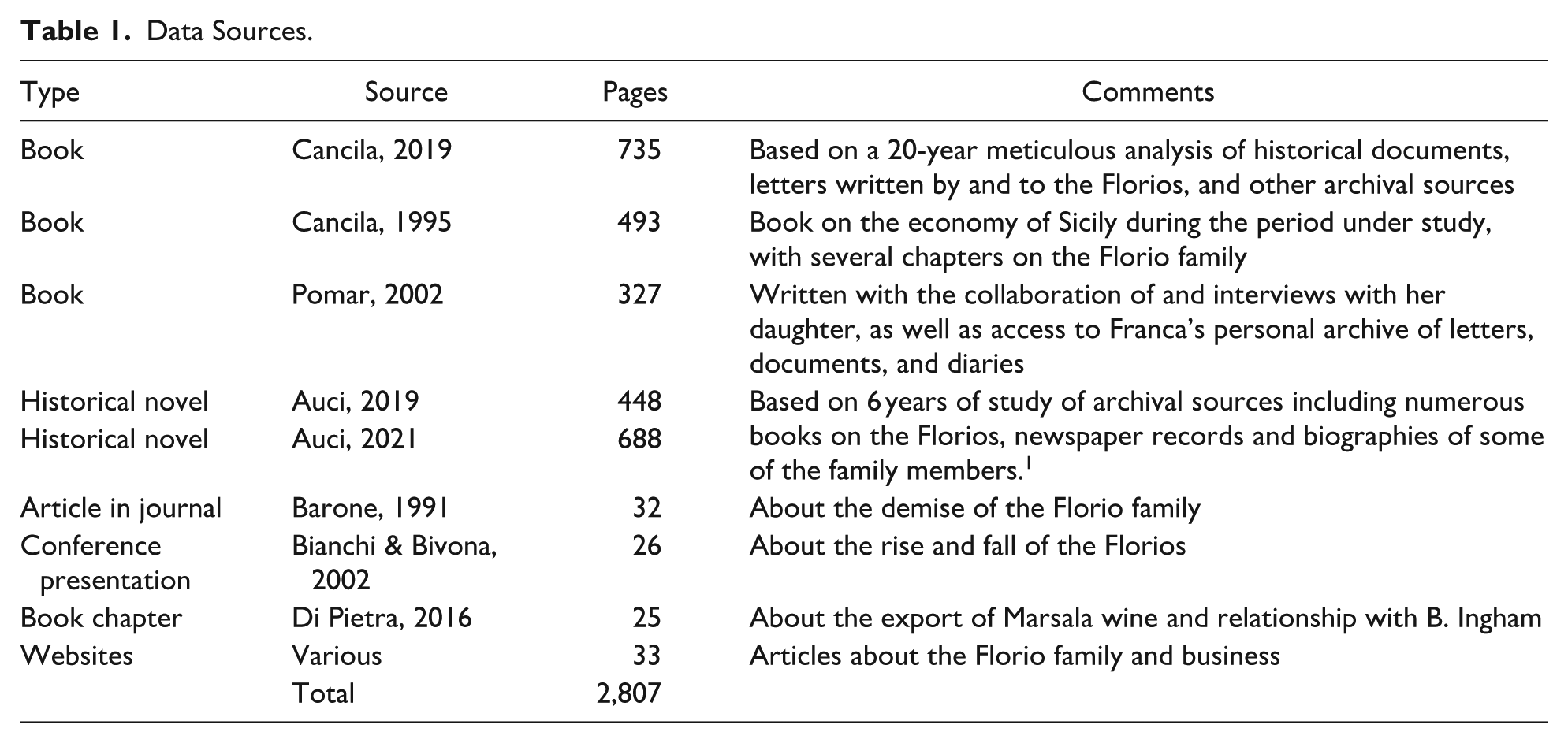
Each of these sources included events and dates about the family and business, which were used to contextualize the data for discovering and unpacking complex interactions among individuals, the family, the business, and the environment (Anteby & Molnár, 2012; Sinha et al., 2020). Two of the sources (Cancila, 2019; Pomar, 2002) were also key to access “conversations in which family members recount events outside the lived experience of any of the individuals at the table” (Suddaby et al., 2023, p. 4). Seeing that interviews were not feasible, because the family members and other key individuals have long gone, their letters and documents from personal archives, accessed through these two books, let these individuals speak in their own voices. Overall, these sources represent the most authoritative ones about the Florio family and their business.
Data Analysis
The method for data analysis is based on strategies for the analysis of process data, as suggested by Langley (1999), while taking into account criteria for interpreting historical sources (Kipping et al., 2014). With regard to strategies for the analysis of process data, it is not straightforward to analyze and manipulate process data because they deal with sequences of events, involve multiple levels and units of analysis, and are based on phenomena and relationships that are changing. Because of this, Langley (1999) suggests strategies for sensemaking, which are meant as approaches to analyze data and can be used in combination with each other. In particular, two of the approaches for process data analysis were pertinent to this study and its data: narrative strategy and visual mapping (Langley, 1999).
The first step in the analysis was to adopt narrative strategy as a data organization device (Langley, 1999). Because the case involved several actors and actions over a long period of time, creating a detailed story from the raw data and preparing a chronological account of events was helpful as a preliminary step (Langley, 1999). This consisted of putting together a timeline of the four generations, highlighting key events for the individuals, family, business, and broader context. Because the study entailed analyzing a large quantity of longitudinal data from several sources, it was important to make sense not only of the texts themselves but also of the temporal relationships therein (Kahl & Grodal, 2015). Data familiarization meant taking notes and highlighting relevant passages in the documents while writing comments on the margin, keeping in mind the research question. At this stage, the story of the Florio family became very vivid, with the intertwining among individual events (e.g., a birth or death), family events (e.g., a marriage bringing the family members close to another one), business events (e.g., the launch of a new business or creation of a business partnership), and events relating to the broader context (e.g., important scientific discoveries or the unification of Italy in 1861). This narrative strategy step was helpful to “get on top of the data, to clarify sequences across levels of analysis, suggest causal linkages between levels, and establish early analytical themes” (Pettigrew, 1990: 280). As such, this step was a preliminary step to start identifying patterns in the case (Pettigrew, 1990).
The second step in data analysis relied on visual mapping, a strategy that lets the researcher present large quantities of information in relatively little space. This allows for the simultaneous representation of several dimensions as well as the passage of time, making this a useful tool for the development and subsequent verification of theoretical ideas (Langley, 1999). This was achieved by manipulating the narrative obtained in the previous step, through narrative strategy, and presenting in graphical form the large amount of information about the case (Langley, 1999). The visual map was helpful to summarize and make sense of what took place in the case and as an intermediate step between the raw data/narrative and a more abstract conceptualization of the findings (Langley, 1999), which is found in the next section. More specifically, the visual map made it possible to analyze the case by identifying phenomena at both the vertical (between higher and lower levels of analysis) and the horizontal (based on the sequential or temporal interconnectedness among phenomena) levels of analysis and visualizing the interconnections among those levels over time (Pettigrew, 1990). Illustrating the case through a visual map also allowed for patterns to start emerging, leading to the timeline covered by the case to be decomposed into three successive temporal periods or stages. This was a helpful way of structuring events and a further step toward exploring theoretical ideas through examination of how one period affected the next (Langley, 1999).
A historical approach offers the advantage of paying attention to process (rather than linear causality), considering multiple, often messy, causes, taking into account past events and path dependency (Suddaby & Greenwood, 2009), and studying causal connections among conditions, actions, and effects in their natural setting or context (Stinchcombe, 2005). However, the sources used are not systematic observations made by the researcher to address the research question, but rather “traces of evidence from the past,” that may have been “produced in cultural and social contexts very different from our own” (Kipping et al., 2014: 306; 312). Therefore, several steps were followed to ensure that the interpretation of historical sources adhered to criteria of validity and robustness while situating the texts within their historical context (Kipping et al., 2014).
First, to establish the validity of the sources used, it is important to consider their provenance, author’s credibility, motive, audience, and purpose (Kipping et al., 2014). The main sources used in this study were: an authoritative historical study based on an extensive (20-year) archival research, written by a respected historian with relevant expertise (Cancila, 2019); an economic history of Sicily, written by the same authoritative historian (Cancila, 1995); a biography of Franca Florio, written by a journalist and author, and drawing from interviews and access to Franca Florio’s personal archives, such as letters and diaries (Pomar, 2002); and two historical novels by an Italian teacher and writer, which dramatize the history of the Florios through fictional—but plausible—dialogues that are grounded in an extensive, 6-year research of archival and documental sources, including letters and personal diaries, as well as conversations with historians and other experts. Overall, these works are by respected and credible authors and are characterized by source transparency because they are verifiable, with claims and evidence that can be linked back to specific sources and documents. Some of these works also contain letters, which may have different individual motives but have “authorial authority and perspective,” meaning that the author can be considered as being “trustworthy and capable in speaking to the issue at hand” (Kipping et al., 2014: 315).
Second, analysis and interpretation were based on triangulation and comparison among multiple and heterogeneous sources of data (Howell & Prevenier, 2001; Kipping et al., 2014). This helped reduce bias and increase confidence in the robustness of the research results (Kipping et al., 2014). Similar to previous historical research, sources were combined to contextualize the data and inductively uncover underlying mechanisms (Anteby & Molnár, 2012; Sinha et al., 2020).
Third, it was important to interpret the historical sources while taking into account the social, cultural, political, and historical contexts in which they were produced. The main sources were produced in recent times (late 20th and early 21st centuries) but drew on archival materials from the time of the Florios (19th and early 20th century), a context that was systematically analyzed—from a political, economic, and social perspective—in one of the sources used (Cancila, 1995). This allowed for the texts to be analyzed in relationship to context, going from text to context and vice versa in a “hermeneutic circle” to interpret the sources in their historical and cultural setting (Kipping et al., 2014). For example, analyzing the content of letters reproduced by Cancila (2019) involved interpreting them in light of the broader conditions in which the writer lived, such as class dynamics or political forces.
Overall, to ensure rigor in this qualitative study, data analysis followed the “analytical moves” illustrated by Grodal et al. (2021), starting from asking a specific research question, as outlined above, then focusing on the data that was most “surprising or salient” in relation to such question (as illustrated in section “Findings”), and finally iteratively relating and contrasting categories emerging from the data to formulate an overarching process model (see section “A Process Model of Economic and Noneconomic Goals in Family Business”). The overarching model focuses on the mechanisms and patterns of family business goals, starting from the individual level and taking into account family, business, and context as well. The proposed process model is then illustrated through two scenarios, exemplifying autonomous and noninternalized extrinsic motivation, respectively, drawing on evidence from the case and showing how the model can be used.
Findings
Narrative Strategy
The first step was to construct a detailed story through narrative strategy (Langley, 1999). This study is based on a longitudinal case study of a family and its business empire that brought Italy, and Sicily in particular, at the forefront not only economically but also culturally in the 19th century while at the same time influencing the politics and policies of its times (Bellanca, 2021). The New York Times defined the Florio family as “the merchant princes of Italy” and the “Italian Lloyds” (“American Trade with Italy. . .,” 1881). The relevance of the Florio family narrative is well encapsulated by the following quote referring to the success of the family business, as well as the family’s wealth and political influence:
Masters of the Mediterranean, true symbols of Italian industry, from holidays with the Rothschilds to shopping at Cartier in Paris and the great tailors of London: for decades talking about the Florio family meant talking about the manufacturing sector in all its splendor. Born as poor spice merchants immigrated from Calabria, within a few generations this Sicilian commercial house was not only able to create an empire on which depended the economic prosperity of Sicily, but was also capable of influencing the policies of the Bourbon kings first and the Savoy kings later. (Bellanca, 2021)
The Florio story starts with brothers Paolo (1772–1807) and Ignazio (1776–1828), the first generation of the Florio family business. They moved as children, with their family, to Sicily in the 1780s following a massive earthquake in their home region of Calabria in Southern Italy (see Figure 1 for a family tree). While their father Vincenzo had been a blacksmith, the two brothers started a business in Palermo in 1797 (Cancila, 2019). This was an apothecary store that sold spices and herbal medicine (similar to a modern pharmacy) and later supplied hospitals, businesses and aristocratic families (see Figure 2 for a timeline).
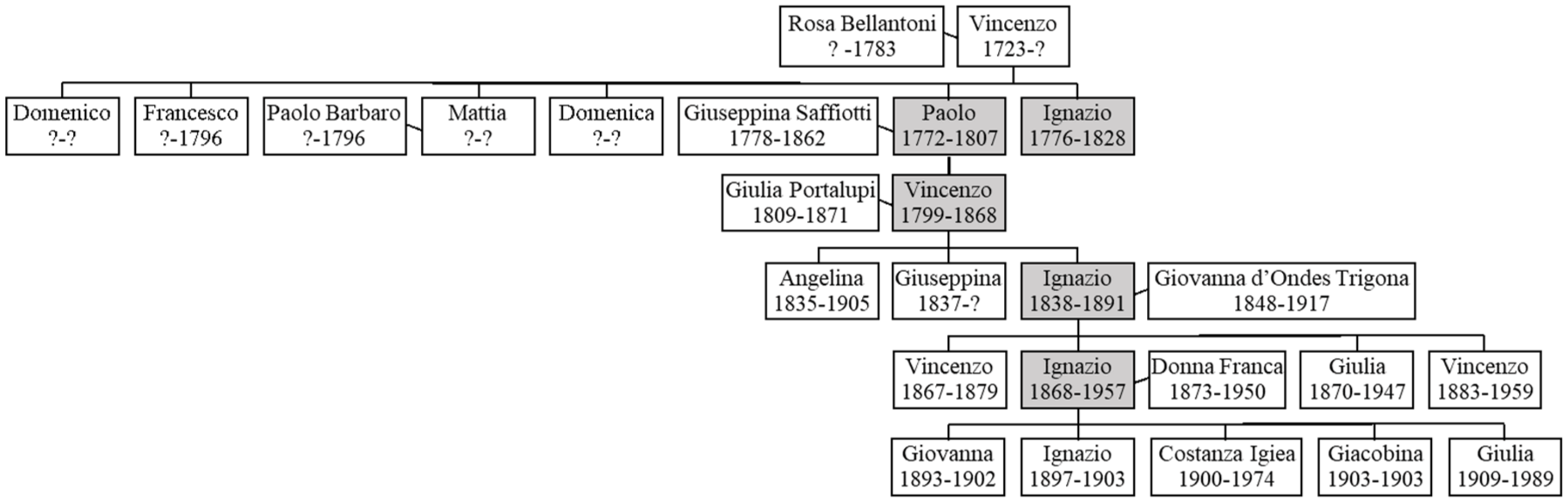
Florio Family Tree.
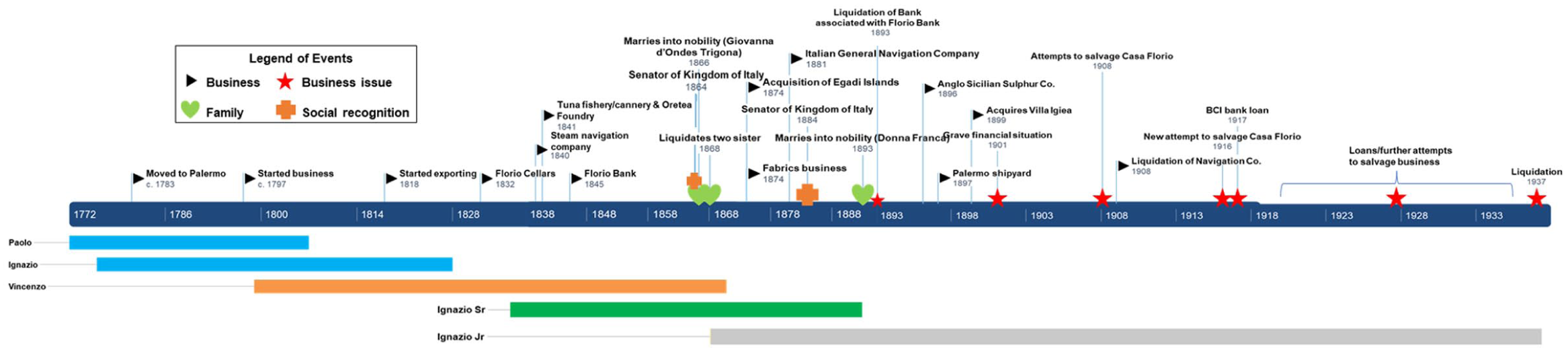
Florio Family and Business Timeline.
Together with their brother-in-law Paolo Barbaro, who came from a family of sea merchants, Paolo and Ignazio Florio started importing expensive spices and food by sea from Northern Italy and Southern France. Paolo and Ignazio were determined to grow their business, although they maintained a relatively modest lifestyle:
Business for Paolo Florio . . . was going very well, even though he continued to live with his family and his brother Ignazio in a rental home . . . It is true that Paolo Florio still did not own his home, but his wife Giuseppa was able to have a housemaid . . . and they had not only silver cutlery . . . but also jewelry. (Cancila, 2019, pp. 41–43)
After Paolo’s death (at the age of 35), Ignazio “dedicated himself to consolidating the main activities of the Florio House” (Cancila, 2019, p. 48). He never married and continued to live with and take care of his widowed sister-in-law and her son Vincenzo, whom he treated as his own child. In the last decade of his life (after around 1818), Ignazio took advantage of the opening of the Sicilian markets to other countries (e.g., exporting sumac and sulfur), which had started thanks to the presence in Sicily of English merchants such as the Inghams. Overall, in the decade in which he owned and managed the family business on his own, between 1807 and 1828, the assets of the family business trebled in value to 12,000 Sicilian ounces (Cancila, 2019), estimated at about 740,000 Euro (or US$780,000) today.
In the second generation, Paolo’s son Vincenzo (1799–1868) benefited from the financial wealth left to him by his uncle to continue growing the family business. He was well educated and was sent to Genoa in northern Italy, as well as France and England, to learn about business. In England, he met entrepreneur Benjamin Ingham, who at the time was the richest entrepreneur in Sicily thanks to trading of wool and Marsala fortified wine, which “Lord Nelson had made fashionable by purchasing large quantities of it for his fleet when Madeira was hard to get” (Mangione, 1973, p. 14). Ingham later became both his business partner and his competitor. While continuing the importing business, Vincenzo also started several new activities. He lived during a period of great political changes, with the end of the Kingdom of the Two Sicilies (which had been ruled by the Bourbons, a ruling dynasty that originated from the Kingdom of France) and the creation of the Kingdom of Italy in 1861, as well as technical and scientific innovation. This included the development of steam energy, leading to the birth of new industries such as large steamers, railways, and new mining technologies.
Vincenzo built a diversified family business group that included activities in several sectors, including: Florio cellars (founded in 1832) for the production of Marsala wine, a fortified wine first commercialized outside Sicily by the English traders Woodhouse, Ingham, and Whitaker; a steam navigation company (Società dei Battelli a Vapore Siciliani, 1840); the Anglo-Sicilian Sulphur Company Limited, with the English entrepreneurs Ingham and Porry (1840); a tuna fishery on the island of Favignana (Vincenzo introduced the industrial canning process still used today by boiling tuna and preserving it in oil, replacing the traditional method of preserving it in salt; 1841); the Oretea Foundry (1841); and the Florio Bank (1845). This breadth of activities was both evidence of Vincenzo’s entrepreneurial spirit, with verticalization of activities (wine, sulfur, ships, foundry) and also a strategy to spread risk across different activities and sectors. At the eulogy for his funeral, he was described as not having “much culture nor philosophical knowledge” but having “a vast mind, an entrepreneurial spirit, resolute courage, accurate readiness, and a singular capacity not only to understand business but also to give it a vigorous momentum coupled with knowledgeable purpose” (eulogy by priest Luigi Di Maggio; as cited in Cancila, 2019, p. 74).
Despite his business success, Vincenzo was treated with contempt by the aristocracy in Palermo, which despised the Florios and the new industrial and commercial bourgeoisie, who had made money through trading and commerce and to whom they often had to turn to borrow money: “For the nobles of Palermo the Florios ‘stink of work’” (Auci, 2019). A Neapolitan baron, Francesco Cotella, referred to Vincenzo as being “faithful to his villain principles, and a rough but lucky person,” whom it would be better “to avoid as much as possible” (from an 1839 letter; as cited in Cancila, 2019, p. 65). Similarly, politician Pasquale Calvi expressed his disdain by defining Vincenzo as a “miser, usurer, soul of mud” (Cancila, 2019, p. 65). Only toward the end of his life Vincenzo finally received recognition for his entrepreneurial success, by being appointed as senator of the Kingdom of Italy and president of the chamber of commerce of Palermo. He also “started the tradition of making donations to poor families in Palermo . . . because, having been born in a poor family himself, he knew what it meant to work to earn a measly piece of bread” (Auci, 2021, p. 110).
In the third generation, Vincenzo’s son, Ignazio Sr (1838–1891), inherited a large estate and grew the family business to its peak. Vincenzo realized that:
. . . the Florios’ wealth did not consist only of numbers, ships, wine or sulfur: to be accepted, they had to change their lifestyle, opening their home, organizing receptions for friends and acquaintances, hosting painters and writers. The aristocrats had to stop looking at them as “nouveau riche.” (Auci, 2021, p. 107)
The Florio family was recognized as a successful business family and accepted in high society only thanks to Ignazio Sr’s marriage to the daughter of a count, whose aristocratic family had run out of money (and consented to the marriage because of Ignazio’s wealth): “a marriage with a d’Ondes Trigona would be enough to clean their blood” (Auci, 2021, p. 108). This marriage allowed Ignazio to become integrated into the international jet-set of the Belle Époque time; for example, in 1887, the Florios were invited to attend the jubilee of Queen Victoria, in recognition of their status. He was also appointed as a senator for life of the Kingdom of Italy in 1883.
Ignazio Sr consolidated the family empire, growing the activities started by his father, in particular the tuna fishing and cannery, as well as the shipping business. In 1881, the Italian General Navigation Company was created from the merger with Rubattino, another large national shipping company. It became the second-largest shipping company in the Mediterranean with over 90 steamers connecting about 40 Italian cities and reaching 30 foreign ports, including new routes across the Atlantic Ocean. Ignazio Sr also relaunched two of his father’s businesses, fabrics, and fishing. In the fabrics factory, Florio created a daycare, free night schooling, an affordable refectory, a bakery, and offered cheap accommodation and even loans to employees. Although these were innovative initiatives, they all failed due to social and cultural resistance:
The laborers, with the exception of a few, not only failed to improve, but were reduced to a bunch of lazy idlers . . . the disgust for the nursery was widespread and the experiment had to be suspended after a month . . . in its third year the free evening school closed, because parents considered it more productive for the family that, during the hours of rest, girls be used for housework rather than left at school; the affordable kitchen was closed after a month with a loss of over 200 lire due to uncollected debts; . . . the bakery . . . soon also closed at a loss. (Morvillo, 1877; as cited in Cancila, 2019, p. 291)
Father (second generation) and son (third generation) were quite different, yet their contrasting qualities could be seen as complementary, as they were described as being “a positive and almost providential antithesis.” Vincenzo’s (father) work was “devouring, feverish, [with] quick intuition, which was followed by swift action, and more exuberant and versatile genius”; Ignazio’s (son) activity was “more continuous, [he had] a calmer intuition, persistent and tenacious action”; “one indicated and opened the way, the other established and followed it” (commemoration of Ignazio Florio in 1891 by politician Vittorio Emanuele Orlando; as cited in Cancila, 2019, p. 181).
Ignazio Sr started promoting the Europeanization of Palermo, later continued by his son, using his political and economic weight to champion social and cultural renewal. This led to the transformation of Palermo through the development of the Liberty style (Italian variant of Art Nouveau). Among other things, Ignazio Sr contributed to the financing for the construction of the Teatro Massimo (still today the largest opera house in Italy and third largest in Europe after Paris and Vienna) by architect Ernesto Basile and the National Exhibition in Palermo in 1891.
When Ignazio Sr died, at the age of 52, his employees “found for him a word that expresses the highest manifestation of affection and gratitude, as only the heart of the people can find. They said: we have lost our father. . . [they saw] in Florio not a symbol but a person.” (1891 commemoration of Ignazio Florio by politician Vittorio Emanuele Orlando; as cited in Cancila, 2019, p. 183).
Ignazio left three children: the heir to the family business, Ignazio Jr (1868–1957), who received two-thirds of the business; his sister Giulia, who received money and buildings but not any part of the business because she was a woman; and his younger brother Vincenzo Jr, who received one-third of the business but was more interested in cars (establishing the Targa Florio, an open-road endurance car race, in 1906). Ignazio Jr, representing the fourth generation, was only 23 years old when he inherited one of the largest fortunes in Europe at the time. He was described as being inexperienced, self-indulgent, and arrogant, having grown up as a spoilt child in a rich family: “[he] has no interest in the business negotiations his father tried to involve him in . . . it is as if Ignazio only wants to see the beautiful things in life. Which, coincidentally, for him are the most expensive” (Auci, 2021, p. 216). Ignazio Jr initially maintained the businesses and attempted to start some new ones such as a shipyard in Palermo, the Anglo-Sicilian Sulfur Society, and the Sicilian Agricultural Consortium. However, with Ignazio Jr, there was a clear shift away from dedication to the success of the family business. Instead, he and his wife, Donna Franca, led a lavish lifestyle, as also Franca “soon realized she could draw with full hands from the abundant streams [of money]” (Pomar, 2002: 45):
He adopted the worst behavioral codes of the Sicilian aristocracy. . . Ignazio was dressed in London by the same tailor as Prince Edward, the future king of England, and his wife Franca was no different and showed off elegant gowns and astounding and very expensive jewels (including a famous seven meter long pearl necklace), almost always a gift from her very generous husband, to make up for his numerous extramarital affairs. (Cancila, 2019, p. 311)
Ignazio kept squandering the family fortune even when the business started facing financial difficulties:
It was rare for a ball at the Florio house to end without gifts of silver bracelets and trinkets to the ladies and of necklaces and silver “petits crayons” [small silver mechanical pencils] to the gentlemen . . . Ignazio Jr’s standard of living continued to be extravagant, alongside his wife’s, everywhere admired and courted as one of the most beautiful and fascinating women in Europe, between a trip abroad and a short stay in Palermo, between an international regatta and a cruise, between a reception at the Olivuzza [the Florio estate] in honor of Kaiser Wilhelm II and a dinner at the court of the sovereigns of Italy (Donna Franca was Queen Elena’s court lady from 1902). A standard of living that no Florio before them had had and that came with very high costs, both in Palermo and when they went around Europe on their private railway carriage, staying for long periods, with a large entourage, in the most elegant and exclusive hotels. (Cancila, 2019, p. 311)
During this period, Ignazio Jr promoted the cultural milieu in Palermo, for example, he commissioned several Art Nouveau villas built in and around Palermo. He also managed the Teatro Massimo opera house in Palermo (1901–1919 and 1923–1926), organizing seasons of notable artistic level, which, however, ended with large financial losses (Cancila, 2019). The family was perceived as being a patron of the city:
. . . the keen interest that these great benefactors of our city, the Florio brothers, have for the well-being of Palermo and the development of its vitality, in all forms. Wherever there is a great initiative to be taken, here is the ready, reassuring, vibrant intervention of Ignazio and Vincenzo Florio. (L’Ora, 1905; as cited in Cancila, 2019, p. 443)
The Florios’ lavish and extravagant spending style has often been indicated as a contributing cause of the demise of the family fortune. In June 1891, only one month after his father’s death, when his relationship with Franca was just starting, Ignazio wrote her a letter asking if she liked life at sea, because in that case “I would intend to sell the Queen [yacht] and buy a bigger one, so that we could make our first voyage comfortably.” While his father, Ignazio Sr, had been content with just one yacht, less than two years after his father’s death, Ignazio Jr owned six yachts to which he added a seventh in 1897 (Pomar, 1985, as cited in Cancila, 2019, p. 311). In the end, the Florios’ personal debts accounted for 15% of total debts (Barone, 1991). Despite this, the image that the couple kept projecting to the outside world was that of overindulgence. In a letter sent to Ignazio Jr in 1909, the director general of the Bank of Italy, Bonaldo Stringher, who was trying to find a solution to help manage the Florios’ growing debt, wrote:
I must manifest my deep regret for your absolute inaction in curbing [your] excessive expenses. You have done and are not doing anything to reduce these expenses, despite it being necessary to show your utmost good will to change the system radically. I do not hide from you that, seeing a lack of a swift and sincere shift towards a new life by you and your family, nobody believes in your promises any longer, nor in the possibility of saving your House and making it flourish once again . . . (Barone, 1991, p. 28)
As the business struggled, Ignazio Jr started delegating decisions to often unscrupulous administrators and spent his time traveling, enjoying life, and pursuing extramarital affairs (Pomar, 2002). When he realized that he was about to lose everything, he wrote to his wife:
My dear Franca, God knows what I am going through. The mortifications that I must overcome with holy resignation. The refusals to the proposals I make, the pain of realizing the lack of trust in our name, and I don’t want to write anything else. (Letter from Ignazio to Franca, May, 31 1934, as cited in Cancila, 2019, p. 600)
The external context also changed around the Florio family business, as there were profound economic and political transformations. Despite being somewhat vertically integrated (foundry, used for the ships and later the shipyard, employed for the transport of wine and sulfur, also produced by the Florios), the family business was too specialized in certain sectors (e.g., sulfur and wine), which over time became less attractive because of growing international competition. Furthermore, the political context changed in the late 1800s, with a new Italian government ending the significant financial aid to the shipping business that the Florios had enjoyed in the first three generations. In addition, the Florios were not able to withstand new competition because their ships required large investments to be modernized. There were other major shifts, for example, trains, rather than ships, started to be used for commercial transport. In addition, the First World War caused a block in all maritime and commercial transportation, paralyzing the family business’s remaining activities. And, importantly, Ignazio Jr made several bad business decisions despite being advised against them, for example, associating his family’s bank with another bank, Credito Mobiliare, which collapsed in 1894, and refusing the intervention of the Bank of Italy to save the family business in 1909 (Barone, 1991).
In the end, the Florios lost everything, including their homes, and, between 1929 and 1935, the businesses were either sold to pay for debts or liquidated (Pomar, 2002): “The liquidation of the Florio assets . . . was disastrous” because the stocks were worth nothing and the Italian state, which took on the failure of the Florio businesses, “lost as of today about 40mln Lire [equivalent to 40mln Euro].” Assets were liquidated with substantial losses, both because they had been overvalued by the Florios and due to the economic crisis of the 1930s (1937 report prepared for the Italian ministry of finance, as cited in Cancila, 2019, p. 604). This marked the end of the Florio business empire, which caused the family to lose everything and forced Ignazio and Franca to move to Rome, often living in hotels as they could no longer afford a home. While Ignazio continued to look for financial resources to salvage the business, Franca kept traveling around Europe, as reflected in Ignazio’s letters to his wife: “How we will get to January”? (Letter from Ignazio to Franca, August 17, 1933, as cited in Cancila, 2019, p. 596); “I am disheartened because I am unable to send you [any money] and cannot pay for the hotel” (Letter from Ignazio to Franca, December 9, 1933, as cited in Cancila, 2019, p. 597). All of the family assets, including jewels, furniture, and paintings, were sold at auction over time, and Ignazio and Franca ended homeless and destitute. He died in 1957, aged 88, in Palermo, where he was staying with his grandchildren, while his wife had died 7 years before at daughter Igiea’s home in Tuscany (Cancila, 2019).
Visual Mapping
The next step for data analysis was to construct a visual map (Langley, 1999; Langley & Truax, 1994), based on the narrative illustrated above. The aim was to present large quantities of information in relatively limited space (Langley, 1999), to start contextualizing changes in family business goals against changes at various levels of analysis (individual, family, business, and external context) while illustrating temporal interconnectedness (Pettigrew, 1990; see Figure 3).
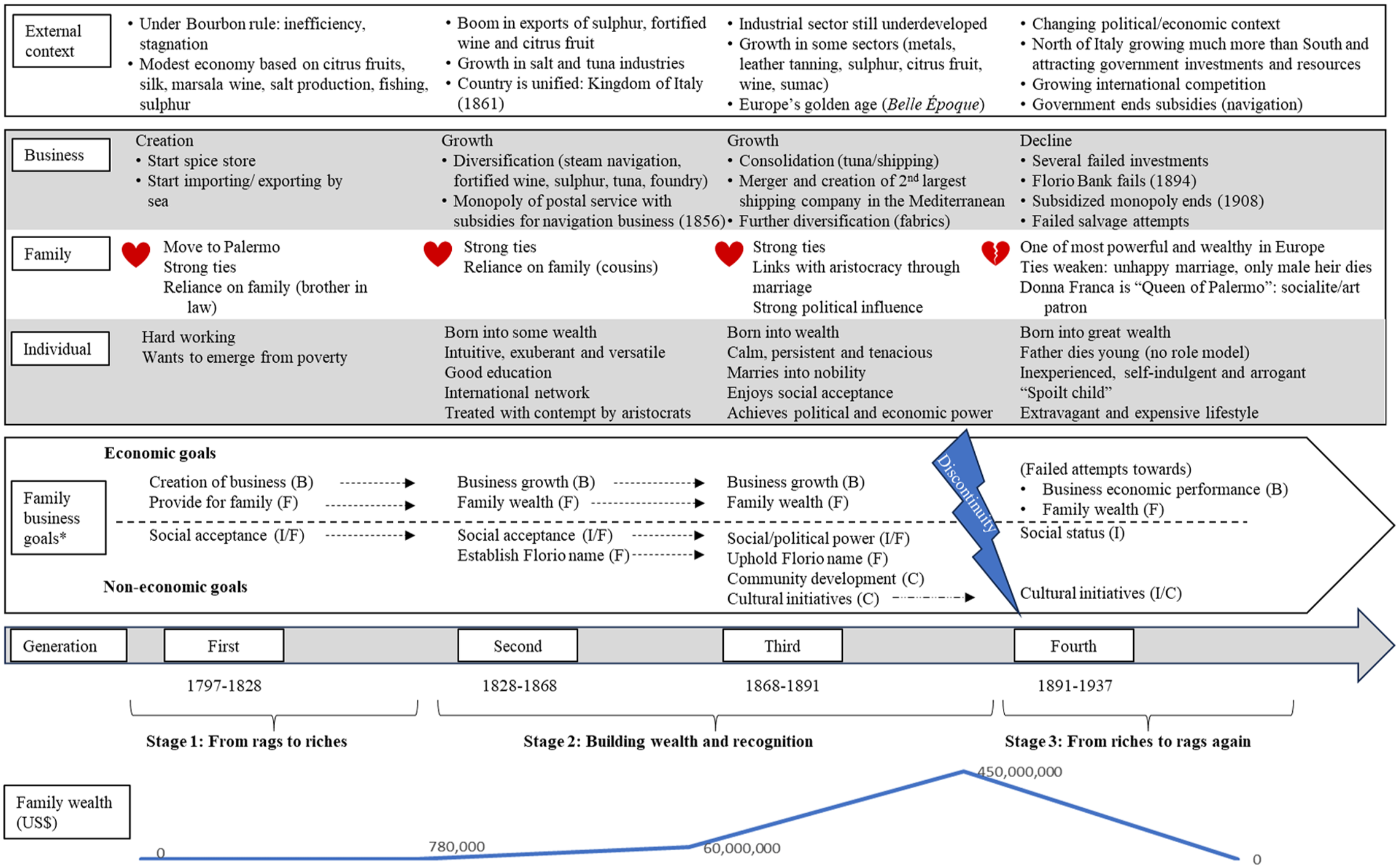
Visual Map.
The bottom part of the visual map shows the wealth created by each generation, growing from nothing to US$780,000 (in today’s value) in the first generation; growing almost 77 times in the second generation to US$60 mln; then 7.5 times in the third generation to over US$450 mln, and finally back to nothing at the end of the fourth generation. The visual map illustrates time, spanning 140 years through the Florio generations, between 1797 and 1937. During the analysis in the visual mapping phase, it became evident that, with subsequent generations and the passage of time, it was important to distinguish among levels of analysis. Overall, the visual map allows for the identification of three successive periods, which go beyond a chronology of events and illustrate underlying patterns (Pettigrew, 1990). These periods are distinguished by discontinuities in the business (e.g., succession to next generation) and in the context (Langley, 1999) and provide a compelling account of the evolution of economic and noneconomic goals.
Stage 1—from rags to riches—encompasses the first generation, which was represented by a strong and united family. In this period, the two brothers started a family business, primarily to sustain the family. Being a family of immigrants, however, the Florios strived for social acceptance. The external context was unfavorable, with Sicily under the Bourbon rule and with an economy that was still based on a feudal system and agriculture. The family was tightly knit (as indicated by the heart symbol), also choosing cousin Paolo Barbaro as a business partner. The family business was in its early stages and pursued a balance of economic and noneconomic goals (benefiting individuals, family, and business), with a slight prevalence of economic goals due to the need to start building the business and providing for the family.
Stage 2—building wealth and recognition—encompasses the second and third generations. The family (both nuclear and extended) remained strong and united (as indicated by the heart symbol): for example, cousin Raffaele Barbaro was asked to run the Marsala winery. The successor in each generation was nurtured and prepared by his father to take on their role in the business. Helped by a more favorable external context, with booming exports in several industries, the Florio successors were able to grow the family business through diversification and consolidation. While enjoying the economic benefits from their successful business, the Florios continued to strive for social acceptance and wished for their name to be known not only for their economic wealth. Finally, after marrying into nobility in the third generation (a marriage that was made possible thanks to the accumulated wealth), the Florios were accepted on a social level and developed their political power and started focusing on community and cultural activities. A balance between economic and noneconomic goals (benefiting individuals, family, business, and community) was evident in this stage.
Stage 3—from riches to rags again—encompasses the fourth generation, which faced challenges on several levels. The Florio successor was entitled and unprepared to take over the family business. This was partly because he was born into one of the wealthiest and most powerful families in Europe, pointing toward classic “spoiled child syndrome,” with a busy father with deep pockets bestowing material possessions on his son who had little exposure to and interest in the family business (De Vries, 1993); and partly because his father died young, indicating a lack of role model (Chlosta et al., 2012), which meant Ignazio Jr, unlike successors in previous generations, was not exposed to his father’s steward-like attitudes and capabilities over a significant part of his life (Le Breton-Miller & Miller, 2015) and had limited identification with and commitment to the family business (Dawson et al., 2015; Sharma & Irving, 2005). Family ties weakened (as indicated by the broken heart symbol), with a marriage that became unhappy and the only male heir dying in infancy. In addition, the Florio successor was unwilling to listen to anybody’s advice and made several bad business decisions. This was compounded by his lavish lifestyle and desire for social status. The Florios continued to sustain cultural initiatives, although these seemed more aimed at further increasing the family and individual social status than sustaining the local community as in previous generations. The context also changed quite dramatically, both politically and economically, and became unfavorable for the family business. In this stage, there is evidence of the business owner taking advantage of financial slack in the family business to pursue his goals freely, leading to complacency and unprofitable use of resources (De Massis et al., 2018; George, 2005; Jensen, 1986), with a clear imbalance between economic and noneconomic goals (leaning toward the latter), often benefiting the individual more than the business or community, eventually leading to the family business’s demise.
A Process Model of Economic and Noneconomic Goals in Family Business
This section builds on the findings, proposing a process model of family business goal formation by shifting the focus to identifying categories that emerged from the analysis, comparing them to each other and identifying relationships among them (Grodal et al., 2021). This step required moving from a more descriptive “what” (illustrated above through narrative strategy and visual mapping) to theorization of the mechanisms, seeking to answer “how,” thus addressing the research question more directly. It became apparent that several of the categories operate in parallel, suggesting that family business goal formation cannot be understood in isolation, as it interacts with several levels of analysis. The overarching process model emerging from the analysis of the data and focusing on the mechanisms and patterns of family business goal formation is visualized in Figure 4. This model draws on self-determination theory (Ryan & Deci, 2000, 2002) to explain how the family business owner’s motivation drives economic and noneconomic family business goals and how, in turn, family, as well as business and context, contribute as well.
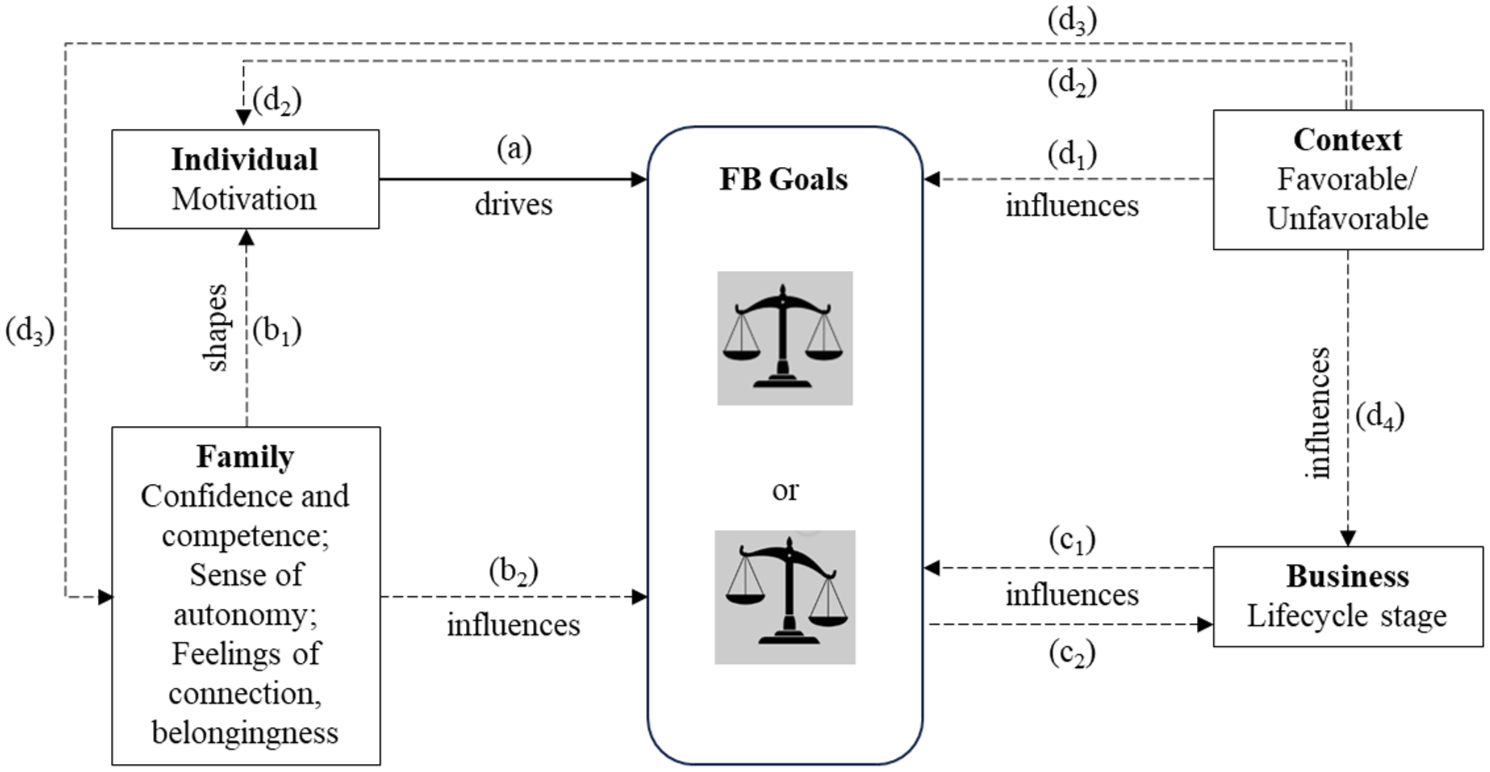
A Process Model of Economic and Noneconomic Goals in Family Business.
The core construct being investigated is family business economic and noneconomic goals (FB Goals), which are placed at the center of Figure 4. These goals can have family or nonfamily as recipient: goals benefiting the family can be economic (e.g., family wealth) and noneconomic (e.g., social status and identification with the family business); nonfamily-centered goals can also be economic (e.g., firm survival, growth, and profitability) and noneconomic (e.g., good relationships with internal and external stakeholders; Kotlar & De Massis, 2013). Family business goals (economic/noneconomic) can be balanced or not (as illustrated by the two scales in the middle of the figure under “FB Goals”), depending on the mechanisms that are illustrated below.
The main pattern that emerges from the analysis is that the individual (main decision-maker in the family business 2 ) drives (arrow a, see top left in Figure 4) family business goals based on their (autonomous or noninternalized extrinsic) motivation. The analysis also suggests further mechanisms that are shaping or influencing family business goal formation and other components of the model (indicated with dashed arrows in the figure), in addition to the main driver identified by arrow a. Individual motivation (main driver) is in turn shaped (arrow b1, center left) by the family, based on whether it fosters confidence and competence, builds a sense of autonomy, and conveys feelings of connection or belongingness to the individual (Ryan & Deci, 2017). Family business goals are also influenced (arrow b2, bottom left) by the family, for example, through a sense of legacy or transgenerational intention (Chrisman et al., 2012; Kotlar et al., 2018). The business influences (arrow c1, bottom right) organizational goals depending on the stage in its life cycle: for example, a start-up may have initially to focus more on economic than noneconomic objectives, at least until it has reached economic viability, because entrepreneurs have to earn enough money to earn a living (Murnieks et al., 2020), as happened in the first generation; and also vice versa (arrow c2, bottom right): for example, a balance between economic and noneconomic objectives may allow a business to flourish and grow, because pursuing noneconomic objectives by employing family members can not only improve family relations but also promote trust or cooperation among employees, thereby benefiting the business and helping it grow (Randolph et al., 2019), as happened in the second and third generations. Another influence is from the external context (arrows d1-4, top right), depending on whether it is (un)favorable. Context can influence family business goals (arrow d1), as well as individual motivation (arrow d2), family (arrow d3), and business (arrow d4): for example, a declining industry can cause a business to suffer because of intensified rivalry among competitors (Porter, 1980), as happened in the fourth generation.
Overall, the process model highlights the main role-played by the individual decision-maker’s motivation, with several other factors at different levels of analysis shaping or influencing family business goals as well as other factors, in a mutually co-dependent and co-evolving manner. Rather than indicating a sequential path to be followed, the process model sets out factors that interact to produce an outcome, that is, family business goals.
The process model described above can be illustrated through scenarios drawing on evidence from this case and exemplifying how the model can be used. Figure 5 illustrates two situations in which the individual decision-maker has autonomous motivation. Panel A illustrates a scenario characterized by a favorable external context, in which the individual displays autonomous motivation, which drives the family business’s goals (arrow a). The individual’s autonomous motivation is shaped by the family (arrow b1), which fulfills the three basic needs of competence, autonomy, and connection (Ryan & Deci, 2000). This scenario reflects the second and third generations in this case, but more generally, it reflects a situation in which the key decision-maker has autonomous motivation and there is a favorable external context. In this case, there is evidence of the family fostering the three basic needs in the successor thanks to the presence of the father as role model, as well as wanting to build on the previous generation’s success to uphold the high standards of quality, efficiency, and innovation (competence), close family ties as well as ties to the local community (relatedness), and the successor being allowed to feel like they have a choice when taking over the family business (autonomy). The data suggest that both Vincenzo (second generation) and Ignazio Sr (third generation) display evidence of autonomous motivation, because they exhibit identification with the value of the activities they were carrying out: their entry into the family business was the result of a gradual socialization process in which they were nurtured by their fathers, and their actions suggest a deep identification with the symbolic and social roles attached to the Florio name. These individuals show evidence of integrating the activities they pursued into their sense of self, as also demonstrated by their highly effective performance and persistence (Deci & Ryan, 2008). At the business level, the stage of the life cycle (growth) means there is limited complexity, allowing the family business to pursue balanced (economic and noneconomic) goals (arrow c1). At the external level, a favorable economic and political context (early signs of industrial capitalism, modernization through expansion of port facilities and first railways, gradual opening of international markets) facilitates pursuing family business goals (arrow d1). Thus, the combination of autonomous motivation at the individual level with a growing business and a favorable context contributes to balanced family business objectives in terms of (economic and noneconomic) goals and (family and nonfamily) recipients. These are represented by the balanced scales symbol in the middle of Panel A in Figure 5 under “FB Goals.” This illustrates how both economic and noneconomic goals are pursued, benefiting both family and nonfamily recipients (indicated by all four boxes in the matrix being shaded).
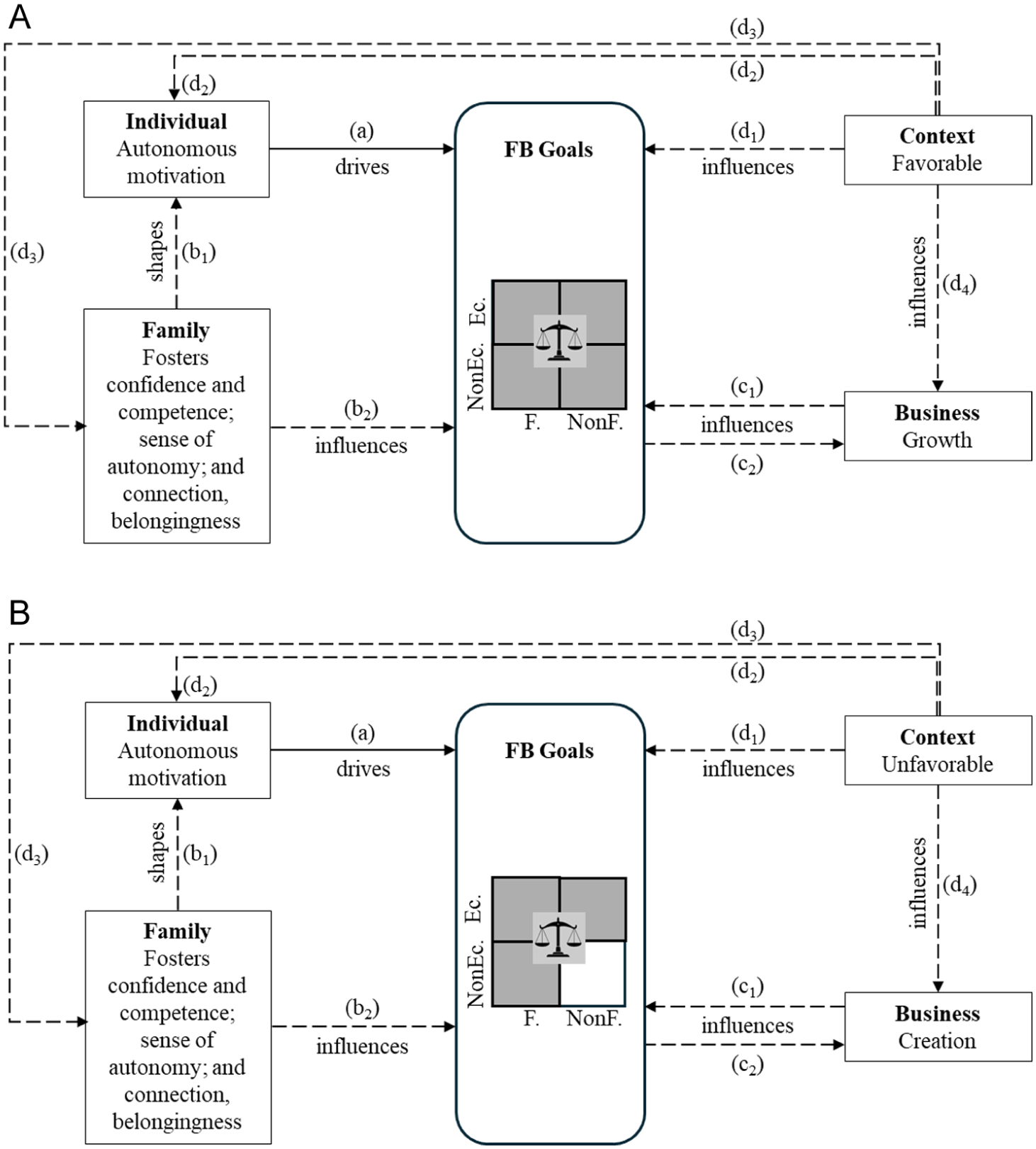
Autonomously Motivated Individual: (A) Favorable Context. (B) Unfavorable Context.
Panel B in Figure 5 illustrates a scenario in which the individual has autonomous motivation, despite an unfavorable context, combined with an early/growth stage in the business’s life cycle. This scenario reflects the first generation in this case, but more generally, it reflects a situation in which the key decision-maker has autonomous motivation, and there is an unfavorable external context. In this case, the individual appears to have autonomous motivation, which drives family business goals (arrow a). For the founders, the three basic needs (Ryan & Deci, 2000) seem to be fostered because the family supports them (arrow b1) in successfully launching the business, making them feel efficacious toward their actions (competence), has close ties—for example, a cousin, who came from a family of sea merchants, went into the same business with the Florio brothers—(relatedness), and decides to move to Palermo to start a business, making the brothers feel they are the source of their behavior (autonomy). There is evidence of brothers Paolo and Ignazio (first generation) displaying autonomous motivation, because they exhibit an identification with the value of the activities they were carrying out, trying to build, starting from their modest roots, a successful business, and then growing it to sustain themselves and their family. They also show an integration of these activities into their sense of self, through a desire to achieve self-made success and independence, as also demonstrated by their highly effective performance and persistence (Deci & Ryan, 2008). In this scenario, the individual is able to balance economic and noneconomic family business goals, despite a slight prevalence of economic objectives due to challenges from the unfavorable context, which was still under Bourbon rule and characterized by a feudal economic structure and a rigid class structure (arrow d1). At the center of Panel B, three out of four boxes in the matrix are shaded, seeing that noneconomic goals for nonfamily recipients are not a priority in this generation; however, overall there is a balance (indicated by the balanced scales symbol at the center). This suggests that the individual effect (arrow a), which is influenced by the family effect (arrow b1), is stronger than the external one (arrow d1).
Figure 6 illustrates a different scenario in which the individual is driven by noninternalized extrinsic motivation, that is, motivation that is not integrated with their sense of self, and instead is driven by the desire to obtain rewards (Ryan & Deci, 2000, 2002)—related to acquiring material goods and social status. This is the key mechanism that drives family business goals (arrow a). This scenario reflects the fourth generation in this case, but more generally, it reflects a scenario in which the key decision-maker has noninternalized extrinsic motivation and there is an unfavorable external context. In this case, the family does not appear to fulfill the three basic needs (Ryan & Deci, 2000) as it does not foster competence, feelings of connection, or a sense of autonomy (arrow b1). This is because the fourth-generation successor, respectively, lacked a role model, experienced weakened family ties, and felt pressured to take over the family business, while he would have preferred to enjoy the family wealth and pursue a hedonistic lifestyle. Data suggest that Ignazio Jr (fourth generation) displays noninternalized extrinsic motivation, because he was mainly driven by external rewards such as buying expensive yachts and jewelry, pursuing an extravagant lifestyle, and upholding his public image, with the aim of attaining a separable outcome in terms of social recognition or to “attain ego enhancements such as pride” (Ryan & Deci, 2000: 72). There is not much evidence of him showing strong interest or effort toward achieving continued growth or success in the family business, and he also disowned responsibility for negative outcomes of his decisions, blaming others (Ryan & Deci, 2000). At the business level, the stage of the life cycle (maturity, with a large, diversified business and later decline) indicates there is increased complexity, affecting family business goals and in particular economic ones (arrow c1). At the external level, the unfavorable context further exacerbates these mechanisms because pressures, such as increased competition and political changes, restrict the owner’s feeling of competence and ability to make autonomous decisions (arrow d2), influencing family business goals and in particular economic ones (arrow d1). In this case the individual is driven by noninternalized extrinsic motivation and pursues noneconomic family business goals at the expense of economic goals. This is illustrated in the figure by the bottom two boxes, representing noneconomic goals, being shaded in the matrix, but not the top two boxes, representing economic goals. Overall, there is an imbalance in family business objectives, indicated by the unbalanced scales symbol at the center. In fact, because the family ties are not as strong, and the need for relatedness is not fulfilled, the noneconomic goals pursued are related to a desire for social status and hedonism/enjoyment of life—typical of extrinsic motivation.
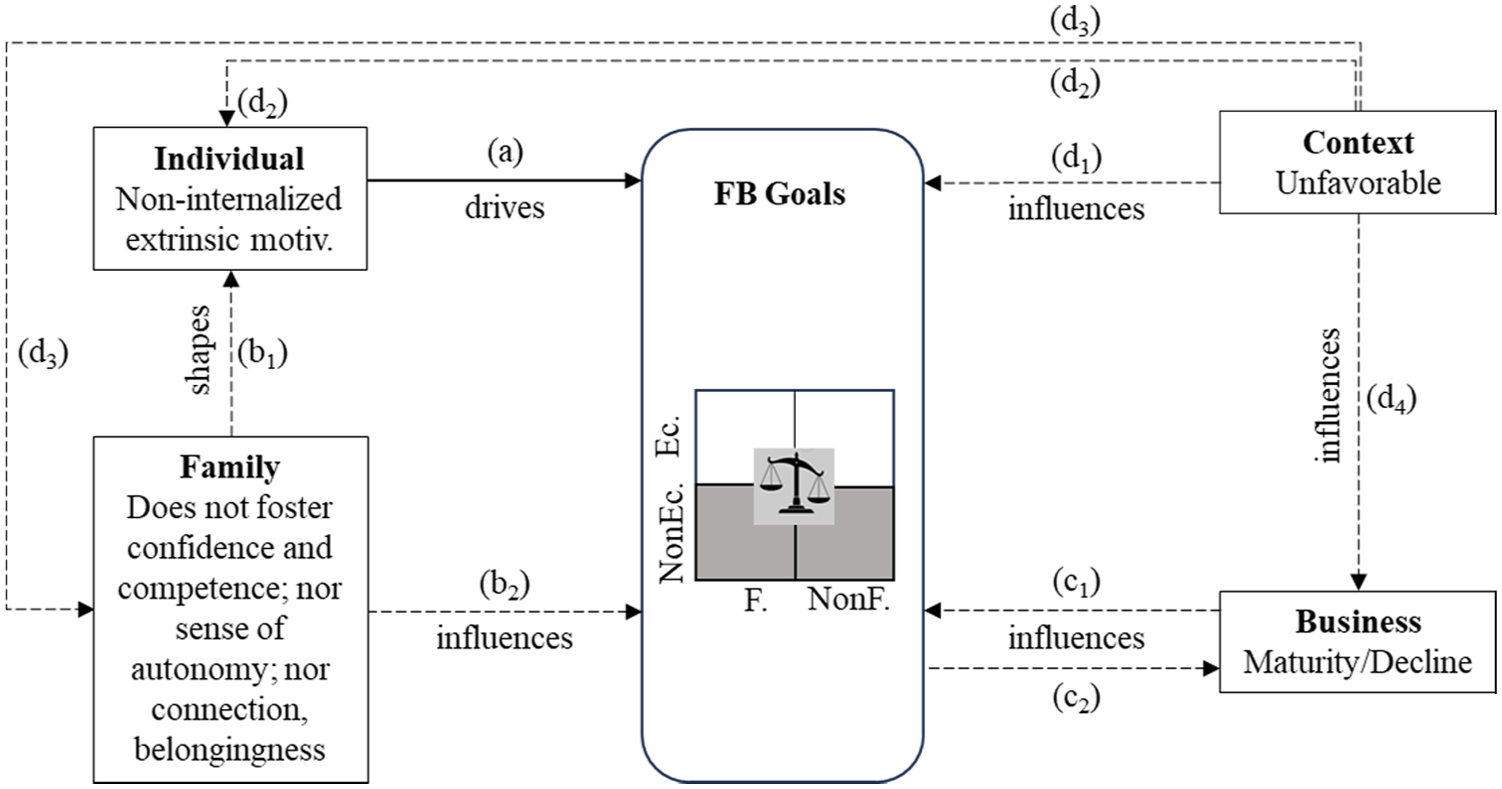
Extrinsically Motivated Individual: Unfavorable Context.
In sum, the scenarios presented draw on evidence from the Florio case, namely: individual with autonomous motivation combined with a growing business and a favorable context (Figure 5A) or an unfavorable context (Figure 5B); and individual with noninternalized extrinsic motivation combined with a large, diversified business and an unfavorable context (Figure 6). The first two scenarios in Figure 5 explain the “rags to riches” part of the story, while the scenario in Figure 6 explains the “riches to rags again” part of the story. The process model exemplifies how the key individual decision-maker drives family business goals, with individual motivation being shaped by whether basic psychological needs for competence, relatedness, and autonomy (Ryan & Deci, 2000) are fostered primarily by the family, with business stage/complexity and external context also being influencing factors. Individuals whose basic needs are satisfied are likely to be more autonomously motivated, leading to a better balance of economic and noneconomic family business goals. Thus, the interaction of categories “individual motivation,” “family influence,” “business stage/complexity,” and “context (un)favorability” can lead to two very different theoretical stories, one led by autonomous motivation at the individual level and balance between economic and noneconomic family business goals, and the other by extrinsic motivation at the individual level and imbalance between economic and noneconomic family business goals.
Discussion
The aim of this study is to add to knowledge of how family business goals develop, through the lens of family memory and history, which lets us view family business “as a dynamic social process” rather than “a static social structure” (Suddaby et al., 2023, p. 5). The motivation for the research was driven by the limited knowledge on the process of family business goal formation (Williams et al., 2018, 2019), which is partly due to its complexity, caused by the interaction between family and business systems (Kotlar & De Massis, 2013), as well as the importance of accounting for multilevel considerations to advance our understanding of this phenomenon (Daspit et al., 2024). While economic and noneconomic goals in family businesses have been mostly studied at the firm level, this study focuses on the individual level because organizational goal setting stems from individuals (Kotlar & De Massis, 2013).
The longitudinal case study is based on the Florio family business story of success and decline through four generations. The analysis of the case suggests how the firm-level goal formation process is mainly driven by the individual level, specifically through key decision-makers’ motivation, and that it can change as a result of the interaction among several mechanisms at other levels. Specifically, the family appears to play an important role by shaping the individual’s motivation, depending on whether the family fosters confidence and competence in the family business owner, builds their sense of autonomy, and nurtures feelings of connection and belongingness—promoting autonomous or noninternalized extrinsic motivation in the individual (Ryan & Deci, 2000). Other important factors are the business life cycle stage/complexity, as well as the external context, which can be favorable or unfavorable. Thus, the findings enhance our understanding of goal formation in family businesses, in particular by complementing SEW with self-determination theory and highlighting the relationships between different levels of analysis, with the individual level being central among them.
Overall this process model captures multiple levels of analysis, illustrating complex mechanisms, which are sometimes sequential (e.g., the family fostering the three basic needs indicated in self-determination theory from childhood in order for an adult successor to have autonomous motivation) and other times simultaneous (e.g., the family continuing to nurture the three basic needs in an already autonomously motivated individual). Considering the interplay across levels of analysis is critical for enriching our theoretical understanding of the mechanisms that explain family business goal formation. Simply considering the individual decision-maker, without taking into account the role of the family, would not explain why some individuals appear to have autonomous and others noninternalized extrinsic motivation. At the same time, both the business and the context also influence which family business goals are pursued and whether there is a balance or imbalance between economic and noneconomic goals, and whether these benefit family or nonfamily recipients. In this sense, the proposed process model offers an explanation of how factors at various levels of analysis influence each other and, ultimately, family business goal formation.
The proposed process model further identifies scenarios that are associated with a balance or imbalance between economic and noneconomic goals. Whereas some generations may engage in “emplacing the legacy within the broader community” by connecting with the local community (Manelli et al., 2023, p. 155), others may veer away from the family legacy and start interacting with the external environment in a way that is no longer aligned with the family’s core set of values (Haag et al., 2023). The scenarios correspond to three periods in the case; however, they illustrate underlying patterns rather than describing a chronology of events (Pettigrew, 1990). The model is not meant to illustrate linear development over time; instead, each period is affected by prevailing mechanisms and is distinguished by discontinuities in the individual, family, business, and context (Langley, 1999). The interaction of these mechanisms provides a plausible and compelling account of the evolution of economic and noneconomic goals. In doing so, this process study not only provides theoretical insights to literature on family business goals but also connects self-determination theory to the family business goals puzzle and the SEW framework, offering further insights for practitioners. As such, this research sheds light on key questions such as what is a family business, how does it reconcile competing demands between the family and business systems as well as the external context, and what can explain its longevity and success (Suddaby et al., 2023), also by offering an explanation of why longevity and success may not endure.
This research makes several key contributions to family business literature. First, it adds to limited research on goal formation (Williams et al., 2019) by suggesting mechanisms that may account for goal formation in family businesses and illustrating patterns through which such goals develop, also explaining the tradeoff between economic and noneconomic goals. By taking a historical approach, combined with a microfoundation lens (De Massis & Foss, 2018), this research aims to explain a firm-level phenomenon, family business goals, by paying attention to the individual level, the business owner-manager. It identifies the role of different actors in the process, starting from the family business owner, seeing that goal formation stems mainly from the individual level—despite most prior research focusing on the firm level. It does so by integrating self-determination theory (Deci & Ryan, 1985) with family business literature, and SEW in particular, providing a nuanced understanding of how individual motivation—whether autonomous or extrinsic—influences goal formation in family firms as well as the balance between economic and noneconomic goals. In so doing, this study contributes to family business literature by offering a process model that integrates individual motivation and family business goals while taking into account other factors such as family, business, and external/historical context. While the SEW framework illustrates noneconomic goals pursued by family businesses, and how families may be willing to make decisions that are not driven by an economic logic (Berrone et al., 2012), it does not explain the mechanisms of goal formation. By incorporating insights from self-determination theory, this study addresses such limitations by situating the motivation in the individuals and explaining the firm-level goals being pursued through these individuals’ autonomous or noninternalized extrinsic motivation—as it interacts with the family, business, and external context.
Second, this study gives more careful consideration to the family, business and context levels showing how they influence goal formation. Thus, the study complements previous research on family business goals (e.g., Chrisman et al., 2012; Kotlar & De Massis, 2013) by illustrating how family business goal formation is a complex process nested within individuals and interacting with the family, business, and external context system, each influencing the process over time with their causes and effects. For instance, this study illustrates how self-motivation may lead to a balance between economic and noneconomic family business goals even in an unfavorable context, combined with an early stage in the business’s life cycle, suggesting that the family effect (including not only the nuclear family but also family through affinity, in this case, through marriage; Suddaby et al., 2023) is stronger than the external effect. This is important, as findings from this study illustrate how different levels within the family business system may lead to substantial changes in family business goals and trade-offs between economic and noneconomic goals. It also suggests a hierarchy among levels, with individual motivation being key for driving family business goal formation and the family effect shaping such motivation (in line with self-determination theory), with the business and external levels as influencing factors. Therefore, this study sheds light on the “fuzzy boundaries among the family, the firm, and the external environment” in explaining firm-level goals (Aparicio et al., 2017), by suggesting a hierarchical effect of each of those levels.
Third, this study moves away from considering family business goals at one point in time—another limitation of the SEW framework (Nason et al., 2019; Swab et al., 2020)—and instead takes into account how goal formation changes over time. It also identifies patterns, such as interdependencies between levels of analysis (individual/family business goals, individual/family, and so on), responses at one level (e.g., individual) following changes on another level (e.g., family), and hierarchies (e.g., family effect being stronger than business or external context influences). Thus, the proposed model illustrates how goals can change over time in response to factors at the individual, family, business, and context levels, reframing the static view of family business goals that is implicit in the SEW view, and shifting toward a more processual, multilevel understanding. The model identifies triggers for goal changes, such as shifts in family structure and dynamics that affect whether basic psychological needs for competence, autonomy, and relatedness, highlighted in self-determination theory, are fostered; as well as changes in the business, as it moves through its life cycle stages, and in the external context, which may shift from being favorable to being unfavorable. By drawing attention to the role of time, this research shows how changes at the family, business, and context levels contribute to a process of social construction (Suddaby et al., 2023), by affecting individual motivation and, ultimately, family business goal formation and tradeoff between economic and noneconomic goals. While various studies have highlighted the existence of both economic and noneconomic goals in family businesses (e.g., Chrisman et al., 2012; Kotlar & De Massis, 2013), it remains unclear how such goals change over time and why they change (Aparicio et al., 2017). By integrating SEW’s focus on noneconomic, family-centered goals with self-determination theory’s insights on intrinsic motivation and psychological needs, this study offers a novel framework that explains not only which goals are prioritized but also how individuals shape these priorities over time, thereby offering a more dynamic and comprehensive understanding of family business goal formation. As such, this study also contributes to our understanding of self-control problems (inner conflicts associated with short-term impulsive behavior and long-term planned behavior; De Massis et al., 2018), namely changes in family owners’ motivation and interaction with changes in other elements of the family business system. Interestingly, while prior work has highlighted how memory (i.e., “knowing the past”) and history (i.e., “rationally organizing the past”) contribute to converting socioemotional challenges into rational best practices by constructing a sense of family identity (Suddaby et al., 2023), this study suggests how, despite the family’s memory and history driving earlier generations, this did not seem to be the case in the last generation. Instead of elaborating the family history for the good of the family business and pursuing “rational best practices” (Suddaby et al., 2023), noneconomic goals prevailed in the last generation because a different type of individual motivation (noninternalized extrinsic motivation, rather than autonomous) appeared to be the driving mechanism, despite the family’s memory and history. In this sense, there may be changes in individual motivation, both within the same individual over time and between one individual and another in different generations. Therefore, time is closely linked to context, and embedding this study in its sociohistorical context allows for interpretation of historically informed theoretical narratives that take into account how individuals are constrained by social forces, which in turn shape their motivation, decisions, and behavior (Maclean et al., 2016).
Fourth, the study brings together family business literature with a self-determination theory lens, adding to the limited research exploring individual goals and motivation in family business (Gagné et al., 2021), which has surprisingly tended not to use motivational theories, such as self-determination theory, to explain this phenomenon (Gagné et al., 2021; for an exception, see McMullen & Warnick, 2015). The self-determination theory lens adopted in this research sheds light on microprocesses, by revealing how individual owners’ motivation (autonomous or noninternalized extrinsic motivation) may affect family business goal formation. The integration of research on individual motivation, and specifically self-determination theory, with the family business literature thus appears to be a promising path toward a better understanding of family business goals.
Finally, the study also contributes to self-determination theory, by studying the family business as a specific context in which social factors are particularly important. According to self-determination theory, the social context can nurture or impede psychological growth by (not) satisfying the three basic needs that are predicted to support autonomous motivation; for example, the need for competence is related to interactions with the social environment and whether it allows the individual to exercise their capacities (Ryan & Deci, 2002). Family businesses offer an ideal and unique social context to study self-determination, thanks to the interaction among family members, the family, and the business entity, as well as the external context. This creates unique systemic conditions (Habbershon et al., 2003) that can create ideal conditions for fulfilling the three basic needs outlined in self-determination theory (Ryan & Deci, 2002). Although these needs are driven by the family level, the Florio family’s ties with their employees, to whom they provided innovative services, as well as the local community, through their contributions to social and cultural projects, demonstrate how relatedness in particular extends beyond immediate family to include broader social networks. In this sense, although self-determination theory was not developed to explain motivation among family members or their families, this study may be useful to advance self-determination theory by extending it to these individuals and groups of individuals as owners and managers of family businesses, thus contributing to a better understanding not only of business families but of motivation as well (Combs et al., 2020).
Overall, this study adds to knowledge on family business goal formation and contributes to explaining the heterogeneity of family businesses with respect to their economic and noneconomic goals (Chrisman et al., 2012; Fang et al., 2019), seeing that they can experience varying patterns of interplaying and dynamic mechanisms over time.
As for practical implications, this study suggests that it is important for families in business to foster autonomous motivation in the next-generation successor to achieve a balance between economic and noneconomic goals in the family business. This is especially important at later stages of the business life cycle, when an older and larger business is likely to present greater complexity, and when the context is unfavorable, posing additional challenges. A second implication for family business leaders is to be aware of the levers that can foster autonomous motivation, through nurturing a sense of confidence and competence in the successor about their skills and capacities, building their sense of autonomy by allowing them to experience their behaviors within the family business as an expression of the self, and nurturing feelings of connection, security, trust, and belongingness within the family (Ryan & Deci, 2002). Confidence and competence can be nurtured by providing role models and implementing mentoring programs; autonomy can be fostered by involving successors in decision-making more strategically and offering them structured opportunities; and feelings of connection trust, and belongingness can be cultivated by developing shared family values, engaging in storytelling about the family and business, and introducing governance mechanisms to facilitate a sense of community.
This study has limitations, which suggest possible future research directions. First, there may be contextual and temporal boundary conditions to the mechanisms identified in the process model. While the model takes into account the economic context, there may be different cultural and societal factors affecting the role and importance of family and legacy, for example, in more individualistic cultures than that of Italy. Therefore, future research should focus on families and their businesses in other countries and cultures. Also, with regard to context, the case does not offer a scenario in which the individual decision-maker is driven by non-internalized extrinsic motivation in a favorable external context. Because the family effect appears to be stronger than the external one, the model suggests that there would be an imbalance among family business goals; however, this should be investigated empirically. There may also be temporal contingencies, as the historical times in which the individuals lived and events took place may have affected their motivation (Bacharach, 1989) as well as other factors included in the process model, including different government regulations, taxation policies, and so on. Although the proposed theoretical framework is not exhaustive, as it is unable to take into account all possible situations and exceptions, nevertheless it can be a valuable first step that other researchers can build on (Bacharach, 1989; Shepherd & Williams, 2023; Whetten, 1989).
Second, another boundary condition is the lack of multiple family members in decision-making positions. Because there was only one decision-maker and owner in each generation (except, briefly, in the first), this case does not include instances of conflict, due to having multiple family members and overlapping or ambiguous roles, which is often the case in later-generation family businesses (Lambrecht & Lievens, 2008). Similarly, the case does not show the relative power of different stakeholders, who can influence the relative importance of organizational goals (Kotlar & De Massis, 2013), either individually or through the formation of coalitions in the firm (Cyert & March, 1963). Future studies may want to consider cases that offer examples of relative stakeholder power and intrafamily conflict to account for such phenomena.
Third, this study relies on a single case, which may lead to idiosyncratic theoretical implications (Gehman et al., 2018). Although the Florios constitute a “unique exemplar” (Yin, 2009) and can be viewed as a “case within cases” because of the long timespan covered and multiple temporal phases and generations (Gehman et al., 2018), future research may want to compare these findings and implications with cases of family businesses from other time periods, including more recent or contemporary, and geographies, through a multiple case study approach, or adopt a polar types approach to observe opposing patterns in the data (De Massis & Kotlar, 2014; Eisenhardt & Graebner, 2007). Future research may also build on the theoretical implications of this study by operationalizing different types of motivation and conducting a quantitative study with a larger sample to obtain statistically generalizable results. This would also address the limitation related to the inherent challenge of inferring motivation from historical data. Although the sources were very rich and based on historical and archival research, identifying an individual’s motivation remains necessarily interpretive. Although efforts were made to mitigate this limitation by paying careful attention to validity, robustness, and triangulation (Kipping et al., 2014), further empirical validation is warranted.
Finally, process-based theorizing is “inherently difficult because the phenomenon of interest is not typically neatly bounded; it may extend over a long period of time, encompassing multiple units and levels of analysis, and it may be best captured with a large set of heterogeneous data from multiple sources that the researcher needs to ‘make sense of’”—consequently, there are no “cookie cutter techniques that are available to support researchers” in their interpretation of the data (Micelotta et al., 2020: 36). However, there are key recommendations, which were followed in this study, including defining a specific research question based on a careful review of the literature (Suddaby, 2006), gathering rich longitudinal data, starting the analysis by creating a “big picture” through a historical narrative that captures the sequence of events, focusing on action and on temporal sequences of events, as well as following techniques (narrative strategy and visual mapping) suggested by Langley (1999) to categorize the data and group them together (Micelotta et al., 2020). Several steps were also followed to ensure that the interpretation of historical sources adhered to criteria of validity and robustness while situating the texts within their historical context (Kipping et al., 2014). In addition, the use of historical data may be problematic because records may be incomplete and have not been created by the researcher to answer a particular research question (Kipping et al., 2014). This limitation was mitigated thanks to the relevance of the Florio family and the availability of ample, rich, and authoritative secondary sources, based on extensive archival study, allowing for triangulation (Kipping et al., 2014). Future research may want to take a similar longitudinal approach to a contemporary family business, which would give access to primary sources of information, such as interviews with key stakeholders.
Footnotes
Acknowledgements
The author gratefully acknowledges the constructive feedback and guidance provided by the Editor, Associate Editor, and anonymous reviewers.
Declaration of Conflicting Interests
The author(s) declared no potential conflicts of interest with respect to the research, authorship, and/or publication of this article.
Funding
The author(s) received no financial support for the research, authorship, and/or publication of this article.
