




Abstract
Family business owners are dependent on legal advice to control ownership changes and uphold a functional balance between owners. This advice spans both family law and business law. However, family business owners are found to underutilize the legal instruments available, especially for small- and medium-sized enterprises. We explore the market for legal advice provided to family business owners. Our findings describe specific ownership costs that decrease owners’ willingness and ability to contract. This avoidance of ex ante costs puts the owners at risk of extensive ex post costs that could ultimately jeopardize the business.
Introduction
I don’t know where it came from, but we used this draft as the starting point and made some minor changes. None of us has any real experience in writing these documents, it is done on an amateur level and the outcome is most likely thereafter. (SME owner #1, regarding their shareholders’ agreement)
As the above quote illustrates, family business owners of small- and medium-sized enterprises (SMEs) are generally not legal experts. Therefore, for the regulation of ownership change, they depend on legal expertise spanning both business law and family law. However, these owners are found to underutilize the legal instruments available, abstain from consulting legal advisors (MassMutual, 2022; Neville, 2013), or rely on “one-size-fits-all” solutions that neglect family heterogeneity (Binz Astrachan et al., 2021). According to the 2019 STEP report, 70% of family business owners have no succession plan, and 53% do not have any emergency plan in case of unexpected events (Calabrò & Valentino, 2019). Similar results are found in the American Business Owner Perspectives Study (MassMutual, 2022), which showed that 68% of owners lack a buy-sell agreement, 51% lack an estate plan for dividing assets in succession, and 64% of owners lack life insurance. According to PwC’s 2023 US family business survey, 78% say that protecting the business is a top priority, but 66% had no succession plan in place, and 73% had no prenuptial agreement. Furthermore, the 11th Global Family Business survey (PwC, 2023) reports that 85% of respondents lack a conflict resolution mechanism for family disputes. These examples illustrate a void that jeopardizes family business owners’ control over the business in case of conflict, illness, divorce, or death, of which all are plausible and the last is inevitable. This was brought to the fore by the COVID-19 pandemic, which caused a vast increase in sudden death among family business leaders, leaving a new constellation of owners to collaborate during particularly challenging family and business times (De Massis & Rondi, 2020; Neubaum & Payne, 2021).
The success of closely held businesses largely depends on a well-functioning collaboration among their owners because of their strong influence over business decisions (Zellweger, 2017). Insufficient ownership regulation increases the risk that family conflicts spill over to business matters, which is a well-known practical problem in family businesses (Chirico & Baù, 2014; Eddleston & Kellermanns, 2007; Kellermanns & Eddleston, 2004; Levinson, 1971; Pieper et al., 2013). The importance of this problem extends far beyond the owner family given the substantial contribution of family businesses to gross national product (GNP) and employment worldwide (Astrachan, 2010; La Porta et al., 1999). The lack of ownership regulation has, however, no explanation in current family business theories. Family business research is good at explaining why family business owners want to protect their ownership, primarily drawing on developments within agency theory, stewardship theory, and the resource-based view (Siebels & zu Knyphausen-Aufseß, 2012). We know that owners strive to keep control either because of economic behavior to minimize agency costs (Schulze et al., 2001), for reasons of stewardship and socioemotional wealth preservation (Davis et al., 1997; Gómez-Mejía et al., 2007), or because family control enables the nurturing of unique resources, that is, familiness, for sustainable competitive advantage (Habbershon & Williams, 1999). We furthermore know that family business owners are protective of their businesses and form a strong emotional bond to them (Zellweger & Astrachan, 2008) and are risk averse to protect the long-term survival of the business (Gómez-Mejía et al., 2007). All these aspects should make owners inclined to use the protective measures available to secure the future of the family business. However, we lack a theoretical understanding of why family business owners neglect to regulate ownership change despite the risks it entails. Some hints can be given by their general shortage of formalization (Tabor et al., 2018) and reluctance to rely on external influence (Johannisson & Huse, 2000). However, they are otherwise willing to take drastic action if the survival of the business is at stake, as shown by Casillas et al. (2019), regarding intense retrenchment strategies when there is a threat to firm survival. It is puzzling that ownership regulation is not sufficiently prioritized when owners are otherwise so keen on protecting their business. We suggest using transaction cost economics as a lens to analyze the market for legal advice offered to family business owners to identify what prevents them from sufficient ownership regulation. The overall research question we set out to answer is as follows.
Why Is Family Business Ownership Insufficiently Regulated by Contracts?
Collaboration among owners can be seen as a contract that includes all expressed and implied contractual aspects of their relationship. This understanding of “contract” originates from the law and economics literature, for example, within the theory of the firm, and goes beyond the narrow legal perception of formal contracts (e.g., Gordon, 1989). We coin and henceforth refer to this contractual relationship among shareholders as “the ownership contract,” defined as all formal and informal aspects of the relationship. It includes formal agreements, such as articles of association or a shareholders’ agreement. It also includes other expressed or implied agreements among the owners, regardless of whether they are legally or morally binding. Finally, it includes any informal agreement or even tacit understanding of joint ownership, e.g., embedded in the business or family culture. A well-functioning ownership contract aligns the interests of the owners and forestalls conflicts.
Changes in ownership structures are naturally caused by the life cycle of both the family and business systems, including entries and exits to the ownership group (Nordqvist et al., 2013). To preserve a well-functioning balance, the shareholders have reasons to control and—by formal contracts—ex ante regulate how entries and exits may occur. This regulation is complicated in family businesses by their hybrid nature, combining a family system that emphasizes tradition and family values with a business system driven by a profit logic (Boers & Nordqvist, 2020; Whetten et al., 2014). Because of hybridity, this formal contractual regulation of ownership change should span the legal frameworks of both family law and business law. The complexity of such regulation makes business owners dependent on legal advice.
The role of advisors is identified as an important area for family business research (de Groote & Bertschi-Michel, 2021; Naldi et al., 2015; Quarchioni et al., 2022; Reay et al., 2013). The Family Firm Institute stresses that the needs of family businesses span several disciplines, most notably, business, social science, finance, and law, which calls for collaborative advisory teams (e.g., Cross & Sprenkle, 2006; Krasnow, 2019). However, research has thus far focused on managerial process advice (e.g., Salvato & Corbetta, 2013; Strike, 2013; Strike et al., 2018). Future research is needed on how legal aspects affect family firms, especially considering family law (Soleimanof et al., 2018). Little academic work has been done on how advisors advise their clients (Blair & Marcum, 2015), and family business owners are found to underutilize the legal instruments available to control for unwanted transfer of shares (MassMutual, 2022; Neville, 2013).
To address this theoretical gap and provide an answer to the research question stated above, this study investigates legal consultation for family business owners and analyzes how it affects the ownership contract. To do so, we conducted in-depth interviews with 30 legal advisors, 9 in-depth interviews with family business owners, and a survey. Through a grounded approach to analysis (Gioia et al., 2013), we identify impeding factors and aggregate dimensions of the process. Although the unknown nature of our research problem led us to work inductively, we found transaction cost theory helpful to frame and conceptualize our data and have used it as a guiding theory, identified during the iterative process of analysis (Orton, 1997).
The study makes three theoretical contributions to family business research. First, we contribute to the advisor literature by studying legal advisors as called for by, for example, Soleimanof et al. (2018). We complement prior research on family business advisors that focused on processual and relational aspects (Strike, 2012, 2013), by moving the analysis from an individual- or firm-level to a market-level explanation of the market for legal advice for family business owners. Second, our study contributes new insights into the underlying reasons for the lack of regulation of ownership change by identifying factors impeding legal consultation caused by structural problems in the market for legal advice. With transaction cost economics as our guiding theory, we identify seven impeding factors that explain why family business ownership is insufficiently regulated. Third, our study expands transaction cost theory in the family business context by introducing the concept of the ownership contract to theorize how intrinsic and extrinsic, pecuniary and nonpecuniary, transaction costs result in incomplete regulation of ownership change. This framing helps us understand the incompleteness of the contract (Posner, 2002) and construct a model for the costs of the ownership contract. We furthermore offer practical implications for how market coordination, increased customer awareness, and policy intervention can improve the market for legal advice to family business owners.
Theoretical Background
Family Business Advisors
Specialized family business advisors emerged in the 1980s and developed as a profession during the 1990s (Goodman, 1998). The ideal family business advisor, as described by Goodman (1998), is a trusted long-term partner who provides holistic advice on a regular and ongoing basis. These advisors are well educated and possess vast experience with other family business clients and appreciate the interrelation of the family system and business system. These “most trusted advisors” can serve an important role as mediators. They can also help owners reconsider issues from new perspectives (Strike & Rerup, 2016), play an important role in strategy work (Quarchioni et al., 2022), and facilitate transfer to a new generation (Michel & Kammerlander, 2015). Without understanding the effect of the family system on the business system, both the advisor and the owners are prone to focus on technical solutions and ignore family aspects (Goodman, 1998, p. 351).
Strike (2012) provides a more fine-grained description of different types of advisors, starting with three main categories of formal advisors, informal advisors, and family-firm boards. The legal advisors in our study correspond to formal advisors, which are those hired by the family or firm. Formal advisors are further divided into two main types: content experts and process consultants, where our legal advisors are typically content experts. The process consultants provide transitional support that takes place over time, sometimes even over generations. Individual family business advisors encounter situations where they lack competence, which is why the Family Firm Institute strongly advocates the benefits of multidisciplinary advisor teams (e.g., Cross & Sprenkle, 2006; Krasnow, 2019). To that end, Strike (2012) suggests teams of both process and various content advisors. The downside to this solution is, apart from escalating costs, the potential difficulty of establishing the requisite trust from family members (Strike, 2012). The advantages of a team of advisors, over a sole advisor, are better identification of issues, more systematic analysis of issues identified, more encompassing total solutions, and enhanced credibility of solutions suggested (Su & Dou, 2013). In sharp contrast to this literature, family business surveys have found that 86% want their advisor to handle both personal and business planning, and 70% prefer to only work with one advisor for all planning (MassMutual, 2022).
Prior research has found that small business owners are unaware of legal issues, hindering them from identifying their need for legal services (Malach et al., 2006). Trust is paramount for the relationship between advisors and family business owners throughout all stages of the advising process and is further deepened over time in well-functioning collaborations (de Groote & Bertschi-Michel, 2021; Ireland et al., 1985). Family members tend to choose someone based on a referral from trusted associates rather than matching an actual need with the relevant competence (MassMutual, 2022; Mathieu et al., 2010). Apart from a vast range of competencies and skills, advisors need to have a deep understanding of the context in question. When advice concerns law, understanding the legal frameworks where the business and its owners are domiciled is fundamental (Blair & Marcum, 2015; Soleimanof et al., 2018). The national legal framework governs fundamental family business issues such as succession, wealth distribution, and inheritance (Strike, 2012).
In sum, the literature depicts the ideal advisor as a person with an extraordinary combination of education, experience, and talent. These qualities are often impossible to find in one and the same individual. For the regulation of ownership change, family business owners nevertheless need such broad expertise. Even if extensive literature reviews (e.g., Strike, 2012; Strike et al., 2018) show plenty of good research on family business advising, we know little about the special case of legal advice to family business owners or how well multidisciplinary teams of advisors function in practice.
Regulation of Ownership Change—The Need for Legal Advice
As family businesses are a hybrid of “family” and “business,” the composition of the ownership group is based on personal relations. Consequently, the business is sensitive to any disruption in the balance of power between the owners or to the entry of new owners (Dimsdale, 1974; Kotlar & De Massis, 2013). Using contracts, owners can control for unwanted transfers of shares and agree on solutions to restore the balance of power when members join or exit the ownership arena. The regulation of ownership change can be achieved through four different complementary legal instruments (Sund et al., 2010). 1 First, transfer restrictions, such as the right of first refusal or pre-emption rights, can be included in (1) the articles of association. Articles of associations, comparable with corporate charters and bylaws, are, according to Scandinavian company laws, a publicly accessible document that governs the company. Other transfer restrictions, such as exit clauses, drag/tag along clauses, and redemption clauses, are often included in (2) a shareholders’ agreement. Such an agreement is a private contract that governs the relationship among shareholders, specifying details such as the circumstances under which shareholders may sell, buy, transfer, or encumber shares (see, e.g., Binz Astrachan et al., 2021). Second, these two documents often should be combined with family law instruments in the form of (3) marital agreements and (4) testaments. Marital agreements, just as prenuptial agreements, regulate the division of property between spouses in cases of a divorce. We chose the term marital agreement because according to Scandinavian laws, such a contract can be entered both before marriage and at any time during marriage. Last, testaments, or wills, are legally binding unilateral dispositions mortis causa, stating how certain property of the deceased shall be distributed. In the case of family business, it is detrimental to combine instruments from both family law and business law. Burgerhart and Verstappen (2015) confer that inheritance law and business law have diametrically opposed goals. On one hand, the main aim of inheritance law is to equally (or fairly) distribute the estate; on the other hand, business law provides the framework within which the business operates.
Previous research indicates that many business owners do not use the available instruments, especially owners of SMEs (Calabrò & Valentino, 2019; Neville, 2013), as confirmed by surveys (MassMutual, 2022; PwC, 2023). Furthermore, the use of marital agreements or testaments depends heavily on whether a legal adviser proposes it (Neville, 2010). Insufficient regulation of ownership change carries the risk of severe ex post costs. Unwanted transfers of shares, caused by, for example, the death of a shareholder, can jeopardize the operation of the business or the possibility of a future succession within the family (Sund & Bjuggren, 2012). Without the regulation of shareholder exits, there is a risk of harmful lock-in effects, and in the case of a severe conflict among owners, the firm risks a potential deadlock (Neville, 2013). The ex post costs can also be a result of lengthy legal proceedings (Freedman, 1994), mediation between the parties, or costs from buying out unwanted owners.
The regulation of ownership is thus paramount for family business longevity. This regulation requires legal advice that spans both business law and family law, which, in both theory and practice, represent two separate legal frameworks. Previous research indicates that the instruments are not used to their full potential. However, we have limited knowledge of the factors impeding the process of legal consultation for family business owners regarding the regulation of ownership change.
Transaction Cost Theory and the Costs of Contracting
Transaction cost theory occurs relatively sparsely in the family business literature (Memili, Chrisman, Chua, 2011). It has been used to explain the existence, functioning, and performance of family firms (Gedajlovic & Carney, 2010; Verbeke & Kano, 2010) and to analyze topics such as business exit (Madanoglu et al., 2020), outsourcing decisions (Memili, Chrisman, Chua, 2011), subcontracting choices (Memili, Chrisman, Chua, et al., 2011), intergenerational succession (Bjuggren & Sund, 2002, 2005); and professionalization (Fang et al., 2017; Verbeke & Kano, 2012). These articles primarily use the concepts of asset specificity and knowledge idiosyncrasy, originating from Williamson (1975, 1985) to analyze why some transactions have a higher value in a specific family business context than they would have if they were redeployed in other firms.
In this paper, we build on the costs of contracting to analyze the relationship among the owners in the family firm. We refer to this relationship as the ownership contract. In transaction cost economics, the concept of a contract is used in a broad sense, summarizing all parts of a contractual relationship between parties. This use of the concept of contract contrasts with the perhaps narrow legal interpretation focusing on legal rights and duties (compare Gordon, 1989; Hart, 1989). The ownership contract refers to both formal and informal aspects of the relationship. It includes everything from formal contracts, such as the shareholders’ agreement, to implied assent and culturally induced practice. In addition, the legislation includes rules, both mandatory and default, that regulate the contractual relationship among owners (Almlöf & Bjuggren, 2019). A well-functioning ownership contract aligns the interests and incentives of the owners, stipulates common aims, and counteracts or helps to solve conflicts.
Framing the relationship among the owners as an ownership contract helps us understand that this contract, like any other, is inevitably incomplete (Posner, 2002). As noted by Coase (1937), transactions are not costless, and entering contracts is associated with transaction costs. As explained by Nooteboom (1993, p. 285), “A transaction can be seen as an event during a process of exchange which consists of three stages: contact, contract, and control.” Each stage entails costs sometimes referred to as the magic Cs (contact, contract, control). Contact costs represent all costs associated with localizing and obtaining information about prospective contract partners and the terms these partners offer/demand. In the ownership contract, the partners are a given, that is, they are the current owners of the firm. However, in cases when new persons are allowed to enter the ownership arena, the costs of this kind become of particular interest. Contract costs are the costs of negotiating and concluding a contract with someone. Negotiations often presuppose costly processes of gathering and valuing information, which include seeking advice from professionals. A contract with an advisor will also be subject to costs of contracting, that is, the three Cs. To separate them from the intrinsic costs of the contractual relationship among the owners, we refer to these costs between the shareholders and the advisor as extrinsic costs of the ownership contract. Finally, control costs are the costs of monitoring and policing the contract, including enforcement and litigation (see, e.g., Scott & Triantis, 2005 on litigation cost). Due to information asymmetry in the buyer-seller relationship, owners have difficulty both identifying suitable advisors and assessing the content and quality of legal services provided (see, e.g., Nayyar, 1990), leading to additional costs of contracting.
In addition to the costs of contracting, represented by the three Cs, our study acknowledges that humans are boundedly rational, which includes the inability to foresee the future and the cognitive limitation to deal with the world in all its complexity (Simon, 2000). Consequently, some aspects of a relationship are not contractable ex ante (Grossman & Hart, 1986). Another reason for leaving some future contingencies unregulated is that parties believe that a situation is unlikely to occur and therefore not worth negotiating about (Korobkin, 1997). Furthermore, humans have a natural inclination to avoid anything not directly needed. The term present biasedness means that economic actors are impatient for immediate gains (Cartwright, 2014, p. 174). As a result, they may choose to postpone tasks that may be beneficial to them in the future (near or distant) but do not result in gains or bring immediate joy. Paying for legal advice to prevent potential future problems represents such a task.
In this paper, we use transaction cost theory as our guiding theory to interpret our findings. Framing the relationship among owners as the ownership contract helps us to understand how the costs of contracting affect the market for legal advice and the regulation of ownership change. The ownership contract is subject to both intrinsic costs (owner to owner) and extrinsic costs (owner to advisor).
Method
Research Design
To explore how business owners are advised on the regulation of ownership change, a multidisciplinary research team has conducted an empirical study combining business administration and law. Given the limited research on legal advice to family business owners, we draw on an inductive grounded theory approach inspired by the seminal work of Glaser and Strauss (1967) to develop new knowledge based on practical insights. We conduct in-depth interviews with legal advisors to create a deep understanding of common practice, identify themes, similarities, and differences, and note potential areas for improvement. Our reasons for choosing to study legal advisors are several. Owners are dependent on legal consultation for formal ownership regulation, while previous studies have pointed out the lack of understanding of how advisors give advice (Blair & Marcum, 2015). Content expert advisors are identified as an important yet understudied topic (Strike, 2012). Preliminary findings show that family business owners, for unknown reasons, often fail to formally regulate ownership (Neville, 2010). Since most family businesses are SMEs with limited resources (Fitz-Koch & Nordqvist, 2017), we furthermore focus on advice to that category of family businesses. We explore the topic through 30 in-depth interviews with legal advisors. The emergent findings are further corroborated with family business owners of SMEs through 9 in-depth interviews and 105 online survey responses to capture the owners’ perspectives. The respondents are viewed as “knowledgeable agents” with the ability to explain their thoughts, intentions, and actions (Gioia et al., 2013). Thus, the voices of the respondents are important to our findings and provide a valuable source for new concepts to emerge (Gioia et al., 2013). Through careful selection, we illustrate our vast empirical material with descriptions in the body text, tables, and “power quotes,” which are the quotes that most effectively illustrate the point (Pratt, 2009, p. 860). After a purely inductive first-order analysis, giving voice to the respondents, we interpret the emerging findings in light of prior research.
Data Collection Through Interviews
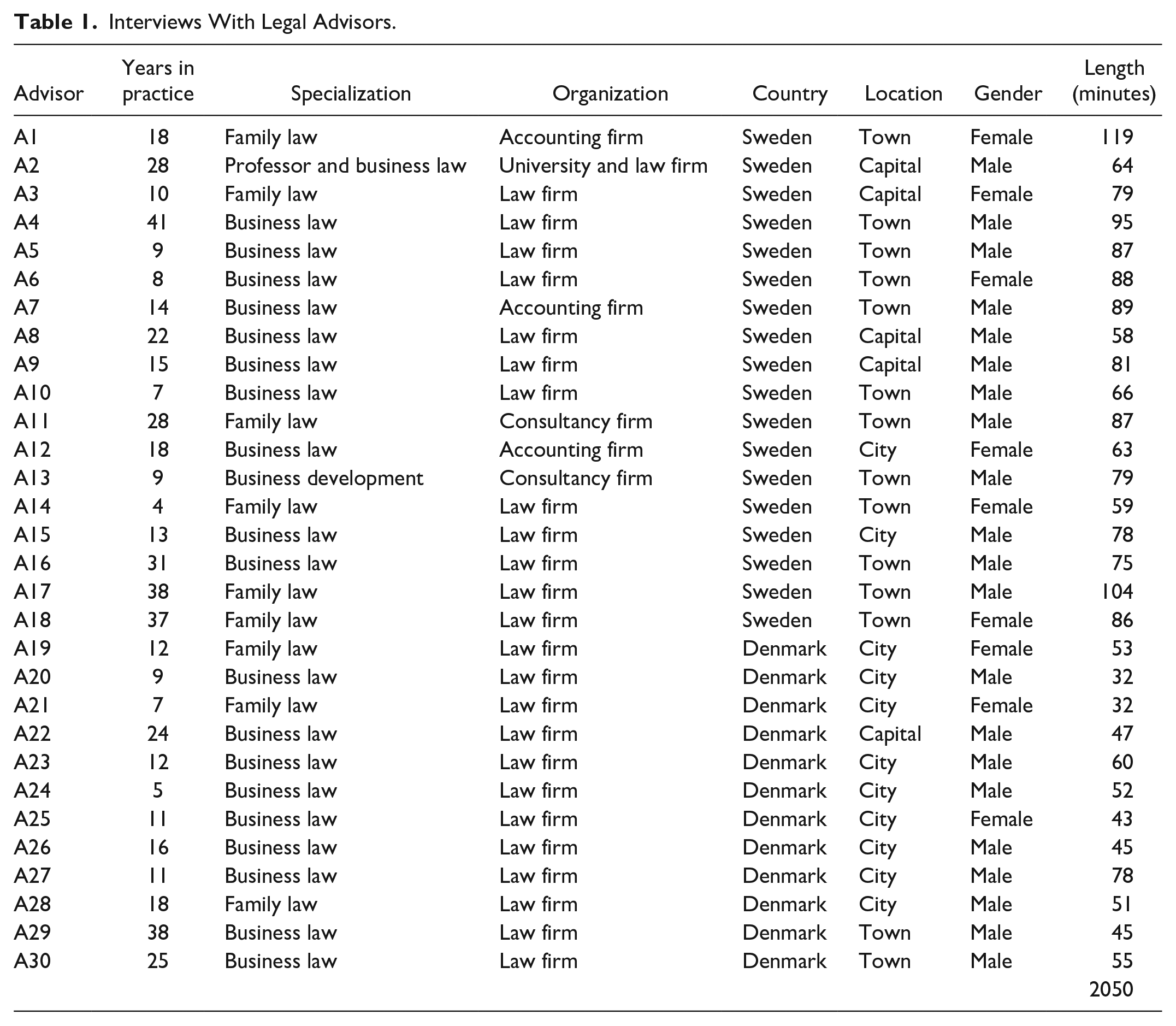
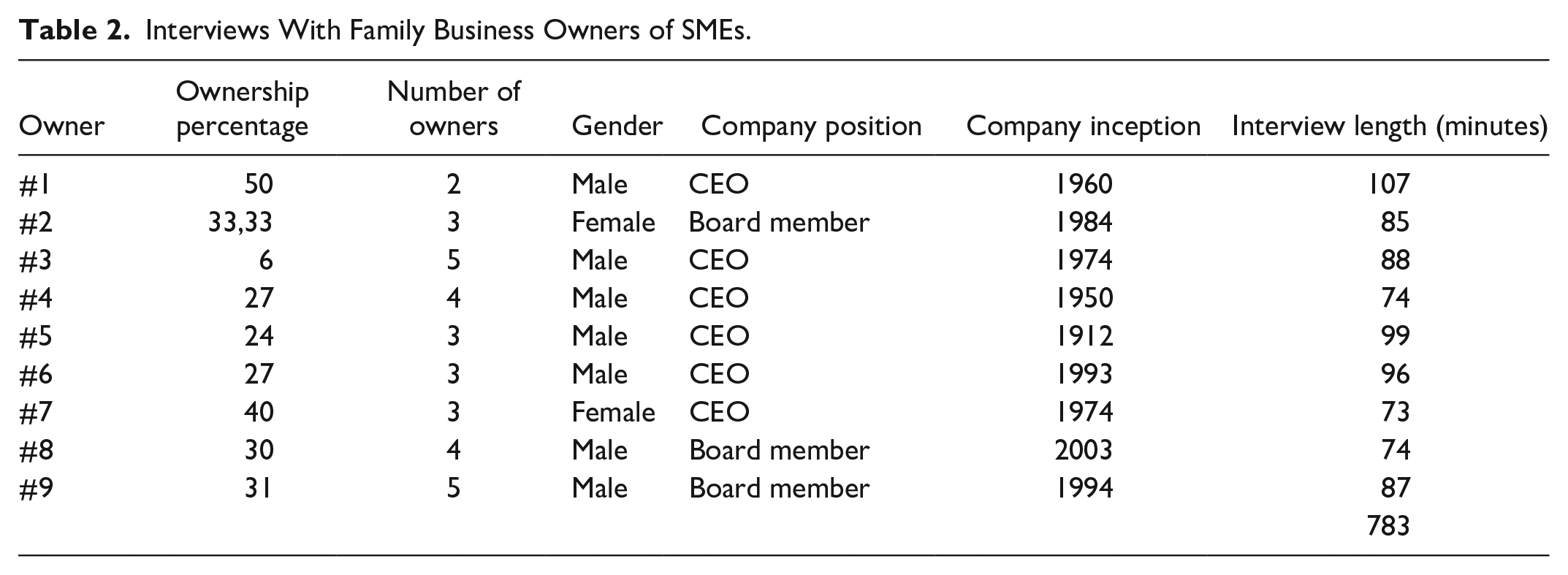
In line with our explorative research design, respondents were selected based on purposeful sampling (Lincoln & Guba, 1985) to ensure an illustration of the phenomenon under study: regulation of ownership change in family businesses. For advisors, the selection criteria were that the advisor was a legal professional and had substantial experience providing legal advice to family business owners, see Table 1. The owners were selected for in-depth interviews on the criteria of owning shares in an SME family business together with at least one more co-owner to necessitate collaboration among owners, see Table 2. Respondents were identified within Sweden and Denmark, where the research team has contacts and the necessary deep understanding of the legal frameworks. Through a snowballing technique, where respondents are asked to suggest other potential respondents (Noy, 2008), we were able to gain access to very busy legal experts and business owners in both urban and rural areas.
Interviews With Legal Advisors.
Interviews With Family Business Owners of SMEs.
The interviews followed an interview proforma of open questions (see Supplemental Appendix). 2 With the advisors, we focused on how they use legal instruments to regulate ownership change, increasing the specificity with follow-up questions if certain issues were not already covered naturally (for example, how do you regulate for long-term illness?). The interview guide included questions on the four main legal instruments (Sund et al., 2010): (1) articles of association, (2) shareholders’ agreements, (3) marital agreements, and (4) testaments. To ensure the relevance of the instruments, the respondents were asked if any other instruments were used. With the owners, we did not focus on legal technicalities but explored their knowledge on how ownership is regulated in their business and how this regulation was decided and carried out. They confirmed the lack of encompassing regulation of ownership, which allowed us to query impeding factors, including both those who had sought help by legal advisors and those who had chosen not to. We also queried about ownership changes in the past and how such changes had affected the owners’ attitude toward regulation. The interviews were conducted in the native language of the respondents (Swedish/Danish), recorded, and transcribed verbatim. Interviews were continued in parallel to data analysis until we felt that the last interviews stopped adding substantially new input to what we had already captured, and we could consider saturation to have been adequately reached (Charmaz, 2006).
Data Collection Through Online Survey of Family Business Owners
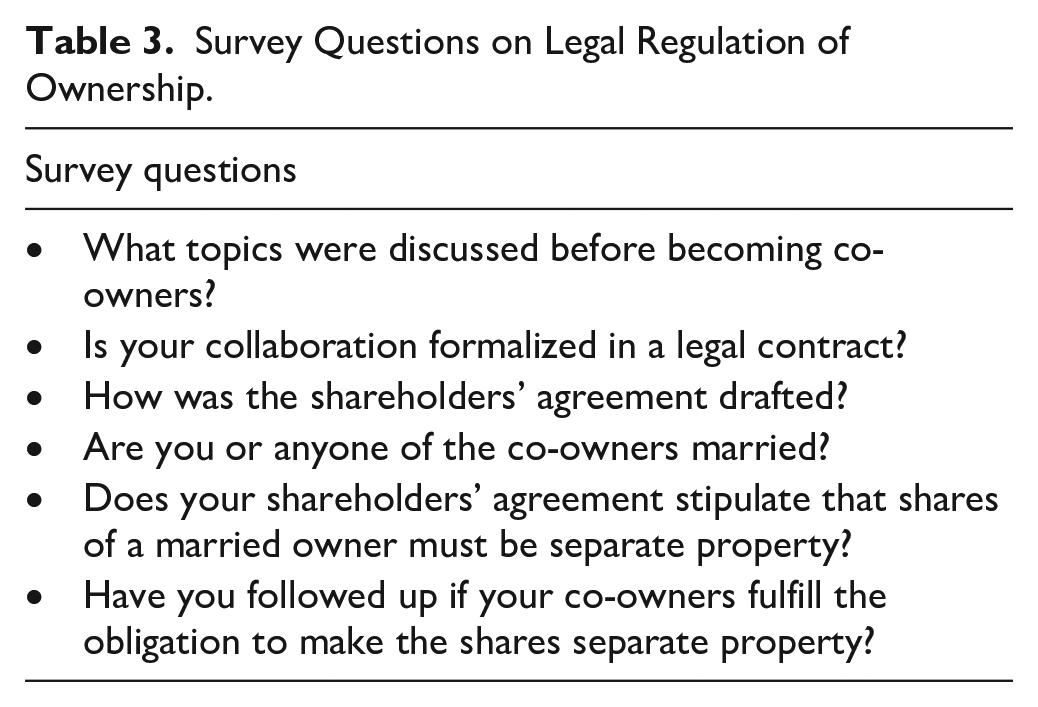
An SME survey on the causes of ownership change was conducted to provide descriptive statistics. This is a reoccurring survey to which we were given the opportunity to add a section pertaining to the legal regulation of ownership. This resulted in 105 responses from family businesses with more than one owner. The survey was a self-completed web questionnaire spread through social media and interest groups for SMEs in Denmark and Sweden. The questions pertaining to this study are listed in Table 3. In the survey, lists of answer options were included when applicable (Saunders et al., 2019). The survey provides further triangulation of the owners’ view on the regulation of ownership by illustrating a broader picture from the owners’ perspective.
Survey Questions on Legal Regulation of Ownership.
Overview and Role of Data Sources
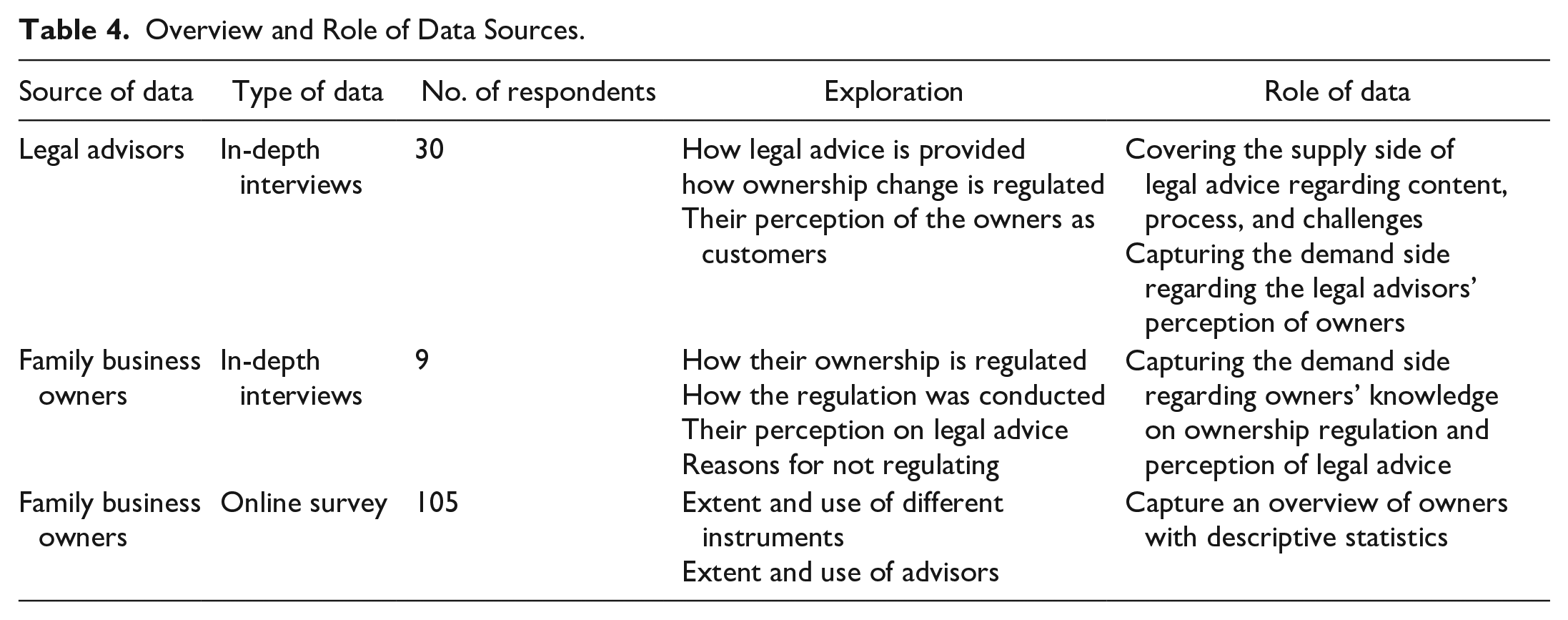
This paper focuses on formal regulation of ownership change, which is why the data based on legal advisors are more extensive in the interview study. The perspective of the owners is no less important but narrower in scope regarding why they do not sufficiently utilize the legal protective instruments available. Table 4 gives an overview of our data sources and their role in the analysis. Advisors are studied to capture the supply side of the market. On the demand side, we capture the advisors’ experience of owners as customers of legal services, and we capture the perspective of the owners through in-depth interviews and surveys. Hence, the supply side is based on studying advisors, and the demand side is based on studies of both advisors and owners.
Overview and Role of Data Sources.
Data Analysis
We apply a grounded approach to analysis, letting patterns and themes emerge from the data (Gioia et al., 2013), by carefully following procedures for naturalistic inquiry (Lincoln & Guba, 1985). To systematically analyze the empirical material, the transcribed interviews were processed with the aid of NVivo software. We follow three stages as suggested by Gioia et al. (2013). In Stage 1 of open coding, three of the authors read the same three interview transcripts individually and made suggestions for NVivo nodes. Thereafter, we met for a brainstorming session to discuss our impressions and mind-mapped identified topics until we had an initial set of codes for our data. Thereafter, two interviews were coded in NVivo by one of the authors, who discussed with the others how the coding scheme worked. The remaining interviews were also coded, and adjustments were made during the process. In this stage, we added nodes freely with no intention of limiting the number of categories. Eventually, we ended up with approximately 50 NVivo nodes. Two authors were responsible for all coding, one from each country. In Stage 2, the codes were analyzed and synthesized into 28 first-order codes grouped into seven categories, displayed in the data structure in Figure 1 (Advisor cannot, Advisor will not, Advisor may not, No coordination, Customer cannot, Customer will not, and Customer dare not). Thereafter, through an iterative sensemaking process comparing data with prior research (Strike & Rerup, 2016), we derived seven second-order themes (compartmentalized content experts, identity and prestige in business law, institutional interference, bounded assignments, information asymmetry, present biasedness, and emotional strain). These themes are the product of our reflections on what the material means, and they move the analysis from first-order informant-centric terminology into second-level researcher-centric concepts (Gioia et al., 2013). In Stage 3, our analysis resulted in two aggregated dimensions (Scattered market and Uninformed customers).
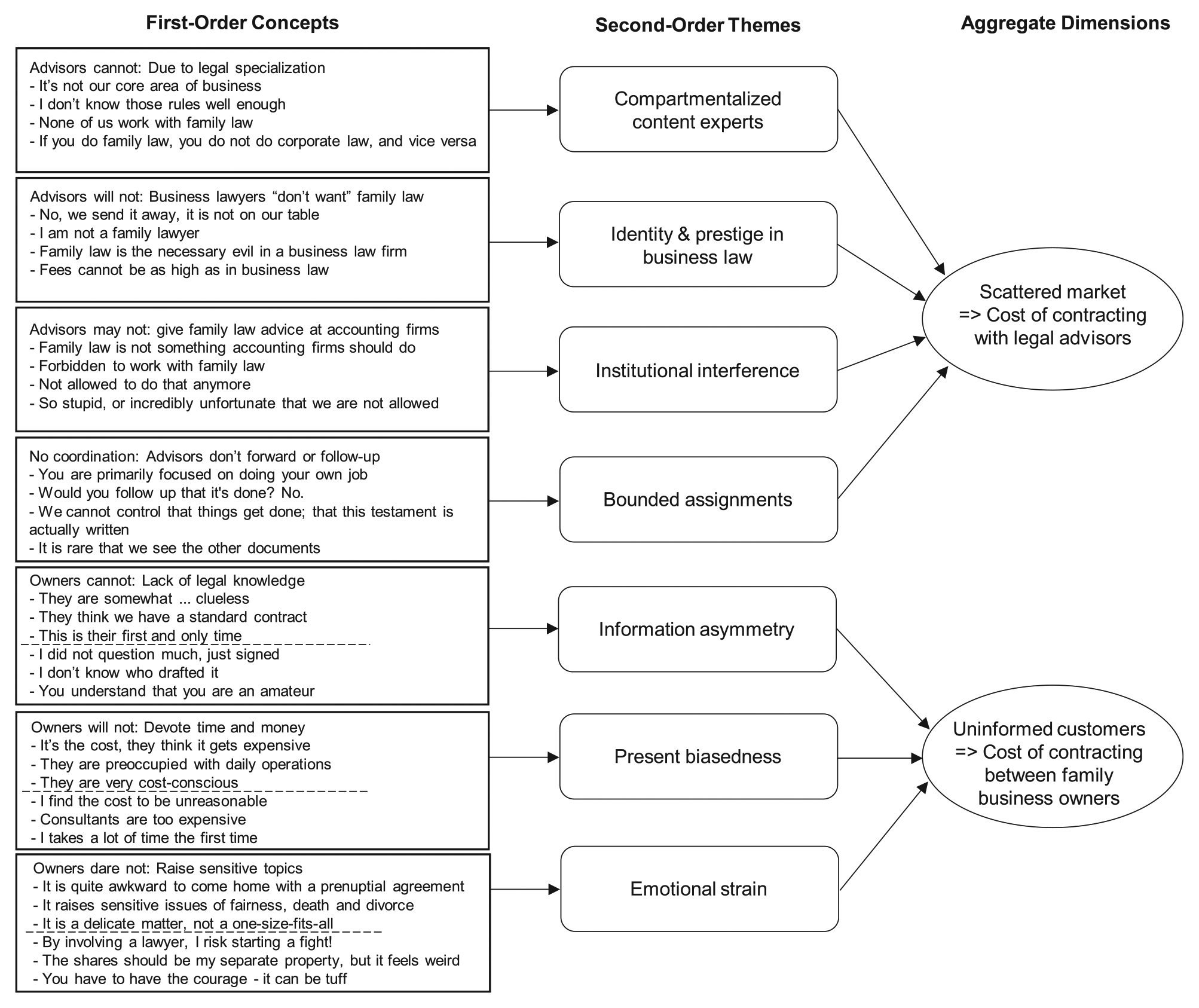
Data Structure.
The three stages overlapped and were subject to iterations back and forth to allow for the addition of new ideas and emerging themes in previously coded interviews. During analysis, we also started to see parallels to concepts stemming from transaction cost theory and found them useful to interpret the emerging structural market-level problems (i.e., impeding factors). For these reasons, transaction cost economics became our guiding theory that was introduced during the analysis to help make sense of the data. From considering the dynamic relation between the themes and dimensions, our theoretical model for transaction costs of the ownership contract emerged (see Figure 2).
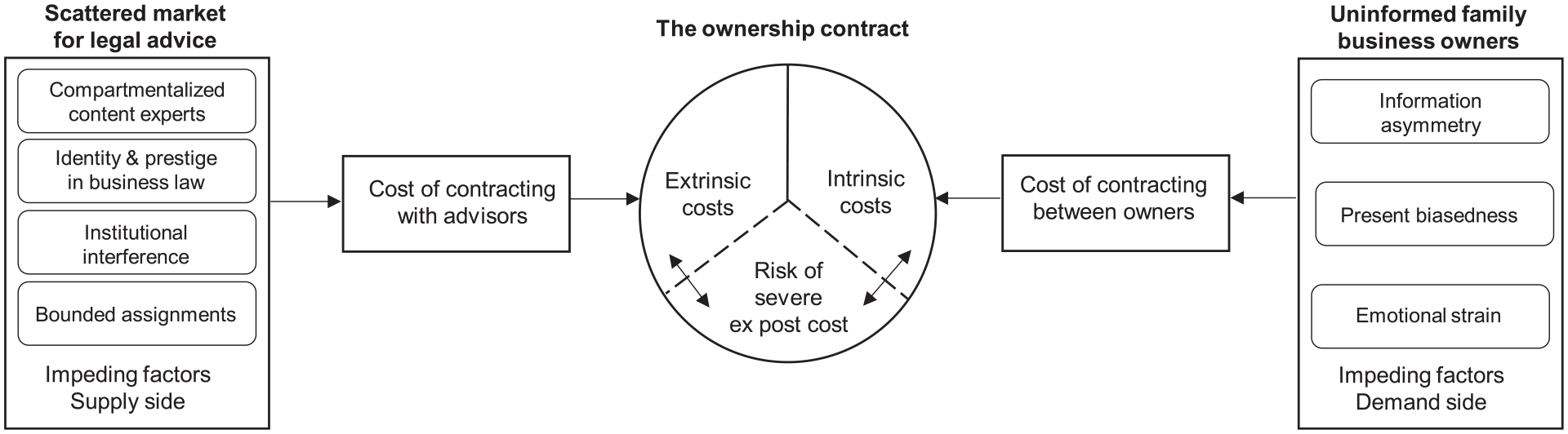
Transaction Costs of the Ownership Contract.
Findings
Impeding Factors
Our findings show that family business owners in most cases receive only partial advice, primarily covering either business law or family law. This finding led us to focus our analysis toward understanding why this is so, that is, the impeding factors. The impeding factors arise both on the supply side, caused by the nature of the market, and on the demand side, caused by the behavior of family business owners as customers of legal advice. The supply-side findings are based on studies of legal advisors, and the demand-side findings are based on studies of both advisors and owners. Figure 1 illustrates our data structure from empirical first-order concepts to second-order themes and the aggregate dimensions derived. The first-order concepts on the left-hand side closely mirror the language of the respondents, 3 while the second-order themes emerged from sensemaking of the emerging patterns (Gioia et al., 2013). The bottom three boxes of first-order concepts in Figure 1 are divided by a dotted line separating input from advisors (above) and owners (below). To further explain the emerging model, Tables 5 and 6 in the Supplemental Appendix provide additional exemplary quotes for each second-order theme.
A Scattered Market for Legal Advice Leading to Costs of Contracting With Legal Advisors
Compartmentalized Content Experts
From our interviews, it is evident that family business owners typically turn to business law firms rather than family law firms for advice on the regulation of ownership change. One reason is that shareholders’ agreements are seen as the key instrument in this respect. However, a family business is a hybrid of both family and business (Boers & Nordqvist, 2020). To achieve sufficient control over all types of ownership changes, owners therefore need to consider all four legal instruments: shareholders’ agreements, articles of association, marital agreements, and testaments (Sund et al., 2010). The former two are business law instruments, while the latter two belong to family law. Legal advisors typically specialize in one or the other legal field. Furthermore, it is not only lawyers who are specialized but also law firms, especially in larger cities. As illustrated by the quotes in Table 5, this divide is ascendant. The advisors at business law firms are compartmentalized content experts that often cannot give advice that belongs to the family law framework, including advice on testaments and marital agreements that would be important to family business owners. As expressed in the quotation by this advisor: If you work with business law, you do that and possibly also contract law. Family law, however, you do not do at all (business law advisor).
Advisors in the market that offer a broad range of services are located in small towns with one or a few advisors who must be able to handle all cases at the cost of content expertise. Some respondents recognize that being forced to be generalists also means a lack of specialization, and they compare themselves with the large law firms in the capital city: Have you spoken with any of the distinguished lawyers in Stockholm . . . that are in the premier league of contracting ideas? We are not like that . . . here in the countryside (business law advisor).
Law firms in large or capital cities are typically highly specialized and therefore only offer advice exclusively within their niche. Hence, in these cases, both the law firm and its advisors have the same specialization.
When an individual advisor encounters a need of the customer outside his or her specialization, a referral to a better-suited colleague might seem like the obvious choice. This can, however, contradict the expectations of the customer. One advisor explains that his service is often requested, and the customer will not settle with a colleague even though that person has specialist knowledge on the matter.
When you are known in a region, they expect you to do something because they have confidence in you. So, I cannot say “we have a great expert on this, and you could go there” . . . They want me, and they expect me to be best (business law advisor).
Taken together, the main reason that legal advisors cannot give all-encompassing legal advice to family business owners is their level of specialization. Hence, it is not included in the repertoire, which we label as advisors being compartmentalized content experts.
Identity and Prestige in Business Law
The divide between business law and family law is enhanced by identity issues deeply rooted in the profession, where business law is perceived as having a higher status and a higher hourly rate than family law (Haag & Sund, 2016).
There is not very much prestige in family law, and the fee charged cannot be as high compared to business law (business law advisor).
For reasons related to their professional
One of the reasons that it [family law issues] is not brought up at my meetings may be that I have exactly no financial incentive to bring it into play because it is a loss-making transaction.
Other explanations by the business lawyers are that they do not deal with “those things” and that it is “super messy” to deal with issues on the private side, such as divorces and children out of wedlock.
Hence, due to status issues and the lower fees associated with family law services, this field of law is a low priority for business advisors. Consequently, even law firms that can give holistic advice will not do so keenly.
Institutional Interference
A prominent actor in providing legal advice to business owners is accounting firms. Previous studies show that business owners consider their accountants to be a primary source of advice on all matters due to a well-established, long-term collaboration (Melin et al., 2004). This sentiment is justified, as accountants are found to be among the “most trusted advisors” to family businesses (Strike, 2013, p. 25). In addition to their core business of auditing and business consultation, large accounting firms have an extensive network of lawyers employed to provide legal services. Based on this, many family business owners turn to their accounting firms for legal advice.
However, in Sweden, a statement by The Swedish Inspectorate of Auditors prohibits lawyers at accounting firms from giving family law advice. This constitutes an
Before [the statement by the Inspectorate], we could assess their need for family law instruments and prevent situations with division of marital property in case of divorce and such, but now we are not allowed to do that anymore (Lawyer at an accounting firm).
Therefore, Swedish accounting firms may not give family law advice, which is unfortunate for family businesses, as they span both frameworks. As a result, the effect of this institutional intervention on the market is counterproductive for family businesses.
Bounded Assignments
Thus far, we have discussed reasons why legal advisors either cannot, will not, or may not provide holistic legal advice for family business owners. This situation would be less problematic if there was a well-functioning collaboration between different specialists, ensuring that all four instruments for the regulation of ownership change are covered and well coordinated, as has been suggested for advisors in other areas (e.g., Strike, 2012; Su & Dou, 2013). Coordination would require that each content expert forward their customer to complementary experts and follow up to synchronize the outcome. Alternatively, specialists can work in well-integrated teams designed to supply family business owners with advice that leads to encompassing ownership regulation. Our study, however, shows that this is not the case in practice. We find that legal advisors, as content experts, are hired to perform what we label “bounded assignments.” These are well-defined tasks that also imply no expectation or responsibility to consider additional aspects outside the boundary of the contracted assignment. Instead, each lawyer is focused on his or her task within their specialization.
They need to get that help [family law] from elsewhere. It is a bit unfortunate because then we cannot control whether things get done, that this testament actually is written, that this marital agreement actually is sealed (business law advisor).
Few individual advisors have complete overviews of all four instruments, as they span both business law and family law. Our respondents noted that they cannot do a good job with shareholders’ agreements without also considering family law instruments. However, it is often outside the scope of their assignment to fulfill these functions.
One should probably tell them to look over their private legal situation with a relevant lawyer. I would recommend that. But to be honest, you would seldom think about it because you are primarily focused on doing your own job (business law advisor).
Hence, the market for legal advice remains scattered for family business owners of SMEs, and because of the boundedness of legal advisors’ assignments, it is largely without coordination among different experts. Our findings on how the market for legal advice is structured show that one advisor cannot capture the diverse needs of a family business owner. This is problematic since owners, if they at all seek legal consultation, prefer to turn to only one advisor (MassMutual, 2022).
Costs of Contracting With Legal Advisors
In sum, we found that family business owners who seek legal advice in general receive only partial services from content experts. This is because the regulation of ownership in family businesses spans both business law and family law on a market for legal advice where these services are scattered. Family business owners are therefore exposed to extra contact costs (Nooteboom, 1993) from turning to different compartmentalized content experts that only combined would cover the encompassing regulation of ownership. This is further accentuated by the identity and prestige of business law advisors, leading them to avoid family law and the institutional interference prohibiting Swedish accounting firms from providing family law services. The need to contract several legal advisors also increases contract costs (Nooteboom, 1993). Since each legal expert stays within their bounded responsibility, the monitoring and coordination needed to achieve sufficient ownership regulation is put on the customer and gives rise to additional control costs (Nooteboom, 1993). Due to the special needs of family business owners, their costs of contracting (contact, contract, control) are increased by factors impeding a scattered market for legal advice.
Family Business Owners Are Uninformed Customers Leading to Costs of Contracting Between Owners
Information Asymmetry
Given the scattered market for legal advice, it is up to the customer to ensure that all relevant areas are covered when regulating ownership change. However, our interviews show that customers lack legal knowledge and therefore rely on their advisor’s expertise. Quite commonly, business owners of SMEs have been told that they need legal advice from their accountant, bank, business advisor, or business associates, but they do not know which kind of advice or regulation they need. Often, this is their first meeting with a legal advisor. Furthermore, a lack of knowledge hampers customers’ ability to assess the encompassment of any advice given. Hence, there is an apparent Many have heard that a shareholders’ agreement is something they should have. They don’t know what it is, but they know they should probably get one (business law advisor).
Interestingly, some advisors had experienced that the lack of awareness of the need for formal regulation is even more prevalent among family business customers than customers from other types of closely held businesses.
I experience that shareholders’ agreements are more common when it is not only the family in the business. Clearly, we think that you should have a shareholders’ agreement nevertheless, even if it is just the dad and the kids, . . . but in many cases they think it is unnecessary. When the owners are not family, then it is more common that we make a shareholders’ agreement (business law advisor).
As illustrated in the quote, the advisors believe this conception is gravely misunderstood. The need for regulation of ownership change is just as relevant for family businesses and, as shown in this study, may be even more relevant compared with other firms.
The family business owners we interviewed and surveyed corroborate the view of the advisors. In our survey, 85% of the owners had a shareholders’ agreement. However, many had refrained from consulting a legal advisor for it. One-fourth of the respondents said that they drafted this agreement without the help of any advisor, while others used an advisor without formal legal expertise. Even if most business owners answered “yes” to having a shareholders’ agreement, the quality of its content is unknown. Strikingly, the in-depth interviews also reveal that co-owners are sometimes unaware of where their shareholders’ agreement comes from, what it contains, and who drafted it, which illustrates that customers cannot master the legal expertise to evaluate their legal needs.
I was 23 years old at the time, and dad and [name of relative] went “this is how you do it and you need to sign here and here,” and papers were sent back and forth. [. . .] I did not question much (Owner #5).
In some cases, the co-owners reused an old shareholders’ agreement originally drafted by a legal advisor without understanding the risk of having a contract that is not customized for the current group of co-owners.
In sum, for reasons pertaining to lack of legal knowledge, business owners are subject to information asymmetry and typically cannot know their need for regulation of ownership change. Therefore, they might refrain from seeking legal advice. The owners who do seek advice cannot evaluate whether the formal contract they receive is encompassing or only covers part of the regulation needed.
Present Biasedness
An unrecorded number of business owners will never contact an advisor to begin with and remain with no formal regulation of ownership change or “homemade versions” with unknown legal consequences. Instead, business owners turn to other sources for legal advice, mainly accountants, relatives, and friends, which is in line with previous research (Melin et al., 2004). The owners who actually seek legal advice accept the additional costs to the ownership contract in the form of time spent and consultation fees. Customers prefer to simplify the process to minimize the cost. This behavior is described as You don’t see the value of it [legal services], until you are in deep shit (Owner #8). Very few SMEs see this cost as well motivated. So, you keep on going without protection and hope for the best. It is truly dangerous (Owner #1).
Advisors express an awareness of keeping costs down when working with SMEs. Their experience is that, once customers commit to seeking advice, they are willing to comply with the process, although there is a constant price sensitivity: There is a price sensitivity. They have so many costs in connection with taking over a business or in a start-up phase, and it is a question of priority, of course. No one has unlimited resources (business development advisor).
Given the general lack of knowledge among family business owners, as described above, customers seem to expect the outcome of the legal consultation to be one document, the shareholders’ agreement. This is, however, not possible in the case of family business, which requires regulation of both business and family law aspects that cannot be combined in one single contract. Some owners interviewed expressed a clear dissatisfaction with legal fees: Should I pay €3,000 to a silly tie-person to make that? I find it unreasonable (Owner #1).
To some extent, advisors can sympathize with customers’ reluctance: They think it is dull with contracts that cost money and only regulate things you don’t want to happen (business law advisor).
Hence, we see from our data that
Emotional Strain
Third and last, some aspects of the regulation of ownership change raise sensitive issues that cause
There are a lot of emotions in this, clearly. Not fun to be newly married or just invested money in a business and think about the day you will die. Or if you get a stroke, or if the wife will leave you. It is really tough to think of these things, I understand them (family law advisor).
The family business owners interviewed support that instruments regulating family law issues feel sensitive to raise, causing emotional strain: It raises issues of what may be. Like, suddenly you say to your partner ”you will never be part of this, as long as we are together you will benefit, we will have dividends, but you will never ever own anything.” And you have to have the courage to make this decision. It can be tough (Owner #4).
Our findings also point to the difficulty of imposing regulation in retrospect when the marriage is already entered and the business already exists: If it is an ongoing business, no specific plans, and suddenly I come home and say I want a marital agreement. This is when you think: so, you want a divorce? (family law advisor).
The reluctance to deal with sensitive topics (Emotional strain) is also visible in the owners’ unwillingness to follow the shareholders’ agreement themselves or to follow up that other co-owners conform. One business owner who has the requirement of a marital agreement stipulated in the shareholders’ agreement explains why he does not fulfill the obligation: My wife and I, we read the documents together . . . At the same time, it feels weird. We have joint accounts. To suddenly write a marital agreement for this part when everything else is common. It doesn’t match in my world. Right or wrong, it felt weird (Owner #3).
In our survey, 29% of the respondents did not know if their shareholders’ agreement included an obligation to ensure that the shares were separate property through a marriage settlement. Among those who had such a rule in their shareholders’ agreement, one-third have followed up if the shares have been made separate property, while two-thirds say they trust their co-owners in this question. While trust can be one reason for not following up if marital agreements have been written, the sensitivity of the question can be another (Emotional strain), as well as failure to understand the importance of the issue (Information asymmetry). The fact that shareholders’ agreements can include the obligation to make shares separate property, while owners might not conform, highlights the typical need for coordination of business law instruments with family law instruments.
Costs of Contracting Between Family Business Owners
Taken together, family business owners cannot, will not, or dare not seek holistic advice to regulate ownership changes. In this regard, they are “uninformed customers” of legal services. Consequently, they are typically not knowledgeable enough to evaluate the encompassment of the legal service received (information asymmetry) or willing to commit to the time and cost needed since it may or may not be needed in the future (present biasedness). Even if a shareholders’ agreement is excellently crafted, the family business owner cannot determine whether that is all they need or if it should be complemented with family law instruments provided by another advisor. The difficulties of information gathering, negotiating, and drafting create contract and control costs between the owners. In addition, the emotional strain from raising sensitive issues creates nonpecuniary costs of contracting between the owners, also affecting the willingness to seek legal advice.
The reluctance of owners to accept pecuniary and nonpecuniary costs related to preventive measures further decreases the likelihood that business owners will turn to several specialists to cover all areas. The number of owners who completely disregard regulating ownership changes is unknown in our study but has been indicated as high by others (Neville, 2013). The impeding factors identified create barriers for owners to accept the costs of contracting they need to prevent unwanted ownership changes in the future.
Discussion—A Transaction Cost Understanding of the Ownership Contract
To answer the research question of why family business ownership is insufficiently regulated, our study identified factors impeding the regulation of ownership change. By framing the relationship among owners as the ownership contract, we can understand its incompleteness. The contracting costs (contact, contract, control) of the ownership contract will never be zero, as it includes both formal and informal aspects of the relationship (Gordon, 1989; Hart, 1989). We focus on formal regulation of ownership change and argue that the need for such regulation makes family business owners dependent on legal advisors. Legal consultation is, however, inherently costly. Consequently, the regulation of ownership change is the way for business owners to cope with the future risk of severe ex post costs to the ownership contract by accepting some costs ex ante. While prior family business research predicts that family business owners would strive to keep control and protect ownership of the business (Gómez-Mejía et al., 2007; Habbershon & Williams, 1999; Schulze et al., 2001), we draw on transaction cost economics to explain why they do not do so sufficiently regarding regulating ownership change.
This section discusses the dynamic relationship between the components of the findings leading to our theoretical model for a transaction cost understanding of the ownership contract, illustrating how the seven impeding factors and aggregate dimensions are connected (Figure 2). On the supply side of the market (left-hand side of the model), the compartmentalization of content experts, professional identity and prestige of business law, some institutional interference, and the boundedness of job assignments constitute impeding factors of a scattered market leading to costs of contracting with legal advisors for family business owners. On the demand side of the market (the right-hand side of the model), owners are subject to information asymmetry, present biasedness, and emotional strain, which constitute impeding factors for uninformed customers, leading to costs of contracting between family business owners. A transaction cost perspective explains how the scattered market and uninformed customers affect the costs of the ownership contract (middle circle of the model). These factors impede the owners from accepting the ex ante costs aimed at lowering the risk of devastatingly large ex post costs and loss of control. The relations between these costs and their effect on the ownership contract are illustrated in Figure 2.
Extrinsic Costs
The nature of the ownership contract, together with the complexity of the legal framework, prompts a need to hire legal advisors to produce formal documents regulating ownership change. This is associated with pecuniary costs. The scattered market for legal advice leads to increased costs of contracting (contact, contract, control) with advisors. As depicted to the left inside the circle in Figure 2, this results in higher extrinsic costs (owners to advisors) of the ownership contract. Finding relevant advisors is difficult and leads to contact costs (Nooteboom, 1993). Since family business owners need expertise from both business law and family law, some costs are unique or at least higher for family firms compared with firms with separation of ownership and control. High extrinsic costs can lead to insufficient formal regulation of ownership change if it entices owners to stop at partial consultation. When family business owners perceive extrinsic costs to be too high, they will not seek legal advice at all. To this end, process advisors could play an important role by advising them to seek legal consultation. Prior studies show that family business owners are more likely to follow the advice given by their long-term trusted advisors (de Groote & Bertschi-Michel, 2021; Strike, 2012; Strike & Rerup, 2016). Since trust is built over time, content experts hired on an hourly basis could instead gain acceptance through referral by a trusted person (Mathieu et al., 2010).
Intrinsic Costs
Owners also face intrinsic costs of the ownership contract (owner to owner), depicted to the right inside the circle in Figure 2. The contracting costs of the ownership contract include both pecuniary costs, such as information gathering, negotiating, and drafting, and nonpecuniary costs from raising sensitive issues such as divorce. If the owners perceive the extrinsic costs from seeking legal consultation to be too high, they can accommodate this by regulating ownership changes by themselves either by formal contracts or informal agreements. This will necessitate substantial efforts in learning both what they need and how it ultimately should be regulated, resulting in high intrinsic costs of contracting while keeping the extrinsic costs to the minimum. As shown in our findings, family business owners often lack relevant knowledge, leading to the risk that their efforts will nevertheless end up in insufficient or inaccurate regulation. Present biasedness further impedes owners from contracting, as it does not result in immediate gain (Cartwright, 2014). Thus, the owners’ lack of understanding for, and interest in, legal regulation is not strange per se (compare Malach et al., 2006) but illustrates a need for increased awareness of the risks it entails. Theory predicts that owners are unlikely to neglect this risk if understood (compare Casillas et al., 2019). The intrinsic costs of the ownership contract, similar to the extrinsic costs, lead to insufficient regulation of ownership change, exposing the owners to the inherent risk of severe ex post costs in cases of, for example, conflicts, divorce, and death. Also in this respect, process advisors could help family business owners overcome impeding factors by raising awareness of the risks to the business.
Risk of Ex Post Costs Due to Incomplete Regulation
Our transaction cost perspective provides new ways of understanding the difficulties of regulating ownership change. The risk of ending up in situations where unwanted ownership changes jeopardize the family business can be reduced through investing in the ownership contract. By contractual regulation ex ante, the owners can lower the risk of severe ex post costs causing devastating effects on the business, as stated in previous research (Freedman, 1994; Neville, 2013; Sund & Bjuggren, 2012). The dynamic relations between extrinsic and intrinsic costs and their effect on the ownership contract are illustrated in the middle of our model (Figure 2). The moving parts of the circle illustrate how the risk of ex post costs due to incomplete regulation decreases when owners accept extrinsic costs of the ownership contract (owners to advisor) or increases when such costs are evaded. Similarly, the risk of ex post costs due to incomplete regulation decreases when owners accept the intrinsic costs of the ownership contract (owner to owner) or increases when such costs are evaded. While extrinsic costs have been identified as a possible impeding factor by, for example, Neville (2010), the effects of intrinsic costs, especially nonpecuniary costs, have not been elaborated before. Finally, our model (Figure 2) illustrates how problems on both the supply and demand sides reinforce the negative result of incomplete ownership regulation. This inability of the market for legal advice to adjust to the needs of family business owners is a sign of market failure. To break this negative spiral, improved market coordination coupled with raised customer awareness is needed on the market for legal advice to family business owners. Alternatively, it is the role of the lawmaker to intervene.
Contributions to Family Business Research
From the elaborations in the above discussion, the results of this study can be summarized in three main theoretical contributions to family business research.
First, our research advances the understanding of advisors in the family business context by shedding light on a hitherto understudied advisor group, legal advisors (Soleimanof et al., 2018). Legal advisors are highly niched content experts, which clashes with the special needs of family businesses caused by their hybrid nature of family and business. Our approach contributes to the literature on family business advisors by exploring the market for legal advice offered to family business owners from a market-level perspective including both the supply side (advisors) and the demand side (owners).
Second, earlier studies have indicated that family business owners are not using the legal instruments available to regulate ownership change (e.g., Neville, 2013), even if extant theory predicts that they should strive to keep control (Habbershon & Williams, 1999; Gómez-Mejía et al., 2007; Schulze et al., 2001). Our study draws on the costs of contracting (Nooteboom, 1993) to contribute new insights into the underlying reasons for this. With transaction cost economics as our guiding theory, we identify seven impeding factors (compartmentalized content experts, identity and prestige in business law, institutional interference, and bounded assignments) that describe why legal advisors cannot, will not, or may not give holistic advice to family business owners. In combination with the lack of market coordination of the market for legal advice, these impeding factors result in incomplete regulation of ownership change. We also identify impeding factors explaining why family business owners cannot, will not, or dare not navigate this scattered market because of information asymmetry, present biasedness, and emotional strain preventing them from seeking holistic advice. These findings complement earlier empirical studies focused on the close relationship between individual owners and their advisors (Salvato & Corbetta, 2013; Strike, 2013; Strike et al., 2018). Our study thereby contributes by identifying the factors impeding legal consultation because of structural problems in the market for legal advice.
Third, we contribute by expanding the use of transaction cost theory in family business research. Prior studies have primarily used asset specificity and knowledge idiosyncrasies (Williamson, 1975, 1985) to explain why some transactions have higher value under specific family business circumstances. Our study expands the application of transaction cost theory within the family business context by introducing the concept of the ownership contract. Framing the relationship among owners as a contract, including all formal and informal aspects of the relationship, helps us understand its incompleteness (Posner, 2002). By applying this transaction cost lens, we contribute to a holistic understanding by explaining how pecuniary and nonpecuniary transaction costs result in insufficient regulation of ownership change. This elaboration of the different types of transaction costs impeding ownership regulation helps us to understand why family business owners fail to accept smaller ex ante costs to avoid severe ex post costs, even though they are potentially devastating for the business.
Implications for Policy and Practice
Although family businesses are among the most common forms of businesses, they are unique in their intertwinement of business matters with family matters (Sharma, 2004). The Scandinavian market for legal advice does not accommodate this situation. Our findings show that there is great room for market improvement and thereby market opportunities for advisors in providing family business owners with holistic advice on the regulation of ownership change.
When the extrinsic and intrinsic transaction costs of the ownership contract are too high, owners choose not to formally regulate ownership change. The “mechanism” that replaces the market when transaction costs are too high is the prevalent national law. Only if the default rules of the given legal framework are adapted to the uniqueness of family businesses and provide an effective solution hereto is the legal framework a substantive alternative to the market. However, the respective legal frameworks of Sweden and Denmark are not adapted to the particular needs of family businesses (Almlöf & Bjuggren, 2019; Neville, 2003). Our findings show signs of market failure of the market for legal advice to family business owners, and therefore, grounds for regulating the market arise.
If we perceive company law as a standard contract and the default rules correspond to what fully informed typical customers would have chosen—so-called majoritarian defaults (e.g., Charny, 1991)—the owners’ transaction costs would decrease. If the company law framework were adapted to the family business context, it would decrease the need for tailored provisions in the business law instruments. Consequently, the process of legal consultation would be eased, as prevalent law would provide the parties with an improved regulation of ownership issues such as share transfers, shareholder exits, and conflicts. Thus, we see a possibility for market intervention to lower the transaction costs of family business owners through better legislation.
Apart from legislative measures, other avenues exist. The issues relating to a lack of coordination between legal specialists could be solved with increased collaboration among advisors within the same firm. They could work in well-integrated cross-disciplinary teams suited to the needs of family businesses. However, without policy change, this would be impossible in Sweden for legal advisors in accounting firms since they are currently prohibited from giving family law advice. Collaboration could also take place between firms with different specializations. Alternatively, a new type of process advisor could coordinate content experts from separate legal fields and guide the owners through the procedure. Market opportunity lies in all these alternatives.
Regarding customer awareness, it may be in the interest of policymakers to facilitate family business owners’ use of legal services by providing information and recommendations at official webpages (for example, at the site where family business owners usually seek information on setting up a company, tax, and submitting annual reports). Similarly, the best practices of legal advisors can be accommodated to the needs of family businesses and other closely held companies, where the longevity of the businesses depends on a well-functioning relationship among the owners. By communicating such practices, owners will become more aware of the need for formal regulation spanning the two separate frameworks of business law and family law.
If customers were informed of their needs, their extrinsic costs would increase, and likewise, the demand for legal advice would increase. However, these ex ante costs are relatively small in relation to the severe potential ex post costs the measures are intended to prevent. Being an informed customer also entails an awareness that pecuniary and nonpecuniary costs are necessary to avoid ex post costs that may ultimately jeopardize the longevity of the business.
Limitations and Future Research
Rather than treating family business advisors as one group, we need a more fine-grained understanding of their different roles (Davis et al., 2013; Reay et al., 2013). Our study is limited to providing insights into content experts in law within a Scandinavian context. This knowledge should be contextualized to different parts of the world. Although our study focuses on Sweden and Denmark, the hybrid nature of family firms and the separation of business law and family law is not unique to the Scandinavian context. An increased understanding of ownership regulation is of international relevance. However, our study has boundary conditions to consider regarding the transferability of the findings (Busse et al., 2017). We have researched ownership regulation in a context characterized by a stable institutional framework, high social security, and ownership protection. Complementary studies should explore the topic in other legal contexts to test the boundaries of our model. Other avenues for future research include analyzing how our theoretical conceptualization of the ownership contract can be useful in other areas, such as explaining corporate governance mechanisms with the cost of decision-making (Buchanan & Tullock, 1965) or network externalities (Klausner, 1995) of the ownership contract in a family business context. Future studies can explore how other mechanisms, such as family constitutions, family councils, and family offices, affect the ownership contract. Finally, a possible next step is to contribute to the literature on crisis management in family businesses (e.g., Amato et al., 2023; De Massis & Rondi, 2020; Salvato et al., 2020) by exploring what happens ex post in cases of, for example, sudden death, divorce, illness, or conflict, when the owners have accurate ownership regulation, compared with when they do not.
Conclusion
In this study, we bring attention to the need for family business owners to regulate ownership change. In these matters, they are dependent on legal advisors. We have explored the content and form of legal advice to family business owners regarding the regulation of ownership change. Specifically, we have studied advice on business law instruments (shareholders’ agreements and articles of association) and family law instruments (marital agreements and testaments). We set out to answer the research question of why family business ownership is insufficiently regulated by contracts. Our answer, informed by transaction cost economics, is that insufficient regulation is caused by the costs of contracting that arise when owners are uninformed customers in a scattered market. Due to the nature of family businesses, owners receive incomplete legal advice even when individual advisors perform their duties well. At best, owners seek legal advice from one advisor, typically a business law advisor, but need specialization from several, leading to an unfortunate neglect of family law. We identify transaction costs that explain why ownership contracts remain highly incomplete. Thus, we see signs of market failure in this regard. The market for legal advice does not sufficiently acknowledge the intertwinement of family and business. Considering that family businesses constitute the majority of firms, this is a problem of great magnitude.
Supplemental Material
sj-docx-1-fbr-10.1177_08944865231217882 – Supplemental material for Legal Advisors and Family Business Owners: A Transaction Cost Understanding of “the Ownership Contract”
Supplemental material, sj-docx-1-fbr-10.1177_08944865231217882 for Legal Advisors and Family Business Owners: A Transaction Cost Understanding of “the Ownership Contract” by Kajsa Haag, Hanna Almlöf, Marina B. Madsen and Mette Neville in Family Business Review
Supplemental Material
sj-docx-2-fbr-10.1177_08944865231217882 – Supplemental material for Legal Advisors and Family Business Owners: A Transaction Cost Understanding of “the Ownership Contract”
Supplemental material, sj-docx-2-fbr-10.1177_08944865231217882 for Legal Advisors and Family Business Owners: A Transaction Cost Understanding of “the Ownership Contract” by Kajsa Haag, Hanna Almlöf, Marina B. Madsen and Mette Neville in Family Business Review
Footnotes
Declaration of Conflicting Interests
The author(s) declared no potential conflicts of interest with respect to the research, authorship, and/or publication of this article.
Funding
This study has been enabled through generous financial support by the Jan Wallander and Tom Hedelius Foundation, and Tore Browaldh Foundation in Sweden and the Dreyers Fond in Denmark.

Supplemental Material
Supplemental material for this article is available online.
Notes
Author Biographies
References
Supplementary Material
Please find the following supplemental material available below.
For Open Access articles published under a Creative Commons License, all supplemental material carries the same license as the article it is associated with.
For non-Open Access articles published, all supplemental material carries a non-exclusive license, and permission requests for re-use of supplemental material or any part of supplemental material shall be sent directly to the copyright owner as specified in the copyright notice associated with the article.
