




Abstract
Interactions between family members of different generations often unleash powerful tensions in family firms. Intergenerational tensions can be particularly prominent during intra-family succession as a result of the different temporal orientations of senior and junior generation family members. However, scant systematic attention has thus far been paid to understanding the temporality of intergenerational tensions in family firms. Through an embedded case study, we explore the mediation process that helps family firms manage intergenerational tensions by way of temporal work. Our investigation of an advisory firm and its clients led us to identify generational brokerage as the intersubjective process through which temporal work enables generations toward the joint understanding of temporal orientations. Our theoretical insights have significant implications for developing a temporal view of succession and add novel important knowledge to research on mediation and time. Indeed, we show that generational brokerage is a dialectic construct with organizing properties able to blend disparate research streams by going beyond a unidirectional forward-flowing logic of time in examining organizational processes.
Rather than leaving it to that idiot son of mine, I’d rather burn the whole business down
Introduction
Generations are defined as cohorts of individuals who coalesce into self-conscious groups based on date of birth and/or social proximity to historical events (Mannheim, 1952 [1928]). In family firms, interactions between family members from different generations can unleash powerful tensions. Manifested as a state of psychological stress, lack of engaged dialogue, and emotional detachment among generations, intergenerational tensions may jeopardize the survival of the family business and cause the fragmentation of the family if overlooked (Ward, 2011). Sociological research suggests that intergenerational tensions have a temporal foundation (Joshi et al., 2011), as the relative emphasis that generations place on the past, present or future, namely their temporal orientation, has a major bearing on their cognitive processes, perceptions, behaviors, and decision-making (Ancona et al., 2001). Although the need to manage such tensions characterizes all firms, it is felt more acutely in family firms where blood ties and the fear of passing away, namely mortality salience (Wade-Benzoni et al., 2012), are considered to stimulate the senior family generation to create and perpetuate a legacy projected onto the junior generation that instead strives to move forward its evolving and alternative ideas about the future (Hammond et al., 2016; Miller et al., 2003; Wade-Benzoni and Tost, 2009). Coherently, the notion of temporal work, that is, a set of practices which involves “negotiating and resolving tensions among different understandings of what has happened in the past, what is at stake in the present, and what might emerge in the future” (Kaplan and Orlikowski, 2013: 965), has been placed in the spotlight of recent calls to study how family firms deal with intergenerational tensions (Salvato et al., 2019; Suddaby and Jaskiewicz, 2020).
Management scholars exploring tensions associated with time gaps (e.g. the widening generational gap) and time pressure (i.e. time as a scarce or abundant resource; Miron-Spektor et al., 2018) recognize that different stages of life embody different temporal orientations (Orlikowski and Yates, 2002), forming the basis of the timing, duration, and rhythm of multiple interactions and activities. Scholars have encouraged further explorations of such temporal constructs in relation to the specific empirical context of family firms, which are seen as intrinsically temporal organizations (e.g. Hammond et al., 2016; Salvato et al., 2019; Sharma et al., 2014). Past research on family firm succession 1 has argued that in such process the junior generation is usually oriented toward renewing and innovating, rather than simply taking care of what has been transferred to them, while the senior generation is more oriented toward the perpetuation of legacy beyond its lifespans (De Massis et al., 2016a; Le Breton-Miller and Miller, 2018; Miller et al., 2003). Thus, succession in family firms, which ultimately relies on the capacity to manage the battle between generations and the related tensions (Gersick et al., 1997), has been recognized as an ideal setting to study the bi-directional relationships between the past, present, and future (Salvato et al., 2019; Suddaby and Jaskiewicz, 2020) embodied in the different temporal orientations of senior and junior generations. However, the role of divergent temporal orientations in intergenerational tensions has not been explicitly addressed so far, and family business investigations are mainly trapped in the unidirectional, forward-flowing logic of succession coherent with imprinting theory (Stinchombe, 1965), the lifecycle perspective (Churchill and Hatten, 1997), and path-dependence theory (Schreyögg and Sydow, 2011). As a result, a theoretical and empirical exploration of how generations confront each other and exert mutual influence despite their different temporal orientations in the succession process is largely lacking in the family business literature.
The role of advisors in family firms offers an ideal empirical basis to embark on this exploration. Prior research has shown that advisors perform mediation tasks whereby they offer guidelines to help mitigate tensions among family members (Bertschi-Michel et al., 2020; Ibrahim et al., 2001) and influence (adaptive) sensemaking (O’Mahony and Bechky, 2008; Quick and Feldman, 2014; Strike and Rerup, 2016). In the family firm succession literature, scholars have widely investigated how family firms manage and make decisions about the future based on various sources of advice (Grote, 2003; Salvato and Corbetta, 2013; Strike, 2012; Strike et al., 2018). Such advice is intended to provide generations with the tools to recognize, understand, and satisfy, rather than rationally resolve, their relational conflicts (e.g. Hjorth, 2007; Strike et al., 2018; Strike and Rerup, 2016) and psychological needs (Clark and Salaman, 1998). For these reasons, we believe that mediation is likely to play a central role in managing intergenerational tensions in family firms: studying mediators can reveal important insights on the effects of temporality—that is, “the ongoing relationship between past, present and future” (Schultz and Hernes, 2013: 1)—and temporal work on those tensions. Thus, in this study, we address the question: How do mediators manage different temporal orientations and the related intergenerational tensions during family firm succession?
To do so, we carried out a 2-year field study focusing on the revelatory case of an advisory firm with more than 30 years’ experience with family firms, examining four of its clients undergoing succession to explore how different generations of family members 2 involved in the business confront each other and exert mutual influence during succession. By bringing a temporal lens to the forefront of our investigation, we unpack the mechanisms through which mediators negotiate different temporal orientations and manage intergenerational tensions during family business succession (Sharma et al., 2014). In doing so, we introduce the construct of generational brokerage as a mediation process that, building on the mechanism of generational reflexivity, intends to understand and negotiate the temporal orientations of two different generations to unlock creative repetition. By focusing on the mediation process enabling firms to deal with intergenerational tensions, we add a connective layer between the concept of intergenerationality (i.e. the interaction between members from different generations) and temporal orientation, revealing the urgent need for temporal work in organizations, and particularly in family firms. Moreover, by delving into the importance of generations and their interactions as the unit of analysis, adopting an intersubjective perspective that considers the dialectical interplay between temporal orientations of the two generations, and examining mediation as the key process for understanding and negotiating temporal orientations, we contribute to a new temporal view of succession in family firm research.
Theoretical background
Intergenerational tensions may exacerbate when two family members of different generations find themselves confronting each other in a shared organizational context. Such tensions are often caused by different generations’ distinct emphasis on the past, present, and future, as well as their inability to understand the other’s viewpoint. To explain how temporal orientations function, Emirbayer and Mische (1998) introduced the construct of the chordal triad of agency within which the three temporal dimensions (past, present, and future) resonate as separate but not always harmonious tones. In other words, different generations are embedded in multiple temporalities at once, holding different temporal orientations oriented toward the past, present, and future at any given moment. The way they imagine and address the past and the future in ongoing activities tends to become embedded in, and eventually transform, their temporal orientations (Emirbayer and Mische, 1998; Schultz and Hernes, 2020). Because the temporal orientation of each generation is inherently incomplete without the other’s, an intersubjective perspective through which agents negotiate their different understandings so that a “joined” or “merged subject” emerges (Weick, 1995: 71) is needed.
Research adopting a process view of time (Reinecke and Ansari, 2017) offers critical insights into the relevance of generations as the locus for the transmission of resources (e.g. traditions; De Massis et al., 2016a; Erdogan et al., 2020; Suddaby and Jaskiewicz, 2020) as well as burdens (e.g. Wade-Benzoni et al., 2008). Exploring the relationships between different generations, Wade-Benzoni and Tost (2009) find that the way a previous generation allocates benefits and burdens to a current generation influences the behavior of the latter with respect to future generations. Likewise, Hjort and Dawson (2016) define the “burden of history dilemma” as a common situation in which generations cannot avoid being historically informed (Nietzsche, 1997). 3 In other words, having a temporal orientation highly emphasizing the past or the future implies that the mind directionally distances itself from the present and paints a more abstract picture of time (Maglio and Trope, 2019). This picture can represent a more specific attitude toward imagining the future or recalling the past depending on the generation’s stage in the human lifecycle. For example, younger generations might be more emotionally oriented to future rather than past events (D’Argembeau and van der Linden, 2004), and thus place higher emphasis on the future (Caruso et al., 2008). For this reason, when different generations manage a firm together, with different temporal orientations emphasizing distant points in time and allocating different values to past and future, a climate of tension is likely to permeate the family firm.
Succession in family firms is a compelling context where to observe the divergent temporal orientations of senior and junior generations. Family business scholars describe succession as the act of passing the baton from one family member to another (Jaskiewicz et al., 2015), and a battle between parents and children (Gersick et al., 1997) driven by personal, psychological, and emotional dynamics (Miller et al., 2003). Research has investigated the individual characteristics of either senior (e.g. Huang et al., 2020; De Massis et al., 2016b) or junior generation (e.g. Dawson et al., 2015) as drivers of succession. These lines of thought have, for instance, explored the explanatory variables that shape senior generation’s retirement planning (Gagné et al., 2011) or junior generation’s attitudes, intention, and commitment toward succession (Sharma and Irving, 2005). While these studies have contributed to highlighting succession as a long-term socialization process that starts from the co-habitation of senior and junior generations much before the decision to engage in leadership transfer (e.g. Gimenez-Jimenez et al., 2020), they have only recently started scratching the surface of how—at the intersubjective level—the two generations interact to co-construct the succession process (Bertschi-Michel et al., 2020; Gagné et al., 2019; Li and Piezunka, 2020). Unfortunately, at present, there is a dearth of systematic research on the role of temporality in such process.
The efforts devoted to examining the lively and dramatic nature of succession in relation to generational interactions in the business have traditionally adopted a lifecycle perspective (Churchill and Hatten, 1997), following an imprinting (Stinchombe, 1965) or path-dependence (Schreyögg and Sydow, 2011) logic. These logics shape the lifecycle of generations in that the “rhetorically reconstructed narratives of the family’s past entrepreneurial behavior or resilience” (Jaskiewicz et al., 2015: 30) imprinted by senior generations, and the emotional commitment of the junior generation, motivate the perpetuation of the founder’s or senior generation’s successful strategies and practices (Colli, 2011). Accordingly, the lifecycle perspective takes a unidirectional approach to succession based on the staggered overlap and role swapping of the two curves representing the junior and senior generation members’ life evolution over time, with the junior raised and mentored by the senior leader who after a period of partnership passes the baton (Churchill and Hatten, 1997). This unidirectional forward-flowing perspective of time assumes that the junior generation, exposed to the family business (Gimenez-Jimenez et al., 2020) mainly understands and interprets the established values, behaviors, and traditions related to the past in the context and time of the senior generation (Suddaby and Jaskiewicz, 2020), implying that succession is either an organizational event that occurs at a specific point in time or a unidirectional process that moves the past into the present, and then into the future (Lippmann and Aldrich, 2016; Lord et al., 2015) based on the punctuated equilibrium paradigm (Gersick, 1991).
Nonetheless, succession involves transferring not only reified entities or objective elements, but also meanings related to time (e.g. Dodd et al., 2013). This in turn may break down the linear mechanisms of transfer from the junior to senior generation, with important implications for the firm’s future. Genealogical views of generations in organizations (i.e. generations linked through the transmission/descent of ideas, values, skills, and knowledge; Joshi et al., 2011) indicate succession as the outcome of specific decision-making scenarios involving different generations (Bengtson et al., 2005), and the main trigger of the generational battle (Gersick et al., 1997). Because generations are blood-related and interact in the family system before the junior generation formally enters the firm, intergenerational conflicts are likely to become particularly pronounced during succession (Bertschi-Michel et al., 2020). As family business scholars have widely recognized, the variety and complexity of the temporal dynamics involved in family firm succession (Salvato et al., 2019; Sharma et al., 2014) have a major impact on their ability to engage in collective action, often causing irrational decision-making (Dyer and Hilburt-Davis, 2003; Kellermanns and Eddleston, 2004; Lansberg, 1999) and goal multiplicity (Jaskiewicz and Klein, 2007; Kotlar and De Massis, 2013) that amplify intergenerational tensions.
Unfortunately, scientific attention to temporality in succession has been so far sporadic and mainly focused on objective clock time-related variables, such as firm age, age difference, and lifecycles (e.g. De Massis et al., 2014; Gersick et al., 1997) or unidirectional time flows (Suddaby and Jaskiewicz, 2020). Family business studies that explicitly incorporate time variables are the exception rather than the norm, and restricted to concepts such as long-term orientation (Dodd et al., 2013; Le Breton-Miller and Miller, 2006; Lumpkin et al., 2010; Miller and Le Breton-Miller, 2005) or transgenerational entrepreneurship (Zellweger et al., 2012), which still fail to address the role of temporal orientation in shaping intergenerational tensions during succession.
Several scholars have emphasized that the ability to navigate multiple temporalities in multigenerational family firms depends fundamentally on the level of communication and interaction between the family members of different generations (Le Breton-Miller and Miller, 2011; Lefebvre et al., 2020). This research stream points especially to the role of mediators as important actors who, despite not being part of the biological family, may have relationships with its members that run very deep, and are thus able to intervene when tension arises (Bertschi-Michel et al., 2020; Strike and Rerup, 2016) and to regulate the equilibrium between family members by bringing objectivity to interactional and emotional concerns (Garcia et al., 2019; Nason et al., 2019), satisfying psychological needs (Clark and Salaman, 1998), and facilitating adaptive sensemaking and socialization (Strike and Rerup, 2016). For example, studies looking into both the benefits and challenges of intergenerational tensions (Schad et al., 2016) show that if managed correctly, tensions can also energize individuals and have positive implications on firm performance (Miron-Spektor et al., 2018), while mentoring can direct parent-child or sibling conflicts toward productive paths (Boyd et al., 1999).
In this context, several studies have explored how mediators resolve disputes among family members (Haynes et al., 1997; Ibrahim et al., 2001), for example, when tensions consist of complex emotions (Bertschi-Michel et al., 2020; Strike and Rerup, 2016) or pejorative perceptions of each other’s roles, negative expectations, and mistrust (Joshi et al., 2010). Although mediation is recognized as an important resource to regulate the equilibrium among family members during succession (Garcia et al., 2019; Nason et al., 2019), scarce attention has been paid to understanding how mediators deal with divergent temporal orientations and the related practices to achieve the aims of temporal work. For these reasons, we propose that examining mediators’ work and how this enables generations to interact and synthesize a new shared understanding of time in family firms’ succession has the potential to unveil the temporal roots of intergenerational tensions.
Methodology
Research setting
To understand the mediation process in dealing with intergenerational tensions, we developed an embedded case study (Yin, 2003) examining a family business advisory firm and four of its family firm clients involved in the succession process. This methodology suits our goal of conducting research in an area where little data or theory exist (Yin, 2003). Specifically, we adopted an abductive approach linking our initial empirical insights with previous theory through an iterative process (Langley et al., 2013; Suddaby, 2006). The advisory firm selected is Cesaro and Associati (C&A), founded in 1986, and exclusively dedicated to supporting family firms and generations in dealing with succession. C&A provided us a fertile and particularly insightful setting to study generations in family firms experiencing situations of tensions within and outside the working environment. Intergenerational tensions among family members constitute C&A’s main scope of intervention, as emerges from this quote:
In the family, there are questions that can determine the death of the business, but if the family dies, sooner or later the business dies (not vice versa). This is why I smile when I see technical ‘experts’ of succession all concentrated on applying rules and laws to save assets and businesses at all costs, even at the price of destroying relationships between family members who for this reason will never again look at each other in the face. (C&A founder Franco Cesaro, 2016: 48–49).
Founded as an organization to help others, C&A has assisted more than 400 micro, small, and medium family firms in diverse industries (e.g. industrial cleaning, foundry industry, paint manufacturing, and shoe making) generally founded during Italy’s industrial boom (1960s). Each family firm is assisted during succession with different intervention intensities for a period that varies from 3 to 20 years depending on needs, with careful attention to avoid a needy relationship between the consultants and clients. Today, C&A’s founding owner, Franco Cesaro, and his 15 collaborators manage four offices in northern Italy, and their approach—developed by the founder and transferred to his collaborators as a distinctive trait—is based on three interdependent pillars, namely, research, consultancy, and education. Its distinctive multidisciplinary approach consists in pedagogy (Lefebvre et al., 2020) oriented to learning from both experience and research-based theory. To do so, C&A promotes activities that span a wide range of initiatives involving personal (technical and psychological) training support, conferences on cultural and organizational topics, business visits, and leisure experiences involving different generations of families in business. Moreover, it provides pedagogical tools (e.g. books, movies, exhibitions) to facilitate organizational and familial functions in the long run. In addition, the founder’s academic involvement in teaching psychology and pedagogy, and collaborations with important scholars in the field, such as Csikszentmihalyi (1997), resulted in the publication of four books and one book chapter. C&A’s lectures are mostly based on psychology and evolutionary theories using a bio-sociocultural approach (Kertzer, 1983), such as epigenetics and memetics—the study of self-replicating cultural ideas (Dennett, 1995)—applied to managerial issues (e.g. how cultural meme replications among generations influence family firm succession).
Therefore, C&A can be seen as an unconventional advisory firm compared with those that work with large firms in well-established and renowned industries (financial, automotive, or food) in Italy. As a result, we consider this a revelatory case of an organization helping micro, small, and medium family firms wrestling with intergenerational tensions causing resistance to change. According to our embedded case study approach (Yin, 2003), among the 400 family firms assisted by C&A, we chose cases that would offer theoretical insights, replicate or deepen our knowledge on intergenerational tensions and the role of mediators, and provide the greatest opportunity to uncover hidden intergenerational tensions (Eisenhardt and Graebner, 2007). Our case selection of four family firms was based on the mediators’ suggestions, we then gained access to them which were undergoing apparently similar succession situations (father to offspring). In the four selected cases, we noted that generational tensions played a crucial role in driving the transition from the senior to the junior generation. Table 1 provides an overview of the four selected family firms, detailing their main succession events, the interaction of the senior and junior generations, and the related pedagogical experiences.
Description of case data.
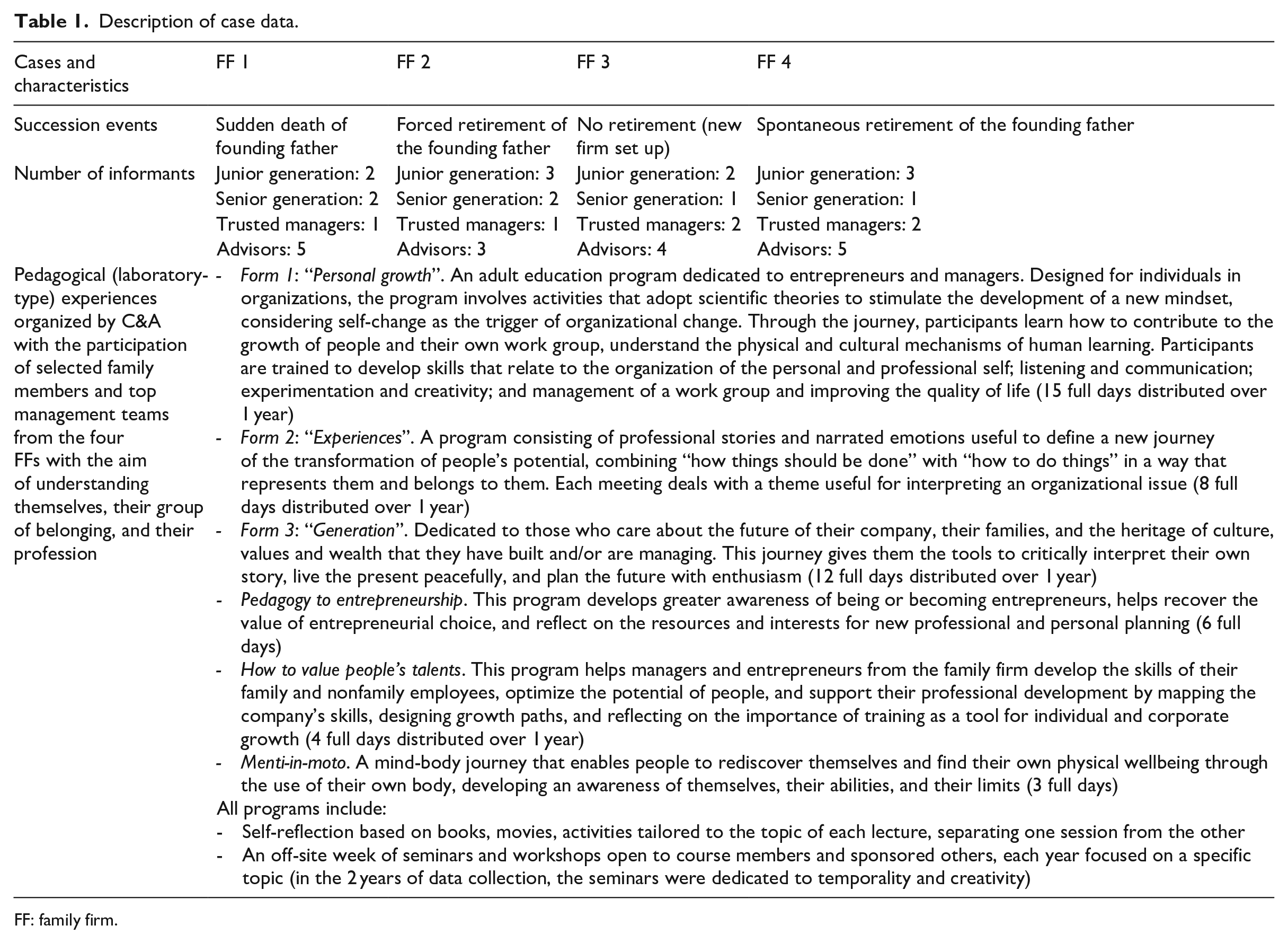
FF: family firm.
Data collection
To develop more robust theory building, we adopted an embedded case study approach (Yin, 2003). Our data comprise a 24-month field study devoted to examining C&A and the four family firms managing extremely problematic intergenerational tensions during succession. The multiplicity of empirical data collection techniques (interviews, naturalistic observations, and archival material) allowed us to integrate findings from diverse sources to build stronger assertions regarding the interpretations (Eisenhardt, 1989; Yin, 2003). In doing so, we took into consideration the mediators’ narratives of the cases as well as the points of view of generations in the firms (i.e. their understanding of temporal orientations).
Analyzing detailed archival data covering over 30 years of C&A’s history (1986–2018) enabled us to trace the evolution of intergenerational tensions while observing how the mediators organized and performed their work with different generations within and outside their work environment (e.g. in theaters, schools, open air venues). To collect primary data, we selected our family firm informants by identifying those involved in succession dynamics (e.g. senior generation leader and junior generation successor, other family members, top managers). The first author interviewed each separately and observed their interactions throughout their learning journey. This involved between five and six informants from each family firm (22 in total) and 15 from C&A assisting each family business during succession. 4
In total, we conducted 63 interviews with 37 informants, interviewing the majority more than once (see Table 2 for an overview). These semi-structured interviews (each recorded and transcribed) lasted between 45 minutes and 2 hours and evolved to incorporate the emerging insights.
Data collection details.
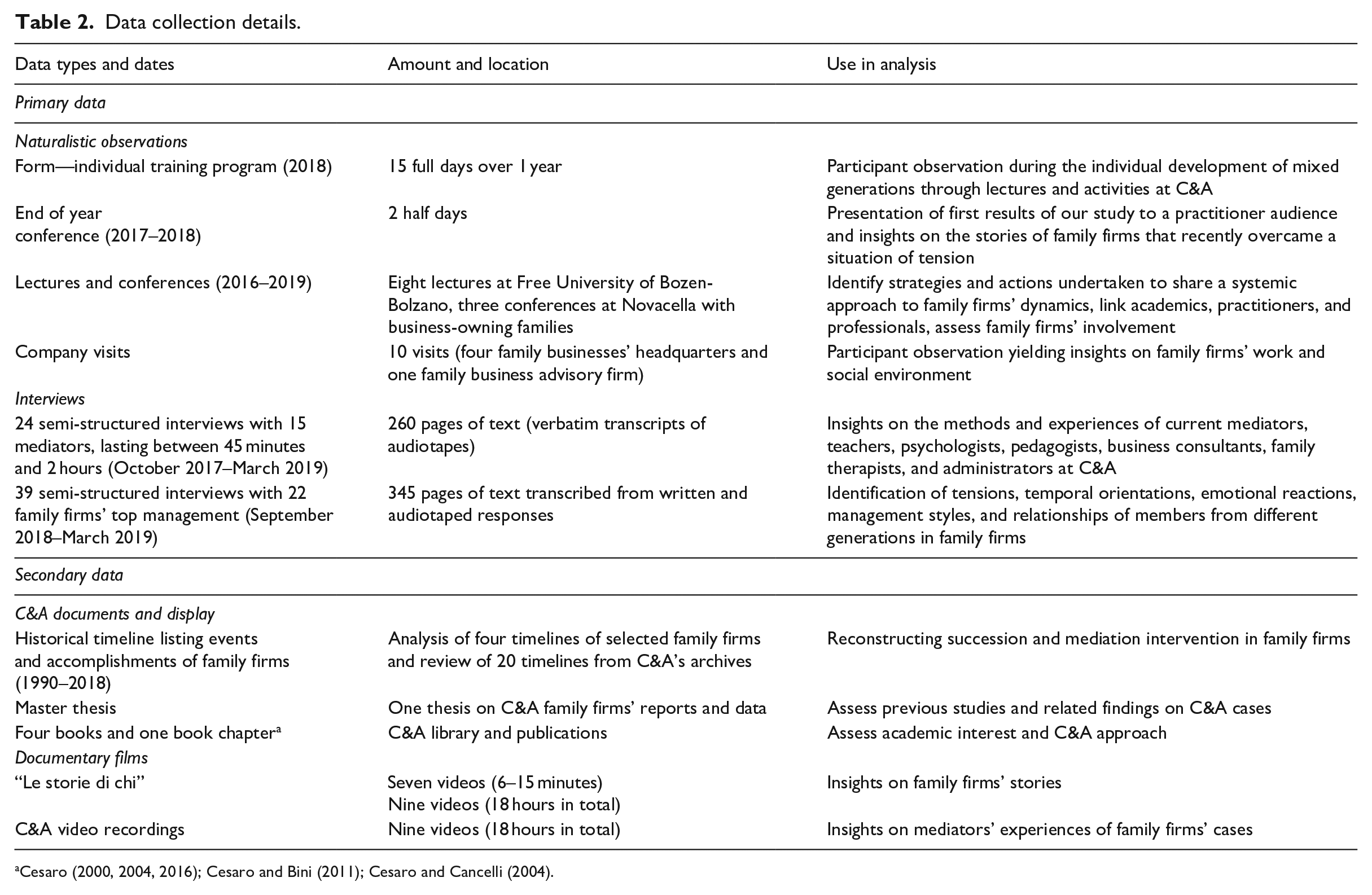
To deeply understand the learning journey of C&A’s clients, the second author participated as attendant in a 1-year pedagogical experience, namely the “Form 1” training program (see Table 1), dedicated to self-development and awareness, together with the family members of 10 family firms, including those we investigated. This program is organized each year as 1 full-day meeting per month at C&A’s headquarter combined with a 1-week summer retreat, currently at the 37th cohort, attended over the years by members of different generations of the four investigated family firms. C&A considers Form 1 a key pillar of its approach, not only at the individual level for those attending the program, but for the whole organization they belong to. As C&A’s founding owner states in the incipit of Form 1,
What is Form 1? It is not a course, it is an experience that can trigger a change in how you see things, both from a personal/professional and family/organizational point of view. Form 1 is a journey, an experience. A learning journey through which a family member questions his/her certainties. The real pedagogical process instills doubts to allow understanding different viewpoints to better understand how reality is lived.
Form 1 was crucial to understanding the intergenerational tension mediation practices, since C&A enrolls members from different generations of different families (and businesses), so that they can confront and interact with other generation members, share their concerns, and learn from others who are not part of their family. Therefore, Form 1’s tacit goal is to foster participants’ engagement in a learning journey to gain insights on how to deal with internal issues in their own family and better understand the other generation’s perspective through interacting with members of other generations and family firms. In every Form 1 session, the second author participated in various laboratories (theater workshop, mindfulness exercises, lectures on self-identity, time, and organizational roles), took notes, and collected impressions from the participants (who were unaware about her role as researcher until the end of the experience). These naturalistic observations were crucial to record our informants’ perspectives outside the less spontaneous interview context, talking about their relationships with family members from other generations, and narrating episodes of tension to their classmates. At the end of each session, notes where compiled with additional insights and reflections, and then shared with the other authors. Her direct involvement was invaluable for our study, as this level of insight into real-time activities is typically difficult to ascertain from interviews and other data sources. In fact, this allowed experiencing, observing, and capturing the practices of intergenerational mediation adopted to spur an understanding of temporal orientations. In terms of naturalistic observation, the authors participated in multiple C&A events (seminars, workshops, and experiential retreats) also attended by members of the investigated family firms during which we presented the preliminary results of the study toward the end of the data collection and received valuable feedback and comments. Throughout the process, the first and second authors involved in the data collection shared their fieldwork and “insider” perspectives, triangulating these with archival data from the mediators and the investigated family firms, sharing them with the other authors who were not present in the field and therefore able to provide a more distanced “outsider” perspective.
Data analysis
Our analysis proceeded through cycles of inductive and deductive reasoning (e.g. Corbin and Strauss, 2008; Gavetti and Rivkin, 2007; Walsh and Bartunek, 2011). In doing so, we relied on the heterogeneous engagement of the authors in the field to generate new conceptual views of the empirics (Suddaby, 2006), with multiple rounds of analysis between field and archival data, the relevant literature, and emerging theoretical constructs (Van Maanen, 1979). Given our initial understanding of the literature on generational succession in family firms, and more broadly intergenerational phenomena in organizations (e.g. Fox and Wade-Benzoni, 2017; Jaskiewicz et al., 2015; Miller et al., 2003), we expected that collaborative interactions between the senior and junior generations would play a crucial role in defining the reconciliation phases (Gersick et al., 1997; Lansberg, 1999; Miller, 1993). However, these initial expectations did not constrain our further examination of the case histories. In particular, the archival and interview data from the mediators and family firms provided considerable and unexpected evidence on the underlying intergenerational tensions driving the interaction dynamics, as well as on how mediators help negotiate the different temporal orientations.
To specifically study how the mediation of intergenerational tensions relates to and affects succession, we conducted the data analysis in three steps. First, we began by reconstructing the mediation approach based on key activities that involved generations from each of the four family firms. Through this initial phase, we identified the creation of “intergenerationality space” as the distinctive element of the mediators’ modus operandi that we label “generational reflexivity.”
Second, we adopted open coding to identify the interaction patterns that drove the mediation of intergenerational tensions by examining the temporal orientations of family members from different generations in each family firm. For each firm, we examined the succession characteristics, including sources, issues, and intergenerational tensions. Moreover, to identify the generation’s temporal orientation, we coded all individual statements from our informants (mediators as well as junior and senior generation members) based on related constructs that expressed differences between the two generations’ modes of thought and action, and/or tacit or explicit conflicting behaviors leading to tensions related to time. This exercise allowed us to unveil, through multiple iterations and gradual aggregation of raw data, the practices through which intergenerational tensions are explicitized and mediated by working on understanding and negotiating the temporal orientations and individual change, which became the building blocks of our model.
Finally, we moved from open to axial coding to explore the relations among our codes. Moreover, we conducted a further data collection round to understand the role of the intergenerationality space in enabling collective and personal experiences, and hence re-interviewed the C&A informants involved in these activities. These analyses revealed two phases through which intergenerational tensions are mediated that we term revelation and reconciliation (see Table 3 for illustrative quotes and data structure). Then, we combined the emerging constructs in a theoretical model where we assembled the conceptual categories and drew on the relevant literature to enhance the plausibility, insights, and criticality of the emergent findings to theorize how mediators manage different temporal orientations and related intergenerational tensions during family firm succession. To perform ongoing validity checks, we discussed our interpretations, emergent insights, and the model with the key informants (Corbin and Strauss, 2008). Through these three steps, we developed our novel temporal view of family firm succession (Golden-Biddle and Locke, 2007).
Illustrative evidence.
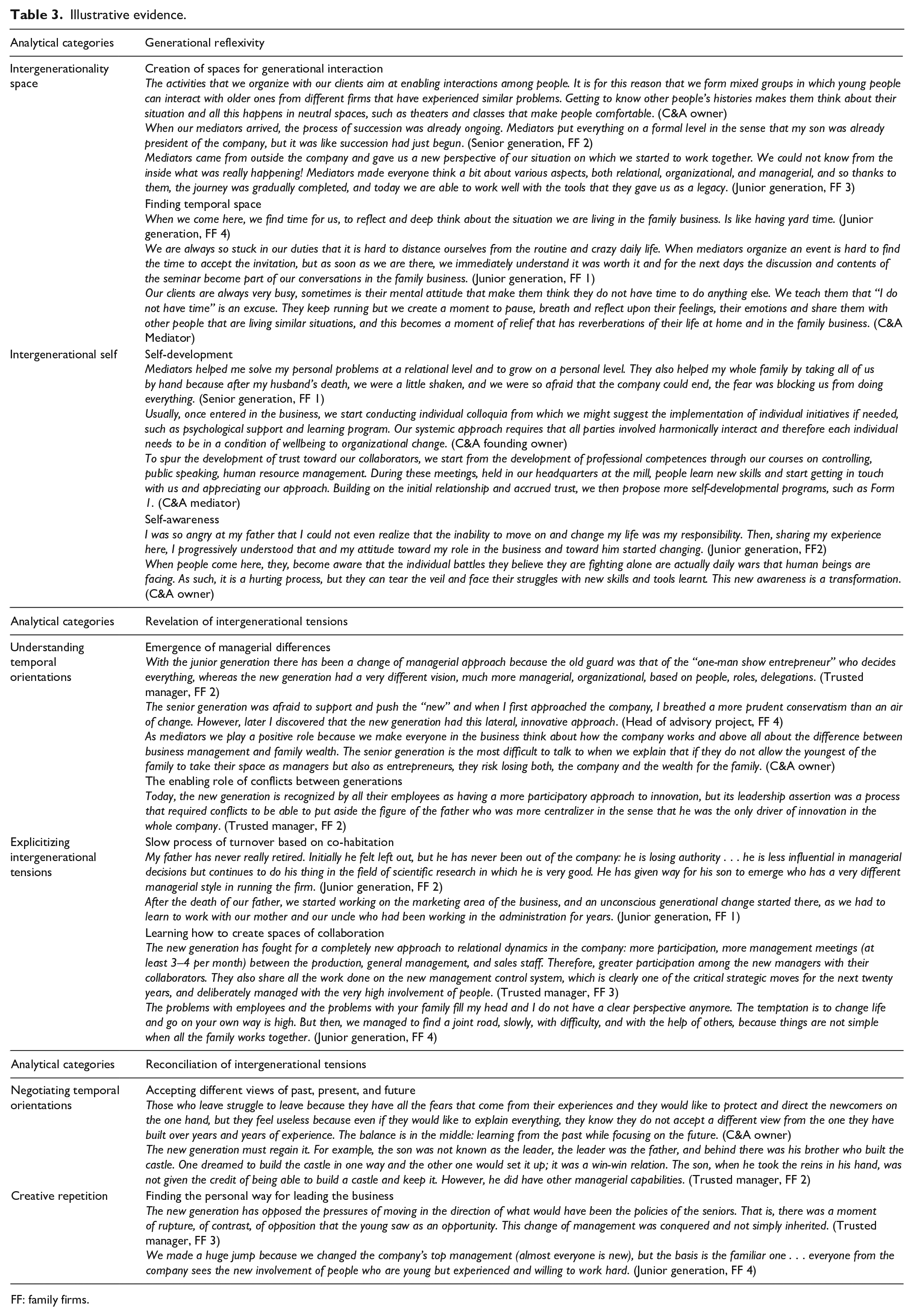
FF: family firms.
Findings
The investigation we conducted at C&A and the four family firms reveals the crucial role of generations and related tensions in shaping family firm survival, particularly during succession. As family members from different generations explained, intergenerational tensions were experienced as highly problematic, and required managing family conflicts and the emotional problems influencing the business structure and strategy. To do so, they relied on the mediators’ approach to understand their temporal orientations. Thereafter, they adopted pedagogical tools to foster change and negotiate the temporal orientations. This process was essential to developing individual and intergenerational dynamics. During succession, each of the family firms employed strategic choices supported by the mediators depending on their specific context and needs, and family members from different generations co-constructed the way of co-habiting throughout the transition from one generation to the next. As C&A’s founder Franco Cesaro explains in his book (2016: 90),
It is my conviction that the real problem of the family business is the co-habitation of generations. This is something that involves individuals not necessarily entire families.
And a C&A mediator,
We deal with generations and how to encourage their coexistence, since only a correct generational coexistence allows survival. We deal with evolution, we want the organization to survive, and this happens if there is harmony in the family across generations.
In analyzing our findings, we observed that prior to C&A’s intervention, much of the family firms’ effort was deployed to avoiding or resolving tensions between the senior and junior generation. However, generations in family firms constantly have to confront their understanding and actions in a shared context. At the point of clash, intergenerational tensions arise, and the mediator’s intervention aimed at leading the two generations toward mutual understanding becomes crucial for the survival of both the family and the firm. Specifically, our findings reveal that generations’ inability to reciprocally understand their different orientations emphasizing more the past or the future is a primary source of intergenerational tensions during succession. Across the four family firms, sources of psychological issues at the core of intergenerational tensions originated from the sudden death of the founding father (FF 1), the forced retirement of the senior generation (FF 2), the lack of retirement plans that required setting up a new business while the senior generation retained ownership of the firm (FF 3), and spontaneous retirement (FF 4). These diverse events spurred intergenerational tensions, influencing succession in the firm. Specifically, when heterogeneous temporal orientations clash, intergenerational tensions exacerbate:
Conflict combines all areas of generational cohabitation [. . .] everyone is afraid of conflict, they [family members] fear it because they feel that it could mean the end of loving bonds and business relationships but this way differences aren’t deal with and fertile asynchronies [. . .] can’t be achieved. Only through the processing and the understanding of diversity (asynchronies) are new ways (fertility) and perspectives of relationships with the deep self and the external world generated. (C&A founder Franco Cesaro, 2016: 116)
Consistently, the data reveal that generations manage their tensions by understanding each other’s temporal orientation through the mediator’s intervention, a process we label generational brokerage. In the next section, we illustrate this mediation through generational reflexivity—a pedagogical experience which involves both self- and critical reflection about beliefs, values, and temporal orientations as well as the nature of relationships, organizational practices, social structures, and knowledge bases in interactive spaces. By examining the mediation approach enacted with the four family firms, we uncovered its two key phases—revelation and reconciliation—that characterize the mediation of intergenerational tensions during succession. Despite the heterogeneous situations related to succession, generations initially interact through their dominant logic, namely either avoiding or resolving tensions. However, through the mediators’ intervention, they then reframed their approach to tensions, with associated changes in their interaction modes and a new logic of relating to others. Through the mediators’ intervention, we observed that the generations became more reflexive and aware of their tensions, promoting a shift in their relationships and communication that gradually supported the succession dynamics. We depict this model in Figure 1.
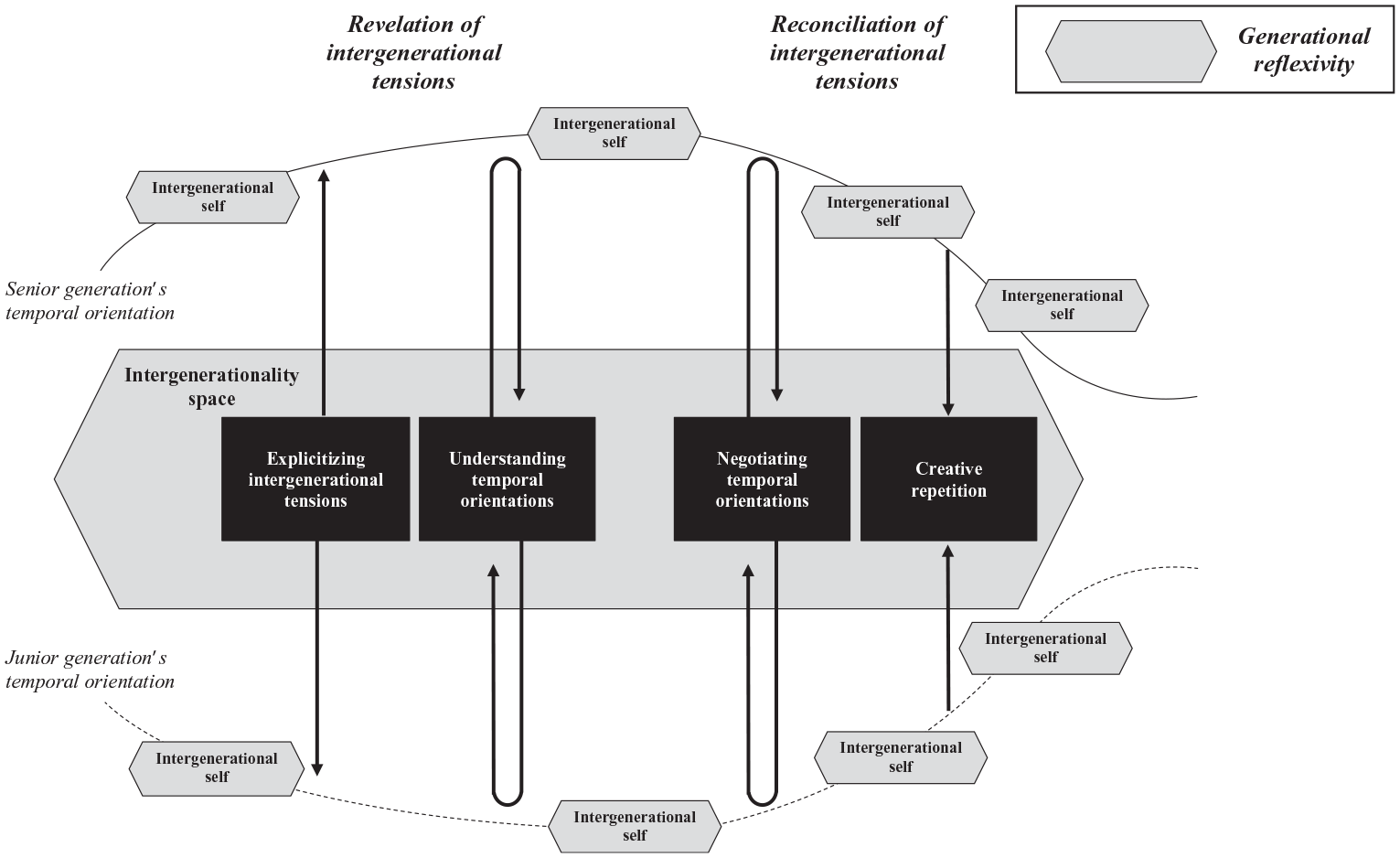
Model of generational brokerage.
Generational reflexivity
The pedagogical nature of C&A’s mediation was deemed particularly important by our informants who recognized it as the pattern to manage intergenerational tensions. For instance, as the C&A founder states in one of his books,
The mediator’s duty is to show how important it is to manage and understand conflict. The reason for the disagreement [between generations] is not the bearer (one member of the generation), who is often only the expression of a diseased system. The tools that should be proposed and applied are training, individual support, the exercise of communication, with the help of mediators who facilitate good results. Art, science, travel, sport and movement, games, doing something, all of these are ways to unify, to understand, to identify meeting points and common values. (Cesaro, 2000: 81)
Besides being the protagonists of mediation within their organizations, the generations were involved over the years in multiple pedagogical initiatives that C&A organizes as reflexive opportunities. These initiatives include Forms 1, 2, and 3 as individual development journeys, thematic seminars involving philosophers, sociologists, and psychologists, yearly summer retreats, and trips (see Table 1 for a brief description of these initiatives). Starting from the analysis of how the generations interact, converging evidence supports the observation that the creation of an intergenerationality space, enacted by the mediators enables generational reflexivity. Intergenerationality space consists in a form of reflexivity that focuses on self-development and interactions where generations meet to perform mediation activities—enables constructive-developmental pedagogy to take place not only in physical spaces (e.g. classes, theaters and meeting rooms), but also in psychological realms that include individual temporal orientations. As one senior generation member told us during a Form 1 session at C&A’s headquarters,
When I come to this place, full of nature and colors, I want to pull everything out and take time for myself.
Thus, both interactional and individual (intergenerational self) activities performed in intergenerationality spaces produce a generational type of reflexivity, meaning that mediation stimulates the beginning of the journey during which family members from different generations continuously “pulled everything out” (e.g. express and question who they are, who they want to become, and examine the impact this has or might have). This reflexive process is intended to make generations aware of their position as family firm members, but also as personal and professional selves with their own lives, developing awareness of their identity, mind-set, and potential. We explored how this awareness emerges by looking at the mediator’s approach to intergenerational tensions. Despite that family firms are known for their reluctance to seek advice outside the family circle due to privacy and integrity concerns, our investigation of C&A’s approach reveals that when generations trust mediators, they are willing to open themselves up in terms of sharing their personal and family stories, their psychological state, and their emotions in the mediation activities. Trust is thus a crucial condition to start the whole transformation process. Through the C&A interviews and archival documents, we explored how this approach to the mediation process occurs.
Our evidence shows that, counterintuitively, the mediators did not aim to resolve or avoid intergenerational tensions but introduce transformative experiences to enable the generations to recognize and understand each other’s viewpoint. This gradual process is thus an accumulation of small visible results (e.g. progressive change in communication modes, listening, approving ideas, overcoming minor managerial issues) that lead the generations to slowly move toward each other. As they are not resolution based, these results are easily underestimated by clients, but our findings unveil that their accumulation marks the iterative evolution of generational interactions, shifting the focus from resolving practical issues to working on generational reflexivity. In the four family firms investigated, the junior generation started interacting with the mediators and then progressively tried to introduce them to the senior generation. This happened through participating in public events organized by C&A or engaging in its professional education courses and then welcoming the mediators in the firm. Since this process is grounded in reflexivity, C&A was not perceived as a firm that sells its services in a commercial spirit, but rather becomes a reference point for continuous personal and professional self-development. Through the individual self-development undertaken by the generations, thanks to participating in the C&A initiatives, some family members began to trust the mediators, perceiving the programs and events as learning opportunities, and becoming promoters of the activities within the organization. As a mediator stated,
There is always an individual within the family who is more sensitive to these issues and feels the need. This person, who usually gets in touch with us after listening to a presentation at a conference or through word-of-mouth asks for our collaboration and starts telling the history and situation of his/her family. Then, s/he introduces us to the rest of the family, and we start interacting.
This gradual changing process is not based on an instruction package or prepared guidelines but designed to support people in questioning and dealing with their own problems by helping them clearly understand the issues at stake and giving them the best instruments to overcome both personal and relational problems. For example, the main advisor of FF 2 explained,
The attempt of the family members to solve issues in the firm had always been technical with organizational, economic, and consulting interventions that put things right from a legal and financial point of view. We have set the work on a completely different side—the recovery of family and intergenerational relationships.
Indeed, we observed that while generations experience small practical results, deeper needs emerged, and in most cases, issues related to their relationship with family members from other generations.
C&A mostly conducts its activities outside the family firm’s venues, as a metaphor of finding a space where generations can interact in an informal, neutral, and peaceful environment. As our informants and our direct participation confirmed, the “space” in which different generations are encouraged to interact is not only physical, but also the social and psychological space where family members from different generations lower their physical distance along with their psychological (e.g. emotional and affective) barriers:
It is a matter of finding a strategic space for thought that on one hand concerns the production of wealth and value, and on the other hand a system of care with very important side effects on generations and generativity. So, we check what generativity and the ability to generate a future mean to them and what they have to do with the development of the business and with the continuation of the family but also the relationship between generations. (Interview with C&A’s founder)
Our observations during Form 1 reveal that when family members from one generation share the same space with unknown members from different generations, psychological barriers disappear:
A dad who is not your dad and yet makes you see the point of view of the other generation. This is a comparison between generations, but not from the same family (that would be very difficult), metaphorically it is like a game of roles psychodrama that became possible in the space created in Form 1. (Junior generation, FF 3 observation during Form 1)
Converging evidence shows that intergenerationality space mainly consists in a temporal space that family members from different generations dedicate to themselves and to each other, allowing them to unveil their hidden temporal orientations by engaging in shared or individual experiences. Moreover, when family members from different generations spend time together in a “neutral” environment, such as at the summer retreat, during the trips, or the 1-day events, different temporal orientations get to the surface. At the same time, intergenerationality space is psychologically neutral in that generations are encouraged to interact and reflect far from the business environment. When two generations that are not related other than through business or family connections interact and are forced to spend time together, their orientations toward past, present, and future emerge. Each year, C&A organizes a 1-week trip to exotic places, such as China or Dubai for junior and senior generation members of family firms. The attendees spend the morning in class and sightseeing in the afternoon with the aim of discovering each other as individuals by spending time together outside the work and home environment. These activities are conceived to create space in time for generations to reciprocally understand their temporal orientations, considered crucial for organizational co-habitation and succession, and to reflect and start acting on their tensions:
Family members from different generations who are entrepreneurs, managers, parents or offspring are always anxious, sometimes angry for specific issues, as if there is no space in the family or in the business for them. Then, by repositioning the people in the family or giving them value, we try to see everyone, to make room for everyone, as sometimes we name them even when absent to order them. Order calms down. (Franco Cesaro, Lecture in March 2017)
Intergenerationality space is thus both cognitive and physical in the sense that meetings are organized at C&A’s headquarters or in other original settings, such as a theater, abbey, kitchen restaurant, and even in a forest. Specifically, C&A is headquartered in an old mill, set in the Valpolicella county, in the middle of a forest in the remote countryside purposefully chosen for the silence, close contact with nature, and homely atmosphere:
You need to find the condition for the alchemy to emerge. I have always believed that this mill was necessary for our job. I had an appointment with a client this morning at 9, he arrived at 8.30 for a meditative walk in the garden . . . The space and setting are fundamental and need to be carefully identified. (C&A founder)
Moreover, C&A organizes each year a 1-week summer retreat in the ancient Novacella Abbey built in 1142, famous for its rich library as a repository of knowledge. As the C&A founder remarked during the 2017 retreat,
Today we are hosted by Novacella Abbey, a special, almost magic venue, a repository of precious documents that has been for centuries the crossroad of pilgrimages, retreats, and prayer. Novacella is a place that carries the power of history as well as an idea of future intended as culture and knowledge.
Revelation of intergenerational tensions
Following a first exploration of how intergenerational tensions are mediated, we familiarized ourselves with the four succession events described in Table 1 that symbolize different ways in which the business is transferred from the senior to junior generation. In understanding intergenerational tensions, mediators delve into the core of the generations’ psychological issues to make them aware of the sources of tensions (either unknown or hided by the generations themselves). The different situations that family firms had to face in terms of succession allowed us to uncover the coherence between the nature of intergenerational tensions (despite the different origins) and the consistency of the mediation approach to these tensions related to temporal orientation. For example, in FF 2, before the junior generation wrote a letter to the senior generation asking for its retirement, nobody had taken responsibility for the intergenerational tensions affecting the organization, hampering succession and constraining business development. As stated in the interview with a member of the junior generation of FF 2,
The driver of change has been the conflict that from tacit became explicit. Our main problem was that when there were these conflicts, we never talked deeply about what each of us really thinks and wants for the future, we always remained on the surface of what we needed to do.
In FF 3, the senior generation preserved ownership of the main business, but set up a new business division entirely managed by one member of the junior generation to give him the opportunity to take full responsibility as leader and manager. These events marked a sharp shift from the senior to the junior generation, leading the generations to not interact once the succession had technically occurred. Even in the case of the founder’s death, as in FF 1, the junior generation had to deal with the old management system embedded in the business structure involving senior generation family members. Identifying the temporal orientation and allowing the intergenerational tensions to clearly emerge helped the generations take responsibility for their actions. Mediators have a clear role in this revelation phase, facilitating a process that is already taking place. As a C&A mediator explained,
We know that junior generations already have the solutions for the future, and we help them to translate, improve, and put them into practice, sometimes against seniors. Like if you find pictures in a drawer of a piece of furniture, we clean, organize, put them in order and then have an exhibition. We are like instruments of valorization. I understand that the willingness to confront with each other is already moving internally, but fails to come to the surface, we are like handrails on already existing ladders.
While working on urgent practical issues that allow better managing business operations, the mediators also work on explicitizing intergenerational tensions by locating and understanding deeper tensions at the intergenerational level that might influence change by blocking it at the origin. A C&A mediator explained,
Often upstream there is a block of family relationships that does not allow undertaking a type of management change or any kind of change, and this block threatens business evolution and survival.
Specifically, family members from different generations across the four family firms are placed at the center of the mediation process. Generations are regarded as the expression of cultural histories that are key to observing the attitudes, motivations, and behaviors hiding repressed situations, conflicts, visions, and hopes. The analysis traced transversal needs and modes of support and/or indifference to others expressed through caring and/or aggressive behaviors. The revelation of this hidden relational system is the first step toward recognizing intergenerational tensions that block change and succession. As a junior generation member from FF 2 recognized,
The push for change was that different and conflicting views and opinions became explicit. Then the main problem, according to me, was that when there are these tacit conflicts, we never talk deeply about what people really want, so you always stay on the surface of what you need to do in everyday practice.
For example, one recurring issue was that even if the senior generation was willing to share its expertise with the junior generation, the latter did not perceive such knowledge as relevant because tacit personal conflicts blocked reciprocity and fueled individuality rather than positive interaction. As a senior generation member from FF 3 explained,
I was a bit disappointed by the fact that when the junior generation entered the company and took responsibility, they considered the predecessors’ know-how obsolete. They should not have thrown away all the good things that the previous ones have done. In many cases, they tried not to use the skills and knowledge and experience of those who governed before.
In turn, resistance to expressing what people feel and perceive about others influenced everyday management and performance, as C&A’s founding owner explained:
Each firm requires first action on the foundations—people—then on the supporting structures—generations—and finally on the development of the firm. If we want to change the numbers, we have to work on people. But we generally work on resistance to change, on the fact that people do not want to change.
Resistance to change was detected by reconstructing the history of the family and the business. In the initial stage of intervention termed “check-up,” besides the conventional assessment of the firm’s financial and operational situation, the mediators conduct a “family anamnesis” to understand the current situation and historical evolution of the intergenerational relationships. During the elaboration of the family anamnesis, each generation individually shares thoughts with the mediator about the complex intergenerational tensions in which she or he is involved, personal and familiar stories that allow reconstructing the most complete history of the family. This effort unveils whether and how the history has been elaborated by family members. Most of the time, mediators face resistive interactions based on non-elaborated historical events that influence decision-making and hamper change. A mediator with extensive experience explained the process through which they reconstruct the family’s and the firm’s history to assess whether there are issues and their origin:
We look for events that involved both the family and the company, events that have influenced the business. If they have been made explicit, we find a positive, manageable, relaxed, and open to change situation, but if they have not been assimilated, there is always a problem.
At this stage, the mediators recognize and share with the family members the importance of psychological barriers and emotions from which most of the family problems and intergenerational tensions derive. Technical issues related to the business are the consequences, since emotions such as pride or guilt toward other family members prevent decision-makers from implementing decisions. Moreover, the junior and senior generation may possess complementary knowledge, and would thus be required to collaborate to accomplish tasks or complete projects, but intergenerational tensions often constrain such collaboration.
Across the family firms and from the interviews and observations collected, we understood the crucial role of understanding temporal orientation in the mediation of intergenerational tensions. As reported by C&A’s founding owner in a book,
The problem is not to manage change, but to manage generations living together [. . .] One way to understand generational confrontation in the life of businesses and families is understanding their different attitudes toward time. (Cesaro, 2004: 120)
In analyzing our four cases, we noted the different temporal orientations characterizing the senior and junior generation. The senior generation was usually concerned with leaving a legacy and designating a future successor capable of preserving both the family and the business wealth. Instead, the junior generation was trying to create its own idea of future by detaching itself from the senior generations’ past. As clearly emerged from the interviews with our informants, it is the discrepancy between these two viewpoints that engenders tensions, and realizing this is crucial to understanding them:
Feeling the responsibility of the future without having the present and the past in your hands, this was overwhelming. (Junior generation, FF 4, interview) I would have preferred to be close to him to help the continuity of the father to son transition, to help the preservation of the good, of the existing, and translating it into the future. (Senior generation, FF 4, interview)
Accordingly, one of FF 4’s mediator highlighted the need to help the junior generation embody a synthesis between two temporal orientations:
The senior generation is concerned about two issues: The first is “I don’t want my children to fight after I die.” The second is “I would be sorrowed if what I built in life is destroyed.” In this case, we need to help the successor manage the firm well to keep the wealth of the family as high as possible, but at the same time s/he must be able to create harmony between his/her vision of the future and the senior generation’s vision of the future.
This process required the generations to identify and acknowledge that different temporal orientations exist, and that they are both necessary to construct positive relationships in the future. Encountering differences in opinion can enhance continuity if they are reconciled in the same path. C&A’s mediation approach also reveals that normally tensions emerge intergenerationally because the senior generation is attached not only to the firm itself, but also to their way of doing things, including routines, activities, and interactions with other employees, belonging to a particular time and culture. These interpretations were confirmed by a member of the senior generation from FF 4:
It is hard to let go one of your creations, to abandon it and give it to others even if they are your children. But if they are my children, I am even more worried because I know them, and I want to do things in my way, as I am used, while they want to do things differently. Therefore, there is a huge difficulty in letting go completely.
In the majority of cases, the mediators faced these different conceptions of the past and future. To identify the temporal orientations and make generations aware of their importance, they focused on working on three levels, the individual—by facilitating reflexivity—the intergenerational—by facilitating interaction—and the organizational—by pushing the business to be autonomous from the senior generation to guarantee survival in the long run. Part of the trade-off between the junior and senior generation involved a confrontation with the other generation while recognizing the value of their temporal orientation and different managerial models for the firm’s evolution.
Reconciliation of intergenerational tensions
The informants in our study helped us understand how the perception of the situation changed and how generations reacted to mediation, the outcome obtained in relation to intergenerational tensions, and the evolution of the family firm’s management. The experiences produced tangible changes for the generations, ultimately creating a shared awareness and acceptance of each other’s temporal orientation. This process motivated the generations to engage in personal development through cultural and emotional elaboration, moving from expressing resistive attitudes toward others (mistrust and conflicts) to empathizing and mutually transferring knowledge and information. By leveraging similarities, the mediators spurred the transformation of the generational temporal orientations into a collective strength, thus overcoming the related tensions. To accomplish this, they suggested and planned activities in different spaces, aimed at learning how to negotiate the temporal orientations and recognize their potential in the family firm’s strategy and decision-making. Our evidence reveals that generations do not have fixed temporalities—that is, specific images about the past, present and the future—rather, they put these images forward to confront them and construct new ones. As a junior generation member from FF 1 explained,
In the end, it’s deeper work that you have to do on the person and then express to others your true desires, feelings, and visions of the past and future, that is, for example, loneliness, difficulties, and hopes. And we focused on this to solve our current problems in the company.
Through expressing their emotions and feelings, listening to other generational members’ stories and responding to external (cultural) stimuli, the generations activate a process of individual change that allows them to understand the fundamental need for confrontation and transformation in the business. As one mediator involved in delivering Form 1 explained,
The point of departure and arrival of this professional “path” is to enhance the culture of people in micro, small and medium family firms, a reality where culture is often considered as secondary to the master of doing things. We stimulate them to consider culture as a fundamental value for the evolution of the person first and then the organization in which s/he is involved. Change has always made us afraid until we find ourselves in front of a forced change for survival.
These manifestations suggest that over time, personal development is the required step to help generations accept themselves and others. Showing respect for others’ temporal orientations is necessary to enable collective work and family harmony. A member of the senior generation from FF 4 explained how his thinking about the future changed (in relation to the idea of himself as not immortal) during the mediation process:
I thought about the best thing for the company . . . In the sense that I am not eternal and therefore we say that it is the young people who have to go on, even by making mistakes, and have to do it before the father is too old to somehow intervene in case of emergency.
Family members also shared their feelings about the mediation process and how they led to reconciliation by working on collaborating with others but strengthening individualities first. For instance, the classwork in the Form 1 program enables sharing, interpreting, and categorizing the experiences and stories with different generations from other family firms who often perceive the same difficulties in managing the business and intergenerational tensions. The role of mediators is to orient, without causally determining, decision-making. A member of the junior generation from FF 1 stated,
Our mediator was like a guardian angel, fundamental for us also because a person of culture like him has always given us a broader vision and made us understand that first of all we need personal growth and then we can move on to the relational aspect and then the business aspect.
This implies that generations must be motivated and committed to what they want to achieve as individuals, family members, and business owners. One mediator specialized in psychology and in personal development explained what personal growth means for the generations involved in the firms:
The basis of the process is simple: you need to understand who you are, what you like, where you feel good, what makes you feel good, and try to manage your working life in equilibrium with your personal life. So, you manage yourself in a context that allows you to exalt your talents, your ability to feel good, and this will make people around you feel good too.
To change individually, the generations need to deal with traumas and emotional blocks that they need to solve, and to do that, the mediators offer individual psychological support. As one of the psychologists of the C&A team remarked,
There are people who don’t know how to throw themselves into the future. So, we understand if we have to work individually to help people become self—aware and work on themselves because they often have traumas or pathologies that need support. In so doing, we start by working with individuals on their past, analyzing behaviors. Then, according to our rereading, we reinterpret behaviors by working on people—and it’s the hardest part because we have to go and work with adults with their certainties and their stories and ask them to get involved—and through that we work on change.
By unpacking the underlying reactions that apparently go against the forward-flowing logic (or future-directed flow) of time, we found that the generations deal with tensions by negotiating the temporal orientations in an exercise of creative repetition that retraces previous family patterns. The mediators nurture this form of creative continuity by supporting behaviors that take into consideration, and attempt to balance, both generations’ temporal orientations—one tending toward past values, legacy and modes of thought, the other characterized by the entrepreneurial enthusiasm of “turning the page.” One mediator stressed that every generation carries with it two apparently opposed motivations that push it toward being similar but also different from the preceding generation. As exemplified by FF 3 that C&A has assisted for 30 years,
For example, in a third-generation family firm, owned today by the great-grandchildren, each generation closes the whole company, and creates a new one again. The same model has been repeated since the first generation, always the same, as if every generation learned and repeated. Driving this pattern is a strong family culture based on doing business and being entrepreneurial.
Indeed, in FF 2, we noted that the junior generation was driving decision-making activities and setting the trajectory at its own pace, even if this meant going against the founding father who told us:
My son was able to interpret expectations and reaction times much better than I could have done. I would have beaten the rhythm of the drum much faster, but both the organization and my son needed another rhythm to implement a new management. This would have caused some disasters . . . I understand it only now . . . at the time I did not understand it, and that is why I did not agree with him, but I was there ready to help him if he needed me.
In analyzing the evidence from FF 2, we noted that to replace the senior generation, the junior generation (F), once he understood the different temporal orientations that had generated intergenerational tensions, put effort into negotiating a joint view that had benefits and costs, but embedded the understanding of other organizational members, as explained by the head of human resources:
Today F is recognized as having a more participatory approach, but his leadership assertion was a process that required conflicts to be able to put aside the figure of the father who was more used to centralize and less prone to delegate [. . .] With effort, involvement, expectation and reflections in the end everyone is aware of what is happening; they are involved in taking decisions, they feel they contribute to the business. The result is perceived very well by our collaborators, but certainly a cost item is the slowdown of the decision-making process, which however pays for itself in the long-run.
Such creative repetition was acknowledged by the senior generation who engaged in the negotiation of the temporal orientation and started recognizing himself in his son’s behavior:
Obviously, it is not so easy to accept this kind of overnight discontinuity, but then I realized that this was a grace of God . . . to have a son who asks to take full power and completely replace the father. The same that I did in the 80s with my father. And so, let’s say I left the management side free for him while continuing to take care of some research issues.
Therefore, this negotiation enables succession to take place by acknowledging rather than avoiding the temporal orientation of family members oriented toward the past. As one member of the junior generation from FF 3 recognized,
Very often the real jumps are done by leaps of a complete paradigm, but discontinuity does not necessarily have to ignore what the organization implicitly shares with the past. It should not ignore the value of the past but move to the side and say: we acknowledge it and do it our way.
Despite that a lack of dialogue on the temporal orientation of different generations is often observed in family firms, across the four family firms in our sample, we found that generations worked on negotiating the temporal orientations by communicating, coordinating, and engaging in each other’s perspectives. The mutual understanding and effort put into finding a way to harmonize the different temporal orientations allowed not only a bi-directional relationship between the past and future viewpoints, but also the coexistence of multiple generations of the same family that by mediating tensions strove for the survival of the business over time.
Discussion
Through an embedded case study analysis of C&A (an advisory firm dedicated to advising generations involved in family firm succession) and four of its clients, we have begun to describe and explain the mediation process that enables generations to manage their intergenerational tensions by understanding and negotiating different temporal orientations, as illustrated in Figure 1. Our study unveils the role of intergenerational tensions during succession, as different generations in each family firm were committed to cooperative interaction, considering it important for family harmony and firm survival, but at the same time, attempting to differentiate themselves by establishing their own understanding of the past, present, and future, even if implying conflicts. In this context, our analysis has highlighted the role of mediators in digging into the diversity of generations’ temporal orientations and related intergenerational tensions, an activity that critically affects succession. While the reluctance to look for advice outside the family circle is often a critical challenge for family firms (Chua et al., 2003; Rue and Ibrahim, 1996; Strike, 2012), and mediators can be seen as a threat to the family’s privacy and integrity (Vago, 2004), mediation and advising are proven to positively affect family business outcomes (e.g. Strike, 2012), especially succession outcomes (Bertschi-Mitchel et al., 2020). Our evidence shows how mediators rely on the past to construct the future (similar to the role of ethnographic historians; Rowlinson et al., 2014), and use temporal work to reconnect different generations, enabling them to develop and communicate meaning across layers of tensions.
Based on our findings, we theorize generational brokerage as a form of mediation that enables family firms to manage intergenerational tensions by embracing the different temporal orientations of two generations, thereby unlocking creative repetition. Such process is driven by the mechanism of generational reflexivity that unfolds throughout the revelation and reconciliation phases. Through our generational brokerage model (Figure 1), we explain how the intertwining of the revelation and reconciliation phases forms a wave in which mediator intervention grounded in generational reflexivity allows generations with different temporal orientations to communicate, understand, and coordinate each other’s perspectives through the use of pedagogical tools. The model refers to generations as agents, constituting the actual brokerage process and the mediators as brokers, triggered through understanding and negotiating the temporal orientations. Neither the generations nor the mediators “own” the process, but their interaction is essential to manage intergenerational tensions over time. Thus, generational brokerage focuses on brokers and agents (in moments of time and space) showing, thorough an intersubjective level of analysis, that temporal work involves engaged interactions in a shared, reflexive world, and not only through subjective mechanisms internal to the individual (Cunliffe, 2011).
Generational brokerage emerges as a dialectic process alternating the subjective and intersubjective levels, namely individual cognitive frames and negotiated understandings of temporal orientations, in which the new synthesis renders the underlying tension obsolete—that is, the synthesis meets a newly emerging antithesis, while the tension persists (Schad et al., 2016). In our case, even if the junior and senior generations created a synergy of temporal orientations, the underlying tensions persisted, emphasizing the dilemma of the burden of history (Hjorth and Dawson, 2016) and thus the temporal nature of intergenerational tensions. Therefore, in this section, we theorize the core mechanisms that constitute generational brokerage as a mediation process to understand and negotiate temporal orientations through temporal work.
Generational reflexivity
Performed in the intergenerationality space, generational reflexivity emerges as an important mechanism that enables generations to manage tensions over time by allowing temporal orientations to be understood and negotiated. At this stage, the mediators aim to set the conditions for generations to be reflexive and thus examine their own assumptions, decisions, actions, interactions (Cunliffe, 2016), underpinning succession and its intended and unintended impacts. By guiding generations’ self-development and interactions, mediators design intergenerationality spaces and create a series of opportunities and instruments that trigger the start of the change process through the construction of an intergenerational self (i.e. a self that is defined as much by one’s place in a familial history as in a personal past; Fivush et al., 2008: 131). Understanding themselves as members of a family provides individuals in family firms with both an historical and emotional anchor for their self-identity mainly shaped by how they understand others’ experiences (Fivush et al., 2008). Similar to informal arenas or strategy workshops, which are perceived to improve working relationships with peers, but less so with junior colleagues (Hodgkinson et al., 2006; Nordqvist, 2012), 5 intergenerationality space—referring to both a physical space of interactions between the generations and a psychological space in which individuals reflect on themselves in relation to others—is a context critical for generations to become aware that each temporal orientation encompasses the other, but their composition can be flexible. Generational reflexivity is thus an important initial phase of the generational brokerage process because it prompts shifts in fixed temporalities—considering and interpreting each other’s viewpoints—to go beyond their narrow idea of tensions as something to be resolved, and seeing them instead as a trigger of change.
Revelation of intergenerational tensions
The first phase of generational brokerage—revelation of intergenerational tensions—allows age-diverse generations with different temporal orientations to work on reconstructing their collective history, achieve their current objectives, thus becoming aware of the tensions and their source. The revelation of intergenerational tensions becomes possible when both generations recognize that the anxiety and defensiveness fostered by tensions are due to their different ideas of the past, present, and future at the base of their relationship. While they try to solve their tensions by pulling toward one side or the other, such response “eventually intensifies the tension in a double bind” (Schad et al., 2016: 10). Mutual understanding and awareness of the diversity of temporal orientations can allow generations to recognize the potential of both viewpoints, especially when they contrast. Whereas tensions are often hidden or unknown to the generations, the mediators—who are familiar with succession dynamics—have a view of the situation from the outside. Thus, compared with family members from different generations who have contradictory selves (Weick, 1995) and do not dissect experience in such a manner while within the flow of temporal passage (Emirbayer and Mische, 1998), mediators can recognize patterns of behavior and deal with the complex set of relationships, supporting their revelation. Our evidence unveils that explicitizing intergenerational tensions (i.e. the behavior that transforms tensions from implicit to explicit) is key for the senior and junior generation to understand their diverse temporal orientations.
Reconciliation of intergenerational tensions
The second phase refers to how intergenerational tensions are reconciled to build a shared vision of the future while maintaining the respective family generation’s temporal orientation. The reconciliation of intergenerational tensions becomes possible when mediators motivate the generations to develop themselves on a subjective level first—through historical, cultural and emotional elaboration—in which the internal dissonant tensions spur the re-composition of temporal orientations through negotiation at the intersubjective level.
During succession, the reconciliation of intergenerational tensions requires creating a future distinct from the present and the past, inciting conflict between past and current practices and future opportunities. To negotiate the different temporal orientations that have arisen in the generations, our investigation of mediators uncovers a form of creative repetition that supports behaviors which takes into account and recomposes the generations’ orientation toward past values and modes of thought with the entrepreneurial enthusiasm of “turning the page.” Our study reveals that mediators facilitate personal development and intergenerationality while pushing the junior generation toward autonomy from the senior generation in leading the firm so as to guarantee its survival in the long run. This facilitation represents an ongoing act toward both change and continuity that moves the past into the present and the future as a dialectic process, namely temporal work (Kaplan and Orlikowski, 2013). This negotiation allows the generations to unlock themselves from an “entrapped frame” (Strike and Rerup, 2016) and favors emotional responses associated with an intergenerational transmission of stories, resources and burdens (Wade-Benzoni and Tost, 2009), thereby allowing generational members to develop an intergenerational self promoting the succession process though creative repetition.
Contributions and implications for research
By proposing generational brokerage as a mediation process, this study links the notions of temporal work (Kaplan and Orlikowski, 2013) and the chordal triad of agency (for which elements oriented variously toward the past, present, and future are interdependent rather than in opposition; Emirbayer and Mische, 1998) to explain temporal orientations as constitutive elements of agency in organizations. We note that our conception of agency related to temporal work differs from how research on temporality and organizational history describes temporal work as implying direct interventions (e.g. Chen and Nadkarni, 2017; Gersick, 1994), material memory (e.g. Hatch and Schultz, 2017; Ravasi et al., 2019; Schultz and Hernes, 2013), and discourse (e.g. Dalpiaz and Di Stefano, 2018; Suddaby et al., 2010). For example, according to some scholars (e.g. Ravasi et al., 2019; Sasaki et al., 2020), organizational members revisit the history of the past in light of present-day concerns to inspire or legitimize future courses of action. This research focuses on specific uses of history in organizations (Argyres et al., 2020). In contrast, our focus is on a new dimension of temporal work that moves the past into the present and the future as a dialectic process. Rather than focusing on strategically using, revisiting (Ravasi et al., 2019), or mobilizing (Suddaby et al., 2010) history for different purposes, we observe that using, revisiting, or mobilizing temporal orientations enables people to perceive and connect to their own histories and pasts in different ways. Thus, building on this link between the notions of temporal work and the chordal triad of agency, we push scholars toward an intersubjective definition of temporal work in which the “work” mainly entails the way temporal orientations are understood and negotiated through interaction rather than an objective or subjective interpretation of history that can be strategically “used.” More generally, we can say that temporal work is an intersubjective coordination and organization of temporal orientations and that generational brokerage is how a third-party together with two generations work to socially construct their sense of being-in time.
In the context of family firms where generations belong to the same dynasty, temporal work has a temporal breadth which allows individuals to understand not only each other’s temporal orientations, but also their own past and future orientations as their lives are intertwined. Therefore, by delving deeply into the context of family firms, we shed light on the underinvestigated temporal foundation of intergenerational tensions in organizations, which is particularly relevant for succession. Past research has acknowledged the importance of examining the temporal foundations of intergenerational phenomena in family firms (Salvato et al., 2019) to stimulate learning tools that allow different generations to communicate, coordinate, and understand each other (Nason et al., 2019). In this regard, the notion of temporal work (Kaplan and Orlikowski, 2013) proves particularly useful in seeking to understand the process of mediating divergent temporal orientations and addressing the related intergenerational tensions. Previous studies focused on the notion of temporal work as capable of resolving tensions and enabling collaboration (e.g. Kaplan and Orlikowski, 2013; Reinecke and Ansari, 2015), but research has yet to explain the process by which temporal work enables driving generations toward the understanding of each other’s temporal orientation. Our study intended to explore this process by looking at how mediators manage different temporal orientations and the related intergenerational tensions during family firm succession. As a result, we blended the literature on temporality with family business research on intergenerational phenomena, reinforcing the idea that dealing with succession mainly implies understanding and negotiating different generations’ temporal orientations.
Our observations offer theoretical depth and specification to this line of inquiry by revealing why the layering of reflexive, intergenerational and temporal factors make succession in family firms complex and difficult to plan (Sharma et al., 2003). While tensions are assumed as negative forces to avoid, our findings suggest that tensions can be a potentially positive force for development and transformation. Accordingly, we help build a dialectic foundation of generational brokerage—for which tensions interact to produce adjustments in and between interdependent temporal orientations that may otherwise be seen as mutually exclusive opposites (Putnam et al., 2016), leading to intergenerational synergy and co-development without necessarily bringing about a new synthetic form, thus keeping tensions alive (Farjoun, 2019).
Our temporal investigation of intergenerational tensions suggests that succession does not consist of a logical sequence progressing through unidirectional, forward-flowing phases from the past toward the future. Rather, succession involves a history-informed interplay of the senior and junior generations’ temporal orientations. Generational brokerage differs in substantive ways from current conceptualizations of succession in which time is considered as flowing unidirectionally from the past to the future (e.g. Churchill and Hatten, 1997; Hammond et al., 2016), change is conceived as following a punctuated equilibrium paradigm (Gersick, 1991) and intergenerationality is limited to some moments (i.e. training and partnership) or events (passing the baton, ownership, and/or leadership). Our conceptualization sheds light on a new temporally-based definition of succession—not a linear or cyclical process where one generation member replaces another, but a dialectic process where the two generations are always connected to each other’s histories and temporal orientations. With this definition, we aim to provide a novel theoretical framework to understand intergenerational tensions grounded in organization studies on temporal work (Langley et al., 2019), which significantly extends the unidirectional, forward-flowing logic of traditional perspectives used in mainstream family business research (Churchill and Hatten, 1997; Gimenez-Jimenez et al., 2020; Hammond et al., 2016).
Finally, our study problematizes the paradoxical view of time—the opposition between cyclical and linear time. 6 Our evidence suggests that the challenges related to managing intergenerational tensions can be addressed, in part, by discarding the dominant tendency in organization theories to use linear and cyclical time as chronological measures for sequences of events (Rowlinson et al., 2014). Even if social relations between generations are often guided by institutionalized conventions and rules that are less easy to modify (Abbott, 2001; March, 1994), and therefore perceived as given, inevitable, and unalterable (Zerubavel, 1982), they cannot be reduced to chronological clock time (Reinecke and Ansari, 2015), as they can also change through a bi-directional movement. Visually, the difference consists in seeing time as an open ocean wave rather than a flowing river. Contrasting the most adopted metaphor of process time as the water in a river that has a beginning and an end (Smart, 1949), with particles traveling in one direction (destination-oriented), we consider process time as an open ocean wave, where even if apparently moving toward land, its particles under the surface actually have constant circular motions (journey-oriented). In doing so, this dialectic process attempts to overcome the limitations of commonsense beliefs about the forward-flowing logic of time considering its unidirectional evolution, change, and causality, and thereby making it highly relevant to a “world in flux” (Farjoun, 2019: 2). The temporal accounts proposed in this study based on the idea that the world is intersubjective, and events are embedded in social times and places (Abbott, 1997), opens the way to exploring the fluid dialectic of social actors moving the past into the present and future iteratively and inhabiting “time as fish live in water” (Rovelli, 2017: 13), and thus to devoting more attention in organization studies toward a situated view of temporality (Hernes and Schultz, 2020). Accordingly, our study advocates further investigations of succession as a dialectic process, where junior generation creatively responds to the complexities of organizational life by differentiating itself from the senior generation through creative repetition.
Conclusion
While the concept of generations has been used in history and the social sciences to explain both historical continuity and discontinuity between eras (Lippmann and Aldrich, 2016), family business scholars tend to detach intergenerational from temporal phenomena. On the contrary, as Salvato et al. (2019) argue, organizational theories on temporal work may help scholars understand how families negotiate, leverage, or fail to acknowledge tensions among generations. In turn, the family business context provides an interesting empirical setting in which to refine and extend existing organization theories on temporal constructs by revealing the underlying mechanisms that have not yet been identified in the nonfamily contexts. We have responded to this call through the uncommon attempt of integrating theories from family business-specific contexts and intergenerational phenomena with research on temporality. Our findings point to a new theoretical framework to address succession, namely a temporal perspective on intergenerational tensions grounded in the generational brokerage construct. Furthermore, our findings highlight the role of temporal work in driving generations toward a joint understanding of each other’s temporal orientation. Then, we suggest that diverse temporal orientations are a constitutive element of agency in organizations, understood, and negotiated intersubjectively through mediated interaction, rather than subjectively conceptualized as current research on organizational time would suggest.
Our empirical investigation builds on the analysis of an advisory firm and its clients, an insightful context that allowed us to develop important theoretical understandings and is also sensitive to the idiosyncratic characteristics of small and medium family businesses in the Italian context. Our findings, however, speak more generally to any firm involving multiple generations called on to closely work together and interact, even if not linked by blood ties. Examining intergenerational tensions by comparing and contrasting cultural contexts could shed light on the different mechanisms of the social evaluation (i.e. status, legitimacy, and reputation) of generations that shape generational brokerage. In our study, we purposefully adopted time brackets that isolate the mediation process during intra-family succession. However, generations in organizations may have different levels of tensions not requiring the involvement of mediators to manage succession. Future studies could explore the influence of the level of tensions in the micro-mechanisms adopted in this context (De Massis and Foss, 2018). Our analytical focus on generational brokerage, for instance, could be extended to intra-generational temporal orientations, exploring their divergence within the same generation as well as their antecedents, to examine the origin of such divergence. Overall, we support the idea that family firms are not only different from other types of firms, but that their complexity cannot be tackled with theories still based on the opposition between cyclical and linear time. As we learn from physics, “incessant interaction is the happening of the world, it is the minimum elementary form of time that is neither directional nor linear” (Rovelli, 2017: 107). With our findings, we hope to encourage future research in the organization and family business fields to move intersubjectivity to the center of our understanding of how organizations are created and evolve over time.
Footnotes
Acknowledgements
We are indebted to Professor Roy Suddaby and the three anonymous reviewers for their insightful feedback and excellent guidance over two rounds of review. We would also like to express our deepest gratitude to Franco Cesaro, the founding owner of Cesaro & Associati and to its advisors and customers who have taken part in our study by generously providing a solid body of empirical evidence. Without their time, commitment and efforts, it would not have been possible to generate new knowledge on this important phenomenon. Last but not least, we are grateful to the whole guest editorial team of this special issue on “Temporal Work: The Strategic Organization of Time” – Pratima Bansal, Juliane Reinecke, Roy Suddaby and Ann Langley – for catalyzing scholarly attention on a timely and timeless topic.
Declaration of Conflicting Interests
The author(s) declared no potential conflicts of interest with respect to the research, authorship, and/or publication of this article.
